
Newsletter

The Deploy Yourself Newsletter

  • Is Your Fear of Failure Increasing Your Likelihood of Failure?

    Allow me to share a story of a conversation with a CEO which happened a few weeks ago.

    Me: Hey Jenny (not her real name), I know you’ve been feeling a bit stuck lately with setting ambitious goals for your company. Can you tell me more about what’s been going on?

    Jenny: Yeah, it’s been a bit of a struggle. I feel like I’m running in circles. I want to set audacious goals to take my mission forward. But the last few times we did that, we did not hit our goals. So now we are not even setting big goals – which is again a problem. I don’t know what to do. How should I set goals?

    Me: Let me ask you this – What does it mean when you hit your goals?

    Jenny: Success

    Me: And what does it mean to you when you do not hit your goals?

    Jenny: It means that we failed as a company – and I failed as a leader. It’s like I’m trapped in this cycle of setting small, safe goals because I’m so afraid of missing the mark.

    Me: I totally get where you’re coming from, Jenny. But what if I told you there’s a different way to look at goals?

    Jenny: Really? How so?

    Me: Well, here is a question for you. This will be a mind-bender so pay attention. How would your life be if success and failure has nothing to do with hitting goals or missing them?

    Jenny: What?

    Me: How would your life be like if whether you hit your goals or not, it doesn’t mean anything about success and failure? What would become possible for you?

    Jenny: but then how would I hold my team accountable? how would I inspire my team? how would I do anything? how…

    Me: (interrupting her) slow down. slow down. you are not answering the question I am asking.

    Jenny: I get what you are trying to say. That there is no failure and we need to learn from failure. That I need to…

    Me: (interrupting her) slow down. you are running ahead. I am not trying to say anything. I am not asking you to do anything – not even to trust me or believe me.

    Jenny: uhhh… so what are you telling me?

    Me: Nothing. I am asking you a question – How would your life be if success and failure has nothing to do with hitting goals or missing them? Now don’t rush ahead. Stay with the question. Close your eyes and be with this question. Don’t rush ahead to your team or any other concern. Think. Imagine. How would life be?

    Jenny: That sounds… freeing. Life would get simple and uncomplicated. But is it practical? I mean, won’t I lose my drive if I’m not constantly pushing myself to succeed? (sounding confused)

    Me: slow down. slow down. Can you notice this is so unusual and uncomfortable that you want to rush ahead with – “yeah but” and “what if” and “wouldn’t I”?

    Jenny: hmmm… I can see that. (closing her eyes again and with a relaxation on her face) yeah I guess it would be tremendously freeing. I can set whatever goal I like – and fast. And if we don’t hit them, we would just set another goal and keep moving forward. (now almost giggling)…

    Me: Wonderful. Thank you for standing in the question and looking at life from there. Now let’s talk about your concerns.

    Jenny: (she continues with all her concerns about pushing herself, her team, and succeeding) Wouldn’t I just set totally directionless and unrealistic goals then?

    Me: I hear you, Jenny. It’s a common concern. Think about it this way – your goals would not be directionless. they would still be aligned to your mission – the reason you started the company in the first place.

    and when you’re driven by your deepest motivations and desires, rather than by a fear of failure or a craving for success, your goals become more meaningful. When you remove the pressure of success and failure, you’re free to pursue your goals from a place of authenticity. You celebrate your wins, but you also celebrate your efforts, regardless of the outcome.

    And that actually increases your chances of achieving bigger goals. It’s a paradox and more importantly, the journey becomes more enjoyable whether you hit your goals or not.

    Jenny: That’s a complete shift in perspective. But how do I even begin to shift my mindset like that?

    Me: It is not just your mindset. This notion of success and failure and that we need to punish ourselves to succeed lives in our nervous system & in our entire culture. That is why it was so difficult to even consider this idea. The power is in staying in that uncomfortable space and taking action from there – not to fight it. Imagine a world where success and failure don’t dictate your every move. What would that look like for you?

    Jenny: I guess it would be liberating. I wouldn’t feel so weighed down by the constant pressure to succeed. I see the value. otherwise I keep on doing the usual. and that will only produce the usual results – and with a lot of stress and anxiety.

    Me: Exactly. It starts with giving yourself permission to explore the possibility of a world without success and failure. Sit with it, let it sink in. And remember, it’s okay to feel uncomfortable with this idea at first. Change can be daunting, but it’s often where the most growth happens.

    Jenny: I suppose it’s worth a shot. I’m tired of feeling trapped by my own fears. I want to feel that sense of freedom and enjoyment in my progress again. I think I need to spend some time reflecting on this. This could change everything.

    Me: wonderful, Jenny. I know that takes courage. If you can practice this, it will be a game-changer for you and your company.

    Jenny: Thanks, I needed to hear that. (takes a sigh)


    I asked AI about a world without success and failure. Its response shows how much failure and success are part of our culture. The below image is what it responded.
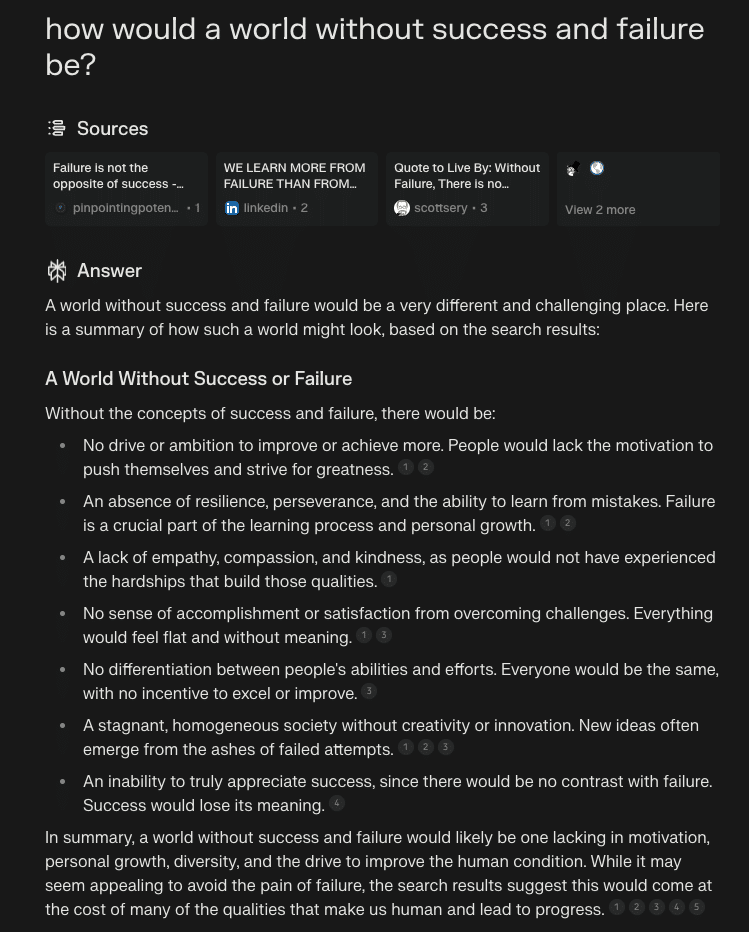
    This narrative about chasing success and avoiding failure drives us unconsciously and harms us in ways we can not even imagine. Read the text below about a world without success and failure – yet full of commitment, peace, joy, momentum, and monumental growth and impact on the world around you.

    This state is what I help my clients reach – and my results speak for themselves.


    The Lie of Success and Failure

    Here’s the trap: Success and failure aren’t real. They’re simply words we use to describe an outcome we’ve decided means something. When I’ve promised myself to hit a particular revenue goal or expand my business to a certain level, it’s easy to think that achieving it equals success and missing it equals failure. But in reality, these are just concepts we’ve invented to either boost our ego or knock us down.

    I want to take you on a different path—a path where success and failure aren’t the goal. Instead, you lead from purpose, from commitment, from what matters to you. When you do that, you unlock a level of freedom, creativity, and power that’s hard to come by when you’re stuck in the success-failure hamster wheel.

    To lead without the burden of success or failure, you need to BE a different kind of leader. You need to be grounded, unwavering in your commitment, and willing to let go of the need for external validation.

    Here are the shifts you’ll need to make:

    1. From Proving to Creating: Stop trying to prove yourself through your achievements. Instead, focus on creating something meaningful. Who cares if you’ve built a $100M business if it’s only been about proving your worth? The real game is about creating something that aligns with your values and vision, regardless of the outcome.
    2. From Controlling to Trusting: You can’t control every outcome, but you can control how you show up. Let go of the illusion that you can control success. Trust the process. Trust that you are exactly where you need to be, and the outcomes will take care of themselves.
    3. From Worrying to Acting: Stop wasting time worrying about whether you’ll succeed or fail. The worry kills your ability to perform at your highest level. Instead, focus on what action you can take right now. Don’t worry about the result; just take the next step, and the next, and the next.
    4. From Achievement to Commitment: Your leadership isn’t defined by what you achieve, but by what you commit to. Commit to the process, to the people, to the mission. Achievements will come and go. What remains is the integrity of your commitment.

    The Payoff

    Leading without the burden of success or failure is liberating. It doesn’t mean you won’t hit big goals—you absolutely will—but you’ll do it with less stress, more creativity, and a deeper sense of fulfillment. When you stop playing the success-failure game, you start living fully in your commitment. And when that happens, magic unfolds. Your energy shifts. You become unstoppable—not because you’re chasing success, but because you’re living out your purpose.

    Success is a story. Failure is a story. You are bigger than both.


    A World Without Success and Failure

    We live in a world defined by success and failure.

    All of us want to win. Nobody wants to fail.

    Yet, both of them go together.

    If there is success in your world,

    Fear of failure is also always lurking around.

    When we hit our goals, we call that success.

    When we miss them, we call that failure.

    When we succeed, we rarely enjoy our success.

    We try to hold on to it and avoid losing it.

    We all know that feeling. Doesn’t feel like “winning”.

    And when we fail, we blame and punish ourselves.

    We are told that beating ourselves up gives us motivation.

    In our world punishment is seen as necessary for success.

    And blaming others is just another way of beating oneself up.

    Hence we beat ourselves up. Over and over again.

    In the long-run, it doesn’t work that way? Does it?

    What if we lived in a world without success and failure?

    In that world,

    When we hit our goals, we hit our goals.

    When we miss our goals, we missed our goals.

    That’s it. Nothing less. Nothing more.

    Most people find difficult to just sit with the above.

    Their mind goes crazy with “yeah but’s” and “what if’s”

    Can you imagine how Freeing that would be?

    To live unburdened, free, and yet fully-immersed.

    You can set any goal you want

    Not for the high of success

    But to create future results that matters to you

    Not to avoid failure

    But to explore, test and expand your potential

    Can you imagine how Fun that would be?

    When you hit your goals, you can celebrate and be proud.

    You can choose your next goal from freedom rather than anxiety.

    And when you do not hit your goals,

    You still celebrate your effort and how far you have come

    You only look back at the past to learn

    Never to beat yourself or others up

    You feel the same pride and choose your next goal without fear

    Paradoxically

    This increases your chances of achieving bigger goals

    When you see that hitting your goals or not doesn’t mean anything

    Either way

    You experience lightness, freedom, and enjoy your progress

    Isn’t this what we seem to be chasing in the first place?

    I know you want to reject this idea – even the possibility

    I know your mind is already full of “why this won’t work”

    I know you already know that “this is not practical”

    I know you think that “this doesn’t apply to me”

    That’s expected. And. For once – sit in the discomfort of this possibility

    A world without success and future? If real, how would that be?

    You simply go for what you want

    Pulled by your deepest motivations & desires

    Rather than pushed by a drive for success or fear of failure

    How could life be in a world without success and failure?

    Give yourself permission to just sit with this possibility.

    Give it space. Nothing else is needed.


    It takes just two seconds to share this

    If you find what I wrote today valuable, it might help others too.

    Before you close, who could be the ONE person who would benefit from reading this?

    Share this with the person that comes to mind.

    Thank you. That’s it for now.

  • Issue #90, 13 Nov 2023 – Getting Real This Diwali – Are you ready?

    Welcome to the Deploy Yourself Newsletter, where I gently provoke you to show you your own power. This newsletter is an invitation to your leadership. You can also read this issue online.

    Hey,

    Getting Real This Diwali – Are you ready?

    Hope this email finds you surrounded by the warmth of Diwali lights and the joy of the season! 🎇

    As I soak in the festive spirit, and whether you are celebrating or not, I wanted to get real this Diwali.

    Diwali is the celebration of light over darkness and good over evil. Yet, when I look at the headlines – whether political or professional, I see how far we are from that vision of Diwali.

    Worse, I still see all of us (us = human beings, including me) still struggling with and perpetuating hate, violence, anger, and stress, whether consciously or unconsciously.

    Let us get real this Diwali!

    It is so easy to point fingers at others and see what they are doing wrong rather than to reflect and deal with the pain, hurt, anger, and sadness in our own hearts.

    I got angry at my 4-year-old son yesterday. It is always easy to blame him and then myself for getting angry, rather than honestly looking at what triggers us and why it hurts us when it does – which then leads to anger.

    Let’s get real this Diwali! And that starts with me understanding and dealing with my own pain, hate and anger before I try to fix or mend my son – or the world.

    Picture a world where love and acceptance conquer hate on a global scale, and where compassion & forgiveness become our biggest weapons.

    Picture this: a world where workplace stress is a distant memory, where the joy of doing meaningful work echoes through office corridors or slack channels. Picture a world where work nourishes people rather than making them sick – physically, emotionally, or mentally.

    It is time to get real and ask – What kind of leadership is required from me today? (yes, not anybody else but us)

    What am I doing to eliminate stress and cultivate joy in my workplace? (yes, this question is for you)

    How can I lead with compassion, forgiveness, and acceptance to honour the spirit of Diwali?

    How can I show up as myself – with all my vulnerabilities?

    How long will I keep hiding behind a facade of what’s deemed ‘reasonable’ and ‘acceptable’?

    When will I speak straight from my heart and let go of the pain of holding it all inside?

    How can I honour, accept, and let go of my own inner demons of hate, indifference, hurt and sadness?

    Unless we can light our own candles and diyas, how can expect the do the same for others?

    Unless we can lead ourselves, how can we talk about expecting leadership from others?

    Unless we can lead by example, how can we ask others to become role-models?

    Often it takes small actions to create big ripples.

    Be the pebble that creates ripples of positive change.

    I invite every reader to REPLY NOW to share your insights or to find out how you can help me on this journey.

    Hit reply to share your answers.

    I read and respond to every reply.

    Fascinating Articles & Stories

    One

    New interviews on the Choosing Leadership podcast

    Bookmark the latest episodes on the podcast and listen at your leisure.

    1. I learned from Dmitrii Kustov that “No matter what you do, do it to your best ability”
    2. I learned from Josh Staph that “A good leader knows what questions to ask and what questions need to be answered”
    3. I learned from Kathleen Hunter that “We all have something valuable to share”

    Two

    Curated resources for your leadership

    Here are my best finds from all over the internet for your leadership. Make yourself tea/coffee as you read, listen and learn.

    Pro-tip – Listen and read the below about YOU – not about the author. (reply back and ask if you do not understand what that means)

    That’s it for now. If you have any questions or feedback, or if you are new and want to introduce yourself, hit reply. I read and respond to every reply. All the best,

    Sumit

    P.S. – I am looking to interview more inspirational leaders on my podcast. If you know anyone I should interview, make an introduction.

    (Twitter) @SumitGupta
    (LinkedIn) Connect

  • Issue #89, 6 Nov 2023 – I have always felt different. I didn’t knew that was OK!

    Welcome to the Deploy Yourself Newsletter, where I gently provoke you to show you your own power. This newsletter is an invitation to your leadership. You can also read this issue online.

    Hey,

    I have always felt different. I didn’t knew it was ok to be different.

    For most of my life, I have felt different and never really belonged to the groups I was a part of – school, college, family, etc.

    I always wanted to belong and fit in but never could.

    I went to great lengths to dress, speak, and do what others did. In order to fit in.

    But it never worked. I always felt out of place and different.

    For a long time, I fought and resisted my life. I wanted to fit in desperately.

    My parents gave me an impossible life – they went beyond their means and sent me to schools, colleges, and other places – where I didn’t belong.

    I was ashamed and scared of showing the “real” me.

    I kept that act up – until the pain of not speaking my truth became too much to bear.

    One day, I finally let go and just started to be honest and completely transparent.

    I started to say what I was thinking. without any filters.

    It was scary, but it felt tremendously freeing and liberating. Like a weight has been lifted.

    I embraced my impossible life. I realised it was OK to be different.

    I realised that a lot of people are fighting a similar battle. They are trying to fit in when they actually want to stand out.

    Now this is what I do daily – help others stand out instead of fitting in – which can be suffocating.

    These days, I make the impossible happen – almost every day – literally.

    As I help others do the same – create an impossible life for themselves.

    Like a senior leader in Amazon who has cut down his meeting time to less than 20 minutes from 60 minutes earlier – saving so much time for himself and his family.

    Like a tech CEO who doubled his revenue in a year after being stuck for a few years.

    Like a woman leader who embraced being herself in a male-dominated company and prioritised herself & her family without feeling guilty.

    Like a tech leader who managed to cut down his hours in half without reducing productivity so that he could pursue his passion for guitar.

    Where are you different but afraid to be honest about it?

    What has been the cost of keeping the real and authentic you hidden?

    What could be possible if you remove all filters and simply start to speak your truth?

    Hit reply to share your answers.

    I read and respond to every reply.

    Fascinating Articles & Stories

    One

    New interviews on the Choosing Leadership podcast

    It has been a month since the last newsletter, so here are a few of the interviews that have been published since then. I promise to be more regular from now on.

    Bookmark them and listen at your leisure.

    1. I learned from John Nance that “A good leader is also a follower”
    2. I learned from Tina Kuhn and Neal Frick that “We both had different but compatible leadership styles”
    3. I learned from Mark Beal that “Every generation brings unique value to the workplace”
    4. I learned from Chris Cirak that “Your true calling is not something that is comfortable to you.”
    5. I learned from Joey Havens that “You don’t manage people. You lead people.”
    6. I learned from Eric Holsapple that “It is impossible to listen when we judge others.”

    Two

    Curated resources for your leadership

    Here are my best finds from all over the internet for your leadership. Make yourself tea/coffee as you read, listen and learn.

    Pro-tip – Listen and read the below about YOU – not about the author. (reply back and ask if you do not understand what that means)

    That’s it for now. If you have any questions or feedback, or if you are new and want to introduce yourself, hit reply. I read and respond to every reply. All the best,

    Sumit

    P.S. – I am looking to interview more inspirational leaders on my podcast. If you know anyone I should interview, make an introduction.

    (Twitter) @SumitGupta
    (LinkedIn) Connect

  • Issue #87, 18 Sep 2023

    Welcome to the Deploy Yourself Newsletter, where I gently provoke you to show you your own power. This newsletter is an invitation to your leadership. You can also read this issue online.

    Hey,

    Can you let go of the 3 bananas? (that traps most leaders)

    It has been 2 weeks since I came back from leading a wonderful leadership retreat in India. I will share more about the retreat later, but today I want to reflect on something I witnessed years ago during my time living in Jaipur, India.

    Jaipur is overrun with 🐒 🐒 monkeys. They cause all sorts of trouble for locals and tourists alike. To deal with the nuisance, the authorities set up “monkey traps” around the city – they place bananas in a small box with a hole just big enough for a monkey to slide its hand in and grab the 🍌 banana. But once the monkey grabs hold of the banana, it can’t pull its clenched fist out of the hole.

    The monkey struggles, fighting for its freedom. But the only thing holding it back is its unwillingness to let go of the banana. The freedom is right there for the taking, if it would only open its hand and release its grip.

    I confess this monkey trap has been an all-too-accurate metaphor for me at certain points in my leadership journey. I’ve found myself struggling against ⛓️ invisible constraints, fighting for a freedom 🔓 that was mine all along. The only thing limiting me was my refusal to let go of certain “bananas” I was clinging to.

    What are these metaphorical bananas for leaders like us? Based on my experience, I see three common ones:

    1. The illusion of control. We want to control outcomes, people, and situations. But true freedom means accepting you can’t control everything.
    2. Playing it safe. Taking risks is scary, so we avoid failure at all costs. Yet real freedom means embracing the fact that failure is part of growth.
    3. Knowing it all. We go into situations convinced of what will and won’t work. But freedom requires humility, openness, and a willingness to be proven wrong.

    I won’t claim to have this all figured out. I still find myself grasping those bananas from time to time.

    Here are 5 practical steps I have found useful to finding the freedom that eludes so many leaders:

    1. Let go of the need to control.
    • Delegate tasks and trust your team to handle them.
    • Set clear expectations then give people flexibility in how they meet them.
    • Focus on guiding the vision and values, not micromanaging the details.
    1. Take calculated risks.
    • Start small, such as allowing a pilot project to launch before it’s fully polished.
    • Set aside a portion of resources/budget for experimenting with bold new initiatives.
    • Celebrate lessons learned from “failures” as much as successes.
    1. Actively seek opposing views.
    • Bring contrarian voices into important conversations and decisions.
    • Read articles/books from sources you disagree with. Stretch beyond your bubble.
    • Ask for blunt feedback on weaknesses and blindspots. Listen without defensiveness.
    1. Admit when you’re wrong.
    • Thank team members who point out mistakes and show you other perspectives.
    • Verbally acknowledge when others prove you wrong. Model openness.
    • Demonstrate the courage to change course based on new information/input.
    1. Replace “knowing it all” with curiosity.
    • Approach issues with inquisitiveness rather than assumptions. Ask, listen, learn.
    • Value curiosity, growth mindset and humility in your hiring and promotion practices.
    • Inspire others’ curiosity by sharing your own learning journey, questions and self-reflection.

    The freedom we seek starts with letting go of false securities. By taking these steps, we can loosen our grip on limiting mindsets and boldly embrace the growth that comes with true freedom.

    The choice is ours. What “banana” will you release today?

    Hit reply to share your responses or insights from the above.

    I read and respond to every reply.

    Fascinating Articles & Stories

    One

    New interviews on the Choosing Leadership podcast

    Since I have not written to you in almost 3 weeks, here are all the interviews that have been published since then on the podcast.

    Bookmark them and listen at your leisure.

    1. I learned from Ajay Tiwari that “Pain brings you closer to reality”
    2. I learned from Blake Hutchison that “Transparent communication and customer centricity are essential for effective leadership”
    3.  I learned from Ranjan Kumar that “The more you worry about the outcome, the more corrupt you become with your efforts”
    4. I learned from Karoli Hindriks about the value of a powerful morning routine – her is 2.5 hours long
    5. I learned from Afraaz Masters that “The most important thing is to keep moving forwards”

    Two

    Curated resources for your leadership

    Here are my best finds from all over the internet for your leadership. Make yourself tea/coffee as you read, listen and learn.

    Pro-tip – Listen and read the below about YOU – not about the author. (reply back and ask if you do not understand what that means)

    That’s it for now. If you have any questions or feedback, or if you are new and want to introduce yourself, hit reply. I read and respond to every reply. All the best,

    Sumit

    P.S. – I am looking to interview more inspirational leaders on my podcast. If you know anyone I should interview, make an introduction.

    (Twitter) @SumitGupta
    (LinkedIn) Connect

  • Issue #86, 26 Aug 2023 – The Power of Slowing Down: 5 Ways I Slow Down Daily

    Welcome to the Deploy Yourself Newsletter, where I gently provoke you to show you your own power. This newsletter is an invitation to your leadership. You can also read this issue online.

    Hey,

    The Power of Slowing Down: Unlocking Peak Performance

    In the fast-paced world of tech, it’s easy to get caught up in the frenzy, constantly chasing the next big thing.

    But what if I told you that there’s incredible value in slowing down?

    I am writing this as I am getting ready to board a plane to head off to India to lead a 3-day Leadership Retreat.

    15 amazing leaders are going to retreat and slow down from their usual pace so that they can go beyond the results they are currently producing.

    It is a paradox, which is why it took me decades to understand the value of slowing down.

    Today, I want to challenge you to embrace the power of going slow and revolutionize your approach to leadership.

    Here are 5 ways I slow down during the day, and how it can benefit you as well:

    1. Slow breathing – Take a moment to inhale deeply and exhale slowly. By practising mindful breathing, you tap into a state of calm and clarity, enabling you to make more thoughtful decisions and lead with composure. This is HUGE.
    2. Slow thinking – Instead of rushing to conclusions, give yourself the gift of presence to ponder and reflect. Slow thinking allows for deep analysis, creative problem-solving, and keeping your long-term purpose present in what you are doing now.
    3. Deliberate time slots for reflecting as a team – Just as marathon runners pace themselves, adopt a similar approach in your leadership journey. Slow down, assess the terrain, and conserve your energy for the long run. This measured approach ensures sustained success.
    4. Slow writing – Craft your words with intention and precision. Slow writing allows you to convey your message effectively, avoiding misunderstandings and fostering stronger connections with your team and stakeholders. Use audio and video messages to convey empathy, and passion, and to show how much you care.
    5. Slow eating – Take the time to savour each bite and nourish your body. When you slow down your eating, you enhance digestion, improve nutrient absorption, and recharge your energy levels, ultimately increasing your overall performance. Remember, a sharp mind can’t survive in an unhealthy body.

    As I’ve incorporated these slow practices into my life, remarkable transformations have occurred.

    I’ve experienced bold decision-making – like starting the Deploy Yourself School of Leadership, reduced anxiety and tension on the journey, and improved health – I have never been fitter and calmer than I am now, and I have fewer regrets. These benefits extend beyond the individual to positively impact your entire organization.

    So, I challenge you to disrupt the “hurry culture” and embrace the art of going slow.

    Remember, great achievements require a deliberate pace.

    I recently recorded a video about the Vertical Dimension of Time, which is related to slowing down.

    Hit reply to share your responses or insights from the above.

    I read and respond to every reply.

    Fascinating Articles & Stories

    One

    I interviewed 5 more inspirational entrepreneurs

    I love talking to CEOs and founders as their stories are so humbling and even provocative at times. It is like looking in the mirror as an entrepreneur.

    That leads me to sometime relistening to these conversations multiple times. Do you relisten to podcast episodes to allow them to sink in?

    This is what I have been learning from these inspirational leaders:

    1. I learned from Mihails Scepanskis that “Motivation means trust in the future”
    2. I learned from Kilian Kaminski that “To be successful, you have to create long-lasting relationships.”
    3.  I learned from Adam McChesney the importance of “Exercise, meditate, read, focus on affirmations, and drink a gallon of water every day”
    4. I learned from Anthony Millin that “If entrepreneurship was easy, everyone would do it.”
    5. I learned from Marina Narishkin that “I don’t lose, I either win or I learn”

    Two

    Curated resources for your leadership

    Here are my best finds from all over the internet for your leadership. Make yourself tea/coffee as you read, listen and learn.

    Pro-tip – Listen and read the below about YOU – not about the author. (reply back and ask if you do not understand what that means)

    That’s it for now. If you have any questions or feedback, or if you are new and want to introduce yourself, hit reply. I read and respond to every reply. All the best,

    Sumit

    P.S. – I am looking to interview more inspirational leaders on my podcast. If you know anyone I should interview, make an introduction.

    (Twitter) @SumitGupta
    (LinkedIn) Connect

  • Issue #85, 21 Aug 2023 – How I’m rethinking my leadership? (and why creativity is the fuel)

    Welcome to the Deploy Yourself Newsletter, where I gently provoke you to show you your own power. This newsletter is an invitation to your leadership. You can also read this issue online.

    Hey,

    Why creativity is the fuel for 21st-century leaders?

    I wanted to get real about something I’ve been working on lately – getting more creative as a leader.

    Early on, I bought into this idea that leadership was about having all the answers and executing plans. But as my teams grew, I hit a wall.

    No matter how smart my ideas seemed, they didn’t spark that energy and inspiration I longed for. My technical expertise wasn’t enough.

    I realized I needed to lead with creativity. But having spent years in analytical roles, this didn’t come naturally to me.

    In one company, I led multiple software and AI teams. When we had a big failure, morale crashed fast. I scrambled to course-correct but nothing revived the team’s spirit.

    That failure taught me leaders need creative thinking (not just new plans) to reframe setbacks into learning opportunities. We need to imagine possibilities that feel out of reach.

    Once I noticed my developers struggling to innovate on an outdated tech stack. My solution? I assigned them the latest coding tools to learn after hours.

    But my “efficient” solution backfired. Resentment grew as their personal time eroded. I failed to see that creativity can’t be forced through sheer effort.

    That humbling moment revealed I needed to cultivate imagination more organically by sparking inspiration, not giving orders.

    These mistakes taught me creativity must flow through everything leaders do—it can’t be compartmentalized.

    Now as an entrepreneur, here are a few ways I’m trying to lead with more creativity:

    • I make time for activities that ignite my imagination outside work – writing, tinkering, photography. This fuels new connections.
    • I’m getting comfortable with half-baked ideas, sharing early sketches and embracing wild questions. This keeps me nimble.
    • I regularly invite creative talent from other companies into strategy sessions to mix things up. Fresh perspectives reveal breakthroughs.
    • I’m letting go of rigid agendas when inspiration strikes. Following energy unlocks our best thinking.
    • I celebrate failure and encourage experiments that fizzle. This gives people permission to play.
    • I make space for improv, prototyping, and other playful ways to unlock creativity, not just status updates.
    • I share my own creative struggles and ask for input. This models that creativity is vulnerable, collaborative work.

    Creativity lives in everyone, not just “innovators.” It reveals itself when people feel safe to play, take risks and voice half-formed ideas.

    But leading with creativity means letting go of the illusion of control. Here are a few key mindsets that help:

    • Seek surprise over certainty.
    • Value imagination as much as practicality.
    • Embrace play and whimsy alongside rigor and analysis.
    • Get comfortable with ambiguity and not having all the answers.
    • Stay open and responsive rather than rigidly attached to “the plan”.
    • Trust your team’s creative genius even when the path is unclear.
    • Know creativity gets messy but bears fruit when persevered through.

    This remains a journey for me.

    But the more I lead with creativity, the more ideas, energy and solutions flow. It feels aligned, joyful, and fulfilling.

    I’d love to hear how you are embracing creativity in your organization!

    Hit reply to share your responses or insights from the above.

    I read and respond to every reply.

    Fascinating Articles & Stories

    One

    I interviewed 5 more inspirational entrepreneurs

    I am now close to interviewing more than 150 entrepreneurs on the Choosing Leadership podcast. Here are the few episodes that have gone live since the last time I emailed you – almost a month!

    This is what I have been learning from these inspirational leaders:

    1. I learned from John Cherian that “You build skill when you get your hands dirty”
    2. I learned from George Huff that “There’s no substitute for experience”
    3.  I learned from Deepti Prasad that “It’s okay to fail, but it’s not okay to not try.”
    4. I learned from Derren de Jong that “Freedom is the biggest driving factor behind everything I do”
    5. I learned from Sanket Nadhani that “A sabbatical helped me discover myself, build confidence, and open my mind”

    Two

    Curated resources for your leadership

    Here are my best finds from all over the internet for your leadership. Make yourself tea/coffee as you read, listen and learn.

    Pro-tip – Listen and read the below about YOU – not about the author. (reply back and ask if you do not understand what that means)

    That’s it for now. If you have any questions or feedback, or if you are new and want to introduce yourself, hit reply. I read and respond to every reply. All the best,

    Sumit

    P.S. – I am looking to interview more inspirational leaders on my podcast. If you know anyone I should interview, make an introduction.

    (Twitter) @SumitGupta
    (LinkedIn) Connect

  • Issue #84, 24 July 2023 – Make yourself and your team come alive with these 2 Surprising Questions

    Welcome to the Deploy Yourself Newsletter, where I gently provoke you to show you your own power. This newsletter is an invitation to your leadership. You can also read this issue online.

    Hey,

    Unlock Your & Your Team’s Energy: 2 Surprising Questions

    Lately, I’ve been thinking a lot about purpose and what truly makes us come alive.

    We get so focused on goals and achievements. In the rush of doing, have we lost touch with what really matters?

    I’ve been exploring two simple yet powerful questions that reconnect us with what we care about:

    1. What makes your heart sing?
    2. What breaks your heart?

    When we get quiet and listen to what stirs our hearts, it tunes us to what really matters to us.

    This is where purpose lives – in that sweet spot where what we care most about aligns with how we can serve best.

    So how do we hear this purpose?

    It’s not something we think up or strategize. Purpose arises when we get out of our heads.

    It’s something we feel, sense, and perreceive when we pay attention to the pulls of our hearts.

    It’s what life is asking through us. What wants you versus what you want?

    Instead of asking – what do you want? – start asking – What wants you? – and see what answers emerge.

    Or – What wants to happen through you?

    The question “What Makes Your Heart Sing?” invites you to remember what brings you joy, wonder and meaning.

    What activities make you lose track of time? When do you feel most creative and expressed? What did you love exploring as a child?

    Pay attention to moments when you feel lit up, curious, and fully alive.

    Your enthusiasms reveal what you care about.

    For me, having deep, intimate, and impactful conversations where people open up and gain insights lights me up.

    I love helping people realise how powerful they already are.

    I also adore writing and synthesizing ideas. Taking complex topics and distilling them simply feels like play to me.

    Maybe that is the engineer in me always looking to come out – now that I have stepped out of my engineering career.

    What about you? When does time stand still? What could you do for hours?

    Your heart’s joys point to your unique giftedness. By naming them, you remember who you are at your core beyond any leadership title or role.

    The question “What Breaks Your Heart?” reveals what you most want to change, improve or create in the world.

    What injustice, gap or suffering moves you to tears? What feels unbearable to ignore?

    For me, it breaks my heart to see people holding themselves back and not going after their dreams. Nothing hurts more.

    What unnecessary pain do you find unacceptable?

    Your heart’s heartbreaks reveal what really matters to you. They show where your unique skills and talents are needed most.

    The Intersection is Where Magic Awaits

    When you can hold both what makes your heart sing and what breaks it, you have found your sweet spot.

    It sits at the intersection of:

    1. What you are uniquely gifted at
    2. What the world most needs
    3. What brings you joy and meaning

    This is the place you lead from.

    Your purpose doesn’t have to be huge in scale. It’s about using your gifts in service of what matters to you, even in small ways.

    Uncovering your purpose is an ongoing practice. It never ends. Even if you find answers to the above questions, the questions still remain open.

    It requires making time to listen beneath the noise of life.

    Here are a few tips:

    • Set a weekly intention to notice what stirs and breaks your heart.
    • Journal regularly on what brings you meaning, joy, and sorrow.
    • Discuss purpose openly with those who know you best. Ask for their insights.
    • Look back on pivot points in your life. What prompted the big change? What stayed constant?
    • Notice what lights you up and what depletes you. This reveals what’s in alignment.
    • Let your purpose evolve. Purpose isn’t fixed, it unfolds as you grow.

    The journey of aligning with purpose requires courage and discernment. But when you tune your inner compass, your leadership becomes a powerful channel for results to flow through you.

    You have gifts no one else does. And you see needs others overlook.

    Keep leading from your heart and hit reply to share your biggest insights from the above.

    I read and respond to every reply.

    Fascinating Articles & Stories

    One

    I have interviewed 5 more investors on leadership

    I have been busy interviewing and learning from VCs and investors in the last month. After interviewing more than 120+ entrepreneurs, I wanted to understand from the other side, from the perspective of the investor.

    This is what I have been learning from these amazing VCs and investors:

    1. I learned from Vignesh Shankar that “Never assume that you know everything”. He is a Managing Partner at Artha99 Investment Partners with a background in Strategy, M&A, and Corporate Finance.
    2. I learned from Tom Horsey that “Creating something from nothing gives him real satisfaction.” Tom is a Business Angel and very early stage VC investor focused on founding teams based in Spain from any sector. He is also a co-founder of StartupLabs Spain and Malta which is an accelerator program focused on growth stage startups.
    3.  I learned from Mark Kahn that “Most successful entrepreneurs have some void that they are filling by what they do”. Mark is a Managing Partner at Omnivore based in India. He is funding entrepreneurs building the future of agriculture and food systems.
    4. I learned from Subrata Patra that “You can learn as much from a bad teacher if you are open to learning.”. Subrata Patra is the Managing Partner at IdeaCapital Ventures and an Alumnus of UC Berkeley Haas School of Business, IIT Delhi, and Jadavpur University.
    5. I learned from Anup Jain that “Culture is more important than any kind of strategy”. Anup Jain  is the Managing Partner at Orios Venture Partners, with previous leadership stints in Bata and Yum Restaurants. 

    Two

    Curated resources for your leadership

    Here are my best finds from all over the internet for your leadership. Make yourself tea/coffee as you read, listen and learn.

    Pro-tip – Listen and read the below about YOU – not about the author. (reply back and ask if you do not understand what that means)

    That’s it for now. If you have any questions or feedback, or if you are new and want to introduce yourself, hit reply. I read and respond to every reply. All the best,

    Sumit

    P.S. – I am looking to interview more inspirational leaders on my podcast. If you know anyone I should interview, make an introduction.

    (Twitter) @SumitGupta
    (LinkedIn) Connect

  • Issue #83, 12 July 2023 – Are you Leading “From Love” or “For Love”?

    Welcome to the Deploy Yourself Newsletter, where I gently provoke you to show you your own power. This newsletter is an invitation to your leadership. You can also read this issue online.

    Hey,

    Are you Leading “From Love” or “For Love”?

    In our fast-paced world, where leadership is often associated with authority and ambition, it’s time to explore a different approach—one that stems from genuine care and compassion.

    Have you ever stopped to reflect on your leadership style?

    Are you leading “from love” or “for love”?

    This can make all the difference in the impact we have on others and ourselves.

    Leading “for love” often involves seeking external validation, climbing the ladder of success, or pursuing recognition – both consciously and subconsciously.

    While there’s nothing inherently wrong with these aspirations, leading for love or approval from others produces very different results as compared to leading from love.

    On the other hand, leading “from love” means love is the place your actions and behaviour come from – irrespective of the situation.

    When we lead from love, we prioritize building meaningful connections, fostering trust, and inspiring those around us.

    Now, here’s the challenge: How can we shift our leadership approach from “for love” to “from love”?

    It starts with self-reflection and becoming aware of when we fall back into leading “for love”. And we all do that – as it is human to want approval and recognition that we often fall into the trap of basing our actions on others’ approval.

    Ask yourself, “Am I leading with the intention to serve my company and team’s vision?” If the answer is yes, that’s a fantastic starting point!

    But if you discover any hidden expectations or attachments, it’s time to recalibrate.

    Leading “from love” requires us to embrace vulnerability, authenticity, and the willingness to put others before ourselves.

    And that takes courage. Especially when there is money, promotions, or bonuses at stake.

    Over time, this approach builds stronger teams, encourages collaboration, and nurtures a sense of belonging that enhances productivity and innovation. You need to have the courage to take some short-term losses or long-term gains.

    Throughout our journey, let’s remember that leading “from love” is a continuous practice. It is NOT a concept to understand. It is a PRACTICE to live each moment, as, in every moment, you are either leading from love or for love.

    It’s not about being perfect but about showing up with compassion and empathy, even when faced with challenges.

    It’s also about recognizing that our leadership impact goes beyond professional settings—it extends to our personal lives, communities, and the world at large.

    This can be very hard to do, yet it is so desperately what our workplace and colleagues needs.

    Keep leading from love and hit reply to share your biggest insights from the above.

    I read and respond to every reply.

    Fascinating Articles & Stories

    One

    I have been interviewing VCs and Investors

    I have been busy interviewing and learning from VCs and investors in the last few weeks. After interviewing more than 120+ entrepreneurs, I wanted to understand from the other side, for the perspective of the investor.

    This is what I have been learning from these amazing VCs and investors:

    1. I learned from Anil Joshi that “Your IQ may be very strong but your EQ is a very integral part of your leadership”. Anil Joshi is the Managing Partner at Unicorn India Ventures. Previously, he was heading operations at Mumbai Angels and Bangalore Angels, leading Angel Investment forums in India as President.
    2. I learned from Bryony Cooper about her unconventional journey, rooted in a creative background as a professional singer and writer, which sets her apart in the world of venture capitalists. For individuals struggling with confidence, Bryony encourages deliberate practice and stepping outside comfort zones. Understanding one’s worth, believing in oneself, and exuding confidence while remaining humble are crucial factors she advises. Bryony is a startup enthusiast and serial founder-turned-investor. She has led a few tech startups, a venture builder, an accelerator program, and is now a Managing Partner at Arkley Brinc VC. 
    3. I learned from Rajiv Vaishnav how to lead and manage by storytelling. Rajiv Vaishnav is the co-founder and Managing Partner at Cornerstone Venture Partners Fund. He is the Honorary Executive Chairman of Start-ups council of India, and was an integral part of NASSCOM’s senior management team for 13+ years. His management style is rooted in storytelling, using anecdotes and experiences to inspire and guide others. He believes in the power of faith, confidence, and trusting mentors to navigate the unpredictable path of success. 
    4. I learned from Paulina Jänsch that if you have a bias, you are not a bad person. It is human to have bias. Paulina Jansch is the Founding Partner at Leanox Impact Capital and one of the TOP 100 most influential women in the European VC and startup space. She emphasizes the importance of education, dialogue, and unlearning biases to achieve equality.
    5. I learned from Francisco Badia that there is a need for meaning in every person. Francisco Badia is the Managing Partner at Grow Venture Partners and the author of “Meaningful Entrepreneurship”. As you delve deeper, discover the pivotal role of purpose in startup success and failure. Explore the power of listening, bringing people together, and embracing resilience on the entrepreneurial journey. Uncover the unexpected link between meditation, gratitude, and building meaningful companies. 

    Two

    5 Fundamental Claims at the Deploy Yourself School of Leadership

    In my work with CEOs and executive teams at the Deploy Yourself School of Leadership, we uncover, talk about, and go deep into certain fundamental claims behind all human behaviour, leadership, and team performance. The current list has 20 such fundamental claims. Below are 5 for you.

    These are deliberately simple, and thought-provoking, and can invite resistance and challenge.

    At the same time, they are deep, not concepts to understand but practices to do, and often not easy.

    Find the 5 Fundamental Claims (out of 20) below:

    1. The quality of our questions determines the quality of our lives and the results we have.
    2. We always get what we are committed to.
    3. Emotions are a choice. Others can’t make you feel anything without your permission.
    4. All results come from prior conversations. If you want new results, look for new conversations to have or stop.
    5. We can not motivate or change anyone else. We can only change ourselves and create the space for others to change.

    If they are not making sense, that is exactly the way it should be.

    And if you get any insights or questions after reflecting on these, shoot back a reply.

    Three

    Curated resources for your leadership

    Here are my best finds from all over the internet for your leadership. Make yourself tea/coffee as you read, listen and learn.

    Pro-tip – Listen and read the below about YOU – not about the author. (reply back and ask if you do not understand what that means)

    That’s it for now. If you have any questions or feedback, or if you are new and want to introduce yourself, hit reply. I read and respond to every reply. All the best,

    Sumit

    P.S. – I am looking to interview more inspirational leaders on my podcast. If you know anyone I should interview, make an introduction.

    (Twitter) @SumitGupta
    (LinkedIn) Connect

  • Issue #82, 21 June 2023 – How I became a pro photographer in just 30 mins?

    Welcome to the Deploy Yourself Newsletter, where I gently provoke you to show you your own power. This newsletter is an invitation to your leadership. You can also read this issue online.

    Hey,

    How I became a pro photographer in just 30 mins?

    Back in 2014, I had no idea about photography.

    I had a DSLR for years, but I didn’t know how to use it beyond the auto mode.

    By 2016, I was making large-size metallic prints of my photographs.

    Not only had I made pro-level photographs all over Europe, but also learned how to post-process them powerfully.

    I even exhibited 5 of my photographs in the cafeteria of my office – and they paid for the whole thing.

    How did I do that?

    By simply spending 30 minutes – each day – from 2014 to 2016.

    I still had a full-time job back then, but I would spend 30 minutes each day – either photographing, post-processing, or learning about photography.

    Without fail, I did that for more than 2 years.

    Here’s the deal: we tend to overestimate what we can accomplish in a single day, but we vastly underestimate the power of consistent effort over the span of a year.

    In just one year, your life can undergo a complete metamorphosis if you show up with unwavering dedication day after day – even for a small amount of time.

    Trust me, the results will blow your mind. As my results did for me.

    Over the years, I have used the same principle to

    • Read thousands of books (by reading 10 mins daily)
    • Become a powerful coach (by coaching and getting coached weekly)
    • Established myself as a travel photographer first and then as a street photographer (by photographing daily)
    • Travelled all over the world (by visiting one new place every few months)
    • Biked 1000s of km on my race bike (by simply biking 20km each day)
    • Interviewed 100+ leaders on my podcast (by focusing on one conversation at a time)

    I am a living testament to the power of showing up every single day.

    Here are three actionable steps you can take right away to kickstart your own remarkable transformation:

    1. Define Your Passionate Pursuit: Take a moment to reflect on your deepest desires, the burning passions that ignite your soul. Identify the one area of your life where you yearn to make a profound impact. Write it down, visualize it, and let it fuel your every waking moment.
    2. Craft a Daily Ritual of Progress: Break down your passionate pursuit into manageable daily actions. Create a ritual that propels you forward, step by step, inching closer to your goals. Consistency is the catalyst that turns dreams into reality, so commit to showing up every single day.
    3. Cultivate a Resilient Mindset: Embrace the challenges that come your way as stepping stones. Slow down and surround yourself with positive influences, books, and podcasts.

    And above all, trust yourself when it is most difficult. And embrace the exhilarating adventure that awaits.

    Stay awesome and hit reply to share your biggest insights from the above.

    I read and respond to every reply.

    Fascinating Articles & Stories

    One

    Tom Coburn- “Do not get too high on the highs and too low on the lows.”

    I interviewed Tom Coburn, CEO of Jebbit.com, on the Choosing Leadership podcast.

    In this conversation, Tom shares how he started his company while still in college and how that has been an advantage – when it comes to culture, leadership, and working remotely. He reflects about the difficult times he faced early on and the important role of transparency in organisations.  

    In the interview, Tom shares

    • I was mentally ready to drop outta school after that summer and go do the business full-time. And the thing that made it an easy decision for me was I talked to both my dean at my college and I talked to the dean I was gonna have at the medical. And I just asked them both for a one year leave of absence and they both said, sure 
    • My current challenge is everything around culture and communication and getting everyone internally at Jebbit g rowing in the same direction, fully in sync with each other.
    • One of the things I hear a lot from new employees when I get their feedback is they’re shocked at how transparent me and my management team are.
    • We spend a lot of time trying to get people in person and getting the right combos of people in person. So we get the whole company together twice a year now for a three day offsite. Once in January and once in July. 

    Listen to the entire episode.

    Two

    Can’t Stay Silent [05] – Overthinking and the Vertical Dimension of Time

    I recorded the 5th episode of the Can’t Stay Silent series on the Choosing Leadership Podcast.

    For most of my life, I have kept my voice buried beneath layers of fear and insecurity. In each episode of this series, I find the strength to express myself from the bottom of my heart.

    Show Notes

    • How being smart and intelligent leads you to never having enough time?
    • What if being smart and very good with planning leads you to never having enough time?
    • normally we see time as a horizontal time shift. Like we see time as something which is coming from the past and going to the future. We see time on the calendar. We see time as a minutes, we see time as hours and  seconds. And we also, we always see time on this dimension right. That it is running out. 
    • What if there’s also a vertical dimension to time, which is not finite, which is infinite. And which is always available to us. And which is a never-ending.
    • it is very important to recognize when your strengths are becoming a liability. Any strength. Even of being. Super smart or having an . High IQ. If you cannot choose to when to use it. And when not to use it. It becomes a liability.
    • When you get this, your life will never be the same again.  

    Listen to the entire episode.

    Three

    Curated resources for your leadership

    Here are my best finds from all over the internet for your leadership. Make yourself tea/coffee as you read, listen and learn.

    Pro-tip – Listen and read the below about YOU – not about the author. (reply back and ask if you do not understand what that means)

    That’s it for now. If you have any questions or feedback, or if you are new and want to introduce yourself, hit reply. I read and respond to every reply. All the best,

    Sumit

    P.S. – I am looking to interview more inspirational leaders on my podcast. If you know anyone I should interview, make an introduction.

    (Twitter) @SumitGupta
    (LinkedIn) Connect

  • Issue #81, 14 June 2023 – “It is already happening” – How to Transform Stress into Success?

    Welcome to the Deploy Yourself Newsletter, where I gently provoke you to show you your own power. This newsletter is an invitation to your leadership. You can also read this issue online.

    Hey,

    “It is already happening” – How to Transform Stress into Success?

    Today I’ve got an electrifying story to share that will leave you buzzing with inspiration.

    Picture this: it was a coaching conversation I recently had with unexpected “aha” moments. Read below and find out how can shifting your state of being lead to bolder plans and greater success.

    Intrigued? Let’s dive in!

    So, I was chatting with this super-talented COO who was all in a tizzy about a project running behind schedule. But here’s the kicker: their stress and fear were clouding their genius-level decision-making. Sound familiar? We’ve all been there, right?

    But wait, there’s a plot twist! By taking a breather, getting centered, and releasing those anxieties, this COO unleashed a bold and audacious plan to get them back on track. You could literally see the fire in their eyes and hear the passion in their voice. It was pure magic!

    Even better, this COO realised that there were many things in motion and there was no reason for them to be worried and anxious anyways.

    They were trying too hard to make the results happen. What they realised was that “it is already happening”.

    Now, here’s the scoop: When stressed, we tend to get stuck looking in the rear-view mirror, trying to avoid past mistakes and playing not to lose.

    But guess what? Your future success lies ahead, not behind. So, let us slow down, center ourselves and break free from old patterns.

    As leaders, it is important that we always play to win.

    Action time! Here are three power moves you can put into practice today to supercharge your leadership game:

    1️⃣ Embrace the Center Zone: Take a few moments each day to find your Center. Close your eyes, take deep breaths (5-second inhales and exhales), and let go of stress. Trust me, you’ll feel the shift!

    2️⃣ Rekindle Your Fire: Connect with your big, audacious goals and why they matter. Feel the excitement when you connect with what you care about most deeply. Let that fire guide your decisions. Get ready for sparks to fly!

    3️⃣ Release the Control Freak: Instead of forcing outcomes, allow the magic to unfold. Trust the process, make room for serendipity, and allow things already in motion to happen.

    When we try too hard to force something to happen, we make that result less likely to happen. That is the paradox.

    Let us break this unhealthy pattern.

    Discover the surprising connection between relaxation, ambition, and achieving big goals. Listen to the full story to find out more.

    Stay awesome and hit reply to share your biggest insights.

    I read and respond to every reply.

    Fascinating Articles & Stories

    One

    Paddy Raghavan – “It is not a failure, it is an experience”

    I interviewed Paddy Raghavan, Co-founder of Multipl, on the Choosing Leadership podcast.

    In this heartfelt conversation, Paddy shares his passion for startups and how he moved from technology to entrepreneurship. He shared the powerful yet simple lesson of “nishkama karma” or detached action – and how he applies that in his role as the CEO. He shares how he had to take a big risk and pledge his property to pay salaries in his previous startup.   

    In the interview, Paddy shares

    • I don’t know, somewhere in my life somewhere I got this entrepreneurial, bug it’s something that I’ve had right from my college days. Multipl is my third StartUp
    • I always wanted to build something on my own that was on the cards, but it wasn’t, I wasn’t really desperate or I wasn’t, not every day that I wake up that I start thinking about, or I should be starting something. 
    • I mean it’s always especially when you’re actually interacting with someone who’s fairly successful, which I would call myself and you would only see the positive side of it. And people tend to think that, yeah it’s a nice journey. It’s good we should become entrepreneurs. But I’ve definitely had my fair share of challenges.
    • I literally had to pledge my property and to pay the salaries in the previous startup it was at a point where we had very difficult situation in terms of you know, raising capital and paying the salary 
    •  I must be grateful to a lot of people. You know, my family has been very supportive. My wife has been very supportive throughout because that is very important. You can’t have a you know, if you have a family you need the support because that could definitely take away a lot of your Focus if it is not in the right frame. 

    Listen to the entire episode.

    Two

    Abhijit Anand- “It becomes hard sometimes because there is nobody to talk to.”

    I interviewed Abhijit Anand, Founder and CEO of Zindagi Technologies, on the Choosing Leadership podcast.

    In this interview, Abhijit opens up about how lonely it can get as a founder and the toll it can take on your wellbeing and health. He also  shared his decision-making process – and how every decision in the company depends on how it impacts the bottom line, the top line, and the company’s reputation. He also shared how he plans his day, stays productive, and how gardening teaches him patience and tenacity.  

    In the interview, Abhijit shares

    • one thing I’ve realized is that cash is king. The moment cash disappears, the company will cease to exist. 
    • both me and my wife, we’ve decided. that Every single decision that we take in our company will have a three-pronged approach. That decision will be a yes or a no, depending upon how well it improves the company’s top line. How well it improves the company’s bottom line, and does it impact the company’s reputation in a positive way or a negative way?
    • From a sales point of view, I’ve realized that, a small customer and a large customer, They’ll take the same amount of time. They demand the same kind of attention. So I’ve decided to focus on some very large customers who, from whom we keep getting big projects
    • one key thing that we did was we kept on we kept our focus on customer satisfaction. Number two, we’ve managed our finances very tightly. And number three, I think We’ve tried to make sure that we treat our employees with the same respect as what we would do to our customers and to our vendors.
    •  Richard Branson’s book, losing my virginity, somebody asked him a question that you look like a quintessential entrepreneur, in your opinion, how would you define a business? And his response was, I’m paraphrasing, but his response was, A business is nothing else but an idea that will improve people’s lives. So that’s how the name Zindagi, which is Hindi the way of life. That’s how the name started. 
    • one key mission statement that we have is to ensure that we leave this earth better than the, where, how we found it.
    • from a personal point of view, I can tell you that It becomes hard sometimes because I feel that there is nobody to talk to.

    Listen to the entire episode.

    Three

    Curated resources for your leadership

    Here are my best finds from all over the internet for your leadership. Make yourself tea/coffee as you read, listen and learn.

    Pro-tip – Listen and read the below about YOU – not about the author. (reply back and ask if you do not understand what that means)

    That’s it for now. If you have any questions or feedback, or if you are new and want to introduce yourself, hit reply. I read and respond to every reply. All the best,

    Sumit

    P.S. – I am looking to interview more inspirational leaders on my podcast. If you know anyone I should interview, make an introduction.

    (Twitter) @SumitGupta
    (LinkedIn) Connect

  • Issue #80, 5 June 2023 – 5 questions to make each month better than the previous one

    Welcome to the Deploy Yourself Newsletter, where I gently provoke you to show you your own power. This newsletter is an invitation to your leadership. You can also read this issue online.

    Hey,

    5 questions to make each month better than the previous one

    June has just begun. I was doing my monthly review recently and thought of sharing my process with you.

    The beginning of a month is a wonderful opportunity to learn from the last one and make this one better.

    It is a good time to start a new month with a strong intent rather than letting it slide by default.

    I have let too many months in my life slide on by default – especially from 2012 to 2018.

    As a result, I hardly grew, changed or evolved during that time.

    Below are the 5 questions (and a power move) to make each month count.

    1. What tasks or activities gave me energy in the last month? (Power move: Say YES more and do more to these activities this month)
    2. What tasks or activities drained me of energy in the last month? (Power move: Say NO and stop doing them. Or delegate/outsource them.)
    3. What matters but I did not take action because of fear? (Power move: Take action right now and schedule these activities in the calendar.)
    4. What were my biggest accomplishments that I am proud of? (Power move: Write down all your accomplishments from the last month – big or small – in a journal. Fill as many pages as you can without being shy or apologetic about. Be PROUD.)
    5. Who were the people who contributed the most in the last month? (Power move: Reach out to them and genuinely and sincerely appreciate them for who they are for you and what they did. Extra points for doing it today.)

    As you might see, all 5 power moves above are simple but not easy.

    They require courage to make sure your time and energy are spent only on what is most valuable.

    They require you to step up and BE a LEADER in areas of your life that matter.

    The only question is – Will you step up, show courage, and be a LEADER?

    Hit reply to share your biggest insights from the 5 questions above

    I read and respond to every reply.

    Fascinating Articles & Stories

    One

    Sanjay Borkar – “You have to involve all your stakeholders in your dreams”

    I interviewed Sanjay Borkar, CEO & Co-founder of FarmERP, on the Choosing Leadership podcast.

    In this heartfelt conversation, Sanjay shares his story of starting out as an entrepreneur 27 years ago and the challenges he faced. He shared how he has grown and evolved as a person along the way, and his vision of contribution and serving the agricultural world through technology. He also shares the powerful but often invisible role our co-founders and families play in our success. 

    In the interview, Sanjay shares

    • We were offered to go and work in Brazil by our first client. However, Santosh and I didn’t find it very attractive. He even offered to come to our houses and speak to our parents.
    • We learnt that information has to be always given free but the services are to be charged or sold. 
    • You have to involve your stakeholders, employees, customers, vendors, banks or financial partners etc in your dreams and vision so that you can all be on the same page. 
    • You need to learn how to communicate with everyone successfully so you can get your work done through a very right way of communication.
    • Secondly, we want to add value to all our customers not just by providing them with technical solutions, but also helping them practice regenerative agriculture. 
    • So internally in the organization we inculcate a lot of leadership trainings and behavior to create more leaders. 
    • We most importantly try to hand over the entire responsibility to a leader and give them complete freedom to work on the project

    Listen to the entire episode.

    Two

    Shikha Gupta – “Collaborating instead of Competing is the most important leadership skill”

    I interviewed Shikha Gupta, Founder- eTraverse on the Choosing Leadership podcast.

    In the interview, Shikha shares her vision and how she started out in her own unique way. She started an edtech consultancy based in Africa and serving the African continent when she saw that nobody was serving Africa. She shares how she drew inspiration from her mother and grandfather early on and that led her to becoming the first engineer in her family.

    In the interview, Shikha shares

    • She’s the first engineer, and a woman working and owning a business on her parents side. 
    • She says that the only thing left is just going to the moon. 
    • She wants to strike a good balance between developing high-tech projects for the Western world and trying to make something substantial for the African continent.
    • There’s more that comes to being a leader than just having the knowledge. The most important skill that a leader should have is empathy.
    • I feel that in the next three years of time when it comes to me as transitioning, who I want to be, to what I want to create is also this one important fact that I want a table where everyone gets the opportunity to speak. 
    • So the only advice that I can give is you need to work on how to conquer that fear, because once you are over that stage of being fearful, the world is all yours and I really feel you take one step and then the world will help you take the next 10 steps.

    Listen to the entire episode.

    Three

    Curated resources for your leadership

    Here are my best finds from all over the internet for your leadership. Make yourself tea/coffee as you read, listen and learn.

    Pro-tip – Listen and read the below about YOU – not about the author. (reply back and ask if you do not understand what that means)

    That’s it for now. If you have any questions or feedback, or if you are new and want to introduce yourself, hit reply. I read and respond to every reply. All the best,

    Sumit

    P.S. – I am looking to interview more inspirational leaders on my podcast. If you know anyone I should interview, make an introduction.

    (Twitter) @SumitGupta
    (LinkedIn) Connect

  • Issue #79, 18 May 2023 – Why you should celebrate more?

    Welcome to the Deploy Yourself Newsletter, where I gently provoke you to show you your own power. This newsletter is an invitation to your leadership. You can also read this issue online.

    Hey,

    Why you should celebrate more?

    Today is my 10th wedding anniversary, and we are celebrating in Berlin. 🥨 🍺

    And this time we are really celebrating – staying in a fancy hotel and dining in premium restaurants.

    You might be wondering why am I sharing this with you. I am sharing because this is so so HARD for me.

    Celebrating is very HARD for me. I am the kind of person who has rarely celebrated his birthdays.

    The last birthday I celebrated must have been at least 20 years ago, if not more.

    Life was full of so many challenges growing up that there was no time to stop – to cherish the wins or to celebrate.

    It was all hard work, hustling, and getting busy for the next goal and milestone.

    The kind of life I am living now – with all the comforts and quality of life – is vastly different from my past.

    However, the past patterns and habits have stuck. I still find it very difficult to stop and CELEBRATE.

    I feel like if I stop running I will miss out on success, even when I have everything that I ever desired.

    I see the same tendency with so many leaders, teams, and companies.

    CELEBRATING is hard. It is so easy to get sucked into working hard and getting busy with the next big thing.

    However, research has repeatedly proven the power of celebration for leaders.

    Celebration holds incredible power and can work wonders for your team’s motivation, cohesion, and overall success 💪

    Recognizing hard work and accomplishments boosts morale, instils a sense of pride, and adds rocket fuel to people’s motivations! 🚀

    Celebration brings people together, strengthening the bonds between team members. 🤝

    Celebration unlocks a growth mindset and sparks innovation within your team. 🌱

    This is the reason I am celebrating in BERLIN 🇩🇪🍻 this week. AND

    This is the reason all of us should celebrate more.

    Do it NOW. CELEBRATE. 🎊 🎉

    Hit reply to share who are you going to celebrate today.

    Are you giving yourself a pat on the back? Or are you going to celebrate someone on your team?

    I read and respond to every reply.

    Fascinating Articles & Stories

    One

    Smiti Bhatt Deorah – “Be comfortable with the idea of being uncomfortable”

    I interviewed Smiti Bhatt Deorah, Co-Founder and Chief Operating Officer at Advantage Club, on the Choosing Leadership podcast.

    In the interview, Smiti shares her journey as a woman leader and the kind of unique challenges it presents. She talks about how she was raised as second to none and how led to confidence and growth as a leader as she is on a mission to create happier workplaces. She gives practical nuggets of wisdom from her life and simple advice for leaders when it comes to dealing with the challenges that come with leading by example.

    In the interview, Smiti shares

    • One of the major things which women, not just leaders or otherwise, lack today is self-worth which comes from the lack of support, which comes to men naturally from their peers. 
    • Men are naturally accepted as leaders as compared to a woman who have to prove herself to then be accepted as a leader.
    • I’ve been lucky enough to have a great family support structure, not just from my parents, but also like from my in-laws and that has helped in my own self-confidence.
    • my mom always had that ideology that she’ll not make her girls feel any lesser than the boys and overprotect us.
    • To create happier workplaces, to create digitized programs through which in a hybrid work setup, you can actually bring employees closer together to the organization, make them more productive, uh, reduce attrition, increase retention overall. 

    Listen to the entire episode.

    Two

    Mohan Thas – “For a leader, it is important to give employees the freedom and the advice they need to get the work done.”

    I interviewed Mohan Thas, Founder of Swift ProSys on the Choosing Leadership podcast.

    In the interview, Mohan shared his family roots and connection to entrepreneurship. He shared many interesting stories from his experience as an entrepreneur – providing valuable lessons like how to hire well, how to delegate and scale, and the importance of trusting your intuition and following up. He also shares how he is a very simple man and finds valuable lessons from ancient 2000-year-old classics like the Bhagavad Gita and the Thirukkural from India.

    In the interview, Mohan shares

    • I’m a very minimal person, a frugal person. I don’t. spend that was much of money. Yeah. Okay. So my needs are very small and also I can take risks since I am started from a lower level.
    • So delegation is more important and we have to give freedom to them, and we have to give advice for them get work done.
    • as an entrepreneur, if you are very much strong in sales and marketing, it’s very easy If you are a tech guy or a operational guy, if you don’t know sales and marketing then it’s very hard to sustain in the business.
    • you have to delegate to a person who knows very well in sales and marketing.  and you have to learn from them. , you should not just delegate. Sales and marketing is a different strategy.

    Listen to the entire episode.

    Three

    Curated resources for your leadership

    Here are my best finds from all over the internet for your leadership. Make yourself tea/coffee as you read, listen and learn.

    Pro-tip – Listen and read the below about YOU – not about the author. (reply back and ask if you do not understand what that means)

    That’s it for now. If you have any questions or feedback, or if you are new and want to introduce yourself, hit reply. I read and respond to every reply. All the best,

    Sumit

    P.S. – I am looking to interview more inspirational leaders on my podcast. If you know anyone I should interview, make an introduction.

    (Twitter) @SumitGupta
    (LinkedIn) Connect

  • Issue #78, 9 May 2023 – You can do hard. You have got what it takes.

    Welcome to the Deploy Yourself Newsletter, where I gently provoke you to show you your own power. This newsletter is an invitation to your leadership. You can also read this issue online.

    Hey,

    You can do hard. You have got what it takes.

    As leaders, we often try to make things easier or more comfortable for ourselves and our people.

    Today I wanted to write this email to tell you that you can do hard. You are stronger than you think.

    We all are.

    Below are 3 recent occasions when I choose to do what was hard and learned how strong I was in the process.

    1. Last year an established coach asked me to reduce my prices as I was a newbie. Instead, I raised my prices and signed 2 new clients at that rate.
    2. A few years ago, I decided to bike 100 km at a stretch. Yes – on a bicycle and not a motorbike. Why? Because I wanted to push myself physically and see if I can do what Dutch people can do even in their 70s. In a few weeks of training, I went from never biking more than 10kms to doing 100kms in 5.5 hours of riding.
    3. When I decided to pivot to coaching, I asked my company to reduce my contract to 3 days a week so that I can pursue coaching in the other 2 days. They agreed. And I said NO to that – while I was literally shaking. Something didn’t feel right, and I decided to practice coaching 5 days a week, even when I was making zero revenue from coaching at that time. It was terrifying and scary, and yet I knew it was the right decision.

    That is what leaders do. They do hard things because they matter to them. Not because they are easy or comfortable.

    And one of the jobs of any leader is to help their team realise that they can also do hard.

    If you are a leader, it is your job to help those around you realise that they are more powerful than they think they are.

    Life can be hard. But you can do hard.

    What “hard” thing is yours to do but you have been holding it off?

    Hit reply to share your “hard” thing and I will share mine. I read and respond to every reply.

    Fascinating Articles & Stories

    One

    Caleb Avery – “When I’m getting anxious and overwhelmed, it is because I am spending too much time on things that I have no ability to change.”

    I interviewed Caleb Avery, CEO of Tilled, on the Choosing Leadership podcast.

    In the conversation, Caleb shares how his entrepreneurial journey started at college going door to door when he was only 19 years of age. We spoke about how the role of a founder or leader changes as their company grows to more than 50 people. He shared the challenges that presents as you have to learn to let go and trust others, and how invests in his own learning in this process.

    In the interview, Caleb shares

    • my entrepreneurial journey at 19 by co-founding , uh, credit card processing business when I was in college. And started my career going door to door, selling payment processing services to small business owners over time, scaled up that business.
    • a buddy of mine at the time, uh, we were talking about this idea of credit card processing and ni neither of us really knew anything about credit card processing at that particular time.
    • I learned, in that experience was really, the, this idea of rejection and how to handle, the rejection, not take it personally, how to overcome those objections and really. Taught me a lot about, how to sell, how to empathize, with the people you know that you’re working with.
    •  it’s easy to fall into the trap of focusing on the things that, you’re good at you enjoy, and you could basically do on autopilot. Like that’s the kind of comfort zone, for an entrepreneur. And oftentimes like, that’s where you decide to go start a business.
    •  it’s easy to fall into the trap of focusing on the things that, you’re good at you enjoy, and you could basically do on autopilot. Like that’s the kind of comfort zone, for an entrepreneur. And oftentimes like, that’s where you decide to go start a business.
    • for the organization to grow and for you to evolve, into that c e o role, you have to push yourself out of that comfort zone and say, Hey, here’s something that I need to go do.
    • I’m an entrepreneur, at heart that’s what my business needs and you have to have leaders in the right roles within the organization that have that desire and intense focus.
    • leader myself, empower them to have the ability to institute, follow and maintain those processes without me, getting in the way.

    Listen to the entire episode.

    Two

    Markus Weubben – “You need to surround yourself with people who are better at things than you are.”

    I interviewed Markus Weubben, Founder of CrossEngage on the Choosing Leadership podcast.

    In the interview, Markus shares his story of starting as a scientist and his growth as a leader. He shares some of the important but difficult lessons that he learned along the way. He also explains how he has invested in his own leadership and now continues to grow the next level of leaders in his organisation as they scale .

    In the interview, Markus shares

    • how he founded his company in 2015 and their main focus was on increasing the customer lifetime values.
    • In his young years, he always wanted to achieve more, he wanted to play a lot of basketball and be successful and just create things and create something out of his own hands. 
    • When you’re really in charge, you need to understand everything and be realistic and honest with yourself in order to see when things are not running right and when you need help.
    • as an entrepreneur, one of the key things you need to do is you need to surround yourself with people who are better at things than you are not.
    • I think it’s important that we focus on the learning and development aspect because times and society is changing.
    • In my company, we have flexible working hours, but we don’t allow people to work at night because we believe we are humans and need to interact.
    • I’m very reliable, so when I say something, I’ll get it done. If something doesn’t go well, I try to always be there
    • I never demand anything from my employees that I’m not doing myself. I can’t demand anything from people that I’m not really showing.
    • So when there are setbacks, it’s really about what can we do to be better next time.
    • the thing that worries me in terms of maybe the business is the way that we sometimes lack to accept opportunities and innovation. We are focused on the risks and things that could go wrong if you were employing new technologies.

    Listen to the entire episode.

    Three

    Curated resources for your leadership

    Here are my best finds from all over the internet for your leadership. Make yourself tea/coffee as you read, listen and learn.

    Pro-tip – Listen and read the below about YOU – not about the author. (reply back and ask if you do not understand what that means)

    That’s it for now. If you have any questions or feedback, or if you are new and want to introduce yourself, hit reply. I read and respond to every reply. All the best,

    Sumit

    P.S. – I am looking to interview more inspirational leaders on my podcast. If you know anyone I should interview, make an introduction.

    (Twitter) @SumitGupta
    (LinkedIn) Connect

  • Issue #77, 25 April 2023 – If you appreciate someone, tell them right then. Don’t Wait.

    Welcome to the Deploy Yourself Newsletter, where I gently provoke you to show you your own power. This newsletter is an invitation to your leadership. You can also read this issue online.

    Hey,

    If you think nice about someone, tell them right then. Don’t Wait.

    It’s a pity that we often wait until a person’s death to say all of the nice things we thought about them.

    Appreciation is a powerful tool for building strong bonds in relationships – whether at work or outside it.

    Most organisations focus on feedback, while I have found that genuine appreciation is much more powerful.

    When you appreciate people, it reminds them who they are rather than what they just did.

    Strong leaders focus on what people do well and not on their shortcomings, and understand that positive attention leads to engagement and exponential performance in the future.

    The next time you have a positive thought about someone—no matter how small or insignificant it may be—tell them right then.

    Write them a short note expressing your heartfelt appreciation for what they’ve done and what that means to you.  Be as specific as you can about what they’ve done that you appreciate. 

    This is not a trick.

    Genuine appreciation must be sincere and genuine – it must come from your heart, and not just your mind.

    I want to acknowledge you for reading this newsletter – week after week – over the last 2 years. THANK YOU.

    Forward this email to someone you want to appreciate with a short personal appreciation. And. Do it right now.

    Fascinating Articles & Stories

    One

    Manish Godha – “There is no right or wrong way to be a leader/entrepreneur.”

    I interviewed Manish Godha, CEO of Advaiya, on the Choosing Leadership podcast.

    In the interview, Manish shared the secrets behind his calm and balanced answers to my questions. We also talk about why there is no one right or wrong way to be a leader and an entrepreneur and unpack some of the unconventional choices he has made. He also shared his vision for the future as he looks to take his organization to the next level of growth.

    In the interview, Manish shares

    • My father has a background in engineering, power production, and power generation, so I became interested in those fields and got an opportunity to work on solar power.
    • As a chartered accountant, you definitely gain exposure to how enterprises use technology, especially in their business processes and overall enterprise resource planning.
    • You have to choose a few things that are fixed and non-negotiable, and other things will then fall into place around those choices.
    • Most entrepreneurs, especially traditional ones of my generation or the one before, tend to have this tendency.
    • One of the challenges is how to continue building, growing, and refreshing your expertise in your business.
    • We have to have the right set of people who share a growth mindset and are willing to build expertise in themselves and provide the benefit of that expertise to others.
    • Things have a way of taking care of themselves, and we just have to ensure that we learn the right things and continue to persist
    • I love reading a lot of things of a fundamental nature, like aspects of physics and the laws of basic sciences. They have quite a calming effect.

    Listen to the entire episode.

    Two

    Shay David- “In our life as entrepreneurs, we are always high on life.”

    I interviewed Shay David, CEO of Retrain.AI, on the Choosing Leadership podcast.

    In the interview, Shay reveals both the very practical data-driven as well as grounded spiritual part of himself, and how he balances both in his day-to-day. We spoke about his vision for the future, how he deals with often debated topics like AI and unemployment, and how entrepreneurship is different now than when he started his first company.

    Shay shares:

    • That he has been working in the HR space for about 15 years where he mostly worked within startups and also into scale up.
    • He describes himself as a leader who has strong hands-on experience.
    • I studied and worked at the same time which was very beneficial for my own development.
    • I started to work for booking.com and I think this was personally the first company where I truly experienced, professionalism in a way and hyper-growth and the use of data to make really good decisions.
    • I had the support also of my parents and that was great. But I also realized this kind of pushed me to go out of my comfort zone so I decided to do an internship in Shanghai China because I felt that I needed to do something that was not very obvious.
    • I think we can Restore trust to become more transparent, to become more clear and overcommunicating on the expected impact, right before we actually start work. 
    • It’s becoming more and more important that employees would also like to have a stronger say have more access to the organizations that they work for so they would like to influence a certain process.

    Listen to the entire episode.

    Three

    Curated resources for your leadership

    Here are my best finds from all over the internet for your leadership. Make yourself tea/coffee as you read, listen and learn.

    Pro-tip – Listen and read the below about YOU – not about the author. (reply back and ask if you do not understand what that means)

    That’s it for now. If you have any questions or feedback, or if you are new and want to introduce yourself, hit reply. I read and respond to every reply. All the best,

    Sumit

    P.S. – I am looking to interview more inspirational leaders on my podcast. If you know anyone I should interview, make an introduction.

    (Twitter) @SumitGupta
    (LinkedIn) Connect

  • Issue #76, 11 April 2023 – How to get the benefits of coaching without the cost?

    Welcome to the Deploy Yourself Newsletter, where I gently provoke you to show you your own power. This newsletter is an invitation to your leadership. You can also read this issue online.

    Hey,

    How to get the benefits of coaching without the cost?

    I have had a coach for the last 3 years now. I regularly invest tens of thousands of dollars each year for the same.

    At the same time, some of my most impactful insights have come from what I would call peer coaching – having a conversation with a trusted friend or colleague in a structured format.

    For the big problems and issues of your life, having an experienced executive coach can be invaluable. That is also probably why it costs anywhere from $1000-$4000 per hour.

    But that also makes executive coaching out of reach for most people and most problems.

    However, that doesn’t mean the rest can’t benefit from the practice of coaching.

    Coaching is simply a way to have a conversation with another human being in which they help you see what you can’t see on your own in order for you to achieve what you want to achieve.

    I have found that it is possible to grow both personally and professionally – without a formal coaching session. Welcome to the world of Peer Coaching!!

    Coaching is so valuable it needs to be accessible to more people.

    Here is how you do it:

    1. Meet weekly for an hour. Alternate between coach and coachee each week.
    2. Coachee comes with a problem or challenge they want to achieve a breakthrough in.
    3. The coach listens actively and asks questions (no advice), reflects together and helps the coachee see what they can not see on their own. (this requires some training and practice of being fully present, active listening, empathy, and asking powerful questions)
    4. The session ends with a recap of any insights and a few action items.
    5. Between sessions, the coachee practices the action items and comes back with successes, failures, and more questions.

    Even if you struggle in the beginning, have fun and you will slowly learn and improve your listening, emotional, and question-framing skills.

    These skills are not just coaching skills, but they are also powerful leadership skills.

    At the minimum, Peer Coaching can create a space for you to express what’s on your mind. You will experience the joy of being seen and listened to without judgement.

    Needless to say, this can only work when both people respect each other’s confidentiality and are willing participants in the process. (if you have never experienced coaching before, some training might be required)

    You can’t force coaching or a breakthrough if the coach or the coachee is not ready.

    Leadership is lonely. But it doesn’t have to be. We are all co-passengers in this journey.

    And peer coaching might be one way to bring the benefits of executive coaching to the masses without the cost.

    If you want me to host a session for you where I introduce coaching and we all practice together, hit reply. It might just change your life.

    Fascinating Articles & Stories

    One

    Gaurav Sabharwal – “You can’t do business in isolation, no matter how intelligent you think you are.”

    I interviewed Gaurav Sabharwal, CEO of JOP, on the Choosing Leadership podcast.

    In the interview, Gaurav shared how entrepreneurship is in his roots, and that has always meant he is comfortable taking risks. We also spoke about the importance of OKRs, the role of intuition in his decision-making, and the importance of being present and keeping the balance between work and family.

    In the interview, Gaurav shares

    • I decided to help my father expand his business in the US rather than spending ours doing jobs during school break. 
    • Growing up I always saw my family talking about business on dinner table and that had a huge impact on me, how I looked at life and at business. 
    • Our biggest challenge as a company would be trying to emerge as a mature player in this space that we are creating.
    • As an entrepreneur, sometimes you get so absorbed with the passion of your business that you tend to ignore or miss on things which are beautiful and which will not come back in your life again.

    Listen to the entire episode.

    Two

    Shakun Sethi – “You need to be you because if you’re not being you, how will you make things work?”

    I interviewed Shakun Sethi, CEO of TickeLife, on the Choosing Leadership podcast.

    In this open and honest conversation, Shakun her personal story of living in the Netherlands and how that led her to start a company in an otherwise taboo industry. We also spoke about what gives her the confidence and grounding to lead her team, as well as the importance of slowing down and establishing clear boundaries.

    We talked about:

    • One of the problem I had when I was starting my company was that it was difficult for me to go into an sex store and look around while asking questions.
    • I lost a lot of friends when I started my company because I come from a culture where talking about sex openly is a taboo
    • Demand is completely, nullified. Everybody has a demand, everybody wants it.
    • Due to the nature of my company, we started facing problems like banks would not allow us to have a bank account, PayPal and Stripe flagged us too.
    • Starting a company in an otherwise taboo industry led to the realization that this is not something bad or wrong, and then internally you feel okay, you feel more confident, you feel more open while otherwise.
    • After my 12 or 13 hours shift when I lie down in the bed, I have a smile on my face. I know that, we are onto something big and what we are building is like we are in a position to make it.

    Listen to the entire episode.

    Three

    Curated resources for your leadership

    Here are my best finds from all over the internet for your leadership. Make yourself tea/coffee as you read, listen and learn.

    Pro-tip – Listen and read the below about YOU – not about the author. (reply back and ask if you do not understand what that means)

    That’s it for now. If you have any questions or feedback, or if you are new and want to introduce yourself, hit reply. I read and respond to every reply. All the best,

    Sumit

    P.S. – I am looking to interview more inspirational leaders on my podcast. If you know anyone I should interview, make an introduction.

    (Twitter) @SumitGupta
    (LinkedIn) Connect