values

  • 8 Reasons We Should Know Our Values, Worth, and Purpose

    A lot of my coaching work involves working with people to figure out what their deepest held values are, and what they consider important in life. It is often surprising that many people have no idea what their values are. And that included me too for a long long time. If I introspect, I realize that I had never thought of my values before I started being coached back in 2010. 

    I often wonder why we don’t know our values as adult human beings? Why don’t we know what is important to us and what we care for? Why don’t we know our worth? It seems to be an important question, yet most of us face this question by accident, and not by design.

    It is difficult to understand why our current education system doesn’t place a lot of emphasis on character formation. I am not talking about someone telling you about right and wrong. What I mean by character formation is encouraging people to think for themselves and make their own decisions about what they care about or not? 

    Shouldn’t this be at the center of our formal education? We teach all about different subjects to children but fail to teach them how to discover their values and how to be the kind of person they want to be? Unless people don’t know what they care for, how will they know their worth and standing in life?

    I sometimes wonder what is the job of the school or the teacher? Is it to drill a specific lesson into the pupil’s heads or to prepare them for life with values, lessons, and tools that they can use in good and bad times alike? Who will teach our kids about resilience, empathy, care, and collaboration instead of only knowledge, chasing success, competition, and ambition? 

    This kind of teaching is severely missing from our educational system. How is one supposed to act in our dynamic and chaotic world if we don’t even know our values? Unfortunately, the problem goes beyond our schools or the education system. We seem to live in a culture that has forgotten the importance of having values. However, this wasn’t always the case.

    “Knowing others is intelligence;
    knowing yourself is true wisdom.
    Mastering others is strength;
    mastering yourself is true power.”

    LAO TZU, Tao Te Ching

    Why Do We Glorify Achievement Over Values?

    In his book, The Road to Character, David Brooks argues that society took a turn for the worse somewhere in the mid-20th century when the focus shifted to individualism and self-desire. As a result, modern society seems to have lost touch with our values. Our culture now glorifies achievement at the expense of character development, and parents are not spared either. Instead of imparting values to their children, they focus on report cards and career progression as they seek glory in their children’s success.

    Teens today think it’s more important to have money. Out of all the teenagers surveyed from 2005 to 2007, 62% thought it was important to have lots of money in life. Compare this to just 44% between 1976 and 1978. During the 1970s, close to 49% of teenagers expected to earn more money than their folks. This number rose to 60% by the 2000s.

    But as the desire for wealth increases, teenagers rarely demonstrate a great work ethic. During the late 1970s, a quarter of the teenagers surveyed admitted they were not willing to work hard for results. A few decades later, this figure had jumped to 39%.

    Focus on Eulogy Virtues Instead of Resume Virtues

    Resume virtues are those qualities that make us seem competent at our jobs. On the other hand, eulogy virtues are values we would want people to associate us with after we are gone. If you want to live a meaningful and satisfying life, stop thinking too much about yourself, your skills, and your possessions. Instead of focusing on the never-ending climb of achievement, focus on the inner struggles that challenge you to fight your own daemons, and grow the courage to go after what really makes you alive.

    The very belief that we can control life is the biggest lie that we tell ourselves. Life, by its very nature, is messy and unpredictable. Good and bad things will happen to you. Your education, job, the country you live in, or any other reason which gives you the illusion of safety, is a very bad armor against life.

    Embrace the uncertainty of life and experience real FREEDOM. Go out and play. Learn a new language. Take a new job, or live in different cities/countries and soak in different cultures. Write, paint, or do anything else that makes you experience life rather than draining the life out of you.

    Don’t try to be nice or do what is expected. Don’t live for the gallery. Be authentic. For a change, LIVE for YOURSELF. And you can’t do that unless you know what your values are, what is important or not important, and what you stand for? In short, unless you know your own worth?

    “Those who have a ‘why’ to live, can bear with almost any ‘how’.”

    ― Viktor E. Frankl

    Accept Your Flaws

    We must not kid ourselves. Perfection is an illusion. As human beings, we are innately flawed. However, we should always strive to be better. Our imperfections are not something to be fixed. Instead, our imperfections (strengths and weaknesses) make us the unique human being that we are. We are perfect in our imperfections. 

    Pride and overconfidence trick you into thinking you are better than who you are. When dealing with your own imperfection, you need to be humble. For instance, you must accept you can’t know it all and that you may never know some things. Perfect knowledge is unachievable. However, you can leverage the experience you gain and your unique strengths, skills, and values to go after what you really care about.

    Find a Purpose

    It is not possible to have a fulfilling life unless you take care of what you care about. Stop searching for happiness since it is not something you should crave for as a means to its own end. Instead, live an intentional life. Joy and satisfaction is a byproduct of going after what is really important to you – irrespective of whether you succeed or fail at your efforts. When you go after your calling, it gives your life meaning, and joy and aliveness will naturally follow.

    I like this definition of success by John Wooden the most, “Success is peace of mind that is the direct result of self-satisfaction in knowing you did your best to become the best that you are capable of becoming.” Knowing what your values are and what is important to you is more important than what you choose to do. 

    When you connect to the things that matter most, you experience true joy. Otherwise, you may end up doubting yourself and questioning why you are doing what you are doing, even when you achieve success by society’s standards.

    Research was conducted among Stanford University students who were heading home for the winter break. They were each asked to keep a daily journal. Some of them were asked to write down their most important values and how they were connected to the events of the day. Others were asked to write down the positive events that occurred throughout the day.

    The results were startling. Those students who jotted down their personal values were healthier, fell sick less often, and had more energy and a better attitude than the students who wrote down the positive events in their life. These findings have been replicated in subsequent studies. In his book, The Upside of Stress, Stanford professor Kelly McGonigal argues that writing about our values has short term and long term benefits for our health, mental attitude, and social life.

    Importance of Knowing Your Values

    Self-awareness begins with knowing what makes you tick, and what is most important to you. The following are some benefits to be gained from knowing your worth – your values and what you stand for.

    1. It Breeds Maturity

    Knowing your values may not lead to fame or fortune, but it will foster maturity and help you stay grounded. When you become mature, you focus on becoming better than your own previous self rather than comparing yourself to others. You move from fragmentation to centeredness. As a consequence, the restlessness disappears, and the confusion about the meaning and purpose of life dies down. 

    1. They Help You Find Your Purpose

    Do you know your purpose in life? As it turns out, this is not the case for most of us. It is only after identifying your values that you can begin to understand this purpose. You won’t know what you want out of life if you don’t figure out what is important to you. The first step is always to ask yourself this question – What do you care about? And the second question which can take you to your purpose is – How can you take care of what you care about?

    1. They Regulate Behavior

    Values are principles that guide and regulate our behaviour without it oscillating between extremes. When you’re faced with a difficult situation, it is natural to react impulsively. You can use your values to determine your actions in moments of crisis. Your values can serve as a moral lighthouse in those tough times. Self-awareness will ensure you behave in a manner that matches what you aspire to be at your core.

    “Human knowledge and skills alone cannot lead humanity to a happy and dignified life. Humanity has every reason to place the proclaimers of high moral standards and values above the discoverers of objective truth.” – Albert Einstein

    1. They are Valuable in Decision Making

    Emotions and struggles tend to cloud our judgment if we are not aware of what we stand for. When faced with important life decisions, it would be important to stop and consider how someone who shares your values would approach the situation? As a result, you are more likely to make clear-headed decisions rather than emotionally charged ones.

    1. They Help You Identify What is Important

    We are constantly distracted by so many things these days. In our consumerism-driven society, we are bombarded with advertisements, notifications, and information constantly. 

    Identifying your values will help you clear out the clutter. It will help you clear the mud from the water allowing you to see clearly. You can then focus your time and energy on what matters and brings value, satisfaction, and aliveness into your life.

    1. They Help You Choose the Right Career

    With so many options available, it can be hard to figure out what you want to pursue in life. However, choosing a career path is easy when you know what matters to you most. Perhaps you value interactions and forging meaningful relationships more than endlessly chasing after results. Perhaps you value just the opposite. Knowing what you stand for, and what matters to you, will help you consciously take your life and career forward, rather than just drifting with the flow.

    1. They Help You Develop a Sense of Self

    Knowing your values and worth shapes your beliefs. It enables you to develop strong opinions about key subjects. You can’t just believe what your parents or friends believe and want you to believe. You have to figure out what you truly stand for so you can be your authentic self around others. In both good times and bad, your values can serve as a moral compass always guiding you to your north star.

    1. They Impact Your Overall Happiness

    At the end of the day, knowing your values brings joy into your life. When you take action aligned with your values and to take care of what you care about, the result will be a more meaningful and happier life. When you are able to do so, you will find aliveness, joy, and satisfaction even if you have to face some tough challenges on the way.

    Conclusion

    As adults, we must dig deeper, introspect, and ask ourselves the tough questions to know our values. Identifying what is important to you will enable you to live a more meaningful life. You will be able to find your purpose, make the right decisions, navigate through tough situations, and choose the right career path. 

    Ultimately, values will help you develop a sense of self, shape your character, improve your confidence, and increase your overall happiness. When you know your worth, you know where you stand and where to draw a line.

  • 5 Steps To Deploy Yourself And Live An Authentic Life

    A lot of us, especially in our youthful days, struggle with how to deploy ourselves in the world. Instead of being true to ourselves and charting our own unique course, we tend to follow paths that others have decided on our behalf. However, if we take the long-term view, taking the path less traveled and Deploying Ourselves can make all the difference in the long run.

    Unfortunately, most of us prefer to stay in our comfort zones instead of striving to become the best version of ourselves. In this article, I will share 5 things that you are probably not doing but which could help you thrive and not just survive.

    To get fulfillment in life, we must understand who we are and lead an authentic life – one that is based on our values, and that utilizes our strengths and talents. The following are five key things that you can do to take charge of your life and Deploy Yourself.

    1. Understand Yourself – Your Values, Emotions, Desires, Strengths, and Weaknesses

    The first step towards Deploying Yourself is to understand what you care about and what is important to you. Identifying your unique set of values can be the first step towards building self-awareness. Often in life, most of us don’t know what we care about and what matters to us. As a result, we end up accepting the standards and values which other people (parents, society, culture, etc) decide for us. However, trying to live your life by others’ standards is akin to surrendering your own will and judgment.

    On the other hand, understanding your own values and being bold enough to follow them enables your unique light to shine upon the world. Looking back at history, it is clear that people who succeed in business or career are those who choose the path less trodden and follow their own path. Steve Jobs, Apple’s former CEO and co-founder is one example. His unique ideas went against the grain, and this transformed the tech world.

    A big part of understanding yourself also means becoming aware of your emotions and desires. What makes you angry, happy, or sad? What gives meaning to your days and weeks? What do you crave? If you wish to master yourself, you must learn to pay attention to what your emotions and desires are trying to tell you.

    Learning about your strengths and weaknesses enables you to choose a path that aligns with your talents and abilities. Research has proven that we can do much more productive and produce better results when we try to build upon our strengths rather than improve or fix our weaknesses.

    “There is no passion to be found playing small — in settling for a life that is less than the one you are capable of living.” – Nelson Mandela

    2. Realise that You are Unique and Special, Just Like Everyone Else

    No two human beings are like. Each one of us has unique talents and skills that enable us to succeed in our careers and life. All of us have activities that fill us up with joy and satisfaction, whenever we are doing them. Unfortunately, most of us are not comfortable in our own skin, especially when our uniqueness takes us against the norms of society or of our peers. People too often hate that they are different from everybody else and try too hard to become someone they are not.

    Failing to embrace your true self could stem from a desire to fit in with the crowd. What you should understand is that no two people are the same, just like no two flowers or no two birds are the same. Everyone has their own journey. And frankly, the world would be such a boring place if everybody was the same.

    Instead of worrying about what others think, be ok with the fact that no matter what you do, someone somewhere will still find fault in you. If you are always comparing yourself to others and are trying to please everybody, you are allowing yourself to be deployed by others. Having a few people in your life who love you for who you are is better than having many friends who love you for who you pretend to be.

    Martha Graham said, “There is a vitality, a life force, energy, a quickening that is translated through you into action, and because there is only one of you in all time, this expression is unique. And if you block it, it will never exist through any other medium and will be lost.” 

    3. Get Out of Your Comfort Zone, Live on the Edge That’s Where the Real “You” Lies

    If you want to become the best version of yourself, you must be willing to get out of your comfort zone. That means pushing yourself to the edge and not being afraid to take risks. Often what stops us from learning new things are the mental limitations we put on ourselves because of fear of going beyond the comfort zone. Being afraid shrinks our vision and cripples our abilities to try out new possibilities, take new actions, and explore new learning pathways.

    The best thing to do is acknowledge the presence of fear – for it is trying to tell you that the path you are moving towards is meaningful for you. Often the things you are most afraid of have the biggest potential to transform your life. So, instead of cowering when confronted by your fears, move towards them and stay at the edge of learning and new possibilities.

    Remember what Bruce Lee once said, ” Courage is not the absence of fear. It is the ability to act in the presence of fear.”

    Accept that fear is a natural and essential factor for growth to happen. Whenever you summon the confidence to step out of your comfort zone and face your fears head-on, subsequent stumbling blocks will look like stepping stones. Progress becomes faster and obstacles become easier because of the momentum you gain progressively. That is what Jim Collins describes as the Flywheel effect.

    If you are given the task of rotating a heavy flywheel mounted on an axle, making the first turn takes a lot of time and effort. But after each successive turn, the wheel will start to pick up speed and momentum. Soon, the wheel’s weight will start working in your favor. Progressively, the effort you put in will be compounded as the wheel turns faster and faster. 

    “To be yourself in a world that is constantly trying to make you something else is the greatest accomplishment.”
    ― Ralph Waldo Emerson

    4. Lead Yourself – Take Control of Your Desires, Emotions, Body and not Be a Slave to Them

    Our emotions can impede our ability to think and act rationally if we allow ourselves to be overwhelmed by them. Most of us have, at some point, let our feelings cloud our judgment and ended up doing something that we regretted almost immediately. Emotions tell us what we care about, but reacting to them impulsively only boosts our ego by giving us instant gratification. This type of behavior feels good in the short term but is detrimental in the long term. 

    The good news is that emotions can be beneficial if you learn how to use them instead of trying to suppress them. Suppressing emotions only results in explosions later on and the emotion continues to keep building up inside. Instead of bottling up your emotions, pay attention to how you feel in your body and what your emotions are trying to tell you. 

    For instance – I once got angry when I got passed up for promotion. An impulsive reaction to that might be letting my frustration, but when I listened, my emotions were telling me that I cared for hard-work and fairness. When you understand your emotions and the motivation behind them, you can embrace them without letting them take the wheel.

    Sometimes your emotions can hold you captive and control your life. They can dictate your actions and prevent you from Deploying Yourself. As Aristotle noted, “I count him braver who overcomes his desires than him who conquers his enemies; for the hardest victory is over self.”

    Desire is insatiable. Once you feed it, it only expands. It disappears temporarily only to come back stronger. Therefore, you cannot overcome them by simply resisting. The key to Deploying Yourself lies in acknowledging your short-term desires and long-term cares and then taking action to take care of your cares.

    For example, do you feed your desire as a way to mask something deeper and much more valuable? Addressing those important issues could help get to the root of the problem, even though that process is usually not very comfortable. If you understand your urges and what fuels them, you will be able to Deploy Yourself instead of being deployed by them.

    5. Stand Up and Speak Up for Yourself and Your Values

    In life, we come across situations that call on us to take a stand for ourselves and what we believe in. Unfortunately, most of the time we struggle with growing a backbone and standing our ground. Any reasonable person wants to avoid conflict whenever possible. That’s understandable. However, being too accommodating can make you a pushover and prevent you from Deploying Yourself. 

    Never leave things unsaid if it is your true self-expression. Irrespective of the circumstances and what happens to you, you always have a choice to express yourself fully in a way that makes you proud. When you express yourself aligned with your values, you will feel good in your body. You will feel aliveness and meaning, even if others’ don’t agree. Sometimes it can be saying something as simple as “No.” Other times, it might mean writing a letter to give ourselves space to express our views authentically.

    Overcome the fear that is holding you back from Deploying Yourself in life. Give it time as you build this new muscle with practice. It won’t happen overnight. But once you start putting your point across without being overly defensive or accommodating, people will be more willing to hear from you. You can start by taking small steps and starting slow. For example, you can tell the person who cuts the line to move back to the start of the line, firmly but politely.

    Standing up for yourself doesn’t mean being aggressive. It is having the courage to stand in the authenticity of your opinion and believing in your self-worth. So, when the situation demands it, stand up and speak up for what you believe. You will find yourself becoming more comfortable in your own skin with time as you build the muscle of Deploying Yourself.

    Final Thoughts

    Take some time to pause and think about what do you really care about. Don’t shy away from asking yourself the hard questions. If you only follow what everyone is doing, you can easily get lost in the crowd. But once you identify your unique set of values, cares, and strengths, and understand your emotions and desires, it can guide you into understanding and deploying yourself.

    History is awash with examples of great individuals and leaders who dared to dream. Their unique ideas managed to change the course of their life while also making a significant impact in their respective fields. If you do the five essential things listed above, you will gain the confidence and assurance needed to chart your unique path instead of following the crowd.

  • The 7 Most Powerful Investments You Can Make. They Are Not What You Think

    What comes to your mind when you are asked about the most powerful investments you should make? Is it stocks? Is it bonds? Or a new house? Real estate is the safest investment, you might have heard.

    If you ask me, I would say, neither!

    Over the course of my life, with its few successes and numerous failures, I have come to see another type of investment that will give you the maximum returns – investing in yourself.

    All of us want to lead a life of high quality and success, isn’t it? We all want to be satisfied and productive.

    Most of the time when we talk or think about investing, we limit our thoughts to financial investing and to maximize our monetary returns. We believe doing so will maximize the quality of our lives in the long term.

    All that is good thinking, but I have discovered that there are some simple investments we can make in ourselves which we tend to miss or neglect. And for most of these are not even financial. You don’t need to have money to do this kind of investing.

    “Investing in yourself is the best thing you can do. If you’ve got talents, no one can take them from you.” — Warren Buffett

    Investing in yourself is a continuous process. The effort and time you put in to invest in yourself consistently will determine the quality of life you would be leading in the future.

    Below are the 7 most powerful investments you can make:-

    1. Reading Books

    I have discovered books to be like ‘power banks‘ that revitalize the human mind. They pack knowledge, wisdom, and valuable lessons from people who have lived life before us.

    My favorite books are often memoirs of successful people from different fields like business, sports, politics, activism, art, etc. Reading them gives you a whole new perspective of how they looked at life, and their struggles and achievements.

    Books can lead you to locations you have never been to. For example – reading Theodore Roosevelt’s biography by Edmund Morris took me to New York in the late 1800s and early 1900s. They can give you many interesting ideas you never would have thought of otherwise, as you relate and compare your own life to the protagonist of the book.

    Take some time out each day to read books. Audiobooks are also available these days and you can tune into your favorite book even when you are on the move. Reading for just 10 minutes daily would help you finish around 15-20 books every year. Does that sound too difficult?

    2. Foundational Knowledge of How The World Works

    The most successful people are used to thinking and reasoning from First Principles. Some notable example thinkers are inventor Johannes Gutenberg, the Greek philosopher Aristotle, and entrepreneur Elon Musk – the founder of SpaceX and Tesla.

    First Principles Thinking starts with learning about the essentials which are always true – in the world we live in, and how the people in it operate. Subjects like physics, math, economics, and psychology are the foundation of how our world works.

    The laws of physics define how the material world behaves, psychology tells you how human beings behave and how irrational we can be, economics defines how the financial world behaves – the world of money and markets which affect us all, and math is often the foundation of every kind of reasoning and logic.

    Investing time in knowing and understanding these basic foundational subjects, irrespective of your job or industry, will help you make better decisions for you and the people around you.

    You wouldn’t go to a new city without looking at its map. So why would you want to interact with people, handle your money, and live in this physical world without the basic knowledge of psychology, economics, math, and physics?

    “An investment in knowledge pays the best interest.” – Benjamin Franklin

    3. Nurturing ‘Positive’ Habits

    By ‘positive’ habits, I mean the habits that serve you and help you achieve what you want to achieve. As most people do, I have been setting goals for myself – both at work and personal – for most of my life. And as most people discover at some point, I now realize that goals (like new year resolutions) never work – at least not as well as we expect them to.

    Neuroscience and psychology research proves that habits are better than goals when we look for iterative and long term results. Goals require willpower and discipline, and still, the desired result might not be in our control. On the other hand, habits are totally in our control and take little motivation as they become part of our routine.

    The best thing about habits is that once formed, they run in the background without taking our mental cycles, just like many software programs run in the background on your computer. This leaves us free to focus on other important things.

    Habits powerfully influence our behavior. And because of the fact that they work as part of our subconscious, bad habits can be just as damaging as good habits can be beneficial.

    “Habits are powerful but delicate. They can emerge outside our consciousness or can be deliberately designed. They often occur without our permission but can be reshaped by fiddling with their parts. They shape our lives far more than we realize—they are so strong, in fact, that they cause our brains to cling to them at the exclusion of all else, including common sense.” – Charles Duhigg

    Some of the ‘positive’ habits that have been very beneficial to me are:-

    • The habit of reading books in every 5 or 10-minute gap I found in my day, instead of making a goal to read 20 books in a year. Now, I automatically default to reading whenever I have a little time and finish over 40-50 books every year.
    • The habit of writing for 30 minutes as soon as I get up in the morning, vs making a goal of writing 2 articles every week. Writing is still the most painful task I do (from a willpower point of view), and having this simple daily habit means now I don’t worry about the number of articles and just focus on writing right after getting up. Usually, the 30 minutes stretch to 60 minutes, and I have been pretty happy with the outcome.
    • The habit of exercising for at least half an hour every day, instead of making goals like running a marathon or so. Be it walking, cycling, or simple exercises in my living room, I am happy now as long as I do 30 minutes of it. In addition to the attached health benefits, this has broken the monotony of everyday life.

    Invest in Yourself
    Invest in Yourself

    4. Communication and Interpersonal Skills

    No matter what we do for a living, we all work with other human beings. Learning to communicate better is one investment we can all make, and it will produce compounded results over time.

    Understanding how human beings behave, and what it takes to convince, persuade, and influence people is as fundamental a skill as any.

    Make a habit of listening to people and giving them the value they deserve. Understand where they are coming from. Make them feel important. Learn how to put the message across, how to talk to different types of people, and how to express yourself with clarity and purpose.

    Let go of the habit of blaming others or yourself when you mess up. Own up and apologize if you need it. Build the foundations that strengthen every relationship. Focus on relationships instead of negotiating when you talk.

    5. Writing Skills

    Writing could be private (a journal) or public (a blog, book, etc). It is not only a skill to communicate and express yourself, but also to think. As you put your thoughts to paper, it helps you to clarify your thinking and form a comprehensive picture of the topic at hand.

    Research shows that writing makes you healthier and happier. It helps you deal with various difficulties life throws in a way you can be proud of. Writing about what makes you grateful helps your mental health and makes you look at life more cheerfully.

    Powerful Investments in Life

    6. Trusting People by Default

    Trust people when you first meet them. Rather than fear the worst-case scenario, have faith that the best case will turn out to be true.

    Give your energy, time, gratitude, and appreciation to people around you. See it as an investment – in people. Investment in people always tends to come back in life, and in proportions we can’t imagine.

    “Everyone thinks of changing the world, but no one thinks of changing himself.” ― Leo Tolstoy

    7. Knowing What You Stand For

    Just like ships need a compass and a lighthouse to navigate in vast oceans, we all need to understand what we stand for, to guide us in difficult times. Our deepest held values, standards, and boundaries can be that guide and keep us in check.

    When we accept the standards and values others’ have set for us, we surrender our own will and judgment. By figuring out what we stand for, we allow our unique light to shine upon the world.

    Conclusion

    As you must have realized, the above-mentioned ‘investments’ do not cost you much (money). You do not need to spend money to make any of these investments. But, you need to be consistent and invest “brick-by-brick” with your time.

    References

    1. The Health Benefits of Writing about Life Goals – Laura A. King, 2001
    2. Top 11 Scientific Benefits of Writing [INFOGRAPHIC]
    3. Have You Discovered Your Leadership Lighthouse? Why Should You?
  • Can we become a Hazare or a Gandhi? That would solve much more than corruption

    We have seen a tremendous response to the peaceful protests triggered by Anna Hazare’s indefinite fast. People from all over the country, and even Indians living abroad, have shown their support for Anna Hazare and Jan Lokpal Bill by peacefully assembling and holding protest marches. He has united India across religions, caste, language or any other divisive factor. It is heartening to see India united for something other than cricket.

    The number of people who have protested have been humungous by any standards. In Delhi and Mumbai each, more than a lakh people marched on 21 Aug 2011. Even in Bangalore, I have been hearing news of around 25000 or more people assembling daily. Similar stories are coming from other cities too, even smaller ones. While I don’t doubt that Anna has immensely resonated with the masses and given hope to millions of frustrated Indians, I also feel that going to a protest site is a very ‘easy and convenient‘ way of showing one’s support to Anna. A real test of commitment to Anna and his Gandhian methods of protest would be if we inculcate many of his preachings in our daily life.

    Anna’s protest has been based on Gandhian principles of fasting and satyagraha. He has advocated the right of citizens to protest peacefully. He has asked people to pray for the ministers and the government. Gandhi ji also used fasting as a tool for punishing oneself so as to melt the hearts of your opponent and win him over to your side. But a big question to ask is, “Can the common man live by these principles?”

    Truth

    Can we truly live by Gandhian principles?
    Can we truly live by Gandhian principles?

    Gandhi’s whole philosophy is based on truth. In our everyday lives this would translate to questions like these

    • Can we live our lives truthfully and honestly, at home and at work, in public and in private, with friends and with family?
    • Can we pledge to follow the rules of the law and live like ideal citizens? Can we wear helmets every time we go out on a two-wheeler and can we not jump signals even if the roads are empty? (In the current movement, I have seen people on two-wheelers carrying the tricolor but without a helmet..)

    Sacrifice

    Gandhian methods of satyagraha and living a simple life resonates from the principle of sacrifice as a means to purify the opponent. In real life, this principle would translate to questions like –

    • Can we pledge to not give any bribe to a cop, babu or a politician?
    • Are we ready to suffer delays and other harassments which might occur when we refuse to pay bribes?
    • Are we ready to sacrifice our personal comfort for the greater goal of a just society?
    • Can we persist making these sacrifices and suffering even while others around us might not be doing so?

    Love the Opponent

    According to Gandhi, non-violence doesn’t only mean such in action, it is also meant in thoughts and words. To understand this, we need to ask ourselves questions like –

    • Can we truly remove the thoughts of hatred from our minds for those who have been unfair to us?
    • Can we love everyone alike, even our opponents, and demonstrate it in thought, word and deed?
    • Can we hate the sin and not the sinner, and stand up against the sin but continue to love and forgive the sinner?

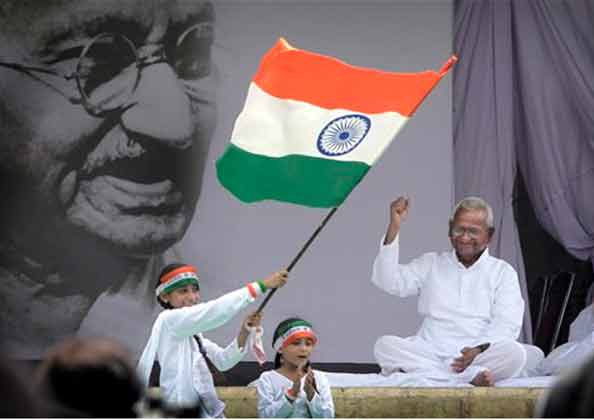
    Hazare, Gandhi and the Tiranga Waving Kids - Perfect Pic
    Hazare, Gandhi and the Tiranga Waving Kids – A Perfect Pic

    Equality and No Discrimination

    The whole of Gandhi’s life and Anna Hazare’s work in Maharashtra has emphasized on the removal of untouchability and discrimination on basis of caste, language and social factors. The people of Ralegan Sidhi (Anna’s village) call it as a family and not as a village.

    • Can we treat our fellow citizens as brothers and sisters and part of the same family?
    • Can we look beyond our caste, language, economic status and love and treat each other alike?
    • Are we ready to practice what Gandhi said, that we are all children of the same God, and any kind of discrimination would be reprehensible to Him?

    What I am trying to say that while it is very easy and convenient to show and voice our support in Anna Hazare in a rally, it would be very demanding and challenging to practice what Anna is following in his daily life. We might have to suffer some short term difficulties and make some sacrifices, but we all know in our hearts that the long term benefits of such a life are always good and more fulfilling. And leave alone corruption, we would remove all or most of the ills that plague our society if we live by the principles by which Anna, and other Gandhi followers live by.

    There is a famous Chinese proverb which I think has a very deep meaning which says – “Laws control the lesser man. Right conduct controls the greater one.” Can we answer YES to the questions I have listed above? Please leave your views and responses as comments below.. If there are any other questions you might want to add to the list, add them as comments too 🙂

  • Five Lessons from the movie “Chak De India”

    Sports can often highlight the need for values like teamwork, honesty, transparency similar to the way these values are needed in life. Sports can end up uniting an otherwise divided crowd cheering for a team. The joy and pride when thousands of people celebrate together, click photographs of the national tricolor flying high after a sports victory is indescribable. Chak De India was one such movie which depicts the values it takes to build a match-winning team and what it takes to achieve something which at one point didn’t seem possible. I will list down five lessons from Chak De India, which are very relevant in the Indian context.

    1. We are Indians first
    We have to see ourselves as Indians first, above any affiliations with state, caste, language, religion, etc. When we seek to achieve something for India and from a national sense, our affiliations with caste, state, etc will only create divisions and barriers which will hinder our objective. If we have to keep our focus on the goal, we have to remove all other distractions from our mind.

    2. Discipline
    Discipline is like the spinal column which holds the whole body together. Discipline has to be a component of one’s daily lives in the discharge of one’s duties. It is required at the personal level, then at the level of society and institutions. Discipline is something which unites a country or society. It means waking up on time, not breaking the traffic rules while going to office, treating others with respect and care, and using your words wisely.

    There is a lot to learn from Chak De India
    There is a lot to learn from Chak De India

    3. Play our role
    All of us have an individual role to play according to our merits. We might have a larger objective and vision as part of a country, society or team but we will have a very specific role to play for which we are best suited. It is important we focus our total undivided energy in fulfilling this role enthusiastically while keeping the larger picture in mind. If everybody does their own task as it is supposed to be done, all our dreams for our nation will be easily achieved.

    4. National Interest over Personal Interest
    We have to put the interest of the nation above our personal interests in order to achieve results over a longer period of time. We will have to overcome our ego and personal biases if we have to achieve something for the nation. We have a limited time on earth, but the nation will outlive us, and we have to see that our actions fulfill this vision even after we are gone.

    5. Short Term vs Long Term
    It is very important to see how our actions are important in the long term too. We might have to take some steps, which don’t look so fruitful in the short term but are valuable in the long term. In other words, we will have to make some short term sacrifices for long term glory. Long term values like patience, loyalty, trust, credibility and honesty are very important in this regard.

  • Family vs Society

    We, as Indians, place great importance on our family and the value system a family carries. The kind of sacrifices our parents have made for us, and the struggles we go through for the well being of the family are unheard of in the West and forms a big part of the contemporary Indian society. However, we care much less about our community, society and others in general. In the West, we see a mutual respect for each other and proactive attitude towards problems in the society. In this post, I am going to speculate on these seemingly different approaches and what could be the approach the Indian of the future should follow to ensure the best future for himself and his country.

    We belong to a culture where deep rooted family values are an integral part. Parents consider it their duty to take care of their children until they stand on their own feet. After that too, there is a strong bond between parents and children. Children too consider their duty to take care of their parents in old age. This ensures a strong emotional bond and support structure for the whole family to lend on each other during difficult times or hardships and to share the happiness and celebrations during good times. The way an Indian family comes together during a wedding or on festivals is a sight in itself. Brothers and sisters share a bond which is based on trust and respect. Elder brother is treated as a father figure and there is a huge connect between brothers and sisters symbolized beautifully by festivals like Raksha Bandhan. Marriage is held to be a sacred union, and it is expected to last over seven births. I can proudly say I am part of such a country and this is the heritage I have inherited.

    A typical Indian family
    A typical Indian family

    However, when it comes to society, we have a totally indifferent attitude. We keep our homes clean and tidy but throw the garbage on the roads everywhere we go. We litter in public spaces as per our convenience (I have seen people litter on the road right outside public toilets.) We don’t care to follow rules of the land, whether they are traffic rules or any other. We take pride in breaking rules and getting away by paying bribes. We do not realize the cost to society when we put our personal interest ahead of the interest of society. And we don’t realize that we can’t be happy and prosperous unless we live in a happy and prosperous society.

    Apathy in addressing common problems is another issue. We turn a blind eye towards most of the problems plaguing our society. We behave as if they don’t exist. Or even if we care, very little of us actually do something about it. Our attitude is “It is not our job“. One reason for this could be that we have been ruled by foreigners for a very long time. And we think that public or societal issues are the responsibility of the government or the ruler and not of the citizens. Maybe we are not used to making decisions on our own. We always have somebody else to take the decisions for us. Currently, this role is of the government, and unfortunately, due to corruption and inefficiency, not much decision making happens there. Our tragedy is that we don’t make these decisions, neither do we stand up and make the government accountable for that they are responsible for.

    Mutual respect towards another human being is an integral part of western culture. We have created so many divisions in society and we treat each other very differently. We look down upon people based on their caste, state, or worse, on the type of work they do. People doing physical work like laborers, plumbers, etc share equal respect in the western society but we treat them shabbily. I think that irrespective of their importance, people should be held accountable for what they do. Be it a plumber or a politician, he should be accountable for what he does. A plumber does not have the right to not do his work because people don’t treat him well, nor does a politician should abandon his duties because nobody can touch him. This works both ways.

    My point here is that the root of our problems lie in a lack of duty towards the society. In other words, when we place the larger good over our personal good and act accordingly, we will make significant progress. After all, our values related to our families are something the whole world envy us for. If we take the same values and apply to our lives outside of home, we can do wonders, for ourselves and for others too. After all, a good and prosperous society will benefit us only in the end. Mahatama Gandhi said that “Be the change we wish to see in the world“, and I also remember one of the earliest lessons from my parents – “Treat others as you would like others to treat you“. Let us become responsible citizens and make our cities and our country a great place to live in.

    We have to extend our value system towards our family and spread it out in the society. We are all good people, for we take care of our families that we should be proud of. The whole world looks up to us for our family value system. The Indian joint family have mesmerized the west for a long time. Let us take a step forward and also turn into good citizens. Citizens who know their responsibilities towards the society, towards the problems that we face, towards the rule of the land and towards fellow human beings. I will end up with this quote from Winston Churchill – “Responsibility is the price of greatness.”

anger anna hazare bangalore business challenge coaching conflict conversation corruption Cricket culture dandi march emotions energy friends fun gandhi giving gold growth hope india jan lokpal bill language leadership lessons Life listening love moment mother movie new year people perspective poem sachin tendulkar saleraja trust values walk waste women words world cup