hope

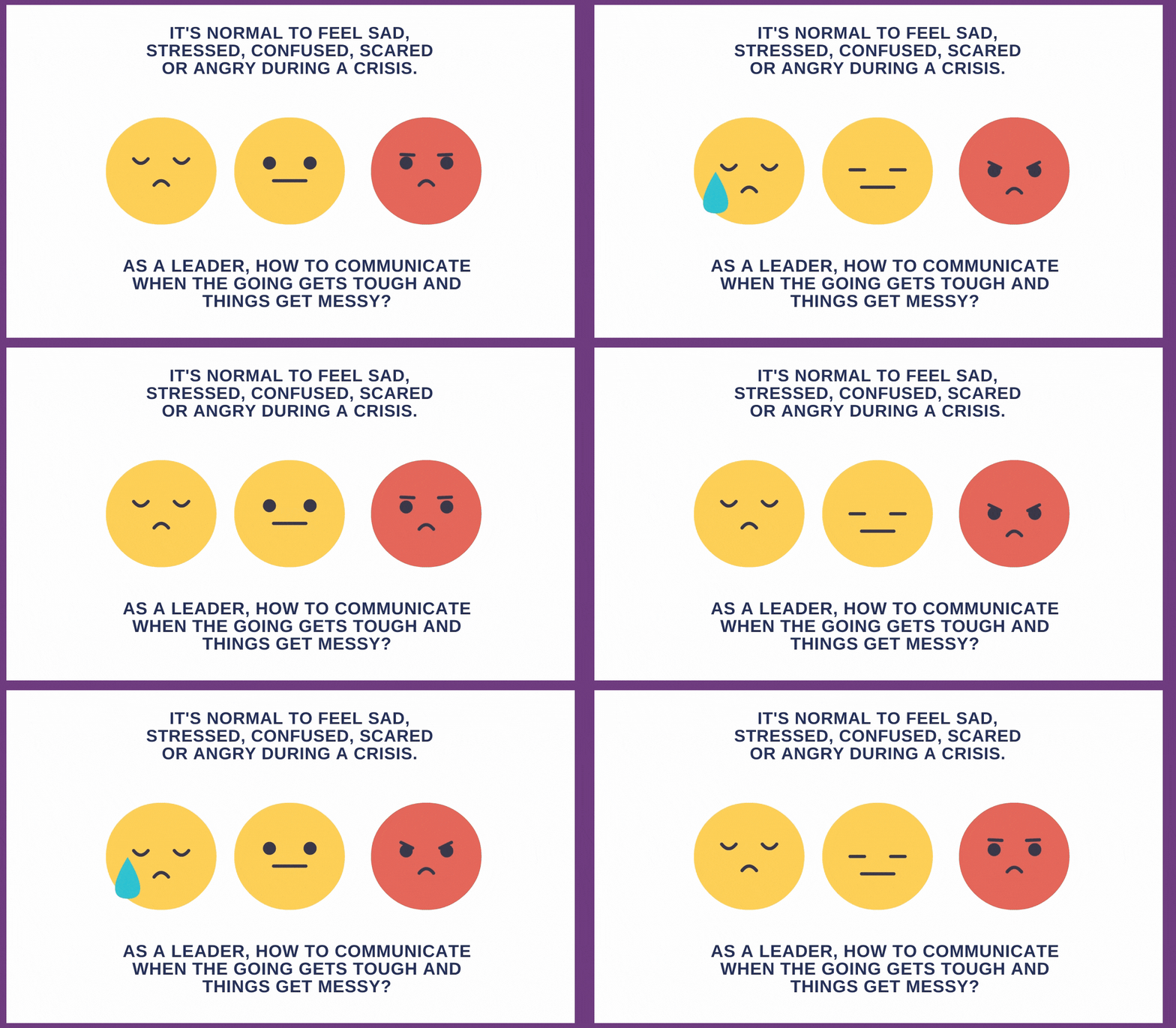
  • How to Communicate When the Going Gets Tough, and Things Get Messy?

    The world is unpredictable and full of chaos and change. Many things can cause worry and tension in an organization. Mergers & acquisitions, leadership wrangles, controversies, and pandemics such as Covid-19 are just some of the many things that can cause a crisis within the organization. 

    The true test of leadership occurs when the going gets tough. How you handle yourself and communicate with your team during tough times is what determines whether your organization will rise or fall.

    Thanks to the unpredictable nature of the world around us, leaders often find themselves with little time to prepare. And no excuse will ever be enough if you fail to respond in a timely manner. At the same time, you must take caution because taking the wrong approach when communicating will do more harm than good.

    The infamous BP oil spill in the Gulf of Mexico is a good example of how not to respond during a crisis. Not only did millions of liters of oil spill into the sea, but also 11 crewmen lost their lives. BP’s chief executive, Tony Hayward, dealt with the disaster in the worst way possible; he shifted blame entirely to Transocean and Halliburton even before investigations had started. Investigations later revealed that BP’s gross negligence is what caused the disaster. By then, the damage had already been done with the energy giant’s credibility taking a major hit. 

    But look at Alan Mulally. In 2006, Ford was on the verge of declaring bankruptcy when Bill Ford brought Mullaly on board. He brought the company back to profitability, and not only that, Ford weathered the 2008-2009 depression without much turbulence. Alan Mulally accomplished this using clear communication and one slogan that echoed through the entire organization, “One Team.”
    The above examples show the tremendous impact of a leader’s words and actions during a crisis. To help you navigate those murky waters of uncertainty that every crisis brings along with it, consider utilizing the following guidelines to communicate during a crisis.

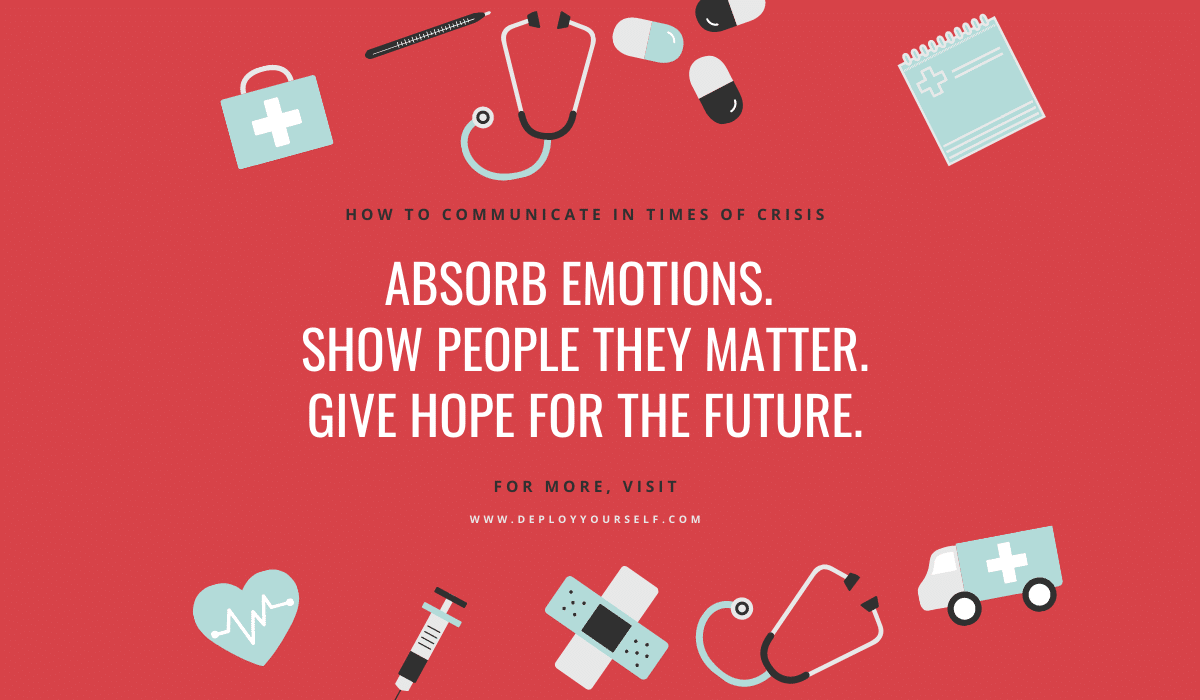
    1. Absorb Emotions. Do Not Amplify Them

    Fear, stress, and other emotions usually run high during any crisis. As a result, chaos can ensue. As a leader, the first step you can take is to manage your own emotions. Your employees look to you for reassurance. If you project fear, they will notice it and can panic. Once you learn to observe your emotions, you can reassure your team. This will help you calm the brewing storm of emotions, and not amplify the emotions of others.

    Each human being acts like a tuning fork. Every emotion is like a wave, which when reaches others, either accentuates or dies down depending on whether the frequencies match or not. When we learn to master our own emotions, it will dampen any emotional waves and allows collaboration, even in the face of disagreement. We can strengthen our relationships with others, even in the most stressful and difficult situations.

    Listen to People’s Concerns & Understand Them

    Be human and embrace the emotions that everyone is experiencing in moments of crisis. You will also need to be transparent about how the situation is affecting you. Opening up, sharing, and displaying vulnerability on such occasions is important, as it can help you build trust. People appreciate knowing that no one is having it easier.

    Try to connect with them by asking people how they are feeling. This will not only provide an outlet for venting emotions but will also provide you with rich feedback to consider while working on a solution. It is much more effective than simply asking how they are doing.

    As much as possible, try to have this meeting in a setting where you both can see each other (and not over email or chat). This is another key element of trust-building, as it shows that you care enough to address them in person. If you cannot be in the same space, set up a meeting via video call.

    You will find that communication is usually better when you can read a person’s emotions through their body language and facial expressions. This is because their subconscious feedback will allow you to adapt your message and tone to soothe their anxiety.

    Be Calm. Don’t React

    During the heat of the moment, some folks might get too emotional. But you cannot control the feelings of another human being. Therefore, allow them to express themselves freely despite your urge to jump in. Calmness is one of the best ways of showing that you are in control of a situation.

    Look at Things from Others’ Point of View

    Putting yourself in the shoes of others will allow you to see things from their point of view. After listening to what someone has to say, suppress the urge to start providing solutions immediately. Instead, bring attention to their (and any shared) values and feelings. At times, this might be all you need to do to reassure your team. 

    However, you might need to do more. For example, ask deeper questions to encourage more active participation. This is also a great way of empowering your team, especially during a crisis, when they are more than likely feeling powerless. 
    2. Show People They Matter

    During a crisis, you will need to communicate with your teams more often than is the norm. Frequent communication shows your people that they are on top of your priorities, and this goes a long way in reducing their fear and uncertainty.

    This means that you might have to repeat your core message several times. While it might feel tiring, you have to remember that people under stress need constant reassuring.

    While at it, ensure that your staff has channels through which they can contact you. Regardless of how many times you call or visit them, if the interactions only occur when you choose to, you risk missing out on all incoming communication. Providing them with a channel through which they can reach you directly allows them to know that their feedback matters to you.

    Keep emphasizing how you want to hear from them, regardless of their level. This will go a long way in building the trust you will need when it comes to implementing any change you might want to implement.

    The feedback channel should not be for show; make sure that you listen to what people are expressing. Therefore, you will need to respond to their feedback periodically. 

    Show Care for People by Taking Care of What They Care About 

    The biggest concern people have during a crisis is whether they will still have a job. While being reassuring is important, it is crucial that you are honest. If part of the solution will involve some people being laid off, the best course of action is to deliver the message as soon as possible. 

    Remember, there is no good time to deliver bad news. The sooner, the better. It allows people to start planning early. Even if you have to break the bad news about layoffs, you can help to soften the blow by choosing an outplacement vendor to help employees with the transition.

    How AirBnB’s CEO Brian Chesky delivered the announcement that the company would have to make layoffs following Covid-19 restrictions is one of the best examples of how to deliver such news. 

    Do What is Required to Take Care of People’s Physical and Mental Well Being

    The mental well-being of your employees should also be among your top considerations. During stressful times, people become more susceptible to mental health issues. Try to take care of that by providing them with resources or tools to support them. Address the issue during your meetings and let them know that the company is there for anyone who might be experiencing mental health issues.

    Highlight Togetherness, and Tell People They Matter

    During trying moments when stability is elusive, it is important to highlight togetherness. Let your people know that the only way to overcome the situation is by maintaining solidarity with each other. The best way of passing this message across is by reinforcing the company’s core values.

    Base your message around statements or questions such as:

    • Who are we as a company?
    • What are our values?
    • What do we believe in?
    • What is our purpose?

    Let your people know that their work matters. People get enormous pride and motivation, knowing that their work is not only appreciated but also contributes to the greater good. Tell people that we are in this together, and you will not be left behind.

    Praise People for Holding up in Adversity, and Ask Them to Look for the Good and Lessons from the Crisis

    People feel good when they are seen, heard, and their effort acknowledged. Do not underestimate the value of positive feedback, as it goes a long way in boosting an individual’s morale and productivity. It also allows them to feel like they are part of a team, thus boosting trust and loyalty within your workforce.

    Therefore, even though you might have a lot on your plate, make sure that you address and acknowledge the hard times that your people have been going through. Acknowledge their ability to adapt, in addition to praising any accomplishments they might have had during the crisis.

    This lets your teams know that you care about them as individuals.  Additionally, ask them to take lessons from the crisis, as it will only make them better – as human beings and at work.

    3. Give Hope for the Future

    Keep in mind that your staff might be under tremendous pressure or anxiety due to the uncertainty of the crisis. As a leader, one of your main objectives is to give them hope and see the light at the end of the tunnel.

    Show (or Create) a Plan to Remove Confusion

    Remember, you are in charge. Therefore, take charge and evaluate your options. It is important that you take action as soon as possible.  Indecisiveness will only breed anxiety and can lead to people questioning your leadership. Therefore, create a plan and explain how things are going to be, as soon as possible.

    However, make sure that you explain your decisions. People might not like or agree with all that you have decided, but they will appreciate that you have taken it upon yourself to explain your decisions. Explain the various courses of action that you considered, and why you decided that this particular one was the most appropriate choice.

    Make sure to align your actions to the company’s core values and purpose, as that will help them feel certainty, togetherness and not confusion.

    Remove Uncertainty. Go Over the Facts. Give Clarity

    While sharing any information about the company’s future, be honest. Tell them all that you know while admitting that there are things you do not know. Embracing the ambiguity of the situation will allow your message to resonate with its recipients better. 

    Assure People by Highlighting What Steps You Have Taken to Ensure their Safety

    People need to know that you have taken actual steps towards ensuring their well-being. If any, highlight them and explain how they will help your team during the tumultuous period.

    Communicate with Confidence, Transparency, and a Positive Outlook for the Future

    In spite of your own uncertainty, you must project confidence when speaking to your teams. Be clear about everything so that you do not leave any room for speculation while remaining optimistic about the future. 

    Conclusion

    The true test of a leader is how they steer their ship and communicate during tough times. It might be difficult, but it is doable, as long as you are proactive, empathetic, and honest.
  • Don’t Allow Yourself to Use the Word TIRED

    Recently I was talking to a friend of mine, who has been a state-level Taekwondo Champion for the state of California. She was telling me about her strenuous training program which she used to follow when she was training. Among other things, the one thing which she told me was that she was not allowed to use the word “tired” even if the trainer asked her to do 300 push-ups. She said “tired” was the word which they could use only after they turned 80.

    The Role of Language in Shaping Our World

    Language plays a very important role in how we feel and go about our daily lives. The way we use language can determine the results we produce in the near and distant future. Researchers at Stanford University have proved that the way we use language shape how we see the world.

    It is often said that what you say is what you get. Saying that you are tired will actually make you feel tired and you will have all the symptoms to prove that. But we don’t realize that it was our word which caused it in the first place.

    So when someone asks you “How are you doing?” and you reply with, “I am tired” or “You know how Mondays’ are.“, we are actually contributing towards the impending tiredness or exhaustion by saying these words. The same goes for all the negative thoughts that come into our mind and out of our mouth, like “I don’t have enough money“, “I am not lucky” and so on.

    Language Creates and Generates Too

    Most people understand language to be descriptive and see it as a tool for communication. They are blind to the generative power of language. It is in language that people create their future and their present. Our mental models and unique assessments of the world determine the narrative we create for ourselves, which in turn determine the world we observe, and every action we take thereafter.

    For example – Every time you said yes or no to a request, you were not just communicating, but also creating a future. Your life would be different if you had said No instead of Yes to the various opportunities you said Yes to previously in your life.

    Chalmers Brothers and Vinay Kumar share this story in their book Language and the Pursuit of Leadership Excellence: How Extraordinary Leaders Build Relationships, Shape Culture and Drive Breakthrough Results.

    Two baseball umpires were sitting around talking, and one says, “Old Joe, he’s a great umpire. There’s balls and there’s strikes, and he calls ‘em like they are.” The second umpire then says, “Yeah, Joe’s a great umpire… there’s balls and there’s strikes, but he calls ‘em like he sees ‘em.” Just then Joe walks up and says, “You’re both wrong… there’s balls and there’s strikes, but they ain’t nothin’ till I call ‘em!”

    They add,

    Language conveys commitment, not just information. By understanding your organization as a network of conversations, relationships, and commitments (human beings making and managing commitments), you can open dramatically new possibilities for intervening and improving performance in a wide variety of areas.

    “I am always in conversation. And sometimes other people are involved” – Mark Twain

    Words can Take Power away, or they can Give Power

    Whenever we say something, we increase our belief in it. We give power to outside situations, individuals, and circumstances which is always disempowering. Athletes, like my friend in the example above, are not allowed to use such language because the trainers are aware of this fact.

    On the other hand, when somebody asks you, “How are you doing?” and you reply, “I am doing great!!“, you will actually feel a smile on your face and some adrenaline rushing through your body. It is impossible to say I am doing great without actually feeling good.

    If you are stretching your limits while doing a task, instead of saying “I am tired“, next time try saying, “Let me check my physical limits.“, and you will gain the strength to go that extra mile and achieve the impossible.

    Do you see a connection between what you have been saying and how your life is turning out?

    One of the quickest ways to improve your way of being is to change the words you use, to others and to yourself. When I say words, it includes the spoken words and the unspoken thoughts too.

    Just by changing the words we use, we can release a lot of tension and create joy. So the next time you speak, be aware of the words that come out of your mouth. Be aware of how others’ negative words make you speak out negative words too, and vice versa. Try to catch yourself when in negative emotion and speak powerful words instead.

    Speak words that profit others, depict hope, courage, and inspiration and which create positive images. Then notice the difference in how your surroundings and people react.

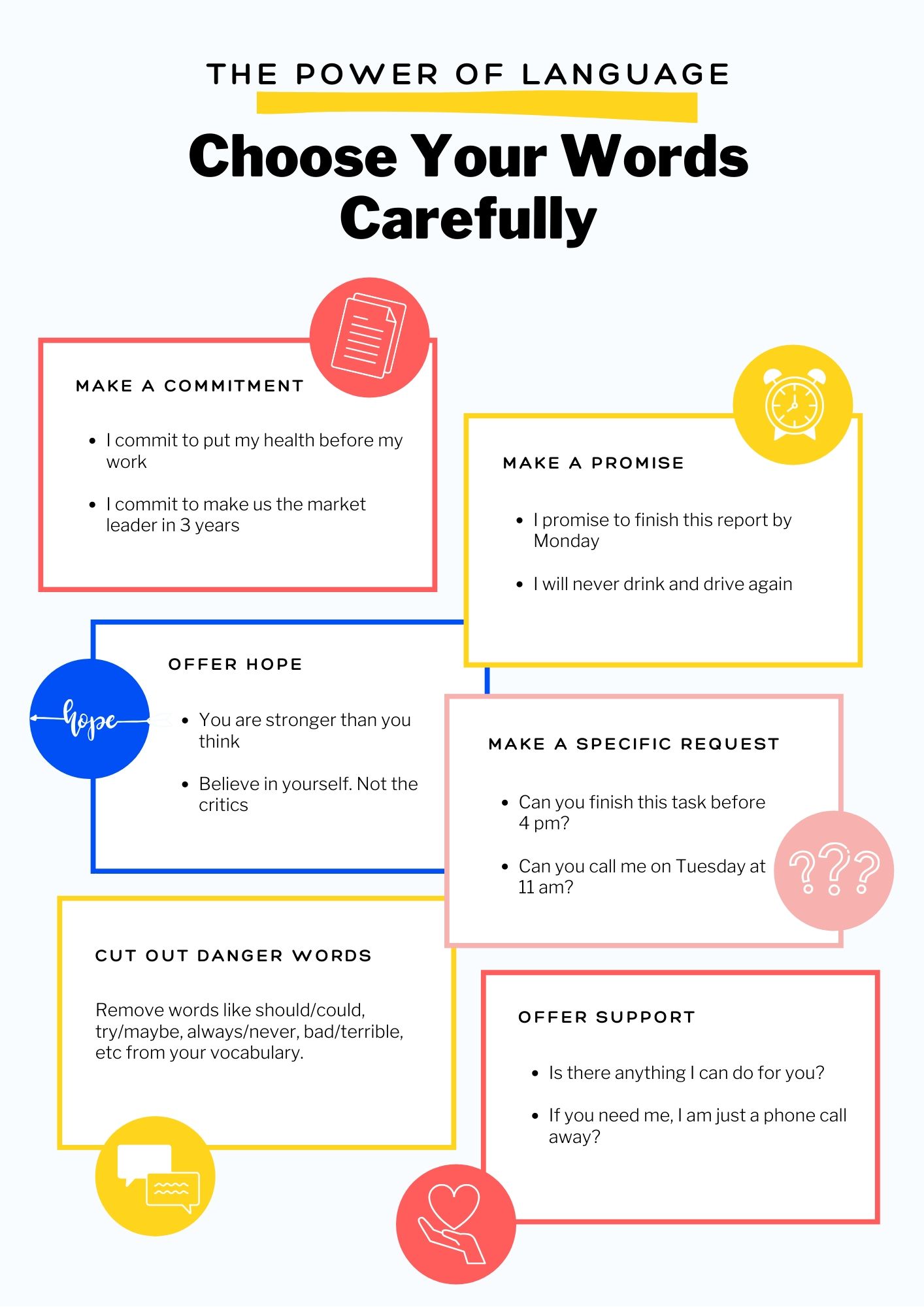
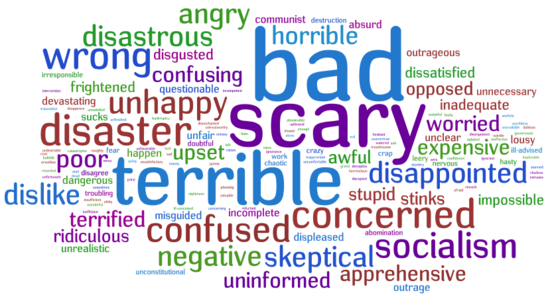
    Some of the danger words which we should cut from our vocabulary are –

    1. Should / Could – These words, spoken for ourselves or for others, implies judgment and makes people defensive and tense.
    2. Try / Maybe – These words leave ambiguity and leave an option for you or another to escape commitment in case things get difficult.
    3. Always / Never / Nobody  / Everybody – These words generalize opinions which are rarely the case and can cause people to react unexpectedly.
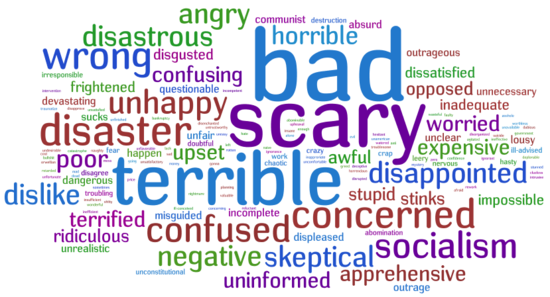
    4. Bad / Disastrous / Terrible – These words spread panic and can lead to more mistakes, stress, and confusion.
    5. Nothing is gonna change / That’s how it is done here – Using such phrases creates a culture of resentment and cynicism which ends up killing all enthusiasm and creativity in people.

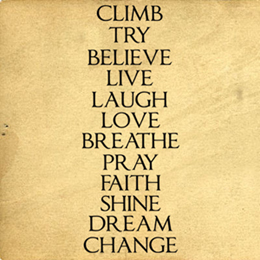
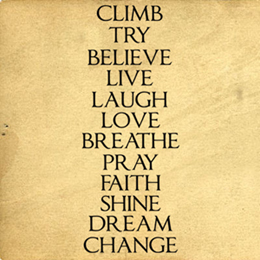
    Instead, you can use powerful words and make them work for you :-

    1. Declare a Commitment. 
      1. I commit to exercising 30 minutes daily.
      2. Let us commit together to make this company the best place to work for.
    2. Make a Promise
      1. I promise to finish this report in two days.
      2. I promise to never drink and drive again.
    3. Make a Specific Request
      1. Can you finish this report before Friday or not?
      2. If you like it, can you share this article on Facebook today?
    4. Offer Support
      1. Is there anything I can do to help you with this task?
      2. I am just a phone call away if you need me.
    5. Offer Hope
      1. You will make it through it. You are stronger than you think.
      2. Believe in yourself, not the critics. I know you will prove them wrong.

    Watch your thoughts, for they become words. Watch your words, for they become actions. Watch your actions, for they become habits. Watch your habits, for they become character. Watch your character, for it becomes your destiny. – Lao Tzu

    So the next time, instead of saying –

    • “I can’t exercise more, I am tired.”, say, “I am not tired, let me do one more round.”
    • “I can’t work outside because I have asthma”, say, “I will work to prove I am bigger than my asthma”
    • “I can’t do this because I don’t have enough money”, say, “How can I earn enough money to start doing this?”
    • “I am not feeling good, it is going to be a bad day”, say, “Today is going to be a great day and I am raring to go”
    • “My life sucks”, say, “Today is a new day. Let’s make the most of it!!”

    Do this and you will see that your days will get brighter and dreams will turn into reality. Break the pattern of using words that suck power out of you, and instead form a new habit of using words that give power to you and the people around you.

  • Don’t Allow Yourself to Use the Word “TIRED”

    Recently I was talking to a friend of mine, who has been a state level Taekwondo Champion for the state of California. She was telling me about her strenuous training program which she used to follow when she was training. Among other things, the one thing which she told me was that she was not allowed to use the word “tired” even if the trainer asked her to do 300 push ups. She said “tired” was the word which they could use only after they turned 80.

    The Role of Language in Shaping Our World

    Language plays a very important role in how we feel and go about our daily lives. The way we use language can determine the results we produce in the near and distant future. Researchers at Stanford University have proved that the way we use language shape how we see the world.

    It is often said that what you say is what you get. Saying that you are tired will actually make you feel tired and you will have all the symptoms to prove that. But we don’t realize that it was our word which caused it in the first place.

    So when someone asks you “How are you doing?” and you reply with, “I am tired” or “You know how Mondays’ are.“, we are actually contributing towards the impending tiredness or exhaustion by saying these words. The same goes for all the negative thoughts that come into our mind and out of our mouth, like “I don’t have enough money“, “I am not lucky” and so on.

    Remove these words from your vocabulory
    Remove these words from your vocabulary

    Words can Take Power away, or they can Give Power

    Whenever we say something, we increase our belief in it. We give power to outside situations, individuals and circumstances which is always disempowering. Athletes, like my friend in the example above, are not allowed to use such language because the trainers are aware of this fact.

    On the other hand, when somebody asks you, “How are you doing?” and you reply, “I am doing great!!“, you will actually feel a smile on your face and some adrenaline rushing through your body. It is impossible to say I am doing great without actually feeling good.

    If you are stretching your limits while doing a task, instead of saying “I am tired“, next time try saying, “Let me check my physical limits.“, and you will gain the strength to go that extra mile and achieve the impossible.

    Do you see a connection between what you have been saying and how your life is turning out?

    One of the quickest ways to improve your way of being is to change the words you use, to others and to yourself. When I say words, it includes the spoken words and the unspoken thoughts too.

    Just by changing the words we use, we can release a lot of tension and create joy. So the next time you speak, be aware of the words that come out of your mouth. Be aware how others’ negative words make you speak out negative words too, and vice versa. Try to catch yourself when in a negative emotion and speak powerful words instead.

    Speak words which profit others, depicts hope, courage and inspiration and which create positive images. Then notice the difference in how your surroundings and people react.

    Use more of these words
    Use more of these words

    Some of the danger words which we should cut from our vocabulary are –

    1. Should / Could – These words, spoken for ourselves or for others, implies judgement and makes people defensive and tense.
    2. Try / Maybe – These words leave ambiguity and leaves an option for you or another to escape commitment in case things get difficult.
    3. Always / Never / Nobody  / Everybody – These words generalise opinions which are rarely the case and can cause people to react unexpectedly.
    4. Bad / Disastrous / Terrible – These words spread panic and can lead to more mistakes, stress and confusion.
    5. Nothing is gonna change / That’s how it is done here – Using such phrases creates a culture of resentment and cynicism which ends up killing all enthusiasm and creativity in people.

    Instead, you can use powerful words and make them work for you :-

    1. Declare a Commitment. 
      1. I commit to exercising 3o minutes daily.
      2. Let us commit together to make this company the best place to work for.
    2. Make a Promise
      1. I promise to finish this report in two days.
      2. I promise to never drink and drive again.
    3. Make a Specific Request
      1. Can you finish this report before Friday or not?
      2. If you like it, can you share this article on facebook today?
    4. Offer Support
      1. Is there anything I can do to help you with this task?
      2. I am just a phone call away, if you need me.
    5. Offer Hope
      1. You will make it through it. You are stronger than you think.
      2. Believe in yourself, not the critics. I know you will prove them wrong.

    Watch your thoughts, for they become words. Watch your words, for they become actions. Watch your actions, for they become habits. Watch your habits, for they become character. Watch your character, for it becomes your destiny. – Lao Tzu

    So the next time, instead of saying –

    • “I can’t exercise more, I am tired.”, say, “I am not tired, let me do one more round.”
    • “I can’t work outside because I have asthma”, say, “I will work to prove I am bigger than my asthma”
    • “I can’t do this because I don’t have enough money”, say, “How can I earn enough money to start doing this?”
    • “I am not feeling good, it is going to be a bad day”, say, “Today is going to be a great day and I am raring to go”
    • “My life sucks”, say, “Today is a new day. Let’s make the most of it!!”

    Do this and you will see that your days will get brighter and dreams will turn into reality. Break the pattern of using words which suck power out of you, and instead form a new habit of using words which give power to you and the people around you.

  • Top 5 Take Aways from the Anti-Corruption Movement

    Anna Hazare has been voted as the Person of the Year / The Indian of the Year by many news channels and newspapers recently. Even international press has noted him as one of the top news makers of the world in 2011. And why not? After all, this 74 year old Gandhian has changed the way Indians look at corruption and given all of us hope that this disease can be removed from our country. As I wrote in a poem, he has come as our Messenger of Hope in 2011.

    Below are what I feel are the top 5 take-aways from this movement so far –

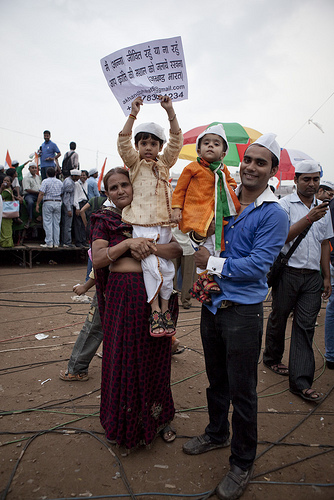
    Anna Hazare Anti-Corruption Rally, Delhi
    Anna has found support from people of all age groups

    1. Strengthening of Democracy

    Anna Hazare has spend all his life promoting the decentralization of power in democracy and his asking for a Lokpal, free of any government control, is another step in this direction. By directly involving the people in his protests, and highlighting the point that the people are the real masters and the politicians only public servants elected by them, he has made it clear that they should proceed in accordance of the will of the public.

    He and his team have taken the issue of Lokpal to the people in small towns and villages, holding live debates and educating the people about the various fine points of the Lokpal Bill and the importance of each clause. This has never happened before. Politicians have never bothered to debate with the people about the fine prints of any bill. By involving the public and making them aware of why and what they are doing, they have enabled a healthy environment which has resulted in the strengthening of the democratic institution.

    2. Hopelessness to Hope

    If you would have asked anyone about the issue of corruption in India at the start of the year 2011, you would have only got hopelessness and pessimism in return. But in one year, Anna has changed that mood to one of hope and optimism. People have seen the power of peaceful protests and how they can pressurize the government to do their job properly. This must be the biggest take-away from this movement.

    3. Uniting India for something other than Cricket

    When India won the World Cup this year in April, people came out on the streets and danced and partied all night long. I wondered that do we have the same unity and patriotism for other issues which are much more important to our country. But my doubts were put to rest as during the two fast-unto-death’s which Anna underwent in April and August, he received huge support from people of all walks of life – from big cities to small towns and villages like. It was so glad to see the whole of India united and fighting for a cause that really matters to every one of us.

    4. Gandhian Values

    It was India who gave the world the weapon of peaceful protest – Satyagraha. But questions have been raised in recent times about its relevance in a 21st century world. But this movement put all such speculations to rest and showed that Gandhian methods of peaceful and non-violent protest are as much effective today as they were 70 years go. It was amazing to see young leaders like Arvind Kejriwal and others using technology (internet, social media) to gather support and spread their word quickly among people.

    5. Patriotism and Power of Youth

    A famous quote says that “A patriot must always be ready to defend his country against his government“. This movement has shown the power of youth and the importance of patriotism in democracy. By coming out in big numbers and by even courting arrest in huge numbers, the Indian youth has shown the importance of public protests in democracy. It has shown to the world that even a corrupt government will find it difficult to operate if the public is aware and ready to hold the government accountable for their actions.

    I would like to conclude by saying that just as a strong and responsible opposition is needed to keep the government on its toes and working properly, a strong public (or civil society) is needed to keep any democratic institution on its toes to do its duty responsibly.

  • 5 Reasons why Anna Resonates with the Masses

    In my previous article, I had a doubt about how the public will react to Anna’s second fast unto death. I was more skeptical about the response to his Jail Bharo call. But I am glad all my skepticism has been proved wrong. The public has responded, and how. Tens of thousands of people have come out on the streets in support of Anna Hazare. People have courted arrests in hundreds and in Delhi, police has to convert a stadium into a jail to keep those arrested. There were around 100,000 people marching to India Gate in Delhi and around Azad Maidan in Mumbai. Now can the government arrest them all?

    I am really glad that the public has risen to the call given by Anna Hazare. But what is special about Anna Hazare that he has galvanized the whole nation when most of us didn’t know him at all a few months ago. How is one man able to dictate terms to the government? How has he cut across the social and economic divides of the populace which is so deeply entrenched in our society?

    History of Work Done

    He is an ex-army man who fought in the 1965 Indo-Pak war and later build his village into a model village, self sustained and free of all social ills. People from all over the world have come to see the amazing work he has done. He has not married and devoted his entire life to his village, and later in his fight against corruption. After that he has fought corruption in Maharashtra and he was one of the active crusader behind forcing the Maharashtra government to bring in the Maharashtra RTI act, one of the first in the country. He has given his life for the service of the nation since the last 35-40 years..

    Clean Image

    He has devoted his life to social activism, mostly in Maharashtra. He developed his village Ralegan Sidhi into a model village which people from all over the world come to see. It is considered a model of self sustainable living and of environmental conservation. The World Bank Group has concluded that the village was transformed from a degraded village in extreme poverty to one of the richest in the country.

    More than a lakh people march from India Gate to Ramlila Grounds on 21 Aug
    More than a lakh people march from India Gate to Ramlila Grounds on 21 Aug

    No Personal Assets or Motives

    Anna Hazare lives in a small room attached to a temple in his village since 1975. He has no assets and has a bank balance of Rs 67,000. Whatever land he has is being used for development purposes for his village. His only source of income is the pension which he gets from the Army. He has devoted his life for the betterment of his village, and after that fighting against corruption. He has never done anything for his personal motives.

    Gandhian Principles

    What is most heartening is to see Anna Hazare following Gandhian principles and using the same methods of fasting and Satyagraha for his cause. In a generation which has come to doubt Gandhi and the relevance of his principles in modern times, this was ample proof of the relevance of his methods irrespective of time and generations. He has called to our souls in the same peaceful manner that Gandhiji did.

    Given Hope to Millions of Frustrated Indians

    More than anything else, the one reason why Anna has resonated with the masses is because he has given hope to millions of frustrated Indians. Everybody knows there is corruption in every nook and corner of the country. But the BIGGEST problem is that nobody can do anything about it. Everybody is helpless in the regard that there is nobody to complaint, and even if they complaint, they end up being harassed by the same people. Anna has given people hope and shown them a way which might lead to a corruption free India. That is why he caught the government totally unaware!!

    It won’t be wrong to say that Anna Hazare has come as the Messenger of Hope in the current state of our country. He has managed to turn all the cynicism and pessimism into an enthusiastic and optimistic revolution by the people of India.

  • Ripple of Hope

    When nothing around you is going your way,
    When nobody is hearing what you have to say..
    Times like these are the real test of your will,
    For amid storms is the challenge to stand still..

    When your life will take a sudden turn,
    When you will reach a point of no return
    Just keep moving ahead despite of every hurdle,
    For there is always light at the end of the tunnel..

    When all you get is blow after blow,
    When every hope and promise seems hollow
    You have to decide how high you want to rise,
    For you know in every crisis there is a prize..

    When nobody around you knows what to do,
    When everybody is searching for a clue
    That is the time for you to stand strong,
    For every night ends no matter how long..

    When everything looks like falling apart,
    It is very important not to loose heart
    For every step you take against the slope,
    You are giving rise to a ripple of hope..

    Let us all spread a ripple of hope
    Let us all spread a ripple of hope


  • Crossing the Road

    When one crosses a road,
    It’s a triumph over a challenge!
    In few steps hope is echoed,
    Inspiring others to take a plunge!!

    Roads get crossed everyday,
    By people like me and you!
    Many will follow the way,
    But lead shall only a few!!

    Have you rested too much,
    Then why not begin to play?
    It’s time to leave the crutch,
    And see what is far far away!!

    Riding on the shoulders of hope,
    And dancing under the blue sky!
    Jump holding on to destiny’s rope,
    And even gravity we shall defy!!

    Lets leap into a dream land,
    Where nothing is impossible!
    It is time for all of us to stand,
    To fight for and win our battle!!

    On the way hardships might arise,
    If you think you can’t take the load!
    Just close your eyes and visualize,
    The sight of a man crossing a road!!

    Take hope from smallest of acts
    Take hope from the smallest of acts


  • Messenger of hope

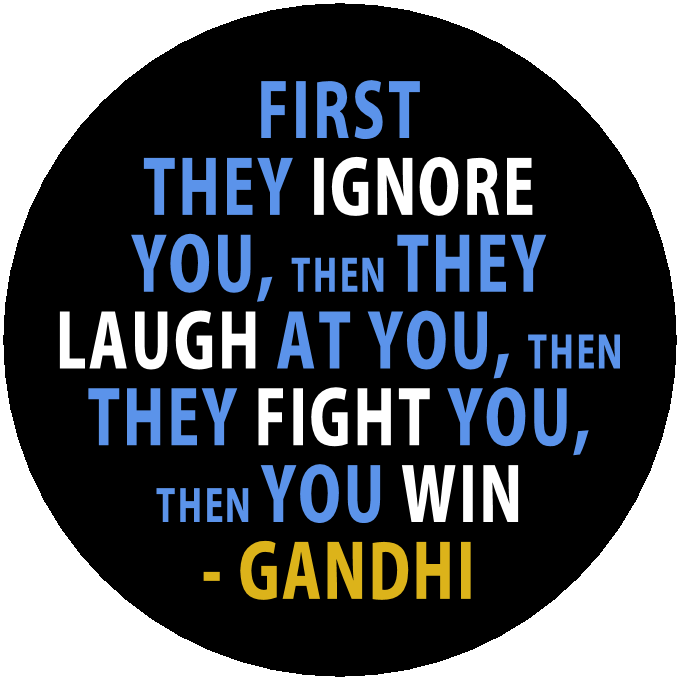
    They have ignored us, had their share of laughs and now they are fighting us, Victory is near
    They have ignored us, had their share of laughs and now they are fighting us, Victory is near

    The whole country has come together,
    As people fast with their countrymen!
    Anna Hazare’s fast is getting bigger,
    For all our dreams about India, Amen!!

    The World Cup win united us,
    As people came out on the roads!!
    Corruption is something serious,
    It is high time public anger explodes!!

    It is only an act of sacrifice,
    No point in just being angry!
    A small act of yours will suffice,
    For one day, just stay hungry!!

    Make the people around you aware,
    And let the corrupt see we are awake!
    Let them find a place to hide somewhere,
    To their activities let us put a brake!!

    It is our country, our money,
    Will not let it go down the slope!
    Let us all support Annaji fully,
    For he is our messenger of hope!!

anger anna hazare bangalore business challenge coaching conflict conversation corruption Cricket culture dandi march emotions energy friends fun gandhi giving gold growth hope india jan lokpal bill language leadership lessons Life listening love moment mother movie new year people perspective poem sachin tendulkar saleraja trust values walk waste women words world cup