listening

  • How To Communicate and Handle Difficult Conversations as an Introvert?

    Introverts are comfortable in being by themselves. Instead of getting energy from others, introverts draw it from solitude and quiet places. As a result, resolving conflicts and navigating tough conversations tend to be difficult and scary since it forces them to have conversations that they would rather not have. Unfortunately, avoiding conflict can be extremely limiting when it comes to leadership and producing results.

    However, most introverts do not know that their introversion is a superpower when it comes to handling difficult conversations. That is because the nature of an introvert is to be thoughtful. That means you do not enter any situation without preparing for it.

    The more you prepare, the more confident you will be. As you can imagine, that confidence will go a long way in helping you manage the nerves of handling difficult conversations and stepping out of your comfort zone as an introvert.

    Another superpower introverts have is their excellent listening skills. Most conflicts result from one or both parties feeling like their grievances are being ignored. As you can imagine, listening goes a long way in diffusing the tension in a difficult conversation. Another benefit of being a good listener is that it allows you to understand not just people’s positions but also their underlying interests.

    However, since you tend to get worn out quickly when you are around people, you will need to manage your energy appropriately. That means scheduling meetings when you have the most energy and avoiding back-to-back meetings. 

    Here is everything else you need to know about communicating effectively and handling difficult conversations as an introvert:
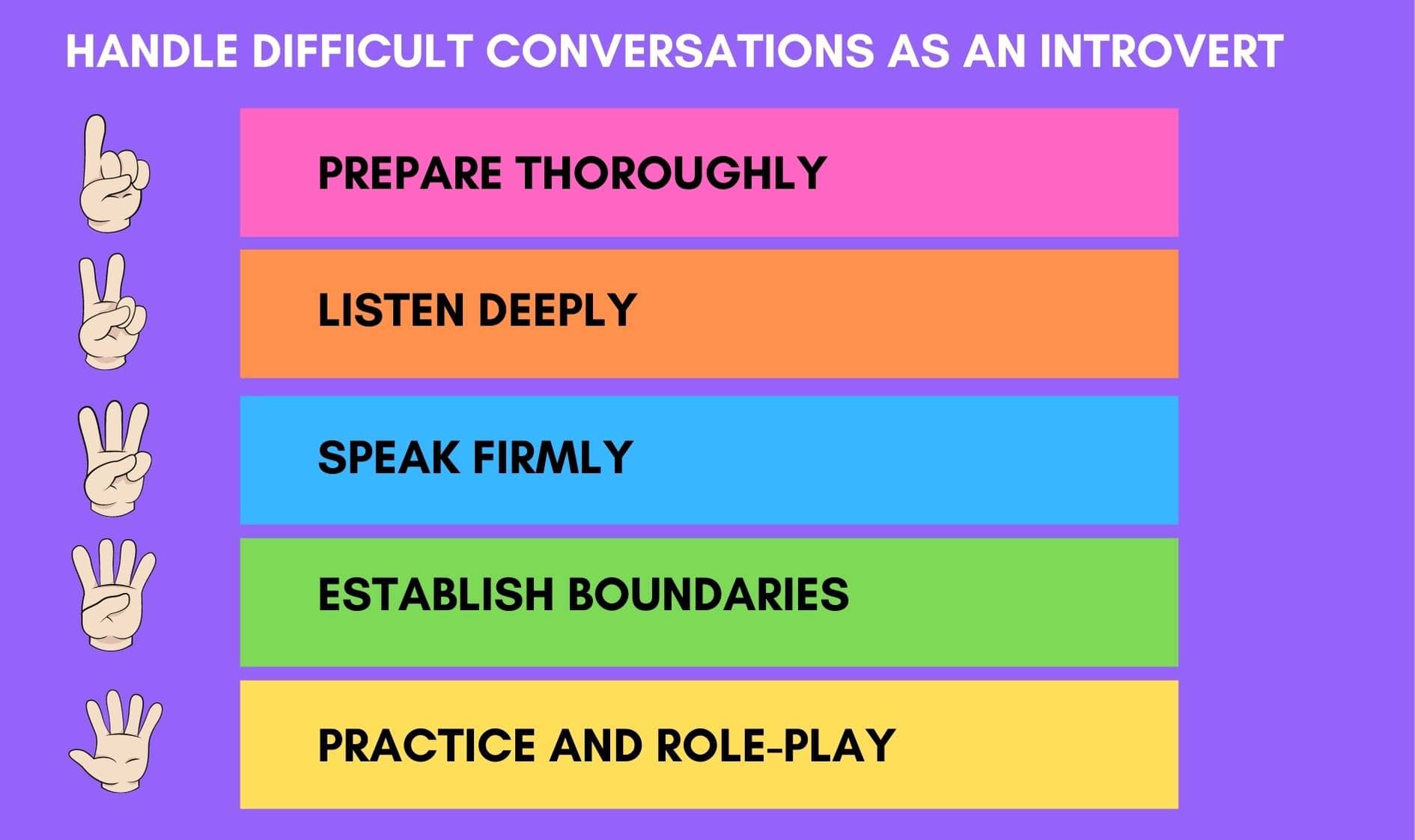
    Prepare For Different People and Situations To Remove Uncertainty and Anxiety

    Preparation is key to succeeding in anything in life. Fortunately, as an introvert, you excel at preparation due to your thoughtfulness. Here are some questions to ask to prepare yourself for difficult meetings.

    1. What is the meeting about? What material should I read before? Who are the participants in the meeting? What is my history and relationship with them? Can I know them better? What are their personality styles? How can I prepare for dealing with bullying, aggressive, or passive-aggressive comments?

    As mentioned, introverts draw their power from within, which is why they do not like having the spotlight on them. Nonetheless, as a leader, you will need to be comfortable with the idea of speaking up. 

    As mentioned before, good preparation is the key to getting the confidence you need to control any situation. When it comes to meetings, research thoroughly about the topics you will be discussing. Doing that will ensure that any point you bring up will bring value to the conversation. 

    When people see that you are well-informed, they will be more willing to listen to what you have to say. You can also consider the different people in the meeting and have a plan on how to interact with them, especially if you find working with them challenging. 

    How should you deal with aggressive, loud, or bullying personalities? For starters, you do not need to be loud; just make sure you speak up when you have to. Here are a few more guidelines:

    • Take control of the conversation by pulling everyone back to the topic once the conversation becomes derailed
    • Make a hand gesture before you speak to get their attention
    • Summarize people’s ideas and point them towards the data you have already prepared.
    1. Can I prepare and circulate my thoughts about the meeting topic before the meeting starts? 

    As an introvert, you excel at quiet reflection – use that strength to plan for your meeting. That will involve thinking about the topic of discussion and broadcasting them before the meeting. This will help you get a jump start and prevent having to wait for your turn to speak in the meeting. 

    1. What are my values? How do I want myself to act? What are my standards and boundaries? What, if violated, I will not stay silent about?

    Introverts often struggle with difficult conversations since they have a difficult time believing in their own authority and opinions. A leader is simply someone capable of speaking up for what they believe in strongly. And knowing what you stand for will make that easier for you.

    The first step to identify your leadership lighthouse is determining your values. What do you believe in? What are your principles? What about the standards and boundaries you want to stick to?  If someone gets out of line, how will you tell him or her that their behavior is not acceptable?

    1. What are my strategies if I get overwhelmed or triggered in the meeting? Can I take a time out; can I ask for time to think? Can I excuse myself for another reason?

    You have to reconcile with the idea that things will not always go your way. Therefore, let go of the need to control the outcome of the meeting. Instead, trust your preparation.

    Nevertheless, there is still a good chance you will still feel overwhelmed or triggered in the meeting. Pay attention to your breathing to stay centered throughout the conversation or meeting. Whenever you feel nervous or triggered, breathe in deeply and then exhale slowly. You will be surprised how calm you will feel immediately. 

    Additionally, breathe when you are speaking. This is because we tend to take shallow breaths when we are nervous. Therefore, by breathing normally, you will be letting your body know there is nothing to be afraid of.

    Most importantly, fight the urge to speak fast. You have the right to be heard. Again, conscious breathing allows you to communicate calmly, giving you the chance to get your ideas heard effectively.

    Use your keen listening skills to go a level deeper and listen to people’s concerns

    As mentioned, the introvert’s ability to listen is a superpower. Here is how to use it effectively:

    1. Be curious about not just the topic of the conversation, but also the people involved.

    Do not listen just for the sake of it; be curious about what the other person has to say. Doing that allows you to understand where people are coming from. If people feel understood, it builds trust and they are more likely to listen to your ideas.

    Additionally, pay attention to the entire person you are talking to. That means not only listening to them but also observing their body language. Doing that gives you deeper insight into what they might not be communicating in words but still expressing otherwise via hand gestures, facial expressions, body posture, etc.

    1. Help people paraphrase each other by listening to people’s concerns. Act as a calming force in the meeting. Acknowledge and validate people’s emotions

    The benefit of paraphrasing others is that it allows them to know and verify that you have listened to them. No one likes being ignored. You should also acknowledge the other person’s emotions as they drive most of our communication. 

    Emotions are the only way people convey what they feel inside and what is important to them. As such, by listening deeply and showing that you understand where they are coming from, you can be a tremendous calming force in the meeting. 

    1. Ask questions with compassion to help people understand what is important to them. 

    Powerful questions can help people understand their point of view better. Being compassionate while doing that is arguably the best gift you can give to that individual. 

    Therefore, one of the best ways of handling difficult conversations is by allowing the other person to express fully by asking curious questions. That way, you will build trust, get to the heart of the matter, and reach an understanding sooner.

    1. Think about the core issue which needs to be solved. Keep the focus on the problem instead of colliding egos and arguments.

    The human condition is prone to our egos getting in the way when communicating. Most times, when people disagree, their immediate response is to defend themselves. As an introvert, you can help people resist the urge to attack each other. Instead, you can help keep the focus on the issue instead of the conflicting egos. 

    1. Remind people they are on the same team, and bring up the common desired goals if need be. 

    The best way to resolve conflict within a team is to remind everyone that they share the same goal. Additionally, remind each individual that their opinions are valued. It is not about massaging egos, but appreciating each person for what they bring to the table.

    1. Use humor or share a story to lighten the mood

    When things get heated in conversations, you can use humor to lighten the mood. You can also share a story to lighten the mood and bring the attention of the group to the main point of importance.

    Practice and Role-Play To Prepare Yourself if You need to

    Needless to say, confrontations and public speaking are not what an introvert look forward to. You can prepare yourself for how various scenarios might play out through role-play with a coach or a trusted partner. You can also practice with a mirror. Consider role-playing the following scenarios:

    1. Practice replying back to aggressive people

    As an introvert, nothing can frustrate you like loud and aggressive people. However, you will need to prepare for such behavior. As mentioned earlier, avoid the urge to engage an aggressive individual in their own game.

    Instead, let them talk, and then state the facts calmly to them. Practice expressing yourself in alignment with your values while still making your point across clearly. While at it, practice proper breathing, as you will need to stay calm in real situations.

    1. Practice dealing with bullying or passive-aggressive behavior without doing the same

    As the saying goes, when you engage a fool at their level, they will beat you with experience. Similarly, avoid engaging a bully at their level. Instead, practice using the guidelines offered earlier on how to deal with such behavior. 

    You can stand your ground and make your point without being aggressive. Also know that you can raise your voice without being aggressive or rude. 

    1. Practice saying no politely but strongly. Be clear about what is non-negotiable for you

    If there is one thing that introverts struggle with, it is saying no. However, as mentioned, you can prepare by identifying your values and enforcing your boundaries. The foundation of assertiveness is having the ability to say “NO”.  Nothing good ever comes out of being a people pleaser and saying YES when you actually mean NO. 

    Conclusion


    While being introverted comes with its fair share of challenges, it can also give you an edge in difficult conversations. Introversion allows you to be more calculative, prepared, and focused, all of which are important in keeping a cool head under stress and pressure. 

    Good leadership is characterized by the ability to stay calm and not lose focus in the heat of the moment. Wear your introversion with pride because that is probably what makes you unique and stand out.


  • Nonverbal Communication – How To Listen To What Is Not Being Said?

    “When the eyes say one thing, and the tongue another, a practiced man relies on the language of the first.”― Ralph Waldo Emerson

    In recent years, technology has brought in a big change in our ways of communication. With the best tech devices and the most vibrant social media platforms around us, there is so much to watch and listen to. Still, we have all been in situations where our own internal dialogue prevented us from giving full attention to a speaker. So the question is, are we really listening?

    Effective listening is not just about hearing what is said but also taking note of things that are left unsaid. Listening to another person may sound like a simple act, but hearing is not the same thing as listening. Nonverbal Communication and Deep listening is not just about listening using the ears, but also listening with our emotions and the entire body. Let’s explore what that means.

    It is often mentioned that only 7 per cent of human communication is verbal. In truth, the exact percentage is not so conclusive. The non-verbal portion of a speech can range from anywhere between 65 to 93 per cent. 

    So spoken language is just one of the many ways by which we communicate. In order to understand the whole picture and listen well, we need to listen and explore beyond the spoken words. Quite often, tone of voice, your eyes, postures, and facial gestures tell a different story than the one the spoken words are telling. However, most people tend to ignore and have rarely learned to listen to the entire body. Hell, it is even difficult to focus on people’s words in this age of distraction.

    Strong nonverbal communication and listening is the foundation of any personal or professional relationship. So it is high time that we pay attention to the nonverbal cues, and learn to listen to what is not being said. Can you listen so well that you notice a shift in the other person’s breathing?

    How to Listen to What Is Not Being Said?

     “Leaders who don’t listen will eventually be surrounded by people who have nothing to say.” – Andy Stanley

    Many famous leaders and personalities from the past were great listeners. One example is Sigmund Freud. His manner of listening was by giving complete attention to the speaker while keeping his gaze and words mild and cordial. The level of attention that he offered to the speaker, made them feel special. 

    To understand the true scenario of any given situation, active listening is a must. This also holds true for any business establishment. Listening to your customers is essential for formulating a successful strategy and making the right decisions. In this article, I will share 3 steps we can all take to listen beyond the spoken word (the emotions, wants, and desires of the speaker), and to what is not being said.

    Step 1 – Clear Your Mind

    We all have our own internal voice which is ON all the time, giving us a running commentary about events happening in real-time. It is very difficult to listen to anyone else when you are immersed in your own world of thoughts. Only with a clear and calm mind, you can focus on what the speaker is trying to convey. Therefore, it is important to listen with a clear mind – without any fear, judgments, opinions, etc about the other person.

    Take A 5 Minute Silent Break Before Important Meetings

    One thing you can do before an important meeting is to take a short break of five minutes (or even two minutes) in a quiet space to calm your mind and prepare yourself to pay complete attention to the upcoming meeting. Use this time to block out your mental noise and allow the mind to calm down.

    If there is something on your mind, it might be a good idea to write that down somewhere to get to it later. This can be very effective to develop the skill of staying focused during the upcoming conversation. Take a few deep breaths during this small break and reorient yourself if you need to. Connect with your values, purpose, and commitments as you step into the other meeting.

    Thoughts arising in our minds can act as distractions. We simply cannot stop these thoughts and any attempt to do that will eventually tire you out. The important thing is to remain aware of them, but not indulge them any further. This will help you to stay on track when your mind starts to drift.

    By taking 5 minutes to prepare your mind and body, you will be ready to pay complete attention to the speaker.

    Give Up Your Opinions, Fears, and Judgements

    It is important to listen to a speaker with an open mind. To listen beyond the spoken words, listen to what is being said without getting filtered by your own prejudices, beliefs, fears, and anxieties. For that, it is important to give up any opinions, judgments, fear, and insecurities you might have about yourself, the other person, or the relationship.

    If you are angry, irritated, or fearful about a person or a situation, it will be difficult to pay attention and listen effectively to the nonverbal cues. For example – do not go into a meeting thinking about how someone is always late, or unreliable, or aggressive.

    Once you judge someone, it becomes difficult to comprehend their viewpoint or their motive. By being non-judgemental, you will have a better understanding of the events or circumstances. As a result, you will be able to understand not just their words but also their concerns and desires. This will help you make better decisions.

    You may feel like replying or arguing to convince the speaker about your views. However, it is important to focus on the speaker’s world and not on our own reply and concerns. Listening is a skill that not only needs complete attention but also requires letting go of our personal biases, that we all have. 

    See Things From Their Point Of View

    “People may not remember what you said, but they will remember how you made them feel”

    ― Maya Angelou 

    You have to imagine yourself in the other person’s position to truly understand and feel what they are trying to communicate. 

    Apart from the literal meaning of the words, pay attention to the emotional content that is being delivered. Keep a close watch on the tone of voice and body language to understand how things look and feel from their point of view. Can you listen to the emotion the other person is feeling? Are they calm, happy, ambitious, frustrated, stressed, or resigned? Can you listen to what the person cares about so much that is making them happy, frustrated, or angry?

    We often view the world through a lens clouded by our own beliefs and opinions. Empathy requires that you observe the world from someone else’s point of view. Empathetically listening to nonverbal cues is not easy, but it is a gift that you can offer as a listener to others.

    Step 2 – Listen Beyond The Words 

    To be an effective listener, you need to be a good observer. In fact, body language is a major way through which true feelings and emotions find expression. By reading and interpreting these signs you can use body language to your advantage not only in the workplace but also in your personal life.

    Our minds are so prone to distractions that concentrating on the speaker is often difficult. An active listener is present in the moment and watches for subtle changes in the speaker’s body language. Noticing such signs will help you differentiate between what their words are saying, and if they are coherent with what their body is communicating.

    Here are some of the signs that you can look out for:

    Facial expressions

    Quite often the spoken words do not match the inner emotions. In such cases, facial expressions can communicate what the speaker is truly feeling.

    Eyes

    Human eyes are the best mirrors that reflect the mind. As the saying goes- “the eyes are the windows to the soul.” Here are a few things to watch out for:-

    • Wide-open eyes indicate surprise
    • Rapid blinking can indicate stress or dishonesty
    • Intense eyes usually indicate anger
    • When the pupils are dilated it can be due to a feeling of fear or romantic interest

    Eyebrows

    Eyebrows can tell a lot about how the speaker is actually feeling.

    • Raised and arched eyebrows indicate surprise
    • A frown or eyebrows knit together indicates anger or irritation
    • When the inner corners are drawn up it indicates sadness

    Mouth

    The mouth can also be a good indicator of emotions apart from the usual happy smile. For example:

    • Biting of lips is usually a sign of anxiety
    • An open mouth indicates fear while a dropped jaw represents a surprise
    • A raised corner of the mouth indicates hate or scorn
    • When the corners are drawn, it indicates sadness

    Body Posture

    The way people position their bodies and move their hands or shoulders can speak a lot about their feelings. By observing gestures, you can understand whether the speaker truly believes what they are saying or not. Do keep in mind that gestures can have different meanings based on cultures and locations. For example:

    • Gripping an item, tapping fingers, or adjusting the hair or clothing can indicate tension.
    • A clenched jaw and tightened neck muscles usually indicate stress.
    • Shaking of legs can indicate anxiety or irritation.
    • Hunched shoulders and arms folded tightly indicate anxiety or fear. On the other hand, it can also mean that the person is feeling too cold.
    • Curving the shoulders forward with folded arms is a defensive posture. The sudden crossing of arms may indicate discomfort or disengagement.
    • A relaxed speaker will have shoulders in a normal position with hands moving freely without jerkiness.
    • A pointed finger with the rest of the hand closed is usually a show of power or dominance.

    Tone of Voice

    A new study has pointed out that listening to the tone of a speaker is often more important for understanding their emotions. For example, even over the phone, we can understand others’ state of mind by their tone of voice. Be it enthusiasm, excitement, or sadness – we can detect all these emotions just from the tone of voice

    With practice, we all are capable of detecting the subtle differences between different emotions from tone of voice. You might have noticed that many people tend to ramble when they get excited or agitated. On the other hand, a slow and steady vocal delivery indicates a thoughtful mental state.

    Paying attention to the emotions in the voice of a speaker helps you to understand what the person is really feeling. In turn, you will comprehend the message the speaker is trying to deliver more effectively.

    Noticing Our Own Body

    Another way to go deeper when it comes to nonverbal communication is to notice your own body as you talk to somebody. Our bodies are tuned to react and mirror what they experience in the room, even in a subconscious way. So if you suddenly feel the tension in your body, the other person might be feeling the same. If you suddenly feel your breathing getting shallow, perhaps the other person is also experiencing the same. Listening to your own body is also a signal you can use to listen to what is not being said.

    Step 3 – Ask Powerful Open-ended Questions

    The first important aspect of deep listening is listening attentively without interrupting. The second is to ask open-ended questions with curiosity to understand the speaker’s concerns, ideas, and emotions better. It also helps you to validate what you are understanding. Never assume on behalf of others. Always validate by paraphrasing or asking questions.

    Here are some examples of powerful open-ended questions.

    • What else would you like to talk about?
    • Tell me more about what’s bothering you?
    • What’s really going on?
    • Can you explain why that matters?
    • I noticed some frustration. Did you not like something about what was just said?
    • In the meeting, I saw you disinterested and with a strange smirk when we discussed that project? What concerns do you have?
    • I could see the surprise and fear on your face. Tell me what worries about this upcoming situation?

    Any question that can be answered with a simple “yes,” or “no,” reply is a closed question. Such questions prevent the possibility of continuing communication. Also, closed questions do not provide detailed information.

    When we ask open-ended questions, we can understand the thoughts and emotions of the speaker, as they have to think and come up with original answers. Sometimes open-ended questions allow people to think and understand their own concerns and thoughts better.

    Remember, while asking open-ended questions, it is best to avoid aggressive questions that can make others defensive. I have observed many managers neglecting this and end up pushing people into a corner.

    Benefits of Listening To Nonverbal Communication

    To be a great leader you have to be a great listener.”- Richard Branson

    Abraham Lincoln was as good a listener as he was a speaker. The 16th President of the United States gave his full attention to every speaker even if their views were different from his own. Many times, he would “lean forward and clasp his left knee with both hands” while listening to others.

    So all his visitors returned with a satisfied feeling. They felt that the president was able to understand their feelings, apprehensions, and motivations. In return, he won their trust and respect.

    Likewise, a good listener needs to be focused, engaged, and flexible. The fast pace of life and the numerous distractions around us are eroding our listening skills in a big way. Only the leader who can overcome that to become a good listener can bring out the best from their team members. 

    By listening without trying to critique or convince we can become more empathetic. It can also offer us an insight into the concerns, hopes, and aspirations of others. Deep listening can not only build trust but can lead to better relationships as it makes us alert and sensitive towards others.

    Communication goes much beyond spoken words. The tone of voice and other physical expressions play a hidden but big part in communication. When we can listen to others – both verbally and nonverbally, we move towards creating more meaningful relationships and being more effective at everything we do.

    References

     1.       https://greatergood.berkeley.edu/article/item/does_your_voice_reveal_more_emotion_than_your_face

    2.       http://web.mst.edu/~toast/docs/Gestures.pdf

    3.       https://www.td.org/insights/listening-is-the-secret-weapon-of-good-leaders

    4.       https://cornerstone.lib.mnsu.edu/cgi/viewcontent.cgi?article=1000&context=ctamj

    5.       https://fremont.edu/how-to-read-body-language-revealing-the-secrets-behind-common-nonverbal-cues/

  • How to Give Feedback Effectively? What to do Before, During and After a Feedback Conversation?

    Giving good quality feedback is an important skill to have in any organization. Doing so regularly with our peers gives everyone an accurate understanding of how they are doing at work, and what needs to change/improve. However, I have always felt that the importance of feedback and how to effectively deliver it is something that is rarely stressed and communicated within companies. In this article, I want to share some of the best practices I have learned from different people and mentors over the years about giving feedback.

    Why?

    The first step to giving good feedback is to realize the importance and reason behind doing so. I believe that the only reason to provide feedback is to improve performance while working together. The purpose of giving feedback is never to measure performance, blame, to prove yourself right, to make others wrong, or to put someone in his/her place.

    I believe this is the most important aspect of feedback which we often miss. I see feedback as a ‘gift’ given from one person to another, with the only purpose of improving how they work together. When we see feedback as a ‘gift’, the feedback conversations tend to be more natural and less awkward.

    Before (Preparation)

    “Give me six hours to chop down a tree and I will spend the first four sharpening the axe.”
    ― Abraham Lincoln

    Like most things in life, doing some groundwork before giving feedback is critical. Over time I have come up with a list of steps which helps me prepare for a feedback conversation.

    1. The first step is to collect data and evidence to back up your feedback and to make sure you have seen the situation from different angles and points of view. This might include gathering some tangible data like sales reports, code reviews, etc, or validating your feedback with a different set of people.
    2. Apart from remembering the why behind sharing the feedback, it is also very important to have an open mind going into the conversation. We must be willing to investigate/apologize if things turn out otherwise. If the person you are sharing the feedback with brings up new facts or information you weren’t aware of, make sure to acknowledge them and take a time out to investigate rather than thrusting your feedback upon the person.
    3. Create a comfortable space for providing feedback. Allow enough time so that none of you feel rushed. Depending on the type of feedback, choose an appropriate setting for the feedback. For example – do not choose a place that is overly conspicuous, and never give negative feedback in public.
      If the feedback is on a trivial issue, you can do it while walking back from a meeting, or in a vehicle driving to another destination to make it less formal. But if your conversation is more difficult, you might want to do it in a meeting room. The important thing to realise is that there is no one right place to deliver feedback, and you should choose based on the type of feedback.
    4. Sleep on it! If you feeling angry, upset, or feel an urge to provide feedback; it is often better to sleep on it. Giving feedback at the wrong time can often do more harm than good. Once your emotions are more settled and you have gathered your thoughts, you can then share the feedback as soon as possible.

    During (Process)

    While you can do all the preparation you want, receiving feedback can still be a stressful experience for people (especially if it is critical). To ensure that the conversation goes smoothly you can follow a few guidelines :-

    1. Criticize in Private, Praise in Public. Use this as a golden rule for any feedback conversation.
    2. Never attach adjectives to people. Start by stating why you are providing feedback, which is always to improve performance (of the person, team, organization). You demonstrate that by stressing the impact of the person’s actions (on the team and their performance) and not on the person themselves. For example – Instead of saying “you are a weak communicator”, say “your communication style can be refined to make a better impact in team meetings”.
    3. Be specific in your feedback. Give examples. Do not be vague in your statements.
    4. Be aware of the other person’s body language. Notice if they are getting defensive, angry, upset, and change course if necessary.
    5. Be prepared for an emotional reaction. But do not react yourself. Do not get into a game of arguments and justifications. Stay silent and let people vent out their emotions (if any).
    6. Listen and paraphrase what you hear to ensure there is no confusion and misunderstanding. Understand the situation from the other person’s point of view.
    7. Use non-conflicting language. Use “I” instead of “you”. For example – Say “I felt disappointed when you did that.” rather than “You disappointed me by doing that.”
    8. Don’t Push – When you push people, they will push back. Present your thoughts without trying to push them through. Give people a choice to accept or reject your feedback, as you cannot force them to your point of view anyway.
    9. Give more positive feedback than negative, and always be sincere when giving positive feedback. Remember that there are always positives about people to acknowledge.
    10. Thank them for listening to your feedback. End the conversation on a positive note, with the other person thinking about the next steps. He/she should see the feedback as a stepping stone, not as a stumbling block.

    “Criticism may not be agreeable, but it is necessary. It fulfils the same function as pain in the human body. It calls attention to an unhealthy state of things.”
    – Winston Churchill

    After (Follow Up)

    To make sure that the feedback is serving its intended purpose, i.e., to improve performance, it is important to take a few follow up steps after the feedback conversation :-

    1. Send a brief summation of your meeting if it was important and critical enough. Also, summarise any action points both of you agreed in a follow-up email.
    2. The other person might need some time to process what you discussed. Give them that space. Follow up after a few days for any additional thoughts. Ask for feedback about how you provided the feedback. Anything they would like you to do differently the next time? Let your people know it is ok for them to give you useful feedback.
    3. Make sure to act on your action points, or share your progress on them. If you don’t walk your talk, you lose trust. If that happens, you have bigger problems to worry about.
    4. Follow up and ask for progress on the other person’s action points. Offer your support and help in any way you can.
    5. Thank the person and commend him/her for any change in future behavior. Remember you can never give enough positive feedback.

    To conclude, feedback sharing sessions, when done well, are an incredible tool to build healthy relationships and make teams stronger. By listening and working on feedback, people can learn about themselves (self-awareness) and be more conscious of their choices and decisions (career development). When you encourage people to give and share feedback, it helps create a culture of feedback, which eventually increases the strength and effectiveness of teams in your organization.

  • How To (and not to) Deal with an Emotional Employee

    As I wrote previously, every human emotion is valid. However, the story behind them might not be, and we always have the choice of how to respond to an emotion. If we want to master how to deal with others’ emotions, our own emotional mastery is the prerequisite.
    Studies have shown that emotions like frustration, cynicism, enthusiasm, etc are as contagious as germs. I believe each human being acts like a tuning fork. Every emotion is like a wave, which when reaches others, either accentuates or dies down depending on whether the frequencies match or not.
    When two people are emotionally reactive, even a small argument can quickly escalate into a fight. When we learn to master our own emotions, it gives us an opportunity to deal with any situation confidently. It will dampen any emotional waves and allows collaboration, even in the face of disagreement. We can strengthen our relationships with others, even in the most stressful and difficult situations.

    1. Learn to Notice Emotional Build Up
    Emotions are like storms. Just as we can forecast most weather storms before they strike, we can always notice and predict “emotional” storms too. If an emotional outburst of an employee is a surprise, then there were some signs we missed.
    Emotional reactions don’t come out of anywhere. Just like storms, they build up over time. There are always signs, physical and behavioral, which we can observe and watch out for. If we notice these signs, we can get advance notice of emotional build-up in people.
    For example – If we notice tightening of muscles and a red face, the person might be getting angry or frustrated. If we notice a trembling voice, sweating, and defensive body language, someone might be feeling scared or anxious. If we notice smiles, laughter, and relaxed body language, the person might be happy about something in his/her life.
    2. Act Early. Validate What You Notice
    When we notice physical signs of an emotional build-up in others, we must act early and validate our assumptions. Obviously, we can’t read another’s mind so whatever we assume about another’s emotional state might or might not be true. So the most prudent way is to state our assumption as just that and ask the other person for validation.
    For example – If your colleague has been quiet and detached for a few days, you can approach them and say – “I see that you have been quiet lately. You seem a bit tensed too. Am I right? Is there something which I don’t know, or can help with?” Never walk up to someone and pass a judgment, “Why are you sad? What’s upsetting you?”
    Remember our assessments about others’ emotional states are just that – assessments. Mistaking them for truth could trigger an emotional reaction and make them defensive, which we don’t want to. What works for me is to state my assessment tentatively, and to always ask for verification.
    3. Listen And Acknowledge. Don’t Judge And React
    It is only human to be emotional. When someone opens up about their emotions to you, it is an act of courage. Don’t dishonor that act by rushing to judgment or suggestion. Just like our own emotions, acknowledge them by listening and understanding their point of view. Try to stand in their shoes and sympathetically feel what they feel.
    Challenging others’ emotions is often counter-productive and makes them feel alienated and disrespected. If their emotion is directed at you or they feel your behavior led to the emotion, you might be tempted to justify yourself. But that never helps anyone. If you can stay calm and relaxed, any emotional attack will eventually diffuse itself.

    Emotions are the result of an internal fire. Reacting emotionally only adds fuel to that fire. Instead, let we can let it run out of fuel by allowing others to express themselves fully while we listen empathically.

    Remember, mastering your own emotions is a prerequisite before handling others' emotions
    Remember, mastering your own emotions is a prerequisite before handling others’ emotions

    4. Let The Storm Pass. Take A Time Out
    When there is damage due to a weather-related storm, we don’t rush out to do repairs while the storm is still on. We wait for the storm to pass before assessing the damage, and doing any repairs. Similarly, if we notice an emotional storm, it is always best to wait for it to pass before jumping in to help.
    There have been many instances when I have been sucked in to respond to an emotional employee. I have always regretted it later as it only made the situation worse. Taking a time out often works for me. A few moments to breathe often allows both parties to stay with their emotions and come to peace with them.
    I believe the best way to understand someone else’s emotions is to observe our own. Becoming aware of our own emotions can help us empathize with others. When we feel compassion for others’ emotional states, regardless of whether we agree with their reasons or not, then we are ready to take the next step — which is asking the right questions and coaching them.
    5. Coach. Inquire. Ask the Right Questions
    The next step is to ask coaching questions and help them understand their own emotions. By genuinely inquiring and listening to others, we can help them clarify their thoughts.

    Coaching via asking open questions is about respecting people as individuals, and giving them a free choice to act in a way that is consistent with their values.

    Coaching someone doesn’t mean fixing other’s problems. We don’t get to be a superhero through coaching. Coaching is about letting others find their own answers – ones they already know but have become masked behind their stirred emotions. Coaching begins with genuine care for your employees and colleagues. It is a skill that requires practice, and you get better at it with each conversation.
    Depending on the emotion, the coaching questions you can ask will differ. Here are a few examples –
    Sadness – What are you sad about? What did you lose? Why did that matter so much for you? How could you grieve or mourn for your loss? Is there something I can do for you to support you?
    Fear – What is scaring you? What are the chances of that happening? How does that impact you? How can you prepare better for it to minimize the damage? What else can you do to feel at peace?
    Anger – Who hurt you? What boundaries did they cross? How can you express your complaint and act in a way consistent with your values? How can you put the issue behind? What would it take for you to forgive them, or let go?
    Guilt – What did you do? What damage did it cause? Who have you hurt? How can you make amends? Have you apologized? How can you be at peace? Can you forgive yourself?

  • How our Listening Filters Create our Reality and Limit Us

    One of my most vivid memories from my childhood is when my grandmother mistook me for my father. I first thought she had gone crazy, but I was relieved when it was diagnosed as cataract in her eyes. Within a few days and after a small surgery, I was back to being her grandson. That was an easy fix — I thought at that time.

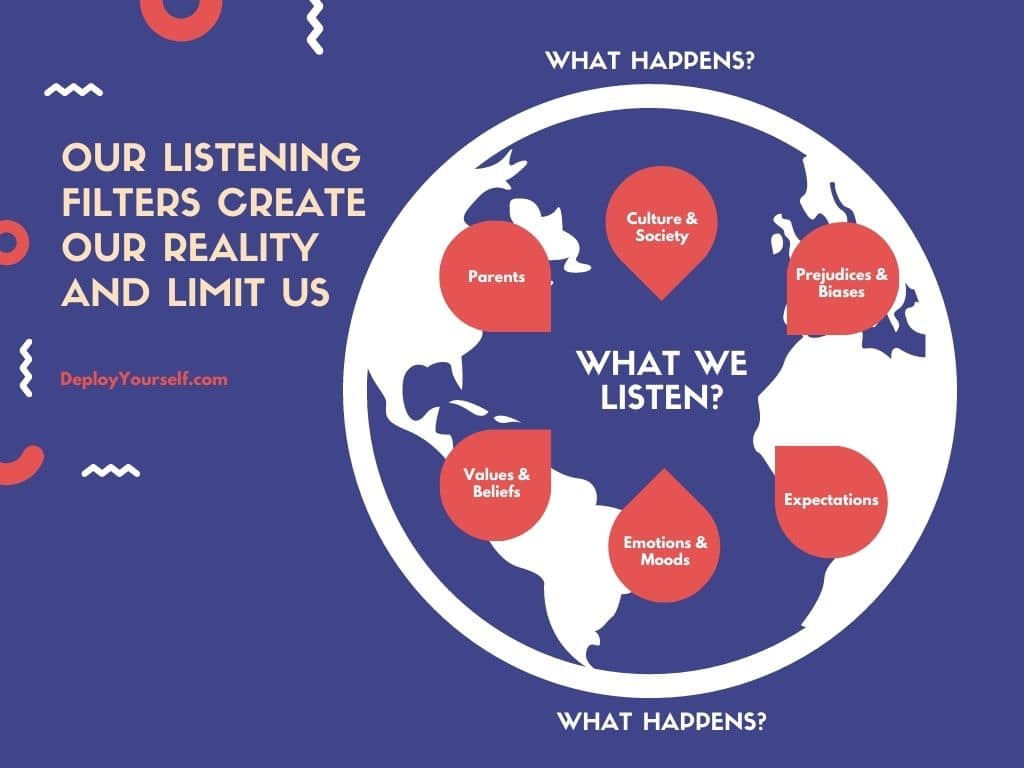
    I had no idea that many years later, I was to discover a kind of cataract — in my vision and listening. The cataract which I am talking about are our listening filters. As I shared briefly in my article about Listening, these filters helps each one of us create our own perceived reality which helps us in making every decision — big or small — of our lives. However, unless we know the various listening filters at play, we don’t see our reality as a perception but as the absolute truth.

    Whenever we see or hear something, we select what to pay attention to and what to ignore, often subconsciously, based on a certain set of filters. A simple example could be someone speaking our name. Even if we are in a crowded room, we will instantaneously pay attention if someone utters our name, even if they are behind or far away from us. Our filters make us give more attention to our name than any other word.

    Similarly, other listening filters make us pay more attention to certain things and ignore others. They can make one of us cry and another laugh on hearing the same story. They allow us to make sense of the situation in front of us, which creates the foundation on which we base our decisions.

    What are these Listening Filters?

    1. Parents

    Our parents are our first contact with humanity. As we grow up, our parents influence us the most. As we try to understand the world around us, our parents tell us stories to make it easier for us to navigate it. Everything that we consider as our most basic self – our religion, language, values, our political affiliations — are shaped by our parents more than anyone else

    Subconsciously we learn to listen to the outside world through them. Depending on what our parents think, and how they act, we learn to make our own choices and judge other’s choices. We either end up see the world as they do or rebelling against them and view the world contrary to how they see it.

    2. Values and Beliefs

    We filter everything we see and listen through our values (how we define right & wrong), and political, religious and other strong beliefs. For example – If a person has suffered racial discrimination in the past, he is likely to filter all future interactions with suspicion and caution.

    If we hear what is in tune with our values and beliefs, we feel relaxed, joyful, and get an ego boost which can easily be seen in our body language. When we hear or see something contrary to our beliefs, we are surprised and might even feel pain and shock. We feel our muscles tightening, which can develop into stress, frustration, and anger. Again, this is visible in our body language.

    3. Culture – Language, Society, Religion

    We behave in the world according to the religion we follow (or not), the languages we speak and are spoken around us, and the norms of the society we live in. Whether we are direct or vague in our communication, whether we are disciplined in our daily dealings or not, whether it is polite to accept a gift or not, and other subtle things in our daily life — are shaped by the culture of the land we live in.

    4. Intentions, Expectations and Mood

    We enter every conversation with an expectation of the outcome. For example – my expectations are very different when I talk to my colleague at work compared to when I run into him over the weekend. Similarly, my expectations differ when my wife calls me up at our usual time, and when she calls up unexpectedly during the middle of the day. What we listen to in these different circumstances is shaped by what we expect to happen.

    Our listening is also shaped (or filtered) by our mood. At the end of a long day when we are tired, if we don’t get our expected response in a meeting, we might easily get frustrated and angry. But if we get the same response at the beginning of a day when we are fresh and energetic, we might respond in a totally different manner. The difference in both these cases is our mood impacting our listening.

    5. Personal Prejudices

    We all have certain personal prejudices, which can be racial, economical, or something even more subtle – like the way one dresses. We listen and treat people differently based on these prejudices, most often on a subconscious level. An example is considering one colleague more ambitious than another based on how they are dressed. Another example is how we listen when we are approached by a homeless person on a street. Do we trust them when they approach us for money or think about whether they are just going to use the money to get drunk?

    We all have such personal prejudices formed over the years which live in our subconscious and give us a filtered view of the world around us. We are likely to ignore anything that opposes these prejudices, and very likely to agree and bond with anyone who shares the same prejudice as us. For instance, if we have a personal dislike for a person, we are likely to be dismissive about his ideas. On the contrary, when we interact with people we admire, we might behave over-optimistically in situations which warrant more caution.

    Does everyone have the same filters?

    Absolutely not. Just like our fingerprints, each one of us has unique listening filters. Based on our past, we all filter how we experience the present and make meaning of what we see and hear. Furthermore, our listening filters are changing (or evolving) daily based on new people we meet, successes and failures we have, and prejudices we form.

    Our listening filters give each one of us a unique view of the world around us. These filters are almost like glasses through which we view the world. We put on our black glasses, and then complain the world around us is black. Not only that, we argue and fight with others wearing red glasses that the world is black and not red. Sounds silly, isn’t it! Yet we all do it.

    What can we do about them?

    Every decision we make, whether it is trivial or a life-changing one, depends on how we assess the situation. Our listening filters help us create this assessment, which in turn limits the options in front of us. If two people act differently in the same situation, the difference is in their assessment of it. Reality is the shaky foundation on which we all rest our decisions.

    As you read this article and understand it through your own filters, don’t be led to believe that there is something wrong with having them. Instead, they are very useful in giving us a set of options in each situation that help us navigate through life. However, we are normally blind to the fact that these filters give us our perspective of life in each moment. If more aware, we are likely to understand how others see things differently.

    Knowing that others may see the same situation differently can help us stay humble in challenging times. Being aware that our listening filters limit our available options can give us a big picture view and bring a smile on our face in stressful situations. In doing so, we don’t have to throw away our colored glasses through which we view the world, we just have to be aware of them. And perhaps, try different ones for a while.

    Making an attempt to sincerely view a situation from the other person’s point of view is what Real Listening is all about. If we can do so, we will make our conversations a bit more constructive, our days a bit more fun, and our relationships a bit more meaningful.

brain care coaching commitment communication conflict conflicts conversation culture deployyourself deploy yourself emotional intelligence emotions empathy energy feedback freedom future gold habits hope john maxwell language leadership lessons listening performance perspective preparation productive productivity psychological safety purpose questions relationships resolution ryan holiday seth godin simon sinek strengths struggle team trust values words