future

  • 7 Essential Work Skills For The Future – The 2020s And 2030s

    Do you remember a time when you couldn’t ‘Google’ something? Or had to rely on a piece of paper to find your way to a location? Or when ‘social networking’ just meant meeting up with people in real life?

    Our world is changing fast, with new technologies and ways of doing business. So much has changed since 2000 – and the next 20 years will be no different. 

    For instance, you probably cannot imagine carrying around a bulky mobile phone, camera, dictation machine, and PDA (personal digital assistant) all the time, but in 2000, this was commonplace for many professionals. Similarly in the next 20 years, things like 3D printing, Artificial Intelligence, 5G, Virtual and Augmented Reality, and Quantum Computing, will completely change how we work and the way we work. 

    Technologies like the internet, smartphones, and GPS changed the way we work and live. Apps like Whatsapp, Instagram, Netflix, and Google Maps have changed entire industries. Similarly, technological leaps in the next 20 years will not only change what we do but also how we do work, irrespective of which country or industry you work in.

    The coronavirus pandemic has already accelerated this change and helped some technologies like video calling to come to the forefront. People will need to adapt to this constantly changing landscape to stay relevant and perform well. 

    Below are 7 workplace skills everyone will need in in the future – the 2020s and beyond that.

    1. Multi-Disciplinary Thinking

    What differentiates a smart machine from a human brain? It is the human brain’s ability to make sense of things. Multi-disciplinary thinking is the skill that enables us to make sense of things, make the connection between complex things, and foster a curiosity to learn new things. 

    Even with the advent of AI and with machines getting smarter, multi-disciplinary thinking, (or as a university from Phoenix puts it, ‘sense-making skills’) will always be critical in the workplace. And this is the one thing machines can’t do, at least not so far.  

    A multidisciplinary approach involves taking cues from different disciplines or areas, and making connections that most people might miss. You can use this skill to approach problems differently, redefine them, and come up with unique solutions. 

    For instance, if you work as an engineer, in a medical environment, you should have a working knowledge of medicine and health. This will help you plug the gaps between these disciplines, and make connections that others would miss. 

    A biomedical engineer may work with doctors, scientists, and researchers to come to a solution or complete a project. And even though people with different skill sets complement each other, and provide different parts of the jigsaw puzzle – you need someone who can take a multidisciplinary approach and make the connection between the scientific, medical, and technical ways of thinking. 

    Computing pioneer Jaron Lanier says, “if we ask what thinking is so that we can then ask how to foster it, we encounter an astonishing and terrifying answer: we don’t know.”

    No one can know everything, but you can work to understand the big important models in each discipline at a basic level so they can collectively add value in a decision-making process. 

    – Charlie Munger 

    2. Emotional Intelligence

    Emotionally intelligent people have an upper hand in the workplace because they can quickly understand the emotions of those around them, and act accordingly. This helps to de-escalate conflict, motivate your employees and coworkers, and stay on top of your own emotional responses. 

    Being able to regulate your emotions and be seen as an empathetic, sensitive coworker goes a long way towards building your worth as an employee or manager. And as the world grows more multicultural and diverse, empathy and emotional intelligence become even more important

    You could be working with people of different ethnicities, different nationalities and diverse cultures. If you are good at forming strong connections with people, it will go a long way towards cementing your position as a valued collaborator. 

    In addition, a high emotional quotient will help you see when one of your employees or coworkers seems angry, frustrated, or upset. This helps you ward off potential conflict by getting to the root of the situation and acting as a source of support and encouragement for your employee. 

    For instance, if you see a normally competent employee acting unreasonably, you could invite them for a quick chat over coffee or lunch, and try to understand why they’re upset. You could say, “I noticed you haven’t been yourself today, is something bothering you?”

    “When dealing with people, remember you are not dealing with creatures of logic, but creatures of emotion.” – Dale Carnegie

    3. Creative, Out-of-the-Box Thinking

    Your ability to think out of the box and come up with creative solutions is a huge asset to any organisation. And you can be creative in any job – creativity isn’t just limited to artists, musicians and writers. 

    Creativity isn’t just about creating artsy designs or being inventive. If you are able to approach a problem differently from others and connect the dots between different processes to come up with a solution that works, you are creative. Problem-solving is an example of creativity, and so is the ability to arrive at win-win solutions. 

    According to the World Economic Forum, “creativity, innovation, and ideation will be key skills for the workforce of the future. These so-called soft skills, which sit alongside analytical thinking and problem-solving, will replace manual tasks that become automated”. 

    In the 2020s and beyond, it is very important for you to see your coworkers as valued collaborators, not as your competition, and work together to arrive at creative solutions. 

    “With the avalanche of new products, new technologies, and new ways of working, employees are going to have to become more creative in order to benefit from these changes. Robots may help us get to where we want to be faster, but they can’t be as creative as humans (yet).’

    Alex Gray, World Economic Forum senior writer

    For instance, in the 1800s, cars were considered expensive toys for the rich. They were expensive and time-consuming to produce. But a creative and innovative solution by an automobile company apprentice cut down production time from 12 hours to 2 and a half hours and the price of a car from  $850 to $290. 

    This creative solution changed the face of the automobile industry and made the apprentice, a man named Henry Ford, a legend. From being a luxury item, cars became a necessity for the average American. 

    “Logic will get you from A to B. Imagination will take you everywhere.” – Albert Einstein

    4. Logical and Data-Driven Reasoning 

    Critical thinking is a valued skill that very few people have. And it isn’t just about arriving at solutions. Critical thinking includes the ability to think logically, use facts and data to arrive at conclusions, and grasp numbers easily. 

    You can develop this skill by training your mind to solve problems and approach everything like a puzzle to be cracked. In addition to critical thinking skills, those who are good with technical skills like programming, building and understanding algorithms, statistics, probability, and machine learning, will also be in high demand in the workplace. 

    For instance, your company has just launched a new product, but you don’t have any buyers. Logical reasoning skills can help you figure out why – there could be similar products on the market at a better price, your potential buyers may not trust you, or your product could be missing a crucial element that makes it successful. 

    Here are some ways to enhance your logical and reasoning skills; 

    • Learn to think critically. You can do this by questioning ideas and assumptions rather than accepting everything you are told.
    • Try paying attention to how you react in different situations. This will give you a deeper insight into your biases, and your emotional triggers. Analyze every situation and try understanding the reasoning behind your actions. 
    • Avoid judging people and making assumptions. Assumptions lead to unreasonable thinking. Watch out for the times you make assumptions based on flimsy reasons, and try to rely on cold, hard facts each time

    “Logical thinking keeps you from wasting time worrying, or hoping. It prevents disappointment. Imagination, on the other hand, only gets you hyped up over things that will never realistically happen.” – Jodi Picoult

    5. Virtual Collaboration

    The importance of sharing knowledge and collaborating effectively via video calls, emails, and messages, is growing every day, even more so in 2020 – when we are all working from home. 

    Teach yourself how to share knowledge via the written word, and through videos. The workplace of 2020 demands that you be comfortable collaborating, brainstorming, working, and socializing over video calls, and emails. 

    Also, the way people consume information has changed. Many people, particularly of the millennial generation, get 100% of their news from social media, and primarily through videos. No matter what industry you work in, you need to have a decent understanding of how your potential audience consumes content, information, and news, and where they spend most of their time. 

    And it isn’t just to appeal to a target audience, you may have to master the skills of communicating through videos and video calls just to collaborate with your coworkers. Remote work has become the norm, and with good reason. According to a Global Workplace Analytics study, – 36% of workers would choose to work from home over a pay raise.

    Being good at communicating digitally, and at expressing yourself well through videos, has become an essential modern-day workplace skill that everyone needs to have. 
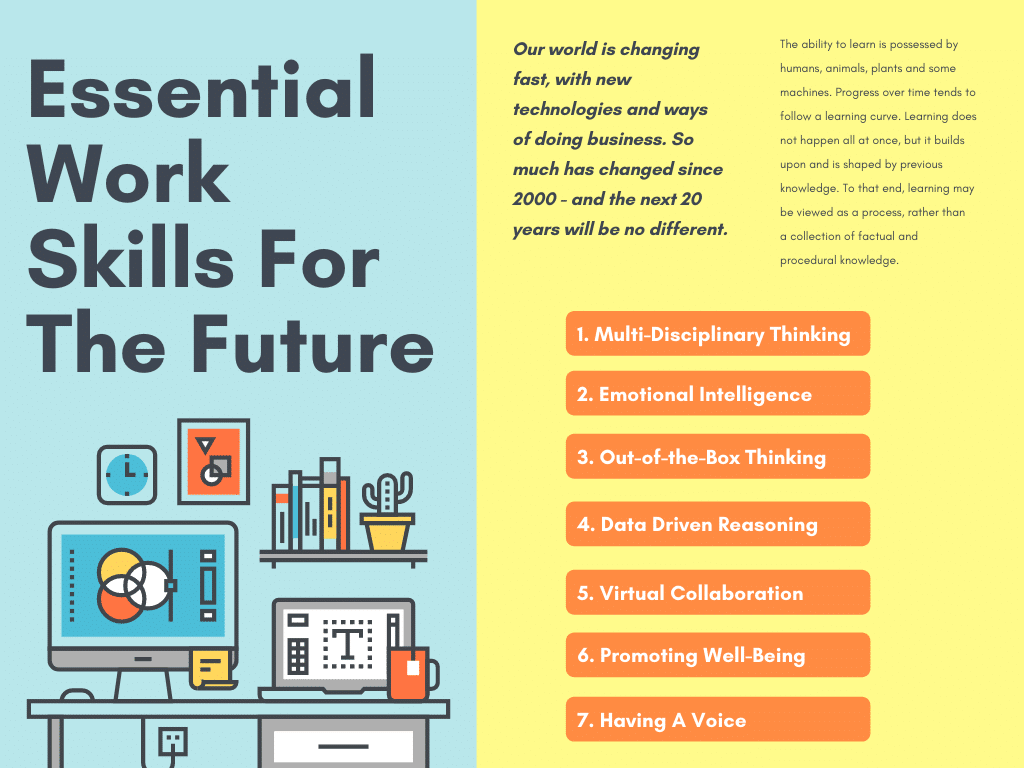
    6. Designing a Holistic Environment That Promotes Wellbeing 

    Work isn’t just limited to productivity, effectiveness, and speed. The workplace is made up of human beings, and the more you look out for their emotional and physical wellbeing, their health, and their motivation levels, the faster and more efficient their work will be. 

    In fact, there is a clear link between happiness and productivity. A study by Oxford University found that happy workers are 13% more productive than others. 

    Work to build an environment where your employees’ and coworkers’ health and emotional wellbeing is prioritized. Check-in with them regularly, and show them that you care about them on a personal level. 

    One way you can do this is by creating helpful ‘nudges’. Nudges are notifications or reminders to remind someone – an employee, a coworker, a manager – of a particular behavior or to trigger an action. 

    For instance, if you are a manager and you hire a new employee, you could set up a nudge to be sent to you reminding you of her 6-month anniversary and make you schedule a check-in meeting. Something as simple as this could positively impact your organization, motivate your employee, and help you keep track of how things are going with all your employees.

    7. Having a Voice

    Having a voice simply means that you are able to express ideas, opinions and even disagree freely. According to a Salesforce survey, employees who have a voice at work, and feel their voice is heard, report feeling 4.6X more empowered to perform their best work. 

    So how exactly can you be confident, overcome your impostor syndrome, and find your voice at work?

    Stand up for what you believe in. Be individualistic, brave, and never be afraid to speak your mind. In today’s world, courage and honesty are highly valued qualities in the workplace. 

    Here a few more ways you can have a strong voice and express yourself at work:

    • Offer Solutions 

    Problem-solving is an important and valued skill in the workplace, and by offering solutions to problems, you can contribute in a meaningful way, while enhancing your value to the organization. 

    • Speak Up in Meetings

    Whether it is asking a question, suggesting an idea or weighing in with your opinion, don’t hesitate to speak up in meetings when you have something to contribute.

    • Ask Yourself How You Can Help 

    Try to think beyond the confines of your role, and see how you can make someone else’s job easier, or help to grow the company. Valuable ideas can come from anywhere, from an intern to the CEO. By going above and beyond, and sharing your best ideas, you make your voice stronger and build credibility. 

    Holding strong opinions and voicing them without fear shows that you are passionate about your work and are strongly committed to a positive outcome. More importantly, when you have a strong voice at work and are able to say what you think and believe, you can promote a more equal, kind, just, and inclusive workplace. 

    Adapting to a Changing World

    The world is changing, and those who don’t adapt quickly will be left behind. You have seen how different 2020 was from the years right before it, and the future will be no different. As the world moves ahead in leaps and bounds, learning these crucial workplace skills will help you stay relevant and be an asset to your organization. 

    References

    1. New Research: How Leading with Equality and Values Impacts Your Business
    2. 5 things you need to know about creativity
    3. 10 Job Skills You’ll Need in 2020 and Beyond
    4. Costs and Benefits
    5. Happy workers are 13% more producti
  • The Top Three Tragic Myths Of The Times We Live In

    “It was dark and quiet, and it took me a few seconds to stand steady on my feet. Well, that’s what happens when you have to get up at 2am to go to the bathroom. But things were going to get worse.

    Just as I began to walk, I suddenly jumped and screamed. Something was crawling on my feet. It felt like a spider and I reached for the light switch. When the light turned on it turned out to be a piece of thread that had been lying on the floor. Apart from the disappointment of jumping for no reason, I was wide awake now!”

    Just as it happened to me, we often get scared of an insect or a rat, but when we turn on the light they are just objects lying around. But our senses gave them an illusion of being an insect or a rat. Building upon this analogy, everything else in life – our riches, our troubles, and our possessions are illusions and a mirage created by our mind.

    “Reality is merely an illusion, albeit a very persistent one.” – Albert Einstein.

    Taking this notion forward, this article of mine is going to dwell upon why life itself is a myth, and how each one of us is driven by some ‘absolute‘ truths that are nothing more than widely accepted myths. These myths drain the life out of our days and take us onto paths of mediocrity and obscurity.

    Below are the three such myths I think we all encounter in everyday life. (Give them some time to sink in, as they very well might be absolute truths for you.)

    1. You Have to Work to Survive

    The biggest myth of our times is ‘having to work‘ to earn a living for surviving. Right from our birth, everything is setup to create this illusion. Our education system, the economic system, all the news and shows on TV and the movies we watch. As we grow up, this myth becomes very ‘real‘ for us. The only thing from our childhood which we term as illusions are the cartoons we watch. Did you ever wonder why everyone loves cartoons?

    There is a common misconception that work is necessary. Over decades and centuries, every rock is chipped away into sand and dust. Work can do the same to our lives and souls. Day by day, hour by hour, our work can chip us away into disintegration.

    If someone tells you they are “making a living”, they can’t be more wrong. They are making a dying, and most probably fast spending whatever little time they have doing things out of compulsion rather than the pure desire of doing it.

    Instead, what we can all do is PLAY. Go out and do what you want. Find something you love doing, something you are passionate about.

    DisclaimerWork and Play don’t have to be mutually exclusive. If you can find a way to play while at work, nothing could be better.

    Many people say they don’t know their passion or hobbies, or they have not discovered them yet. Here is a formula – Look into your life, and the things you do for which you pay others are your hobbies and passions, and for which you get paid and compelled to do is work.

    DO NOT spend the vast majority of your life working so that you can play in the end. That end might never come, or which might be tomorrow itself, for all you know.

    2. Planning and Living for the Future

    We live in a world where insurance and pension policies, investments, education, business, almost everything is done with an objective to achieve something in the future. While planning for the future has its benefits, I believe we often take it too far and miss the only time we really have, which is “now”, or this very moment.

    Who gave you the guarantee that you will not die tomorrow, next week or next month? What made you believe that you are going to die at 70 or 80, and not at 20 or 30 or 40. If you don’t believe it, read and watch the news. People are dying every day at all ages. The average age might be 70 or 80, but ask yourself – Do you really want to live your life based on a statistic?

    Instead, LIVE NOW. Enjoy whichever phase of life you are in. Be in each day fully, rather than counting the days. Live your life in a way that you are satisfied even if you die tomorrow or the next second. Make every breath count. Don’t wait for tomorrow if you want to fall in love, travel to your dream destination, or eat that favorite ice-cream of yours. Do it NOW (or at least pick a date in the calendar and book tickets now).

    Fall in LOVE with life, not just with a few selected people, things and ideas. Whether you make 1 grand or 1 million, whether you live in an apartment or a mansion, embrace life fully NOW and don’t let your goals and milestones in life decide the level of your happiness or joy.

    3. Control and Consistency

    The next big myth we base our lives on is aiming for control and consistency. We plan and build systems, and we make rules and processes to make our lives more comfortable and smooth. But the very fact that we can control life is the biggest lie that we tell ourselves.

    Life, by its very nature, is messy and unpredictable. It is not fair and nobody is entitled to get anything out of it. In school, if you study more, you get better grades and vice versa.

    The same doesn’t hold true in life, as there are so many other factors at play other than your efforts. The sooner we realise this the better. Good and bad things will happen to you. Your education, job, the country you live in, or any other reason which gives you the illusion of safety, is a very bad armor against life.

    Instead, be FREE from these controls. Embrace the uncertainty of life and experience real FREEDOM. Go out and play. Learn a new language. Take a new job, or live in different cities/countries and soak in different cultures. Write, paint, or do anything else that makes you experience life rather than draining the life out of you.

    Don’t try to be nice or do what is expected. Don’t live for the gallery. Be authentic. For a change, LIVE for YOURSELF. Let yourself be misunderstood, hated, judged, or whatever, but live by your convictions. It is better to be assassinated by another human being than being assassinated by death.

    Conclusion

    Our thoughts (and perception of reality) shape our decision and in turn our circumstances. It is like watching the same movie again and again. If we want to play a different movie in our life, we have to change the tape.

    And rejecting the above myths might be the first step. Thoughts arise in the mind, and we become aware of them. But over time, we stop seeing them as thoughts and see them as reality. Therefore, we should never stop to question our thoughts and the reality they form.

    Life is a mirage. An earring and a bangle are both made out of gold. But our thoughts make one an earring and another a bangle, but in essence, both are only gold. Yet we only term what we see while asleep as dreams and not what we see while awake. In essence, both are illusions created by our senses. We must never lose sight of that.

  • Five reasons you should join the Dandi March II walk in your city

    81 years after Gandhiji did the Dandi March to shake the British Empire, it’s happening again. Concerned citizens of India all over the world are marching in over 80 cities against corruption in India. Corruption has become the new colonialist in India. The politicians, bureaucrats and other officials are engaging in corruption without fear or shame. They have exploited the democratic system and the huge poverty in India to their advantage. It has become almost impossible to remove them from their offices, leave alone punish them or recover the money lost due to corruption. The demand and objective of this Dandi March 2 is to pressurize the Indian government into enacting the Jan Lokpal Bill‘ which has been advocated by noted social activists like Anna Hazare, Kiran Bedi, Arvind Kejriwal, and others.

    Walk together against corruption
    Walk together against corruption

    Dandi March 2 is happening all over the globe. Check out here and find out if it is happening in your city. If not, you can take the lead in organizing a small march in your own city. Remember, it is the collective intention of Indians marching in different cities that will help put pressure on the government to take action. Here are five reasons why you should join the Dandi March II walk happening in your city –

    1. Enough is Enough
    While you have been busy eating popcorn and watching that latest movie on television, our politicians have been eating our hard earned money we have paid as tax. They have sat in parliament, assemblies, offices and framed laws and made systems which make it easy for them to continue their brazen acts of corruption. They have neglected the complaints which few people have raised against them, and used the law, the police, and even the mafia to deter and scare such people. It is time that YOU wake up and demand accountability for YOUR money.

    2. Sheer volume of corruption
    The 2G scam has rocked the telecom ministry in the Indian government, and even the Indian Prime Minister has taken a flak from the Supreme Court. The amount of Rs 1,76,000 crore which the exchequer lost due to the 2G scam is mind boggling. The Commonwealth Games last year became a game of corruption with the whole international media being witness to the ‘tamasha’ going on. This has brought India widespread negative publicity and shame all over the world. It’s time to reclaim OUR pride from these looters.

    3. Gandhi’s dream

    Corruption is everywhere
    Corruption is everywhere

    Gandhi did not only dream of an Independent India, but also an India free of poverty. He dreamt of an India of equal opportunities to one and all, and equal right to justice irrespective of one’s social standing. Now our politicians, bureaucrats and babus ask for and take bribes openly sitting in a room with Gandhi’s portrait hanging there. It’s time we realize why we call Gandhi the Father of the Nation, and what we all owe to him, our Independence. Go ask your grandparents what it was living in an India which was not free. Just as a child can never repay his parents for showering him/her with life, we can never repay our freedom fighters what they have given us, our Independence. It is time we demand OUR Independence from corruption.

    4. We live in a democracy
    In the last few months, we have seen public protests uprooting governments in Islamic dictatorship nations of Tunisia and Egypt. These were countries where such mass protests are not allowed by law, but they could not stop people to get out of their homes for change. In our country, we are bestowed with a system to register our protest with the government under law. We have a moral obligation to go out and demand what is rightfully ours. It is also our duty as model citizens to put brakes on this practice of corruption which is eating our country from the inside. It is time for CHANGE.

    5. The Future
    I have always believed that this world is something we have borrowed from our next generations and before going we have to return it back to them. We should ought to return it back better than we inherited it. This was the vision every great mind has been inspired for. Gandhi dreamt for a free India for us. He himself lived only a few months in a free India before being assassinated. Many freedom fighters didn’t even see an Independent India when they died. They died for us. They struggled for us. Similarly, it is the future of a corruption free India which we have to see. In our vision, in our dreams, for our children and grand children. We have to get inspired from the dream of our future generations living in a just society. It is time to STAND for that dream.

    We Indians do for our children what no other country or society does. Our parents sacrificed a lot for this future of ours which they saw back then. We will do the same for our children. We don’t want them to ask us later that – Why did you not give me education? Why did you not give me values to stand in this world? Let them not ask us – Why did not YOU leave me a just and equal society to live in?

    It is time to hear that question NOW. It is time to STAND UP. It is time to WALK for the FUTURE.

anger anna hazare bangalore business challenge coaching conflict conversation corruption Cricket culture dandi march emotions energy friends fun gandhi giving gold growth hope india jan lokpal bill language leadership lessons Life listening love moment mother movie new year people perspective poem sachin tendulkar saleraja trust values walk waste women words world cup