March 2022

  • The Black Swan by Nassim Nicholas Taleb – Book Summary & Review

    Understanding Black Swan Events

    Often, humans lack the ability to define or understand randomness and give in to decision-making methods that heavily rely on intuition. The human perception of randomness and intuitions while making predictions and decisions can result in profound consequences individually, and as a society, often at the expense of accuracy.

    Nassim Nicholas Taleb coins the term ‘Black Swans’ to describe events that are thought to be impossible, yet redefine one’s understanding of the world. In his 2010 work, The Black Swan, Taleb points out these seemingly random events and their pitfalls. It is a guide to understanding one’s own shortcomings while making logical decisions and predictions, recognizing the human desire to fit information into easy-to-understand narratives as an outcome of clouded judgement, making better use of ignorance, and why it is detrimental to cling to one’s beliefs.

    Black Swans

    Humans are wired to derive meaning from all the information available in the environment. This ability to compartmentalize any stimuli received into meaningful information has led to understanding science and creating scientific methods, complex mathematical models and even philosophizing the nature of the being.

    However, these accomplishments do not indicate that humans are actually good at it. In fact, humans are predisposed to be narrow-minded and cling to their beliefs of how the world functions.

    The constant evolution and growth of human knowledge is a dogmatic approach that makes no sense. For example, doctors and scientists were supremely confident about their knowledge of medicine, just about two hundred years ago. Today, that very confidence they have seems ludicrous.

    A dogmatic approach to beliefs makes humans blind to anything that falls outside the paradigms of what is believed to be true and can result in massive surprises. More often than not, the surprise generates not from the randomness of the event or information, but from the fact that human perceptions and outlook is too narrow to accept it. These surprises are the ‘Black Swans’ that propel humans to fundamentally reconsider their beliefs and perceptions of the world.

    The term is derived from a very simple event. Earlier, people assumed that all swans were white. This led to all imaginations, depictions,  and associations of ‘swanness’ to the colour white. However, when they discovered the black swan, it fundamentally changed their understanding of what all a swan could be.

    It is thus necessary to accept that not all events are white swans, and not all events have the same outcome as previously experienced or take the course as previously believed.
    The Earth-Shattering Consequences Of Black Swans

    Let’s look at an example of what a ‘black swan’ event is. John always places his bets on his favourite horse Rocket. For about 3 to 4 races, her track record, her build, the skill of her jockey, as well as the lack of competition, has made Rocket a safe bet.

    With this in mind, John gambles everything on a sure-shot win once again. However, when the pistol is fired, Rocket refuses to budge from her place at all. Such a surprising turn of events is a classic example of a black swan event. Even though John had all the information, and had placed his bets carefully, he lost everything!

    On the other hand, the owner of the horse, Mr Wallis, knew that Rocket had been acting up the previous evening, and had placed his bets on another horse. The same black swan event had no effect on Mr Wallis, because he simply had a piece of information John did not.

    Black Swan events affect everyone in different ways. The deciding factor on how a black swan event will affect someone depends on the information one possesses. Simply put, the more information one has, the likely the person is to be affected by such an event.

    Moreover, Black Swan events differ in terms of the scale of their impact too. They can affect individuals, as well as whole communities and societies too. They can change the course of how the whole world works, impacting different areas of society such as theology, physics, and philosophy. Copernicus’ proposition that the Earth is not the centre of the universe has challenged not only the historical belief of the people but also the historical belief of the Bible itself and thus the authority of the ruling Catholics.

    This Black Swan event impacted Copernicus as an individual, as well as established a new beginning of belief for European society.

    How Logical Fallacies Fool

    Human beliefs are based on the information acquired in the past. Humans tend to create narratives because past experiences are seen as an indication of the future. This tendency is a fallacy that does not consider unknown factors that could throw curveballs into the belief system and leave humans open to making mistakes.

    Turkeys living on a farm are fed, watered, and cared for by the farmer. Accustomed to the past experiences, they are oblivious to the fact that the next day, they would be Thanksgiving dinner, eaten by the very people why fed and cared for them.

    Humans are like those turkeys on the farm, believing in the fallacy that predicting the future based on past experiences works. Thus such fallacies can lead to dire consequences.

    The concept of Confirmation Bias is one such fallacy, wherein people tend to look for evidence to support their own beliefs, to the extent that they even tend to ignore evidence that contradicts their beliefs. Humans tend to not only ignore contradictory evidence, but they are also unlikely to accept it and even look for sources that could help undermine the contradiction.

    People who think that climate change is a conspiracy theory, are likely to get upset if they see the documentary called “The Undeniable Evidence for a Changing Climate,”. In fact, they are more likely to search the internet for information on ‘climate change hoax’ rather than “evidence for and against climate change.”

    Belief in such fallacies is sewn into the very nature of humans. They are bad habits that aren’t easily shaken off.

    Accurate Predictions Are Difficult Due To The Way The Brain Categorizes Information

    The human brain evolved to survive the wild, adapt fast and learn to deal with danger quickly. Today, the inherent danger has been replaced by complexities. Hence, the way the brain evolved to categorize information to survive the danger, is practically useless today.

    The Narrative Fallacy, where humans use linear narratives to describe situations is an example of how humans incorrectly categorize information. According to this method of information categorization, the brain selects only the information it considered important out of the tons of information it is bombarded with daily, to make sense of it. For example, the brain chooses to remember what food was eaten for breakfast rather than remember different types of cars it saw on the way to work.

    Moreover, the brain tries to turn all the unconnected bits of information retained into coherent narratives. For example, a person selects only those events in their life that seem important and arrange them in order if she wants to reflect on how she became who she is. So this person connects her love for music because she remembers her mother singing to her every night before bed.

    This method of creating connected, coherent, narratives, however, doesn’t give one a meaningful understanding of how the world works. It doesn’t take into account the infinite reasons that could have contributed to any one event. It only considers the past. The fact of the matter is that even the tiniest, most insignificant event could have massive, unpredictable consequences.

    Differentiating Between Scalable And Non-Scalable Information

    Humans, unfortunately, do not have the ability to differentiate between different types of information, despite inventing many models and methods of categorizing it. However, understanding the difference, especially between scalable and non-scalable information is crucial.

    Non-scalable information like weight and height of the body has definite, statistical lower and upper limits. For example, while a person can weigh 1000 pounds, it is impossible for anyone to have a weight of 10,000 pounds. These physical limitations make it possible for people to make meaningful predictions and averages.

    Scalable information, on the other hand, such as the distribution of wealth and sales, is abstract. There are no limits to how much sales a digital album could make if sold on iTunes. The sales numbers on digital platforms are not determined by the number of physical copies manufactured. Furthermore, for online transactions, one isn’t limited by physical currency to prevent one from selling a possible billion digital albums online.

    To get an accurate picture of how the world works, understanding the difference between scalable and non-scalable information is important. Applying the rules of scalable data to non-scalable information only leads to errors.

    For instance, to measure the wealth of the population of England, one has to simply work out the per-capita income, by adding the total income and dividing it by the number of citizens.

    But since wealth is scalable data, and there is a possibility of a small percentage of the population having a large amount of wealth, using per-capita to calculate the total wealth could result in inaccurate outcomes.

    Overconfidence In Beliefs

    Humans are, by nature risk-averse. Thus, to be safe from harm, people try to assess and manage the possibility of risk. People try to measure risk as accurately as possible, all while trying to not miss out on opportunities.

    To do this, people evaluate possible risks and then measure the probability of these risks materializing. For example, while buying insurance, people try to choose a policy that gives protection from the worst-case scenario, yet not is a waste of money. People try to make this informed decision by measuring the threat of accidents or disease against the consequences if those do happen.

    Unfortunately, humans fall prey to ludic fallacy,  a tendency to be overconfident of knowing all the possible risks that they need to be protected from. They tend to handle risk like they would a game, with probabilities and a set of rules that are pre-determined before they actually play it.

    This approach is based on the ludic fallacy. For example, for casinos, the major threats might not be thieves or lucky gamblers. Threats to the casino could be utterly unpredictable, like an employee that fails to submit the casino earnings to the IRS, or a kidnapping of the casino owners child.

    The fact of the matter is, that no matter how much one tries to assess or calculate the accuracy in risk, there is too much uncertainty to factor in every bit of it.

    Ignorance Is Not Always Bliss

    There are two contradicting thoughts, ‘knowledge is power’ and, ‘ignorance is bliss’. While both have their merits depending on the situation, it is far better to be aware of what one doesn’t know.

    Focusing only on the knowledge one has can limit one’s perception of all possibilities, in any event, creating the perfect base for black swan events. Consider a person in the US in 1929. This person plans to purchase stocks in a company and has been studying the market trends from 1920 to 1928. While he assesses the highs and lows of the market in the past 8 years, he notices that the trend is generally upwards. He then invests all his savings in the market. The next day, however, the market crashes and he loses everything.

    This person focused only on the information he had about the past 8 years. Had he noticed the trends of booms and busts from a little ahead in time, he would have probably been better prepared.

    Poker players, especially the good ones, have an understanding of what they don’t know. For example, they know the rules of the game, they know the cards they hold, and they are also aware of the fact that the opponent could have better cards than they do. However, they are also aware of information that they don’t know such as, the opponent’s strategy and how much the opponent can stand to lose.

    By simply being aware of what they don’t know, they are able to strategize and make a better assessment of risks in playing their hand.

    Understanding Limitations Leads to Better Choices

    We have established that it is necessary to have a good understanding of the tools one uses to make predictions. However, it is far more important to understand the limitations of those tools. 

    While knowing limitations isn’t a sure-shot strategy to escape the consequences of every blunder it can help in reducing the number of bad decisions one makes. For example, a person who is aware that he is subject to cognitive bias finds it easier to recognize that he is only looking for information that confirms his beliefs.

    Thus if one understands that humans have a tendency to organize everything into casual, neat narratives and that this helps to simplify the complexity of the world, one will be more likely to look for more information that enables one to get a better view of the whole picture.

    Even a small amount of this kind of critical analysis, and knowing one’s own shortcomings can give a person an edge over others. For example, if one is aware that there could be unforeseeable risks in an opportunity, one will be careful to not heavily invest in it, even if it seems extremely promising.

    One can at least, mitigate the damage of ignorance, even if one cannot understand the complexity of the world or win over seeming randomness.

    Conclusion

    Humans are bad at making predictions. They have full confidence in the knowledge and underestimate their ignorance. Humans need to understand that Black Swan events occur due to over-reliance on seemingly sensible methods, their inability to define or understand randomness and even the basic human biology that leads to bad decisions.

    Nothing can truly prepare one from Black Swan events that can change the course of one’s life or even the world. However, simply being aware can make all the difference!
  • Issue #49, 29 Mar 2022 – Do you have a best friend at work?

    Welcome to the Deploy Yourself Newsletter, where I share what impactful leadership looks like to show your own power. I also share the most insightful lessons and stories I encountered in the last two weeks. You can also read this issue online.

    Hey,

    Do you have a best friend at work?

    We normally do not talk about friendship at work. Neither is it spoken about in business schools, board rooms, or at other strategic meetings.

    However, one of the main questions in Gallup’s famous surveys is – “Do you have a best friend at work?”

    Why do they ask this question?

    Because, in their own words, “research has repeatedly shown a concrete link between having a best friend at work and the amount of effort employees expend in their job”.

    Research shows that having a best friend at work can double an employee’s engagement.

    Imagine the massive boost of engagement and performance if an entire team has multiple strong friendships among them.

    Gallup has also found that only 8% of workers who didn’t have a best friend at work were engaged.

    Friendship is not only about having a good time, it also leads to better customer satisfaction ratingslower rates of workplace misdemeanour and higher levels of service.

    So what can you do to build friends at work?

    1. Listen not just to what people are saying, but to what they care about – what is behind their words
    2. Share openly and give them a peek into your life – be vulnerable
    3. Do what you say, irrespective of how small or big it is. Or, apologise and make amends when you mess up.

    Have you had strong work friendships – either currently, or in the past? How did it impact your performance?

    What can you do to become a friend to the people around you – irrespective of whether you are a leader or not?

    Reply back and share any insights. I read and respond to every reply.

    Articles and Stories Which Have Fascinated Me

    One

    The Unusual Books That Shaped 50+ Billionaires and Prodigies

    In this article, Tim Ferris shares a mega-list of the most-gifted and favourite books of 50-60 people like billionaire investor Peter Thiel, Tony Robbins, Arnold Schwarzenegger, elite athlete Amelia Boone, Malcolm Gladwell, legendary Navy SEAL Commander Jocko Willink, Dr. Brené Brown, music producer Rick Rubin, chess prodigy Josh Waitzkin, Glenn Beck, Reid Hoffman, Marc Andreessen, and many more.

    Find the full list here

    Two

    Using Data to support employees on a human-level

    This article talks about how their VP of Engineering, Ale Paredes, used data to diagnose and then implement new practices which led to increased empathy and productivity with their remote employees. In her own words,

    “We’re not trying to behave as if it’s business as usual, because it’s not business as usual.”

    After diagnosing the data, she found that “People didn’t have the same amount of context. We used to rely on the fact that we were all together in the office so that if I had something to say, the person next to me would hear it…our team is small enough that usually, everyone on the team has context.” This led them to implement 4 major changes.

    1. They created systems for intentional public communication.
    2. They leaned more heavily on documentation.
    3. They wrote down and shared their plans
    4. They fostered a culture of sharing

    From an article on Code Climate

    Three

    How to Break a Bad Habit

    Research shows that most of what we do is a result of habits – whether good or bad.

    Most of the time, bad habits are simply a way of dealing with stress and boredom. Everything from biting your nails to overspending on a shopping spree to drinking every weekend to wasting time on the internet can be a simple response to stress and boredom.

    All of the habits that you have right now — good or bad — are in your life for a reason. Because bad habits provide some type of benefit in your life, it’s very difficult to simply eliminate them.

    It is better to replace your bad habits with healthier behaviour that addresses that same need. If you expect yourself to simply cut out bad habits without replacing them, then you’ll have certain needs that will be unmet and it’s going to be hard to stick to a routine of “just don’t do it” for very long.

    From an article by James Clear

    That’s it for now. If you have any questions or feedback, or just want to introduce yourself, hit reply. I read and respond to every reply. All the best,

    Sumit

    (Twitter) @SumitGupta
    (LinkedIn) Connect

  • Leadership Journeys [13] – John Featherby – “What I’m doing with my time is why I’m here!”

    This is the Leadership Journey series on the Choosing Leadership Podcast.

    I believe we all have a lot to learn from each other’s stories – of where we started, where we are now, and our successes and struggles on the way. With this series of interviews, my attempt is to give leaders an opportunity to share their stories and for all of us to learn from their generous sharing.

    In the interview, John talks about how can we make work a place where people can seek and find dignity, uncover who they are and find joy in what they do, in addition to just making a living. He opens up about his faith, about our tricky relationship with money, and he shares that what he does today is the reason he is here. We also talk about the importance of having people to lean back on and of celebration in the context of leadership.

    You can find John at the below links

    In the interview, we talk about

    • How do we kind of rescue the company in a way and provide a place where people can seek and find dignity and who they are and joy in what they do and as well as making a living?
    • It’s more that we lost our way and we forgot, what was important or we separated what we felt was important from what we actually did.
    • I think the pandemic has accelerated this question around that people wants to do meaningful things with their time.
    • The company of the future is going to be quite different, but for a number of different reasons, not just meaningful work, The family structure has changed. People who go to work have changed and digital, the digital landscape has changed. The regulatory landscape is changing. Almost everything has changed except for the structure of a company.
    • A very rampant individualism has made people feel like I can force my will on the world. And the companies have felt the same, but I think are increasingly finding that it’s not quite as forward. And you’re not quite as in control as you thought.
    • Our purpose is to restore joy, meaning and freedom to every workplace.
    • It is starting to see money as a tool, as opposed to something that you have rather than it has you.
    • How do we use money more wisely? How can we redirect its energy and power in a positive direction as opposed to just being captured by it all the time?
    • I think trade has always been part of the human experience and it always will be, but I think we are perhaps moving beyond the sort of obsession with consumerism and material identification.
    • The real problem is in people. It’s in their hearts and souls and that spirit, why do I do this? What matters to me? How am I going to treat people? What level of courage do I have? How much sacrifice could I cope with?
    • You might need some painkillers, but long term, if you really want to change, you’re going to have to put in the effort.
    • I have a faith myself I do lean on that and have my kind of rituals or prayer or whatever that helps me feel.
    • The bigger that responsibility gets the lonelier. And with it comes more wealth and in the world’s eyes, more power, but it can be extremely isolating.
    • It is really important to, even with the small things, to take time out, to feast and celebrate and find gratitude and joy in what you’re doing.
    • I quite like challenging the stereotype of who I am, I come from a particular background and, sometimes that means in some situations, people make assumptions about how you’re going to see the world. And I enjoy sometimes disrupting those and then being surprised at what my perspective on something might be or what I might say.
    • How do we design education to support children becoming adults for jobs that are not only very different from the average professional of my age, but potentially not just companies that aren’t there, but whole sectors that might show up?
    • When big companies start talking about questions of purpose and meaning in work, these are such deep human questions that I think it is a mistake for them to imagine that they can control those in a kind of manufactured and corporate way.


  • Wired for Story by Lisa Cron – Book Summary & Review

    Writing To Attract The Brain

    Storytelling is an art. Moreover, writing compelling stories that appeal to an audience, intrigue them, and keep them coming back for more, is a science. Writers today, have a clear advantage over the writers of the past. They have science on their side and can use the power of brain science to write better, compelling stories.

    Wired for Story (2012) by Lisa Cron delves into the human brain to understand what type of narratives appeal to the human brain, and how writers can tap into some of the fundamental techniques that can make their readers come back for more!

    The Evolution of The Love For Storytelling

    Why do humans love stories? 

    Stories have been a part of humanity since the beginning. Exchanging stories was the most effective manner of communicating lifesaving information that human ancestors had. Humans thus evolved to pay attention to stories, which was hardwired into the human brain, enabling humans to visualize the future, and even prepare for it.

    When a story captivates a person, it is because dopamine, a neurotransmitter gets released in the brain, causing interest and concentration to heighten. This process is also attributed to evolution.

    To understand how this process worked, imagine a Stone Aged man telling another how his child ate some red berries nearby and almost died. Hearing this, the second man might have learned how to keep his own children away from those berries and out of danger.

    To get a deeper understanding of this evolutionary practice, modern neuroscience helps by stripping it down further. It shows that the brain processes the information in the story like real life and becomes a stimulating learning experience. Such stories teach how to ward off danger without even experiencing it oneself.

    Hence, in ancient times, learning that approaching a tiger is dangerous through a story is better than approaching itself and finding out for real. While both, listening to a story and facing reality teaches the same lesson, hearing a story is far less dangerous.

    This ability of stories to educate is relevant and endures even today – an ability that modern-day writers can use to their advantage.

    Focus Filters Out Unnecessary Information

    Why does one lose interest in a story?

    More often than not, a story without a plot, one that has an aimlessly meandering narrative fails to captivate attention. Furthermore, it is tough to find a good story without a plot.

    To create an engaging, great story, it needs to have an explicit focus that consists of the following three factors.

    • The Protagonists Issue: The protagonist needs to have a main desire. In Hamlet, the protagonist’s issue murder of the hero’s father, the investigation surrounding it, and the protagonists need to know what happened.
    • Theme: The theme of the story communicates humanness. The themes in Hamlet would be depression, madness, and sanity.
    • Plot: The third factor is the plot, or the protagonist’s quest to reach a goal. Everything unexpected that leads to Hamlet’s death, surmises the plot.

    In a story, all the information needs to adhere to one of the three factors, without any superfluous information. Why?

    The human brain gets flooded with about 11 million pieces of information every second! And it is able to process only 5 to 7! Hence, the focus is vital to a story being relevant and providing important information to the brain. Without this focus, the brain struggles to process the amount of information, filter out what is important resulting in a drop in dopamine levels. The brain then loses interest in the story. 

    Hence, without a clear focus, Hamlet would have been just a random compilation of facts about Medieval Denmark.

    Empathizing With Emotions

    The human personality is believed to have two sides. One side corresponds with rationality, reasoning, and decision-making, and the other side corresponds to emotions, intuitions and judgement.

    While many think that smart decisions need to stem only from rationality, neuroscience has proved that the emotional side is as important. Antonio Damasio, a neuroscientist, studied a man who had a brain tumour. The tumour had rendered the man incapable of feeling emotions. In fact, while he scored high on a number of IQ tests, without his emotional capabilities, he could not make decisions – as simple as choosing a pen – at all.

    Hence writers need to be able to satisfy the emotional side of their readers and empathize with them to get engaged in the story. This can be achieved by putting the readers in the protagonist’s shoes so that they can experience, and feel exactly what the protagonist feels.

    In order to do this, writers can describe how the protagonist reacts to emotions. For example, describing how the hero paces back and forth in a room describe his anxious state, or how his face turning ghostly pale can describe a feeling of fear.

    Another way is to reveal to the reader’s information that the protagonist doesn’t know. For example, a murderer hiding inside his house, as the protagonist approaches it, will give the readers a look into how the protagonist will feel in the near future. Additionally, writers can also use narrators to show the protagonists thoughts and feelings.

    A Clear Internal Goal

    In order to captivate the readers, a writer needs to give the protagonist a clear goal. 

    The mirror neurons in the human brain are responsible for making a story or a situation compelling. For example, a reader reads that the protagonist is fumbling with the keys to open the door, without knowing that there is a murderer inside, the same areas of the reader’s brain get activated if the reader was in the same situation as the protagonist.

    How do mirror neurons in the reader’s brain connect with a protagonist’s goal?

    If the reader did not know or understand the goal of the protagonist, the reader won’t be able to understand the behaviour, feelings, and emotions the protagonist feels in that situation. While reading, without understanding how the protagonist will feel when he finally encounters the murderer and how will he escape.

    Protagonists’ goals can be of two types – internal and external goals. Consider an example. In the movie Die Hard, John McClane’s goal is to stop a gang of terrorists from killing everyone at the Nakatomi Plaza. His other goal is to get back with his ex-wife Holly.

    In this situation, stopping the terrorists would be McClane’s external goals, which are goals that need to be completed in the outside world. 

    On the other hand, winning his ex-wife back are McClane’s internal goals. A protagonist needs to realize internal goals in order to evolve as a person. These are the goals that readers most identify with and are vital to the protagonist’s story. They should be crystal clear to the readers.

    While on one hand, readers won’t really be able to identify with feelings the protagonist feels while fighting terrorists, they will surely be able to identify with personal internal goals of trying to win back a loved one.

    External goals are used to make a plot intriguing and exciting. However, they should not dominate the story.

    Specifics That Help Readers Engage And Imagine

    The human brain has evolved with the amazing ability to mentally create images. That said, images are extremely vital, and stories must have abstract ideas and central concepts.

    The images that people mentally create a model of a world wherein they can imagine their actions without any consequences they would face in the real world.

    According to Damasio, the entire human consciousness is filled with images, making them crucial to a story. For example, Einstein was able to bring to reality his abstract concept of the Theory of relativity by remembering how he would visualize himself riding a beam of light in his childhood.

    For writers, using imagery brings forth an advantage. Generalities do not create specific imagery in a readers mind. A story with too many generalities results in the reader’s brain drifting off, making the story conceptually difficult to grasp. This leads to a drop in the levels of dopamine, and the reader loses interest in the story.

    Consider the following pieces of information– 

    1. In the United States, about 2500 people perish in house fires.
    2. David rushed inside his smoke-filled house, finding his mother trapped under the collapsed roof, screaming. As he fought to reach her through the flames, she looked towards him and whispered, “I love you, son.”

    Here, the second piece of information helps create an image. The specifics and details given help readers visualize the situation and the reader immediately gets involved in the story. The first sentence, however, being a general fact doesn’t create any imagery, making it difficult for the brain to relate to it.

    The Desire To Look For Patterns

    The human brain has evolved to look for patterns in places where none exist. In fact, it hates randomness. This evolution took place to break down the complex surrounding world – a useful tool to be able to rapidly predict subsequent actions.

    For example, when a cave dweller first saw a mammoth lower its head before charging would have learned that another mammoth is prepared for charging when it lowered its head.

    Thus the evolution to seek patterns has an impact on storytelling too. Humans fundamentally assume that everything is the start of a pattern or a setup, and expect the following payoff. Hence everything that signifies an action in the future in a story is a setup.

    For example, when Q shows James Bond a number of gadgets, it is a setup for the future action in the story. When Bond uses one of the gadgets against the villain, it is the payoff.

    For a story to be effective, the path that links the setup and the payoff should be clear, concise and quick enough. For example, if a setup is introduced at the beginning of the story and reappears only at the fag end of it, the payoff might not be as effective or satisfying enough.

    However, when the writer breaks the expected pattern in the story, he can get the readers attention. This is because anything that deviates from the pattern can be shocking and intriguing.

    Practising Makes Storytelling Intuitive

    The brain functions at its best when it works alongside intuition. For example, when asked how many letters of ‘e’ are there in the word ‘entrepreneur’, the brain immediately tries to visualize the word. Sometimes, when the brain can’t remember the spelling, overthinking tends to decrease its performance.

    According to Herbert Simons, the Nobel Laureate, a person takes about 10 years to excel at a subject. After 10 years, the brain internalized about 50,000 bits of knowledge, enabling it to process these bits automatically. One doesn’t need to actively think about them to recall them.

    For example, an expert tennis player, after years of practice, can estimate the speed, bounce, and direction of the ball without thinking about it.

    How does this connect to writing?

    In order to develop the necessary skills for writing a good, compelling story, it has to be rewritten over and over again. Practising writing the story makes it intuitive, thus making the story better with every new draft. Michael Ardnt had reworked the story of Little Miss Sunshine over a hundred times before the final award-winning screenplay was written.

    Almost all great novels and stories have been rewritten a number of times. After all, all first drafts are shit!

    Conclusion

    Writers today have the advantage of brain science to write compelling, intriguing, great stories. Whether it is to understand when and why the brain releases dopamine, how mirror neurons work to make the reader experience the feelings of a protagonist, or how the brain functions best alongside intuition, they need to understand how and why the brain reacts to stories, and use writing techniques that exploit the brain’s manner of processing information.

  • Issue #48.5, 22 Mar 2022 – “With very little, you can do so much”

    Dear reader, click here to view this leadership update on your browser.

    “With very little, you can do so much” – Catherine Nakalembe

    Dr. Catherine is an Associate Research Professor at the University of Maryland and the NASA Harvest Africa Program Director. She was recently honored with the Highest Civilian Award of Uganda by President Yoweri Museveni for her dedication to improving food security in Africa. She works with the governments of Kenya, Rwanda, Tanzania, Uganda, and Mali, among others. Her work is funded by institutions like NASA, USDA, Lacuna Fund (Meridian Institute), SwissRe Foundation, Bill and Melinda Gates Foundation, and USAID.

    In the interview, Catherine shares how she had very humble beginnings growing up just outside Kampala, Uganda, and how she learned so much from her parents – who were very resourceful despite having very little resources. She talked about her openness to learn and build new things, and also shares the value of speaking in a language your audience understands. We also discussed how acknowledging that “I do not know” is often what allows growth to happen.

    She adds, “I like to communicate as effectively as possible. Trying to sound like a very good scientist when I’m talking to a farmer is completely pointless.”

    Find the full audio interview and show notes here

    “You should never get too high when you win and never get too low when you lose” – Roei Samuel

    Roei Samuel is a serial entrepreneur and angel investor. He is currently the CEO & Founder of Connectd and was previously the CEO & Founder of RealSport. He regularly invests in early-stage tech companies and also mentors at the London School of Economics’ socially conscious spin-out accelerator. He is also a mentor at the Founder Institute and helps founders build a meaningful business.

    In the interview, Roei opens up about his views on entrepreneurship, leadership, and his relationship with money. We also talk about how our early experiences shape us in subtle ways we do not realise, and the importance of vulnerability, transparency, and caring for people. We also discuss the responsibility of an early-stage startup leader to their team and investors – and how that is paramount.

    He adds that as a leader, “you have got to nurture all of your people to go on, not just the journey for the company, but their own. And you really got to help those people achieve what they want to do because ultimately unless you’ve got the right team to execute on things, that is just not going to work. People are everything.”

    Find the full audio interview and show notes here

    Related Finds

    5 Valuable Life Lessons Struggle and Hardship Teaches You

    Ikigai – Book Summary

    Why True Joy and Real Happiness Doesn’t Come from Winning But From A Dignified Struggle?

    Maps of Meaning – Book Summary

    Why We Should Break the Safety Wall Around Us 

    How can you contribute?

    Choosing Leadership is a podcast for people who know deep inside that there is more. My invitation to you is to “choose” leadership and to step up as a leader.

    Subscribe to the Choosing Leadership podcast on Spotify, Google, or Amazon Music. We are also live on Apple Itunes.

    I am interviewing leaders to learn from their stories – of how they came to be where they are today. These are the stories peers and friends don’t usually know, and my attempt is to bring them out. Find out what has shaped them to be the person and leader they are today.

    Our journeys might not look alike. They might resemble more of a roller-coaster ride than a race track, and that is what makes each one of us special and unique in our own ways. I am deeply touched when someone takes the time to share their story with me.

    If you would like to recommend someone else who I should interview, feel free to recommend them. You can send me a message on LinkedIn or send me an email at sumit@deployyourself.com.

    Until the next week, keep Choosing Leadership.

    With gratitude,

    Sumit

  • Leadership Journeys [12] – Roei Samuel – “You should never get too high when you win and never get too low when you lose”

    This is the Leadership Journey series on the Choosing Leadership Podcast.

    I believe we all have a lot to learn from each other’s stories – of where we started, where we are now, and our successes and struggles on the way. With this series of interviews, my attempt is to give leaders an opportunity to share their stories and for all of us to learn from their generous sharing.

    In the interview, Roei opens up about his views on entrepreneurship, leadership, and his relationship with money. We also talk about how our early experiences shape us in subtle ways we do not realise, and the importance of vulnerability, transparency, and caring for people. We also discuss the responsibility of an early-stage startup leader to their team and investors – and how that is paramount.

    You can find Roei at the below links

    In the interview, we talk about

    • It’s easy to see entrepreneurialism to see, leadership and think, oh, that looks great and looks really attractive, but it doesn’t all the time. And when it is not always a success, it can have real impacts.
    • My experience growing up as a child, teenager was one of, whatever you get in your life, you’re going to have to work for, there wasn’t going to be any handouts.
    • If you did have that experience growing up, I think you mature at a much quicker rate. So I think if you, at eight years old, 10 years old, whatever, it might be, start having to face those realities of, what the real world is. I think it definitely means that when you come into 18, 19 years old, you’re already a few years ahead
    • I’ve got a very strange relationship with money and it’s not been a good one for a long time.
    • That was a really great learning experience for me that, you back people because you want to be involved with the right people and want to support the right people.
    • What I’m learning is you have really got to nurture all of your people to go on, not just the journey for the company, but their own. And you really got to help those people achieve what they want to do because ultimately unless you’ve got the right team to execute on things, that is just not going to work. People are everything.
    • So making sure that you put an arm around everyone and give everyone their own personal plan. It’s so important, but it’s a difficult thing to do.
    • Your job as a CEO in many ways is to protect your time to spend with your core team. So bringing in an EA has massively helped on that side and trying to limit the amount of time I spend on smaller tasks.
    • I don’t buy into this idea of if you’re a founder of a business, you could do a four-day working week. I think your responsibility is to your team and to your investors.
    • I’m very fortunate as well that my girlfriend understands the entrepreneurial journey. Her brother’s an entrepreneur. She’s seen it from a very early age where means to have that commitment. If you’re with someone who doesn’t understand, it can be very difficult.
    • It’s about transparency as well. Being transparent with your team of being authentic and saying, look, guys, I’m struggling with the idea of this. That I’m just going, to be honest with you guys. It’s super important, but, and it’s one of the most difficult things to strike the balance because you need to show and truthfully be very considerate, very open to what other people think about.
    • But you also need to be decisive enough that people have faith in you as a leader. So it’s getting that balance of saying, I want to listen to everyone and I want to take on board all of your ideas and manage that with, but don’t worry, guys, this is the decision. This is what we’re going to do.
    • My mum grew up in communist Hungary and they escaped and she ended up in a refugee camp and, all, but then they were sent back and then when they got send back to hungry, people had taken over that house. So I also think it’s one of the reasons I’m such a hard worker is, from where they’ve come from and it transcends through the way that they brought me up and everything else.
    • I think that so much of life is luck. I’m very grateful that, with real support, we got the right thing at the right time and I’d be so grateful for so many opportunities.
    • I’m still learning so much that I feel like my journey in a leadership position, my journey as a leader is so at the beginning that I still feel like every day I’m learning so much about what I mean.
    • No matter what’s going on in business, if you’re flying and you’ve got a hundred employees and you’re about to do a big fundraiser, you still got to do the dishes at home there. You still got to help out around the house. If you want to have a happy home life.
    • I think success is doing everything you can to reach your potential. Whatever that means, that could be financial, it could be creative. It could be raising a family who are happy, many different people have different views on that. But I think that you need to go for it, whatever your view on success is.
    • You just got to love the journey because you’ll always be on the journey. The second you stop loving the job, you need to evaluate whether it’s a journey you want to be on, or if there’s something else that would make you happy.
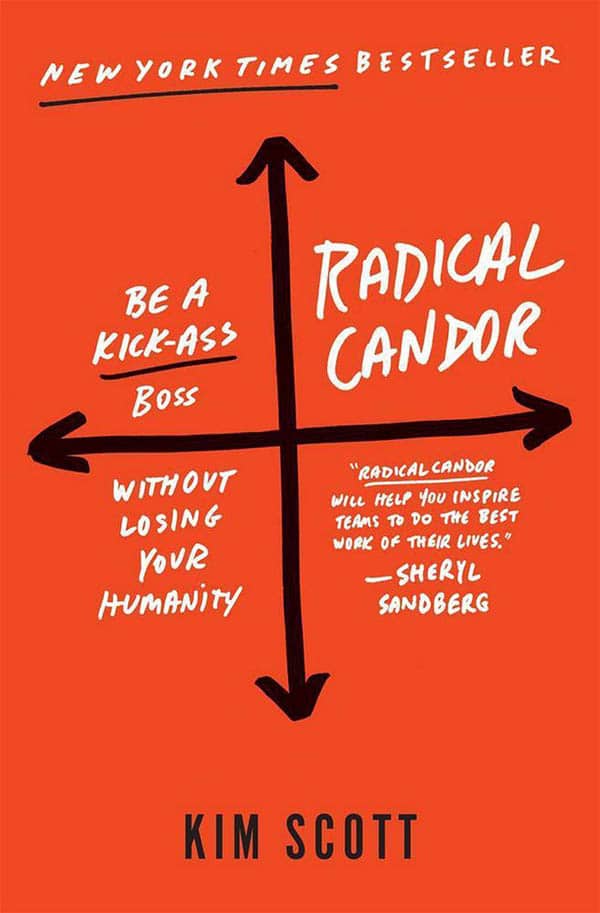
  • Radical Candor by Kim Scott – Book Review & Summary

    Candid Leader

    A leader is expected to have many virtues. Being candid is possibly one of the most important ones. While different people respond to different types of leaders, it is the boss who can combine bluntness with empathy and be direct and caring at the same time, who can establish the best possible relationship with his employees.

    Radical Candor (2017) by Kim Scott builds the case for leaders with radical candor, guides towards creating an environment that brings out the best ideas and gives an insightful approach to the best management practices that make a kickass leader.

    Developing Beneficial And Strong Relationships 

    Not every manager or leader heads to work with a feeling of excitement about leading the team through another day of great work. However, a manager with radical candor certainly approaches the workplace with a positive attitude most of the days.

    Practising radical candor involves two main principles.

    1. Personally caring about employees, and,
    2. Instilling challenge in their work.

    These two principles are at the crux of developing trusting relationships with team members. While different people react differently, and have unique personalities, using radical candor works for just about any type of employee.

    As a leader, one has to be personally invested in the growth and success of the employees. This entails proving that one genuinely cares about all that is happening in the employee’s life. It includes sharing, opening up and talking to the employee about more than just work and business. Not everyone believes it but a good work relationship is a very personal one.

    Secondly, a good leader should be able to challenge employees, if and when they are meeting expectations.

    While this can be a little tough to achieve, especially since candor and a direct approach might not seem like caring behaviour, the ability of a leader to challenge the team is a hallmark of a good leader who cares.

    Being candid has several benefits for the performance and the culture of an organization, just as being direct and honest does. With honesty and a direct approach, a leader can open up the channels of communication with the team, making the acceptance and reciprocation of feedback easier.

    Such an open culture of being candid, where employees can freely discuss with the leader and amongst themselves, will soon spread through the workplace, creating an efficient, healthy and productive work environment.

    Balancing Honesty And Directness Without Offending

    Managers often face defensive or aggressive behaviour after giving out constructive feedback, despite all good intentions. Being honest and direct, without seeming offensive is a skill. A leader has to be able to help and guide the employee while doling out criticisms, without sounding mean.

    When Scott started as a manager at Google, her boss was adept at giving feedback with radical candor. Once, after Scott gave a presentation, her manager called her aside to give her constructive feedback. At first, her manager began to honestly compliment her for being able to handle the questions from the audience. Only after lauding her presentation, did she call out the fact that Scott used “um…” too often.

    When Scott didn’t think of it as too important at first, her boss explained that using ‘um’ too often tends to make a person sound dumb, which was not the case with Scott.

    Scott’s boss made her point clear and complimented Scott at the same time. After that, Scott took efforts to improve her speech with a coach. Such feedback is radical candor at its best!

    Scott’s boss was direct, open, and honest, without discouraging Scott or discounting the success of the presentation. Her boss encouraged Scott to improve, without sugarcoating the criticism. The boss also didn’t wait to give feedback, enabling Scott to start working on improving immediately.

    Being open, direct, and honest about both, the positive and the negative ensured that Scott didn’t consider it a personal attack.

    The Pitfalls Of Lazy, Fearful, Or Overly Aggressive Management

    Meryl Streep did a beautiful depiction of Vogue’s Anna Wintour in The Devil Wears Prada. It is the perfect example of a toxic work environment, and the leadership shown in the movie is exactly the opposite of what radical candor aims at.

    Radical candor, as explained earlier, is about caring for employees. Honesty and directness do not justify being obnoxiously aggressive or being humiliating while doling out criticisms. Such behaviour can only destroy morale, create enemies, and encourage employees to quit.

    That said, given a choice of being a friendly boss who can honestly give critical assessments to the employees or being an unpopular asshole who is painfully honest and direct, it’s better to choose the latter. After all, directness and honesty are far better for the organization and everyone involved.

    Leaders should also be careful to avoid ruinous empathy and manipulative insincerity. While manipulative insincerity is a result of not caring enough to challenge employees, it shows that a manager is lazy. For example, a manipulative, insincere manager will tell an employee who has given a poor presentation that it was adequate, just because it is easier than having discussions over points of improvement.

    On the other hand, a manager who has ruinous empathy will avoid conflict out of fear of hurting the employee’s feelings. However, in both cases, the employee loses out on constructive criticism that could have enabled him to improve. This will only result in further deterioration of the employee’s performance, leading to the employee getting fired for non-performance.

    Providing Professional Development

    A fulfilling job that drives genuine passion in employees, is a job found in utopia. In reality, work is tedious. Moreover, it isn’t a manager’s responsibility to make it easier for anyone.

    Motivating employees doesn’t include sugarcoating the difficulties. Moreover, while a meaningful job, a purpose to fulfil can inspire employees to do their best, manufacturing a false sense of purpose and meaning can only backfire.

    At Google, when Scott was a manager, she tried to convince her staff that their work was important to the creative worker. She would give her team pep talks. However, one of her employees saw through the façade and approached her honestly. He told her that it would do better if she was true to the team and told them clearly that their work was at times unfulfilling and tedious. Scott realised that there’s no shame in admitting that at times, jobs have only one purpose – and that’s to make money!

    Hence, telling employees that working hard will bring satisfaction and that good work is acknowledged, rather than trying to alleviate their existential dilemmas’ is much better than giving them phoney motivational talks.

    Leaders should rather provide employees with tools to help them grow as professionals, and give them a clear perspective of their careers. To do this, leaders and managers should be able to identify and differentiate between 3 kinds of employees – 

    • The Superstar employees, who need to be challenged, and given opportunities to raise the ladder to meet their full potential.
    • The Rockstar employees, who will do great work as long as they have the stability and the time to shine at their work, thus offering a steadier presence in the team, and,
    • The Falling Star employees, those who are unable to perform consistently, even after getting chances to improve.

    The Firing Experience

    Firing an employee is probably the toughest job a leader has. When an employee falls under the ‘Falling star’ category, leaders need to ensure that firing the employee is but the last resort left. This is because; firing an employee has several repercussions. 

    Losing a job puts an employee in an incredibly tough situation. There are many aspects of the employees’ lives and even the organization that gets impacted. While, for the employee, it could mean loss of a source of income, the strain on his marital and/or family life, and even losing out on health insurance, for the employer, it means making a radical change to the team and the way it works, and even tackling the effects the firing will have on the other members of the team.

    It is thus the leader’s job to ensure that an employee is let go for the right reasons, and the leader is seen as an honest and caring manager, despite the negativity surrounding the incident.

    The leader thus should account for the following points before firing any employee – 

    • Making clear efforts to try and improve the employees’ performance.
    • Using radical candor to directly and honestly tell them that they indeed do good work, but certain areas need a lot of improvement.
    • Avoid personal attacks at all costs.
    • Keep in mind the negative effects the bad employee has on the overall working of the team.
    • Consider a second and even a third opinion before making the move.

    Once all these points are taken into consideration, then the person can be let go. The leaders or manager, however, should have a clear plan chalked out as to how, when and where the employee will be fired. After all, the act must reflect well on the manager/leader, as being honest and working towards the best of the team as a whole.

    Collaborative Leadership

    Leadership should always be collaborative. Rather than viewing leadership as an opportunity to boss over people, it should be an opportunity to work with talented minds. Often, managers mistakenly think that it’s their job to tell people what to do. This leads to mistakes. 

    Apple’s Steve Jobs knew that he couldn’t always be right. He relied on his team to challenge his ideas and speak up if they disagreed. Moreover, once, he was even furious with an employee who let him win the argument when the employee was right. Jobs went ahead and told the employee that it was his duty to correct Jobs when he was wrong, not back down in any argument when the employee was right, and avoid such mistakes.

    Leading a team without giving orders seems like a paradox. However, collaborative leadership is the best way to make a team successful. There are four steps to practice collaborative leadership successfully.

    • Listen to the team – Listening to what members of the team have to say is the first step in collaborative leadership. It ensures that the team members feel safe to discuss and even disagree with the boss, leading to great collaborative ideas.
    • Time and space for ideas – The second step involves giving team members enough time and space to develop their ideas so that they aren’t shot down and are understood by others in the team.
    • Allowing healthy debates – Leaders should encourage healthy debates for every idea that is presented by a team member. These ideas become great only when everyone in the team agrees that it will work.
    • Pushing the idea ahead – The final step in collaborative leadership involves the leader or manager convincing other executives in the company that the idea of the team is worth taking ahead. Then it is the responsibility of the manager to execute the idea.

    This process of collaborative leadership should be applied over and over again to all ideas and discussions.

    Listening Loudly, Or Quietly

    A leader should know when to speak, yet, having listening skills are as important. When it comes to listening, depending on the personality, the leader has two ways to choose from.

    • Listening Quietly – Listening quietly helps get honest opinions from team members. Additionally, it works best for leaders who prefer to let others talk. 

    Apple’s CEO Tim Cook is notorious for being painfully silent and letting another talk. This provides the team encouragement, opportunity, and the freedom to speak their mind

    To practice quiet listening, managers need to be quiet for at least 10 minutes per hour of a conversation, and patiently listen to what others have to say. It is often seen that managers interrupt others to give their opinions. This results in the person talking to change their ideas or thoughts to align with what the manager has said. By doing this, managers can never get an honest opinion.

    • Listening Loudly – Leaders that have confrontational personalities can opt to listen loudly. Steve Jobs was adept at practising loud listening. He would make a strong point, and then encourage his team to give stronger inputs to keep the discussions going.

    Listening loudly pushes people to respond. It is a great method to get the shy employees to give their inputs. Loud listening needs the manager to instil confidence in the team to open up. Thus, a manager will have to be positive to opinions that come forth, even if the manager does not agree. 

    Loud listening aims to get employees to speak up and challenge the points the manager puts forth.

    Listening is a great skill. It helps in promoting a creative and effective team. Finally, it gives managers a way to help move the careers of the team members ahead.

    Discussions that Help Reveal True Motives

    Every employee has a dream to realize and achieve. It is thus the responsibility of the manager to help individuals realistically approach these dreams and achieve them.

    Leaders should be able to talk openly and listen effectively to be able to grasp the aspirations of team members. This helps employees know that their leader is personally invested in their growth and is willing to direct them towards the right path.

    Google’s Director of Sales, Russ Laraway would conduct career talks to keep the team motivated. During a discussion with an employee, Sarah, Russ found that she was a little hesitant, and not completely honest with him when she mentioned that she aspired to become a boss like him one day. On further probing, he found that her dream for the future was to own a Spirulina farm.

    Russ discussed Sarah’s upbringing and got her to talk about her main motivators. He found that she wanted to help the environment and become a financially independent leader.

    These discussions helped Laraway focus on helping Sarah develop her management skills so that her current job could help prepare her for managing her dream farm.

    A leader needs to be able to identify the important motivators and dreams in their employees’ lives. To do this, leaders can use 3 types of conversations – 

    • The life story conversation – This involves helping employees open up about everything in their life that has to lead to their current position. This helps in identifying what motivates the employee.
    • The dream job conversation – This discussion involves finding out their biggest career desires.
    • The 18-month plan conversation – This discussion focuses on the immediate future of the employee. It helps a leader identify everything that needs to be done, to keep the employee on the right track.

    These conversations help in identifying motivators and keeping employees highly motivated to achieve great things.

    Conclusion

    Being a great leader and a boss needs radical candor. Practising it can help a leader be truly honest and direct with team members. Moreover, it helps in challenging them to perform and achieve great things.

    Practising radical candor also involves being personally invested in, and genuinely caring about the welfare, growth, and success of the employee. A leader should additionally practice collaborative leadership to ensure that are constructively receptive and to bring out the best in the team.

  • Issue #48, 15 Mar 2022 – Identifying the Putin and Zelensky within us

    Welcome to the Deploy Yourself Newsletter, where I share what impactful leadership looks like to show your own power. I also share the most insightful lessons and stories I encountered in the last two weeks. You can also read this issue online.

    Hey,

    Identifying the Putin and Zelensky within us

    I am sure you are also saddened by the recent violence in Ukraine and watching the two very different leadership styles of Putin and Zelensky.

    While one is being criticized by the world for his fear-based leadership despite having a lot of power, the other is being called a lion and a symbol of courage, even without a lot of military and political power. Below are some quotes from Ukraine’s President Volodymyr Zelenskyy

    The fight is here; I need ammunition, not a ride. [To U.S. government]

    “I do not want my picture in your offices: the President is not an icon, an idol or a portrait. Hang your kids’ photos instead, and look at them each time you are making a decision.”

    The president can’t change the country on his own. But what can he do? He can give an example.

    I do not try to play a role. I feel good being myself and saying what I think.

    While I am shocked at Putin’s actions, I am not surprised as I see both Putin and Zelensky within me. I remember the times when I have been so scared and angry that I have acted in a destructive manner. I remember when I have been blind to other people’s wise counsel.

    At the same time, I (like many in the whole world) have also felt the courage of Zelensky and his leadership – and to take a stand for something bigger than oneself. Recognising this, I am aware that the choice is mine – to fall prey to fear and anger or to choose courage to stand for what I deeply value.

    He has taken a stand for the future of Ukraine. He is showing us that we all can choose courage over fear, transparency over censoring, and freedom over domination.

    He is also demonstrating massive action by constantly talking to world leaders and asking them for what Ukraine wants – weapons, aid, sanctions against Russia, and calls for courageous action.

    What could be possible in our lives if we choose massive courage action instead of acting from fear?

    What could be possible if we choose courage and freedom over fear and control in our organisations and work?

    What could be possible if we would all follow Ukraine’s President Zelensky’s example of courageous leadership?

    Reflect, think, and journal on this prompt. I have been doing the same for the last week.

    Reply back and share what you discover. I read and respond to every reply.

    Articles and Stories Which Have Fascinated Me

    One

    How to Win the Long Game – Podcast

    In this conversation, Dorie Clark shares how to win the long game, even when things look bleak today. She talks about the typical timelines that most professionals should expect in order to get traction on their work. Plus, she highlights three key questions to ask yourself during the toughest times.

    1. Why am I doing this?
    2. How has it worked for others?
    3. What do my trusted advisors say?

    An episode on the Coaching for Leaders podcast

    Two

    Trapped in a Values Oasis, and Learning to Influence without Authority

    Misalignment of values within an organization can cause a great deal of friction. I call those pockets of values misalignment a Values Oasis. Perpetuating a Values Oasis is betting your team’s long-term success on your own, and recognizing that ought to shift your ethical calculus.

    Even when you believe fervently that your values are better for your team, it’s not necessarily an altruistic act of leadership to adopt them if you can’t bring the broader organization along with you.

    When you come across a missing process, this is a great time to lead your organization forward by modelling an effective approach. For example, Julia Evans’ approach of writing brag documents is perfectly shaped to fill a gap that most organizations have. This is the right time to use a technique like “model, document and share.”

    The rule of thumb here is to lead through ambiguity and advocate through disagreement. It can be extraordinarily frustrating to “disagree and commit” to a policy or value that goes against your personal values, but any worthwhile measure of successful leadership needs to consider your team’s success more highly than your own.

    From an article titled Trapped in a Values Oasis by Will Larson

    Three

    The Art of Asking Powerful Questions

    Powerful Questions are not what you hear normally. A powerful question comes up as an unexpected surprise to the listener and stops them in their tracks. For example – “How are you doing?” is not a powerful question. Instead “What was your favorite moment thus far today?” is one such powerful question.

    Powerful Questions makes one think and come up with original answers. If a question makes you think about your life, priorities, values, etc, it is a powerful question. They don’t linger on the surface where there is emotional safety. Instead, powerful questions force you to be vulnerable. It requires some courage to face the discomfort of answering a Powerful Question.

    Powerful questions can be provocative and open up new pathways for people which weren’t available before. They create space to reach the heart of the issue. Below are 5 principles to follow when asking powerful questions:

    1. Ask open-ended questions. Don’t ask questions that have one-word answers.
    2. Be curious. Ask one question at a time. Then shut up and listen. Get comfortable with silence.
    3. Don’t ask leading questions 
    4. Ask deep and meaningful questions that make people think 
    5. Don’t assume. Instead, challenge yours and others’ assumptions by asking, “What are we assuming in this situation”?

    From an article from my desk on Powerful Questions

    Four

    How Do I Stay Courageous While Facing Death?

    Real courage comes from the recognition that we are all part of something bigger than ourselves and by transcending our limited self to connect with a larger purpose.

    For example, people in war may act in a way that is consistent with this recognition by transcending themselves and their own personal needs and acting for a cause greater than themselves, such as freedom.

    From a video on Youtube about being courageous during the Ukraine War

    That’s it for now. If you have any questions or feedback, or just want to introduce yourself, hit reply. I read and respond to every reply. All the best,

    Sumit

    (Twitter) @SumitGupta
    (LinkedIn) Connect

  • Leadership Journeys [11] – Catherine Nakalembe – “With very little, you can do so much”

    This is the Leadership Journey series on the Choosing Leadership Podcast.

    I believe we all have a lot to learn from each other’s stories – of where we started, where we are now, and our successes and struggles on the way. With this series of interviews, my attempt is to give leaders an opportunity to share their stories and for all of us to learn from their generous sharing.

    In the interview, Catherine shares how she had very humble beginnings growing up just outside Kampala, Uganda, and how she learned so much from her parents – who were very resourceful despite having very little resources. She talked about her openness to learn and build new things, and also shares the value of speaking in a language your audience understands. We also discussed how acknowledging that “I do not know” is often what allows growth to happen.

    You can find Catherine at the below links

    In the interview, we talk about

    • “I really enjoyed badminton. I taught myself how to teach aerobics. I was a games prefect when I was in high school. And for some reason that I can’t really pinpoint, it kept me together and I liked doing it also kept me and my sisters really close because we all played it.”
    • “I always loved math. I did do pretty well at math and I loved geography. And so those two things coming together allow me to be able to do this environmental science program. And that’s how I took the path into. Environmental science.”
    • “I liked computers so much that I bought my first computer with what would have been my housing stipend. I made a deal with my mom that I’d like to use that money to buy a computer.”
    • “I didn’t have access to books and stuff like that growing up. So like my view or perception of the world was, it was very limited. And so going to university and finding out all these other things you can study made me think that I need to do more of it.”
    • “Just like with discovering more and more stars and stuff like that, it’s there’s more after this is more, there’s more.”
    • “It was in the city, but we lived in a mudhouse and I wanted to my primary school does not exist anymore. It was very small, it’s a place called Katwe. There’s a market there and it’s a slum. And yeah, it was very simple. To watch television I’d have to go to the neighbours.”
    • “I walked to school from when I was three, at least six or seven kilometres from home where I went to like kindergarten. And yeah, so it was like that.”
    • “It is in my nature maybe want to build on things.  When I was five. I didn’t think I was going to be a rocket scientist. I didn’t even know what a rocket scientist or I didn’t say I wanted to be a doctor or I didn’t have that kind of mind frame, but what I had was what I had with me, I would make something.”
    • “So like with what I have, I tried to do something with and that, because of that, I discovered more and more which I think opened up more and more doors. I bought a computer, which was dead, had making that computer work, buying additional drives and stuff like that. So that taught me about IT.”
    • “It’s just being open and being, having that, the mindset of, if a window opened, you can look in and then see how far you can look at.”
    • “You find that there are some people who can do something so quickly and it’s better that they do it. And that makes it makes it a better fit and a better outcome.”
    • “I like to communicate as effectively as possible. Trying to sound like a very good scientist when I’m talking to a farmer is completely pointless.”
    • “I’m also really grateful for my husband, and my kids that give me I’m blown away by my kids. I’m learning so much through them, which is so exciting.”
    • “I try to be present when I’m doing a task. I can tell when I’m not like when I’m supposed to be watching my sons, but I get distracted. I can tell that I get angry really quickly when they ask me something, which as kids they should. Recognizing that helps me like switch off immediately.”
    • “The advice that I would give, have given to myself was to keep exploring, even with the limited things that that I had, I liked creating and creating with nothing. Kids learn things from touching and moulding from putting blocks together, it gives them they learn a lot of things and it doesn’t have to be anything special. It doesn’t have to be Legos. You could just be like regular blocks that they made with boxes and things like that.”
    • “With very little, you can do so much. No work is beneath you as long as you learn something from it, nothing is beneath anybody.”
    • “I listened to some of your podcasts. I’ve listened to, three or four episodes. And it’s just incredible how people reflect on this place and what they do. And it’s, there’s just so much to learn and I learn a lot by listening.” 
  • Work Rules! by Laszlo Bock – Book Review & Summary

    Being The Best Employer There Ever Was

    Workplace to some of the world’s brightest minds, Google is one of the worlds most successful and powerful companies. It is a dream job for many. 

    But what makes Google the best place to work?

    Google’s consistent ranking at being the best employer in the world isn’t just because it means working in a powerful company, or because it brings in a fat lot of stock options. It’s much more than that!

    It is the consistent hard work put in by one of the world’s most innovative HR departments, Google’s People Operations, and its mastermind Laszlo Bock, head of People Operations and a champion of Google’s in-house culture. ‘Work Rules!’ (2015), delves into what consistently makes Google the best employer in the world.

    Mission, Transparency, And Voice

    Google has a powerful yet simple mission – “to organize the world’s information and make it universally accessible and useful.”

    Rather than imparting a commercial meaning, the mission gives a profoundly moral sense to the work the employees do. Every bit of work done at Google makes it possible for users worldwide to find the information they need through the search engine.

    It is different from other typical mission statements like ‘becoming the market leader’. Such statements, once achieved, serve no actual inspirational purpose. Google’s mission statement has no ceiling, and thus, inspires employees to constantly search for new ways to organize information.

    Transparency is another key tenet of the culture one finds at Google.  Any employee at Google can access everything, right from product launch initiatives, to other employees weekly reports, in addition to their projects.

    Every week, the CEO of Google updates the whole company on the ongoing events of the past week and encourages a Q&A session for half an hour after. This ensures that everyone knows who is working on what, who the go-to person for any particular project is, and that no work is doubled-up unnecessarily.

    Google ensures that it gives each employee a voice. They essentially value the inputs of each employee, ensuring that they have a say in how the company is run. Most of the company’s practices have originated from employees.

    Looking Beyond Degrees

    There are two primary ways to get exceptional employees – either hire the best or train the average ones. At Google, they prefer to hire the best!

    Any average company, according to the Corporate Executive Board, pays around $450 for hiring and $600 for training. Considering a worst-case scenario, after hiring, a great employee could perform at a mediocre level. However, the worst-case scenario of hiring an average candidate is that they drain training resources and they perform low to boot. Comparing the scenarios, it’s obvious what most companies are doing wrong!

    At Google, a lot of time and resources are invested to find the right candidate. Google hires only 5000 a year out of the 1 to 3 million applications they get each year. With an admission rate of 0.25%, they are extremely scrupulous for a reason.

    Initially, Google only hired about a hundred employees per year from a pool of only Ivy League candidates. Over time, Google realised that a number of their best weren’t the ones from these illustrious institutions. They soon started looking for candidates who showed more promise in overcoming obstacles and were more resilient.

    They looked for people who were better than them and hired those who could make everyone around them successful. Thus, they carefully sift through the best performers.

    For example, the VP of People Development at Google, Karen May, actually had turned Google down repeatedly for four years, when she owned her HR consulting firm. Google persisted and waited patiently until she finally agreed to join the team.

    Let The People Run The Show

    Most companies are contradictory when it comes to their expectations from employees. While on one hand, companies expect employees to show autonomy and initiative, they have managers who control the employees’ salary, workload, day-offs, promotions, etc.

    At Google, everyone’s the same. They have reduced bureaucratic hierarchy and have liquidated status symbols. Every employee, from a new hire to the executives, gets the same support, resources; funding, etc. Furthermore, there are only 4 levels at Google, individual contributor, manager, director, and VP.

    Google has a culture where managers are trained to lead their teams through inspiration. If any employee has aspirations to become a VP, the employee has to first show the skills by leading their team and project to success.

    Every project, though run by the employees, has a final decision-maker. At Google, rather than having managers make these decisions, they rely on data. This ensures that the decision-making process is transparent, unbiased and in alignment with one of Google’s core principles – “Don’t politick. Use data.”

    This core principle also helps in addressing sensitive topics such as rumours and gossip, as well. 

    For example, the VP of Google used data to prove that promotions at Google are unbiased. When rumours that working in the headquarters would guarantee a faster promotion were doing the rounds, she used data to prove that promotion rates at the HQ were the same as any other Google office.

    Transparency through data management and open discussions makes it easy to hand over power to the people, leading to the best ideas.

    Seize The Best And The Worst!

    Looking at the performance curve of most companies, one finds that the best and the worst make the two ends of the curve, while the rest of the chunk – the average performers – make up the middle. Additionally, one sees a classic pattern where the minority of the top performers give the majority of the successes in the company, whereas the rest simply tag behind these successes.

    The poor performers in any company are often let go, and new hires replace them. These new hires, unfortunately, need to be trained, and there is no guarantee of their performance either. Most companies focus on training and bringing the average middle chunk up to mark, often ignoring the top performers, and not utilizing their skills to the maximum.

    What does Google do differently?

    Google keeps its focus on the top performers, studies these people who are familiar with best practices, and helps those who need to improve. Rather than focus on the best practices of other companies, Google works to study and analyse their own, a proven tactic from Harvard professor Boris Groysberg’s research that shows high performance is contextual.

    Google’s PiLab, or People and Innovation Lab, is their internal research team that helps the company study the best practices within the company.

    PiLab’s Project Oxygen proved that top engineer performance needs a great manager. It showed that engineers who had great managers performed 5% to 18% better than ones with weak managers. The project also identified best management practices so that the knowledge could be shared with all managers and help improve weak ones.

    In addition to this, the bottom 5% performers at Google are regularly identified and offered training to improve and even opportunities to re-fit into other roles. Google goes a step ahead because they know that poor performance can also be a result of a lack of motivation or skill, stemming from personal issues.

    Using The Best In-house Resources For Training

    In 2011, American companies spent an annual $156.2 billion on training programs. As seen earlier, most of the amount spent on training employees often goes to waste. There are several reasons why this happens.

    Firstly, training is designed and imparted by the wrong people. Secondly, they are too general to serve a specific purpose, and thirdly, the training results don’t get analysed to effectively measure successes.

    While the general understanding is that it takes about 10000 hours to master any skill, according to Anders Erricson research, it is best to divide the needed skills into smaller tasks and aim for a specific improvement one by one, via feedback, correction and repetition.

    The global consultancy firm, McKinsey sends their second-year consultants for an Engagement Leadership Workshop, training them to deal with irate customers. During the training, the participants are taught the basic rules and then are asked to role-play the scenario. Next, they are shown the video of their role-play and are encouraged to observe and discuss. This process is repeated till every desired outcome is seen in the behaviours of the consultants.

    While the training is expensive, it helps consultants retain the specific skills to deal with irate customers and imbibes excellent skills. They measure the success of the training, not through money or time spent in training, but through changes and improvement in consultant behaviour.

    At Google, while they apply a similar principle, they also look for trainers within the company itself. For example, they seek out the best performing sales manager to impart sales training to sales reps.

    This tactic has a two-pronged purpose – to save training costs, as well as create a close-knit community and culture within the company.

    The Benefits Of Unfair Pay And Rewarding Failure

    Rewarding failure and unfair compensation are often seen as an absolute no! Then why does Google do it sometimes?

    Compensation is a touchy matter. In most companies, compensations have ‘fair’ and ‘position-wise limits. Often, these salary caps also have regulations such as not having more than a 20% difference between salaries for similar positions, strapped to compensation. The result is often the top performers looking for better compensation in other companies.

    Google understands this issue. Hence, they sometimes pay ‘unfairly’. For example, one may find that a junior top performer at Google gets paid more than an average performer in a senior role. Or, one employee may receive $10000 as a stock award, while another in the same position might get awarded $1 million in stock.

    Another tactic Google employs to retain employees is by offering them an experience rather than money. They learned the effectiveness of this tactic the hard way.

    Google had, in 2004, introduced a Founders award for performance. That year, they awarded $12 million to two teams. The next year, $45 million was divided as an award between 11 teams. However, this monetary award had quite the opposite effect that it should have. Employees started looking for other jobs, where the possibilities of getting a generous reward were higher.

    This experience made them realise that rather than just monetary rewards, awarding employees with experiences such as a paid vacation, or a dinner for 2, helped create memories, and was more effective at retaining employees.

    Additionally, Google also rewards employees when it is least expected.

    One of the teams that had worked on their real-time collaboration tool Google Wave for two years chose to forgo their bonuses and opt for a higher compensation via stocks if Wave succeeded. Wave, however, failed. But the team was awarded bonuses nevertheless. 

    Google knew that the team had put in hard work, and understood that efforts towards hard work, innovation, and wanting to explore the unknown should be rewarded, even if the project fails.

    Confronting The Dark Side Of Culture

    Google is known best for empowering its employees. It is furthermore successful because it believes in transparency, and gives its employees a voice. However, sometimes, these very best practices can backfire. Google, nevertheless, knows how to handle these.

    For instance, Google had at least one major leak per year. These leaks are investigated, and the party who is responsible for the leak – whether by accident or by design – is fired. Upholding their values of transparency and openness, the company then lets every employee know what was leaked, who did it, and what happened to the person involved. Considering maintaining their values, the price of a leak is very small.

    Another issue Google sometimes faces is the huge influx of ideas that result from their culture of fostering innovative thinking. More often than not, these ideas have to be culled, or adjusted to keep the company running. For example, between 2006 and 2009, Google had released about 250 products, which were later discontinued.

    It is the responsibility of the CEO, Larry Page to conduct an annual spring-cleaning, to weed out waning products, or products that are getting outperformed, or ones that don’t have good market prospects. The company additionally, is open about why the product got culled. This helps the company maintain its direction and focus, retain managers whose ideas get shelved, and not antagonize them.

    Another dark side of culture that Google experienced was when one employee was unhappy with the cafeteria using smaller plates. In protest, he and some other employees started throwing forks in the trash can and even threw food at the cafeteria staff.

    Next, when the company introduced Meatless Mondays to promote employee health, one employee threatened to move to Facebook, Microsoft, or Twitter via an anonymous survey. Google shared this survey with the employees. Many employees were embarrassed by the actions of the person and this led to a reduction in levels of abuse.

    This was an example of how even perks and benefits can turn sour. The point is that a company should know how to handle these dark sides of culture.

    Conclusion

    Google is consistently ranked the best employer for a reason. The strategies and tactics they employ help in creating a people’s company and maintaining success.

    Having a ‘ceiling less‘ mission, nurturing values of transparency and openness, giving employees a voice, looking beyond degrees while hiring, encouraging the top performers and giving the bottom ones a chance, using the best in-house trainers, using pay benefits and rewards wisely and understanding that having a great culture can backfire and how to deal with it, are just some of the strategies that make Google the place to be!

  • Issue #47.5, 8 Mar 2022 – “It is actually the stories that change people, not facts.”

    Dear reader, click here to view this leadership update on your browser.

    “You can present all the facts, but it’s actually the stories that change people” – Moky Makura

    Moky Makura is the executive director of Africa No Filter which is working to shift the narrative about African people and Africa as a continent. She has also worked with the Bill and Melinda Gates foundation previously. Prior to that, she was a well-known TV presenter, producer, author, publisher and a successful entrepreneur – which she calls “jumps from one tree to another”.

    In the interview, Moky talks about her trust in the universe, and how that allows her to take risks and venture into very different territories. We talk about how growing up in Nigeria gave her such a boost of confidence that she doesn’t see “failure” as anything except learning. She also highlighted how her parents never told her that she can not do this or that – and which allowed her to take big risks in her career.

    She adds, “Failure is part and parcel of who I am because I don’t see it as a failure. I just see it as, the experience. And I think that is a huge sort of difference in confidence booster because I never failed. I just learnt. “

    Find the full audio interview and show notes here

    Related Finds

    Storytelling is not just important in business and work, but also in every other area where you are called to show up as a leader – in your family, neighbourhood, society, or country. Here are my notes and summary of the 3 best books I have read on the topic of “Storytelling”, which is an essential leadership skill in the 21st century.

    1. Stories for Work By Gabrielle Dolan
    2. Lead With A Story (2012) by Paul Smith
    3. Building a StoryBrand by Donald Miller

    I have now published 10 episodes in the Leadership Journey series of the Choosing Leadership podcast. If you have missed any of these, take a look at these insightful conversations I have had with the below inspirational leaders.

    How can you contribute?

    Choosing Leadership is a podcast for people who know deep inside that there is more. My invitation to you is to “choose” leadership and to step up as a leader.

    Subscribe to the Choosing Leadership podcast on Spotify, Google, or Amazon Music. We are also live on Apple Itunes.

    I am interviewing leaders to learn from their stories – of how they came to be where they are today. These are the stories peers and friends don’t usually know, and my attempt is to bring them out. Find out what has shaped them to be the person and leader they are today.

    Our journeys might not look alike. They might resemble more of a roller-coaster ride than a race track, and that is what makes each one of us special and unique in our own ways. I am deeply touched when someone takes the time to share their story with me.

    If you would like to recommend someone else who I should interview, feel free to recommend them. You can send me a message on LinkedIn or send me an email at sumit@deployyourself.com.

    Until the next week, keep Choosing Leadership.

    With gratitude,

    Sumit

  • Ikigai by Hector Garcia Puigcerver and Francesc Miralles

    Achieving Longevity Through Ikigai

    Okinawa, an island in Japan, has the highest concentration of centenarians. They practice, and believe in the concept of Ikigai – roughly translated to ‘the reason for living’. Ikigai is their secret to longevity, in addition to attaining a deep, fulfilling sense of happiness.

    Finding purpose in one’s life, a deep sense of happiness, along with living a healthy, long life, is something that everyone wishes to achieve. Hector Garcia Puigcerver and Francesc Miralles’ Ikigai (2016) is a guide that delves into the wisdom of the Japanese culture and helps one find their ‘Ikigai’ while giving a few health tips along the way.

    What Is Ikigai

    Ikigai not only means one’s reason for living. It can also mean one’s inner motivation towards any professional activity, and one’s ability to attain a high level of specialization and attention to detail in their daily work. Ikigai is often described as a confluence of four notions – 

    • What one is passionate about
    • Where one’s skills lie
    • How one can earn a living, and
    • What the world needs

    According to many Okinawans, everyone is born to fulfil their Ikigai, however, some find it earlier and quickly, while some take time to understand and seek it.

    Those who follow the rules of Ikigai, are highly motivated and committed to their Ikigai, and hence, are able to unlock the secrets of longevity. Many Okinawans are able to remain active late in their lives. Their belief and pursuit of Ikigai keep them engaged for long, as they are simply able to translate their motivations and their passions into whatever they do.

    Simply put, if one’s job is their Ikigai, then one shouldn’t retire. Or if one’s hobby is one’s Ikigai, then it should never be given up!

    According to studies conducted on Okinawan centenarians, the level of commitment Okinawans have to their Ikigai and that they have engaged minds, are the reasons they have lower rates of heart diseases and dementia.

    An Active, Low-Stress Mind

    It is common knowledge that ageing gracefully is the result of having a healthy body and mind. However, most people tend to neglect the health of their minds.

    Physiologically, a lack of mental work results in weakening of the brain neural connections, just as living a sedentary life impacts the body. According to neuroscientist Shlomo Breznitz, the elderly tend to lose the flexibility of their brains because they refuse to try out new things and get trapped in routines and patterns. 

    Hence exercising the brain too is extremely vital to maintain good mental health. While mind games such as cards or chess help, what one really needs to exercise the brain is social interaction. An active mind that has exposure to many enriching activities, interaction with friends and family, etc. is a healthy mind.

    In addition to having an active mind, avoiding stress is important. Stress is the key reason why the body and the mind experience unnecessary wear and tear. Stress increases the possibility of premature ageing.

    A study conducted at the Heidelberg University had a young doctor undergo a few strenuous job interviews, wherein he was asked to solve complicated mathematical questions. After the interviews, his blood sample taken indicated the presence of stress-induced antibodies, as though his body was fighting a viral or bacterial infection.

    His body had reacted to the stress, where its immune response was aimed at wiping away the threat. However, in the absence of any viral or bacterial threat, the antibodies were attacking healthy cells, causing the body to age faster.

    It is thus important to be able to calm the mind and body down, avoid stress, practice techniques such as mindfulness or yoga, and even exercise to improve one’s longevity. 

    The Morita Therapy

    In the fast-paced modern world, stress, burnouts, and anxiety are on the rise. Japan itself sees an increase in these due to the intense working culture the country has adopted.

    The Japanese, however, have a tool called the Morita therapy, which can be practised world-over to cope and reduce anxiety, stress, and burnouts.

    Invented by the psychotherapist and Buddhist practitioner Soma Morita, the technique addressed and dealt with obsessions, compulsions, and chronic anxiety.

    Unlike other therapies that focus on positive thinking, Morita therapy works by asking patients to address and accept their emotions and feelings, without trying to change them. Next, patients are asked to take particular actions to form new emotions, replacing old ones gradually.

    The therapy has 4 stages. The first stage is one of absolute rest, where patients are asked to lie down in bed for about a week, without talking to anyone or having any exposure to media. They have to simply observe their emotions as they come and go. Their only contact is a small amount of supervision by the psychotherapist.

    The second stage involves integrating repetitive activities into their daily routines, such as breathing exercises, diary writing, or taking walks.

    The third stage increases the level of these activities, wherein they become more creative and physical. Activities such as painting, woodcutting, etc., and the increase in the level of activity and physical engagement, produce new feelings in patients and they begin to feel equanimity and joy due to the engagement.

    In stage four, the patient re-engages with the world with a new sense of purpose and calmness.

    The Morita therapy is a form of cleansing that proves that if one gets plenty of space and rest from distractions in life, one will be able to focus attention on things that are important.

    Immersing Oneself In A State Of Flow

    A state of flow refers to a state of concentration and enjoyment that is so deep that one gets completely immersed into the activity, even losing a track of time itself. Psychologist Mihaly Csikszentmihalyi coined the term in 1970. 

    Getting immersed in any activity enables one to achieve such a state, where the activity itself becomes the source of one’s enjoyment. Such activities, as opposed to hedonistic ones that people indulge in to get rid of boredom, such as substance abuse, overindulgence in entertainment media and even overeating, should be prioritized. These activities help increase longevity.

    The state of flow is universal to all cultures and helps one to focus on a single activity for a prolonged period of time. Chess players, painters, etc often experience such a state of flow. Ikigai can also produce a similar state of flow. Hence if one’s occupation doesn’t, then it is essential that one indulge in a hobby that does.

    The level of difficulty of the activity at hand is intrinsic to achieving a state of flow. For example, if the activity is too easy, then one can get easily distracted and bored. Similarly, with an activity that is too tough, one gets stressed out and tends to give up. Both scenarios can hinder a person from attaining a state of flow, and hence, it is essential to calibrate the level of difficulty of the activity indulged in.

    One has to keep innovating, lookout for new and interesting things to do and keep calibrating the levels of difficulty to achieve flow.

    Get Recommendations From The Experienced

    We now know that some habits can increase longevity. However, understanding how to really have a longer life is best known by those who are already living it. The Okinawan centenarians have some simple tips on how to get about increasing longevity. According to these old-timers, one should – 

    • Worry about things in life as little as you possibly can.
    • Greet everyone, even strangers, with an open heart and a smile.
    • Having a sunny disposition will ensure that one always has loved ones and friends near – a type of simulation that will keep one younger.
    • Stop worrying about the things that cant be changed.
    • Enjoy whatever one has in life rather than fretting over what one doesn’t.
    • Cultivate good habits such as getting up early. Early risers tend to have more time to themselves, are happier and healthier.
    • One should grow one’s own vegetables, and cook one’s own food. The benefits of a farm-to-table habit are many-fold.
    • Finally, maintain friendships, visit neighbours, and be socially engaged.

    By following these tips, one can live a healthier, happier life and thus have better chances at longevity.

    The Okinawan Diet

    It is obvious knowledge that maintaining a healthy diet is one of the secrets to longevity. Makoto Suzuki, a heart specialist from Ryukyus University in Okinawa, conducted research on the Okinawan diet.

    He found that firstly, the Okinawans consume a variety of foods, having as many as 206 different types of food regularly. While the base of their diet consists of grains – essentially noodles and rice, it also includes a variety of herbs and spices, about 5 separate portions of fruits and vegetables every day. They strive to ensure that their plate has all the colours of the rainbow.

    Moreover, the Okinawans use salt and sugar sparingly, eating about 60% and 50% fewer amounts of sugar and salt respectively than the other Japanese natives (who have a relatively healthier diet than the rest of the world already!)

    Along with variety in their diet, the Okinawans also place importance on portion size. They believe that one should stop eating when one is about 80% full – essentially, remain a little hungry. This concept is called the hara hachi bu.  They achieve this by either avoiding dessert or reducing the portions they consume. They control their portion size by using smaller plates and instinctively eat less.

    Even according to modern sciences, calorie-reduction has shown benefits. Consuming lesser calories helps limit the level of insulin-like growth factor 1 – a protein that is known to age cells faster. Thus eating lesser amounts is intrinsic to longevity.

    Foods Rich In Anti-Oxidants

    It is the age of the super-foods. Diet today is an essential form of medication. Some of the foods consumed by the Japanese are great for rejuvenation and longevity.

    The Japanese regularly consume green tea. Green tea is full of antioxidants and helps promote longevity. The Okinawans regularly consume green tea, as, unlike other teas, it is unfermented and air-dried, thus retaining anti-oxidants and other active elements. It is known to reduce bad cholesterol, improve circulation, help regulate blood sugar levels, and even fight off infections.

    Another option is white tea. White tea has a higher level of anti-oxidants, and when boosted with jasmine, both green and white tea improves immunity and cardiovascular health.

    The Okinawans also eat shikuwasa, a type of citrus fruit that is loaded with antioxidants, containing about 40% more of nobiletin than other citrus fruits such as lemons and oranges. The fruit is highly acidic and is used in diluted quantities in a number of Okinawan dishes.

    Traditional Okinawan foods might not be available to everyone. Hence it is best to increase one’s consumption of anti-oxidant rich foods such as broccoli, apricots, salmon, strawberries, etc.

    Ensuring Movement

    Humans have evolved to move. Unfortunately, in the past few decades, humans have inched closer to sedentary lives, increasing the number and the chances of lifestyle diseases.

    Being physically active, even in the smallest of ways, have numerous health benefits. The Okinawan centenarians aren’t big on physical activities such as sports and fitness, however, are known to incorporate movement into their lives in the simplest of ways.

    The Okinawans walk. They walk in their gardens and in the neighbourhood. They ensure that they are constantly on the move, whether it is to get up, and sing karaoke at a bar, or spend time with grandchildren in their gardens. Their activities aren’t always intense, however, they never stop.

    Even modern sciences have proved that sitting idly can adversely impact health. According to Gavin Bradley, a health expert, the body’s metabolism slows down after just sitting for half an hour. Sitting for more than two hours results in a drop in the levels of good cholesterol, and disrupts the digestion of fat. Thankfully, moving around for just five minutes after a half an hour sit-down can help offset these effects.

    The Okinawans and native Japanese practice a concentrated form of exercise known as Radio Taiso, a basic form of warm-up. Originally broadcasted on the radio, Radio Taiso involves simple exercises, for example, lifting the arms above the head and bringing them down in circular movements. 

    These exercises are performed in the morning and even throughout the day. The Okinawans have incorporated these in schools, old-age homes and even in some workplaces, and gather as a community to perform them. The exercises help to gently warm up the muscles and joints of different parts of the body, keeping the body active and incorporating movement.

    Conclusion

    Living a long healthy life isn’t difficult. Like the Okinawans of Japan, everyone can work towards leading a healthier, happier life by practising Ikigai, finding one’s flow, reducing stress, maintaining a simple yet healthy diet and incorporating movement in life. Achieving longevity isn’t about a concentrated effort. It is about incorporating simplicity in life and truly loving whatever one has.

  • Issue #47, 1 Mar 2022 – Who is your climbing buddy?

    Welcome to the Deploy Yourself Newsletter, where I share what impactful leadership looks like to show your own power. I also share the most insightful lessons and stories I encountered in the last two weeks. You can also read this issue online.

    Hey,

    Who is your climbing buddy?

    Leadership is like climbing a mountain with no top. And if you know, even the most professional mountain climbers do not climb alone. They often have a few people (their team) supporting them on the journey. Yet in leadership, there is still a myth that we have to do it alone.

    On the mountain, your climbing buddy can tell you when you stray off track, can throw a rope when you slip up, or call for help when you are injured or unable to continue the journey.

    In leadership, it is the same. Nobody is perfect, and leadership does not demand us to be. A good “leadership buddy” allows you to move forward into the unchartered waters that leaders often have to, knowing that someone has your back. Your leadership buddy can show you where you are better than yourself.

    They can prevent you from wasting time and energy in crevasses of strongly held opinions, blame, frustration, stress, self-pity, and impostor syndrome. They can allow you to confidently move forward and remember who you really are – especially when you forget it yourself. And we all forget that at times.

    Who is your climbing buddy? Who could be one? Who are the people who always have your back?

    How can you create a team of buddies to empower and support your leadership – not because you are weak or imperfect – but because the future you have committed to is so much important?

    What could be possible in your life if you stop trying to do it all alone? Who are those people you can invite to be your climbing buddies?

    Do not rush to answer this question. Think about it. Journal about it. And see what comes up.

    And then reply back and share what you discover. I read and respond to every reply.

    Articles and Stories Which Have Fascinated Me

    One

    Choose Carefully – Podcast

    All of us make choices all the time, and we may think we’re making those choices freely. But psychologists know and say that there is an architecture behind the way choices are presented to us, and this invisible architecture can influence decisions both large and small.

    Here is a podcast that illustrates how we make unconscious choices and how decision architecture can influence those choices.

    An episode on the Hidden Brain podcast

    Two

    100 Days Of Joy

    People incorrectly associate happiness with accomplishments and achievements. They can quickly serve as death sentences for delight and enthusiasm.

    As adults, we lose sight of the things that bring us joy because we’re too focused on success. But things that bring joy don’t need to have a metric attached to them. They are worth doing simply because they make you happy. Nothing is a waste of time that gives you energy. 

    In The Untethered Soul, Michael A. Singer explains that people have a phenomenal amount of energy inside of them:

    “It doesn’t come from food and it doesn’t come from sleep. This energy is always available to you. At any moment you can draw upon it. It just wells up and fills you from inside. When you’re filled with this energy, you feel like you could take on the world.”

    When we prioritize joy we draw upon the energy that fills us from the insides and emanates out to everyone and everything we come in contact with. And if we don’t prioritize joy, we fall into a repetitious trap of shoulds and expectations and worry. 

    From an article titled 100 Days of Joy

    Three

    Are you Interested? or Are you Committed?

    When one says he is committed to something, does it mean a trade? Does it mean that I will do this or that only if you do some other this or that? Does this commitment expect something in return from the other side? Will the commitment waver if one doesn’t get a response from the other side?

    In my experiences over the years, I have realized that our aim should not, and cannot, be to make our commitment contingent on some external factor. If our commitment wavers because of a lack of response from the other side, then maybe that was not even committed in the first place.

    That is the difference between interest and commitment. If I am interested in some results, I will take steps to get that result. But it will be very easy to give up (in the case of interest) when circumstances turn averse or not as expected. We no longer see the interest getting fulfilled, so we have every reason to back out. Fair enough.

    But a commitment is bigger, it is a promise you make to yourself (more than anybody else) and then there are no excuses, but only results that matter. For example, a mother has a commitment to her child, and she will even go hungry to feed her child. A mother doesn’t demand fairness from her son, she just loves her, for that is her commitment.

    Where have you been holding back your commitment?

    From an article from my desk – The difference between being interested vs being committed.

    Four

    What is boredom? And what does it have to do with desire and meaning?

    Contrary to popular belief, boredom doesn’t have much to do with being idle. Instead, it has more to do with desire, and the inability to direct that desire toward anything meaningful.

    Idleness doesn’t lead to boredom as long as that idleness is desired. Sitting alone and doing nothing may look really boring to an outsider, but for the person that finds meaning in that activity, it is not.

    This is why escaping boredom through binge-watching Netflix or scrolling through Twitter feels empty afterwards. Your engagement in those activities wasn’t grounded in intention, but rather from a mindless whim to satisfy a sense of longing.

    Desire’s greatest trick is in convincing us that we will be satisfied after we fulfil it. We realize that the “promised land” is actually just a starting point for another journey.

    Funnily enough, the antidote to boredom is to actively seek it at various moments in your life. By giving yourself the space to do nothing, you cease looking outward for novel experiences and look inward to uncover the meaning that can be found within the nuances of your mind.

    From an article on More than That – The Riddle of Boredom

    That’s it for now. If you have any questions or feedback, or just want to introduce yourself, hit reply. I read and respond to every reply. All the best,

    Sumit

    (Twitter) @SumitGupta
    (LinkedIn) Connect

brain care coaching commitment communication conflict conflicts conversation culture deployyourself deploy yourself emotional intelligence emotions empathy energy feedback freedom future gold habits hope john maxwell language leadership lessons listening performance perspective preparation productive productivity psychological safety purpose questions relationships resolution ryan holiday seth godin simon sinek strengths struggle team trust values words