Do you use feedback as a tool to improve performance? If your answer is yes, you are not alone. Most managers see (and use) feedback, most of which is negative or critical, as a tool to improve performance. If you give positive feedback too along with the negative (the sh*t sandwich), we all know that people tend to focus on the negative and ignore the positive. If it helps, remember the last time you received a mix of positive and negative feedback? How did it feel?
There is a story about Abraham Lincoln in his biography by David Herbert Donald that captures the futility of negative feedback. Lincoln would write letters to those that he had strong feedback for (like a Civil War general who was failing). Rather than letting the heat of the moment get the best of him, he would never send these letters and instead keep them to himself. He would much later give a response that showed more empathy and was more effective.
Feedback Has Its Place
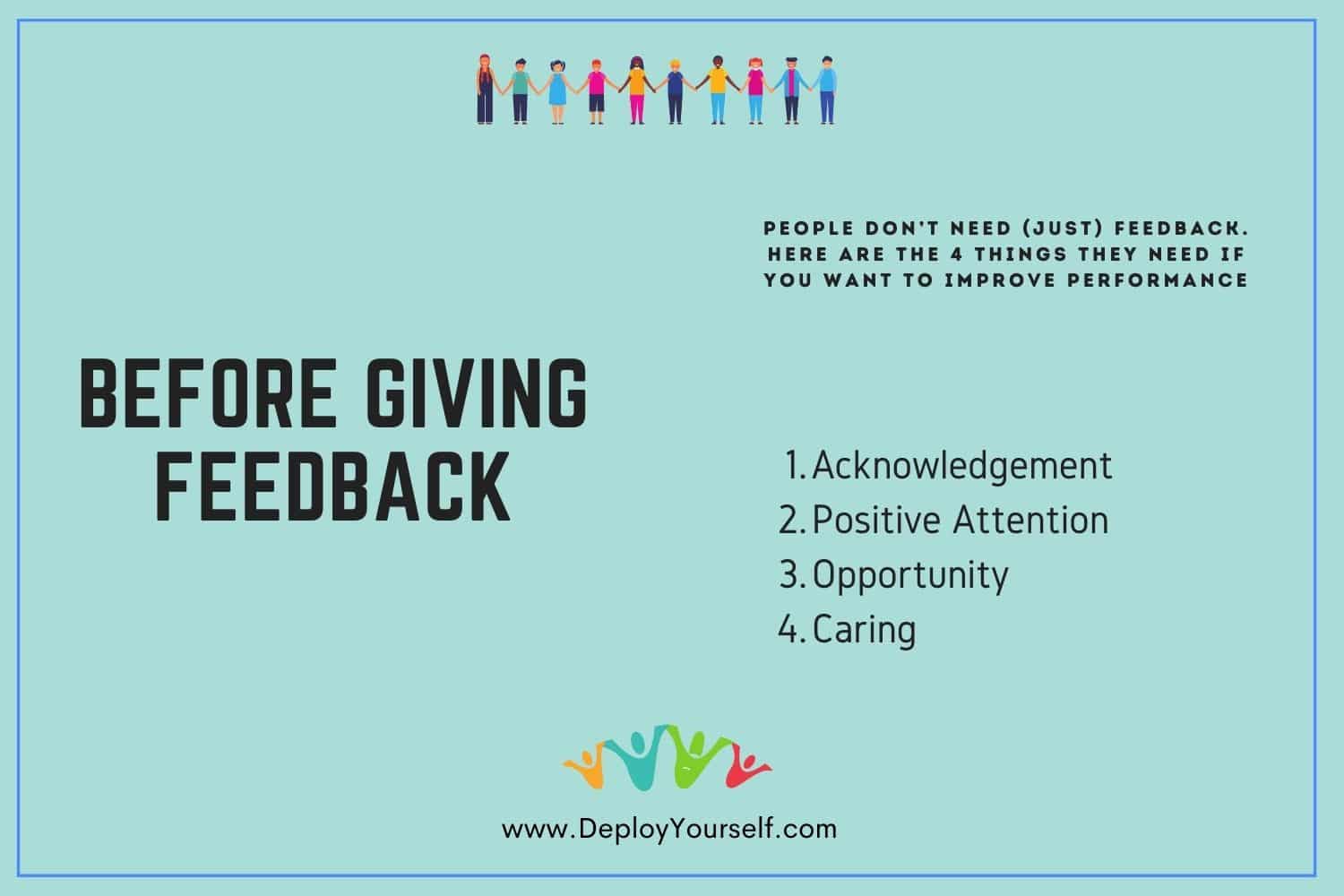
In this article, I want to argue that feedback is important, but it has its place. There are more powerful tools any leader can use to improve performance and keep people motivated and engaged. These tools are acknowledgment, attention, opportunity, and caring.
The four things mentioned below focus on the future, while feedback is glued to the past. And they must be done before and more often than giving feedback. People don’t need (just) feedback. Here are the 4 things they need if you want to improve performance:-
“Too many companies believe people are interchangeable. Truly gifted people never are. They have unique talents. Such people cannot be forced into roles they are not suited for, nor should they be. Effective leaders allow great people to do the work they were born to do.” – Warren Bennis
- They Need Acknowledgement
Good leaders see people for who they are (values), what they bring to the table (skills), and where they want to go (future ambitions). They understand and listen to them as human beings, and not just for the role they were hired for. This creates psychological safety, which is the first step needed for people to perform without fear and apprehensions. Good leaders trust people by default, and that creates a solid foundation for all future performances.
As a leader, your biggest job is to create an environment where people can do their best work. By listening to people about their dreams, fears, and ambitions, leaders can sure people look forward to coming to work each day. In addition to helping with business productivity, it will also impact the well-being of employees.
When leaders communicate transparently, authentically, and check in regularly to ask what people need, it deepens engagement and instills confidence as people know that their leaders have their back.
“People change by feeling good, not by feeling bad.” – BJ Fogg - They Need Positive Attention
Strong leaders believe in their people and their abilities, often more than people themselves do. When someone does a job well, good leaders notice and let their people know. Research has repeatedly proven that positive attention is more powerful than negative attention to improving performance. Nobody shows up at work to do a job poorly, and if we only focus on moments of mistakes and failures, we are killing the enormous potential for good that people have.
Good leaders understand that performance is not static, and everyone makes mistakes or fails to do a “perfect” job occasionally. Strong leaders focus on what people do well and not on their shortcomings, and understand that positive attention leads to engagement and exponential performance in the future.
For example – A simple email showcasing major accomplishments or any behavior you want to encourage can go a long way in setting the right example. - They Need Opportunity
People need opportunities to contribute to something bigger than themselves. It is a common human desire to belong and contribute to a larger cause or mission. Leaders need to keep this in mind when they find and present work opportunities for people.
If work doesn’t provide a way for your employees to belong and contribute, people will get bored and leave, or get used to mediocrity, which is even worse. The question every leader must ask themselves is – Can I give people the opportunity to do the work of their lives? - They Need Caring
Above everything else, people need caring. We all have a need to belong, to love, and to be loved by others. Good leaders know this and care for those around them like a fellow soldier. They enrich their relationship in every moment, by every word they say and every action they take.
A caring leader notices small changes and inquires about people’s wellbeing and growth. Strong leaders demonstrate their care by coaching people to find their own way, which builds confidence and momentum as people take on and complete challenging projects. A good leader knows what their people care about, and she shows her care by taking care of that.
For example – many companies offer the option for people to work flexible hours or to work from home, while others have an on-premises creche facility to better support employees who are parents.
“Treat a man as he appears to be, and you make him worse. But treat a man as if he were what he potentially could be, and you make him what he should be.”
— Johann Wolfgang von Goethe
Conclusion
Leading with care is a forward-looking and long term strategy to improve engagement and performance. Leaders need to focus on their people’s strengths and develop them, instead of “fixing” them with feedback.
If you are a leader, focus on what people can do, versus what they can’t do, and you will see completely new opportunities for them. Spend your time and attention on what people do well, and that will give you the leverage to produce exponential results. Strong leaders understand that taking care of people is in alignment with (and not against) business results.