mind

  • How To Use Both Conscious and Subconscious Mind to Maximise Creativity And Solve Our Biggest Problems?

    We would all agree that our mind is our most important asset. The human brain is often called the most sophisticated machine in the universe. Everything we do is only possible because of our brains. Be it writing a letter, loving our family members, playing a game, preparing a presentation, or planning for the future – none of these tasks are possible without our brains. Yet isn’t it surprising that our brain doesn’t come with an owner’s guide? Also, our education rarely teaches us how to make the best use of our brains.

    Scientists have come to know a lot about the human body in the last century, which has improved medical science and human quality of life by leaps and bounds. The kind of life we all live today is better than the lives lived by the kings and presidents a century ago. Isn’t it amazing? Yet, for all the medical discoveries, we still know very little about the human brain. And whatever little we know about our brains, the content has not made it to our textbooks and education.

    Either at school or at work, nobody educates us about how our mind works, which is a pity. Even though a lot is unknown about how our mind works, there has been considerable progress in neuroscience in the last two decades. If the average human being knows about what we now know about our brains, I believe we can vastly increase our performance in all aspects of our lives. After all, understanding how our mind works is the first step towards using it in the most effective way.
    Conscious and Subconscious Minds

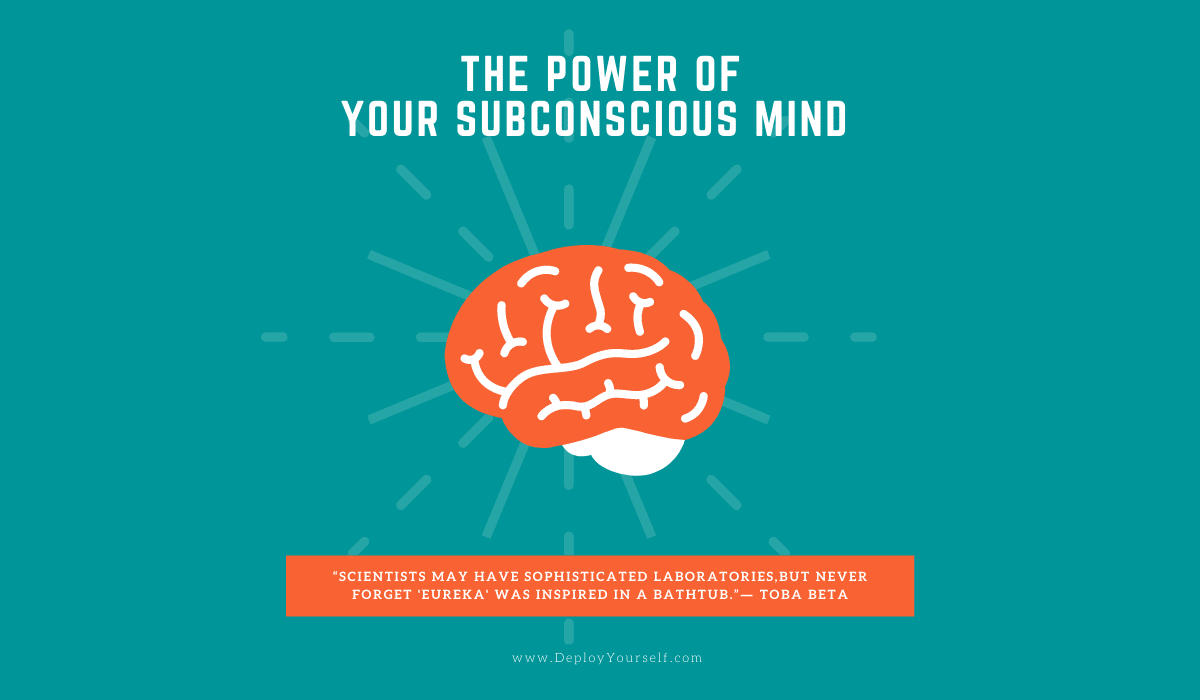
    Our mind is often categorized into two categories – the conscious and the subconscious. Everywhere where we use rational thought, we are using our conscious mind. For example – we are using our conscious mind when we apply logic to solve a math problem. Similarly, we use our conscious mind when we use our intellect to plan for the future. It is our conscious mind that leads us to speak, write, move our body, or plan. We use our conscious mind whenever “we” decide to do something.

    The subconscious mind, on the other hand, is where our intuition lies. This is the part of the mind where all our memories and past experiences lie. This is the part of the mind which knows how to breathe, how our vital organs function without our making any decisions. It is through our subconscious mind that we form beliefs and intuition about what is happening around us. Our subconscious mind is where our feelings and emotions originate.

    We might think that when we develop ideas and solve problems, it is only our conscious mind at work. But our subconscious mind also plays a big role in the background. This is the part of the mind’s functioning which most people are unaware of. At the same time, this is exactly the information which can make us much more productive if we were to know how it works.

    “The subconscious mind is ruled by suggestion, it accepts all suggestions – it does not argue with you – it fulfils your wishes.” – Joseph Murphy

    Accidental Discoveries

    We have used our intellect to achieve great things for humanity in the last 70 years. However, a lot of scientific discoveries and achievements have been accidental, or not what the scientists were working towards. Even in our lives, we can see that trying too hard to solve a problem can lead to frustration sometimes, yet when we step aside and do something else we can suddenly see the solution. This kind of idea generation and making connections between different ideas are a result of our intuitive and subconscious processes. For example –

    1. Archimedes discovered the principle of buoyancy while bathing at his home.
    2. The fall of the apple on Newton’s head leading to the discovery of gravitation is probably the most well known eureka moment in history.
    3. Einstein’s idea of general relativity came to him while working as a clerk in the patent office in Bern
    4. Niels Bohr said that he developed his atomic theory based on a dream he had.

    In science, these accidental discoveries are often called “Eureka” moments, and they look unpredictable on the surface. But if we look deeper, we can see the common threads across many such eureka moments. One such common element is taking a break from whatever problem you have been working on and doing something else for a while. Focussing on something else for a while gives our brains a break which can yield novel insights.

    “If you realized how powerful your thoughts are, you would never think a negative thought.” – Anonymous

    How to Engage Your Subconscious Mind

    Scientists have discovered that taking long walks in nature is one such mind wandering activity that can generate creative insights for problem solvers. There is evidence that spending just a few minutes outside in nature can improve people’s moods and generate positive emotions, which in turn can improve our intuitive idea generation.

    Negative emotions like stress and anxiety which are the result of focussing on a problem too hard, can on the other hand stifle creativity. If we want to be more creative, it helps to not take things too seriously from time to time and to loosen up and allow our minds to wander.

    The subconscious mind delves on certain ideas and concepts and perceives information in a manner that the established logical thought process cannot. Therefore, insights are most common when a person is taking a break and not using the conscious mind. There are times when the conscious brain hits a mental impasse – a point where they hit a block. At these times, insight – a sudden stroke of genius or a perfect solution – breaks the impasse.
    We should all allow ourselves to be surprised by the power of our subconscious mind, and let work flow from the deep confines of our subconscious. When I write articles or poems I often get stuck. What I have noticed in those moments is that no matter how hard I try it is almost impossible to force myself to write. At the same time, if I take a break and do something else for a while, I suddenly feel an urge to write and am then able to complete the article or poem in no time. I have written a few poems which later I had no idea how I wrote it.

    In the book “Daily Rituals: How Artists Work”, the author Mason Curry has researched and shown that many creative artists do their best work in short bursts interspersed by breaks which often included long walks in nature. By taking regular replenishing breaks, we can also use our subconscious mind to our advantage. When we do so, we turn off our rational brain and give ourselves the freedom to wander off-topic. This often results in new idea generation and pattern recognition which we would not have done otherwise.

  • 2012 – The Year That Was

    One year is not a very long time, so to speak. But what can change in one’s life in that one year has no boundaries. If I look back at where I was at the start of this year and where I am now, there are hardly anything in common.

    I’m not in the same job as I was a year before, neither am I staying in the same home and city. The set of people I was talking to most in January and those with whom I interact with these days are totally different. Even at the deeper level of thoughts and consciousness, I am a very different person now than what I was a year ago ( thought still not very sure about this). I am thinking and acting about the same stuff differently, and have already done some things in this year which I thought I would never do.

    The year started with a big change on the professional front – as I left Yahoo and got busy in setting up my own company. I enjoyed writing product specs, then coding most of them myself, releasing beta releases of my product and getting feedback from prospective customers. Then started the process of making business plans, pitching for funding to investors and forming partnerships with other entrepreneurs.

    2013 - Happy New Year
    2013 – Happy New Year

    Working from home had another perk – I got to spend the maximum time with my parents, unless when I was out with friends or for work related meetings. Before I got the biggest jolt of my life in July, I enjoyed and cherished every second I spend with my parents in Bangalore. Although my mother was troubled by a leg injury at the beginning of the year, she was duly enjoying my being at home full time. We used to play and tease each other, and often run around the house chasing each other on trivial issues. But the most important thing was – she was truly happy and enjoying whatever Bangalore had to offer.

    As the year ends, all these conflicting thoughts and emotions are settling and giving way to a peaceful state again. The anger and the upset is still there, but I guess there is less mental holding on to it now. It’s not like the emotions are not there, but now I am not so caught up in them.

    It is said that the “mind” is our biggest treasure, the one thing which separate us from animals. But it can also be our biggest hindrance. The mind likes to think – about the past pains, about the future dreams, and so on. If we get too caught up with it, we risk missing the right here right now, this very moment. We can only cherish the present moment if we learn and practice to separate from our constantly spinning mind. And it also doesn’t mean that the pain will go away. It will stay with us, and there is no place to go. But it is all OK.. Just as it is!! There is no where else to go. Pain or pleasure, it doesn’t make any difference.

  • What is Reality?

    In my experience over the last 28 years of education, work, entrepreneurship, social activism and living in Delhi, Jaipur and now Bangalore, I have seen my beliefs change many times. My idea of right and wrong, how to treat people, how to earn money, how to live life have all gone through tremendous changes as I have met different people from all age groups, occupations and different sections of society. Politicians, armymen, social activists, judges, entrepreneurs, economists, software engineers, students, artists, police officers, government employees, senior citizens, foreigners and more – It has been a wonderful experience meeting and interacting with them.

    As I have seen varying point of views about all topics from different people, I sometime wonder what reality is? What is wrong for one person is only right for another? Most of us are very narrow in thought and limited in our circle of education and employment, and these two areas shape our thoughts and emotions. I wonder at the powerful meaning this simple quote by Einstein captures –
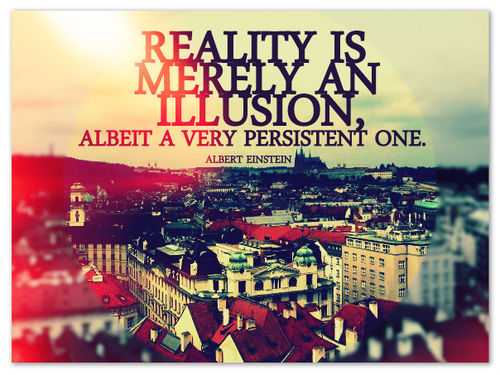
    Reality is merely an illusion, albeit a very persistent one.

    realityPhilosophers like Immanual Kant and John Locke, both suggested centuries ago that reality is something we construct for ourselves. I somehow wonder – Is the world we see while awake any different in perception from the world we see (dream) while asleep? Everything is created as an image in our minds, whether our eyes are open or closed. In dreams too, we see and interact with people, we have emotions like anger, love and they appear very real to us until we wake up. Dreams can make us scared, sweat like we would do with normal emotions, all while asleep.

    The illusion comes, and many problems of life, when we start believing what we see as the ‘ultimate reality‘ rather than just one frame of reference our mind has decided to show us. Indian philosophers in the past have spoke of this as ‘Maya‘. It says that we deceive ourselves when we think that the objects we see are the objects themselves.

    Most of our reality is shaped by our senses of vision, sound, touch, smell and taste. And it is scientifically proven that our senses can only comprehend a fraction of the physical realities of light, sound, etc. Furthermore, there are many more realities which we have no way (or senses) to understand and measure like magnetic field and electric charges. Other animals sometimes can detect these in varying quantities, like dogs have a better sense of smell and sound.

    Another example to highlight that everything we say and believe as truth is only an illusion is the “Earth is a sphere” discovery. In ancient times, it was believed that the earth is flat. It was so much a part of everyone’s reality that ships used to go a certain distance in the ocean and then come back due to the fear of falling off the surface of the earth. Everything we believe and see right now is nothing different from this example.

    I would even say that the concepts of space and time are totally shaped by our mind, even when it is very ‘real‘ to us with scientific proof. But we can’t hold space and time like we can hold a table or a chair, and so they are more about some concepts we have created rather than an ‘absolute truth’. Now contemporary physics have begun to validate this viewpoint too, though I will need to spend more time researching to make a credible claim on that.

    As human beings, we are conditioned to see our culture, language, politics, religion as reality, which is only an illusion. This illusion is then passed on from generation to generation. Without even knowing, we spend all our lives driven by this ‘reality’. It takes real courage to question and challenge these beliefs and assumptions and bring in a more mature perspective on how to lead our lives.

    I will end with this powerful quote around the same question I started with – What is Reality?

    What we call reality is an agreement that people have arrived at to make life more livable. ~Louise Nevelson

anger anna hazare bangalore business challenge coaching conflict conversation corruption Cricket culture dandi march emotions energy friends fun gandhi giving gold growth hope india jan lokpal bill language leadership lessons Life listening love moment mother movie new year people perspective poem sachin tendulkar saleraja trust values walk waste women words world cup