
jeffrey pfeffer

  • Power by Jeffrey Pfeffer – Why Some People Have It and Others Don’t

    Power, many believe is best suited in the hands of a few. However, that doesn’t mean you can’t try to gain power and work your way up the ladder of success. The mind-set that power is only for a selected few is completely wrong. Moreover, it can be changed and success and power can be yours. How?

    Power (2010) by Jeffery Pfeffer shows the way. The book focuses on how any individual can make it to the top. With tips on how to beat the competition and stand out in the crowd, it dispels the myth that power is only meant for the few.

    1. Power Is Only For A Selected Few

    Let us debunk the first and most important myth – power isn’t for everyone.  We often find that people keep on trudging at the workplace, wait for a promotion that is seemingly right-around-the-corner, only to be passed over in the end, finally believing that they did not deserve it.

    However, studies show that there is no relation whatsoever between performance and promotion. A study conducted on the Dutch aircraft manufacturer Fokker showed that post receiving a rating of ‘very good’, only 12 percent of white-collar executives were likely to be promoted when compared to those receiving a ‘good’ rating. 

    Moreover, the ones who do not get promoted fall under the trap of the ‘just-world-hypothesis’, a term coined by psychologist Melvin Lerner, where people tend to believe that the ones who do get promoted are the ones following all the rules and that they themselves have fallen short somewhere.

    The ‘just-world-hypothesis’ makes us think that a person using nefarious means to get to the top will one day ‘get it back’. We let our perceptions of their bad behavior cloud our ability to see and understand how such people succeed, often ignoring some of the techniques and tips that can be useful to us.

    2. Be Honest About That SWOT Analysis

    We often look at a leader and attribute their leadership qualities as ‘inborn or natural’, ignoring the fact that anyone can be a leader. Leadership qualities can be studied, practiced, and learned.

    Learning to be a leader first begins with an understanding of what the qualities of a good leader are. Moreover, it is about understanding the qualities that one embodies. Whether it is confidence, empathy, awareness, energetic behavior, resilience, or self-awareness, etc., that one has or has to imbibe; reflecting on which are the qualities that can be categorized as one’s strengths and weaknesses is essential. 

    Additionally, it is more important for an aspiring leader to be able to be honest about their strengths and weaknesses, as the strengths will need to be honed to perfection, to able to constantly be in the limelight to get noticed; and the weaknesses will have to be rigorously worked upon to ensure that they convert to strengths.

    3. Landing the Right Department

    Just as there are great differences between two companies, there is a wide difference between the different departments within the same company too. 

    A study conducted on the career paths of about 388 managers in public utility companies found that the managers who started their careers in the powerful departments of the organization had higher salary growth rates as well as higher chances of finding jobs in the powerful departments of other companies.

    Unfortunately, there is no way to pre-determine which department in an organization enjoys higher power over the other, however, fortunately, a 3-factor evaluation method can help one gauge which are the powerful departments – 

    • Relative Pay – The no brainer indicator. The more powerful departments tend to offer higher salaries.
    • Physical proximity to leadership – The departments that are physically located closer to where the leadership sits.
    • Composition of Important committees – The third is the departments that have representation in the boardroom.

    4. Breaking The Rules To Get Noticed

    There is an old Japanese proverb that says ‘The nail that sticks out, gets hammered down.’ 

    When it comes to seeking power and getting noticed by the leadership, this works quite in the opposite way than the proverb implies.  Simply put, the employee that stands out from the crowd gets noticed for promotions. How does one stand out then?

    There are two ways – by asking the powerful people in the organization for help and by making yourself memorable.

    People often shy away from seeking advice and asking for help – especially from the leaders – thinking that they will face rejection or that they are too little and inconsequential to be spent time on. However, the confidence in asking a leader help to the top is what often gets a person noticed.

    In addition to asking for help and seeking advice, one has to make themselves memorable to the leaders. One has to break or bend the rules a little to get noticed. In a pool of employees that follow the rules laid down by the organization, the one that gets noticed is the one that changes the way they work from the others. While breaking rules is essential, one has to be careful that they don’t steer onto the wrong side of rule-breaking.

    5. Helping Others

    The corporate world is all about working within teams. Therefore one cannot expect to receive help from teammates to make it to the top without helping them in their time of need. 

    Whether it is social support, career advice, or monetary help, sharing any kind of resources with colleagues demands reciprocity. It becomes a social obligation to return a favor. This reciprocity works better when the help given seemingly does not involve personal gain. For example, helping your boss plan a team outing. While it might not be much of a cost in terms of work, but will keep you in the memory of your boss for the help.

    Another resource to leverage is being fair and polite. Politeness is a rarely used virtue, however, one that makes a person stand out. Politeness never goes unnoticed, and in fact, it can help a person keep you in memory. The case is similar when you treat people fairly.

    6. Looking, Feeling, And Exuding Power

    It is simple. To be powerful, you have to look powerful. If you notice politicians, it is the way they speak and behave that influences people and they know that to be able to influence people, they have to attune the way they speak and behave.

    Emotions are contagious and have the ability to influence others. For example, when you enter a room smiling versus when you enter a room with a frown on the face, you will notice that the others in the room will reciprocate the same emotions. Therefore one has to exude a feeling of power.

    One way to exude power is to speak slowly and deliberately, which makes one seem to be confident and also helps in avoiding contradicting oneself. Another way is to study the display of dominant behavior. A study has shown that simply expressing anger while disagreeing with something makes others perceive you as strong and competent.

    7. Having A Good Reputation

    Reputation is indeed a fickle friend, albeit an important one. People make judgements and find ways to consistently back their judgements. Simply put, people will pay more attention to the things that will testify to their judgements, ignoring everything else. This is known as cognitive discounting. Additionally, people also modify or change their behaviour and reactions towards you depending on their judgement and assumptions they have previously made.

    It is therefore extremely important to have a good reputation. It is even more important to maintain it. A good reputation is made and maintained by firstly, making a good impression in the first place, because it is extremely difficult to change an established view.

    8. Conflict and Failure Are Inevitable

    Making it to the top is impossible without a few rounds of conflict and failure.  However, as essential as they are, these experiences can be used in one’s favor to make it to the top.

    Humans tend to be conflict-averse. However, a leader uses conflict to his advantage by preparing to face people with conflicting ideas head-on. To do this, however, one has to choose their conflicts wisely.

    For example, a fight for a good parking space might not be worth it as compared to defending your work that is being criticized by another person. Additionally, powerful people give the opponent in a conflict a chance to retreat gracefully. It is important to end a conflict on respectful terms; else one risk making lifelong enemies that can even destroy careers.

    Another important aspect is to know when you have lost the battle. And it is even more important to know how to move forward after that.

    Power, leadership, and success aren’t as elusive as they seem. Neither are they meant only for a select few. Leadership skills can be honed and power can be acquired by keeping the aforementioned tips in mind and by practicing the techniques enlisted.
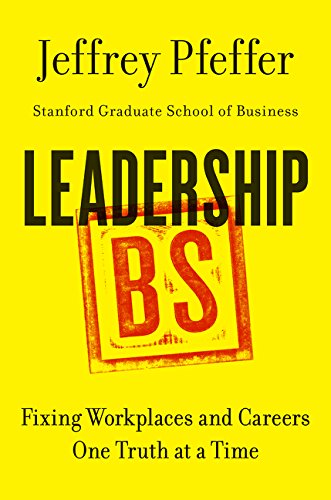
  • Leadership BS by Jeffrey Pfeffer – Fixing Workplaces and Careers One Truth at a Time

    Business and corporate life is a cutthroat world, where perceptions of popular and successful leaders have been created in fiction. While there is no doubt that these leaders have presented phenomenal leadership learning’s for the rest of the world, their climb up the ladder has always been documented in a positive light, leaving the negatives in darkness.

    Leadership BS: Fixing Workplaces and Careers One Truth at a Time (2017) by Jeffrey Pfeffer lifts the veil off the rosy picture that most leadership books and biographies put forth, and gives us an alternative insight into what a nasty business the way up to the top really is.

    Mythical Storytelling

    Who doesn’t want to tell an inspiring tale of a person who rises from the ashes of struggles, only to shine at the top of the business ladder? Well, everyone does, especially since everyone wants to listen! Heroic stories make books sell. Yet they do not give the true picture.

    Take the example of Jack Welch, well-known CEO of General Electric. Books often tend to leave out terms such as ‘GE Jerks’ and ‘rank and yank’ – the former being a name for a type of workers that existed under Welch’s leadership, and the latter, being a system of ranking all employees and firing the bottom 10% year-on-year, irrespective of overall career performance.

    Additionally, literature never mentions the number of pollution lawsuits GE has faced, the price-fixing schemes, or the cases of fraud registered against Welch.

    Such doe-eyed authorship results in two main problems – 

    1. Flawless biographies create utopian legacies. People looking for inspiration from such books give up due to the fact that they can never imagine living up to their legacies.
    1. With this feeling, real change never takes place, because people never realise that successes can be achieved despite imperfections

    Narcissism and Self-Promotion Are Leadership Traits

    Books and leadership gurus talk about qualities such as thirst for knowledge, strong personalities, ambition, trustworthiness, drive to succeed, listening skills, empathy, etc. However, one will never see narcissism or self-promotion as virtues of great leaders. 

    Yet, research has proven that effective and successful leaders have a streak of narcissism and are prone to self-promotion to an extent. Research also suggests that some leaders are not only confident but also arrogant, and believe that they hold a special power over others. 

    Let’s take Donald Trump for example. As a successful businessman and leader, his self-promotion has attracted people to his positive qualities than the negatives, despite the negatives being clear enough for all to see – right down to electing him as the President. 

    It is the bold actions, risk-taking, and overconfidence of such leaders that make people respect them. A similar observation of characteristics can be seen amongst the other presidents of the United States. A study suggested that out of 41 former presidents, those with fearless dominance, narcissism, and persuasiveness received the best evaluations for leadership.

    Phony Over Authenticity

    Another fact that leadership books slide over is that the decision-making process requires heartless decision making too. Leaders need to block out their emotions while making certain decisions, need to play a phony act in some cases, and fake their beliefs in many.

    Helen Rubin, who has worked with many leaders to write biographies, believes that leaders have to put up an act. Sooner or later this act comes naturally to them. Take for CEO of Intel, Andy Grove’s wolf school. It was a workshop designed to toughen up shy managers and involved managers conditioning themselves to be brutal to face.

    Leadership can need ‘a fake it till you make it’ attitude if it takes you up the ladder, keeps you there, and most importantly if that is what is needed for the business to succeed. Authenticity can take a backseat!

    Lies, Lies And More Lies

    It is hard to believe that all leaders follow the principle of truth. George Washington’s famous cherry tree confession is an example that we learn early on in life. However, it has been proven that lying has brought success to many leaders of the past.

    A study showed that people at the top could easily lie, and lie often. This is because people in power have a lesser chance of facing the consequences of lying. Additionally, conflicts can be smoothened over by lying.

    Apple CEO, Steve Jobs, many employees claim had a distorted vision of his company and often invented his own reality.

    Trust Needs To Be Broken

    No literature list of ‘must-have’ leadership qualities can be complete without trust. Yet, trust is a virtue that many leaders lack, and disregard often. 

    A study conducted amongst American workers on trust in 2014 showed paltry results, where only 7% of the study group believed that the senior management was truthful about their actions, only 10% trusted managers to make correct decisions, and only 14% thought that their leaders were ethical and honest.

    Not all breaches of trust can be attributed to the evil schemes of the evil leader.  In fact, it is common knowledge that leaders have to undertake brutal breaches of trust due to unavoidable circumstances in business. Breaking alliances, spying on competitors, dealing with competitors, making abrupt changes in the organization structure, mass lay-offs, etc. are only a few sins committed in the name of business.

    Maintaining The Top Position

    Care and concern for the team and the employee below them is another quality of leaders that gets glorified in books. However, in reality, leaders often use their power to stay in power.

    As discussed earlier, leaders need to appear to be confident and self-promotion is of vital importance. This very fact proves that as a leader, one has to appear flawless – even if it is at the cost of making an innocent person a scapegoat.

    Leaders often tend to deceive, trample, place blame, and slash careers simply to maintain their positions on the top.

    No Reason For Loyalty

    In the corporate world, the top management will almost always protect their power, without any consideration to employees. Mass layoffs are better than the organization losing face by scaling down on office space – is a general perception. Essentially, there is not much credit given to loyalty.

    Moreover, reciprocity and loyalty don’t hold much value in the corporate world. Most organizations put themselves before their employees and consider that loyalty and hard work gets paid for every month-end in the form of a paycheck. This attitude towards loyalty and reciprocity can be attributed to the belief that in business, everything is a transaction, and even loyalty is a move towards some personal gain in the future.

    Observing The Ugly Truth

    Playacting’ is a term in sports such as football or basketball, where players fake injury to simply gain a free kick/throw. Leaders are conditioned to tune in with the benefits of playacting. They know to focus more on observing behavior patterns along with listening to what is being said. This is the reason why socializing outside the workplace has become an essential tool for leaders.

    Machiavelli’s The Prince is a prime example of the protection of the virtuous by immoral means in the name of the greater good. Leadership works on similar principles, especially, finding the least dubious methods to achieving success.

    For example, in Apple, the phrase, ‘You’ve been Steved’ was commonplace for employees who had gotten bullied and/or threatened by Jobs. While it is disconcerting, maybe the ugly truth lies in the fact that Apple’s success wouldn’t have been much without many getting ‘Steved’.

    The Crux Of The Matter…

    The crux of the matter is, while we all have had books on leadership to inspire us, most create flawless, utopian characters that are too hard to follow truly. This literatures completely miss out on reality and often hide the ugly truth behind the CEO’s desk.

    Aspiring leaders of today should, therefore, keep their eyes, ears, and minds open to the fact that leadership isn’t all virtuous and has its fair share of Leadership B.S!!

brain care coaching commitment communication conflict conflicts conversation culture deployyourself deploy yourself emotional intelligence emotions empathy energy feedback freedom future gold habits hope john maxwell language leadership lessons listening performance perspective preparation productive productivity psychological safety purpose questions relationships resolution ryan holiday seth godin simon sinek strengths struggle team trust values words