If you are a leader or manage a team, it is not uncommon to come across someone in your team who intimidates you. This might be because they are better than you in a particular skill and that brings your insecurities to the fore. Or it might be because the person might be overly assertive, has temperament issues and you are trying to avoid conflict.
The first of the above reasons above to feel intimidated is a good one. You should always have people in your team who are better than you in certain skills. That is what makes a strong team. On the other hand, if you never feel intimidated by the expertise of people in your team, maybe you are not hiring the right people.
The second reason, though, if left unaddressed, can have a massive impact on the culture and performance of the whole team. As human beings, we all tend to psychologically avoid conflict and create harmony. But overly aggressive people can take advantage of that unless you know where to draw the line.
Below are 3 situations in which we, as leaders, might have to deal with and manage an intimidating employee:-
Situation 1 –Employee Has Skillset That You Don’t Have
Good managers hire people who are better than them in different skillsets, so they know it is nothing to feel insecure about. When they do feel insecure (which they will feel because it is human nature to do so) they are self-aware to recognize it in themselves. They are then brave to be vulnerable and share the same with the employee (or the entire team).
A good leader will ask the employee to share his/her expertise and lead in this niche area, while the leader can provide support when required to help them do their job. This will make the employee feel good about their skill and give them opportunities and encouragement to grow further.
If they still feel intimidated or feel they can’t understand what the employee is talking about, a good leader will ask the employee to be understanding and explain things slowly and in simpler language. They also make it clear that learning to do so will help the employee build much-needed skills to communicate their ideas to a more general audience.
Good leaders are confident and not weak or fidgety. They understand everyone brings different skillets to the table, and are comfortable in their own skin.
Situation 2 – Employee Has Anger Issues and Sometimes Explodes
Good leaders make it clear that exploding in anger and saying unworthy things or using bad language is not acceptable, irrespective of how good people are at their job. They make it clear that doing so repeatedly will have consequences, even leading to dismissal. And strong managers keep their word and are strong enough to take disciplinary action when required.
They do so because they know that tolerating bad behavior sets the wrong example and can be detrimental to the culture and morale of the team. If this happens, then it is very difficult to fix and can impact the performance of the entire team.
Know Your Values. Know What You Stand For
Having said that, good managers are empathetic and listen attentively to the source of the anger. They get to the root of the problem and fix any process or other issues that might cause frustration for people, and the anger to arise in the first place. Just being a disciplinarian without being supportive never works.
Ideally, a good leader should notice any build-up of emotions in his/her people during regular interactions and 1-on-1’s and take action before the emotions lead to an explosion in anger. The best time to repair damage from an emotional storm is before the storm, not after it.
Good managers coach their people to handle their emotions in a way that is constructive – without suppressing or exploding. They understand that emotional intelligence is an important skill, and take an emotional outburst as a teaching/coaching opportunity to help others step up their Emotional Intelligence game.
Situation 3 – Employee Doesn’t Listen Because They Think They Know Better
Good managers create workplaces where listening and respecting each other for their skills is an important value. Even if people know better, they are expected to listen to different opinions with empathy and express themselves without attitude or arrogance.
Good leaders don’t tolerate awesome jerks, and let people know that they are accountable for how they do their work, and not just what they do. They are strong enough to take action when required and understand that tolerating a jerk never works in the long term as it destroys team culture.
On the other side, good managers know that everyone has different styles of communication. They give people the freedom to express themselves in their own unique way as long as they don’t cross certain boundaries. They give others a chance to improve or adapt their communication so that it does not hurt the culture of the team.
Good managers help/coach others to be better communicators. Everyone can have different styles of communication, but the objective remains the same – to express themselves, to persuade others, or to share an important message. Everyone can learn to become better communicators as it will help them do their jobs more effectively.
“Because one believes in oneself, one doesn’t try to convince others. Because one is content with oneself, one doesn’t need others’ approval. Because one accepts oneself, the whole world accepts him or her.” – Lao Tzu
Conclusion
Doing all of the above is only possible when a strong leader knows their values and what they stand for. Being comfortable in your own skin is the first step in deciding when to intervene and when to let people do what they want. As a leader, it is always a fine line between autonomy and management.
You want to give your team maximum autonomy and keep the management and control to a minimum. It helps to get the team involved proactively to jointly come up with team values and preferred ways to communicate. People are more likely to follow any guidelines and boundaries if they themselves created them.
Once these values are clear to everyone, good leaders lead by example. They live by and uphold these values – even if that means having uncomfortable conversations at times. If you are new to leadership, it might be uncomfortable to do so, but soon you learn to handle such situations with the poise and confidence of a strong leader.
Bryan, an 18-year-old, graduated high school at the top of his class. He then headed off to attend Columbia University. Now, Bryan feels petrified. He is convinced that the admissions department at Columbia has made a terrible mistake. He feels he does not deserve to be in such a prestigious university.
Bryan is one of the many among us who is affected by imposter syndrome. In fact, a major segment of the population has faced this psychological phenomenon at some point or another in their life. Men and women from all sorts of professions are affected by imposter syndrome.
In most cases, imposter syndrome starts with a feeling of inadequacy or unworthiness. This makes people doubt their own accomplishments. This can result in a fear of being taken as a fraud by other colleagues or friends. Any achievements and past successes are overshadowed by this all-consuming feeling of self-doubt.
Even the smartest and the most skilled professionals can suffer from this syndrome. Most of all, this creates a negative impact on their confidence levels. The waves of self-doubt can adversely affect career growth and leadership skills.
But the silver lining is that this is not the end of the road. There are methods to train your mind and regain your confidence. It is important to recognize the signs of the syndrome and acknowledge them…
Impostor Syndrome Is Universal
Confidence Is The Key to Success
“Confidence is contagious. So is lack of confidence.” – Vince Lombardi
Self-confidence and self-esteem are two factors that determine our well-being to a great extent. The best levels of performance and productivity in any field is achieved when you are confident about your skills and abilities. Confidence allows you to make the best use of your knowledge and skills through action.
Below are some of the ways in which confidence helps you to reach your goals.
Earning Respect
Respect is something that you have to earn in your professional life. Consider a person who can confidently perform tasks and meet challenges. Such an individual naturally earns respect from colleagues.
It also helps you to showcase your skills to your superiors. Having said that, it is also necessary for you to listen to and respect other people’s opinions in return.
Increasing Productivity
When you are certain of your abilities to complete a task, your productivity levels rise. Confident employees are not stopped by the fear of failure. They face fear head-on, take necessary precautions, and move ahead. They will be more willing to take on new challenges.
It is the confidence levels of the employees that determine the productivity of work. Confidence also allows us to assess our strengths and take the right steps to improve on the weaknesses. In the end, we can be in a much better position to achieve the goals that we have set.
A Positive Influence
Teamwork is a must in any professional environment. However, all the team members may not have the same levels of capability. A confident individual can motivate and influence others more effectively. A confident leader can boost the morale of the team and make it more productive. You will also find confident individuals being less affected by failures and setbacks.
Standing Out in a Crowd
In a competitive and crowded workplace, confidence allows a person to stand out. In fact, the body language of a confident individual easily stands out. Confident people do not let the fear of failure stop them nor are they afraid to make mistakes. At the same time, confidence does not mean becoming cocky or arrogant. To overcome imposter syndrome you need to find the right balance between humility and confidence.
Confidence Can Make A Huge Difference
Impostor Syndrome Is Universal
“…the exaggerated esteem in which my lifework is held makes me very ill at ease. I feel compelled to think of myself as an involuntary swindler.” – Albert Einstein
Imposter syndrome has affected many famous personalities like Tina Fey, Howard Schultz, Serena Williams and Tom Hanks. While it is normal for anyone to question their abilities at times, imposter syndrome is mostly observed in those who set the bar very high. This can lead to an endless striving for perfection and the feeling of being inadequate.
There are some experts who believe that imposter syndrome is related to anxiety or neuroticism. Others think that it may be linked to the childhood or the family dynamics of an individual. Being brought up in a family where achievement was highly valued can have a lasting impact on a person. Perhaps unsurprisingly, impostor syndrome is more common in women than in men.
Listed below are some common thought patterns associated with imposter syndrome. Basically, all these feelings can erode your confidence and sabotage your chances of growth.
I feel like a fake
I’m totally not qualified
I do not deserve this
It’s all because of luck
I must not fail
My success is no big deal
Success Can Breed Imposter Syndrome
It turns out, imposter syndrome is common among highly successful individuals. So we can say it is not directly associated with a lack of self-confidence. Many people push themselves to the limits to be the best in all aspects of life. Constantly working towards becoming “perfectionists” can make them question their own competence at times.
These “perceptions of impostorism” are also influenced by various social factors. They also affect a large percentage of professionals working in a competitive environment. So it is important to realize you are not the only person disturbed by such feelings.
You are totally fine if you feel self-doubt. The point is – it has nothing to do with your true capabilities.
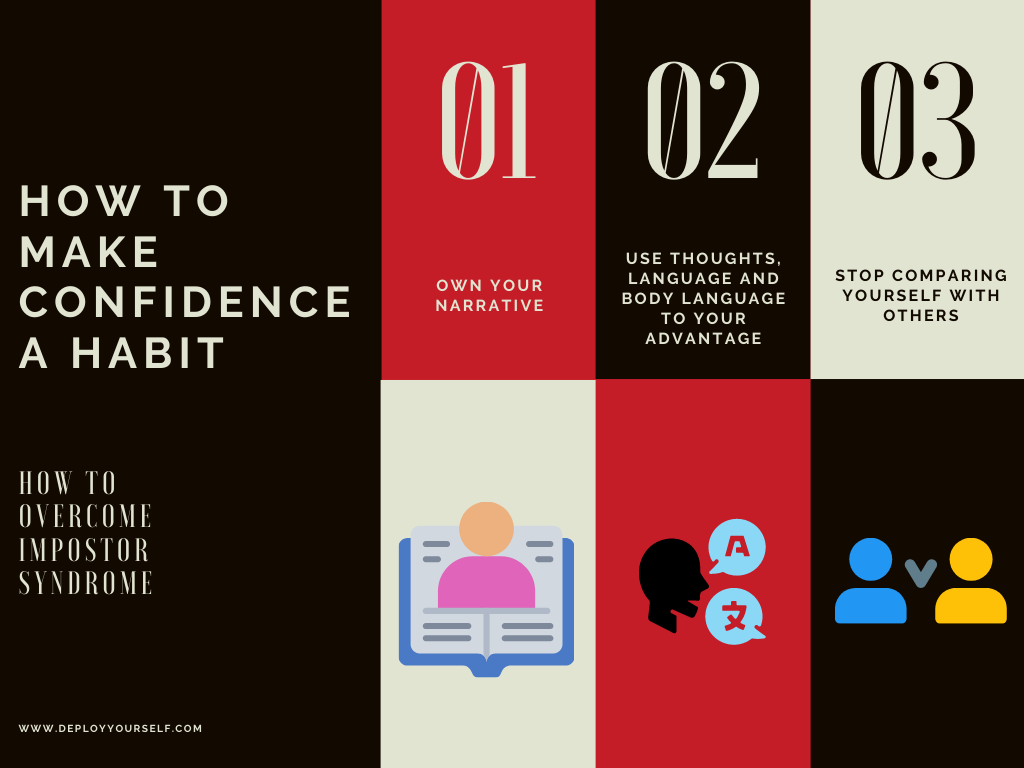
How to Overcome Impostor Syndrome and Make Confidence a Habit?
Let us take a look at some basic but effective steps to overcome imposter syndrome.
Step 1 – Own Your Narrative
Listen To And Understand Your Story
The first step towards coping with imposter syndrome is to ask yourself the below questions to understand yourself and build self-awareness. Here are a few such questions. Leaders know and understand that their own life stories have true value. They learn from these experiences.
What are your core values and principles?
What kind of person do you want to be?
How do you want to live your life?
What are your biggest successes and failures?
What do did they reveal about you?
Who has had the most influence upon you?
Once you dig deep and find the answers to these questions, it will help you to build self-awareness and understand the narrative of your own life better. Questions like these can help you uncover your personality and understand how you came to be the way you are. By exploring these questions you also get the freedom to choose the kind of person you want to be, or if there is something you want to re-invent or change about yourself.
Recognize Your Values
These questions will also reveal your core values. You will be able to trust your own decisions and judgments without insecurity. Values and principles, along with self-awareness guide leadership. If a leader has firm values and principles, he will establish authentic leadership skills.
All of us are good in certain areas and not so good in a few others. When you make a realistic evaluation of your capabilities, you will recognize the areas where you can improve.
Look Beyond the Negatives
When you find yourself staring into a pit of self-doubt, look back at your roots to boost your confidence.
It is easy to let negative thoughts overpower you when events do not turn out the way you want. What I have learned is that mistakes and losses should not be allowed to drag you down. In fact, they can be used as effective tools for self-improvement.
For example – Let’s see how Oprah Winfrey defines herself. Until she was 36, she blamed herself as a bad girl. She had been raped as a young girl and then as a teenager, she had gotten pregnant. She believed she was responsible for all that trouble.
Her personal narrative and her career totally changed the day that she interviewed Truddi Chase, a writer with multiple personality disorder, who had been sexually abused as a child. “That was the first day I recognized that I was not to blame,” she said. That was her crucible. The interview led her to understand her true purpose in life – to help others along their journey to success.
The above is hard work and not always easy. It is the core part of building up a foundation for your success. But it is very very important. Without doing the hard work required to build self-awareness, the below points won’t work.
How To Make Confidence A Habit?
Step 2 – Use Thoughts, Language and Body Language to Your Advantage
Changing your thought patterns to break the cycle of imposter syndrome can bring about a gradual change in your mindset. Learn to talk yourself into being confident. Positive declarations and visualizations can make a small difference which can compound over time.
We can use our language to effectively counter the feelings generated by imposter syndrome. Overcoming imposter syndrome is about shifting your focus away from playing the victim and instead of thinking and acting like a player. You can think about the difficulties that you have to overcome to reach the present level. This will help you to stop undermining your past achievements. The other way is to challenge any negative thought that arises with a question or a positive statement.
It has been proven that positive assertions can boost confidence levels. In fact, famous personalities like LeBron James and Malala Yousafzai have used this technique with great results. Such positive assertions can transform your thought process by breaking the chain of negative thoughts.
Use Body Language Effectively
“When speechless, let the body do the talk.”― Toba Beta, Master of Stupidity
A major part of our daily communications is through body language. Using it right can make a big difference. The fact that imposter syndrome is not related to muscle memory allows you to use it to your advantage.
For example, during a meeting or a presentation, you can practice slow and deep breathing to ease any negative thoughts. Next, you can use the right gestures (like standing instead of sitting) to overcome them and project your confidence.
Other non-spoken elements of body language include facial expressions and postures. Actions like an open posture, eye contact, and a firm handshake can convey your confidence to others. By being conscious about your own choices based on your values and beliefs, you can take control of the steering wheel of your life and stop being just a passenger in life.
Step 3 – Stop Comparing Yourself With Others
Many times we think that others are sailing through a given situation while we are struggling. In reality, they may have their own internal struggles to deal with. It is no wonder Theodore Roosevelt said “Comparison is the thief of joy.”
While dealing with such thoughts try to keep these points in mind.
Each person has their own journey and comparisons are hardly helpful.
Comparing your weaknesses with the strengths of another person is a mistake.
By being sure that you are delivering your 100% towards any objective, you can step out of the rat race and still be satisfied. That is success beyond success, as defined by John Wooden.
Talk to Those Who Can Help
Quite often, people are ashamed of discussing the conditions of imposter syndrome with others. However, by discussing the issue with the right people, you can get some valuable feedback about dealing with it.
A recent study among students pointed out one aspect of those who were able to cope better with imposter syndrome. These were those who reached out to family, friends, or professors outside their major for support.
Seek Internal Validation Instead of External Validation
If you depend on internal validation, you can better be in control of how you feel about yourself. Relying on external validation and using other people’s opinions to dictate your abilities is a sure-fire way to feeling bad about yourself.
While it is difficult to get rid of imposter syndrome completely, you can definitely prevent it from hindering your growth. It is up to you to realize that the negative voice inside your head doesn’t have to stop you from moving ahead.
Conclusion
Lastly, I will add that each one of us is unique and have tremendous potential. While it is natural for even the best to make mistakes, it is important to see them as learning opportunities and not get demotivated. By reframing your thoughts and actions, you can deal with imposter syndrome effectively.
In truth, we all need support and motivation to build up our confidence. True leaders step out of narrow personal boundaries to encourage and empower others in delivering their best. When you help others through your words and actions, it will also boost your own morale. Everyone needs confidence, whether they acknowledge it or not. Pay it forward by acknowledging the good work done by others to empower them.
We all know the physical and health benefits of exercising daily in the morning. If we exercise, we will remain fit, healthy and energetic all through the day. We also know the health benefits of exercising in our sedimentary lifestyle. Regardless of age, exercising helps us prevent chronic diseases and maintain our cholesterol and blood pressure levels. It also helps us burn those extra calories and to keep our weight in check. Exercising also keeps different parts of our body active, making it easier to do any strenuous physical task whenever required.
But there are many other benefits of exercising daily in the morning which we don’t realize. These benefits effects our mood and energy levels all through the day. Here I am listing 5 such positives from exercising which we don’t realize –
1. Personal Victory
When you wake up early, and get out of bed for exercising, that itself is a victory. A personal victory over our lazy and procrastinating self. A victory over the many different reasons which you will find for not getting out of bed in the morning. And let me tell you, those reasons will always be there. Having the courage to actually get out of bed and go walking or jogging is a personal victory. And what better way to start your day than with a personal victory over that part of yourselves which is weak, doubtful and unsure by the part which is courageous, brave and energized.
2. Confidence in Yourself
Keeping your confidence in yourself is very important, especially in times of setbacks, emotional turmoils or financial difficulties. Knowing that you wake up every morning and exercise will always remind you that you are a winner. It takes a lot of courage, determination and discipline to exercise daily and when you apply these traits in exercising, you know you can apply these in other areas of your life too. You carry the positive energy coming from exercising to the rest of your life and that will help create a chain of positive events, even in difficult times.
A man's health can be judged by which he takes two at a time – pills or stairs. ~Joan Welsh
3. Stress Buster
Life is full of surprises, and not all of them good. And it hurts when a not-so-good surprise reaches us when we are not expecting it. Often we find ourselves reaching for things like food, alcohol, or drugs because they make us feel better. The same feeling can come from exercising. Exercise provides an outlet for negative emotions like your frustration, anger, resentment towards an individual, an organization or a situation, which in turn promotes a positive outlook. Medically also it is proved that exercising releases mood-elevating chemicals in the brain and reduces the amount of negative hormones.
4. Peaceful Greeting to the Day
Exercising is a wonderful way to greet every new day as it begins. Nothing can be better than seeing the first rays of light on the horizon or the sunrise. Everything is so quite and peaceful in the morning, and many say that mornings are the most productive time to do anything. You can easily hear the sound of the wind, of bird chirping in the morning. You can focus on your breathing in the morning as the city is still asleep and you are alienated from its hustle and bustle. Mornings are also a wonderful time to read a book, or to think and make plans for the day ahead.
5. Free Time Later in the Day
When you get up early in the morning, you are calm and relaxed as you get time to think and plan out your day. You don’t to have to rush to get ready to catch the office bus or take the car through traffic in a rush to reach office in time for that 10 am meeting. Instead you are free and can leave early to avoid the traffic rush. With this state of mind, you are more productive and energetic the whole day and will obviously wrap up your work earlier than in normal days. This will leave you extra time in the evening to spend with your kids and family. Just imagine the kind of sleep you will get at night if you get up and exercise, then reach office and work more productively, and later spend some quality time in the evening with your family.
In such a lifestyle, there is no space for any stress and we will always be better equipped to handle life’s problems and setbacks when they come. All by doing one simple act of exercising daily, and regularly. If you have always thought that you didn’t have time to exercise because you are busy, think again. Because exercising does not only gives you benefits in that 30 mins or 1 hour that you exercise, it has a huge impact on the whole of your day. I would say, certainly a worthwhile investment to do daily first thing in the morning.
It was December 2009, and although I was still working on SaleRaja, it was now more as a burden than for interest. I was stumbling in the timelines for feature changes that I had set myself, my enthusiasm was low and I was unsure about what the future had in store for me and SaleRaja. Finally, after managing SaleRaja alone for the whole of 2009, I decided to let it go and focus on my career through a job. That means I was soon looking for a job when at one time I thought that I would not have to find another job ever. My motivation levels were at an all-time low, and I was confused and unsure about what next?
But I decided to take a break from entrepreneurship, focus on my career through a normal job, and come back to entrepreneurship some years later. It was not an easy decision, and it took me around six months of consideration to finally stop running SaleRaja as a business. Looking back now, 16 months after that decision, I can laugh over those uncertain times and say that it might be one of the best decisions I ever took. The first few months were tough, as I was confused, low on confidence and struggling to find a direction in life. But after that, and till now, the going has been wonderful. I have done things in the last one year that I never thought I could, and would do, ever. I am listing below everything for which I am really grateful in this past year.
Started sumit4all.com
I had always been good at writing, but used my writing skills only when writing letters, emails, or when somebody asked my help with it. Hence, in January 2010, I started sumit4all.com as a blog where I would write about different things I feel about, my experiences, my life, etc. I could only do so because I was free and there were no SaleRaja deadlines to follow. It was not easy at first, and I was not able to write more than one post per week. Writing was like a pain in the ass and I had to put in a lot of concentration, patience and effort to research about a topic and write an article. But slowly and steadily, I started enjoying writing and I am writing around 15 articles every month now. Many of my articles have been well received and been shared a lot through social media like facebook, twitter, etc. Now I have plans of writing and getting a book published in 5 years.
Reading Books
I started reading books during the last few months of 2009 when I was struggling with SaleRaja, but I made it regular only after Jan 2010. I started reading two books every month and have been following this practice till now. I have read autobiographies, self help books, and a few business and fiction books too. These books have allowed me to take a peek into the stories of so many men and women, and the perspective of life I got after that have been amazing. I have a small, but good library now and have a lot of books in my to-read list.
A screenshot from SaleRaja.com
Landmark Education
Right after SaleRaja, I was looking for some kind of education to fill in the gaps in my skills which I had found during my stint with SaleRaja. I looked at MBA options, some short time courses done by IIMs and other B-schools, but nothing interested me. I started finding groups online related to business, entrepreneurship and started meeting like minded people in Bangalore, but that also didn’t sustain. Then I enrolled myself in the various programs of Landmark Education since July 2010, and am continuing this education even now. This could not have come at a better time for me. It has helped me get my confidence to a new level and clear a lot of doubts about life. Also, I met a lot of people through Landmark Education who are very successful and leading wonderful lives, providing inspiration and support. I can without doubt say this last seven-eight months of Landmark has been the best education of my life. It is ironical how we keep studying about specific skills / courses but never study anything about life and living in general.
Joined Yahoo
Yahoo, Google and a few more are the dream companies of many people. I was open to both startups and big companies when I started looking for a job again, and found myself in Yahoo in March 2010. Having spent the last one year here, it has given me my first experience of working in a multinational company. Dealing with different people and teams from Singapore, Brazil, Europe and US over the last year has given me much needed exposure about how work happens across continents, cultures and languages. In the future too, I am sure there is a lot I can gain from Yahoo and working here.
Waste Management Activities
In September 2010, I got intrigued by the idea of waste management and thought of a business idea around it. Since starting a new business was out of question, I got involved in waste management related activities in Bangalore to know more about its details. I took an initiative to implement waste management in apartments starting November 2011 and have got a decent response from that. I have met a lot of people who are already working in this area and am totally amazed by their energy levels. They have been a great inspiration about how to to live life responsibly. It also gave me the confidence to take new initiatives in any area, irrespective of my skills and knowledge in that area.
Dandi March 2
In March 2011, I got a chance to organize an anti-corruption walk in Bangalore. In less than three weeks, I put together a team and on 26 March, over 400 people walked over 11km under 4 hours to make this walk a huge success. These three weeks were one of the best of my life, with all my learnings in the past year put to test. I got confidence like never before after this event, and the Anna Hazare magic caught the attention of the whole nation soon after that. It was during this time only that some articles written by me attracted huge traffic from google as people searched for anti-corruption keywords on the internet. The success of this walk is the reason nothing seems impossible now to me.
What Next?
Although I have gained a lot in the last one year, I very clearly see a long journey ahead with lots to learn and do. I am in the most calm and peaceful state of mind that I have ever been, and with confidence that I can take on anything now. It has not been all uphill too in the last year, and I have tasted some setbacks too, but I have surprised myself with how well I have handled myself during these breakdowns. I have taken the lessons from the mistakes I have committed without getting frustrated and upset, and moved on to newer things. For the remaining of 2011, I have atleast two more initiatives lined up in the social space, so watch out in the coming weeks for more updates 🙂
Update – Pick a Fight was born soon after I wrote this post
We, as a nation, stand today in a moment of reckoning. We are at a fortunate junction where our actions will decide the course our nation and 1.2 billion people will take in the coming decades and centuries. If India’s history were to be written 200 years later, what we do in the next few years will certainly play a very important role. We have broken from the shackles of the license raj and taken the flight of globalization and economic growth. We are expected to be third largest economy soon. But at the same time, we are plagued by many social evils like poverty, illiteracy, corruption, etc. Whether and how we act in this moment of reckoning will decide whether we rise like a phoenix in the 21st century or again loose the opportunity to reclaim the title of “Sone ki Chidiya“.
We have a feel good mentality about our future now. Incomes are rising, jobs are plenty, multinationals have set up shops in different cities and amenities are galore if you want to go out for eating, recreation or just fun. We are one of the fastest growing economies in the world, and our companies like Reliance, TCS, Infosys are going multinational. Our engineers are behind many technological innovations in developed countries, and we are being seen as a knowledge powerhouse. American President Barack Obama has publicly asked American kids to study hard or they risk loosing their jobs to Indians (and Chinese). We have made our mark in the filed of telecom, space technology, medicine, defense, and have also started to make an international impact in arts and sports.
However, having said that, we are grappling with many problems which are deep rooted in our system because of our colonial roots and the closed economy system from 1950-1990. Our economic growth has still left a large part of the population untouched. We have got problems of poverty, illiteracy, unemployment, corruption, rising prices, social inequality and terrorism. We are one of the poorest countries in the world, where more people have access to mobile phones than a toilet. The middle and higher classes use drinking water for flushing toilets too, and the lowest segments of society don’t even have access to clean drinking water. The condition of women is still poor. More than 50% are illiterate, and there are still social ills like dowry, child marriage, female infanticide prevalent in society. Our public services are breaking under the strain of bureaucracy and inefficiency.
Can we keep the optimism alive?
With majority of our population being young, and the kind of confidence they see for their future, I believe we have everything to change the situation around. The youth have to see this as a moment of reckoning, where the actions we take today will decide the future course our nation takes. We can feel the optimism an average Indian has in the way he goes about his daily routine, with aspirations in his mind and hope in his vision. The Indian today wants to grab a piece of this growth, a piece of future, and provide a better future for himself and his family, and indirectly, for the nation too.
So when our history is written 200 years down the lane, what our generation did with this opportunity will decide the course India takes. We have missed opportunities in the past, and we might miss this one too if we let our skepticism and cynicism about the current state of affairs overcome the very basic human ability, to strive despite of problems and shortcomings. History might say India had a golden opportunity to shine and lead a new world but instead it dig its own grave and continued to grapple with its problems. Or history might witness the rise of India, again, after the period of colonization and slow growth for 60 years, into a prosperous society and economy which will lead the world order in matters of importance. We have already shown leadership to the world in the area of trade reforms and environment concerns, and there is no doubt why we can’t give this world the direction it is looking so badly for.
I use cookies on this website to give you the most relevant experience and for analytics purposes. Any personal data collected will never be shared with any third party, or used to spam you. That is my promise. - Sumit By clicking “Accept”, you consent to the use of ALL the cookies.
This website uses cookies to improve your experience while you navigate through the website. Out of these, the cookies that are categorized as necessary are stored on your browser as they are essential for the working of basic functionalities of the website. We also use third-party cookies that help us analyze and understand how you use this website. These cookies will be stored in your browser only with your consent. You also have the option to opt-out of these cookies. But opting out of some of these cookies may affect your browsing experience.
Necessary cookies are absolutely essential for the website to function properly. This category only includes cookies that ensures basic functionalities and security features of the website. These cookies do not store any personal information.
Any cookies that may not be particularly necessary for the website to function and is used specifically to collect user personal data via analytics, ads, other embedded contents are termed as non-necessary cookies. It is mandatory to procure user consent prior to running these cookies on your website.