
Newsletter

The Deploy Yourself Newsletter

  • Issue #60, 30 Aug 2022 – For the sake of what?

    Welcome to the Deploy Yourself Newsletter, where I share what impactful leadership looks like to show your own power. I also share the most insightful lessons and stories I encountered in the last two weeks. You can also read this issue online.

    Hey,

    For the sake of what?

    In the last few weeks, I have helped two leaders in a company overcome a conflict. When we started, both had their own approaches to a business challenge their company was facing. At the same time, both of them were stuck in their own point of view and could not move forward.

    Worse, it had begun to impact their relationship and the wider culture in the organisation as both of them were leading 70-80 people orgs. As you might know, this happens all the time when people work together. And it (friction and different perspectives) is a good thing if handled well.

    One of the reasons I love coaching teams is to help them see something they could not see before. A good question to start this exploration is – For the sake of what are you doing (or proposing to do) what you are doing (or proposing)?

    I often stick around with this question for a few hours or days as we uncover layers of answers. What I am usually helping people see is what they care about on 3 levels-

    1. IT – The level where all problem statements, business challenges, projects, tasks, and deadlines are found.
    2. WE – The level where all relationships – with their history, expectations, emotions, and future possibilities are found.
    3. I – The level where your individual dignity, values, beliefs, emotions, past experiences, and habits are found.

    Over the last few weeks, I have helped these two leaders go deeper on these 3 levels by exploring questions like

    1. For the sake of what are you even here? What does your business CARE about that both of you are part of this team?
    2. To create the above-identified business results, what kind of relationship do both of you aspire to have?
      1. Is it A vs B?
      2. Or is it, “A and B” vs “what the business CARES about”?
    3. For the sake of what are you proposing what you are proposing? Answer this on all 3 levels of IT (business), WE (relationship), and I (self).

    It is so easy to talk about the IT – the business problems – without uncovering what is at stake on the relationship and personal level. And asking the “For the sake of what?” question uncovers that.

    It is so easy to end up talking past each other or even in a state where you are not even talking – a lot of damage on the hidden layers of WE (relationship) and I (self), even if you achieve wonderful business results (IT).

    I invite the reader to ask themselves the same question “for the sake of what” on these three levels which are always at play.

    1. For the sake of what external outcome am I doing what I am doing? What is it that I CARE about here?
    2. For the sake of what kind of future relationships (with those involved) am I doing what I am doing? Are my actions and behaviour aligned with what I CARE about in the kind of relationship I want to take care of the business outcomes?
    3. What personally matters to me? Why am I doing or proposing what I am? What do I most deeply CARE about?

    When the answer to these questions (which are often unsaid and unheard) are spoken and listened to, it creates a safe space where all future leadership and results happen. It creates trust in teams, releases unexpressed desires and emotions, and people come closer together – even if they have different ideas.

    And needless to say, business results skyrocket as people simply ‘click’ together. It improves their well-being, eliminates stress, and creates fun and laughter at work.

    Now, who wouldn’t want that?

    Reply back with any insights you might have on reading this.

    PSI help leaders and entrepreneurs solve their biggest problems to achieve in 3 years which would normally take 10 years. To know more, send me a message.

    Fascinating Articles & Stories

    One

    How Matt, CEO of Panther.co, runs a fully-remote startup

    This is how Matt and his team communicate across ~8 time zones.

    1. Async is the bedrock of a good communication system while remote. You simply can’t expect a global, fully-distributed team to be sitting on Zoom at odd hours. More importantly, meeting culture kills productivity.
    2. By creating communication norms, you can make sure everyone’s communicating the same way––and that people aren’t getting ripped out of deep work by meaningless notifications.
    3. Get better at writing. Most async communication happens in a written format.
    4. Get as close to 0 meetings as you can. Have meetings for the right reasons – for brainstorming, teambuilding, 1on1s, relationships, etc.

    Source: Reddit

    Two

    15 Powerful Centering Methods to Reduce Stress, Increase Focus, and Make Better Decisions

    Learning how to center yourself is perhaps the most important skill most people never learn. This guide explains what the Center actually means and offers effective methods to help you find it.

    You can train yourself to notice when you’re out of Center. Then, you can reclaim the Center, over and over again.

    When you’re out of Center, one thing is certain: you’re not breathing properly.

    The simplest way to get back to center is through focusing on your breathing. Just 3 or 4 deep, slow, quiet breaths from your belly can help bring you closer to the Center.

    From an article by Scott Jeffrey

    Three

    A Humble Inquiry on How to keep yourself motivated?

    In this episode, Leslie joins me as my co-host to humbly inquire into how to keep oneself motivated as a leader. If we are not motivated ourselves, it shows its impact on everything we do and every responsibility we have. Leadership starts with finding and staying connected with our own motivation first. Below are some highlights from the episode.

    • “if we get our body moving, it lifts our moods, it lifts our spirits.”
    • “motivation is  it’s it’s connecting to that fire, which is within you and then giving it a little bit of air so that it becomes like a flame”
    • “going for a walking meeting together is a great way to combine a lot of what we’ve talked about when it comes to finding that motivation”
    • “there is no such thing as a motivated or a demotivated person. There are only moments in which you are motivated and demotivated. And then every moment is a new opportunity,”
    • “Motivation is not something which you can design or control. You can only create the conditions for motivation to happen, but not really directly motivate somebody.
    • “if you don’t take a shower, that doesn’t mean that you’re a bad person or something is wrong. You just take a shower, if you wash your hands and they become dirty again, you simply wash your hands again. Similarly with motivation, right? If you’re not motivated or if you don’t feel that energy, it’s not like something is wrong or something is missing. You just shift. Connect with what motivates you and then you’re motivated again.”

    Listen to the complete recording on the Choosing Leadership podcast

    That’s it for now. If you have any questions or feedback, or if you are new and want to introduce yourself, hit reply. I read and respond to every reply. All the best,

    Sumit

    (Twitter) @SumitGupta
    (LinkedIn) Connect
  • Issue #59, 16 Aug 2022 – No one is coming… to save you

    Welcome to the Deploy Yourself Newsletter, where I share what impactful leadership looks like to show your own power. I also share the most insightful lessons and stories I encountered in the last two weeks. You can also read this issue online.

    Hey,

    No one is coming… to save you

    “I was hoping coaching would solve my problems”, one of my coaching clients recently shared with me.

    “And what are you realising now?”, I followed up with a question.

    “That nobody can help me until I am ready to take responsibility to change myself.”

    There was a pause after that. I saw that he was reflecting so I did not intervene.

    “I started coaching as a way to escape responsibility – to get that relief that from now on – my coach will solve all my problems. Now I see that no one is coming to save me. In fact, no one can. Except myself”, he further added after around 45 seconds of silence.

    “And is realising this – that no one is coming – a relief or a burden?”, I probed further.

    “Surprisingly, it is a massive relief. Now, I can finally stop hiding, take RESPONSIBILITY for the actions that brought me where I am, and then CHOOSE my actions now based on where I want to go. It is a massive relief”, he said as he let out a long and audible out-breath.

    This small little exchange was a pivotal moment in our coaching relationship.

    It was like he became a totally different person after that.

    In the six months since, he has totally transformed his life and the results he has produced have been magical.

    More importantly, apart from the results, his experience of life has dramatically shifted.

    Now, he has no obligations, stress, heaviness, overwhelms, or burden of the big challenges he has taken on as a leader. Instead, he is able to experience full commitment, joy, and freedom.

    He is able to say YES and NO with ease, establish boundaries when required, and take out time for his family, health, and other passions without feeling guilty.

    I will leave you with the below quote by Naval Ravikant for further reflection.

    Doctors won’t make you healthy.

    Nutritionists won’t make you slim.

    Teachers won’t make you smart.

    Gurus won’t make you calm.

    Mentors won’t make you rich.

    Trainers won’t make you fit.

    Ultimately, you have to take responsibility.

    Save yourself.

    Reply back with any insights or areas you identified where you need to stop hiding and start taking responsibility. Because no one is coming to save you. As no one can. Except yourself.

    PSI help leaders and entrepreneurs solve their biggest problems to achieve in 3 years what would normally take 10 years. I have only one spot remaining in 2022, and my 2023 slots are already open. To know more, send me a message.

    Fascinating Articles & Stories

    One

    Why leaders need to resist the urge to fix everything

    It’s better to coach your teams through challenges rather than immediately offer solutions.

    Giving advice—even if it’s the wrong advice—often feels far more comfortable than the ambiguity of asking a question. But to get to the root of the real problem, or to drive innovation, they should stay curious longer before offering feedback or advice, and they can do this by asking good questions. 

    Coaching, or better yet, coach-like curiosity (slowing down a rush to action and advice-giving) can be woven into any conversation. It’s an awesome starting place, since staying curious longer and asking questions leads to clarity. And clarity makes ALL the difference in having an impact.

    Source: FastCompany

    Two

    Five Insights To Improve Your Life

    1. Learn to have conversations that are direct and respectful and that drive positive change, rather than cause defensiveness
    2. You have to work to be open – to realize you don’t know everything, to embrace [the idea] that those around you have something to contribute, maybe even people you don’t know. The more open you are, the more you will learn.
    3. Most executives – most people, really – have no idea how they are perceived. They have a movie in their head that tells them what is going on, but the movie that everyone sees around them is really quite different
    4. You can’t be productive if you don’t know what work truly matters. Force yourself to sit down and define what meaningful work is, and then schedule time proactively to do it
    5. Being busy is no excuse for not having fun. Put time on the calendar to recharge which protects it from encroachment by the constant demands of work.

    From an article on Forbes

    Three

    My Favorite Five Books for Summer Reading

    As the whole northern hemisphere is under a spell of heatwaves and unusually dry weather, here are 5 of my favourite books (with summaries) to take along with you on your summer holiday.

    I am also enjoying a week-long silent retreat these days (I scheduled this email to go out last week).

    1. Developing the Leader Within You by John C Maxwell – Moving Up The Leadership Levels
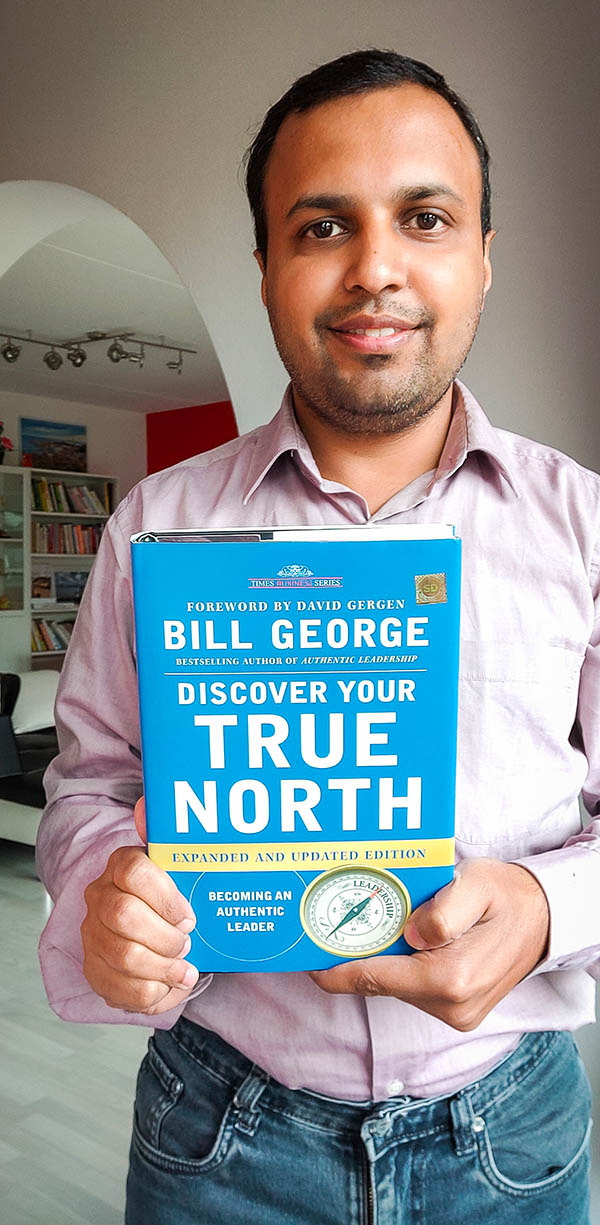
    2. How To Discover Your True North? And Other Key Lessons from Bill George
    3. Turn the Ship Around – How David Marquet’s Leadership Turned Around A Nuclear-Powered Submarine’s Performance
    4. Reboot by Jerry Colonna – Looking Inward For Better Leadership
    5. Leaders Eat Last by Simon Sinek – From Hormones To Leadership

    That’s it for now. If you have any questions or feedback, or if you are new and want to introduce yourself, hit reply. I read and respond to every reply. All the best,

    Sumit

    (Twitter) @SumitGupta
    (LinkedIn) Connect

  • Issue #58, 2 Aug 2022 – Can you CARE so much that you do not care?

    Welcome to the Deploy Yourself Newsletter, where I share what impactful leadership looks like to show your own power. I also share the most insightful lessons and stories I encountered in the last two weeks. You can also read this issue online.

    Hey,

    Can you CARE so much that you do not care?

    As a leader, what you CARE about defines you and determines all your results.

    As a leader, you have a responsibility and commitment – to create powerful results – for all stakeholders involved. For example – If you are the CEO, you have a responsibility to

    1. grow your company (revenue and profit),
    2. provide value to your customers, partners, and local communities, etc
    3. build a healthy, fun, and meaningful place for people to work
    4. do the above while honouring your values, principles, or other standards of behaviour

    As a leader, can you CARE so much about the above that you DO NOT care about your own fears and insecurities?

    Can you CARE so much about the above that you DO NOT care about playing safe and staying in your comfort zone?

    Can you CARE so much about the above that you DO NOT care about looking good and proving yourself right?

    Can you CARE so much about the above that you DO NOT care about ease and convenience and instead do what is required?

    In which area of your life, do you CARE so much that you DO NOT care?

    What results could you produce in your life, work, relationships, and leadership if you CARE so much that you DO NOT care?

    Reply back with any insights or areas you identified where you need to CARE so much that you DO NOT CARE.

    I read and respond to every reply.

    PS – I help tech leaders who are overwhelmed and at a crossroads do the work of their life in just 1 hour per week. Have a trusted adviser like me on your side who has been where you are today, who has gone through it all, and who always has your best interest in mind. To know more, send me a message.

    Fascinating Articles & Stories

    One

    28 Lessons From Warren Buffett’s Annual Letters To Shareholders

    Each year, Warren Buffett writes an open letter to Berkshire Hathaway shareholders. Over the last 40 years, these letters have become an annual required read across the investing world, providing insight into how Buffett and his team think about everything from investment strategy to stock ownership to company culture, and more.

    These are the 28 best lessons on compensation, stock ownership, investments, leading people, company culture, etc.

    Source: CB Insights

    Two

    The best way to change behaviour – Tiny Habits

    BJ Fogg is a behavior scientist, with deep experience in innovation and teaching. He’s directed a research lab at Stanford University for over 20 years.

    He is an expert in behavior change, from habit formation to company culture change.

    Key points from this podcast interview:

    1. Information does not lead to action.
    2. People change best by feeling good, not by feeling bad
    3. Create a tiny habit through an ABC process: anchor moment, a tiny behavior, and instant celebration.

    From an episode on the Coaching for Leaders podcast

    Three

    Leadership Journeys – Prakash Palani and Thomas Vles

    I released two new episodes on the Leadership Journey series on the Choosing Leadership Podcast.

    In the 19th episode, Prakash, Founder of BCS, opens up about his early childhood filled with struggles, and how he had no choice but to succeed. He shares how he created a life for himself through hard work and never giving up, and how he started his own company to give back to others like him.

    We talk about leadership and responsibility, and he surprises me by sharing that he feels no pressure as a leader because everyone in his team takes equal responsibility. His leadership style, in his own words, is “people come first, everything else follows”.

    In the 20th episode, Thomas, CEO at Tellow, opens up about realising how he was living a life that was not what he really wanted. We talk about the importance of focusing on yourself first, and the importance of happiness, friendships, experiences, and relationships.

    He shares the wisdom of doing nothing, and the important role sports and exercise play in his life. In addition to leading his company, he climbs mountains, does kickboxing, races cycles, and has plans to make a movie. He knows he is more than what he does and doesn’t let work define him.

    To listen to all previous episodes, find the podcast on my website, or on Apple or Spotify. Leave a rating if you love what you hear.

    That’s it for now. If you have any questions or feedback, or if you are new and want to introduce yourself, hit reply. I read and respond to every reply. All the best,

    Sumit

    (Twitter) @SumitGupta
    (LinkedIn) Connect

  • Issue #57, 19 July 2022 – I want __ or I wish __ is NOT leadership. Find out what is

    Welcome to the Deploy Yourself Newsletter, where I share what impactful leadership looks like to show your own power. I also share the most insightful lessons and stories I encountered in the last two weeks. You can also read this issue online.

    Hey,

    I want _ or I wish _ is NOT leadership. Find out what is

    Leadership is choosing to commit to whatever it is you desire – moment by moment. Do you have the guts to do that?

    “I wish I could…”

    “I hope I can…”

    “I want to…”

    “I would like to….”

    The above are common ways we describe when we express our desires for a particular result in life.

    For example, I have caught myself thinking – “I want to increase my revenues by 10x next year” – a few times in the last 6 months.

    However, wanting something is very different from choosing and committing – the two acts of courage we need to turn any desire into reality.

    It is so easy to fool ourselves (subconsciously) by wanting something and then continuing our day as if nothing has changed.

    This actually creates a negative mood of resentment and resignation over time as just wanting or wishing doesn’t change anything.

    A key shift happens with my coachees when they move from hoping, wishing, and wanting to choosing and committing to what they desire.

    It might look like a semantic difference of language, but it makes a big difference in our subconscious.

    When I say, “I choose to increase my revenue 10x in a year”, I can not blame anything or anybody else (as it is my choice).

    When I say, “I commit to increasing my revenue 10x in a year”, I can not ignore all the actions that I must take each passing moment but that I am not taking.

    In other words, wanting or wishing is safe because we are still in our comfort zone – with our reasons and excuses as to why what we want is already not a reality or not possible.

    When we move from wanting to choosing and committing, there is no space for reasons and excuses. There is no place to hide behind.

    When you commit to producing an outcome in the future, all the discomfort is staring you in the face and asking, “Now what?”

    Are you willing to stay with that discomfort which arises when you fully commit to a future outcome?

    Are you willing to see the learning in that discomfort to grow yourself into a powerful leader?

    Are you willing to make tough choices and stop hiding behind your reasons for not moving towards what you truly desire?

    What is it that you need to say NO to – either people or time commitments – so that it frees you up for your commitment?

    What is it that you need to say YES to – new conversations and actions – so that you make progress, even if hurts in the short term?

    I know this is no small matter, and the journey from wanting something to committing to it can often be challenging and painful…

    But this pain fades in comparison to the massive gaping hole you feel in your heart when you do not move forward towards what you know you deeply desire…

    The good news is that the CHOICE is yours.

    Moving from wanting to committing something is a choice – YOUR CHOICE. There is nothing right or wrong, and good or bad about either choosing it or not.

    However, that is what leadership is – the CHOICE to COMMIT yourself moment by moment towards creating the future that you CHOOSE to create.

    What such choices are awaiting you?

    Where do you need to leap into the unknown? Reply back with any true desires which you have been holding back on. I read and respond to every reply.

    PS – I have opened up all my coaching spots for 2023. There are 3 slots for leadership teams, and 11 spots for 1on1 coaching. If you sign up now, you get complimentary coaching for the rest of 2022 at no additional cost. They will all be gone before the end of the year.

    If you want to explore, book a listening call with me where I ask a few questions and listen – to what you truly desire.

    Fascinating Articles & Stories

    One

    Silence is your superpower

    Silence forces us to notice our automatic thoughts — the ones we can’t help but think and habitually think, particularly, the ones that shine a cold light on our fears and insecurities.

    Silence often wakes us up to the truth — truths that we may not want to acknowledge.

    Amazing, inspiring, and life-giving truth can also be found in silence.

    In addition, silence increases concentration, improves creativity, heightens self-awareness, makes learning easier, calms your mind, and enriches relationships and health.

    If that is not a superpower, I do not know what is.

    Source: Being comfortable with silence is a superpower

    Two

    How to mentor someone? Here are 7 techniques

    Having a workplace mentor can help us feel like we’re getting somewhere, and like we have further to go.

    This not only strengthens employee engagement but also impacts employee retention and can help reduce employee turnover.

    Here are 7 techniques:

    1. Make space for failure and learning
    2. Respect who your employee is
    3. Have your mentee explain things to you
    4. Work to dismantle a sense of hierarchy
    5. Empower your mentee to take risks
    6. Ask questions to help guide them
    7. Take an active approach to being a mentor

    We all have something to learn and having someone to encourage us, back us up, and give us a push when we need it makes all the difference.

    From an article on OfficeVibe

    Three

    Humble Inquiries on Teams – Part II

    ”If people do not feel there is enough space for them to be open either with their emotions, with their ideas or , just what is happening in their physical body, it will impact performance “

    “Another thing that I’ve become so aware of in that is the value of actually declaring that there’s been a breakdown, whether that’s been a breakdown in communication or process procedure or even a breakdown in the team.”

    “It’s also the commitment to not just doing more producing more results, but it’s also the commitment to the purpose, to the standards, to the values and to the ways of behaviour that the team has set. “

    “Every team has a customer and are we really taking care of their concerns and producing value and sometimes doing more or being busy is not directly correlated to that.”

    “I have seen people being very relaxed, very calm, not busy, and still producing more than what they were doing earlier”

    “As leaders, it’s very important to be conscious of. What mood am I creating in my team? And is my language, is my tone of voice, is my physical posture, reflecting that accurately or not?”

    “A high-performance team is not a checklist to go down. It’s a fluid, circular process. It’s like dancing. You might step on your partner’s feet every now and then or you might fumble a little bit. You just say I’m sorry. And how do we get back on track and keep rolling ahead? But it’s definitely not a checklist.”

    The above are the show notes from the seventh episode of the Humble Inquiries series on the Choosing Leadership podcast, which I am co-hosting with Leslie Wireback. Listen to the sixth episode – where we talk about what makes a group of people a team…

    In each episode of Humble Inquiries, we are deliberately going to put ourselves in the uncomfortable space of not knowing the answer and humbly inquiring about these challenges – with the aim to provoke new thoughts, actions, and practices – to help us better serve our coaching clients, and also to help the leader in you navigate the biggest challenges – at life and at work.

    To listen to all previous episodes, find the podcast on my website, or on Apple or Spotify. Leave a rating if you love what you hear.

    That’s it for now. If you have any questions or feedback, or if you are new and want to introduce yourself, hit reply. I read and respond to every reply. All the best,

    Sumit

    (Twitter) @SumitGupta
    (LinkedIn) Connect

  • Issue #56, 5 July 2022 – The perks of vulnerability

    Welcome to the Deploy Yourself Newsletter, where I share what impactful leadership looks like to show your own power. I also share the most insightful lessons and stories I encountered in the last two weeks. You can also read this issue online.

    Hey,

    The Perks of Vulnerability

    Most of us are afraid of opening up and admitting our faults. We see vulnerability as a weakness.

    Research shows that this fear is totally baseless.

    Because when you open up and share, others see it as a strength.

    It builds trust and strengthens relationships.

    For example – asking for help is a strength, not a weakness.

    Admitting to your mistakes is a courageous step which builds trust rather than deplete it. (Counterintuitive, I know!)

    Opening up with vulnerability is not comfortable – for sure. And that is why it is a choice – just like most aspects of leadership are.

    If you find yourself judging yourself too harshly, practice self-compassion towards yourself as we all tend to be more self-critical than anybody else would be.

    Our fear that others may judge us is just that – a fear.

    Being kind to ourselves gives us a safe place to operate from and come back to when we need to.

    The bottom line is – you might think you are a mess, but others do not think so. Especially when you speak up about it.

    Where in your life can you open up and share your deepest fears? To your spouse, a friend, a colleague, or your boss?

    Be kind to yourself and share what you think might be embarrassing or messy.

    Reply back with any interesting outcomes once you do that. What did you discover about yourself?

    PS – Want to see the impact of these principles on your leadership? I love partnering with ambitious leaders and teams. My coaching programs reveal the hidden first principles of all human behaviour, allowing you to produce exponential results (think 100x, not 10x).

    PPS – I am opening up all my coaching spots for 2023. There are 3 slots for entire leadership teams, and 11 spots for 1on1 coaching. If you want to explore, book a listening call with me where I ask a few questions and listen.

    Fascinating Articles & Stories

    One

    Establish rituals to set yourself free

    Ritual is – or can be – part of all human activity. It governs greetings and conservation.

    It’s how you harmonise your life with the rhythms of the world.

    And if you take ritual seriously, submit to it and practise it, then transforming your life for the better will go from difficult to effortless.

    Good habits (and bad ones) are effortless, reflexive actions cultivated through repetition.

    From a guide on Psyche

    Two

    A List of 8 Expectations From Managers That Employees Have

    Great managers don’t happen by accident. They learn from their mistakes and invest in developing their skills.

    While it is almost never voiced, employees have certain expectations from their managers. The following are expectations you must fulfil when managing any group of people.

    1. Trustworthiness – Employees are more likely to actualize goals set by leaders they trust and are honest about what is happening in the organization. 
    2. Vision – Having a vision & purpose motivates and inspires people to keep going in spite of the circumstances – which can be chaotic and dynamic.
    3. Effective Communication – It is imperative to be clear, consistent, and transparent when communicating. Leaders should stop using complicated language or hiding behind jargon.
    4. Psychological Safety – In a safe environment, you don’t have to wear a mask and can be completely honest about what you know and what you don’t.
    5. Career and Professional Development SupportPeople are mostly unaware of how they can grow in their careers, and as a coach, you can help them figure this out.
    6. Coaching – Coach people first before offering advice. Coaching enables long term behavior change, while advice is short term.
    7. Strengths-based development – When your employees are doing what they are good at, they will be intrinsically motivated, and their performance will improve as a result. Focusing on weaknesses creates friction which leads to demotivation.
    8. Autonomy – If you hope to inspire your employees to be the best they can be, allow them to make decisions for themselves.

    From an article from my desk

    Three

    Humble Inquiries on Mastering Overwhelm and Teams

    “I do not have time is never the whole truth. There is something deeper beyond that. “

    “overwhelm and having a sense of too much to do is basically an invitation to ask better questions”

    “what makes a team is a set of conversations, not just a hierarchical relationship, are not just something on paper”

     you cannot force people to be a part of a team.

    The above are the show notes from the fifth and sixth episodes of the Humble Inquiries series on the Choosing Leadership podcast, which I am co-hosting with Leslie Wireback. Watch out for more episodes in the coming weeks. If you have missed the previous episodes, you can listen to the first, second, and third episodes.

    In each episode of Humble Inquiries, we are deliberately going to put ourselves in the uncomfortable space of not knowing the answer and humbly inquiring about these challenges – with the aim to provoke new thoughts, actions, and practices – to help us better serve our coaching clients, and also to help the leader in you navigate the biggest challenges – at life and at work.

    To listen to all previous episodes, find the podcast on my website, or on Apple or Spotify. Leave a rating if you love what you hear.

    That’s it for now. If you have any questions or feedback, or if you are new and want to introduce yourself, hit reply. I read and respond to every reply. All the best,

    Sumit

    (Twitter) @SumitGupta
    (LinkedIn) Connect

  • Issue #55, 21 June 2022 – Do You Dream During The Day?

    Welcome to the Deploy Yourself Newsletter, where I share what impactful leadership looks like to show your own power. I also share the most insightful lessons and stories I encountered in the last two weeks. You can also read this issue online.

    Hey,

    Do You Dream During The Day?

    I want to start with this quote by TE Lawrence

    “The dreamers of the day are dangerous men, for they may act their dreams with open eyes, to make it possible.”

    We all dream during the night, but do you dream during the day?

    Or, it would be more appropriate to say, do you give yourself permission to dream during the day?

    If you do, then you know that there is something deep inside you that is calling your attention.

    If not, it doesn’t mean that you have no deep desires.

    It just means that a dream might be buried deep inside, but it is still alive. Because YOU are.

    Daydreaming is not a waste of time. Research has shown that daydreaming reduces stress and anxiety, and helps you be more creative by utilising different parts of your brain.

    We all do this as children, but we often forget daydreaming as adults, thinking of it as silly, worthless, or a waste of time.

    However, the latest research has shown that daydreaming boosts our mood, improves our wellbeing, and allows for novel solutions to problems as we tap into a source of information and wisdom which has been lying dormant.

    We are not built to be “on” (or using our analytical brain) all the time. Taking time to wander off not only gives us a much-deserved break, it also improves focus and builds presence which leads to better relationships.

    As you start to (or try to) daydream, do not think about the dream you have. Instead, think about the dream which has you. Think about that dream which keeps coming back to you? Perhaps, a desire from childhood? Or a long-lasting wish to see something different in the world around you?

    Do not try to think or understand your dreams. Instead, try to listen to them and ask yourself –

    What are your dreams inviting you for?

    What are your dreams trying to tell you about yourself and what you deeply care about?

    Do you give yourself permission to indulge, listen, and engage with your dreams?

    Do you give your permission to take the first tiny (or bold) steps in the direction of your dreams?

    What would it mean for you if you would work towards making those dreams a reality?

    Reply back with any insights from asking the above questions. I am eager to hear what this email triggers. I read and respond to every reply.

    Fascinating Articles & Stories

    One

    Are You Playing to Play, or Playing to Win?

    Federer uses a one-handed backhand — a notoriously more difficult technique than the two-handed version. He also happens to make it look easy.

    And so to watch Federer play a tennis match is a little like watching God play tennis — or perhaps, more accurately, like watching a version of tennis that is more ballet than racquet sport.

    This, I think, is what mastery looks like. Federer, like Ono in Judo, is a maestro. We can’t believe that they do it. But we stand in awe of them because they do it anyway, and win.

    Find an article on Commonplace

    Two

    Stop Trying So Hard

    This podcast episode explores the tendency many of us have to work hard, but not necessarily clearly define what we’re trying to achieve.

    Greg McKeown invites us to look at the minimum steps required to complete what’s most essential.

    From an episode on the Coaching for Leaders Podcast

    Three

    How to Identify What You Enjoy

    In this special-edition, bonus episode of How to Build a Happy Life podcast, the psychotherapist Lori Gottlieb demystifies one of the vital components of a happy life: enjoyment.

    As responsibilities multiply exponentially, time grows limited, and challenges mount, it becomes harder to make time for fun, let alone remember what it feels like.

    Gottlieb believes that we not only find it challenging to make time for day-to-day enjoyment, but also struggle to identify what it should feel like. In this episode, Arthur C. Brooks and Lori Gottlieb discuss the importance of fun, the cultural distortion of emotions as “good” or “bad,” and how envy points you in the direction of your deepest desires.

    From a podcast on The Atlantic

    Four

    New Leadership Journey Interviews on the Choosing Leadership podcast

    Listen to the below CEOs and leaders as they reflect and share key learnings from their leadership journeys.

    I believe we all have a lot to learn from each other’s stories – of where we started, where we are now, and our successes and struggles on the way. With this series of interviews, my attempt is to give leaders an opportunity to share their stories and for all of us to learn from their generous sharing.

    To listen to all previous episodes, find the podcast on my website, or on Apple or Spotify. Leave a rating if you love what you hear.

    That’s it for now. If you have any questions or feedback, or if you are new and want to introduce yourself, hit reply. I read and respond to every reply. All the best,

    Sumit

    (Twitter) @SumitGupta
    (LinkedIn) Connect

  • Issue #54, 7 June 2022 – Remind People Who They Are Instead of Just Giving Feedback

    Welcome to the Deploy Yourself Newsletter, where I share what impactful leadership looks like to show your own power. I also share the most insightful lessons and stories I encountered in the last two weeks. You can also read this issue online.

    Hey,

    Remind people who they are instead of just giving feedback

    A popular quote by Thomas Leonard goes like this –

    Remind people who they are instead of just complimenting them on what they’ve done.

    You might have heard that giving positive feedback or compliments can build strong relationships. This advice can be found in hundreds of leadership and management books. However, the “how” to do it is often missing, and today I will share my biggest learning on this topic in the last couple of years of being an executive leadership coach.

    How many times has someone given you a “compliment” and you just know they’re trying to get something from you?

    There is a huge difference between complimenting someone and acknowledging them.

    Compliments and positive feedback are important, but they are often focused on you (the giver) instead of the person in front of you. They often start with “I” and talk about how you loved a particular behaviour or action the other person did. “Great job” is another example of such positive feedback.

    Acknowledgements, on the other hand, go deeper. Acknowledgements are about who the person is instead of just what they did.

    They take more effort and they focus on who the recipient is “being” rather than what they just “did”.

    For example – “Your sincerity and reliability stand out, and yesterday’s project update meeting was a demonstration of that. Keep it up”.

    OR

    “Everybody around here knows they can count on you when it comes to taking responsibility. You lead by example and that helped the team achieve more than they committed to at the start of the year.”

    The part in bold in the above two statements is the acknowledgement part. Acknowledgements make the other person feel understood and valued. They remind people of who they are rather than what they just did.

    Before I end, I must add that the above is not a “trick” that you can copy and paste. People can see right through a fake acknowledgement. An acknowledgement must be sincere and genuine – it must come from your heart, and not just your mind.

    Give genuine acknowledgements instead of feedback or compliments for a few days. Reply back with what you notice – in your own behaviour as well as the other person. I respond to every reply.

    Articles and Stories Which Have Fascinated Me

    One

    The Art of Framing Problems

    Framing is the process of breaking down a problem into a set of choices, trade-offs, and options that enable a team to make a call and move forward.

    One of the critical disciplines of framing is to “find the right question.” Too often debates start with “solutions,” before we determine if we’re asking the right questions, in the right order.

    It is my view that being a great framer is a magical ability for just about any role, and is also a completely learnable skill.

    Find an article on Coda by Shishir on making “decisions that stick.”

    Two

    How to Do Twice as Much With Your Time

    This video shows how to group your goals together and get them done—at the same time.

    The secret is to create “Multipliers”—activities that fulfil multiple goals. This may sound impossible, but once you watch this video, you’ll see how easy it is to do twice as much!

    If you find this interesting, do not miss the accompanying resource guide PDF.

    From a video by Jennifer Aaker at the Stanford Graduate School of Business

    Three

    Seven Ways to Cope with Uncertainty

    Living with so much uncertainty is hard. But sometimes—maybe always—it’s more effective not to attempt to create certainty.

    Though evolution might have rigged our brains to resist uncertainty, we can never really know what the future will bring. And in improbable situations like the pandemic, which has massively disrupted our routines and utterly destroyed our best-laid plans, we need to learn to live with ambiguity.

    “Uncertainty is the only certainty there is,” wrote mathematician John Allen Paulos. “Knowing how to live with insecurity is the only security.”

    So how can we best cope? Here are 7 ways:

    1. Don’t resist. Practice acceptance (of what is so)
    2. Invest in yourself
    3. Find healthy comfort items
    4. Don’t believe everything you think
    5. Pay attention
    6. Stop looking for someone to rescue you
    7. Find meaning in the chaos

    From an article at The Greater Good Science Center at the University of California, Berkeley

    Four

    A Humble Inquiry on Coaching as a leadership skill

    • Leslie – “Coaching helps people create lasting change and long-term impact and really is about empowering the coachee to create their own path forward.”
    • Leslie – “one of my mentors always shared the beautiful analogy of,  the Lily pads on the surface of the water. Beautiful flowers come from that, but they have. Come up from the deep murky bottom of the water to come through and shine their light as a beautiful flower. So sometimes what’s stopping an individual or getting in the way is it’s down there deep in the murky, muddy mess, and a coach can help go through there and part the way for the growth to move forward and for others to see that.”
    • Sumit – “Coaching is showing people the mirror. And what happens when we see the mirror. is we get to see what we cannot see on our own.”
    • Leslie – “One of the most rewarding things in coaching is when you ask a question and the other person says, wow, that’s a really great question. Or I’ve never thought about that right there. It’s an opportunity for that person to change and look at something differently. “
    • Leslie – “As the manager, you don’t always have all the answers often. They think you do because you’re in charge of the department, the function, whatever that may be, but you don’t have to have all the answers and you don’t have to have walked the journey before them. That’s where shifting into a coaching conversation really creates so many more possibilities because you don’t have to have the answer”
    • Leslie – “You don’t know what you don’t know. And sometimes you really just need to experience it.”
    • Sumit – “the kind of people I am coaching are high-level executives and leaders. What I’ve seen is the most use of coaching can be taken by high performers. People who are already performing or who are already ambitious, they can take their performance and the results they produce to a totally different level, a totally unheard-of level through the process of coaching.”
    • Sumit – “every business team and every business leader will have a coach in the future because it’s quite natural that if something can help you move towards your future and you get more productive at the same time, and more happy and joyful. Why wouldn’t you have that resource why wouldn’t you avail of that?”

    The above are the show notes from the fourth episode of the Humble Inquiries series on the Choosing Leadership podcast, which I am co-hosting with Leslie Wireback. Watch out for more episodes in the coming weeks. If you have missed the previous episodes, you can listen to the first, second, and third episodes.

    That’s it for now. If you have any questions or feedback, or just want to introduce yourself, hit reply. I read and respond to every reply. All the best,

    Sumit

    (Twitter) @SumitGupta
    (LinkedIn) Connect

  • Issue #53, 24 May 2022 – How to listen and lead people on video calls?

    Welcome to the Deploy Yourself Newsletter, where I share what impactful leadership looks like to show your own power. I also share the most insightful lessons and stories I encountered in the last two weeks. You can also read this issue online.

    Hey,

    How to listen (and lead) people on video calls?

    Most of us are working remotely or hybrid these days. Whether we like it or not, we can not deny that we are living in a video-based world.

    If you want to lead people over video calls, you need to be able truly to capture people’s attention and listen deeply.

    It is not like listening and other soft skills were not important before, but now they are even more important given you are competing with all other open windows on a person’s computer.

    Here are 3 practices if you want to capture attention and lead people over video calls

    1. Get the technicals right – get a good quality camera and microphone, a properly lit room, and a non-distracting and good quality background. It makes a massive difference if people can not see or hear you well, or if they are always distracted by the mess in your background. And if your face is not well lit, what you have to say might be misinterpreted, and I am sure you don’t want that.
    2. Positioning in the camera frame – If you are a leader, the way you position yourself in front of the camera has a massive impact on the “body-language” part of communication (which is close to 70%). Ensure you keep the camera at eye level and avoid either looking down (by placing yourself above the camera) or looking up (by placing yourself below) at the other person. Subtle positioning shifts can create or destroy psychological safety (often subconsciously).
    3. Focus and listen to the full body of the person in front of you. This is even more important in a remote world as only the upper part of the other person’s body is visible to you. My coach once said that deep listening is when you can notice a shift in the breathing of the person in front of you. You do not have to do that, but can you notice a subtle shift in someone’s voice? Can you notice a sudden tightening of someone’s jaw and face muscles? Can you notice a smile or a tear – and then humbly inquire into what they might be communicating?

    All of the above is meaningful communication and important signals for you as a leader.

    The only question is – are you paying attention and listening?

    I know the above can lead to more questions than answers, so feel free to reach out if you would like a conversation to talk more on any of the above points. I respond to every reply.

    Articles and Stories Which Have Fascinated Me

    One

    Digital Body Language: how to prevent producing anxiety in others?

    In this podcast episode, Erica Dhawan talks about some mistakes leaders can make to produce unnecessary anxiety for others. Among other things, she talks about:-

    • How all of us are now immigrants, processing more interactions in a digital world
    • Excessive brevity may save a few keystrokes or seconds but can generate lots of extra work for the team and organization.
    • The power of being explicit about our expectations on response time and teaching others what to expect from us.
    • Seemingly unimportant choices like who we list first on emails can generate assumptions from those we’re communicating to.

    Find a podcast on the Coaching for Leaders podcast

    Two

    The Distinction Between Meaningless Activity and Meaningful Actions

    I have realized that I often fall into the trap of being busy rather than being productive. What I mean by meaningless activity is anything we do to only keep ourselves busy.

    In contrast with the above, any activity which adds meaning to your life, or takes you in the direction of a conscious intention (or a goal), is what I would term meaningful.

    What is meaningless and meaningful is different for everyone. Only you can define that. No-one else can make that distinction for you.

    Doing things that we find meaningful is essential to our well being. But how many of us spend time wondering about what gives our life meaning, and what is really important to us?

    I believe the intersection of answers to the below three questions will be the most meaningful work for you.

    • What are you good at?
    • What do you love doing?
    • What need can you serve?

    Once you have these answers, it will give you the clarity to prioritize tasks and the courage to say “No” to anything that doesn’t align with what you discover.

    From an article from my desk – Meaningless activity vs Meaningful Actions

    Three

    Do you take things personally? Here’s how to stop

    Most of us take situations personally — we feel hurt, neglected, offended or betrayed by others.

    Our ego thinks others should take us into consideration. Our ego doesn’t want to be criticized. Our ego wants to be acknowledged and told we’re always right.

    When our egos take over, it’s exhausting.

    Some strategies to stop taking everything personally :

    1. Realise it is not about you
    2. Give yourself some empathy. See if you are at fault?
    3. Open up, be vulnerable, and speak up without blaming the other person.

    From a TED talk and article by Frederik Imbo

    Four

    A Humble Inquiry on Mental Health and Burnout

    • Sumit – “Everybody is different. Every family is different. Every society and every group is different. So there is also that something very localized, very personal. , To this challenge, we cannot really predict. We cannot really guess what is happening to somebody. ” 
    • Sumit – “what makes it, I think even worse or what compounds the problem is, we don’t talk about all of this stuff. This is very human stuff. This is not alien stuff, This is very human stuff. And yet we don’t talk about it.”
    • Leslie – “And because we don’t talk about it. We don’t even know how to talk about it. And the sensitivity around that creates even more hesitation.”
    • Sumit – ” It takes a moment to shift ourselves to do, to bring up a smile on our faces.”
    • Leslie – “just as we learn and grow all throughout our lives and career, this is another step in the journey and another opportunity to change how we work moving forward, how our world is moving forward.”
    • Sumit – “there are a lot of things which we are on top of it, but at the same time to make it an assumption that I can be on top of everything can become a very heavy place to operate from. It can almost become self-defeating.”
    • Sumit – “letting go of control is actually not anxiety is actually curiosity.”
    • Leslie – “The individual may have depression or anxiety, but that doesn’t shape everything. That’s not who they are. They are not a depressed and anxious person. They are someone who has depression and anxiety.”
    • Sumit – ” The external does not control the internal in a deterministic way. So we still do have a choice, to choose how to react to situations. And our well-being is not a function of what is happening outside. Nobody can take that away from us.”
    • Leslie – “Creating the space to talk about mental health and wellbeing. And allowing that to be accepted is a powerful piece of what each and every one of us brings to every day and every conversation.”
    • Sumit – “the neutral state of any human being is wellbeing is peace. That’s a neutral state. It’s not like jumping with joy, but it’s also not being depressed or sad, the neutral state. We don’t really have to do anything if we just let things go that we are trying to control. That’s where (the neutral state) we will land automatically.”

    The above are the show notes from the third episode of the Humble Inquiries series on the Choosing Leadership podcast, which I am co-hosting with Leslie Wireback. Watch out for more episodes in the coming weeks. If you want to know what humble inquiry is all about, listen to the intro episode here.

    That’s it for now. If you have any questions or feedback, or just want to introduce yourself, hit reply. I read and respond to every reply. All the best,

    Sumit

    (Twitter) @SumitGupta
    (LinkedIn) Connect

  • Issue #52, 10 May 2022 – Why do we love sports (and sportspeople)?

    Welcome to the Deploy Yourself Newsletter, where I share what impactful leadership looks like to show your own power. I also share the most insightful lessons and stories I encountered in the last two weeks. You can also read this issue online.

    Hey,

    Why do we love sports (and sportspeople)?

    We all have our favourite sport that we enjoy watching. Even otherwise, the thrill of an exciting moment in a game is hard to avoid – even if we are unaware of the sport or the sportsperson involved…

    I was wondering today why is that so. Why do we love sports and sportspeople? It is because they are out on the court (or stadium) chasing their dreams. They put their heart and sweat into practising for weeks, months, and years so that they can perform and win during a game. They give it their all – in front of everybody else.

    This is why we do not just cheer for those who win. We cheer for those who give a good fight and go beyond themselves – irrespective of whether they win or not.

    This is why we cheer for the underdog. For it is not about the dog in the fight. It is about the fight in the dog, as Mark Twain said.

    Perhaps it is time to ask yourself – In your life, are you on the court playing the game of life? Or, are you in the stands watching others play?

    Your dreams might be buried deep inside, but they are still alive in there. This is why you cheer for your favourite team, enjoy a sports movie, or laugh or cry while watching a good performance.

    Shake off the dirt if you are not playing the game already. Shake off the heaviness of circumstances, past delays and frustration, and try again.

    Leadership is the choice to shake off the dirt and start again. And again. And again.

    Yes. Leadership is a choice. Your choice. And yes, you have the choice to be a leader – in each moment.

    Believing in yourself is a choice. Making a commitment is a choice.

    Are you giving yourself permission to make that choice every day? Or not? What are you waiting for?

    Make a choice to reply back and your answers to the above question. I read and respond to every reply.

    Articles and Stories Which Have Fascinated Me

    One

    The future of work is written

    Writing can transcend our distances in all their forms and lengths. Constitutional governments are great examples of how written artifacts can survive—and influence work—across centuries.

    Some decisions require presence and discussion, certainly, but not all. Many can be made both responsibly and asynchronously. Collaborative documents, for instance, can become self-documenting meetings, and writing the foundations and reasoning for critical decisions might produce a better result, even when brainstorming.

    Writing, though, offers us possibilities far beyond meeting documentation. When we write, we get to freeze ideas: They stop evolving and become accessible to others to establish a consensus or working frame, which later can be collaboratively reshaped.

    Knowing and then deciding what to write is often more valuable than writing everything, but knowing what matters is more of an art than a science. Writing is hard. Doing it well takes time. Comfortably sharing work in progress requires psychological safety, so ideas can see the light and be nurtured when they’re the most fragile.

    If we embark on a journey of communicating better at a distance, we’ll have to consider that we’re all still human. We interpret differently. We require safety. We react well to stories. Our sarcastic humor doesn’t always travel well in written form. Leaders who move us closer to a written and remote future, who truly understand the value of communication, will invest holistically in tools, staff, ideas, and infrastructure.

    Find an article on Increment exploring the future of asynchronous communication and the written word.

    Two

    10 Prerequisites for Being a Good Manager – Lessons I learned the hard way

    The more I learn about leadership and what motivates people to do their best work, the more I realise how little I know.

    Although few managers would admit they lack the skills required to do their job, the reality is that most don’t have a clue. According to Gallup, organisations fail to choose the right person for the job 82% of the time. 

    In a culture where confidence is praised and mistakes ridiculed, admitting your ignorance may seem unnatural. But as one study found out, intellectually humble people are more motivated to learn. To become a better manager, you must be ready to admit you know little about leading and motivating people.

    Accepting you don’t know something opens the door to learning and growth. Admitting you have shortcomings sets you on a path of knowledge seeking. As Nobel Prize winner Subrahmanyan Chandrasekhar remarked, “Believing that you must be right, in other words, lacking intellectual humility-can actually stymie discovery, learning, and progress.” 

    From an article from my desk – 10 Prerequisites to Have Before Managing and Leading People

    Three

    How to Ask Useful Questions

    Asking useful questions is a skill, and it requires practice. If you want useful answers, learn to ask better questions.

    Keys to information-seeking questions:

    • Be specific about the information you’re looking to obtain.
    • Give context by referencing why you’re contacting them and how you found their contact information.
    • Make it easy for the recipient to refer you to the best resource as quickly as possible, which will save you both time.

    Keys to clarification questions:

    • Include a short summary of the topic for context.
    • “It sounds like…” leaves room for clarification without being confrontational.
    • “Is that correct?” (or a close variant) is clear, concise, direct, and polite.

    Keys for asking for assistance:

    • Be clear and precise about what you’re trying to do.
    • Give context by including what you’ve tried so far, which makes it clear that you’re doing your own work and not asking the recipient to solve your problems for you.

    Keys for asking for advice:

    • Be clear and precise about what you’re trying to achieve.
    • Be clear about your priorities, and include any known tradeoffs. The recipient can’t read your mind or set your priorities for you.
    • Make it clear you’re asking for advice or perspective, not for the recipient to decide for you.
    • Give the recipient an easy out – you’re asking for a favor, so be polite.

    From an article by Josh Kaufman

    Four

    A Humble Inquiry on Hiring and Retaining People

    • Leslie – “Everyone wants to be valued and to have a purpose in their work”
    • Sumit – “Communication is not only about what is being said. Communication is also about what is not being said, which needs to be said, and what is being said, but  which you are not hearing.”
    • Leslie – “It really is about creating space. Before you created that space physically, you created a lunchroom, you created a little lounge, and you created some space built within your culture that fostered that. Now that space needs to be created virtually or in a hybrid format to be able to continue to cultivate those relationships and conversations.”
    • Leslie – “The leader doesn’t have to have those solutions. The leader needs to create the environment, to have the conversations, to be able to come up with those solutions.”
    • Sumit – “If we can help leaders get better at the conversations they are having that will also solve not just the productivity problem, but also the hiring problem. Coaching is just a way to have conversations more effectively.”
    • Sumit – “Vacation should not be taken to distress or to avoid burnout. Everybody should be free to use their vacation days for travelling, practising their hobbies, any other passions, spending time with family. But if you use vacation for de-stressing. Then it means that something is wrong in the workplace itself. And that’s where we can focus our attention.”
    • Leslie – “When your talented employees and the driven ones become silent, that’s the really scary moment because something is wrong.”

    The above are the show notes from the second episode of the Humble Inquiries series on the Choosing Leadership podcast, which I am co-hosting with Leslie Wireback. Listen to the first episode on Change, Pressure and Uncertainty, and watch out for more episodes in the coming weeks. If you want to know what humble inquiry is all about, listen to the intro episode here.

    That’s it for now. If you have any questions or feedback, or just want to introduce yourself, hit reply. I read and respond to every reply. All the best,

    Sumit

    (Twitter) @SumitGupta
    (LinkedIn) Connect

  • Issue #51, 26 Apr 2022 – Can self-gratitude help you become a better leader?

    Welcome to the Deploy Yourself Newsletter, where I share what impactful leadership looks like to show your own power. I also share the most insightful lessons and stories I encountered in the last two weeks. You can also read this issue online.

    Hey,

    We all know the power of gratitude. But do you know the power of thanking yourself?

    When researcher Erin Westgate returned to her office for the first time after lockdown, she opened her desk drawer to find a pleasant surprise: a Reese’s peanut butter cup.

    “She texted me like, ‘Oh my gosh, my past self left my future self a Reese’s,’” recalled her colleague Matt Baldwin. “I was like, ‘Wait a second. You’re expressing gratitude towards something your past self had done. We have to study this.’”

    Baldwin and his colleague Samantha Zaw asked people to write letters of gratitude. One group was asked to thank someone else, while another group thanked themselves. A third control group simply wrote about a positive experience.

    After the exercise, the people who wrote letters of gratitude to themselves had an increase in feelings of clarity, authenticity and connectedness.

    “Being appreciative of ourselves carries an added benefit of truly understanding who we are and feeling connected to ourselves,” said Zaw.

    We all know the power of gratitude in increasing the energy and elevating the mood of a team. As a leader, it is a very simple and powerful practice to “just say thanks”; and yet many of us often forget or find it difficult to express gratitude to ourselves.

    Take a moment to ask yourself – What can you thank yourself for right now? What is that about you that is worth acknowledging and celebrating?

    Write yourself a small note of gratitude for the leader, the employee, the citizen, the parent, or the spouse that you are.

    Research shows that embracing gratitude as a regular practice can actually make us happier.

    Gratitude leads to happiness, authenticity, and satisfaction on a personal level and when practised with a team, it leads to courage, empathy, teamwork, and creativity.

    If you are a leader in any capacity, what are you waiting for? What stops you from expressing gratitude towards yourself and others?

    Can you start small and just express gratitude – right now – either to yourself or to someone else on your mind?

    Reply back and share any new results or behaviours you noticed after expressing gratitude. I read and respond to every reply.

    Articles and Stories Which Have Fascinated Me

    One

    Autonomy is absolutely critical for 21st-century work

    Work hasn’t been “normal” for more than a few years now. Many leaders remain worried about employee productivity, while many employees have thrived with the increased autonomy of working remotely. They don’t want to give that up. 

    Autonomy is a key driver of human behavior, and research shows that even a little can go a long way.

    Whatever you decide, know that increasing employee autonomy, even a little, is likely to increase their productivity.

    Find an article titled “Autonomy is the absolute key to getting “the new world of work” right”

    Two

    How I Taught the ‘Team from Hell’ to Trust Each Other

    Many leaders, however, are ambivalent about teams. They fear overt and covert conflict, uneven participation, tunnel vision, lack of accountability and indifference to the interests of the organisation as a whole.

    In this article, the author states the importance of team coaching to help a team learn how to work together better and faster than if they were to do it on their own.

    It is very liberating to tell our life stories to a coach/leader, and while doing so, give our team members a sense of what we are all about. When listening to the life stories of others, we also come to realise that we are not alone in our confusion. 

    Many problems are universal and seeing that our team members struggle with similar issues can bring a great sense of relief and help us both accept and provide peer guidance. In addition, it creates hope that something can be done about whatever problem we are up against.

    Returning to the “team from hell” I coached, the mood among the group had changed remarkably at the end of our session. They seemed more trusting and connected. Many admitted it was the first time they had had an open and honest conversation. There was a greater willingness to make commitments.

    From an article on INSEAD Blog titled How I Taught the ‘Team from Hell’ to Trust Each Other

    Three

    Courage book reviews, and Humble Inquiries on the podcast

    I am sharing reviews and notes of my favourite leadership books on courage below. Enjoy and share what you learn.

    1. Brave by Margie Warrell
    2. The Magic of Thinking Big by David Schwartz
    3. The Fearless Organization by Amy Edmonson

    In addition, I have launched a new series called Humble Inquiries on the Choosing Leadership podcast. I will be co-hosting this series with Leslie Wireback, and the first episode on Change, Pressure and Uncertainty is just out. Listen to it, and watch out for more episodes in the coming weeks. If you want to know what humble inquiry is all about, listen to the intro episode here.

    Four

    How Your Ego Controls Your Life (And How to Stop It)

    Loch Kelly explains the role the ego plays in your life. Instead of thinking of the ego as one “person”, Kelly explains that it’s more like different pieces of you that react to situations in different ways.

    Loch is an author and leader in meditation and psychotherapy. He talks about mindfulness, awareness, and being an observer of your behaviour, ego, and patterns. And it doesn’t need to be the driver of YOU.

    From an interview on The Knowledge Project hosted by Shane Parrish

    That’s it for now. If you have any questions or feedback, or just want to introduce yourself, hit reply. I read and respond to every reply. All the best,

    Sumit

    (Twitter) @SumitGupta
    (LinkedIn) Connect

  • Issue #50, 12 Apr 2022 – Not Knowing is OK! Actually, it is great!!!

    Welcome to the Deploy Yourself Newsletter, where I share what impactful leadership looks like to show your own power. I also share the most insightful lessons and stories I encountered in the last two weeks. You can also read this issue online.

    Hey,

    You do not need to see the whole way. And It is OK!!

    In 2007, I started my first company. I had no idea how to start or run a company. Yet, we ran the company for 3 years.

    In 2011, I said YES to organising an anti-corruption march in Bangalore, despite having no idea about activism or doing anything like that. Yet, in 40 days, over 400 people walked over 11km, and the protest march itself was covered in all major newspapers.

    From 2011 to 2012, I started and ran an NGO on the side of my full-time work. In these 2 years, I created independent and volunteer-driven teams in 6 Indian cities of 5 to 10 people – each doing their own impact making work – including everything from ideation, fundraising, on the ground activities, and so on. Once again, when I did so, I had no idea how to.

    Why am I telling you this? Because when I ask people why are they not pursuing their wildest dreams and things they care most about, the answer I often get is – “Because I do not know how to.”

    Most people are stopped from turning their dreams into reality because they do not know how to. That seems like a legitimate reason, but it is not.

    You do not need to know or predict how everything will play out before starting. Just like we can drive at night with the car’s headlight illuminating only a small fraction of the way, we all can move towards our biggest dreams without seeing the whole way. In fact, that is how all dreams turn into reality.

    As long as you continue moving in the right direction (of chasing what you care about most deeply) and keep putting one foot after another, you will be OK. In fact, you will be more than OK. That’s all there is to make any dream less intimidating – to just take the next step you need to take or to have the next conversation you need to have.

    In fact, the moment you get OK with not knowing what is next, it will become more than OK. The moment you can replace the dread and anxiety of not knowing with the curiosity and wonder of not knowing (like a child), you will not only be chasing your dreams but also having a great time while at it.

    When you bring a child-like curiosity and wonder and focus on the next thing to do and the next conversation to have, nothing changes on the outside, and yet, everything changes in your experience of it. And ironically, that allows you to take more assured steps and move faster and turn your dreams into reality.

    This is how I established myself as a photographer after I moved to Amsterdam in 2014.

    And this is how I am currently establishing myself as a leadership coach after 16 years in the software industry.

    What about you? What are you waiting for? What journey lies waiting for you?

    Can you start small and just take the next step or have the next conversation – right now?

    Reply back and share any insights – before or after you took that next step. I read and respond to every reply.

    Articles and Stories Which Have Fascinated Me

    One

    The damaging effects of being bored at work

    We all know what burnout is and why it’s bad. But fewer of us have heard of ‘boreout’ – a related phenomenon that’s arguably just as pernicious.

    While burnout is linked to long hours, poor work-life balance and our glamourisation of overwork, boreout happens when we are bored by our work to the point that we feel it is totally meaningless. Our job seems pointless, our tasks devoid of value.

    A 2021 study showed that 186 government workers in Turkey who suffered from boreout also dealt with depression, and high rates of stress and anxiety. Studies show depression from boreout can follow workers outside the office, and lead to physical ailments from insomnia to headaches.

    Preventing boreout in workers, says Harju, can boil down to “plain old good leadership”, whereby leaders take time to communicate to workers why what they’re doing is valued and valuable.

    If you think boreout is seriously affecting your health (either physical or mental), it may be valuable to ask yourself how you might be able to repoint your career path toward something healthier for you. Seek the advice of mentors, career counsellors or friends and family.

    Find an article on BBC titled The damaging effects of ‘boreout’ at work

    Two

    A wonderful example of a “Working with Me” document

    1. I’m always trying to learn

    2. Experimentation beats debating

    3.  I’m not interested in being the smartest one in the room

    4. If I ask for feedback, I actually want feedback

    5.  The “Who” in a project is as important as the “What”

    6.  I tolerate “foot faults” when we are moving at speed

    7.  I want to know what makes you passionate about our shared projects

    8. You need to be a self-starter; I’m not going to tell you what to do…

    9.  …and that means you need to be very clear in what you need from me

    10. Friendship is really important to me; if I can reasonably help a friend, I will

    Everything you need to know about working with Reid Hoffman

    Three

    New book reviews, and Humble Inquiries on the podcast

    I published three new leadership book reviews in the last month. Find them below:

    1. Wired for Story by Lisa Cron
    2. The Black Swan by Nassim Nicholas Taleb
    3. Blueprint (2019) by Nicholas A. Christakis

    In addition, I am launching a new series called Humble Inquiries on the Choosing Leadership podcast. I will be co-hosting this series with Leslie Wireback, and the first introductory episode is just out. Listen to it, and watch out for more episodes in the coming weeks.

    Four

    Why we do some tasks before their time? (Pre-Crastination)

    Procrastination is a well-known and serious behavioral problem. Procrastination is the thief of time.

    Pre-crastination is the inclination to complete tasks quickly just for the sake of getting things done sooner rather than later. Familiar adages also warn of the hazards of pre-crastinating: Measure twice, cut once. Marry in haste, repent at leisure.Look before you leap.

    Pre-crastination clearly adds to the challenge of coping with procrastination. Not only must procrastinators start sooner to begin tasks they’d rather defer, but they must also inhibit the urge to complete small, trivial tasks that bring immediate rewards just for being completed.

    The discovery of pre-crastination may suggest a way to counter the ills of procrastination. Break larger tasks into smaller ones. Such smaller tasks, when completed, will promote a sense of accomplishment, will bring one closer to the final goal, and, via trial-and-error learning, may support the discovery of even more adaptive or innovative ways of behaving.

    From an article on Scientific American – Pre-Crastination: The Opposite of Procrastination

    That’s it for now. If you have any questions or feedback, or just want to introduce yourself, hit reply. I read and respond to every reply. All the best,

    Sumit

    (Twitter) @SumitGupta
    (LinkedIn) Connect

  • Issue #49, 29 Mar 2022 – Do you have a best friend at work?

    Welcome to the Deploy Yourself Newsletter, where I share what impactful leadership looks like to show your own power. I also share the most insightful lessons and stories I encountered in the last two weeks. You can also read this issue online.

    Hey,

    Do you have a best friend at work?

    We normally do not talk about friendship at work. Neither is it spoken about in business schools, board rooms, or at other strategic meetings.

    However, one of the main questions in Gallup’s famous surveys is – “Do you have a best friend at work?”

    Why do they ask this question?

    Because, in their own words, “research has repeatedly shown a concrete link between having a best friend at work and the amount of effort employees expend in their job”.

    Research shows that having a best friend at work can double an employee’s engagement.

    Imagine the massive boost of engagement and performance if an entire team has multiple strong friendships among them.

    Gallup has also found that only 8% of workers who didn’t have a best friend at work were engaged.

    Friendship is not only about having a good time, it also leads to better customer satisfaction ratingslower rates of workplace misdemeanour and higher levels of service.

    So what can you do to build friends at work?

    1. Listen not just to what people are saying, but to what they care about – what is behind their words
    2. Share openly and give them a peek into your life – be vulnerable
    3. Do what you say, irrespective of how small or big it is. Or, apologise and make amends when you mess up.

    Have you had strong work friendships – either currently, or in the past? How did it impact your performance?

    What can you do to become a friend to the people around you – irrespective of whether you are a leader or not?

    Reply back and share any insights. I read and respond to every reply.

    Articles and Stories Which Have Fascinated Me

    One

    The Unusual Books That Shaped 50+ Billionaires and Prodigies

    In this article, Tim Ferris shares a mega-list of the most-gifted and favourite books of 50-60 people like billionaire investor Peter Thiel, Tony Robbins, Arnold Schwarzenegger, elite athlete Amelia Boone, Malcolm Gladwell, legendary Navy SEAL Commander Jocko Willink, Dr. Brené Brown, music producer Rick Rubin, chess prodigy Josh Waitzkin, Glenn Beck, Reid Hoffman, Marc Andreessen, and many more.

    Find the full list here

    Two

    Using Data to support employees on a human-level

    This article talks about how their VP of Engineering, Ale Paredes, used data to diagnose and then implement new practices which led to increased empathy and productivity with their remote employees. In her own words,

    “We’re not trying to behave as if it’s business as usual, because it’s not business as usual.”

    After diagnosing the data, she found that “People didn’t have the same amount of context. We used to rely on the fact that we were all together in the office so that if I had something to say, the person next to me would hear it…our team is small enough that usually, everyone on the team has context.” This led them to implement 4 major changes.

    1. They created systems for intentional public communication.
    2. They leaned more heavily on documentation.
    3. They wrote down and shared their plans
    4. They fostered a culture of sharing

    From an article on Code Climate

    Three

    How to Break a Bad Habit

    Research shows that most of what we do is a result of habits – whether good or bad.

    Most of the time, bad habits are simply a way of dealing with stress and boredom. Everything from biting your nails to overspending on a shopping spree to drinking every weekend to wasting time on the internet can be a simple response to stress and boredom.

    All of the habits that you have right now — good or bad — are in your life for a reason. Because bad habits provide some type of benefit in your life, it’s very difficult to simply eliminate them.

    It is better to replace your bad habits with healthier behaviour that addresses that same need. If you expect yourself to simply cut out bad habits without replacing them, then you’ll have certain needs that will be unmet and it’s going to be hard to stick to a routine of “just don’t do it” for very long.

    From an article by James Clear

    That’s it for now. If you have any questions or feedback, or just want to introduce yourself, hit reply. I read and respond to every reply. All the best,

    Sumit

    (Twitter) @SumitGupta
    (LinkedIn) Connect

  • Issue #48.5, 22 Mar 2022 – “With very little, you can do so much”

    Dear reader, click here to view this leadership update on your browser.

    “With very little, you can do so much” – Catherine Nakalembe

    Dr. Catherine is an Associate Research Professor at the University of Maryland and the NASA Harvest Africa Program Director. She was recently honored with the Highest Civilian Award of Uganda by President Yoweri Museveni for her dedication to improving food security in Africa. She works with the governments of Kenya, Rwanda, Tanzania, Uganda, and Mali, among others. Her work is funded by institutions like NASA, USDA, Lacuna Fund (Meridian Institute), SwissRe Foundation, Bill and Melinda Gates Foundation, and USAID.

    In the interview, Catherine shares how she had very humble beginnings growing up just outside Kampala, Uganda, and how she learned so much from her parents – who were very resourceful despite having very little resources. She talked about her openness to learn and build new things, and also shares the value of speaking in a language your audience understands. We also discussed how acknowledging that “I do not know” is often what allows growth to happen.

    She adds, “I like to communicate as effectively as possible. Trying to sound like a very good scientist when I’m talking to a farmer is completely pointless.”

    Find the full audio interview and show notes here

    “You should never get too high when you win and never get too low when you lose” – Roei Samuel

    Roei Samuel is a serial entrepreneur and angel investor. He is currently the CEO & Founder of Connectd and was previously the CEO & Founder of RealSport. He regularly invests in early-stage tech companies and also mentors at the London School of Economics’ socially conscious spin-out accelerator. He is also a mentor at the Founder Institute and helps founders build a meaningful business.

    In the interview, Roei opens up about his views on entrepreneurship, leadership, and his relationship with money. We also talk about how our early experiences shape us in subtle ways we do not realise, and the importance of vulnerability, transparency, and caring for people. We also discuss the responsibility of an early-stage startup leader to their team and investors – and how that is paramount.

    He adds that as a leader, “you have got to nurture all of your people to go on, not just the journey for the company, but their own. And you really got to help those people achieve what they want to do because ultimately unless you’ve got the right team to execute on things, that is just not going to work. People are everything.”

    Find the full audio interview and show notes here

    Related Finds

    5 Valuable Life Lessons Struggle and Hardship Teaches You

    Ikigai – Book Summary

    Why True Joy and Real Happiness Doesn’t Come from Winning But From A Dignified Struggle?

    Maps of Meaning – Book Summary

    Why We Should Break the Safety Wall Around Us 

    How can you contribute?

    Choosing Leadership is a podcast for people who know deep inside that there is more. My invitation to you is to “choose” leadership and to step up as a leader.

    Subscribe to the Choosing Leadership podcast on Spotify, Google, or Amazon Music. We are also live on Apple Itunes.

    I am interviewing leaders to learn from their stories – of how they came to be where they are today. These are the stories peers and friends don’t usually know, and my attempt is to bring them out. Find out what has shaped them to be the person and leader they are today.

    Our journeys might not look alike. They might resemble more of a roller-coaster ride than a race track, and that is what makes each one of us special and unique in our own ways. I am deeply touched when someone takes the time to share their story with me.

    If you would like to recommend someone else who I should interview, feel free to recommend them. You can send me a message on LinkedIn or send me an email at sumit@deployyourself.com.

    Until the next week, keep Choosing Leadership.

    With gratitude,

    Sumit

  • Issue #48, 15 Mar 2022 – Identifying the Putin and Zelensky within us

    Welcome to the Deploy Yourself Newsletter, where I share what impactful leadership looks like to show your own power. I also share the most insightful lessons and stories I encountered in the last two weeks. You can also read this issue online.

    Hey,

    Identifying the Putin and Zelensky within us

    I am sure you are also saddened by the recent violence in Ukraine and watching the two very different leadership styles of Putin and Zelensky.

    While one is being criticized by the world for his fear-based leadership despite having a lot of power, the other is being called a lion and a symbol of courage, even without a lot of military and political power. Below are some quotes from Ukraine’s President Volodymyr Zelenskyy

    The fight is here; I need ammunition, not a ride. [To U.S. government]

    “I do not want my picture in your offices: the President is not an icon, an idol or a portrait. Hang your kids’ photos instead, and look at them each time you are making a decision.”

    The president can’t change the country on his own. But what can he do? He can give an example.

    I do not try to play a role. I feel good being myself and saying what I think.

    While I am shocked at Putin’s actions, I am not surprised as I see both Putin and Zelensky within me. I remember the times when I have been so scared and angry that I have acted in a destructive manner. I remember when I have been blind to other people’s wise counsel.

    At the same time, I (like many in the whole world) have also felt the courage of Zelensky and his leadership – and to take a stand for something bigger than oneself. Recognising this, I am aware that the choice is mine – to fall prey to fear and anger or to choose courage to stand for what I deeply value.

    He has taken a stand for the future of Ukraine. He is showing us that we all can choose courage over fear, transparency over censoring, and freedom over domination.

    He is also demonstrating massive action by constantly talking to world leaders and asking them for what Ukraine wants – weapons, aid, sanctions against Russia, and calls for courageous action.

    What could be possible in our lives if we choose massive courage action instead of acting from fear?

    What could be possible if we choose courage and freedom over fear and control in our organisations and work?

    What could be possible if we would all follow Ukraine’s President Zelensky’s example of courageous leadership?

    Reflect, think, and journal on this prompt. I have been doing the same for the last week.

    Reply back and share what you discover. I read and respond to every reply.

    Articles and Stories Which Have Fascinated Me

    One

    How to Win the Long Game – Podcast

    In this conversation, Dorie Clark shares how to win the long game, even when things look bleak today. She talks about the typical timelines that most professionals should expect in order to get traction on their work. Plus, she highlights three key questions to ask yourself during the toughest times.

    1. Why am I doing this?
    2. How has it worked for others?
    3. What do my trusted advisors say?

    An episode on the Coaching for Leaders podcast

    Two

    Trapped in a Values Oasis, and Learning to Influence without Authority

    Misalignment of values within an organization can cause a great deal of friction. I call those pockets of values misalignment a Values Oasis. Perpetuating a Values Oasis is betting your team’s long-term success on your own, and recognizing that ought to shift your ethical calculus.

    Even when you believe fervently that your values are better for your team, it’s not necessarily an altruistic act of leadership to adopt them if you can’t bring the broader organization along with you.

    When you come across a missing process, this is a great time to lead your organization forward by modelling an effective approach. For example, Julia Evans’ approach of writing brag documents is perfectly shaped to fill a gap that most organizations have. This is the right time to use a technique like “model, document and share.”

    The rule of thumb here is to lead through ambiguity and advocate through disagreement. It can be extraordinarily frustrating to “disagree and commit” to a policy or value that goes against your personal values, but any worthwhile measure of successful leadership needs to consider your team’s success more highly than your own.

    From an article titled Trapped in a Values Oasis by Will Larson

    Three

    The Art of Asking Powerful Questions

    Powerful Questions are not what you hear normally. A powerful question comes up as an unexpected surprise to the listener and stops them in their tracks. For example – “How are you doing?” is not a powerful question. Instead “What was your favorite moment thus far today?” is one such powerful question.

    Powerful Questions makes one think and come up with original answers. If a question makes you think about your life, priorities, values, etc, it is a powerful question. They don’t linger on the surface where there is emotional safety. Instead, powerful questions force you to be vulnerable. It requires some courage to face the discomfort of answering a Powerful Question.

    Powerful questions can be provocative and open up new pathways for people which weren’t available before. They create space to reach the heart of the issue. Below are 5 principles to follow when asking powerful questions:

    1. Ask open-ended questions. Don’t ask questions that have one-word answers.
    2. Be curious. Ask one question at a time. Then shut up and listen. Get comfortable with silence.
    3. Don’t ask leading questions 
    4. Ask deep and meaningful questions that make people think 
    5. Don’t assume. Instead, challenge yours and others’ assumptions by asking, “What are we assuming in this situation”?

    From an article from my desk on Powerful Questions

    Four

    How Do I Stay Courageous While Facing Death?

    Real courage comes from the recognition that we are all part of something bigger than ourselves and by transcending our limited self to connect with a larger purpose.

    For example, people in war may act in a way that is consistent with this recognition by transcending themselves and their own personal needs and acting for a cause greater than themselves, such as freedom.

    From a video on Youtube about being courageous during the Ukraine War

    That’s it for now. If you have any questions or feedback, or just want to introduce yourself, hit reply. I read and respond to every reply. All the best,

    Sumit

    (Twitter) @SumitGupta
    (LinkedIn) Connect

  • Issue #47.5, 8 Mar 2022 – “It is actually the stories that change people, not facts.”

    Dear reader, click here to view this leadership update on your browser.

    “You can present all the facts, but it’s actually the stories that change people” – Moky Makura

    Moky Makura is the executive director of Africa No Filter which is working to shift the narrative about African people and Africa as a continent. She has also worked with the Bill and Melinda Gates foundation previously. Prior to that, she was a well-known TV presenter, producer, author, publisher and a successful entrepreneur – which she calls “jumps from one tree to another”.

    In the interview, Moky talks about her trust in the universe, and how that allows her to take risks and venture into very different territories. We talk about how growing up in Nigeria gave her such a boost of confidence that she doesn’t see “failure” as anything except learning. She also highlighted how her parents never told her that she can not do this or that – and which allowed her to take big risks in her career.

    She adds, “Failure is part and parcel of who I am because I don’t see it as a failure. I just see it as, the experience. And I think that is a huge sort of difference in confidence booster because I never failed. I just learnt. “

    Find the full audio interview and show notes here

    Related Finds

    Storytelling is not just important in business and work, but also in every other area where you are called to show up as a leader – in your family, neighbourhood, society, or country. Here are my notes and summary of the 3 best books I have read on the topic of “Storytelling”, which is an essential leadership skill in the 21st century.

    1. Stories for Work By Gabrielle Dolan
    2. Lead With A Story (2012) by Paul Smith
    3. Building a StoryBrand by Donald Miller

    I have now published 10 episodes in the Leadership Journey series of the Choosing Leadership podcast. If you have missed any of these, take a look at these insightful conversations I have had with the below inspirational leaders.

    How can you contribute?

    Choosing Leadership is a podcast for people who know deep inside that there is more. My invitation to you is to “choose” leadership and to step up as a leader.

    Subscribe to the Choosing Leadership podcast on Spotify, Google, or Amazon Music. We are also live on Apple Itunes.

    I am interviewing leaders to learn from their stories – of how they came to be where they are today. These are the stories peers and friends don’t usually know, and my attempt is to bring them out. Find out what has shaped them to be the person and leader they are today.

    Our journeys might not look alike. They might resemble more of a roller-coaster ride than a race track, and that is what makes each one of us special and unique in our own ways. I am deeply touched when someone takes the time to share their story with me.

    If you would like to recommend someone else who I should interview, feel free to recommend them. You can send me a message on LinkedIn or send me an email at sumit@deployyourself.com.

    Until the next week, keep Choosing Leadership.

    With gratitude,

    Sumit