Book Review

  • The ONE Thing by Gary Keller and Jay Papasan – Book Summary & Review

    How To Achieve That Most Important Goal In Life

    Living a life with purpose, priority and productivity, without other aspects of one’s life going out of balance, and performing with focus leads to success. Often, the maxims that one accepts as good practices in life are mere myths that can end up hindering one’s progress.

    Not being afraid of the grander visions in life, thinking big and discovering one’s most important goal is the first step towards achieving success. The ONE Thing (2013) by Gary Keller and Jay Papasan, is a guide to maintaining focus on that one ‘most important goal in life and provides tools that help in using one’s time productively to get there.

    Think Big

    When J.K. Rowling conceived the story of Harry Potter; she had envisioned a seven-part series of books of his life at Hogwarts even before she wrote the first chapter of the first book. Her ability to think big and have a grand vision at the onset itself was one of the reasons she achieved tremendous success.

    It is hard to think ahead, or envision success without this first step. Negative emotions such as feeling overwhelmed or intimidated prevent one from thinking big. These negative emotions can dominate one’s thinking, leading to mediocrity as one ends up limiting their own potential for achievement.

    If we look at the field of science, the progress that humanity has achieved today would have not been possible if even one scientist had not gone beyond unimaginable possibilities. History is proof that humans are poor at estimating limits; hence, one should never let their aspirations get constrained by limited perceptions.

    Success is an outcome of action, and action is propelled by thought. Hence it is but natural that in order to achieve success, one’s actions have to be based on ‘ thinking big’.

    Prioritizing The To-Do List

    Making ‘to-do lists’ of tasks is a great method of organizing one’s day. However, most people fail to prioritize these tasks. While some struggle with deciding whether to start with the most time-consuming or smallest task first, others simply start with what is at the top of the checklist.

    However, it is important to remember that not all tasks are equal, and prioritizing between which tasks will have a profound impact is vital to success. While he was working at General Motors, Joseph M. Juran, a pioneer in quality-control management, found that the majority of the defects in their cars were caused due to only a few production flaws. Hence rectifying these flaws was a priority.

    He named this discovery the ‘Pareto Principle’ after the Italian economist Vilfredo Pareto’s 19th century model for wealth and distribution. The model showed that 80% of the land was owned by 20% of the people, proportions that Juran matched with his own model.

    Juran realised that the 80/20 principle could be a universal law, for example, 80% of one’s output or results are delivered by only 20% of one’s input or work.

    The Pareto Principle, thus, proves that in a to-do list, it is the 20% of the tasks that will make a major contribution to one’s success, and hence, prioritizing between the tasks is extremely important to success.

    Focussed Questions And Actionable Tasks

    Mark Twain said, “The secret of getting ahead is getting started. The secret of getting started is breaking your complex overwhelming tasks into small manageable tasks, and starting on the first one.”

    It is, however, difficult to clearly ascertain which the first task should be and how to get there. Thus, in order to make this clear, one should ask focussing questions. Questions such as, ‘What is the one task that can make all other tasks either easier or unnecessary to do?’

    Focusing questions serve two levels, with each level serving its own functions.

    1. Macro-level: At a macro level, focussing questions help in viewing the bigger picture, and identifying the overall goal. For instance, the one big goal, the overall goal can be one’s career. It helps in finding the right direction.
    2. The short-term level: At the micro, or short-term level, focussing questions help to focus on smaller tasks and prioritize between available options to select the most effective task. For instance, having a team meeting to delegate work and finish faster. It helps in choosing the right action.

    The answers that one gets while repeating the focussing questions lead to progress and build momentum, as they provide actionable steps that aim towards the goal.

    Sequential Habit Forming

    Bill Gates is known to be very self-disciplined. His success in life can be attributed to this quality he cultivated in his formative years. How was he able to maintain such self-discipline?

    Successes like Bill Gates not only constantly focus on drive and discipline, but also selectively use discipline to form good habits. 

    Another example of success, Michael Phelps was diagnosed with ADHD as a child. He could never focus on one task at hand. However, his success today can be attributed to his discipline and focus. Phelps channelled all his focus on creating one habit – to swim every day. Right from the age of 14, and through the Beijing Olympics, he swam every day of every week of every year!

    It is always easier to maintain a habit than to form it. Hence, once a habit is formed, one can channel discipline and focus into forming a new habit, building habits sequentially. 

    For example, one can cultivate the habit of getting up 30 minutes earlier every day to exercise. Once waking up early becomes a habit, one can move on to the next one of perhaps trying to get to work 30 minutes earlier. Then, one can focus on clearing emails before the other gets to the office, and so on.

    Such positive habits and application of discipline selectively help cultivate a disciplined life, without needing to specifically focus on creating discipline.

    Multitasking Is Inefficient

    Contrary to popular belief, multitasking is inefficient. Multitasking, or doing two or more things simultaneously, was a term used to describe the ability of a computer to do multiple tasks using a single processor, alternating between tasks in rapid succession.

    Although people too can do two or more tasks simultaneously, like walking and talking on the phone, one cannot truly focus on either of the tasks effectively. Essentially, people, like computers, switch their focus from one task to the other, juggling between them.

    According to research, juggling between two or more tasks exacts a time penalty. This happens because humans take time to move from one task and focus on the other. While the penalty seems small when tasks are simple, it is much greater when even one of the tasks is complex in nature.

    For instance, if another colleague interrupts a person working on a complex spreadsheet to discuss another business matter, it takes the person a lot of time to refocus on the spreadsheet, and the person tends to struggle to get his bearings back.

    The time penalties – small or big – add up throughout the day. It is seen that on average, in the work environment, workers get distracted every 11 minutes, and spend about one-third of their workday recovering from these distractions.

    Hence, in order to avoid time penalties, distractions and the loss of one-third of a workday, it is better to prioritize and give that one task undivided attention.

    The Willpower Fuel Tank

    For most people, having an iron hold on their willpower is tough. Additionally, research has shown that willpower isn’t a constant resource available to people. Depending on the activities one engages in, it depletes at varying rates throughout the day.

    For example, willpower gets drained when one focuses their attention on a task, modifies behaviour to pursue a goal, or even when one suppresses emotions. Once it gets depleted, the ability of a person to exert it on another task reduces. For example, people find it difficult to resist a snack after any tedious work, or after making tough decisions.

    Furthermore, giving in to a guilty pleasure is one thing, however, if a person is making life and death decisions when willpower is low, the consequences can be much more severe. Hence, if we consider the importance of decision-making at a parole-board hearing for a prisoner, can something as arbitrary as the time of the day influence the decision-making?

    Research conducted on Israeli judges showed that they were more inclined to give favourable judgements at the beginning of the day than towards the end of it. The judges, due to depleted willpower towards the end of the day, were more likely to rely on the default ‘no parole’ decision. It was also seen that the rates of favourable judgements picked up after snacks and breaks.

    This proves that full-blown willpower needs a full tank, and thus one should avoid decision-making when the willpower fuel tank is running low.

    Saying ‘No’ To Unimportant Tasks

    People often find it difficult to say no to requests and help others. While helping people can be very rewarding personally, one has to be able to reserve time and energy for important tasks and for reaching one’s own goals. Hence, one has to be able to say ‘NO’ to low-priority requests.

    Steve Jobs, for example, was equally proud of the projects he did not pursue, as he was of the ones he did. When Jobs came back to Apple in 1997, he reduced the number of project outputs from 350 to 10. He said at a 1997 conference, “When you think about focusing, you think ‘Well, focusing is about saying yes.’ No! Focusing is about saying no.”

    Saying ‘no’ to others need not always be selfish and cold. One can give the person in need another alternative where one does not need to be involved or direct the person to someone else who can help. 

    Additionally, one can implement strategies to cut down the number of requests one gets, like putting a list of FAQs in place. However, it is important to keep in mind that sometimes, saying ‘no’ is inevitable.

    Time, energy, and resources are limited. And hence, one has to be able to prioritize by saying ‘no’ to trivial tasks and requests.

    Living With Purpose And Visualizing Steps

    Having a goal to work towards is very important. If one had to imagine a life without goals and ambitions, making decisions on a daily basis would be tough. Moreover, one would never feel the need to persevere at a tough task, let alone know why one is even doing the task.

    Having a goal gives purpose and meaning to life. It adds conviction to action and clarity in thought, enabling faster decision-making. Most importantly, a goal provides motivation and inspiration when one faces problems.

    Goals encourage planning steps to achieve them. Moreover, visualizing these steps as one moves ahead, is inspiring, and motivating. A study conducted among students showed that the students who visualised either the outcome of the planning process were better prepared, had higher levels of motivation and fared better.

    Take for example; a person who has one goal of climbing Mount Everest. This person will start planning, do research, and acquire the equipment needed. Such planning and visualizing the process leads to progress towards the goal. Without defining this purpose and goal, the person would merely be adrift, with no ambition and no purpose in life.

    Prioritize Work Time And Never Compromise

    People endeavour to achieve a balance in life, between the things that matter most. Yet, no one questions this endeavour. People strive towards balance because their work – personal or professional – has a place of importance. However, this need to achieve balance is by nature unobtainable. Trying to achieve a balance between everything leads to short-changing everything that one attempts to achieve.

    James Patterson, the author, summed up this problem by calling life ‘ a game of juggling 5 balls’. The balls are family, health, work, integrity, and friends. The work ball is made of rubber and the other four are made of glass. As one attempts to balance and keep all the five balls in the air if the work ball is dropped, it will bounce back, however, the other four will break!

    This example clearly indicates that one’s personal life should take priority over professional goals and that one should never compromise personal priorities over professional priorities. How does one then succeed in professional life?

    The answer lies in prioritizing one’s work-life ruthlessly. The fact of the matter is that though neglecting one’s personal commitments and goals can be perilous, one’s professional goals and commitments take top priority.

    Over time, tasks that are of lesser priority can wait, be managed by someone else, and have to be minimized, until the tasks with top priority are completed. In this manner, as one prioritizes work commitments ruthlessly, one can achieve great results.

    Effective Time-management Strategies

    Consider that a person has discovered that one, single most important goal in life, and has a clear plan of how to achieve it. 

    Now, as this person is all geared up to reach that goal, there is one unforeseen problem. Life doesn’t have a pause button, and the world waits for no one. The person realises that while he was busy working on achieving that one goal, things have stacked up, and there are other people, commitments, and projects that are demanding his attention.

    While attempting to focus on that one goal, chaos and the pressure to attend to those builds up in other areas of life. How does the person deal with this?

    The simple answer is trust. By placing trust in the fact that the top-priority goal will come through, one can simplify the other areas of life. Essentially, the person has to let the chaos pile up and accept it.

    Remember the issues of multi-tasking? 

    If the person truly has to commit to the top-priority goal, he has to learn to make the most of his time. One has to defend and ruthlessly commit to the top-priority goals in life. Creating time blocks to work only on the top-priority goal is essential. This can be done by altering the physical work surrounding, by minimizing distractions such as phones or emails, or even working away from the office, so as to avoid distractions from colleagues. These are effective time-management strategies to focus on the top-priority goals.

    Conclusion

    Success can be attributed to defining and working towards that one big goal in life. One has to think big, prioritize to-dos, and use focussing questions to understand which tasks take priority.

    Moreover, avoiding multitasking and focussing on the top-priority goal, forming habits sequentially, identifying when one’s willpower is at its peak, and saying ‘no’ to unimportant tasks will help keep one focussed on that one big goal.

    Finally, one has to find purpose and visualize the process of achieving that goal. Using effective time-management strategies, and prioritizing one’s professional commitment ruthlessly, while never compromising on personal commitments will lead to achieving great success in life. 
  • Difficult Conversations (1999) by Douglas Stone, Bruce Patton and Sheila Heen – Book Summary & Review

    Handling Tough Conversations

    Communication lies at the crux of a healthy relationship. While some people are naturally good at communicating, many others find it extremely difficult to conduct, hold, or manoeuvre difficult conversations. However, it is essential for everyone to know and learn how to handle conversations, especially the difficult ones that people try to avoid.

    Difficult Conversations (1999) by Douglas Stone, Bruce Patton and Sheila Heen is a compilation of everyday examples of difficult conversations and tips to help manoeuver them. It helps in analysing what makes some conversations difficult to have and why people tend to avoid them. It also gives an insight into how one can end a difficult conversation and make sure that there are no hurtful outcomes from those difficult conversations.

    Never Avoid Difficult Conversations

    When one finds any topic difficult to discuss with others, it can be termed as a difficult conversation. While gender politics, race, sexuality, and religion are topics that find their way into conversations easily, they can quickly turn difficult to discuss. 

    Unpleasant and difficult conversations often leave people vulnerable and thus, are often avoided. Most people who avoid such conversations face a conundrum of whether they should approach the topic, or steer clear of it altogether. While mustering the courage to approach the topic could lead to improving situations, the risk of an undesirable outcome is always present.

    For example, if a neighbour has a dog that keeps incessantly barking at night, having a conversation with the neighbour about the issue could either make the neighbour sympathetic towards others’ plight, keeping his dog inside at night, or he could react in an unpleasant manner thinking that one is overreacting to the issue and hold a grudge.

    While difficult conversations are never ideal, not facing the issue to find a solution is worse. Hence, it is always better to have that difficult conversation, learn to speak up in an effective manner and find a viable solution to the problem so that relationships surrounding that conversation improve.

    Blame, Feelings, And Identity

    There are three parts of a difficult conversation, which take place simultaneously. They are – the “What Happened” conversation’, the Feelings conversation, and the Identity conversation.

    1. The “What Happened?” conversation – In this conversation, the two parties fight over who is right, assume and believe the other person is wrong, and assign blame. For example, if a person tells a friend “What you said the other day was inappropriate,” however, the other person could tell the first person the same thing!

    While trying to assert that one is right, one could end up accusing the other of ill intent. For example, if a person flushed down their partner’s cigarettes down the drain, the partner could perceive the act as malicious and one of trying to gain control, rather than perceive it as the more likely scenario of trying to help the partner quit the habit.

    People also tend to blame the opposite person for actions that they may have nothing to do with. For example, the partner could accuse the person of being the reason why they were late to work (“I was late to work because I had to stop to buy a new pack of cigarettes. If you hadn’t flushed them down the drain, I wouldn’t be late!”)

    1. The Feelings conversation – Conversations are all about the emotions a person feels, and this is what makes them difficult. Emotions such as disappointment, anger, frustration, hurt, fear etc. can cause people to feel disrespected.
    1. The Identity conversation – This conversation revolves around character. In the case of the neighbour and his dog, the person feels uneasy to have the conversation with the neighbour, even though they decide to confront the neighbour. The person considers himself as being friendly and is worried about being perceived by his neighbour as aggressive. This worry leads to self-doubt, challenges one’s self-image, and causes imbalance making the person avoid the conversation with the neighbour.

    Understanding these components of a difficult conversation helps in understanding which areas need improvement. One then needs to turn a difficult conversation into a Learning Conversation.

    The Learning Conversation

    When two people in a conversation discuss without blame, fighting, silencing their emotions, or without self-doubt, the conversation is said to be a Learning Conversation. The concept can be applied to the aforementioned three types of difficult conversations.

    1. The ‘What Happened’ Conversation – Firstly, rather than think about the irrationality of the opposite person opinions and thoughts, one should try to understand where the person is coming from. One can try to focus on the fact that the person views the situation in a completely different manner. What are the person’s perspectives? Does the person have different information that has led to this conclusion?

    Thinking in this manner helps in feeling offended and incites a genuine interest in the opinions of the other person.

    Secondly, the focus should be on the actions of the person rather than thinking that the opposite person has any ill intentions. For example, if a friend comments that your attire is shabby, rather than thinking that the friend is trying to insult, maybe, actually, the friend is concerned about your health.

    Thirdly, one should avoid blaming others at all costs. Blaming focuses on judgement. It incites resentment and is a backwards-looking tactic, which gets people nowhere. Instead, one can focus on trying to understand how people contribute to a situation. 

    The focus should lie on understanding how both the parties involved have contributed to the argument, and what can be done to resolve the differences.

    1. The Feelings Conversation – Dealing with, and sharing ones emotions with others are tough. Moreover, when these feelings threaten to embarrass, people tend to suppress such emotions. Applying the concept of the Learning Conversation to the Feelings conversation takes place in three steps.
    1. Exploring – The first step involves exploring one’s emotional footprint. This essential entails understanding emotional reactions and what one considers ok to express or suppress. Questions such as, ‘How did one learn to categorize certain feelings as inappropriate?’ ‘How did one process these feelings as a child?’ etc. these questions help in identifying what one is feeling.
    1. Negotiating – Feelings change as perceptions change. Hence negotiating one’s feelings by focussing on curiosity, impact and contribution is important. For example, rather than assuming things about the opposite person, one can focus on finding out what is one’s own contribution, and how does one impact the conversation. Once assumptions and impact are addressed, one will be able to understand the situation more clearly and also understand how one’s emotions are affected.
    1. Sharing – The third step involves sharing one’s feelings with the opposite person in a thoughtful manner. If one simply bombards the opposite person with pent-up emotions, any difficult conversation will worsen. Thus, while sharing feelings, it is important to address, both, the good feelings as well as the bad ones. For example, rather than telling one’s mother outright, ‘I am angry with you.’ One can say, ‘I understand your concern for me, but I also feel angry every time you bring up the issue of me not having a job.’
    1. The Identity Conversation – People tend to get confused about their own identity because humans by nature tend to judge themselves in terms of absolutes: useless or competent, incapable or capable, kind or mean, etc. however, it is essential to understand that identities are made up of a number of components in varying degrees.

    For example, let us consider a person who considered himself loyal. This person gets a job offer from a rival company. Though the pay is very attractive, he turns down the offer thinking that accepting the job would amount to disloyalty.

    A person should ideally try to understand which are the traits and characteristics they value most in themselves and are afraid to lose. Once a person is able to understand these, one can start building complexities to one’s identity.

    Essentially, the person should start challenging the thought that he would be disloyal. Doesn’t being underpaid in the current job and still staying put amount to loyalty?

    People should accept that there are grey areas to everything and that the world isn’t either black or white. Hence battling others challenges to ones own self-perception is always a futile task.

    Another way to manage the identity conversation is to stop believing that one can control others reactions. This helps in balancing oneself. Others reactions are their own and one can never predict them. Understanding this will help in staying focused in the conversation and others reactions won’t seem so unsettling as they did before.

    The Neutral Third Story

    Difficult conversations are always tough to initiate. However, it is never a good idea to start with one’s own perceptions, as they could threaten the opposite person’s self-image.

    For example, if a person tells his partner, “I’m upset about what you said about me in front of your friends.” This could be misinterpreted by the partner in this manner, “You betrayed me by talking about me to your friends, or if you accidentally said those things, you are thoughtless.”

    Here the partner would then become aggressive or defensive in her response, so as to protect their own self-image as a loyal partner. How should one then, address a problem without inciting defensiveness or causing hurt?

    Telling a neutral third story is the key. A third story is a third-person perspective of an issue. It addresses the differences between the two sides in a conversation.

    Consider two roommates. The first roommate complains that the second roommate never does the dishes. The second roommate can’t understand why the first roommate is so obsessed with cleaning dishes. Neither of the arguments is a good starting point for a discussion. Hence, they can turn to the third story, with a statement such as, “the definitions of cleanliness and choice of washing the dished differ.” In this statement, no one has passed a judgement on the other, and hence, neither of the parties in the conversation needs to get defensive. Both the roommates can then look for a solution that satisfies the needs, perceptions, and opinions of both.

    With a neutral third story, any difficult conversation can turn into a productive and meaningful one.

    Conclusion

    People often avoid difficult conversations due to the fear of their outcomes. In order to have, manage, and find a resolution to a difficult conversation, one has to understand the components of a difficult conversation. They need to convert the difficult conversation into a Learning Conversation. 

    The focus should lie on sharing feelings, curiosity to understand the opposite persons perspective and avoid playing the blame game. 

    Finally, turning to a neutral third story can help transform a difficult conversation into a meaningful and productive one.

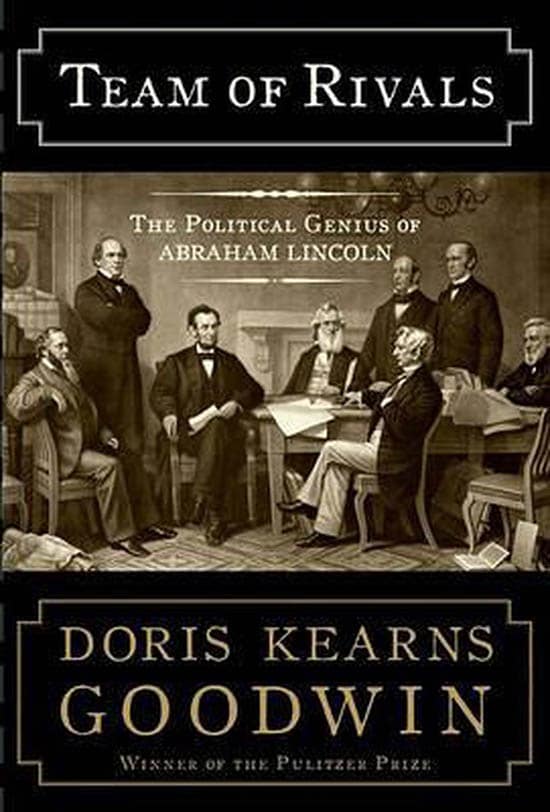
  • Team of Rivals (2005) by Doris K. Goodwin – Book Review & Summary

    The Greatest President There Ever Was

    Abraham Lincoln is touted as the ‘greatest President there ever was’. His ability to inspire, political genius, and the strength in his vision had the ability to change the course of a country’s history. 

    Team of Rivals (2005) by Doris K. Goodwin, is a closer look into his life, how he led the country into greatness by keeping the northern front united, putting an end to slavery, and winning the Civil War.

    A Uniquely Ambitious Man

    Abraham Lincoln’s early childhood years were splattered with hardships. Born on 12th February 1809, young Lincoln’s father Thomas Lincoln made him work at a tender young age. He would split and chop down trees, plough fields and dig wells. Yet he had an innate desire to learn, read, write, and educate himself. His father would even burn Lincoln’s books so that he wouldn’t get distracted from his work.

    It was, however, due to his loving his mother Nancy Hanks Lincoln that he did eventually learned to read and write. While not much is known about Nancy Hanks, she was a strong woman and died when Lincoln was only 9 years old, of dairy poisoning. Her death strained the relationship between Lincoln and his father. 

    As tragedy kept rearing its ugly face, a few years later, Lincoln’s sister Sarah Lincoln, died due to childbirth. His first love Ann Rutledge died in 1835, possibly of typhoid. Undeterred, and encouraged by his stepmother, Sarah Bush Lincoln, Lincoln continued to follow his ambitions.

    His stepmother saw his potential for greatness and encouraged him further. In April 1837, Lincoln relocated to Springfield, Illinois to start his career in law.

    Turbulent Political Scenario

    Lincoln was soon elected to the Illinois House of Representatives in 1834. The decades of the 1840s and 1850s saw the emergence of slavery as a major political issue. As the physical territory of the United States expanded to the west, a clear divide between the ‘free’ northern states and ‘enslaved’ southern states emerged, whether the newly created states of California and New Mexico should allow slavery or not.

    Another political point of dispute was the Fugitive Slave Law, a controversial subject that needed escaped slaves to re-join with their masters, even though they had escaped to a ‘free state’.

    To diffuse emerging tensions, in 1850, The Compromise of 1850 was passed. It surmised that California was to be a slave-free state; the Fugitive Slave Law would be strengthened. While any comforting effect of the compromise was only temporary, debates started once again in Nebraska and Kansas.

    The Kansas-Nebraska Act was passed. It allowed territories to themselves decide whether slavery would be allowed. The Act rescinded a previous statute wherein slavery would not be allowed north of Missouri.

    These events were primary to propelling Lincoln’s political career, as he became more active in fighting against slavery, leading to the creation of the Republican Party in 1854.

    The Whigs and the Democrats, the two important political parties at that time, were at odds on the issue of slavery and all those against slavery joined as Republicans.

    Salmon Chase, the Ohio statesman, became the first Governor of the Republican Party, as he was one of the most vociferous voices against slavery. As the Whigs split, Lincoln, along with William Henry Seward, New York Senator, and Edward Bates, a St. Louis Statesman, joined the Republican Party. Being the prominent leaders, these were the rival candidates who would stand for the 1860 Presidential Elections.

    An Underdog In The Party

    As compared to the stalwarts in the party, Lincoln had so far had, a very brief and modest political career. He was not the top choice as compared to William Henry Seward, who was a well-established politician. Seward’s exuberant personality matched his career choice, and his enthralling speeches made national news.  

    Secondly, Salmon Chase, the next contender was the trailblazer of the campaign against slavery. He had made himself a name in high-profile cases by defending slaves from the Fugitive Slave Law. Despite losing several of these cases, his claim that ‘the law was unconstitutional’ would, later on, serve as the foundation of the Republican Party.

    The third candidate in the running, Edward Bates, was a senior in the Party. At the age of 66, he was an 1812 war veteran and had an established law career to boot. He was also one of those who was an advocate for mending the north-south divide and had drafted the state constitution of Missouri.

    With such stalwarts vying for candidature, Lincoln’s modest career placed him quite low in the ranks for consideration for nomination. This point is more elaborately explained in Team of Rivals.

    The Big Surprise

    Lincoln’s career was slowly building momentum within the party as the big stalwarts were resting on their laurels. The legendary Lincoln-Douglas debate of 1858 gave Lincoln his first national exposure. Despite losing to Douglas, Lincoln won the popular vote. His speeches at the debate were later published and studied as part of debate classses for years to come.

    Lincoln was campaigning in the north, in the New England states, making eloquent speeches and perfectly laying out the agenda of the party through captivating campaigns. His clear stance against slavery and consistency in belief showed that he was willing to work to resolve the issues of the southern states.

    While Lincoln was making friends at every campaign, Chase and Seward were not even campaigning. They were overconfident. Seward even went for a European tour in 1859 instead of campaigning, and Chase was of the opinion that he deserved the nomination for all the work he had already done.

    As for Bates, his indecisiveness with his stance on slavery, preference to discuss issues such as economy rather than slavery, and even stating that others were using the issue of slavery to propel their political careers was the last nail in the coffin. The Republican Party members were not happy with his comments.

    All these factors were the reason for Lincoln winning the nomination at the Republican Convention of 1860 – a big surprise to all his rivals.

    A Balanced Cabinet – A Team Of Rivals

    Lincoln’s political genius was perhaps evident in his presidential victory in 1860. However, it was the selection of his heads of administration that is the true testimony of his political intelligence.

    He used a simple strategy: to choose those who were best qualified for the role, rather than thinking whether they belonged to the group of Democrats or Whigs. Hence, he first turned to his election rivals – Seward, Chase and Bates. In Lincoln’s administration, Seward made Secretary of State, Bates bagged the position of Attorney General, and Chase became the Head of Treasury. Apart from these prominent positions, he chose to have a good mix of politicians for other important positions. 

    Some of his unique mixes included former Democrat Simon Cameron as Secretary of War to represent the state of Pennsylvania, and as Postmaster General, he appointed Montgomery Blair from Kentucky (whose family had held a powerful place in the Democratic Party).

    His choices were indeed surprising, as any President would prefer to choose allies who would be supportive of his decisions. Instead, he chose people from diverse backgrounds who wouldn’t hesitate to voice their opinions and diverse perspectives clearly. This is what the author Doris Kearns Goodwin calls a “Team of Rivals”

    He believed that his choice of representatives would help in uniting the north and the south. However, the situation rapidly deteriorated following the Great Secession Winter. South Caroline had decided to secede from the Union, citing the election of a ‘Black Republican’ as the tipping point, a move that was soon followed by Florida, Alabama, Texas, Mississippi, Georgia, and Louisiana. 

    The Onset Of The Civil War

    Lincoln was inaugurated as a President on 4th March 1861. The newspapers were already calling him the ‘first President of the Northern Confederacy’. While it wasn’t an ideal start, Lincoln was ready for all challenges that headed his way.

    The very next day of his inauguration, Lincoln got a letter informing him that Fort Sumter in South Carolina was about to be captured by the Southern Confederates and that supplies had been cut off. Lincoln had a choice to make. Should he send reinforcements, which would agitate the situation further, or give up the fort, which would be perceived as weakness?

    Though it was a time of quick decision-making, Lincoln did not act in haste. He called his cabinet for opinions. Initially, only Seward had reservations about sending reinforcements to Fort Sumter. Unfortunately, though Lincoln tried to send reinforcements, conflicting orders went out and the plan went bad. 

    In an attempt to salvage the plan, new messages were sent out. However, the Confederates had intercepted the message and attacked the fort even before the new reinforcements reached. Lincoln lost the fort on 13th April and took full responsibility for the failure.

    The loss of Fort Sumter led to the secession of North Carolina, Virginia, Arkansas, and Tennessee from the Union. The United States was at the brink of a Civil War, and the first blood was spilt when a regiment was attacked in Baltimore on 19th April 1861. 

    Lincoln realised that the Union was not as good with uniform, weapons, and horses, and were unprepared for war. He then urged Cameron and Chase to get the military in shape.

    Keeping The North United

    A conflict was now inevitable. However, Lincoln saw a chance in the midst to unite the people of the north. In his address to the Congress on 4th July 1861, he made it clear that the fight was about keeping the very idea of democracy alive, and not just against slavery.

    On the 21st of July 1861, the First Battle of Bull Run took place in Virginia. The battle was fierce, and could almost be heard within the city of Washington DC. However, the Union was no match for the valour of Confederate General Thomas J. Jackson. 

    General George McClellan was put in charge to rally the Union troops. However, his continuous overestimation of the Confederate army, and his claims that there were twice the men in the army than there actually were, led to stalling, and he refused to march on the orders. The stalling resulted in their loss in the Second Battle of Bull Run in Richmond and caused 10,000 casualties. This was a clear indicator to Lincoln that he needed to make changes in his cabinet first.

    His Department of War was rampant with corruption and the head of the department, Cameron had no idea that his associates were pocketing and wasting large amounts of public funds. Lincoln chose former Democrat and US Attorney General, Edwin Stanton to replace Cameron. It was time for drastic measures.

    The Emancipation Proclamation And The Shift in The War

    Lincoln knew that the confederates were using slaves in the war. Whether the Union should recruit black soldiers in the army or not was being debated for months.

    In July 1862, Lincoln introduced the Emancipation Proclamation – an executive order that would allow him to circumvent Congress. In one move, he slammed down the Fugitive Slave Law and freed about 3 million to 4 million slaves in the United States, making them eligible to enlist in the army.

    At this point, Seward alerted Lincoln against making the proclamation as the proposal would seem as last effort and affect the already low morale in the Union Army. Lincoln heeded the General’s advice and waited till the Union was victorious.

    Lincoln got his opportunity at end of the Battle of Antietam. In September 1862, Confederate General Robert E. Lee, marched into Union territory, forcing General McClellan to take immediate measures. A fierce battle ensued and the Confederate army retreated. However, McClellan stalled once again giving the Confederates time to regroup. The stalling was the General’s last action, and Lincoln relieved him of his duties as Stanton declared McClellan a traitor.

    The win at Antietam, was, however, just what the Union needed. At the start of 1863, the Emancipation Proclamation was announced, as the Union saw more victories. 

    On the western front at Mississippi, General Ulysses S. Grant had divided the Confederates and claimed the Mississippi River. His victory at the Battle of Gettysburg marked the shift of the war in favour of the Union. Lincoln had found his general as Grant proved to be a formidable asset in war.

    Re-election, Victory, And A Disappointment

    After Lincoln’s Emancipation proclamation, 180,000 black soldiers formed a regiment. More than 50,000 casualties had taken place at Gettysburg in addition to many others. Lincoln’s re-election seemed a distant dream.

    In September 1863, at Chickamauga, the battle resulted in the Confederates losing 18,000 soldiers whereas the Union lost 16,000. Though the battle was lost, the Union held on to the city of Chattanooga. Stanton saw the advantage in time and in an emergency cabinet session, proposed to reinforce the city with 20,000 soldiers.

    With cooperation from the Department of Railroad, Stanton carried out his plan within 7 days before the Confederates could regroup. Lincoln then put General Grant in charge. One of the fastest deployments in military history, Stanton’s plan proved to be a success and the Union drove the confederates out of Tennessee.

    At the same time, the Democrats were planning a misguided coop to overthrow Lincoln, not knowing that Lincoln’s plans were actually heading towards victory. The Democrats were proposing ‘peace at any cost’ with the South with General McClellan at the helm.

    However, 3 days after the Democrats’ announcement, General William T. Sherman of the Union, won the battle in Atlanta, and the Navy captured the confederate port of Mobile Bay. These victories sealed the fate of Lincoln’s re-election and thwarted the Democrats’ plans of compromise.

    Determination And Goodwill

    Lincoln’s goodwill towards his colleagues was evident even after the war. Salmon Chase, the Secretary of Treasury, had been campaigning for his own spot during the re-elections. He had begun placing his own friends in the department, overstepping his bounds and refusing to accept his mistake.

    Though Lincoln was aware of this, he chose to not sever the ties of a productive relationship. Thus, while he accepted Chase’s resignation, he also appointed him as a US Supreme Court Chief Justice – a gesture of goodwill that never went unnoticed. Seward even proclaimed that Lincoln’s ‘magnanimity is almost superhuman.’

    Lincoln knew that as the war came to a close, he had to protect the Emancipation Proclamation even in peacetime. He knew he had to push the proclamation as an amendment in Congress. Hence, in January 1865, his Thirteenth Amendment abolished slavery once and for all.

    He individually met with significant members of the Congress and secured the much-needed five Democratic votes in favour of the amendment, the final nail that broke the spirit of the Confederates.

    In the initial months of 1865, representatives of both sides were in deep discussion about ending the war. However, without any conclusions drawn, the last few battles of the war ensued. General Sherman, however, successfully captured Charleston in North Carolina and Columbia in South Carolina. In April 1865, finally, General Lee was defeated in battle at Petersburg.

    The Confederacy fled Richmond, and a week later, General Lee handed over his 28,000 troops to Grant. The war had ended, and victory was sweet, as Lincoln triumphantly walked the streets of Richmond, with former slaves cheering.

    A Loss For The Nation

    After General Lee’s surrender, Lincoln gave an enthralling speech from the White House. As Lincoln laid out his hopeful plans of uniting the southern states and the Union, John Wilkes Booth, along with Lewis Powell and George Atzerodt, were amongst the crowd, planning to kidnap Lincoln in exchange for Confederate prisoners of war. 

    However, after hearing Lincoln promise citizenship to slaves, Booth changed the plan and decided to kill Lincoln along with Vice President Andrew Johnson and Secretary of State William H. Seward.

    Lincoln was scheduled to watch the play Our American Cousin at Ford’s Theater on 14th April 1865. Familiar with the location as a professional actor, Booth entered Lincoln’s seating box in the theatre. He shot Lincoln in the back of the head and escaped as Major Rathbone tried to hold him down. He stabbed Rathbone in the chest and jumped onto the stage.

    At the same time, Powell broke into Seward’s house and severely injured many as he looked for Seward. Seward was bedridden as he was recovering from surgery due to a carriage accident. Though he stabbed Seward in the face, the metal that was used to repair his jaw saved Seward.

    George Atzerodt, deciding that kidnapping was one thing, but murder was unacceptable, reneged on his plan to murder Johnson.

    Lincoln died the next day.

    Conclusion

    The death of Abraham Lincoln was a sharp blow to the rebuilding of the United States. According to southern-born Montgomery Blair, “Those of southern sympathies know they have lost a friend willing and more powerful to protect and serve them than they can now ever hope to find again.”

    Lincolns political genius was evident in how he surrounded himself with his political rivals. Moreover, his goodwill and determined belief that those who did not agree with each other or him would make the best decisions for the country, and whose unique opinions and thinking would help in exploring solutions from all possible angles for any issue.

    Lincoln’s ‘team of rivals’ was perhaps the best cabinet that led to the making of a great country!

  • Thinking in Systems by Donella H Meadows – Book Summary & Review

    The Systems Around Us

    Everything around us works in a system, right from the different systems that make our body function, as it should, to the different climatic systems that define the very existence of life on earth. In fact, systems can be found in companies, in sports teams, and within a family too. They are everywhere, however, some systems are simply not as obvious as others are.

    Thinking in Systems (2008) by Donella H Meadows, gives an insight to system thinking, to see how the entire world is interconnected in networks, yet have detailed different elements. It explains what systems are, how these systems work, and how can one sustain within them, in order to achieve success in life.

    What Are Systems?

    A system is a group of elements, connected by relationships and that share a purpose. While these elements can be physical and visible, they can also be intangible. For example, while we can touch and see trees, their roots and leaves and the system within which they function, the functioning and the system that underlies the workings of a university are amorphous.

    What binds these elements together is the relationship – whether physical or not. For example, in trees the elements of the system are connected by – or related by – the numerous chemical reactions and metabolic processes, whereas, in the university, the system is connected by the admission processes, teaching processes and examinations.

    What is the purpose of a system?

    The purpose of any system is defined by its observed behaviour, and not by its stated goals. For example, while a government may have a goal of protecting the environment, it may not do much about it. Hence, its goal does not reflect what it actually does, and thus protecting the environment is not its purpose.

    A system is determined by its purpose and its relationships, even if its elements change. For example, a sports team can get a new roster, have changes in its team, etc., however, its relationship to the purpose of winning remains the same.

    The behaviour of any system can be divided into stocks and flows. These can change over time.

    • Stocks – These are elements that can be accounted for, at any given time. For example, books in the library, the water in a bathtub, money put in banks, etc.
    • Flow – Flow is the change that takes place over time in the stock. These take place due to inflows that add to a flow, and outflows, then subtract from it. For example, birth and death are elements of the life system that add and subtract respectively.

    The Importance Of feedback In A System

    We know that stocks and flows are constantly changing in a system. This constant change in stock affects the inflow and outflow in any system and is known as feedback.

    There are different forms of feedback.

    • Balancing Feedback – This type of feedback occurs when any force stabilizes the difference between the desired and the actual levels of stock. Balancing Feedback is a chain of physical laws, or rules, that have the ability to change it and relate to the level of stock.

    A thermostat is used to balance the temperature in a room. In this example, the temperature is the stock; the heat that comes from the radiator is the inflow, whereas the heat that escapes from a window is the outflow. Thus when there is a drop in temperature, the thermostat, based on the difference in temperature between the actual temperature in the room and the desired one, turns on the heater.

    • Reinforcing Feedback – Reinforcing Feedback constantly generates more or reduces what already exists. For example, when one put money in a bank, one accrues more interest, thus generating more money in the bank. Reinforcing feedback can exponentially and constantly produce growth or even destruction.

    This feedback is extremely important to a system, as system structures consist of a stock that has one reinforcing and one balancing feedback.

    Consider the human population. The positive birth rate functions as reinforcing feedback, which is growing exponentially. With more people in the world, more babies are born. These babies grow up and have babies of their own, and the cycle of birth continues. However, the human population has balancing feedback in the form of death. Thus, as a population grows exponentially, the balancing feedback kicks in when people die due to diseases and insufficient resources.

    Well-Functioning Systems

    How and why do systems function well?

    Resilience is a very important factor that helps determine if functions well or not. For example, the world’s ecosystems or well-oiled machines work seamlessly. It is their resilience that helps their ability to seamlessly adapt to changing conditions.

    Resilience is the elasticity of a system, or its ability to recover from transition. It is the product of its structure and its feedbacks, working in different directions, ways, and varying time scales. The human body, for example, can adapt to different temperatures, adapt to changes in the supply of food, repair muscles, and reallocate blood supply.

    Resilience, however, is often underestimated, and often sacrificed for goals of comfort or productivity, to a point where the system itself collapses. The overuse of the earth’s natural resources is an important example, where it is leading to severe damage to the ecosystems of the planet. Environmental catastrophes are inevitable.

    Systems, however, have another defence apart from the resilience of self-organization. Many systems can self-organize. Essentially, they learn, evolve, diversify, and can build their own structure.

    This brings us to the next factor of well-functioning systems – hierarchy. As systems self-organize and build new complex structures, they naturally organize into a hierarchy. For example, everything on the planet is divided into sub-systems, which are a part of a larger sub-system, and so on.

    A cell in the stomach, for example, is part of the sub-system of the organ itself, which is further a sub-system of the digestive system, which is a sub-system of the individual. The individual is a sub-system of a family, which is a sub-system of a nation, etc.

    Hierarchies, in a system, help in reducing the amount of information that any given part of a system needs to manage. For example, since the cells in the stomach have the function of digesting food, the cells in the lungs – part of the respiratory system – do not need to carry out that function.

    Investigating Systems Productively

    Sometimes, people tend to focus more on the output of a system that they know well and that seems transparent. However, one can misconstrue the system if one doesn’t focus on the real behaviour or the way the system functions over a period of time. Because the output is the most visible aspect, people tend to simplify it into a series of events.

    For example, while watching a game of football, where both teams are evenly matched, but one of the teams is playing really well, the result of that team winning is less surprising for a person than if the person only saw the final outcome.

    Similarly, people tend to anticipate the linear relationship, even though the world functions more non-linearly. So, if a farmer adds 10 pounds of fertilizer to his farm and gets 2 bushels of wheat, he will assume that adding 20 pounds will reap 4 bushels. Here, the farmer might not consider that adding more fertilizer could also render the farm infertile and reap lesser, or the same amount of wheat.

    Additionally, people tend to dismiss the fact that systems are almost always interconnected, and mentally isolate systems to make the processing of information simpler. At the same time, it is also easy to forget that boundaries are but artificial, and one can tend to get accustomed to them. Hence the tendency to think is too broad or too narrow terms is also possible.

    For instance, while understanding the effects of global warming, charting a detailed model of earth climate can complicate the process, whereas focussing only on C02 emissions from automobiles will also be fruitless.

    Corrupt Systems

    Some systems can show problematic and unnatural behaviours. This happens due to policy resistance, where each individual sub-system has a different goal.

    For example, if an actor in any sub-system or system, gets an upper hand and uses that advantage to change the direction of the system, all the other actors in that system will have to work twice as hard to get the anomaly back in line. In such a case, the system gets stuck, with a recurring problem.

    Drug peddlers and users, both want the supply of drugs to be high, however, law-enforcement works towards the opposite. Hence, when law enforcers are successful in preventing drugs from entering the country, the prices of the drugs available on the street rise, leading to a rise in crime as addicts look to find different ways to acquire drugs, whereas, peddlers and suppliers work towards evading authorities.

    Sometimes, systems can encounter other problems too. For example, when the system uses an unsustainable but commonly owned resource, it inevitably collapses. So if a piece of land that is used for grazing cows sees a constant increase in the number of cows grazing on it, the amount of grass that grows on it eventually decreases and the land cannot be used for grazing anymore.

    Essentially, here, the feedback between resource users and resources is either highly delayed or virtually non-existent. Thus it becomes extremely important the resource users know and understand the effect of overuse, and how regulation can replenish the resource continually.

    Physically Adjusting Systems

    The question arises – How to enable systems to produce more of the good and less of the bad effects?

    The answer lies in changing buffers, system designs, and delays. These can make systems more efficient.

    • Changing Buffers – Buffers such as time, storage and inventory space should be of an optimal size to function properly. Therefore, increasing the capacity of a buffer helps in stabilizing a system. However, if it is increased too much, it will create an inflexible system. For example, it is far more expensive for businesses to store excess goods than to buy the minimum and allow an occasional product shortage.
    •  Changing System Design – A properly designed system works efficiently, has a better understanding of limitations and bottlenecks, and is less prone to fluctuations. For example, earlier, the only road between East and West Hungary passed through the capital city causing severe congestion. The road system itself needed a new design.
    • Changing Delays – Delays are the time it takes any system to notice and adapt to change. Though all systems have delays, sometimes, when these delays are long-term, the system finds it difficult to respond to short-term changes.

    For example, everyone all over the world seeks rapid economic growth, but the physical reality of some elements such as technology, factories, prices, etc., does not change at the same rate, causing delays. Hence to bring inefficiency in the system, it is better to give these physical realities time to catch up and slow down the growth rates.

    Internal Mechanisms And Rules Of Systems

    Apart from changing the physical realities of a system, there are other ways that can make it more efficient and fix problems. This can be done by focussing on the flow of information, its self-organization and the rules of the system.

    In some Dutch suburbs, the electric meters were installed in hallways rather than basements. This change resulted in a reduction of energy consumption by one-third, due to the fact that information about how much energy was being consumed was available to residents. This enabled them to adjust their usage. Here, the system simply introduced a sufficient flow of information that resulted in a significant change.

    However, if setting the rules of the system and its control fall in the hands of those who benefit from it, the system will inevitably collapse. For example, if the trading system of the world was in the hands of corporations, run and ruled by them, and the benefits were for those selected few corporations only, it would collapse.

    Systems have a fascinating characteristic of self-organization, wherein the system evolves and learns on its own. However, self-organization means that humans lose control over it. Thus systems often have man-made limitations. Such limitations can result in a different set of problems, and hence, it is better to let systems self-organize.

    When the goal of a system changes, the entire system learns to adapt to the changed goal. Hence, when systems hold incorrect goals and paradigms, they can run into problems. Paradigms, however, are the deepest beliefs that form the base of a system. Hence an incorrect paradigm needs to be changed.

    For example, the paradigms of environmental protection have changed. Hence, there have been changes in a number of connected systems such as industries, countries, cities, and people, in how they manage waste.

    Understanding The Inner Working Of Systems

    How does one understand and increase the efficiency of systems in a world of systems?

    Firstly, learning the history and collecting information about a system helps to understand its behaviour, as the more information one has the better judgements can be made. 

    Once the information about the system is collected, one can note down how the system works, its functions and arrangements. This ensures that the models drawn are consistent and complete.

    The second step is to distribute the data collected so that the system can function properly. During this process, it is essential to focus on the important measurable and immeasurable factors. Often, people tend to pay more attention to measurable factors, as they can be quantified, easily visible, and tangible, than the immeasurable factors such as quality. For example, justice, freedom, security, etc. cannot be quantified.

    Additionally, one must keep an eye open for what behaviours are produced by which external or internal factors, and if they can be controlled.

    Following these steps helps in understanding wherein a system, the responsibility lies, and what consequences are results of which action.

    Conclusion

    The world is full of systems. These systems are interconnected and interdependent.  In order to make some semblance of these systems that govern the world, it is essential to learn to recognise and study the patterns and behaviours they exhibit.

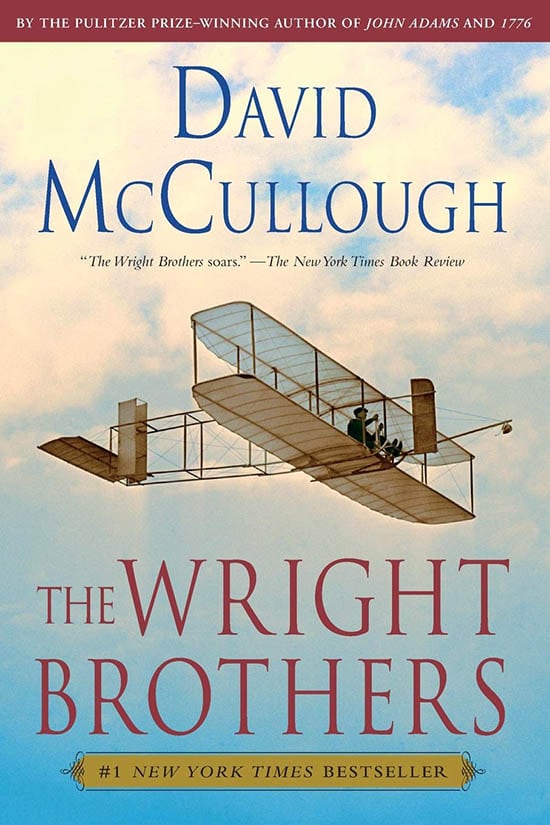
  • The Wright Brothers by David McCullough – Book Review & Summary

    Flying Towards Success

    Every successful story has a history of struggles, untold tragedies and much-needed failures. However, every successful story also has a history of inspiration, virtues of persistence, hard work and perseverance, invaluable lessons for everyone. 

    One such story of inspiration is that of the Wright brothers from Dayton, Ohio, who pioneered in the fields of both, invention and aviation, becoming inspiring idols for a long line of generations of inventors.  Their fascination and obsession with birds brought about the most iconic invention of all time – the aeroplane.

    The Wright Brothers (2015), by David McCullough, gives a deep insight into their lives, and how hard work and passion can make anything possible.

    A Winning Team

    The Wright brothers, Wilbur and Orville, born four years apart, were virtually inseparable throughout their lives. They ate together, had joint bank accounts, and even had similar handwriting. Yet, they both had unique personalities. Being the elder of the two, Wilbur was more scholarly and was clearly the leader of the two. Orville was more gentle, sensitive to criticisms and more cheerful than his brother. While Wilbur had nerves of steel, Orville was more adept at business.

    Having a modest upbringing, their house was always stocked with books. Their father, Bishop Wright always encouraged the children to be open-minded and hardworking. The Wright brothers lived with their mother Susan, and a younger sister Katherine. They also had older siblings, Reuchlin and Lorin, who lived elsewhere.

    While their father encouraged education, he never stopped them from taking a day off from school to enjoy the books at home.

    The early exposure to books helped Orville develop a keen business sense. By the time he was in high school, Orville had already started his own print shop. The same habit instilled a fascination for flight and birds in Wilbur. Wilbur was also a keen follower of the work of Otto Lilienthal, a German glider enthusiast, and Pierre Mouillard, a French poet and farmer who also shared a profound love of flight.

    A few years later, Wilbur and Orville opened a bicycle shop. This shop funded their research and work on airplanes.

    The Early Tests

    By the twentieth century, many had dreams of flying and had failed. The press would jump at every failure and those dreamers would face mockery from the rest of the world. One such inventor, Charles Dyer had tried to build an airplane in the shape of a duck in 1870. 

    Wilbur and Orville, however, weren’t deterred by the risk of failure and ridicule. They pressed on with developing important insights, especially surrounding equilibrium.

    They realised that flight sustenance could be achieved when all the forces of the airplane were balanced, had the ability to change with the wind, and to do so, the pilot would need to have that ability by controlling the airplane quickly and precisely.

    The solution came to Wilbur. He realised that the wings of their glider needed to ‘warp’, or bend to enable the plane to turn and achieve different angles. Essentially, the plane could be controlled if the pilot could control the ‘warping’. Thus, they began their work on their first glider in 1899, in the fields of Kitty Hawk, in Dare County, North Carolina. It was in this isolated area where they first staged their successful trials with their glider. Kitty Hawk had the ideal conditions of steady winds that helped lift the glider, and sand dunes that could cushion any crash landings.

    Their first assembled glider weighed only 50 pounds, with two fixed biplane wings on top of each other. It had a movable rudder in the front and could be manoeuvred with warping controls. The pilot would need to lie stomach-down on the middle of the lower wing, facing forward. 

    The brother had a safety pact in place. They decided to never pilot the glider together so that if one of them died, the other brother would be alive to continue their work.

    These first test flights took place in September 1900 and were remarkably successful. They were able to achieve glide heights of 300 to 400 feet at 30 miles per hour.

    Moving On To The Motor

    The success of their test flights fuelled a hunger to improve the designs of their plane. The brother built a lab, just above their bike shop. This lab housed a custom-made wind tunnel. It was a 6-foot long wooden box, with a fan on one end and an opening on the other, allowing them to test different curvatures and shapes of wings.

    By August 1902, the brothers had a new and improved model. With more than 2000 tests of this glider at Kitty Hawk, and one test spanning a height of 600 feet, the results were brilliant. Their next move, after perfecting gliding, was to introduce a motor.

    However, they were unable to find anyone who would build them a motor light enough for their plane. Finally, their friend, Charlie Taylor, a mechanic, built them a custom-made, 12-horsepower, 125-pound motor. The Wright brothers made the propellers for this plane on their own from scratch.

    The new plane, the ‘Flyer’, had 2 8.5-foot propellers spinning in opposite directions to avoid the plane from getting pulled to one side. They got back to Kitty Hawk for tests, where Wilbur won the coin toss to ride the Flyer first. However, he crash-landed when he pulled too hard on the rudder.

     After a few days of repairs, it was Orville’s turn, and on 17th December 1903, at 10:35 AM, the Flyer took off, flew of exactly 12 seconds over a distance of 120 feet successfully charting a new course for motorized flying!

    Nevertheless, their work was far from over. They started straight off on more improvements on the Flyer.

    Scepticism

    Next, Wilbur and Orville began to look for a new location to test their flights, in order to save on time and the cost of transportation to Kitty Hawk. They found a cow pasture in their home state, Ohio, called Huffman Prairie.

    However, the winds in this new location weren’t as ideal as Kitty Hawk, so they built a catapult to assist the plane with take-offs. They would drop weights from a height of 20 feet, which triggered a sling to push the plane on the attack. They were soon able to manage a half turn to land back where they started, despite many failed attempts.

    Despite their success at perfecting motorized flying, the local press didn’t seem to be interested. In fact, the publisher of Dayton News, James Cox, later confessed that they thought the reports of the Wright brother’s successes were bogus, and hence never bothered to check.

    One of the reasons for this scepticism was that Professor Langley of the Smithsonian Institute had recently failed at a motorized flight in December 1903. Funded by the government, Langley’s $50,000 aircraft was receiving much ridicule for its failure from the press. In fact, the first accurate account of the achievements the Wright brothers’ had, came from a beekeeper and flight enthusiast, Amos I. Root, in his periodical Gleanings in Bee Culture in 1905. 

    The lack of press coverage and shown scepticism didn’t deter the brothers. They soon started to think commercially. After patenting their motorized plane in 1903, they approached the military with their ideas. The military too, sceptical due to Langley’s failure, didn’t respond to the brothers despite two different proposals.

    Wilbur and Orville then turned to French and British representatives and signed a contract in France in December 1905 with a team of businessmen. This contract included public demonstrations – eventually taking them halfway around the world – and $200,000 per Flyer!

    From New York To Europe

    By 1907, the brothers had received a patent for the Wright Flying Machine, and their business in the European nations picked up. While their deal with the French was still underway, the Germans offered them $500,000 for 50 Flyers. 

    The brother hired a New York firm, Flint and Company, who had experience in selling military goods in the European market, as their sales representatives. They included a 20% commission only on the European sales, leaving the US markets to the brothers.

    A few months later, Hart O. Berg, the European representative of the firm advised that one of the brothers should address the buyers in Europe in person. Being the natural leader of the two, Wilbur boarded the RMS Campania in May 1907 to Europe.

    Accustomed to opulence, Berg ensured that Wilbur travelled first class, got him a tailored suit from the Strand, and put him up at the New Hotel Meurice in Paris, replete with a rooftop garden and a panoramic view of the city.

    Unfazed by the luxury, Wilbur was more interested in European architecture. He wrote a letter home describing his opinions on the city’s museums and buildings, and how he preferred the obscure John the Baptist to Da Vinci’s Mona Lisa.

    Their business in Europe began stalling, and soon, by late July 1907, Orville and their mechanic friend Charlie Taylor joined them, along with their latest model The Flyer III, for demonstrations. However, the demonstrations got delayed, and with the Flyer II stuck at customs in France’s Le Havre, they returned home in November 1907.

    Tasting Early Success

    With public demonstration still schedules for the summer of 1908 in France, they got the good news that the US War Department was interested in their planes. The department accepted their offer for $25,000 with a condition that the plane had to pass various tests.

    Before Wilbur left for France again, the brothers demonstrated a new model at Kitty Hawk, which not only allowed the pilot to sit in the plane rather than lie down but also included space for a passenger.

    However, when Wilbur got back to France, he found that their Flyer sitting at the customs was severely damaged by the agents at Le Havre. Wilbur, remarkably, rebuilt a new Flyer from scratch on his own. When the plane was ready two months later in August, he took to the skies at the Le Mans racetrack in front of an influential crowd. 

    Soaring for 2 miles at 30 to 35 feet off the ground, he made two successful half turns and landed gently. The massive success of this demonstration immediately caused a shift in public opinion, making Wilbur’s flight international news. The London, Paris, and Chicago papers were heralding its success, putting a firm stopper in any scepticism that would tarnish the success of the demonstration.

    As Wilbur continued with his popular demonstrations to crowds that rose to thousands, Orville was about to put up an equal fascination show at For Myer, Virginia.

     On 3rd September 1908, Orville demonstrated in front of a small military crowd. Starting tentatively, he became more confident and daring in his demonstrations, garnering the title of the new star of aviation. In just a few weeks, Orville had set seven new world records in altitude, speed, and duration.

    But challenges were far from over.

    A Brush With Death

    Egged on by the world records and daring demonstrations, disaster struck. On 17th September 1908 at For Myer, Orville took flight with a passenger, Lieutenant Thomas Selfridge, a distinguished young officer.

    Though Orville had experience in flying with passengers twice before, this time around, one of the propeller blades cracked mid-flight, tangled with one of the wires controlling the rear rudders, and caused the plane to thrash around wildly before it dived 125 feet down. While Orville was seriously injured, the young officer died of a skull fracture.

    With a hip and a leg fractured, and four broken ribs, he recovered slowly as his sister Katherine nursed him back to health. His injuries left him with the use of a cane for a while.

    Yet, this accident did not deter the brothers from continuing to make history.

    As Orville recovered, Wilbur resumed flight demonstrations after a break. The success returned too, with a crowd of 200,000 watching his demonstrations at Le Mans. He soon started training 3 French aviators, a condition that was part of his agreement with the French businessmen. By January 1909, he had earned $35,000. 

    The brothers were winning many awards in France. Including the Legion of Honor, Wilbur himself won the Michelin Cup of Aviation for setting a record for distance for covering 77.5 miles. Soon Orville and Katherine joined Wilbur in France for an opportunity to meet King Edward VII of England and King Alfonso XIII of Spain. The accolades kept pouring in and the Wright brothers were a resounding success in Europe.

    Home Again

    Wilbur and Orville returned to the US with many awards in hand and about $200,000 richer. As they arrived in New York, they were met with a swarm of reporters and fans that followed them all the way to Dayton. The real celebrations and festivities were just about to begin!

    About 10000 people, waiting for them on their front porch, a two-day-long celebration, and a parade that covered the history of America and Dayton in their honour, received them. The parade included 15 floats, 560 historically dressed actors, and 2500 school children dressed in red, blue, and white, singing the national anthem, to commemorate the achievements of the Wright brothers.

    Topping the celebrations was a trip to the White House, with President Taft presenting them with gold medals. 

    All the celebrations and honours in the world could not, however, stop the brothers from continuing their work. Just 48 hours after the parade ended, Wilbur and Orville were back at Fort Myer to finalize the US Army deal, and so that Orville could complete the endurance and speed tests that were unfinished.

    Additionally, a pending legal case against Glen Curtiss, a celebrity pilot who was illegally using their wind-warping technology needed to be addressed. This case – an all-out patent war – went on for about a decade.

    The aviation industry was touching heights all over the world. The Wright brothers too were flying higher. Wilbur flew alongside the Hudson River encircling the Statue of Liberty. Soon, one of Wilbur’s trainees, a Russian aristocrat named Charles Lambert flew over Paris and the Eiffel Tower touching about 1300 to 1400 feet.

    On 25th May 1910, the brother completed a personal milestone at Huffman Prairie. Bishop Wright, their father, at 82, was present to see his sons flying together for the first time! The next round was a memorable one for them too when Orville took the Bishop as a passenger.

    His pride and exhilaration were summed up when he leaned over to Orville as they soared over Ohio, and said, “Higher, Orville, higher!”

    Conclusion

    The story of the Wright brothers is one of the remarkable success, perseverance, and undeterred determination. In the face of hard scepticism and challenging hurdles, they managed to, through sheer talent, change the face of the aviation industry.

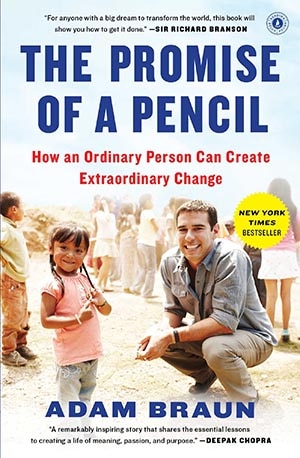
  • The Promise of a Pencil by Adam Braun – Book Summary & Review

    10 Lessons To Realising Dreams

    Pencils Of Promise is a charity organization started by Adam Braun. While the charity was started with only $25, it has expanded with more than 200 schools providing basic education in developing countries across the globe.

    This is the story of the charity organization that was started with only a group of supportive friends and humble beginnings and is today one of the leading charities in the world. While hard work is the crux of this success story, it is also about the passion, confidence, inspiration, and gratitude of Braun and his colleagues. 

    Adam Braun’s Promise of a Pencil is an account of the inspirational story of the charity organization, and how Braun realized his dream. It is a guide that encourages each and every person to follow dreams, finds their passion, and use their potential to the fullest.

    Lesson 1: Follow Your Dreams

    Why do people choose the safer path in life? What stops them from being courageous enough to take risks? Moreover, why are they so vary about the expectations and opinions of others?

    As a college student standing at the brink of a successful Wall Street career, he backpacked across the globe. He saw widespread poverty and the lack of basic education in many countries, which laid the foundation for his dream. Braun started his charity in 2008 with a simple aim – to raise enough funds to start a school in a Laotian village.

    His career was at stake, his family thought that he was wasting his time on an impossible dream. Raising the required $10000to start his school was an unattainable feat. Yet, Braun ignored the criticisms of his family and friends and ploughed through. He achieved his goal in a matter of months.

    His dedication and dismissal of others opinions and expectations helped him achieve his goal. He didn’t let others discourage him.

    Braun’s dedication to giving it a try at the least led to the fast growth of his organization. By 2013, Pencils of promise was running ground to opening their 100th school in Ghana, despite the fact that at the onset, neither Braun himself nor his friends and family believed that would be able to achieve the success they had.

    What did Braun do to achieve his goals?

    Firstly, Braun and his team believed in and committed to their idea. Secondly, he allowed himself to follow his dreams and did not delay acting upon them. Therefore, to realise one’s dreams it is crucial to start living them, today!

    Lesson 2: Get Out Of The Comfort Zone

    Most people live within their own comfort bubbles. They surround themselves with like-minded people who share opinions, habits, and interests. This sense of comfort brings a sense of safety.

    However, this is not the ideal way to live life. One has to push oneself out of the safety of comfort now and then and have experiences that will enrich life.

    Adam decided to take a semester off to travel at the brink of a successful Wall Street career. Most of his friends and family advised him against taking such a risky step, especially since it wouldn’t help his career in any way.

    However, Braun’s travels gave him fresh insights that changed his life.

    It is not easy to get out of the comfort bubble. It requires a high level of optimism and some amount of risk-taking. Additionally, pondering over incessantly about the things that go wrong will thwart new ideas and one will never experience fresh insights.

    While Adam was travelling in Guatemala, he met a local who offered to give him a place to stay in his house for a few weeks in exchange for teaching his family English. While Adam had his doubts over the safety of the proposition, his eventual agreement to accept the offer enabled him to make new friends and learn about the Guatemalan culture.

    The lesson here is, staying in the comfort one never leads to valuable experiences, and one never learns to deal with unfamiliar situations.

    Lesson 3: Follow Your Intuition

    Intuitions are strong feelings, and most often powerful advisers. Intuitions help us realize what is good much before we, ourselves do.

    Braun’s realization of his dream was triggered by an epiphany he experienced while he was at a pianist concert at the New York Philharmonic. The passion that he witnessed in the pianist’s performance, inspired him to write the mission statement for Pencils of Promise that very night.

    Intuitions are also central to providing solutions to a dilemma. Intuitions work on a subconscious level, showing certain signs of what one must do.

    As Braun began his work on his charity, he was working as a consultant. He usually worked during his free time. Soon his supervisors noticed his lack of commitment to his job and asked him to choose between his job and his dream. That day, on his way home, he came across a cardboard box with ‘Become your dream’ written on it. The timing of seeing the graffiti was perfect. It was the push he needed to make his decision.

    Intuitions guide people and give confidence. One should listen to that inner voice more often and follow that intuition.

    Lesson 4: Don’t Be Afraid To Start Small

    Most often, the enormity of following one’s dream puts a stopper in realizing them. However, one should remember that every big accomplishment starts with a small step, no matter how insignificant it may seem at the beginning. These small steps can hold the power to change lives.

    While Braun was backpacking through India, he asked a small boy what was it that he wanted most in the world. The boy answered – a pencil. Adam gave the boy one of his own pencils, making the child incredible happy.

    What seemed like a small cheap item to Adam meant the world to the little boy – a fulfilment of his biggest wish. The experience had a profound effect on Adam – profound enough that he named his charity from the inspiration he got.

    Starting with small steps also means that one doesn’t need a lot of money to effect positive change. Many successful entrepreneurs have worked within limitations and started small, slowly building their ideas over time.

    Braun too started small by opening an account with $25 in the name of his organization. He soon began raising funds by asking family and friends, collected a veritable amount that he used for his charity.

    Dreams, at the outset, often seem like unreachable goals. The trick is to start with small steps and not be afraid to take them.

    Lesson 5: Remain Confident

    Difficulties and hurdles are inevitable while one follows their dreams. During such times, one has to remain confident and believe in their ideas and in themselves. This will ensure that one does not give up when the going gets tough.

    Braun, in the course of following his dream, encountered one difficulty that changed his life’s course drastically. On his way to Africa, his ship got caught in a severe storm. It damaged the ship badly and the passengers were scared for their lives. However, Adam did not believe that he would die that day. He believed that he has a purpose to fulfil and he had to live on to fulfil it.

    It was this sense of confidence that helped him remain calm, help others around, and emerge stronger from this experience.

    However, confidence in one’s dreams and oneself isn’t enough. One has to act confident and show the world that one is in control. A show of confidence demonstrates to others that one is not afraid or weak, especially in a dangerous situation.

    While Adam was in Nepal, he found himself in the midst of a huge political demonstration, where the protestors were agitated and ready to attack. Though he was afraid, he got out of his taxi and confidently walked away. Though he had no idea where to go, it was probably his confidence that saved him that day.

    One has to have the confidence to change the manner one confronts obstacles, even if it means to pretend that one is confident.

    Lesson 6: Use The Right Language

    Language, like confidence, is vital to success. Therefore, one has to use it to their advantage to be successful.

    Choosing one’s words carefully is crucial while talking to supporters, as sometimes, even seemingly harmless words can backfire and affect people negatively.

    When Pencils of Promise started, Adam often referred to it as a non-profit organization. However, some of his managers had an aversion to the negative connotation of the prefix. When he realised this, he changed it to ‘for-purpose’, thereby making the connotation positive and increasing interest.

    Language can also be used to making ideas concrete. When an idea is still nascent, inside one’s mind, it can be hard to develop. However, simply voicing them out loud or writing them down can help increase the chances of actually realising them.

    After a trip to Ghana, Adam was playing with the idea of expanding his charity in Africa. However, during a speech at a fundraiser, he ended up spontaneously promising the audience that if they could raise donations worth $1 million at the gala, the proceeds would be used to open a school in Ghana. Voicing out his nascent idea, led to an overwhelming response and they were easily able to reach the goal of a million dollars. Thus, the first school in Ghana was opened.

    Lesson 7: Inspire Others

    No dream can be truly realized without the help of others. Hence recruiting the right people the right way is crucial.

    One gets only one chance to influence people to follow their cause. The first impression should be good, and the listeners should feel important, especially while addressing a large crowd.

    Braun employs the idea of  ‘one person, one thought’ throughout his presentations. This practice involves establishing eye contact with one person for as long as one thought is discussed. Once that thought is done, move on to establishing eye contact with another person, and so on.

    This method helps in getting people to feel that they are being addressed directly. Their chances of understanding the cause and getting inspired due to the few seconds of personal interaction are higher.

    While addressing a crowd, the number of people addressed is not as important as the number of people within that crowd who actually listen. It’s better to have one inspired and dedicated person, rather than a hundred who don’t care.

    For example, during the early days, Adam and his friends would hold presentations at universities all over the country. For one such presentation, they had booked a huge classroom considering expected numbers. However, just one person showed up. Rather than cancel or reschedule, Braun though frustrated, decided to present irrespective of the poor attendance.

    His decision paid off. The single attendee eventually became a dedicated and valued volunteer of the organization.

    Lesson 8: Thank People For Their Support

    Thanks’ is a magical word. It mends, heals, and strengthens relationships. It is as important to share joys and sorrows, appreciate, and thank the people one works with as it is with family. Moreover, it is essential to remember that one gets treated the way one treats others.

    Braun dedicated the first school the organization opened to his grandmother. A holocaust survivor, she had escaped to the USA with nothing and built a safe life for her children and grandchildren. Braun’s grandmother was moved to tears when she saw her name engraved on the school door. Additionally, seeing his grandmother’s joy, made Braun happy too.

    In another example, Braun remembered that two years into starting the organization, he had not personally thanked the first stranger who had donated a large sum of money to the organization. He wrote a belated note thanking the stranger.

    The stranger was so happy to receive the note of thanks and due to his interest in the organization, he arranged for a new office to be built for the organization at no cost at all.

    Lesson 9: Recognize Weaknesses And Learn From Mistakes

    Weaknesses and failure are inevitable components of being human. Neither can be completely avoided. Hence, understanding weaknesses and learning from mistakes is advantageous. 

    Analysing mistakes shows what can and cannot work, and knowing weaknesses can help one avoid mistakes.

    Adam once got a mail from a colleague in Nicaragua that he had been robbed. Surprisingly, Adam, instead of enquiring after the person’s well being, first informed him that the organization wouldn’t be able to reimburse the losses. The colleague was really upset, especially since he hadn’t asked Braun for any money. When Braun realised his mistake, he vowed to never repeat the mistake of placing the importance of money ahead of the well being of his staff.

    Understanding and learning from his mistake enabled him to develop a better leadership style.

    In another example, during the early years, Braun never asked anyone for money directly or personally. This was not a principle he followed, but a fear of rejection. When he realized this weakness, he confessed it to the board of directors, who helped him overcome it.

    They helped him practice asking for others money and gave him advice on how to handle such situations.

    Lesson 10: Take Time To Make Decisions

    Following one’s dreams requires making tough decisions. Doubts ad moments of uncertainty, especially in the wake of having an easier way out are inevitable. During such times, one has to think of both, the short-term benefits and obstacles as well the ones that could arise in the long run.

    Just as Braun’s charity organization had started, he received an attractive job offer – one that would give him a very high salary and many personal benefits, however, one that he would have to leave his dream for.

    At the moment of making his decision and accepting the offer, his friends advised him to think of his principles and think of what he loved to versus what he needed. Thus Braun chose to stick to what he loved doing and rejected the job offer.

    Making such a decision also requires a person to be in the right frame of mind, simply to be able to make the right decision. For example, routines tend to thwart gaining new perspectives, and judgements can get impaired. Hence, it is essential to take breaks and think of creative ways of changing one’s routine to gain newer perspectives.

    Conclusion

    Realizing one’s dream isn’t an easy task. However, with the right amount of confidence, staying committed to the dream, listening to one’s intuition, and getting out of the comfort zone one can achieve goals.

    Additionally, one should not be afraid to make risky decisions to make dreams a reality. Starting with small steps, inspiring people and thanking people for their help goes a long way in succeeding.

    Adam Braun’s struggles, his dedication to pursuing his dream and belief in his own abilities to make them a reality are a great example for all to follow.

  • The Magic of Thinking Big by David Schwartz – Book Summary and Review

    The Power Of Self-Belief

    It is one thing to have dreams and set goals towards achieving them. However, it is a completely different matter to be able to push through and actually achieve these dreams and goals. Whether it is a small short-term goal of finishing that yearly spring cleaning by the weekend or a long-term one of investing and saving money, the question that always arises is ‘How and where do I begin?’

    The Magic of Thinking Big (1959) by David Schwartz is a guide to setting and achieving dreams and goals. The methodology focuses on believing in oneself as the pivotal key to success. The author’s experience and interactions with individuals and businesses that have seen both sides of the failure-success coin support his belief that anyone can achieve anything that they set out to do.

    A Matter Of Belief

    So how and where does one begin to start working towards goals?

    The answer lies in having belief. Believing, and honing a mindset where one feels a hundred per cent capable of doing whatever they set their mind to do, is the best approach.

    Believing truly in one’s own ability helps the mind to focus on finding the ways to accomplish those set goals. This is the minds creative power. The more one believes the more creative power is unleashed. Essentially, as long as the level of one’s belief matches the difficulty level of the task, even the most challenging goals can be met.

    When one truly starts believing in oneself, others start believing in the ability of that person too. A study conducted by the McKinsey Foundation for Management and research conducted interviews with the government, science, religion, and business leaders. They were asked what type of people they preferred to work with. The answers were almost unanimous. Everyone wanted people who had a sheer desire to succeed, a trait that is contingent on self-belief.

    Such individuals never give, irrespective of the hurdles they have to encounter, and are constantly motivated. Leaders associate such belief with success. True belief aids one’s mental power to shift to persevering towards the set goals. In turn, a support system of inspiration and confidence builds up, where other start believing too.

    Sharpening Those Creative Thinking Skills

    Thinking is of two types – fact memorization and creative thinking.

    While fact memorization involves learning pieces of information, which are stored in the brain, and accessed later on, creative thinking involves a focus on finding innovative solutions. Essentially, it means finding new and improves methods of managing any kind of problems and challenges.

    While fact memorization has its own merits, creative thinking enables efficient and quick thinking to overcome hurdles. Where fact memorization makes the brain rigid, creative thinking makes it flexible, adaptive, and agile.

    Successful individuals always stress creative thinking, rather than memorization of facts. One can get into the habit of thinking creatively by

    • Being more receptive to new ideas
    • Grab as many opportunities one can to try new ideas
    • Spend ten minutes every morning reflecting on, ‘How can I be better today?’

    In order to develop these as a habit, one has to diversify one’s lifestyle. For instance, one should surround themselves with people who support, yet challenge beliefs and ideas openly. Engage in communities and groups that are far removed from one’s line of work. For example, a budding chef can join a Math Club. The new and varied skills that the chef will learn could help in managing accounts for his upcoming restaurant.

    Think Positive, Act Positively

    Today, one is constantly exposed to negativity. From murders in the news to fat-shaming advertisements, and sometimes even close friends and relatives can turn on the negativity dial by putting down ideas and dreams. Over time, the constant exposure to negativity normalizes it. 

    Negativity is a mental monster. The more one feeds it with negative thoughts, the stronger it becomes and encroaches on every bit of positivity one has. Negativity is one of the main reasons people end up average or unsuccessful. Negativity is an abnormality that sucks out one’s will to succeed.

    In order to thwart negativity from one’s life, one has to practice positive thinking and positive actions on a daily basis. Positive thoughts and actions help eradicate negativity from festering in the mind.

    To do this, one can write a ‘pep-talk’ or a ‘self-selling advertisement’ that showcases one’s best traits and shows oneself how they are better than everyone else. Repeating this advert to oneself loudly – in private – on a daily basis, and repeating it silently many times a day will help in enforcing positive thoughts and deflect negativity.

    For instance, a teacher who knows that she can make her students laugh should repeat to herself, ‘I am the best at making my students laugh and learn’. This will help in boosting her confidence, distinguish her best trait, and encourage her to contribute her best.

    Nurturing Relationships

    We know the saying ‘what goes around comes around’. If one treats the people around in a bad manner, the people around will also react in the same way. However, if a person treats everyone around with importance and respect – irrespective of whether they treat the person in the same way – over time, those same people will start treating the person with importance and respect too.

    The support of the people around is crucial for achieving success. No one can achieve success on one’s own. One needs the support of those around to reach the top. For example, a person that makes it to the position of a CEO reaches there due to the support of her team, her subordinates, and her peers as well.

    Keeping this in mind, it is crucial to understand that nurturing relationships in life, with those who are close as well as those who are not. The Ex-American President, Lyndon Johnson had his own ten-point success formula. He would take efforts to memorize the names of everyone working in his office and even congratulate them personally when they achieved something.

    Thus, whether a person is closely related to one’s success, or is just another acquaintance or encounter, every relationship should be nurtured and respected, as if success hinges on that one encounter or acquaintance.

    Having A High-Quality Environment

    The notion of ‘you are what you eat’ implies that a healthy body is directly proportional to maintaining a healthy diet. This same notion is true for one’s mentality. Essentially, how a person thinks is directly proportional to what that person sees and hears.

    The associations one makes, the friends one keeps, the living space that surrounds, as well as what one chooses to read and watch, all are instrumental in influencing one’s thought process. For instance, surrounding oneself with people who love to gossip, will in turn make one more likely to be a gossipmonger. Essentially, one is affected by the company one keeps.

    Therefore, success rides on one’s ability to maintain a high-quality environment. The people one associates with, the living space, workplace desk, and even how one spends leisure and social time should be of high quality, enabling one to grow as a person.

    In order to do this, one should surround oneself with successful people, understand their motivations, and study how they think. Even when it comes to seeking advice, one should turn to those who are currently in positions where one wants to be in the future. Additionally, when it comes to friends, it is essential to surround oneself with those who not only have their own successful ambitions but also who can believe in yours.

    Hence, when it comes to creating a high-quality environment, it is vital to create and maintain a high-quality support system, which will keep motivations high even when achieving goals seems virtually impossible.

    Keep A Check On That Attitude

    For a large part of man’s existence on earth, man did not have language. Communication included only body language, facial expressions and gestures, and languages and the written word developed much later on. So it is no surprise that it is easier to read ones body language, facial expressions and gestures more easily.

    Evolutionarily, man is predisposed to understanding the attitudes of others far better and faster. Attitudes are essentially mirrors of the mind. If one has to achieve success, especially while interacting with the people around, it is necessary to have a positive attitude.

    Keeping a positive attitude first entails doing things that one believes is morally correct and appropriate. When a person behaves or indulges in morally incorrect actions, such as lying to or stealing from others, can reflect the guilt of the action in the attitude of the person. This can erode one’s confidence.

    On the other hand, good behaviour and morally correct actions can lead to confidence and comfort with one’s own decisions, which in turn reflects in one’s attitude.

    Another way to instil confidence and have a good attitude is to keep up ones physical appearance. Looking good and dressing well, even on occasions that do not require one to dress up, can make one feel confident about themselves and in turn, makes others feel the same about the person.

    Finally, what really works at maintaining a positive attitude is to believe in the fact that what one is doing in their life is worthwhile and important. This kind of attitude becomes an unending source of confidence.

    Build Confidence

    Fear is very real. And fearing anything in life is the biggest reason why many people cannot succeed despite trying hard. Whether it is a fear of facing uncertain situations or having a fear of other people, all fears have only one antidote – confidence.

    The stronger one’s self-confidence is, the less likely it is for any kind of fear to have a debilitating effect. In fact, confidence works as an immune system against fear. Just like the body needs to keep its immune system healthy, the mind needs to nourish confidence to make it long-lasting and effective.

    The first step to build and nourish one’s confidence is by acting confident even when one doesn’t feel confident. While it might be tough to maintain this, it can become a habit over time. By acting the way one wants to feel helps in managing emotions.

    One can start with simple actions such as choosing to sit in the first row during presentations and classes, increasing one walking pace by 25%, or increasing eye contact with others during conversations. Such actions of increased interactions make people stand out from the crowd while strengthening one’s own self-awareness.

    Moreover, it is important to remember, that no one was born with confidence. Confidence needs to be built, nourished, and practised daily.

    What Are You Eager For?

    As the saying goes, there are two types of people in the world. However, while the two types can be almost anything, the most common and identifiable types are failures and successes.

    If one looks closely, the failures always have an excuse or look for excuses for their failures. On the other hand, it is visible that successful people have the ability to bounce back from their failures and get busy looking for other ways to succeed.

    Everyone – all successful people and failures – encounters challenges, personal misfortunes, setbacks, discouragements, etc., but what truly separates people into these categories, is how they choose to handle these challenges.

    Once, a young couple wanted to buy a house. However, they were unable to afford the down payments. They decided to approach their challenge in a creative manner. They approached the builder and asked him for a private loan to cover their initial down payment.

    Next, the couple decides to cut back on $25 out of their monthly expenditure so that they could be able to afford the $100 monthly loan. Furthermore, the husband convinced his boss to allow him to work overtime, so that he could cover up the remaining $75.

    Their creative thought process, ability to face challenges, not give up, and keep thinking for new ways to find a solution, in addition to a positive attitude worked in their favour. They honed these skills and were successful at their seemingly impossible endeavour.

    Plan And Study

    Realising what one wants to achieve in life is great. However, it is the easiest part of achieving a goal successfully. The tougher part is putting that realization into action, and furthermore, making a plan for that action.

     A plan for achieving a goal should ideally include the steps that need to be taken, how to take those steps, and a timeline for achieving those plans. One can turn to other successful people and study their attitudes and techniques. 

    However, there can be a number of things that can way-lay even the most carefully drafted plan. In such cases, one can use these delays and setbacks to study them, understand what went wrong and why, and work towards improving on them, to avoid them in the future.

    This is exactly the reason why doctors perform autopsies to understand what caused the person to die. They study and learn just so that they can avoid the same in the future.

    More important is the fact that setbacks should never cause one to berate or discourage oneself. One should channel their energy into finding out what is wrong with their plan, and what can they do to succeed, despite failure.

    Conclusion

    Believing in oneself and one’s own abilities are the single most important tool to succeed in life. No one is born successful, or confident. Confidence is built, nurtured, and practised.

    One needs to have the drive, the ability to push oneself in spite of the failures one encounter. They should have a clear plan in place, the willingness to analyse failures in their plan, and the positive attitude to start over again, and again, and again!

  • The Book of Joy by Dalai Lama and Desmond Tutu

    Finding Happiness

    Depression and stress have unfortunately become more common in the modern age. While there are more and more among us who are sad, depressed and stressed, there is a larger number amongst these people, who simply are unable to flip the switch from unhappiness to happiness.

    The Book of Joy (2016) by Dalai Lama and Desmond Tutu, perhaps the most famous spiritual teachers of our time, is a guide to seeking happiness and living a stress-free, depression-free life. Their teachings are inspirational and show the way to overcoming obstacles and cultivating happiness for oneself and for those around.

    The Core Aspect of Life

    Suffering and happiness are two sides of the same coin. Suffering is actually constructive and fruitful – a vital core aspect of life – to seek and enjoy happiness.

    Giving birth is an extremely painful process. Yet, for the mother, the joy of holding her baby in her arms makes the suffering and pain worth it. Hence, one cannot find joy without some amount of pain and suffering.

    Nelson Mandela suffered greatly in the 27 years he spent in prison.  Living through the hardships of inmate life, these hardships were vital in helping him develop compassion and empathy in his later years. This compassion was the reason why he was able to strive hard to fight for the rights of these people, making him the first president of free South Africa.

    Suffering, which makes one shift their perspective from self to others, and that is only experienced in a particular way, can lead to the path of happiness. 

    Once, the Dalai Lama was on his way to Bodh Gaya to deliver his teachings. He felt a sharp pain in his stomach. He needed medical attention, but the nearest hospital was two hours away. On his way, he saw an old man, very sick and nearing his death. Forgetting his own pain, he shifted his attention to the sick man. 

    According to the Buddhist mind-training practice, lojong, obsessing over oneself invariably leads to sadness and suffering.

    Mental Immunity And The Choice Of Response

    Mental immunity is quite similar to how the immunity of the body works. For example, a person with a healthy body has lower risks of catching the flu in the flu season, whereas, a person with poor health can fall sick with the slightest exposure.  Resilience is crucial to building immunity and thus a healthy body.

    Similarly, mental immunity, which is built over the years, is more resilient against emotional disturbances. While one is bound to feel the pain, one is better equipped to manage it and the chance to recover from such setbacks is far better.

    How can one, then, build mental immunity?

    Fear and frustration are facets of one’s mind. They are not part of reality. Understanding this fact, and choosing to not respond or let them take control is the first step to building mental immunity.

    Once, when the Dalai Lama and actress Peggy Callahan had to take a 6-hour-long journey by road to the nearest airport because their flight got cancelled. Despite the frustrating circumstances, both of them didn’t let frustration get them. Instead, they chose to make their forced road-trip pleasant by sharing funny stories.

    Often, circumstances get beyond one’s control. Desmond Tutu once found himself in the thick of a traffic jam as he was travelling to an important meeting. While in his earlier days, he would have gotten frustrated and probably succumbed to the frustration, his realization that traffic jams are simply out of one’s control, led to him accepting them. He understood that letting frustration take control, by yelling or even grinding his teeth in anger would only infuriate him more. He then began to view traffic jams as opportunities for praying.

    One has to accept that certain situations are beyond one’s control. Mental immunity becomes stronger in such situations, where one practices patience.

    Compassion Helps Overcome Frustration And Stress

    Exercising patience in frustrating situations can be tough, and stress can overtake the mind. 

    In today’s times, expectations are sky-high, and at times, one tends to succumb to the pressures of unrealistic expectations and desires.  When one inevitably fails to meet these high expectations, one experiences fear. Fear leads to anger and anger adds to the stress.

    This cycle of fear, anger and stress of not meeting expectations (one’s own and other people’s) in life is painful and damaging as well. However, one can break the cycle with compassion and love.

    Scientist Paul Ekman was a ‘rage-aholic’. His father’s aggression and his mother’s suicide led to him having random bouts of rage. All this changed after he met the Dalai Lama at a conference. The love that the Dalai Lama showed him through his teachings made his frustrations vanish.

    Compassion connects people. Similarly, sadness connects people too. A study conducted by Joseph Forgas, the psychological researcher, showed that low levels of sadness could also have positive outcomes.

    The sad participants in Forgas’ study had greater sensitivity to social norms and were more generous with better judgement than the happier ones. As part of the experiment, Forgas asked people how much money would they keep to themselves and how much would they give to others. The study revealed that the sad participants were willing to give more to others than the happy ones.

    When the Dalai Lama’s foremost teacher passed away, he was wrought with grief and sadness. Instead of letting these feelings overtake him, he converted them into inspiration to fulfil the teacher’s wishes. He shares this experience with others, teaching them that the sadness one feels due to the loss of a loved one is inevitable. However, one can use these emotions to fulfil an ambition.

    Envy And Loneliness Wreck Havoc

    Considering the seriously low number of people we interact with on a daily basis, loneliness affects more people than we assume. Loneliness has been linked to a number of health issues.

    One study, conducted at Columbia University found that people who used the 1st person pronouns ‘I’, ‘me’ and ‘mine’ more were prone to more heart attacks. It is not as strange as it seems, considering that those who focus more on themselves tend to be more isolated from others. Such people are more prone to stress and increased blood pressure.

    It is thus vital to be able to share life with others, trust them more, and find ways to be more openhearted. Similar to loneliness, envy can be damaging too. Humans are evolved to desire the things that others have. 

    In a famous experiment conducted by primatologist Franz de Waal on monkeys, he rewarded a monkey with a slice of grape for accepting a rock. The neighbour monkey was given a tasty grape for performing the same task. The second time around, the first monkey performed his task enthusiastically, with hopes that he too would receive a tasty grape. However, when the monkey was given another cucumber slice, the monkey protested the unfairness with rage by shaking the bars of its cage.

    While speaking up against unfairness is reasonable, even a well-intentioned desire for fairness can cause unhappiness.

    Valuing Life And Happiness

    It is often seen that people with near-death experiences start understanding the value of life and appreciating life more. Making it through extremely tough and traumatic situations inevitable leads to happiness.

    This is evident in the democratic elections held in the US in 1994, and the first one for South Africa held in the same year. Having just attained freedom, the South African people lined up to exercise their voting rights, whereas, in America, the turnout was below forty per cent. This was because, by 1994, most of the voting citizens hadn’t fought for their voting rights and thus couldn’t appreciate the right.

    When the Dalai Lama fled as a refugee to India from Tibet, he was extremely saddened due to the Chinese destroying Tibetan monasteries, statues, and books in an attempt to wipe out the Tibetan language and culture.

    However, the Dalai Lama channelled his sadness to save and ensure the preservation of whatever was left of the Tibetan culture.

    One appreciates and has value for what one has only when they come very close to losing it all. Furthermore, accepting the inevitability of death and the reality of it also enables one to experience joy.

    As a child Desmond Tutu was prone to illnesses, almost nearing death due to them. As a teenager, he contracted tuberculosis and saw other TB patients dying from it. Never expecting to survive, he was able to embrace the concept of mortality as he underwent numerous trials and tribulations with his health. Facing the most challenging, life-changing experiences, he grew as a person.

    The 8 Pillars Of Joy

    Understanding and managing ones mental immunity is one aspect of seeking happiness. The other aspect is learning to cultivate it. There are 8 pillars of joy help in looking at the positive side of things. Let us see how these work.

    1. Perspective: Having a positive perspective, and observing situations through a wider lens, can bring about the realization that nothing lasts forever. Even a moment of pain and tribulations will pass. Perspective involves focussing on the present and living in the moment. 

    While Viktor Frankl, the Austrian neurologist was in the Auschwitz concentration camp; he noticed many people were able to survive by adopting a different perspective. One of the prisoners, sick and on the verge of death, clung to her belief that the camp would be liberated by Christmas. This perspective kept her alive. However, as Christmas came and went, with no liberation insight, she lost hope and passed away. 

    1. Humility: In his early days, the Dalai Lama saw himself as being superior to others. This view would make him anxious every time he was asked to deliver spiritual teachings to an audience. His failure at practising humility led to isolation and loneliness, not joy. Over time, he learned to accept and view himself as any other person. His experiences became more relatable and his anxiety would dissipate.

    The belief in the notion that one is better than others never brings true joy.

    1. Humour: Humour, especially in the face of adversity helps in relieving stress. After the Rwandan genocide, Desmond Tutu was invited to address two warring tribes. Addressing the crowd in a tense situation, he chose to tell them a fictional story of how big-nosed people in a village discriminated against small-nosed people.

    While the silly story made the audience laugh, it also allowed them to see the futility and absurdity of prejudice.

    1. Acceptance: Life has is difficult moments. Accepting this simple fact allows one to experience joy, by understanding that one has no control in certain situations.

    For example, if a person has strained relations with their neighbour, they can choose to fret and stress over the difficult ensuing interaction, or even choose to ignore them completely. However, neither of the options is a solution.

    If the person accepts the situation, he will be able to see the situation more clearly and make efforts to improve it. Furthermore, this will also help him understand that he cannot do anything about how his neighbour feels about him. Such acceptance helps in breaking free from the stress and despair of the situation.

    1. Gratitude: Having gratitude not only involves being thankful for what one has but also understanding that one should not take things for granted. Anthony Ray Hinton was arrested and handed a death-row sentence for a crime he did not commit. To make things worse, because he was black, he was placed in solitary confinement. Decades later, the court released him following a unanimous decision. However, instead of feeling rage at the discrimination, he chose to forgive those who discriminated against him.

    Free from prison, he would run out whenever it rained and feel the drops of water falling on his face – an experience he was denied in prison. Without forgiveness, he would never have been able to experience the joy of life, or feel thankful for being able to live another day.

    1. Forgiveness: Hinton’s experience also focuses on the virtue of forgiveness. Forgiveness helps one put behind feelings of anger and rage, helping one to reduce stress and feel joy.

    During the Truth and Reconciliation Commission in South Africa, the case where apartheid supporters tricked young adolescents was brought to light. One of the mother’s, who had seen her son’s body being dragged on public television, chose to forgive those responsible. She believed that imprisoning them wouldn’t bring her son back. Her ability to forgive, and not seek revenge against the people responsible, abled her to put her past behind and find peace.

    1. Compassionate Concern: According to evolutionary biologists, compassion is a core aspect of human self-interest. Reciprocal altruism or the feeling of joy one experiences by helping others releases endorphins in the body, creating a sense of euphoria, or a helper’s high. Thus, showing compassion physically fills the heart with joy.

    This feeling is what one experiences even when they give gifts to others. Being compassionate to others results in an intense feeling of joy.

    1. Spending time on other’s happiness: The pillar of compassion leads to the next pillar. The founder of the Center for Compassion and Altruism Research and Education at Stanford University, James Doty, donated $30 million of the fortune he earned as a medical technology entrepreneur, to charity. Soon after, he lost all his wealth due to a stock market crash.

    When his advisors told him to withdraw his charitable donations, he refused. He saw that taking the money back wouldn’t bring him the happiness he felt by helping others and making others happy.

    Conclusion

    Seeking joy and happiness in a life full of suffering and stress is not easy. However, one has to accept that joy and suffering are two sides of the same coin. One cannot experience the joy in life without accepting pain and making efforts to move past it. 

    Compassion and acceptance lead to a positive change in perspective, and exercising patience in the face of stress is the way to cultivating happiness

    People are reluctant, and get scared of the vulnerability that results in feelings such as humility, gratitude, forgiveness, and compassion. However, these feelings are actually some of the most uplifting and healing feelings that one can experience.

  • Can’t Hurt Me (2018) by David Goggins – Book Summary & Review

    How David Turned His Life Around?

    Determination and perseverance are virtues that can help one achieve even the most difficult goals in life. To be able to live a life without making any excuses to give a 100% is not impossible, yet most of us struggle with staying true to even the most basic fitness regimen.

    Can’t Hurt Me (2018) by David Goggins is an inspirational story of how Goggins turned his life around and achieved the near-impossible with focus and an unbreakable mind. An inspirational athlete and military man, Goggins trudged through a traumatic childhood, overweight twenties and faced numerous hardships, only to turn his life around.  

    A Scarred Childhood

    Goggins was born in New York in 1975. From the age of 6, Goggins suffered abuse at the hands of his father Trunnis. Trunnis was a roller-disco rink owner, a self-made businessman. Tyrannical as he was, he made his family, David, his older brother and his mother, work hard at the rink.

    At the tender ages of 6 to 8 years, David was tasked with looking after the skating shoes at the rink, while his mother cooked food on a hot plate at the rink. Working hard until midnight, David and his brother would sleep in the office. However, the disco music made sleep impossible, and David would often fall asleep in school in the mornings. While the late nights and school routine were gruelling for the children, they also had to endure brutal Trunnis regularly beating up their mother. 

    Trunnis never spent money on his family. Once, when David has a bad ear infection, his mother dared to take him to the hospital. When they came back, Trunnis beat up his wife badly. When David tried to save his mother, he was lashed by the belt, too. Often, David had to cover up the bruises he got from his father.

    At the age of 8, his mother planned to escape from this tyranny. Sweet-talking her husband into getting her a credit card, she took the help of a neighbour and fled along with David to Brazil, Indiana. David’s elder brother chose to stay back with his father, and hence, David hardly met his brother after that.

    Their life in Indiana was far from easy. In spite of being free from Trunnis’ tyranny, David and his mother had to face another harsh reality. They were dirt poor. Without any help from Trunnis, they had to live on a pittance. With the allowance from David’s mother’s part-time job and the $123 monthly welfare check, they lived in a public housing block, paying $7 a month rent.

    Soon, David’s traumatic early life started showing its effects. David developed a nervous stutter, patches of his skin started losing colour and he started losing his hair. This happened due to long term changes in their brain chemistry, resulting in the permanent ‘fight or flight’ state his brain was in. He was suffering from toxic stress, a condition that affected children who suffered abuse. David’s brain was permanently under stress and on alert for danger. This condition, as David soon found out, also affected his memory. 

    Struggling to memorize and remember what he was taught in school, David was soon labelled stupid. The only back child in his class, David endured ridicule and yelling, and was about to be kicked out of school. Placed in a ‘special needs’ facility, David resorted to the only thing he knew that could get him through school – cheating.

    His cheating in tests and homework, allowed him to stay in school, but by the time David was a teenager, he could barely read, and his education suffered greatly, as he struggled with literacy.

    In his late teens, David finally found something concrete to pursue – a career as an Air force pararescue. Cling on to his dream, David focussed on learning to read and was soon accepted into Air Force Training.

    However, his hope was short-lived. In training, David needed to pass a swimming test, an ability he severely lacked.  Not being able to afford swimming classes, David had never seen a swimming pool till the age of 12. Due to his fear of the tough swimming challenges in training, he eventually quit, as routine medical examination showed that he was predisposed to sickle cell anaemia. His medical examination and fear got the better of his dreams.

    By 1999, David was working as a night-shift pest exterminator. Losing hope of ever pursuing his dream, David took to comfort eating, and his weight shot to almost 300 pounds. David had turned to food to deal with his failure of being overweight, uneducated, and heading towards a dead-end future.

    The Turning Point

     One morning, just as the author David Goggins was indulging in another heavy breakfast, he saw a documentary about Navy SEALS on TV. Seeing the toughest training he had ever seen, Goggins was transfixed. The determination, mental toughness and peak physical conditioning made him long to join the SEALS like nothing else mattered.

    He spent the next few weeks calling every Navy recruitment office in the country, pleading for an opportunity. Luckily, he stumbled across a program for former recruits, who wanted to get back in action. However, there were two challenges in front of him. First, the program was shutting down in three months, and second, the maximum weight for joining the program was 191 pounds. Sitting at 297 pounds, Goggins was more than overweight and needed to shed over 100 pounds if he was to get into the program, within three months.

    Goggins, determined and undeterred, started following a punishing regime. He woke up at 4:30 am every morning and worked on an exercise bike for 2 hours. He would next drive to a nearby for another 2 hours. After his swim, he would hit the gym for circuit training, doing 5 sets of a minimum of 200 reps working out all the major muscle groups. He would then get back on the exercise bike for another two hours and get back on it after dinner.

    He lost 25 pounds within 2 weeks and added a 4-mile run to his routine after a month. As the deadline drew closer, Goggins was fit as a fiddle. He got through the recruitment program and started gruelling training. He finally graduated and joined the Navy SEALS, fulfilling his dream.

    After a few years as a Navy SEAL, Goggins was yearning for newer challenges. He wanted something that would test his abilities to the limit. He found his answer in extreme long-distance running, or ultra running.

    When a few of his fellow SEALS died in a military operation in Afghanistan, Goggins decided to raise money for the families they left behind. He started running for a good cause and raise charity, all while fulfilling his quest to complete the most difficult race on earth.

    The Badwater 135

    Goggins chose to race in the Badwater 135, a 135-mile race that included the most challenging elevations in the toughest, sweltering weather conditions. The race begins in California’s Death Valley – below sea level – and ends at an elevation of 8374 feet. Always held in the month of July, the valley is the hottest place on earth. It is the ultramarathon to end all ultramarathons, and the top performers of the race incredibly finish it in 48 hours.

    However, the organisers of the race required Goggins to qualify for the Badwater by running another 100-mile race called the San Diego One day, run in the heart of the city. Incredibly, Goggins completed the qualifier without any special training, and by doing only 20 minutes of cardio on a cross-trainer at his gym in the year leading up to the race.

    During the qualifier, Goggins suffered a loss of bladder and bowel control due to sheer exhaustion. He, however, completed the run within 19 hours, running an extra mile just to ensure that he had completed the race.

    He was accepted in the 2006 Badwater. This time around, he trained hard. He studied the terrain and trained in extreme heat, to imitate the extreme weather conditions he would experience during the race.

    Goggins completed the 2006 Badwater in 30 hours, coming in 5th place.

    Perseverance And Determination

    Goggins’ story exhibits a penchant for determination, perseverance, and discipline. Without these, he would never have achieved being the only African-American SEAL in the US and a prolific ultra runner.

    He is often asked, ‘ What is the secret of his success?’ to which his only answer is – work ethic.

    He believes that there are no quick fixes, especially if one wants to harness their true potential and master anything. One might be talented and passionate, but without hard work and a disciplined work ethic, success is elusive. For Goggins, the willingness to work hard and putting everything else, but the goal in sight, at second place is a priority.

    Goggins often hears people tell him that they do not have time for work or family. However, his most important belief is that there are no excuses for hard work. He always tells people that ‘what doubters need to do is win the morning’. Essentially, being an early bird, waking up early in the morning, is the first step towards achieving any fitness goal.

    Goggins clear focus and discipline towards his fitness regime can be seen in his daily routine. Waking up at 4 am, he starts out for a 6-mile run. Back at 5:15, he showers and has breakfast. He then cycles 25 miles to work and is ready at his desk by 7:30 am. Additionally, he finds time for another 6-mile run and a gym session during his lunch break. He cycles back home by 7 pm and also finds time to add in another ten-minute run and a 50-mile cycling session. He achieves all of this with a 9 to 5 desk job.

    Goggins invented the 40 per cent rule.  According to him, we tend to give up when we have expended only 40% of our efforts. The reason is that the mind has a natural tendency to protect the body from hardships, pain, and suffering, and it trich us into believing that we have given it everything we have got when there is about 60% more potential; left within. He says that to really achieve something, one has to ignore the voice in the head and push through the suffering.

    Conclusion

    Achieving the impossible is possible. Despite a traumatic childhood and a number of setbacks in his life, Goggins believed in his ability to do hard work. Beginning the day early is an essential step to achieving it.

    There is nothing that one cannot achieve if one gets up early and starts pushing oneself. If Goggins could do it, anyone can! 

  • Decisive by Chip and Dan Heath – Book Summary & Review

    The Right Way To Decision Making

    Decision-making is an integral part of life. Right from the simple day-to-day decisions about what to cook for dinner, to the important ones like which job offer to take up, making better decisions in life leads to a better life itself. 

    Decisive by Chip and Dan Heath highlights the typical problems one faces while making decisions. It gives insight into how decisions are formed and how one can avoid making bad ones. Additionally, it also shows how making poor decisions and not making any decision at all can have damaging effects, and what one can do to counter them. 

    Don’t Limit Choices Artificially

    Making a choice between two options can be tough. Often, with binary choices, people tend to not even consider other alternatives. While one may have only two options present, one could struggle between the two without realising that there are a whole array of choices apart from those present.

    For example, a simple choice between two options – whether one should attend a party or not – presents one out of two choices. As one grapples with choosing one out of the two, the possibility of the choice of watching a movie, or a football game is not even considered.

    One can consider the ‘opportunity cost’ of a choice. For example, one could ask – ‘what will I give up, if I make the choice?’ For instance, between a choice of buying a $1000 fancy stereo, versus a $700 basic functional one, the opportunity cost makes one think of the pros and cons of saving the $300. The opportunity cost would help one determine whether it is better to have better sound and classy design, or choose the functional stereo and buy $300 worth of records.

    In a study conducted, participants were given a choice of buying a video for $14.99, or not buying it at all. 25% of the group chose to not buy the video. However, when the wording of the offer was changed to ‘keep the $14.99 for other purchases’ the percentage of people who chose not to buy the video increased to 45.

    This showed that initially when there were only 2 choices, people didn’t even consider other alternatives. However, when presented with the faintest hint of other alternatives, people were able to make better decisions.

    Multi-tracking To Find The Best Solution

    Binary decision-making involves choosing one of the perceived better choices. However, as seen above, considering other alternatives can help in better decisions. This is called multi-tracking.

    Multi-tracking, or actively seeking out other options simultaneously, drastically improves one’s chances of making better decisions.

    A study tasked two groups of graphic designers to make a banner advertisement for an online magazine. The first group made one ad at a time, receiving feedback for each ad as they presented it. The second group worked on three ads at a time. Upon receiving feedback, they narrowed down their choices to two. The next feedback round enabled them to finalize their choice. The ads of the second group were even rated higher by editors and executives in a real-world test.

    Working on several choices helped then compare the feedback received for each ad simultaneously. They were able to combine the feedback from each round and incorporate it into the final ad. 

    The process resulted in better quality work as well as made decision-making faster. By having alternatives, one is less invested in one single idea allowing flexibility in opinion. Furthermore, working on multiple alternatives simultaneously, one has a plan to fall back on if the original one doesn’t work.

    That said one has to be wary of choice overload, where too many alternatives can paralyse decision-making. For example, when buyers were presented with 6 jam samples, the likelihood of purchase increased ten times than when customers were presented with 24 options.

    Analyse Similar Solutions

    People often think that the fact that their own problems in decision-making are unique to them because their problems could differ slightly from another’s problem that has already been resolved.

    Looking for similar problems that have already been solved by others can help. For example, in 1954, the founder of Walmart, Sam Walton, took a 12-hour bus ride just to see the new checkout line at Ben Franklin stores. He saw that they had one central checkout rather than different counters for different categories of products.

    He immediately implemented the same process at his stores. In this way, Walton would keep a check on his competitor to solve his own issues and make better decisions.

    Analogies help in perceiving specific problems in a general manner, helping in finding an effective solution.

    The designer of Speedo’s Fastskin Swimwear, Fiona Fairhurst, examined all the things that move fast such as torpedoes, space shuttles, and sharks while designing the suit. Using the features of both, she created a material that reduces drag and compresses the skin of the swimmer to emulate a torpedo-like shape.

    She considered the general idea of speed rather than thinking of a specific one of making a fast swimsuit. The result was so good that the material was banned in 2010.

    Avoid Biases And Play The Devil’s Advocate

    The choices one makes are always the ones that one likes most. However, these choices might not necessarily result in the best decisions. While preferences can bias decisions, one can employ certain practices to reduce their influence on decisions.

    In this method, one should get another person to disagree with their choice, then consider the things that make the least preferred choice, or all the other options the best choice. This way, one doesn’t think of validating personal preferences, but rather thinks logically about the pros and cons of the other least-preferred choice.

    Another way is to get the other person to play the devil’s advocate against the preferred choice and get them to make a presentable case for the least-preferred choice(s).

    The next step is to ask questions that help in getting out opposing information. For example, say a person is offered a well-paying, secure job in an established law firm. 

    Playing devil’s advocate would mean asking questions to the employees such as, ‘How often do they dine with the family at home?’ ‘What is the rate of attrition in the company?’ etc., rather than asking them if they are happy with their current jobs.

    Get An ‘Outside’ Perspective Of The Situation

    Despite the small differences in situations, most people face issues that are similar. One can benefit from looking at how others fare in these similar situations.

    Consider Jack, a great Thai chef who is planning to open a restaurant. He finds a location that has other Thai restaurants in the vicinity, albeit with good foot traffic. 

    This is Jack’s inside view. To understand an outside view, Jack has to analyse data of how others in a similar situation have fared. For example, the outside view could reveal that about 60% of restaurants fail within the first 3 years of opening considering base rates.

    While it isn’t a deciding factor for Jack to open his restaurant or not, it is an important factor to consider. 

    Secondly one must ask indicative rather than predictive questions. For example, rather than asking a lawyer, ‘Will my case get settled before reaching trial?’ one should ask, ‘How many cases similar to mine have gotten settled before trial?’

    One must, however, be wary not to take information at face value either. It is always wiser to look deeper. For example, a person looking for an excellent Chinese restaurant finds one with a 3.5 rating. However, on closer examination of the reviews, he finds that the ratings are based on cost, whereas the food at the restaurant is actually outstanding. Not having a problem with cost, the decision to eat at the restaurant is a good one.

    In this case, the rating (based on cost) itself lacked the specific information the person wanted.

    Check If The Idea Works

    Experimenting with an idea on a smaller scale is a great strategy. Often, executing a plan purely based on belief can backfire. Testing the waters with small experiments is called ooching.

    Internships, for example, help in gaining a little experience in any profession. It helps people test the waters before diving headlong into a career. Humans are bad at predicting futures, and hence, ooching works well as a strategy in making decisions.

    When companies hire people based on interviews, they often fall victim to interview illusion. A few hours of interviewing can never help one get the true measure of the potential of a new hire. In such cases, hiring for internships – a form of ooching – works best.

    Some situations, however, do not present the opportunity to ooch. In such cases, full commitment is needed from the start. For instance, one cannot enrol in university to simply try it out. Here, one has to do a good amount of research and formulate a plan before committing.

    Shift Focus To The Future

    Considering long-term consequences is vital to any decision. Often, the choices one makes are hijacked by what one believes is important about that choice, at the moment the person is faced with it. There are some techniques one can apply to avoid bad outcomes of choices.

    1. Emotional distancing – The emotions one experiences in the present while making a choice are clear, whereas it is impossible to ascertain how one will feel about those choices in the future. For instance, salesmen exploit this fact and work to sell people a product based on short-term emotion. Hence training the brain to emotionally distance from choices, by imagining the outcomes in a future perspective is essential.

    One should use the method of 10/10/10. The method involves asking oneself how they would feel about the decision 10 minutes, 10 months, and 10 years in the future. This way one can equalize current emotions about any decision.

    1. Taking an observer’s perspective – Consider a situation where a girl likes a boy in her class. She really likes the boy, but hasn’t spoken to him much, and worries that he won’t remember her at all.

    She has two options, a) call the boy, or b) call him after she gets to know him better. Studies show that in such situations, people often suggest option a to others, whereas tend to choose option b for themselves. This happens because the fear of rejection – a short-term emotion – doesn’t present itself to them while helping others with a decision.

    Thus, taking an observer’s perspective, or looking at the choices from a distance, make certain obvious aspects of the choice visible, which are often far from the ones that cloud the mind in the present. Asking oneself, ‘What would I recommend my friend to do in this situation?’ is thus one of the best questions that can help solve this dilemma.

    Identify Core priorities

    Identifying the core priorities that affect a decision is very important in decision-making. Often, it is not the emotions, but the order of priorities that can hamper good decision-making.

    For example, a person who has a new job offer could still be confused about whether he should accept it or not, even after the initial excitement of clearing the interviews has passed over. The question here is, ‘Which are the long-term emotional goals, values, and aspirations that are most important?’ Stating and prioritizing core priorities will help in making a decision.

    It is more important to commit to act on those core priorities once they are in order. While many swear by multitasking, one has to understand that considering the limited time one has in life, devoting time to figuring out core priorities will mean that one has to limit the time they spend on other things.

    For example, if a person decides that exercising after a long day at work is a better way of relaxing rather than watching TV, she has to commit to a regular workout schedule. She has to be prepared to give up on TV watching if exercising is a core priority.

    Preparing For The Consequences Of Decisions

    People have a foolish tendency to consider only one possible consequence of their decisions, even though they have no way of ascertaining that future outcome. It is essential to consider both the worst and the best possible outcome. This enables one to estimate their current position and then act when reality moves closer to the worse outcome. One can use prospective hindsight – the concept that cognitively evaluating fact is better than a possibility – to one’s advantage.

    For instance, consider it is one year from a decision made. One can ask why the decision failed, rather than asking what could happen one year in the future after the decision is made.

    That said one should also be prepared for possible success. For instance, a company that decides to launch a new product should be able to handle the exponential increase in demand if it becomes a skyrocketing success.

     One should also have a safety net in place to prepare for and protect from unforeseeable circumstances. Elevators, for example, are made with cables that are actually 11 times stronger than the calculated weight and strain that they will endure. Adjusting predictions to factor in overconfidence is extremely important.

    For example, if a web designer is confident that he will be able to create a website within the given 2 days deadline, he should factor in at least half a day as a safety net for unforeseen consequences.

    Setting A Tripwire From Auto To Manual

    It is difficult to estimate gradual changes in any action or thing when it is done or seen every day. Not being able to account for or foresee such changes can lead to drastic consequences. Hence it is vital to have a ‘tripwire’ set, which makes one aware of their actions or behaviour that could potentially lead to those changes, and if needed helps correct it.

    Here, one can set or establish clear signals that could check against ‘autopilot behaviour’. The American shoe seller Zappos has set a tripwire to help unmotivated employees see and understand their situation. They offer employees $4000 to quit if they, at any point, feel that they are unmotivated in their current role. This tripwire interrupts indecisive habitual behaviour inciting conscious decision-making. The bonus for the company – it helps in getting rid of underproductive staff.

    Another way is to set partitions and deadlines from getting into unproductive habits. 

    Deadlines enforce decision-making that people would otherwise procrastinate upon. A study offered students $5 to complete a survey. When a five-day deadline was given to them, 66% of the students completed the survey and collected the money, as opposed to only 25% when there was no deadline.

    Partitions work in similar ways. For example, large investments are handed out in smaller parts over time, rather than handing out one large sum. This is done to make each small part work as a tripwire, ensuring that everything is going well.

    The third method is to use labels. Labels help in recognising encouraging or disturbing patterns in behaviour or action. Pilots are, during training, introduced to a concept called ‘leemers’. The term is used to describe a vague feeling that something isn’t right, even when it’s not clear what is wrong and why. Assigning a label for such a feeling makes pilots less likely to ignore that feeling and try to figure out what’s wrong.

    In situations where lives are at stake, having a tripwire in place is vital to prompt people to pay close attention.

    Conclusion

    Decision-making can be an arduous process. However, following certain practices can help in making better and sound decisions that can eventually help one lead a better life.

    One can follow the WRAP process, which stands for – 

    • Widening one’s options
    • Reality-testing assumptions
    • Attaining distance from emotions attached to decisions
    • Preparing to be wrong
  • Loving What Is by Byron Katie – Book Summary & Review

    The Work

    Stress and depression are more common amongst people than we think. They can be the source of a number of mental and physical health problems. Unfortunately, many people resign to living with their stress, thinking there is no alternative.

    Loving What Is (2002) by Byron Katie shows that is an alternative. It explains and guides how one can overcome stress and conquer depression. It describes a practice called ‘The Work” – a simple-step method that helps in addressing, analysing, tackling, and dealing with issues related to depression and shows the way to lead a healthy and fulfilled life.

    Putting Thoughts Into Perspective

    One has to understand the source of stress and depression. More often than not, the source of these lies in one’s thoughts and thus, changing the way one thinks is key.

    Let us consider a hypothetical situation. A person in a happy marriage starts thinking that his partner doesn’t love him anymore and that starts stressing him out. He tries to find ways to make his partner love him again. However, not seeing any change in his partner’s behaviour towards him, the person gets more stressed.

    In this situation, it is the person’s interpretation of the events, and his assumption that his partner doesn’t love him, which is the cause of his stress. He may have read his partner’s behaviour incorrectly. Hence even a small act of his partner forgetting to kiss him goodbye at the door can seem magnified, stressing his interpretation and assumption.

    Let us see how one can use the practice of ‘The Work’ in this scenario.

    The first step is to write down the thoughts that cause stress. For example – ‘My partner doesn’t love me anymore

    Next, the person asks an important question – ‘Is this true?’ The person should revaluate his partner’s actions to understand if he isn’t being too rash in his judgement with the next question – ‘Am I absolutely sure?’ 

    The person should then, put his partner’s actions into perspective and see if there are any other interpretations of her behaviour.

    Then he should ask – ‘How am I reacting to this thought?’ Anxiety can prolong stress, causing one to get more paranoid with the thought.

    Finally, the person should ask – ‘Who would I be without this thought’ More often than not the answer to this question is ‘a happier person’.

    Penning down thoughts and putting them in perspective gives one a deeper understanding of their negative thoughts.

    The Turnaround

    Once thoughts are penned down and put into perspective, the next step is the Turnaround’.

    This step in ‘The Work’ focuses on turning thoughts around to understand one’s own situation, feelings, and discovering deeper truths about oneself.

    In the earlier example, the person should approach the thoughts and feelings with another angle of perception. Maybe his partner really loves him and that he is the one who has got it all wrong.

    Then the person should apply the aforementioned 4 questions to this thought and see the answers. This step will help the person gain a new perspective on his stress-causing problem.

    In this manner, the person should consider all angles and possibilities and apply the questions to them. The insights gained in this question and answer session will help one discover the actual reasons behind the insecurity and the cause of stress.

    It is however essential to remember that the practice of the ‘The Work’ only presents one with different options and possibilities. One has to follow the option that feels the truest.

    What Can Be Changed

    Considering the fact that the practice gives one options, it is vital that one understands which situations are in their control and which cant be changed at all.

    For example, stressing over the fact that rains have delayed one from getting to work on time is futile. It is a reality that is beyond one control. The idea is to find acceptance of this fact.

    Real-world problems like poverty, war, hunger, etc., are always out of the control of one single individual. While the anger and frustration one feels over these can be motivating, they can also drive one into the wall as easily.

    Hence, one has to seek out the little things in life that one can change. Knowing that one can make a difference – even a small one – can be a very empowering feeling. Practising this overtime makes taking small, yet important actions easier and more natural. Finding satisfaction in being able to do or change something – no matter how small – is key.

    Applying The Practice

    This simple-step method can be applied to all aspects of life, whether it is relationships, career decisions or even managing finance.

    For example, Bill is stressed due to his business. He feels that his partner isn’t competent enough to manage the work, especially work related to accounts. His feelings are creating tension between the two partners. Furthermore, he is getting more stressed due to them.

    If Bill implements ‘The Work’ to his business situation, he could get down to the root cause of his stress. Turning his thoughts around could help him realize that while his partner is weak in some areas, he is a pro at others. Hence, even with his lack of skills in accounting, he could be an indispensable source.

    Additionally, by turning his thoughts around, Bill would not only be able to reduce his stress, but he himself could also perform better at work.

    Often the thoughts that trouble us might not seem as obvious, but upon analysing them, a simple and effective solution could reveal that is the thoughts that are the root cause of stress.

    One must look for happiness, and ‘The Work’ is a great tool to find it.

    Conclusion

    Stress and depression can really throw one off balance. Negative emotions and thoughts can be put into perspective by applying the simple-step practice of ‘The Work’, and gain a deeper understanding of these. Mastering one’s thoughts can help in understanding how one interprets their own thoughts and can show the way to leading a happier, stress-free life.

  • Why Are We Yelling? by Buster Benson – Book Summary and Review

    Agreeing To Disagree Productively

    The phrase ‘a good argument’ seems like an oxymoron. In fact, all children are taught from a very young age that arguments are not good and that it is best to avoid disagreements. 

    ‘Why Are We Yelling?’ (2019) by Buster Benson provides a different view on arguments. Benson goes on to destigmatize the concept of arguing, stating that not all arguments are bad. He stresses the fact that arguments, only if unproductive, are detrimental, and that arguments can actually help improve personal relationships, broaden one’s outlook, and even help in performing better professionally. He encourages engaging in arguments as they can be crucial to opening up communication pathways and that they are a red flag indicating that something one cares deeply about is at stake.

    He emphasises that arguments should be respectful and open. He also shows how being open to arguments and disagreements can bring out a positive change in people, making them not only less irritated with disagreements but also make them more perceptive to others perspectives.

    Accepting Anxieties

    In March 2019 the Internet lost its collective mind when it started bashing a Twitter user @alekkrautman for uploading a picture of a bagel sliced vertically rather than the traditional horizontal manner. Replies to the post reached a frenzy with people even stating, “Who told you this was okay?” and “First of all, how dare you”.

     The question that arises is,  what provoked an extreme response to such a simple matter? The correct way of slicing a bagel is a low-stake, light-hearted argument. However, it created heaps of anxiety among Twitter users.

    One experiences anxiety when a valuable perspective is challenged and conflicts with a different viewpoint. Whether the stakes are low or high, anxiety is the basis of disagreements and is an unpleasant emotion. Hence it is humanly natural to experience angst, inciting dismissal and even downright attack. 

    Refusal of thoughtful engagement with matters that trigger anxiety can close the doors for any possible dialogue, growth, and even understanding, denying productive disagreement any opportunity to present itself.

    Anxiety is individually unique. It is a complicated emotion that arises from a number of sources. For instance, two people disagreeing with each other could attach completely different anxieties to the same argument. Therefore, it is vital to categorize anxieties.

    1. Anxieties of the head, which are related to rational thought and information.
    2. Anxieties of the heart, which are related to emotions, and,
    3. Anxieties of the hands, which are related to practicality and usefulness.

    In a situation where parents of a 12-year-old, leaving for an adults-only party, are left in the lurch by their babysitter cancelling out last minute, one parent opines that its unsafe to leave the child alone at home, while the other argues that it is perfectly safe and legal to leave a 12-year-old alone at home. Here we can see that anxieties of the head and the heart are at odds, and the argument between the two can’t be resolved.

    Hence with anxieties, it is better to productively disagree by creating awareness of one’s own anxieties, triggers, and understanding the source of an opponent’s anxieties by exercising empathy.

    Hear Your Thoughts

    Hot-button topics such as gun control, vaccinations, and climate change ruled the roost in 2019. Additionally, these topics seemed extremely polarized with a middle ground in short supply. One can place the blame on cognitive dissonance.

    When one’s own perspective is contradicted by another belief or behaviour, it results in cognitive dissonance. The more gaps there are between 2 different perspectives or behaviours, the greater is the anxiety and cognitive dissonance. Thoughts and voices in one’s own head then try to assuage the anxiety felt. These voices can be categorized into 4 types.

    Let’s consider the polarized debate surrounding vaccinations to understand these voices. Two people, for and against vaccinations, are at a headlock in an argument. While one opines that vaccinations should be made mandatory for public welfare, the other disagrees that parents should be given a choice to vaccinate or not. Their diametrically opposing views cause dissonance and thus anxiety.

    1. Voice of power: The voice of power in both the opponents will want to shut down the argument completely and win the argument. The voice simply rejects the other opinion and doesn’t accept any other viewpoint.
    1. Voice of reason: The voice of reason uses evidence and reasoning to win the argument. It even calls out the opponent to prove their point with proof, evidence, and reasoning. It has a ‘Bet you can’t prove and win it’ attitude.
    1. Voice of avoidance: This voice simply chooses to stay away from the argument and steer clear from any discussion that challenges belief.
    1. Voice of possibility: Here, the voice is open to dialogue. It views disagreements as an opportunity to understand a different perspective.

    Out of the four types, the voice of possibility is ideally the best way out. It is open to understanding a different view and has the potential to make space for it. Nevertheless, it doesn’t mean that while using the voice of possibility, one has to accept another viewpoint or change one’s stance. It is simply more receptive to another perspective.

    One should thus, listen, know, and understand the voices in one’s own head.

    Facing Biases

    Let’s understand how biases work. In a choice between a chocolate gelato and a pistachio flavoured one, a person who opts for the chocolate flavour has done so simply because they do not like the flavour of pistachio. Never having liked the pistachio flavour, the bias against the flavour helped in making a useful decision. Thus not all biases are bad. They help in sorting the enormous amounts of information directed at us.

    However, biases can have negative consequences as well.

    Daniel Kahneman used the term availability heuristic to describe the bias that is manifested as a mental shortcut. This bias dictates that when faced with a decision, a person only considers those options that first come to mind. Availability heuristics are individually unique and hence, any solution or strategy that seems easy for one could be difficult, or even downright dangerous to another. The problem arises when two availability heuristics clash.

    In-group favouritism is another negative outcome of bias. Those who are considered ‘part of our group’ are often given the benefit of doubt. Such biases can become extremely toxic, especially in high-stake disagreements such as politically inclined arguments. People tend to then dismiss the views of those outside the group.

    Such biases, while can result in saving time and energy in the right context, can make one’s worldview limited, and restrict one from engaging in productive disagreements.

    Unfortunately, cognitive biases do not have a switch-on-off button. One has to proactively and honestly acknowledge one’s own bias. Moreover, one has to openly admit that their own biases can limit the objective viewing of others opinions. One has to truly be self-aware that their own biases aren’t getting the better of them.

    Avoid Speculations

    How a person understands one’s own perspective during an argument or a disagreement and inhabits it can be one’s strong point. On the other hand, making speculations about an opponent’s perspective can be a weakness. It is human nature to speculate, oversimplify, or even demonize an opponent’s view while trying to comprehend their perspective.

    Let’s consider a hypothetical situation. Two friends, Sofia and Bob, have had an argument over the 2016 elections. While it was one of the most closely won and contentious elections of all time, many chose not to vote. Sofia, when she found that her friend Bob was one of those who chose not to vote, was quite angry.

    Why? Sofia’s reasons for voting for her candidate were very clear. She believed passionately in the candidate and she presumed that knew exactly why Bob hadn’t voted. She thought he was unwilling, apathetic, and selfish towards his democratic duty to the country.

    A few days later, Sofia – knowing well that she always respected Bob’s intelligence – started questioning her own perception of Bob’s unwillingness to vote. Wanting to know the reason behind his actions, she approached him. 

    Bob genuinely didn’t feel that any of the candidates were fit to do justice to the role. Hence, with a clear conscience, he chose to exercise his right to refrain from voting, considering his non-vote a protest.

    Here, Sofia used her voice of possibility to reach out to Bob and understood his perspective, even though she didn’t agree with Bob’s decision. She understood the complexity behind Bob’s actions, and despite the argument, their friendship is still intact.

    This example shows that speaking up for oneself and giving others a fair chance to do the same helps in understanding the reasoning behind one’s perspectives and actions – even when one agrees to disagree.

    Questions Are Pathways

    If we take the game of Battleship as an example, both players cannot see their opponent’s grid. By asking a series of questions, one has to locate the ships on the opponent’s grid and sink them.

    In a similar manner, questions work as essential toolkits or pathways to having productive disagreements and solving them. Questions help in revealing anxieties, opening up perspectives, broadening understanding, inciting empathy, and at times, even helping to find solutions.

    However, people tend to use questions poorly. People tend to ask closed questions during disagreements, which are aimed and calibrated at shutting down discussion and dialogue. Other times, people tend to ask questions that emphasise and validate their own perspectives. Essentially, during disagreements, people use the same strategy as the game of Battleship, aiming to sink the discussion completely and win.

    People can use the questioning strategy they use in the game Twenty Questions instead. The aim of the game is to probe and ask powerful questions that will help reveal the thing the opponent is thinking about. The game works best when questions are open-ended, imaginative, and unexpected. It discourages participants to ask questions that have one single answer in mind.

    Battleship questions, as opposed to the Twenty Questions strategy, hold an iron grip on the dialogue rather than open up space for positive disagreeing.

    Consider two friends, one a committed sceptic and the other a believer of ghosts. In an ensuing conversation, the sceptic can ask, ‘What did you experience to believe in ghosts?’ rather than, ‘What proof do you have of the existence of ghosts?’ the second question, rather than ‘sinking the ship’, aims at illuminating the perspective of the believer.

    A disagreement with a space to understand others perspectives can even foster closeness between friends. Such light-heartedness can be given to high-stake conversations such as political ones too. The key is to only ask the right questions.

    Choosing A Strong debate Partner

    In debates, a strategy called nutpicking works wonders. The idea is to pick the opponent with the nuttiest, silliest arguments and then counter-argue that one by one. However, the strategy thwarts interpersonal communication, personal growth and one loses the opportunity to have a productive disagreement.

    A productive disagreement needs another tactic. Choosing the wisest and most credible opponent and engaging with them in a challenging debate, actually proves to be a challenge in itself, resulting in a different, unexpected perspective of one’s own argument. On the other hand, challenges to one’s own argument could also lead to strengthening it and broadening one’s own horizons.

    Such a level of the debate can also alert one to blind spots and loopholes in one’s own reasoning. A famous story by W.W. Jacobs, called ‘The Monkey’s Paw’, is a great example of why one has to guard against loopholes in one’s own logic.

    In the story, a couple is given a magical monkey’s paw. They are told that the paw will grant them any wish, except for one catch. The paw will look for loopholes in the wish and grant the wish in a way different than the intention of the wisher.

    The couple, ignoring the disclaimer, decided to try the magic of the paw. They wished for money enough to pay off all their debts. The very next day, their son gets killed in a workplace accident. The compensation they receive is exactly the amount that they require to pay off all debts!

    In a debate, one has to seek their ‘monkey’s paw’ – an opponent so skilled that their own loopholes and flaws are highlighted. A debate is a truly challenging one, only when the opponent proves to be a worthy sparring partner!

    Having A Neutral Environment

    The surrounding environments of an argument are as vital as its content. Spaces are very important factors in influencing disagreements. If we look at a classroom setup, we find that debates happen face-to-face. Additionally, there are rules that students need to abide by and adhere to, and a teacher present to adjudicate.

    On the other hand on social media, the consequences of the same topic discussed in a classroom set-up can be different. In such a setting, there is no authority to adjudicate or monitor responses. Social media is a more democratic space, yet more anarchic at the same time. Context can largely influence an argument.

    What, then, could be an ideal space for an argument?

    • Irrespective of location (classroom or social media) the best space for any arguments should be neutral. 
    • Whether physical or mental, the space should allow for different perspectives and ideas. 
    • Comfort in sharing opinions and in giving feedback is essential. 
    • Additionally, there should be a culture of open discussion that allows acknowledgement of one’s biases and anxieties. 
    • Controversial opinion or not, no participant should be removed from the group or forced to leave the space. 
    • Joining and leaving should be of free will, and without explanations.
    • The space should be flexible, having a capacity of evolving like the participants. 
    • For example, in a physical space, flexibility would mean that the participants could arrange and move furniture so as to make the space more agreeable for a debate.
    • A digital manifestation of a neutral space would include allowing participants to express themselves – by using emojis or developing an ‘internet-speak
    • The space should, finally, be adapting to fit the needs of participants.

    A neutral space always harbours productive disagreements; hence creating a neutral space becomes essential.

    Ignoring Doesn’t Help

    Engaging in productive disagreements is easiest for benign issues, such as choosing a restaurant. It’s less easy, yet most productive for critical issues such as politics. However, ensuring a productive dialogue for hot-button topics such as gun control is most difficult. This is because, with ideas that incite extreme feelings or seem dangerous or repellent, it is extremely difficult to engage productively.

    The first reaction to a seemingly abhorrent idea is to shut it down with a voice of avoidance. It is natural to not want to get involved in any way and feel it irresponsible to allow even a minute of existence to such ideas.

    The truth of the matter is, that feeling this way or even ignoring such ideas doesn’t make them disappear. Unfortunately, shutting down any dialogue on radical and extreme issues only radicalizes them more.

    In fact, when it comes to such hot-button dialogues, the best course of action is to accept the presence of dangerous ideas without endorsing them. One has to engage and consider the offending idea with all three categories the head, the heart, and the hands. In doing so, one can understand the logic and rationale that underpins it, emotionally get to the source of the anxiety, and understand how the idea can be useful, perhaps to strengthen one’s arguments against it.

    Understanding the idea with the head will help in understanding how the opponent is thinking. Understanding the idea with the heart will help in asking open-ended questions giving an insight into the emotional core of the idea. Understanding the idea with the hands will help in clarifying its utility, allowing demystifying of the appeal of the idea to the opponent.

    Conclusion

    Unproductive disagreements do pose a clear threat to humanity, especially with hot-button topics. Unable to reach a conclusion on such issues could be catastrophic. Understanding productive disagreement is vital to healthy communication, connecting with others and clearly visualising a positive goal for ending arguments.

    Hence, it is the need of the hour to have people who know how to argue well, argue productively, and productively disagree, where everyone wins! 

  • Algorithms To Live By – Brian Christian and Tom Griffiths – Book Summary & Review

    Enhancing the Quality of Life with Algorithms

    The world functions on algorithms. Right from the computer and the smartphone in our hands, to the decisions we make, and while even finding a life partner, we use the power of algorithms to make like simpler, easier and much, much better.

    Algorithms To Live By (2016) by Brian Christian and Tom Griffiths shows how we can use different algorithms in life and how these algorithms can be put to practical use in our daily lives.

    Problem Solving

    We already know that computers run on algorithms. Every output or problem it solves is due to an algorithm that is fed into it. 

    The term ‘algorithm’ actually dates back to the 9th century, when the Persian mathematician Muhammad al-Khwarizmi first coined it. However, they were used only about 4000 years ago during the Sumerian civilization. To define an algorithm, it is a ‘finite series of steps that help solve a problem’.

    Thus, everything around us can be considered an algorithm. When we follow the instructions in a recipe or following the instructions of a board game– all can be considered as algorithms.

    While jotting down a list of pros and cons to choosing a job or thinking systematically to make a decision, one uses intuitive algorithms. However, by nature, intuitive algorithms aren’t precise. For example, making a decision to start a new business venture is an algorithm, however, it is used in a time of uncertainty for comprehending the best outcome.

    Hence though intuitive algorithms differ from mathematical algorithms, they serve the same purpose – to solve a problem. The criteria one puts in place while choosing an apartment and the step-by-step actions one takes to meet them require processes akin to a computer to solve problems and arrive at solutions.

    The Optimal-Stopping Algorithm

    Let’s consider searching for an apartment. One often finds it tough to decide when to keep searching or when to stop. One’s judgement is often clouded by the first apartment one sees, perceiving it as the best option available. However, the second option could seem better in retrospection. The optimal stopping algorithm can solve such a conundrum.

    Mathematically, the optimal stopping algorithm looks at the first 37 out of 100 options, without choosing any. The idea is to then establish a standard that emerges. For example, the standard could be that an apartment that has 3 rooms, placed on floors above the fifth, etc. Out of the 37, the first apartment that meets the criteria should be considered. While it doesn’t guarantee the best option, the optimal odds are much better than simply guessing. This rule of 37 can be applied to practically anything.

    Math unfortunately doesn’t indicate when one should stop. In a simple coin flip of a triple or nothing strategy, the bet triples with each flip, or one risks losing all that they have won. Thus if one starts with $4, with odds of fifty-fifty, one can either win $12 or lose it all. Averaging it out, one can expect to end up with $6. In the next round with $12, one can hope to win $18 on average and so on.

    Hence, mathematics doesn’t tell when to stop betting if we consider odds and averages. Sooner or later, one can stand to lose all ending the betting game. A purely mathematical algorithm thus doesn’t help in every situation.

    Multi-Armed Bandit Problems And Upper Confidence Bound Algorithm

    At a slot machine in a casino, while many choose to wait to hit the jackpot eventually, others choose to explore different options and use the information to their advantage.

    However, in other situations such as investing or dating, one faces the dilemma of how long to keep losing till one hits jackpot. How does one arrive at a winning strategy then?

    These are multi-armed bandit problems in math and they can have many different answers. At the casino slot machines, the easiest approach to improving odds is “stay-win, lose-shift.” This, however, won’t always be the best strategy. The strategy states that one should stick to one machine till one loses. However, a one-time loss cannot be the indicator of how one’s luck turns out.

    The Upper Confidence Bound algorithm is a better option in such cases.

    Using this algorithm, one chooses the machine that provides the best-expected value of playing. One thus chooses the machine with the biggest jackpot based on information from the jackpot counter. Then, one keeps track of how much one wins, and whether the wins are gradually increasing or decreasing than expected. If the outcome is continually disappointing, then one should move to the second-biggest jackpot slot machine and so on.

    This algorithm considers that a good machine can still result in a loss, thus increasing one’s chances of winning.

    Adaptive clinical trials in the pharmaceutical industry are also an example of how multi-armed bandit problems can be solved. During drug testing for ailments, doctors keep evaluating subjects and make on-the-fly changes to the testing plans. If the drug doesn’t seem to work, they immediately focus on another drug that worked too. They keep testing, trying, and eliminating even before the trials are over or before results are in.

    Sorting Using The Bubble Sort, The Insertion Sort And The Merge Sort

    Everyone has been through the situation where they are unable to find a file or books once they clean the mess in their office shelves. Not only do these take up a lot of time and energy, but leave one exasperated at not finding things when they are most needed. Algorithms can be applied to mundane chores like sorting files and books too.

    The least efficient algorithm, the Bubble Sort, involves organizing one pair of things, one time, again and again, till everything is sorted. For instance, while alphabetically sorting books in a library, one can start with going through the shelves starting with “A”. 

    If there are two books starting with ‘A’ already in place, one puts them in alphabetical order. So ‘A Guide To Eating Right’ is placed before ‘Alice In Wonderland’. Then one comb through the entire collection, gathering books starting with ‘A’, and places them alphabetically before, after, or in between these two books. The same procedure is then used for all other alphabets.

    This method is, however, extremely time and energy-consuming. One can then choose to use the Insertion Sort. In this method, one simply takes out all the books and puts them back, one by one, in the alphabetically right order as compared to the ones that have already been put in.

    The third method, the Merge Sort algorithm, involves dividing all books into piles, sorting the piles alphabetically, and then putting them alphabetically in place by merging all the piles.

    Data Organization

    Computers sort and file data in a hard drive, or in a solid-state drive (SSD). Hard drives can store more data, whereas SSD’s are quicker and efficient in getting the data one requires. Today, there are devices that combine the advantages of both, thus helping in faster data retrieval and making more space to create archives. However, the most frequently used and most important data is stored in the upper layer of memory called the cache.

    Computers are able to choose what data gets stored in the cache. It uses the algorithm Last Recently Used (LRU) that stores the information last used at the top of the cache. The LRU is an easy way for computers to guess which data will be needed most in the future.

    This method thankfully can be used for letters, bills and other important papers too, that one needs to keep handy. This method is perfect for those who choose to keep clutter on their desk. The most important papers are already on the top of the desk!

    The human brain works in a similar fashion too, when one has a tough time remembering unused information. Thus, for a presentation, or an exam, reading up notes right before one sleeps can make the information easily accessible.

    Scheduling With Algorithms

    Scheduling and organising one’s time is an effective strategy for success. Meeting, and remembering to meet deadlines on time can be a challenge. Algorithms can be used for this purpose as well.

    The Earliest Due Date algorithm helps when one is juggling multiple tasks. It involves starting with the task that has the closest deadline.

    Moore’s Algorithm is used when time is running out and one knows that all tasks cannot be completed in time. Moore’s algorithm involves skipping the tasks that will take the most time to complete, thereby, giving one more time to complete other tasks. With this method, overall, more tasks can be completed.

    However, with these algorithms, one should be wary of priority inversion, where minor, unimportant tasks take up all the time, leaving one with no time for completing more important tasks. Additionally, one must remember that there are no quick-and-easy or sure-shot methods to solving the majority of the time-management, scheduling problems.

    Moreover, one has to be careful that the actions of scheduling or organizing tasks themselves can take up a lot of one’s time.

    Thankfully, there is a simple method one can use to get as much as possible done in the shortest amount of time. This method involves a lot of focus and ignoring any distractions such as texts or emails. The act of switching between work and mails or messages takes up time and energy, requiring the brain to start the thinking process afresh. Focus always helps finish work faster, without worrying about where to start.

    Algorithms Can Help Predict Future Outcomes

    While no one can accurately predict the future, algorithms can be used to predict probable outcomes. Known as forecasting, this method has its roots in 18th century England when Reverend Thomas Bayes found a basic way to predict the probability of future events such as drawing a winning lottery based on certain prior events.

    For example, in lottery scratch tickets, one wants to understand what proportion of the tickets in circulation can offer a win for the 3 tickets purchased. According to the Reverend, one has to start by hypothesizing about the prevalence of winning tickets in circulation and using this as an assumption, one can calculate the probability of the results actually seen in the three tickets. Thus if all 3 tickets win, one can assume that all tickets in circulation offer a win – that is a 100% win all the time. If only half of the tickets win then one only has a 12.5% chance of winning.

    The more information one gathers, the more precise the hypothesis is.

    Over the years, math has given the world precise tools to make predictions. Those predictions then depend on the distribution pattern of a phenomenon. If we look at the bell curve that is modelled on normal distribution, it can be applied to many phenomena. For example, the bell curve assumes that in an age demographic, there are few very young or very old people, whereas most middle-aged people fall in the middle of the bell. Hence, a person will definitely not go on a blind date with people falling on either end of the bell curve’s spectrum.

    Some other situations follow the power-law distribution. In this algorithm of averaging, one reaches the median average by having most observations fall below it, whereas the most enormous ones fall above. For instance, considering wealth distribution, there are more poor people in the world, whereas the lion’s share of the world’s wealth is in the hands of a select few!

    Managing Data Overload And Exchanging Messages

    Let’s consider a scenario where two generals, each standing atop two adjacent hills separated by a valley, plan to attack a city fortified by the valley. They need to communicate with each other about the exact time of their intended, coordinated attacks. If they send messengers across the valley, the messengers will get caught exposing their plan. How can they hence, communicate their plans to each other?

    Computer scientists have been trying to solve such conundrums and find ways to communicate messages using algorithms. One such algorithm, the retransmitted till breakdown method, works by sending in messenger after messenger, until the message goes across, a method similar to when a person repeatedly calls or messages a friend until they get a reply. 

    Today, one faces different problems while getting messages across. For example, an error due to an overloaded server could stop messages from reaching the intended recipient.

    The exponential backoff method can then prove to be helpful. If an overloaded server is blocking messages or emails, this method advises waiting, for say 2 minutes, instead of hitting the refresh button over and over again. If the same error occurs, double the waiting time to four minutes, and keep doubling the waiting time till the message goes through.

    Ideally speaking, everyone should use the exponential backoff method. However, it is seen that the additive Increase, Multiplicative Decrease (AIMD) method is useful too. It helps one understand the maximum load of data a server can handle. The algorithm first sends one package of data, and then doubles the amount subsequently, till the point of overload.

    It then pinpoints the limit just before the overload and after that, it sends the highest amount of data, increasing the load by just a tiny amount till the limit is reached.

    Algorithms Help Guiding Decisions

    A scenario in game theory best explains how algorithms can help predict what people will do in certain scenarios.

    Let’s consider 2 bank robbers who have looted a bank, are called in for questioning and are placed in separate rooms. Both are aware that the cops don’t have enough evidence against them. If both keep shut, all the cops can do is give both a 1-year prison sentence on a lesser charge. 

    However, the police offer both the prisoners a deal to testify against the other. If the first robber testifies and the other remains quiet, the first robber goes free while the other gets a 10-year sentence. If both testify against each other, both get a 5-year sentence. How would 2 rational individuals respond to such a situation?

    Rationally speaking, both would testify against each other, with the hope that the other remains silent. However, both testifying against each other becomes an inevitability. The maximum reward – the possibility of escaping a sentence – is what lures both the robbers and both testify against the other. While a five-year sentence is better than a ten-year sentence, it is still the cops who have a win-win situation.

    Another algorithm called the mechanism design works to force a behaviour from people rather than give them options at all.

    For instance, the company Evernote faced the problem of employees not availing of their vacation time. Being aware that well-rested employees are more productive than overworked ones, the company even offered a $1000 bonus to those who used their vacation time. However, that plan didn’t work either.

    The mechanism design algorithm, if used in this case, simply takes away the option of using the vacation or not. It makes taking time off mandatory!

    Limitations Of Algorithms

    Algorithms can be used in many fields and they have proved to work well. However, it is imperative to know and understand that algorithms too have limitations.

    1. Not all algorithms work all the time. for example, while understanding the cause of obesity, one has to consider a number of factors including, genetics, unhealthy lifestyles, lack of exercise, etc. Simply focusing on a diet won’t work. Hence one would need a complex algorithm than a simple one.
    1. The complexity of an algorithm can be a limitation too. Applying algorithms to real-world problems can prove to be difficult. One has to factor in uncertainties and errors in data. One would ideally want to start with a sample data set, build an algorithm to make predictions, and even add variables and errors to make it perfect. This is called overfitting and can cause a problem when applying it to a different data sample.
    1. Perfect algorithms don’t exist. The travelling salesman problem poses the question of how to find a single route between multiple points without requiring to go to any location more than once. If the designated area spans an entire country, the algorithm becomes complex, and there is no perfect solution. Hence the only choice is, relax one standard and settle with ‘good enough’ rather than ‘perfect’.

    Conclusion

    Algorithms aren’t limited to computers and mathematics. They can be used, and are used in day-to-day life. Humans are mostly unaware that they are applying an algorithm.

    Algorithms help in problem-solving and contain a lot of wisdom that can help in making decisions. They can even help in predicting possible outcomes and help people enhance their general productivity.

  • Everybody Matters by Bob Chapman and Raj Sisodia – Book Summary & Review

    Happy Employees and How to Get Them

    The workforce of any business or organization is its core. However, businesses and organisations are often uncaring and have nothing more than a ‘suggestion box’ to offer their employees. Rather than treating employees like mere ‘cogs in the machine’, caring for them like they are family can help companies reach the heights of success by helping employees reach their full potential and garner unparalleled loyalty of employees.

    Everybody Matters (2015) by Bob Chapman and Raj Sisodia, chronicles Chapman’s search for the best leadership style and the quest for the best approach to business. It narrates how one businessman put his employees first, gave them room to innovate and sought business success.

    Treating Employees Like Family

    It is common to measure the success of a business by looking at the profits and the number of its sales. However, the true measure of a business’s success lies in the well being of its employees. Creating a work environment where employees are, first and foremost, happy, is essential.

    Strong leadership, rather than stewardship, is the answer. It entails letting employees know that the company truly cares for their best interests. It requires more than just managerial skills. To make employees know that they are cared for, one has to actually go beyond merely acknowledging or recognizing productivity and take time out to tell them that their efforts are valued.

    Leaders have to keep time aside for a one-on-one appreciation talk, perhaps as often as once a week. Such gratitude, especially when shown by leaders, instils a sense of security, fulfilment, and can even result in health benefits for the employees.

    Such leadership is akin to good parenting, where a parent is constantly checking to ensure that all is well with their children. Questions such as – ‘Do you feel secure?  Is your work meaningful for them? Do you feel fulfilled?’ can help.

    Leaders who ask such questions themselves also find that they are actually responsible for the happiness of their employees. A workplace is after all like home, where security and safety are paramount.

    Creating Trust In The Management

    Employees need to have faith and trust in the management. It is vital for their security and psychological safety. A motivational mission statement like a company charter is one way to do this. It clearly states out the values and goals of the company. However, a company charter that itself doesn’t make employees feel valued can leave them underappreciated and unhappy.

    Leaders should reach out to their employees to create an impactful charter. As CEO of Barry Wehmiller, the manufacturing equipment supplier, co-author Bob Chapman clearly understood the importance of this. He sat down with his employees when he wrote the charter of his company ‘Guiding Principles of Leadership’. He included everyone’s input, thereby learning about their concerns as well as acknowledging their opinions.

    Many employees had expressed their concern about a lack of trust between the management and the employees. He thus prominently advocated the creation of an environment of trust at the top of the charter.

    Putting the words of the charter into action is the next important step. Chapman, therefore, worked towards backing his words. An employee was annoyed at the rule of set times for bathroom and coffee breaks. Chapman and his management, the very next day, started dismantling all rules and practices that were perceived as the management’s lack of trust in employees. He did away with time clocks and timed breaks. He showed employees that the management was listening.

    This action helped forge trust between employees and the management.

    Empower Employees To Make Their Own Decisions

    Oppressive rules are the direct link to employee unhappiness. Top-down edicts lead to a lack of trust as well as stunt creativity, motivation for innovation and individuality.

    Cultivating an environment of responsible freedom and designing the workplace in a manner that helps employees reach their full potential is vital. A goal-oriented approach called the ‘just enough’ method at Barry-Wehmiller gives employees a clear idea of what ‘winning’ is and what they should work to achieve.

    ‘Winning’ can be defined by a customer-oriented company, as scoring the best result on a customer satisfaction survey. Employees can then work towards achieving that goal. However, they should have the freedom to use their individual skills and talents. Moreover, the management should allow employees to use their own judgement to carry out tasks and achieve goals. This is empowerment.

    At Barry-Wehmiller, a team of employees were allowed to choose a laser-cutting machine. What might have seemed like a simple decision was in fact one of their biggest purchase in the history of the department? It enabled garnering a sense of responsibility within employees to ensure that the machine was set up. Employees were willing to work even on weekends, learn and research about the machine. They were so thorough, that they knew more than the installation representative.

    The empowering approach was even gathered praise by the Harvard Business School group that toured the company later on.

    A Strong Cultural, Business Vision

    A stagnating company is often the abode of unhappy employees. To change this, organizations should use visioning. Visioning entails visualising a path forward. It entails asking questions such as ‘Where is the company heading? And why is it heading there?’

    The ‘why’ in the question pertains to the cultural vision of the company. It highlights the company’s higher purpose, reflecting on how the company plans to improve the lives of employees.

    Design Group, the consulting company prioritized maintaining an inclusive work environment, over increasing the size of the company, as part of their cultural visioning.

    While cultural visioning is one pillar, business visioning is the second pillar. A business vision answers the ‘where’ question and addresses how to achieve the goal set by the vision.

    Design Group, over time, realised that the company still lacked momentum. They thus added a bold business vision of doubling the size of the company in a span of five years.

    This ambitious business and inclusive cultural vision got the employees excited to be a part of a growing company with a bright future. It eventually led the company to achieve its business goal in not five but three years.

    Celebrate Team Achievements

    Leaders must understand that acknowledging hard work and achievements is a sure path to a happy employee. Additionally, when a team recognises and praises the effort of a colleague, employee morale gets boosted ten-fold.

    At Barry-Wehmiller, awards as bestowed on employees through a system where employees nominate their peers for the awards. All nominees – irrespective of whether they get the award or not – get a letter of acknowledgement and praise. In fact, the letters are more appreciated by the employees than the awards themselves, as colleagues put a lot into just writing nomination letters. Such a system instils motivation and inspiration to improve, much more than what monetary incentives do.

    Monetary incentives help with career orientation and aligning an employee’s goal with the company’s. On the other hand, creative and personal appreciations are uniquely memorable. When the System of awards was introduced at Barry-Wehmiller, the CEO also included a prize for the winner. The award winner would get to drive one of the CEO’s convertibles for a week. An excellent example of establishing and strong-holding trust!

    With other innovations in the award program such as inviting the family of the award winner to be a part of the ceremony and celebration, the award ceremony is today, one of the most important celebrations at Barry-Wehmiller.

    Conclusion

    Business success is completely misunderstood. It isn’t a by-product of good leadership or high sales. It is in fact, attributed to happy, satisfied and content employees.

    Organizations need to treat employees like family and truly care for them. Celebrating achievement in a meaningful manner, doing away with oppressive rules and giving employees the chance to be responsibly free, can skyrocket an organization to success. In addition, companies should provide employees with a strong cultural and business vision to achieve success.

  • The Body: A Guide for Occupants by Bill Bryson – Book Review & Summary

    Wondrous, Mysterious, Us

    The human body is a wondrous miracle. From the way it functions as a whole, to the individual parts of the body, we never stop to think and consider how it works. Even scientists and doctors, who devote their lives to studying it, find it profoundly strange, complex, and even baffling at times. 

    The Body: A Guide for Occupants (2019), by Bill Bryson is an entertaining account of facts that try to explain the functioning of the human body. It helps discover more about the body, right from the various organs such as the heart and brain, down to the hormones that play a vital role in regulating emotions and the sex drive, how sleep plays an ambiguous, role in keeping one healthy. It tells us why it is tough to manage a diet, and what role millions of microbes, living on and inside us, play.

    Moreover, it is a journey that each and everyone should embark on to understand their bodies better.

    Can We Make A Human?

    Scientists have been trying to figure out what would it take to create a human right from scratch. 

    The UK’s Royal Society of Chemistry took on a bizarre task in 2013 of estimating what it would take to build actor Benedict Cumberbatch. They calculated a requirement of 59 elements, with 6 elements – hydrogen, oxygen, carbon, nitrogen, calcium and phosphorous – needed in large quantities. They estimated a cost of £96,546.79, just for the elements, not counting labour and tax costs.

    Another estimate by the US PBS network’s science program Nova estimated the cost of building a human at a mere $168 in 2012.

    While the cost of elements can be debatable, it is the actual act of building a human that is still baffling. Even with all the necessary material at hand, how does one create life? 

    No one has been able to specify where life actually begins. While science has pegged the cell as the essential unit of life, it still cannot explain how they coordinate to make the body function, how the genes and chromosomes in the body have been transmitted from generation to generation in the DNA, how the body survives – like a machine – without needing many repairs for decades and how it runs only on water and food?

    The fact that the human body is conscious is a wonder in itself, in addition to the fact that it had evolved from only a few cells in the ocean. The evolution of the human body is a series of wondrous accidents.

    A Trillion Microbes

    Apart from water and food that the body needs for survival, it would never have even existed without the trillion microbes on and inside it.

    About 40,000 species of microbes live in and on our body, of which 900 live in the nostrils alone. The microbes inside the intestines and gut are especially important considering that they give the body 10% of calories by simply breaking down the food we consume. While the human body produces only 20 enzymes, microbes can produce about 10,000 digestive enzymes. The sum of all the microbes on the human body, or the microbiota, practically functions like an organ in itself.

    The microbiota contains viruses too. San Diego State University’s Dana Willner states that the human body has about 174 viruses, of which we know only 10%. The microbiota furthermore contains archaea or single-celled microorganisms, which thankfully, do not cause any diseases. It also contains fungi (that have very little effect on the body), and protists (all other microscopic organisms).

    Of the trillion microbes that reside, only 1451 are known to be harmful to the body. While it is a good ratio of harmful to harmless, the 1451 disease-causing microbes account for about one-third of all deaths.

    Penicillin proved to be an invaluable antibiotic for humanity. Produced in bulk in the US during WWII, it was a fungus that was scraped off a cantaloupe, proving to be highly potent in killing bacteria. All the penicillin we have today descends from that one melon.

    While its bacteria-killing function is brilliant, its very efficacy in killing microbes has also proven to be detrimental. Penicillin works on the bad bacteria, true.  But it also kills the good bacteria the body needs. Additionally, since bacteria develop resistance over time, increased use of antibiotics render medications ineffective over time.

    The real problem though lies in the fact that antibiotics are too commonly prescribed world-over. In the West, an average person receives antibiotics at least 5 to 20 times before reaching adulthood. Antibiotics are being prescribed to farm animals in large quantities too, adding to antibiotic resistance. This is a looming threat and humans are at the mercy of these microscopic organisms.

    The Human Brain

    There isn’t anything in the world that is more extraordinary than the human brain. The brain, hidden away inside the skull, is strangely soft and made up of 70-85% of water. It is unique and amazing both, by structure and function.

    The saying that humans do not use more than 10% of their brains is a myth. Humans not only use the whole brain all the time but also spend about 20% of their entire energy on it. Babies use 65% of their entire energy to keep the brain functioning. 

    In terms of its size and material, it is no different from the brains of animals such as dogs or hamsters, but its efficiency and uniqueness are attributed to the 86 billion or so neurons it contains that form trillions of connections with each other. 

    The brain is divided into 3 main sections, 

    • The Cerebrum – The home of all sensory processing, personality, and emotion, it is split into 2 hemispheres.
    • The Cerebellum – Containing more than half of the neurons in the brain, it is responsible for movement and balance.
    • The Brainstem – Connecting the brain to the spine and the rest of the body, the brainstem regulates functions such as breathing and sleeping.
    • The Hypothalamus – Peanut sized, it controls the chemical functions of the brain and regulates sexual drive, hunger, and thirst, and how we age. 

    Earlier in the 19th century, the disciplines of craniometry and phrenology emerged due to the belief of some scientists that the size and shape of one’s head can help deduce some aspects of one’s personality. 

    While these disciplines were termed bogus later on, it is still true that the human head has many amazing features.  The head houses the organs responsible for the 3 key senses – sight, smell, and hearing, which are in turn processed by the brain.

    The face has the amazing ability of expressivity. While there is a multitude of expressions, there are 6 universal ones, namely – pleasure, anger, disgust, fear, sorrow, and surprise. Without to ability to independently control the muscles that generate these emotions, no human can fake them.

    The Heart And All That Flows Within

    Ironically, the heart symbol that is a unanimous expression of love world-over, has no connection to the human heart whatsoever. There is nothing romantic about its shape and neither does it have any connections with emotion. Our notion of its placement to the left of the chest is wrong too.

    Yet its remarkability lies in the single, crucial job it does – pumping blood through the body.

    Placed more towards the centre, the heart beats an average of 3.5 billion times through an average lifespan and pumps about 260 litres of blood per hour. One powerful thrust of the heart sends blood down 4 feet on average, and then travels back up against gravity, carrying oxygen, transporting chemicals, killing pathogens, eliminating waste and regulating body temperature, all at once! It is a multifaceted function, and a complicated one too, enabling doctors to gain a lot of information through just one blood test.

    Blood is made up of four main components.

    • Plasma is the main component of blood, containing various chemicals in 90% of water.
    • The red blood cells are the oxygen delivery boys.
    • White blood cells are the infection-fighting army.
    • Platelets help the blood clot and also help in regenerating tissue.

    Today, we casually throw around sentences discussing blood transfusions, without realising how complex the procedures that doctors perform really are. 

    Earlier, blood treatments were emblematic of the lack of knowledge we had about blood. George Washington is an important example of this. During his treatment, doctors had let out about 40% of the blood within 2 days; while the world still thinks he died of a throat infection.

    Today, our understanding of blood is much better, enabling us to transfuse, store, and even try to create artificial blood (though with little success). Medical advancements aside, we can rest in the knowledge that the heart will go on… pumping what some of the worlds finest cant completely reproduce yet!

    Mysterious Hormones

    Hormones are truly mysterious. Though they lie in one part of the body, they have the ability to cause effect in another part, by delivering chemicals to different parts of the body. Hormones are diverse and scientists have only recently begun studying them. 

    Diabetes is a classic example of how hormones affect the body. Diabetes is caused when the body is unable to produce enough insulin, making the body unable to regulate sugar. Diabetics before 1920 lived a death sentence, with stopping eating being the only defence.

    In his book The Discovery of Insulin, Michael Bliss calls the discovery and the ability of scientists to produce insulin, a resurrection for all mankind. The effects of administered insulin were miraculous – a medical triumph.

    Robert Waldow of Illinois is another example of the wonders of hormones. Being the tallest person that ever lived, Waldow was over 8 feet tall when he graduated and 8 feet 11 inches tall when he died at the age of 22 of a septic infection he caught due to his leg braces, meant to support his height. He kept growing taller due to a problem in his ‘baked bean-sized pituitary gland that produced too much growth hormone. It is amazing to think that such a small organ can have such huge effects.

    Hormones are still a mystery to humankind. While some effects can be explained, many remain mysterious. Oxytocin, for example, is known for generating feelings of affection. However, it also helps direct contraction of the uterus during labour and also helps in facial recognition. The how and why of the connections of these tasks are still a mystery.

    The Unique Skeleton

    The human body has 206 bones. However, one in every eight people has a thirteenth rib. Additionally, the body also has sesamoid bones – or bones that are sesame-sized – near the hands, feet, and the rest of the body that aren’t counted.

    We know for sure that the bones give the body structure, protect the inner organs, store chemicals, and make blood cells. However, in the early 2000s, it was discovered that bones also produce a hormone called osteocalcin, the reason why regular exercise also reduces the risks of Alzheimer’s.

    The hand has 29 bones, 17 muscles, 123 named ligaments, and assorted arteries and nerves. Additionally, the forearm has 18 muscles that control these. The manner in which all these are connected and function is so amazing that Sir Charles Bell, the 19th-century Scottish surgeon called flexibility that ensues from these connections proof of divine creation. 

    While most primates have an opposable thumb, humans have a unique trio of muscles –the extensor pollicis brevisflexor pollicis longus, and first volar interosseous of Henle – in the thumb that enables effective manipulation of tools.

    Bipedal ability also makes humans uniquely different from primates, perhaps as important as the differences in the brain. Evolution, particularly of the long necks, suppler backs, and bigger knees than other primates has enabled humans to walk upright.

    However, the same unique evolution of bipedal ability has evolved women to have narrower pelvises. Childbirth for humans is thus uniquely (and excruciatingly) painful and dangerous as compared to other primates. 

    Evolutionarily, humans are made for movement. Being hunter-gatherers and being on the move always for procuring food used up a lot of energy. Thus, we can’t digest food while exercising. A positive excuse for couch-slouchers if there was ever one!!

    We Are What We Eat

    The digestive system of the human body works primarily to kill all the harmful bacteria we ingest. The hydrochloric acid in the stomach kills microbes and helps in further softening the cooked food that is chewed. The food then progresses down to the intestines, where nutrients are absorbed, and bacteria break down fibre.

    What isn’t useful comes out of the body as faeces. Faeces are made up of undigested fibre, dead cells from the blood and the intestine, dead bacteria. From all that we consume, that is all that is left. The body is adept at using everything else.

    Eating, today, is considered more as a way of satisfying one’s gastronomic pleasures; however, the primary function of eating is to attain energy. Cooking food helps in extracting more energy from the food we eat. Additionally, we need to eat to ensure the body gets its nutrients such as vitamins and minerals from outside sources, as it cannot make these itself. 

    Today, the concept of dieting is immensely popular world-over. Despite the innumerable diet plans and methods available, dietary science is still flawed. The body needs the essential five – carbs, proteins, vitamins, minerals and fibre, and it is impossible to ascertain who needs how much of these as every person has a different body make and lifestyle.

    However, there is one thing certain. Humans consume much more sugar than they need to. Considering all that the body uses from the food consumed, we need to stop and think – how much sugar are we letting the body consume.

    The problem lies not only in the fast-food culture that has taken the world by storm. Even the average fruit has been enhanced and produced to taste sweeter. The WHO recommends only five teaspoons of added sugar a day as the upper limit for consumption. The fact that the average American consumes 22, counting the amount consumed in processed foods is alarming. The odds are certainly stacked against humans, and habits are to blame!

    Sleeping Right

    We spend about a third of our lifetime sleeping. No one has been able to pinpoint the importance of it. Yet, sleep does so much for the human body. It helps reset the immune system, hormones, our memories, and much, much more.

    We lose consciousness when we sleep. While there must be a sound reason for it, no one really knows it. Sleep researcher Allen Rectschaffen, says that sleep either does something very important or is an evolutionary mistake of unique proportions.

    There are many processes that help indicate sleeping time to the body. Along with the rods and cones in the eyes, it was discovered in 1999 that the eyes have a third photoreceptor – the photosensitive retinal ganglion cells. These detect brightness, telling the body when its night and day. These cells can also help some blind people know when light is switched on or off. 

    The body also has a number of internal circadian clocks – chemical mechanisms found in the pancreas to the kidneys, that respond to the time of the day. Different circadian cycles have their own schedules: one such cycle, for example, prescribes that our reflexes are best in the middle of the afternoon.

    The pineal gland in the brain tracks seasons, similar to hibernating animals. This makes the body function differently in different seasons. The faster growth of hair in the summer is one such example.

    In addition, stages of life have different circadian cycles. The amount of sleep a human need decreases as we age. A baby needs about 19 hours of sleep, whereas, it is commonly found that the elderly suffer from a lack of sleep. Young adults need more sleep than they usually get, and hence, teenagers seem to be lazier than their parents. 

    Women And Childbirth

    Sexism has, unfortunately, affected gender sciences too. Women have been studied far lesser than men have. In fact, Nettie Stevens, the female scientist who discovered the Y chromosome that men have and women don’t, did not even get the credit for her discovery because a man discovered it too, roughly at the same time in 1905.

    Until recently, a number of drug trials have excluded women due to the fact that menstrual cycles could skew their results. However, it is essential to account for menstruation in drug trial results. It is an important determiner why some drugs affect women differently.

    While the male anatomy has been widely researched, the female anatomy is grossly under-researched. Menopause and menstruation were not studied at all.

    Childbirth and pregnancy are under-researched too. For example, the placenta plays a vital role in the development of the foetus. It filters toxins, kills anything that could harm the foetus and even distributes hormones. Yet it is one of the least understood organs. Most of the problems women face during pregnancy result from problems in the placenta rather than the foetus itself.

    Childbirth itself is miraculous and strange. Just as the womb drains away from the amniotic fluid, a baby’s heart and lungs start working. No one yet knows what triggers it. 

    A newborn baby’s head is, on average about an inch wider than the birth canal, owning to why childbirth is so excruciatingly painful. 

    Another wondrous thing about the body and childbirth can be seen in the long-term effects of birthing a baby naturally (through the birth canal) and via Caesarean section. Though still developing, research indicates that microbes present in the birth canal could be the reason why children delivered via the Caesarean section could have a greater chance of developing Type 1 diabetes and asthma. Exposure to a mother’s microbes may make a notable difference to the long-term health of individuals.

    Fighting Diseases

    We have treaded a long successful path when it comes to fighting diseases. In fact, 2011, a notable year in the history of fighting diseases, saw more deaths from non-communicable diseases than communicable ones. Deaths due to stroke and heart failure topped lists, whereas there were lesser deaths caused by viruses. This can be attributed to medical sciences as well as changes in lifestyle.

    Earlier, communicable diseases wreaked hell on humanity. Diphtheria once killed as many as fifteen thousand people a year in the US alone. Today, deaths caused by diphtheria are rare. Medical sciences have been able to render smallpox – one of the world’s most rampant infectious diseases  – extinct as of 1980.

    Science knows about seven thousand non-communicable genetic diseases. Furthermore, there are some non-communicable diseases, which are extremely rare. pycnodysostosis is one such example, where the growth of the legs stops after puberty. There have been only 200 known cases so far. Diseases such as pycnodysostosis, due to their rarity aren’t studied as much and thus have no effective treatments.

    Professor Daniel Leiberman of Harvard also names a category of diseases mismatch diseases. These diseases are caused due to the discrepancy between current lifestyles and the evolution of the human body to match the hunter-gatherer lifestyle of our ancestors. Cardiovascular diseases and Type 2 Diabetes are examples, where changes in lifestyles can help avoid them.

    Another disease that instils fear among humans is cancer. The study of the uncontrollable division of cells that causes the body to attack itself is still in its nascent stages, despite having improved treatments year on year. Cancer, according to Neuroscientist Patrick Wall, is the ‘apogee of pointlessness’. The pain caused by cancer in the later stages, and chronic pain (though a veritable indication of danger) are examples of how the body, though wondrous and miraculous, can malfunction anytime.

    The Inevitability Of Death

    According to Harvard physiologist Lawrence Henderson, at some point between 1900 and 1912, the chances of a patient having a successful doctor’s visit improved by 50%. Medical progress kept improving from that point onwards.

    British epidemiologist Thomas McKeon hypothesized that since the beginning of the 19th century, in addition to improvements in medicine; there was a clear improvement in living standards such as better sanitation, better diet (owing to the fact that railways facilitated the delivery of fresher food to many places). The decline in deaths caused by a number of diseases including measles and tuberculosis started even before the treatments were available.

    Scientists still do not know why humans age. However, treatment for diseases is only a temporary solution to stave off death. The lifespan of an individual depends on a number of factors. However, according to Lieberman a person, on average, can live till the age of 80 following a healthy lifestyle. However, the chances of an individual living longer than that depend on genes.

    There are many theories stating that today’ younger humans will be able to live 50% longer in the future. But we are still a long way from turning these theories into reality.

    Conclusion

    The human race has come a long way in discovering some of the secrets of the human body. Medical sciences have unlocked the mysteries of many functions of the body. Despite the discoveries and the knowledge we have gained, it still amounts to a mere drop in the vast ocean. 

    We still have much to learn and understand about the functioning of the human body, the diseases that affect us, and the world surrounding us.