August 2022

  • Issue #60, 30 Aug 2022 – For the sake of what?

    Welcome to the Deploy Yourself Newsletter, where I share what impactful leadership looks like to show your own power. I also share the most insightful lessons and stories I encountered in the last two weeks. You can also read this issue online.

    Hey,

    For the sake of what?

    In the last few weeks, I have helped two leaders in a company overcome a conflict. When we started, both had their own approaches to a business challenge their company was facing. At the same time, both of them were stuck in their own point of view and could not move forward.

    Worse, it had begun to impact their relationship and the wider culture in the organisation as both of them were leading 70-80 people orgs. As you might know, this happens all the time when people work together. And it (friction and different perspectives) is a good thing if handled well.

    One of the reasons I love coaching teams is to help them see something they could not see before. A good question to start this exploration is – For the sake of what are you doing (or proposing to do) what you are doing (or proposing)?

    I often stick around with this question for a few hours or days as we uncover layers of answers. What I am usually helping people see is what they care about on 3 levels-

    1. IT – The level where all problem statements, business challenges, projects, tasks, and deadlines are found.
    2. WE – The level where all relationships – with their history, expectations, emotions, and future possibilities are found.
    3. I – The level where your individual dignity, values, beliefs, emotions, past experiences, and habits are found.

    Over the last few weeks, I have helped these two leaders go deeper on these 3 levels by exploring questions like

    1. For the sake of what are you even here? What does your business CARE about that both of you are part of this team?
    2. To create the above-identified business results, what kind of relationship do both of you aspire to have?
      1. Is it A vs B?
      2. Or is it, “A and B” vs “what the business CARES about”?
    3. For the sake of what are you proposing what you are proposing? Answer this on all 3 levels of IT (business), WE (relationship), and I (self).

    It is so easy to talk about the IT – the business problems – without uncovering what is at stake on the relationship and personal level. And asking the “For the sake of what?” question uncovers that.

    It is so easy to end up talking past each other or even in a state where you are not even talking – a lot of damage on the hidden layers of WE (relationship) and I (self), even if you achieve wonderful business results (IT).

    I invite the reader to ask themselves the same question “for the sake of what” on these three levels which are always at play.

    1. For the sake of what external outcome am I doing what I am doing? What is it that I CARE about here?
    2. For the sake of what kind of future relationships (with those involved) am I doing what I am doing? Are my actions and behaviour aligned with what I CARE about in the kind of relationship I want to take care of the business outcomes?
    3. What personally matters to me? Why am I doing or proposing what I am? What do I most deeply CARE about?

    When the answer to these questions (which are often unsaid and unheard) are spoken and listened to, it creates a safe space where all future leadership and results happen. It creates trust in teams, releases unexpressed desires and emotions, and people come closer together – even if they have different ideas.

    And needless to say, business results skyrocket as people simply ‘click’ together. It improves their well-being, eliminates stress, and creates fun and laughter at work.

    Now, who wouldn’t want that?

    Reply back with any insights you might have on reading this.

    PSI help leaders and entrepreneurs solve their biggest problems to achieve in 3 years which would normally take 10 years. To know more, send me a message.

    Fascinating Articles & Stories

    One

    How Matt, CEO of Panther.co, runs a fully-remote startup

    This is how Matt and his team communicate across ~8 time zones.

    1. Async is the bedrock of a good communication system while remote. You simply can’t expect a global, fully-distributed team to be sitting on Zoom at odd hours. More importantly, meeting culture kills productivity.
    2. By creating communication norms, you can make sure everyone’s communicating the same way––and that people aren’t getting ripped out of deep work by meaningless notifications.
    3. Get better at writing. Most async communication happens in a written format.
    4. Get as close to 0 meetings as you can. Have meetings for the right reasons – for brainstorming, teambuilding, 1on1s, relationships, etc.

    Source: Reddit

    Two

    15 Powerful Centering Methods to Reduce Stress, Increase Focus, and Make Better Decisions

    Learning how to center yourself is perhaps the most important skill most people never learn. This guide explains what the Center actually means and offers effective methods to help you find it.

    You can train yourself to notice when you’re out of Center. Then, you can reclaim the Center, over and over again.

    When you’re out of Center, one thing is certain: you’re not breathing properly.

    The simplest way to get back to center is through focusing on your breathing. Just 3 or 4 deep, slow, quiet breaths from your belly can help bring you closer to the Center.

    From an article by Scott Jeffrey

    Three

    A Humble Inquiry on How to keep yourself motivated?

    In this episode, Leslie joins me as my co-host to humbly inquire into how to keep oneself motivated as a leader. If we are not motivated ourselves, it shows its impact on everything we do and every responsibility we have. Leadership starts with finding and staying connected with our own motivation first. Below are some highlights from the episode.

    • “if we get our body moving, it lifts our moods, it lifts our spirits.”
    • “motivation is  it’s it’s connecting to that fire, which is within you and then giving it a little bit of air so that it becomes like a flame”
    • “going for a walking meeting together is a great way to combine a lot of what we’ve talked about when it comes to finding that motivation”
    • “there is no such thing as a motivated or a demotivated person. There are only moments in which you are motivated and demotivated. And then every moment is a new opportunity,”
    • “Motivation is not something which you can design or control. You can only create the conditions for motivation to happen, but not really directly motivate somebody.
    • “if you don’t take a shower, that doesn’t mean that you’re a bad person or something is wrong. You just take a shower, if you wash your hands and they become dirty again, you simply wash your hands again. Similarly with motivation, right? If you’re not motivated or if you don’t feel that energy, it’s not like something is wrong or something is missing. You just shift. Connect with what motivates you and then you’re motivated again.”

    Listen to the complete recording on the Choosing Leadership podcast

    That’s it for now. If you have any questions or feedback, or if you are new and want to introduce yourself, hit reply. I read and respond to every reply. All the best,

    Sumit

    (Twitter) @SumitGupta
    (LinkedIn) Connect
  • Humble Inquiries [08] – How to keep yourself motivated?

    This is the Humble Inquiries series. In this episode, Leslie joins me as my co-host to humbly inquire into how to keep oneself motivated as a leader. If we are not motivated ourselves, it shows its impact on everything we do and every responsibility we have. Leadership starts with finding and staying connected with our own motivation first.

    In each episode of Humble Inquiries, we are deliberately going to put ourselves in the uncomfortable space of not knowing the answer and humbly inquiring about these challenges – with the aim to provoke new thoughts, actions, and practices – to help us better serve our coaching clients, and also to help the leader in you navigate the biggest challenges – at life and at work.

    Show Notes

    • Sumit – “if we get our body moving, it lifts our moods, it lifts our spirits.”
    • Leslie – “my personal practice is sitting with coffee and enjoying a bit of cosy time and journaling, and that helps me reflect on yesterday and set the intention for what today is.”
    • Sumit – “another practice which works very well for me is to just highlight three or four areas where I want to complete something today”
    • Sumit – “anybody can build a new practice, even if that is uncomfortable for them.”
    • Sumit – “motivation is  it’s it’s connecting to that fire, which is within you and then giving it a little bit of air so that it becomes like a flame”
    • Sumit – “You don’t have to do anything as an obligation. Because that’s, again, going against motivation, right? Motivation is when you are free to choose and do something.”
    • Leslie – “Some other ways are just taking that time to pause and maybe asking for help, as a leader that could be. An opportunity, not only for yourself but the team as well ask for help. “
    • Sumit – “sitting in silence or sometimes taking a break allows all of those matters, which we deeply care about, but we don’t really address because we are so busy, just having that moment of peace allows them to come up and then we can listen to them and actually put it into our actions and practices.”
    • Leslie – “going for a walking meeting together is a great way to combine a lot of what we’ve talked about when it comes to finding that motivation”
    • Sumit – “I think an overcrowded mind sometimes can stop us from being motivated. And once we empty our mind, either through reflection or through journaling, it allows us to touch those deep levels of feelings, which actually is motivation. Motivation is not a thought process. It’s not something you can reason yourself into it. It’s a feeling that you already have. But sometimes the mind is so cluttered that you get lost or you’d lost touch with it”
    • Leslie – “it is different for everyone and the leader can’t take sole responsibility for motivating each person on the team. It’s each of the individual’s responsibility to find that too, but there is value in communicating what motivates.”
    • Sumit – “there is no such thing as a motivated or a demotivated person. There are only moments in which you are motivated and demotivated. And then every moment is a new opportunity,”
    • Sumit – “every moment is basically telling you that if you’re demotivated, that something is missing, either you need to say no to something, or you need to do something differently that you can make the experience fun”
    • Sumit – “Motivation is not something which you can design or control. You can only create the conditions for motivation to happen, but not really directly motivate somebody. You can direct somebody or force somebody to be motivated.”
    • Leslie – “One of my suggestions, which I got from another organization was let someone from the team lead, let them bring a topic, let them change the format. So again, creating that space and really injecting some air back into it, to give motivation and really the opportunity for that motivation all over again, as a team.”
    • Sumit – “if you don’t take a shower, that doesn’t mean that you’re a bad person or something is wrong. You just take a shower, if you wash your hands and they become dirty again, you simply wash your hands again. Similarly with motivation, right? If you’re not motivated or if you don’t feel that energy, it’s not like something is wrong or something is missing. You just shift. Connect with something and then you’re motivated again.”

    As quoted by Edgar Schein in his book Humble Inquiry, an humble inquiry is recognizing that insights most often come from conversations and relationships in which we have learned to listen to each other and have learned to respond appropriately, to make joint sense out of our shared context, rather than arguing with each other into submission.

  • Leadership Journeys [24] – Arturs Burnins – “I feel comfortable doing any work which is good for the company”

    This is the Leadership Journey series on the Choosing Leadership Podcast.

    I believe we all have a lot to learn from each other’s stories – of where we started, where we are now, and our successes and struggles on the way. With this series of interviews, my attempt is to give leaders an opportunity to share their stories and for all of us to learn from their generous sharing.

    In the interview, Arturs shares his vision for the future and how he plans to take his company from 15 to 50 people. He is a leader who is not afraid to get his hands dirty and he is ready to do any job in his company. He has no false pride of being a CEO, and yet, at the same time, takes time to step way from the day-to-day to focus on the long-term strategy for his company, and then supporting his team to execute on that.

    You can find Arturs at the below links

    In the interview, Arturs shares

    • I always wanted to do things my way. And do the things that I believe it’s the right thing to do.
    • Nothing happens in weeks or months. it usually takes years. Or at least half a year to see some initial result. You need to work hard and at least for some time you need to work on idea on a project before you see any reasonable results.
    • Energy is a limited resource. You cannot utilize your energy forever without any recharge. you sometimes to recharge your battery to get new energy and new ideas.
    • The thing that’s helped me probably the most, I think it’s doing sports. I personally play football. During this one to hour session with the team, you physically cannot think about the business. You cannot think about the problems you just focus on the ball on the team, on the situation on the field. So basically the moment when you basically recharge your mind.
    • That’s probably challenge number one. How do we keep everything on the same page? When we have 15 people versus when we have 50 people in a team. 
    • So how you communicate, how you make a decision. So that’s one of the challenges to making it very transparent. And not over-micromanage everybody to achieve that.
    • I feel comfortable doing any work which is good for the company. Some people think that okay, the CEO should only basically lead or show the vision and don’t do some not CEO stuff. In my opinion, like as far as it’s a company if it helps. I can do any part of the job as far as it helps
  • Leadership Journeys [23] – Bhav Patel – “We’re so focused on the gravestone that we forget the graveyard”

    This is the Leadership Journey series on the Choosing Leadership Podcast.

    I believe we all have a lot to learn from each other’s stories – of where we started, where we are now, and our successes and struggles on the way. With this series of interviews, my attempt is to give leaders an opportunity to share their stories and for all of us to learn from their generous sharing.

    In the interview, Bhav shares not just his leadership style but also the madman part of him. He talks about the incredible role luck plays in our journeys, and how he uses drawing to bring a deep focus to his work – and how that helps him stay balanced as a leader.

    You can find Bhav at the below links

    In the interview, Bhav shares

    • I’ve always put a lot of my journey down to luck. Like just having been at the right place at the right time with the right manager who was able to guide me into the role.
    • I certainly try to think about decisions I make that impact the company that impacts the team. Just like the bigger picture, as opposed to always just focusing on the team.
    • I talk about this with my team constantly when we have career development conversations generally. What gives you energy? Like, what is it that gets you up? What do you enjoy? 
    • Energy is like a balance. There’s gonna be things that give you energy and things that drain you on an adventure. 
    • A large part of like my early influence has always been maths, science, and believe it or not, art. I feel like between those three subjects, you kind of get to see the world with different lenses. So from the math and science perspective, you get to see the world from a very quantitative matter-of-fact, point of view, then from art, you kind of have this very abstract interpretation of what things mean and how people interpret them.
    • Everyone’s different. And people react to situations very differently.
    • I like to paint and draw when I’m not working. Obviously I’ve got two kids, which means that my free time is limited and precious. Sitting down and painting or drawing helps me take my mind off things and just focus on being in the moment.
    • When I focus, I can, I’ll put myself into almost a meditative state where it’s nothing but the problem I’m working on.
    • I’ll split my week between like being really close to the problems and what my team working on, but also then taking a huge step back to actually, are we as a team heading on the right track?
    • If you don’t want to be misinterpreted or you want to get to some outcome. You have to recognize who you’re speaking to. Adopt and adapt the way you talk to their style.
    • If you adopt the right style for your audience. You at least minimize the risk of something being lost in translation. 
    • I think there is this distinct lack of training in all organizations, even in education, which prepares people for these non-technical skills. That’s also critical as you progress into leadership positions. 
    • We communicate in so many different ways that people sometimes forget.
    • If I’m being completely honest. I don’t know what the answer is, what the future holds.
    • I use the expression we’re so focused on the gravestone. We forget the graveyard.
    • It’s easy to be a good leader when things are looking great. It’s only when you know, you’re staring down the barrel of a gun and you have to make like big decisions and know, you have to prioritize ruthlessly and you have to, you’re going to disappoint people that actually your skills as a leader and your authenticity and your concept communications, they really started to show themselves in you your true character is revealed.
    • I’ve said it before and I’ll say again, I think people often forget. Yes, of course you’ve earned your right to be, uh in a position of leadership, but there’s an incredible amount of luck for every person who makes it into a management position, probably like 10X who don’t.
    • It took me a while to recognize that I can’t solve every problem. I can’t, I’m not supposed to. I’m supposed to be the advocate. I’m supposed to have the hard conversations when I need to. I need to motivate them when I need to. I need to praise them. 
    • All of the skills that got me into this position are not going to be the skillset that will make me successful moving forward.
    • I think having a network of peers, people who are at the same level as you don’t have to be in your discipline, Talking to them, understanding what the challenges are, reaching out to people, and understanding what you need to develop a service mindset sooner. It’s going to be super helpful. 
  • Leadership Journeys [22] – Bart Snijders – “Having fun and meaningful work is way more important than high salary”

    This is the Leadership Journey series on the Choosing Leadership Podcast.

    I believe we all have a lot to learn from each other’s stories – of where we started, where we are now, and our successes and struggles on the way. With this series of interviews, my attempt is to give leaders an opportunity to share their stories and for all of us to learn from their generous sharing.

    In this interview, which is one of the longest ones I have done because both of us were having so much fun, Bart talks about his goal to offer meaningful and fun work to a thousand people. We also talk about the value of stopping and celebrating and what all happens under the surface of spoken words when it comes to people, conversations, and leadership. You do not want to miss listening to this one.

    You can find Bart at the below links

    In the interview, Bart shares

    • A big part of my life is my family. So it’s definitely worth mentioning. And, uh, yeah, there’s no book words written how to raise a kid.
    • I try to create like a unique company culture and create a legacy with it can inspire other companies as well, how we work together.
    • I believe that people can do everything if they want it bad enough.
    • We don’t really judge on what you can do at this point, but we look at people at the potential. Like the learning capacity, how fast can they learn something? How willing are they to go the next mile and, and to really push towards the result? And I think that’s failure is a big part of our culture here. 
    • I am nothing more than anyone else here. It doesn’t matter if you’re like, if you have a hundred million or not, if you have super smart, super, pretty like rural people. And I think that’s the base of the culture here under leadership, uh, how we try to do it and try to help each other.
    • I want to offer a thousand people meaningful and fun work. ’cause I think for a lot of people, work is something you need to do to get paid for. And I really believe that it should be a lot of fun and it should be meaningful.
    • Psychological safety is one of the most important things for high-performance teams.
    • I don’t offer people work, but offer people meaning. I give them the opportunity to do meaningful work and contribute like, if you look back in 10 years or 20 years, and even like at the end of your life, you can look back and say, Hey, you know, this is what I left behind. This is how I changed the world a bit. 
    • Most people in my team understand that having fun and meaningful work is way more important than having a high salary.
    • You can never put revenue in front of mental or like even physical health in any way.
    • I think we’re the top 50 fastest-growing companies in the Netherlands. And, uh, this is something that we can really be proud of. So I’m really thankful.
    • I try to be a good example. So to my teams, uh, I tried to walk in the office like at a different time. Just to, to, to show them that you don’t have to be at nine, like nine to five now, please. Now. And I go to the gym in the middle of the day to show them, and I try not to send slack messages in a weekend or evenings, but to give you the example as well, and, and to, to have that flexibility and to, to be in control of your own life.
    • Working for 14 hours straight – that’s the stupidest thing you can do.
    • I think in general, like if you can do six hours really productive work a day, and I think you’re very busy and then you can do some like email stuff around it. Please like go to the gym and then work because you will be way more effective and. Yeah, which I do try to support that in older, all the way we can similar as mental health.
    • Life is – you cannot, you can never put a filter on everything. I thought it was also stuff that you need to deal with. And people that say that they don’t have any issue. Like. They’re lying because everybody has their own sort of shit.
    • I think being a, being a parent is kind of very related to being a leader. because it helps you, first of all, focus on something bigger than yourself. It helps you focus on long term rather than just thinking of short term, uh, many times the way children deal with things. It teaches you a lot.
    • If you really look at communication, then words might be the least important thing. You can feel so many different things when you communicate and when you’re leading. And I’m very aware of that energy that I bring.
    • Recently I went to a colleague and, and when I was at a desk, she starts crying and I just, I, I saw it. I felt that I needed to be there, but in the past I would never have been capable of doing this because I was not aware of, uh, I was just listening to words, looking at people.
  • Issue #59, 16 Aug 2022 – No one is coming… to save you

    Welcome to the Deploy Yourself Newsletter, where I share what impactful leadership looks like to show your own power. I also share the most insightful lessons and stories I encountered in the last two weeks. You can also read this issue online.

    Hey,

    No one is coming… to save you

    “I was hoping coaching would solve my problems”, one of my coaching clients recently shared with me.

    “And what are you realising now?”, I followed up with a question.

    “That nobody can help me until I am ready to take responsibility to change myself.”

    There was a pause after that. I saw that he was reflecting so I did not intervene.

    “I started coaching as a way to escape responsibility – to get that relief that from now on – my coach will solve all my problems. Now I see that no one is coming to save me. In fact, no one can. Except myself”, he further added after around 45 seconds of silence.

    “And is realising this – that no one is coming – a relief or a burden?”, I probed further.

    “Surprisingly, it is a massive relief. Now, I can finally stop hiding, take RESPONSIBILITY for the actions that brought me where I am, and then CHOOSE my actions now based on where I want to go. It is a massive relief”, he said as he let out a long and audible out-breath.

    This small little exchange was a pivotal moment in our coaching relationship.

    It was like he became a totally different person after that.

    In the six months since, he has totally transformed his life and the results he has produced have been magical.

    More importantly, apart from the results, his experience of life has dramatically shifted.

    Now, he has no obligations, stress, heaviness, overwhelms, or burden of the big challenges he has taken on as a leader. Instead, he is able to experience full commitment, joy, and freedom.

    He is able to say YES and NO with ease, establish boundaries when required, and take out time for his family, health, and other passions without feeling guilty.

    I will leave you with the below quote by Naval Ravikant for further reflection.

    Doctors won’t make you healthy.

    Nutritionists won’t make you slim.

    Teachers won’t make you smart.

    Gurus won’t make you calm.

    Mentors won’t make you rich.

    Trainers won’t make you fit.

    Ultimately, you have to take responsibility.

    Save yourself.

    Reply back with any insights or areas you identified where you need to stop hiding and start taking responsibility. Because no one is coming to save you. As no one can. Except yourself.

    PSI help leaders and entrepreneurs solve their biggest problems to achieve in 3 years what would normally take 10 years. I have only one spot remaining in 2022, and my 2023 slots are already open. To know more, send me a message.

    Fascinating Articles & Stories

    One

    Why leaders need to resist the urge to fix everything

    It’s better to coach your teams through challenges rather than immediately offer solutions.

    Giving advice—even if it’s the wrong advice—often feels far more comfortable than the ambiguity of asking a question. But to get to the root of the real problem, or to drive innovation, they should stay curious longer before offering feedback or advice, and they can do this by asking good questions. 

    Coaching, or better yet, coach-like curiosity (slowing down a rush to action and advice-giving) can be woven into any conversation. It’s an awesome starting place, since staying curious longer and asking questions leads to clarity. And clarity makes ALL the difference in having an impact.

    Source: FastCompany

    Two

    Five Insights To Improve Your Life

    1. Learn to have conversations that are direct and respectful and that drive positive change, rather than cause defensiveness
    2. You have to work to be open – to realize you don’t know everything, to embrace [the idea] that those around you have something to contribute, maybe even people you don’t know. The more open you are, the more you will learn.
    3. Most executives – most people, really – have no idea how they are perceived. They have a movie in their head that tells them what is going on, but the movie that everyone sees around them is really quite different
    4. You can’t be productive if you don’t know what work truly matters. Force yourself to sit down and define what meaningful work is, and then schedule time proactively to do it
    5. Being busy is no excuse for not having fun. Put time on the calendar to recharge which protects it from encroachment by the constant demands of work.

    From an article on Forbes

    Three

    My Favorite Five Books for Summer Reading

    As the whole northern hemisphere is under a spell of heatwaves and unusually dry weather, here are 5 of my favourite books (with summaries) to take along with you on your summer holiday.

    I am also enjoying a week-long silent retreat these days (I scheduled this email to go out last week).

    1. Developing the Leader Within You by John C Maxwell – Moving Up The Leadership Levels
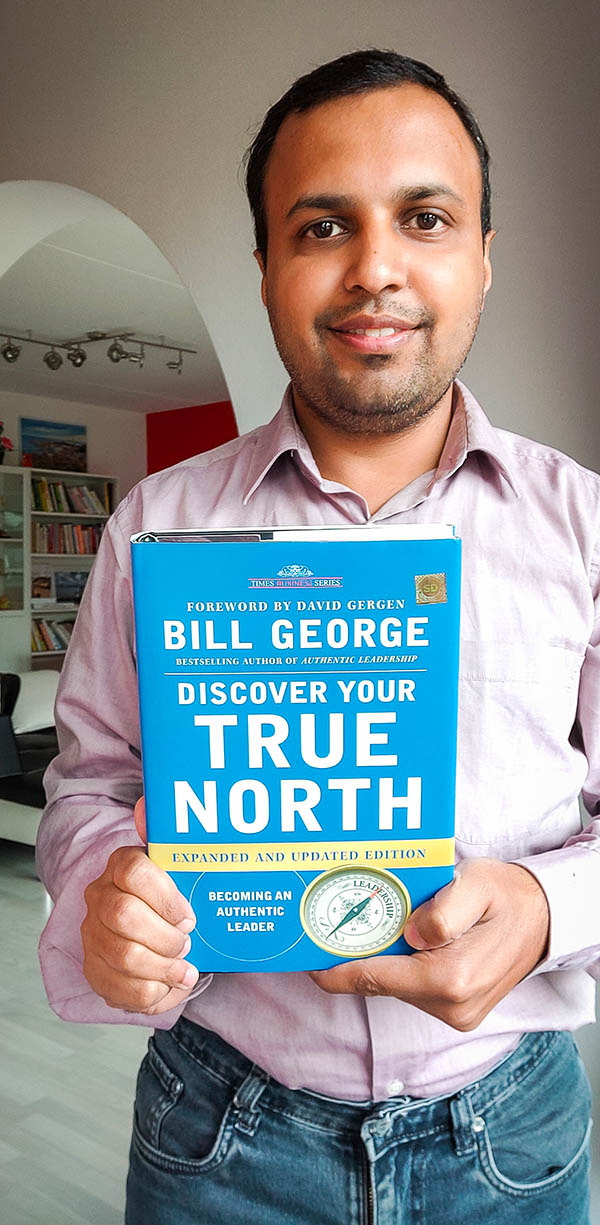
    2. How To Discover Your True North? And Other Key Lessons from Bill George
    3. Turn the Ship Around – How David Marquet’s Leadership Turned Around A Nuclear-Powered Submarine’s Performance
    4. Reboot by Jerry Colonna – Looking Inward For Better Leadership
    5. Leaders Eat Last by Simon Sinek – From Hormones To Leadership

    That’s it for now. If you have any questions or feedback, or if you are new and want to introduce yourself, hit reply. I read and respond to every reply. All the best,

    Sumit

    (Twitter) @SumitGupta
    (LinkedIn) Connect

  • Leadership Journeys [21] – Sandeep Sharma – “When the oxygen is less, the lighter you are, the better you walk”

    This is the Leadership Journey series on the Choosing Leadership Podcast.

    I believe we all have a lot to learn from each other’s stories – of where we started, where we are now, and our successes and struggles on the way. With this series of interviews, my attempt is to give leaders an opportunity to share their stories and for all of us to learn from their generous sharing.

    In our interview, Sandeep talks about his career as a series of base-camps on the way to the summit. He spoke about his learnings from his father, shared his views on leadership – and how leadership all starts with being authentic. He also gave some advice on trust, building relationships, and putting down the weight or burden we unnecessarily put on your shoulders – as a leader. Those who are listening, this is going to be an inspirational listen for you.

    You can find Sandeep at the below links

    In the interview, Sandeep shares

    • You believe in people they believe in you and that’s when great things happen. And that’s when trust builds.
    • People recognize me for my smile and I keep smiling, even during the toughest of my days.
    • A lot of times in leadership, people say that to hide their emotions, they need to read a mask. And I don’t think so. Those times are there right now. Post the pandemic, you need to be authentic, you need to be truthful.
    • I’ve always, probably been in the background, not confident about myself. To now be in the foreground um, is been conscious of not being it’s taken a lot of hard work and effort work.
    • When people are able to express themselves, that is a validation of a leader. I think that’s what we need to be. 
    • You just be what you are. I don’t think so. You need to fake it. Because people will see it if you fake it.
    • Fundamentally, if you do three things that 1) give people clarity, 2) enable them to do the job and 3) keep motivating them, you will be successful in anything which you do. You don’t have to reinvent the wheel. 
    • I’m happy at the end of the day when you yourself are happy and the people we’re supporting are happy. 
    • Nobody’s perfect in this world actually its imperfections are what makes us so human beings.
    • What got you here will not get you there. we had to shed some weight because when the oxygen would be less, the lighter you are, the better you walk.
  • Issue #58, 2 Aug 2022 – Can you CARE so much that you do not care?

    Welcome to the Deploy Yourself Newsletter, where I share what impactful leadership looks like to show your own power. I also share the most insightful lessons and stories I encountered in the last two weeks. You can also read this issue online.

    Hey,

    Can you CARE so much that you do not care?

    As a leader, what you CARE about defines you and determines all your results.

    As a leader, you have a responsibility and commitment – to create powerful results – for all stakeholders involved. For example – If you are the CEO, you have a responsibility to

    1. grow your company (revenue and profit),
    2. provide value to your customers, partners, and local communities, etc
    3. build a healthy, fun, and meaningful place for people to work
    4. do the above while honouring your values, principles, or other standards of behaviour

    As a leader, can you CARE so much about the above that you DO NOT care about your own fears and insecurities?

    Can you CARE so much about the above that you DO NOT care about playing safe and staying in your comfort zone?

    Can you CARE so much about the above that you DO NOT care about looking good and proving yourself right?

    Can you CARE so much about the above that you DO NOT care about ease and convenience and instead do what is required?

    In which area of your life, do you CARE so much that you DO NOT care?

    What results could you produce in your life, work, relationships, and leadership if you CARE so much that you DO NOT care?

    Reply back with any insights or areas you identified where you need to CARE so much that you DO NOT CARE.

    I read and respond to every reply.

    PS – I help tech leaders who are overwhelmed and at a crossroads do the work of their life in just 1 hour per week. Have a trusted adviser like me on your side who has been where you are today, who has gone through it all, and who always has your best interest in mind. To know more, send me a message.

    Fascinating Articles & Stories

    One

    28 Lessons From Warren Buffett’s Annual Letters To Shareholders

    Each year, Warren Buffett writes an open letter to Berkshire Hathaway shareholders. Over the last 40 years, these letters have become an annual required read across the investing world, providing insight into how Buffett and his team think about everything from investment strategy to stock ownership to company culture, and more.

    These are the 28 best lessons on compensation, stock ownership, investments, leading people, company culture, etc.

    Source: CB Insights

    Two

    The best way to change behaviour – Tiny Habits

    BJ Fogg is a behavior scientist, with deep experience in innovation and teaching. He’s directed a research lab at Stanford University for over 20 years.

    He is an expert in behavior change, from habit formation to company culture change.

    Key points from this podcast interview:

    1. Information does not lead to action.
    2. People change best by feeling good, not by feeling bad
    3. Create a tiny habit through an ABC process: anchor moment, a tiny behavior, and instant celebration.

    From an episode on the Coaching for Leaders podcast

    Three

    Leadership Journeys – Prakash Palani and Thomas Vles

    I released two new episodes on the Leadership Journey series on the Choosing Leadership Podcast.

    In the 19th episode, Prakash, Founder of BCS, opens up about his early childhood filled with struggles, and how he had no choice but to succeed. He shares how he created a life for himself through hard work and never giving up, and how he started his own company to give back to others like him.

    We talk about leadership and responsibility, and he surprises me by sharing that he feels no pressure as a leader because everyone in his team takes equal responsibility. His leadership style, in his own words, is “people come first, everything else follows”.

    In the 20th episode, Thomas, CEO at Tellow, opens up about realising how he was living a life that was not what he really wanted. We talk about the importance of focusing on yourself first, and the importance of happiness, friendships, experiences, and relationships.

    He shares the wisdom of doing nothing, and the important role sports and exercise play in his life. In addition to leading his company, he climbs mountains, does kickboxing, races cycles, and has plans to make a movie. He knows he is more than what he does and doesn’t let work define him.

    To listen to all previous episodes, find the podcast on my website, or on Apple or Spotify. Leave a rating if you love what you hear.

    That’s it for now. If you have any questions or feedback, or if you are new and want to introduce yourself, hit reply. I read and respond to every reply. All the best,

    Sumit

    (Twitter) @SumitGupta
    (LinkedIn) Connect

  • Leadership Journeys [20] – Thomas Vles – “I realized I was living a life that I thought I wanted, but not the life I really wanted.”

    This is the Leadership Journey series on the Choosing Leadership Podcast.

    I believe we all have a lot to learn from each other’s stories – of where we started, where we are now, and our successes and struggles on the way. With this series of interviews, my attempt is to give leaders an opportunity to share their stories and for all of us to learn from their generous sharing.

    In the interview, Thomas opens up about realising how he was living a life that was not what he really wanted. We talk about the importance of focusing on yourself first, and the importance of happiness, friendships, experiences, and relationships. He shares the wisdom of doing nothing, and the important role sports and exercise play in his life. In addition to leading his company, he climbs mountains, does kickboxing, races cycles, and has plans to make a movie. He knows he is more than what he does and doesn’t let work define him.

    You can find Thomas at the below links

    In the interview, Thomas shares

    • I realized about myself that I was living a life that was actually the life that I thought I wanted, but not the life I really wanted.
    • Later on I realized that’s actually it’s more important to also focus on yourself. Having the quality of life, happiness, friendships, relationships, experience and yeah, that, that sort of you have changed the whole ambitions that I had.
    • If you ask people, then they would probably describe me as being very ambitious, but for me, work is lower on the priority list 
    • I think it’s very important to live your life like that you take, most of life gives you, and I think that’s the responsibility to everybody, as you can not change what happens to a person, but you can still change the way you respond to things that happen.
    • In the weekend, I really try to focus on not working. I tried to keep the weekend really private.
    • My team gives me a lot of energy. everybody takes ownership. Everybody feels as if you’re on a mission and that’s, I think very special.
    • I believe that every person is interesting and has a story, so I always am keen to hear about that.
    • I’m currently here and enjoying it, so there’s no need for me to really look ahead in life.
    • I really enjoy doing something for the first time. 
    • I try to put myself in places where I can really take everything out of myself and full myself and grow a lot
    • He basically helped me out in a very difficult period of my life by sharing with me his wisdom about doing nothing and letting everything go for a while in order to to find what you need to do. that advice is advice that actually led to where I am today.
    • I think it’s going to sound very egoistic, but let’s say this, the first thing you need to worry about is yourself. If you are not in touch with yourself, then how can you love work? 
    • People would describe me as being super ambitious. So it’s, I think it’s about seeing the relevance in it and also not letting things define you. Like it doesn’t make me a better person to have a great job, but it does put me in a position where I can have an impact on leadership.
    • I think gratitude is key in life, for sure. I’m really grateful for the people around me for the blessings because I’m very privileged in life. And also I was lucky sometimes. But mainly also about let’s say how amazing I’m healthy. I have a beautiful wife and a good life. Everything is really good. 
    • I do think that if you can create an environment in your office where you have the feeling that you were friends with everybody and it’s a fun experience for everybody. And I think that’s very important also for your success as a company. 
    • You need to be basically naive enough to believe in your own dreams. And then really go for it.
    • If you have a product start selling it before you have it and see if people like it.