For the last few months, I have been interviewing leaders and sharing their leadership journeys in a mini-newsletter in the gap week between two regular newsletters. You can also read this mini-issue online.
As of last week, I have also launched a podcast titled “Choosing Leadership with Sumit Gupta” and released 3 interviews. This is a podcast for people who know deep inside that there is more. My invitation to you is to “choose” leadership and to step up as a leader in an area of life that matters to you – be it work, passion, health, impact in society, or something else.
I will be starting (and stopping) multiple series of episodes from time to time. All of them will focus on leadership – but they will look at it from multiple angles and perspectives. I will lovingly and gently provoke you to help you see your own light – to help you see what you are already capable of.
To not miss future episodes, subscribe to the Choosing Leadership podcast onSpotify, Google, or Amazon Music. (coming soon on Apple podcasts as well)
Leadership Journeys
We all have a lot to learn from the stories of our leaders – of how they came to be where they are today. These are stories peers and friends don’t usually know, and my attempt is to give you an opportunity to learn from those who have already tasted success and made an impact.
Find out about the events from their lives that shaped them to be the person and leader they are. In the interview, they also share about the people who have influenced them the most in their leadership.
The First Episodes
Vicky Kennedy – “I learned to be my own advocate and take risks”
Vicky is the Chief Strategy Officer for Intellum, and, in her own words, has been nerdy about education for many years. She started in higher education but later pivoted to working in companies like Facebook and Amazon. She began to see how education can dramatically improve a company’s performance – from internal productivity to customer retention. In 2021 she developed a proprietary tool to unite all educational initiatives in one central map that demonstrates the education’s expected business impact.
Vicky shares how it was rattling for her to be laid off from a job where she had worked for 10 years. What surprised me was that, on top of that, she decided to switch her industry and city when that happened. She packed her bags and move from Florida to New York City to find work in a totally new industry. In the episode, she shares what gave her the courage to make such a massive shift.
Kate Daniels – “I want to live in a world where all companies are B corporations”
Kate Danielsworks to merge the worlds of economic growth and human development. She works directly with entities like the World Bank, the European Development Financing Institutions (DFIs), and startups. She leads projects for African and Latin American companies, International Development Organizations and the American Government through USAID. She has studied in 4 continents and brings a global perspective when leading teams and aligning businesses in emerging economies with international investment standards.
Kate opens up about growing up in a very isolated town with a population of only 432, and how that created a hunger to go out and experience the world. She talks about studying in Italy and later Ireland and then working in South Africa and Dubai on international aid programs. She talks about how leaving her country taught her the value of empathy and seeing the different ways people do things in different places.
Ramon Llamas focuses on building ecosystems to address health disparities, which are designed with equity and health as a fundamental starting point. His mission is to change how society views health. He thinks we cannot continue to depend on the providers of health care to fix our problems. He envisions a future where health care is a collaboration to maintain, rather than repair, an individual’s health and wellness.
Ramon shares his journey of coming from an immigrant family, and how losing his grandfather to cancer allowed him to experience and later shape the role of healthcare in society. Today he empowers individuals to take ownership and be more proactive when it comes to health. Treating everybody with dignity is one of his core values, and he is giving dignity back by focusing on public health in underserved populations.
Each one of us is on a leadership journey. Our journeys might not look alike. They might resemble more of a roller-coaster ride than a race track, and that is what makes each one of us special and unique in our own ways. I am deeply touched when someone takes the time to share their story with me. The leaders I work with are also left inspired when we listen to each other’s leadership journeys.
If you think that your leadership journey is worth sharing and would be valuable to others, reach out and allow me the privilege to interview you. If you would like to recommend someone else who I should interview, feel free to write to me. You can send me a message on LinkedIn or send me an email at sumit@deployyourself.com.
That’s all for this week! I wish you all a happy and prosperous 2022. Until then, keep Choosing Leadership.
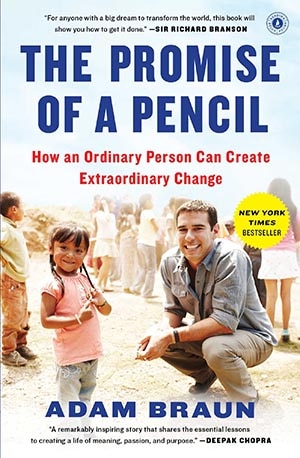
Pencils Of Promise is a charity organization started by Adam Braun. While the charity was started with only $25, it has expanded with more than 200 schools providing basic education in developing countries across the globe.
This is the story of the charity organization that was started with only a group of supportive friends and humble beginnings and is today one of the leading charities in the world. While hard work is the crux of this success story, it is also about the passion, confidence, inspiration, and gratitude of Braun and his colleagues.
Adam Braun’s Promise of a Pencil is an account of the inspirational story of the charity organization, and how Braun realized his dream. It is a guide that encourages each and every person to follow dreams, finds their passion, and use their potential to the fullest.
Lesson 1: Follow Your Dreams
Why do people choose the safer path in life? What stops them from being courageous enough to take risks? Moreover, why are they so vary about the expectations and opinions of others?
As a college student standing at the brink of a successful Wall Street career, he backpacked across the globe. He saw widespread poverty and the lack of basic education in many countries, which laid the foundation for his dream. Braun started his charity in 2008 with a simple aim – to raise enough funds to start a school in a Laotian village.
His career was at stake, his family thought that he was wasting his time on an impossible dream. Raising the required $10000to start his school was an unattainable feat. Yet, Braun ignored the criticisms of his family and friends and ploughed through. He achieved his goal in a matter of months.
His dedication and dismissal of others opinions and expectations helped him achieve his goal. He didn’t let others discourage him.
Braun’s dedication to giving it a try at the least led to the fast growth of his organization. By 2013, Pencils of promise was running ground to opening their 100th school in Ghana, despite the fact that at the onset, neither Braun himself nor his friends and family believed that would be able to achieve the success they had.
What did Braun do to achieve his goals?
Firstly, Braun and his team believed in and committed to their idea. Secondly, he allowed himself to follow his dreams and did not delay acting upon them. Therefore, to realise one’s dreams it is crucial to start living them, today!
The Promise of a Pencil
Lesson 2: Get Out Of The Comfort Zone
Most people live within their own comfort bubbles. They surround themselves with like-minded people who share opinions, habits, and interests. This sense of comfort brings a sense of safety.
However, this is not the ideal way to live life. One has to push oneself out of the safety of comfort now and then and have experiences that will enrich life.
Adam decided to take a semester off to travel at the brink of a successful Wall Street career. Most of his friends and family advised him against taking such a risky step, especially since it wouldn’t help his career in any way.
However, Braun’s travels gave him fresh insights that changed his life.
It is not easy to get out of the comfort bubble. It requires a high level of optimism and some amount of risk-taking. Additionally, pondering over incessantly about the things that go wrong will thwart new ideas and one will never experience fresh insights.
While Adam was travelling in Guatemala, he met a local who offered to give him a place to stay in his house for a few weeks in exchange for teaching his family English. While Adam had his doubts over the safety of the proposition, his eventual agreement to accept the offer enabled him to make new friends and learn about the Guatemalan culture.
The lesson here is, staying in the comfort one never leads to valuable experiences, and one never learns to deal with unfamiliar situations.
Lesson 3: Follow Your Intuition
Intuitions are strong feelings, and most often powerful advisers. Intuitions help us realize what is good much before we, ourselves do.
Braun’s realization of his dream was triggered by an epiphany he experienced while he was at a pianist concert at the New York Philharmonic. The passion that he witnessed in the pianist’s performance, inspired him to write the mission statement for Pencils of Promise that very night.
Intuitions are also central to providing solutions to a dilemma. Intuitions work on a subconscious level, showing certain signs of what one must do.
As Braun began his work on his charity, he was working as a consultant. He usually worked during his free time. Soon his supervisors noticed his lack of commitment to his job and asked him to choose between his job and his dream. That day, on his way home, he came across a cardboard box with ‘Become your dream’ written on it. The timing of seeing the graffiti was perfect. It was the push he needed to make his decision.
Intuitions guide people and give confidence. One should listen to that inner voice more often and follow that intuition.
Lesson 4: Don’t Be Afraid To Start Small
Most often, the enormity of following one’s dream puts a stopper in realizing them. However, one should remember that every big accomplishment starts with a small step, no matter how insignificant it may seem at the beginning. These small steps can hold the power to change lives.
While Braun was backpacking through India, he asked a small boy what was it that he wanted most in the world. The boy answered – a pencil. Adam gave the boy one of his own pencils, making the child incredible happy.
What seemed like a small cheap item to Adam meant the world to the little boy – a fulfilment of his biggest wish. The experience had a profound effect on Adam – profound enough that he named his charity from the inspiration he got.
Starting with small steps also means that one doesn’t need a lot of money to effect positive change. Many successful entrepreneurs have worked within limitations and started small, slowly building their ideas over time.
Braun too started small by opening an account with $25 in the name of his organization. He soon began raising funds by asking family and friends, collected a veritable amount that he used for his charity.
Dreams, at the outset, often seem like unreachable goals. The trick is to start with small steps and not be afraid to take them.
Lesson 5: Remain Confident
Difficulties and hurdles are inevitable while one follows their dreams. During such times, one has to remain confident and believe in their ideas and in themselves. This will ensure that one does not give up when the going gets tough.
Braun, in the course of following his dream, encountered one difficulty that changed his life’s course drastically. On his way to Africa, his ship got caught in a severe storm. It damaged the ship badly and the passengers were scared for their lives. However, Adam did not believe that he would die that day. He believed that he has a purpose to fulfil and he had to live on to fulfil it.
It was this sense of confidence that helped him remain calm, help others around, and emerge stronger from this experience.
However, confidence in one’s dreams and oneself isn’t enough. One has to act confident and show the world that one is in control. A show of confidence demonstrates to others that one is not afraid or weak, especially in a dangerous situation.
While Adam was in Nepal, he found himself in the midst of a huge political demonstration, where the protestors were agitated and ready to attack. Though he was afraid, he got out of his taxi and confidently walked away. Though he had no idea where to go, it was probably his confidence that saved him that day.
One has to have the confidence to change the manner one confronts obstacles, even if it means to pretend that one is confident.
Lesson 6: Use The Right Language
Language, like confidence, is vital to success. Therefore, one has to use it to their advantage to be successful.
Choosing one’s words carefully is crucial while talking to supporters, as sometimes, even seemingly harmless words can backfire and affect people negatively.
When Pencils of Promise started, Adam often referred to it as a non-profit organization. However, some of his managers had an aversion to the negative connotation of the prefix. When he realised this, he changed it to ‘for-purpose’, thereby making the connotation positive and increasing interest.
Language can also be used to making ideas concrete. When an idea is still nascent, inside one’s mind, it can be hard to develop. However, simply voicing them out loud or writing them down can help increase the chances of actually realising them.
After a trip to Ghana, Adam was playing with the idea of expanding his charity in Africa. However, during a speech at a fundraiser, he ended up spontaneously promising the audience that if they could raise donations worth $1 million at the gala, the proceeds would be used to open a school in Ghana. Voicing out his nascent idea, led to an overwhelming response and they were easily able to reach the goal of a million dollars. Thus, the first school in Ghana was opened.
Lesson 7: Inspire Others
No dream can be truly realized without the help of others. Hence recruiting the right people the right way is crucial.
One gets only one chance to influence people to follow their cause. The first impression should be good, and the listeners should feel important, especially while addressing a large crowd.
Braun employs the idea of ‘one person, one thought’ throughout his presentations. This practice involves establishing eye contact with one person for as long as one thought is discussed. Once that thought is done, move on to establishing eye contact with another person, and so on.
This method helps in getting people to feel that they are being addressed directly. Their chances of understanding the cause and getting inspired due to the few seconds of personal interaction are higher.
While addressing a crowd, the number of people addressed is not as important as the number of people within that crowd who actually listen. It’s better to have one inspired and dedicated person, rather than a hundred who don’t care.
For example, during the early days, Adam and his friends would hold presentations at universities all over the country. For one such presentation, they had booked a huge classroom considering expected numbers. However, just one person showed up. Rather than cancel or reschedule, Braun though frustrated, decided to present irrespective of the poor attendance.
His decision paid off. The single attendee eventually became a dedicated and valued volunteer of the organization.
Lesson 8: Thank People For Their Support
‘Thanks’ is a magical word. It mends, heals, and strengthens relationships. It is as important to share joys and sorrows, appreciate, and thank the people one works with as it is with family. Moreover, it is essential to remember that one gets treated the way one treats others.
Braun dedicated the first school the organization opened to his grandmother. A holocaust survivor, she had escaped to the USA with nothing and built a safe life for her children and grandchildren. Braun’s grandmother was moved to tears when she saw her name engraved on the school door. Additionally, seeing his grandmother’s joy, made Braun happy too.
In another example, Braun remembered that two years into starting the organization, he had not personally thanked the first stranger who had donated a large sum of money to the organization. He wrote a belated note thanking the stranger.
The stranger was so happy to receive the note of thanks and due to his interest in the organization, he arranged for a new office to be built for the organization at no cost at all.
Lesson 9: Recognize Weaknesses And Learn From Mistakes
Weaknesses and failure are inevitable components of being human. Neither can be completely avoided. Hence, understanding weaknesses and learning from mistakes is advantageous.
Analysing mistakes shows what can and cannot work, and knowing weaknesses can help one avoid mistakes.
Adam once got a mail from a colleague in Nicaragua that he had been robbed. Surprisingly, Adam, instead of enquiring after the person’s well being, first informed him that the organization wouldn’t be able to reimburse the losses. The colleague was really upset, especially since he hadn’t asked Braun for any money. When Braun realised his mistake, he vowed to never repeat the mistake of placing the importance of money ahead of the well being of his staff.
Understanding and learning from his mistake enabled him to develop a better leadership style.
In another example, during the early years, Braun never asked anyone for money directly or personally. This was not a principle he followed, but a fear of rejection. When he realized this weakness, he confessed it to the board of directors, who helped him overcome it.
They helped him practice asking for others money and gave him advice on how to handle such situations.
Lesson 10: Take Time To Make Decisions
Following one’s dreams requires making tough decisions. Doubts ad moments of uncertainty, especially in the wake of having an easier way out are inevitable. During such times, one has to think of both, the short-term benefits and obstacles as well the ones that could arise in the long run.
Just as Braun’s charity organization had started, he received an attractive job offer – one that would give him a very high salary and many personal benefits, however, one that he would have to leave his dream for.
At the moment of making his decision and accepting the offer, his friends advised him to think of his principles and think of what he loved to versus what he needed. Thus Braun chose to stick to what he loved doing and rejected the job offer.
Making such a decision also requires a person to be in the right frame of mind, simply to be able to make the right decision. For example, routines tend to thwart gaining new perspectives, and judgements can get impaired. Hence, it is essential to take breaks and think of creative ways of changing one’s routine to gain newer perspectives.
Conclusion
Realizing one’s dream isn’t an easy task. However, with the right amount of confidence, staying committed to the dream, listening to one’s intuition, and getting out of the comfort zone one can achieve goals.
Additionally, one should not be afraid to make risky decisions to make dreams a reality. Starting with small steps, inspiring people and thanking people for their help goes a long way in succeeding.
Adam Braun’s struggles, his dedication to pursuing his dream and belief in his own abilities to make them a reality are a great example for all to follow.
This is the Leadership Journey series on the Choosing Leadership Podcast.
I believe we all have a lot to learn from each other’s stories – of where we started, where we are now, and our successes and struggles on the way. With this series of interviews, my attempt is to give leaders an opportunity to share their stories and for all of us to learn from their generous sharing.
Vicky shares how it was rattling for her to be laid off from a job where she had worked for 10 years. What surprised me was that, on top of that, she decided to switch her industry and city when that happened. She packed her bags and move from Florida to New York City to find work in a totally new industry. In the episode, she shares what gave her the courage to make such a massive shift.
how getting laid off was quite shocking and a bit rattling for her because she had worked there for 10 years
how she took this opportunity to basically reset her whole professional life move to New York city with nothing other than what fit in her car and three pets
“I had people to sort of lean on and ask for direction or guidance, suggestions on how to navigate different things”
“I also really did learn to be my own advocate and take those risks.
“Sometimes we can feel stuck in a story, we can feel stuck in a path. But there’s a lot of opportunities out there.
“If someone who is listening has a desire to shake it up, try something new, do not worry about perception or what you are supposed to do, or what is the next logical step, but to consider taking calculated risks and to be your own advocate with that.”
This is the Leadership Journey series on the Choosing Leadership Podcast.
I believe we all have a lot to learn from each other’s stories – of where we started, where we are now, and our successes and struggles on the way. With this series of interviews, my attempt is to give leaders an opportunity to share their stories and for all of us to learn from their generous sharing.
Kate opens up about growing up in a very isolated town with a population of only 432, and how that created a hunger to go out and experience the world. She talks about studying in Italy and later Ireland and then working in South Africa and Dubai on international aid programs. She talks about how leaving her country taught her the value of empathy and seeing the different ways people do things in different places.
the experience that helped her realize that there were a lot of exciting things going on outside of the US and she wanted to be part of it.
“I would argue that companies that have a responsible orientation and strong ESG standards and sort of an impact orientation into their DNA from the beginning are companies who are going to do better financially as well.”
“Environmental, social and governance information makes for more robust investment decision-making. And I also think that ESG kind of serves as a proxy indicator for leadership”
“I want to live in a world where all companies are B corporations and all investments are impact investments.”
“I think one of the most important things I ever did was leave my country. There’s something very powerful and beautiful about studying abroad. There’s something very powerful about being a foreigner in a foreign lens and having to negotiate and figure that out.”
“there’s real value in exposing ourselves to ways of thinking or to worldviews that don’t reflect our own.”
“the more that one can slow down and ask questions and listen and engage in informal connection with other human beings, the more effective he or she is going to be at getting it done, whatever it is that they want to get done”
“As I work with people in companies and organizations across the world is that we have so much more in common than we do not in common. And I think that’s perhaps a bit trite and perhaps a bit, bit of a, you know, sort of aphorism, but it’s also true”
This is the Leadership Journey series on the Choosing Leadership Podcast.
I believe we all have a lot to learn from each other’s stories – of where we started, where we are now, and our successes and struggles on the way. With this series of interviews, my attempt is to give leaders an opportunity to share their stories and for all of us to learn from their generous sharing.
Ramon shares his journey of coming from an immigrant family, and how losing his grandfather to cancer allowed him to experience and later shape the role of healthcare in society. Today he empowers individuals to take ownership and be more proactive when it comes to health. Treating everybody with dignity is one of his core values, and he is giving dignity back by focusing on public health in underserved populations.
What most people know about me is that I have spent 20 years doing computer programming, 8 years doing photography, and started 2 companies, 1 non-profit organisation and a few social initiatives in the past. What most people don’t know about me is that I have spent a lifetime staying invisible. I have used my computer and camera as tools to hide behind.
This podcast is titled “Choosing Leadership” because I believe that is what leadership is. Yes, you heard it right. Leadership is a choice and we all have this choice in every moment of our lives – to choose leadership or not. In fact, I am choosing leadership right now as I record this podcast, as I have been procrastinating on it for more than a year.
Welcome to the Deploy Yourself Newsletter. Every two weeks I share what impactful leadership looks like to show your own power. I also share the most insightful lessons and stories I encountered in the last two weeks. You can also read this issue online.
Hey,
Two Ways To Dissolve Your Problems
Many of us have made a living and a career out of solving problems. What I am realising in the last few years is that there is something better than solving problems – it is dissolving them, or making them go away completely. I have found there are 2 ways to dissolve our problems:-
Find and eliminate (or redesign) the context that “has the problem” – Any problem does not exist independent of the entity (person, organisation, etc) or the environment that has the problem. For example – I have a pen in my hand right now. The pen exists as a physical object independent of me. However, any problem is not physical like the pen. My problem only exists for “me” – or how I see things. An organisation’s problems also only exist for that organisation – or how that organisation looks at it.
If you remove or redesign the entity that “has the problem”, the problem can dissolve with it. The situation remains as it is, but it stops being a problem. Such an approach requires identifying our (or our organisation’s) blind spots. It requires questioning our own deeply held beliefs, identifying our mental models which block us from moving forward, and then deliberately replacing them.
When I started out on my own as a Leadership Coach with Deploy Yourself earlier this year, I had a big problem that “I am not good at sales” and it created a lot of anxiety and stress. However, with the help of my coach, I redesigned the context from “selling something” to “elevate leadership in every conversation I have”.
This has allowed me to not fall into the trap of traditional marketing and sales tactics which I hated, and instead, I have only relied on making difference to people in every conversation I have. This has enabled me to create an invite and referral only business without a lot of stress and anxiety and work with some very powerful and inspirational leaders.
Take on a bigger problem – Another way to make your current problem go away is to take on a much bigger problem consciously. For example – One of my coachees was raising 500k USD for their charity and facing big problems in asking for money. After our coaching, he took on a much bigger problem of raising 5 million USD to make a larger impact, and suddenly all his previous problems have disappeared.
He might not hit the 5 million he had promised, but he will certainly overshoot the 500k he was going after initially. Today he is making single fundraising requests for 500k USD, and his confidence, ability, self-esteem, and credibility has already transformed compared to when we started working together.
Does that make sense? If anything is unclear from the above or it sparked a question, reply back. If you are thinking it can’t be that easy, remember I never said it would be.
The above is very simple when you understand it fully, but not easy. Reply back to share what you think. I read and respond to every reply.
Articles and Stories Which Have Fascinated Me
One
5 Wrong ideas about work
Find out 5 wrong ideas about work in this article by Lesley. The problem arises when it’s actually the wrong idea for you but you fail to see that. This means you get unnecessarily stuck by a self-limiting worldview that wasn’t actually true for you.
Work is the soul-sucking thing I do every day to get money.
I need to do work I’m passionate about.
I need to know exactly what I want to do with my life.
Why managing uncertainty is a key leadership skill
If the last two years has shown us anything, it is that we are living in an uncertain and unpredictable world. COVID-19 has brought into sharp relief a crucial business skill: the ability to navigate uncertainty.
That means knowing what you can control and what you cannot, aligning your company and employees with a shared purpose, holding to a clear vision of where you want the company to be, and trusting your team to help your company get there.
Because nobody knows what is next, no CEO can reasonably be taken to task for not knowing everything. That provides an opening for leaders who have deployed a top-down, command-and-control leadership style to switch to a mindset that helps them and their teams better navigate uncertain conditions.
The biggest challenge for many business leaders, in Leavitt’s view, is to see their role as orchestrating, not commanding. That means making sure your employees are in touch with their own desires and potential just as much as your business is aligned with its sense of purpose.
What comes to your mind when you are asked about the most powerful investments you should make? Is it stocks? Is it bonds? Or a new house? Real estate is the safest investment, you might have heard.
If you ask me, I would say, neither!
Over the course of my life, with its few successes and numerous failures, I have come to see another type of investment that will give you the maximum returns – investing in yourself.
All that is good thinking, but I have discovered that there are some simple investments we can make in ourselves which we tend to miss or neglect. And for most of these are not even financial. You don’t need to have money to do this kind of investing.
“Investing in yourself is the best thing you can do. If you’ve got talents, no one can take them from you.” — Warren Buffett
Investing in yourself is a continuous process. The effort and time you put in to invest in yourself consistently will determine the quality of life you would be leading in the future.
Below are the 7 most powerful investments you can make:-
A Face-to-Face Request Is 34 Times More Successful Than an Email
A new study finds that people tend to overestimate the power of their persuasiveness via text-based communication and underestimate the power of their persuasiveness via face-to-face communication.
In one experiment, 45 participants were instructed to ask 10 strangers to complete a survey. Half the participants made the request over email, and half made it face-to-face.
Participants who made requests over email felt just as confident about the effectiveness of their requests as those who made their requests face-to-face, and yet the face-to-face requests were 34 times more effective than the emailed ones.
That’s it for now. If you have any questions or feedback, or just want to introduce yourself, hit reply. I read and respond to every reply. All the best,
It is one thing to have dreams and set goals towards achieving them. However, it is a completely different matter to be able to push through and actually achieve these dreams and goals. Whether it is a small short-term goal of finishing that yearly spring cleaning by the weekend or a long-term one of investing and saving money, the question that always arises is ‘How and where do I begin?’
The Magic of Thinking Big (1959) by David Schwartz is a guide to setting and achieving dreams and goals. The methodology focuses on believing in oneself as the pivotal key to success. The author’s experience and interactions with individuals and businesses that have seen both sides of the failure-success coin support his belief that anyone can achieve anything that they set out to do.
A Matter Of Belief
So how and where does one begin to start working towards goals?
The answer lies in having belief. Believing, and honing a mindset where one feels a hundred per cent capable of doing whatever they set their mind to do, is the best approach.
Believing truly in one’s own ability helps the mind to focus on finding the ways to accomplish those set goals. This is the minds creative power. The more one believes the more creative power is unleashed. Essentially, as long as the level of one’s belief matches the difficulty level of the task, even the most challenging goals can be met.
When one truly starts believing in oneself, others start believing in the ability of that person too. A study conducted by the McKinsey Foundation for Management and research conducted interviews with the government, science, religion, and business leaders. They were asked what type of people they preferred to work with. The answers were almost unanimous. Everyone wanted people who had a sheer desire to succeed, a trait that is contingent on self-belief.
Such individuals never give, irrespective of the hurdles they have to encounter, and are constantly motivated. Leaders associate such belief with success. True belief aids one’s mental power to shift to persevering towards the set goals. In turn, a support system of inspiration and confidence builds up, where other start believing too.
The Magic of Thinking Big (1959) by David Schwartz
Sharpening Those Creative Thinking Skills
Thinking is of two types –fact memorization and creative thinking.
While fact memorization involves learning pieces of information, which are stored in the brain, and accessed later on, creative thinking involves a focus on finding innovative solutions. Essentially, it means finding new and improves methods of managing any kind of problems and challenges.
While fact memorization has its own merits, creative thinking enables efficient and quick thinking to overcome hurdles. Where fact memorization makes the brain rigid, creative thinking makes it flexible, adaptive, and agile.
Successful individuals always stress creative thinking, rather than memorization of facts. One can get into the habit of thinking creatively by
Being more receptive to new ideas
Grab as many opportunities one can to try new ideas
Spend ten minutes every morning reflecting on, ‘How can I be better today?’
In order to develop these as a habit, one has to diversify one’s lifestyle. For instance, one should surround themselves with people who support, yet challenge beliefs and ideas openly. Engage in communities and groups that are far removed from one’s line of work. For example, a budding chef can join a Math Club. The new and varied skills that the chef will learn could help in managing accounts for his upcoming restaurant.
Think Positive, Act Positively
Today, one is constantly exposed to negativity. From murders in the news to fat-shaming advertisements, and sometimes even close friends and relatives can turn on the negativity dial by putting down ideas and dreams. Over time, the constant exposure to negativity normalizes it.
Negativity is a mental monster. The more one feeds it with negative thoughts, the stronger it becomes and encroaches on every bit of positivity one has. Negativity is one of the main reasons people end up average or unsuccessful. Negativity is an abnormality that sucks out one’s will to succeed.
In order to thwart negativity from one’s life, one has to practice positive thinking and positive actions on a daily basis. Positive thoughts and actions help eradicate negativity from festering in the mind.
To do this, one can write a ‘pep-talk’ or a ‘self-selling advertisement’ that showcases one’s best traits and shows oneself how they are better than everyone else. Repeating this advert to oneself loudly – in private – on a daily basis, and repeating it silently many times a day will help in enforcing positive thoughts and deflect negativity.
For instance, a teacher who knows that she can make her students laugh should repeat to herself, ‘I am the best at making my students laugh and learn’. This will help in boosting her confidence, distinguish her best trait, and encourage her to contribute her best.
Nurturing Relationships
We know the saying ‘what goes around comes around’. If one treats the people around in a bad manner, the people around will also react in the same way. However, if a person treats everyone around with importance and respect – irrespective of whether they treat the person in the same way – over time, those same people will start treating the person with importance and respect too.
The support of the people around is crucial for achieving success. No one can achieve success on one’s own. One needs the support of those around to reach the top. For example, a person that makes it to the position of a CEO reaches there due to the support of her team, her subordinates, and her peers as well.
Keeping this in mind, it is crucial to understand that nurturing relationships in life, with those who are close as well as those who are not. The Ex-American President, Lyndon Johnson had his own ten-point success formula. He would take efforts to memorize the names of everyone working in his office and even congratulate them personally when they achieved something.
Thus, whether a person is closely related to one’s success, or is just another acquaintance or encounter, every relationship should be nurtured and respected, as if success hinges on that one encounter or acquaintance.
Having A High-Quality Environment
The notion of ‘you are what you eat’ implies that a healthy body is directly proportional to maintaining a healthy diet. This same notion is true for one’s mentality. Essentially, how a person thinks is directly proportional to what that person sees and hears.
The associations one makes, the friends one keeps, the living space that surrounds, as well as what one chooses to read and watch, all are instrumental in influencing one’s thought process. For instance, surrounding oneself with people who love to gossip, will in turn make one more likely to be a gossipmonger. Essentially, one is affected by the company one keeps.
Therefore, success rides on one’s ability to maintain a high-quality environment. The people one associates with, the living space, workplace desk, and even how one spends leisure and social time should be of high quality, enabling one to grow as a person.
In order to do this, one should surround oneself with successful people, understand their motivations, and study how they think. Even when it comes to seeking advice, one should turn to those who are currently in positions where one wants to be in the future. Additionally, when it comes to friends, it is essential to surround oneself with those who not only have their own successful ambitions but also who can believe in yours.
Hence, when it comes to creating a high-quality environment, it is vital to create and maintain a high-quality support system, which will keep motivations high even when achieving goals seems virtually impossible.
Keep A Check On That Attitude
For a large part of man’s existence on earth, man did not have language. Communication included only body language, facial expressions and gestures, and languages and the written word developed much later on. So it is no surprise that it is easier to read ones body language, facial expressions and gestures more easily.
Evolutionarily, man is predisposed to understanding the attitudes of others far better and faster. Attitudes are essentially mirrors of the mind. If one has to achieve success, especially while interacting with the people around, it is necessary to have a positive attitude.
Keeping a positive attitude first entails doing things that one believes is morally correct and appropriate. When a person behaves or indulges in morally incorrect actions, such as lying to or stealing from others, can reflect the guilt of the action in the attitude of the person. This can erode one’s confidence.
On the other hand, good behaviour and morally correct actions can lead to confidence and comfort with one’s own decisions, which in turn reflects in one’s attitude.
Another way to instil confidence and have a good attitude is to keep up ones physical appearance. Looking good and dressing well, even on occasions that do not require one to dress up, can make one feel confident about themselves and in turn, makes others feel the same about the person.
Finally, what really works at maintaining a positive attitude is to believe in the fact that what one is doing in their life is worthwhile and important. This kind of attitude becomes an unending source of confidence.
Build Confidence
Fear is very real. And fearing anything in life is the biggest reason why many people cannot succeed despite trying hard. Whether it is a fear of facing uncertain situations or having a fear of other people, all fears have only one antidote – confidence.
The stronger one’s self-confidence is, the less likely it is for any kind of fear to have a debilitating effect. In fact, confidence works as an immune system against fear. Just like the body needs to keep its immune system healthy, the mind needs to nourish confidence to make it long-lasting and effective.
The first step to build and nourish one’s confidence is by acting confident even when one doesn’t feel confident. While it might be tough to maintain this, it can become a habit over time. By acting the way one wants to feel helps in managing emotions.
One can start with simple actions such as choosing to sit in the first row during presentations and classes, increasing one walking pace by 25%, or increasing eye contact with others during conversations. Such actions of increased interactions make people stand out from the crowd while strengthening one’s own self-awareness.
Moreover, it is important to remember, that no one was born with confidence. Confidence needs to be built, nourished, and practised daily.
What Are You Eager For?
As the saying goes, there are two types of people in the world. However, while the two types can be almost anything, the most common and identifiable types are failures and successes.
If one looks closely, the failures always have an excuse or look for excuses for their failures. On the other hand, it is visible that successful people have the ability to bounce back from their failures and get busy looking for other ways to succeed.
Everyone – all successful people and failures – encounters challenges, personal misfortunes, setbacks, discouragements, etc., but what truly separates people into these categories, is how they choose to handle these challenges.
Once, a young couple wanted to buy a house. However, they were unable to afford the down payments. They decided to approach their challenge in a creative manner. They approached the builder and asked him for a private loan to cover their initial down payment.
Next, the couple decides to cut back on $25 out of their monthly expenditure so that they could be able to afford the $100 monthly loan. Furthermore, the husband convinced his boss to allow him to work overtime, so that he could cover up the remaining $75.
Their creative thought process, ability to face challenges, not give up, and keep thinking for new ways to find a solution, in addition to a positive attitude worked in their favour. They honed these skills and were successful at their seemingly impossible endeavour.
Plan And Study
Realising what one wants to achieve in life is great. However, it is the easiest part of achieving a goal successfully. The tougher part is putting that realization into action, and furthermore, making a plan for that action.
A plan for achieving a goal should ideally include the steps that need to be taken, how to take those steps, and a timeline for achieving those plans. One can turn to other successful people and study their attitudes and techniques.
However, there can be a number of things that can way-lay even the most carefully drafted plan. In such cases, one can use these delays and setbacks to study them, understand what went wrong and why, and work towards improving on them, to avoid them in the future.
This is exactly the reason why doctors perform autopsies to understand what caused the person to die. They study and learn just so that they can avoid the same in the future.
More important is the fact that setbacks should never cause one to berate or discourage oneself. One should channel their energy into finding out what is wrong with their plan, and what can they do to succeed, despite failure.
Conclusion
Believing in oneself and one’s own abilities are the single most important tool to succeed in life. No one is born successful, or confident. Confidence is built, nurtured, and practised.
One needs to have the drive, the ability to push oneself in spite of the failures one encounter. They should have a clear plan in place, the willingness to analyse failures in their plan, and the positive attitude to start over again, and again, and again!
Depression and stress have unfortunately become more common in the modern age. While there are more and more among us who are sad, depressed and stressed, there is a larger number amongst these people, who simply are unable to flip the switch from unhappiness to happiness.
The Book of Joy (2016) by Dalai Lama and Desmond Tutu, perhaps the most famous spiritual teachers of our time, is a guide to seeking happiness and living a stress-free, depression-free life. Their teachings are inspirational and show the way to overcoming obstacles and cultivating happiness for oneself and for those around.
The Core Aspect of Life
Suffering and happiness are two sides of the same coin. Suffering is actually constructive and fruitful – a vital core aspect of life – to seek and enjoy happiness.
Giving birth is an extremely painful process. Yet, for the mother, the joy of holding her baby in her arms makes the suffering and pain worth it. Hence, one cannot find joy without some amount of pain and suffering.
Nelson Mandela suffered greatly in the 27 years he spent in prison. Living through the hardships of inmate life, these hardships were vital in helping him develop compassion and empathy in his later years. This compassion was the reason why he was able to strive hard to fight for the rights of these people, making him the first president of free South Africa.
Suffering, which makes one shift their perspective from self to others, and that is only experienced in a particular way, can lead to the path of happiness.
Once, the Dalai Lama was on his way to Bodh Gaya to deliver his teachings. He felt a sharp pain in his stomach. He needed medical attention, but the nearest hospital was two hours away. On his way, he saw an old man, very sick and nearing his death. Forgetting his own pain, he shifted his attention to the sick man.
According to the Buddhist mind-training practice, lojong, obsessing over oneself invariably leads to sadness and suffering.
The Book of Joy (2016) by Dalai Lama and Desmond Tutu
Mental Immunity And The Choice Of Response
Mental immunity is quite similar to how the immunity of the body works. For example, a person with a healthy body has lower risks of catching the flu in the flu season, whereas, a person with poor health can fall sick with the slightest exposure. Resilience is crucial to building immunity and thus a healthy body.
Similarly, mental immunity, which is built over the years, is more resilient against emotional disturbances. While one is bound to feel the pain, one is better equipped to manage it and the chance to recover from such setbacks is far better.
How can one, then, build mental immunity?
Fear and frustration are facets of one’s mind. They are not part of reality. Understanding this fact, and choosing to not respond or let them take control is the first step to building mental immunity.
Once, when the Dalai Lama and actress Peggy Callahan had to take a 6-hour-long journey by road to the nearest airport because their flight got cancelled. Despite the frustrating circumstances, both of them didn’t let frustration get them. Instead, they chose to make their forced road-trip pleasant by sharing funny stories.
Often, circumstances get beyond one’s control. Desmond Tutu once found himself in the thick of a traffic jam as he was travelling to an important meeting. While in his earlier days, he would have gotten frustrated and probably succumbed to the frustration, his realization that traffic jams are simply out of one’s control, led to him accepting them. He understood that letting frustration take control, by yelling or even grinding his teeth in anger would only infuriate him more. He then began to view traffic jams as opportunities for praying.
One has to accept that certain situations are beyond one’s control. Mental immunity becomes stronger in such situations, where one practices patience.
Compassion Helps Overcome Frustration And Stress
Exercising patience in frustrating situations can be tough, and stress can overtake the mind.
In today’s times, expectations are sky-high, and at times, one tends to succumb to the pressures of unrealistic expectations and desires. When one inevitably fails to meet these high expectations, one experiences fear. Fear leads to anger and anger adds to the stress.
This cycle of fear, anger and stress of not meeting expectations (one’s own and other people’s) in life is painful and damaging as well. However, one can break the cycle with compassion and love.
Scientist Paul Ekman was a ‘rage-aholic’. His father’s aggression and his mother’s suicide led to him having random bouts of rage. All this changed after he met the Dalai Lama at a conference. The love that the Dalai Lama showed him through his teachings made his frustrations vanish.
Compassion connects people. Similarly, sadness connects people too. A study conducted by Joseph Forgas, the psychological researcher, showed that low levels of sadness could also have positive outcomes.
The sad participants in Forgas’ study had greater sensitivity to social norms and were more generous with better judgement than the happier ones. As part of the experiment, Forgas asked people how much money would they keep to themselves and how much would they give to others. The study revealed that the sad participants were willing to give more to others than the happy ones.
When the Dalai Lama’s foremost teacher passed away, he was wrought with grief and sadness. Instead of letting these feelings overtake him, he converted them into inspiration to fulfil the teacher’s wishes. He shares this experience with others, teaching them that the sadness one feels due to the loss of a loved one is inevitable. However, one can use these emotions to fulfil an ambition.
Envy And Loneliness Wreck Havoc
Considering the seriously low number of people we interact with on a daily basis, loneliness affects more people than we assume. Loneliness has been linked to a number of health issues.
One study, conducted at Columbia University found that people who used the 1st person pronouns ‘I’, ‘me’ and ‘mine’ more were prone to more heart attacks. It is not as strange as it seems, considering that those who focus more on themselves tend to be more isolated from others. Such people are more prone to stress and increased blood pressure.
It is thus vital to be able to share life with others, trust them more, and find ways to be more openhearted. Similar to loneliness, envy can be damaging too. Humans are evolved to desire the things that others have.
In a famous experiment conducted by primatologist Franz de Waal on monkeys, he rewarded a monkey with a slice of grape for accepting a rock. The neighbour monkey was given a tasty grape for performing the same task. The second time around, the first monkey performed his task enthusiastically, with hopes that he too would receive a tasty grape. However, when the monkey was given another cucumber slice, the monkey protested the unfairness with rage by shaking the bars of its cage.
While speaking up against unfairness is reasonable, even a well-intentioned desire for fairness can cause unhappiness.
Valuing Life And Happiness
It is often seen that people with near-death experiences start understanding the value of life and appreciating life more. Making it through extremely tough and traumatic situations inevitable leads to happiness.
This is evident in the democratic elections held in the US in 1994, and the first one for South Africa held in the same year. Having just attained freedom, the South African people lined up to exercise their voting rights, whereas, in America, the turnout was below forty per cent. This was because, by 1994, most of the voting citizens hadn’t fought for their voting rights and thus couldn’t appreciate the right.
When the Dalai Lama fled as a refugee to India from Tibet, he was extremely saddened due to the Chinese destroying Tibetan monasteries, statues, and books in an attempt to wipe out the Tibetan language and culture.
However, the Dalai Lama channelled his sadness to save and ensure the preservation of whatever was left of the Tibetan culture.
One appreciates and has value for what one has only when they come very close to losing it all. Furthermore, accepting the inevitability of death and the reality of it also enables one to experience joy.
As a child Desmond Tutu was prone to illnesses, almost nearing death due to them. As a teenager, he contracted tuberculosis and saw other TB patients dying from it. Never expecting to survive, he was able to embrace the concept of mortality as he underwent numerous trials and tribulations with his health. Facing the most challenging, life-changing experiences, he grew as a person.
The 8 Pillars Of Joy
Understanding and managing ones mental immunity is one aspect of seeking happiness. The other aspect is learning to cultivate it. There are 8 pillars of joy help in looking at the positive side of things. Let us see how these work.
Perspective: Having a positive perspective, and observing situations through a wider lens, can bring about the realization that nothing lasts forever. Even a moment of pain and tribulations will pass. Perspective involves focussing on the present and living in the moment.
While Viktor Frankl, the Austrian neurologist was in the Auschwitz concentration camp; he noticed many people were able to survive by adopting a different perspective. One of the prisoners, sick and on the verge of death, clung to her belief that the camp would be liberated by Christmas. This perspective kept her alive. However, as Christmas came and went, with no liberation insight, she lost hope and passed away.
Humility: In his early days, the Dalai Lama saw himself as being superior to others. This view would make him anxious every time he was asked to deliver spiritual teachings to an audience. His failure at practising humility led to isolation and loneliness, not joy. Over time, he learned to accept and view himself as any other person. His experiences became more relatable and his anxiety would dissipate.
The belief in the notion that one is better than others never brings true joy.
Humour: Humour, especially in the face of adversity helps in relieving stress. After the Rwandan genocide, Desmond Tutu was invited to address two warring tribes. Addressing the crowd in a tense situation, he chose to tell them a fictional story of how big-nosed people in a village discriminated against small-nosed people.
While the silly story made the audience laugh, it also allowed them to see the futility and absurdity of prejudice.
Acceptance: Life has is difficult moments. Accepting this simple fact allows one to experience joy, by understanding that one has no control in certain situations.
For example, if a person has strained relations with their neighbour, they can choose to fret and stress over the difficult ensuing interaction, or even choose to ignore them completely. However, neither of the options is a solution.
If the person accepts the situation, he will be able to see the situation more clearly and make efforts to improve it. Furthermore, this will also help him understand that he cannot do anything about how his neighbour feels about him. Such acceptance helps in breaking free from the stress and despair of the situation.
Gratitude: Having gratitude not only involves being thankful for what one has but also understanding that one should not take things for granted. Anthony Ray Hinton was arrested and handed a death-row sentence for a crime he did not commit. To make things worse, because he was black, he was placed in solitary confinement. Decades later, the court released him following a unanimous decision. However, instead of feeling rage at the discrimination, he chose to forgive those who discriminated against him.
Free from prison, he would run out whenever it rained and feel the drops of water falling on his face – an experience he was denied in prison. Without forgiveness, he would never have been able to experience the joy of life, or feel thankful for being able to live another day.
Forgiveness: Hinton’s experience also focuses on the virtue of forgiveness. Forgiveness helps one put behind feelings of anger and rage, helping one to reduce stress and feel joy.
During the Truth and Reconciliation Commission in South Africa, the case where apartheid supporters tricked young adolescents was brought to light. One of the mother’s, who had seen her son’s body being dragged on public television, chose to forgive those responsible. She believed that imprisoning them wouldn’t bring her son back. Her ability to forgive, and not seek revenge against the people responsible, abled her to put her past behind and find peace.
Compassionate Concern: According to evolutionary biologists, compassion is a core aspect of human self-interest. Reciprocal altruism or the feeling of joy one experiences by helping others releases endorphins in the body, creating a sense of euphoria, or a helper’s high. Thus, showing compassion physically fills the heart with joy.
This feeling is what one experiences even when they give gifts to others. Being compassionate to others results in an intense feeling of joy.
Spending time on other’s happiness: The pillar of compassion leads to the next pillar. The founder of the Center for Compassion and Altruism Research and Education at Stanford University, James Doty, donated $30 million of the fortune he earned as a medical technology entrepreneur, to charity. Soon after, he lost all his wealth due to a stock market crash.
When his advisors told him to withdraw his charitable donations, he refused. He saw that taking the money back wouldn’t bring him the happiness he felt by helping others and making others happy.
Conclusion
Seeking joy and happiness in a life full of suffering and stress is not easy. However, one has to accept that joy and suffering are two sides of the same coin. One cannot experience the joy in life without accepting pain and making efforts to move past it.
Compassion and acceptance lead to a positive change in perspective, and exercising patience in the face of stress is the way to cultivating happiness
People are reluctant, and get scared of the vulnerability that results in feelings such as humility, gratitude, forgiveness, and compassion. However, these feelings are actually some of the most uplifting and healing feelings that one can experience.
For the last two months, I have been interviewing leaders and sharing their leadership journeys in a mini-newsletter. As a subscriber to this (Deploy Yourself) newsletter, you will get the best-curated insights from these interviews in a mini-email like this one. I will send it in the gap week between two regular newsletters. You can also read this mini-issue online.
The Why
We all have a lot to learn from the stories of our leaders – of how they came to be where they are today. These are stories peers and friends don’t usually know, and my attempt is to give you an opportunity to learn from those who have already tasted success and made an impact.
Find out about the events from their lives that shaped them to be the person and leader they are. In the interview, they also share about the people who have influenced them the most in their leadership.
The Who(s)
Mark Horoszowski – “Leadership takes a lot of practice, introspection, and training!”
Mark Horoszowskiis the CEO and co-founder of MovingWorlds – which is an award-winning social enterprise that helps individuals scale world-changing ideas. He shares how coming from an immigrant family helped him to be more open to giving and receiving help than most people. He talks about the importance of physical activities for approaching any issue from different perspectives.
In his own words, “Leadership is a challenging skill that takes a lot of practice, introspection, and training.” He further talks about his passion for fairness. “Creating a fair and sustainable planet means we need to tackle the biggest system challenges of our time, and I’m passionate about using my time and skills to do that.”, he adds.
Each one of us is on a leadership journey. Our journeys might not look alike. They might resemble more of a roller-coaster ride than a race track, and that is what makes each one of us special and unique in our own ways. I am deeply touched when someone takes the time to share their story with me. The leaders I work with are also left inspired when we listen to each other’s leadership journeys.
If you think that your leadership journey is worth sharing and would be valuable to others, reach out and allow me the privilege to interview you. If you would like to recommend someone else who I should interview, feel free to write to me. You can send me a message on LinkedIn or send me an email at sumit@deployyourself.com.
That’s all for this week! If you have any questions, don’t hesitate. Just hit reply.
Determination and perseverance are virtues that can help one achieve even the most difficult goals in life. To be able to live a life without making any excuses to give a 100% is not impossible, yet most of us struggle with staying true to even the most basic fitness regimen.
Can’t Hurt Me (2018) by David Goggins is an inspirational story of how Goggins turned his life around and achieved the near-impossible with focus and an unbreakable mind. An inspirational athlete and military man, Goggins trudged through a traumatic childhood, overweight twenties and faced numerous hardships, only to turn his life around.
A Scarred Childhood
Goggins was born in New York in 1975. From the age of 6, Goggins suffered abuse at the hands of his father Trunnis. Trunnis was a roller-disco rink owner, a self-made businessman. Tyrannical as he was, he made his family, David, his older brother and his mother, work hard at the rink.
At the tender ages of 6 to 8 years, David was tasked with looking after the skating shoes at the rink, while his mother cooked food on a hot plate at the rink. Working hard until midnight, David and his brother would sleep in the office. However, the disco music made sleep impossible, and David would often fall asleep in school in the mornings. While the late nights and school routine were gruelling for the children, they also had to endure brutal Trunnis regularly beating up their mother.
Trunnis never spent money on his family. Once, when David has a bad ear infection, his mother dared to take him to the hospital. When they came back, Trunnis beat up his wife badly. When David tried to save his mother, he was lashed by the belt, too. Often, David had to cover up the bruises he got from his father.
At the age of 8, his mother planned to escape from this tyranny. Sweet-talking her husband into getting her a credit card, she took the help of a neighbour and fled along with David to Brazil, Indiana. David’s elder brother chose to stay back with his father, and hence, David hardly met his brother after that.
Their life in Indiana was far from easy. In spite of being free from Trunnis’ tyranny, David and his mother had to face another harsh reality. They were dirt poor. Without any help from Trunnis, they had to live on a pittance. With the allowance from David’s mother’s part-time job and the $123 monthly welfare check, they lived in a public housing block, paying $7 a month rent.
Soon, David’s traumatic early life started showing its effects. David developed a nervous stutter, patches of his skin started losing colour and he started losing his hair. This happened due to long term changes in their brain chemistry, resulting in the permanent ‘fight or flight’ state his brain was in. He was suffering from toxic stress, a condition that affected children who suffered abuse. David’s brain was permanently under stress and on alert for danger. This condition, as David soon found out, also affected his memory.
Struggling to memorize and remember what he was taught in school, David was soon labelled stupid. The only back child in his class, David endured ridicule and yelling, and was about to be kicked out of school. Placed in a ‘special needs’ facility, David resorted to the only thing he knew that could get him through school – cheating.
His cheating in tests and homework, allowed him to stay in school, but by the time David was a teenager, he could barely read, and his education suffered greatly, as he struggled with literacy.
In his late teens, David finally found something concrete to pursue – a career as an Air force pararescue. Cling on to his dream, David focussed on learning to read and was soon accepted into Air Force Training.
However, his hope was short-lived. In training, David needed to pass a swimming test, an ability he severely lacked. Not being able to afford swimming classes, David had never seen a swimming pool till the age of 12. Due to his fear of the tough swimming challenges in training, he eventually quit, as routine medical examination showed that he was predisposed to sickle cell anaemia. His medical examination and fear got the better of his dreams.
By 1999, David was working as a night-shift pest exterminator. Losing hope of ever pursuing his dream, David took to comfort eating, and his weight shot to almost 300 pounds. David had turned to food to deal with his failure of being overweight, uneducated, and heading towards a dead-end future.
Cant Hurt Me (2018) by David Goggins
The Turning Point
One morning, just as the author David Goggins was indulging in another heavy breakfast, he saw a documentary about Navy SEALS on TV. Seeing the toughest training he had ever seen, Goggins was transfixed. The determination, mental toughness and peak physical conditioning made him long to join the SEALS like nothing else mattered.
He spent the next few weeks calling every Navy recruitment office in the country, pleading for an opportunity. Luckily, he stumbled across a program for former recruits, who wanted to get back in action. However, there were two challenges in front of him. First, the program was shutting down in three months, and second, the maximum weight for joining the program was 191 pounds. Sitting at 297 pounds, Goggins was more than overweight and needed to shed over 100 pounds if he was to get into the program, within three months.
Goggins, determined and undeterred, started following a punishing regime. He woke up at 4:30 am every morning and worked on an exercise bike for 2 hours. He would next drive to a nearby for another 2 hours. After his swim, he would hit the gym for circuit training, doing 5 sets of a minimum of 200 reps working out all the major muscle groups. He would then get back on the exercise bike for another two hours and get back on it after dinner.
He lost 25 pounds within 2 weeks and added a 4-mile run to his routine after a month. As the deadline drew closer, Goggins was fit as a fiddle. He got through the recruitment program and started gruelling training. He finally graduated and joined the Navy SEALS, fulfilling his dream.
After a few years as a Navy SEAL, Goggins was yearning for newer challenges. He wanted something that would test his abilities to the limit. He found his answer in extreme long-distance running, or ultra running.
When a few of his fellow SEALS died in a military operation in Afghanistan, Goggins decided to raise money for the families they left behind. He started running for a good cause and raise charity, all while fulfilling his quest to complete the most difficult race on earth.
The Badwater 135
Goggins chose to race in the Badwater 135, a 135-mile race that included the most challenging elevations in the toughest, sweltering weather conditions. The race begins in California’s Death Valley – below sea level – and ends at an elevation of 8374 feet. Always held in the month of July, the valley is the hottest place on earth. It is the ultramarathon to end all ultramarathons, and the top performers of the race incredibly finish it in 48 hours.
However, the organisers of the race required Goggins to qualify for the Badwater by running another 100-mile race called the San Diego One day, run in the heart of the city. Incredibly, Goggins completed the qualifier without any special training, and by doing only 20 minutes of cardio on a cross-trainer at his gym in the year leading up to the race.
During the qualifier, Goggins suffered a loss of bladder and bowel control due to sheer exhaustion. He, however, completed the run within 19 hours, running an extra mile just to ensure that he had completed the race.
He was accepted in the 2006 Badwater. This time around, he trained hard. He studied the terrain and trained in extreme heat, to imitate the extreme weather conditions he would experience during the race.
Goggins completed the 2006 Badwater in 30 hours, coming in 5th place.
Perseverance And Determination
Goggins’ story exhibits a penchant for determination, perseverance, and discipline. Without these, he would never have achieved being the only African-American SEAL in the US and a prolific ultra runner.
He is often asked, ‘ What is the secret of his success?’ to which his only answer is – work ethic.
He believes that there are no quick fixes, especially if one wants to harness their true potential and master anything. One might be talented and passionate, but without hard work and a disciplined work ethic, success is elusive. For Goggins, the willingness to work hard and putting everything else, but the goal in sight, at second place is a priority.
Goggins often hears people tell him that they do not have time for work or family. However, his most important belief is that there are no excuses for hard work. He always tells people that ‘what doubters need to do is win the morning’. Essentially, being an early bird, waking up early in the morning, is the first step towards achieving any fitness goal.
Goggins clear focus and discipline towards his fitness regime can be seen in his daily routine. Waking up at 4 am, he starts out for a 6-mile run. Back at 5:15, he showers and has breakfast. He then cycles 25 miles to work and is ready at his desk by 7:30 am. Additionally, he finds time for another 6-mile run and a gym session during his lunch break. He cycles back home by 7 pm and also finds time to add in another ten-minute run and a 50-mile cycling session. He achieves all of this with a 9 to 5 desk job.
Goggins invented the 40 per cent rule. According to him, we tend to give up when we have expended only 40% of our efforts. The reason is that the mind has a natural tendency to protect the body from hardships, pain, and suffering, and it trich us into believing that we have given it everything we have got when there is about 60% more potential; left within. He says that to really achieve something, one has to ignore the voice in the head and push through the suffering.
Conclusion
Achieving the impossible is possible. Despite a traumatic childhood and a number of setbacks in his life, Goggins believed in his ability to do hard work. Beginning the day early is an essential step to achieving it.
There is nothing that one cannot achieve if one gets up early and starts pushing oneself. If Goggins could do it, anyone can!
Welcome to the Deploy Yourself Newsletter. Every two weeks I share what impactful leadership looks like to show your own power. I also share the most insightful lessons and stories I encountered in the last two weeks. You can also read this issue online.
Hey,
Three Ways To Shape Your Future
All of us are heading into a “future”.
The only question is – Is it a future of our choosing? Or is it a “default future” – the one that is waiting for us if things continue as they are?
Part of being a leader is acknowledging that we do not control our future. Once you accept that, you stop fighting things not being your way.
That allows you the humility and freedom from resistance and frustration. It allows you to be in charge of your actions.
You can not control your future. But you can shape it. You can always be in charge, never in control.
Understand and take charge of your emotions, your thoughts & conversations, and your actions. And you will start to shape your future.
Three specific ways you can shape your future is by:
Declare and go after what you want. If you want something, either go after it or stop “wanting”. Continuing to want a future but not going after it is an invitation for disempowering emotions like frustration, resentment, and hopelessness. Make a declaration (to a limited set of people or publicly) to bring forth your commitment for the journey from where you are now to where you want to be.
Ask and make requests for what you need. Unless you ask, the answer will always be NO. Ask people to join hands with you. Ask people to support you financially or with other resources. Ask people to volunteer their time. And if you can not figure out what to ask to whom, ask for advice and help. Find out who has done what you want to do before, and ask for mentoring or coaching.
Take the next tiny step. Often it is having a simple conversation. Every time you are stuck, ask yourself – what is the next conversation I can have? Sometimes it is a conversation you need to have with yourself (self-reflection)? Unless you take the next step, you will always be in the same place. Go have the next conversation.
What are you living into a default future? Are you ok with that? If yes, wonderful. However, if not, what is the next step you can take? What is the missing conversation that you are not having?
If anything is unclear from the above or it sparked a question, reply back. If you are thinking it can’t be that easy, remember I never said it would be. The above is very simple when you understand it fully, but not easy. Reply back to share what you think. I read and respond to every reply.
Articles and Stories Which Have Fascinated Me
One
Why Unreasonable Goals Are Better For Your Growth And Success?
We all have our definitions of what is reasonable and what is not. You know what’s reasonable and what is not, and you set reasonable goals for yourself.
This sounds like a fine approach, but is it?
Setting unreasonable goals could, in fact, be the better choice. That means aiming for what you think is unreasonable, looking at your reasonable goals and raising the bar a few notches.
When setting goals you’re easily capable of achieving, you avoid chances of failure but also avoid reaching your full potential. It was Robert Browning who said that “a man’s reach should exceed his grasp.”
What if we are capable of achieving much more than we think? Wouldn’t it be a pity if we never found out, and keep aiming too low.
In this article, I share that the most important benefit of going for unreasonable goals is that it will help you expand as a person. You can lose your money and possessions. But you can never lose what you have become.
It is not about what you get or achieve. It is about who you BECOME.
Some quotes and notes from this podcast episode with Michael Hyatt
“Fast-forward to the end of your life. What will you wish that you had done differently? Palliative care nurse Bronnie Ware recorded the regrets of her dying patients. Among the five most common? “I wish I hadn’t worked so hard.” Bronnie observes, “This came from every male patient that I nursed. They missed their children’s youth and their partner’s companionship. . . . All of the men I nursed deeply regretted spending so much of their lives on the treadmill of a work existence.”
Many high-achieving people tend to have two leisure modes: feeling weird, unsettled, and distracted when taking time off — or vegging out on screens after exhaustion.
Mihaly Csikszentmihalyi advises doing something that’s not related to work at all to get you into a different mindset.
Spending more time on a hobby that has nothing to do with work can boost confidence in your ability to perform your job well.
That’s it for now. If you have any questions or feedback, or just want to introduce yourself, hit reply. I read and respond to every reply. All the best,
Decision-making is an integral part of life. Right from the simple day-to-day decisions about what to cook for dinner, to the important ones like which job offer to take up, making better decisions in life leads to a better life itself.
Decisive by Chip and Dan Heath highlights the typical problems one faces while making decisions. It gives insight into how decisions are formed and how one can avoid making bad ones. Additionally, it also shows how making poor decisions and not making any decision at all can have damaging effects, and what one can do to counter them.
Don’t Limit Choices Artificially
Making a choice between two options can be tough. Often, with binary choices, people tend to not even consider other alternatives. While one may have only two options present, one could struggle between the two without realising that there are a whole array of choices apart from those present.
For example, a simple choice between two options – whether one should attend a party or not – presents one out of two choices. As one grapples with choosing one out of the two, the possibility of the choice of watching a movie, or a football game is not even considered.
One can consider the ‘opportunity cost’ of a choice. For example, one could ask – ‘what will I give up, if I make the choice?’ For instance, between a choice of buying a $1000 fancy stereo, versus a $700 basic functional one, the opportunity cost makes one think of the pros and cons of saving the $300. The opportunity cost would help one determine whether it is better to have better sound and classy design, or choose the functional stereo and buy $300 worth of records.
In a study conducted, participants were given a choice of buying a video for $14.99, or not buying it at all. 25% of the group chose to not buy the video. However, when the wording of the offer was changed to ‘keep the $14.99 for other purchases’ the percentage of people who chose not to buy the video increased to 45.
This showed that initially when there were only 2 choices, people didn’t even consider other alternatives. However, when presented with the faintest hint of other alternatives, people were able to make better decisions.
Decisive by Chip and Dan Heath
Multi-tracking To Find The Best Solution
Binary decision-making involves choosing one of the perceived better choices. However, as seen above, considering other alternatives can help in better decisions. This is called multi-tracking.
Multi-tracking, or actively seeking out other options simultaneously, drastically improves one’s chances of making better decisions.
A study tasked two groups of graphic designers to make a banner advertisement for an online magazine. The first group made one ad at a time, receiving feedback for each ad as they presented it. The second group worked on three ads at a time. Upon receiving feedback, they narrowed down their choices to two. The next feedback round enabled them to finalize their choice. The ads of the second group were even rated higher by editors and executives in a real-world test.
Working on several choices helped then compare the feedback received for each ad simultaneously. They were able to combine the feedback from each round and incorporate it into the final ad.
The process resulted in better quality work as well as made decision-making faster. By having alternatives, one is less invested in one single idea allowing flexibility in opinion. Furthermore, working on multiple alternatives simultaneously, one has a plan to fall back on if the original one doesn’t work.
That said one has to be wary of choice overload, where too many alternatives can paralyse decision-making. For example, when buyers were presented with 6 jam samples, the likelihood of purchase increased ten times than when customers were presented with 24 options.
Analyse Similar Solutions
People often think that the fact that their own problems in decision-making are unique to them because their problems could differ slightly from another’s problem that has already been resolved.
Looking for similar problems that have already been solved by others can help. For example, in 1954, the founder of Walmart, Sam Walton, took a 12-hour bus ride just to see the new checkout line at Ben Franklin stores. He saw that they had one central checkout rather than different counters for different categories of products.
He immediately implemented the same process at his stores. In this way, Walton would keep a check on his competitor to solve his own issues and make better decisions.
Analogies help in perceiving specific problems in a general manner, helping in finding an effective solution.
The designer of Speedo’s Fastskin Swimwear, Fiona Fairhurst, examined all the things that move fast such as torpedoes, space shuttles, and sharks while designing the suit. Using the features of both, she created a material that reduces drag and compresses the skin of the swimmer to emulate a torpedo-like shape.
She considered the general idea of speed rather than thinking of a specific one of making a fast swimsuit. The result was so good that the material was banned in 2010.
Avoid Biases And Play The Devil’s Advocate
The choices one makes are always the ones that one likes most. However, these choices might not necessarily result in the best decisions. While preferences can bias decisions, one can employ certain practices to reduce their influence on decisions.
In this method, one should get another person to disagree with their choice, then consider the things that make the least preferred choice, or all the other options the best choice. This way, one doesn’t think of validating personal preferences, but rather thinks logically about the pros and cons of the other least-preferred choice.
Another way is to get the other person to play the devil’s advocate against the preferred choice and get them to make a presentable case for the least-preferred choice(s).
The next step is to ask questions that help in getting out opposing information. For example, say a person is offered a well-paying, secure job in an established law firm.
Playing devil’s advocate would mean asking questions to the employees such as, ‘How often do they dine with the family at home?’ ‘What is the rate of attrition in the company?’ etc., rather than asking them if they are happy with their current jobs.
Making Better Decisions
Get An ‘Outside’ Perspective Of The Situation
Despite the small differences in situations, most people face issues that are similar. One can benefit from looking at how others fare in these similar situations.
Consider Jack, a great Thai chef who is planning to open a restaurant. He finds a location that has other Thai restaurants in the vicinity, albeit with good foot traffic.
This is Jack’s inside view. To understand an outside view, Jack has to analyse data of how others in a similar situation have fared. For example, the outside view could reveal that about 60% of restaurants fail within the first 3 years of opening considering base rates.
While it isn’t a deciding factor for Jack to open his restaurant or not, it is an important factor to consider.
Secondly one must ask indicative rather than predictive questions. For example, rather than asking a lawyer, ‘Will my case get settled before reaching trial?’ one should ask, ‘How many cases similar to mine have gotten settled before trial?’
One must, however, be wary not to take information at face value either. It is always wiser to look deeper. For example, a person looking for an excellent Chinese restaurant finds one with a 3.5 rating. However, on closer examination of the reviews, he finds that the ratings are based on cost, whereas the food at the restaurant is actually outstanding. Not having a problem with cost, the decision to eat at the restaurant is a good one.
In this case, the rating (based on cost) itself lacked the specific information the person wanted.
Check If The Idea Works
Experimenting with an idea on a smaller scale is a great strategy. Often, executing a plan purely based on belief can backfire. Testing the waters with small experiments is called ooching.
Internships, for example, help in gaining a little experience in any profession. It helps people test the waters before diving headlong into a career. Humans are bad at predicting futures, and hence, ooching works well as a strategy in making decisions.
When companies hire people based on interviews, they often fall victim to interview illusion. A few hours of interviewing can never help one get the true measure of the potential of a new hire. In such cases, hiring for internships – a form of ooching – works best.
Some situations, however, do not present the opportunity to ooch. In such cases, full commitment is needed from the start. For instance, one cannot enrol in university to simply try it out. Here, one has to do a good amount of research and formulate a plan before committing.
Shift Focus To The Future
Considering long-term consequences is vital to any decision. Often, the choices one makes are hijacked by what one believes is important about that choice, at the moment the person is faced with it. There are some techniques one can apply to avoid bad outcomes of choices.
Emotional distancing – The emotions one experiences in the present while making a choice are clear, whereas it is impossible to ascertain how one will feel about those choices in the future. For instance, salesmen exploit this fact and work to sell people a product based on short-term emotion. Hence training the brain to emotionally distance from choices, by imagining the outcomes in a future perspective is essential.
One should use the method of 10/10/10. The method involves asking oneself how they would feel about the decision 10 minutes, 10 months, and 10 years in the future. This way one can equalize current emotions about any decision.
Taking an observer’s perspective – Consider a situation where a girl likes a boy in her class. She really likes the boy, but hasn’t spoken to him much, and worries that he won’t remember her at all.
She has two options, a) call the boy, or b) call him after she gets to know him better. Studies show that in such situations, people often suggest option a to others, whereas tend to choose option b for themselves. This happens because the fear of rejection – a short-term emotion – doesn’t present itself to them while helping others with a decision.
Thus, taking an observer’s perspective, or looking at the choices from a distance, make certain obvious aspects of the choice visible, which are often far from the ones that cloud the mind in the present. Asking oneself, ‘What would I recommend my friend to do in this situation?’ is thus one of the best questions that can help solve this dilemma.
Identify Core priorities
Identifying the core priorities that affect a decision is very important in decision-making. Often, it is not the emotions, but the order of priorities that can hamper good decision-making.
For example, a person who has a new job offer could still be confused about whether he should accept it or not, even after the initial excitement of clearing the interviews has passed over. The question here is, ‘Which are the long-term emotional goals, values, and aspirations that are most important?’ Stating and prioritizing core priorities will help in making a decision.
It is more important to commit to act on those core priorities once they are in order. While many swear by multitasking, one has to understand that considering the limited time one has in life, devoting time to figuring out core priorities will mean that one has to limit the time they spend on other things.
For example, if a person decides that exercising after a long day at work is a better way of relaxing rather than watching TV, she has to commit to a regular workout schedule. She has to be prepared to give up on TV watching if exercising is a core priority.
Preparing For The Consequences Of Decisions
People have a foolish tendency to consider only one possible consequence of their decisions, even though they have no way of ascertaining that future outcome. It is essential to consider both the worst and the best possible outcome. This enables one to estimate their current position and then act when reality moves closer to the worse outcome. One can use prospective hindsight – the concept that cognitively evaluating fact is better than a possibility – to one’s advantage.
For instance, consider it is one year from a decision made. One can ask why the decision failed, rather than asking what could happen one year in the future after the decision is made.
That said one should also be prepared for possible success. For instance, a company that decides to launch a new product should be able to handle the exponential increase in demand if it becomes a skyrocketing success.
One should also have a safety net in place to prepare for and protect from unforeseeable circumstances. Elevators, for example, are made with cables that are actually 11 times stronger than the calculated weight and strain that they will endure. Adjusting predictions to factor in overconfidence is extremely important.
For example, if a web designer is confident that he will be able to create a website within the given 2 days deadline, he should factor in at least half a day as a safety net for unforeseen consequences.
Setting A Tripwire From Auto To Manual
It is difficult to estimate gradual changes in any action or thing when it is done or seen every day. Not being able to account for or foresee such changes can lead to drastic consequences. Hence it is vital to have a ‘tripwire’ set, which makes one aware of their actions or behaviour that could potentially lead to those changes, and if needed helps correct it.
Here, one can set or establish clear signals that could check against ‘autopilot behaviour’. The American shoe seller Zappos has set a tripwire to help unmotivated employees see and understand their situation. They offer employees $4000 to quit if they, at any point, feel that they are unmotivated in their current role. This tripwire interrupts indecisive habitual behaviour inciting conscious decision-making. The bonus for the company – it helps in getting rid of underproductive staff.
Another way is to set partitions and deadlines from getting into unproductive habits.
Deadlines enforce decision-making that people would otherwise procrastinate upon. A study offered students $5 to complete a survey. When a five-day deadline was given to them, 66% of the students completed the survey and collected the money, as opposed to only 25% when there was no deadline.
Partitions work in similar ways. For example, large investments are handed out in smaller parts over time, rather than handing out one large sum. This is done to make each small part work as a tripwire, ensuring that everything is going well.
The third method is to use labels. Labels help in recognising encouraging or disturbing patterns in behaviour or action. Pilots are, during training, introduced to a concept called ‘leemers’. The term is used to describe a vague feeling that something isn’t right, even when it’s not clear what is wrong and why. Assigning a label for such a feeling makes pilots less likely to ignore that feeling and try to figure out what’s wrong.
In situations where lives are at stake, having a tripwire in place is vital to prompt people to pay close attention.
Conclusion
Decision-making can be an arduous process. However, following certain practices can help in making better and sound decisions that can eventually help one lead a better life.
One can follow the WRAP process, which stands for –
Widening one’s options
Reality-testing assumptions
Attaining distance from emotions attached to decisions
This interview is part of a new series where leaders in influential positions share their leadership journey – how they got to where they are today. I believe we all have a lot to learn from our stories of where we started, our successes and struggles, and important lessons learned on the way.
This interview is with Mark Horoszowski. He is the CEO and co-founder of MovingWorlds – which is an award-winning social enterprise that helps individuals scale world-changing ideas. He is also an adjunct faculty and lecturer at the University of Washington on Corporate Social Responsibility, and a fellow at the RSA. He also contributes to Huffington Post Impact and serves on the American Cancer Society’s National Relay For Life Leadership Team. You can find Mark on LinkedIn here.
Share your backstory and how you got where you are today. Can you share one or two events (positive or negative) in life that shaped who you are as a person and leader?
My parents immigrated to the states from Slovenia and Poland with next to nothing, so we’re used to simultaneously helping those in need and receiving help in return. With that volunteering gene firmly ingrained, I went on to join the Boy Scouts. In college, I volunteered with The American Cancer Society’s Relay for Life program and even helped start one at his school.
Mark Horoszowski
I ended up accepting a position with a prestigious accounting firm but quickly discovered something strange: Though my volunteer work helped me land the job, they didn’t want me to continue it once I was part of the company. In 2010, I packed my bags and set out on a yearlong journey around the world that would change my life. As the journey was coming to an end, I met my soon-to-be co-founder, Derek Norde.
What do you like about the work you do? What do you find most challenging?
What I like most is learning so much about a wide variety of topics AND that this learning is being directly applied to solve the most pressing challenges of our time.
In my role, I have the level of intellectual stimulation that energizes me every day, I get to work with a wonderful team from around the world, and with the knowledge that our work is creating meaningful impact.
What are you passionate about? (or what dreams keep you up at night?)
Fairness. I believe that people everywhere should be able to live without environmental, financial and social stress and inequities. Creating a fair and sustainable planet means we need to tackle the biggest system challenges of our time, and I’m passionate about using my time and skills to do that.
How do you manage pressure and overwhelm?
This continues to evolve for me as I learn more about myself, my body, and my relationships with others. A common theme is to engage in an activity that enables me to be physically active, but in a way that lets my mind wander and approach the issue from different perspectives – long-distance trail running, hiking, backcountry skiing, and cross-country skiing tend to be my go-to activities for this.
Who has had the most influence on your leadership? Share a story to illustrate your point.
I can’t think of one person. Leadership is a challenging skill that takes a lot of practice, introspection, and training. I have many people that I look to for inspiration – Sachi Shenoy who founded Upaya Social Ventures because of her commitment and dedication to solving that hardest funding gap that exists for businesses. Jacqueline Novogratz for her steadfast commitment to morals and principles.
And while unpopular in the social impact space, Jeff Bezos for his singular focus on doing the right thing for customers and sticking to his audacious strategy for over such a long duration of time. On a more personal note, my parents both model quiet, community-based giving with an emphasis on staying principles and doing the right thing for others.
What are your goals or aspirations for this year?
MovingWorlds is growing our revenues, team, and impact. Growth stages are exciting for social enterprises because of the potential for impact, but scaling also creates real operational challenges. My goal is to keep building a better team and improving our culture as we grow so that we remain an award-winning employer.
I use cookies on this website to give you the most relevant experience and for analytics purposes. Any personal data collected will never be shared with any third party, or used to spam you. That is my promise. - Sumit By clicking “Accept”, you consent to the use of ALL the cookies.
This website uses cookies to improve your experience while you navigate through the website. Out of these, the cookies that are categorized as necessary are stored on your browser as they are essential for the working of basic functionalities of the website. We also use third-party cookies that help us analyze and understand how you use this website. These cookies will be stored in your browser only with your consent. You also have the option to opt-out of these cookies. But opting out of some of these cookies may affect your browsing experience.
Necessary cookies are absolutely essential for the website to function properly. This category only includes cookies that ensures basic functionalities and security features of the website. These cookies do not store any personal information.
Any cookies that may not be particularly necessary for the website to function and is used specifically to collect user personal data via analytics, ads, other embedded contents are termed as non-necessary cookies. It is mandatory to procure user consent prior to running these cookies on your website.