
Time and attention. The quantity and magnitude of our results are determined by where we choose to put our attention & use time. Not by how much or how hard we work. The biggest levers we have to produce asymmetric results is our time and attention. Nothing else.
All Work Is Not Equal
I am living an impossible life today. And every company in my portfolio has either achieved or is going for an improbable or asymmetric result. Let me explain what I mean, because it is easy to hear that and misunderstand it.
In 2020, I did not have the confidence to apply for a job at the companies of the CEOs I support now. My background is in software and has nothing to do with creating leadership teams and scaling companies. I did not get here by working more hours. I had already tried that. Sixteen years of my IT career. There is no path to reaching where I am today by working more hours.
What I learned in forty days
In 2011, I read about a protest march against corruption and sent an email asking how I could join. They wrote back that there was no march in my city. Would I like to organise one? The march was in forty days. I said yes. I had never organised anything in my life.
In the next 40 days, I called the police for permission. I built a team. I went to the media. I called activists and politicians. I reached out to business owners. I raised money. Forty days later, four hundred people walked eleven kilometres. I did not do that by doing more of what I was already good at. I did it by doing a dozen things I had never done and did not know how to do.
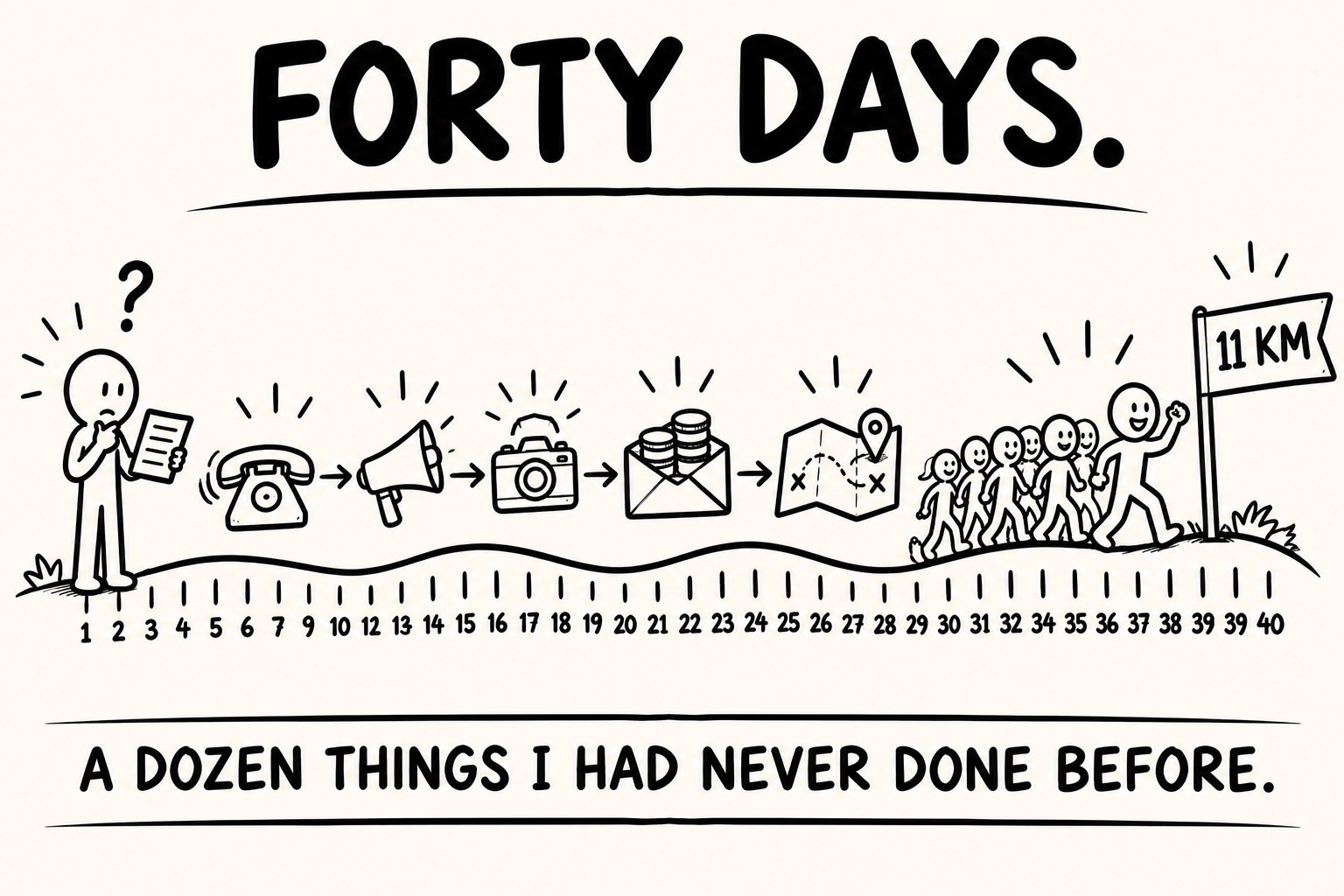
That is when I learned that impossible is only an idea. There is no impossible thing out there with a label on it. It is just an idea, and usually a very convincing one. To organise the protest march, which I had neither the experience nor the knowledge for, there was no path that went through working harder or doing more. How I used my time and attention in those 40 days taught me something that changed the entire trajectory of my life since then.
Three kinds of work
After the march, I started looking at work differently. I realised that all work and use of time is not equal. In fact, they can be massively disproportionate, and the outcomes produced with the same time and work input are so asymmetric that the human brain can not understand it. Below are the 3 types of work that I discovered:
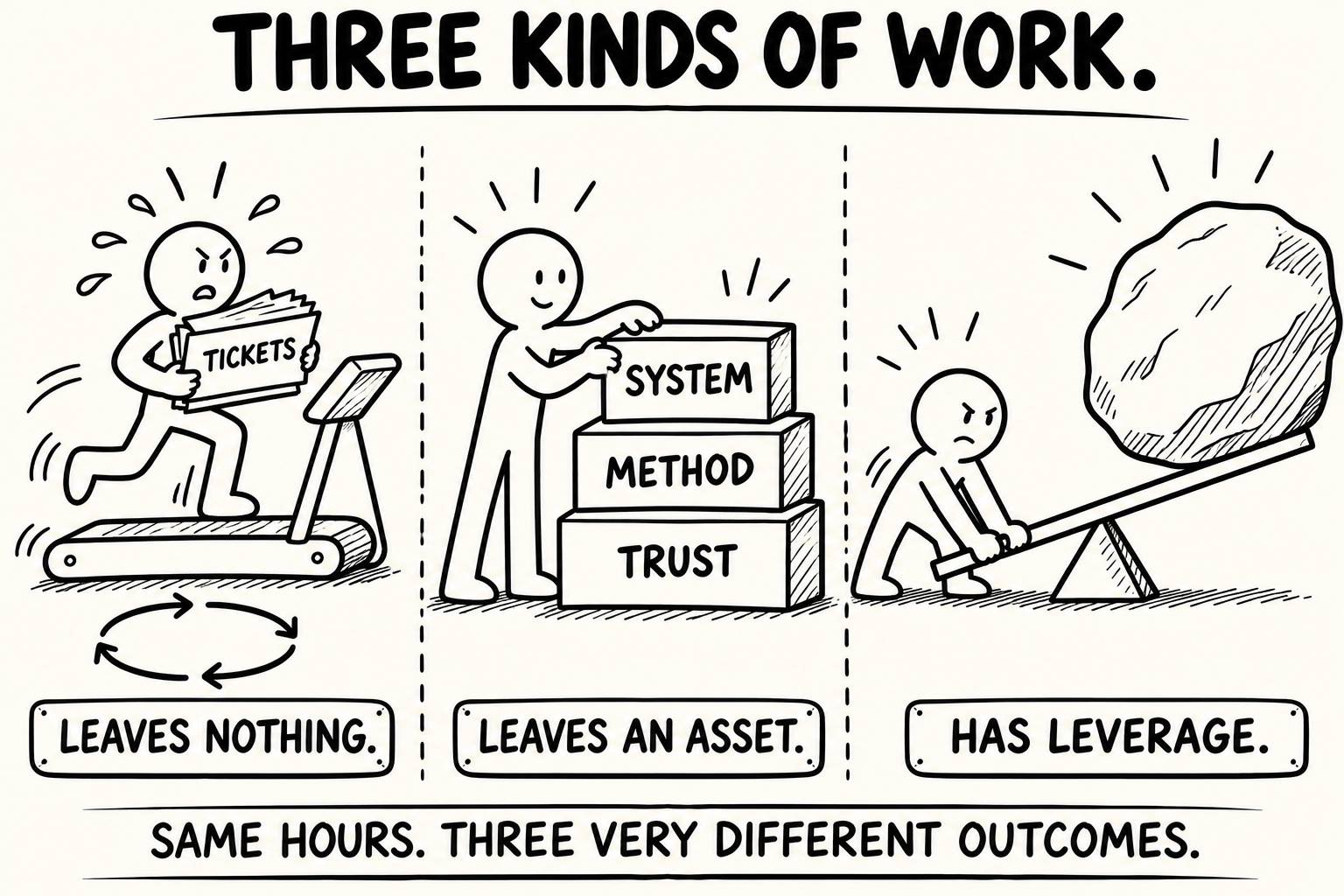
The work that leaves nothing behind. It keeps today moving. When you stop, it stops. Ex – the ticket queue, the status meeting that exists so people know what is happening, or the deck you rebuilt for the third time. For a CEO, this is when you personally solve problems for others all day. You use your time & attention to get things done.
Somebody has to do this work. Invoices, hiring, the customer call at four. The problem is when the whole week is this kind of work. We call it building a company or having work ethic or living a respectable life. It has one advantage. It gives you a feeling of progress and a dopamine hit, which is why it feels good.
The work that leaves an asset behind. It solves a problem that matters and leaves an asset behind – a method, a system, a relationship, or a capability. Writing down how you actually solve something so the next person does not start from zero. Two days with a leadership team, where they leave with a way of challenging each other that still works a year later. You use your time & attention to build assets.
This kind of work rarely feels urgent. That is why it is easy to delay or ignore.
The high leverage work. Most of us get to do this kind of work only accidentally. This is the one highly asymmetric idea or action that has a huge upside and limited downside. This kind of work creates a future that you can’t even imagine, let alone plan, from today’s reality. You use your time & attention to make moves that help you take massive leaps.
This could be a software you built. Or a new distribution channel instead of relying on 1-on-1 sales. Or a new partnership that gives you years of work and credibility immediately. Or a piece of a company you acquire. Or a new innovation and a body of work (IP) that makes you a category of one, or an audience that you own.
High leverage work produces disproportionate results. It reaches ten times the people without ten times the effort. Or it helps you do in one year what took the last five. This is the only one of the three that can produce an impossible result.
Why don’t we do it?
If you are anything like me, you already know the first two, and you have seen glimpses of the third one. So why is the first one still filling up most of your calendar?
Because it is the only one that tells you every day that you are doing fine. And that feels good and comforting. Hard work and hustling get you respect, approval and praise from others, which reinforces the behaviour socially. The high-leverage asymmetric one is the most uncomfortable and daunting emotionally – as you are risking exposure to failure, rejection, judgement, or simply uncertainty.
I know this from personal experience. Engineers are trained to be reliable. Close the ticket. Code the requirements. Do not leave loose ends. You can have an entire career of closed tickets, regular promotions and no leverage built. I nearly did.
A lot of what we call hustle and hard work is a fear response. It looks like commitment because it is visible and it fills the day. What it actually does is keep you too busy to ask whether any of this is the most important thing you want to do with your time. When I am scared, I go back to what I am good at, and I do a lot of it, very fast. It feels wonderful. Nothing changes.
Money follows the same pattern, individually or as a company.
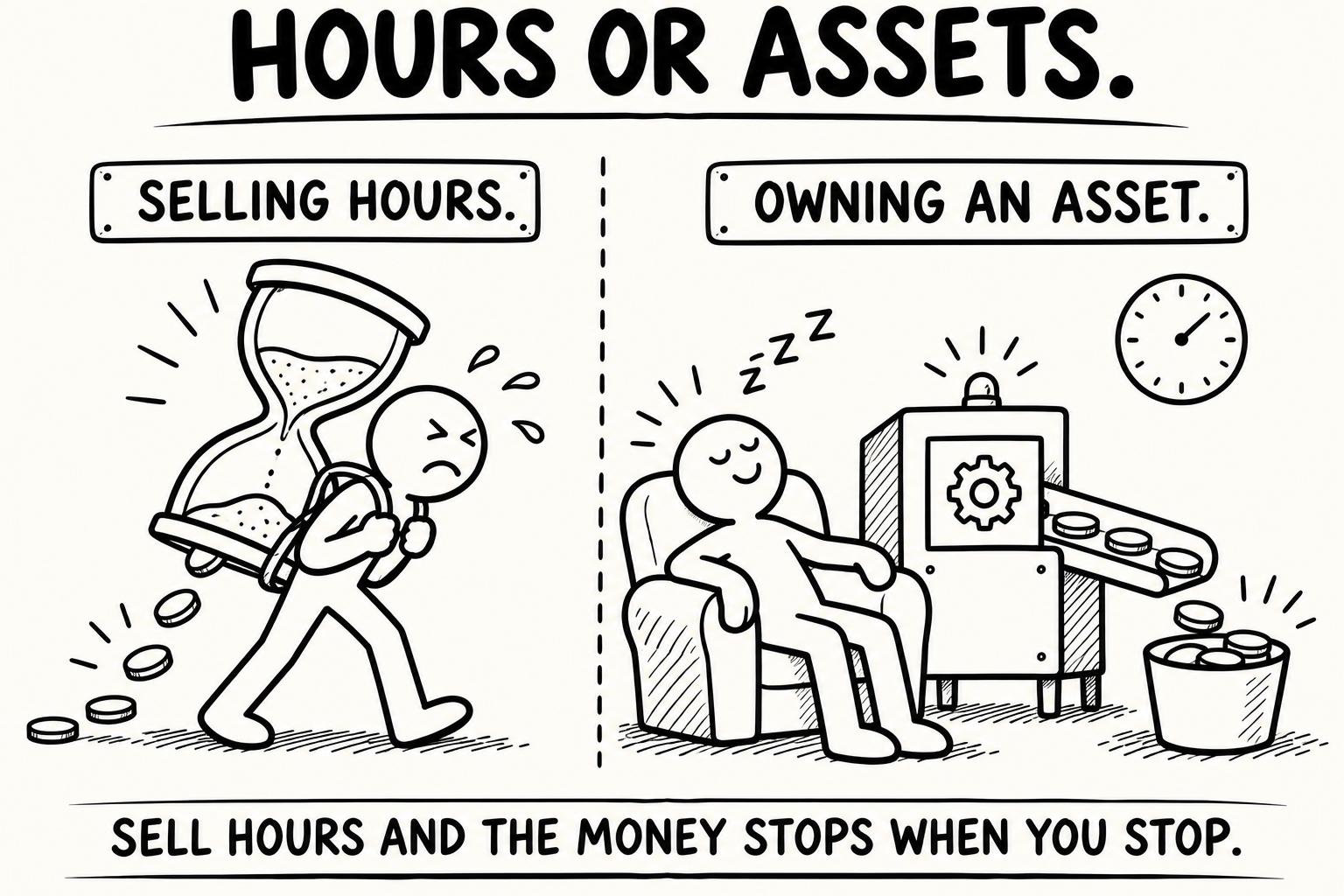
Selling hours (as an employee or freelancer) means the money stops when you stop.
Owning an asset means the thing keeps earning while you sleep. I have made that move myself. From selling my time (first as an employee and then as a freelancer) to partnerships and equity. Same skills. Completely different relationships and outcomes.
Using leverage with asymmetric bets is how i have grown my worth and impact multiple times – often in a single conversation. The first was starting my own company. The second was supporting entire companies on their growth journey with a stake in the upside. And the next one is partnering, investing and starting companies together with other entrepreneurs to create value in the economy.
A company is only the mirror image of its leaders. So the same three levels of work show up there as well.
A cash flow company sells, delivers, and starts every year at zero. Each year is a repetition of the past. And each future year will also be the same or similar. Its business rises and falls in cycles without adding any intrinsic value to the business itself. Examples: an agency, an accounting firm, an events business or a trading company.
A value company creates assets (code, media, technology, relationships, distribution, brand, etc.) that stay, so next year begins better than this one. This company grows – albeit linearly or slowly. Over decades, this slow and steady growth can compound to outstanding business results & valuation over time. Examples are Coca-Cola (brand + distribution) and Microsoft (platform + OEM relationships).
A high-leverage company concentrates effort around one idea nobody else has, and then compounds these over time with ownership, acquisitions, and partnerships. They become a category of one, eliminating all competition, and can do what sounds impossible in the long term. They can grow 10-100 times in a few years, and often expand into new industries without any experience or expertise in them. Examples are Amazon, LVMH, Tesla and Google.
I have watched this happen multiple times.
I spent two days with the leadership team at Tekdi. Parth (their CEO) told me afterwards, “What we did in those two days I’ve been trying to do for the last year.” Two days did what a year of normal work could not, because the work was different. Nobody worked longer hours.
What stayed afterwards was not a feeling. It was the way the team now shows up every day, challenges each other, keeps its promises and holds each other accountable as peers.
One company that had $1M of ARR when we started closed a single deal worth $2.5M in the first 60 days. They are now committed to 10x growth in the next 12 months – aiming for $10M ARR. This is not because of hard work or more sales activity. Instead, the opposite is true. They simplified their sales pipeline and are only pursuing opportunities worth $1M+. Much less hustle, outreach and conversations. Much higher quality and leverage of each.
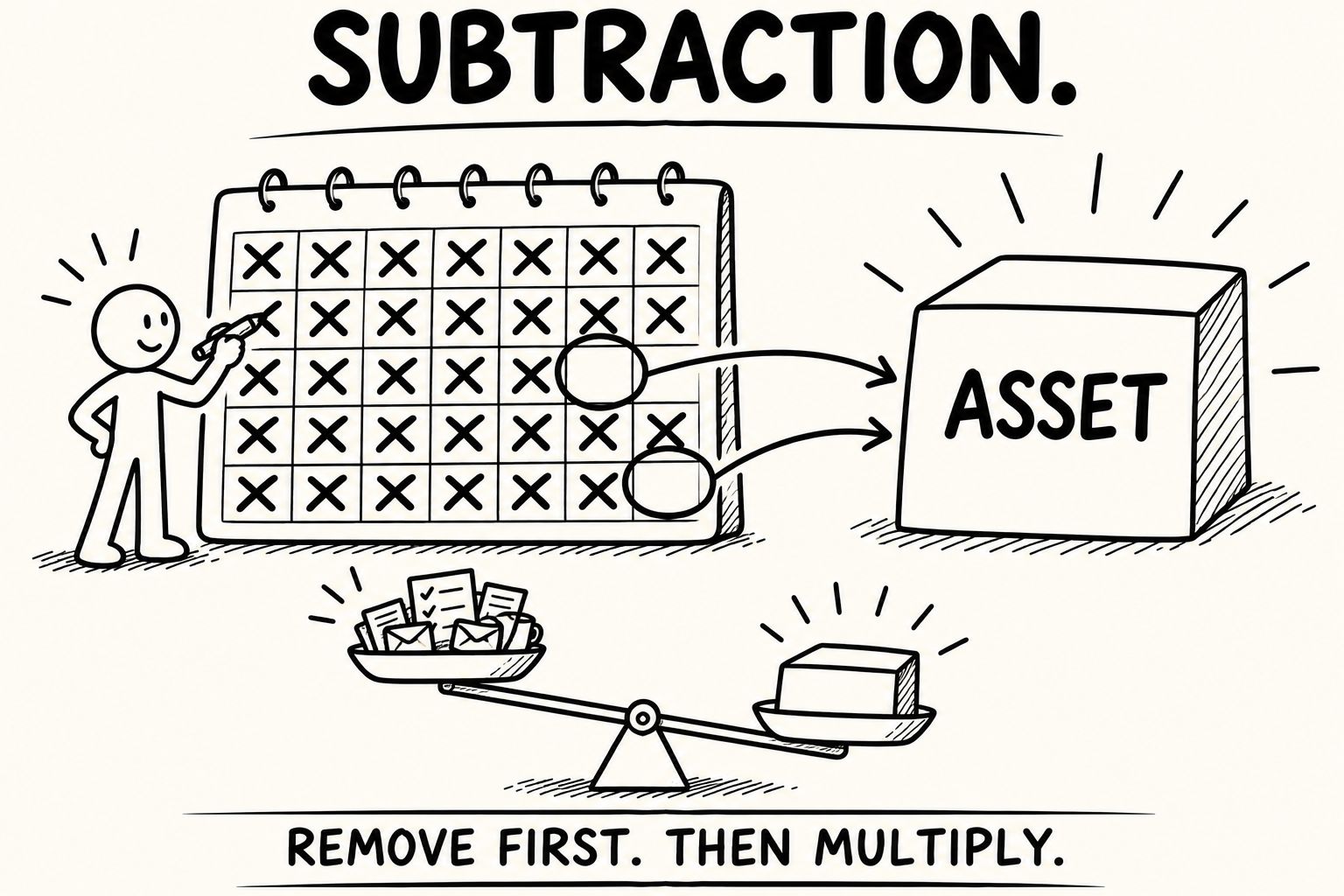
At NKP, the leadership meetings went from two and a half hours to forty-five minutes. That is not just a better meeting. It is eight hours a month, every month, given back to the leadership team, permanently. A senior manager at Amazon was spending 12 hours a day in meetings and getting performance feedback. He went to 6-hour meetings a day, and his team’s performance, as well as his ratings, shot through the roof.
Nobody in either story got there by adding something. They all removed something and let the busy work go. They said no to speaking from fear or insecurity, participating in endless discussions and opinions, hesitating on decisions, people-pleasing, and diplomatic conversations. They all learned to go all-in and speak their mind out (harder than it sounds) and then built more leverage with the hours they got back.
Using high-leverage bets to gain asymmetric upside is a process of subtraction, not addition. It is about simplification so that multiplication stands a chance. It is about preserving and focusing our time & attention to a few areas to create unimaginable quality of work and exponential results.
Your challenge
Busy work is tempting, cheap, and widely accepted – which is why it is a trap.
What is one piece of work you will stop doing this month?
What is one asset you will start building?
What are some asymmetric bets in front of you with huge upside and limited downside?
Say them out loud to someone who will notice if you don’t.
You cannot hustle your way to an impossible result. Hustle is what you do when you have no other way out. Hustling and being able to work hard is a powerful skill to survive and get out of tough situations. However, when it becomes a reflex, it creates an illusion of progress while you only make little or incremental progress. Worse, you do not see or even realise that there is a high-leverage pathway to exponential results right in front of you.
Leave a Reply