A founder I work with told me something this week, almost in passing, that I could not stop thinking about.
He has built a real company over the last decade. Good infrastructure, a good team, steady growth. He is thinking out loud about the next thing, something genuinely bigger. Hardware. Robotics. Building a car. And in the middle of it, without any drama, he said: “But how would I convince my dad?”
Most ambitious people do not lack ideas. They lack permission. Not permission from the world. Permission from themselves – first and foremost. When they deny themselves the permission that only they can give themselves, they keep collecting the small and sensible wins, and underneath it all, a bigger version keeps waiting. More importantly, the part of them that is bold, unapologetic and without boundaries slowly suffocates.
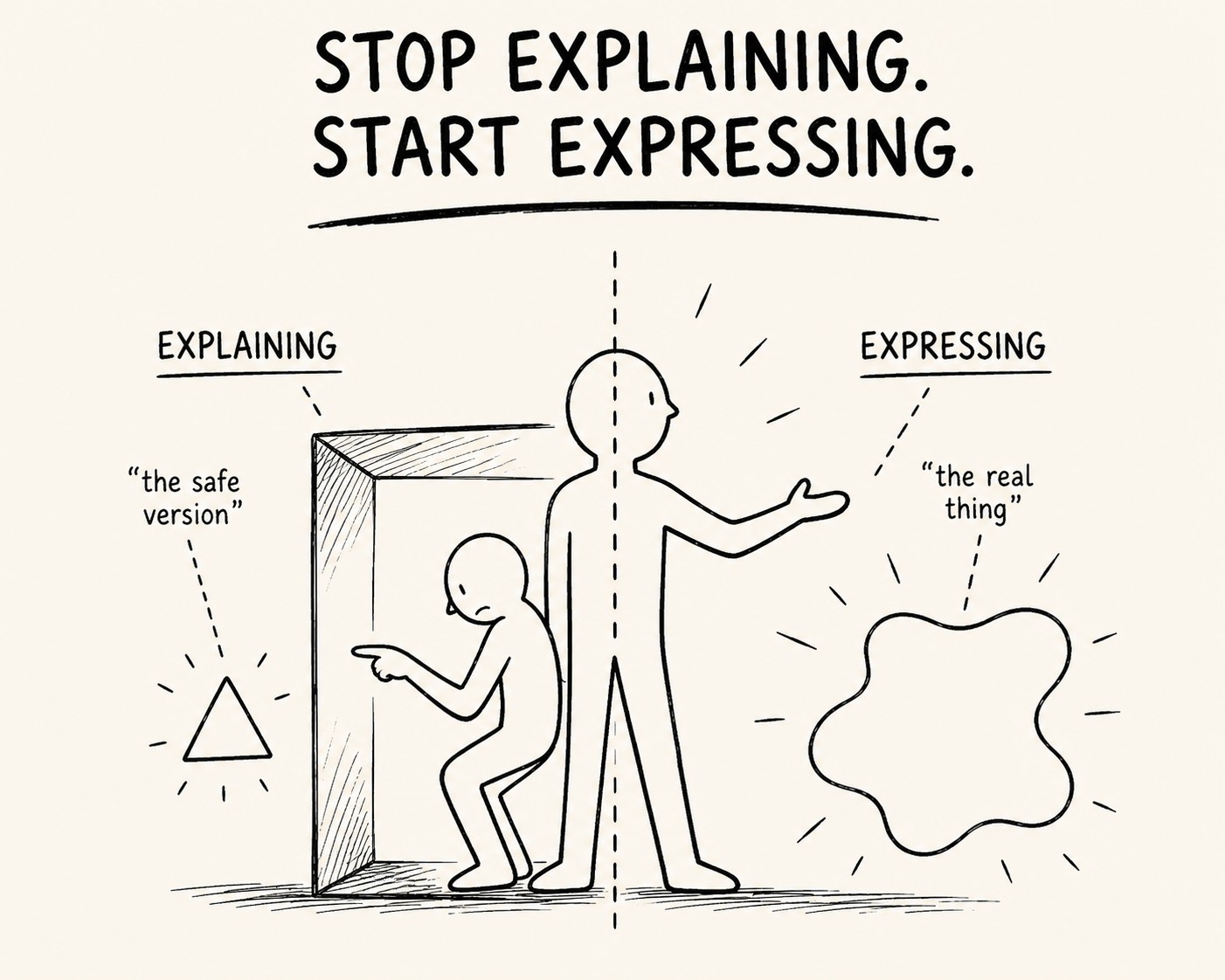
I denied myself that same permission for sixteen years. It leads you to explaining yourself (to seek validation) instead of expressing yourself freely. If you keep explaining, you can build a very successful life and still never fully feel alive – which is a travesty.
Here is How it Starts
You have a vision that feels too large, too strange, too difficult to explain. So you shrink it into language that feels safer.
Then you spend years building consolation prizes. Great success for most people – but not for you – as you never aimed for what you really wanted in the first place.
I know this from the inside. I spent sixteen years in a corporate career that, on paper, was everything someone should want. Good work. Real money. Nothing wrong with it, except it was safe, it was small, and it kept the real me quiet.
There is a question that sits underneath the careful plans, and most people avoid it for decades: what is the thing that wants to happen through you?
Not the thing that is easy to justify. Not the thing that gets immediate approval. The real thing that you long and yearn for.
That founder spoke a version of seeking permission that we all do a bit differently: “How would I convince my dad?” As if his dreams needed permission.
Why You Explain Instead Of Expressing
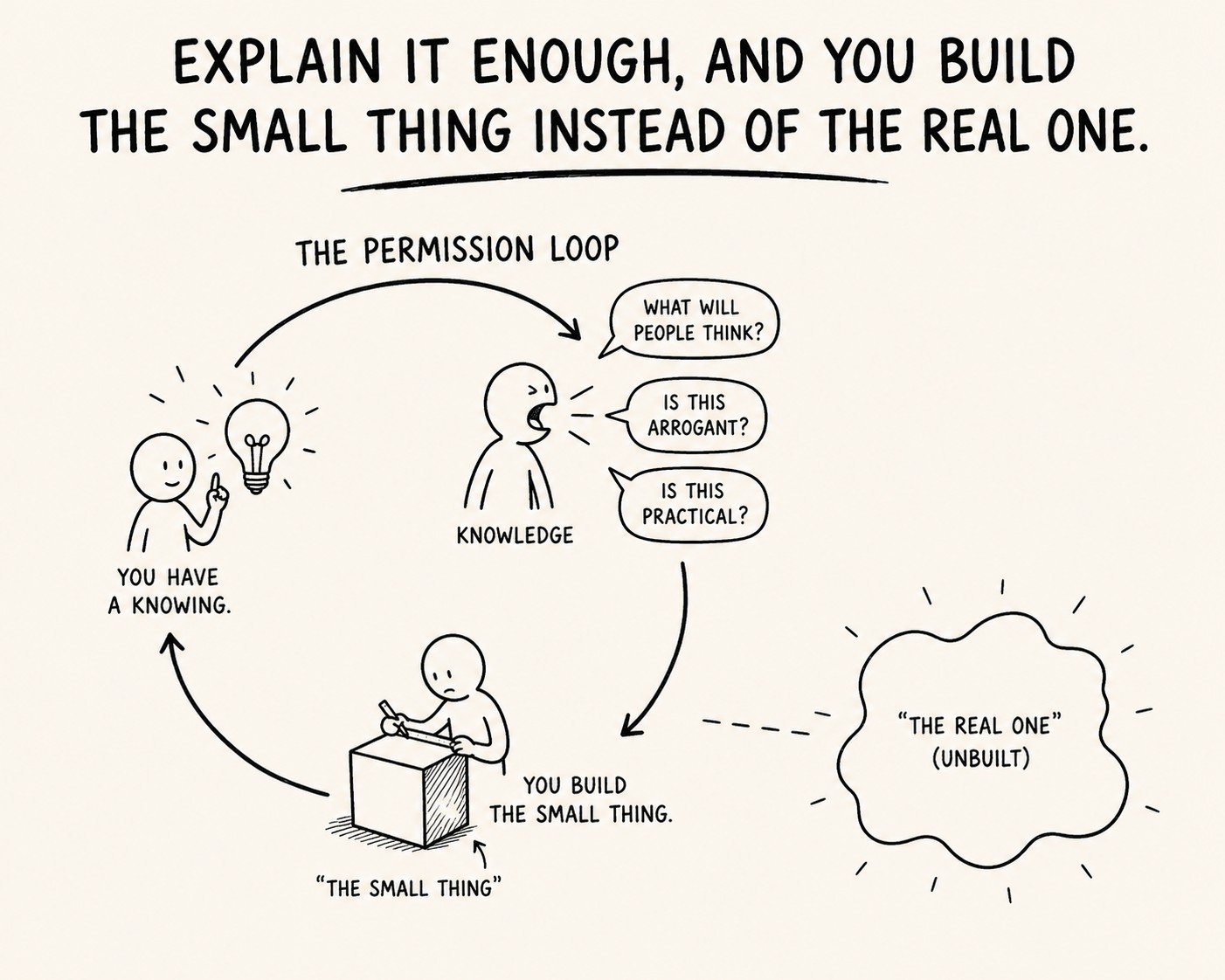
What will people think? Is this arrogant? How will I explain it? Will my family understand? Is this practical?
When these questions run amok in your mind, something that was alive gets diluted. The problem is not that leaders think too much. The problem is that they use thought to override what they already intuitively know.
Most of the time you already know the conversation you need to have. You already know the product you need to stop building, the person you need to let go of, the bet you need to make, the apology you need to offer. The knowing is there. Then knowledge arrives with its objections, and you talk yourself out of what you already know.
There is a name for this split between what our knowledge is and what we actually know. A thinker named Michael Polanyi spent his life studying it and called it tacit knowledge. His famous line is simple: we know more than we can tell. You can know your next move deeply and have no way to justify it, and that is not a flaw. That is how real knowing works.
Accommodation Is Not Empathy
When I suggested this founder to express himself without permission, he told me he was naturally very compassionate. That he feels responsible for a lot of people. And that is why he holds back.
I told him, as gently as I could: that is not empathy. And it is important not to confuse the two.
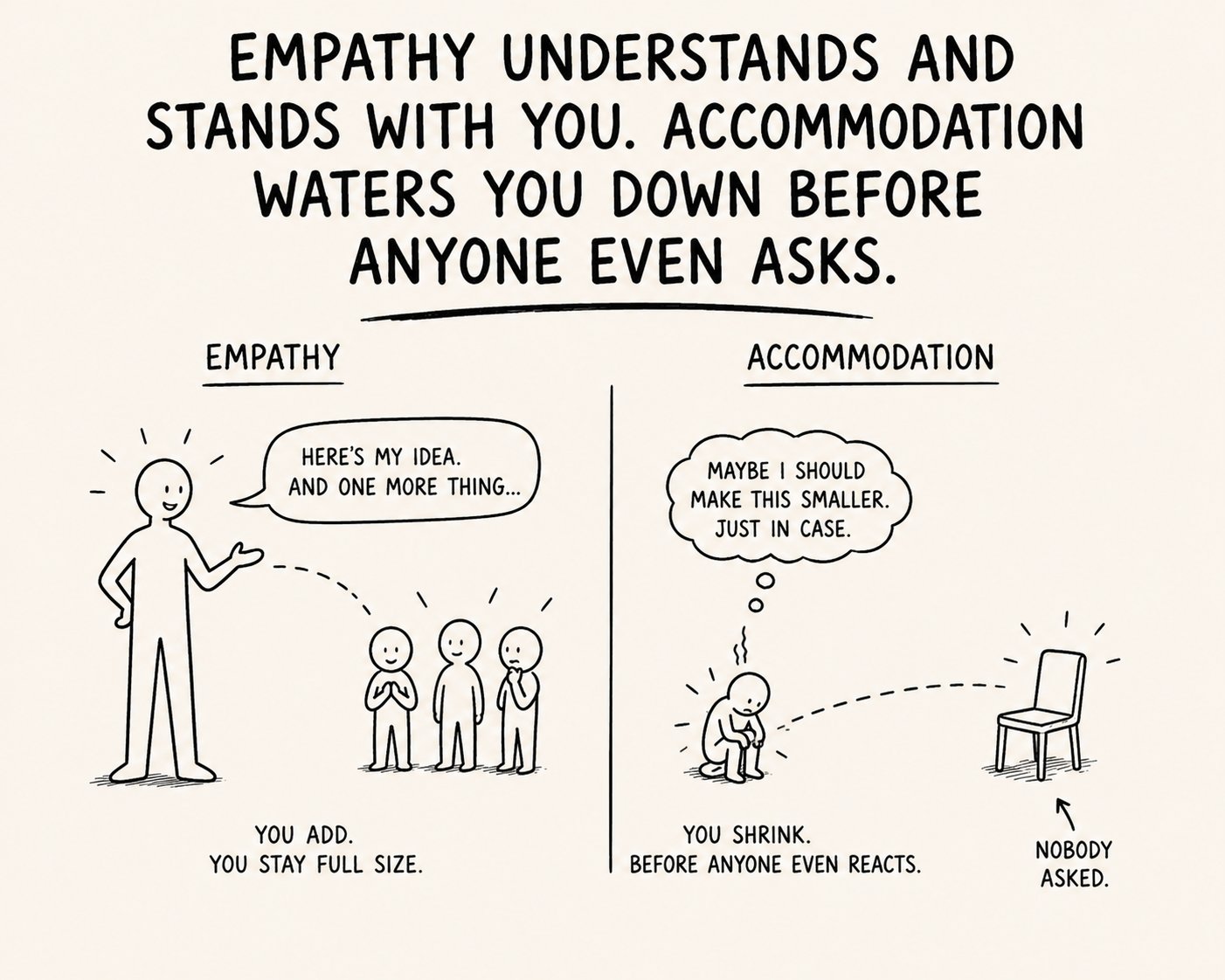
Empathy is understanding. It is connection. It is being willing to put yourself in somebody else’s shoes. And it stops there. Empathy does not ask you to become less authentic to keep them comfortable.
What he was describing was accommodation. Accommodation is watering yourself down before anyone has even asked you to. It is living your life as an answer to how other people might react. And I have seen it more times than I can count, dressed up as kindness.
For example: if you are giving a talk and you add one more sentence alongside your strong point of view because you sensed the room, that is empathy. If you never make the point you actually wanted to make, to keep the room calm, that is not empathy. That is accommodation. That is building an airline because the rocket felt too much to explain.
Psychologists Edward Deci and Richard Ryan spent decades on a question that sounds academic and is actually the most practical thing in the world: what keeps a person alive in their work? Their answer, over and over, is autonomy. The drive that survives is the one that comes from something being truly yours, not the one held up by rewards and approval from the outside. Explain everything for approval, and the energy drains. Express it because it is yours, and the energy holds.
Don’t ask what the world needs. Ask what makes you come alive, and go do it. Because what the world needs is people who have come alive.” — Howard Thurman
Stop Telling Me What You’re Not
That founder told me at least ten times in one conversation that he does not want money. Or stake. Or control. Or recognition.
I believed him. That was never the issue. The issue was that he was telling himself, out loud, in front of me. And when you keep announcing what you are not, you are not living it. You are arguing with yourself.
You do not have to tell people you are not here to take their oxygen. Just breathe.
If you go out and build companies, one of two things can happen. You start something, and it becomes big, or you go bankrupt. But you do not have to keep rehearsing your purity to the world. That repeated sentence is a dialogue you are having with yourself, neatly labelled as an explanation.
The Road Has No Name Yet
Here is the uncomfortable truth I put in front of him, and it is the same for anyone trying to build something genuinely new. The most original work cannot begin with an explanation, because you can not explain what doesn’t exist yet.
It may not fit the polarities we already believe in. Socialist or capitalist. Big or humble. Ambition or service. The founder spoke about building a “socialist network” of companies, and I stopped him. Those two words, socialist and capitalist, are loaded guns. The moment you say either one, people stop listening to the thing and start judging you by their own ideology. Even you judge yourself with them.
I told him: when democracy was invented, nobody called it a better monarchy. They had to find new words, and those new words broke the old categories open. If the people who built democracy had pitched it as “an alternative monarchy,” it would have stayed a footnote.
Something genuinely new requires a new language. And a new language is uncomfortable. It means criticism, misunderstanding, and long stretches where nobody can see what you can see. It means following breadcrumbs rather than executing a neat roadmap.
There is a version of you that never asks – am I right? and never explains anything. That version is the one the world has not seen yet. And the world not being ready to see it is not your concern. The world not being ready to see the rose is not the rose’s problem.
Start In Ordinary Moments
I gave the founder a challenge. Forget the big ideas for a week. In your day-to-day life, notice what wants to happen through you. It can be tiny. Walk slower if that is what feels true. Say the difficult thing you have been carrying. Change your mind. Sit quietly and watch a bird raise and lower its feathers for no reason at all. There is no productive use in that, and that is the point.
This is where the science of effortlessness and the mystical both point the same way. A psychologist named Mihaly Csikszentmihalyi studied people at their best and found the moments of highest performance were the least effortful. He called it flow: total involvement, no inner arguing.
The river is not thinking about whether it is nourishing a field or flooding a valley. It is just moving. It is raining, and the rain is not against anyone, and it is not doing anyone a favour. It is just raining. That is the quality of flow I am pointing to. Your mind will resist it and ask for proof. Do not fight the mind. Just notice it. Then give expression to the deeper knowing anyway.
Let yourself be direct. Let yourself be alive. Because a life can become very successful while never being fully expressed. And that would be a travesty.
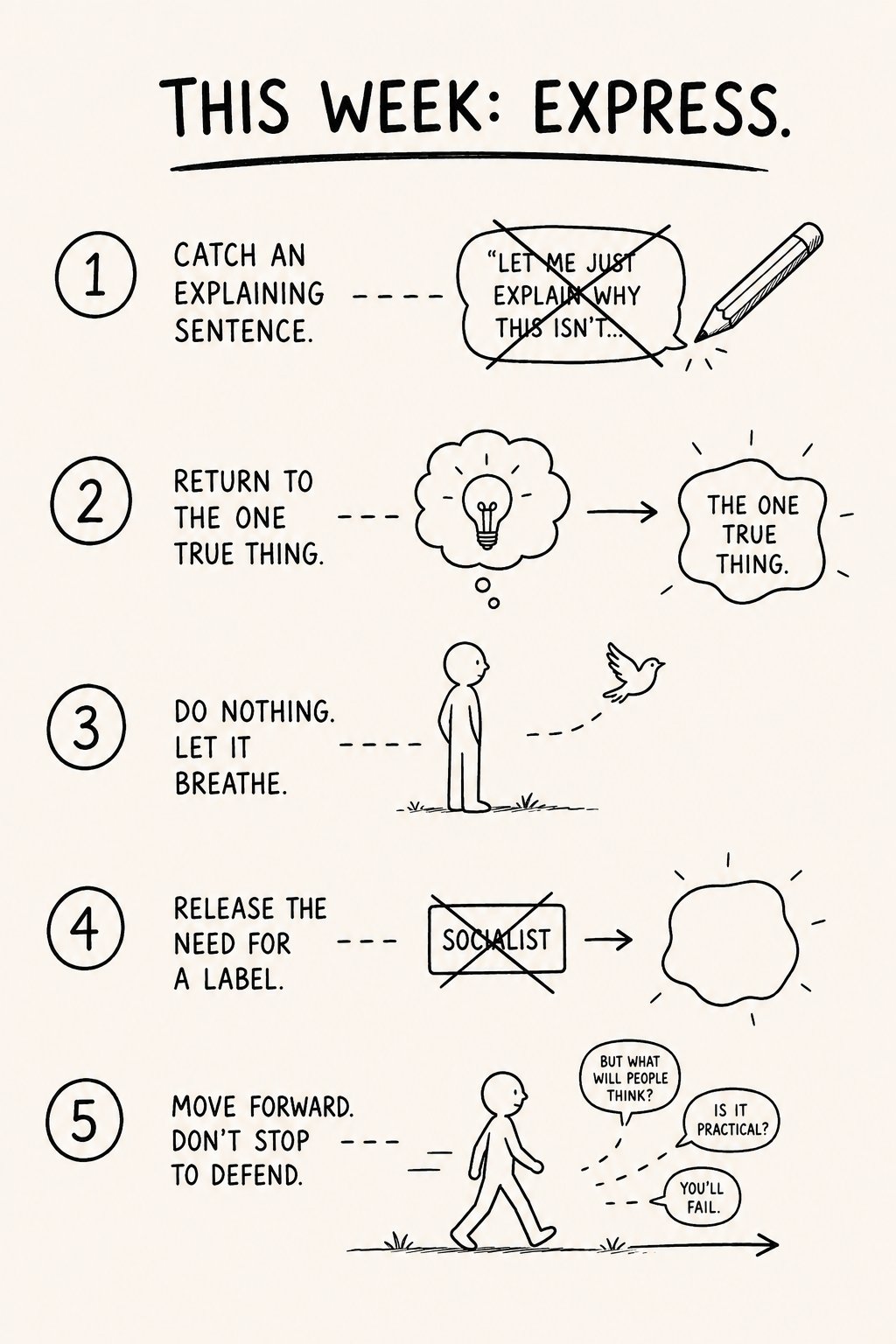
The Practice
This week, I want you to stop explaining and start expressing. In small doses. Here is exactly how.
Catch yourself explaining. For the next seven days, notice every time you add a justification to your words. The extra because. The softening. The sentence you add so the point feels safe. Write one of them down when you catch it. That is explanation, not expression, and noticing is where it ends.
Name the knowing. Once a day, pause and ask: what do I already know I need to say or do, and what is the one thing I can leave unjustified? Do not reach for the plan or the precedent. Just the true thing, this moment.
Give one small expression with no purpose. Say the difficult thing. Walk a little slower. Sit somewhere and watch something alive. Change your mind out loud. Do nothing. No reason needed. Watch how it feels to let it move.
Drop one label. One time this week, describe what you want without the words that polarise. Not socialist or capitalist. Not humble or grand. Not safe. Just the thing itself.
Let the objections speak, and answer none of them. When what will people think? shows up, name it out loud, do not fight it, and take the step anyway. The objections are not reasons.
The founder told me, near the end, that these businesses, the ones he is building now, he calls his petty things. These are my petty things.
He was not being modest. He was telling me that the real thing, the huge unexplainable version of himself, had still not been given air.
And I could see the beauty of it, because he said it without realising what it meant. He kept calling the big thing a series of small things, and the small things a consolation, and the real thing unnamed. That is exactly what explaining does to us. It takes the thing that wants to happen through you and makes it something you can defend.
There are two ways to spend a life. Explaining the version of you that the world can already understand, over and over, until it is acceptable and smaller than you are. Or giving expression to the version that has no name yet, and trusting that the path appears as you walk, breadcrumb by breadcrumb, because you refused to shrink it for others before you even started.
What is the thing that wants to happen through you?
Stop explaining it. Start expressing it. Because a life that stays small and acceptable forever, while the bigger thing inside you never once gets its turn in the light, is not safe.
It is a travesty.
Sources
- Polanyi, M. (1966). The Tacit Dimension. The distinction between what we can say and what we truly know: “we know more than we can tell.” https://en.wikipedia.org/wiki/Tacit_knowledge
- Csikszentmihalyi, M. (1990). Flow: The Psychology of Optimal Experience. The state of effortless, total involvement. https://en.wikipedia.org/wiki/Flow_(psychology)
- Deci, E. L., & Ryan, R. M. (1985). Self-determination theory: autonomy and intrinsic motivation as the source of durable drive. https://en.wikipedia.org/wiki/Self-determination_theory
Leave a Reply