(You are doing things in the wrong order)
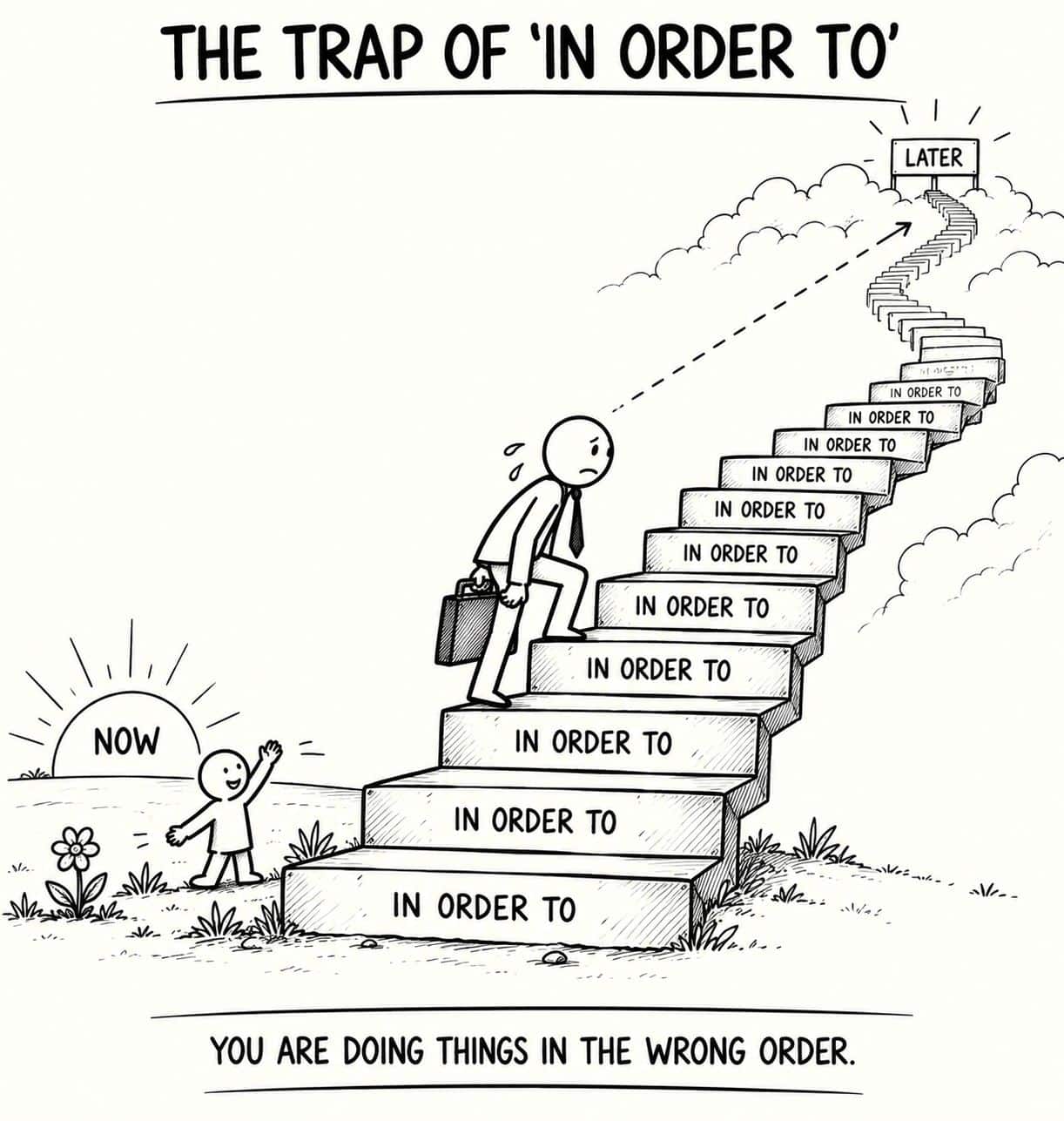
Let me ask you something. Finish this sentence: “I’m doing this in order to…” Now try it with a few things in your life:
- I’m working this weekend in order to…
- I’m raising this round in order to…
- I’m going to the gym in order to…
- I’m taking this vacation in order to…
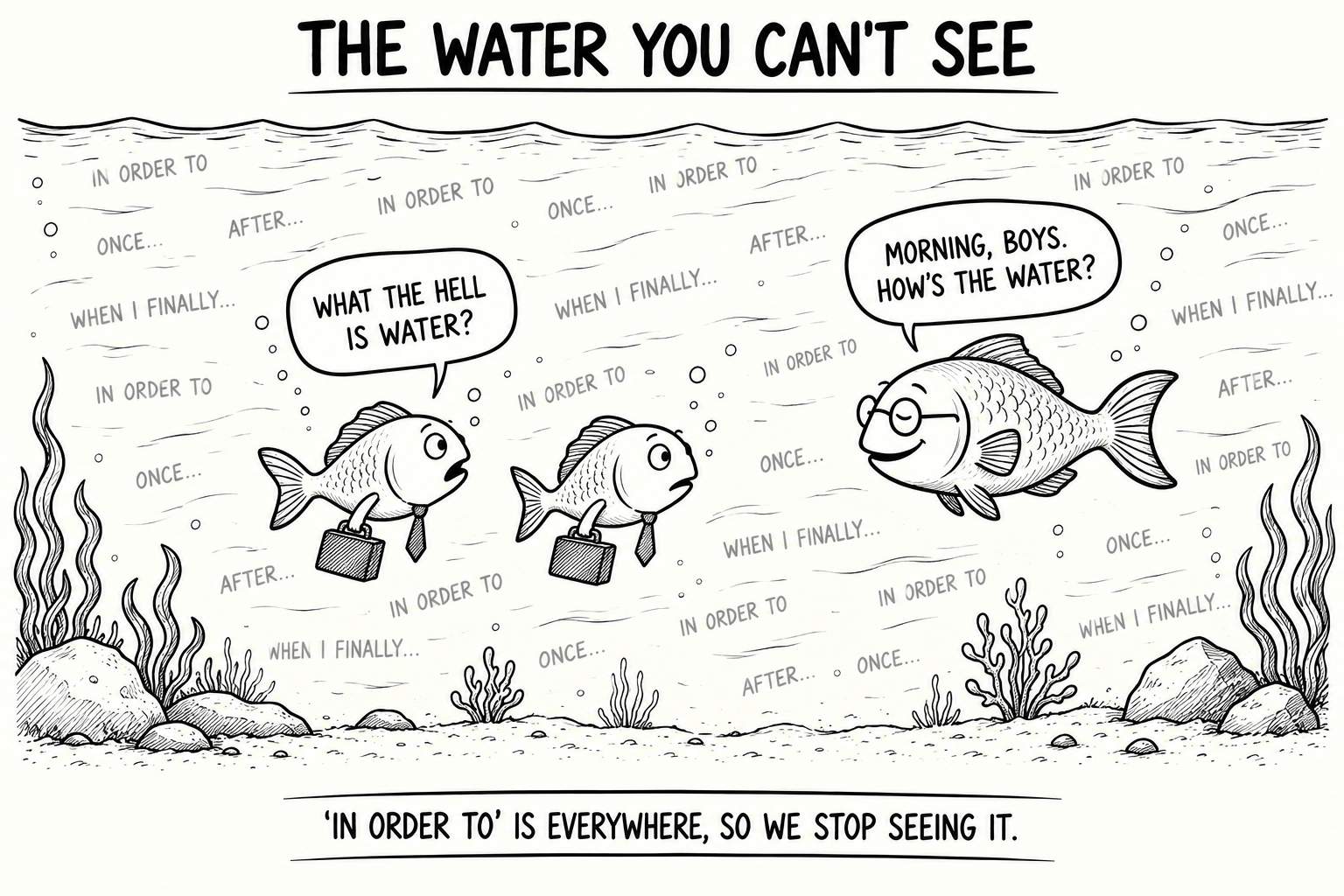
Now keep going. What’s the in order to after that? And the one after that? Notice how the sentence never really ends? There’s always one more step before you get to the part where you feel good, where you relax, where you’re finally proud of yourself.
The trap I lived in
I spent sixteen years climbing the ladder in tech. I delivered big, complex projects and got promotions and raises. From the outside, it looked like I’d made it. And I was miserable. Not because the work was bad, but because I was using every project, every role, and every meeting in order to prove or get something. That I was smart. That I belonged. That I was finally enough.
Here’s how deep it went. I once turned down a job offer because the title didn’t have the word “Senior” in it. It was the same kind of work, just missing one word. And that one missing word made me feel like a failure, so I said no. It sounds silly now, but that’s honestly who I was back then.
Then I finally got the senior role I’d been chasing for more than a year. This was the one that was supposed to make me feel like I’d arrived. And do you know what I felt? Nothing. Actually, worse than nothing, because now I had a brand new worry: What if they find out I don’t deserve this? What if it was a fluke? What if I lose it? I hadn’t escaped the anxiety at all. I’d just upgraded it.
The water you can’t see
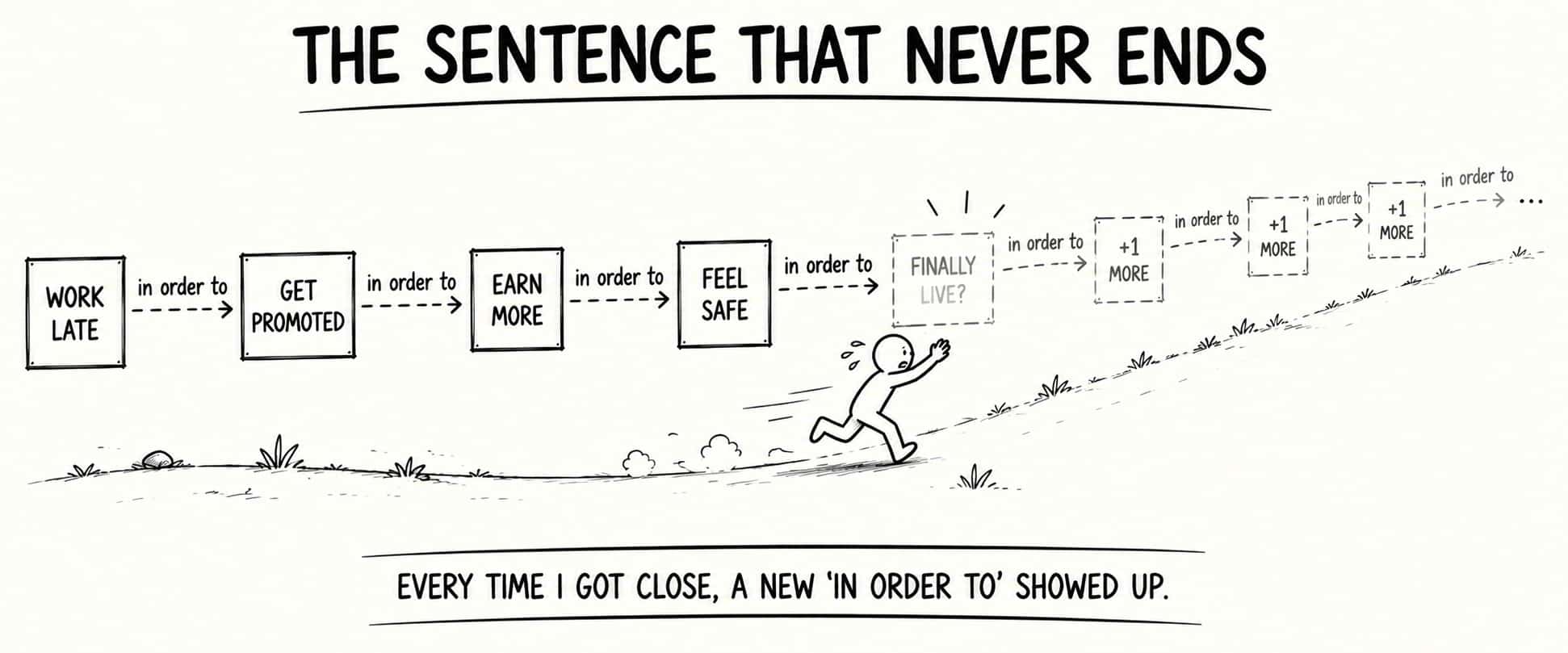
Two young fish were swimming. An older fish swims by and says, “Morning. How’s the water?” The two young fish swim on. After a while, one of them turns to the other and asks, “What the hell is water?” When something is everywhere, you stop seeing it. And “in order to” is our water. It shows up in every part of our lives:
- With our bodies. We go to the gym in order to look a certain way. We check the mirror again and again. We buy clothes in order to feel like we belong in the room.
- With our hearts. We perform in relationships in order to be liked. We collect approval like trophies, hoping the next person will finally make us feel complete.
- With our minds. I used to be proud of reading 100 books a year. Want to know how many of them actually changed how I lived? Maybe two. I wasn’t reading in order to learn. I was reading in order to feel smart, and then to tell people I’d read 100 books.
- With our work. We chase the bigger office, the next revenue milestone, the new business unit, the impressive hire. All in order to prove that we matter.
Without realising, we put our confidence, our joy, our peace, and our sense of worth on hold. We keep doing things “in order to” have something later. This is a trap. As later never comes. It just keeps moving further away.
What it’s costing you
“In order to” doesn’t just delay your happiness. It drains you right now. When today is only a tool for tomorrow, you’re never really here. You’re in the meeting, but you’re busy managing how you look. You’re at dinner, but you’re quietly checking whether you’re on track. Your body is in the room, but you are not.
And even when you win, you can’t really enjoy it. You get maybe ten seconds of feeling good. Maybe a day, if you’re lucky. Then the fear kicks in: What if I lose this? It’s a game that simply can’t be won. No matter how much you put in, it never feels full.
I see this all the time in my work. Brilliant leaders come to me running for decades and pretending they’re fine. Their lights are dim. And it’s not because they’re failing. Very often it’s because they’re succeeding, and it still isn’t enough. It is because they have become so good at running and chasing that the thought of stopping terrifies them.
You already know how to live differently
Here’s the good news: you already know how to live outside of “in order to”. You just don’t do it everywhere. Think about picking your kid up from school. Do you sit there asking yourself, “what’s in it for me? Will this make me look good?” Of course not. You just go.
If your kid spills his milk over his clothes, you clean up and do what has to be done. It needs doing, so you do it. There’s no drama, no calculating, no overthinking.
Or think about when your best friend calls you at midnight. You don’t lie there working out the ROI of that conversation. You pick up the phone, you listen, and you help however you can. In those moments, you’re not doing in order to get anything. So you naturally ask a completely different question:
What does the person or situation in front of me need from me?
That’s your default as a human being. When you are not doing it “in order to”, you naturally do what suits best for the person and situation in front of you. Irrespective of how it looks or what it says about you. You just serve the moment in front of you the best you can.
In India, we have a name for it: karma yoga. It simply means action for its own sake. You serve what’s in front of you, and the action itself is the reward.
Two ways to act
When you look closely, there are really only two ways to act in any moment:
- “In order to.” This moment is just a stepping stone to something better later. The future matters more than now. So you’re never fully here, and you miss most of what’s right in front of you.
- Serving the moment. You stop using now to get somewhere else, and you give it your full attention. Think of a great athlete in the zone. They’re not thinking about the gold medal. They’re not even thinking about themselves. And that’s exactly why their action has so much power.
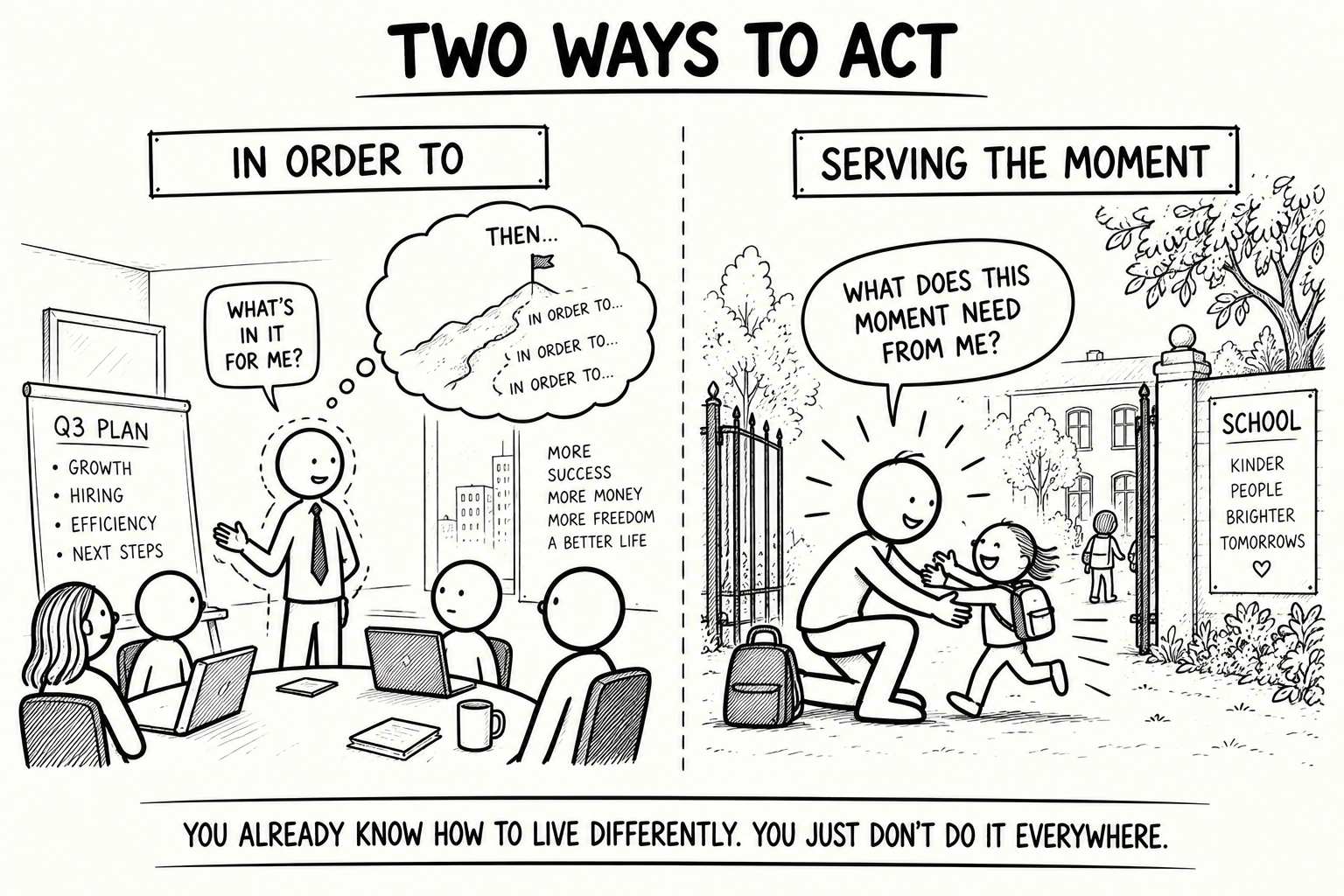
The coach Michael Neill says it simply: if you’re doing things in order to be happy, you’re doing them in the wrong order. Happiness doesn’t come after. Courage doesn’t come after. Peace doesn’t come after. They come first, and then you build everything else from there.
“So should I stop dreaming big?”
Hell no. I don’t do small or incremental anything. I work with CEOs to help companies take 100 million leaps. I love big, bold, crazy goals. The dreaming is not the problem. How you hold it is. You can chase a dream in order to finally feel alive. Or you can go after it from already being alive, and let the dream be the way you express that.
For years, I was scared to leave tech. Not because I loved it, but because I was afraid of what people would think. My family, my colleagues, even me. I was deeply attached to being “the smart engineer.”
Then one day I was sitting in yet another meeting about optimizing some algorithm, and I realized I wasn’t even there. I was going through the motions, collecting a paycheck, and protecting an identity that didn’t fit me anymore.
Meanwhile, out in the world, brilliant leaders were burning out. Company cultures were making people sick. People were quitting their jobs because they couldn’t find any meaning in them. I knew I had something to offer. The scary part of quitting wasn’t the money. It was letting go of needing to look successful.
The question I’d been avoiding was a simple one: What does this moment in my life actually need from me? When I finally quit, I didn’t feel certain about anything. I felt relief. For the first time in a long time, I was doing something that felt true.
What becomes possible
When you stop using your work to fix something inside you, everything starts to change. I worked with a SaaS CEO. Let’s call her Shri. Every board meeting was a performance for her, carefully built to make her look like the perfect CEO. She was exhausted.
Then one quarter, the numbers were soft. Really soft. And instead of spinning a story, she told the board the truth: “I know you want aggressive growth. But expanding internationally right now would hurt us. We haven’t solved our home market yet.”
She told me later that something shifted inside her as she said it. She wasn’t nervous and she wasn’t spinning. She was just giving them what they needed to know. The board pushed back at first, and then they came around. But the real reward wasn’t their approval. It was finally getting to be herself in that room.
When I was just starting out, a founder wanted to hire me to “fix” an employee he was about to fire. The more I dug in, the clearer it became that the employee wasn’t the problem. The culture was. I asked the founder to be coached first, and he refused. It would have been easy money, right when I needed it most. I said NO anyway. He didn’t hire me, and I slept better that night than I had in years.
That NO was its own reward, as I didn’t say it “in order to” anything. I said it because that’s what the situation needed from me at that point. This is what happens when you lead from “what does this moment need?” instead of “what can I get?”:
- Your team stops walking on eggshells and starts bringing you the real problems.
- Your peers stop seeing you as competition, because you’re not trying to outshine anyone.
- Your investors trust you more, because they know you’re telling them the truth.
- Everyone relaxes, because people can feel when you’re not trying to take something from them. That’s where real trust comes from.
Try this for one week
You don’t need a big plan for this. Just three small moves, every day for one week:
- Catch the sentence. Listen for every “in order to,” “once…,” and “when I finally…”. Each one is a piece of your life you’ve put on hold.
- Before every meeting and every decision, ask: What does this moment need from me?
- Then ask the braver question: What would I do here if the action itself was the only reward? What would I do if I do not need anything from this moment at all?
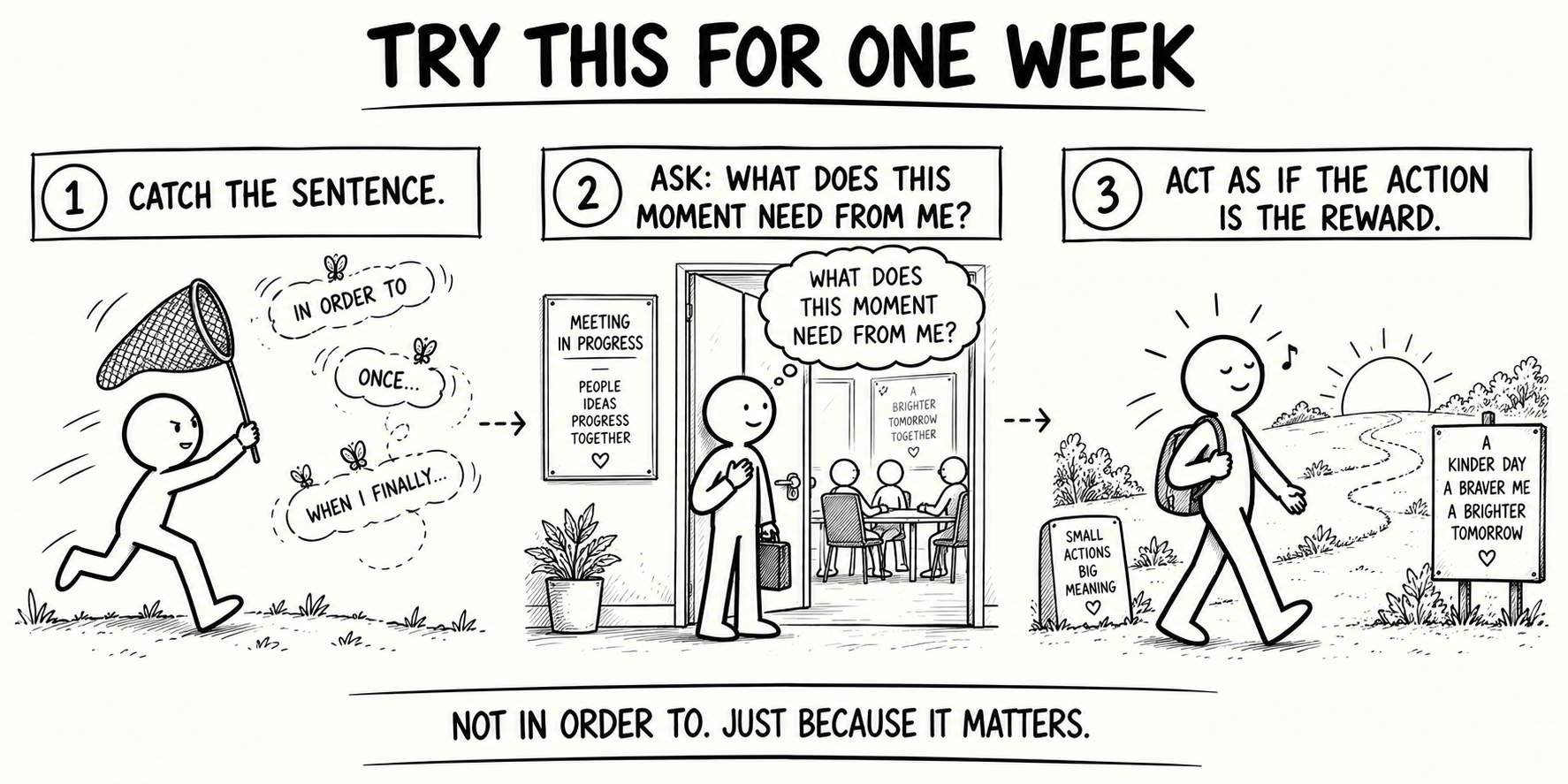
Then go and do that thing, even if it’s uncomfortable. Especially if it’s uncomfortable. Sometimes that means:
- Having the conversation you’ve been avoiding.
- Saying “I don’t know” or “I got that wrong.”
- Turning down money or opportunities that don’t fit who you are.
You’ll feel something you probably haven’t felt in a while: relief. And a quiet kind of confidence that doesn’t depend on how things turn out.
The only moment you’ll ever have
Here’s what I know for sure. You are not going to achieve your way into feeling enough. That game is rigged. I played it for sixteen years, and I never won. You can stop playing it today.
So keep your big dreams. Make them even bigger. Go for the impossible. Just stop making your life now the price of getting there. Everything you’re chasing (courage, joy, peace, aliveness) isn’t waiting for you at the finish line. It’s right here, in the action in front of you.
So go do something that matters. Not in order to. Just because it matters.
How’s the water?
Leave a Reply