
(there are more than one)
Last week I was on a call with a founder I work with. He had asked me to work with him, and we had already spent two long calls on his business. On this call, I told him what it would cost to work with me. He went quiet for a moment, and then he told me it was more than he could spend.
He Told Me He Couldn’t Continue
He said he couldn’t continue with me, very clearly, which I appreciate. He did not hide behind “let me think about it” or “I have to discuss this with my wife”. He told me the truth: the money had to go home first. He had not taken a salary from his company for years, and his family had been paying for everything at home. He was also in the middle of getting money from investors, and he had a product to launch and a team that depended on him. So he said no. Very reasonable.
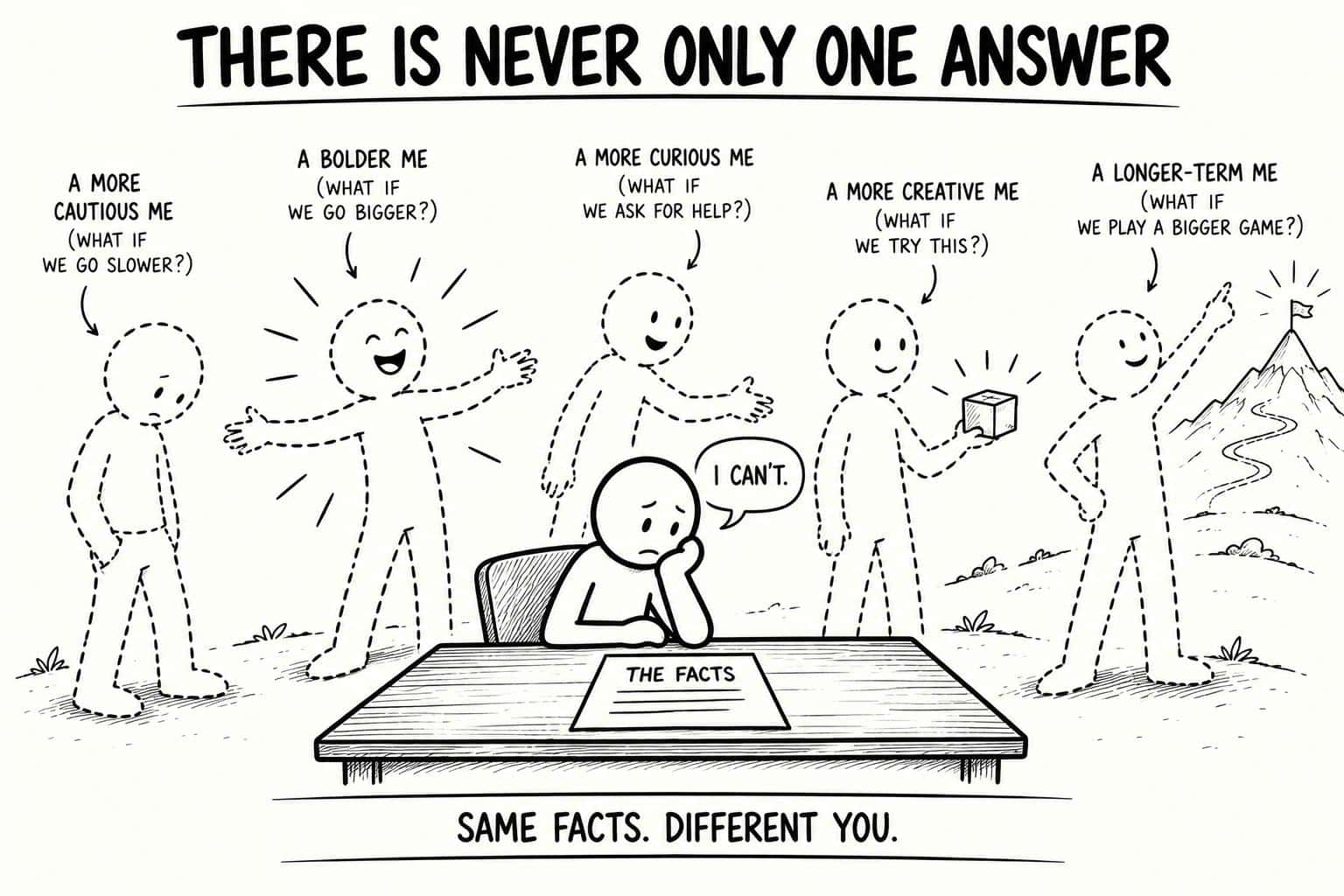
I want to say something clearly here, because it matters for the rest of this article. I do not think his answer was wrong. It was a perfectly reasonable answer. He was not lying to me. He was not avoiding a hard conversation. Everything he told me was true, and still, it was only one possible answer out of many.
Everything He Said Was True
He had not taken a salary for years. That was true. His family had been carrying everything at home. That was true. The business needed money to grow. That was true. The money from investors might come, or it might not. That was true too. All of his facts were correct, and I did not argue with any of them. What he missed was not facts. His facts were right.
The problem was that he had answered a question that had more than one answer, as if it only had one. There are two things in any situation. The facts, which you cannot change. And what you decide to do inside those facts, which you can. His facts were fixed. What he did about them was not.
So I Asked Him to Look Again
I did not try to convince him. I asked him to look at the same situation one more time. First, I said his answer back to him. “I don’t have the money, so we can’t go ahead.” After struggling for around 7 minutes, he gave me four more answers with the same facts. He had not said any of them initially, and every one was just as possible as the answer he gave.
Four Answers He Could Have Given
- “I don’t have the money. But I’ll find a way to make it.” This one is a promise to himself. He will go and create money that is not there today.
- “I can’t do that. Can you do something else?” This one is a request for help. It is hard to say, because we were taught that asking for help makes us look weak.
- “I can’t do the whole thing. I can do this much.” This one is smaller. He does not say no. He says what he can actually do.
- “I’ll add it to what I’m raising and figure it out.” This one uses something he is already doing. He is getting money from investors anyway. He could put this in the same plan.
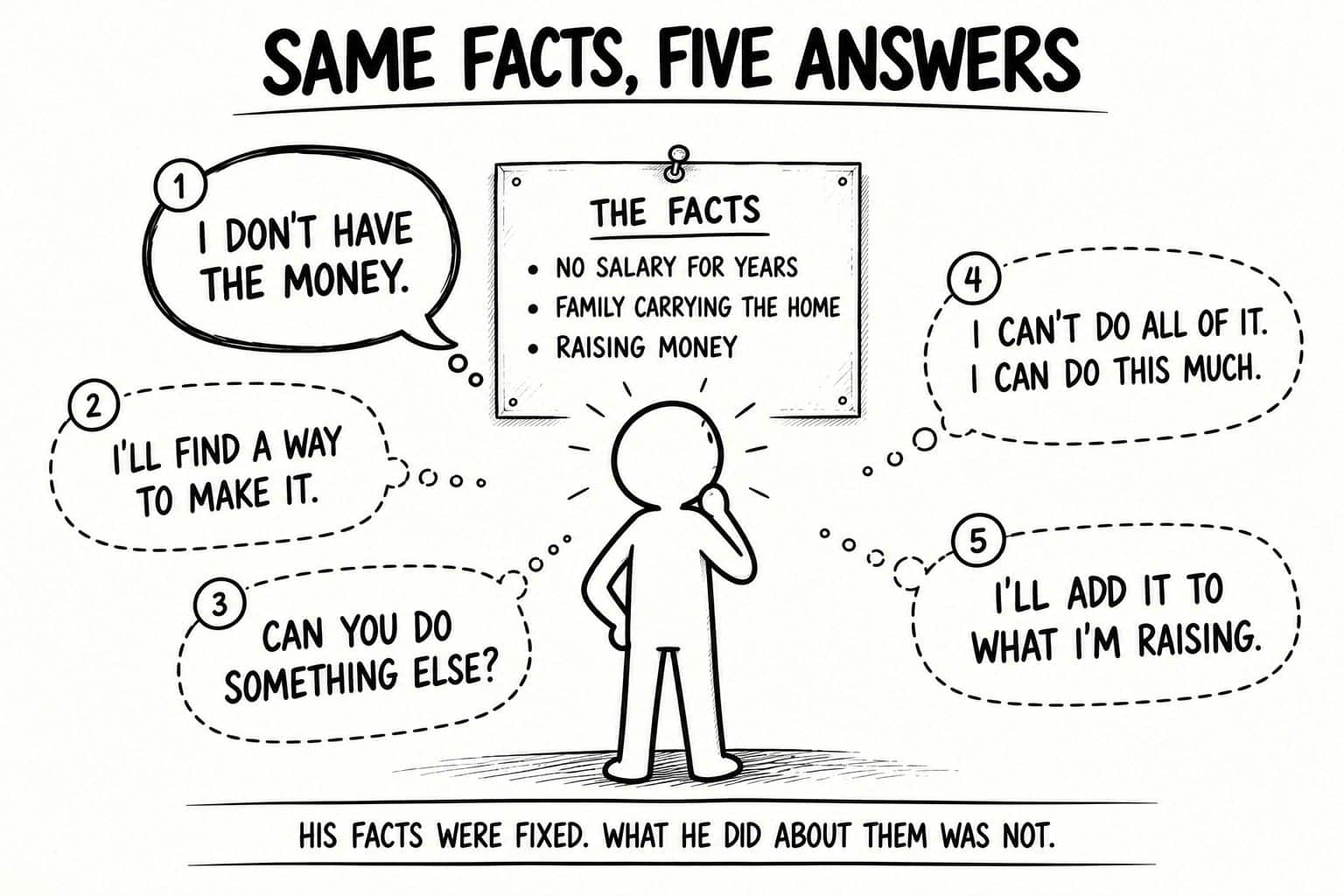
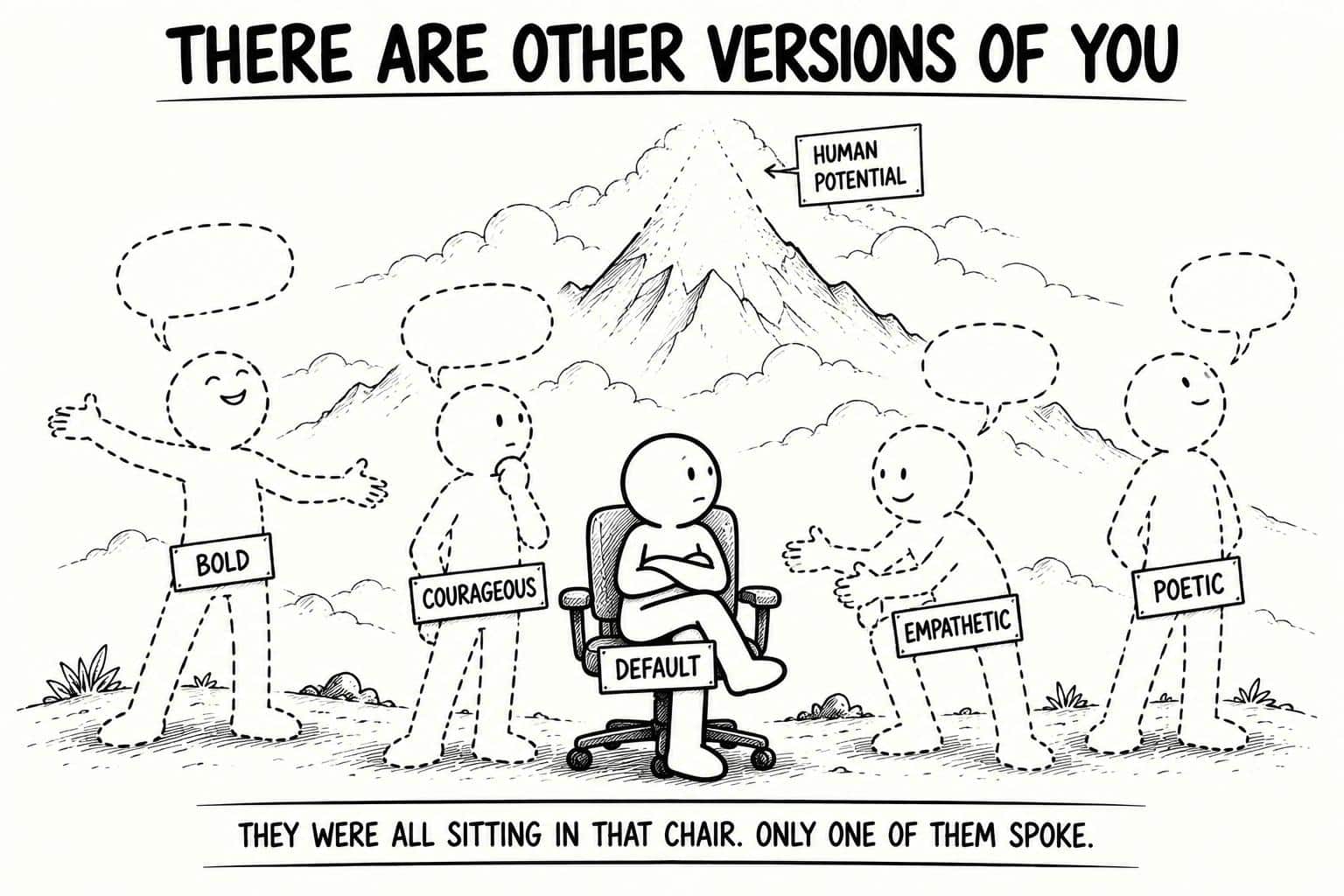
Four answers. The same facts. The same day. Notice what all four have in common. Every one of them asks him to promise something, and the answer he gave me promised nothing. (Leaders make bold promises.) The answer he gave came from the “default” version of him that was living his life. What I know is that “human potential is limitless”. It is like a mountain with no top. Which means that there are different versions (bold, timid, courageous, poetic, empathetic, dominating, etc.) that we can operate from in any given moment (if we realise this).
Once he saw that, a few minutes later, in that same call, he made me an offer. He named a price he could pay. He had found a version of himself who could do that, and he did it live, while we were talking. That takes courage – to operate from a “not default” version of yourself. He did not need more information about his business, because he already had that. What he needed was to know that the other answers existed – and to tap into the BEING who would express those answers.
There Are Other Versions of You
That is what I said to him on the call. Not four options for me to choose from. Four versions of him. On that day, only one of them spoke, and the one who said no was careful and honest. He could defend that answer to anybody. The other four versions were also sitting in that chair with him, and they never got a chance to say anything.
Here is why this is bigger than one call about money. We all do the same thing every day, in every part of our life. We do it at work. We do it at home. Most of the time we do not even notice it happening.
95% of Human Behaviour is Habitual or Subconscious
So why did only one answer come out? Because it was the easiest one to say. It asked nothing of him. It needed no courage. It needed no hard conversation. If anybody questioned him, he had facts to show them. That is easy to build a habit around, and habits like these run us on autopilot most of our days.
The others were unfamiliar and hence harder for him. They asked him to take on more. They turned him into someone who had made a promise and now had to keep it. So the easy answer wins, not because it is better, but because it is the easiest one to reach for, and that will keep happening for the rest of your life unless you go looking for “who else you could BE – with the same facts?”
Same Facts, Different You
This is the part I want you to take into your own life. Nothing about his situation changed. What changed was which version of him spoke. And the same thing is true for you, in every situation you are in, especially in situations when you do not get what you want.
- Say your best customer asks for a discount. You can say yes and keep them happy. You can say no and keep your price. Or you can ask what they would want if they paid more and got more, and change the deal. Same customer, same problem, different yous.
- Say the best person on your team tells you they are leaving. You can accept it and start looking for someone new. You can offer them more money. Or you can change the job so it is worth staying for, and tell them honestly that is what you are doing. The first one needs nothing. The last one needs a leader.
- Say someone you work with is not doing their job. You can hope it gets better. You can mention it carefully and then drop it. Or you can tell them exactly what you need, what you will do if nothing changes, and what you will do to help them get there.
- Say you want something bigger than anyone in your industry has done. You can wait until you feel ready. You can promise only what you are sure about. Or you can commit to a vision & the number that scares you, and then go and become the person who can deliver it. All of these are equally possible for you, just as much as your default way of BEING.
In every one of those, there are three versions of you, and the one that shows up is the one you reach for out of habit. The facts do not have to change. Only who you show up as and what you ask of yourself has to.
Why You Can Only Use What You Can See
Two psychologists, Hazel Markus and Paula Nurius, studied the way people think about who they could become. Every one of us carries several pictures of ourselves in our head. There is who we are now, and there is who we might become. But here is the important part. The pictures that change what we actually do are the ones we can see clearly. If you can describe it and hear the sentences it would say, it starts to pull you towards it. If it is just a vague feeling, nothing happens. You cannot become a version of yourself that you cannot picture.
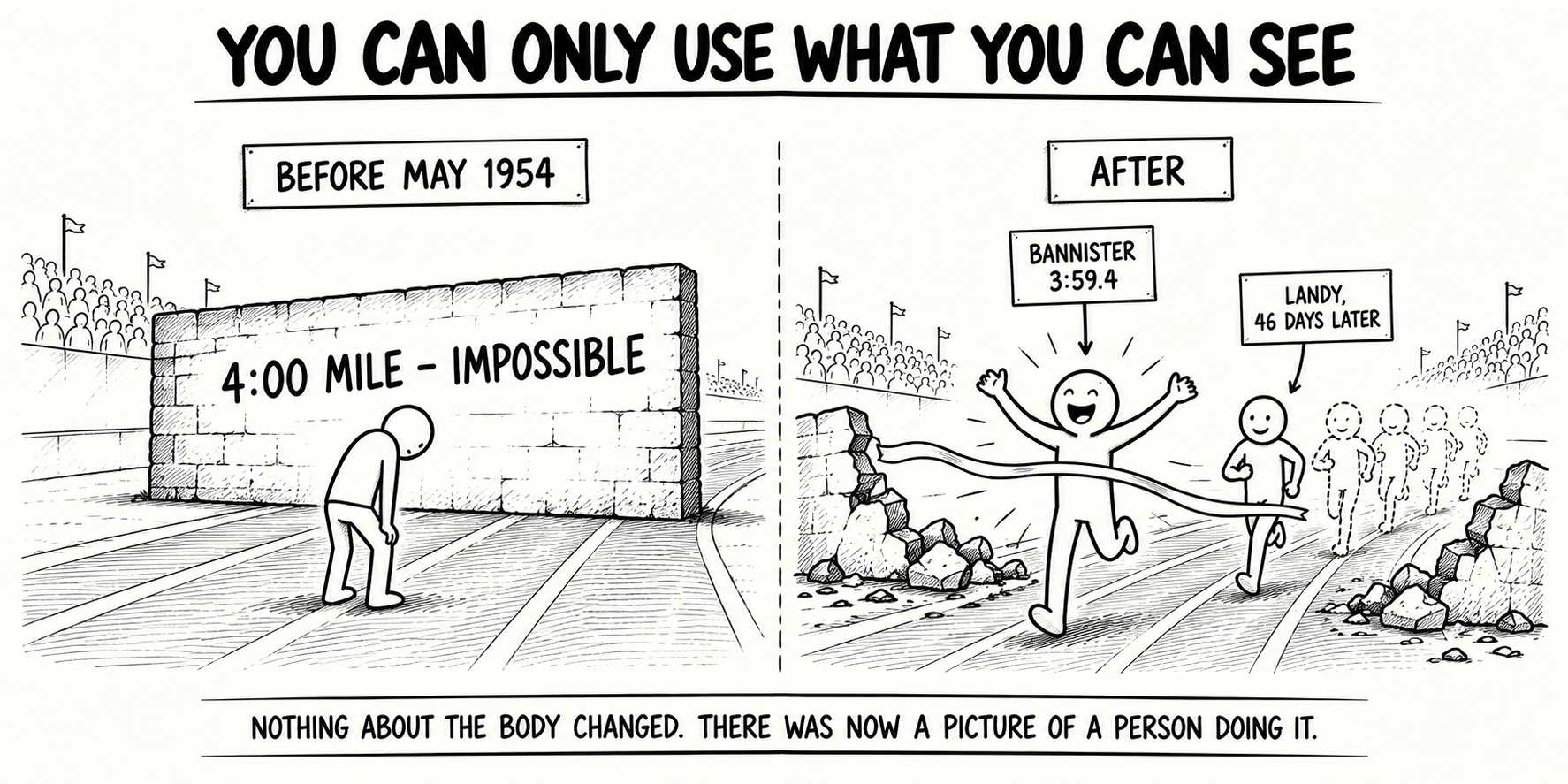
You can see this in sport too. For many years, runners believed that nobody could run a mile in under four minutes. Then Roger Bannister did it in May 1954, and forty-six days later, another runner, John Landy, did it as well. Nothing about the human body changed in those six weeks. What changed was that there was now a picture of a person doing it.
So look at your own life for a moment. Every version of you that could handle your situation is already possible, but only the ones you can picture will ever get used. That is what I was doing on that call and what I do with leaders and companies alike. I was not selling him anything. I was showing him four versions of himself and asking him to choose – given his dreams and ambitions.
Practice Practice Practice
Albert Bandura spent his whole career studying one question. What makes a person believe they can do something? His answer has stayed with me. The best way to believe you can do something is to have already done it. Being told you can do it does not help much. Imagining it does not help much either. Doing it once changes everything.
That is why I tell people that confidence is never needed to start. Confidence is what you get after you start. Herminia Ibarra says the same thing about leadership. In her book Act Like a Leader, Think Like a Leader, she explains that people grow into bigger roles by trying the new behaviour first, and then their idea of themselves catches up. Not the other way around.
The founder on that call gave me the everyday version of this himself. He had started playing badminton again after years away, and he said he only began to feel steady once he had played well a few times and won a few matches. That is how it works for all of us. You do not get to feel ready first.
What It Costs
A bigger version of you makes promises. Then you have to keep them. That is the price. It is also why this is not about being arrogant. It is about being accountable. If you commit to more, you have to show up on the day you do not feel like it. This is what leadership is. It asks more from you, and more of you.
I have been on both sides of this. A couple of years ago I was in a meeting with a CEO, and he said to me, let’s negotiate. The old me would have heard that as a threat and started defending my price. Instead, I said, let’s go up. How much more do you want to pay? We both laughed, and we still work together today two years later. What made that possible was not force. It was that I “danced” with the conversation and I knew there are infinite ways to show up and respond to his ask to negotiate.
The Practice
Do this on paper, in one sitting. It takes about forty minutes.
- Write down what you actually want. Not for this month. The big thing. Where you want to be in five years. Choose the version of you that the big thing needs, not the version you feel like today.
- Pick one conversation from this week where you gave the easy answer. Write the facts of it in one line. Only the facts.
- Write five versions of you answering it. Not five options for the other person. Five ways you could behave. Include the one that sounds unreasonable, the one that needs a promise you would have to keep, and the one you would never say out loud.
- Number them from 1 to 5. One is safe. Five is the one that scares you. Then write down what version five would have to believe about themselves to say it.
- Use one of them within seven days. Ask for the bigger number. Ask for something for free. Offer something you would normally not offer. It can be big or small. Doing it is the point.
- Write down what happened, then do it again. Doing it once is an experiment. Doing it again and again is how it becomes who you are.
The facts were never the problem, and they never will be.
There is never only one answer. There is always another one. You just have to be willing to make the bigger offer, and then be the person who keeps it. So the next time something comes up, and it will come up this week, ask yourself one question before you answer.
Which version of you turned up?
And then ask the more powerful question. Which one could have?
Sources
- Markus, H., & Nurius, P. (1986). “Possible Selves.” American Psychologist, 41(9), 954-969. How we carry several pictures of who we might become, and why only the ones we can see clearly change what we do. Open-access summary
- Bandura, A. Self-efficacy. The belief that you can do something is built mostly by having done it, not by being told. Overview
- Ibarra, H. (2015). Act Like a Leader, Think Like a Leader. Harvard Business Review Press. Why acting first and becoming second works better than the other way round. Author overview
- Four-minute mile. Roger Bannister, 6 May 1954, Iffley Road, Oxford, 3:59.4. John Landy, 21 June 1954, Turku, 3:57.9. Overview
Leave a Reply