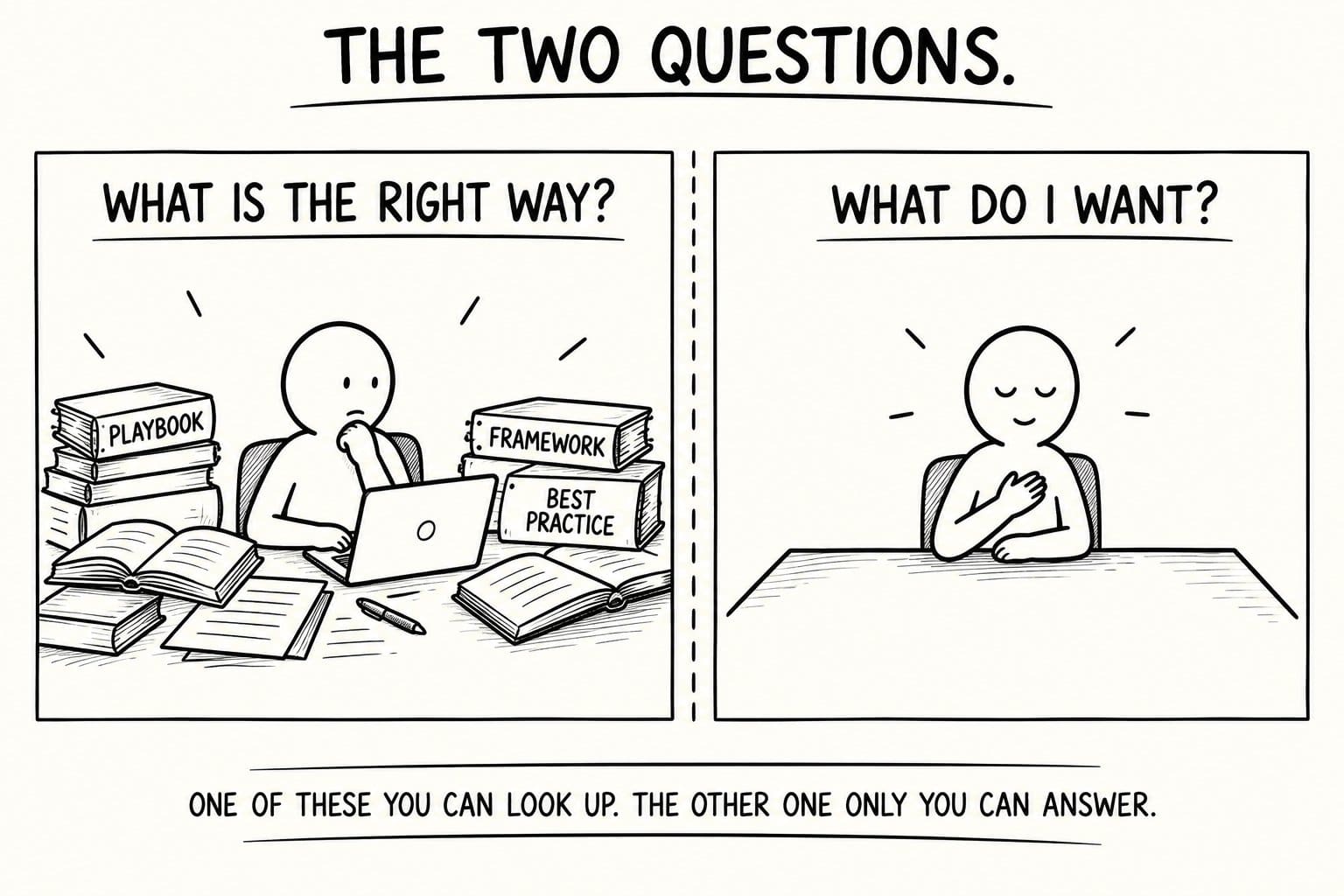
I keep having the same conversation with CEOs and entrepreneurs. They are working through a real decision with me. A hire, a new market, a product they are about to kill. And every question they ask is about what the right way would be. What the playbook says. What the best operators do.
So I stop them and ask: Forget about the “right way”. What do you want to do?
And there is a pause. Every time. It is not because they can’t answer that question. These are capable people who have built real things. The pause is there because they have not asked themselves what they want to do for a long time now. It used to be: what do I want to build here? Now it is: what is the correct way to build it?
Nothing Wrong With Efficiency Or Optimising
There is nothing wrong with “getting it right”. For most people reading this, it is the reason you have the life you are living today. It got you out of difficult situations. It built the company.
I grew up this way too. My only job was getting my family out of poverty, and every rupee had somewhere to go before it arrived. I optimised my life to get better, ahead, and super productive. That habit worked. It did exactly what it was supposed to do. And I did not stop at the money. I became a productivity and efficiency freak. I optimised every minute of my day. I got a real kick out of it – every single time I made something faster or more efficient than it was before.
It saved me. And then it nearly ate me.
“There is more to life than increasing its speed.” — Mahatma Gandhi
What it costs, and why you can’t see it
Here is what happens when a useful habit becomes the only way you know how to live.
You bend yourself to fit the correct or the right version. You might have learned that from a mentor, a book, an old boss, or your industry. You also worked out your own ways of optimising life. You run your life now on autopilot on these “rules”.
The thing that makes you different gets cut. We all have odd habits and ways of working that make sense to nobody but us. On any productivity list, they are the least efficient items. They were also the only things nobody could copy. Keep removing them, and what is left of who you are? What happens to your unique expression?
You forget how to want things. You stop wanting for its own sake, and start wanting the correct things or to get it right or to get somewhere.
Somebody else becomes the judge. You give your own authority to something or somebody outside of you. A framework, a peer, a set of rules, a spreadsheet.
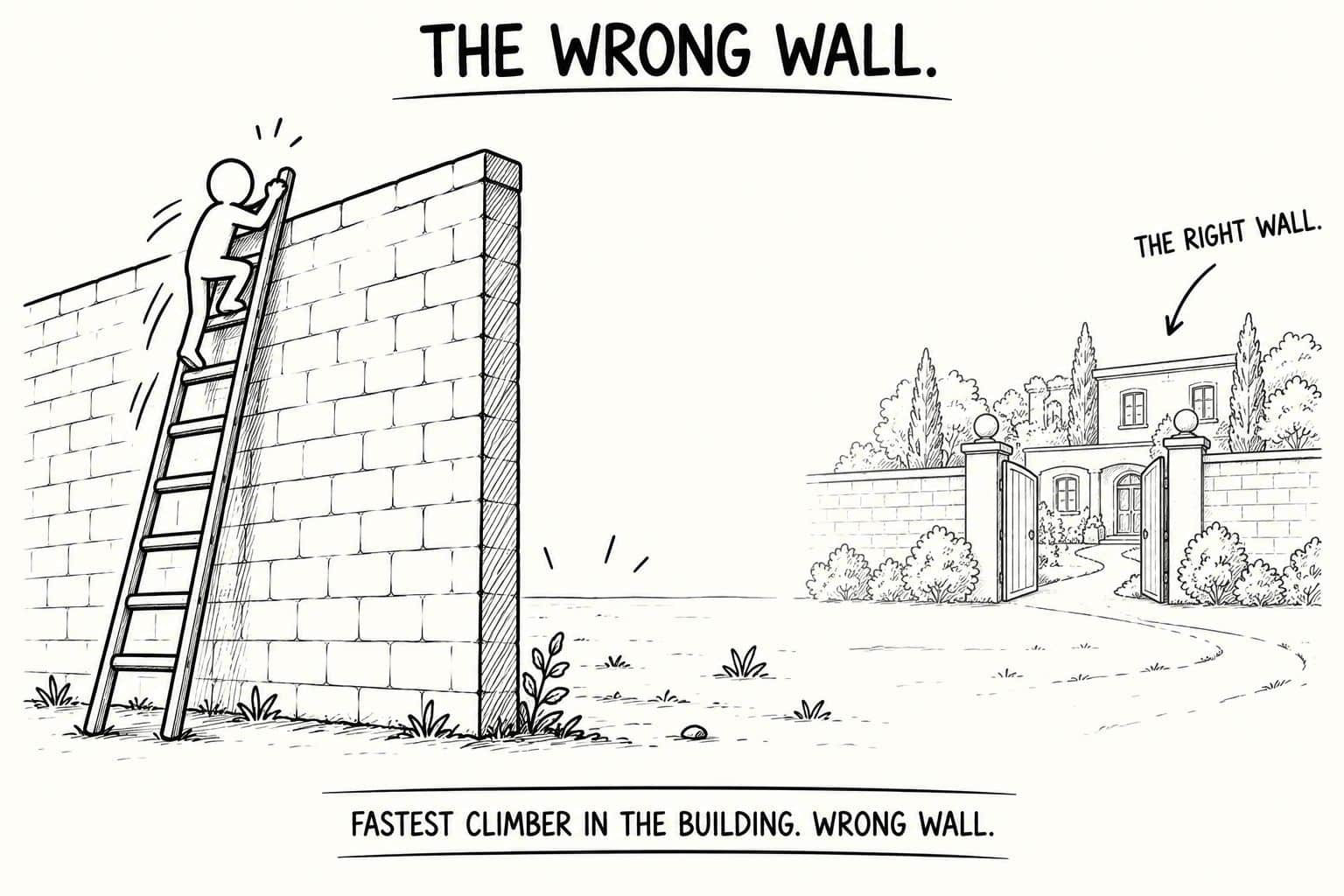
And you get very good at living a life that is super optimised but not yours anymore. Stephen Covey said it long before I did. Getting better and better will get you up the ladder faster than anybody around you. It will never once tell you if the ladder is leaning against the wrong wall.
Michael Neill says, “There is a way of living that fits you so perfectly it feels as though it was made for you.” His work is about turning up the volume on your own voice and telling it apart from the noise. That noise is not only other people. A lot of it is your own old life lessons, learnings and assumptions, still playing loudly, long after the situation that needed them has gone.
Somebody just made all of this up
Everything you are bending yourself to fit – the industry standard, the right way to run a company, the correct career path, the normal working week, how long a decision should take, any best practice – somebody made that up. It is not physics. Someone decided it once, usually for reasons that stopped making sense years ago. Everyone since has been copying. The people we call innovators are usually not smarter than you. They just noticed the rules were written by people who came before them.
The biologist Humberto Maturana put it in five words: “Everything said is said by someone.” Every rule you have came out of some person’s mouth in some particular year. Steve Jobs said it, back in 1994:
“Everything around you that you call life was made up by people that were no smarter than you. And you can change it, you can influence it, you can build your own things that other people can use.”
Every “that’s just how this industry works” you have ever accepted was somebody’s opinion. Payment terms. Margins. How you hire? What a proposal looks like? How many people you need in marketing, sales, engineering, and so on?
So is it good or bad to optimise?
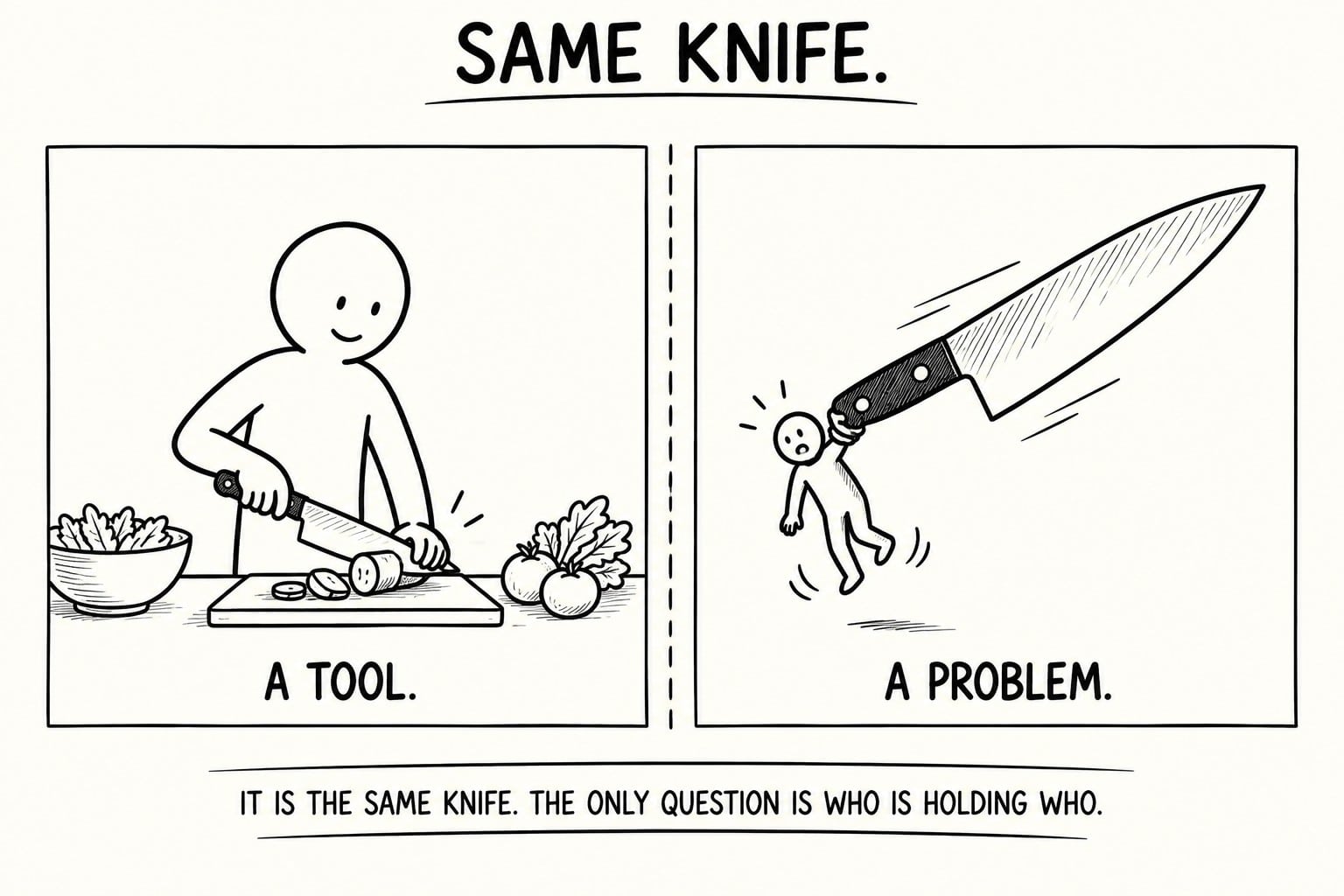
Neither. It depends on whether you are in charge or the optimisation is in charge.
- As a tool: you choose to use whatever optimisation strategy you have. You know what an hour of your time is worth, so you decide better and faster. If you are in charge, you can also choose not to use your best frameworks and best practices at will.
- As a master: your strategies use you. You do the correct thing because it is correct, and you cannot imagine doing anything else. In other words, you do not have a choice. You feel compelled to do everything the “right” way instead of “your” way.
Reflect on this question:
When the efficient way and your true way disagree – which one wins, and what is the cost of that?
What is actually on the other side
People assume doing it your way means a worse result. Usually the opposite happens. When you do it your own way:
- Nobody can copy you. Best practice is what everybody else is already doing. Nobody can copy your own unique way.
- Decisions get faster. Not because you found a better process. Because you simply intuitively know – without reason or justification.
- No stress or exhaustion. Performing takes energy all day. Being yourself costs nothing.
- You find “your people”. State your terms and the right people come closer, not fewer. I state my conditions in the first conversation now. If that costs me a client on that call, it is always the wrong client.
“Don’t ask yourself what the world needs. Ask yourself what makes you come alive, and go do that, because what the world needs is people who have come alive.”
— Howard Thurman
And sometimes you lead the way for others
Doing it your way is not only a private decision. Often it becomes the new normal for everybody else. Every unique path looks silly right up until the moment it doesn’t.
Dr. Govindappa Venkataswamy opened an eleven-bed eye hospital in Madurai in 1976, after he had already retired. Everyone told him the model made no sense: paying patients would fund free surgery for everyone who could not pay, same doctors, same quality, both wards. Aravind is now studied in business schools around the world.
Yvon Chouinard built Patagonia around the idea that his staff should go surfing when the waves were good. He wrote a book about it called Let My People Go Surfing. Every serious businessman of the day called it slack. It became one of the most admired companies on the planet, and in 2022 he gave it away so the planet itself became the only shareholder.
Ricardo Semler let people at his Brazilian company set their own hours, then their own salaries. No titles, almost no rules. Everyone said it would fall apart. It didn’t.
None of them found a clever new theory. They refused to do one normal thing, and then did it their own unique way – just because they wanted to.
A life that feels good to live
If you think that your way might work out better, that is its own trap. It sounds like a promise: be yourself, and you will win. I am not saying that. What I am saying is that there is a difference between a well-optimised life that looks good on paper and a life that feels good to live.
Photography is the least productive thing I do. It makes me no money. It moves nothing forward. It is a dying craft and skill in the age of smartphone cameras. On any list of how I should spend a Saturday, it does not appear. Being an engineer, I should never have picked it up.
Yet, it also saved my life. When I lost my mother, I had nothing that helped and nothing to say. I had a camera. Walking around with it was the only thing that gave me any peace for a long time. The most useless thing I did turned out to be the thing that I love most today – for no reason and in a way that I can not explain.
Vivian Maier was a nanny in Chicago for forty years. In her free time, she took over a hundred thousand photographs and showed them to almost nobody. After she died, someone found the negatives in a storage locker. She is now called one of the great street photographers of the century. She never knew any of that. And it was a good life while she was living it, whether anybody found that box or not.
You do not have to be famous to live life your way
Chouinard and Semler have big companies attached to their names. Most of us do not. So below are examples of people who were nobody in particular, and who only got noticed because of the odd thing they refused to stop doing.
- Nek Chand was a roads inspector in Chandigarh. For eighteen years, in his spare time, he secretly built a garden of sculptures out of waste and broken pottery on protected land where nothing was allowed to be built. The city wanted to demolish it. Instead, it became the famous Rock Garden that I visited in my childhood, and have not been able to forget since.
- Lucky Wong ran a diner in San Diego alone for nearly fifty years. Cook, waiter and busboy. He took orders in his head instead of writing them down. He refused to hire anybody, and refused to let a single item on the menu cross ten dollars. When he died, the city renamed a street after him.
None of them had a strategy. Each lived life their way for decades while other people questioned it. As simple as that.
Think about the people you remember from your own life. Not the most successful ones. The most alive ones. Almost none were the most optimised person in the room. They were unmistakably themselves, and you could feel it within ten seconds. That is what stayed with you – who they were – with their quirks. Not their results or achievements.
Nobody has ever said, at the end, that they wish they had run a more optimised life. People say they wish they had been more themselves, earlier.
The Practice
Here is how to practice living life your way in five steps.
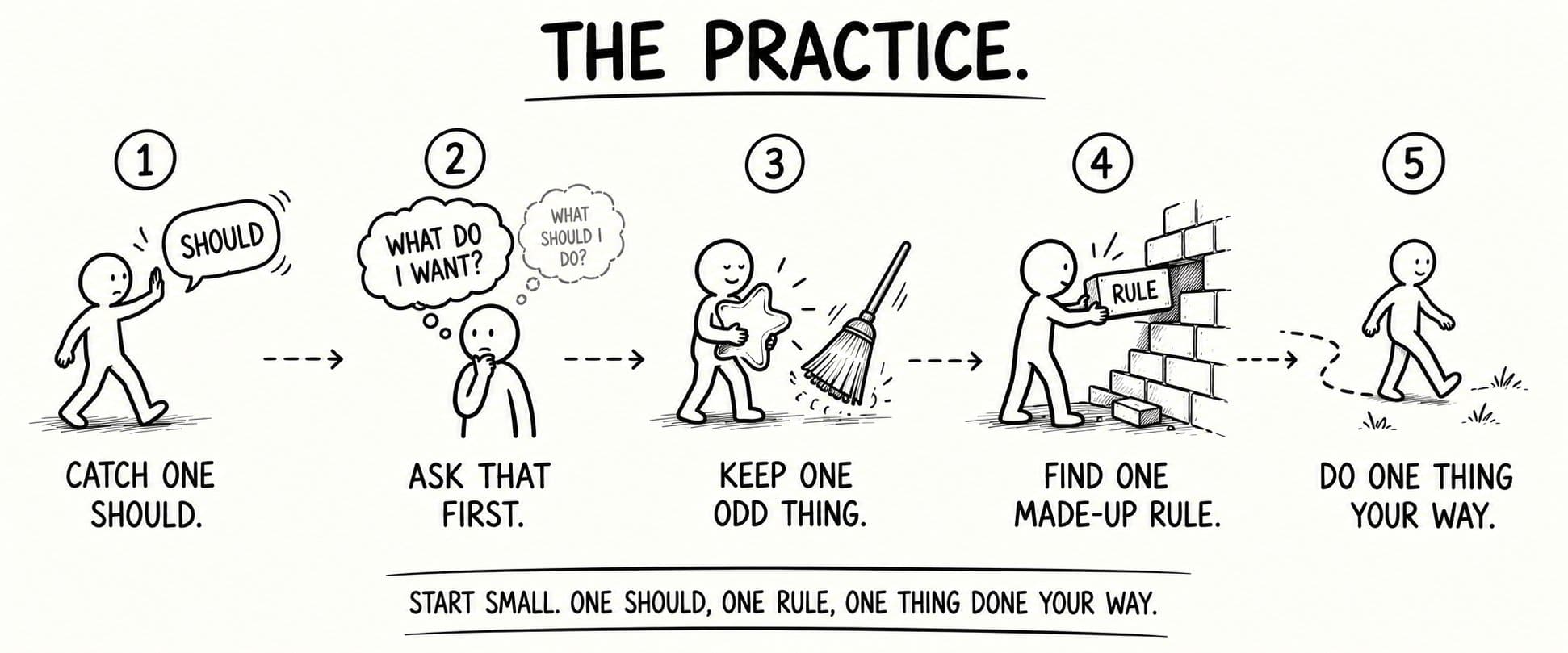
- Catch one “should” a day. Notice when you are about to do something only because it is the right way. Just notice it. Do not change anything yet.
- Ask: What do I want? Before your next decision, ask what do I want here before you ask what is the best approach. Both questions. In that order.
- Keep one inefficient thing. Find something you do that makes no sense on paper, and you love it. That is usually where your edge lives.
- Find one rule that is just somebody’s opinion. Something your industry treats as fixed. Work out who decided it and whether you still agree. Then change one this week.
- Do one thing your way where you would normally do it the accepted way. Keep it small. Then watch what actually happens.
That CEO could not answer “what do you want” because he had spent fifteen years getting extremely good at “what is the correct way”. You do not have to stop getting better at things. You just have to stop letting that decide who you are. The world you are trying to fit into was made up by people no smarter than you. There is a way of life that will feel like you were born to live that way. You will not find it by doing everything properly.
Sources
- Neill, M. Your Life, Your Way. https://www.michaelneill.org/yourlifeyourway/
- Covey, S. The 7 Habits of Highly Effective People. https://en.wikipedia.org/wiki/The_7_Habits_of_Highly_Effective_People
- Maturana, H. & Varela, F. “Everything said is said by someone.” https://en.wikipedia.org/wiki/Humberto_Maturana
- Jobs, S. (1994). Santa Clara Valley Historical Association interview. https://www.inc.com/peter-economy/steve-jobs-on-the-1-remarkably-simple-secret-of-life.html
- Venkataswamy, G. Aravind Eye Hospitals, Madurai. https://en.wikipedia.org/wiki/Aravind_Eye_Hospitals
- Chouinard, Y. Let My People Go Surfing. https://www.goodreads.com/book/show/22155.Let_My_People_Go_Surfing
- Semler, R. Maverick, Semco. https://en.wikipedia.org/wiki/Ricardo_Semler
- Chand, N. The Rock Garden of Chandigarh. https://en.wikipedia.org/wiki/Nek_Chand
- Wong, L. Lucky’s Breakfast, San Diego. https://www.kpbs.org/podcasts/the-finest/the-story-of-lucky-wong-and-his-legendary-one-man-diner-in-san-diego
- Maier, V. https://en.wikipedia.org/wiki/Vivian_Maier
Leave a Reply