
A founder of two businesses I work with spent four days last week rebuilding how his company runs. This is what he did.
- Friday. He pulled his leadership team together and asked each of them for three real improvements to the business, not firefighting, not shaving time off something that already works. Actual structural change.
- Sunday. The answers came in.
- Monday. They went through every point together, out loud, in front of each other. 33 proposals became 12. Then he pushed on the timelines. Everything had come in at 30-60 days, and he kept asking the same question – why sixty days? Within an hour, most had shrunk to fifteen or thirty days, with a few remaining at sixty.
- Tuesday. He gave his second business a 120-day launch date, after months of it sitting at “almost ready.”
It was genuinely powerful work. So I asked him one question. If this keeps going for a year, how much money does it make you?
He went quiet. Then he said: “I haven’t really thought about it, honestly.” He had just shifted what & how his whole company works. And he had no idea how it would change his business financially.
The number he had never looked at
So we did the maths together on the call. It took about a minute.
- Year one: around five million dollars added to his top line, from those four days alone.
- It compounds. The change is structural, so it carries forward.
- In the next five years: somewhere around fifty million dollars of value unlocked, as he and his team get better at it.
And here is the part that matters more: his team still doesn’t know it. They did the work. They came up with the initiatives. They cut the weak ones and squeezed the timelines. And not one of them has any idea what difference they were actually making to the business. They think they had a good Monday.
I see this in more companies than I would like to admit. And this is not a small thing. As leaders, if we don’t bring in financial clarity alongside operational clarity, we are withholding useful information from the people doing the work. And without financial clarity, how can these leaders make good decisions and avoid mediocre ones?
I want to be clear that this is not a criticism. It is not natural to think this way. Nobody teaches it – not at school, not at home, and B-schools and management training tell you nothing about the financial value of your own time and decisions. And it is one of the most important parts of leading any entrepreneurial venture.
“It’s not about the money for me”
Then he said: “Sumit, it’s not about the money for me.“
Good. It isn’t about the money for me either. That’s not what this is about.
Here is the thing. To play & be effective at any game, you have to know and understand the rules. The game of business is played with money. You didn’t pick that, and neither did I. It is simply how it works. Money is how the game of business keeps score. It is not the reason to play. It is the scorecard.
You can hate the rules. You can want to change them. You still have to know them. And if you really want to win, you need to understand the rules better than the average leader. Nobody walks onto a football pitch without knowing what offside means. You would look silly. You would lose, and you wouldn’t even know why you lost.
People run companies like this every day:
They don’t know what an hour of their time is worth. They don’t know their real margin. They don’t know what a month of delay costs. They don’t realise the financial upside or downside of their decisions. And nobody questions that (that drives me nuts).
Then they wonder why the business isn’t growing faster. If you are bad at this game, you run out of money before you finish. The thing you actually care about: your people, your product, the change you wanted to make, quietly suffers. Money isn’t the point. It is the scoreboard. Not looking at the scoreboard doesn’t make you a better person. It just makes you run blind.
Two halves of the same job
There are two questions you can ask about any piece of work.
- Who will own this, and by when will it be done? Most good operators are excellent at this one.
- What is this worth, and what does waiting cost us? Almost nobody asks this one.
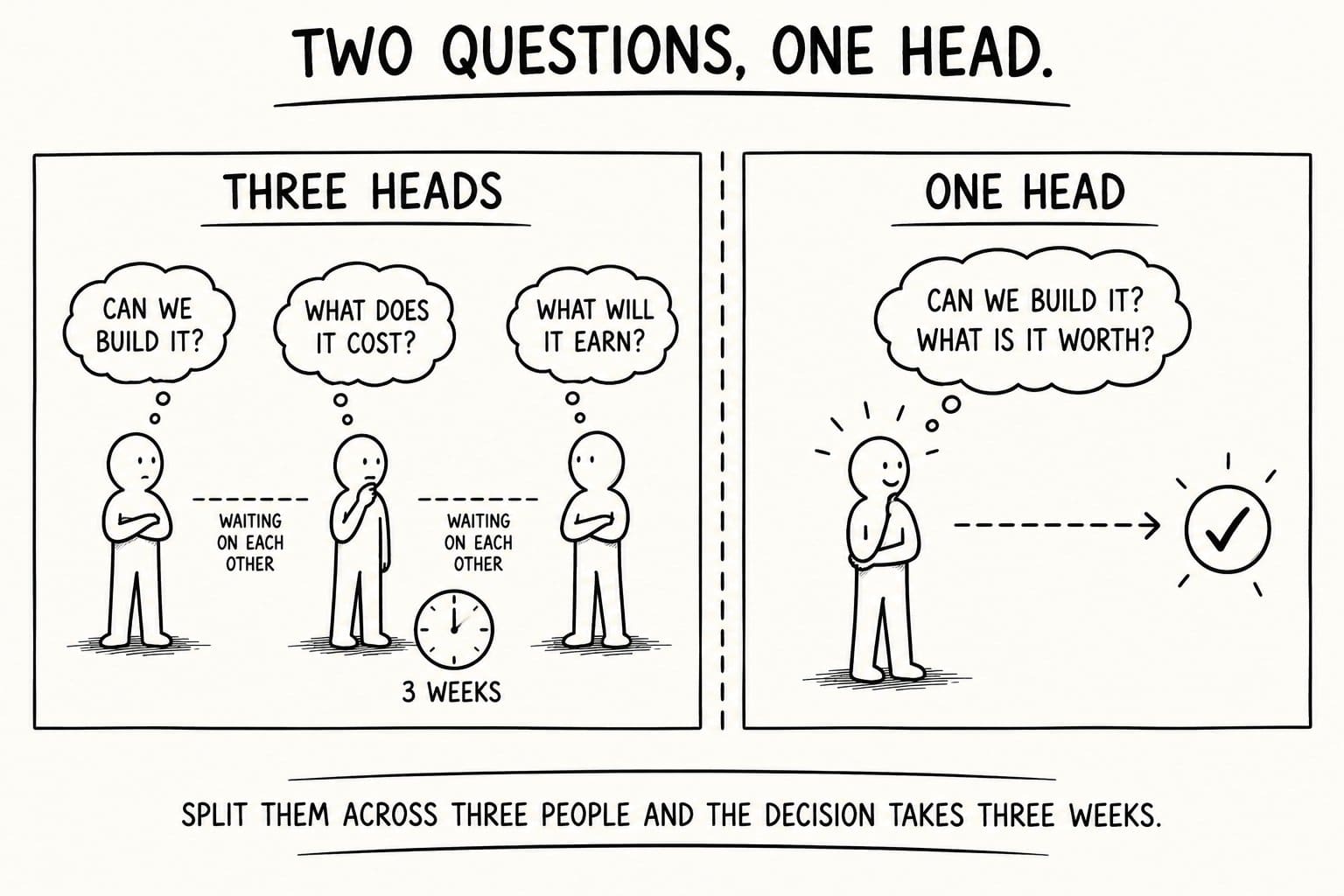
In most companies, the second question is split across three different people:
- Engineering works out what can be built.
- Finance works out what it costs.
- Sales works out what it might earn.
Then everyone waits for everyone else, and the decision takes three weeks. One of the reasons Musk moves the way he does is that finance and engineering sit in the same head. He makes the technical call and understands what it means in money at the same moment, without passing it round a table.
You do not need to be him to do this. You just need to understand the financial value of your work to the business.
So I asked the founder the second question, four different ways:
- If you launch in 120 days instead of 150, what are those thirty days worth in money?
- Does the person running that project know that number? What is the cost of them not knowing?
- When two projects compete for the same team, can they tell you which one is worth more – or only which one is easier?
- Can the people closest to your customers turn what they see into a money case, without you in the room?
A team that only thinks about effort will always choose the safest plan. A team that can put a price on waiting will choose the right one.
What Is Your One Hour Worth?
Almost nobody knows what one hour of their own time is worth. Let’s do this together. Follow the 3 steps below:
- Take the money your work unlocks in a year – for your business or company. (Find out if you do not know that)
- Divide it by the hours you work in a year.
- Look at the number sitting next to one hour.
All my portfolio companies combined do 194M in annual revenue. I am directly involved with the CEOs of each to grow this number. The first time I did the math (194M divided by the 20 hours a month that I work today), I couldn’t believe when the worth of an hour of my time came out to 800k. That changed my whole outlook on where I give my time and what I say NO to.
Do it for yourself, now. Then look honestly at last month. How many hours went into something that did not matter?
A discussion that should have been a decision. A meeting that happened just because it was in the calendar. I catch CEOs whose every single hour is worth $500k or more doing this constantly:
- Booking their own travel.
- Driving themselves across the city through traffic instead of hiring a driver.
- Going down to the gate to deal with a delivery rider.
- Sorting out scheduling or something an assistant could have handled in five minutes.
Ask them why, and the answer is always some version of the same thing: it’s not worth paying someone for that. They think they have saved five hundred euros, maybe a thousand. However, they have just spent an hour that, depending on the size of their business, was worth hundreds of times more than what they saved. Nobody sees it, because the saving is visible and the cost is not.
Elon Musk does the opposite, and the contrast is worth noticing:
- He refused a part priced at twenty-five thousand dollars, because he believed it should cost two. His team actually made it in 2000$ – which is a high-leverage decision, as they have made millions of these parts over the years.
- In the same period, he spent around sixty thousand dollars on jet fuel to fly a part to Hawaii – because it saved a single working day. And a single working day for Tesla is worth 10s of millions of dollars.
He isn’t cheap, and he isn’t extravagant. He is precise. He knows what a day is worth, so he knows when to spend and when to refuse. Most of us are the other way round. We guard the small visible number and give away the large invisible one.
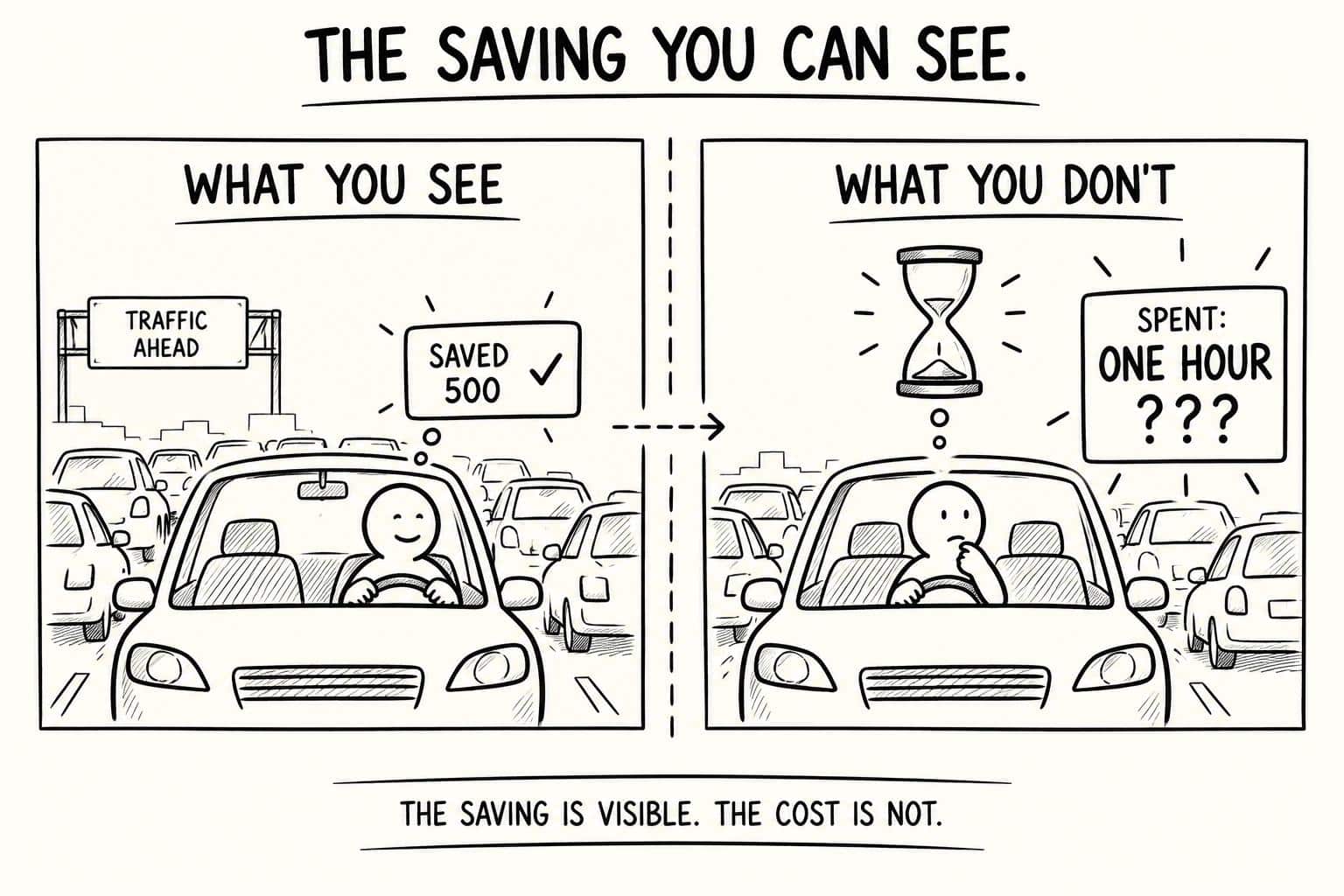
We spend an hour without thinking about it. We would never spend that much cash without thinking about it. They are the same thing. Only one of them shows up in your accounts.
The most expensive words in your company
Once you know the value of one hour of your time, you start hearing words you never noticed before:
- “Soon.”
- “Let’s come back to this.”
- “Let’s see how it goes.”
- “Let’s discuss next week.” – with no day, no time, and nobody named.
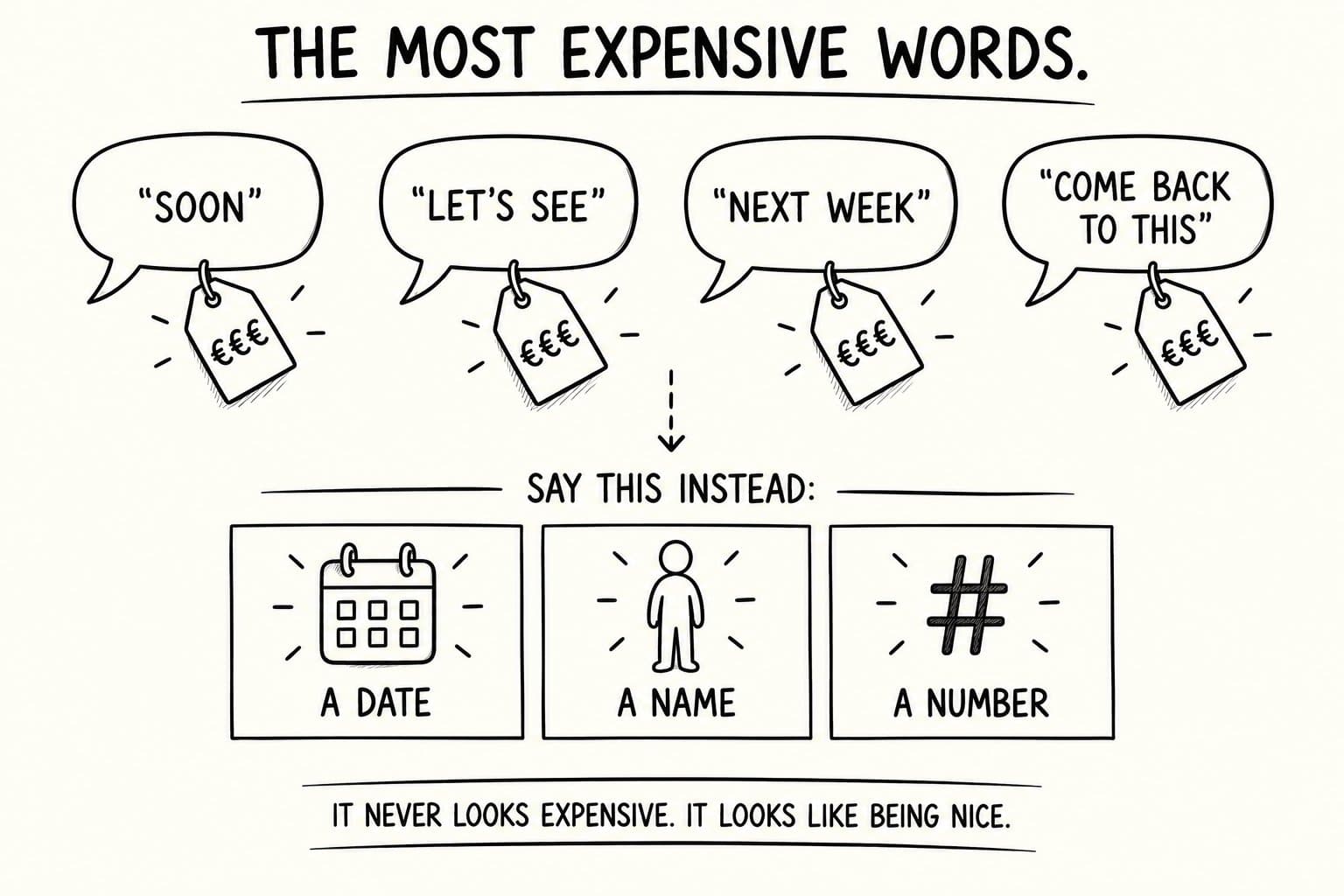
These sound normal. They sound reasonable, even considerate. Every one of them is a decision you just chose not to make, and every one of them has a price. Calculate the cost of waiting for a decision for a few days or weeks. If an hour of your company’s time carries real money, what does a two-week loop cost? What does “let’s see how it goes” cost when it quietly means four more weeks of waiting?
And notice where those words come from. Not laziness:
- From wanting to keep the room comfortable.
- From not wanting to pin a colleague down.
- From not wanting to be the direct person who fixed a date to it.
That is people-pleasing, and it is the most expensive habit in most companies I walk into. It never looks expensive. It looks like being nice and polite to each other.
The fix is not complicated:
- A date instead of “soon.”
- A name instead of “we.”
- A number instead of “let’s see.”
You are not being harsh. You are closing the loop while it is still cheap. You are bringing financial and operational rigour to your company.
What people who do this well actually do
Cost of delay: Donald Reinertsen spent years studying how products actually get built, and his finding: most teams cannot tell you what one week of delay costs them, and when they finally work it out, they change their minds about what to do first. Often immediately.
Jeff Bezos: in his 2016 letter to shareholders, he says to make most decisions with about seventy percent of the information you wish you had. Wait for ninety, and you are too slow. Most decisions can be undone, so being a bit wrong is cheap. His line: “Being slow is going to be expensive for sure.”
Elon Musk: he has put a figure on it. At Tesla’s scale, he says, “every high-quality minute of thinking has a million-dollar impact” – and that there have been half-hour meetings that added a hundred million dollars to the value of the company. You can argue with his arithmetic. You cannot argue with what it does to his behaviour:
- He told every Tesla employee to walk out of a meeting the moment they stop adding anything. Leaving isn’t rude, he said. Making someone sit there is.
- He runs his day in five-minute blocks.
- He goes wherever the biggest bottleneck is, maximising the financial impact of his time, skills and energy.
That is not discipline. That is what happens to a person who knows their worth in exact numbers – and the rules of the game they are playing. None of these three is talking about being productive. They are treating time like money, because how you spend your time either costs or earns you money.
Getting things done finishes the work. Putting a price on it tells you whether the work was worth finishing.
You already know how fast your team can move. Do you know what an hour of that speed is worth?
You are playing the game of business either way. You may as well know the rules.
Sources
- Reinertsen, D. The Principles of Product Development Flow. Cost of delay — why teams that can’t price a week of waiting choose the wrong work first. https://en.wikipedia.org/wiki/Cost_of_delay
- Cost of delay, explained. https://www.pmi.org/disciplined-agile/what-is-the-economic-cost-of-delay-for-software-delivery
- Bezos, J. (2016). Letter to Amazon Shareholders. High-velocity decision making and the 70% rule. https://www.aboutamazon.com/news/company-news/2016-letter-to-shareholders
- Musk, E. (2018). Productivity memo to all Tesla employees. https://www.cnbc.com/2018/04/18/elon-musks-productivity-rules-according-to-tesla-email.html
- Musk, E. The Book of Elon. The million-dollar minute, the jet-fuel trade-off, and bottleneck thinking.
Leave a Reply