Life

  • Don’t Wait for Inspiration or Motivation. Create It Like Winners Do.

    Let me tell you something that’ll piss off a lot of people: You don’t need to feel anything to do the thing.

    I know, I know. The self-help industrial complex has sold us this fairy tale that we need to “find our passion” or “wait for the right energy” or “feel confident first” before we take action.

    Bullshit.

    The 6 AM Gym Test

    Here’s the simplest example in the world: Your alarm goes off at 6 AM. You promised yourself you’d hit the gym. But guess what? You don’t feel like it. Your bed is warm. Your body is tired. Zero motivation. Zero confidence. Zero inspiration.

    So here is my question to you – Can you still go to the gym even if you are tired, do not feel motivated or inspired when you get up?

    Is it still possible for you literally move your body from the bed to the gym without the feeling of motivation or inspiration?

    If you are being honest with yourself, the answer is YES.

    No feeling stops you from doing anything. And that is what WINNERS do.

    Winners put on their shoes and go anyway.

    Losers scroll Instagram for 45 minutes reading motivational quotes about how they need to “wait until they feel ready.” Then they wonder why nothing changes.

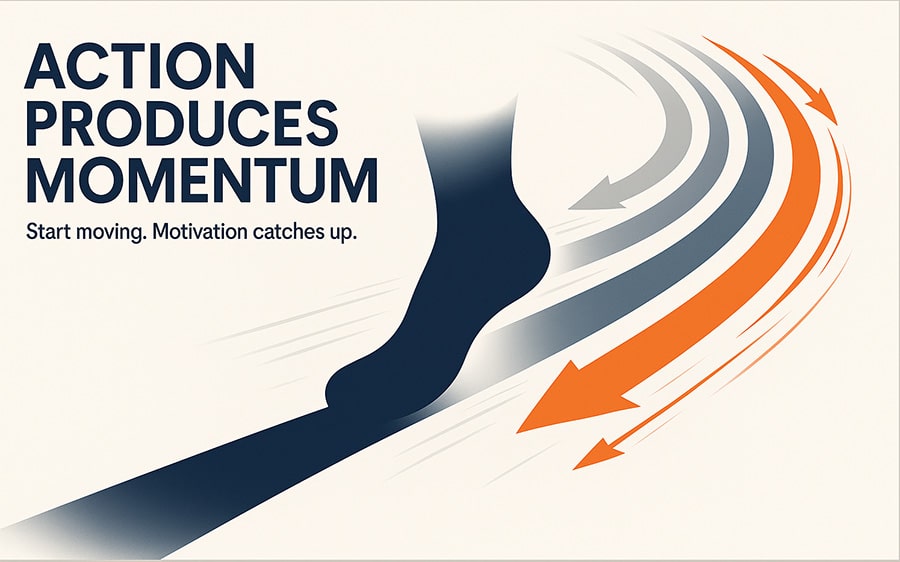
    The paradox that champions understand and losers refuse to accept: Action produces momentum. Not the other way around.

    Motivation doesn’t create action. Action creates motivation.

    Confidence doesn’t create results. Results create confidence.

    Inspiration doesn’t fuel movement. Movement fuels inspiration.
    Stop Waiting for Feelings

    We’ve been sold this romantic nonsense that we need to feel a certain way before we can act.

    Let me destroy this myth right now:

    Feelings are irrelevant to action.

    You can act without feeling ready. You can act without feeling confident. You can act without feeling motivated. You can act without feeling inspired.

    Winners do it every single day.

    I’ll give you my own example: I stopped myself from coaching CEOs full-time for 8 years because I kept saying “I’m not confident.”

    Like I needed some magical confidence certificate before I could help people. The regret of those 8 years almost killed me – I was living, though I was not really alive in those 8 years.

    You know what happened in 2021? I stopped waiting and started coaching leaders anyway.

    More than 2500 hours of coaching leaders and teams since 2021 (as of Oct 2025).

    And guess what showed up AFTER I took action? The confidence I thought I needed BEFORE.

    I had it backwards. Most people do.

    Confidence is an outcome of taking action, not a prerequisite.

    This is what I get paid to tell champions and winners. And yes, when I say this stuff, losers rise up in arms. They’ll tell me I’m being insensitive. Not honoring their “process.”

    Cool. Let them stay stuck.

    The Language That Keeps You Weak

    Listen to how people (including me) trap themselves with words:

    • “I’m waiting for confidence to show up”
    • “I don’t feel ready yet”
    • “When I’m motivated, I’ll start”
    • “I need to feel inspired first”

    Every single one of these phrases is a delay tactic. You’ve just give the power away to the feelings of your life.

    Now listen to how winners talk:

    • “I’m doing it no matter what happens”
    • “I’m starting before I’m ready”
    • “I’m acting regardless of how I feel”
    • “I’m moving, and momentum will follow”
    • “I am willing to look like a fool, but I am not waiting”

    See the difference? One group waits for permission from their feelings. The other group understands that feelings follow action, not the other way around.

    Your language creates your reality.

    When you speak like someone waiting to feel good enough, you’ll spend your life waiting.

    When you speak like someone who acts first and lets results speak, you become unstoppable.
    The Success Journal: Your Evidence File

    Here’s a tactical move that separates amateurs from professionals:

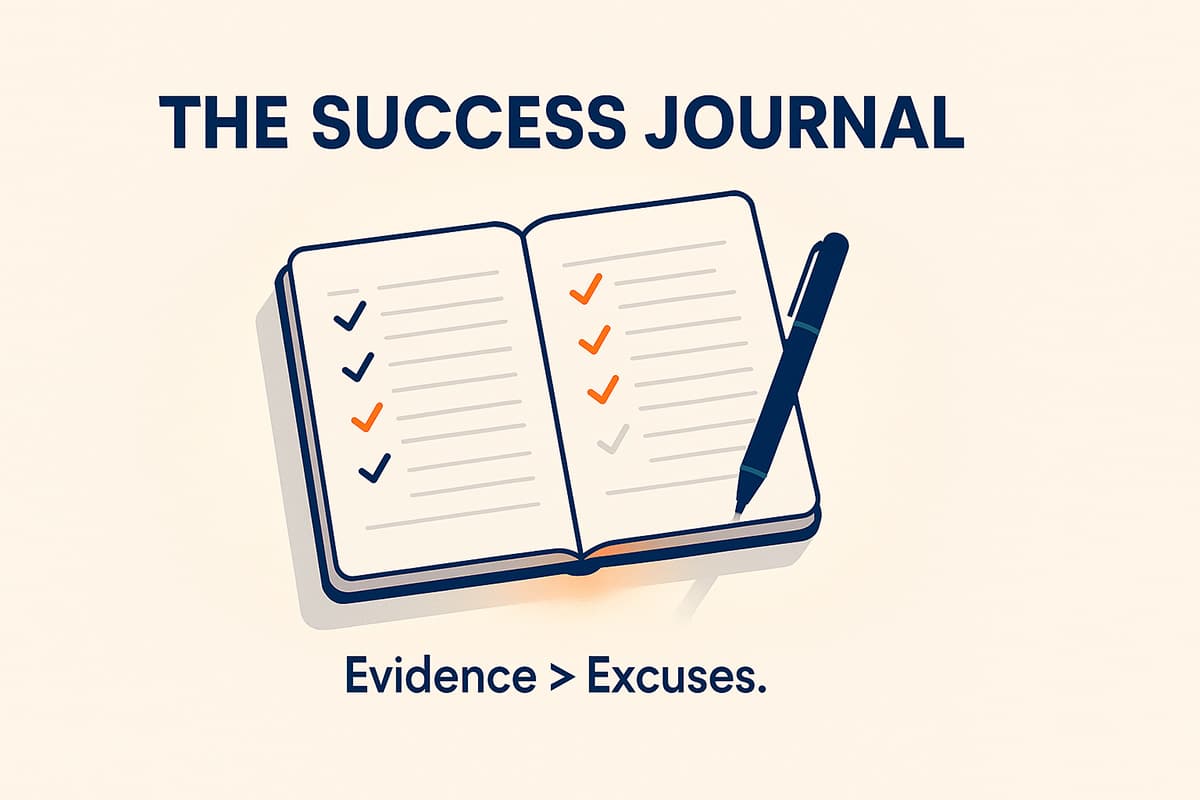
    Create a Success Journal.

    Not to track your feelings. Not to journal about your “journey.” But to document the evidence that you’re already powerful.

    What Goes In Your Success Journal:

    • Every time you acted despite not feeling ready
    • Every win—big or small—where you delivered results
    • Every problem you solved that you thought you couldn’t
    • Every promise you kept to yourself
    • Every moment you chose action over comfort
    • Every proof point that you’re capable
    • Every praise, appreciation or acknowledgement you received.

    Why This Works:

    Most people forget their own power. They forget what they’ve already accomplished. They dismiss their wins and obsess over their gaps.

    (this is not wrong. this is natural. the number one purpose of the brain is to keep us safe – and it does by focusing on the negatives – the failures; instead of the positives – the successes)

    Your Success Journal is your evidence file. It reminds you of a simple truth:

    You’re already powerful. You’ve already done hard things. You can do them again.

    When you’re about to delay on something important, open that journal. Don’t read it to “get motivated.” (that’s a trap)

    Read it to remember who you actually are.

    Action First. Always.

    Here’s the uncomfortable truth that champions embrace:

    Action comes first. Everything else follows.

    You don’t act AFTER you feel ready. You act, and readiness shows up later.

    You don’t act AFTER you feel confident. You act, and confidence builds with each rep.

    You don’t act AFTER you feel motivated. You act, and motivation appears as momentum builds.

    Think about the last time you crushed something. Did the good feelings come before or after?

    After. Always after.

    So when you’re lying in bed at 6 AM, here’s what you do:

    1. Notice the absence of feeling without obeying it. “I notice I don’t feel like going. And I’m going anyway.”
    2. Open your Success Journal. Read one entry. Remember you’ve done harder things.
    3. Move immediately. Sit up. Stand up. Put on your shoes. Small actions create momentum.
    4. Keep the promise you made. Not because you feel like it. Because you said you would. (otherwise you are teaching yourself that you can not count on yourself)

    That’s integrity. That’s power. That’s how winners operate.

    “Ready” Will Never Come

    Let me be brutally honest with you:

    “Ready” is a lie.

    You will never feel ready. You will never feel confident enough. You will never feel motivated enough.

    Because those feelings aren’t prerequisites. They’re outcomes.

    As Matthew McConaughey writes in his autobiography Greenlights (one of my favorite books): “If you have jumped into the arena, you are already a winner.”

    Not when you feel good about jumping. Not when you’re confident about jumping. Not when you’re motivated to jump.

    The moment you jump—regardless of how you feel—you’ve won.

    Winners Act. Losers Delay.

    Some people will read this and get angry. They’ll say I don’t understand their situation. That it’s not that easy.

    You’re right. I never said it was easy.

    Simple? Yes. Easy? Hell no.

    The principle is simple: Act first, feelings follow.

    But doing it? That’s hard. That’s why most people don’t.

    They wait for confidence that never arrives.

    They wait for motivation that comes and goes.

    They wait for inspiration that depends on their mood.

    Meanwhile, winners are moving. Building. Shipping. Failing. Learning. Winning.

    Not because they feel better. Because they act better.

    The Math Is Simple

    Every time you act despite not feeling like it, you:

    • Build proof of your capability
    • Generate actual momentum
    • Create real results
    • Develop genuine confidence (as a byproduct)
    • Get closer to what matters

    Every time you delay because you don’t feel ready, you:

    • Reinforce the lie that feelings matter more than action
    • Stay stuck in the same place
    • Prove to yourself that you can’t be trusted
    • Give away your power to your emotions
    • Get further from what matters

    The people I work with—CEOs leading purpose-driven companies, leaders transforming organizations, humans chasing bold ambitions—they’ve all learned this truth:

    You don’t need to feel anything to do everything.

    Your Move

    So here’s what you do today:

    Start your Success Journal. Right now. Not when you feel like it.

    Write down 25 things you’ve already done that were hard (all my clients do this). Times you acted despite your feelings.

    Then tomorrow when you don’t feel like doing the thing you committed to do, open that journal and remember:

    You’ve already proven you can act without feeling ready. You’ve done it before. You’ll do it again.

    Because here’s the final truth:

    The gap between where you are and where you want to be isn’t about feelings.

    It’s about action.

    Winners understand this. Losers fight it.

    Which one are you?


    This is the kind of message I get paid to deliver to the champions and winners I work with. If you’re a leader who’s done waiting for “ready” and prepared to act regardless of how you feel, get in touch.


  • 8 Reasons We Should Know Our Values, Worth, and Purpose

    A lot of my coaching work involves working with people to figure out what their deepest held values are, and what they consider important in life. It is often surprising that many people have no idea what their values are. And that included me too for a long long time. If I introspect, I realize that I had never thought of my values before I started being coached back in 2010. 

    I often wonder why we don’t know our values as adult human beings? Why don’t we know what is important to us and what we care for? Why don’t we know our worth? It seems to be an important question, yet most of us face this question by accident, and not by design.

    It is difficult to understand why our current education system doesn’t place a lot of emphasis on character formation. I am not talking about someone telling you about right and wrong. What I mean by character formation is encouraging people to think for themselves and make their own decisions about what they care about or not? 

    Shouldn’t this be at the center of our formal education? We teach all about different subjects to children but fail to teach them how to discover their values and how to be the kind of person they want to be? Unless people don’t know what they care for, how will they know their worth and standing in life?

    I sometimes wonder what is the job of the school or the teacher? Is it to drill a specific lesson into the pupil’s heads or to prepare them for life with values, lessons, and tools that they can use in good and bad times alike? Who will teach our kids about resilience, empathy, care, and collaboration instead of only knowledge, chasing success, competition, and ambition? 

    This kind of teaching is severely missing from our educational system. How is one supposed to act in our dynamic and chaotic world if we don’t even know our values? Unfortunately, the problem goes beyond our schools or the education system. We seem to live in a culture that has forgotten the importance of having values. However, this wasn’t always the case.

    “Knowing others is intelligence;
    knowing yourself is true wisdom.
    Mastering others is strength;
    mastering yourself is true power.”

    LAO TZU, Tao Te Ching

    Why Do We Glorify Achievement Over Values?

    In his book, The Road to Character, David Brooks argues that society took a turn for the worse somewhere in the mid-20th century when the focus shifted to individualism and self-desire. As a result, modern society seems to have lost touch with our values. Our culture now glorifies achievement at the expense of character development, and parents are not spared either. Instead of imparting values to their children, they focus on report cards and career progression as they seek glory in their children’s success.

    Teens today think it’s more important to have money. Out of all the teenagers surveyed from 2005 to 2007, 62% thought it was important to have lots of money in life. Compare this to just 44% between 1976 and 1978. During the 1970s, close to 49% of teenagers expected to earn more money than their folks. This number rose to 60% by the 2000s.

    But as the desire for wealth increases, teenagers rarely demonstrate a great work ethic. During the late 1970s, a quarter of the teenagers surveyed admitted they were not willing to work hard for results. A few decades later, this figure had jumped to 39%.

    Focus on Eulogy Virtues Instead of Resume Virtues

    Resume virtues are those qualities that make us seem competent at our jobs. On the other hand, eulogy virtues are values we would want people to associate us with after we are gone. If you want to live a meaningful and satisfying life, stop thinking too much about yourself, your skills, and your possessions. Instead of focusing on the never-ending climb of achievement, focus on the inner struggles that challenge you to fight your own daemons, and grow the courage to go after what really makes you alive.

    The very belief that we can control life is the biggest lie that we tell ourselves. Life, by its very nature, is messy and unpredictable. Good and bad things will happen to you. Your education, job, the country you live in, or any other reason which gives you the illusion of safety, is a very bad armor against life.

    Embrace the uncertainty of life and experience real FREEDOM. Go out and play. Learn a new language. Take a new job, or live in different cities/countries and soak in different cultures. Write, paint, or do anything else that makes you experience life rather than draining the life out of you.

    Don’t try to be nice or do what is expected. Don’t live for the gallery. Be authentic. For a change, LIVE for YOURSELF. And you can’t do that unless you know what your values are, what is important or not important, and what you stand for? In short, unless you know your own worth?

    “Those who have a ‘why’ to live, can bear with almost any ‘how’.”

    ― Viktor E. Frankl

    Accept Your Flaws

    We must not kid ourselves. Perfection is an illusion. As human beings, we are innately flawed. However, we should always strive to be better. Our imperfections are not something to be fixed. Instead, our imperfections (strengths and weaknesses) make us the unique human being that we are. We are perfect in our imperfections. 

    Pride and overconfidence trick you into thinking you are better than who you are. When dealing with your own imperfection, you need to be humble. For instance, you must accept you can’t know it all and that you may never know some things. Perfect knowledge is unachievable. However, you can leverage the experience you gain and your unique strengths, skills, and values to go after what you really care about.

    Find a Purpose

    It is not possible to have a fulfilling life unless you take care of what you care about. Stop searching for happiness since it is not something you should crave for as a means to its own end. Instead, live an intentional life. Joy and satisfaction is a byproduct of going after what is really important to you – irrespective of whether you succeed or fail at your efforts. When you go after your calling, it gives your life meaning, and joy and aliveness will naturally follow.

    I like this definition of success by John Wooden the most, “Success is peace of mind that is the direct result of self-satisfaction in knowing you did your best to become the best that you are capable of becoming.” Knowing what your values are and what is important to you is more important than what you choose to do. 

    When you connect to the things that matter most, you experience true joy. Otherwise, you may end up doubting yourself and questioning why you are doing what you are doing, even when you achieve success by society’s standards.

    Research was conducted among Stanford University students who were heading home for the winter break. They were each asked to keep a daily journal. Some of them were asked to write down their most important values and how they were connected to the events of the day. Others were asked to write down the positive events that occurred throughout the day.

    The results were startling. Those students who jotted down their personal values were healthier, fell sick less often, and had more energy and a better attitude than the students who wrote down the positive events in their life. These findings have been replicated in subsequent studies. In his book, The Upside of Stress, Stanford professor Kelly McGonigal argues that writing about our values has short term and long term benefits for our health, mental attitude, and social life.

    Importance of Knowing Your Values

    Self-awareness begins with knowing what makes you tick, and what is most important to you. The following are some benefits to be gained from knowing your worth – your values and what you stand for.

    1. It Breeds Maturity

    Knowing your values may not lead to fame or fortune, but it will foster maturity and help you stay grounded. When you become mature, you focus on becoming better than your own previous self rather than comparing yourself to others. You move from fragmentation to centeredness. As a consequence, the restlessness disappears, and the confusion about the meaning and purpose of life dies down. 

    1. They Help You Find Your Purpose

    Do you know your purpose in life? As it turns out, this is not the case for most of us. It is only after identifying your values that you can begin to understand this purpose. You won’t know what you want out of life if you don’t figure out what is important to you. The first step is always to ask yourself this question – What do you care about? And the second question which can take you to your purpose is – How can you take care of what you care about?

    1. They Regulate Behavior

    Values are principles that guide and regulate our behaviour without it oscillating between extremes. When you’re faced with a difficult situation, it is natural to react impulsively. You can use your values to determine your actions in moments of crisis. Your values can serve as a moral lighthouse in those tough times. Self-awareness will ensure you behave in a manner that matches what you aspire to be at your core.

    “Human knowledge and skills alone cannot lead humanity to a happy and dignified life. Humanity has every reason to place the proclaimers of high moral standards and values above the discoverers of objective truth.” – Albert Einstein

    1. They are Valuable in Decision Making

    Emotions and struggles tend to cloud our judgment if we are not aware of what we stand for. When faced with important life decisions, it would be important to stop and consider how someone who shares your values would approach the situation? As a result, you are more likely to make clear-headed decisions rather than emotionally charged ones.

    1. They Help You Identify What is Important

    We are constantly distracted by so many things these days. In our consumerism-driven society, we are bombarded with advertisements, notifications, and information constantly. 

    Identifying your values will help you clear out the clutter. It will help you clear the mud from the water allowing you to see clearly. You can then focus your time and energy on what matters and brings value, satisfaction, and aliveness into your life.

    1. They Help You Choose the Right Career

    With so many options available, it can be hard to figure out what you want to pursue in life. However, choosing a career path is easy when you know what matters to you most. Perhaps you value interactions and forging meaningful relationships more than endlessly chasing after results. Perhaps you value just the opposite. Knowing what you stand for, and what matters to you, will help you consciously take your life and career forward, rather than just drifting with the flow.

    1. They Help You Develop a Sense of Self

    Knowing your values and worth shapes your beliefs. It enables you to develop strong opinions about key subjects. You can’t just believe what your parents or friends believe and want you to believe. You have to figure out what you truly stand for so you can be your authentic self around others. In both good times and bad, your values can serve as a moral compass always guiding you to your north star.

    1. They Impact Your Overall Happiness

    At the end of the day, knowing your values brings joy into your life. When you take action aligned with your values and to take care of what you care about, the result will be a more meaningful and happier life. When you are able to do so, you will find aliveness, joy, and satisfaction even if you have to face some tough challenges on the way.

    Conclusion

    As adults, we must dig deeper, introspect, and ask ourselves the tough questions to know our values. Identifying what is important to you will enable you to live a more meaningful life. You will be able to find your purpose, make the right decisions, navigate through tough situations, and choose the right career path. 

    Ultimately, values will help you develop a sense of self, shape your character, improve your confidence, and increase your overall happiness. When you know your worth, you know where you stand and where to draw a line.

  • 5 Steps To Deploy Yourself And Live An Authentic Life

    A lot of us, especially in our youthful days, struggle with how to deploy ourselves in the world. Instead of being true to ourselves and charting our own unique course, we tend to follow paths that others have decided on our behalf. However, if we take the long-term view, taking the path less traveled and Deploying Ourselves can make all the difference in the long run.

    Unfortunately, most of us prefer to stay in our comfort zones instead of striving to become the best version of ourselves. In this article, I will share 5 things that you are probably not doing but which could help you thrive and not just survive.

    To get fulfillment in life, we must understand who we are and lead an authentic life – one that is based on our values, and that utilizes our strengths and talents. The following are five key things that you can do to take charge of your life and Deploy Yourself.

    1. Understand Yourself – Your Values, Emotions, Desires, Strengths, and Weaknesses

    The first step towards Deploying Yourself is to understand what you care about and what is important to you. Identifying your unique set of values can be the first step towards building self-awareness. Often in life, most of us don’t know what we care about and what matters to us. As a result, we end up accepting the standards and values which other people (parents, society, culture, etc) decide for us. However, trying to live your life by others’ standards is akin to surrendering your own will and judgment.

    On the other hand, understanding your own values and being bold enough to follow them enables your unique light to shine upon the world. Looking back at history, it is clear that people who succeed in business or career are those who choose the path less trodden and follow their own path. Steve Jobs, Apple’s former CEO and co-founder is one example. His unique ideas went against the grain, and this transformed the tech world.

    A big part of understanding yourself also means becoming aware of your emotions and desires. What makes you angry, happy, or sad? What gives meaning to your days and weeks? What do you crave? If you wish to master yourself, you must learn to pay attention to what your emotions and desires are trying to tell you.

    Learning about your strengths and weaknesses enables you to choose a path that aligns with your talents and abilities. Research has proven that we can do much more productive and produce better results when we try to build upon our strengths rather than improve or fix our weaknesses.

    “There is no passion to be found playing small — in settling for a life that is less than the one you are capable of living.” – Nelson Mandela

    2. Realise that You are Unique and Special, Just Like Everyone Else

    No two human beings are like. Each one of us has unique talents and skills that enable us to succeed in our careers and life. All of us have activities that fill us up with joy and satisfaction, whenever we are doing them. Unfortunately, most of us are not comfortable in our own skin, especially when our uniqueness takes us against the norms of society or of our peers. People too often hate that they are different from everybody else and try too hard to become someone they are not.

    Failing to embrace your true self could stem from a desire to fit in with the crowd. What you should understand is that no two people are the same, just like no two flowers or no two birds are the same. Everyone has their own journey. And frankly, the world would be such a boring place if everybody was the same.

    Instead of worrying about what others think, be ok with the fact that no matter what you do, someone somewhere will still find fault in you. If you are always comparing yourself to others and are trying to please everybody, you are allowing yourself to be deployed by others. Having a few people in your life who love you for who you are is better than having many friends who love you for who you pretend to be.

    Martha Graham said, “There is a vitality, a life force, energy, a quickening that is translated through you into action, and because there is only one of you in all time, this expression is unique. And if you block it, it will never exist through any other medium and will be lost.” 

    3. Get Out of Your Comfort Zone, Live on the Edge That’s Where the Real “You” Lies

    If you want to become the best version of yourself, you must be willing to get out of your comfort zone. That means pushing yourself to the edge and not being afraid to take risks. Often what stops us from learning new things are the mental limitations we put on ourselves because of fear of going beyond the comfort zone. Being afraid shrinks our vision and cripples our abilities to try out new possibilities, take new actions, and explore new learning pathways.

    The best thing to do is acknowledge the presence of fear – for it is trying to tell you that the path you are moving towards is meaningful for you. Often the things you are most afraid of have the biggest potential to transform your life. So, instead of cowering when confronted by your fears, move towards them and stay at the edge of learning and new possibilities.

    Remember what Bruce Lee once said, ” Courage is not the absence of fear. It is the ability to act in the presence of fear.”

    Accept that fear is a natural and essential factor for growth to happen. Whenever you summon the confidence to step out of your comfort zone and face your fears head-on, subsequent stumbling blocks will look like stepping stones. Progress becomes faster and obstacles become easier because of the momentum you gain progressively. That is what Jim Collins describes as the Flywheel effect.

    If you are given the task of rotating a heavy flywheel mounted on an axle, making the first turn takes a lot of time and effort. But after each successive turn, the wheel will start to pick up speed and momentum. Soon, the wheel’s weight will start working in your favor. Progressively, the effort you put in will be compounded as the wheel turns faster and faster. 

    “To be yourself in a world that is constantly trying to make you something else is the greatest accomplishment.”
    ― Ralph Waldo Emerson

    4. Lead Yourself – Take Control of Your Desires, Emotions, Body and not Be a Slave to Them

    Our emotions can impede our ability to think and act rationally if we allow ourselves to be overwhelmed by them. Most of us have, at some point, let our feelings cloud our judgment and ended up doing something that we regretted almost immediately. Emotions tell us what we care about, but reacting to them impulsively only boosts our ego by giving us instant gratification. This type of behavior feels good in the short term but is detrimental in the long term. 

    The good news is that emotions can be beneficial if you learn how to use them instead of trying to suppress them. Suppressing emotions only results in explosions later on and the emotion continues to keep building up inside. Instead of bottling up your emotions, pay attention to how you feel in your body and what your emotions are trying to tell you. 

    For instance – I once got angry when I got passed up for promotion. An impulsive reaction to that might be letting my frustration, but when I listened, my emotions were telling me that I cared for hard-work and fairness. When you understand your emotions and the motivation behind them, you can embrace them without letting them take the wheel.

    Sometimes your emotions can hold you captive and control your life. They can dictate your actions and prevent you from Deploying Yourself. As Aristotle noted, “I count him braver who overcomes his desires than him who conquers his enemies; for the hardest victory is over self.”

    Desire is insatiable. Once you feed it, it only expands. It disappears temporarily only to come back stronger. Therefore, you cannot overcome them by simply resisting. The key to Deploying Yourself lies in acknowledging your short-term desires and long-term cares and then taking action to take care of your cares.

    For example, do you feed your desire as a way to mask something deeper and much more valuable? Addressing those important issues could help get to the root of the problem, even though that process is usually not very comfortable. If you understand your urges and what fuels them, you will be able to Deploy Yourself instead of being deployed by them.

    5. Stand Up and Speak Up for Yourself and Your Values

    In life, we come across situations that call on us to take a stand for ourselves and what we believe in. Unfortunately, most of the time we struggle with growing a backbone and standing our ground. Any reasonable person wants to avoid conflict whenever possible. That’s understandable. However, being too accommodating can make you a pushover and prevent you from Deploying Yourself. 

    Never leave things unsaid if it is your true self-expression. Irrespective of the circumstances and what happens to you, you always have a choice to express yourself fully in a way that makes you proud. When you express yourself aligned with your values, you will feel good in your body. You will feel aliveness and meaning, even if others’ don’t agree. Sometimes it can be saying something as simple as “No.” Other times, it might mean writing a letter to give ourselves space to express our views authentically.

    Overcome the fear that is holding you back from Deploying Yourself in life. Give it time as you build this new muscle with practice. It won’t happen overnight. But once you start putting your point across without being overly defensive or accommodating, people will be more willing to hear from you. You can start by taking small steps and starting slow. For example, you can tell the person who cuts the line to move back to the start of the line, firmly but politely.

    Standing up for yourself doesn’t mean being aggressive. It is having the courage to stand in the authenticity of your opinion and believing in your self-worth. So, when the situation demands it, stand up and speak up for what you believe. You will find yourself becoming more comfortable in your own skin with time as you build the muscle of Deploying Yourself.

    Final Thoughts

    Take some time to pause and think about what do you really care about. Don’t shy away from asking yourself the hard questions. If you only follow what everyone is doing, you can easily get lost in the crowd. But once you identify your unique set of values, cares, and strengths, and understand your emotions and desires, it can guide you into understanding and deploying yourself.

    History is awash with examples of great individuals and leaders who dared to dream. Their unique ideas managed to change the course of their life while also making a significant impact in their respective fields. If you do the five essential things listed above, you will gain the confidence and assurance needed to chart your unique path instead of following the crowd.

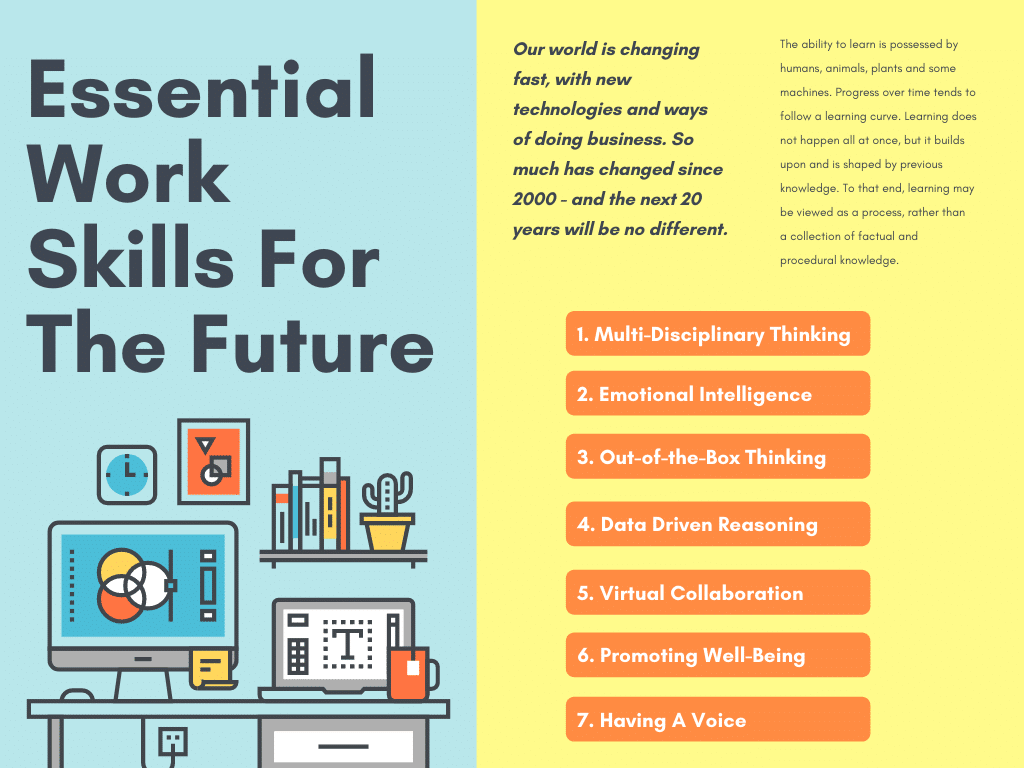
  • 7 Essential Work Skills For The Future – The 2020s And 2030s

    Do you remember a time when you couldn’t ‘Google’ something? Or had to rely on a piece of paper to find your way to a location? Or when ‘social networking’ just meant meeting up with people in real life?

    Our world is changing fast, with new technologies and ways of doing business. So much has changed since 2000 – and the next 20 years will be no different. 

    For instance, you probably cannot imagine carrying around a bulky mobile phone, camera, dictation machine, and PDA (personal digital assistant) all the time, but in 2000, this was commonplace for many professionals. Similarly in the next 20 years, things like 3D printing, Artificial Intelligence, 5G, Virtual and Augmented Reality, and Quantum Computing, will completely change how we work and the way we work. 

    Technologies like the internet, smartphones, and GPS changed the way we work and live. Apps like Whatsapp, Instagram, Netflix, and Google Maps have changed entire industries. Similarly, technological leaps in the next 20 years will not only change what we do but also how we do work, irrespective of which country or industry you work in.

    The coronavirus pandemic has already accelerated this change and helped some technologies like video calling to come to the forefront. People will need to adapt to this constantly changing landscape to stay relevant and perform well. 

    Below are 7 workplace skills everyone will need in in the future – the 2020s and beyond that.

    1. Multi-Disciplinary Thinking

    What differentiates a smart machine from a human brain? It is the human brain’s ability to make sense of things. Multi-disciplinary thinking is the skill that enables us to make sense of things, make the connection between complex things, and foster a curiosity to learn new things. 

    Even with the advent of AI and with machines getting smarter, multi-disciplinary thinking, (or as a university from Phoenix puts it, ‘sense-making skills’) will always be critical in the workplace. And this is the one thing machines can’t do, at least not so far.  

    A multidisciplinary approach involves taking cues from different disciplines or areas, and making connections that most people might miss. You can use this skill to approach problems differently, redefine them, and come up with unique solutions. 

    For instance, if you work as an engineer, in a medical environment, you should have a working knowledge of medicine and health. This will help you plug the gaps between these disciplines, and make connections that others would miss. 

    A biomedical engineer may work with doctors, scientists, and researchers to come to a solution or complete a project. And even though people with different skill sets complement each other, and provide different parts of the jigsaw puzzle – you need someone who can take a multidisciplinary approach and make the connection between the scientific, medical, and technical ways of thinking. 

    Computing pioneer Jaron Lanier says, “if we ask what thinking is so that we can then ask how to foster it, we encounter an astonishing and terrifying answer: we don’t know.”

    No one can know everything, but you can work to understand the big important models in each discipline at a basic level so they can collectively add value in a decision-making process. 

    – Charlie Munger 

    2. Emotional Intelligence

    Emotionally intelligent people have an upper hand in the workplace because they can quickly understand the emotions of those around them, and act accordingly. This helps to de-escalate conflict, motivate your employees and coworkers, and stay on top of your own emotional responses. 

    Being able to regulate your emotions and be seen as an empathetic, sensitive coworker goes a long way towards building your worth as an employee or manager. And as the world grows more multicultural and diverse, empathy and emotional intelligence become even more important

    You could be working with people of different ethnicities, different nationalities and diverse cultures. If you are good at forming strong connections with people, it will go a long way towards cementing your position as a valued collaborator. 

    In addition, a high emotional quotient will help you see when one of your employees or coworkers seems angry, frustrated, or upset. This helps you ward off potential conflict by getting to the root of the situation and acting as a source of support and encouragement for your employee. 

    For instance, if you see a normally competent employee acting unreasonably, you could invite them for a quick chat over coffee or lunch, and try to understand why they’re upset. You could say, “I noticed you haven’t been yourself today, is something bothering you?”

    “When dealing with people, remember you are not dealing with creatures of logic, but creatures of emotion.” – Dale Carnegie

    3. Creative, Out-of-the-Box Thinking

    Your ability to think out of the box and come up with creative solutions is a huge asset to any organisation. And you can be creative in any job – creativity isn’t just limited to artists, musicians and writers. 

    Creativity isn’t just about creating artsy designs or being inventive. If you are able to approach a problem differently from others and connect the dots between different processes to come up with a solution that works, you are creative. Problem-solving is an example of creativity, and so is the ability to arrive at win-win solutions. 

    According to the World Economic Forum, “creativity, innovation, and ideation will be key skills for the workforce of the future. These so-called soft skills, which sit alongside analytical thinking and problem-solving, will replace manual tasks that become automated”. 

    In the 2020s and beyond, it is very important for you to see your coworkers as valued collaborators, not as your competition, and work together to arrive at creative solutions. 

    “With the avalanche of new products, new technologies, and new ways of working, employees are going to have to become more creative in order to benefit from these changes. Robots may help us get to where we want to be faster, but they can’t be as creative as humans (yet).’

    Alex Gray, World Economic Forum senior writer

    For instance, in the 1800s, cars were considered expensive toys for the rich. They were expensive and time-consuming to produce. But a creative and innovative solution by an automobile company apprentice cut down production time from 12 hours to 2 and a half hours and the price of a car from  $850 to $290. 

    This creative solution changed the face of the automobile industry and made the apprentice, a man named Henry Ford, a legend. From being a luxury item, cars became a necessity for the average American. 

    “Logic will get you from A to B. Imagination will take you everywhere.” – Albert Einstein

    4. Logical and Data-Driven Reasoning 

    Critical thinking is a valued skill that very few people have. And it isn’t just about arriving at solutions. Critical thinking includes the ability to think logically, use facts and data to arrive at conclusions, and grasp numbers easily. 

    You can develop this skill by training your mind to solve problems and approach everything like a puzzle to be cracked. In addition to critical thinking skills, those who are good with technical skills like programming, building and understanding algorithms, statistics, probability, and machine learning, will also be in high demand in the workplace. 

    For instance, your company has just launched a new product, but you don’t have any buyers. Logical reasoning skills can help you figure out why – there could be similar products on the market at a better price, your potential buyers may not trust you, or your product could be missing a crucial element that makes it successful. 

    Here are some ways to enhance your logical and reasoning skills; 

    • Learn to think critically. You can do this by questioning ideas and assumptions rather than accepting everything you are told.
    • Try paying attention to how you react in different situations. This will give you a deeper insight into your biases, and your emotional triggers. Analyze every situation and try understanding the reasoning behind your actions. 
    • Avoid judging people and making assumptions. Assumptions lead to unreasonable thinking. Watch out for the times you make assumptions based on flimsy reasons, and try to rely on cold, hard facts each time

    “Logical thinking keeps you from wasting time worrying, or hoping. It prevents disappointment. Imagination, on the other hand, only gets you hyped up over things that will never realistically happen.” – Jodi Picoult

    5. Virtual Collaboration

    The importance of sharing knowledge and collaborating effectively via video calls, emails, and messages, is growing every day, even more so in 2020 – when we are all working from home. 

    Teach yourself how to share knowledge via the written word, and through videos. The workplace of 2020 demands that you be comfortable collaborating, brainstorming, working, and socializing over video calls, and emails. 

    Also, the way people consume information has changed. Many people, particularly of the millennial generation, get 100% of their news from social media, and primarily through videos. No matter what industry you work in, you need to have a decent understanding of how your potential audience consumes content, information, and news, and where they spend most of their time. 

    And it isn’t just to appeal to a target audience, you may have to master the skills of communicating through videos and video calls just to collaborate with your coworkers. Remote work has become the norm, and with good reason. According to a Global Workplace Analytics study, – 36% of workers would choose to work from home over a pay raise.

    Being good at communicating digitally, and at expressing yourself well through videos, has become an essential modern-day workplace skill that everyone needs to have. 

    6. Designing a Holistic Environment That Promotes Wellbeing 

    Work isn’t just limited to productivity, effectiveness, and speed. The workplace is made up of human beings, and the more you look out for their emotional and physical wellbeing, their health, and their motivation levels, the faster and more efficient their work will be. 

    In fact, there is a clear link between happiness and productivity. A study by Oxford University found that happy workers are 13% more productive than others. 

    Work to build an environment where your employees’ and coworkers’ health and emotional wellbeing is prioritized. Check-in with them regularly, and show them that you care about them on a personal level. 

    One way you can do this is by creating helpful ‘nudges’. Nudges are notifications or reminders to remind someone – an employee, a coworker, a manager – of a particular behavior or to trigger an action. 

    For instance, if you are a manager and you hire a new employee, you could set up a nudge to be sent to you reminding you of her 6-month anniversary and make you schedule a check-in meeting. Something as simple as this could positively impact your organization, motivate your employee, and help you keep track of how things are going with all your employees.

    7. Having a Voice

    Having a voice simply means that you are able to express ideas, opinions and even disagree freely. According to a Salesforce survey, employees who have a voice at work, and feel their voice is heard, report feeling 4.6X more empowered to perform their best work. 

    So how exactly can you be confident, overcome your impostor syndrome, and find your voice at work?

    Stand up for what you believe in. Be individualistic, brave, and never be afraid to speak your mind. In today’s world, courage and honesty are highly valued qualities in the workplace. 

    Here a few more ways you can have a strong voice and express yourself at work:

    • Offer Solutions 

    Problem-solving is an important and valued skill in the workplace, and by offering solutions to problems, you can contribute in a meaningful way, while enhancing your value to the organization. 

    • Speak Up in Meetings

    Whether it is asking a question, suggesting an idea or weighing in with your opinion, don’t hesitate to speak up in meetings when you have something to contribute.

    • Ask Yourself How You Can Help 

    Try to think beyond the confines of your role, and see how you can make someone else’s job easier, or help to grow the company. Valuable ideas can come from anywhere, from an intern to the CEO. By going above and beyond, and sharing your best ideas, you make your voice stronger and build credibility. 

    Holding strong opinions and voicing them without fear shows that you are passionate about your work and are strongly committed to a positive outcome. More importantly, when you have a strong voice at work and are able to say what you think and believe, you can promote a more equal, kind, just, and inclusive workplace. 

    Adapting to a Changing World

    The world is changing, and those who don’t adapt quickly will be left behind. You have seen how different 2020 was from the years right before it, and the future will be no different. As the world moves ahead in leaps and bounds, learning these crucial workplace skills will help you stay relevant and be an asset to your organization. 

    References

    1. New Research: How Leading with Equality and Values Impacts Your Business
    2. 5 things you need to know about creativity
    3. 10 Job Skills You’ll Need in 2020 and Beyond
    4. Costs and Benefits
    5. Happy workers are 13% more producti
  • 9 High Leverage Skills We Should All Learn (And Why Aren’t We Teaching Them Already?)

    “It’s not only children who grow. Parents do too. As much as we watch to see what our children do with their lives, they are watching us to see what we do with ours. I can’t tell my children to reach for the sun. All I can do is reach for it, myself.” – Joyce Maynard

    From a young age, children are taught various things. However, most of the knowledge is centered on academic progress. There are hardly any courses that teach them the skills for leading a fulfilling and joyful life.

    Conventional knowledge can make a child successful in the professional world years down the line. But to be happy and content, they need to learn a set of skills that can help them no matter the field they step into. I have found that the below 9 skills are rarely taught in our formal education systems, yet are very important.

    These high-leverage skills are important no matter what you do for work, and can amplify the results you produce. Considering how valuable these skills are in my life, I found it very surprising that we don’t teach these skills as part of our formal education. 

    1. The Art of Communication

    Good communication skills are necessary for producing results and breaking down barriers between people. At the same time, the old adage – we have two ears and one mouth- is of great importance. To communicate well, we need to be good listeners first.

    It is ok for two people to disagree on a subject. But disagreement does not have to lead to a conflict or a breakdown in communication. People disagree when they have different perspectives, and it becomes a problem when they get stuck there rather than going deeper to find shared goals.

    How to disagree, understand each others’ points of view, and coming up with a win-win solution that works for both parties is a very important skill irrespective of what you do and where you work. Yet it is never taught and we are left to learn from our own experiences.

    When people care about the other person’s point of view, it leads to a better understanding of their feelings. That results in the development of tolerance and acceptance of others in them. In other words – empathy. Empathy not only helps to bring people together but also results in more fulfilling relationships. 

    2. The Importance of Asking Questions

    I remember that as a kid, I used to have so many questions at all times. No wonder I kept troubling my mother all the time. The range of questions that children come up with is simply amazing! 

    Genuine inquiry can bring about so much learning and knowledge rather than having definite answers or ideas. Questions can open the mind to new ideas. On the other hand, the doors to knowledge get blocked once children grow up and eventually stop asking questions.

    While definite answers lead to the end of learning, a good question heralds the beginning of new learnings and opportunities. Hence asking powerful questions is a very important skill that we are never taught. Instead, we are too obsessed with finding answers that we rarely stop to question.

    3. Being Ok With Not Knowing

    “I see my path, but I don’t know where it leads. Not knowing where I’m going is what inspires me to travel it.” – Rosalia de Castro

    If we genuinely look at the vast universe around us, we will realize our knowledge is minuscule. When we admit “I do not know” it opens up a pathway towards learning. But I have observed that saying “I  do not know” is a tough task for many people, and it is seen as a bad sign – both in school and at work.

    The competitive themes woven in the fabric of modern society does not encourage individuals to admit their ignorance. It teaches us that any gaps in our knowledge should be hidden or filled up at the earliest. However, the person who knows everything is like the proverbial filled cup that can only overflow and not learn anything new.

    By refusing to acknowledge our ignorance we are blocking our passage towards knowledge. Mostly “I do not know” is perceived as a negative statement. But we need to change our outlook and see it with a growth mindset and curiosity. That transforms a person into a true seeker and leads to real self-development.

    To let people explore and find the truth like children, we need to encourage the culture of saying “ I do not know”.

    4. Not Seeking Approval From Others

    Many times, we are busy, consciously or subconsciously, winning approval from others as that makes us happy. But keep in mind that this desire to seek approval from others is a kind of bondage, which kills the freedom to grow and develop as a confident individual.

    The need for approval can lead to fear, anxiety, and stress. This can prevent people from moving beyond their self-imposed boundaries in life. 

    Once people develop self-belief stop worrying about what others think, they are free to create their life the way they want. It is important to teach people that their lives are their own making based on their choices. Opinions and social pressure should not hold back their individuality.

    5. Overcoming Negative Emotions

    Resentment is like drinking poison and then hoping it will kill your enemies.”-  Nelson Mandela

    All of us have been overcome with anger, grudges, or emotional pain at some point in our lives. When we feel wronged or offended, our ego takes the driver’s seat, killing any possibilities for learning.

    The truth is, negative feelings do more damage to ourselves than to the other person. When we let go of the past and move on, there is a sense of peace that rises from within. With no emotional baggage to weigh us down, we can move freely and joyfully through life. It also allows us to focus our time and energy on issues that truly matter to us.

    Just like the waste generated in our households and cities is processed to create energy, we can and must process our emotional waste too. If we know how to deal with our emotions, they can be used to generate productive energy.

    Learning to transform emotional waste into creative energy for a common or higher purpose is a skill. And just like other skills, it can be learned and developed. We can all use our emotional intelligence to make productive use of our emotions. If we can do that, these emotions will stop being “negative” for us. And we will end up with stronger relationships and a better world for all of us – not just you and me.

    6. The Importance of Integrity

    Take a moment to look back and think – Have you always done what was expected of you even when nobody was around to check what you were doing? How many times have you gone back on a promise because you were tired, or not in the mood?

    Integrity is a quality that deeply impacts every other aspect of our lives. This is an age where material success and fame seems more important than integrity.

    The word integrity can mean multiple concepts like honesty, honor, responsibility, and authenticity. But simply said, integrity is doing what you say and saying what you do. Integrity is honoring your word and keeping your promises. Yet we rarely teach people the value of integrity and the high costs associated with not acting in integrity.

    Integrity leads to trust between people, higher self-esteem, better reputation, and bigger results for us. At the same time, a lack of integrity can lead to distrust, anxiety, lack of confidence, and diminished results over the long term.

    Here is something Warren Buffet said- “You’re looking for three things, generally, in a person – intelligence, energy, and integrity. And if they don’t have the last one, don’t even bother with the first two.”

    7. To Remain Balanced Through Life

    “No man has been shattered by the blows of Fortune unless he was first deceived by her favours.” – Seneca

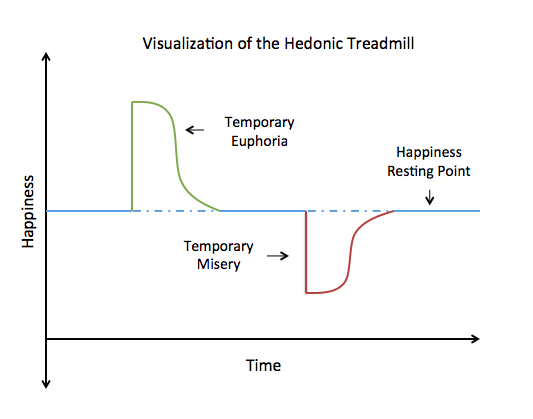
    Life can be a seesaw of success and failure. This can lead to alternative cycles of pain and pleasure. In reality, none of these situations are permanent. We must be careful not to get carried away by them.

    The true nature of human consciousness can be compared with a clear blue sky. The various events of life are the white and dark clouds that pass over that sky. Once we realize our true nature, the passing clouds cannot affect our state of being.

    While failure can lead to anger, frustration, anxiety, and depression, success can lead to arrogance, pride, and egotism. To maintain the right emotional balance, we need to avoid both ends of the spectrum.

    The Bhagavad Gita talks about staying the same in joy and sorrow. It says that the problem does not lie in the joy or sorrow as everyone goes through ups and downs in life. Pairs of opposites are everywhere – in the outside world, and in your mind. But you do not need to be attached to either joy or sorrow. You can learn to stay balanced and act in a constant way irrespective of them.

    8. Stepping Out of the Comfort Zone

    Get out of your comfort zone. Seek discomfort. Make sure the weakest parts of you don’t survive.”- Robert Celner 

    Consider these examples:

    • Richard Branson did not enjoy public speaking and used to get nervous about it. He had to step out of his comfort zone to master the art.
    • An editor fired Walt Disney and remarked that “he lacked imagination and had no good ideas.” Before he built Disneyland, Disney had to face bankruptcy multiple times.

    There are many other celebrities who stepped out of their comfort zones and took risks to accomplish what they believed in. Trying out new things and embracing new ideas is a must when you want to enrich your experience of life. Also, it is fine to face failure in your new path. Every failure can add a new chapter of lessons in the book of life.

    Fear is an effective tool designed by nature for our self-preservation. Even then, overcoming a fearful mind and taking calculated risks is necessary for exploring new horizons in life. The most successful people have faced fear in their lives. But that did not make them compromise with the goals and objectives they considered most important.

    9. Embracing Life in Every Moment

    Children have neither a past nor a future. Thus they enjoy the present, which seldom happens to us.” – Jean de La Bruyère

    Children have a natural ability to be joyful in the present moment. They dance through life and embrace every moment. They take each moment as it happens, and don’t try to control everything as we adults do.

    In reality, the past and the future exist only in our minds. All we have is the current moment. Most of our anxieties, fears, and worries exist in the past and the future. The flutter of life often makes us forget the importance of embracing the present moment- the Now.

    Each day determines the quality of our lives. The innumerable moments that we live make up these days. So happiness is not to be found in the future. Our ability to accept the present moment and make the best out of it determines how happy we are.

    In our constant search for security and safety, we tend to forget that life is inherently unpredictable. Even our best efforts can not ensure that events will turn up the way we want. So it is important to be flexible, which makes us ready to accept and dance along with the various surprises of life.

    Conclusion

    I strongly feel that our education system needs a reform. The 21st century looks vastly different from the last one, yet our schools and classrooms are exactly the same as they were a hundred years ago. We are still teaching our children math and science, and turning them into good workers and engineers.

    While there is nothing wrong with that, most people today don’t work in factories. Today, people work with their brains more than their hands, and talk and interact with people from different continents, cultures, and languages almost every day. Hence, along with math and science, the above mentioned 9 skills like communication and empathy are very important.

    These high leverage skills can be like seeds which can be planted in the minds of children at a very young age. And over time, these seeds can grow into healthy trees which give the fruits of a just, empathetic, and prosperous world – where we succeed together rather than in our own little echo chambers.

  • How to Powerfully Step into the New Year 2026

    I think it was 1989 when I, for the first time, realized that the 1st of January was a special day. The biggest change for me, one that always took a few weeks to get used to, was to write 1990 instead of 1989 in our school notebooks daily. While the whole world celebrated and wished each other on the 1st of Jan, nothing much else seemed to have changed (for me).

    Very soon, as we stand at the cusp of another new year (2026), 36 years have passed since then. Though the fact still remains that nothing much changes between Dec 31 and 1 Jan, if we look at the last 36 years, then we can no doubt say that the whole world and each of our individual lives have changed immensely.

    While we may not always notice and acknowledge it, change is the only constant in life. A New Year is our annual reminder that the time has come to move on and prepare ourselves for the changes coming.

    Today I want to ponder and write about how to powerfully step into the new year so that we are not surprised or shocked by the changes it will bring along. Over the years I have realized that we might very well let the years slide by without much attention; there always comes a time when we are made aware, often not subtly, that time has moved on.

    So read on if you prefer to enter the new year on your own terms, or skip this article if you feel a new year is too insignificant an event to trouble your brain cells.

    1. Complete The Current Year (2025)


    The first step before starting anything new is to complete what you are doing now. Just like we put the first foot down before lifting the other one while jogging, just like we get our raw vegetables and spices ready before cooking our food, it is imperative that we finish 2025 before we even start thinking about 2026. If we ignore this first step, the result will be the same when we start cooking a delicious dish only to realize later we never got the required ingredients.

    What I mean by completing the current year is taking some dedicated time before the new year to –


    1. Introspect your goals (if any) at the start of the year and make peace with where you are now.
    2. Celebrate your achievements (big and small) and laugh about your failures (missed opportunities)
    3. Reflect upon what you have learned, and how you have changed or grown over the year.
    4. Free your mind from the grip of the difficult people and hard situations you have encountered this year.
    5. Apologize if you realize you have been a difficult person in someone else’s life.
    6. Give up any blame, regret or shame gathered this year. There will be new to collect in 2026 🙂
    7. Thank and express gratitude to everyone who has made a difference in your life.

    2. Know Yourself


    The next step before moving ahead is to take some time to know yourself better. That doesn’t mean finding out your blood group or body weight or exam grades or other people’s predictions about your future but rather looking deep inside yourself to discover your deepest values and motivations. You can do so by answering questions such as –


    1. What are your deepest motivations? What have you always wanted to do?
    2. What are you really passionate about? Is there something worth devoting your life to?
    3. What drives your actions and decisions? What are the values you hold most dearly?
    4. What makes you really happy or angry?
    5. Who are your biggest inspirations in life, and who are the people you can’t stand? Why?

    Answering these questions is anything but simple and there can never be final answers to them. But if we take time and ponder over them and come up with some ideas, we will know ourselves better than anybody else (our parents, friends, grades, achievements, money) can tell us about.

    3. Where do you want to be in the next 5 or 10 years?


    The next step is to think about the future and exercise your imagination muscles. Think about the kind of person you want to be in the next 3, 5, or 10 years. This might seem too far ahead in the future, but it doesn’t take long for these years to roll by. Just think about how quickly the last 10 years have passed by. Imagining your own future can feel a bit strange and uncomfortable at first, but soon it will become a lot of fun – just like a game.

    Do not let this question overwhelm you (which it can), and instead, play it like a game and see what you come up with.

    While you imagine your future, think about your deepest desires and ambitions. What do you want to accomplish that will give you the most satisfaction? What changes do you want to see in yourself, your family, your society, your company, your city, and your country?

    What are the dreams that you haven’t even dreamt yet? How do you want people to relate to you after 10 years? In this step, you do not need concrete answers, but a vague image of where you want to be. The intention of this exercise is to get you thinking about your future, the actual answers you come up with are not so relevant.

    4. Decide milestones or checkpoints on the way

    The next step is to identify milestones for the next 1 year for the ambitions which you discovered in the previous step. Don’t let this step scare you. You don’t have to decide on milestones for each one of your ambitions – you can choose a few which are the most important to you. Also don’t worry or bother about “how” you will reach your milestones as you have the whole year to think about that.

    These milestones will serve as checkpoints which will measure your progress towards your long-term ambitions. These milestones can be broken down into quarterly and monthly milestones depending on what you prefer. The only thing to take care of while marking these milestones is to make sure they can be observed and measured by anyone easily and are not vague.

    Make sure to be clear about what you want to achieve, when and where you will achieve that and with whom. The more numbers you can use the better this step will be in its fruitfulness, and it is best to avoid vague words like soon, sometime, in a few weeks, improvement, better, more, etc.

    In the above two steps, it is very important to also include and keep time for recreation, fun, sports, and other forms of entertainment. The whole idea of this exercise is to be more aware of yourself and prepared for the coming year, and it is very important to not take it too seriously and think only about work and professional stuff. If you are a movie buff and want to watch 100 movies or visit a few movie festivals next year, plan your milestones for it.

    With the above four steps, you can step into the new year and make a powerful “start“. Of course, that doesn’t mean that your life will pan out exactly as you imagined or that the next year is going to be your best year. It just doesn’t work that way. But knowing where you want to go is always better than hoping to get “somewhere”.

    I can write another article about what you can do in the new year to make sure you hit your milestones, but we must always remember that change is the only constant in life, and it can come up in unexpected ways and mess up our plans anytime. But having messed up plans is still better than having no plans at all, and we can repeat the above process anytime to plan afresh for the future – we need not wait for the next “New Year” to repeat this process.

  • 5 Valuable Life Lessons Struggle and Hardship Teaches You

    When faced with difficulties as human beings, our natural reaction is to avoid the situation rather than power through it. Years of evolution have wired our brains to seek the comfort of the familiar and avoid the discomfort that comes with new and challenging experiences. 

    When you experience fear, whether physical or psychological, the part of the brain responsible for dealing with emotions (limbic system) is triggered before the reasoning part of the brain (neocortex). Overwhelming fear triggers a fight or flight response that makes you act before you think. 

    Subconscious reactions are necessary for your survival. But they can also be an impediment when there’s no actual danger or when the situation calls for an appropriate response rather than a spontaneous reaction.

    Emotions can teach you a lot about yourself, but you should never allow them to take control of your responses. Hasty responses such as outbursts of anger make it difficult to have meaningful relationships, handle conflicts, and communicate effectively.

    Every 2 weeks I share my most valuable learnings from living life fully in my Deploy Yourself Newsletter. Sign up now to download a workbook with 164 Powerful Questions which I use daily in my work and coaching. Allow these questions to transform your life and leadership.

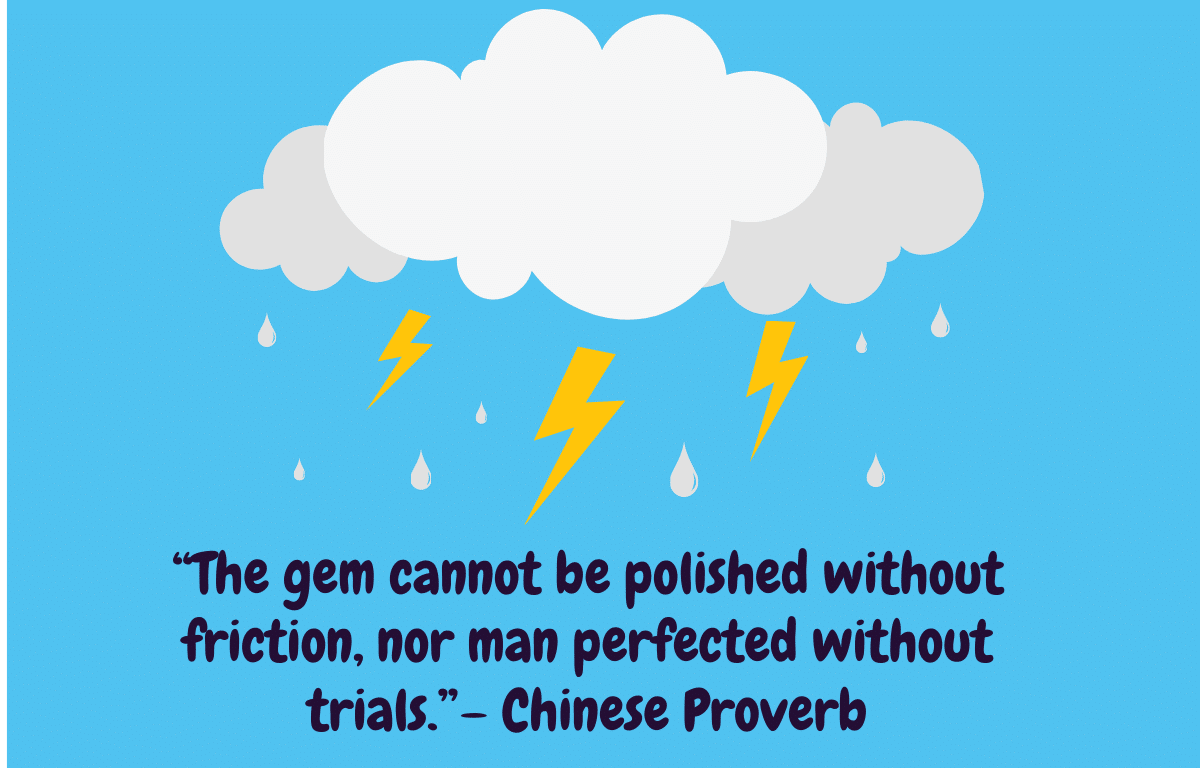
    Although avoiding struggle is a natural biological response, it is also ironic because struggle can teach us many valuable lessons. Struggle builds character, makes you stronger, and enables you to grow in all aspects of your life. Nobody wakes up in the morning hoping to struggle, but the struggle can provide you with valuable life lessons. 

    5 Lessons Struggle Teaches You That Are Valuable In Life

    Every cloud has a silver lining. Going through a difficult phase in life can be immensely valuable if you face it with an attitude of perseverance and patience. The following are 5 valuable lessons struggle teaches you.

    1. Resourcefulness

    Resourcefulness is the ability to look for and utilize available resources to attain a certain objective. Achieving your set goals may seem impossible when resources are limited, but this is also an opportunity to be resourceful and make the best of what you have.

    Persevering in times of struggle enables you to think outside the box and try new approaches to dealing with the problem. Rising above the struggle of limited opportunities will teach you to be more resourceful and enhance your problem-solving skills for the future.

    “Success is not about your resources. It’s about how resourceful you are with what you have.” – Tony Robbins

    When you grow up in a family with little money, the only choice you have is to find creative solutions to make ends meet. For example, when I was growing up I remember how my mother used any spare paper for taking notes and math practice, any spare cloth for making clothes, or to utilize a pencil till it disappears by attaching it to pen handles. 

    Being resourceful will not only help you achieve your goals but will also help you manage stressful situations better. According to a research conducted to examine the impact of learned resourcefulness on the relationship between academic stress and academic performance, highly resourceful students were found to be better at managing academic stress. 

    The study which sampled 141 university students revealed that academic stress negatively impacted the students’ academic grades. However, the stress had no impact on students who showed high resourcefulness.

    The frustration you experience when struggling with a problem can open up your mind to alternative ideas and solutions. When the methods you’re using are not helping you find a solution, you are bound to try other ideas you wouldn’t have thought of had things been sailing smoothly. 

    You may even try things you had initially ignored. Struggle can bring out the hidden creative genius within you, enabling you to see a problem from a new angle. You tend to remain in your comfort zone and take less risk when everything is going well.

    The best way to learn resourcefulness is to look beyond your struggle and approach problems from a new perspective. By not giving up when problems seem difficult, you can learn from mistakes along the way. This is the common formula that highly successful people like Walt Disney, Richard Branson, etc have utilized in their respective careers.

    2. Struggle Teaches You Prioritization and Helps You Realize What Is Really Important

    Prioritization means choosing what matters most. When you face multiple tasks and responsibilities in life, they will compete for both your time and resources. Although everything may seem important, not every task requires your urgent attention. 

    Learning to prioritize will save time you would have wasted going back and forth between tasks. Prioritizing is a skill that needs constant practice. It requires you to know what matters and recognizing what should be put on the back burner. Facing struggles in life will teach you to let go of things that don’t add value and to value what is really important.

    When your financial situation is favorable, you will find joy engaging in activities such as going to the club, shopping, traveling, dining in restaurants, and going to events. When you’re facing struggle, however, you may not see these activities as high priority ones. You will more likely direct your resources (time, attention, money) to more important activities.

    Instead of eating out, you will start cooking. Instead of going to the club, you will consider a more intimate gathering of friends in your house. Rather than buying things you don’t need, you will learn to appreciate what you have in life. Little by little, you will realize you don’t really need fancy stuff to be happy and learn to appreciate the simple things.

    When you’re dealing with adversity, how you adapt or cope will determine whether you bounce back quickly or not. Self-awareness is crucial to developing emotional intelligence. Learning to monitor your thoughts and emotions will help you understand yourself better and be at peace with who you are.

    When dealing with life struggles, the important thing is to make taking care of yourself physically and emotionally, your first priority. Physical self-care includes getting enough sleep, eating healthy, and engaging in physical activities. Emotional self-care tips include self-acceptance and learning to appreciate yourself and your needs. Put on your oxygen mask first.

    3. Struggle Makes You More Confident and Humble in Your Ability to Weather the Storms

    The story of the struggling butterfly paints a perfect picture of how struggles are an integral part of life. It shows how difficulties along the way help strengthen your resolve and brace you for bigger storms ahead.

    A gardener saw a butterfly laying some eggs and took an interest in a particular egg. He began to notice the egg moving and shaking a little. Here was an opportunity to see life brought forth before his eyes, and he watched for hours as the egg began to expand. Cracks started to develop, and he could see the head and antennae as the pupa struggled to come out of the egg.

    As he saw the struggling little creature, he took mercy on it and decided to help it by breaking the egg with his forceps. Long story short, the pupa did make it out of the egg, but it never grew to become a fully-fledged butterfly. Denying it, the struggle of breaking out of the egg on its own made it weak, and it died after four weeks.

    Just like the young pupa, your life struggles are only building your confidence and preparing you for tougher challenges ahead. If you take the easy way out, you will enjoy instant gratification but limit your own growth. Embracing your circumstances will make you stronger and help you appreciate life more. As you face struggles, you will learn your strengths and weaknesses. You will also learn to accept things you can’t control.

    Oliver Wendell Holmes once said, “A mind that is stretched by a new experience can never go back to its old dimensions,” and he was right.

    Going through challenges in life requires both physical and mental strength. Although you can’t control what happens to you, you can change your attitude and choose your response. Changing how you look at things will enable you to master change instead of allowing it to master you. Mastering change will make you more confident and less afraid of what life throws your way.

    Henry Ford once said, “Whether you think you can or think you can’t—you’re right”. A study published in a journal of the Association for Psychological Science supports this statement. According to the study, people who believe they could learn from their mistakes fare better than others after making mistakes. Your attitude determines your level of success.

    “The harder the conflict, the more glorious the triumph. What we obtain too cheap, we esteem too lightly; it is dearness only that gives everything its value. I love the man that can smile in trouble, that can gather strength from distress and grow.”

    ― Thomas Paine

    4. Struggle, if You Never Forget It, Can Help You Stay Grounded

    Change and uncertainty can make you feel like things are spinning out of control. When things are bad, keeping a calm head is a challenge as your mind is constantly racing. If you lack experience in dealing with difficult situations, you can easily get lost in the maze. The current Coronavirus pandemic is a perfect example of how change and uncertainty can lead to fear and panic. It has taught us that everyone reacts differently in challenging situations.

    While the pandemic is a challenge, it is also an opportunity. If you’re able to stay grounded, you will emerge out of the crisis stronger and able to overcome similar challenges in the future. The coronavirus crisis has not made the world unpredictable. It has only revealed how uncertain and unpredictable life is.

    Challenges and change are inevitable. The best you can do is embrace them and allow them to become your teacher. Tackling challenging situations will keep you grounded as you recognize that there’s always room for improvement and more to learn.

    The story of Abraham Lincoln can teach us many life lessons. But most of all, it teaches us the importance of being humble. Lincoln is arguably one of the most iconic presidents of the United States and is revered for his modesty and deep-seated humility. He was a leader who was willing to admit his shortcomings, accept his mistakes, and learn from them.

    Lincoln’s road to the white house was riddled with failures and disappointments. As a child, his family was forced to move out of their home because of land disputes, and his mother died shortly after when he was merely nine years old. He tried his hand at business and failed multiple times and experienced financial struggles that drove him to the verge of mental dissipation.

    Yet despite all his failures, he still managed to stand on his feet, dust himself up and take charge of his destiny. He sought to improve his life through constant learning and self-reflection. When the going gets tough, being fully present will help keep you grounded. Take control of your emotions and focus your mind and energy on things you can control. 

    5. Struggle Imbibes in You a Respecting and Helpful Attitude Towards Our Fellow Beings

    Experiencing adversity in life can make you more respectful and helpful towards others. If you have experienced pain, it is easier to understand another person’s pain. According to Dr. Sood, adversity breeds compassion. Several studies have revealed that experiencing hardships is a catalyst for developing empathy for others. These studies show that people with low socioeconomic status develop feelings of compassion when responding to the suffering of others.

    They are also able to determine the emotional state of others with better accuracy. Such individuals also exhibited more prosocial behavior and have more motivation to connect with others compared to their counterparts with higher socioeconomic status.

    “The struggle of life is one of our greatest blessings. It makes us patient, sensitive, and Godlike…” – Helen Keller

    Battling life struggles gives you valuable experience. You can understand situations and people better as you compare their battles with your own experiences. When you meet people in a similar predicament, you are in a better position to help since you have walked the same path before. You will also feel closer to people with whom you have experienced struggles together. For instance, buddies who served in the army together will experience a special bond.

    Oprah Winfrey experienced a tumultuous childhood. She was raised by her grandmother, whose only ambition for her granddaughter was for her to become a domestic worker. She was first raped by her 19-year-old cousin at the tender age of nine and would experience other instances of sexual abuse at the hands of men over the years. Despite her traumatic experiences, she has gone on to become one of the richest and influential women leaders of our time and is widely recognized for her deep compassion.

    Final Word

    Throwing resources at a problem often covers up inefficiencies and prevents creative solutions. According to research, people who struggle with a problem without seeking assistance from others record better performance the second time they face the obstacle than those who didn’t struggle. Experts refer to this phenomenon as a productive failure

    When you experience hardships and failures, there’s no reason for feeling pessimistic or depressed. Take each obstacle as an opportunity to learn more and improve yourself. Identify where you made a mistake and make adjustments to prevent the problem from recurring in the future.

    If you find yourself in a difficult situation with no end in sight, you’re exactly where you need to be. Hard work and persistence during this trying period will toughen you up, build your character, and enhance your relationship with other people. Struggle (whether of our choice or not) can help us discover much more about ourselves and what we are capable of.

  • 5 Unconscious Ways We Limit Our Own Freedom

    I still remember that morning of excitement. It was supposed to an relaxing long drive in my new car, but I had no idea how the day would turn up. As I started the engine and pushed down on the accelerator, I got busy admiring the posh interiors and the sophisticated dashboard of my car. As soon as I got on the highway, I turned on the cruise control mode so that the car can drive itself while I was free to admire the views of the snow-capped mountains ahead.

    Over 20 odd kilometers away, I felt something was off. So I decided to take back control from the cruise control and accelerate. But to my surprise, I felt a lack of power. I pushed on the accelerator and didn’t get the speed I expected from my brand new car. I continued to struggle in disbelief to get some power for the next 50 kilometers when I smelled a burning odor.

    “Damn”, I said as I started to look for the … yes .. the hand brake. There it was, and as I grabbed and released the brake, I felt that power which had eluded me so far. But by then the smelling odor (from the brake pads) was strong enough that I decided to turn back and head to the mechanic. In the end, my car’s brakes needed replacement and ended up costing me a good amount. My thoughts then moved from my new car’s brilliance to my lack of it.

    Are you living your life with your hand-brakes on without realizing it? Are you struggling to get the power in your life which you know you can? Do you wonder why your life looks so constrained and limited in this age of freedom and abundance?

    “Let go of certainty. The opposite isn’t uncertainty. It’s openness, curiosity, and a willingness to embrace paradox, rather than choose upsides. The ultimate challenge is to accept ourselves exactly as we are, but never stop trying to learn and grow.”  ― Tony Schwartz

    In this article, I will share how freedom is a state of mind, and the many ways we unconsciously restrict it. Freedom is not something to be given by others. People are as free as they want to be. However, it is very easy to be un-free, and most of the time we do not even realize that we are limiting our own freedom.

    As Daniel Kahneman points out in the book “Thinking, Fast and Slow” our fast and unconscious thinking brain helps us survive by making quick decisions. It is then a paradox that the same part of our brain limits our freedom in so many ways before we can consciously intervene and make our own choices. Conscious thinking and reasoning is very tiring for our brains, and hence most of our decisions are made unconsciously or in our brain’s autopilot mode.

    You Are As Free As You Want To Be
    You Are As Free As You Want To Be

    Our unconscious mind control far more of our decision making than we can imagine. Let’s find out 5 unconscious ways in which we limit our own freedom :

    1.  We are not clear about what we want, and just continue to go by what we see in the world or what society expects from us. We have never taken the time to define what “freedom” really means and the kind of life we would like to have for ourselves. We never sit down to think consciously of what our “ideal” life would look like. We never set our own boundaries and rules, and unconsciously accept what is the “norm” around us. We let the attachment to a certain way of life, and a desire for money and possessions come in the way of defining our own ideal definition of life and success.

    “We live in an age when unnecessary things are our only necessities.”  ― Oscar Wilde

    2. We are unaware of our own limiting beliefs. The language that we use and the thoughts that we think has a huge impact on how we show up in life. What do you believe and communicate about your abilities and the kind of life you want? Are those abilities good to create the kind of life you really want?

    3. We don’t execute our plans. We get lost in the details or get used to mediocrity. We allow procrastination to come in the way and accept the reasons of our circumstances and obligations. We don’t hold ourselves accountable for what we said we will do. We will always have reasons why we can’t do anything. Our unconscious mind presents us with these reasons to keep us safe and to ensure our survival. But it is up to us to believe these reasons as truth and stop moving ahead, or consciously find ways around these reasons to reach our destination.

    4. We don’t aim big enough. We settle for too low. And then we blame ourselves for achieving less than what we know deep inside we are capable of. We play small as everyone around us is doing the same. Playing small is easy as we don’t get unwanted attention and questions. Unless we consciously aim for what really makes us feel alive, we will never know what we are capable of. We deprive the world of our full self-expression and what we can achieve if we were to play the game of life with complete freedom. The psychologist Abraham Maslow called this the Jonah complex – “… the “fear of one’s own greatness” or the “evasion of one’s destiny” or the “running away from one’s own best talents.”

    “Our deepest fear is not that we’re inadequate, Our deepest fear is that we’re powerful beyond measure. It is our light, not our darkness, that most frighten us. But our playing small doesn’t serve the world. There’s nothing enlightened about shrinking so that other people won’t feel insecure around you.” – Marianne Williamson

    5. We don’t ask for help when we need to. We keep our true desires, challenges, and ambitions inside us because we have no idea how to realize them. We are too scared to show the world our brilliance because it might invite unconscious reactions of hate, envy, and humor. So we take our own unconscious decision to fit when what we really ought to do is to stand out. We think that we are all alone and never look for the right mentor or coach who can guide us and help us along the way.

    We Limit Our Own Freedom Unconsciously
    We Limit Our Own Freedom Unconsciously

    Conclusion

    Your unconscious and limiting beliefs stop yourself “to be” in the world. It is not “you” if you are not free. You might be breathing but you are not living. If you allow your unconscious mind to limit your choices in life, you will endlessly worry without finding out if you are on the right path or not. Being scared or feeling anxious about our deep desires is normal (from both the psychological and neuroscience point of view), but the real opportunity and power lie beyond them. And the amount of unconscious resistance you face from within can give you a measure of the real potential you have kept locked inside and which is waiting to be unleashed.

    Go ahead and give yourself full permission to acknowledge your own unique gifts. Give yourself the freedom to play, laugh, and fully express yourself without any fear or apprehensions. Act in a way that allows your own unique light to shine upon the world, instead of following the path others have decided for you.

    Resources

    1. https://www.psychologytoday.com/us/blog/passion/201903/why-we-play-small
    2. https://www.brainpickings.org/2018/04/17/erich-fromm-escape-from-freedom/
  • What Is The Baskerville Effect and Why Your Thoughts Matter?

    So much has been written and said about the power of positive thinking that an ordinary person could even develop a strong allergy to the very notion of “thinking positive”. Therefore, in this article, I will talk about negative thinking and the consequences of it, fatal sometimes – one of these phenomena is called the “Baskerville Effect”.

    What Is The Baskerville Effect?

    The Baskerville effect is a fatal scare phenomenon. It was named after Conan Doyle’s story “The Hound of the Baskervilles”, in which Sir Charles Baskerville dies of a heart attack provoked by psychological stress. Dr. David Phillips, an American sociologist, believes that a person can really be scared to death. According to Phillips, there is a connection between severe psychological stress and the following heart attack (often fatal). 

    Numerous laboratory studies have shown that stress is indeed followed by cardiovascular changes, but in the course of studies patients are still not scared to death, and based on moderate stress it is impossible to determine whether a strong shock can cause a fatal heart attack. 

    However, Dr. Phillips found a vivid stress factor associated with Eastern superstitions. The fact is that in the Cantonese dialect of Chinese and Japanese the words “death” and “four” sound almost the same. As a result, the number “4” causes unpleasant sensations and gloomy feelings in many Chinese and Japanese. 

    Dr. Phillips found that Americans of Chinese and Japanese origin have the peak of heart disease deaths in the fourth month of the year, which is not observed among Americans of European origin. After analyzing death certificates for more than 200,000 Chinese and Japanese Americans and 47 million white Americans, Dr. Phillips confirmed that Chinese and Japanese Americans have 13% more deaths from heart disease in the fourth month. And in California, where the Chinese and Japanese populations are concentrated, 27% more deaths from heart disease occur in the fourth month. He concluded that research suggests a connection between psychological stress and heart attacks.

    Conclusion

    Our behavior and the quality of our actions largely depend on the quality of our thoughts. Our moods and reactions depend on our thoughts. Positive thinking is not a character trait, it’s a choice. It can be easily developed; the main thing is to want it. At first, you will need to be persistent and zealous, but then everything will go “in the right direction”.

  • Give Yourself Permission To Focus on the Journey Instead of the Destination. Here’s How It Can Fill Your Days With Joy and Satisfaction?

    During a 3200 meter race in 2012, Arden McMath collapsed due to exhaustion. Instead of continuing past her and finishing one spot ahead, fellow runner Meghan Vogel stopped to give Arden a hand. Meghan draped Arden’s arm over her shoulders, and supported her the last 50 meters to the finish line. When they crossed, Meghan ensured Arden finished before her, and in the process, ensuring she finished last overall.

    Despite being at the bottom of the standings, Meghan was a winner that day, she finished a champion. With the crowd watching the events unfold, Meghan’s sportsmanship won over many hearts. It’s a testament to how the first place is not the only way to triumph.

    Arden McMath and Meghan Vogel Finishing Their Race Together
    Arden McMath and Meghan Vogel Finishing Their Race Together

    Winning Is Not The Only Thing That Matters

    We all know that winning is important, be it in sports or life. It is, after all, the reward at the end of the race that initially attracts most competitors.

    Today I want to highlight something beyond winning, something which is even more important—the journey. As you can see in the above story, winning is not the only thing that matters. Meghan was a winner that day despite finishing last.

    You can see this in all sports. You don’t only support the best players or teams. You don’t only cheer for the winners. You cheer for the people that play with integrity and give it their all. (See an infographic with the main points of this article at the end.)

    Even those that come in last are cheered when they play the game with the right attitude. You’ll find that most sports have awards not only for winning but for many other aspects of the game. There are trophies and awards handed out for sportsmanship in almost every sport.

    Sports stars are not only athletes. They are role-models. Apart from their performance, it is their attitude and behavior that makes them so.

    It’s Not the Dog in the Fight, It’s the Fight In The Dog

    Over 50 years before Meghan helped Arden to the finish line, a similar thing occurred in the 1956 Australian National Championships.

    Runner Ron Clarke got in a tangle when another runner inadvertently clipped his heels. Clarke had been leading the race but at this point fell to the ground, and was leaped over by those runners just behind him.

    One of those to initially jump over him was John Landy. Unfortunately in his attempt to avoid Ron, John’s shoe clipped and cut Ron’s arm. Rather than continue on, John—who was a favorite for the race and expected to appear in the nearing Olympic Games—stopped to check on Clarke. After helping him up, the two continued the race. John, even after stopping to help, made up the deficit and won the race.

    But it was not the win that John was remembered for. His gesture of sportsmanship was so well-received that a sculpture of the moment was made, and remains to this day in Olympic Park, Melbourne. Clarke, in his autobiography, wrote:

    “Within seconds the whole field was jumping over me or running wide. Then John did a foolish, but a typically thoughtful thing – he came back to say he was sorry and see if I was alright. The mile title, his bid for the world record, even the approaching Olympics… all were forgotten as the champion made his spontaneous gesture to the raw stripling floundering in the cinders.”

    We must always keep our eye on the prize, but play the game with all our hearts. The reward or goal at the end shouldn’t distract us from the process of playing the game itself. If John Landy or Meghan Vogel had been too focused on the white stripe at the end of the track, it’s unlikely they would be as well-remembered or respected as they are today.

    A game well played is an attribute worth admiring in itself. And playing the game doesn’t happen in the moment of winning or losing, it happens in every moment before that. This is the reason we all cheer for an athlete who lost but gave it everything.

    There Is No Shame In Losing When You Have Given Your Best

    There is no shame in losing when you know you have given your best. In life as well as in sports, it is the spirit of the game that people admire, not just the results produced.

    If we only focus on the result, it is easy to miss the process which leads to those results in the first place. We all reveal, identify, and discover ourselves through the process, as that is where we spent most of our time.

    The finish line is a fraction of the total time we invest. When you switch from only enjoying the rewards at the end to relishing the entire process, more of your life becomes meaningful and enjoyable.

    Growth is a continuous process, not something that happens only in brief moments of time. Most of our life is spent in between the wins and the losses, the ups and the downs, and the start and the finish. Happiness is fleeting, and if you only expect yourself to be happy when you reach certain goals, it will leave you disappointed and frustrated most of the time.

    There are two reasons why our happiness from these moments quickly fades:

    • The first is that positive emotions fade after the moment of success or victory. While we might be joyous and celebrate for a time, the shine wears off and we return to a baseline state.
    • The second is that our aspirations continually grow. We don’t reach a goal and decide to completely stop. We soon turn our attention to something else. A new goal takes hold, and the struggle begins again.

    The result is that after we achieve a goal, we enjoy it for a moment before moving onto the next thing. It is part of what psychologists call hedonic adaptation, and occurs for both positive and negative events—the emotions never last, you always return to the baseline. 

    Goals Don’t Create Or Sustain Happiness

    They have value because they give us a direction, and they’re trackable and measurable. But only focusing on them places a lot of pressure on us. When we do achieve them, the positive effect is over all-too-soon. Then it’s on to the next thing, with the pressure back on.

    This is not a healthy way to live or grow. However, there is an alternative, which is to give more of our attention to the journey instead of the destination.

    For The Love Of The Challenge

    If you are only focused on what you want, the process will be an obstacle. If you think of the process as a problem, you’ll do anything to find a short cut, and get straight to the prize, reward, or good feeling, without the challenge.

    There are times when removing a challenge will help you. You use calculators and washing machines to achieve goals that you don’t want to waste your time and effort on. Because you want to save your effort for more important tasks.

    But when it comes to our most important goals, there are no shortcuts. If there were, it would defeat the purpose. Growth happens and life derives its meaning in the process. It’s what happens when you respond to the challenge, not when you reach the end result.

    Philosopher and mathematician Bertrand Russel wrote that removing challenges from life is a sure way to remove happiness, not increase it. You need the struggle, the obstacles, and the challenges to overcome. That’s how you improve and derive meaning and joy.

    Our most significant lessons and outcomes in life do not come from winning, but from giving our best in a dignified struggle. The joy of a race won or a business victory lasts only a few seconds, while the satisfaction of discovering something deep and true about ourselves lasts a lifetime.

    When you pour effort into an activity, you do so because of love for what you’re doing. When behavioral economist Dan Ariely and others had participants build IKEA products or origami, their creations were often of poor quality. But their creators loved them and expected to be paid much more for their products than anybody was willing to pay.  From an outsider’s perspective, each person’s creation could be viewed as a failed attempt, especially when compared to expert creations. But to each individual, the time and effort that went into what they built ensured they held it in high regard.

    When you’re not busy trying to compete with other people or claim a reward, and simply focus your energy on the task itself, the outcome will be positive and meaningful no matter your level of success.

    How To Change Your Perspective 

    You don’t know who you will be in the future. You don’t know whether you will even reach the destination when you’re still on the journey. But you do know who you are now, the direction in which you want to go, and the kind of effort you want to put in. Setting your sights on the future can distract you from what happens in the here and the now. Every distant goal begins with taking action now, so it is important to focus on your present actions. Winning a race depends on taking action now. 

    World-class sports stars do not just walk out on the track and win, they practice day and night for years. There is a long and arduous process that happens behind the scenes. You need similar processes and habits driving you. And you need to cherish them, even when they get repetitive or painful.

    This means changing your focus from your big goals to your system of daily habits and processes. Goals are something you go after, habits and processes define who you are. Goals are future bound, but processes are in the here and now.

    By creating habits, you can make lasting changes in the way you show up for life. Instead of reverting back to your past self when you reach your goal, you will continue the behavior. Your goal becomes another point on a journey of continuous improvement. 

    Research suggests that a simple change of perspective can help us do this. In six studies by Szu-Chi Huang and Jennifer Aaker, of over 1600 people from different cultures and backgrounds, they found that construing goals as a journey led to continuing the behavior that attained the goal. They write that:

    “The journey metaphor may have helped people think more about the actions they took during the journey, where they started out, and all the ups and downs along the way, leading to the feeling of growth. These thoughts could also contribute to an increased perception that the actions they took were instrumental and should be continued.”

    If you want to lose weight, and you succeed, there’s little stopping you from falling back into old habits and putting the weight back on. Treating the process as the most important element ensures we don’t regress after a goal is achieved but continue on the journey. 

    There is another benefit to thinking in terms of a journey—the scale of the goal is less likely to deter you. 

    Before you start on your journey, a goal that seems insurmountable might stop you from acting at all. A goal that seems easy could have you put it off. By changing your perspective and focusing on what you can do now, and what processes will help, you win even when the goal is missed

    Hence you should learn to enjoy and appreciate each moment in the journey towards the destination. Relish the challenge. When we know we have given our best, we never regret it in the end. That is success beyond success. There is no better joy or satisfaction in life than knowing you did the best you could.

    It Is The Journey, Not The Destination

    Goals are just dots on a map and often miss the story of how you got there. And everybody cares deeply about their story. You don’t skip to the end of movies or books to read about the happy ending, because it’s the process that is most appealing. It’s the difficult stuff that reels you in, the trials and tribulations, the conflicts and resolutions.

    In any story, there are unexpected twists and turns. If you’re too focused on the future, you’ll miss opportunities to do something good and meaningful now. When someone falls (like in the story I started this article with), you’ll be too concerned with your goal to stop and help them up.

    Real winners are not identified by the medals hanging around their necks, or the plaques on their walls, or their names in the record books—real winners are embodiments of qualities like determination, sacrifice, grit, integrity, effort, and heart.

    It’s how they respond to the challenge, not the final result. It’s their journey, not the destination. And right now, you’re on your journey. There will be good times and there will be tough times, and it’s what you do in each of those that count. 

    Watch the video of the story (Meghan and Arden) I started this article with below. Every time I watch it, it gives me goosebumps and leaves me a little teary-eyed. And as you can see, Meghan’s act of sportsmanship that day continues to inspire people even today.

    If that is not what success is, then I don’t know what is.

  • 15 Timeless and Valuable Lessons Learned After 15 Years of Working Professionally

    I started to work professionally in 2005, and very soon it will be 15 years. Over this decade and a half, it has been a wild journey working in over 8 different companies across 2 continents, including 2 companies that I started. I have seen ups and downs and worked with people and teams from all over the world. I also dabbled in social activism while I was in Bangalore. Organizing the Dandi March 2 in 2011 and then co-founding and running a not for profit organization for a couple of years was an experience in itself.

    Ever since moving to Amsterdam in late 2014, I have traveled and experienced life in Europe and attempted to express myself through my photography. Training and establishing myself as a photographer has come with exposure to the world of journalism, media, and photography which was totally alien to me before. In the process, I have met and interacted with a lot of remarkable people from the world of photojournalism and news. That has given me a tremendous perspective in addition to my other life as a software leader.

    There Can Be Joy In Overcoming Suffering
    There Can Be Joy In Overcoming Suffering

    Below are 15 timeless lessons I have learned over the last 15 years.

    1. Good Days Pass, And Bad Ones Too. In the last 15 years, I have had many good days where I have thumped my fist or felt extremely proud and satisfied. At the same time, I also have had my share of bad days where I have been shaken to the core. Yet if there is one timeless lesson which I have learned is that time stops for no one, and whether good or bad, days pass and take along with them their impressive highs as well as their depressive lows. If I compare my current self to my past self, I can say that the highs and the lows are more moderated now, and you won’t see me fist-pumping on a good day or getting anxious and sad on a bad day.

      “No man has been shattered by the blows of Fortune unless he was first deceived by her favors.” – Seneca

    2. Process Over Outcome. When I started working, nothing but success mattered to me. And I defined success as external results – good marks in exams, high output at work, more business revenue, and so on. I wanted to reach these success milestones so badly that many times I even cut corners for them. Not to say that external success or results are not important, but today I view success very differently. Now I define success as doing the best I am capable of doing irrespective of the results they produce and expressing myself fully while doing so. I have learned to value the process over the outcome, and the journey rather than the destination. This has made me slow down and appreciate the people and the valuable relationships I build along the way.
    3. If Something Is Important to You, You Must Work to Make it Happen. Outcomes and results don’t happen by themselves. Don’t wait for “one day” or the “future”. Nothing worthwhile is accomplished without discipline, hard work, and patience. Play the game seeking whatever outcome you are seeking, take the risks that are required, and acknowledge the roses and bricks that come along the way. I am not saying it will be easy, but if it is a journey you must take, I can assure you that the roses and the bricks will be worth their weight in gold.
    4. In Seeking Worthwhile Goals, There May Be Suffering. But there can be Joy in Suffering. Life is not about playing it safe or avoiding pain and suffering. Every path of learning and growth require (or demand) some suffering which will make us more resilient, mature, and strong eventually. There can be joy going through a painful moment – from the satisfaction of giving your best and acting according to your values. On the other side of suffering, you will find yourself stronger and more resilient, and that will prepare you for journeys that lie ahead.
    5. Believe in Yourself, and Act with Confidence. Self-confidence is one of the most important criteria when it comes to influence, leadership, and success. Yet most highly skilled people I have met have been unsure about their abilities. I still see myself struggling with self-doubt a lot. While there is nothing wrong with doubt, and we all feel the presence of doubt, it should not stop us from acting with conviction when required. We must always take the “healthy” doubt into consideration, consider different opinions and perspectives, and then speak and act with confidence.
    6. We Should Not Let Confidence Blind Us. When we are challenged, we must check your assumptions, listen to feedback, and adjust course if necessary. Sometimes it is necessary to kill our favorite ideas, and overconfidence should not come in the way of doing that. Learning to listen to different perspectives, considering opposing ideas, and questioning our assumptions can save us many troubles in the future. It will not only make us better decision-makers but also enrich our relationships with people around us.
    7. Think Long Term – For the first 8 years of my career, I only focused on short term goals and chased immediate results. However, when I look back, I see that I have missed so many opportunities to create impact just because I was too impatient to stick and persevere with an idea/project/company over time. Today I know that success comes from playing iterated games over an extended period of time. Compounded results are behind every single success or human achievement. It is no surprise Einstein called it (Compound Interest) the 8th wonder of the world.from Pixabay
    8. Business is about People (customers, employees, partners) and not things (profits, markets, revenue). As I have worked with different companies, both big and small, I have found myself in meetings about markets, financials, strategies, and competition. Very often we end up giving secondary importance to the people involved – customers, employees, other stakeholders, etc. Today I believe that empowering our people (employees) might be our most important job as leaders to produce business results which end up serving another set of people – our customers. Focusing on the people involved can help us simplify the complicated in business, and strip out the necessary from the superfluous.
    9. We Are All Flawed. We are wrong more often than we think we are. One of my most revealing insights has been how often human beings run on autopilot without even realizing so. We think we are in control of our actions and feelings, but in reality, they are shaped subconsciously by our past experiences, emotions, and cognitive biases. We all put up a brave face in front of others, but we are all dealing with self-doubt and are yearning to be acknowledged by others.

      “Character, like a photograph, develops in darkness.” — Yousuf Karsh

    10. Don’t Work for People You Don’t Share Values With. Life is too short for not having a good time at what you are doing. Find places to work where you can be yourself, and the work gives you joy rather than suck the life out of you. However, don’t confuse this with facing discomfort that always comes with growth. There must always be some learning curve (decide your slope yourself) which will come with some pain and suffering. That only means you are growing to become a better version of yourself.
    11. Don’t Wait for Retirement or Some Time In The Future To Do What You Always Wanted To Do. What is on hold in your life? If you are waiting for tomorrow, remember that it never comes. Find time to do it today, and fill a little bit of each day with one such activity. For me, it has been writing articles, doing poetry, learning the French and Dutch languages, reading books, learning and practicing photography, traveling, social activism, or following my curiosity and expanding my knowledge in previously unknown subjects like coaching, neuroscience, history, psychology, human rights, urban design, deep learning, and so on. To reiterate, find what is on hold in your life, and make space for it.
    12. The Most Powerful Phrase at work, and in Life is “I Don’t Know”. However, it is very difficult to say. Acknowledging that there is something we don’t know is the first step in seeing reality as it is, and opens up the pathways for future learning. We all need to overcome our insecurities and inner fears and be brave enough to acknowledge our “not knowing” something. Once you acknowledge that you don’t know it, you earn yourself the freedom to act like a beginner and take whatever actions are required.
    13. Guard Your Time, and Only Fill it up with Life-Enriching activities. Time is your most valuable resource. Set boundaries for what you are willing to do and not, and enforce them in your life. Saying No can be intimidating, but people will respect you for it. Cut off your TV consumption as it is the easiest way to be sucked into wasting time mindlessly. Instead spend that time doing exercise, reading, or writing – which are all life-enriching activities.
    14. Always Be A Student. Keep on learning. Always update yourself in your core skills to stay up-to-date with the latest developments. But also spend some time learning a bit about a subject outside of your core expertise. Over time this can add up to a lot, and open up previously unknown career opportunities.
    15. The Only Person you can Change or Control is Yourself. Focus on yourself and not on changing others. Ask yourself the hard questions and introspect when you need to. Constantly revisit your values and beliefs, and build up the courage to act accordingly. And last but not the least, take care of your body. It needs rest to replenish and rejuvenate between sprints of hard work. Give it the gift of rest to live more sustainably.
    16. Do Different Things, which you would never do otherwise, just for the heck of it. Explore life. It will give you perspective and respect for different ways of life. Every once in a while, let others decide things for you. Or when an unexpected event happens, take it as an opportunity to dance with life and go with the flow instead of resisting it. You never know what you might end up discovering.

      “The tragedy of life is what dies inside a man while he lives.”  ― Albert Einstein

    17. Life is Uncertain and you will be disappointed if you want your expectations to be precise and true. That is why you end up with 17 lessons in this article instead of the 15 I promised.
  • The Top Three Tragic Myths Of The Times We Live In

    “It was dark and quiet, and it took me a few seconds to stand steady on my feet. Well, that’s what happens when you have to get up at 2am to go to the bathroom. But things were going to get worse.

    Just as I began to walk, I suddenly jumped and screamed. Something was crawling on my feet. It felt like a spider and I reached for the light switch. When the light turned on it turned out to be a piece of thread that had been lying on the floor. Apart from the disappointment of jumping for no reason, I was wide awake now!”

    Just as it happened to me, we often get scared of an insect or a rat, but when we turn on the light they are just objects lying around. But our senses gave them an illusion of being an insect or a rat. Building upon this analogy, everything else in life – our riches, our troubles, and our possessions are illusions and a mirage created by our mind.

    “Reality is merely an illusion, albeit a very persistent one.” – Albert Einstein.

    Taking this notion forward, this article of mine is going to dwell upon why life itself is a myth, and how each one of us is driven by some ‘absolute‘ truths that are nothing more than widely accepted myths. These myths drain the life out of our days and take us onto paths of mediocrity and obscurity.

    Below are the three such myths I think we all encounter in everyday life. (Give them some time to sink in, as they very well might be absolute truths for you.)

    1. You Have to Work to Survive

    The biggest myth of our times is ‘having to work‘ to earn a living for surviving. Right from our birth, everything is setup to create this illusion. Our education system, the economic system, all the news and shows on TV and the movies we watch. As we grow up, this myth becomes very ‘real‘ for us. The only thing from our childhood which we term as illusions are the cartoons we watch. Did you ever wonder why everyone loves cartoons?

    There is a common misconception that work is necessary. Over decades and centuries, every rock is chipped away into sand and dust. Work can do the same to our lives and souls. Day by day, hour by hour, our work can chip us away into disintegration.

    If someone tells you they are “making a living”, they can’t be more wrong. They are making a dying, and most probably fast spending whatever little time they have doing things out of compulsion rather than the pure desire of doing it.

    Instead, what we can all do is PLAY. Go out and do what you want. Find something you love doing, something you are passionate about.

    DisclaimerWork and Play don’t have to be mutually exclusive. If you can find a way to play while at work, nothing could be better.

    Many people say they don’t know their passion or hobbies, or they have not discovered them yet. Here is a formula – Look into your life, and the things you do for which you pay others are your hobbies and passions, and for which you get paid and compelled to do is work.

    DO NOT spend the vast majority of your life working so that you can play in the end. That end might never come, or which might be tomorrow itself, for all you know.

    2. Planning and Living for the Future

    We live in a world where insurance and pension policies, investments, education, business, almost everything is done with an objective to achieve something in the future. While planning for the future has its benefits, I believe we often take it too far and miss the only time we really have, which is “now”, or this very moment.

    Who gave you the guarantee that you will not die tomorrow, next week or next month? What made you believe that you are going to die at 70 or 80, and not at 20 or 30 or 40. If you don’t believe it, read and watch the news. People are dying every day at all ages. The average age might be 70 or 80, but ask yourself – Do you really want to live your life based on a statistic?

    Instead, LIVE NOW. Enjoy whichever phase of life you are in. Be in each day fully, rather than counting the days. Live your life in a way that you are satisfied even if you die tomorrow or the next second. Make every breath count. Don’t wait for tomorrow if you want to fall in love, travel to your dream destination, or eat that favorite ice-cream of yours. Do it NOW (or at least pick a date in the calendar and book tickets now).

    Fall in LOVE with life, not just with a few selected people, things and ideas. Whether you make 1 grand or 1 million, whether you live in an apartment or a mansion, embrace life fully NOW and don’t let your goals and milestones in life decide the level of your happiness or joy.

    3. Control and Consistency

    The next big myth we base our lives on is aiming for control and consistency. We plan and build systems, and we make rules and processes to make our lives more comfortable and smooth. But the very fact that we can control life is the biggest lie that we tell ourselves.

    Life, by its very nature, is messy and unpredictable. It is not fair and nobody is entitled to get anything out of it. In school, if you study more, you get better grades and vice versa.

    The same doesn’t hold true in life, as there are so many other factors at play other than your efforts. The sooner we realise this the better. Good and bad things will happen to you. Your education, job, the country you live in, or any other reason which gives you the illusion of safety, is a very bad armor against life.

    Instead, be FREE from these controls. Embrace the uncertainty of life and experience real FREEDOM. Go out and play. Learn a new language. Take a new job, or live in different cities/countries and soak in different cultures. Write, paint, or do anything else that makes you experience life rather than draining the life out of you.

    Don’t try to be nice or do what is expected. Don’t live for the gallery. Be authentic. For a change, LIVE for YOURSELF. Let yourself be misunderstood, hated, judged, or whatever, but live by your convictions. It is better to be assassinated by another human being than being assassinated by death.

    Conclusion

    Our thoughts (and perception of reality) shape our decision and in turn our circumstances. It is like watching the same movie again and again. If we want to play a different movie in our life, we have to change the tape.

    And rejecting the above myths might be the first step. Thoughts arise in the mind, and we become aware of them. But over time, we stop seeing them as thoughts and see them as reality. Therefore, we should never stop to question our thoughts and the reality they form.

    Life is a mirage. An earring and a bangle are both made out of gold. But our thoughts make one an earring and another a bangle, but in essence, both are only gold. Yet we only term what we see while asleep as dreams and not what we see while awake. In essence, both are illusions created by our senses. We must never lose sight of that.

  • Don’t Allow Yourself to Use the Word TIRED

    Recently I was talking to a friend of mine, who has been a state-level Taekwondo Champion for the state of California. She was telling me about her strenuous training program which she used to follow when she was training. Among other things, the one thing which she told me was that she was not allowed to use the word “tired” even if the trainer asked her to do 300 push-ups. She said “tired” was the word which they could use only after they turned 80.

    The Role of Language in Shaping Our World

    Language plays a very important role in how we feel and go about our daily lives. The way we use language can determine the results we produce in the near and distant future. Researchers at Stanford University have proved that the way we use language shape how we see the world.

    It is often said that what you say is what you get. Saying that you are tired will actually make you feel tired and you will have all the symptoms to prove that. But we don’t realize that it was our word which caused it in the first place.

    So when someone asks you “How are you doing?” and you reply with, “I am tired” or “You know how Mondays’ are.“, we are actually contributing towards the impending tiredness or exhaustion by saying these words. The same goes for all the negative thoughts that come into our mind and out of our mouth, like “I don’t have enough money“, “I am not lucky” and so on.

    Language Creates and Generates Too

    Most people understand language to be descriptive and see it as a tool for communication. They are blind to the generative power of language. It is in language that people create their future and their present. Our mental models and unique assessments of the world determine the narrative we create for ourselves, which in turn determine the world we observe, and every action we take thereafter.

    For example – Every time you said yes or no to a request, you were not just communicating, but also creating a future. Your life would be different if you had said No instead of Yes to the various opportunities you said Yes to previously in your life.

    Chalmers Brothers and Vinay Kumar share this story in their book Language and the Pursuit of Leadership Excellence: How Extraordinary Leaders Build Relationships, Shape Culture and Drive Breakthrough Results.

    Two baseball umpires were sitting around talking, and one says, “Old Joe, he’s a great umpire. There’s balls and there’s strikes, and he calls ‘em like they are.” The second umpire then says, “Yeah, Joe’s a great umpire… there’s balls and there’s strikes, but he calls ‘em like he sees ‘em.” Just then Joe walks up and says, “You’re both wrong… there’s balls and there’s strikes, but they ain’t nothin’ till I call ‘em!”

    They add,

    Language conveys commitment, not just information. By understanding your organization as a network of conversations, relationships, and commitments (human beings making and managing commitments), you can open dramatically new possibilities for intervening and improving performance in a wide variety of areas.

    “I am always in conversation. And sometimes other people are involved” – Mark Twain

    Words can Take Power away, or they can Give Power

    Whenever we say something, we increase our belief in it. We give power to outside situations, individuals, and circumstances which is always disempowering. Athletes, like my friend in the example above, are not allowed to use such language because the trainers are aware of this fact.

    On the other hand, when somebody asks you, “How are you doing?” and you reply, “I am doing great!!“, you will actually feel a smile on your face and some adrenaline rushing through your body. It is impossible to say I am doing great without actually feeling good.

    If you are stretching your limits while doing a task, instead of saying “I am tired“, next time try saying, “Let me check my physical limits.“, and you will gain the strength to go that extra mile and achieve the impossible.

    Do you see a connection between what you have been saying and how your life is turning out?

    One of the quickest ways to improve your way of being is to change the words you use, to others and to yourself. When I say words, it includes the spoken words and the unspoken thoughts too.

    Just by changing the words we use, we can release a lot of tension and create joy. So the next time you speak, be aware of the words that come out of your mouth. Be aware of how others’ negative words make you speak out negative words too, and vice versa. Try to catch yourself when in negative emotion and speak powerful words instead.

    Speak words that profit others, depict hope, courage, and inspiration and which create positive images. Then notice the difference in how your surroundings and people react.

    Some of the danger words which we should cut from our vocabulary are –

    1. Should / Could – These words, spoken for ourselves or for others, implies judgment and makes people defensive and tense.
    2. Try / Maybe – These words leave ambiguity and leave an option for you or another to escape commitment in case things get difficult.
    3. Always / Never / Nobody  / Everybody – These words generalize opinions which are rarely the case and can cause people to react unexpectedly.
    4. Bad / Disastrous / Terrible – These words spread panic and can lead to more mistakes, stress, and confusion.
    5. Nothing is gonna change / That’s how it is done here – Using such phrases creates a culture of resentment and cynicism which ends up killing all enthusiasm and creativity in people.

    Instead, you can use powerful words and make them work for you :-

    1. Declare a Commitment. 
      1. I commit to exercising 30 minutes daily.
      2. Let us commit together to make this company the best place to work for.
    2. Make a Promise
      1. I promise to finish this report in two days.
      2. I promise to never drink and drive again.
    3. Make a Specific Request
      1. Can you finish this report before Friday or not?
      2. If you like it, can you share this article on Facebook today?
    4. Offer Support
      1. Is there anything I can do to help you with this task?
      2. I am just a phone call away if you need me.
    5. Offer Hope
      1. You will make it through it. You are stronger than you think.
      2. Believe in yourself, not the critics. I know you will prove them wrong.

    Watch your thoughts, for they become words. Watch your words, for they become actions. Watch your actions, for they become habits. Watch your habits, for they become character. Watch your character, for it becomes your destiny. – Lao Tzu

    So the next time, instead of saying –

    • “I can’t exercise more, I am tired.”, say, “I am not tired, let me do one more round.”
    • “I can’t work outside because I have asthma”, say, “I will work to prove I am bigger than my asthma”
    • “I can’t do this because I don’t have enough money”, say, “How can I earn enough money to start doing this?”
    • “I am not feeling good, it is going to be a bad day”, say, “Today is going to be a great day and I am raring to go”
    • “My life sucks”, say, “Today is a new day. Let’s make the most of it!!”

    Do this and you will see that your days will get brighter and dreams will turn into reality. Break the pattern of using words that suck power out of you, and instead form a new habit of using words that give power to you and the people around you.

  • Why We Should Break the Safety Wall Around Us (to be Happy)

    “It is not because things are difficult that we do not dare, it is because we do not dare that they are difficult. ” – Seneca

    We all have built ‘safety walls‘ around us that are unconscious to us, and are strengthened over time. They determine what we can and cannot do, what we try and what we don’t. Almost all our actions are determined by these safety walls.

    But rather than being safety walls, they are more of a trap where we are stuck in a state of presumed comfort and our every decision is determined by these walls. They make us believe that life is tough outside of these, and there might be unforeseen dangers. So unknowingly, and only in the assumption of some ‘danger‘, we don’t risk going over these walls.

    I have found myself in similar situations many times. No matter how many fake assurances I gave to myself that I was doing good, the fact is that when you are in your comfort zone, you are still while life is zipping by.

    When the world is moving ahead and you are still, you are on a decline.

    If we stay in this zone, over time, our excitement and energy levels begin to come down. We feel more and more lazy and tired each day, and our eating habits (and with it, our belly too) go out of shape pretty soon.

    It might look like life is going on FINE, but in reality, we all know that we are not moving ahead while our limited time on this planet is passing by.

    Be Vulnerable

    The first step towards breaking the aforementioned safety walls around you is to become aware of the fact that you are trapped in your habits. Are these habits and patterns are running your life on auto-pilot? Or are you in control of your life?

    Once you are aware of this trap, you can take steps towards breaking these so-called safety walls and explore the ‘real‘ world outside. If you have to really live (rather than just exist), go outside and be vulnerable – to your fears, anxiety, and become comfortable with them. Only then you will feel liberated and peaceful.

    Outside of these walls, what I have found is that there are opportunities rather than dangers, there is excitement rather than boredom and joy rather than frustrations.

    The brick walls are there for a reason. The brick walls are not there to keep us out; the brick walls are there to give us a chance to show how badly we want something. - Randy Pausch
    The brick walls are there for a reason. The brick walls are not there to keep us out; the brick walls are there to give us a chance to show how badly we want something. – Randy Pausch

    Have Faith

    When you step out of your comfort zone, there will always be a little uncertainty and fear. But consider that these are more of an illusion created by your brain rather than real, and move on ahead. Have faith in life and face your fears by taking small steps.

    It will do two things. One is that you will realize that your fears were more perceived than real, and two, you will expand your comfort zone. Very soon you will be comfortable in situations you weren’t before.

    Dream Big

    In our safety zone, we all tend to believe that we have something to lose if we step out and try something new. But take a moment and think, what do we have to lose?

    We all have our limited time on this planet, and nobody knows when ours is ending. Life is a gift given to all of us, and when we stay in our safety walls, we are just waiting for it to get over rather than truly enjoying whatever it has to offer.

    So do something, almost anything you like and the way you want to do it and see what happens. When you let go of whatever is holding you back, you will experience what real freedom and being alive is about. So dream big, and go for them, step by step.

    If you win, you WIN! If you loose, remember that you didn’t had anything to loose anyways!

    Stay Young, Die Young

    I have always felt that age has nothing to do with being twenty or sixty. I can show you many 80-year-olds more energetic and active than many 20-year-olds. When you step out of your comfort zones, you experience being alive and that is what being young is.

    Wouldn’t you want to stay young all life and die a young man, irrespective of your age? We should all strive to live our lives waiting for Mondays rather than Fridays, waiting for mornings rather than evenings, and waiting for beginnings instead of endings.

    Each day is a gift, and we should be grateful for it every day we wake up. Life is giving us this gift daily, and we must strive to make the most out of these gifts before they run out of. There is not a second to be wasted, not a moment to be spent without feeling alive.

    Make out most of what each moment has to offer. Because we never know when life will stop giving us this gift!

  • How to Use The Surprising Power of Compound Interest in Life

    When I was young my mother used to wake me up 5 minutes earlier than I had told her to and made me study any of my school books before getting ready to go to school. I often used to ask her – “how would studying this for just 5 minutes make any difference?” And she would say – “You will know that by the end of the year.” It took me a few years to realize how much my good grades were determined by those 5 minutes of study time daily.

    We all know the power of compound interest when it comes to money. This article will focus on how we all can use the same principle of compound interest in other areas of our life to get enormous gains. Only if we realize, that is.

    Doing something small, which might look very trivial and futile, and doing it regularly without fail – no matter what it is, will take your skills in that area to a totally different level over time. This habit has stayed with me ever since my childhood, and I have used to learn several new skills. Below are a few examples we can make our lives better in just 5 minutes –

    1. Just spend 5 minutes reading a book every day, and by the end of the year, you will have finished many books and you will have many new skills and learnings. I still carry this habit which my mother imbibed in me so many years ago.
    2. Spend 5 minutes exercising every day, and you will be amazed at how much strength and energy you have after a few months.
    3. Getting up Early – If you get up at 8 am and want to move to a 5 am routine, start with just a 5-minute early start. Get up at 7:55 am for a week, and then get up at 7:50 am the next week. In around 9 months, you will be waking up at 5 am without even noticing it.
    4. Write – If you always want to write something but never had the time to do so, just write the topic and title of what you want to write about today. Tomorrow, just write a few bullet points. Over the next few days – take each point and expand it to a paragraph. Within a week, you will have a full-page post ready.
    5. Photography – I was always interested in making better photos and photography, but never used to get the time to do so. After 4 years of buying my DSLR, I finally decided to give 5 minutes to photography daily – whether it is shooting any subject I could find at my home or outside, or reading an article or watching a video about it. Within a couple of years, my photography skills had improved so much that I now take it very seriously and might even do it professionally at some point in the future.

    So think about the things which are not working in your life and career right now or stuff for which you don’t have time. Now, start doing just 5 minutes of it daily, and stick to it.

    Things to Take Care

    While it is easy to do something for just 5 minutes a day, it is also very easy to forget doing your 5-minute task. There are a few things we can do to keep at this habit –
    1. Set a reminder in your phone. Once the alarm goes off, make it a priority to do your 5-minute task.
    2. Watch yourself get better in that skill over time. Celebrate for 5 minutes every now and then, for sticking to the habit and for getting better.