Leadership and Management

  • How to Have Career Development Conversations With Your Employees? or How to Care for Your People?

    One of the most fundamental human needs we all share is to make meaningful progress in what we are doing. At the workplace this means knowing how does the road ahead looks, and how can we learn and grow to the next milestone on that road.

    If you lead people, you can coach and guide your people on the path of future success by having what I term as Career Development Conversations. Knowing that their career progression is being taken care of freeing up mental space for people, which in turn gives them the space to do well in their current roles.

    What They Are?

    Career Development Conversations are a set of coaching conversations a leader can have to help people understand, prioritize, and act on their long term career ambitions.

    People are mostly unaware of how they can grow in their careers, and as a coach, you can help them figure this out. These conversations help provide clarity on how best to make meaningful progress, within or outside the current organization.

    Every 2 weeks I share my most valuable learnings from living life fully in my Deploy Yourself Newsletter. Sign up now to download a workbook with 164 Powerful Questions which I use daily in my work and coaching. Allow these questions to transform your life and leadership.

    1. Career Development Conversations show you “Care” for your people

    I believe one of the most important roles for a coach (and every manager is a coach by default) is to “care” for their people. And you do that by taking care of the “cares” of your people.

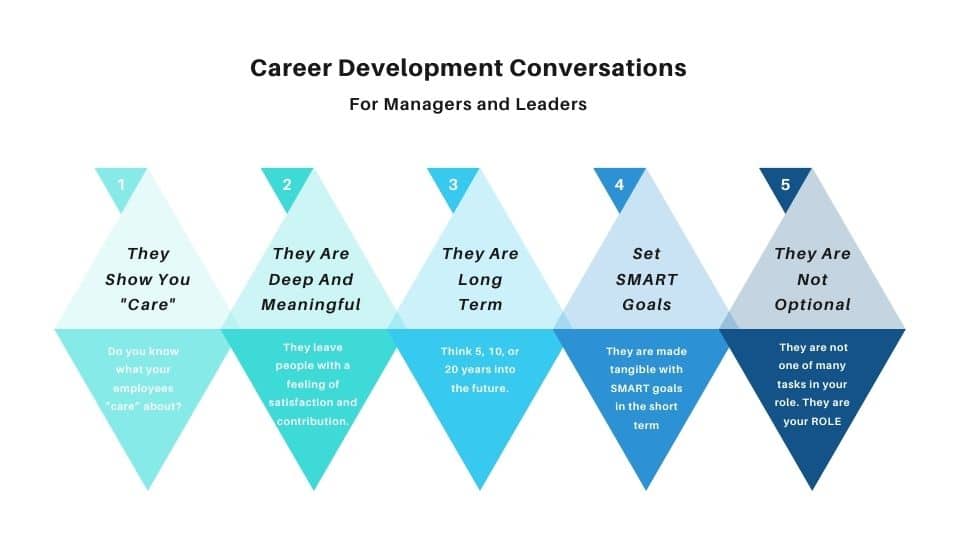
    Do you know what your employees “care” about, what they value or not value in life, and why? Do you know what motivates or drives them? Do you know what frustrates them?

    As a coach you can help people figure out what they “care” about. If we explore this simple yet powerful concept of “care” with our teams, it can open up a new world for them as individuals, and for us as a leader.

    2. They are Deep, Meaningful, and Long Term; but made Tangible with Short Term Goals and Milestones

    Working with various teams across continents over the last decade and a half, I have seen that people are often not aware what they “care” about, and what matters the most to them.

    Career Development Conversations are deep and meaningful to figure this out. They not only help people to be proactive in their career choices as they achieve important career milestones like promotions but also leave them with a feeling of satisfaction and contribution.

    3. They are the second-best opportunity to serve your people

    Leading by example is without doubt the primary way your people see and perceive your leadership. Any conversation or management practice will fall through if you don’t do what you talk about.

    The second best way is to continuously have these career development conversations with your people, which will create the context and form the background of everything else people do in their day to day jobs.

    These conversations can inspire people to cooperate in the face of business challenges. They help people align their own purposes with the larger collective purpose of the organization, leading to accountability and co-operation instead of conflict and self-destruction.

    “Treat a man as he appears to be, and you make him worse. But treat a man as if he were what he potentially could be, and you make him what he should be.” — Johann Wolfgang von Goethe
    What they are not?

    There are a lot of misconceptions around career development conversations since there are different definitions of them depending on the organisation you find yourself in. Let’s clear up what I mean when I say career development conversations.

    1. They are not Optional

    Most managers / leaders I have seen in different companies don’t have these conversations at all. Companies don’t realise its importance and it often takes a backseat with the focus mostly on driving business results.

    Even when they are, they are not regularly reinforced and leaders are not held accountable for them. Nobody told me about these conversations either. I have learned them the hard way – making numerous mistakes as a leader and only later stumbling upon these conversations from numerous trainings and books.

    2. They are not Performance Reviews.

    Many people and companies equate career development conversations with performance reviews, which happen on a quarterly or half yearly basis. However, what I mean by career development conversations is the total opposite of performance reviews.

    Performance reviews focus on the past. Career development conversations focus on the future.  Performance reviews focus on putting you in a box (of job expectations) and measuring you against the expectations of that box. Career development conversations encourage you to get out of any defined boxes (or job roles) and define for yourself the meaning of success and contribution.

    3. They are not Short Term.

    Career Development Conversations are long term. Think 5 to 10 years or even longer if you can. They help people envision what their career is (or can be) all about. They go beyond material milestones and successes; and empower each person to find their own meaning at work, and define the legacy they want to leave behind.

    Having said the above, and keeping that as the background context, Career Development Conversations then drop back to shorter time frames of one year and less. By working on tasks aligned with the long term context, people can find new meaning and joy in their work which wasn’t available before. Needless to say, all of this results in better business results too.

    4. They are not about the Next Promotion or Job Titles.

    Career Development Conversations can also be confused with promotion and the usual benefits that come along. I believe that while that might happen as an outcome of these conversations, they are not the end goal in themselves.

    The focus is on the continuous development of employees and their progression as professionals. The emphasis is on doing work which not only challenges people professionally but also leaves them with a deep sense of pride and purpose in your work.

    5. They are not just one of many “tasks” to be done

    Career Development Conversations should not be taken lightly by managers / leaders. They are not just one of many tasks in your role. Infact, they are your ROLE. If you are not having these conversation, you are leaving huge potential in people and your team untapped. When done well, they can cause careers to take off.

    Career development conversations should not be taken lightly. I believe every task your team member does should revolve around these conversations. These conversations will set the context of everything the team member does or does not achieve. They are to careers what oxygen is to life.
    Key Conversations

    Having gone over what career development conversations are and what they are not, let’s go over some of the key conversations :-

     1. Understand Them

    The intent of this conversation is to understand your people beyond their job descriptions. You can do so by asking and answering the below questions.

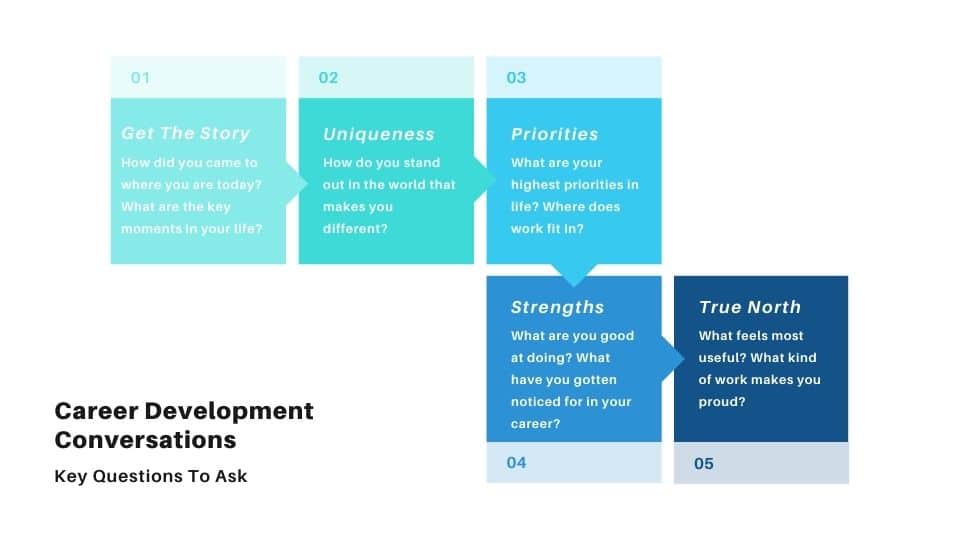
    • What is your story?
    • How did you come to where you are today?
    • What are the key moments in your life –  ups and downs, successes and failures, and how each of these events has shaped you?
    • Tell me something I don’t know about you. This question always amazes me as I find out something new about the person.

    If you think this can be hard, then you are absolutely right. Getting people to open up about their life can be a slow and gradual process as you build trust and go beyond personal barriers.

     2. Help them figure out their True North / Lighthouse

    • How do you stand out in the world that makes you different?
    • What are you good at doing? What do you believe you are the best at? What have you gotten noticed throughout your career?
    • What feels most useful? What kind of work makes you proud? Which of your tasks are most critical?
    • What bugs you? What makes you angry or frustrated?
    • What are your highest priorities in life? Where does work fit in?

    By asking some powerful questions like the above, you will help people identify their strengths and weaknesses, values, and motivations, and what makes them unique and special. For me, knowing someone as a human being is such a wonderful experience as I get exposed to the personality of the person which is normally hidden in workplace conversations.

    Helping people figure out their True North can help clear the fog of uncertainty and clearly distinguish the path or at least the direction, they can pursue in the future. This True North can be a lighthouse (of values) that can serve as a compass in difficult times.

    3. Empower Them by Preparing a Plan

    The next type of conversation is to build upon the above two and make it concrete in the form of a plan for where they want to go. Present them opportunities for future growth in the organisation based on their values and motivations, and not just on their talent and skills.

    Once you have identified opportunities that they can pursue with purpose and commitment,  support them to find training to acquire any skills they need, or in reaching the right people. Work with them to create SMART (Specific Measurable Attainable Relevant Timely) objectives, which are impactful for both the organization and the individual personally.

    Having clear objectives to achieve in the future, and also clarity about how will it help them individually as well as the organisation will empower them as they build up confidence and momentum once they start. Once they grow their wings and build up speed, get out of the way and give them space to fly. (which can be very difficult, especially in big organisations)

    In conclusion, I would also like to add that all the 3 kinds of conversations above never happens chronologically. You can jump between them as you feel fit, and it is a gradual process as you discover more and more about your people, and guide / support them on their way.

    As you discuss these questions, you also open up and answer these same questions for yourself too. These conversations are not a monologue but a dialogue. I have always found having these conversations very useful to me too, and you also end up building deeper relationships and friendships at work. And working with friends is always a breeze while working with strangers can be painful.  

  • The Distinction Between Meaningless Activity and Meaningful Actions, And Why It Can Make All The Difference

    In today’s age of always-connected devices and nonstop notifications, we all have more to do each day than the hours can fit. Crossing items off the to-do list always feels good and gives one a feeling of accomplishment, but have we ever stopped and asked ourselves – accomplishment towards what?

    The ‘Busy’ Trap

    Whenever I have stopped to ask myself that question, I have realized that I have fallen into the trap of being busy rather than being productive. Being busy often relieves us from the fear of sitting still and the pain of conscious thinking, while the really important tasks often get neglected.

    We are often sucked into doing meaningless activities, either through algorithms running on our “smart” devices or through habits we have formed by emulating our peers rather than consciously choosing them. In other words, we waste most of our time doing meaningless activities that we have no time left for what really matters.

    We keep looking for happiness in materialistic gains which never leads to fulfillment. While everyone is constantly fighting to achieve their materialistic goals, very few understand that these are mere empty pursuits, only adding to the vicious cycle of wanting more.

    Every 2 weeks I share my most valuable learnings from living life fully in my Deploy Yourself Newsletter. Sign up now to download a workbook with 164 Powerful Questions which I use daily in my work and coaching. Allow these questions to transform your life and leadership.

    Meaningless vs Meaningful

    Everything that we do can be divided into either meaningless activity or meaningful actions. What I mean by meaningless activity is anything we do to only keep ourselves busy. Example – checking email and social media, hanging out with friends, or anything we do without a specific intention in mind.

    In contrast with the above, any activity which adds meaning to your life, or takes you in the direction of a conscious intention (or a goal), is what I would term meaningful. It could be a business trip for one or spending time with their family for another.

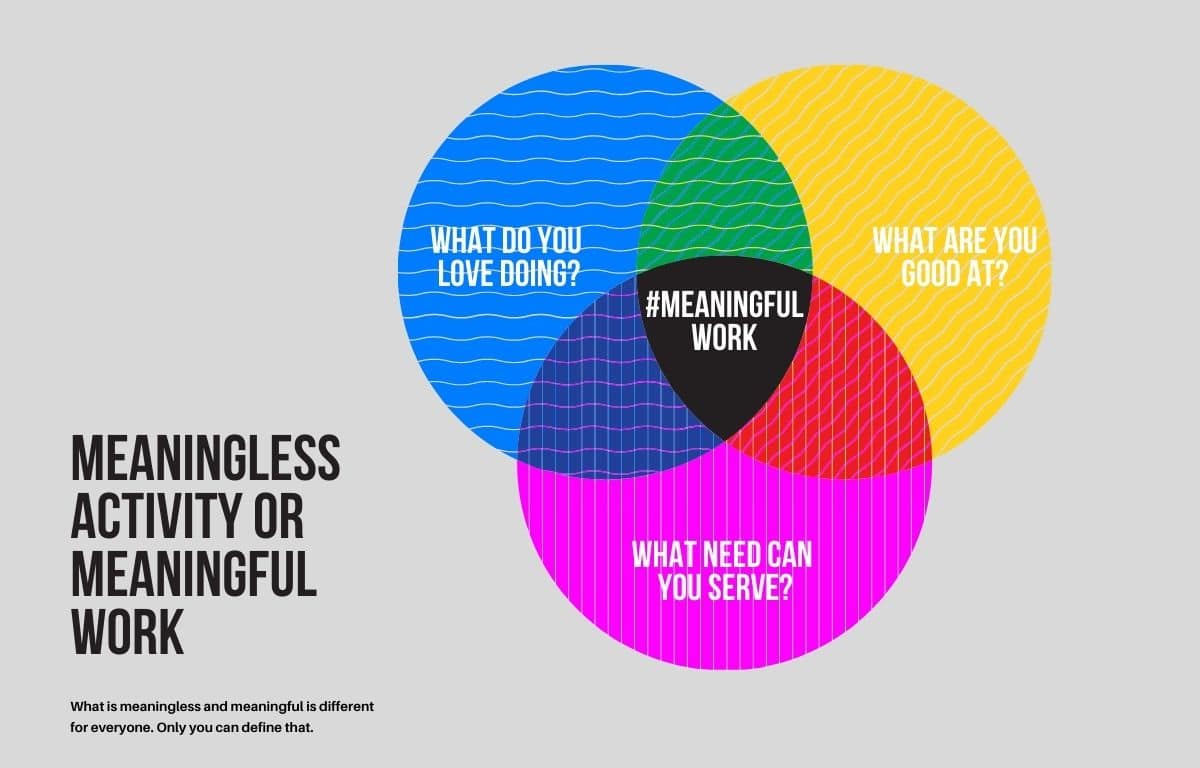
    What is meaningless and meaningful is different for everyone. Only you can define that. No-one else can make that distinction for you.

    We are often focused on what is urgent or what seems important today that we end up ignoring what is really important for us in the long run. Only by being aware of our decisions, we can be deliberate about them to move our life in the direction we want to go.

    “A man who procrastinates in his choosing will inevitably have his choice made for him by circumstance.” – Hunter S Thompson

    Focus and Prioritise

    Research has shown that not having the courage to live a life true to ourselves, not expressing our feelings when we should have, and working too hard are the top three regrets people have at the end of their lives.

    Doing things that we find meaningful is essential to our well being. But how many of us spend time wondering about what gives our life meaning, and what is really important to us?

    When we accept the standards and values others’ have set for us, we surrender our own will and judgment. By figuring out our own values, we allow our unique light to shine upon the world.

    If we only follow what everyone else is doing and not take the time and effort required to find our own values, which are unique for everyone, we will soon find ourselves lost and confused. But once you have put in the effort and identified your unique set of values, motivations, desires, and talents; you can nurture them and let them guide you.

    Three Questions

    • What are you good at?
    • What do you love doing?
    • What need can you serve?

    I believe the intersection of answers to the above three questions will be the most meaningful work for you. Once you have these answers, it will give you the clarity to prioritize tasks and the courage to say “No” to anything that doesn’t align with what you discover.

    Answering these questions will require some sincere and dedicated effort on your side, but once you do that, you will have more clarity on how you define your meaningful work. I would also like to add that it is a continuous rather than a one-time process. You should revisit the above questions every now and then as a “health-check”.

    Having the clarity about the “why” before the “what” and “how” of any action will ensure you create focused output that moves you forward, rather than the effort that just takes you around in circles. So the next time you think you have no time to follow your dreams, you know you have fallen into the trap of being busy with meaningless activities.

  • Have You Discovered Your Leadership Lighthouse? Why Should You?

    A Global World

    Today, we live in a globalized world which is more connected than ever before, and the movement of people and goods has never been easier. It is driven by economics and money, and it is possible to sit on your couch and order what you want from the opposite corner of the world and have it delivered to you in a few days.

    Open markets, lower trade tariffs, and an ever-increasing movement of people, goods, and information to any part of the world have resulted in great prosperity for everyone involved. Major world problems like poverty, hunger, and disease have decreased considerably over the last 50 years. The health and well-being of people all over the world have never been better.

    However, living in a consumerist society driven by economics has also resulted in greed, corruption, and the pursuit of economic success at any cost. It is no surprise then that we saw scandals like Enron in 2001, the financial crisis in 2008, and the Volkswagen emissions scandal in 2015-16. These scandals resulted from cutting corners in the pursuit of success by leaders in these companies.

    The Leadership Lighthouse

    Just like ships need a compass and a lighthouse to navigate in the vast oceans, our companies and their leaders too need a leadership lighthouse to find direction in the vast ocean of global competition. The speed (of a ship or a business) is not the only thing matters. Our leaders need to realize that the direction they choose to go and take their companies along is more important than the speed.

    The Leadership Lighthouse is a set of values (to guide us), standards (to measure us), and boundaries (to keep us in check); which will act as a moral compass as leaders take decisions and navigate their companies in the race for success in the global economy. These standards and values guide us in finding the right direction in challenging and exciting times.

    Find Your Own Way

    The whole essence of leadership is to bring our own unique values, talents, and skills into the world, and to express ourselves in alignment with those. When we accept the standards and values others’ have set for us, we surrender our own will and judgment. By figuring out our own leadership lighthouse, we allow our unique light to shine upon the world.

    If we only follow what everyone else is doing and not take the time and effort required to find our own leadership lighthouse, which is unique for everyone, we will soon find ourselves lost and confused. But once you have put in the effort and identified your unique set of values, motivations, desires, and talents; you can nurture them and let them guide you.

    If we stop and look back at the history of the world, be it in the business world or outside of it, you will find that every human achievement is an achievement of the individual who went against the norm and followed their own leadership lighthouse.

    How Can You Find Your Leadership Lighthouse

    As mentioned above, our leadership lighthouse is the set of standards and values that define and inspire you. It will guide you during challenging moments by serving as a moral compass and give you a solid ground to stand upon when you face turbulent times.

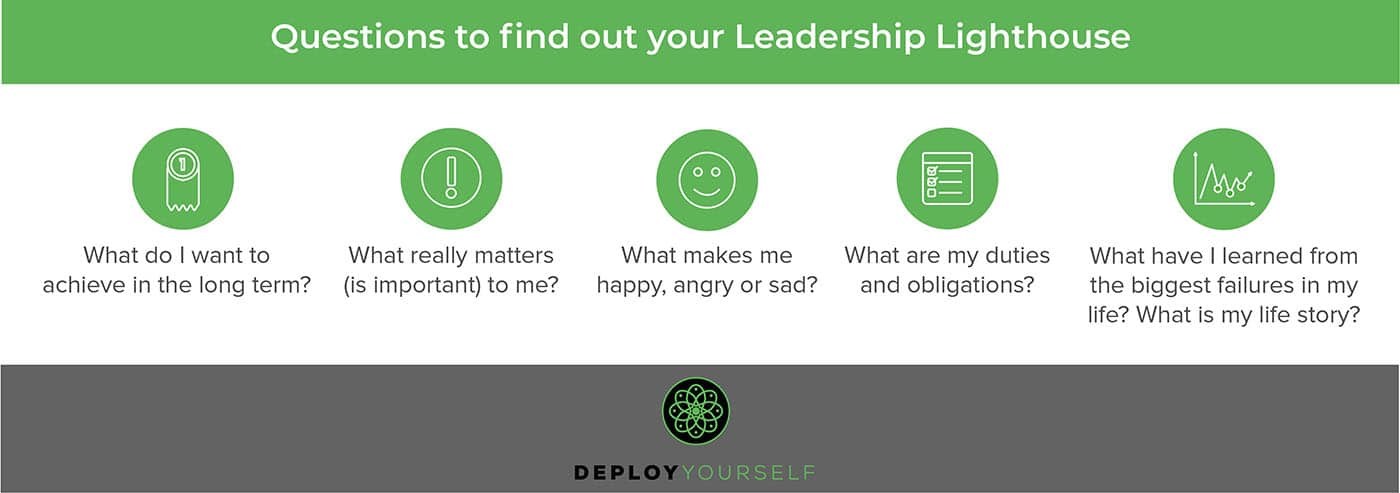
    To find leadership lighthouse, try answering the below questions:-

    1. What do you want to achieve in the long term?
    2. What really matters (is important) to you?
    3. What makes you happy, angry, or sad?
    4. What are your duties and obligations with regard to different aspects of your life?
    5. What have you learned from the biggest failures of your life?

    Answering these questions will require some sincere and dedicated effort on your side, but once you do that, you will have more clarity on how you define your own leadership lighthouse. I would also like to add that it is a continuous rather than a one-time process. You should revisit the above questions every now and then as a “health-check”.

    Knowing your leadership lighthouse will give you the confidence and assurance to follow your own path instead of the path others have decided for you. Once you nurture and develop your strengths and act consistent with your standards and values, you will allow your own unique light to shine upon the people and the world around you.

anger anna hazare bangalore business challenge coaching conflict conversation corruption Cricket culture dandi march emotions energy friends fun gandhi giving gold growth hope india jan lokpal bill language leadership lessons Life listening love moment mother movie new year people perspective poem sachin tendulkar saleraja trust values walk waste women words world cup