Last year I wrote an article about three small steps in treating our employees that can make a big difference as an entrepreneur. Great teams are made up of employees who help each other, know their roles, set aside personal goals, and value team success over everything else. I want to expand those steps and add three more very simple things we can do –
Your first few employees will make or break your company
4. Be the First to Take the Blame
Whenever something goes wrong, as it will many times, it is the boss’s duty and responsibility to be visible and face the music from inside and outside. Otherwise, anger, upsets and blame can set in and make things worse for the future. While taking blame, you also have to be honest about what is happening and efficient in dealing with the repercussions.
5. And the Last to Take Credit
Always give credit to the team first, because any success you have is actually theirs. That doesn’t mean discounting your role which you should always acknowledge. But your success is not only yours, and that’s why you should pass on every credit you get to the people behind, who normally wont get much visibility. Make sure they know their part in the success and importance in the company.
6. Make Sure Your Employees know how much They Mean to You
If someone is working a weekend for you, make sure you are there too. Otherwise, do something to let them know how much that means to you. Nobody wants to work on a weekend, and it is your duty to acknowledge their effort and responsibility to make them feel thanked for their contribution.
One side effect of being an entrepreneur is that you stop hearing the word “NO“. In fact, one can say that you still hear the word but you don’t listen to it or it doesn’t stop you anymore. Where it gets interesting is when this start happening even in personal and day-to-day issues apart from just professional matters, as I have observed in the last few months.
Lately I have noticed that how I have annoyed and surprised many people as I have ignored when they said NO to a certain matter, or how I have come up and followed up with them again and again. People are not used to hear back from people after they have uttered the NO word, but it works for me as long as it gets the job done.
What’s your definition of NO?
I think what entrepreneurship has done is forced me to change the definition of NO to “not right now”, “not this way” or something else depending on the situation. If I look back, I can remember very clearly a few instances when I have followed up on a NO response with – “How about tomorrow?”, “How about if I do it this way?”, or “Is there another way we can work it out?” and similar such questions until I get at least a part of what I wanted in the first place.
When we are working on something we really care about, it is very easy to get discouraged. It is very normal to even assume NO as the answer if the opposite party doesn’t reply or get back to us for a few days. But the truth is that there is probably a reason unknown to us for the No or No Reply. And in most of the cases, there is an alternate to that reason which, if explored, could lead to a Yes eventually.
I guess this is almost second nature to entrepreneurs, but we must always keep persevering if we “really” want to get what we desire. And if it is meant to be, it will happen eventually. We just have to keep on it, day after day, week after week, and month after month.
And even if you get a final NO (like somebody threatening to hit you the next time you bring a certain issue up) or you decide to move on (which is always a fine line), I have also realized that setbacks are often the starting points of something else, and not an end in itself. The only question is how we approach them, and where we draw that thin line between “giving up” and “going after what you really care about“.
As I have written in some of my previous articles, what distinguishes great people and organizations is not how they succeed, but how they fail. Great organizations (especially dealing with innovation) are about taking risks to do things that haven’t been done before. And like with any experiment – you know there are going to be more failures than successes. That is the definition of innovation. If the odds were higher and success was almost certain in every one of two cases or so, every Tom, Dick and Harry would be doing it.
Take Intelligent Risks
We live in a world of risks, and we live in a world of failure. Entire industries like venture capital, portfolio management and insurance work on the model of taking intelligent bets and risks, and making the few big wins count more than the numerous failures. So rather than eliminating risks, we should take intelligent risks and learn to eliminate the uncertainties. Because without risks, there is no moving ahead.
Look Far Ahead – The Bigger Perspective
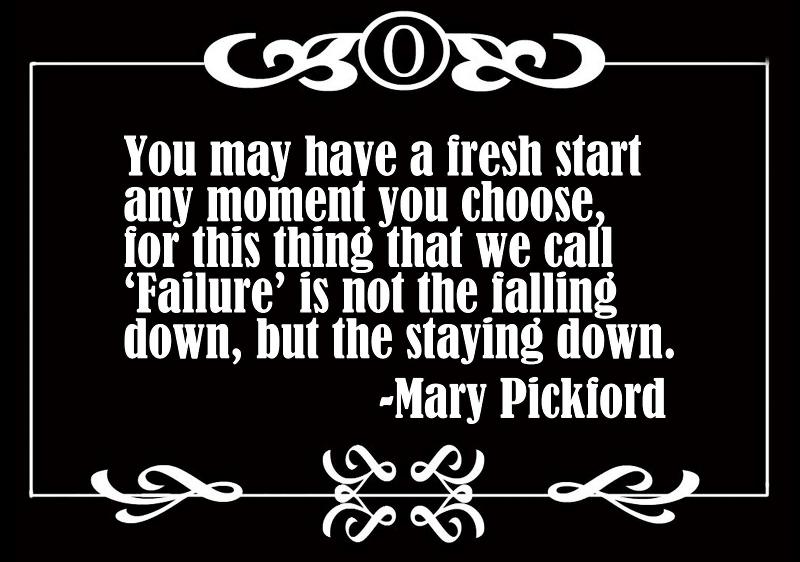
When you look at the big picture you will realize that when you fail you are not finished. Failure doesn’t mean a full stop, it just means a temporary barrier on your way to wherever your vision is going to take you. Failures build our character amid immense challenges, and that is an incredible muscle to build for tough times. Over the period of a long journey, the definition of failure changes for most people, and we start becoming much less scared of it.
Be Ok with the Fear of Failure
What is lacking in the current environment is the concept of constructive failure, by which I mean the ability of doing things and failing, then learning from the mistakes and iterating until you reach the milestone of success. Failures can by compared to the lighting lamps on the way to every success story. Being able to take failure as an asset is a unique trait. When you really learn is when you are confronted with failure.
Dont Live Life, Be Alive
Many people say you can learn from the failure of others, but there is only limited knowledge and experience you can gain from reading books and listening to others. You can’t relive the experience of falling from a bike by reading about it. So in terms of failure, if we ‘really’ want to learn the lessons and want our time and money’s worth from failure, they better be our own. There are some experiences which must be felt if you have to learn the lessons with them, and there are no short cuts.
Infact, most of the success stories we know today are also stories of many more failures which are never highlighted by the media. To give a few examples, Henry Ford failed in five businesses before starting the Ford Motor Company and Soichiro Honda was turned down by Toyota for a job and was jobless for some time before he started making his own scooters at home. Walt Disney was fired by a newspaper for a “lack of imagination” before he started Disney. To stress the point that innovation in business is similar to experiments by scientists, we have the examples of Thomas Edison and the Wright Brothers. We will have examples in art, politics and sports too of such people, and some names that come to mind are Winston Churchill, Oprah Winfrey, Steven Spielberg, JK Rowling, Elvis Presley and Michael Jordan.
Employees are your first customers. If you want to make your customers happy, the first step is to delight your employees. However, this is a double edged sword and easier said than done. Being flexible to listen to and find the best fit for an employee in your company and still being able to take decisive actions is a tough skill to master. Here are three simple steps every entrepreneur should take to ensure the right working relationship with his / her employees.
1. Share Everything
I believe that honesty is the best policy, so celebrating the good news together and breaking the bad news first is very important. Keep everything transparent with your employees and other stakeholders (unless something is legally confidential) to build trust and ensure their co-operation. It is important to learn the lessons of entrepreneurship together with your employees, and make sure they understand everything and grow with you.
Recently, I was asked if I was going to fire an employee who made a mistake that cost the company $600,000. No, I replied, I just spent $600,000 training him. Why would I want somebody to hire his experience? Thomas John Watson, Sr.
2. Do Everything
Never ask your employees to do something which you don’t want to do. Always tell them that you are ready to do whatever it takes for making the business successful. Do tasks from time to time to build emotional bank deposits and build trust. Make sure they understand why everybody is doing what their roles demand, and how it all fits into the bigger picture.
3. Get Connected
Make friends with your employees. Get to know them personally, their families, problems in life and what they want to do and achieve in life. See if you can make a difference. Respect their private space, but always recognize that they are human beings first, and employees second. And health and family will always take preference, as it does for us. So if they are not able to give their best at work because of some other issues, as an entrepreneur, it is our problem to make sure they have whatever support they need.
Now that I have written 3 points, I think I can write another three. But I will save that for a later post and time.
If I were to compare a startup to hunting, then the idea of hunting that bear is akin to the new business idea you are pursuing. But the hunting doesn’t start unless we get our lazy asses out in the jungle. Similarly, entrepreneurship only happens when we enter the jungle (execution), with all its uncertainty and dangers which we all miss in the city (idea). Below are some rules of the jungle, if you have forgotten –
1. No Reasons and Excuses
Once you have stepped in the jungle, you can’t blame the wild bushes and animals and the lack of roads. You can’t demand a hospital and a restaurant in a jungle. So if you think you need funding to execute an idea, or a quiet time to write that book, or that degree to be successful, then shut the **** up and stop giving excuses. Outside in the civilized world you can give these reasons, but in the jungle these become just excuses. Nobody wants your MBA degree in the jungle, and neither can it make any difference.
Life is a zoo in a jungle. – Peter De Vries
2. No Blame, Only Responsibility
In the jungle, you can either blame the thorns and the leeches for you not being able to hunt, or you can take responsibility for stepping into the jungle and dealing with whatever it has to offer. Taking responsibility will ignite the inner fire in you, to take charge of your life and improve/change and do whatever is required to reach your goal, inspite of all the challenges that the jungle presents to you. And yes, it takes strength.
3. Calmness amid Change
In a jungle, you can’t blame that the ecosystem changes every inch. If fact, it is utter stupidity if you expect anything other than change in a jungle. Similarly, in the startup world, you must learn to accept that life is filled with change. The only thing that matters is how accepting or rejecting you can get of that change, discomfort and hardship? The more you accept that as normal and stop resisting it, the more easily you can find the hidden treasures of entrepreneurship. As one wise man once said – “It is much easier to ride the horse in the direction that it is running.”
4. One Difference
If there is one difference between a startup and hunting, it is that in hunting you know which tools to carry and what animal you are going to hunt. But in a startup, most often you don’t even know your target (customers) so there is no question of having the right tools like a gun or a knife with you. So, you will not have the programmer, the sales guy, the money when you need it the most. Face it. Using whatever tools, you have to do get the job done. Using rocks as knifes and stones as guns can look funny to others, but that is the best you can do in your situation. And so you do it.
Taking it a notch ahead, I would say LIFE itself is a jungle. Think about it? For me, that is what makes it so exciting. For you, only you can answer this question?
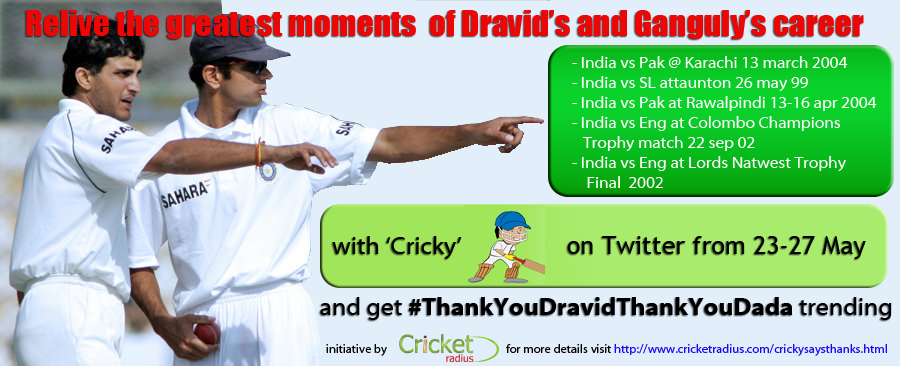
As I (CricketRadius) launch the Cricky says Thanks to Dravid and Ganguly campaign on twitter today, I want to take you into a brief journey of how I came up with the idea and how I see fun as an integral part of life, whether it is doing business or watching a game of cricket, or anything else for that matter.
If you Obey all the Rules, You miss all the Fun
If there is one mantra I live my life by, it would be this. The focus is not on breaking rules, but on having fun. We learn by doing, and by failing we learn how not to fail the next time. But that failing had all the fun. Remember the childhood days when you fell off the bicycle, or while playing football, and how much fun it was. And with every fall, we became better at not falling. For me, doing something the way I want do it is the greatest thrill in the world.
Cricky The Fan
Work = Fun = Play = Business
I have always been in the business of cricket. Irrespective of where I have worked, I have always followed every single cricket match played by India in the last 20 years. I have devoted hours every day reading articles, watching videos and discussing about cricket with my friends and colleagues. The point I am making is what you ‘care‘ about is your business anyway, in whichever form it is. And throwing yourself into a job you love and enjoy is one of life’s greatest pleasures.
I am my own Customer
The one thing that wakes me up in the morning these days is the idea of giving a great experience to my customer. I have myself followed cricket by way of keeping a track of records in notebooks and cutting pictures from newspapers to form huge albums of collages. Later on I have maintained excel sheets containing all kinds of cricket related data and kept them updated regularly. What I am trying to do with CricketRadius is to deliver a product for myself and people like me. I have still not figured out what the end product would be, but I am sure I know it somewhere deep inside and just have to bring it out in the right form.
Get Started. Make Impact. Small is not Bad
If I have an idea that can save the planet, I will act on it. But if I have a small idea which will just make watching cricket more fun, I will work on that too. For me, the real joy is of ‘creating‘ something new, not in how big or small, and the journey in itself rather than the destination. So the point is – Just make a difference where you can. Some solutions can be scaled up, some can’t, but I like to realize that after taking action, rather than in classrooms and meetings.
Relive 5 historic matches of Ganguly and Dravid on Twitter from 23-27 May
How the campaign came about?
It is not a co-incidence that the campaign is about expressing gratitude to Dravid and Ganguly for their contribution to Indian Cricket. I have spent my childhood watching their entire careers and I believe these two players have had the biggest impact on Indian Cricket in the last 20 years, along with Anil Kumble, VVS Laxman and Sachin Tendulkar. And in todays inter-connected world, the question I am asking with this campaign is – “What if twitter had been there on these 5 historic matches which I am re-creating and reliving?” Every fan has the option to relive those moments of pure joy by following the commentary, reading articles and watching videos about the same online for 5 days starting today.
And what better way to show that we acknowledge Dravid’s and Ganguly’s contribution to Indian Cricket than getting all fans together in the form of a huge collage made out of our Twitter profile pictures – The Twit-Bat. So follow the matches live on our twitter account, and invite other fans to take part in the campaign all details of which can be found here.
As you know, I launched CricketRadius.com on April 2nd. It is my second stint at entrepreneurship after SaleRaja earlier. In this article I will try to answer what idea I had so as to convince me to leave Yahoo and jump full time into this. Being very frank, I got the idea (and it is still refining) after leaving Yahoo. I had a very basic vision of doing something to connect fans when I left Yahoo, but the idea of a social network and what all features it will have have only come in the last three months. See below paragraphs to know more about the problem, the market and the solution.
The Problem
As a cricket fan, right now there are websites where you can check scores, read articles and stories written by former players and experts. Cricinfo, CricBuzz, CricketNext, Yahoo Cricket are some of the popular names. There are also a lot of fan blogs where bloggers share their views about the game. But there is no platform which gives you a cricket profile, where you can express your love for your favorite teams, players, stadiums and matches. There is no platform where all the fans can come together and share the experience which comes when our team wins, or our favourite player gets a century or a hat-trick. We watch cricket and enjoy it with our friends and family, and that is where the real love and joy for the game comes out.
We can obviously share about cricket on social networks like facebook and twitter. But it is annoying when you share about your favorite team on social networks, and every other non-cricket update gets in the way? Like someone’s birthday wishes, or what dish has one cooked, or some funny pic about a guy getting hit by a car. Wouldn’t it be great if you could talk just about Cricket?
CricketRadius – Because Fans Deserve Better
The Product? CricketRadius is a social network for cricket fans by cricket fans. Interact with others who have cricket in their blood, and discuss about your favorite players, teams and ongoing matches. Check in to the players and teams you are watching, score runs and let the world know your cricket acumen. Also, score runs and get rewarded on the way.
The Market
Currently there are more than 100 million Indian internet users, of which 45 million are on facebook. There is no need to quantify in numbers the popularity of cricket and how many of these users visit various cricket websites or share about cricket on facebook and twitter. This number is expected to rise to 300 million by 2014, according to Google India. A large young population (more than 50% of Indians will be under 30 by 2015) with better incomes and a growing economy are all reasons for this impending growth.
Online advertising in India is only worth $200 million, of which $100 million is of Google alone. Online ads and engagement models have yet to catch on in India, considering the global online ad market is $ 80 billion while global revenue for Google is $29 billion. This despite the fact that India is the third largest internet populace, only behind US and China. Some more figures can be found at http://thenextweb.com/in/2011/09/16/internet-users-to-triple-in-india-by-2014-google/
This presents to me a huge gap and a product missing for an ardent cricket fan like me. Cricket is something about which I am really passionate about, and it has been a dream come true creating a product which more than anyone else, I want to use and share with my cricket lover friends.
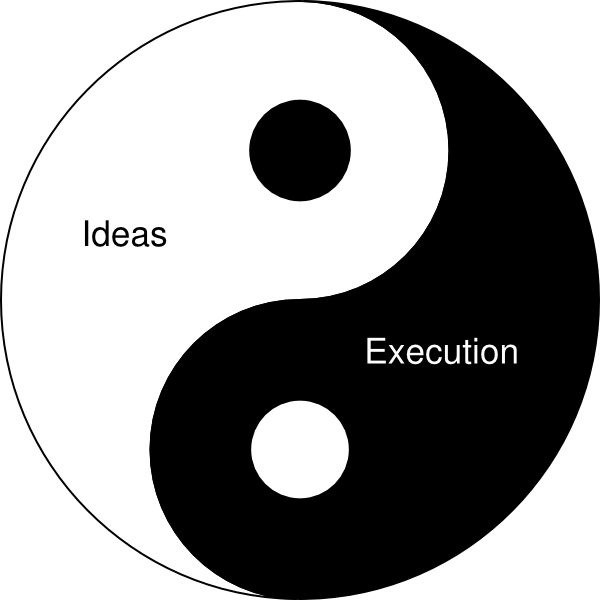
It is a very difficult question to answer, and I can take any side and debate endlessly for its merits. One important point from a business point of view is that both are critical, and there can be no successful business without either idea or execution. In a way, both are inseparable. What will you execute if you don’t have an idea to start with? And there is no such thing as the perfect idea. As you get out in the world and start executing, your idea will obviously change and refine itself based on market feedback and knowledge of realities which you were not present to earlier.
For Idea
Start up is the art of executing an idea, so obviously the idea is critical. If you are hell bent upon executing a stupid idea, no matter what your execution is, it just doesn’t add up. The idea in turn is the key to attract good investment and people, which are critical for the execution. A bad idea will simply not get enough traction to survive in the market place. A great idea is a way to attract other resources who will do the execution. Obviously execution is important, but it is zilch without the idea first. In short, the idea must be executable for the execution to matter.
For Execution
An idea is just an initial vision for a product, or a solution by the founder. To develop it as a business, the whole business model has to be considered. Who are your customers, how will you reach them, what is your USP, what will be the key resources for you, and most importantly, what all will you incur expense for and what all will fetch you money. An idea without answering these questions is well, just an idea. Sometimes no matter how great your product or service is, you simply can’t make the economics work and you end up in the dead pool.
The choice of market, the team, its persistence, timing, and how good you are at adapting the business along the way based on what you learn all comes in the execution sphere. And it is very important to be mature enough to realize that no idea is the ‘final’ idea. You need to pivot your idea and product, and try out different products, marketing strategies, revenue models before you find a product market fit. For example – We all know solar is a good idea, but it has not been successful because there are huge upfront costs which customers are unwilling to pay. But there are many companies like Simpa who have changed their business model by partnering with banks and offer their solutions to the customers at the same expense they are incurring now. The idea is the same, but the execution is the differentiator here.
The bottom line – execution is required for any enterprise to succeed, either with a good idea or a mediocre idea. Of course, nobody can help you if you have a bad idea.
Idea or Execution
Derek Siver’s Explanation
He believes an idea is just a multiplier, and formulates its relation to execution as follows:
Awful idea = -1
Weak idea = 1
So-so idea = 5
Good idea = 10
Great idea = 15
Brilliant idea = 20
No execution = $1
Weak execution = $1000
So-so execution = $10,000
Good execution = $100,000
Great execution = $1,000,000
Brilliant execution = $10,000,000
To make a business, you need to multiply the two.
The most brilliant idea, with no execution, is worth $20. The most brilliant idea takes great execution to be worth $20,000,000.
( My) Conclusion
Seth Godin says that just about every successful venture is based on an unoriginal idea, beautifully executed. Nearly every startup morphs their idea, often in very significant ways, once they enter the market. I would say that both are inseparable, you have to continuously refine your idea while you execute, and that is the key. So I would probably put the split at 40/60 in favor of execution. But there is hardly any business success story without both.
One of the best definitions of business that I have read or heard is “Business is a process by which an organization creates, delivers and captures value.” Short and simple. Create, Deliver and Capture. The three main roles of any business, and all of them revolve around the customer. In a way, we all say that we are doing business for money, or to be our own boss, or it is a way of life, but the fact is that a business cannot succeed or survive if it doesn’t have the customer at its focus all the time. Here are my four reasons why we (employees or founders) should treat our customers as friends :-
1. Customers are our biggest teachers
In my previous stint at entrepreneurship, ignoring the customer was the biggest mistake we did. Of course we didn’t realize that we were ignoring the customer till after two years we started SaleRaja, we always thought that we knew what the customer want. Even when we started interacting with customers, we were trying to sell them a product which we built according to their needs (which we guessed) rather than really taking the time to listen to them and understanding their real needs.
2. Most important relationship
If there is one relationship in business which should be friendly, it should be your relationship with your customer, even ahead of your investors and shareholders, but maybe at par with your employees. To thrive in any business, you need to know the pulse of what is happening in the lives of your business. You have to care for them at a level bigger than just your company and your product or service. Treating customers is not just about selling, but about forming long term and mutually benefiting friendships.
Customer service is not a department, it's an attitude!
3. Connect them on an emotional level
We need to understand our customers, the businesses they run and the challenges they face on a much deeper level than what is generally the norm. We should be willing to stand by our customers in tough times, and support them in whatever way is possible (by even suffering some temporary losses). We should be interested in meeting and talking to them even when we have nothing to talk on the business front. We should always keep and deliver on our promises. We should respect their opinions and ask them for advice. Nobody can give a more subjective view of our company than our customers. Once a customer told me – “I am ready to pay you ten times what you are asking, but you have to give what I actually need.” Only if I was listening 😉
4. You will be rewarded
Being a good friend demands hard work and commitment but if we can do that, nobody can reward us better than our customers. Our customers will love us and never forget how we made them feel. If we stick by them in their tough times, they will do the same. And that is what makes business life so rewarding apart from the usual cold and transactional meetings which are the norm. An example of such a business is Apple. Every Apple customer buys its products not only because of their superior design and quality, but also because of the relationship Apple has forged with its customers over the years.
However, this doesn’t mean that the customer is always right and we do have to be professional in our dealings. But I will leave that for another post.
If I have not told you yet or you have not heard yet, let me tell you. Recently, I quit Yahoo and am now working on another entrepreneurial venture of mine (after SaleRaja). Like most things in my life, this happened suddenly and without notice. When I joined Yahoo!, I was very clear that I would jump back into entrepreneurship again, but always thought it was 3 to 5 years away. More than that, I had a certain set of skill-gaps which I wanted to plug in before jumping back again.
Today, as it has already been over a month since I left Yahoo!, I can say with surety that those skill-gaps have not been plugged 🙂 And though I have done and learned a lot in the two years I spent at Yahoo, the gaps I wanted to plug still have a lot of holes left in them. But as I wrote in one of my previous posts (read point 9), maybe it was only a question of WHEN and not IF, that this would happen. And I am thankful to Yahoo to pushing me where I am today.
It started with the idea of a job change a few months ago and perfectly coincided with a separate cricket blog I started in November (cricketradius.com). When the response I got in the next couple of months to mine (and others) articles on CricketRadius surprised me, I actually looked at starting this as a business, even when I had a good and exciting job offer in hand. And so here I am, a little scared, a lot unsure about the future, but certainly confident that this is the right thing to do and I will figure out the maze that awaits me in the year ahead.
CricketRadius – Because Fans Deserve Better
Coming back to cricket, it has always had a very central place in my heart right from my childhood. From watching every ball of Test Matches to cutting pictures from newspapers and creating collages to the many thousands of cricket records and statistics in my head, I always knew cricket is going to take up a lot of my time, no matter what I do and where I work. And when I started writing regularly in 2010, I couldn’t stop myself from writing on a lot of topics related to the gentleman’s game. Eventually it led me to where I am today. Another benefit of my writing and proof that if you have faith in life, the dots will somehow connect in the future.
I am working on developing the first version of the CricketRadius product I have in mind, and it would go live in April first week. The central idea around CricketRadius is that fans like me are at the center of everything that happens in cricket. There would be no meaning to any cricket without fans, and as much as cricketers are sports persons, they are also entertainers performing in front of an audience. This fan base is the glue holding the cricket world together, as they generate the eye-balls, the emotions and the revenue which eventually runs cricket and pays for the salaries of everyone involved with the game.
The aim of CricketRadius is hence to provide a platform on web, mobile and other mediums where fans can express themselves and share their emotions about the game they so much love and adore. Because as fans, we deserve a lot more than just being able to read articles by journalists or hear the commentary by former players or watch the match passively on television or at the stadium. As a fan, I want the ability to express my love for my team and my favorite players in an easy and convenient way. I want to let the world know how big a cricket fan I am, and what this game means to me.
The exact details of how this will shape up as I build the product is still very unclear and evolve in the year ahead, but what I am very sure is the ‘WHY’ of doing this as a business. And the WHY is that ‘BECAUSE FANS DESERVE BETTER‘.. Much better than the options currently in the market to express their love for the game. And more than anybody else, I am the most eager person to start using the CricketRadius website once it is live.
If you are a fan, behold, as the COUNTDOWN begins…
I was never among the physically stronger kids during my childhood. And since fist-fights among kids are not uncommon, I had to devise other ways to tackle my opponents rather than relying on only my physical strengths. At times you get beaten up, but since you know you can’t overpower someone you start hitting the areas where they might be most vulnerable. Sometime you just wait and pass time while your opponent gets tired before you take your shot.
Starting and running a start-up is also the same, in many ways. Being matched up against competitors many times your size and weight, and that too in a market which is not always ‘fair‘, to put it gently. But as in my childhood, being placed against a bigger opponent can have its benefits too. You learn persistence and resourcefulness irrespective of your current situation. These challenges are what makes a startup interesting, and those who drive the thrill out of overcoming these challenges are the right people for a startup.
Why would anyone do that?
You can ask that why would anyone want to fight against a tougher and stronger opponent? Why would anyone want to do something where the chances of success are only minimal? Yes, it doesn’t make sense. This ‘WHY‘ is very difficult to explain in words, but those who do it know the answer somewhere inside. Maybe it is the same reason people cheer the underdog team when they win against a stronger opposition in sports? Maybe it is the same reason that we draw hope from those who fight against the norms for something they truly believe in? Despite of all the fears and challenges. Despite of the very minimal chance of success.
Coming back to entrepreneurship, maybe it is just in some people’s blood (as they say entrepreneurs are born and not made). But whatever it is, the likes of Steve Jobs, Lance Armstrong, Bill Gates and Anna Hazare felt it and at many different times, each one of us have also felt it. When we believe in something for which we are ready to put a lot at stake, we all become entrepreneurs in a way. Whether it is fighting for a cause, running a business, or expanding the boundaries of human performance!!
How would anyone do that? – Perseverance and Resilience
When you win against a stronger opponent, you become more confident and fearless. But when you lose, you start working on your weaknesses and try to make use of the resources you have. You very well know you can’t afford and have all the resources your competitors have, so you try to make the best out of what you have. And by doing so, you develop such a wonderful skill which even your big competitors doesn’t have – the ability to survive tough times with resilience.
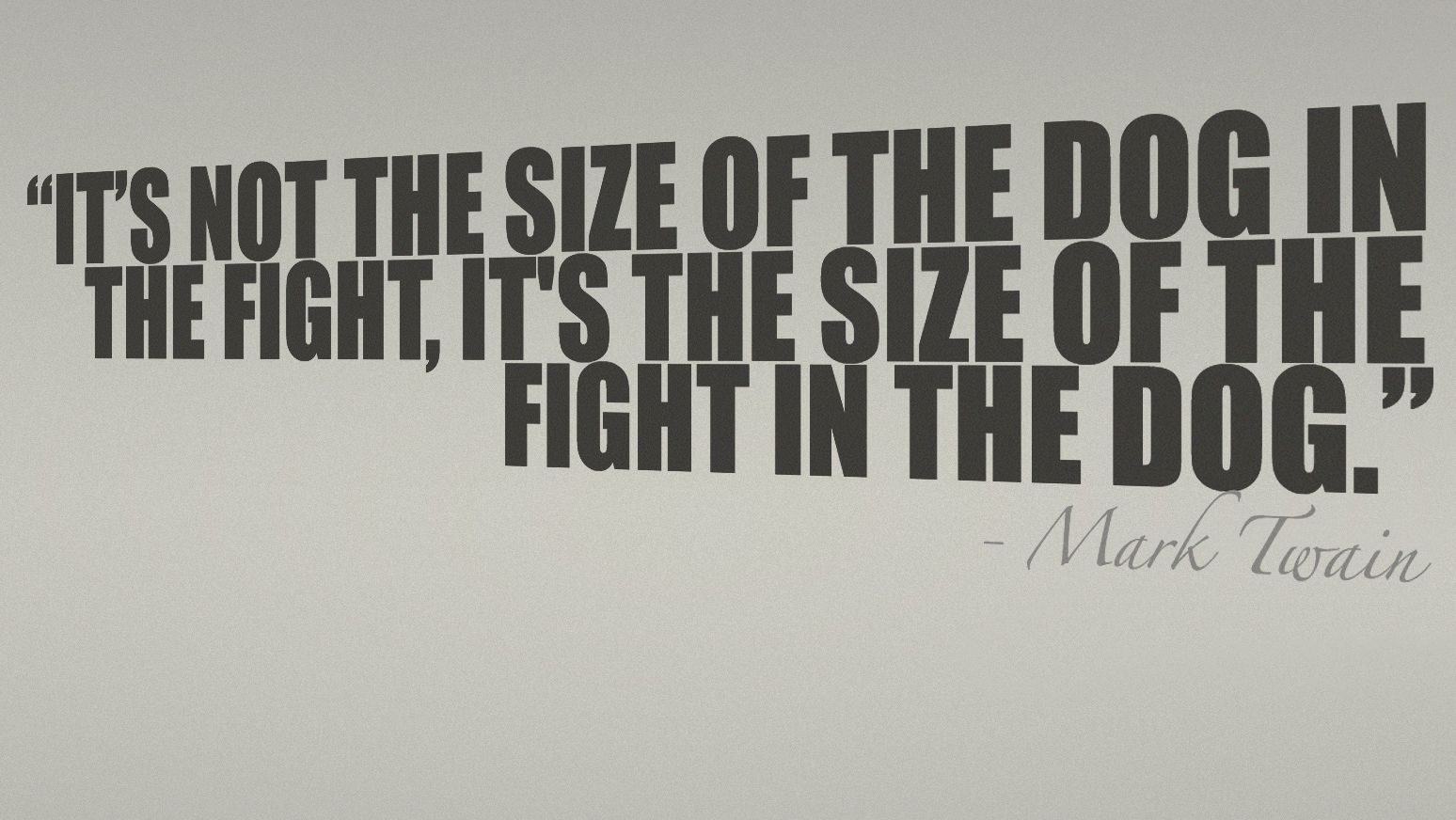
Mark Twain said it very rightly so
– Iterate
In the startup world, as George Patton said “A good plan today is better than the perfect plan tomorrow”, it is very important to act on incomplete information and in a world where uncertainty looms large. If you are doing something worthwhile, then you have to constantly go into uncharted territory, try new ideas, fail, then start again, and then fail again. And so on. As you have to expand yourself so much and step out of your comfort zone in doing so, you also have a steep learning curve.
– Use your ego, but with feet on the ground Ego is not always bad. Doing a startup is basically believing in yourself when no-one else does, and when even you have your doubts. It is about the confidence that “I can do it, I will do it, even if I don’t have the resources or skills to do it“. It takes a man with ego to go up and stand against the world. But at the same time, you need to stay realistic and know your limitations. A healthy ego is not only required but also necessary to constantly expand yourself and to keep fighting every day, even after facing many defeats. A healthy ego doesn’t stop you from getting back up knowing you might get beaten again.
– Getting things done, despite of a hundred things which need your attention
Startups aren’t for everyone. In a startup you always have thousands of things to do, and you don’t have anybody to delegate to. You will have to do all kinds of things which are normally reserved for ‘other‘ people in a normal job. In short, there are no boundaries of work. You might be planning, designing, coding, doing marketing and sales calls, all in a day. What becomes most important in a startup is to get a task done, irrespective of whether it is above or below your pay scale, irrespective of whether you have done it before or not, irrespective of whether you know how to do it or not. If a client is visiting and your office is a mess, the first person who picks a broom to clean up is the best fit for that startup.
In the end, I think it is the fighting that matters and not the winning. It is the daily grind you go through which is the most important part, even more than actually beating a stronger opponent. As it has been told by many great leaders – “The journey is more important than the destination”. I will end with a quote by Marian Wright Edelman – “You’re not obligated to win. You’re obligated to keep trying to do the best you can every day.”
18 Oct 2008, that was the day I landed in this beautiful garden city Bangalore as a 25 year old full with enthusiasm and energy to make it big. Now, three years hence, I can say it is exactly the same state I found myself in. Buzzing with energy, pumping in 14-16 hour days and excited about a lot of ideas sprouting in my head. Now I won’t say that it has been all rosy in these last three years, as there was a brief period of being lost, where I hardly was able to put in 6 hours a day, and I was either angry, frustrated, irritated or just tired all day along. But I am glad that this phase happened, and gladder that it is over now 🙂
SaleRaja – The Joy and Pains of Entrepreneurship
The first year in Bangalore was full of experiencing what entrepreneurship is all about. There were good days, and there were not so good days. Technical discussions, night long marathon coding sessions, sales calls, and a lot of manual and boring repetitive tasks used to fill up my day. The Bangalore weather was the perfect catalyst for all this. Going to events, meeting the founders of other startups, partnering with a lots of people for different tasks and lots of brainstorming sessions made this period one of the most memorable of my life. I started SaleRaja.com as I felt working with InfoEdge that it was not too difficult to earn money ‘for ourselves‘. SaleRaja taught me it was not so easy either 😉 Nothing could be more humbling than that, and the lessons from SaleRaja makes me what I am today. 15 months in Bangalore, and I had to make one of my toughest decisions to let go of SaleRaja, which might also be one of the wisest. For the whole SaleRaja journey, I can say that I started SaleRaja for earning money and getting rich. It didn’t make me any richer (in financial terms) but it ended my hunger for money and pushed me towards a journey for more meaningful things, and that was a big breakthrough.
New city, New games
Exploring New Territories
Once the burden of SaleRaja was no more, I felt really free and light compared to the heavy feeling of burden which I felt earlier. I started meeting a lot of people from the startup ecosystem in Bangalore, also had time to catch with a lot of friends in Bangalore whom I rarely met during the times of SaleRaja. I got interested in looking for new ideas for business, and saw a few very interesting ideas by entrepreneurs. I joined Yahoo during this time, and apart from work, started volunteering to teach school kids as part of a Yahoo! initiative. This step was path breaking as it helped me discover a new side of myself and opened up a lot of new doors. Not to forget are the many long rides I did on my bike which literally meant exploring new territories.
The Joy of Starting New Initiatives
Around the end of 2010, I decided it was time to do something (again). Well, once an entrepreneur, always an entrepreneur. I love starting new initiatives, and this time I decided to do something non-commercial, and something which was not related to internet and coding in any way. I took up a waste management initiative, organized an anti-corruption walk, and later started Pick a Fight. This journey, which still continues, got me in contact with some amazing people from the non-technical world, and it was an eye opening and view expanding experience.
Every city has its own language, customs and festivals
The Future – I can sense some change soon
It has been almost two years since I gave up on SaleRaja, and I am really eager to get back to the game again. Although I am involved in the initiatives mentioned above, I am always excited by new business opportunities. In a way I can feel the winds of change coming towards me soon. I am not sure how long before I start something again, or whether I will start myself or join an already existing startup, or what idea it would be? But I am very sure that I am ready for it again now based on my learnings in the last two years. But this time I will not hurry up into it like last time (not repeating the mistakes) and do proper due diligence before jumping again (making new mistakes).
Recently I wrote about some of the important lessons I learned after working with SaleRaja and other startups. I was pondering over this article and I realized I can think of many more points which I can write about. So below are 8 more lessons which I came up after reflecting on those days spend building some amazing products with SaleRaja, InfoEdge and Jivox.
8. Spend wisely
As a startup your balance sheet will be in the red in the first few years as you build the infrastructure, teams and systems for the future. Hence it is very important to monitor and control what you spend and for what purpose. Even if you have secured funding, you never know which way the economy turns in the future. The point is to always have cash in the bank to act as a cushion in tough times.
9. Networking
Big corporations are people independent, i.e. , they never depend heavily on any one or a few people for their business to survive. It is because of this that they can hire in big numbers, and even fire people easily in hard times. In startups though, the commitment to the company by employees is very important. Similarly, each employee is very critical to the company and it can’t afford losing an employee as it might impact their business. Due to this, the hiring in startups (at least the initial hirings) normally happen through networking and personal contacts as trust in the employee – employer relationship is very critical for startups. And networking is not only useful in hiring but in other business aspects too.
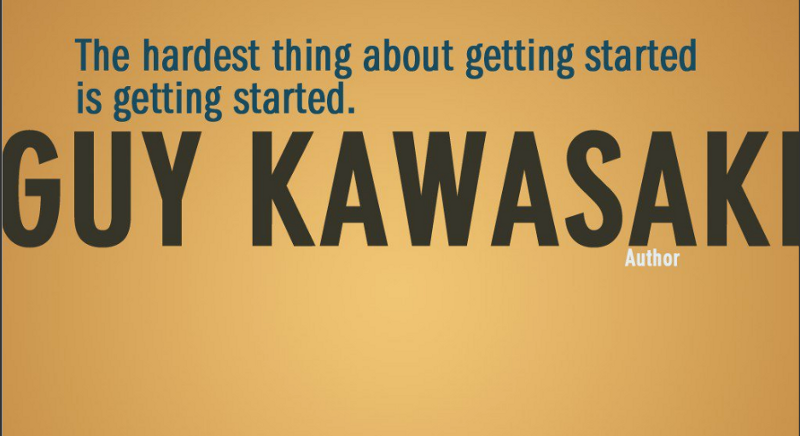
Beginning is Half Done
10. Have Fun Along the Way
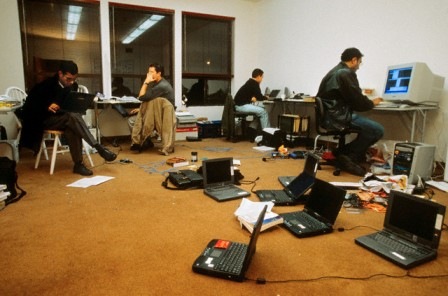
I have always believed in the idea that if we love what we do, it is not work but more like play. And while doing different tasks during a typical day, it is very important to have fun and not get too serious. A team of people working who smile and have fun with each other in a casual atmosphere will always have more productivity. So in your team, play some games, pull somebody’s leg, take out time for discussions other than work, or whatever, but don’t miss to have FUN. This might be an exaggeration, but see what happened during a night out in my first job.
11. Do everything – customer service to sales to coding
As a co-founder or starting member of a startup, you should try to do everything to get a pulse of the whole business. That would mean doing coding with your engineers, being involved with your marketing team, going out on sales calls with your sales team and also hearing customer complaints and feedback. This will keep you well informed of what is happening in the whole ecosystem around your business and will help you make better decisions.
12. Do your Business Ethically
It is important to follow both the legal and ethical laws of the land where you operate your business. Being ethical will help you in fostering a long term relationship with your customers. Any success that is attained without the foundation of ethics is bound to be short lived, as lies and scams tend to come out sooner or later. The primary objective of business is not just to maximize profits, but it is also to be a responsible citizen in a just society and working in a way that benefits all its stakeholders.
13. Make Mistakes, but Don’t Repeat
It is only human to make mistakes, and as you start a new business, you will also make few. But the important lesson here is to not keep repeating them. We must take enough risks for our business to grow, but also be wise enough to learn from our mistakes and not repeat them. We just need to make ‘new and better‘ mistakes going into the future. As for me, I am really glad for the mistakes I have made.
14. Mature with Time, but Don’t Grow up..
As our business grows and we reap success, we grow more mature and this maturity starts reflecting in our daily lives as well as our business decisions. But as a startup, it is very important not to loose what makes you special in the first place. It is always good to be a little crazy, keep having fun along the way and not get too serious. It is ok to risk, and it is ok to fail.
15. Don’t accept Failure as an Option
One of the most important word you have to stop listening when starting something new is ‘NO‘. So no matter what, in the face of a NOs, keep on finding new ways of achieving the objective, but never give up. Try out a lot of things, and go with the things that work. When things are not going well, take a break, do something which inspires you, but after that, get back to it with relentless persistence. Remember, failure is not an option.
When I joined my first job, work was on full swing to launch 99acres.com . I was part of the team which did all the technical work and the site was launched one month after I joined. Thereafter, I launched Sukip.com in Jan 2007 and Saleraja.com in Aug 2007. After moving to Bangalore, I worked with Jivox.com for 18 months. Recently I startedPickaFight.in, this time as a non-profit initiative. In all these endeavors over the last six years, I got a good exposure to starting up and scaling up websites, both from a technical, product and business point of view.
There have been many lessons along the way, most of them learned the hard way. Here are seven important points I would like to share with one and all who might be interested in starting a web based business. Update – Here are eight more lessons which I wrote as a follow up article 🙂
1. Passion in what you are doing
Always do what you are passionate about. If you are starting a new website based business, it will keep you awake at nights and make you work on weekends. So it is very important that it is something you are really excited about.
2. Prioritize
In my first job, my boss gave me a valuable lesson, “In a startup, you will always have thousand things to do but not the resources to do all of them. The key is to prioritize among them and then keep your focus on doing the selected tasks to the best”. I have never forgotten this. You will always have more than your plate can hold. So prioritize, prioritize and prioritize.
Working in a startup can be totally fun and 'not like' work
3. Release regularly
We launched sukip.com after 6 months of development, and then SaleRaja.com was launched after just 11 days of coding. Release early, release often is the idea. Rather than planning and building a Taj Mahal after months or years of work, start with a basic model and then make changes based on market feedback. Because the customer is the best judge of your product. Period.
4. Understand technology driving your product
As a founder, you might not do all the coding for your product, but it is very important to understand the technology behind it. By doing so, you will be better prepared to perform your job when you step in the shoes of your sales guy or the product manager. In short, it will allow you to make better business decisions.
5. Work like a family
Starting a company is like raising a baby, and hence it is very important the atmosphere is very cordial and like a family. People need to trust each other, care for each other and treat the work as their baby. This family like work culture could be the difference between success and failure later on.
6. Hire people smarter than you or who fill your gaps
You might be smart, talented and hard working, but nobody can know or do everything. Hence it becomes very important to hire people smarter or more talented than you are, or who are talented in the areas where you have a skill gap. Many times people don’t do this for personal and ego reasons, but this is a valuable lesson which I have learned the hard way.
7. Work with people who share your value system
Although your work might not require you to deal with your moral and ethical values very often, it is better to work with people who share your value system. In times of crises, or in times of extreme excitement and growth, these value systems can sometimes prevent us from making big mistakes. At the same time, a difference in the value system can cause rift between the team as both parties might consider their beliefs as right and blame the other party for not understanding.
Right from August 2007, when we started SaleRaja, it has been like a baby for me. It was something on which we had great hope. SaleRaja was supposed to be our way out of normal day-to-day jobs. I never thought I would have to work for any other company again at that time, and we even got a promising response in the beginning. But soon, the growth in terms of traffic and registrations began to steady out and it was clear that we would need a lot more funding and resources to scale it up to the next level.
With the recession in 2008-09 and considering our background (having only technical skills and no financial, marketing and sales skills), we struggled to get any funding. There was one remote chance of funding or a tie-up but unfortunately we blew that up. Also, my partners decided to part ways because of impending personal issues like marriage and finances, and there I was, running SaleRaja alone in Dec 2008. I got together with one more guy in the beginning of 2009, then with another girl for sales for 3-4 months, at the same time myself managing my day job at Jivox and coding for SaleRaja in the mornings and evenings.
It was around September 2009 that I was alone again (it didn’t work out as expected with the other two). I was still working day in and day out, doing coding as well as sales calls, but it was beginning to take its strain on me. I was no longer enjoying what I was doing, was getting tired and fatigued easily, and my energy levels started to dip for the first time in many years. The 16 hour work days which used to pass like a breeze started to seem like a self-imposed torture. This continued from September to December 2009. It was during these last few months of 2009 that I started to ponder on questions like –
Is this really what I want to be doing?
Why am I not enjoying this work now if I used to love it so much earlier?
Where am I headed if I continue this way?
Is there any other view or picture which I am missing here?
“If you change the way you look at things, the things you look at change.” – Wayne Dyer
I had jumped into SaleRaja at the age of 23. I also had blind faith in the idea that doing business is not possible after marriage, so this was THE time for me. And I had so much faith in mine and my friend’s abilities that failure never looked an option. I think I got so caught up in these predetermined notions that I tried harder, harder and harder but was unwilling to see the big picture, the picture that there might be something missing from our skill sets, the picture that business can even happen later on in life too, and that these last 2.5 years have taught me a lot even if they have not been as expected.
So what I learned from this experience is that sometimes we get so caught up in our day to day existence that we seldom take time to step back from our daily activities to reflect and observe our life as a whole. It is like we are so much busy in reaching the destination that we don’t even have time to stop for fuel. When we are stressed by situations, we start taking our decisions also in that emotional state. It’s strange how one bad incident can take us off track and get us going in the opposite direction instead. Only if we remember to look things in perspective of our whole life.
Taking time to stop every once in a while and gather our senses is also very important. We have to be calm and make sure we don’t panic. No matter how busy we get, we should always keep some time (a few hours or a whole day) to sit quietly and introspect that we are going in the right direction or not. It will allow us to focus on what we already have rather than what we don’t. Then we can go about calmly making new plans and vision for the future. In this quiet time we can ponder on long term questions like –
What all resources do I have now, and what all do I need?
What have been the past successes and failures, and lessons from them?
What skills, qualities, talents I need and how can I get them?
How can I more effectively use what I have right now to get the best results?
Gaining perspective also allows us to be patient and conserve our energies for future riches rather than wasting it on frustrations. It can also prevent us from making a big and costly mistake. Many times we just have to wait before the tide turns in our favor and we can start running again. Sometimes, perspective also makes us aware that we are not going in the right direction, and we might need to take a step or two back before starting again. Like in my case, I realized I didn’t have the resources and skills to pursue SaleRaja. Also, my egoistic view that business can’t happen later in life was getting in the way of making better decisions. It was then I decided to step back and take a break from entrepreneurship, work on to plugging my skill gaps, and then get back to entrepreneurship later on. It was a tough decision back then considering the work I had put on SaleRaja for the last 2.5 years, but necessary, as Steve Jobs remarked in his famous commencement speech, “It was awful tasting medicine, but I guess the patient needed it.”
I am glad I took this time to introspect, and today, 20 months after that decision, I can say I am on the right track, plugging my gaps and will soon be ready to jump into the entrepreneur world once again.
I use cookies on this website to give you the most relevant experience and for analytics purposes. Any personal data collected will never be shared with any third party, or used to spam you. That is my promise. - Sumit By clicking “Accept”, you consent to the use of ALL the cookies.
This website uses cookies to improve your experience while you navigate through the website. Out of these, the cookies that are categorized as necessary are stored on your browser as they are essential for the working of basic functionalities of the website. We also use third-party cookies that help us analyze and understand how you use this website. These cookies will be stored in your browser only with your consent. You also have the option to opt-out of these cookies. But opting out of some of these cookies may affect your browsing experience.
Necessary cookies are absolutely essential for the website to function properly. This category only includes cookies that ensures basic functionalities and security features of the website. These cookies do not store any personal information.
Any cookies that may not be particularly necessary for the website to function and is used specifically to collect user personal data via analytics, ads, other embedded contents are termed as non-necessary cookies. It is mandatory to procure user consent prior to running these cookies on your website.