Communication Skills

  • 9 Steps To Make The Most Out Of Difficult Conversations

    “The right word at the right time will unlock the door to treasures – the wrong one will close it forever” – Rasheed Ogunlaru

    Think about a discussion you have been planning to have with your manager. For example, to ask for a raise. Perhaps as a manager, you may need to terminate an employee or resolve a conflict with a co-worker.

    These are some of the many difficult conversations that we have to deal with quite often. However, it is important to realise what makes a conversation “difficult”. It is not the conversation itself that makes it difficult. It is our communication skills (or the lack of it) that make them appear difficult.

    There are many situations in our daily lives when such conversations are necessary. Still, it can be a challenge for many of us, including managers and leaders.

    Be it in our professional or personal lives, none of us enjoy having difficult conversations. We all love to hold on to our views and opinions, and don’t like being challenged. Our underlying fears prevent us from facing such conversations head-on.

    But avoiding such a conversation does not resolve the issue either. While we tend to steer away from conflicts or disagreements, quite often, such discussions are unavoidable. The chances are, a delay in the discussion will make the situation even worse. 

    In reality, making the most out of difficult conversations is extremely important for our personal and professional growth. Let’s see 9 steps explaining how to do that.

    How to Go About a Difficult Conversation?

    You’re not learning anything unless you’re having the difficult conversations.” – Gwyneth Paltrow

    Millions of years of evolution have taught our bodies to react in a certain manner to external threats. In moments of stress, our bodies react by releasing chemicals like cortisol that increase the heart rate. 

    This is often termed “amygdala hijacking” by psychologists. As a result, we often overreact or behave irrationally. Basically, the neurochemical interactions in the brain make it even harder to think straight and behave rationally.

    I believe being ready for tough conversations makes us better equipped to face challenges in life. When done in the right manner, difficult conversations have the potential to enhance a relationship and produce ever-expanding results over the long term.

    While there are no defined rules for handling difficult conversations, I have found that these nine crucial steps can make a big difference.

    1. Set the Right Context 

    The right conversation in the wrong context is the wrong conversation. The first step is to set the right context for the discussion. The best leaders know how to set the tone of the conversation and guide it towards the desired outcome. Here is an example:

    Imagine saying this to a client- “We need to talk about the project timelines being missed repeatedly from your end.”

    Instead, try this- “ I wanted to divert some of our best talents to your team, but the project timelines keep shifting. Let us discuss the best ways to frame a workable schedule.”

    Without context, we tend to react to what is being said rather than considering the bigger picture in mind. The right context helps keep the focus on what is really important. 

    Before you enter a difficult conversation, take some time to prepare for it. While a casual approach does not help, rushing through a serious conversation is also the wrong approach. Also, give the other person enough time to prepare instead of catching them by surprise. Are you going into the conversation to prove your side of the story and to prove them wrong? Or, are you going to the conversation to solve a problem together?

    The right context also helps to understand the social, psychological, cultural threads that are involved in the conversation. Have the discussion privately by creating a safe and congenial environment. It is important to enter the conversation as a “learner” willing to learn something new rather than as a “knower” who is there to prove something. You can also set up some mutually agreed ground rules to avoid misunderstandings and stick to the facts.

    2. Be Willing to See Another’s Perspective

    You cannot reason people out of a position that they did not reason themselves into.” ― Ben Goldacre

    To clearly perceive an issue, you need to also understand the perspective of others. Many times, we use our perspective to understand others. However, this might be completely different from their perspective and can cause friction in the conversation

    In the personal or professional world, there are hardly any situations when two people absolutely agree with each other. The fact is, disagreements are normal and they do not need to hamper a discussion. 

    David Maxfield, the co-author of the book Change Anything: The new science of personal success, sums it up perfectly – “Ignoring the disagreements doesn’t work, and turning disagreements into fights doesn’t either. The key to a successful relationship is how you handle the inevitable disagreements.” 

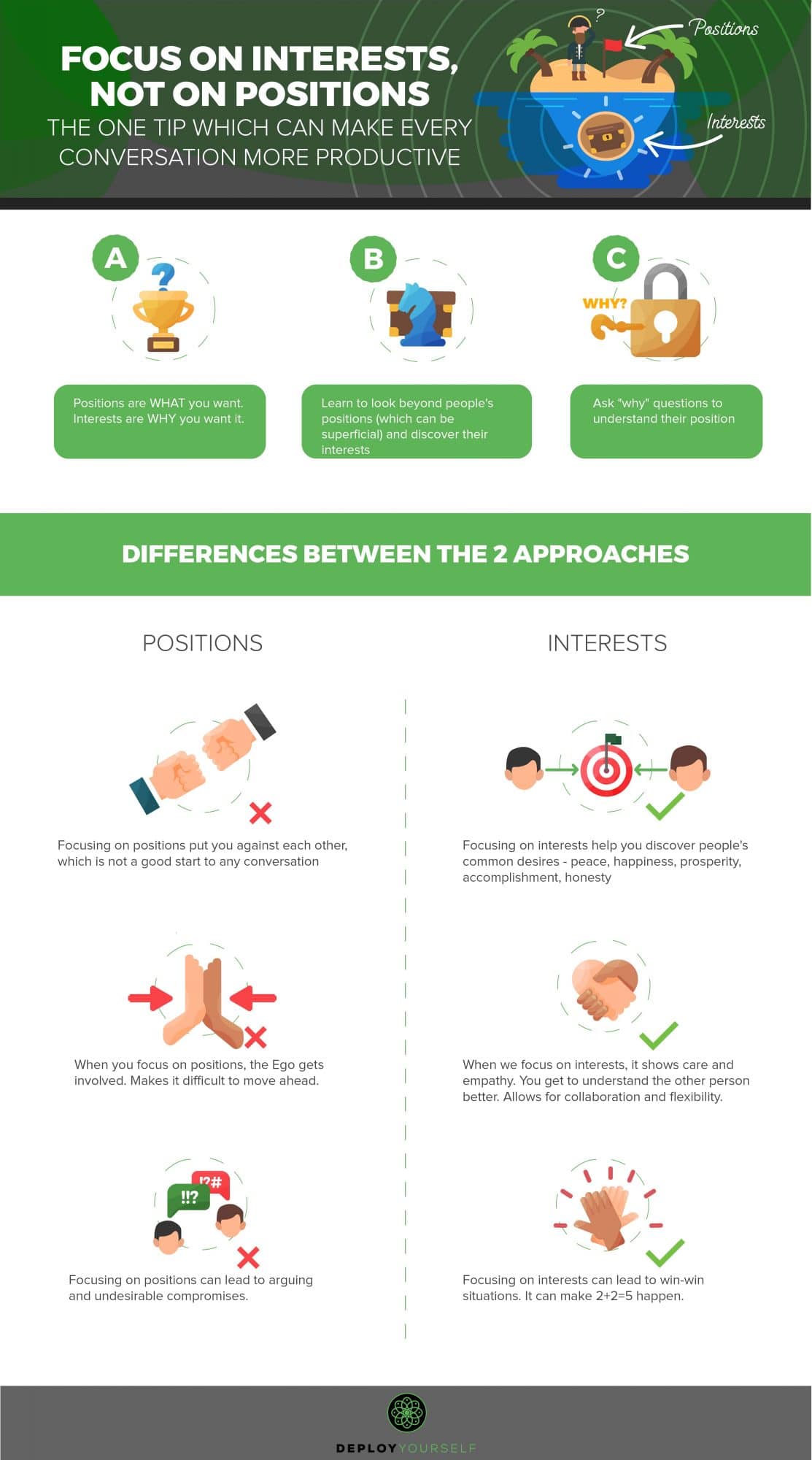
    Good leaders know that healthy arguments can be an integral part of creative problem-solving. The important thing is not to get stuck by the disagreement but to look deeper and understand what both parties really care about. Conflicts arise in a conversation when we fail to understand what is important to the other person. 

    To avoid that, we need to listen attentively and go deeper than their positions to understand what they really want. Deep listening helps us understand the feelings and viewpoints of the other person. Leaders need to be open-minded about understanding different perspectives. 

    3. Separate Facts From Opinions

    “Every man has a right to his opinion, but no man has a right to be wrong in his facts.” – Bernard Baruch

    What is the difference between a fact and an opinion?

    Basically, a fact is a statement that can be proven true or false by a reliable authority. But an opinion is a personal view that cannot be verified. Opinions can be based on individual feelings and emotions. 

    Also, a fact is universal, but opinions can vary from one individual to another. Take this conversation for example:

    “That movie has been a blockbuster according to New York Times and is number 1 on the box-office charts.”

    “Is it? I found it boring.”

    While the first statement is a fact, the second is an opinion. People often confuse the two, and that can be misleading during a conversation.

    Asking the right questions is extremely important to get the facts underlying an opinion. Questions can help you to differentiate between facts and opinions. Once you have the facts and the data, use them to analyze the situation together. A statistical/logical approach also helps you to separate the objective reality from the subjective.

    In addition, you can also summarize each other’s understandings or note them down. This will ensure that you are on the same page. As a result, proceeding with a difficult conversation can get much easier. 

    4. Mutual Respect

    “I speak to everyone in the same way, whether he is the garbage man or the president of the university.”– Albert Einstein

    Mutual respect is to a conversation what oxygen is to humans. Take it out and the conversation dies. Being respectful goes much beyond the use of “please” and “thank you” in a conversation. True respect lies in understanding, courtesy, and kindness for another’s opinions.

    For this, there are two important steps. Firstly, you should listen to the other person without criticizing or indulging in any form of personal attack. Secondly, you need to be aware of how you are treating the other person. No two people are the same, so understanding their individual perspectives is very important.

    Even if you feel frustrated during a conversation, avoid negativity. Insulting or ridiculing the other person will lead to a loss of respect. Good leaders do not allow their emotions to hijack their responses at any moment.

    Emotions can be a big asset in a difficult conversation (as they can reveal what each party cares about) but they should not be allowed to overpower our reasoning. It is the faculty of reason that allows us to choose the best path in a challenging situation. We can then use our emotions to guide us along that path.

    Also, understand that we all make mistakes. In case mutual respect has been violated in some way, it is important to apologize. That helps in removing any ill feelings from a relationship. At the same time, it allows the conversation to move forward.

    5. Keep the Focus on the Shared Goal

    A few years ago, there was a situation when the strained relation between two engineers led to multiple confrontations and delays in a project. All it needed was a timely intervention from the manager to bring them together as members of the same team, and help them see the common goal of their discussion. As it turned out, they both cared for the project and were arguing for different ways to complete it. Once they could see that they both wanted the same end result, they themselves managed to come to a resolution.

    When people realize they want the same things, it is easier for them to work together and not against each other. Sometimes emotions can take the better of us, but it is very important to attack the problem, not each other. If you can focus on the common objectives of both parties, you can argue like comrades rather than competitors.

    6. Brainstorm Together, Not Against Each Other 

    Speak when you are angry and you will make the best speech you will ever regret.”- Ambrose Bierce

    A difficult conversation need not be a victory for one and a loss for the other. A conversation is about finding solutions and not about seeking victory for the ego. Rather, it can be an effective brainstorming session for the generation of ideas and finding solutions. 

    At the same time, it should not be a temporary compromise to keep the ball rolling. An open conversation that can explore the root cause of any issue is required to get over an impasse. In reality, when individuals work against each other, the business is the real loser.

    By brainstorming and allowing the creative juices to flow, you can look for a 2+2=5 outcome. This simply means the sum is much greater than the individual parts, or the final solution works better for both the parties involved.

    7. Express Gratitude

    Appreciate everything your associates do for the business. Nothing else can quite substitute for a few well-chosen, well-timed sincere words of praise. They’re absolutely free and worth a fortune.” – Sam Walton

    Always be thankful to the other person for participating in the conversation. This important step can create a positive mood for driving the discussion forward. However, it is often overlooked during a conversation.

    Offering thanks shows appreciation for the other side’s efforts in the conversation and helps to strengthen the relationship. Thankfulness allows individuals to focus on the positive aspects instead of being trapped by negativities. Genuine gratitude is also a great motivator. It expresses confidence in the future.

    As a leader, you can also assure the person of your help and support. It is also important to display a positive outlook during the conversation and express confidence in the abilities of the other person. This can result in positive interactions during a conversation.

    8. Make Sure to Follow Up

    It is wrong to assume that the task is complete once the conversation is over. No conversation is fruitful unless it leads to the desired changes and outcomes. You need to follow up and make sure that what was discussed and promised is being done.

    Note, following up is not about finding faults, but about keeping track. Both parties are mutually accountable for the outcome of the conversation. But we all know, agreeing to change our behaviour is a long way from actually changing it.

    For a leader, follow up is also an opportunity to collect and share feedback. Feedback is vital for making any changes to the decided plan of action.

     9. Reflect to Become Better

    Once a conversation is over, we can reflect and learn lessons from it for our next conversations. We all make mistakes in the heat of the moment, so it is important to reflect and learn any lessons for future conversations.

    Here are a few important aspects that can be improved in most cases.

    • Expressing our emotions aligned with our values rather than suppressing them or exploding
    • Enhancing self-awareness and recognizing the signs of “fight or flight”.
    • Using the right words and body language
    • Directing our emotional energy towards the common objective

    As with all other skills, the art of dealing with difficult conversations will get better as you reflect and practice. As you practice, the conversations remain the same. However, they stop being “difficult”.

    Conclusion

    We all deal with difficult conversations from time to time.  When we act in a “my way or the highway” manner without considering the views of the other side as legitimate, it becomes very difficult to make progress in conversations.

    But it is best to handle them proactively by overcoming our fears and hesitations. At the end of the day, it is important to keep your eyes on the shared objectives of both parties. A good leader is one who is ready to address difficult topics and look for win-win results, also strengthening the relationship in the process.


  • Can We Walk in Another Person’s Shoes? Why Empathy Might Be The Most Important Human Ability?

    On a recent archaeological dig in Man Bac in what is now northern Vietnam, a team of researchers made a remarkable discovery. While unearthing the remains of some Stone Age people who were buried 4,000 years ago, they discovered one young man who had been placed in his grave differently from the others: he was curled in the fetal position.

    It turned out he was laid to rest as he lived. Further examination showed that this man suffered from a rare congenital disease that fused the vertebrae of his spine. It would have left him paralyzed from the waist down from the time he was a small child.

    Yet the scientists concluded that this young man lived a good ten years past his adolescence. That means that for years, perhaps decades, others had to care for him, feed him, keep him clean, and keep him safe from danger.

    Why is this significant? Because this young man’s life and death show us the essence of what it means to ‘walk in someone else’s shoes.’ This profoundly disabled young man lived into his 20s only because others in his little tribe had empathy for him: they imagined what it might be like to be him, they chose to feel his pain, and they chose to experience the difficulty of his life.

    And then they chose to care for him since he couldn’t care for himself.

    That is walking in someone else’s shoes. That is the beating heart of empathy.

    Every 2 weeks I share my most valuable learnings from living life fully in my Deploy Yourself Newsletter. Sign up now to download a workbook with 164 Powerful Questions which I use daily in my work and coaching. Allow these questions to transform your life and leadership.

    What Do We Mean By Walking in Another Person’s Shoes?

    To walk in someone else’s shoes is to make an effort to grasp their point of view emotionally.

    Empathy‘ is the ability to recognize and understand the feelings and thoughts of another person.

    Perhaps most importantly, walking in another person’s shoes is the ability to not only see the world from their perspective but to feel it as if you were them.

    The Ability To Walk In Someone Else’s Shoes

    Sadly, empathy isn’t taught very well in our schools and workplaces. This is strange given that developing empathy has always been recognized as an important part of human development.

    Throughout our lives, we learn many skills that are drilled into us through regular tests, projects, and repetition. But in my experience, I’ve found that it isn’t always the formal skills – the ones like math, history, and physics – that are the most important.

    Formal Skills vs. Informal Skills

    After going through 21 years of education and now 15 years of work experience, I have learned that while the skills taught in formal education are important, the most crucial skills I have used to succeed in my career and life were never taught to me in an educational setting.

    Like most people, I was not even aware that there were other skills that I needed in order to succeed. As many of us do, I was running blind without even knowing that this blind spot was hampering my growth and success. I’ve since learned that there are a few vital informal skills that we can develop, skills that put a powerful compass in our hands to help us navigate the difficult seas of the modern workplace – and life in general.

    Vital Informal Skills

    Why Are These Skills So Important?

    Of course, having the kinds of skills we learn in school and later in the workplace are important. However, knowing how to actually achieve your goals while working together with multiple people within your company is a different matter altogether.

    A lack of empathy not only hampers our ability to be productive in the workplace, but it is also foundational to rational decision-making, building lasting relationships, and distinguishing between right and wrong.

    Without empathy, that one particular, critical skill in your tool kit – one that often doesn’t appear on a CV – you are likely to face an uphill battle in anything you’re trying to accomplish.

    “When you show deep empathy toward others, their defensive energy goes down, and positive energy replaces it. That’s when you can get more creative in solving problems.”

    – Stephen Covey

    I Hear You, I See You, I Feel You.

    To walk in another person’s shoes is to shift perspective, and to see and feel the world as another sees and feels it. The word feel in the previous statement is very important, important enough that we must take a closer look at it.

    What I mean by feeling as another person is that you must learn to not only see things intellectually from someone else’s point of view but also to feel the same emotions that the other person feels. This might mean feeling scared, tearful, or elated depending on the situation, and understanding on a profound level what has made the other person feel this way.

    Researchers have found that when we feel another person suffering, it activates not only the visual cortex in the brain but also our emotions and physical sensory receptors. Imagine witnessing someone get a paper cut: you not only sympathize with their pain, but you might also wince, or draw your own hand back involuntarily. You can almost feel the slice happening to you.

    Developing and nurturing these empathetic abilities rather than shying away from them is like a secret weapon when it comes to working with other people. It’s a foundational component of what made us human in the first place – just ask our Stone Age friend from Man Bac in Vietnam.

    So what is it that prevents us from fully understanding what another person is feeling? Why can’t we listen deeply?

    That’s because we’ve already filtered it out.

    Listening Filters, Empathy and Your Truth

    Empathy has deep roots in our evolution as a species. Developmental psychologists say that empathetic behaviors like altruistic helping and comforting others who appear to be in distress emerge in children as young as 12 months! Thus, empathy is built into who and what we are.

    However, as we get older, it becomes more and more difficult for us to be empathetic with others.

    All of us see the world differently based on our listening filters. We select what to pay attention to and what to ignore, often subconsciously, based on our particular set of experiences and knowledge. Our parents, friends, culture, values, beliefs, expectations, moods, and prejudices all combine to form such filters. These filters help each one of us create our own perceived reality and affect every decision we make.

    The important thing to realize here is that the “truth” we form by the above process is only “our” truth and not the absolute truth. Throughout any interaction, understanding that others’ perceptions of the world are equally valid as ours is key to gaining any level of understanding with them.

    Everyone has a right to form their own perception based on how they experience the world around them. Indeed, if you stop and think about our listening filters, we quickly realize that it would be literally impossible for two people to share the same “truth” in the deepest sense.

    Once we understand that our apparent “truth” is only a perspective, it allows us to view the same situation differently and accommodate someone else’s point of view. This is the foundation of empathy and is of immeasurable help in resolving conflicts.

    “Physics isn’t the most important thing. Love is.”

    ― Richard P. Feynman

    Perspective and Conflict

    Conflicts don’t occur because of different perceptions, not exactly. Rather, conflicts occur because of our inability to step outside of our own perspective and acknowledge the other person’s point of view. If you can’t take a moment to walk in another person’s shoes, how on earth are you going to reach any kind of accord or understanding with them?

    And this is why I believe that seeing and understanding different points of view is a superpower for those who possess it. Friction should be between points of view, not between people, and certainly not between organizations and nations. Empathy allows us to escape unnecessary stress from friction in relationships.

    President John F. Kennedy famously brought in advisers from profoundly different backgrounds and political persuasions in order to guarantee he would get the widest possible variety of perspectives. After a pair of advisers went on a fact-finding mission to Vietnam in the early years of the conflict there and came back with wildly differing tales of what the conditions were like on the ground, Kennedy famously quipped, “You both went to the same country?”

    When it comes to our own lives, it’s vital to remember that we can all be in the same country, even standing in the same room, but nonetheless perceive our surroundings in profoundly different ways.

    Celebrating Difference, Loving Friction

    Every great human accomplishment has come out of differing opinions and the energy generated by healthy friction. Seeing things from different perspectives can allow us to create something better than anyone could on their own.

    Taking the time to step into the other person’s shoes is the very necessary first step we must take to engage in productive conversations, iron out our differences without making things personal, and reach a win-win solution/agreement. To not do so out of defensiveness or fear is to invite unnecessary conflict and misunderstanding.

    How to Build Empathy

    Like any skill, empathy can be learned and it gets better over time with practice. Here is how you can do so:-

    • Pay Attention – Be fully present without distractions when in the company of others.
    • Active Listening – Stop thinking about what you’re going to say next and just take in what the other person is saying.
    • Don’t Interrupt – Even with the best intentions, saying things like, ‘It’ll get better,’ or ‘It’s not that bad’ diminish the other person’s problems and may cause them to shut down. Avoid doing that.
    • Make It About them, Not You – Resist the urge to speak. Use filler words like “umm”, “and”, and “tell me more” to hear them out fully before speaking.
    • Be Open and Vulnerable – Empathy is a two-way street. We make these connections by sharing our own vulnerabilities and struggles. Don’t be afraid to open up.

    You Can Be Right and Still Be Wrong.

    In the end, we must ask ourselves this question – Do we want to be right, or effective?

    And this is the question that can be answered by seeing things from another’s point of view.

    Do we want to be right and prove others wrong and secure a personal victory?

    Or is it more important to be effective in dealing with the topic at hand, even with the different points of view we might have?

    Once we learn to choose the latter, we can take meaningful steps towards reaching solutions and agreements that are more positive and inclusive than any individual point of view. Developing the ability to empathize and to approach life from this perspective will result in consistently better results for not only you but for everyone around you.

    Now that’s what I call a real superpower.

  • The Ultimate Guide To Interpersonal Communication & Difficult Conversations

    This guide contains everything you need to know about dealing with interpersonal communication – conflict, disagreements, and other difficult conversations – be it at work or outside it.

    How to listen well.

    Why conflicts are natural?

    What to do, and what not to do when dealing with conflicts?

    And what to do if nothing else works?

    With that, here are the steps to master interpersonal communication:

    1. Why Conflicts Are Natural And Should Be Expected?
    2. How We Form Our Different Perspectives?
    3. Can We Use The Energy in Conflict Productively?
    4. How To Build Empathy?
    5. How To Prepare For A Difficult Conversation?
    6. How To Communicate During A Tough Conversation?
    7. What If You Can’t Find A Solution?

    1. Why Conflicts Are Natural And Should Be Expected?

    CONFLICT!

    Is that a word that scares you? Is that something that makes you run in the opposite direction? Do you wish you had the skills to handle conflicts better?

    If you are like most people, you are no fan of conflicts and have often been caught up in the maze of a conflict. I certainly have, and I can honestly attest that conflict (or the fear of it) has given me many sleepless nights.

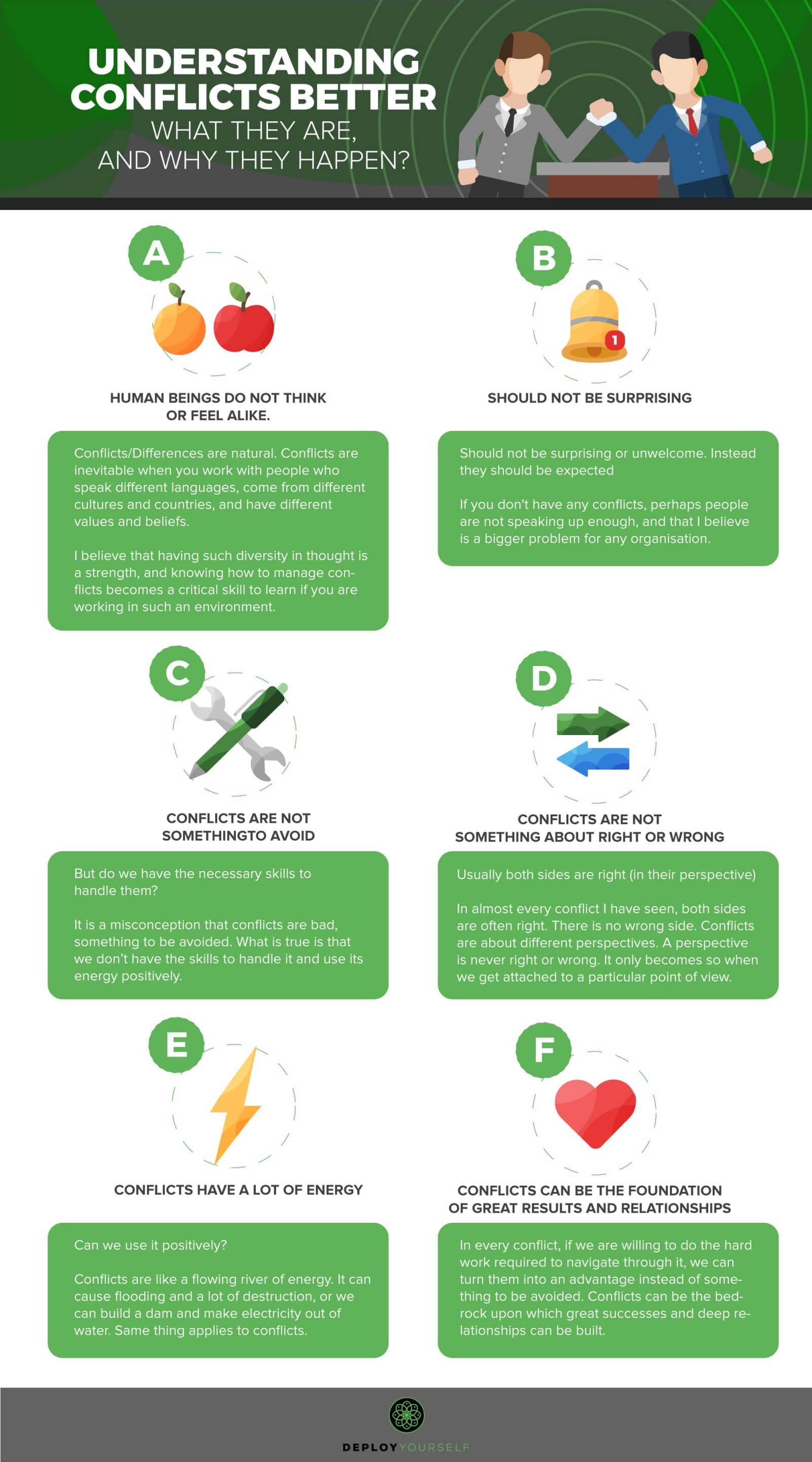
    Human Beings Do Not Think or Feel Alike. Conflicts are Natural.

    Wherever there is life, there is conflict. Every species on this planet experiences conflict in its fight for survival. Plants and animals strive for limited food, space, and mates in the wild, often giving rise to conflict. Humans are much more complex. In addition to food, space, and sex; we want power, fame, and money; giving rise to even more conflicts.

    Conflicts are a natural order of life, and if we step back and see the bigger picture, there is nothing unexpected around them. They are inevitable when we work with people who speak different languages, come from different cultures and countries, and have different values and beliefs.

    Conflicts and Disagreements Should Be Expected.

    Today we live in a world driven by democratic and secular values (in most countries). If you don’t see any conflicts, perhaps people are not speaking up enough, and that I believe is a bigger problem for any society or organisation.

    In democratic societies, differences of opinion are not only expected in interpersonal communication but it is also a duty of each citizen to express himself without fear or hesitation. I believe that having diversity in thought is a strength, and knowing how to manage conflicts becomes a critical skill to learn if we are to live and work in such an environment.

    2. How We Form Our Different Perspectives?

    Conflicts don’t occur because of different perceptions, not exactly. Rather, conflicts occur because of our inability to step outside of our own perspective and acknowledge the other person’s point of view. If you can’t take a moment to walk in another person’s shoes, how on earth are you going to reach any kind of accord or understanding with them?

    And this is why I believe that seeing and understanding different points of view is a superpower for those who possess it. Friction should be between points of view, not between people, and certainly not between organizations and nations. Empathy allows us to escape unnecessary stress from friction in relationships.

    Celebrating Difference, Loving Friction

    Every great human accomplishment has come out of differing opinions and the energy generated by healthy friction. Seeing things from different perspectives can allow us to create something better than anyone could on their own.

    Taking the time to step into the other person’s shoes is the very necessary first step we must take to engage in productive conversations, iron out our differences without making things personal, and reach a win-win solution/agreement. To not do so out of defensiveness or fear is to invite unnecessary conflict and misunderstanding.

    Conflicts Are Not About Right or Wrong. Usually, Both Sides Are Right.

    In almost every conflict I have seen, both sides are right. There is no wrong side. Conflicts are about different perspectives, and each perspective is valid for the one holding it. A perspective becomes right or wrong only when we get attached to a particular point of view. If we understand this, interpersonal communication would get seamless and friction-free.

    Can we see that we are all seeking to express the truth as we see it? Can we acknowledge that everyone sees the world differently and form their own perception of events? Conflicts happen not because of different perceptions, but because of our inability to acknowledge another’s point of view.

    Everybody is ignorant, only on different subjects. – Will Rogers

    How We Form Our Different But Equally Valid Versions of Reality?

    The first thing we must do is to take a pause and ponder about how we form our truth in the first place. We (human beings) gather inputs from our five senses – smell, touch, sight, sound, and taste. Anything which is external reaches us via one of the senses. We touch something which is hot, and we “know” it is dangerous and not safe. We hear something from multiple people or from a reliable source, and are inclined to believe it as truth”.

    Once we collect the sensory information from the outside world, our brain makes sense of it. It decides which signals to pay more attention to and which to ignore. Our brains also apply the collective influence of our memories, beliefs, thoughts, and values to every new information, and derive meaning from it. I already wrote about Listening Filters and how they create the “truth“. For example – Growing up in a very hierarchical corporate culture (and society) in India, it still takes effort on my part to see and interact with people above me on the corporate ladder as peers in Amsterdam.

    Every decision we make, whether it is trivial or a life-changing one, depends on how we assess the situation. Our listening filters help us create this assessment, which in turn limits the options in front of us. If two people act differently in the same situation, the difference is in their assessment of it. Reality is the shaky foundation on which we all rest our decisions.

    The important thing to realize here is that the “truth” we form by the above process is only “our” truth and not the absolute truth. Realizing that different people can see and create their own truth in the same situation is the key to working together more productively. Seeing our own truth as a ‘perspective‘ instead of the truth leads to humility and a willingness to consider other perspectives.

    Unless we step down from the high pedestal of truth we often end up placing ourselves on, we can’t see all the other perspectives out there. I believe there are (at least) five different perspectives that can offer tremendous insights to us. However, it is not always easy, nor are we often willing, to view a situation from these perspectives. They might lead to some uncomfortable moments, but the process can often result in new insights and learnings. These not only can lead to better results but also help us become more human in the process.

    3. Can We Use Energy in Conflict Productively?

    Conflicts are like a flowing river when it comes to communicating with people. If left unchecked, they can cause flooding and destruction. But if we can build a dam and channel the water in the right direction, we can turn it into electricity.

    The same thing applies to conflicts. The only question is – Can we use the energy in conflict productively? Can we channel this energy into productive conversations that can lead to creative solutions and better results?

    Millions of years of evolution have taught our bodies to react in a certain manner to external threats. In moments of stress, our bodies react by releasing chemicals like cortisol that increase the heart rate. 

    This is often termed “amygdala hijacking” by psychologists. As a result, we often overreact or behave irrationally. Basically, the neurochemical interactions in the brain make it even harder to think straight and behave rationally.

    I believe being ready for tough conversations with people makes us better equipped to face challenges in life. When done in the right manner, difficult conversations have the potential to enhance a relationship.

    However, if we can’t control the energy in a conflict, it can result in damage (stress, frustration, bad results) and lost opportunity. Interpersonal communication and conflict can become a source of energy and powerful results, but only if we know how.

    Healthy disagreement creates friction and energy. If we look back at history we will find that every great accomplishment has come out of differing opinions of people who have found a way to work together.

    In every conflict, if we are willing to do the hard work required to navigate through it, we can turn them into an advantage instead of something to be avoided. Conflicts can be the bedrock upon which great successes and deep relationships can be built.

    “The wound is the place where the Light enters you.” ― Rumi

    4. How to Build Empathy?

    Creating a safe environment is the first step in creating empathy. When people feel safe, trust builds, and people interact with each other without being suspicious. This interaction breeds cooperation, which is key to any organization’s success. Without trust, it is difficult to bring people together.

    Like any skill, empathy can be learned and it gets better over time with practice. You can do this by creating a safe environment that values empathy over blame. Always encourage your team members to listen first, and then express their concerns without holding back.

    For example, you can ask “You don’t seem yourself today. Would you like to take a break and chat?”, or “I would hate to see you burn out. Are you taking care of yourself? Is there anything I can do?”. Simple statements like these can go a long way in showing your care for people as human beings.

    A few words, said at the right time, can make a world of difference. And we all have the power to make a difference by practising empathetic listening and noticing emotional cues. You never know what your support at the right moment might mean for someone else. 

    Asking the right questions and sincerely listening will help you see things from others’ points of view. Consciously expressing your care can help people understand their own emotions better and make our relationships more meaningful.

    “You cannot truly listen to anyone and do anything else at the same time.”

    ― M. Scott Peck

    Here is how you can do so:-

    • Pay Attention – Be fully present without distractions when in the company of others.
    • Active Listening – Stop thinking about what you’re going to say next and just take in what the other person is saying.
    • Don’t Interrupt – Even with the best intentions, saying things like, ‘It’ll get better,’ or ‘It’s not that bad’ diminish the other person’s problems and may cause them to shut down. Avoid doing that.
    • Make It About them, Not You – Resist the urge to speak. Use filler words like “umm”, “and”, and “tell me more” to hear them out fully before speaking.
    • Be Open and Vulnerable – Empathy is a two-way street. We make these connections by sharing our own vulnerabilities and struggles. Don’t be afraid to open up.

    The latest neuroscience research has found that the hormone oxytocin reduces fear and increases trust and empathy in the workplace. If you are wondering why trust is important, it leads to 74% less stress, 106% more energy at work, 50% higher productivity, 13% fewer sick days, 76% more engagement, 29% more life satisfaction, and 40% less burnout.

    5. How To Prepare For A Difficult Conversation?

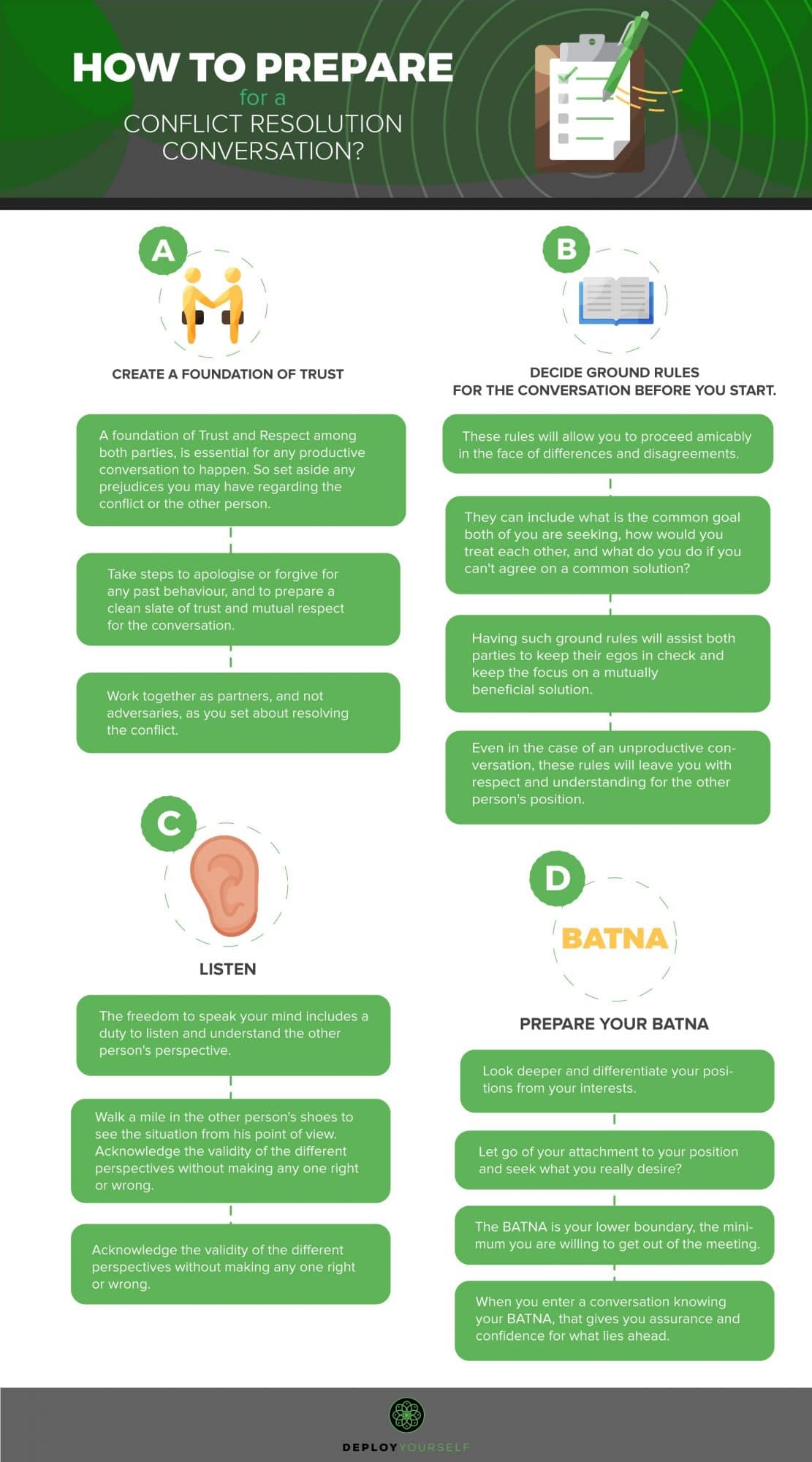
    While there are no defined rules for handling difficult conversations, I have found that these four crucial steps can make a big difference to our interpersonal communication.

    1. Set the Right Context The right conversation in the wrong context is the wrong conversation. The first step is to set the right context for the discussion. The best leaders know how to set the tone of the conversation and guide it towards the desired outcome. Without context, we tend to react to what is being said rather than considering the bigger picture in mind.

    The right context helps keep the focus on what is really important.  The right context also helps to understand the social, psychological, cultural threads that are involved in the conversation. Have the discussion privately by creating a safe and congenial environment. You can also set up some mutually agreed ground rules to avoid misunderstandings and stick to the facts.

    2. To clearly perceive an issue, you need to also understand the perspective of others. The freedom to speak your mind includes a duty to listen and understand the other person’s perspective. Walk a mile in the other person’s shoes to see the situation from his point of view. Acknowledge the validity of the different perspectives without making anyone perspective right or wrong.

    Good leaders know that healthy arguments can be an integral part of creative problem-solving. The important thing is not to get stuck by the disagreement but to look deeper and understand what both parties really care about. Conflicts arise in a difficult conversation when we fail to understand what is important to the other person.

    3. Mutual respect is to a conversation what oxygen is to humans. Take it out and the conversation dies. Being respectful goes much beyond the use of “please” and “thank you” in a conversation. True respect lies in understanding, courtesy, and kindness for another’s opinions. For this, there are two important steps.

    Firstly, you should listen to the other person without criticizing or indulging in any form of personal attack. Secondly, you need to be aware of how you are treating the other person. No two people are the same, so understanding their individual perspectives is very important.

    4. Brainstorm Together, Not Against Each Other – A difficult conversation need not be a victory for one and a loss for the other. A conversation is about finding solutions and not about seeking victory for the ego. Rather, it can be an effective brainstorming session for the generation of ideas and finding solutions. At the same time, it should not be a temporary compromise to keep the ball rolling. An open conversation that can explore the root cause of any issue is required to get over an impasse. In reality, when individuals work against each other, the business is the real loser.

    Each human being acts like a tuning fork. Every emotion is like a wave, which when reaches others, either accentuates or dies down depending on whether the frequencies match or not. When we learn to master our own emotions, it will dampen any emotional waves and allows collaboration, even in the face of disagreement. We can strengthen our relationships with others, even in the most stressful and difficult situations.

    5. Prepare your BATNA (Best Alternative to a Negotiable Agreement) – The BATNA is your lower boundary, the minimum you are willing to get out of the conversation. Knowing your BATNA increases your negotiating power. When you enter a conversation knowing your BATNA, that gives you assurance and confidence. If nothing else works, you walk out with your BATNA.

    6. How To Communicate During A Tough Conversation?

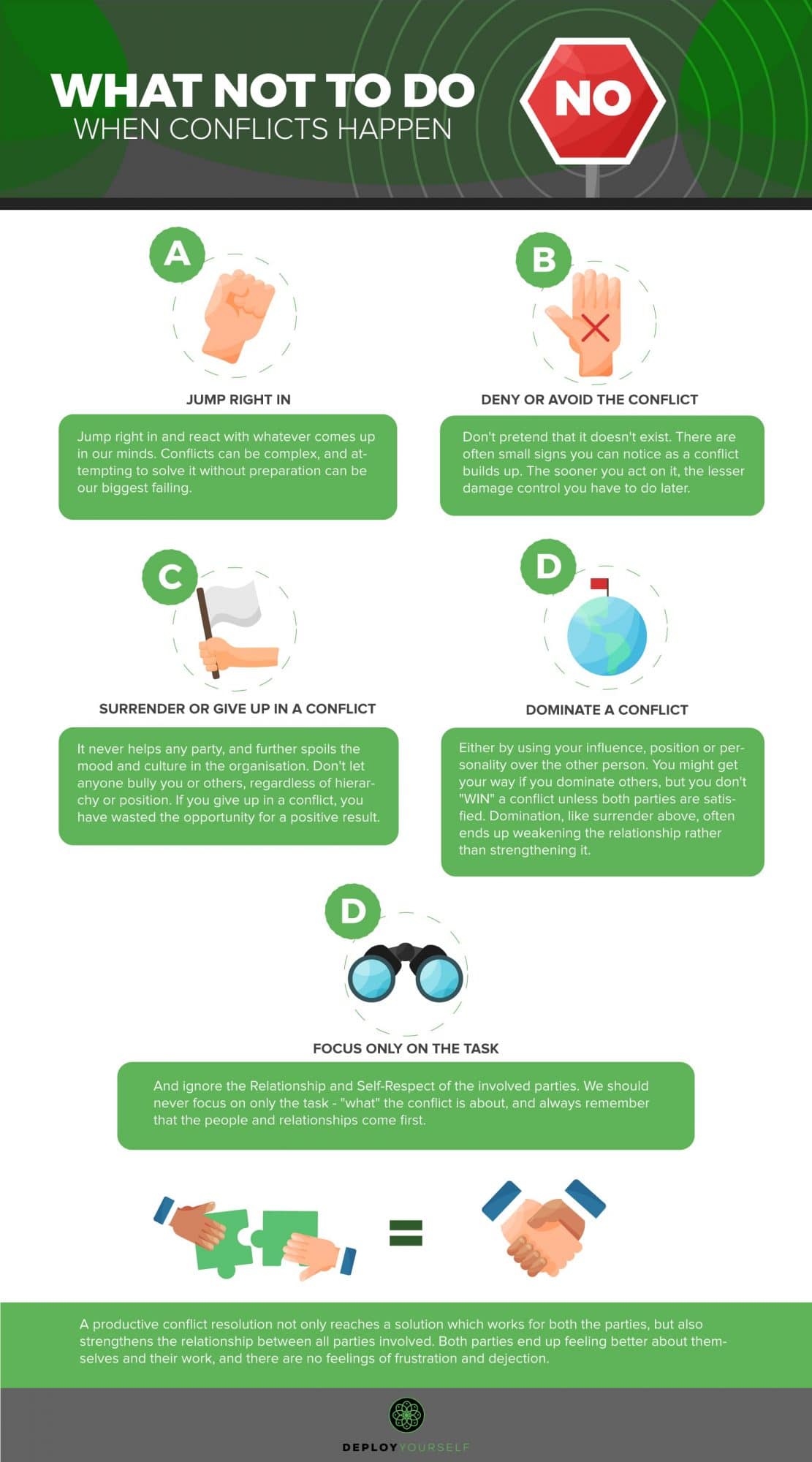
    While there are different ways we can approach a conflict, I have learned from my experiences a few things we MUST NOT DO when conflicts happen. However, these are the very things we end up doing when we are not prepared or aware of how to respond to a particular conflict.

    1. Jump Right In and React
    2. Deny or Avoid the conflict
    3. Surrender or Give Up
    4. Dominate a Conflict
    5. Ignore the Relationships and People Involved

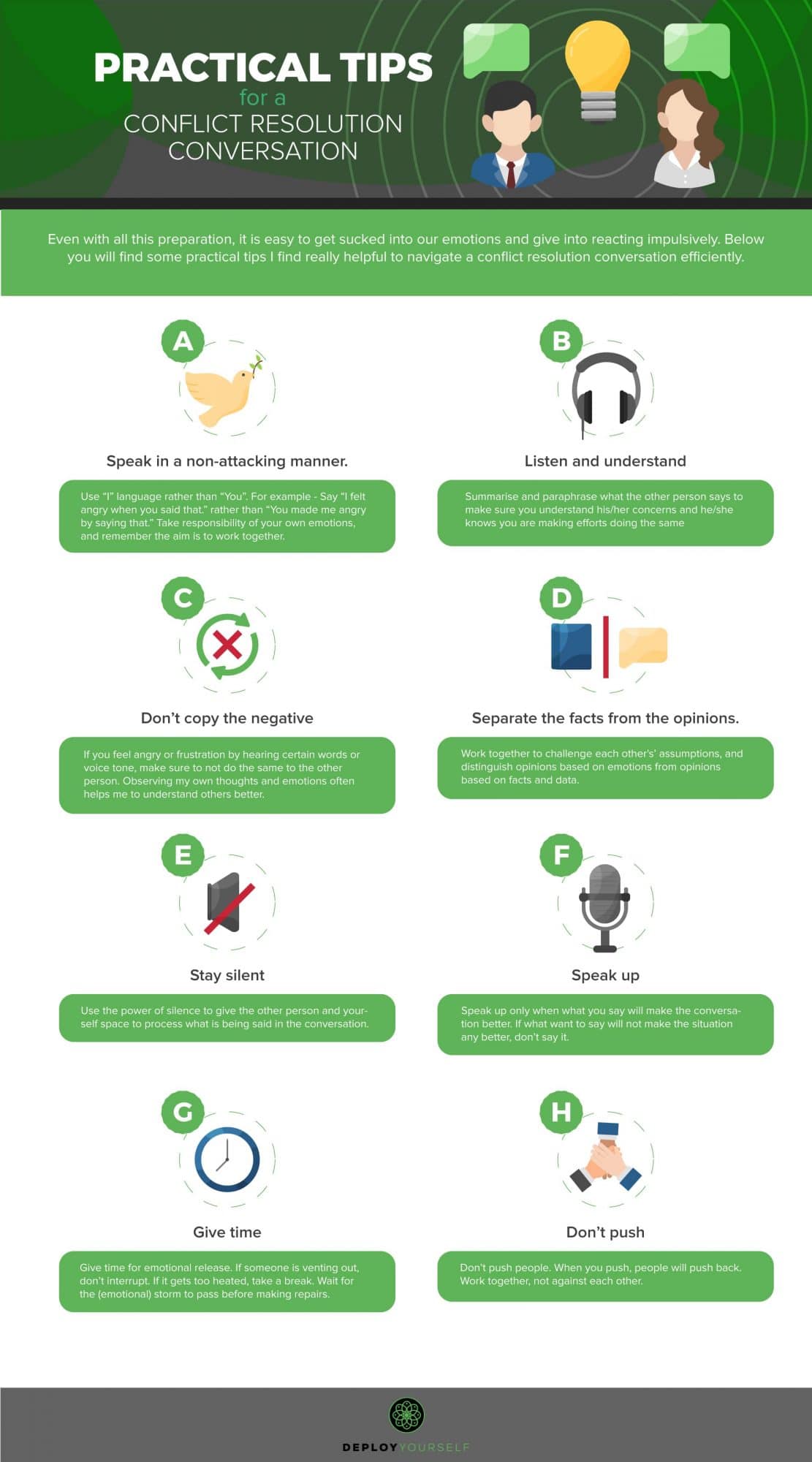
    Even with all this preparation, it is easy to get sucked into our emotions and give into reacting impulsively. Below you will find some practical tips I find really helpful to navigate a conflict resolution conversation efficiently.

    I have gathered and collected these tips from various books about interpersonal communication I have read and training I have undertaken, apart from my own mistakes and learnings in the past.

    1. Speak in a Non-Attacking Manner – Use “I” language rather than “You” language. For example – Say “I felt angry when you said that.” rather than “You made me angry by saying that.” Take responsibility for your own emotions, and remember the aim is to work together.
    2. Listen and Understand. Summarise and paraphrase what the other person says to make sure you understand his/her concerns and they know it is very important for you to do so.
    3. Walk the Talk – If you feel angry or frustrated by hearing certain words or voice tones, make sure to not use the same words and tone to the other person. I have often seen that observing my own thoughts and emotions helps me to understand others better.
    4. Separate the Facts from the Opinions –  Work together to challenge each other’s assumptions, and distinguish opinions backed by emotions from opinions backed by facts and data.
    5. Stay Silent – Use the power of silence to give the other person and yourself space to process what is being said in the conversation. It creates positive energy instead of building tension and enables us to handle tough situations in a more mature way.
    6. Speak Up Only If It Makes Things Better – Speak Up only when what you have to say will help the conversation in one way or the other. If what you have to say will not make the situation any better, don’t say it. In other words, do not vent or speak only because you had a thought in mind. Speak only when it helps you move towards the desired result.
    7. Give Time for Emotional Release – If someone is venting out, don’t interrupt. If it gets too heated, take a break. Wait for the (emotional) storm to pass before making repairs. Jumping in too early to fix things might backfire and cause more damage despite your good intentions.
    8. Don’t Push –  When you push people, they will push back. Present your thoughts without trying to push them through, and be open and flexible to listen to others’ concerns and thoughts. Give people a choice to accept or reject your ideas, as you cannot force them to your point of view anyway. Work together, not against each other.

    7. What If You Can’t Find A Solution?

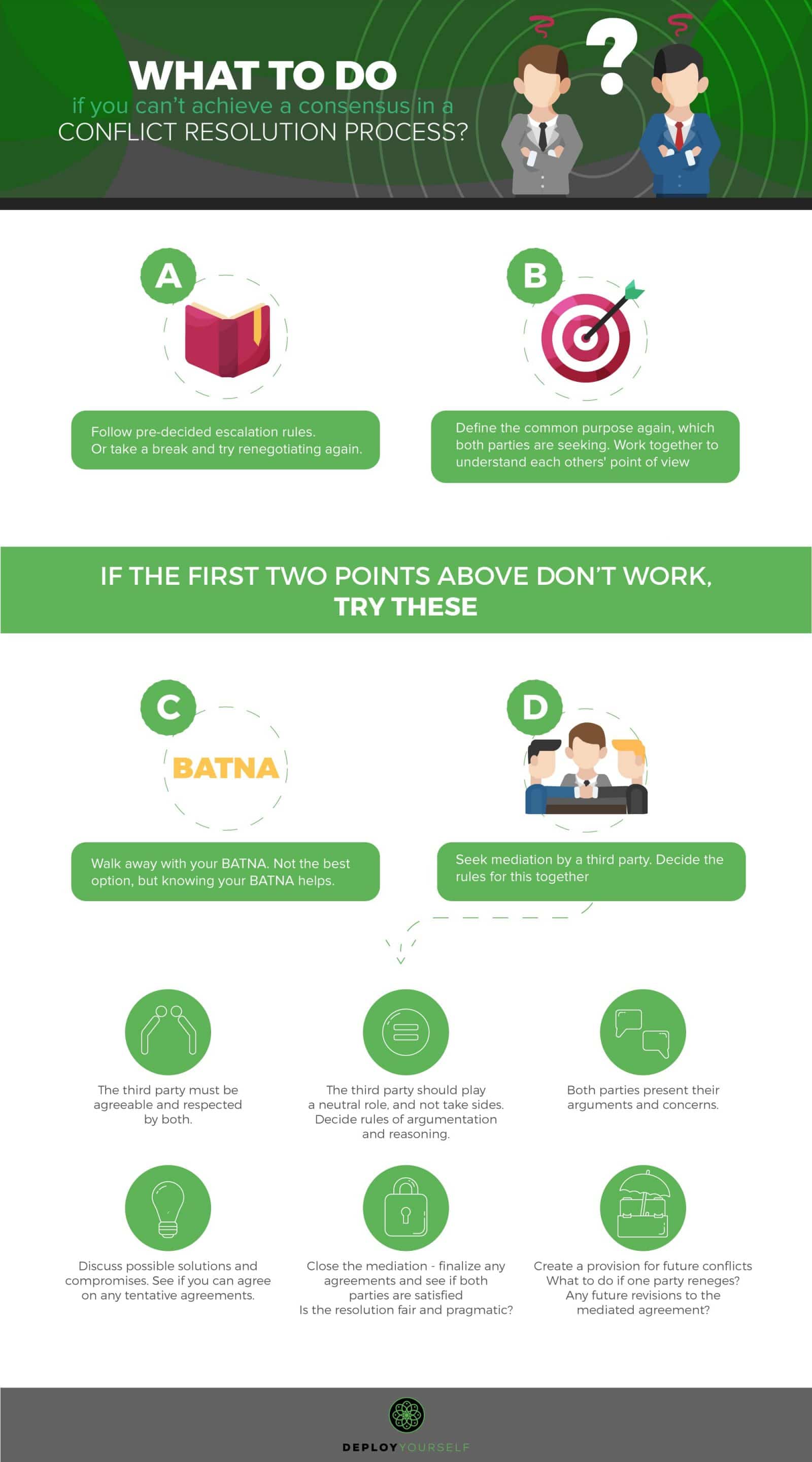
    If you have done your preparation well, you already know how to escalate the stalemate to your superiors in the organization so that they can help. If you have not decided on any escalation rules earlier, now is not a bad time to do it either.

    The only thing we must keep in mind with deciding escalation rules or escalating an issue itself is to not do it unilaterally. It is always beneficial to work with the other party to decide whatever escalation rules you can come up with, and then if the situation demands, to escalate the issue together. Escalating an issue alone without first communicating with the other party hurts the trust and the relationship which might make it even more difficult to resolve the conflict in the future.

    Take A Break, And Try Again

    If you have reached a stalemate, one common option is to take a break and reconvene later. Taking a pause at this time gives both sides space to reflect on the discussions so far and evaluate options. You might decide to harden or soften your position during this time and get a different perspective of the big picture.

    When you meet again after a break, it is important to redefine the common purpose which both parties are seeking. Then you can work together to understand each other’s points of view and negotiate again.

    Walk Away With Your BATNA

    If the disagreement has reached a point where you can’t reach a solution acceptable to both parties, it might be prudent for both parties to walk away with their respective BATNAs (Best Alternative To A Negotiated Agreement). Not reaching a consensus in a conflict is not a bad outcome. Sometimes the best outcome is to not agree with the other party while still respecting them and keeping the relationship healthy.

    Seek Mediation By A Third Party

    Another step forward (if both parties agree to it) could be to seek mediation from a third party. This is different from escalation as escalation means involving your managers or seniors in the conversation. The rules of mediation seek the involvement of an independent third party.
    And of course, the rules of mediation should be decided by both parties together.

    In the end, we must ask ourselves this question – Do we want to be right, or effective?

    And this is the question that can be answered by seeing things from another’s point of view.

    Do we want to be right and prove others wrong and secure a personal victory?

    Or is it more important to be effective in dealing with the topic at hand, even with the different points of view we might have?

    “Do I not destroy my enemies when I make them my friends?”

    ― Abraham Lincoln

    Once we learn to choose the latter, we can take meaningful steps towards reaching solutions and agreements that are more positive and inclusive than any individual point of view. Developing the ability to empathize and to approach life from this perspective will result in consistently better results for not only you but for everyone around you.

    Conflicts can lead to misunderstanding and destroyed relationships, or it can be an opportunity to collaborate constructively and strengthen relationships. In the high-pressure business environment, we all live in today, if we can develop this ability to resolve conflicts amicably, it can become a competitive advantage for us and the companies we work in.

  • How to Communicate When the Going Gets Tough, and Things Get Messy?

    The world is unpredictable and full of chaos and change. Many things can cause worry and tension in an organization. Mergers & acquisitions, leadership wrangles, controversies, and pandemics such as Covid-19 are just some of the many things that can cause a crisis within the organization. 

    The true test of leadership occurs when the going gets tough. How you handle yourself and communicate with your team during tough times is what determines whether your organization will rise or fall.

    Thanks to the unpredictable nature of the world around us, leaders often find themselves with little time to prepare. And no excuse will ever be enough if you fail to respond in a timely manner. At the same time, you must take caution because taking the wrong approach when communicating will do more harm than good.

    The infamous BP oil spill in the Gulf of Mexico is a good example of how not to respond during a crisis. Not only did millions of liters of oil spill into the sea, but also 11 crewmen lost their lives. BP’s chief executive, Tony Hayward, dealt with the disaster in the worst way possible; he shifted blame entirely to Transocean and Halliburton even before investigations had started. Investigations later revealed that BP’s gross negligence is what caused the disaster. By then, the damage had already been done with the energy giant’s credibility taking a major hit. 

    But look at Alan Mulally. In 2006, Ford was on the verge of declaring bankruptcy when Bill Ford brought Mullaly on board. He brought the company back to profitability, and not only that, Ford weathered the 2008-2009 depression without much turbulence. Alan Mulally accomplished this using clear communication and one slogan that echoed through the entire organization, “One Team.”

    The above examples show the tremendous impact of a leader’s words and actions during a crisis. To help you navigate those murky waters of uncertainty that every crisis brings along with it, consider utilizing the following guidelines to communicate during a crisis.

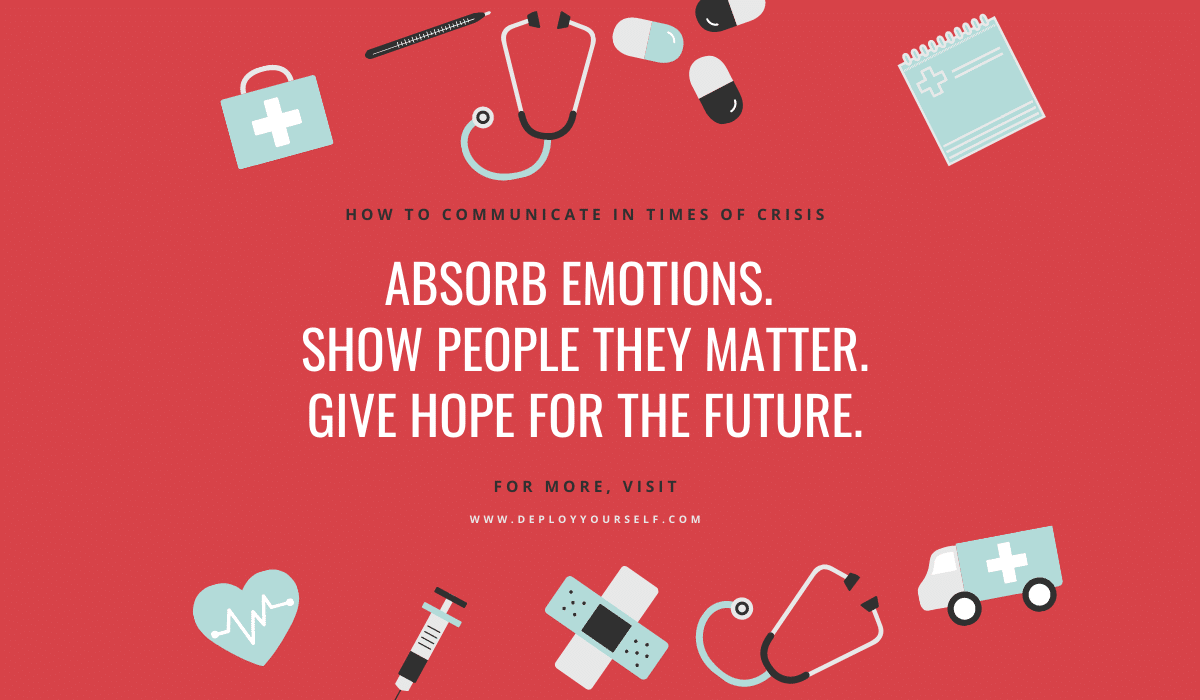
    1. Absorb Emotions. Do Not Amplify Them

    Fear, stress, and other emotions usually run high during any crisis. As a result, chaos can ensue. As a leader, the first step you can take is to manage your own emotions. Your employees look to you for reassurance. If you project fear, they will notice it and can panic. Once you learn to observe your emotions, you can reassure your team. This will help you calm the brewing storm of emotions, and not amplify the emotions of others.

    Each human being acts like a tuning fork. Every emotion is like a wave, which when reaches others, either accentuates or dies down depending on whether the frequencies match or not. When we learn to master our own emotions, it will dampen any emotional waves and allows collaboration, even in the face of disagreement. We can strengthen our relationships with others, even in the most stressful and difficult situations.

    Listen to People’s Concerns & Understand Them

    Be human and embrace the emotions that everyone is experiencing in moments of crisis. You will also need to be transparent about how the situation is affecting you. Opening up, sharing, and displaying vulnerability on such occasions is important, as it can help you build trust. People appreciate knowing that no one is having it easier.

    Try to connect with them by asking people how they are feeling. This will not only provide an outlet for venting emotions but will also provide you with rich feedback to consider while working on a solution. It is much more effective than simply asking how they are doing.

    As much as possible, try to have this meeting in a setting where you both can see each other (and not over email or chat). This is another key element of trust-building, as it shows that you care enough to address them in person. If you cannot be in the same space, set up a meeting via video call.

    You will find that communication is usually better when you can read a person’s emotions through their body language and facial expressions. This is because their subconscious feedback will allow you to adapt your message and tone to soothe their anxiety.

    Be Calm. Don’t React

    During the heat of the moment, some folks might get too emotional. But you cannot control the feelings of another human being. Therefore, allow them to express themselves freely despite your urge to jump in. Calmness is one of the best ways of showing that you are in control of a situation.

    Look at Things from Others’ Point of View

    Putting yourself in the shoes of others will allow you to see things from their point of view. After listening to what someone has to say, suppress the urge to start providing solutions immediately. Instead, bring attention to their (and any shared) values and feelings. At times, this might be all you need to do to reassure your team. 

    However, you might need to do more. For example, ask deeper questions to encourage more active participation. This is also a great way of empowering your team, especially during a crisis, when they are more than likely feeling powerless. 

    2. Show People They Matter

    During a crisis, you will need to communicate with your teams more often than is the norm. Frequent communication shows your people that they are on top of your priorities, and this goes a long way in reducing their fear and uncertainty.

    This means that you might have to repeat your core message several times. While it might feel tiring, you have to remember that people under stress need constant reassuring.

    While at it, ensure that your staff has channels through which they can contact you. Regardless of how many times you call or visit them, if the interactions only occur when you choose to, you risk missing out on all incoming communication. Providing them with a channel through which they can reach you directly allows them to know that their feedback matters to you.

    Keep emphasizing how you want to hear from them, regardless of their level. This will go a long way in building the trust you will need when it comes to implementing any change you might want to implement.

    The feedback channel should not be for show; make sure that you listen to what people are expressing. Therefore, you will need to respond to their feedback periodically. 

    Show Care for People by Taking Care of What They Care About 

    The biggest concern people have during a crisis is whether they will still have a job. While being reassuring is important, it is crucial that you are honest. If part of the solution will involve some people being laid off, the best course of action is to deliver the message as soon as possible. 

    Remember, there is no good time to deliver bad news. The sooner, the better. It allows people to start planning early. Even if you have to break the bad news about layoffs, you can help to soften the blow by choosing an outplacement vendor to help employees with the transition.

    How AirBnB’s CEO Brian Chesky delivered the announcement that the company would have to make layoffs following Covid-19 restrictions is one of the best examples of how to deliver such news. 

    Do What is Required to Take Care of People’s Physical and Mental Well Being

    The mental well-being of your employees should also be among your top considerations. During stressful times, people become more susceptible to mental health issues. Try to take care of that by providing them with resources or tools to support them. Address the issue during your meetings and let them know that the company is there for anyone who might be experiencing mental health issues.

    Highlight Togetherness, and Tell People They Matter

    During trying moments when stability is elusive, it is important to highlight togetherness. Let your people know that the only way to overcome the situation is by maintaining solidarity with each other. The best way of passing this message across is by reinforcing the company’s core values.

    Base your message around statements or questions such as:

    • Who are we as a company?
    • What are our values?
    • What do we believe in?
    • What is our purpose?

    Let your people know that their work matters. People get enormous pride and motivation, knowing that their work is not only appreciated but also contributes to the greater good. Tell people that we are in this together, and you will not be left behind.

    Praise People for Holding up in Adversity, and Ask Them to Look for the Good and Lessons from the Crisis

    People feel good when they are seen, heard, and their effort acknowledged. Do not underestimate the value of positive feedback, as it goes a long way in boosting an individual’s morale and productivity. It also allows them to feel like they are part of a team, thus boosting trust and loyalty within your workforce.

    Therefore, even though you might have a lot on your plate, make sure that you address and acknowledge the hard times that your people have been going through. Acknowledge their ability to adapt, in addition to praising any accomplishments they might have had during the crisis.

    This lets your teams know that you care about them as individuals.  Additionally, ask them to take lessons from the crisis, as it will only make them better – as human beings and at work.

    3. Give Hope for the Future

    Keep in mind that your staff might be under tremendous pressure or anxiety due to the uncertainty of the crisis. As a leader, one of your main objectives is to give them hope and see the light at the end of the tunnel.

    Show (or Create) a Plan to Remove Confusion

    Remember, you are in charge. Therefore, take charge and evaluate your options. It is important that you take action as soon as possible.  Indecisiveness will only breed anxiety and can lead to people questioning your leadership. Therefore, create a plan and explain how things are going to be, as soon as possible.

    However, make sure that you explain your decisions. People might not like or agree with all that you have decided, but they will appreciate that you have taken it upon yourself to explain your decisions. Explain the various courses of action that you considered, and why you decided that this particular one was the most appropriate choice.

    Make sure to align your actions to the company’s core values and purpose, as that will help them feel certainty, togetherness and not confusion.

    Remove Uncertainty. Go Over the Facts. Give Clarity

    While sharing any information about the company’s future, be honest. Tell them all that you know while admitting that there are things you do not know. Embracing the ambiguity of the situation will allow your message to resonate with its recipients better. 

    Assure People by Highlighting What Steps You Have Taken to Ensure their Safety

    People need to know that you have taken actual steps towards ensuring their well-being. If any, highlight them and explain how they will help your team during the tumultuous period.

    Communicate with Confidence, Transparency, and a Positive Outlook for the Future

    In spite of your own uncertainty, you must project confidence when speaking to your teams. Be clear about everything so that you do not leave any room for speculation while remaining optimistic about the future. 

    Conclusion

    The true test of a leader is how they steer their ship and communicate during tough times. It might be difficult, but it is doable, as long as you are proactive, empathetic, and honest.

  • Nonverbal Communication – How To Listen To What Is Not Being Said?

    “When the eyes say one thing, and the tongue another, a practiced man relies on the language of the first.”― Ralph Waldo Emerson

    In recent years, technology has brought in a big change in our ways of communication. With the best tech devices and the most vibrant social media platforms around us, there is so much to watch and listen to. Still, we have all been in situations where our own internal dialogue prevented us from giving full attention to a speaker. So the question is, are we really listening?

    Effective listening is not just about hearing what is said but also taking note of things that are left unsaid. Listening to another person may sound like a simple act, but hearing is not the same thing as listening. Nonverbal Communication and Deep listening is not just about listening using the ears, but also listening with our emotions and the entire body. Let’s explore what that means.

    It is often mentioned that only 7 per cent of human communication is verbal. In truth, the exact percentage is not so conclusive. The non-verbal portion of a speech can range from anywhere between 65 to 93 per cent. 

    So spoken language is just one of the many ways by which we communicate. In order to understand the whole picture and listen well, we need to listen and explore beyond the spoken words. Quite often, tone of voice, your eyes, postures, and facial gestures tell a different story than the one the spoken words are telling. However, most people tend to ignore and have rarely learned to listen to the entire body. Hell, it is even difficult to focus on people’s words in this age of distraction.

    Strong nonverbal communication and listening is the foundation of any personal or professional relationship. So it is high time that we pay attention to the nonverbal cues, and learn to listen to what is not being said. Can you listen so well that you notice a shift in the other person’s breathing?

    How to Listen to What Is Not Being Said?

     “Leaders who don’t listen will eventually be surrounded by people who have nothing to say.” – Andy Stanley

    Many famous leaders and personalities from the past were great listeners. One example is Sigmund Freud. His manner of listening was by giving complete attention to the speaker while keeping his gaze and words mild and cordial. The level of attention that he offered to the speaker, made them feel special. 

    To understand the true scenario of any given situation, active listening is a must. This also holds true for any business establishment. Listening to your customers is essential for formulating a successful strategy and making the right decisions. In this article, I will share 3 steps we can all take to listen beyond the spoken word (the emotions, wants, and desires of the speaker), and to what is not being said.

    Step 1 – Clear Your Mind

    We all have our own internal voice which is ON all the time, giving us a running commentary about events happening in real-time. It is very difficult to listen to anyone else when you are immersed in your own world of thoughts. Only with a clear and calm mind, you can focus on what the speaker is trying to convey. Therefore, it is important to listen with a clear mind – without any fear, judgments, opinions, etc about the other person.

    Take A 5 Minute Silent Break Before Important Meetings

    One thing you can do before an important meeting is to take a short break of five minutes (or even two minutes) in a quiet space to calm your mind and prepare yourself to pay complete attention to the upcoming meeting. Use this time to block out your mental noise and allow the mind to calm down.

    If there is something on your mind, it might be a good idea to write that down somewhere to get to it later. This can be very effective to develop the skill of staying focused during the upcoming conversation. Take a few deep breaths during this small break and reorient yourself if you need to. Connect with your values, purpose, and commitments as you step into the other meeting.

    Thoughts arising in our minds can act as distractions. We simply cannot stop these thoughts and any attempt to do that will eventually tire you out. The important thing is to remain aware of them, but not indulge them any further. This will help you to stay on track when your mind starts to drift.

    By taking 5 minutes to prepare your mind and body, you will be ready to pay complete attention to the speaker.

    Give Up Your Opinions, Fears, and Judgements

    It is important to listen to a speaker with an open mind. To listen beyond the spoken words, listen to what is being said without getting filtered by your own prejudices, beliefs, fears, and anxieties. For that, it is important to give up any opinions, judgments, fear, and insecurities you might have about yourself, the other person, or the relationship.

    If you are angry, irritated, or fearful about a person or a situation, it will be difficult to pay attention and listen effectively to the nonverbal cues. For example – do not go into a meeting thinking about how someone is always late, or unreliable, or aggressive.

    Once you judge someone, it becomes difficult to comprehend their viewpoint or their motive. By being non-judgemental, you will have a better understanding of the events or circumstances. As a result, you will be able to understand not just their words but also their concerns and desires. This will help you make better decisions.

    You may feel like replying or arguing to convince the speaker about your views. However, it is important to focus on the speaker’s world and not on our own reply and concerns. Listening is a skill that not only needs complete attention but also requires letting go of our personal biases, that we all have. 

    See Things From Their Point Of View

    “People may not remember what you said, but they will remember how you made them feel”

    ― Maya Angelou 

    You have to imagine yourself in the other person’s position to truly understand and feel what they are trying to communicate. 

    Apart from the literal meaning of the words, pay attention to the emotional content that is being delivered. Keep a close watch on the tone of voice and body language to understand how things look and feel from their point of view. Can you listen to the emotion the other person is feeling? Are they calm, happy, ambitious, frustrated, stressed, or resigned? Can you listen to what the person cares about so much that is making them happy, frustrated, or angry?

    We often view the world through a lens clouded by our own beliefs and opinions. Empathy requires that you observe the world from someone else’s point of view. Empathetically listening to nonverbal cues is not easy, but it is a gift that you can offer as a listener to others.

    Step 2 – Listen Beyond The Words 

    To be an effective listener, you need to be a good observer. In fact, body language is a major way through which true feelings and emotions find expression. By reading and interpreting these signs you can use body language to your advantage not only in the workplace but also in your personal life.

    Our minds are so prone to distractions that concentrating on the speaker is often difficult. An active listener is present in the moment and watches for subtle changes in the speaker’s body language. Noticing such signs will help you differentiate between what their words are saying, and if they are coherent with what their body is communicating.

    Here are some of the signs that you can look out for:

    Facial expressions

    Quite often the spoken words do not match the inner emotions. In such cases, facial expressions can communicate what the speaker is truly feeling.

    Eyes

    Human eyes are the best mirrors that reflect the mind. As the saying goes- “the eyes are the windows to the soul.” Here are a few things to watch out for:-

    • Wide-open eyes indicate surprise
    • Rapid blinking can indicate stress or dishonesty
    • Intense eyes usually indicate anger
    • When the pupils are dilated it can be due to a feeling of fear or romantic interest

    Eyebrows

    Eyebrows can tell a lot about how the speaker is actually feeling.

    • Raised and arched eyebrows indicate surprise
    • A frown or eyebrows knit together indicates anger or irritation
    • When the inner corners are drawn up it indicates sadness

    Mouth

    The mouth can also be a good indicator of emotions apart from the usual happy smile. For example:

    • Biting of lips is usually a sign of anxiety
    • An open mouth indicates fear while a dropped jaw represents a surprise
    • A raised corner of the mouth indicates hate or scorn
    • When the corners are drawn, it indicates sadness

    Body Posture

    The way people position their bodies and move their hands or shoulders can speak a lot about their feelings. By observing gestures, you can understand whether the speaker truly believes what they are saying or not. Do keep in mind that gestures can have different meanings based on cultures and locations. For example:

    • Gripping an item, tapping fingers, or adjusting the hair or clothing can indicate tension.
    • A clenched jaw and tightened neck muscles usually indicate stress.
    • Shaking of legs can indicate anxiety or irritation.
    • Hunched shoulders and arms folded tightly indicate anxiety or fear. On the other hand, it can also mean that the person is feeling too cold.
    • Curving the shoulders forward with folded arms is a defensive posture. The sudden crossing of arms may indicate discomfort or disengagement.
    • A relaxed speaker will have shoulders in a normal position with hands moving freely without jerkiness.
    • A pointed finger with the rest of the hand closed is usually a show of power or dominance.

    Tone of Voice

    A new study has pointed out that listening to the tone of a speaker is often more important for understanding their emotions. For example, even over the phone, we can understand others’ state of mind by their tone of voice. Be it enthusiasm, excitement, or sadness – we can detect all these emotions just from the tone of voice

    With practice, we all are capable of detecting the subtle differences between different emotions from tone of voice. You might have noticed that many people tend to ramble when they get excited or agitated. On the other hand, a slow and steady vocal delivery indicates a thoughtful mental state.

    Paying attention to the emotions in the voice of a speaker helps you to understand what the person is really feeling. In turn, you will comprehend the message the speaker is trying to deliver more effectively.

    Noticing Our Own Body

    Another way to go deeper when it comes to nonverbal communication is to notice your own body as you talk to somebody. Our bodies are tuned to react and mirror what they experience in the room, even in a subconscious way. So if you suddenly feel the tension in your body, the other person might be feeling the same. If you suddenly feel your breathing getting shallow, perhaps the other person is also experiencing the same. Listening to your own body is also a signal you can use to listen to what is not being said.

    Step 3 – Ask Powerful Open-ended Questions

    The first important aspect of deep listening is listening attentively without interrupting. The second is to ask open-ended questions with curiosity to understand the speaker’s concerns, ideas, and emotions better. It also helps you to validate what you are understanding. Never assume on behalf of others. Always validate by paraphrasing or asking questions.

    Here are some examples of powerful open-ended questions.

    • What else would you like to talk about?
    • Tell me more about what’s bothering you?
    • What’s really going on?
    • Can you explain why that matters?
    • I noticed some frustration. Did you not like something about what was just said?
    • In the meeting, I saw you disinterested and with a strange smirk when we discussed that project? What concerns do you have?
    • I could see the surprise and fear on your face. Tell me what worries about this upcoming situation?

    Any question that can be answered with a simple “yes,” or “no,” reply is a closed question. Such questions prevent the possibility of continuing communication. Also, closed questions do not provide detailed information.

    When we ask open-ended questions, we can understand the thoughts and emotions of the speaker, as they have to think and come up with original answers. Sometimes open-ended questions allow people to think and understand their own concerns and thoughts better.

    Remember, while asking open-ended questions, it is best to avoid aggressive questions that can make others defensive. I have observed many managers neglecting this and end up pushing people into a corner.

    Benefits of Listening To Nonverbal Communication

    To be a great leader you have to be a great listener.”- Richard Branson

    Abraham Lincoln was as good a listener as he was a speaker. The 16th President of the United States gave his full attention to every speaker even if their views were different from his own. Many times, he would “lean forward and clasp his left knee with both hands” while listening to others.

    So all his visitors returned with a satisfied feeling. They felt that the president was able to understand their feelings, apprehensions, and motivations. In return, he won their trust and respect.

    Likewise, a good listener needs to be focused, engaged, and flexible. The fast pace of life and the numerous distractions around us are eroding our listening skills in a big way. Only the leader who can overcome that to become a good listener can bring out the best from their team members. 

    By listening without trying to critique or convince we can become more empathetic. It can also offer us an insight into the concerns, hopes, and aspirations of others. Deep listening can not only build trust but can lead to better relationships as it makes us alert and sensitive towards others.

    Communication goes much beyond spoken words. The tone of voice and other physical expressions play a hidden but big part in communication. When we can listen to others – both verbally and nonverbally, we move towards creating more meaningful relationships and being more effective at everything we do.

    References

     1.       https://greatergood.berkeley.edu/article/item/does_your_voice_reveal_more_emotion_than_your_face

    2.       http://web.mst.edu/~toast/docs/Gestures.pdf

    3.       https://www.td.org/insights/listening-is-the-secret-weapon-of-good-leaders

    4.       https://cornerstone.lib.mnsu.edu/cgi/viewcontent.cgi?article=1000&context=ctamj

    5.       https://fremont.edu/how-to-read-body-language-revealing-the-secrets-behind-common-nonverbal-cues/

  • How to Ask and Get the Feedback You Need Without Any Stress and Awkwardness?

    “I want to give you some feedback.”

    If you are like most people, once you hear the above statement, your heart will start to beat a little faster, your palms might begin to sweat, and in certain situations, you might even begin to shake. Feedback can make anyone anxious and stressed – not because there is something inherently negative or bad about it, but because most people have never been trained in giving and receiving feedback. If you give and get feedback only once a quarter at work (even worse if it is once a year), and without any preparation, obviously it will be a strange conversation.

    What I have learned over my career is that feedback can be an immensely valuable and insightful tool in our growth and progression, but only if we are ready and prepared to digest and use it for our benefit. Today I want to share via this article my thoughts on the value of feedback, what is the best way to receive it, and then what to do with it. I hope that after reading this article, instead of just waiting for feedback you actually start asking for it. If you are thinking why would anyone do that, let’s dive right in.

    Why Do You Need Feedback?

    Feedback is one of the easiest and most insightful tools to uncover your blind spots. A blind spot is anything that others know about you but you yourself don’t. For example – if you think you are confident but others find you arrogant and cocky, how the hell do you figure that out if nobody ever tells you that?

    Feedback is like a beam of light which shows you how others perceive you. It can be the simplest way to uncover your strengths and weaknesses, but it is often not easy to digest and process it. Feedback lets you know how others perceive you and your talent, skills, behaviour, and performance. And knowing them is a good thing. When used correctly, feedback can be a very useful tool to move in the right direction, change course if necessary, and grow in your career (and in life).

    “Criticism may not be agreeable, but it is necessary. It fulfils the same function as pain in the human body. It calls attention to an unhealthy state of things.”
    – Winston Churchill

    How Do You Ask For Feedback?

    Just like hearing feedback can be stressful for you, providing feedback can also be a stressful experience for the person on the other side. But there are a few ways you can make the feedback conversation a pleasant experience:-

    1. The best way to make the process easier for both sides is to actively and explicitly ask for it. When you invite feedback regularly, it removes the formality surrounding the process and makes the conversation more “normal”.
    2. Explain that you see feedback as a tool to learn and grow and that you welcome any negative or uncomfortable feedback. You can also go one step ahead and assure the person that the feedback will not have any negative impact on the relationship. Knowing this always puts the other person at ease and allows the conversation to continue more maturely.
    3. Know what you are looking for in feedback. Feedback is not always critical. You should also ask for acknowledgment or appreciation for a task well done. Positive feedback will help you understand your strengths, and gives you the confidence and assurance required to look objectively at your weaknesses.
    4. Be specific and ask for examples. Don’t let anyone get away with vague feedback. Always dig deeper and ask for specific events and evidence in support of the feedback you receive. Here are a few questions you can ask:-
      a) Can you explain what you mean?
      b) Can you give an example to support your point?
      c) Paraphrase the feedback and ask – Is that what you mean?
    5. Seek feedback from people all around you and not just your boss. Ask people above, below, and sideways in your organization. Multiple sources of feedback can eliminate any outliers and helps to surface any obvious blind spots immediately.


    Powerful Questions

    Whenever you are looking for some powerful and insightful answers, there are always corresponding powerful questions to go with them. Below are a few such questions you can ask to solicit deep and meaningful feedback about yourself:-

    1. If I were to wow you with my performance, what would that look like?
    2. What’s one thing I could improve?
    3. What would you have done differently had you been in my position?
    4. What’s your opinion about how I handled that conversation, presentation, task, etc?
    5. What specifically can I do to handle that task, conversation, project better?
    6. What is one thing you can always count on me for?
    7. What is one thing you will never count on me for?

    What To Do After Receiving The Feedback

    The worst thing that you can do with feedback is to do nothing with it. The feedback conversation is just the beginning on the road to learning and growth. So once you are done with the feedback, you can take the following steps to make the most of it.

    1. Thank the person for providing you feedback. Not only is feedback essential for your growth, it is also often a courageous step to provide it in the first place. Acknowledge the person for the conscious act of providing you feedback.
    2. Do not defend yourself during a feedback conversation. Do not get into a game of blame and justifications. Respond to the feedback, not react to it.
    3. If the feedback is critical, take responsibility (not blame) for what you hear. Let the other person know that you will evaluate the feedback and get back.
    4. Take time to introspect and evaluate the feedback. Does it resonate with feedback from others? Can you gather more data or feedback to validate it? If no, explain to others how you see it. If yes, let them know what you will change. Make certain promises and then do what you say.
    5. Take all the positive feedback and put it into a complements” document. Often we tend to focus too much on the negatives and ignore what we are doing well. Visiting this document regularly will give you motivation and positive reinforcement. Sometimes reading one little positive feedback can make your day.

    Following the above guidelines doesn’t mean that your feedback conversations will be painless, but they will certainly go more smoothly. Once you see feedback for the powerful tool it is in your learning and growth, you will fall in love with it. The more you seek and get feedback, the faster you can move to learn, adapt, and change course if necessary. To conclude I would like to leave you with the below quote by Ken Blanchard.

    “Feedback is the breakfast of champions.”
    – Ken Blanchard

  • How to Give Feedback Effectively? What to do Before, During and After a Feedback Conversation?

    Giving good quality feedback is an important skill to have in any organization. Doing so regularly with our peers gives everyone an accurate understanding of how they are doing at work, and what needs to change/improve. However, I have always felt that the importance of feedback and how to effectively deliver it is something that is rarely stressed and communicated within companies. In this article, I want to share some of the best practices I have learned from different people and mentors over the years about giving feedback.

    Why?

    The first step to giving good feedback is to realize the importance and reason behind doing so. I believe that the only reason to provide feedback is to improve performance while working together. The purpose of giving feedback is never to measure performance, blame, to prove yourself right, to make others wrong, or to put someone in his/her place.

    I believe this is the most important aspect of feedback which we often miss. I see feedback as a ‘gift’ given from one person to another, with the only purpose of improving how they work together. When we see feedback as a ‘gift’, the feedback conversations tend to be more natural and less awkward.

    Before (Preparation)

    “Give me six hours to chop down a tree and I will spend the first four sharpening the axe.”
    ― Abraham Lincoln

    Like most things in life, doing some groundwork before giving feedback is critical. Over time I have come up with a list of steps which helps me prepare for a feedback conversation.

    1. The first step is to collect data and evidence to back up your feedback and to make sure you have seen the situation from different angles and points of view. This might include gathering some tangible data like sales reports, code reviews, etc, or validating your feedback with a different set of people.
    2. Apart from remembering the why behind sharing the feedback, it is also very important to have an open mind going into the conversation. We must be willing to investigate/apologize if things turn out otherwise. If the person you are sharing the feedback with brings up new facts or information you weren’t aware of, make sure to acknowledge them and take a time out to investigate rather than thrusting your feedback upon the person.
    3. Create a comfortable space for providing feedback. Allow enough time so that none of you feel rushed. Depending on the type of feedback, choose an appropriate setting for the feedback. For example – do not choose a place that is overly conspicuous, and never give negative feedback in public.
      If the feedback is on a trivial issue, you can do it while walking back from a meeting, or in a vehicle driving to another destination to make it less formal. But if your conversation is more difficult, you might want to do it in a meeting room. The important thing to realise is that there is no one right place to deliver feedback, and you should choose based on the type of feedback.
    4. Sleep on it! If you feeling angry, upset, or feel an urge to provide feedback; it is often better to sleep on it. Giving feedback at the wrong time can often do more harm than good. Once your emotions are more settled and you have gathered your thoughts, you can then share the feedback as soon as possible.

    During (Process)

    While you can do all the preparation you want, receiving feedback can still be a stressful experience for people (especially if it is critical). To ensure that the conversation goes smoothly you can follow a few guidelines :-

    1. Criticize in Private, Praise in Public. Use this as a golden rule for any feedback conversation.
    2. Never attach adjectives to people. Start by stating why you are providing feedback, which is always to improve performance (of the person, team, organization). You demonstrate that by stressing the impact of the person’s actions (on the team and their performance) and not on the person themselves. For example – Instead of saying “you are a weak communicator”, say “your communication style can be refined to make a better impact in team meetings”.
    3. Be specific in your feedback. Give examples. Do not be vague in your statements.
    4. Be aware of the other person’s body language. Notice if they are getting defensive, angry, upset, and change course if necessary.
    5. Be prepared for an emotional reaction. But do not react yourself. Do not get into a game of arguments and justifications. Stay silent and let people vent out their emotions (if any).
    6. Listen and paraphrase what you hear to ensure there is no confusion and misunderstanding. Understand the situation from the other person’s point of view.
    7. Use non-conflicting language. Use “I” instead of “you”. For example – Say “I felt disappointed when you did that.” rather than “You disappointed me by doing that.”
    8. Don’t Push – When you push people, they will push back. Present your thoughts without trying to push them through. Give people a choice to accept or reject your feedback, as you cannot force them to your point of view anyway.
    9. Give more positive feedback than negative, and always be sincere when giving positive feedback. Remember that there are always positives about people to acknowledge.
    10. Thank them for listening to your feedback. End the conversation on a positive note, with the other person thinking about the next steps. He/she should see the feedback as a stepping stone, not as a stumbling block.

    “Criticism may not be agreeable, but it is necessary. It fulfils the same function as pain in the human body. It calls attention to an unhealthy state of things.”
    – Winston Churchill

    After (Follow Up)

    To make sure that the feedback is serving its intended purpose, i.e., to improve performance, it is important to take a few follow up steps after the feedback conversation :-

    1. Send a brief summation of your meeting if it was important and critical enough. Also, summarise any action points both of you agreed in a follow-up email.
    2. The other person might need some time to process what you discussed. Give them that space. Follow up after a few days for any additional thoughts. Ask for feedback about how you provided the feedback. Anything they would like you to do differently the next time? Let your people know it is ok for them to give you useful feedback.
    3. Make sure to act on your action points, or share your progress on them. If you don’t walk your talk, you lose trust. If that happens, you have bigger problems to worry about.
    4. Follow up and ask for progress on the other person’s action points. Offer your support and help in any way you can.
    5. Thank the person and commend him/her for any change in future behavior. Remember you can never give enough positive feedback.

    To conclude, feedback sharing sessions, when done well, are an incredible tool to build healthy relationships and make teams stronger. By listening and working on feedback, people can learn about themselves (self-awareness) and be more conscious of their choices and decisions (career development). When you encourage people to give and share feedback, it helps create a culture of feedback, which eventually increases the strength and effectiveness of teams in your organization.

  • What is Feedback? And The Benefits of Feedback for Your Team / Company You Never Knew?

    It is the end of the quarter. And it is feedback season again!

    Feedback is a word many people dread and it makes them uncomfortable, while for others it is a tool to reflect on and improve performance. Having been on both ends of the feedback spectrum over my career, I want to share today what I think feedback is, and how it can benefit people as well as organizations.

    What is feedback?

    Do you think feedback is an operational necessity that your organisation requires you to do? Do you think feedback is something “extra” you have to do in addition to your work? In the early days of my career, I saw feedback as a distraction that keeps me away from “real” work. I wanted to get done with the feedback cycles as soon as possible as it would make me anxious and nervous. After all, nobody ever told me the purpose of feedback, how to do it well, and how to make it a tool in my development.

    It was only through my own mistakes receiving and giving feedback (and a few trainings) that I realized that feedback is work itself and not something external to it. Feedback is as much a part of my (and everyone else’s) work duties as any other task I consider essential. Over time I came to see feedback as a tool to improve not just my own performance, but also of the people around me, and of my team/organization as a whole.

    Feedback can happen in a ‘day to day’ manner like any other task. It can be a simple comment on some work which was just completed, like :-

    • You handled that really well. Thank you for thinking about that specific case.
    • I loved how you presented your ideas in the meeting we just had.

    OR, Feedback can be a structured conversation with your manager or employee. For example :-

    • I see you doing really well in … , …
    • I would like to see you develop skills like … , etc

    “Feedback is the breakfast of champions.”
    – Ken Blanchard

    The Benefits of Feedback You Never Knew

    The most important and obvious benefit of feedback is that it shines a light on and reveal our blind spots. We all need feedback to reflect, learn, and grow. It helps us become aware of our strengths and weaknesses, and identify any actions required to address them and improve performance. Timely feedback is essential to creating a loop where we are constantly reflecting upon what we did in the past and how can we do better in the future.

    But apart from assisting in our own personal development, I believe feedback can be an important tool that can help our team/company in other ways. Some of these are :-

    1. Better Relationships

    A regular cycle of feedback, not just with our managers but also with our peers, helps us build better relationships at work. It helps us get comfortable with each other and develop friendships with our colleagues. Having strong relationships at work not just impacts business results, but also results in more smiles and satisfaction from what we do. Giving and receiving feedback builds trust and helps create a safe environment where people can be themselves without any pretensions.

    2. Clear Expectations

    Having regular feedback conversations with people help clear expectations about what we expect from each other. It brings out our implicit expectations in the open and irons out any disagreements. Doing this right avoids any future misunderstanding and conflicts, and even if they arise, are much easier to handle and resolve.

    3. Positive Reinforcement

    Giving appreciation of a task well done serves as a wonderful positive reinforcement for the kind of behaviors you want to nurture in your team and your organization. Giving people a pat on their back or an informal “whoop” or “cheers” can do wonders for their confidence and sets an example for everyone else.

    4. Culture of Feedback

    If people are comfortable giving and receiving feedback in a company, and if it becomes a part of people/teams working together, then you have what is called a “culture of feedback”. This can be a tremendous asset for any organization. This culture lets your employees know that you care about them as people and not just the business results they produce. The culture of feedback creates an environment that enables every team to take ownership and pride in going after and achieving their business goals, while also taking care of their personal well-being and growth.

    To sum it up, the benefits of continuous feedback far outweigh the cost of having a culture of feedback and the little awkwardness everyone feels while giving and sharing feedback, which can be easily mitigated with proper training and guidance. Having a culture of open communication and regular feedback empowers people to come to work and make a difference – to their own growth as well as to the company’s purpose.

  • Focus on Interests, Not on Positions – The One Tip Which Can Make Every Conversation More Productive

    There was once only one orange left in a kitchen and two chefs were fighting over it.
    “I need that orange!”
    “Yes, but I need that orange as well !”
    Time was running out and they both needed an orange to finish their particular recipes for the dinner. They decided on a compromise: they grabbed one of the large kitchen knives that was lying around, split the orange in half, and each went to his corner to finish preparing his meal.
    One chef squeezed the juice from the orange and poured it into the special sauce he was making. It wasn’t quite enough, but it would have to do. The other grated the peel and stirred the scrapings into the batter for his famous cake. He too didn’t have as much as he would have liked, but given the situation, what else could he have done?

    We all love to form, hold, and defend our positions. Whether it is at home with our spouse, or at work with our colleagues, once we form a position on a certain topic, it is going to take some convincing to loosen our hold on our “coveted” position. Isn’t that true?


    As human beings, we function and operate in this world by forming positions on different subjects we face in our day to day interactions. However, when we encounter opposition or resistance to our point of view, or when we oppose others’ points of view, it is very common for us to defend our positions and it takes some convincing for us to yield from our position.


    What I have discovered with my experience of dealing with people over the last many years is that if we focus on people’s interests instead of their positions, it can become much easier to negotiate and converse with them. To clarify my point, and to understand the difference between positions and interests, consider the three points (and corollaries) below.

    1. Positions are WHAT You Want. Interests are WHY You Want It.

    In the story above both chefs wanted the orange, and that was their position. What you WANT, the specifics and details of it is your POSITION. One chef wanted the orange for its juice to prepare a sauce while the other for its peel to prepare a cake. This was their INTEREST behind wanting the orange.

    Corollary 1

    Focusing on positions puts us against one another, which is not a good start to any conversation. On the other hand, distinguishing between the positions and interests helps us discover people’s common desires – like fairness, accomplishment, happiness, and prosperity. These desires might not be the same for both parties, but they often are compatible, which makes for easier negotiation.

    2. Look Behind Superficial Positions To Discover People’s Hidden Interests.

    The positions we form can be, and often are, superficial in nature. Considering the above story again, it is obvious now that it would have been better for the chefs to peel the orange and take the part they needed for their respective recipes. However, they choose to focus on each other’s positions (the what) and hence ignored their interests (the why).

    Corollary 2

    When we focus on positions, our EGO gets involved which makes it difficult to move ahead. Looking to discover each other’s interests helps us to understand each other better. It presents an opportunity to collaborate and work together to produce not just better results, but also better relationships.

    3. To Uncover Interests, ask “WHY?”

    In the above story, what the two chefs got was an undesirable compromise, and I am sure their relationship didn’t get any better because of this.
    It is very easy to form positions as human beings, but it is always helpful to ask ourselves why we want what we want. Asking this question can help us discover our hidden interests, which can then lead to many flexible alternatives instead of just one fixed position.

    Corollary 3

    Focusing on positions alone can lead to unpleasant arguments and/or undesirable compromises. Understanding each other’s motivations behind the positions can lead to win-win situations. It can make 2+2=5 happen.

    Conclusion

    It is very common to confuse positions and interests. When we act in a “my way or the highway” manner without considering the views of the other side as legitimate, it becomes very difficult to make progress in conversations. Negotiating in this way can do more harm than good, as people tend to dig-in with their opinions and justifications, and their positions tend to move further apart.


    However, looking to work together by asking the “Why?” question, and taking efforts to understand each other’s concerns can create a pathway where there was none before. It can result in a partial solution in a not-so-ideal case, and it can allow for magic (any solution better than what both sides wanted initially) to happen in the best case.

  • What To Do If You Can’t Achieve Consensus in a Conflict?

    In the previous four articles, I have written about what conflicts are, what not to do when they happen, how to prepare to solve them through a conversation, and some practical tips to follow during the conversation itself. However, doing all this doesn’t guarantee the result you desire.
    Conflicts can be complex, and there are times when people (including you and me) are more interested in winning (or getting our way) rather than working together to get what we really want.  Human beings are complex emotional beings, and often we end up attaching the outcome of a conflict to our personal identification.
    That leaves us with the question of what to do if we can’t achieve consensus in a conflict resolution conversation?

    1.  Follow Pre-Decided Escalation Rules

    If you have done your preparation well, you already know how to escalate the stalemate to your superiors in the organization so that they can help. If you have not decided on any escalation rules earlier, now is not a bad time to do it either.
    The only thing we must keep in mind with deciding escalation rules or escalating an issue itself is to not do it unilaterally. It is always beneficial to work with the other party to decide whatever escalation rules you can come up with, and then if the situation demands, to escalate the issue together.
    Escalating an issue alone without first communicating with the other party hurts the trust and the relationship which might make it even more difficult to resolve the conflict in the future.

    1. Take A Break, And Try Again

    If you have reached a stalemate, one common option is to take a break and reconvene later. Taking a pause at this time gives both sides space to reflect on the discussions so far and evaluate options. You might decide to harden or soften your position during this time and get a different perspective of the big picture.
    When you meet again after a break, it is important to redefine the common purpose which both parties are seeking. Then you can work together to understand each other’s points of view and negotiate again.

    If the above two steps don’t help you in moving forward, you can try these:-

    What To Do If You Can’t Achieve Consensus in a Conflict?
    What To Do If You Can’t Achieve Consensus in a Conflict?

    1. Walk Away With Your BATNA

    If the disagreement has reached a point where you can’t reach a solution acceptable to both parties, it might be prudent for both parties to walk away with their respective BATNAs (Best Alternative To A Negotiated Agreement). Not reaching a consensus in a conflict is not a bad outcome. Sometimes the best outcome is to not agree with the other party while still respecting them and keeping the relationship healthy.
    Once the discussions are over and everyone walks with their BATNAs, you can look back and reflect upon the whole process. There might be lessons for you that might help you in future conflicts, and evaluating the choices you made is a good exercise after the discussion.
    You should also acknowledge yourself for putting in the effort required to resolve the conflict. Give yourself credit for working together and strengthening the relationship, irrespective of whether you got the result you wanted or not.

    1. Seek Mediation By A Third Party

    Another step forward (if both parties agree to it) could be to seek mediation from a third party. This is different from escalation as escalation means involving your managers or seniors in the conversation. The rules of mediation seek the involvement of an independent third party.
    And of course, the rules of mediation should be decided by both parties together. Below are a few ideas to keep in mind before you go down the path of mediation.

    1. The third-party must be agreeable and respected by both of you. Do not accept a third party mediator you don’t trust, and never force a third party on another.
    2. The third-party should play a neutral role and not take sides. It must listen to both sides then make a decision based on the merits of the arguments and facts presented. Decide the rules of argumentation and reasoning together before starting the process.
    3. Discuss possible solutions and compromises. See if you can agree on any tentative agreements. Take it step by step. Even if you can’t reach your desired outcome, see if you can reach halfway.
    4. Close the mediation and finalize any agreements. Do a final check to see if both parties are satisfied? Do both the parties consider the mediation and final resolution fair and pragmatic? Without a YES to the above questions, any solution or agreement is unlikely to last the distance so don’t ignore this step.
    5. Create a provision for future conflicts. What will you do if one party goes back to the mediated settlement? Can any party seek a revision to the mediated agreement?
    “The harder the conflict, the more glorious the triumph. What we obtain too cheap, we esteem too lightly; it is dearness only that gives everything its value. I love the man that can smile in trouble, that can gather strength from distress and grow.”
    ― Thomas Paine

    To sum up, the above four steps will help you to amicably close a conflict resolution process – with or without an agreement. I believe learning to effectively manage conflicts in a constructive and respectful manner is an important skill to learn, and one which gives people more confidence to work together.
    Conflicts can lead to misunderstanding and destroyed relationships, or it can be an opportunity to collaborate constructively and strengthen relationships. In the high-pressure business environment we all live in today, if we can develop this ability to resolve conflicts amicably, it can become a competitive advantage for us and the companies we work in.  

  • Eight Practical Tips for Making A Conflict Resolution Conversation More Effective

    So you have prepared well (read my previous article), and are walking into a conflict resolution conversation with trust and respect for the other person. You have established ground rules for the conversation, and you know your BATNA.

    Even with all this preparation, it is easy to get sucked into our emotions and give into reacting impulsively. Below you will find some practical tips I find really helpful to navigate a conflict resolution conversation efficiently.

    An enemy is a person whose story we have not heard. - Gene Knudsen Hoffman
    An enemy is a person whose story we have not heard. – Gene Knudsen Hoffman

    I have gathered and collected these tips from various books I have read and trainings I have undertaken, apart from my own mistakes and learnings in the past.

    1. Speak in a Non-Attacking Manner – Use “I” language rather than “You” language. For example – Say “I felt angry when you said that.” rather than “You made me angry by saying that.” Take responsibility for your own emotions, and remember the aim is to work together.
    2. Listen and Understand. Summarise and paraphrase what the other person says to make sure you understand his/her concerns and they know it is very important for you to do so.
    3. Walk the Talk – If you feel angry or frustrated by hearing certain words or voice tone, make sure to not use the same words and tone to the other person. I have often seen that observing my own thoughts and emotions helps me to understand others better.
    4. Separate the Facts from the Opinions –  Work together to challenge each other’s assumptions, and distinguish opinions backed by emotions from opinions backed by facts and data.
    5. Stay Silent – Use the power of silence to give the other person and yourself space to process what is being said in the conversation. It creates positive energy instead of building tension and enables us to handle tough situations in a more mature way.
    6. Speak Up Only If It Makes Things Better – Speak Up only when what you have to say will help the conversation in one way or the other. If what you have to say will not make the situation any better, don’t say it. In other words, do not vent or speak only because you had a thought in mind. Speak only when it helps you move towards the desired result.
    7. Give Time for Emotional Release – If someone is venting out, don’t interrupt. If it gets too heated, take a break. Wait for the (emotional) storm to pass before making repairs. Jumping in too early to fix things might backfire and cause more damage despite your good intentions.
    8. Don’t Push –  When you push people, they will push back. Present your thoughts without trying to push them through, and be open and flexible to listen to others’ concerns and thoughts. Give people a choice to accept or reject your ideas, as you cannot force them to your point of view anyway. Work together, not against each other.
  • How to Prepare for a Conflict Resolution Conversation?

    A conflict resolution conversation is one of the most critical conversations in any organization. The success or failure of this conversation will determine how the inherent energy in a conflict will be used, and how the relationship between the involved parties will be in the future.

    As I have written previously, conflicts have a lot of energy, like an overflowing river. It is up to us to build a dam and channel all this extra water (energy) into electricity? Because if left unchecked, all this extra water can cause flooding and devastation in its path. The most effective tool to prevent the flooding and use the energy in each conflict productively is the Conflict Resolution Conversation.

    Below are the 5 steps I think all of us must take before/in any conflict resolution conversation:-

    1. Create A Foundation of Trust and Respect among all involved parties, which is essential for any productive conversation to happen. This is more like a step 0, as trust is like oxygen in a conversation.

    Take steps to apologize or forgive for any past behavior, and prepare a clean slate by setting any prejudices aside. This will help create an environment of trust and mutual respect. Work together as partners, and not adversaries, as you set about resolving the conflict.

    2. Decide Ground Rules for the conversation before you start. These rules will allow you to proceed amicably in the face of differences and disagreements. They can include what is the common goal both parties are seeking, how would you treat each other, and what do you do if you can’t agree on a common solution?

    Having such ground rules will assist both parties to keep their egos in check and keep the focus on a mutually beneficial solution. Even in the case of an unproductive conversation, these rules will leave you with respect and understanding for the other person’s position, rather than with resentment and cynicism.

    3. Listen. The freedom to speak your mind includes a duty to listen and understand the other person’s perspective. Walk a mile in the other person’s shoes to see the situation from his point of view. Acknowledge the validity of the different perspectives without making any one perspective right or wrong.

    Walk into the conversation with an empathetic attitude and care for the other party’s concerns. Understand that the conversation is not productive unless the concerns of both parties are met. If you work to address what the other person cares about, you create the possibility of a win-win result which might be even better than what you initially wanted.

    “Courtesy towards opponents and eagerness to understand their viewpoint is the ABC of non-violence.” – Mahatma Gandhi

    4. Differentiate Your Positions from your Interests – Ask yourself what do you really desire? And why? Let go of your attachment to your position and seek to discover yours and others’ common desires. Asking the question “why” a couple of times can help you do that.

    This will help you understand the other person better and create space for collaboration and flexibility. Understanding the concerns of each other will turn you into partners rather than adversaries, and it opens up the possibility of making 2 + 2 = 5 happen.

    5. Prepare your BATNA (Best Alternative to a Negotiable Agreement) – The BATNA is your lower boundary, the minimum you are willing to get out of the conversation. Knowing your BATNA increases your negotiating power.

    When you enter a conversation knowing your BATNA, that gives you assurance and confidence. If nothing else works, you walk out with your BATNA.

    To sum it up, doing this preparation before any conflict resolution conversation prevents us from reacting impulsively when the going gets tough. Conflicts are a natural order of life, and being prepared will allow us to turn them into an opportunity to build a strong foundation (relationship) not just for immediate but also long term results.

    It is also important to note that the above steps do not guarantee a successful conversation or the results we desire. But they will equip us to deal with conflicts with steady and not shaky hands, which is always a good skill to have.

  • What Not To Do When Conflicts Happen?

    We all deal with conflicts in the workplace. In the last 12 years of my professional career, I have had my own share of conflicts. That has left me with some learnings about how to navigate through them successfully. This article is the second in a series of articles. To understand conflicts better, find the first one here.

    While there are different ways we can approach a conflict, I have learned from my experiences a few things we MUST NOT DO when conflicts happen. However, these are the very things we end up doing when we are not prepared or aware of how to respond to a particular conflict.

    1. Jump Right In and React

    Conflicts can be complex, and attempting to handle them without preparation can be our biggest failure. As human beings, we (or our brains) never want to be involved in a conflict, so whenever we encounter one, the first impulse is always to react with whatever comes up in our minds.

    Our brains are hardwired to protect us from danger and to ensure our survival. An unexpected conflict is perceived as a threat, and it can lead us towards a fight or flight reaction. Doing so without understanding the conflict and giving ourselves time to process it can do damage which can take a lot of effort to undo in the future.

    2. Deny or Avoid the conflict

    One of the most natural ways to react to a conflict is to deny its existence. There are always small signs you can notice as conflict builds up. The sooner you act on it, the lesser damage control you have to do later. Don’t pretend that it doesn’t exist, or you are only postponing the problem.

    Denial means acting like the conflict doesn’t even exist, and I don’t think there is any human being who has not acted with denial when presented with a conflict at least once in their life. We can close our eyes and walk around as nothing has happened, but that can often result in falling into a pit which can then take a lot of effort to get out of.

    “You can’t shake hands with a clenched fist.” – Indira Gandhi

    3. Surrender or Give Up

    Many of us hate confrontation, and often we give up our needs and position to avoid an ‘unpleasant’ confrontation. While this prevents the confrontation, it often results in resignation and cynicism as surrendering doesn’t help in moving forward in our careers or life.

    Surrendering never helps any party, and spoils the mood and culture in the organization. We should not let anyone bully us or others, regardless of hierarchy or position. If we give up in a conflict, we must know that we have wasted an opportunity for a positive result.

    Can you put anger to productive use?
    What Not To Do When Conflicts Happen?

    4. Dominate a Conflict

    On the other spectrum of surrendering is trying to get our way by dominating. We can do this either by using our influence, position, or personality over the other person. We might get our way if we dominate others, but we never truly “win” a conflict unless both parties are satisfied.

    Domination, like surrender above, often ends up weakening the relationship rather than strengthening it. If people are unhappy and resentful, sooner or later it will boil up again as a conflict or show in poor results in whatever we are trying to do.

    5. Ignore the Relationship and the People Involved

    We often get sucked up in tasks and getting the results we want, that we totally ignore the relationship and the people involved. We should always remember that the people and relationships come first and that any success that focuses only on the “task” will be short-lived if we destroy the relationships in the process.

    A productive conflict resolution not only reaches a solution that works for both the parties but also strengthens the relationship between all parties involved. They end up feeling better about themselves and their work, without any frustration and cynicism.

    In conclusion, I would like to add that constructive conflict resolution can only happen in a space of trust and camaraderie between people, and all of the points above destroys this space. When people understand each others’ needs and look beyond their fears and anxieties, they can work together to create new results that work for everyone. When this happens, you win WITH the other person rather than OVER them.

  • Understanding Conflicts Better – The First Step to Conflict Resolution

    CONFLICT!

    Is that a word that scares you? Is that something that makes you run in the opposite direction? Do you wish you had the skills to handle conflicts better?

    If you are like most people, you are no fan of conflicts and have often been caught up in the maze of a conflict. I certainly have, and I can honestly attest that conflict (or the fear of it) has given me many sleepless nights.

    In my 12 years of professional life, I have spent many a moment amidst conflicts, and many more reflecting upon them. Why do they happen? How can I best handle them? Can I still achieve my goals and enrich my relationships with conflict all around me? Can I beat the stress and anxiety which comes with conflict and still be happy and peaceful? Can I deal with conflict in a way that I can be proud of?

    There has been wise advice shared with me which I have ignored out of arrogance or ignorance, only to stumble upon and be humbled by the same realization later. Over time I have written down some notes which I have referenced later in times of conflict. This article is the first in a series of articles I am writing from these notes which revolve around the subject of handling conflict in our professional and personal lives.

    Human Beings Do Not Think or Feel Alike. Conflicts are Natural.

    Wherever there is life, there is conflict. Every species on this planet experiences conflict in its fight for survival. Plants and animals strive for limited food, space, and mates in the wild, often giving rise to conflict. Humans are much more complex. In addition to food, space, and sex; we want power, fame, and money; giving rise to even more conflicts.

    Conflicts are a natural order of life, and if we step back and see the bigger picture, there is nothing unexpected around them. They are inevitable when we work with people who speak different languages, come from different cultures and countries, and have different values and beliefs.

    They Should Not Be Surprising. Instead They Should Be Expected.

    Today we live in a world driven by democratic and secular values (in most countries). If you don’t see any conflicts, perhaps people are not speaking up enough, and that I believe is a bigger problem for any society or organisation.

    In democratic societies, differences of opinion are not only expected but it is also a duty of each citizen to express himself without fear or hesitation. I believe that having diversity in thought is a strength, and knowing how to manage conflicts becomes a critical skill to learn if we are to live and work in such an environment.

    Understanding Conflicts Better Infographic
    Understanding Conflicts Better Infographic

    Are Conflicts Bad? Or Do We Lack The Skills To Handle Them?

    After facing and trying to avoid many conflicts over the years, I have come to believe that conflicts are not bad or something to be avoided. However, it is a common misconception and I have seen people do anything to avoid them.

    We have no choice or power over when a conflict is going to present itself. Our only choice is in responding to them. We find them undesirable or unproductive not because they are unpleasant but because we have no idea about how to handle them.

    Conflicts Are Not About Right or Wrong. Usually Both Sides Are Right.

    In almost every conflict I have seen, both sides are right. There is no wrong side. Conflicts are about different perspectives, and each perspective is valid for the one holding it. A perspective becomes right or wrong only when we get attached to a particular point of view.

    Can we see that we are all seeking to express the truth as we see it? Can we acknowledge that everyone sees the world differently and form their own perception of events? Conflicts happen not because of different perceptions, but because of our inability to acknowledge another’s point of view.

    Conflicts Have A Lot of Energy. Can We Use It Productively?

    Conflicts are like a flowing river. If left unchecked, they can cause flooding and destruction. But if we can build a dam and channel the water in the right direction, we can turn it into electricity.

    The same thing applies to conflicts. The only question is – Can we use the energy in conflict productively? Can we channel this energy into productive conversations that can lead to creative solutions and better results?

    However, if we can’t control the energy in a conflict, it can result in damage (stress, frustration, bad results) and lost opportunity.

    Conflicts Can Be The Foundation for Great Results and Relationships.

    Healthy disagreement creates friction and energy. If we look back at history we will find that every great accomplishment has come out of differing opinions of people who have found a way to work together.

    In every conflict, if we are willing to do the hard work required to navigate through it, we can turn them into an advantage instead of something to be avoided. Conflicts can be the bedrock upon which great successes and deep relationships can be built.

    “An enemy is a person whose story we have not heard.” – Gene Knudsen Hoffman

    In the next article, I will share a few things which most of us have done in the past amidst a conflict, but which I have learned that we MUST NOT DO when we encounter a conflict.

  • There Are Only Perspectives, No Truth. And Five Different Perspectives You Can Apply In Each Situation

    Tom : “I am sorry I am a bit late to this meeting. My previous meeting ran over.”
    Sara : “I am more worried about the missed deadline on the product your team is developing. Your team is slow.”
    Tom : “It’s not my fault. Two members on my team reported sick last week and I can’t help it.”
    Sara : “I don’t really care what happened. But I know I can’t count on your team. This makes me look bad.”
    Tom : “You are not being fair, Sara. “
    Sara (to herself) : “Tom’s lack of experience shows. He doesn’t hold his team accountable, and always has excuses for delays.”

    How many times have we spoken or seen others speak such sentences? As we solve complex business problems, very often we “know” the truth (you are slow, this is not how things work here, etc) and base our actions on it. In this article, I want to stress that there are no truths in the workplace (and life). There are only perspectives, and there can be many different perspectives depending on how you look at the situation. Once we realize that our apparent “truth” is only a perspective, it allows us to view the same situation differently to help us make better decisions.

    How We Form Our Truth?


    The first thing we must do is to take a pause and ponder about how we form our truth in the first place. We (human beings) gather inputs from our five senses – smell, touch, sight, sound, and taste. Anything which is external reaches us via one of the senses. We touch something which is hot, and we “know” it is dangerous and not safe. We hear something from multiple people or from a reliable source, and are inclined to believe it as truth”.

    The quality, source, and frequency of sensory information we gather have a big role in how we interpret it. For example – If you read an article with a lot of grammatical and spelling mistakes (quality), you are less likely to trust the content. Similarly, if you hear about the same thing from multiple people (frequency), you will be more inclined to trust it.

    Once we collect the sensory information from the outside world, our brain makes sense of it. It decides which signals to pay more attention to and which to ignore. Our brains also apply the collective influence of our memories, beliefs, thoughts, and values to every new information, and derive meaning from it. I already wrote about Listening Filters and how they create the “truth“. For example – Growing up in a very hierarchical corporate culture (and society) in India, it still takes effort on my part to see and interact with people above me on the corporate ladder as peers in Amsterdam.

    The Five Different Perspectives


    The important thing to realize here is that the “truth” we form by the above process is only “our” truth and not the absolute truth. Realizing that different people can see and create their own truth in the same situation is the key to working together more productively. Seeing our own truth as a ‘perspective‘ instead of the truth leads to humility and a willingness to consider other perspectives.

    Unless we step down from the high pedestal of truth we often end up placing ourselves on, we can’t see all the other perspectives out there. I believe there are (at least) five different perspectives that can offer tremendous insights to us. However, it is not always easy, nor are we often willing, to view a situation from these perspectives. They might lead to some uncomfortable moments, but the process can often result in new insights and learnings. These not only can lead to better results but also help us become more human in the process.

    As I write down the different perspectives below, I will also specify a few questions we can ask to uncover each perspective :-

    First Person (My) Perspective


    The first person perspective is how I see and perceive things. The biggest clue about the first-person perspective is the usage of pronouns like We, Us, Our, I, Me, Mine in our thoughts, and language. This is the most natural perspective for all living creatures, and we listen and think in a first-person perspective by default. The first person perspective leaves you with ownership, authenticity, and often attachment to your point of view.

    Questions to Uncover First Person Perspective


    1. What conclusion am I arriving at?
    2. Is it the truth or just my opinion?
    3. What reasons/proof do I have in my opinion?
    For Example – Sara’s (in the above conversation) first-person perspective could be – “Tom is a difficult person to deal with because of his immaturity. I can’t trust him or his team as he is not accountable.”

    Second Person (Your) Perspective


    The second person perspective is seeing things from another person’s point of view. Listening to someone and making efforts to understand her perspective shows respect. The second person perspective calls for seeing and feeling the world as another person does. It doesn’t matter if you agree or disagree with it. The second person perspective has a lot to do with listening and it can have a massive impact. The second-person perspective leaves you with empathy and humility.

    Questions to Uncover Second Person Perspective


    1. How would this situation look and feel to him/her?
    2. How would he/she interpret the situation? Can I step in his/her shoes?
    3. Can I feel how he/she might be feeling (anger/joy/frustration) right now?
    For Example – Sara’s second-person perspective could be – “Tom is new to this job and he must be finding it difficult to make demands from his people. He must be really stressed out and might need some help to manage his priorities better. I might only be making matters worse for him. Instead, can I help him somehow?”

    Third Person (His/Her) Perspective


    Another perspective could of a related third party. If you are talking to your colleague, a third party perspective could be of your manager or another colleague. For example – In a workplace, a third-person perspective could be of a colleague whose work will/might be impacted by what you are talking about. Seeing through the third-person perspective leaves you with a big picture view, more options, and opens up blind spots.

    Questions to Uncover Third Person Perspective


    1. How would my boss think about this situation?
    2. How would the sales head think about this conversation?
    3. If I were him/her, how would I have described the situation?
    For Example – Sara’s third-person perspective, from the point of view of another colleague, would be – “Tom is trying hard to keep everyone happy, and failing at it. And Sara is not making it any easier for him by making demands without understanding his situation. How will they make this project succeed? If they fail, it will hurt our team and we will miss our targets.”

    Stranger (Witness) Perspective


    The fourth perspective calls for viewing the situation from the point of view of a witness. A witness is someone who neither has any stake in what you are discussing nor does he knows either of you. The witness perspective is purely objective, and the witness observes the proceedings just like a camera would. Taking this perspective leaves you with detachment and objectivity. You see things as they are, without any judgment and attachment to either side or to a specific outcome.

    Questions to Uncover Stranger Perspective


    1. How would a stranger see and report my situation?
    2. If this were a movie, how would I describe it?
    For Example – Sara’s stranger perspective could be – “Tom is acting like a typical newbie, and is going to make the same mistakes everyone makes. People around him are too busy in their own lives to help or assist him grow through this phase in his career. Sara or Tom’s manager can step in to help, but do they even realize the need for it.”

    God / Compassion Perspective


    The fifth perspective calls for looking at the situation from a place of love, kindness, and compassion. With this perspective, we look at how we can make things better for every party involved, and worse for no-one. We attempt to listen to our inner voice (consciousness) from this perspective. How does it feel? Is there something which I know but am unwilling to acknowledge?

    Questions to Uncover God Perspective


    1. Would I want this conversation to be aired on TV, or reported in tomorrows’ newspapers?
    2. Do I hear an inner voice saying “this doesn’t feel right” or anything else?
    3. How would Jesus / Allah / Buddha / Krishna do in my situation?
    Disclaimer – This perspective has nothing to do with religion or our religious views, but is rather an invitation to stand in a place where we want to see everyone happy. It is about feeling instead of thinking and using our heart for mutual well-being instead of our brain for personal gains and business results.
    For Example – Sara’s fifth perspective could be “Tom must be going through a hard time, and might even be carrying his stress into his personal life. And I am not making it any easier for him. Can I help him manage his priorities better? Can he seek some training or help? The same holds true for me too. Going after business goals is fine, but it doesn’t have to be at the cost of stress and unhappiness.”

    To conclude, asking the above questions and viewing our situation from multiple perspectives can be tremendously liberating. It can provide us with options that weren’t visible to us before. Getting lost in what we believe to be the truth (first-person perspective) can bring us stressful days, broken relationships, and health problems.

    All of this can often be avoided by taking a look at the above five perspectives. It can often ease up any emotional build up (stress, anger, over-excitement) and prevent us from doing something in haste and from our limited viewpoint. It might not solve every business problem we get stuck in, but we can surely finish with better results and make more informed choices after considering these five different perspectives.