This is the Leadership Journey series on the Choosing Leadership Podcast.
I believe we all have a lot to learn from each other’s stories – of where we started, where we are now, and our successes and struggles on the way. With this series of interviews, my attempt is to give leaders an opportunity to share their stories and for all of us to learn from their generous sharing.
In the interview, Moky talks about her trust in the universe, and how that allows her to take risks and venture into very different territories. We talk about how growing up in Nigeria gave her such a boost of confidence that she doesn’t see “failure” as anything except learning. She also highlighted how her parents never told her that she can not do this or that – and which allowed her to take big risks in her career.
“Our theory of change is that in order to shift or change the narrative, you’ve got to introduce new different stories.”
“Where do you want to be buried? And when I think about that, I won’t be buried in Nigeria or my ashes sprinkled in Nigeria that’s home. So I think first and foremost, I am Nigerian and second be I am an African”
“I used to have a talk about my career, which is called jumping trees. And the reason why I use that analogy was that I never climbed the tree to get to the top of it. I went to the top of one. To the top of another, to the top of another. So I was jumping trees.”
I went from never being an actress to having been a lead on a what turned out to be a really groundbreaking, a major drama series in Africa. So I went straight from never having gone to drama school to being in a top drama that required a lot of being brave because I’d never acted before. You’ve just got to trust the universe that when you do these things, when you jump onto a tree or you jump from one thing to another, I just trust the universe, which requires a lot of confidence in both yourself and the universe.”
“There was this image that, because you’re black, you weren’t as good. And you were African, you were even not really not as good because I’ve always said there’s a hierarchy. It’s probably white men at the top, then black men, then white women and then black women. And then at the bottom of that is African women”
“my formative years were, spent in Nigeria and there was something about that continent that. Us all such a boost of confidence. I stepped out in the world as if I was in first class and the world had to fall behind me. I grew up believing I was a proud Nigerian and still am, and that makes a very big difference.”
“Failure is part and parcel of who I am, because I don’t see it as failure. I just see it as, the experience. And I think that is a huge sort of difference in confidence booster because I never failed. I just learnt. “
“Storytelling is powerful. It is the single thing that can inform, educate, influence. If you think about, for example, how you got your impression about America? It wasn’t probably because you went there. It was because you watched the American movies, then you figured out that’s, you know who they are.”
“It’s not about, fighting the issue. It’s about putting out stories that counter the issue because people’s beliefs do not come from facts. It comes from perceptions and an ideology and all these other soft things. You can present the facts, but it’s actually the stories that change people. “
“I think we need to learn to embrace diversity because we are not very good at it. It’s actually why there is so much polarization because people want us all to be the same. Nobody’s allowing that truth that you live, let me live. For me, it’s really not about, one, anything it’s about, embracing the diversity of this globe.”
Dear reader, click here to view this leadership update on your browser.
“So many people appear confident, but there’s always something going on.” – Nina Rauch
Nina Rauch founded the social initiative Pink Week for breast cancer awareness in 2013 at only the age of 16. Her campaign has since raised over $500,000 (including $48,000 in under an hour). As a result of that, she was named a Future 100 by Barclays. She is currently leading Social Impact, CSR and Giveback for Lemonade; which is an insurance company driven by social good.
In the interview, Nina shares how losing her mother inspired her to start Pink Week. She opens up and talks about how bad things hurt her heart, and how knowing that has shaped her career. She also talks about the importance of working in a company where you feel comfortable expressing your voice, which I think is one of the main tasks of any leader in any organisation.
She adds, “If you have a job that you’re passionate about and that you’re focused on, it really helps to calm the nerves and decrease some of that intense pressure because you’re going in the right direction.. “
“It is important to put yourself into the shoes of those that you want to inspire” – Christian Guttmann
Christian Guttman is a leader in science, technology and business; because of which he was named a Top 100 AI global leader recently. He has been a startup founder, professor, Vice President and Executive Director at some of the largest international tech companies, successful startups and leading universities.
In the interview, Christian and I spoke about our common love for technology and leadership, about computers and people, and about artificial and human intelligence. We talk about the importance of listening with empathy, understanding the cultural assumptions that lie behind all conversations, and the important role of curiosity when it comes to leadership.
He adds that as a leader, “it is important to have empathy, to put yourself into the shoes of those that you want to inspire, that you want to help and want to lead and want to manage and want to give a perspective. “
Choosing Leadership is a podcast for people who know deep inside that there is more. My invitation to you is to “choose” leadership and to step up as a leader.
I am interviewing leaders to learn from their stories – of how they came to be where they are today. These are the stories peers and friends don’t usually know, and my attempt is to bring them out. Find out what has shaped them to be the person and leader they are today.
Our journeys might not look alike. They might resemble more of a roller-coaster ride than a race track, and that is what makes each one of us special and unique in our own ways. I am deeply touched when someone takes the time to share their story with me.
If you would like to recommend someone else who I should interview, feel free to recommend them. You can send me a message on LinkedIn or send me an email at sumit@deployyourself.com.
There are many lessons one can learn from the leadership tactics of the Navy SEAL commanders. The complex combat situations of life and death that they deal with have underlying principles that can be applied to modern-day business.
Leaders in the tough business world have to take charge, make difficult decisions in difficult situations, and apply many strategies, much like commanders need to on the field.
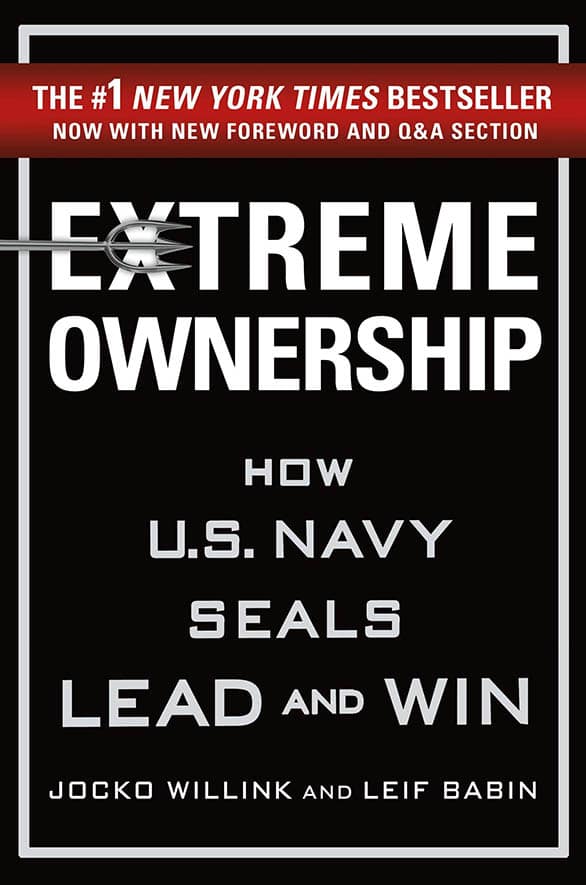
Extreme Ownership (2015) by Jocko Willink and Leif Babin, two Navy SEAL task unit leaders, discusses these strategies that leaders in the business world can apply to overcome even the most challenging business battles.
Taking Responsibility For Failures
Every leader, just as every team, whether it is in the navy or in the corporate world makes mistakes. However, what separates good leaders from others is their willingness to take responsibility for their own failures, as well as those their teams make.
Jocko Willink, one of the authors, and a SEAL task unit commander in 2012 were in Ramadi, Iraq when he and his unit encountered heavy firing. What was initially thought of as firing from the mujahedeen, turned out to be firing from another SEAL unit. The chaos of the cross-firing led to the death of one of the soldiers.
Willink came forth and took the responsibility for the consequences. Owning up was what actually saved his job and he was allowed to keep command of the unit.
During SEAL training, when teams underperform or fail, many commanders are known to place blame on either the scenario itself, subordinates, or the troop itself. Commanders like Willink who man up and shoulder responsibility for the failure consider criticisms as constructive and make detailed notes from their failures to make improvements in strategy and in their leadership abilities.
Willink knew from the worst-case scenario training that he and his team undergo, that it is often during such training that a commanders attitude becomes apparent. He also understood from experience that when a bad commander places blame on others and the situations, the attitude of blaming passes on to other members in the unit. This, more often than not, results in the entire team becoming incapable and ineffectual.
On the other hand, subordinates of commanders who take responsibility for the failure of their team and their own actions, tend to show attributes akin to their commanders, ensuring that initiative and accountability flow down the chain of command.
Extreme Leadership by Jocko Willink and Leif Babin
Understanding The Importance Of Every Mission
A leader has to truly believe and fully understand the objectives of any project, task, or mission. In times, where an order or an objective seems questionable, a leader has to consider how it strategically aligns with the larger goals of the organization, and have a wider outlook of its actual implications for the future.
Willink once received an order from his commanders that his unit – impeccable and elite – would be fighting alongside a newly trained Iraqi Army. Feeling that the Iraqi teams were often poorly trained and equipped, and sometimes, known to be disloyal to their American counterparts, his first reaction was, “Hell No!”
He, however, kept his feelings to himself. He knew he had to find out why was the move implemented. He found that the move was actually a strategic one, as the involvement of the Iraqi army was intentional. It would eventually enable the US forces to withdraw their armies from the country.
With this understanding, he was able to truly believe in the mission and went ahead with discussing the move with his team. He was able to convince the team as well, and the team was able to carry out their orders with full commitment.
Had Willink shared his reservations with his team early on, he would have not only faced backlash, but an unconvinced team would have failed the mission too.
A leader is a part of something much bigger than himself and his team. Hence, if a leader does not understand a given directive, it is his responsibility to seek the right answers from those higher up. While questioning superiors can be daunting, securing the understanding of why an order is given an amount to not carrying out one’s responsibilities.
Allies Are Not Competition
For a leader, it is vital that he always considers and covers all possible options. While one eye has to be focused on the mission, one should be on covering the broader aspects, including other teams that could well offer strategic support. A leader has to understand that other teams within the same organization are too, working towards the same goal in the broader sense. They aren’t the competition.
While co-author Leif Babin was in Ramadi, he found himself and his unit deep inside the enemy territory without any backup. He had no option but to risk his team and walk across the city in broad daylight, with high chances of enemy attack.
While Babin and his unit made it to safety, Babin later realised that there was another SEAL unit close by. His myopic focus on the objectives of ‘evacuation without injury’ had led to consider one of the most fundamental tactics of ‘cover and move’. This SEAL tactic means that one has to work as a team and support all others to achieve the overall mission.
Babin had completely missed considering the positions of the other units and how their assistance could have prevented him from endangering his team unnecessarily.
In another instance, while Babin worked as a business consultant, he noticed that there was a rife competition within different teams of the same company. It is thus vital for leaders to understand and check such inter-organizational competition and remind the teams that they all work towards the same objective. The competition always lies outside the team.
Setting And Acting On Clear Priorities
One of the most important characteristics of good leaders is the ability to remain calm, even in the toughest of situations. At times, when there are more fires burning than one can put out, trying to tackle all issues simultaneously never helps.
In such cases, leaders should use the ‘prioritize and execute’ principle. Here, leaders should be able to make quick decisions on what issues take the topmost priority and then act on them.
Once in Ramadi, Babin’s team had moved on to what seemed the roof of a building, after exiting from the one beside it. the roof, however, was not a roof, but a tarp, resulting in one soldier falling through the covering and injuring himself 20 feet below. The unit was deep in enemy territory, exposed, vulnerable without backup and faced an enemy bomb at the exit of the building.
Babin was faced with multiple issues to focus on. However, his ‘prioritize and execute’ training principle helped him make the best possible decision. Babin saw that security was his first priority, reaching the wounded soldier his second, and getting a headcount of his unit’s men was the third. Despite the pressure, he was able to think calmly, assess the scenario, and take actions according to priority.
In the corporate world too, leaders need to calmly assess their tasks based on priority, communicate with their teams in a concise and simple manner, take key inputs from the higher command if any on the plan, and finally, focus the team into executing it. however, leaders should also keep in mind that priorities can shift, and communicating with the team about these changes is vital.
Identifying And Mitigating Risks Ahead Of Time
Leaders have the responsibility to plan for success. However, without identifying, quantifying, and mitigating all possible potential risks, success is elusive. Drafting out comprehensive contingency plans for all tasks at hand, and communicating these clearly to the team, help in not only reducing risks but also preparing the team for any plan that derails, at any point of time during execution.
While in Iraq, Babin received intelligence just before an operation to rescue an Iraqi hostage held by the Al-Qaeda, that the hostage was surrounded by explosives and guarded by bunker machine guns. The risk level of the operation instantly skyrocketed. However, Babin had already factored in the risks of the mission and moved forward as planned.
Babin, had, even before he knew the danger existed, estimated the potential risks of the operation into his comprehensive plans. Communicating the newly developed situation to his troops was simple due diligence. His thorough planning enabled him to execute as planned, without needing to change or postpone the operations due to the changed circumstances.
Preparedness is essential to any mission or project. Babin, in fact, always uses this situation as an example during training for new SEAL recruits. He often asks them, “Would they still go ahead with the mission after such risks come to light?” The right answer for this question is always, “Yes.”
Leaders should also be aware of the fact that despite all preparedness, some risks can’t be mitigated. In such scenarios, leaders should then focus first on the risks that can be controlled.
Giving Superiors The Information They Need
Questioning about one’s operation plans from superiors can sometimes come across as interference. At times, it can even seem like the top boss isn’t giving the leader and his team enough support. However, leaders should realize that it is always better to maintain good relations with superiors. Moreover, good leaders are aware of the fact that it is their responsibility to ensure that superiors have the correct critical information about the operation plans so that they can give their full support to decisions.
In Iraq, when Babin and Willink were SEAL unit commanders, Babin often approached Willink, complaining about the emails sent by their commanding officer. He felt the questions directed towards him by his commanding officer were stupid, pestering and a waste of his time.
Willink, however, explained that these questions were coming to him because he wasn’t taking the responsibility to provide the commanding officer with sufficient updates and details of his plans.
Babin eventually realized that these questions were aimed at getting the necessary information the officer needed to approve the plans, pass them up the chain of command for final approval, and make it possible for Babin to execute them. Babin also learned that he needed to check his own attitude and ensure that clear, highly detailed plan documents were sent to his superiors.
Being a good leader amounts to being able to influence both, those up and down the chain of command.
Conclusion
The learning one gets from the experiences of Willink and Babin as SEAL unit commanders are –
Good leaders always take responsibility for their failures.
They understand that every project or mission is important even when it doesn’t seem so.
They understand that all teams within the organization are allies and not the competition.
Good leaders must set clear priorities and act upon them.
Risks should be identified, quantified, and mitigated well ahead of time.
It is the responsibility of the leader to ensure that superiors get detailed information to help the execution of any plan.
Whether in the military, or the corporate world, leaders that take extreme ownership are the ones who find success.
This is the Leadership Journey series on the Choosing Leadership Podcast.
I believe we all have a lot to learn from each other’s stories – of where we started, where we are now, and our successes and struggles on the way. With this series of interviews, my attempt is to give leaders an opportunity to share their stories and for all of us to learn from their generous sharing.
In the interview, Christian and I spoke about our common love for technology and leadership, about computers and people, and about artificial and human intelligence. We talk about the importance of listening with empathy, understanding the cultural assumptions that lie behind all conversations, and the important role of curiosity when it comes to leadership.
I think I realized early on my big ambition of seeing big AI projects turning into something requires you to work very closely together with lots and lots of other experts with great people. All sorts of qualities that they can bring to the table. And of course, each of these individuals have different backgrounds, different ambitions, different ways of communicating a different view on the world.
If you understand where people come from, if you can connect to those individuals. That’s a different quality that you need to bring in as a leader.
Regardless of how big the company is, your responsibility at the end of the day is to really make sure you’re viable as a business.
If you’re lucky, you also understand the assumptions, the underlying life assumptions of the other individual that you see that still today, clearly in the bigger setup where culture in which individuals or operating, plays a big role in how people make decisions and how they be
It’s a good level of curiosity. I’m genuinely curious about another person, how they think what’s the background, what’s the interest, what’s the ambition. How do they want to change the world? What do they see as being responsible for which role. In this big theater we call life, do they consider it being their role, right?
If you manage to have followers, it is important to have empathy, to put yourself into the shoes of those that you want to inspire, that you want to help and want to lead and want to manage and want to give a perspective.
Focus on the purpose, focus on the meaning of doing this type of work. It’s answering that question. “Why am I here?”
The expectation for me is not only to know the latest algorithm but to actually also understand how do I attract the people that know the latest algorithm, how do I keep them all happy and meaningful?
Mathematics is intrinsic to nature. Moreover, it is at the base of all human behaviour and an intuitive reflection of human thinking. We apply a number of mathematical tools in our daily life, without even realising it. A science of common sense, math touches our lives in a deeply profound manner.
How Not To Be Wrong by Jordan Ellenberg, explains the way mathematicians think, how math is deeply woven in our lives, how to use it to solve the different problems we encounter, and most importantly, how we can avoid making mistakes while applying the tools of math in life. It shows the path to finding correct solutions and how not to be wrong!
The Science Of Common Sense And Not Being Wrong
People often find math challenging. More often than not, most people think that the complicated problems they were expected to solve in school were irrelevant in the real life. However, it is a fact that one never stops using math. Math is often the basis of finding solutions to different problems in life. Only, it is not called ‘math’.
Mathematics is the science of common sense and not being wrong.
During WWII, a number of American planes returned from Europe, ridden with bullet holes. It was however observed that the planes’ fuselage had more bullet holes than the engine.
The obvious suggestion from military advisers was to strengthen the fuselage with better armour. However, one young mathematician suggested strengthening the engine armour. He was able to see what the military advisers did not.
He deduced that the planes that did not survive and come back were the ones that were hit on the engine. He deduced that with stronger engine armour, more planes would survive. Their myopia of focussing on what survived rather than on improving areas that were the actual problem is a logical-mathematical error called ‘survivorship bias’. While the problem might not have presented itself as a mathematical one, it was.
Furthermore, mathematics is derived from common sense and a reflection of what we already know intuitively. For example, everyone knows that 5+2 is the same as 2+5. It is so obvious, that it becomes difficult to explain. The understanding that one has of this from childhood, is a reflection of the basic definition of math being commutative, where for any value of a and b, a+b = b+a.
How Not To Be Wrong by Jordan Ellenberg
Simplifying With Linearity
While learning math, everyone follows one basic principle – make a difficult problem easier, and then solve the easier problem, hoping that it is close enough to the difficult problem.
In geometry, things with straight lines are considered linear, whereas curves are nonlinear. Tough problems can be broken down into easier ones by assuming they have linearity.
From the perspective of an ant that is walking around a big circle, it would think that it is walking in a straight line. If one was to zoom in closer on a part of the curve of the circle, it would look like a straight line, thus showing that a curve of a circle is actually similar to a straight line bent at very slight angles.
If one had to measure the area of the circle, one could insert a square in the centre of the circle, with each corner touching the circle. Then one can measure the area of the square. Next, one can insert a number of polygons in the remaining areas, calculate the area of those polygons, and ascertain an approximation of the circle’s areas by just using straight lines.
The idea is to simplify the problem with linearity.
Linearity is often used in statistics. A mathematical relation can be seen even in calculating voting preferences or salary levels. For example, the statistic that shows, for every extra $10,000 a person makes, the person is 3% more likely to vote republican. This is an example of Linear Regression and is often used to compare how different observations can be related (like voting preference and salary level).
Linearity helps in finding approximations of any data taken as a whole and making it simpler to understand and apply in real life.
How Probability Theory Helps
Theories are built based on data collected through observations. However, drawing conclusions from observational data can be precarious as it can also come about by chance.
For example, a neuroscientist, in 2009, showed pictures of people to a dead fish. The fish’s brain activity showed that it responded correctly to the emotions displayed by the people in the photos. While the whole experiment was a gag, the scientist proved that research data can come about by chance.
When brain scans are performed, scientists divide the scans into thousands of pieces called voxels, corresponding to different parts of the brain. These scans, even if it is of a dead fish, will measure some amount of ‘noise’ in every voxel. Considering the number of voxels that are created, the chances of even one voxel responding to any stimulus are very high.
However, it is not always clear that the observational data has been acquired by chance. Hence the Probability Theory comes into use.
Consider a scientist is testing a new drug to cure a disease. He uses a mathematical tool called the null hypothesis significance test. In this tool, the scientist will first start with a null hypothesis – an assumption of what will happen in the first test conducted. The null hypothesis of the first test will be that the drug does nothing at all.
Then, the scientist will consider the deviations of the data observed in the experiment. The scientists will also consider the probability of the data coming by chance. This probability is called its p-value. Considering p = 00.5, if the probability is lesser, then the data is considered significant, statistically.
If the data is statistically significant, then the scientist can be 95% sure that the new drug has the desired effect.
Probability, Expected value, And Risk
Probability doesn’t ascertain the future outcome in an uncertain situation. But it can help in understanding what one can expect.
For instance, the probability theory can be applied to understand a likely outcome when one places a bet. If a person buys a lottery, he can use probability by determining its expected value. Thus to calculate the lottery ticket expected value, he will have to consider each and every possible outcome, multiply the chances of each and every outcome with the ticket value, given that outcome, and add up the results.
Let us say the ticket has only 2 outcomes – winning and losing. At a cost of $1 a ticket, there are 10 million tickets in circulation, and the winning ticket is worth $6 million. Thus based on calculations, the ticket expected value is 60 cents, and on average, the person should expect a loss of 40 cents every time he plays the lottery.
The concept of expected value is applied while pricing life insurance or stock options.
Expected value, however, doesn’t consider risk. For example, given an option, would one rather receive $50,00 or place a bet where the odds are either to lose $100,00 or gain $200,000?
Here, while the expected value in both cases is the same, the outcome of losing in the second option is far worse than not placing a bet at all. Expected value tends to hide the fact that a bet also has a tangible risk.
Thus a risky investment is a good bet only if one has the ability to cover probable losses, and one should always consider the risks in any bet before placing it.
The Regression Effect
The regression effect states that if a variable produces an unlikely outcome, the next outcome will tend to be closer to the mean.
Consider the trend where a novelists second book doesn’t garner as much success as the first book does. This phenomenon can be attributed to the regression effect, for anything that involves randomness. For example, while short people have short children, the children of very short people arent likely to be very short. Instead, their height will be closer to average.
The height of a person depends on many factors including genes. Factors such as eating habits, health, exercising preferences and even chance affect height. It is thus highly unlikely that the external factors affecting the children mirror those of the parents.
The regression effect is, however, not recognised often. In 1976, the British Medical Journal published a paper mentioning that bran helps regulate the digestive system. However, participants with a fast digestion rate on one day showed a slower rate the next day, and vice versa for those with slow digestion rates.
The effects of regression proved that the effects of bran on digestion might not be remarkable after all. Thus researchers have to be careful and consider the effects of regression, especially for any biological phenomena.
Linearity Of Regression
We have seen that Linearity of Regression can be used to understand the correlation between variables. While it is an important tool in statistics, it cannot be used for every set of data. Used incorrectly, it can produce results that can mislead the whole observation.
The linear regression of any data set can be plotted on a graph. Then, one finds the line that passes closest to all the reference points plotted. This method only makes sense if all the plotted points are already generally linear.
For instance, the curve path a missile follows when fired seems like a line if one segment of that curve is zoomed upon. This can be used to predict where the missile would be in a few seconds, but it isn’t possible to clearly indicate where it would land, as linear regression doesn’t account for the curvature of its path. Zooming out from the path segment, its curvature indicates nonlinearity and can’t be described by one line anymore.
Applying linear regression to nonlinear observations will produce incorrect results. In 2008, the Journal Obesity published a paper that claimed all Americans would be obese by 2048.
What the researchers of the paper had done was to apply the concept of linear regression to a graph that plotted the percentage of obesity against time. The graph crossed 100% at 2048, and estimated that 109% of Americans would be obese by 2060!
Thus, trends such as obesity cannot be plotted linearly as they tend to produce curved graphs over longer periods of time.
Incorrect Probability Calculations And Misused Data
Professor John Ioannidis, in 2005, published a paper “Why Most Published Research Findings are False.” The paper had made some valid points.
The paper stated that chance can lead to insignificant observations passing a statistical significance test. For example, while considering the genetics of a person while calculating the probability of the person getting schizophrenia, it is sure that some genes get passed on, but it is unclear which genes do.
Out of about 100,000 genes, 10 could be related to schizophrenia. Moreover, even with the most commonly used significance test of 95%, about 5% of the genes will pass by mere chance. Calculating the numbers, 5% amounts to 5,000 genes, which isn’t a result specific enough to mean anything significant.
The paper also stated that the results of unsuccessful studies don’t get published, hence resulting in disproportionate attention given to the results of successful tests. Consider that 20 labs, conduct tests to check if green jellybeans can cause acne. Of these 20, 19 labs don’t find any significance to the claim and don’t publish their results. But that lab that finds successful statistically significant results is more likely to publish the study.
The paper also stated that scientists tend to tweak the data to be able to get statistically significant results.
If 95%certainty is needed for a study to be even considered as statistically significant, and if gets a 94% certainty for the experiments conducted, it would be deemed insignificant for just one percentage point.
In such cases, researchers are known to tweak the data by just a little so that the study can be deemed statistically significant. This happens not because the researchers have ill intentions to cheat, but because they deeply believe in their hypothesis.
The Problem With “Public Opinion”
How is a vague concept such as public opinion measured? While polls are the tools used to measure public opinions, there are problems with the accuracy of the results.
Why?
Public opinion is based on what a majority thinks. Considering that every individual can have contradicting opinions and these change from time to time, the results will also change, thus invalidating the precious “public opinion.”
For example, CBS News, in Jan 2011, claimed that according to a poll conducted, 77% of the respondents thought that the best way to address the Federal Budget is to cut spending. However, a month later, Pew Research conducted a poll where people were asked their opinions on 13 different categories of government spending. The results in 11 of the categories showed that people actually supported spending.
Another issue is of majority.
The rule of majority works when respondents have only 2 options to choose from. When there are more options, the responses get divided differently, leading to completely different results.
For example, in a poll conducted in October 2010, about 52% of the respondents opposed the U.S. Affordable Care Act, while 41% supported it. however, when the responses were broken down into detail, only 37% wanted the health care bill repealed, 10% wanted the law weakened, and 15% wanted to leave the bill as it was. About 36% opined that it should be expanded to change the system even more.
Such scenarios can be seen in elections as well. During the 2000 Presidential election, while George Bush had 4885% of the Florida vote, Al Gore had 48.84%, whereas Ralph Nader had 1.6%.
This clearly indicated that Bush was the winner. However, it can also be said that all those who voted for Nader would have prefered Gore instead of Bush if they hadn’t had another choice. It indicated that out of a hundred per cent, 51% did not want Bush to win, which would have led to a completely different scenario.
Conclusion
Mathematics and mathematical ideas can be applied to daily life. They can be used to draw accurate conclusions of unmeasurable concepts. The mathematical tools that can be used, are derived from common sense and one learns how to not make mistakes, whether it is to find the probability of winning the lottery, getting life insurance or even researching a cure for an illness!
Welcome to the Deploy Yourself Newsletter, where I share what impactful leadership looks like to show your own power. I also share the most insightful lessons and stories I encountered in the last two weeks. You can also read this issue online.
One such question to ask ourselves is, “Who am I?”
If you let this question marinate and reflect over it, you will see answers emerge at 3 levels of depth.
At the surface level, the obvious answer is your name. Like – “I am Sumit Gupta”. Isn’t that obvious? But – is that really you – your name? Isn’t it more accurate to say, “My parents named me Sumit, but I am much more that those 5 letters.”
If you go just a bit deeper into the inquiry with this question, you will start coming up with the roles you play. Like for me – I am a son, father, husband, photographer, coach, leader, and so on. Or – the boxes you have found yourself in – either by choice or by default. Like – I am Hindu, Indian, Dutch, liberal, man, and so on. But again, ask yourself – Is that who you are? Or – is there more to you than the roles you play?
The third level is the level where you Deploy Yourself and choose who you want to BE. This is where your creative choice comes alive and you show up as a leader you are required to BE, rather than who you think you are. It means choosing in any given moment who you want to BE – to create results that matter to you. For example –
When you are with your child, you can BE funny and playful (even if you have been having a bad day)
When you are with your team, you can BE empathetic and caring (to create powerful teams and relationships)
When you are reviewing work commitments, you can BE straight, focussed, and hold people accountable (to produce results)
When you mess up or make a mistake, you can BE apologetic to clear the mess you have created.
And when you have to take risks as a leader, you can BE bold and brave (to move forward towards the future).
What is opening up for you with the above exploration?
Instead of operating from who you think you are – nice, kind, bold, shy, caring, etc – you can choose to BE who you need to be as a leader – in any given moment. That is when you Deploy Yourself and produce results previously thought impossible.
What could be possible in your life if you can creatively choose who you are? What could be beyond your name, your roles, your beliefs, and your past experiences?
Do not rush to answer this question. Think about it. Journal about it. And see what comes up. What new possibilities open up? What questions and doubts come up?
And then reply back and share what you discover. I read and respond to every reply.
Articles and Stories Which Have Fascinated Me
One
Pursue Mastery, Not Status
Measurements give us the valuable information required to track progress, but unfortunately, they also standardize that progress into a universal, almost soulless metric.
Each domain wields its standard metric of progress, and by focusing on it intently, we gauge our work not by what we produce, but by how it is received and measured. Anytime progress is standardized, a status game is reinforced.
It often leads to a never-ending game of comparison via shallow standards. Our relentless chase for status (and the showboating of it) is a cancer that masquerades as success.
Fortunately, there is an antidote to this cancer, and its name is mastery.
Mastery is the quest to improve yourself as an end in itself. Comparisons are not made with other people, but only with prior versions of yourself.
Status is obtained by collecting attention, whereas mastery is achieved by refining intuition. Status is always relational, so external validation is a prerequisite to feeling secure. Mastery, on the other hand, is gauged by your unique sense of progress, which can only be derived from within.
The key here is to continue seeing status for the societal poison that it is, and to resist its allure.
A truth that applies to many fields, which can frustrate some as much as it energizes others, is that the person who tells the most compelling story wins. Not who has the best idea, or the right answer. Just whoever tells a story that catches people’s attention and gets them to nod their heads.
Charles Darwin didn’t discover evolution, he just wrote the first and most compelling book about it.
Great ideas explained poorly can go nowhere while old or wrong ideas told compellingly can ignite a revolution.
When a topic is complex, stories are like leverage.
Stories get diverse people to focus attention on a single point.
Good stories create so much hidden opportunity among things you assume can’t be improved.
6 Things You Must Not Do As a Leader To Ensure High Team Performance
It is easier to cause damage as a leader by ignorance than it is to improve performance by deliberate intervention. Here are 6 things that you must avoid doing :
1. Do not accept mediocrity or low standards. Whatever standards you accept will become the norm.
2. Don’t treat people with disrespect. Even when they mess up.
3. Don’t force people to commit to deadlines or take on work that would mean spending time away from their families or ignoring their health.
4. Don’t put profits over employee well-being. Don’t push people to stress and burnout
5. Don’t bias your decisions because of who and what you like.
6. Don’t micromanage. Trust people and let them do the work they were hired for.
That’s it for now. If you have any questions or feedback, or just want to introduce yourself, hit reply. I read and respond to every reply. All the best,
This is the Leadership Journey series on the Choosing Leadership Podcast.
I believe we all have a lot to learn from each other’s stories – of where we started, where we are now, and our successes and struggles on the way. With this series of interviews, my attempt is to give leaders an opportunity to share their stories and for all of us to learn from their generous sharing.
In the interview, Nina shares how losing her mother inspired her to start Pink Week. She opens up and talks about how bad things hurt her heart, and how knowing that has shaped her career. She also talks about the importance of working in a company where you feel comfortable expressing your voice, which I think is one of the main tasks of any leader in any organisation.
I was really inspired by my mother. She passed away when I was young. Gosh, she had breast cancer for around three years.
It was really important to me to just say, why don’t we just bring that awareness level a few years earlier? Why do we have to wait until we reach an age where we are vulnerable to breast cancer? And why can’t we like look at a preventative away?
I really hate seeing bad things happen. It really hurts my heart. And I think that’s very much why it ended up in the nonprofit sector, because I just feel like a real connection with giving back and facilitating other people.
I think for-profits are the organizations that need to pave the way for a new kind of giving, engaging a completely new consumer set, and a target audience that could be interested in giving back and perhaps becoming more dedicated to these nonprofits as they.
I think all corporations should be B Corps, because I think it’s really the best way to do business nowadays.
I think that if you have a job that you’re passionate about and that you’re focused on, it really helps to calm the nubs and decrease some of that intense pressure because you’re going in the right direction.
I think when you come to a leadership role at a young age, then everybody struggles with this kind of imposter syndrome. And that’s something that I definitely feel.
I think, so many people appear confident, there’s really always something going on behind closed doors. So I think everyone should be more open about how they’re really feeling. And then live in a much more transparent environment.
Today’s economy is all about start-ups. The 1990s saw a massive boom in the start-up segment, which resulted in the ‘.com’ bubble bursting. By the early 2000s, many companies had collapsed due to a lack of funding. This gave rise to a number of smaller start-up companies that focused on user-based content. They were all part of the Web 2.0 movement.
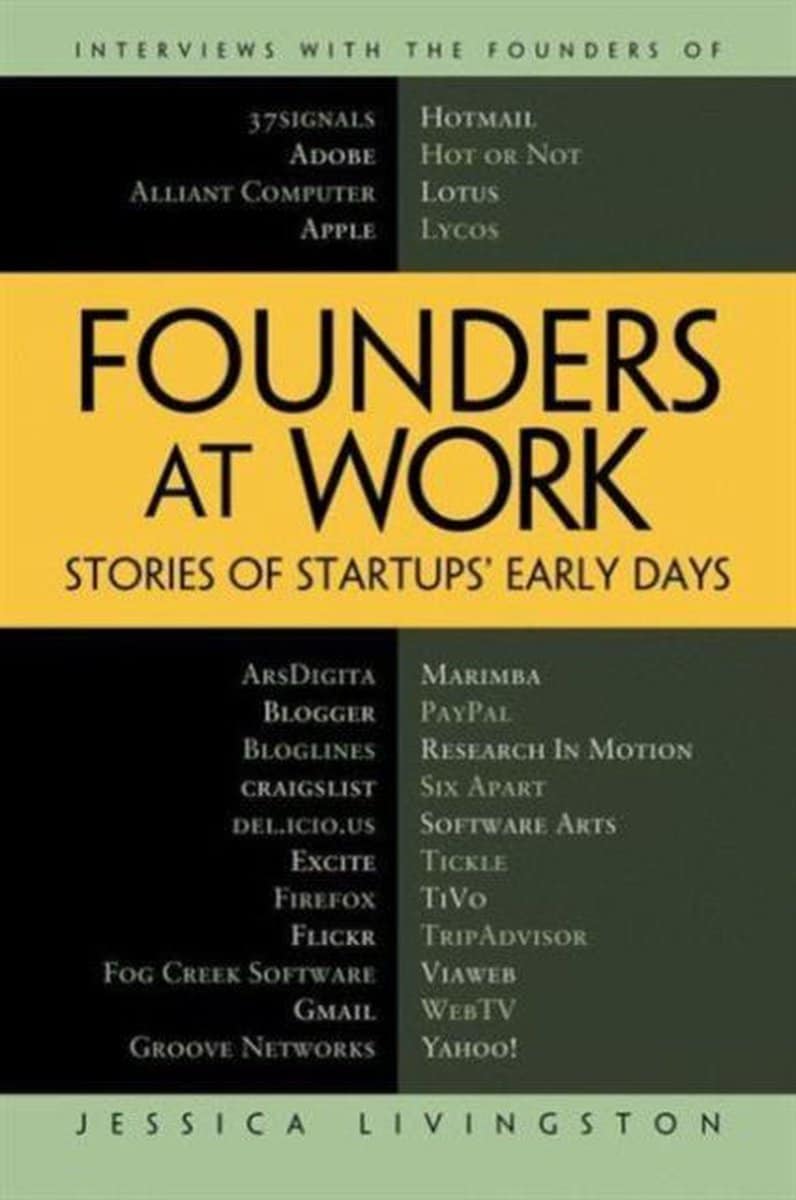
Jessica Livingston, the author of Founders At Work (2007) had interviewed a number of founders of these start-up companies such as Blogger.com, Flickr, and Hotmail – and about 30 influential US start-ups, from the days of the early Web 2.0 generation. She learned about the trials and tribulations they faced while making their dreams a reality.
The stories of these pioneering founders are still relevant in today’s times, despite the fact that technology has zoomed far, far ahead. Her book discusses a few business mantras that aren’t commonly discussed and guides entrepreneurs towards understanding the past, the stories that have made history while charting a course towards a successful future.
Ideas Change
One of the commonalities Livingston noticed during her interviews is that a number of successful start-ups had products and ideas that were completely different from the original ones they started with.
One such example is PayPal. When Max Levchin started out, he was originally working on emulator software for a hand-held computer similar to the Palm Pilot in the late 1990s. The software would make multiple passwords and multiple device systems obsolete. However, the market wasn’t that big.
Levchin thought that users mostly needed secure credit card information. This led to creating software that enabled users to securely ‘beam’ money between two Palm Pilot devices. However, the software maxed out when they managed to get 12,000 users only. They however noticed that their online money transfer demo on the website had attracted about 1.5 million users. Thus PayPal’s web-based money transfer was born.
Once they shifted focus to online web-based transfers, they started getting about 20,000 users a day. This eventually led to eBay purchasing PayPal for $1.5 billion in 2002.
Another example comes from Bloggers.com. Founder Evan Williams and his team of partners were working on making project management software in 1999 and had started Pyra Labs. Their blog was only one of the tools they were working on.
However, the tool they created made it far easier for anyone to log in, write, and publish their work for everyone to see from any computer. The tool had no connection to project management, and Williams was almost broke. Yet, determination and the tool’s fan following made Blogger.com a success, eventually gaining millions of users and formidable revenue. Google then acquired Blogger.com in 2003.
The Difficulties Of Innovative Ideas
Founders At Work by Jessica Livingston
While innovative ideas are great for start-ups, the difficulty with them is that is not that often well received by others, at least not in the initial stages of the business. people could find them a little tricky or confusing, especially if they involve spending funds.
Steve Perlman’s innovative WebTV idea was at first difficult to comprehend and even execute. In 1995, Perlman was a known name for helping Apple develop its first colour display MAC already, and his ideas for an interactive TV seemed difficult to sell.
His idea was brilliant, yet at times when TV didn’t have program guides even, an interactive TV seemed far-fetched as there was no hardware to support it. Moreover, the absence of interactive content in the market to prove that there even was a market for such hardware was tough.
The people he approached just weren’t convinced that people would want to do anything more than just change channels on their TV’s. Perlman however, proved the naysayer’s wrong, and after Microsoft purchased his idea, the new MSNTV generated $1.3 billion in revenue in its first 8 years.
In 1996, email accounts were primarily given by one’s employer. Additionally, firewalls would prevent people from accessing their email from anywhere outside the internal network of the workplace.
Sabeer Bhatia and Jack Smith, the founders of Hotmail, understood the benefits of accessing their emails from any web browser. While the idea was a great one, it was rejected by many investors. One investor, however, gave them just enough funding so that they could bring their idea to fruition.
Their smart idea of adding a link at the bottom of their Hotmail website started garnering about 5000 users per day, resulting in 7 million subscribers in just one year. Soon, Hotmail was acquired by Microsoft for $400 million, and the rest they say is history!
A Great Team Is Better Than A Great Idea
Start-ups often succeed because of a great idea. However, most of the successful start-ups have succeeded because of the great team behind their great idea. At times, many businesses don’t have an idea, to begin with at all.
An early web-search tool, Excite, was started by Joe Kraus and his five friends in 1993. He and his team proved that a great team is better than a great idea. Sharing similar passions with his Stanford University friends, Kraus knew it was but a matter of time before they pooled their intelligence to come up with a great idea for a business.
It was during one of the brainstorming sessions that they understood that people needed to have an easier way to search for the hoard of digital information that was being published. Initially, they focused on digital encyclopaedias but realised the real money was on the web. They got around to developing a tool that could scale to search massive databases. With a $3 million financing, Excite became the primary tool used for search in the then-dominant browser – Netscape.
Similarly, in 1996, Arthur van Hoff and his three other colleagues from Sun Microsystems had teamed up together. While they had no idea, to begin with, they were all a part of developing Sun’s Java programming language. Each of them decided to invest $25,000 into their own business venture.
Van Hoff trusted his team to be able to quickly pivot from one idea to another. He also knew that not all first ideas get accepted. Finally, van Hoff and his team came up with Marimba, a subscription-based software distribution model. The model enabled faster software updates for everyone all over the world simultaneously, a boon for large companies like Morgan Stanley.
Thus, Van Hoff’s belief in the ability of his team to pivot quickly was far more important than their ideas.
The Value Of A Personal Project
Many ideas have become successful mainly because they were solutions to problems personally faced by founders. While Hotmail is an important example, Yahoo is the most famous example of how a personal project can become highly valuable.
Jerry Yang and David Filo, two Stanford grad students, made a collection of online footnotes in the form of web links, to make references easier for their PhD thesis papers. This site of references grew fast with new links and categories getting added, with suggestions from enthusiastic fans. The site’s popularity was increasing at such speed that Yang and Filo roped in Tim Brady, their friend, to write up a business plan. Thus Yahoo was born.
What started as a hobby, soon became a real business garnering $1 million. In 1996, Yahoo went public, it went on to become one of the pioneering empires.
Around the late 1990s and early 2000s, finding things on the Internet wasn’t as easy as it is today. Joshua Schachter, then a Morgan Stanley analyst, began a collection of online bookmarks in the late 1990s. By 2001, he had gathered around 20,000 bookmarks with the help of suggested links from others.
Schachter then needed to keep his huge collection of bookmarks organized. He started using short categorical descriptions with tagged links such as ‘food’, ‘math’, etc. As soon as he made this collection public on a server, he gathered around 30,000 users within a year. Its popularity got him a $1 million funding. Soon the site deli.icio.us, which was created by Schachter to address his personal organization issues, was purchased in 2005 by Yahoo for a whopping $30 million.
Keeping It Simple Is The Best
Often, the best solutions are the simple ones, like Schachter’s descriptive tags for the organization of data. Even for Apple, simplicity has been the basis of all their business solutions.
During the nascent stages, when Steve Wozniak worked out of his apartment, his focus was always to generate more and better outcomes by working with lesser. For example, as a high schooler, he would take gadgets apart and try to put them together using as few parts as possible. He would try to make things work more elegantly with lesser parts and cheaper costs.
For Wozniak, entrepreneurship entailed creating things with limited resources, all while trying to make them better than what was available in the markets.
Philip Greenspun, the founder of ArsDigita, used a similar thought process in 1997 while starting his web design company. Many companies started requesting him to build their company websites after he developed the popular community site called Photo.net.
As he worked on more projects, he developed and published a free design framework that anyone could use, called the ArsDigita Community System. In 1998, after his book Database Backed Websites was published, the request for web designing work increased.
The aim of Greenspun’s business was two-fold – to offer clean, quick and simple design solutions and to change the perception that people held of programmers from mere human robots who wrote code, to problem solvers. ArsDigita, with an annual growth of 500 per cent was working for clients such as Hearst Publications and Levis.
However, too much growth, too fast, can also prove to be a liability. As soon as Greenspun opened his doors to venture capitalists, all founders, but one of them, were squeezed out. The new leadership wanted the start-up to become an expensive and slow company like IBM. ArsdDigita collapsed and became an example of the disadvantages of venture capitalism.
Keeping it small and simple is sometimes better than trying to get big!
The Disadvantages Of Investors And Venture Capitalists Funding
Opening the doors to more investors and venture capitalists sure has its disadvantages. Like Greenspun learned it the hard way, venture capitalists come with their fair share of strings attached. More often than not, it involves either handing over company shares, or a percentage of the profits made by the company. In addition to that, one has to deal with the investor-approved executives that come in.
For a start-up, staying in control of the business is paramount, even if it means reducing cost or even finding ways to avoid involving investors.
Joel Spolsky, the founder of Fog Creek Software, understood the issues faced by ArsDigita. Thus, while he focused on planning his company on the lines of ArsDigita, he also focused on avoiding those same mistakes Greenspun had made.
Building on the philosophy Greenspun followed at ArsDigita, Spolsky too, wanted to build a company that not only had great programmers but also had an environment that respected them. His office was designed to make sure that programmers were comfortable, with their own office, comfortable chairs, first-class travel, four weeks of annual vacations, etc.
Such comforts and expenses are often deemed unnecessary by investors. Hence, Spolsky planned his business to avoid venture capital. He founded a bug-tracking software called FogBugz. Additionally, he even understood a vital aspect of software sales – that software can appear more valuable if it has a higher cost. Therefore, when he increased the cost of his software to $999, he ended up selling more units.
Many founders opine that another way to avoid investors and venture capitalists is to stay cheap. The co-founder of Viaweb, Paul Graham who designed the startup incubator, the Y Combinator, advises that for every bit of investor money one makes, one is at the mercy of others, and has lesser autonomy.
How and why do I summarise books? – Sumit Gupta
Be Honest With Products That People Need
The most important aspect of any business is the customer. Hence the most common advice most founders give is to listen to the customer and focus on creating real value for them.
This was the ideology that Paul Graham believed in. “Make something people want”, was in fact, printed on the Y Combinator t-shirts too. He believed that every business should focus on making people happy and that happiness can then be converted into profits.
Graham also believed in honesty. Along with co-founder Robert Morris, he decided to make the best e-commerce software available. With their focus firmly placed on customer satisfaction and on the quality of competitor products, they were able to, with all honesty, claim that their software was indeed the best!
It’s simple. When an entrepreneur is honest about the fact their product or service is the best available, the customer will know that it is the truth. Additionally, if one doesn’t have what it takes to be a great salesperson, truth and honesty are the best backings one can have to win over clients. After all, it is tough to compare or put a price on honesty.
For Graham, salesmanship was never a natural ability. However, he saw that his honesty about his product was a very persuasive and valuable quality. He knew that truth and honesty can overpower any amount of natural salesmanship virtue!
It Is All About Timing
The success of any start-up also depends on the timing. If the product or the service enters the market just at the right time as it did with Flickr, the chances of success shoot up.
Flickr’s founders Caterina Fake and Stuart Butterfield, her husband, hadn’t really planned for the idea of Flickr. As with many other companies, Flickr wasn’t the original idea they started out with. In 2002, they were working on a videogame based on the popular pet game Tamagotchi. Called Game Neverending, the game involved a feature that enabled players to share their photos with each other. In the process, Fake started working on a feature that eventually enabled players to share their photos on a webpage.
While other photosharing programs were already doing the rounds, by 2004, the social media wave had already hit with Friendster, Myspace, and personal blogs, making photo-sharing popular with users. At the same time, digital photography had also made it easier for users to post their photos online.
The timing, according to Fake was just right for Flickr. Back then, services such as Shutterfly were online paid printing services, with a very small market. Had Flickr been their main project, the research data would have suggested that there was no market for a tool that enabled people to simply share photos on the web, without making prints.
Soon, however, the market shifted towards photo-sharing becoming the main ‘fun’ activity on the web. The addition of personal blogging made the idea of sharing personal photos publically more comfortable, thus making the time of arrival of Flickr just right!
Conclusion
The decades between the late 1970s and the early 2000s indicated a huge paradigm shift for start-ups. With the focus firmly on user-generated content, start-ups had their business plans set.
The experience of the founders of the most successful start-ups of that era is valuable, relevant lessons for any start-up trying to place their footsteps firmly in the industry even today.
Dear reader, click here to view this leadership update on your browser.
“You do not have to be the cleverest person in the room” – Jason Rees
Jason Rees is a customer-focused technology solutions leader with over 25 years of experience in architecting, delivering, supporting and leading technology projects for clients and customers. He is currently a VP at Oracle Corporation.
In the interview, Jason shares how playing and coaching team sports like Rugby has shaped his leadership. He talks about how as a leader, you do not have to be the most clever person in the room with all the answers, and how he sees listening to different perspectives as a superpower. He told me his leadership is not about him, but about his teams. And I found that very powerful.
He adds, “everyone wants to feel relevant. Everyone wants to feel, they understand why a big company or a small company quite frankly, is going in the direction is doing going. “
“I’ve had to work on reining in my natural instinct to avoid burning out!” – Kindred Motes
Kindred Motesis the founder and managing director at KMSG, which is a boutique strategy, social impact, management, and communications consulting firm. KMSG leadership brings more than a decade of communications, social impact, philanthropic, management, and digital strategy experience to its practice, including impact campaigns for or in collaboration with some of the most prominent names in the social justice, technology, policy, and philanthropic sectors:
The United Nations, The Obama White House, USAID, ACLU, Global Citizen, Netflix, Participant Media, Amnesty International, Oxfam, Google, the John D. and Catherine T. MacArthur Foundation, Southern Poverty Law Center (SPLC), Vera Institute of Justice, the Foundation for Louisiana, Wallace Global Fund, and New America, among others.
He talks about how he had to work on reining in his natural instinct, which is to get excited and say yes to a project just because the organization’s mission or vision aligns with his without first considering his own likelihood of burning out from continual 16 hour days.
This year, KMSG is implementing a 4-day workweek and requiring any current or future staff or contractors to make time for their own rest, relaxation, and creativity by asking them to take a minimum of four weeks per year in paid time off.
Choosing Leadership is a podcast for people who know deep inside that there is more. My invitation to you is to “choose” leadership and to step up as a leader.
I am interviewing leaders to learn from their stories – of how they came to be where they are today. These are the stories peers and friends don’t usually know, and my attempt is to bring them out. Find out what has shaped them to be the person and leader they are today.
Our journeys might not look alike. They might resemble more of a roller-coaster ride than a race track, and that is what makes each one of us special and unique in our own ways. I am deeply touched when someone takes the time to share their story with me.
If you would like to recommend someone else who I should interview, feel free to recommend them. You can send me a message on LinkedIn or send me an email at sumit@deployyourself.com.
This is the Leadership Journey series on the Choosing Leadership Podcast.
I believe we all have a lot to learn from each other’s stories – of where we started, where we are now, and our successes and struggles on the way. With this series of interviews, my attempt is to give leaders an opportunity to share their stories and for all of us to learn from their generous sharing.
In the interview, Jason shares how playing and coaching team sports like Rugby has shaped his leadership. He talks about how as a leader, you do not have to be the most clever person in the room with all the answers, and how he sees listening to different perspectives as a superpower. He told me his leadership is not about him, but about his teams. And I found that very powerful.
I would say a lot of reasons I’ve shaped by that is I’ve played team sports. Like rugby is the sort of sport I played the most.
The feedback is not “you’ve done this wrong.” It’s much more. “What did you observe? What went well, what didn’t go well”
“I try to actually put the time in my diary to take a step back. There’s a danger that we are operational all the time, we’re hitting our KPIs, our targets, whatever we measure our business by and what that means is, and again, especially in the current work. People get burnt out. I think people get burnt out by just getting the tasks done.”
Everyone wants to feel relevant. Everyone wants to feel, they understand why a big company or a small company quite frankly, is going in the direction is doing going.
You don’t have to be the cleverest person in the room. What you need to do is make sure that you have people with diverse backgrounds, diverse experiences who are all able to look at problems in different ways. And sometimes the problem can be solved in a totally different way. And I think that’s that for me is the superpower.
I don’t care where people come from. I think it’s just better that we’ve got diverse ideas.
Leaders need to tap into what that person’s passion is, and if we can get it aligned to our company goals the corporate goals, then you create high performing team.
I think it’s not about the quantity of communication. It’s about the quality of communication. And then listening basically plays a huge part.
Don’t be held back by the fear of failure, just be excited by what you can do.
Being the best, having a great ambition, and succeeding at whatever endeavours one chooses in life, is what most people are taught to achieve, right from childhood. Contrarily, that the final fruits of years of hard work should lead to a comfortable retirement package, tucked away in a peaceful retirement home, is the goal that people end up reaching out for.
Why?
The answer is that people have a fear of failure and rejection, and a lack of ambition, to continue on the path of achieving goals.
Be Obsessed Or Be Average (2016) by Grant Cardone, explains that a quiet retirement need not be the only ambition in life. It guides towards leading life to its fullest. It shows how passion and obsession are powerful enough to unlock the unlimited rewards of ambition.
Being Obsessed
When one feels that they are on the verge of burnout, and feel completely depleted of energy to continue work, one essentially has two choices –
Taking a break, or
Becoming obsessed
For an average person, taking a break is the most likely choice. However, giving up at that moment and taking a break doesn’t help to achieve the set goal, or even moving to the next step. In such a scenario, one needs a push towards achieving goals. That push comes from being obsessed.
What truly helps during burnout is to reaffirm the purpose of achieving that goal. For example, when Cardone reached the age of forty, he started feeling stressed out and tired. His travels required him to be crisscrossing the country to deliver talks, and when there was a holiday in the US, he would book talks in Canada. This often led to Cardone not knowing which country or state he was in when he woke up on his flights.
At this point, Cardone realised that delivering talks all over the country wasn’t his goal. His real obsession was with becoming the greatest salesman on earth, and being a public speaker had distracted him from that goal. He decided to write down and reassert his goals in life. He felt rejuvenated the moment he cleared his mind and focussed on his goal.
Cardone found that being obsessed is the key to achieving true balance and unlocking energy.
Balance isn’t about relaxing and taking time off. It’s about stabilizing while achieving career and professional goals, health and wealth goals and family and personal goals at the same time.
To do this, one needs to work hard, with the passion that accompanies obsession, each and every moment.
Be Obsessed Or Be Average (2016) by Grant Cardone
Keeping Obsessions Fresh and Consistent
Achieving set goals consistently needs passion and obsession. Consider a person has realised what he is passionate about. He is able to meet goals or inch closer to them faster than expected. In this scenario, it is easy for the person to think they have time to start on the next goal, or meet the goal, and to take some time off, before the last mile.
He has to push ahead, keep obsessing about the next big thing, or things. Only then can the person achieve consistent great success. One has to set future more audacious goals consistently, and consistently push towards achieving them.
Furthermore, goals should drive one towards a limitless future. Setting an end goal, like achieving a lavish retirement life won’t keep one obsessed. Such goals do not excite a person to work towards achieving goals each and every day!
Endless ambitions fuel a person’s motivation each day. This ultimately leads to an exceptional life. For example, if a person achieves the goal of becoming a millionaire, the next big goal should be to become a billionaire.
Thinking about how he can fund charitable organizations with the billions he is able to achieve, is the kind of forward-thinking he should have to get obsessed, to get motivated, and to be passionate in life, consistently
Aiming High
Being obsessed and passionate consistently helps in setting a goal. But even billionaires cannot predict the course of life and how they are actually going to achieve the goal. How do they achieve their goals then?
The trick is to make a promise to achieve a goal ten times higher than what they can actually achieve and then push themselves and their teams to reach it.
Setting a high aim helps in giving one that necessary push and rise to the challenge.
All the major decisions one makes in life need one to dive in and then figure how to swim along the way. For example, one can plan to have a child and have big plans of raising them right. However, there is no guarantee that things pan out exactly as planned. One has to learn parenting as one experiences it.
This principle applied to goals as well.
For example, almost every Apple product released in the market has had flaws. However, Apple places importance on the values of innovation, being bold and being the next big thing. Hence rather than wasting time on testing, and probably lose the opportunity to be the pioneers in the industry, they innovate and make corrections with new versions as they see how their products perform in the market, this is what has made Apple one of the greatest successes in the world.
Sometimes, being first is better than being perfect!
Belief and trust in one dream and the ability to achieve are important as well. The New England Patriots football team has won 5 Super Bowls after Robert Kraft took over as the owner of the Patriots in 1995. Despite the team struggling, Robert Kraft made a bold promise to win the Super Bowl. His bold vision, motivation and obsession with winning enabled the players to give more than their hundred per cent to each game of each season. Additionally, even fans place their belief in the team. The teams $3.2 billion worth is proof of that fact.
Hence, aiming high, and having confidence in one’s ability to get there is as important.
Embracing Fears
Aiming high can create a sense of fear too. However, fear is good. It needs to be embraced and understood, as it is an important prerequisite of success.
Fear is of two types –
Fear of rejection
Fear of failure
It is vital to be able to deal with both types of failure if one has to achieve success.
As J.K Rowling addressed the 2008 Harvard University graduating class, she said, “What makes you great in life is being brave enough to fail. So if you never fail, you will never live.”
Rowling’s Harry Potter was rejected by no less than 12 publishers before it was accepted by one. It was her perseverance that led to around 12 million copies getting sold! If Rowling had let her fear stop her, Harry Potter would not have existed today!
Being afraid isn’t bad. It only means that one is moving ahead and pushing oneself. One starts getting too comfortable in their position if they do not feel fear now and then. It means that one is stagnating and does not have any more room to grow. Then, perhaps it is time to move to a bigger pond, and not simply be a big fish in a small pond.
Fear is also useful when it comes to beating out the competition. When one embraces fear, one creates the right mindset, which could lead to a psychological advantage.
Following the economic collapse of 2008, Cardone found his biggest breakthrough. While everybody was facing the fear of the unstable future, Cardone decided to use it as an incentive to be more aggressive in getting sales and making more public appearances, expanding to other markets. This move paid off very well.
Use Money To Grow
Growth is always a yardstick by which one measures growth. The smart thing to do, therefore, is to put one money and energy into expansion. This strategy helps in cornering the market. This strategy also implies that spending should have more importance than saving because the money that is spent on growth is more money than simply sitting in the savings account.
Additionally, this strategy also amounts to good tax sense. While profits get taxed, any money reinvested in one’s own company does not get taxed, which means that the money that is spent in expansion is more valuable.
It thus makes more sense to be on the lookout for growth and expansion opportunities, as well as explore new markets and new avenues. The author’s recommendation is to reinvest about 30-40% of one’s profits in expansion opportunities.
Sometimes, finding expansion opportunities can get difficult. In such cases, one should spend those profits on publicity. As the saying goes, ‘any publicity is good,’ and any amount invested in advertising and marketing never goes to waste. The right publicity increases visibility, and one becomes a household name. Then, the earlier, ‘hard to find expansion opportunities come knocking at the door!
However, one has to be careful to not become a ‘one-man-show. One has to work with and guide the whole team to success. According to Cardone, about 75% of the companies in the US today are one-man shows, with an average annual profit of a meagre $44,000. On the other hand companies such as Apple and Microsoft with 200,00 and 100,000 strong staff tell another story of success.
Cardone too learned the limits of being a one-man-show the hard way. He realised that real success comes when there is a strong team to help earn the money and that work has to be delegated. That’s when he started hiring more employees and the company truly began to grow.
Haters Can Be used To Fuel One’s Obsession
Anyone who is successful has a fair share of ‘nay-sayers’. Moreover, these critics and competitors can be studied and anticipated, which helps in preparing oneself against them.
Social media, today, provides these critics with many platforms to criticize. The manner to deal with them is to use the attention and be thankful for it, rather than trying to shut it down.
As mentioned earlier, there is nothing such as bad publicity. Critics can thus be counted as free publicity. Essentially, the more haters one has, the more successful one is! No one is interested in picking at an unknown or insignificant business. Trolling and vehement criticisms are targeted only to those who are seen as worthy in the market.
Additionally, haters and critics make one more resilient. They help one build a thicker skin and make one more passionate to prove them wrong. Used well, the opinions of haters can actually help one to make improvements in their own product or business. It’s as simple as the fact that the bully who picked on you in high school, made you the better person you are today!
It is also important to remember that ‘nay-sayers’ can also exist with one’s own team and hold one back from being obsessed and following passions. The answer to dealing with them is to instil a company-wide culture of obsession.
Instilling A Company-wide Obsessive Culture
Leaders have to focus and be obsessed with efficiency and keeping everyone in the team on track, more than just generating profits. That entails making unpopular decisions too, and if it is needed, literally controlling the conversations as well.
As a leader, one has to ensure that everyone in the team is on the same page about the goals of the company, and are as passionate and obsessed. At any point, if a leader feels that a team member isn’t up to standards, or a client isn’t properly advised, it is alright for the leader to step in and close the gap.
There are many other ways of instilling obsession among team members. Leaders should make team members aware that they are personally interested and aware of every aspect of the business.
Cardone regularly recognises the work of every individual. He sends personal messages by recording videos on his phone and sending it to his team. Such personal touches ensure commitment from team members, which over time becomes an obsession to perform and bring inefficiency.
However, a leader’s control over the team begins with being ruthless when it comes to hiring the right people and firing the wrong ones.
When an individual is hired for a role, a formal agreement is made between the company and the individual to be paid according to a standard of work expected and to be treated fairly. Thus, if an employee does not keep up their end of the deal, one should not feel bad to let them go and hiring someone who will honour that deal.
Building an obsessive team is a leaders job, and thus the leader has to strike a balance between being ruthless and clearly stating out what is expected from team members, clearing out any dead-weight such as non-performers so that the rest of the team is aligned with respect to efficiency, and using recognition with personal touches to instil pride, passion and obsession among team members.
Conclusion
Achieving great success requires obsession. One has to be consistently passionate and keep oneself motivated to push ahead to achieve. This can be done by raising the bar high and embracing one’s fears and using those fears to an advantage.
Furthermore, one has to understand that in order to succeed, one has to think of haters as fuel that feeds the obsession, and finally, one has to create a passion for obsession and efficiency among team members.
Welcome to the Deploy Yourself Newsletter, where I share what impactful leadership looks like to show your own power. I also share the most insightful lessons and stories I encountered in the last two weeks. You can also read this issue online.
Hey,
How to do a 3 level awareness check-in for optimal performance and wellbeing?
We casually ask each other “how are you doing” and then casually answer “fine” and “good” all the time. What a missed opportunity to increase both well-being and performance!
A few of my clients who are senior executives in organisations have started to implement a 3-level awareness check-in which has shown tremendous results. Here is what they have been doing in their 1on1 and group meetings.
Before the meeting starts, each person checks in by answering “how am I doing?” on three different levels –
What am i thinking (rationally) right now? It could be a worry, a new idea, a nagging thought, or anything else on their mind.
What am i feeling (emotionally) right now? It could be sadness, peace, anxiety, joy, stress, ambition, or any other emotion.
What am I sensing (physically) right now? It could be a faster heart rate, stiffness in neck, back pain, butterflies in the stomach, goosebumps, excitement, or any other body sensation.
We all know self-awareness is important, but do we know what does self-awareness even mean? To be self-aware means to be aware of the 3 levels of awareness – thoughts, emotions, and physical sensations.
Teams who have been using the “3 level awareness check-in” have reported deeper relationships, a reduction in stress, and an increase in wellbeing and productivity at the same time. Try it out for yourself – at work or even at home – with family.
Does your team follow a similar or a different way to check-in before a meeting? Have you tried the 3-level awareness check-in? Have you created enough psychological safety in your team for people to share what they are thinking, feeling, and sensing?
Reply back and share what you discover. If you have any questions, just hit reply. I read and respond to every reply.
Articles and Stories Which Have Fascinated Me
One
How to build remote teams properly
Winning at the remote game means building your company in a way that empowers the employees, establishes self-sufficient teams that function autonomously with little supervision. Here are a few tips :
Start with implementing proper onboarding processes. This means having a standard procedure for introducing a person to the whole company and to the team where he will be working.
Have an employee handbook – all the stuff that the person might need to know – your principles, work ethic, etc. EVERYTHING needs to be in there.
Keep it personal, or at least make sure that the system is in place to make the person feel welcomed. Engage with him, guide him through his first few days.
The first thing to do is to set up a system for asynchronous and synchronous communication.
Automate and integrate everything, join your different services (HubSpot, Jira, HR Software, Monitoring Software …) into one big hub.
Keep everything transparent – the feedback, the decisions, the mistakes, the praise.
Keep track of the mental health of your employees. The line between work and life gets blurred when you’re working from home. Make sure your employees know that it’s OK to turn off notifications. It’s OK not to respond immediately.
Create timed entries in your calendar – blocks of 2-, 4-, or 6- hours where you only do the task. No emails, no meetings, no nothing. Just the task at hand – it keeps you focused, and you don’t waste time.
I Got Promoted To Management. Three Reasons Why That Was A Bad Idea
Promoting people based on their success in their previous role fails because of three main reasons.
Management is a different role altogether, not an extension of your current “individual contributor” role. Yet, most people are promoted or rewarded with a “management role” for succeeding in their previous role.
New managers usually have no idea what it means to be a manager and only have bad examples to follow from their own untrained managers.
Managers (new and old) never learn the skills required for their new role before getting promoted. Nobody shows them how to develop a leadership style that is authentic as well as results-driven.
What Should Happen Instead?
Dangling the managerial role as a carrot result in skewed incentives. Management roles should not be handed out as a reward for good performance.
Companies should invest in their managers by providing them with the right tools, resources, and support they need to hone their management skills and refine their strengths.
People who want to move into management and show strength in relevant skills should get management positions. These skills are motivating people, clear communication, overcoming challenges and obstacles, fostering accountability, building strong relationships, and good decision making.
Sometimes self-care might look like taking a bath. And sometimes self-care might look like speaking up, erecting boundaries, being assertive and holding yourself accountable.
Everyone has access to self-care. It’s not just about what you spend your money on, it’s also about how you invest your time, your effort and your energy into meaningful work. Setting up boundaries is self-care work. Full stop. Boundaries allow us to recognize what we do and don’t have control over.
Consistently saying, “Yes” when we should be saying, “No” not only impacts us by causing stress and burnout — it also enables the destructive behaviors that keep people coming back to us. Remind yourself that saying yes to something is saying no to something else.
People often think mindfulness means taking a deep breath, meditating, and then moving on. Mindfulness is learning to be rooted in the present by engaging in a specific task.
The #1 thing managers appreciate: when employees do things that need doing without being asked.
Upward empathy is the ability to consider what the bosses situation feels like — and what they need from you.
A job description might be a starting point, but it’s almost never the ending point.
Beware of becoming the foosball player that does hard work in one spot, but misses the bigger picture. Become a nimble midfielder who plays where they are most needed.
That’s it for now. If you have any questions or feedback, or just want to introduce yourself, hit reply. I read and respond to every reply. All the best,
I use cookies on this website to give you the most relevant experience and for analytics purposes. Any personal data collected will never be shared with any third party, or used to spam you. That is my promise. - Sumit By clicking “Accept”, you consent to the use of ALL the cookies.
This website uses cookies to improve your experience while you navigate through the website. Out of these, the cookies that are categorized as necessary are stored on your browser as they are essential for the working of basic functionalities of the website. We also use third-party cookies that help us analyze and understand how you use this website. These cookies will be stored in your browser only with your consent. You also have the option to opt-out of these cookies. But opting out of some of these cookies may affect your browsing experience.
Necessary cookies are absolutely essential for the website to function properly. This category only includes cookies that ensures basic functionalities and security features of the website. These cookies do not store any personal information.
Any cookies that may not be particularly necessary for the website to function and is used specifically to collect user personal data via analytics, ads, other embedded contents are termed as non-necessary cookies. It is mandatory to procure user consent prior to running these cookies on your website.