October 2020

  • 5 Valuable Life Lessons Struggle and Hardship Teaches You

    When faced with difficulties as human beings, our natural reaction is to avoid the situation rather than power through it. Years of evolution have wired our brains to seek the comfort of the familiar and avoid the discomfort that comes with new and challenging experiences. 

    When you experience fear, whether physical or psychological, the part of the brain responsible for dealing with emotions (limbic system) is triggered before the reasoning part of the brain (neocortex). Overwhelming fear triggers a fight or flight response that makes you act before you think. 

    Subconscious reactions are necessary for your survival. But they can also be an impediment when there’s no actual danger or when the situation calls for an appropriate response rather than a spontaneous reaction.

    Emotions can teach you a lot about yourself, but you should never allow them to take control of your responses. Hasty responses such as outbursts of anger make it difficult to have meaningful relationships, handle conflicts, and communicate effectively.

    Every 2 weeks I share my most valuable learnings from living life fully in my Deploy Yourself Newsletter. Sign up now to download a workbook with 164 Powerful Questions which I use daily in my work and coaching. Allow these questions to transform your life and leadership.

    Although avoiding struggle is a natural biological response, it is also ironic because struggle can teach us many valuable lessons. Struggle builds character, makes you stronger, and enables you to grow in all aspects of your life. Nobody wakes up in the morning hoping to struggle, but the struggle can provide you with valuable life lessons. 

    5 Lessons Struggle Teaches You That Are Valuable In Life

    Every cloud has a silver lining. Going through a difficult phase in life can be immensely valuable if you face it with an attitude of perseverance and patience. The following are 5 valuable lessons struggle teaches you.

    1. Resourcefulness

    Resourcefulness is the ability to look for and utilize available resources to attain a certain objective. Achieving your set goals may seem impossible when resources are limited, but this is also an opportunity to be resourceful and make the best of what you have.

    Persevering in times of struggle enables you to think outside the box and try new approaches to dealing with the problem. Rising above the struggle of limited opportunities will teach you to be more resourceful and enhance your problem-solving skills for the future.

    “Success is not about your resources. It’s about how resourceful you are with what you have.” – Tony Robbins

    When you grow up in a family with little money, the only choice you have is to find creative solutions to make ends meet. For example, when I was growing up I remember how my mother used any spare paper for taking notes and math practice, any spare cloth for making clothes, or to utilize a pencil till it disappears by attaching it to pen handles. 

    Being resourceful will not only help you achieve your goals but will also help you manage stressful situations better. According to a research conducted to examine the impact of learned resourcefulness on the relationship between academic stress and academic performance, highly resourceful students were found to be better at managing academic stress. 

    The study which sampled 141 university students revealed that academic stress negatively impacted the students’ academic grades. However, the stress had no impact on students who showed high resourcefulness.

    The frustration you experience when struggling with a problem can open up your mind to alternative ideas and solutions. When the methods you’re using are not helping you find a solution, you are bound to try other ideas you wouldn’t have thought of had things been sailing smoothly. 

    You may even try things you had initially ignored. Struggle can bring out the hidden creative genius within you, enabling you to see a problem from a new angle. You tend to remain in your comfort zone and take less risk when everything is going well.

    The best way to learn resourcefulness is to look beyond your struggle and approach problems from a new perspective. By not giving up when problems seem difficult, you can learn from mistakes along the way. This is the common formula that highly successful people like Walt Disney, Richard Branson, etc have utilized in their respective careers.

    2. Struggle Teaches You Prioritization and Helps You Realize What Is Really Important

    Prioritization means choosing what matters most. When you face multiple tasks and responsibilities in life, they will compete for both your time and resources. Although everything may seem important, not every task requires your urgent attention. 

    Learning to prioritize will save time you would have wasted going back and forth between tasks. Prioritizing is a skill that needs constant practice. It requires you to know what matters and recognizing what should be put on the back burner. Facing struggles in life will teach you to let go of things that don’t add value and to value what is really important.

    When your financial situation is favorable, you will find joy engaging in activities such as going to the club, shopping, traveling, dining in restaurants, and going to events. When you’re facing struggle, however, you may not see these activities as high priority ones. You will more likely direct your resources (time, attention, money) to more important activities.

    Instead of eating out, you will start cooking. Instead of going to the club, you will consider a more intimate gathering of friends in your house. Rather than buying things you don’t need, you will learn to appreciate what you have in life. Little by little, you will realize you don’t really need fancy stuff to be happy and learn to appreciate the simple things.

    When you’re dealing with adversity, how you adapt or cope will determine whether you bounce back quickly or not. Self-awareness is crucial to developing emotional intelligence. Learning to monitor your thoughts and emotions will help you understand yourself better and be at peace with who you are.

    When dealing with life struggles, the important thing is to make taking care of yourself physically and emotionally, your first priority. Physical self-care includes getting enough sleep, eating healthy, and engaging in physical activities. Emotional self-care tips include self-acceptance and learning to appreciate yourself and your needs. Put on your oxygen mask first.

    3. Struggle Makes You More Confident and Humble in Your Ability to Weather the Storms

    The story of the struggling butterfly paints a perfect picture of how struggles are an integral part of life. It shows how difficulties along the way help strengthen your resolve and brace you for bigger storms ahead.

    A gardener saw a butterfly laying some eggs and took an interest in a particular egg. He began to notice the egg moving and shaking a little. Here was an opportunity to see life brought forth before his eyes, and he watched for hours as the egg began to expand. Cracks started to develop, and he could see the head and antennae as the pupa struggled to come out of the egg.

    As he saw the struggling little creature, he took mercy on it and decided to help it by breaking the egg with his forceps. Long story short, the pupa did make it out of the egg, but it never grew to become a fully-fledged butterfly. Denying it, the struggle of breaking out of the egg on its own made it weak, and it died after four weeks.

    Just like the young pupa, your life struggles are only building your confidence and preparing you for tougher challenges ahead. If you take the easy way out, you will enjoy instant gratification but limit your own growth. Embracing your circumstances will make you stronger and help you appreciate life more. As you face struggles, you will learn your strengths and weaknesses. You will also learn to accept things you can’t control.

    Oliver Wendell Holmes once said, “A mind that is stretched by a new experience can never go back to its old dimensions,” and he was right.

    Going through challenges in life requires both physical and mental strength. Although you can’t control what happens to you, you can change your attitude and choose your response. Changing how you look at things will enable you to master change instead of allowing it to master you. Mastering change will make you more confident and less afraid of what life throws your way.

    Henry Ford once said, “Whether you think you can or think you can’t—you’re right”. A study published in a journal of the Association for Psychological Science supports this statement. According to the study, people who believe they could learn from their mistakes fare better than others after making mistakes. Your attitude determines your level of success.

    “The harder the conflict, the more glorious the triumph. What we obtain too cheap, we esteem too lightly; it is dearness only that gives everything its value. I love the man that can smile in trouble, that can gather strength from distress and grow.”

    ― Thomas Paine

    4. Struggle, if You Never Forget It, Can Help You Stay Grounded

    Change and uncertainty can make you feel like things are spinning out of control. When things are bad, keeping a calm head is a challenge as your mind is constantly racing. If you lack experience in dealing with difficult situations, you can easily get lost in the maze. The current Coronavirus pandemic is a perfect example of how change and uncertainty can lead to fear and panic. It has taught us that everyone reacts differently in challenging situations.

    While the pandemic is a challenge, it is also an opportunity. If you’re able to stay grounded, you will emerge out of the crisis stronger and able to overcome similar challenges in the future. The coronavirus crisis has not made the world unpredictable. It has only revealed how uncertain and unpredictable life is.

    Challenges and change are inevitable. The best you can do is embrace them and allow them to become your teacher. Tackling challenging situations will keep you grounded as you recognize that there’s always room for improvement and more to learn.

    The story of Abraham Lincoln can teach us many life lessons. But most of all, it teaches us the importance of being humble. Lincoln is arguably one of the most iconic presidents of the United States and is revered for his modesty and deep-seated humility. He was a leader who was willing to admit his shortcomings, accept his mistakes, and learn from them.

    Lincoln’s road to the white house was riddled with failures and disappointments. As a child, his family was forced to move out of their home because of land disputes, and his mother died shortly after when he was merely nine years old. He tried his hand at business and failed multiple times and experienced financial struggles that drove him to the verge of mental dissipation.

    Yet despite all his failures, he still managed to stand on his feet, dust himself up and take charge of his destiny. He sought to improve his life through constant learning and self-reflection. When the going gets tough, being fully present will help keep you grounded. Take control of your emotions and focus your mind and energy on things you can control. 
    5. Struggle Imbibes in You a Respecting and Helpful Attitude Towards Our Fellow Beings

    Experiencing adversity in life can make you more respectful and helpful towards others. If you have experienced pain, it is easier to understand another person’s pain. According to Dr. Sood, adversity breeds compassion. Several studies have revealed that experiencing hardships is a catalyst for developing empathy for others. These studies show that people with low socioeconomic status develop feelings of compassion when responding to the suffering of others.

    They are also able to determine the emotional state of others with better accuracy. Such individuals also exhibited more prosocial behavior and have more motivation to connect with others compared to their counterparts with higher socioeconomic status.

    “The struggle of life is one of our greatest blessings. It makes us patient, sensitive, and Godlike…” – Helen Keller

    Battling life struggles gives you valuable experience. You can understand situations and people better as you compare their battles with your own experiences. When you meet people in a similar predicament, you are in a better position to help since you have walked the same path before. You will also feel closer to people with whom you have experienced struggles together. For instance, buddies who served in the army together will experience a special bond.

    Oprah Winfrey experienced a tumultuous childhood. She was raised by her grandmother, whose only ambition for her granddaughter was for her to become a domestic worker. She was first raped by her 19-year-old cousin at the tender age of nine and would experience other instances of sexual abuse at the hands of men over the years. Despite her traumatic experiences, she has gone on to become one of the richest and influential women leaders of our time and is widely recognized for her deep compassion.

    Final Word

    Throwing resources at a problem often covers up inefficiencies and prevents creative solutions. According to research, people who struggle with a problem without seeking assistance from others record better performance the second time they face the obstacle than those who didn’t struggle. Experts refer to this phenomenon as a productive failure

    When you experience hardships and failures, there’s no reason for feeling pessimistic or depressed. Take each obstacle as an opportunity to learn more and improve yourself. Identify where you made a mistake and make adjustments to prevent the problem from recurring in the future.

    If you find yourself in a difficult situation with no end in sight, you’re exactly where you need to be. Hard work and persistence during this trying period will toughen you up, build your character, and enhance your relationship with other people. Struggle (whether of our choice or not) can help us discover much more about ourselves and what we are capable of.


  • Issue #12, 29 Oct 2020 – Are You Taking Meaningful Actions? Or Just Busy?

    Welcome to the Deploy Yourself Newsletter. Every two weeks I share about what impactful leadership looks like. I also share the most insightful lessons and stories I encountered in the last two weeks. You can also read this issue online.

    Are You Taking Meaningful Actions? Or Just Busy?

    Have you fallen into the trap of being busy rather than being productive? Are you taking meaningful actions, or are you busy in meaningless activities?

    Being busy often relieves us from the fear of sitting still and the pain of conscious thinking, while the really important tasks often get neglected.

    Everything that we do can be divided into either meaningless activity or meaningful actions. What I mean by meaningless activity is anything we do to only keep ourselves busyExample – checking email and social media, hanging out with friends, or anything we do without a specific intention in mind.

    In contrast with the above, any activity which adds meaning to your life, or takes you in the direction of a conscious intention (or a goal), is what I would term meaningful. It could be a business trip for one or spending time with their family for another.

    What is meaningless and meaningful is different for everyone. Only you can define that. No-one else can make that distinction for you.

    Research has shown that not having the courage to live a life true to ourselves, not expressing our feelings when we should have, and working too hard are the top three regrets people have at the end of their lives. I have myself struggled with this lack of courage for years, and this newsletter is a prime example of that – I have been thinking of starting this newsletter since 2016, but only found the courage to do so this year.

    Doing things that we find meaningful is essential to our well being. But how many of us spend time wondering about what gives our life meaning, and what is really important to us?

    Three Questions

    • What are you good at?
    • What do you love doing?
    • What need can you serve?

    I believe the intersection of answers to the above three questions will be the most meaningful work for you. Once you have these answers, it will give you the clarity to prioritize tasks and the courage to say “No” to anything that doesn’t align with what you discover.

    If what you read above made you realize what is meaningful for you, I would like to hear more. This could be the start of something big and meaningful for you.

    Articles and Stories Which Have Fascinated Me

    One

    9 Steps To Make The Most Out Of Difficult Conversations

    Millions of years of evolution have taught our bodies to react in a certain manner to external threats. In moments of stress, our bodies react by releasing chemicals like cortisol that increase the heart rate. 

    This is often termed as “amygdala hijacking” by psychologists. As a result, we often overreact or behave irrationally. Basically, the neurochemical interactions in the brain make it even harder to think straight and behave rationally. When faced with difficult conversations, our amygdala is often triggered shutting off the thinking part of the brain.

    I believe being ready for tough conversations makes us better equipped to face challenges in life. When done in the right manner, difficult conversations have the potential to enhance a relationship and produce great results.

    While there are no defined rules for handling difficult conversations, I have found that these nine crucial steps can make a big difference.

    1. Set the Right Context
    2. Be Willing to See Another’s Perspective
    3. Separate Facts From Opinions
    4. Mutual Respect
    5. Keep the Focus on the Shared Goal
    6. Brainstorm Together, Not Against Each Other
    7. Express Gratitude
    8. Make Sure to Follow Up
    9. Reflect to Become Better

    From 9 Steps To Make The Most Out Of Difficult Conversations – An Article From My Desk

    Two

    13 Things You Should Give Up If You Want To Be Successful

    Sometimes, to become successful and get closer to the person we can become, we don’t need to add more things — we need to give up on some of them.

    There are certain things that are universal, which will make you successful if you give up on them, even though each one of us could have a different definition of success.

    You can give up on some of them today, while it might take a bit longer to give up on others.

    From the article 13 Things You Should Give Up If You Want To Be Successful by Zdravko Cvijetic

    Three

    The Research-Backed Benefits of Gratitude

    This year has been a tough one for most people, whether or not they have been impacted by Covid. Being separated from loved ones, and seeing so many others suffers in illness and death is never easy. I was on vacation in India earlier this year during Covid’s first wave, and I was stuck in India with a 6-month old kid for two months as all flights back were cancelled.

    Ever since returning to Amsterdam, I have found that expressing gratitude to those who have supported me has decreased stress, and given me hope for the future. Below you can find the various advantages of gratitude.

    • Improved physical, emotional, and social well-being
    • Improved feelings of connection in times of loss or crises
    • Increased self-esteem
    • Heightened energy levels
    • Strengthened heart, immune system, and decreased blood pressure
    • Improved emotional and academic intelligence
    • Decreased stress, anxiety, depression, and headaches

    Read more on The Advantages Of Gratitude In This Article

    That’s it for now. If you have any questions, just hit reply. All the best,

    Sumit

    (Twitter) @SumitGupta
    (LinkedIn) Connect

  • 7 Key Reasons Why Asking Powerful Questions & Coaching Works Better Than Giving Advice

    We’ve all got an irresistible urge to offer advice. It’s a basic human instinct. We often switch to our expert, advice-giver, answer-it, solve-it, fix-it mode. A recent medical research study revealed doctors interrupt their patients with advice within 11 seconds. (Phillips, K.A., Ospina, N.S. & Montori, 2019)

    But why do we feel compelled to advise to be helpful? Is it because we can predict the other person’s future mistake? Or we assume our knowledge will fast track their success? Or maybe it’s our ego — a need to use their situation to flaunt our knowledge and self-importance.

    Coaching is a style of management characterized by asking questions, instead of the usual command and control style. You will find this article valuable if you manage people or have people coming to you for help often. I will share the 7 key differences between coaching (by asking questions) and giving advice, and why the former works better than the latter.

    “Answers are closed rooms, and questions are open doors that invite us in.” — Nancy Willard.

    7 Key Difference Between Coaching And Giving Advice

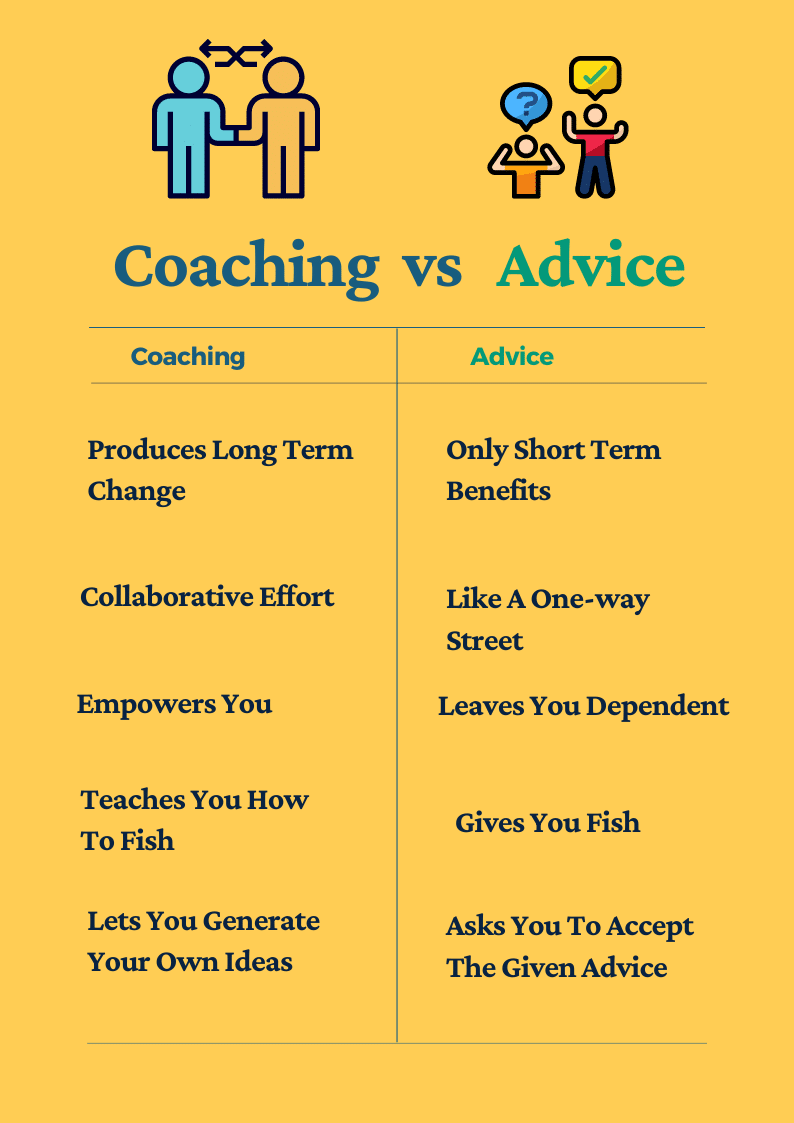
    1. Coaching Enables Long Term Behaviour Change. Advice Is Short Term

    Think of it this way. If a member of your team comes up to you for advice, would you prefer working with them so that they learn, improve, and grow or would you prefer to get it sorted out as soon as possible?

    Coaching not only solves the problem but also helps people grow. When you help people think things through, that leads to long-term behavior change. As a coach, you empower and help people build their own critical thinking and problem-solving skills.

    On the other hand, offering suggestions or sharing your advice will solve their current problem faster, but you limit their potential to think for themselves. Any gains that come from giving advice is only short-term, without any long term learning. The next time people face a problem, they will again need your advice.

    1. Advice Is a One-Way Street, While Coaching Is Cooperative

    Coaching is a mutual learning experience. It allows the person seeking help to dig deep into their own experience and begin to fit pieces of the puzzle for themselves. It is empowering for both the individual and the coach.

    In contrast, advice is a one-way street with you holding yourself as the “expert“. You may feel good about advising the employee and solving their issue, but nothing has changed in reality.

    As a coach myself, I often struggle to bite my tongue when I have the urge to dispense advice. I have realized that asking powerful questions is often a better way, and people often surprise you by coming up with better solutions than my “advice”.

    Coaching people has allowed me to learn so much from my coachees, while giving advice is always a one-way street.

    1. Advice Can Be Crippling, While Coaching Empowers

    It’s incredible what happens when you stop trying to be the “wellspring of knowledge” with all the answers. With advice, you are stifling people’s ability to arrive at their own solutions. 

    The truth is people already have the answers to their challenges within themselves. Your only task is to help them learn how to find theirs.

    Yes, advice has its place, but when we coach people by asking open-ended questions, we pull them forward towards their potential by letting them think for themselves.

    As a manager, you can see coaching as a tool to empower your people – helping you to take a hands-off approach.

    1. Coaching Is Teaching People How To Fish, Advice Is Giving Them Fish

    Many leaders give people “great” advice only to see them not take it and not make any changes. After all, no one likes to be told what to do. And there is hardly any ownership when you are following someone else’s advice.

    That is what differentiates coaching from advising. You ask simple, open-ended questions that draw out thoughtful responses. People are more motivated as it is their own idea, and they’re accountable to themselves.

    1. Coaching Lets People Think Big and Generate New Ideas. Advice Is Asking People to Accept Your Idea

    The role of the coach is to help the coachee think without any shackles and decide for themselves what to do. Far too many people have an obsession with dishing out advice on anyone who will listen.

    Advice stifles creativity and doesn’t create an opportunity for that person to think. Good coaches motivate their employees and encourage critical thinking and problem-solving. You will be surprised when people show resourcefulness and come up with big ideas on their own.

    1. Coaching starts with being curious and asking powerful questions. Advice leaves little room for brainstorming and dialogue.

    At this very moment, people are solving unnecessary problems in their organizations. It is because leaders haven’t stayed curious enough to pull back the curtain on the real issues.  That is why asking questions is more powerful than giving advice.

    Coaching creates space to reach the heart of the issue. People often have the answers to their problems. Most times, what they’re looking for is a sounding board and a keen listener.

    But when you advise people, you don’t expand their awareness. The advice trap makes it impossible for them to discover innovative solutions.

    1. Coaching shows humility, empathy, and respect. Advice gives a feeling of arrogance, indifference, and separation.

    As humans, we have a strong reflex against being told what to do. It takes away our independence. We have a strong impulse for self-control and freedom.

    So when we tell a person what they need to do, we wear the coat of authority, “I know what is best for you.” It is a poor move for a leader. When you push people, they will push back.

    Sometimes, advice does the exact opposite of what you intend for it to do: damage relationships and push the person further away from a solution. Your advice will have zero worth if it doesn’t show respect and empathy for people to independently figure out things.

    Coaching creates a space for people to express their feelings and validate their ideas. It says to them: I see you, I hear you, and I value you.  

    How To Ask Powerful Questions

    The one critical skill in coaching is asking powerful questions. It is at the heart of any good coaching session. It creates authenticity in the relationship and also inspires confidence.

    Below are 5 principles to follow when asking powerful questions:

    1. Ask open-ended questions. Don’t ask questions that have one-word answers.

    The way you pose questions is very important. Don’t ask questions people can answer with a yes, no, or other one-word response.

    Ask questions that make people pause and think, and probe deeper. Some of my favorite questions start with “How so?”, “Tell me more about …”, and “Why is that important to you?”

    These types of questions are uncomfortable because they break down defenses and challenge people to think differently and see things from fresh perspectives. For example – How do you hope to personally and professionally benefit from working on this project?

    1. Be curious. Ask one question at a time. Then shut up and listen. Get comfortable with silence.

    Silence is uncomfortable and awkward. Nobody likes those pauses in conversations. We often feel a need to fill up the void, but that moment of silence encourages people to think for themselves.

    You need to learn to shut up and be genuinely curious when your coachee is thinking something through. Imagine this scenario: You’re coaching an employee. She starts to think about taking on a new initiative, and there’s a short back and forth. 

    Then there is silence while she reflects. It is at this stage you need to hold off since she’s weighing options. Whatever she says next is going to be important and useful to her. 

    1. Don’t ask leading questions 

    Leading questions invite a yes or no. Lawyers use these types of questions during cross-examination to manipulate the conversation towards a certain way. For instance, “Do you feel Bill bullies you?” is a leading question while “How would you describe Bill’s behavior towards you?” is not.

    Don’t assume for other people, or put words in their mouths by asking leading questions. Your questions should get your coachees to do most of the talking and thinking. People need space, time, and acceptance to feel heard and then think their way through their fears, difficulties, and challenges.

    1. Ask deep and meaningful questions that make people think 

    The art of questioning is a powerful tool in coaching and leading others. Powerful questions change the way you connect with people. These questions give your employees time to think about what is really important to them.

    We have well-rehearsed and scripted answers for the usual questions. Powerful Questions makes one think and come up with original answers. If a question makes you think about your life, priorities, values, etc, it is a powerful question.

    They don’t linger on the surface where there is emotional safety. Instead, powerful questions force you to be vulnerable. It requires some courage to face the discomfort of answering a Powerful Question.

    They take longer to answer, but they often end up revealing something important about yourself which you were not aware of before. For example – What is “on hold” in your life? What is that you want to do someday / one day? What are you waiting for?

    1. Don’t assume. Instead, challenge yours and others’ assumptions by asking, “What are we assuming in this situation”?

    Our assumptions often sabotage many well-meaning intentions. Here is what I mean. When assumptions appear in your mind, you may tend to rush to conclusions and make a poor judgment. You need to recognize this immediately and stop. 

    Instead, be curious. Ask yourself and the person you’re coaching about what you don’t know. Let people know when you make an assumption. Doing this will trigger both self-awareness and clarity for everyone involved. 

    Conclusion

    Remember that coaching is not about you – but about the employee. When an employee asks for your help, they often need the time and space to think it through. Coaching aims for development first, performance second. Though, over the long-term coaching leads to more sustained performance too.

    A good coach empowers their coachees to be more confident and solve their own problems in an empathetic way. 

    References

    1. Phillips, K.A., Ospina, N.S. & Montori, V.M. Physicians Interrupting Patients. J GEN INTERN MED 34, 1965 (2019). https://doi.org/10.1007/s11606-019-05247-5
    2. https://hbr.org/2014/12/the-questions-good-coaches-ask
    3. https://www.forbes.com/sites/forbescoachescouncil/2018/11/21/coaching-isnt-just-questions/#67eaff8447a1
    4. https://www.deployyourself.com/deploy-yourself/asking-powerful-questions-51-different-situations/
  • 9 Steps To Make The Most Out Of Difficult Conversations

    “The right word at the right time will unlock the door to treasures – the wrong one will close it forever” – Rasheed Ogunlaru

    Think about a discussion you have been planning to have with your manager. For example, to ask for a raise. Perhaps as a manager, you may need to terminate an employee or resolve a conflict with a co-worker.

    These are some of the many difficult conversations that we have to deal with quite often. However, it is important to realise what makes a conversation “difficult”. It is not the conversation itself that makes it difficult. It is our communication skills (or the lack of it) that make them appear difficult.

    There are many situations in our daily lives when such conversations are necessary. Still, it can be a challenge for many of us, including managers and leaders.

    Be it in our professional or personal lives, none of us enjoy having difficult conversations. We all love to hold on to our views and opinions, and don’t like being challenged. Our underlying fears prevent us from facing such conversations head-on.

    But avoiding such a conversation does not resolve the issue either. While we tend to steer away from conflicts or disagreements, quite often, such discussions are unavoidable. The chances are, a delay in the discussion will make the situation even worse. 

    In reality, making the most out of difficult conversations is extremely important for our personal and professional growth. Let’s see 9 steps explaining how to do that.

    How to Go About a Difficult Conversation?

    You’re not learning anything unless you’re having the difficult conversations.” – Gwyneth Paltrow

    Millions of years of evolution have taught our bodies to react in a certain manner to external threats. In moments of stress, our bodies react by releasing chemicals like cortisol that increase the heart rate. 

    This is often termed “amygdala hijacking” by psychologists. As a result, we often overreact or behave irrationally. Basically, the neurochemical interactions in the brain make it even harder to think straight and behave rationally.

    I believe being ready for tough conversations makes us better equipped to face challenges in life. When done in the right manner, difficult conversations have the potential to enhance a relationship and produce ever-expanding results over the long term.

    While there are no defined rules for handling difficult conversations, I have found that these nine crucial steps can make a big difference.

    1. Set the Right Context 

    The right conversation in the wrong context is the wrong conversation. The first step is to set the right context for the discussion. The best leaders know how to set the tone of the conversation and guide it towards the desired outcome. Here is an example:

    Imagine saying this to a client- “We need to talk about the project timelines being missed repeatedly from your end.”

    Instead, try this- “ I wanted to divert some of our best talents to your team, but the project timelines keep shifting. Let us discuss the best ways to frame a workable schedule.”

    Without context, we tend to react to what is being said rather than considering the bigger picture in mind. The right context helps keep the focus on what is really important. 

    Before you enter a difficult conversation, take some time to prepare for it. While a casual approach does not help, rushing through a serious conversation is also the wrong approach. Also, give the other person enough time to prepare instead of catching them by surprise. Are you going into the conversation to prove your side of the story and to prove them wrong? Or, are you going to the conversation to solve a problem together?

    The right context also helps to understand the social, psychological, cultural threads that are involved in the conversation. Have the discussion privately by creating a safe and congenial environment. It is important to enter the conversation as a “learner” willing to learn something new rather than as a “knower” who is there to prove something. You can also set up some mutually agreed ground rules to avoid misunderstandings and stick to the facts.

    2. Be Willing to See Another’s Perspective

    You cannot reason people out of a position that they did not reason themselves into.” ― Ben Goldacre

    To clearly perceive an issue, you need to also understand the perspective of others. Many times, we use our perspective to understand others. However, this might be completely different from their perspective and can cause friction in the conversation

    In the personal or professional world, there are hardly any situations when two people absolutely agree with each other. The fact is, disagreements are normal and they do not need to hamper a discussion. 

    David Maxfield, the co-author of the book Change Anything: The new science of personal success, sums it up perfectly – “Ignoring the disagreements doesn’t work, and turning disagreements into fights doesn’t either. The key to a successful relationship is how you handle the inevitable disagreements.” 

    Good leaders know that healthy arguments can be an integral part of creative problem-solving. The important thing is not to get stuck by the disagreement but to look deeper and understand what both parties really care about. Conflicts arise in a conversation when we fail to understand what is important to the other person. 

    To avoid that, we need to listen attentively and go deeper than their positions to understand what they really want. Deep listening helps us understand the feelings and viewpoints of the other person. Leaders need to be open-minded about understanding different perspectives. 

    3. Separate Facts From Opinions

    “Every man has a right to his opinion, but no man has a right to be wrong in his facts.” – Bernard Baruch

    What is the difference between a fact and an opinion?

    Basically, a fact is a statement that can be proven true or false by a reliable authority. But an opinion is a personal view that cannot be verified. Opinions can be based on individual feelings and emotions. 

    Also, a fact is universal, but opinions can vary from one individual to another. Take this conversation for example:

    “That movie has been a blockbuster according to New York Times and is number 1 on the box-office charts.”

    “Is it? I found it boring.”

    While the first statement is a fact, the second is an opinion. People often confuse the two, and that can be misleading during a conversation.

    Asking the right questions is extremely important to get the facts underlying an opinion. Questions can help you to differentiate between facts and opinions. Once you have the facts and the data, use them to analyze the situation together. A statistical/logical approach also helps you to separate the objective reality from the subjective.

    In addition, you can also summarize each other’s understandings or note them down. This will ensure that you are on the same page. As a result, proceeding with a difficult conversation can get much easier. 

    4. Mutual Respect

    “I speak to everyone in the same way, whether he is the garbage man or the president of the university.”– Albert Einstein

    Mutual respect is to a conversation what oxygen is to humans. Take it out and the conversation dies. Being respectful goes much beyond the use of “please” and “thank you” in a conversation. True respect lies in understanding, courtesy, and kindness for another’s opinions.

    For this, there are two important steps. Firstly, you should listen to the other person without criticizing or indulging in any form of personal attack. Secondly, you need to be aware of how you are treating the other person. No two people are the same, so understanding their individual perspectives is very important.

    Even if you feel frustrated during a conversation, avoid negativity. Insulting or ridiculing the other person will lead to a loss of respect. Good leaders do not allow their emotions to hijack their responses at any moment.

    Emotions can be a big asset in a difficult conversation (as they can reveal what each party cares about) but they should not be allowed to overpower our reasoning. It is the faculty of reason that allows us to choose the best path in a challenging situation. We can then use our emotions to guide us along that path.

    Also, understand that we all make mistakes. In case mutual respect has been violated in some way, it is important to apologize. That helps in removing any ill feelings from a relationship. At the same time, it allows the conversation to move forward.

    5. Keep the Focus on the Shared Goal

    A few years ago, there was a situation when the strained relation between two engineers led to multiple confrontations and delays in a project. All it needed was a timely intervention from the manager to bring them together as members of the same team, and help them see the common goal of their discussion. As it turned out, they both cared for the project and were arguing for different ways to complete it. Once they could see that they both wanted the same end result, they themselves managed to come to a resolution.

    When people realize they want the same things, it is easier for them to work together and not against each other. Sometimes emotions can take the better of us, but it is very important to attack the problem, not each other. If you can focus on the common objectives of both parties, you can argue like comrades rather than competitors.

    6. Brainstorm Together, Not Against Each Other 

    Speak when you are angry and you will make the best speech you will ever regret.”- Ambrose Bierce

    A difficult conversation need not be a victory for one and a loss for the other. A conversation is about finding solutions and not about seeking victory for the ego. Rather, it can be an effective brainstorming session for the generation of ideas and finding solutions. 

    At the same time, it should not be a temporary compromise to keep the ball rolling. An open conversation that can explore the root cause of any issue is required to get over an impasse. In reality, when individuals work against each other, the business is the real loser.

    By brainstorming and allowing the creative juices to flow, you can look for a 2+2=5 outcome. This simply means the sum is much greater than the individual parts, or the final solution works better for both the parties involved.

    7. Express Gratitude

    Appreciate everything your associates do for the business. Nothing else can quite substitute for a few well-chosen, well-timed sincere words of praise. They’re absolutely free and worth a fortune.” – Sam Walton

    Always be thankful to the other person for participating in the conversation. This important step can create a positive mood for driving the discussion forward. However, it is often overlooked during a conversation.

    Offering thanks shows appreciation for the other side’s efforts in the conversation and helps to strengthen the relationship. Thankfulness allows individuals to focus on the positive aspects instead of being trapped by negativities. Genuine gratitude is also a great motivator. It expresses confidence in the future.

    As a leader, you can also assure the person of your help and support. It is also important to display a positive outlook during the conversation and express confidence in the abilities of the other person. This can result in positive interactions during a conversation.

    8. Make Sure to Follow Up

    It is wrong to assume that the task is complete once the conversation is over. No conversation is fruitful unless it leads to the desired changes and outcomes. You need to follow up and make sure that what was discussed and promised is being done.

    Note, following up is not about finding faults, but about keeping track. Both parties are mutually accountable for the outcome of the conversation. But we all know, agreeing to change our behaviour is a long way from actually changing it.

    For a leader, follow up is also an opportunity to collect and share feedback. Feedback is vital for making any changes to the decided plan of action.

     9. Reflect to Become Better

    Once a conversation is over, we can reflect and learn lessons from it for our next conversations. We all make mistakes in the heat of the moment, so it is important to reflect and learn any lessons for future conversations.

    Here are a few important aspects that can be improved in most cases.

    • Expressing our emotions aligned with our values rather than suppressing them or exploding
    • Enhancing self-awareness and recognizing the signs of “fight or flight”.
    • Using the right words and body language
    • Directing our emotional energy towards the common objective

    As with all other skills, the art of dealing with difficult conversations will get better as you reflect and practice. As you practice, the conversations remain the same. However, they stop being “difficult”.

    Conclusion

    We all deal with difficult conversations from time to time.  When we act in a “my way or the highway” manner without considering the views of the other side as legitimate, it becomes very difficult to make progress in conversations.

    But it is best to handle them proactively by overcoming our fears and hesitations. At the end of the day, it is important to keep your eyes on the shared objectives of both parties. A good leader is one who is ready to address difficult topics and look for win-win results, also strengthening the relationship in the process.

  • Leadership: In Turbulent Times (2018) by Doris Kearns Goodwin

    Leadership: In Turbulent Times (2018), by Doris Kearns Goodwin discusses the leadership secrets of four presidents who played a pivotal role in shaping the transformation of the United States of America.

    The author takes a look into the leadership qualities of four influential and transformational presidents – Abraham Lincoln, Theodore Roosevelt, Franklin Roosevelt, and Lyndon Johnson, and we learn what makes a great leader.

    1. Backgrounds Hardly Matter In The Path To Greatness

    Great leadership doesn’t always stem from one’s background or from the circumstances of a person. The difference between the backgrounds and upbringing of Abraham Lincoln and Theodore Roosevelt are proof.

    Abraham Lincoln was born in Illinois to an uneducated father, who took him out of school at the age of nine to help him in his work. However, Lincoln’s love for education made him borrow books from other people. As a young adult, it took him years of relationship building with townspeople in New Salem to earn a reputation good enough to earn a seat in the state assembly of Illinois.

    In contrast, Theodore Roosevelt was born in New York, a grandson to the fifth richest individual, with a trust fund bequeathed to him. His father was a philanthropist and gave his son access to the large family library at a young age. Theodore Roosevelt’s family name itself was enough to merit his entry into politics.

    With such stark differences in backgrounds, it is clear that the background and circumstances are not of much importance in the path to greatness. 

    2. Not All Leaders Have The Same Personal Traits

    Just as great leaders come from varied backgrounds, they do not have the same personality traits.

    Where Franklin Roosevelt had a loving, stable, and nurturing environment that resulted in a warm and optimistic demeanour, Lincoln, due to his tough upbringing, used to suffer from depression and melancholy. Even in terms of physical attributes, Lincoln was tall, healthy, strong, and athletic due to his laborious background. On the other hand, Theodore Roosevelt had fragile health and suffered from asthma.

    When we consider another aspect of personality, memory, we find that where Theodore Roosevelt had a photographic memory, Lincoln had to practice and memorize to be able to retain large amounts of information.

    The personalities of these four presidents were as different as chalk and cheese, even when it came to how they spent their free time. Out of the four, only Lyndon Johnson was a workaholic. Where Lincoln loved drama and poetry, Theodore Roosevelt loved novels and birds and Franklin Roosevelt played poker and sailed.

    3. They All Had Strengths And Associated Weaknesses

    It is easy to perceive great leaders as larger-than-life personas. However, in reality, while they did have remarkable strength and mettle as transformational presidents, their very strengths were also double-edged as weaknesses. Even these strengths and weaknesses are varied and do not point to any commonality among them. 

    Lincoln learned the ropes of politics through patiently observing, till he was confident to enter the fray. Conversely, Theodore Roosevelt’s approach to the presidency was aggressive and he had uncontained energy. While it proved to be a great asset, it also can be seen as a weakness, considering his interrogation and violation of rules would irritate his colleagues sometimes.

    Similarly, Franklin Roosevelt would willingly bend, bypass, and even at times, break rules if the end justified the means. This trait worked as a strength as well as a weakness.

    4. Ambition Is The Common Factor

    Once again, the backgrounds and upbringing of Theodore Roosevelt and Abraham Lincoln show that despite the contradictions, they had one factor that was common – ambition.

    Looking back at Lincoln’s early years, one would never guess that he would become a successful politician one day, let alone be the greatest presidents of history. His ambition is shown in his love and thirst for education, his independence in learning to read and write himself, his penchant for studying law by working day and night.

    At the same time, Theodore Roosevelt, one might say, had it all served on a platter. However, when his health prevented him from outdoor games, he cultivated voracity for reading and knowledge, which sparked his ambition.

    5. They All Had A Greater Purpose In Life

    All the presidents show that their climb towards great leadership can be attributed to the fact that they were able to blend their strengths, ambitions, and traits and align them to a greater purpose in life.

    Johnson can perhaps be cited as a classic example of having that greater purpose. His promotion of Civil Rights led to a number of reforms that led to programs such as eliminating poverty, racial injustice, and discriminatory voting laws. His greater purpose in life also guided him to founding Medicare for the elderly and passing of the Voting Rights Act. 

    6. The Uncertain Path To Leadership

    The path to great leadership has one thing for certain – uncertainty. While there are stories of strength, victories, and great thoughts and ideas being put into action, the stories of hardships, setbacks, and failures are also there.

    All four transformational presidents have had their fateful trysts with uncertainty at the brink of their political careers. While Franklin Roosevelt developed a polio-like condition at the age of 39, Lincoln lost in his first try at the Illinois state assembly. During his second run, his ambitious plans for a complete overhaul of state infrastructure at risk of his own reputation was sent crashing down by a multi-year recession. The following days brought him severe depression, where his friends hid all his razors fearing he would commit suicide.

    Theodore Roosevelt suffered an attack of acute depression after his mother and wife passed away on the same day. Lyndon Johnson too suffered from depression, however, a heart attack in the middle of a presidential run, which put a halt to his political ambitions was his tryst with uncertainty.

    7. Retreat, Reflect, and Rebuild In The Face Of Crisis

    It was these very difficult uncertain setbacks in the lives of the transformational four that propelled them towards greatness. While Lincoln returned to law, Theodore Roosevelt took time off at his Western ranch and dedicated his time to strengthening his physical self and transforming his timid demeanor into one of courage. 

    Johnson, after his heart attack, took time off to recuperate and spend time with family. He used his break to reevaluate his political goals by reconnecting with his political values. Franklin Roosevelt on the other hand took seven years to regain his strength. He built a formidable team of close confidants who kept his reputation alive in politics.

    8. Lessons In Crisis Management From Personal Crises

    The path to great leadership is strewn with crises, and the transformational four, each saw their fair share of personal crises. These personal crises helped them emerge stronger and leverage the learnings from their personal crises in their pursuit of the presidency. Yet, each of them also faced national crises in the White House.

    Abraham Lincoln had to deal with the Civil War, Theodore Roosevelt with the Coal Strike of 1902, Franklin Roosevelt faced the Great Depression, and Lyndon Johnson faced the assassination of President Kennedy.

    Case in point, President Franklin Roosevelt’s debilitating illness, and the debilitating national economic crisis helped him identify parallels and come up with strategies that eventually led to the formation of about 16 new innovative governmental agencies that helped the economy back on its feet.

    9. Great Leaders Build Diverse Teams

    It is Franklin Roosevelt’s illness that shows us the importance of a great team. Without his confidante surrogates, his political career would have died its death. Yet it helped him bounce back to become the governor of New York and eventually President.

    Similarly, Lincoln knew and thus assembled a supportive team to take on the Confederacy. Additionally, his cabinet included his rivals Edward Bates, Salmon Chase, and William Seward along with others who reflected diverse views. This diversity provided a range of opinions that Lincoln would view, review, and weigh before acting upon. 

    10. There Is No Mantra To Great Leadership

    The path towards great leadership of the transformational four shows us that great leadership isn’t a one-click mantra. It doesn’t rely on similar background and upbringing and neither can it be attributed to a common personality trait. Rather, it is a fusion of ambition, strengths, failure, accomplishment, personal crises, and most importantly a great team that propels them towards imbibing and exhibiting the great values of leadership that took the United States of America to greatness and power.

  • Issue #11, 15 Oct 2020

    Welcome to the Deploy Yourself Newsletter. Every two weeks I share about what impactful coaching and leadership look like. I also share the most insightful lessons and stories I encountered in the last two weeks. You can also read this issue online.

    I Sent YOU!! – A Poem

    I was talking today to a long-time friend of mine, and he reminded me of this poem I wrote more than 9 years ago (in Sep 2011). This was much before the idea of Deploy Yourself was born. Yet when I think of my articles and poetry from that time (which can be found on www.sumit4all.com), the central theme seems to be the same – of deploying ourselves or empowering those around us, of being able to see with new eyes and to realize how powerful we are to create change in the world around us.

    Here it goes:-

    I knew a young man,
    Energetic and ambitious!
    He grew up in struggle,
    Like in mud grows a lotus!!

    He had big dreams for himself,
    And ahead he went with full steam!
    But he always used to wonder,
    Why the world is so extreme??

    At times he saw people confused,
    Worrying about what ‘all‘ to eat?
    Yet at other times he saw the poor,
    Wondering about ‘what‘ to eat??

    He could never understand,
    How could this be even possible?
    If all are children of the same God,
    How can one, and other not be special??

    He used to think in disbelief,
    Why doesn’t God do anything?
    If he has all the power,
    For what is he waiting??

    One night in his dream he saw God,
    He asked how can this be true?
    There is so much misery around,
    Why doesn’t He come to the rescue??

    God said He has done his work,
    The man asked, “What did you DO?”
    To this God laughed and said,
    “Can’t you see my child, I sent YOU !!”

    P.S. – while the poem mentions God, it is not religious in nature. The central theme of the poem, if there is one, is empowerment.

    If what you read above made you realize something deep, hit reply, and share the insight that you had?

    Articles and Stories Which Have Fascinated Me

    One

    As A Leader, Can You See And Treat Your People As Superheroes?

    Showing belief in someone can be powerful. It is so easy to judge, doubt, and belittle people that honest belief in someone’s abilities can be refreshing and empowering.

    Treating your people as superheroes can instill a lot of confidence in people. Believing that an employee is capable of much more than their current performance can help change your actions and words in many subtle ways. These small changes are reflected in your body language and tone of voice, and give people confidence and belief in their own abilities, freeing them of any doubts and insecurities.

    It is said that people perform at the level their leaders expect them to, and the first step to improve the performance of your people is by changing how you look at them – with judgment and feedback, or with wonder, curiosity, and awe. See them as superheroes, and they will perform like one.

    From How to Expand the Capacity of Your People and Enable Them to Do More Than They Think They Are Capable of? – An Article From My Desk

    Two

    I don’t know. I need help. I made a mistake. I’m sorry.

    I recently finished reading The Fearless Organization: Creating Psychological Safety in the Workplace for Learning, Innovation, and Growth by Amy Edmonson in which she writes about the importance of psychological safety in the modern knowledge-work economy. She writes:

    A few simple, uncommon, powerful phrases that anyone can utter to make the workplace feel just a tiny bit more psychologically safe: I don’t know. I need help. I made a mistake. I’m sorry.

    She adds that the “failure of an employee to speak up in a crucial moment cannot be seen. This is true whether that employee is on the front lines of customer service or sitting next to you in the executive board room. And because not offering an idea is an invisible act, it’s hard to engage in real-time course correction. This means that psychologically safe workplaces have a powerful advantage in competitive industries.”

    To me the words “I don’t know. I need help. I made a mistake. I’m sorry.” signal a turning point as it acknowledges the lack of certain skill or knowledge and open pathways to learning which are closed otherwise. Yet in most companies, these words are very hard, almost impossible for anyone to say.

    From the book The Fearless Organization: Creating Psychological Safety in the Workplace for Learning, Innovation, and Growth by Amy Edmonson

    That’s it for now. If you have any questions, just hit reply. All the best,

    Sumit

    (Twitter) @SumitGupta
    (LinkedIn) Connect

  • 8 Things Leaders Can Do To Create a High Trust, High Engagement, and High-Performance Team

    Many people have a rather simplistic view of how people and teams perform. People don’t perform based on their abilities alone. Any person’s performance is the sum total of their own abilities and effort plus the prevalent culture in the company (and team). A high-trust and high engagement culture can enhance performance just like bad culture can degrade performance

    Engagement and trust are incredibly important facets of a high-performance team yet according to Gallup, employee engagement is now at an all-time low. The benefits of high engagement at work are numerous. Here are some of the key advantages of an engaged workforce:

    • A more positive job outlook
    • Willingness to share opinions
    • Readiness to ask for help when needed
    • The inclination to offer alternative solutions
    • Eagerness to achieve more and improve on a personal level
    • Providing guidance for colleagues
    • Understanding the importance of their contributions

    Conversely, disengaged employees tend to :

    • Become easily frustrated
    • Develop unclear/unrealistic expectations
    • Feel undervalued and demotivated
    • Become complacent and disinterested
    • Fail to understand the importance of their contributions

    It is estimated that just over half of workers in America (and an even higher proportion worldwide) are not engaged in their jobs. The figure for engaged employees worldwide could be as low as 13% (Crabtree, 2013). Therefore, It is clear that it is within a company’s interests to increase engagement and trust in order to boost team performance.

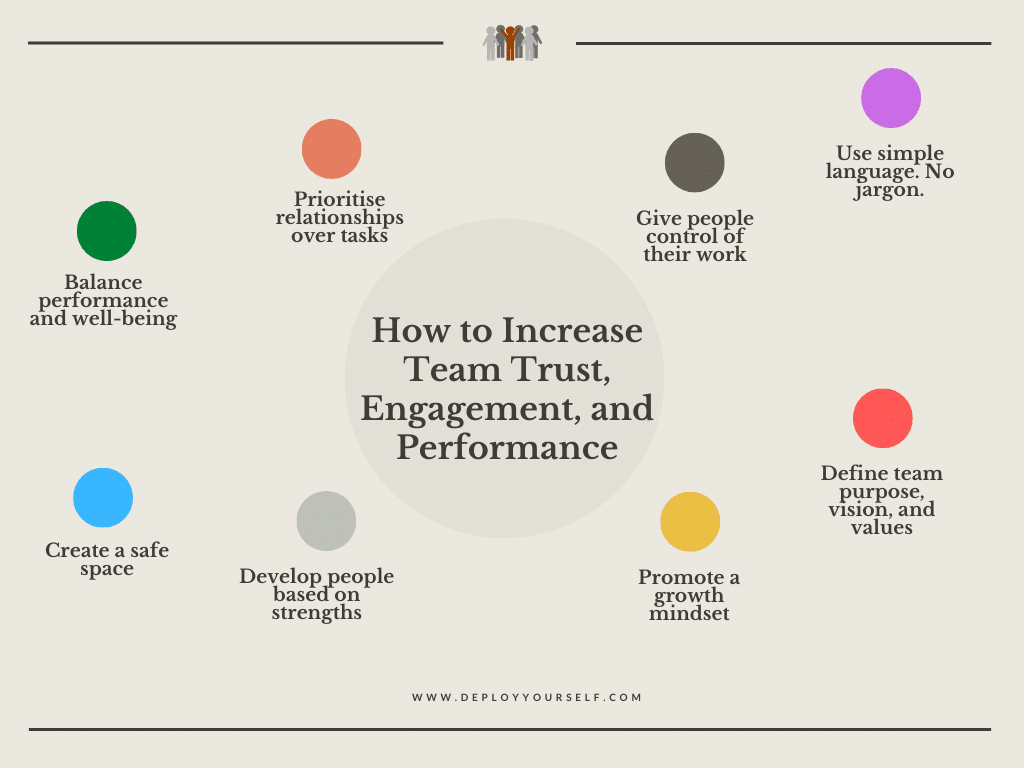
    8 Things Leaders Can Do To Increase Trust, Engagement, and Performance

    1.  Prioritise Trust and Relationships Over Tasks and Projects

    Too many companies believe people are interchangeable, and treat them as just resources to get work done. That is why most work conversations revolve around what we do – the tasks, projects, deadlines, budgeting, strategy, etc. I believe we are missing a trick here if only focus on the tasks, and ignore the relationships between people who do these tasks.

    Good leaders understand that it is the people and the relationships among them which decide the quality of work done. Hence they focus on building strong relationships and creating a culture where trust, honesty, and accountability are prioritized.

    Leaders build strong relationships by understanding people’s deepest beliefs and ambitions, by coaching them to figure out their values and empowering them by setting relevant milestones and then providing support along the way. This way the relationship becomes the bedrock of everything being done and the conversations shift from being project-based to relationship-based.

    Gallup found that people who have a good friend in the workplace are more likely to be satisfied. With good relationships, precious time and energy that would have been spent in fixing bad relationships and solving conflicts is now instead spent productively. This results not just in increased wellbeing but also increased business productivity.

    2.  Give People Control of Their Work

    Giving people more control over their day-to-day decisions and work is a fantastic way to improve engagement. Autonomy creates accountability and accountability leads to engagement (Saragih, 2011).

    Good leaders allow people to have a greater say in their work and they become more involved and engaged by extension. Nobody likes to be told what to do. Nobody likes to be micromanaged. We hire people after extensive interviews. I think we disrespect their skills when we don’t listen to them.

    Resisting the temptation to micromanage and involve yourself in every task can be difficult. Allowing your people to do what they do best without interference will, however, lead to better results in the long-run. Provide them the assurance and freedom they need and desire to do their job. Give them ownership, so the work is theirs, not yours. This makes their tasks, their projects, and their responsibilities more meaningful.

    3.  Promote a Growth Mindset

    Mistakes are unavoidable when chasing big goals but how you deal with them can make a world of difference. Instead of viewing mistakes as negative, strong leaders see them as an opportunity to learn. This begins by showing your own vulnerabilities as a leader. If you make a mistake, it’s important to admit it. Be willing to accept feedback on your performance and then use the information for positive change.

    Strong leaders promote a “growth mindset” among their people. This growth mindset is based on the belief that your basic qualities are things you can cultivate through your efforts. As Carol Dweck, who studies human motivation, says in her book Mindset : The New Psychology of Success, “The passion for stretching yourself and sticking to it, even (or especially) when it’s not going well, is the hallmark of the growth mindset. This is the mindset that allows people to thrive during some of the most challenging times in their lives.”

    With the growth mindset, people become students for life and see each success and failure as opportunities to learn. With this attitude, everything becomes a journey and people avoid getting stuck in defeating self-talk like “I can’t do this.”, or “This is beyond my abilities”.

    Strong leaders create a growth mindset by promoting a culture where people are not blamed for mistakes and failures, which will eventually happen. Instead these are seen as learning opportunities so that the same mistakes are not repeated in the future.

    4.  Develop People Based on Their Strengths

    Have you worked in a company or with a manager where every conversation focussed on what you are not doing well, and what you need to do to improve your weaknesses? Have you been asked to create measurable goals to show progress in an area where you have not been doing so well? How does it feel when your manager talks about your weakness in every 1-on-1?

    If you are like most people, you will find this experience extremely frustrating. As human beings, there are always skills that we do well and some skills where we don’t do as well. Focussing on weaknesses brings our fears, insecurity, and anxiety to the fore, and impairs learning and growth.

    In a massive study by Gallup involving 1.2 million employees across 22 organizations in seven industries and 45 countries, it was found that focussing on strengths leads to increased sales, profits, high engagement for employees, and safety. By focusing on weaknesses, the true potential of employees where they can shine and do their best work is often neglected.

    Researchers have also found that receiving praise releases dopamine, which is the chemical associated with rewards in our brain. Praise basically tells our brain “Do that again.” This is why, when good work is praised and recognized, people will tend to do more of the same in the future.

    Praise works best when it is specific and not vague. So instead of praising someone’s work as “brilliant” or “wonderful”, be more specific in appreciating the effort. Below are some specific examples of praise done well :

    • “I liked how you have used juxtapositions to add humor to your sentences.”
    • “I loved the report, especially the solid research you did and can be seen in the statistics you presented.”

    “If you focus on people’s weaknesses, they lose confidence.”

    ― Tom Rath

    5.  Balance Performance and Wellbeing

    Performance needs to be balanced with employees’ health and wellbeing for the best results. Overworking employees leads to a decline in engagement and performance over time. Instead, good leaders encourage days off, reduce overtime, and allow weekends off to ensure people get enough rest to recover and come back fresh to work every week.

    Overworking will have detrimental effects on your employees’ physical and mental health in the long-run (Wong, Chan & Ngan, 2019). It goes without saying that this is not a good outcome. Your people’s health and wellbeing should be your number one concern, as it can impact everything the business does.

    There are no winners when people are overworked and it is bad for the long-term success of your company. Managers should encourage people to focus on their health by providing and promoting adequate health insurance, healthy food, and sports facilities – whether inside or outside the physical space of organizations.

    Just like overplanting plants drain the soil of all its nutrients and lead to failed crops, overworking people leads to sick employees and poor work performance.

    6.  Create A Safe Space Where Employees Feel Comfortable

    The working environment you create is vital to the performance of your team. Employees should feel comfortable to voice concerns, open up, and make suggestions. They should not fear repercussions for taking initiative or speaking up. Everyone should be aware that they are working in a safe space absent of blame or retaliation.

    Organizational behavioral scientist Amy Edmondson defines psychological safety as “a shared belief held by members of a team that the team is safe for interpersonal risk-taking.” Psychologically safe teams understand and give the opportunity for people to stand out because of their uniqueness, rather than attempting to fit people in boxes (or roles, titles, etc).

    In a safe environment, you don’t have to wear a mask and can be completely honest about what you know and what you don’t. When you do that, others step in to help and close the gaps in skill and knowledge, leading to faster learning and better execution. This is leaps and bounds better than the alternative – when people fake knowing something they don’t, and this leads to mistakes or other faults down the line.

    Some ways in which you can create a safe and comfortable workspace include:

    • Listen to and take action based on inputs and feedback provided by your team.
    • Remove blame and punishing people from your culture. Instead, focus on learning from mistakes.
    • Delegate decision making and remove unnecessary processes and approvals. Let your team own their own decisions.
    • Lead by example by sharing your own vulnerabilities.
    • Ask for support from your team when you need help. Show them that this doesn’t make you weak. It only shows you are human.

    “Teamwork begins by building trust. And the only way to do that is to overcome our need for invulnerability.” – Patrick Lencioni

    7.  Define Team Purpose, Vision, and Values

    The ‘why’ is arguably more important than the ‘what’ and the ‘how’. In more specific terms, the purpose, vision, and values behind a project have the potential to influence its success as much as the details of the project itself.

    Continuously offering reminders of the bigger picture when working on daily tasks is key. People are motivated by meaning and this concept is perfectly illustrated by Dan Ariely. Research has shown that acknowledgment or meaning behind work, even in small quantities, is associated with more engagement and higher ownership.

    Ariely research indicated that not only are people motivated by meaning, but they are also aware of this. When asked to predict their output for two conditions of varying acknowledgment, participants correctly predicted a greater output in the meaning condition. Perhaps most interestingly, it has been suggested that even if you like something, you are still demotivated by a lack of meaning.

    Everyone wants to contribute to something bigger than themselves and make a difference. Strong leaders show people how their work impacts the customer and the wider benefits to the industry/society. A wonderful example of this is the below story –

    During a visit to the NASA space center in 1962, President John F. Kennedy noticed a janitor carrying a broom. He interrupted his tour, walked over to the man, and said, “Hi, I’m Jack Kennedy. What are you doing?”

    “Well, Mr. President,” the janitor responded, “I’m helping put a man on the moon.”

    “Coming together is a beginning, staying together is progress, and working together is success.” – Henry Ford

    8.  Use Simple Language to Make Expectations Clear

    Corporate language is known for being unnecessarily complicated and boring. Cutting down on corporate jargon increases engagement, transparency, and understanding. Often, simple and clear statements will get the point across. Corporate jargon is unpopular and often confusing, so use it sparingly, if at all. There is research to suggests that plain and simple language is effective in a business setting.

    Leaders should stop using complicated language or hiding behind jargon. Trust people and share information openly. Let people ask anything about everything. Transparent communication involves people in problem-solving and they see the team’s or the company’s problems as their own. And, you never know where a good solution to your biggest challenges might come from.

    A few simple tips for clearer language in the workplace are –

    • Use shorter sentences
    • Make your most important point first
    • Use headings and bullet points to make your message easier to skim
    • Keep your target audience in mind when communicating
    • Use visuals aids like graphs and chart to make it easier for people

    “When corporate executives get really excited, they leverage their learnings against comprehension to revolutionize English.”

    ― Tanya Thompson

    Conclusion

    Treating your employees as just employees will make them just employees. Treating them as people will unlock their full potential by creating more trust, higher engagement, and better performance.

    Finding out what your employees need and providing the opportunities to access them is one of your primary goals as a leader. Create stronger relationships, communicate transparently and regularly, and encourage participation. These are all key to an engaged and trusting workforce, that will perform better as a result.

    The single best way to increase performance is to create a culture that enables people to do their best work. Culture should enable performance, rather than stand in its way. By using the 8 things presented in this article, leaders can ensure people feel connected to the larger vision of the organization and supported by peers, subordinates, and leaders.

    References

    1. Historic Drop in Employee Engagement Follows Record Rise
    2. Worldwide, 13% of Employees Are Engaged at Work
    3. The “IKEA Effect”: When Labor Leads to Love Working Paper
    4. THE FUTURE WORKPLACE
    5. Inbound Recruiting: HubSpot’s Approach to Employer Branding
    6. The Effect of Long Working Hours and Overtime on Occupational Health: A Meta-Analysis of Evidence from 1998 to 2018
    7. How to Create Safe Spaces at Work
    8. If We All Hate Business Jargon, Why Do We Keep Using It?
    9. Why Plain Language is Good for Business –
    10. (PDF) The Effects of Job Autonomy on Work Outcomes: Self Efficacy as an Intervening Variable
    11. Trust Employees: 3 studies showing the power of trust in the workplace
  • Want To Improve Performance? Before Giving Feedback, Give People These Four Things

    Do you use feedback as a tool to improve performance? If your answer is yes, you are not alone. Most managers see (and use) feedback, most of which is negative or critical, as a tool to improve performance. If you give positive feedback too along with the negative (the sh*t sandwich), we all know that people tend to focus on the negative and ignore the positive. If it helps, remember the last time you received a mix of positive and negative feedback? How did it feel?

    There is a story about Abraham Lincoln in his biography by David Herbert Donald that captures the futility of negative feedback. Lincoln would write letters to those that he had strong feedback for (like a Civil War general who was failing). Rather than letting the heat of the moment get the best of him, he would never send these letters and instead keep them to himself. He would much later give a response that showed more empathy and was more effective.

    Feedback Has Its Place

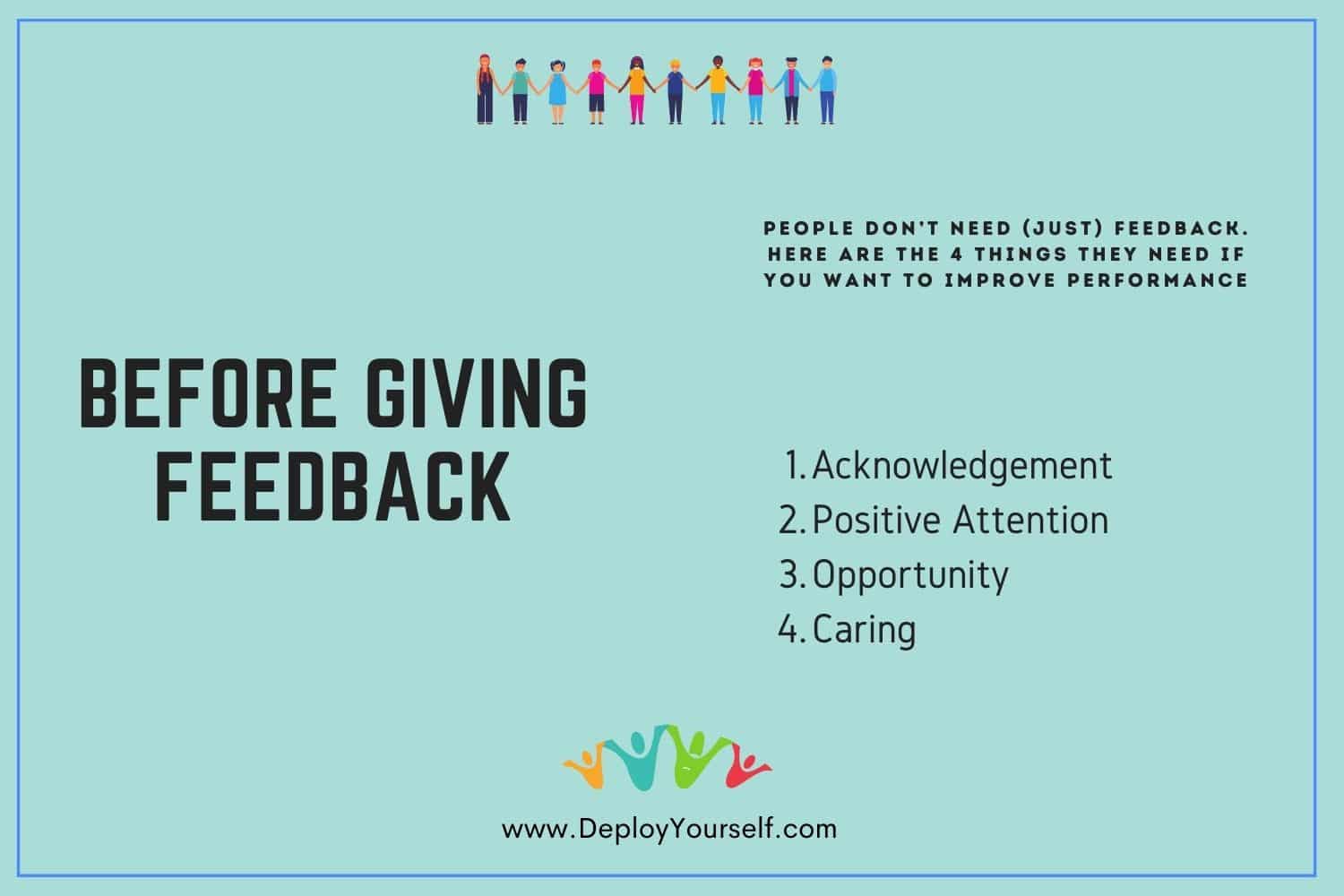
    In this article, I want to argue that feedback is important, but it has its place. There are more powerful tools any leader can use to improve performance and keep people motivated and engaged. These tools are acknowledgment, attention, opportunity, and caring.

    The four things mentioned below focus on the future, while feedback is glued to the past. And they must be done before and more often than giving feedback. People don’t need (just) feedback. Here are the 4 things they need if you want to improve performance:-

    “Too many companies believe people are interchangeable. Truly gifted people never are. They have unique talents. Such people cannot be forced into roles they are not suited for, nor should they be. Effective leaders allow great people to do the work they were born to do.” – Warren Bennis

    1. They Need Acknowledgement

      Good leaders see people for who they are (values), what they bring to the table (skills), and where they want to go (future ambitions). They understand and listen to them as human beings, and not just for the role they were hired for. This creates psychological safety, which is the first step needed for people to perform without fear and apprehensions. Good leaders trust people by default, and that creates a solid foundation for all future performances.

      As a leader, your biggest job is to create an environment where people can do their best work. By listening to people about their dreams, fears, and ambitions, leaders can sure people look forward to coming to work each day. In addition to helping with business productivity, it will also impact the well-being of employees.

      When leaders communicate transparently, authentically, and check in regularly to ask what people need, it deepens engagement and instills confidence as people know that their leaders have their back.

      “People change by feeling good, not by feeling bad.” – BJ Fogg
    2. They Need Positive Attention

      Strong leaders believe in their people and their abilities, often more than people themselves do. When someone does a job well, good leaders notice and let their people know. Research has repeatedly proven that positive attention is more powerful than negative attention to improving performance. Nobody shows up at work to do a job poorly, and if we only focus on moments of mistakes and failures, we are killing the enormous potential for good that people have.

      Good leaders understand that performance is not static, and everyone makes mistakes or fails to do a “perfect” job occasionally. Strong leaders focus on what people do well and not on their shortcomings, and understand that positive attention leads to engagement and exponential performance in the future.

      For example – A simple email showcasing major accomplishments or any behavior you want to encourage can go a long way in setting the right example.
    3. They Need Opportunity

      People need opportunities to contribute to something bigger than themselves. It is a common human desire to belong and contribute to a larger cause or mission. Leaders need to keep this in mind when they find and present work opportunities for people.

      If work doesn’t provide a way for your employees to belong and contribute, people will get bored and leave, or get used to mediocrity, which is even worse. The question every leader must ask themselves is – Can I give people the opportunity to do the work of their lives?
    4. They Need Caring

      Above everything else, people need caring. We all have a need to belong, to love, and to be loved by others. Good leaders know this and care for those around them like a fellow soldier. They enrich their relationship in every moment, by every word they say and every action they take.

      A caring leader notices small changes and inquires about people’s wellbeing and growth. Strong leaders demonstrate their care by coaching people to find their own way, which builds confidence and momentum as people take on and complete challenging projects. A good leader knows what their people care about, and she shows her care by taking care of that.

      For example – many companies offer the option for people to work flexible hours or to work from home, while others have an on-premises creche facility to better support employees who are parents.

    “Treat a man as he appears to be, and you make him worse. But treat a man as if he were what he potentially could be, and you make him what he should be.”

    — Johann Wolfgang von Goethe

    Conclusion

    Leading with care is a forward-looking and long term strategy to improve engagement and performance. Leaders need to focus on their people’s strengths and develop them, instead of “fixing” them with feedback.

    If you are a leader, focus on what people can do, versus what they can’t do, and you will see completely new opportunities for them. Spend your time and attention on what people do well, and that will give you the leverage to produce exponential results. Strong leaders understand that taking care of people is in alignment with (and not against) business results.

    Resources

    1. https://www.verywellmind.com/what-is-the-need-to-belong-2795393
    2. https://www.tonyrobbins.com/mind-meaning/do-you-need-to-feel-significant/
    3. https://globalleadershipfoundation.com/the-caring-leader/
  • 6 Reasons People Are So Unhappy At Work

    According to this study cited in Forbes, more than half of the US workforce is unhappy. Gallup surveys show that nearly two-thirds of employees are disengaged at work. In my own experience of the last 15 years and the numerous stories I have heard from people in multiple countries, I have heard and witnessed the same.

    Why do we wait for Fridays and not Mondays? Irrespective of where we work, why do we think that our ‘real life‘ starts after work in the evenings and on the weekends? Why is work usually associated with stress and not joy? Why do we have to use our time after work to recover from what happened at work? Why can’t work be fun, satisfying, and enriching? Why can’t work nourish and enrich our lives, rather than making us sick?

    I think the current state of work, and the continuous stress and exasperation associated with it, is because of the below 6 reasons:

    1. New Work, Old Practices

    We are still managing our teams and people like we did over a hundred years ago. We continue to use the same systems and processes for employee motivation and performance management which were used for manual and rote work in factories.

    People are no longer operating assembly lines. And the tasks they do are not what can be done by following step by step instructions. The over a century-old process we continue to use today can result in obedience and compliance but never in engagement and loyalty. In the factories, there was never a concern for people’s mental and physical health, as everyone was replaceable.

    The current management theories have evolved from the Scientific Management movement by Frederick Taylor over a century ago. This method focussed on efficiency and achieved performance improvements by standardizing processes, paying for productivity, and continuous monitoring of factory workers.

    Today, when people rarely work in factories, and when we use our minds more than our hands to work, the scientific management philosophy fails to value the people as individuals. This results in psychologically unsafe environments, where cognitive work is inhibited rather than encouraged. If we continue to use the old management practices in the current age, motivation, productivity, and workplace satisfaction will continue to suffer.

    “There is little success where there is little laughter.” – Andrew Carnegie

    2. Treating People Like Tools And Resources

    We have totally ignored the fact that the work we do today is highly creative and knowledge-based, and doesn’t resemble how we used to work just 3 or 4 decades ago. This leads to people being treated as tools and resources, and nobody likes to work in a place where they are treated like a machine.

    People need to be led, and that begins by caring for them, listening to them, and working together to create a trustworthy and psychologically safe environment. Good leaders and companies understand that, and they show their “care” by caring for what their people care about. This has resulted in many employee-friendly practices in companies like Google, Whole Foods, Tata Group, Starbucks, etc which we unheard of just a few decades ago.

    These companies understand that employees are their most important stakeholders and not replaceable like tools and machines. They also realise that a totally new level of commitment and productivity is unleashed when people care about their work and see them as owners rather than workers.

    3. Lack of Leadership

    People today crave freedom and autonomy, and they want to work in a place where they are cared for. They want to be part of a larger vision, and to make a difference. They want to feel proud of what they do and how they do it. The sooner leaders of all companies understand this, the sooner we can create a workforce that is not only highly productive but also healthier and happier.

    People today want to be acknowledged and appreciated for the hard work and effort they put in. 79 percent of people who quit their jobs cite ‘lack of appreciation’ as their reason for leaving. Good leaders show genuine appreciation, warmth, and gratitude for employees’ hard work, and never treat their employees like “resources”.

    People don’t need feedback (which leaders and managers are always ready to provide). Instead, they need attention, acknowledgment, and autonomy to do their work without unnecessary rules or supervision. Good leaders create a culture driven by universal principles that permeate the culture of the company, and where everyone sees beyond the ‘productivity at all costs’ mantra.

    “When people are financially invested, they want a return. When people are emotionally invested, they want to contribute.” Simon Sinek

    4. No Or Very Little Management Training

    In a recent study, 58 percent of managers said they didn’t receive any management training. This leads to the sad reality of bad management. Most of the managers found in the industry today don’t know how to lead. A Harvard Business Review survey reveals that people trust strangers more than their own boss. Isn’t that not only disappointing but also sad?

    Understanding human behavior and basic psychology is not rocket science, yet it appears so. In the last few decades, we have created highly sophisticated interview systems to interview knowledge workers like software engineers, product owners, data scientists, etc. Yet we continue to hire or promote people to management without any specific training and qualification criteria.

    It is no doubt people hate and lack trust in their managers when they are rarely trained in basic concepts like emotional intelligence, human psychology, and the various cognitive biases that form the basis of every decision we make. Any decision a leader or manager can impact the productivity of tens or hundreds of people, and hence it is imperative that we train and educate our managers in the latest behavioral and psychological research.

    5. Lack Of Downtime

    Many of us work in companies where time off is discouraged by peer pressure or because of a fear of falling behind. Because of this people don’t take the leaves they are entitled to and pile up work which they often continue in the evenings or on weekends. All of this results in an unsustainable health impact over the long term, leading to stress and burnout.

    Research has shown that productivity declines beyond a certain number of hours worked per week, and more hours doesn’t mean more output. People sit in offices and continue working from home to maintain appearances, which slowly takes its toll on mental health and people’s quality of life.

    Adopting a less hectic schedule and allowing people to prioritize personal time can improve ‘flow’ and productivity at work, not to mention health and well being. Some companies are already taking steps (like banning after-work emails) to discourage the always-available culture to help people relax and recover from any stress gathered during the day.

    Downtime allows people to be more productive, not less, as people come back rejuvenated for another day of “deep work.”

    “Most people chase success at work, thinking that will make them happy. The truth is that happiness at work will make you successful.”
    – Alexander Kjerulf

    6. Unhealthy Eating Practices

    You can’t be happy in an unhealthy body. Yet the way we work encourages many bad eating habits. In many modern workplaces, sugary drinks like cookies, chocolates, cakes, cold drinks, candies, etc are available on every floor – for free. Due to the constant rush of never-ending meetings or tight deadlines, people tend to eat unhealthy food, which they often bring to their desks. Many even skip lunch and just gulp one caffeine drink after another to get through the day.

    This constant pressure during the day often leads to smoking and alcohol intake during the evening hours to relieve stress, which further impacts the quality of sleep. All of this leads to a vicious circle of unhealthy eating and sleeping practices which results in people gaining weight and explains the increased presence of heart disease and diabetes in our society today.

    Research has shown that workplace canteens ‘treat’ employees with foods like pizza, soft drinks, brownies, and pies. They are filled with salt, sugar, fat, and a lot of empty calories. Over time, this adds up and results in a multitude of diseases and long-term health impacts. Just one high-fat meal, research has shown, can turn healthy red blood cells into small spiky cells, which leads to heart disease.

    It goes without saying that food has a direct impact on our cognitive abilities and productivity. It is much easier to munch on chips and cola when we are mentally drained as our self-control ability also goes down with mental tiredness. Companies and leaders can help ease this double whammy by encouraging healthy food options that will lead to more motivation, energy, and productivity; rather than leading to diseases like obesity, type 2 diabetes, and heart ailments.

    Conclusion

    Factors like lack of health insurance, erratic shifts, job security, lack of autonomy and freedom at work, etc will continue to make people not just unhappy and unproductive, but also physically and mentally sick. Research indicates that being exposed to these factors contributes to about 120,000 excess deaths per year in the United States alone.

    An unhappy workforce causes employee disengagement and low morale, which undermines stock prices, profitability, productivity, and innovation. It is not good for anybody, yet companies continue to use these practices. Companies need to see employees as equal (if not more important) stakeholders to their customers and shareholders and treat them as such.

    As long as business leaders continue to treat people like tools, people will continue to be unhappy at work. There is enough research today to show that creative ideas flow easily and we are better at problem-solving and decision-making in a happier state of mind. Watch the “Happiness at Work” documentary below to find out how work pressures have continued to affect our health and well-being.

    References

  • Issue #10, 1 Oct 2020

    Welcome to the Deploy Yourself Newsletter. Every two weeks I share about what impactful coaching and leadership look like. I also share the most insightful lessons and stories I encountered in the last two weeks. You can also read this issue online.

    Do More Of This, Less Of That

    I am sure the below points will help you be a little less busy, and appreciate the wonder of this moment a little more.

    • Praise people more, criticize them less
    • Give people credit more, blame them less
    • Make your decisions yourself more, give advice to others less
    • Use both emotion and reason to make wise decisions more, make only rational or only emotional decisions less
    • Listen to others more, ask for others’ understanding less (or later)
    • Say Thank You more often, Gossip less
    • Appreciate what you have more, feel envious about what you don’t have less

    If what you read above made you realize something deep, hit reply, and share the insight that you had?

    Articles and Stories Which Have Fascinated Me

    One

    It Is What You Leave Behind That Defines Success.

    Government houses seldom came with fences. Mother and I collected twigs and built a small fence. After lunch, my mother would never sleep. She would take her kitchen utensils and with those she and I would dig the rocky, white ant infested surrounding. We planted flowering bushes. The white ants destroyed them. My mother brought ash from her chulha and mixed it in the earth and we planted the seedlings all over again. This time, they bloomed. At that time, my father’s transfer order came. A few neighbors told my mother why she was taking so much pain to beautify a government house, why she was planting seeds that would only benefit the next occupant. My mother replied that it did not matter to her that she would not see the flowers in full bloom. She said, “I have to create a bloom in a desert and whenever I am given a new place, I must leave it more beautiful than what I had inherited”.

    That was my first lesson in success. It is not about what you create for yourself, it is what you leave behind that defines success.

    From Go Kiss The World – A Wonderful Commencement Speech by Subroto Bagchi in 2006

    Two

    You Are Not The Work You Do; You Are The Person You Are.

    Author Toni Morrison shares a lesson from her father:

    “…one day, alone in the kitchen with my father, I let drop a few whines about the job. I gave him details, examples of what troubled me, yet although he listened intently, I saw no sympathy in his eyes. No “Oh, you poor little thing.”

    Perhaps he understood that what I wanted was a solution to the job, not an escape from it. In any case, he put down his cup of coffee and said, “Listen. You don’t live there. You live here. With your people. Go to work. Get your money. And come on home.”

    That was what he said. This was what I heard:

    1. Whatever the work is, do it well—not for the boss but for yourself.
    2. You make the job; it doesn’t make you.
    3. Your real life is with us, your family.
    4. You are not the work you do; you are the person you are.

    I have worked for all sorts of people since then, geniuses and morons, quick-witted and dull, bighearted and narrow. I’ve had many kinds of jobs, but since that conversation with my father I have never considered the level of labor to be the measure of myself, and I have never placed the security of a job above the value of home.”

    From the article The Work You Do, The Person You Are by Toni Morrison

    That’s it for now. If you have any questions, just hit reply. All the best,

    Sumit

    (Twitter) @SumitGupta
    (LinkedIn) Connect