Narendra Modi seems to be the most popular topic on news channels these days. From the old sermons over the 2002 riots to his statements, he is never away from controversy and news. While he might be an enigma, and his personality might be very polarizing, I think we should all support him not for his speeches, his party or his influence, but for the results he has produced in Gujarat. Unfortunately, none of the media channels seem to highlight the progress in Gujarat in a maddening race for TRPs and viewership. It seems people are more interested in watching meaningless debates between a BJP and a Congress politician than knowing about his work and how they can contribute to the state.
Below are some of the facts which they (media) are not telling all of us about Narendra Modi –
1. Gujarat has 5% of India’s population but amounts to 21% of India’s exports and gets 20% of the total investment India gets.
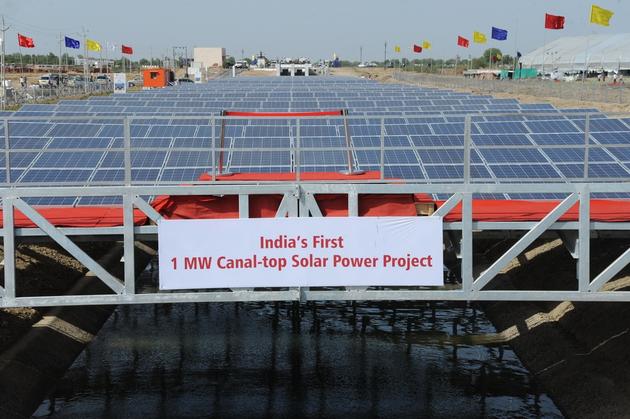
2. Modi has an entire canal of length 19000 km (Sanand Branch Canal) of the Sardar Sarovar Project embedded with solar cells to generate electricity. This will generate electricity and prevent water evaporation from the canal. It is operational with 1MW electricity output and expected to generate 2200 MW of power when completed.
3. According to a World Bank, Gujarat roads are an example of best practices in road management and are closest to international standards. While the Delhi BRT system has been a big failure, nobody is talking about the Ahmedabad BRT which is a big success with 125,000 people using it daily (even with higher ticketing prices than normal buses). While Delhi has 6 km of BRT, it is spread over 67km and will have 115km when it is completed in 2015. The Indian Government (yes, the one with UPA at power) has given the “Best Mass Rapid Transport System” award in 2009, “Best Innovation Award in Urban Mobility” award in 2010 and “Award of Excellence for best IMTS project” in 2011 to the Ahmedabad BRTS system, apart from a host of international awards. But nobody is talking about that.
Generating Electricity while Reducing Water Loss
4. Kutch was reduced to rubble after the 2001 earthquake. It is now a bustling industrial hub.
5. Gujarat has 100% power in rural areas too. It has improved the quality of life and business, and halved the government given power subsidy. Yes, reduced to half. While other governments has been demanding votes for doling out subsidies, Gujarat makes a scheme after which subsidy was halved. You decide which is better? And that scheme (Jyotigram Yojana) is set to be adopted by Govt of India now.
6. According to the infamous Tendulkar report on poverty, 30% of India is below poverty line. According to the same standards, Gujarat’s figure was at 32% in 2004 but is now at 23%.
7. Gujarat has the biggest gas pipeline networks in India, has the most CNG outlets in the country and consumes more than a third of the total gas consumed by India. It has 2200km gas grid and has a more than 75% share in industrial PNG connections (3100 of 4000 PNG connections in India are in Gujarat).
Anna Hazare has been voted as the Person of the Year / The Indian of the Year by many news channels and newspapers recently. Even international press has noted him as one of the top news makers of the world in 2011. And why not? After all, this 74 year old Gandhian has changed the way Indians look at corruption and given all of us hope that this disease can be removed from our country. As I wrote in a poem, he has come as our Messenger of Hope in 2011.
Below are what I feel are the top 5 take-aways from this movement so far –
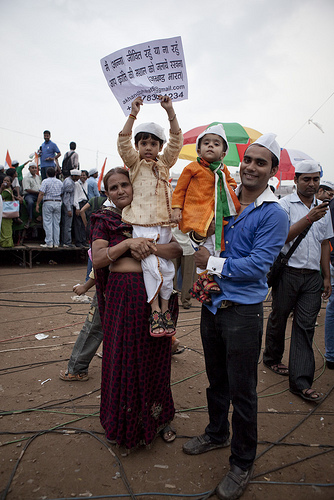
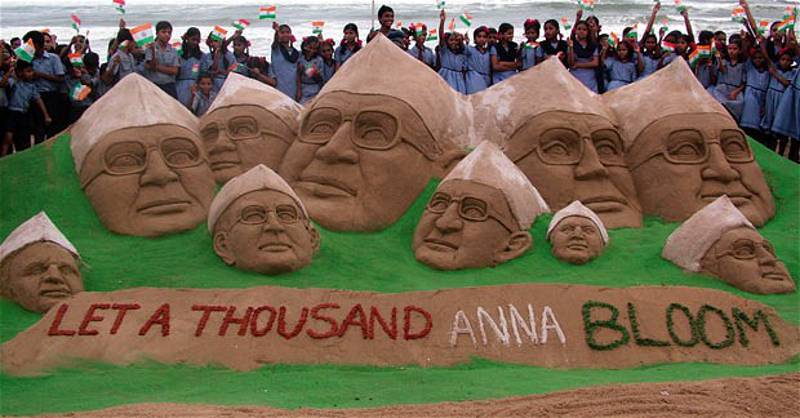
Anna has found support from people of all age groups
1. Strengthening of Democracy
Anna Hazare has spend all his life promoting the decentralization of power in democracy and his asking for a Lokpal, free of any government control, is another step in this direction. By directly involving the people in his protests, and highlighting the point that the people are the real masters and the politicians only public servants elected by them, he has made it clear that they should proceed in accordance of the will of the public.
He and his team have taken the issue of Lokpal to the people in small towns and villages, holding live debates and educating the people about the various fine points of the Lokpal Bill and the importance of each clause. This has never happened before. Politicians have never bothered to debate with the people about the fine prints of any bill. By involving the public and making them aware of why and what they are doing, they have enabled a healthy environment which has resulted in the strengthening of the democratic institution.
2. Hopelessness to Hope
If you would have asked anyone about the issue of corruption in India at the start of the year 2011, you would have only got hopelessness and pessimism in return. But in one year, Anna has changed that mood to one of hope and optimism. People have seen the power of peaceful protests and how they can pressurize the government to do their job properly. This must be the biggest take-away from this movement.
3. Uniting India for something other than Cricket
When India won the World Cup this year in April, people came out on the streets and danced and partied all night long. I wondered that do we have the same unity and patriotism for other issues which are much more important to our country. But my doubts were put to rest as during the two fast-unto-death’s which Anna underwent in April and August, he received huge support from people of all walks of life – from big cities to small towns and villages like. It was so glad to see the whole of India united and fighting for a cause that really matters to every one of us.
4. Gandhian Values
It was India who gave the world the weapon of peaceful protest – Satyagraha. But questions have been raised in recent times about its relevance in a 21st century world. But this movement put all such speculations to rest and showed that Gandhian methods of peaceful and non-violent protest are as much effective today as they were 70 years go. It was amazing to see young leaders like Arvind Kejriwal and others using technology (internet, social media) to gather support and spread their word quickly among people.
5. Patriotism and Power of Youth
A famous quote says that “A patriot must always be ready to defend his country against his government“. This movement has shown the power of youth and the importance of patriotism in democracy. By coming out in big numbers and by even courting arrest in huge numbers, the Indian youth has shown the importance of public protests in democracy. It has shown to the world that even a corrupt government will find it difficult to operate if the public is aware and ready to hold the government accountable for their actions.
I would like to conclude by saying that just as a strong and responsible opposition is needed to keep the government on its toes and working properly, a strong public (or civil society) is needed to keep any democratic institution on its toes to do its duty responsibly.
With the recent Anna Hazare led movement against corruption and the amazing support that it has received from the common man, everybody is busy pointing out the failure of the government. The media, social activists and the common man, have all come out and criticized the government and its ministers of the way they have handled the issue of corruption. But what about the opposition? How have they fared over the past few years? And on a general note, what is the role of the opposition in a democracy?
What is the role of the opposition?
I feel the role of opposition in a democracy is as important as that of the ruling coalition. The most important job which the opposition has is the responsibility for keeping the government in check and making sure they are delivering their promises to the public. Just because you are sitting in the opposition, it doesn’t mean that you are not liable or don’t have any commitment to the public who have elected you.
In fact, in my opinion you can do more good in opposition if you are really committed to serving the people of your country. The opposition should be sensible, intelligent and wise. They must use their intellect and reasoning critically and constructively. The opposition should work and interact with the people of the country and bring the concerns of the people to the government, if the government is not already doing so. Within the parliament and other democratic structures, they should engage in constructive debates and help/support the government in the common objective of serving the nation. They should also act as a deterrent in case any party or office bearer try to misuse his/her office for personal gains.
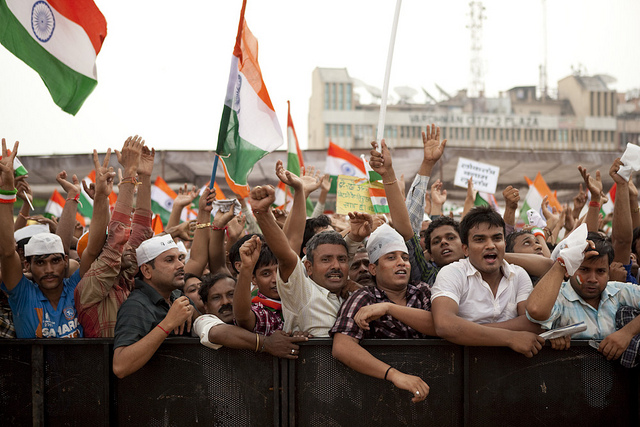
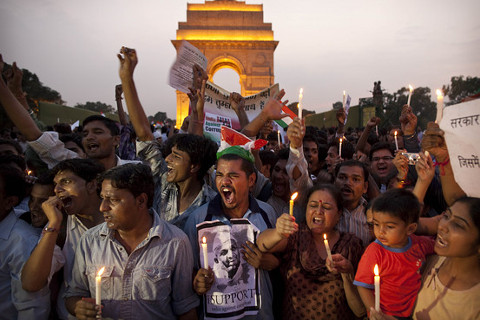
Anna Hazare Anti-Corruption Rally, Delhi (photo courtesy http://www.flickr.com/photos/ishanz/)
What is not the role of the opposition?
The opposition should not be the opposition just for the sake of it. Also, they should not criticize and oppose every government policy just because they are sitting in the opposition. They should not disrupt the working of parliament and other constitutional structures. All their actions have to be directed towards the common cause (which they share with the government) of serving the nation. In the Indian scenario, it is clearly visible how the opposition have lost their credibility and status as they oppose each government policy and indulge in mindless accusation of government leaders.
What has Anna Hazare done?
No matter how good or sincere Anna Hazare is, he would not have been able to gain the public support if the opposition had been doing its job properly. Anna Hazare has only stepped into the vacuum left by the non-governance by the ruling coalition and the total ineffectiveness of the opposition parties to check that. The situation has come to a point where the public was totally hopeless and helpless, and only in this space Anna Hazare and IAC have stepped in. They are doing the job of the opposition, to pressurize (and support) the government to do their job. (I have answered some FAQs about the movement here)
Today’s opposition parties might be tomorrow’s ruling parties, and their approach and analysis can backfire on them tomorrow, if they show negative thinking and only care about coming back to power. Opposition is the back-bone of a healthy democratic setup, and a good opposition is necessary for the success of parliamentary democracy. I hope our opposition realizes this, sooner than later.
Some people, by the mention of their names, spark arguments and controversy like someone has just thrown oil to a burning fire. Narendra Modi is one of those names. The controversial but highly celebrated Chief Minister of Gujarat has been in the news ever since he came to power, either for the communal riots of 2002 or for the various development projects he has undertaken which has turned Gujarat into the state driving the Indian growth story. There are two kinds of people in this world, one for whom world opinion and the ‘right‘ way of doing things matter, and the other who do what they feel is right, irrespective of debates or consequences. No points for guessing which kind of person Mr Modi is.
Under Modi, Gujarat has become an economic dynamo. From becoming the Chief Minister in 2001, when Gujarat was suffering from the aftermath of a massive earthquake and its economy was shrinking, Modi has transformed Gujarat into a state with the highest growth rate among all Indian states. Some of the plans or schemes he launched are Krishi Mahotsav, Chiranjeevi Yojana, Matru Vandana, Beti Bachao, Jyotigram Yojana, Kanya Kelavani Yojana, among others. Read about them to know what all these are and what results have they produced.
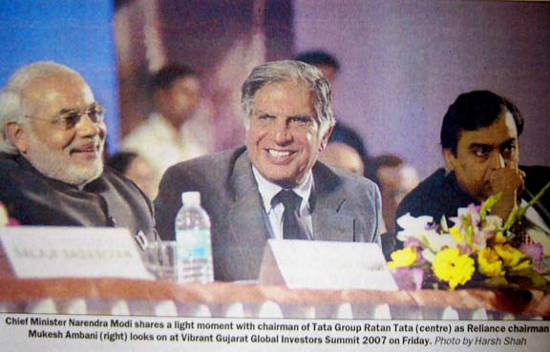
The Vibrant Gujarat Summit
If these scheme names doesn’t mean much to you, let me provide some figures. Gujarat has 50,000 km of fibre optic network, 2200 km of gas pipelines, 1400 km of drinking water pipelines to 7,000 villages, and 24 hour uninterrupted power in rural areas. On the human development side, Gujarat is turning Kutch, a desert, into a green land. The school dropout rate from Std 1 to 5 has dropped from 20% to 2% in the last 10 years. Sex ratio has increased from 883 girls per 1000 boys in 2001 to 920 girls in 2011 due to the Beti Bachao campaign.
Almost all industrial houses have their plants (or are planning to open) in Gujarat which contributes 22% of India’s exports and attracts 25% of all investment coming in India. Many industrialists have publicly expressed their support for Narendra Modi, with Ratan Tata even saying that “You are stupid if you are not doing business in Gujarat”. Recently, the US also endorsed Gujarat as the driver of Indian economic growth and the best example of governance and development. Many are vouching for a strong leader like him for the Prime Minister’s post in 2014.
It is not to say that Gujarat doesn’t have any problems. Like the rest of India, people in Gujarat are also poor, hungry and deprived of basic human amenities like sanitation, health care and availability to easy credit. The disease of corruption is also present in Gujarat like other Indian states. But in all these areas, the graph is only going downwards. In the last 10 years, there can be no doubt in anybody’s mind that Gujarat has changed only for the better. And I hope it continues to do so.
However, no discussion about Modi can be complete without a mention of the 2002 riots in which over fifteen hundred people were killed, most of them Muslims. The riots, which started after the burning of Sabarmati Express, continued for over four months with muslims and their owned businesses facing the bulk of the damage. These riots have always been politically controversial, with many terming it as genocide and believing that Gujarat government and Narendra Modi gave a free hand for these riots. Well, considering the scale of the riots, it is very difficult to imagine them without state support. There could be riots for a few days which the state might be unable to control, but over a period of months, whom are you kidding? It just would not be possible without the support of the police and the government.
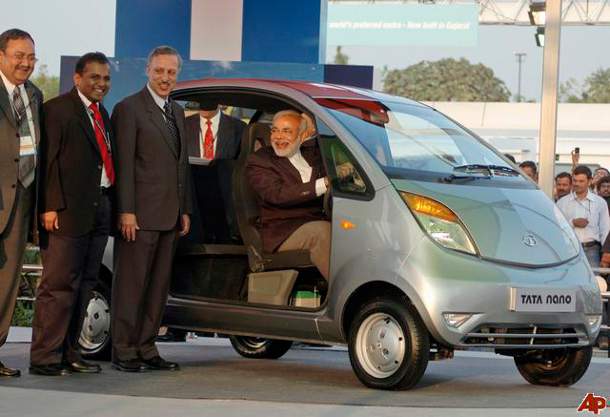
Gujarat is emerging as a global automobile manufacturing hub with companies like Ford, PSA Peugeot and Tata Motors opening up their facilities here. (photo courtesy Associated Press)
Having said that, proving the role of the State in such events is very difficult. There are cases pending before courts, but there has been no proof against Modi or the Gujarat government. Again, as I said, even if he was involved, it would be almost impossible to prove it considering the state of the public offices in this country. I am not trying to absolve Narendra Modi of the responsibility for the riots but trying to stay neutral by pointing out that nothing has been proved. What if he is really innocent and the state has no role? Even I don’t think that is the case, but what if?
Coming to the issue of riots, Modi is not the first politician to be accused of communalism. The 1984 anti-Sikh riots in Delhi have been the worst riots we have seen in recent times, with over 3500 Sikhs killed, thrice the number of those killed in Gujarat. And that was under Congress rule, and under circumstances (the Indira Gandhi assasination) which would leave no doubt about the role of state in those riots. But again, as I said, nothing has been proved and it would be very unlikely if any Congress politician is ever convicted.
Coming to the question of opposing Narendra Modi based on the 2002 riots, we should ask ourselves that have we stopped voting for Congress after the 1984 Sikh riots (which were much worse). Obviously not! But why? Is it just the case that 1984 is long forgotten while the wounds of 2002 are still fresh in our minds. I think both the acts can never be pardoned, and the nation is paying a heavy price for both of them. As much as these riots are indisputable facts, another fact is that there is no better performer than Narendra Modi in our political structure. Time is not stuck in 1984, and neither it is in 2002. Time has moved on, and so has Narendra Modi. And so must we. I am not calling him clean, noble, honest or anything but just seeing in him a bold leader who might be the best among all the villains.
And all this is not because of his political lineage, or his religion, or how charismatic he is, but because of the results he has produced. It is said that all tomatoes that are eaten in Afghanistan are produced in Gujarat and all potatoes in Canada come from Gujarat farms. In one of the most arid lands in the country, this one man had the courage to interlink the rivers and the result is that the Sabarmati never goes dry now. To sum it up, he might not be the ideal choice, but I think he is our best bet.
I have been hearing many questions in the minds of people regarding the ongoing movement against corruption. In this post, I have tried to document and answer (according to my thinking) some of the most frequently asked questions. These questions have been asked on social media websites or on my blog on the articles I have written related to the Anna Hazare led movement.
Q – I do not identify myself with no corruption. Can those lakhs of people pledge on their life that they will never ever engage in corruption?
A – It is very important to see people who give bribes (for small/individual corruption) as victims and not culprits.. I think most of the us will prefer not giving bribe if work can be done without it. Big corporate and large scale corruption is another matter altogether. They use corruption for their own advantage, while the common man mostly has to shelve money to get something which is his/her right, like getting the passport, or a birth or marriage certificate, etc.
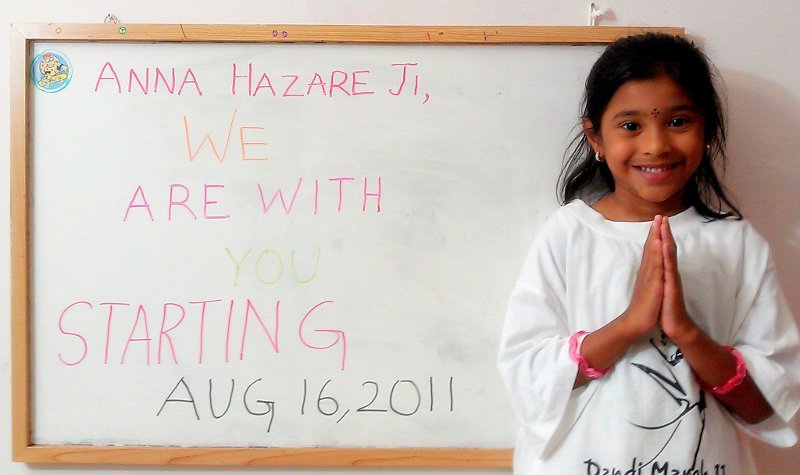
People supported in their own unique ways
Q – It’s a part of our mindset. Its more of a psychology thing. It can be reduced, but never totally eradicated.
A – Yes, it is a part of mindset and can’t be totally eradicated. But it can be reduced from 90% to say 10-20%.. And to do so, it means people will have to be disciplined (not jumping red lights, wearing helmets, following rules, etc) and might have to suffer some hardships or harassments in the short term. But we need to take these in our strides for long term benefits.
Q – The only factor that prevents corruption is fear. Until that is very strong, it cannot stop. My only wish is Jan lok pal bill will instill the fear in the hearts of corrupt people, of strict punishment. If not then I think it wont prove worthy..
A – I agree. Corruption is a high profit and low risk business now… A strong law will make it low profit high risk business… If this happens most people will automatically become non-corrupt… It’s simple human psychology to not indulge in high risk activities. See what happened in Hong Kong..
Q – Its a vicious circle. Who will make the law ? What if the lawmakers are themselves corrupt ? What if the Jan Lok Pal Bill committee members are themselves corrupt ? Who will preside over them ? What if they are corrupt too ?
A -The government / parliament has to make the law.. I agree the lawmakers are themselves corrupt and hence they will make law only under public pressure.. They will make it only if they know that people will not vote for them if they don’t make this law… We saw a glimpse of that in the current protests… and thats why keeping public pressure is VERY important… Infact I would say that, Public Pressure is not only important but also necessary in a democracy…
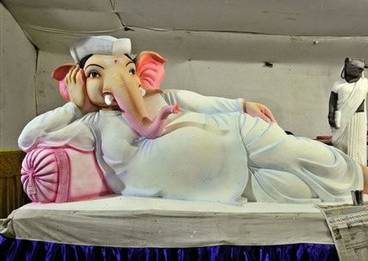
Ganesha Chaturthi idol like Anna
Q – Can a single law stop corruption?
A – The answer is YES and NO. A single law can act as a strong deterrent for people who want to indulge in corrupt activities. It can reduce the corruption levels considerably by turning corruption into a low profit high risk business, but it can’t eradicate corruption totally, for sure. We need to work on three areas in parallel if we want to reduce corruption –
1. Punishment for corrupt – Jan Lokpal Bill will serve this purpose.
2. Education : Moral and Legal – We need to spread moral awareness among our youth, preferably from the school level, about why is it bad to indulge in corruption, and how it can harm ourselves, the society and the country in the long term. We need to bring up our children in an environment of high moral standards.
3. Constant modifications of laws and processes – We are in a democracy, and we can always made amendments to laws, systems and processes if we feel the need to. There should be constant monitoring of laws and systems already in place, and constant modifications to them must be suggested and implemented to reduce the possibility of anybody indulging in corruption. Examples are putting CVC and CBI under Lokpal, implementing Citizen’s Charter, etc
Q – These methods of protests are undemocratic?
A – Actually, this was the biggest win of the democratic process!! What we saw was parliament doing what the public wants.. that is what democracy is all about. A little public pressure is always required for a democracy to work properly. But it’s just half the battle won, if the government backtracks on this commitment, this movement will spread across every nook and corner of the country and they won’t get any votes in 2014… What was heartening was seeing even the opposition engaging in proper debates and not just adjournment drama as even they have a responsibility in a democracy.. and the failure of the opposition was the reason in the first place why someone like Anna got such huge following from the people… If the protests by the people made the government take corruption seriously and even made the opposition work sincerely, how can this be against democracy!!
Q – Are we expecting a ”Nayak” movie scenario where thousands of government and corrupt people would be affected?? Can we expect govt. services to be reliable and affordable rather than private sectors? Can we see common man benefitting and in what areas??
A – Considering the levels at which corruption has seeped into our babudom, it won’t be a surprise if a large number of officials are suspended or penalized after Lokpal becomes official. But it would be foolish to believe that change will happen overnight and corruption will disappear. Even after Lokpal Bill, it will take a long time (in years) to eradicate the cancer of corruption from our society. Even Lokpal will have its loopholes and limitations which would need to plugged by further amendments to the law as and when required. Expecting government services to be better than private sector is another matter as a lot more than corruption need to be tamed for that. Government companies need to be run by CEOs in a professional manner rather than politicians and babus for that to happen. The common man will certainly benefit, and in every area, directly or indirectly, as he won’t have to shell out money as bribes, and secondly, his tax money will be properly used in public services which will come to benefit him sooner or later.
There is no hiding the fact that corruption is prevalent everywhere in India, with babus, bureaucrats and politicians sitting at the top of the list of ‘most corrupt people‘. Corruption has become the elephant in the room, which everybody knows you have to face at every walk of life, but nobody wants to discuss it or stand for a solution. We have to pay bribes to get your birth certificate, marriage certificate, death certificate and everything that comes in between.
New Malls, New Brands for a New Middle Class
I guess corruption seeped into our social fabric during the pre-1991 era when Nehruvian methods were followed and every big industry was a public sector company. State Bank of India, Bhel, LIC, BSNL, Indian Oil, NTPC and ONGC became the companies where everybody wanted a job, for it provided job security and ‘under the table‘ earning options too. People working in these companies formed the Indian middle class during the pre-liberalization era.
But after the economic reforms of 1991, competition opened up and many foreign companies set up shop in India. It also led to the emergence of the service economy with the booming of the BPO and IT sectors. A lot of youngsters started earning handsome salaries and a chance to travel abroad was no more a luxury. In the last 20 years, this population has become the new middle class. Compared to the previous middle class, these set of people are more young and ambitious, they speak fluent English, buy foreign brands and earn good salaries without any ‘under the table’ options. They work hard in a competitive but (mostly) honest environment to earn their living.
In a way, what happened after the 90s was that the middle class of people working in PSUs were replaced by the middle class of people working in the new service based economy. While the people in governance – the politicians and the babus remained the same. Very clearly, there was (and is) a disconnect between the governed and the government. With Parliament sessions shown live on TV, there are enough reasons for this new middle class to get frustrated with the politicians.
The protesters were mostly from the educated middle class
So when Anna Hazare, Arvind Kejriwal, Kiran Bedi, Prashant Bhushan and others started this movement against corruption, they just caught the right nerves of this middle class. They gave the middle class a ray of hope out of the otherwise hopeless situation they felt they were in. And with their youth and the ‘josh‘ (enthusiasm) it brings with it, they joined the movement in thousands and poured on the streets. Suddenly the sleeping, lazy, not caring about the country middle class awakened and to utter surprise of many, protested for a corruption free India.
Due to this disconnect between the government and the people, the government was caught totally unaware that where did this huge support to Anna Hazare came from. This middle class might be only 20-30% (and growing) of our population but even that means tens of crores of people, which is a big enough number for any government to take notice. And going forward, this middle class is only going to increase in number and become very critical to the political fortunes of those in power.
These are my views about why and how the government was caught unaware and committed harakiri by arresting Hazare and later releasing him in panic. And I think this educated and aware middle class will have a huge say in deciding the way our government create policies in the years and decades to come. Our politicians can no longer ignore the educated middle class as they have done for the last 50 years. Because, leave the protests and fasts alone, we are still a democracy, and as many Congress leaders have said in arrogance, “The public can throw them out in the next elections“.
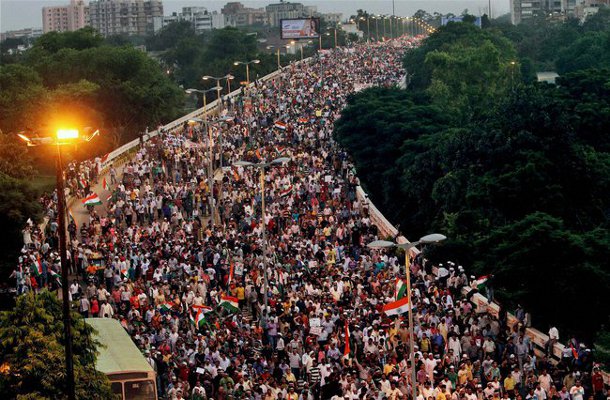
In my previous article, I had a doubt about how the public will react to Anna’s second fast unto death. I was more skeptical about the response to his Jail Bharo call. But I am glad all my skepticism has been proved wrong. The public has responded, and how. Tens of thousands of people have come out on the streets in support of Anna Hazare. People have courted arrests in hundreds and in Delhi, police has to convert a stadium into a jail to keep those arrested. There were around 100,000 people marching to India Gate in Delhi and around Azad Maidan in Mumbai. Now can the government arrest them all?
I am really glad that the public has risen to the call given by Anna Hazare. But what is special about Anna Hazare that he has galvanized the whole nation when most of us didn’t know him at all a few months ago. How is one man able to dictate terms to the government? How has he cut across the social and economic divides of the populace which is so deeply entrenched in our society?
History of Work Done
He is an ex-army man who fought in the 1965 Indo-Pak war and later build his village into a model village, self sustained and free of all social ills. People from all over the world have come to see the amazing work he has done. He has not married and devoted his entire life to his village, and later in his fight against corruption. After that he has fought corruption in Maharashtra and he was one of the active crusader behind forcing the Maharashtra government to bring in the Maharashtra RTI act, one of the first in the country. He has given his life for the service of the nation since the last 35-40 years..
Clean Image
He has devoted his life to social activism, mostly in Maharashtra. He developed his village Ralegan Sidhi into a model village which people from all over the world come to see. It is considered a model of self sustainable living and of environmental conservation. The World Bank Group has concluded that the village was transformed from a degraded village in extreme poverty to one of the richest in the country.
More than a lakh people march from India Gate to Ramlila Grounds on 21 Aug
No Personal Assets or Motives
Anna Hazare lives in a small room attached to a temple in his village since 1975. He has no assets and has a bank balance of Rs 67,000. Whatever land he has is being used for development purposes for his village. His only source of income is the pension which he gets from the Army. He has devoted his life for the betterment of his village, and after that fighting against corruption. He has never done anything for his personal motives.
Gandhian Principles
What is most heartening is to see Anna Hazare following Gandhian principles and using the same methods of fasting and Satyagraha for his cause. In a generation which has come to doubt Gandhi and the relevance of his principles in modern times, this was ample proof of the relevance of his methods irrespective of time and generations. He has called to our souls in the same peaceful manner that Gandhiji did.
Given Hope to Millions of Frustrated Indians
More than anything else, the one reason why Anna has resonated with the masses is because he has given hope to millions of frustrated Indians. Everybody knows there is corruption in every nook and corner of the country. But the BIGGEST problem is that nobody can do anything about it. Everybody is helpless in the regard that there is nobody to complaint, and even if they complaint, they end up being harassed by the same people. Anna has given people hope and shown them a way which might lead to a corruption free India. That is why he caught the government totally unaware!!
It won’t be wrong to say that Anna Hazare has come as the Messenger of Hope in the current state of our country. He has managed to turn all the cynicism and pessimism into an enthusiastic and optimistic revolution by the people of India.
In April, the government agreed to a joint drafting committee for a Lokpal Bill as they were ‘bound by duty‘ of the people to do so. They promised to discuss the points raised by Anna Hazare, Arvind Kejriwal and others and present a Lokpal Bill in the monsoon session of the parliament. August is here, four months have passed since Anna Hazare galvanized the whole nation with his fast, but has the last four months been anything but a hogwash by our politicians?
The talks never got anywhere because both sides blamed each other before and after every round of talks. The demand for televising the talks was never accepted by the government. Even after numerous round of talks, there was no consensus on the various contentious points of the Jan Lokpal Bill. This was very visible in the press conferences by both parties after every round of fresh talks. It was clear there was no trust between the two sides of the drafting committee, from the very beginning. Without mutual trust and respect, expecting a positive outcome from the committee was like expecting Tom and Jerry to become friends because they were on TV.
Finally, the government is ready to present a Lokpal Bill in the parliament. A bill which cannot tackle or investigate any of the serious corruption cases we have seen in recent times. It will not have jurisdiction to investigate the Commonwealth Games scam, Bellary mining scam or the Adarsh society scam as it can’t prosecute state government officials. It can’t investigate the 2G scam as PM and his office has been kept out of it. It can’t take your complaint for corruption against your traffic police officer, or the magistrate, or the collector in your district. Under it, you can not complain against any babu who refuses to process your file or pay you your pension without taking a cut from it.
Are you? Will you?
The United Nations Convention Against Corruption (UNCAC) clearly mentions the terms based on which a country’s anti-corruption body should work. It asks for an independent body, which the Lokpal will not be because the CBI’s anti-vigilance wing will continue to function as usual, and under the government. Moreover, the Lokpal will be appointed by government officials themselves, creating a huge conflict of interest. If the government only wants to create a Lokpal for top level bureaucracy, how has the action over the last few months serve the public and the day to day corruption which everybody has to face.
Has the government here played both sides very cleverly to its own advantage? Did the setting up of a committee only a hogwash to dispel the growing public anger in support of Anna Hazare’s movement? Was it only to give an impression that ‘we care’ whereas the ground situation has hardly changed in the last few months? Is the government not trying to suppress Anna Hazare’s threat for a fast again by imposing section 144 in Delhi and refusing permission to his fast from Aug 16? Will they arrest him and force feed him? Will they not even allow an agitation to start this time?
But more importantly, the question is what will the public do? The government can put section 144 in Delhi, but not in every street of the country. They can arrest Anna Hazare, Arvind Kejriwal and Kiran Bedi, but can they arrest millions of people if they come out on the streets on Aug 16. Will the public again dispel this movement as ‘it will never work’ and go back to living their pity lives. As the next few weeks before Aug 16 pass, everybody needs to ask themselves just one question, “Do we want to support Anna Hazare while discussing with friends over coffee and watching him on TV, or do we have the balls to go out on the streets to really stand for what Anna Hazare is fighting for?”
And who is Anna Hazare fighting for, not for himself, but for us. Have we even lost the dignity to support the person who is fighting selflessly for us, or are our souls so dead already that we can dismiss Anna Hazare by terming his entire movement a ‘publicity exercise’??
I will end with a quote by Henry Louis Mencken – ” It is hard to believe that a man is telling the truth when you know that you would lie if you were in his place.”
Over the last month, amid all the controversies and media debates around the Jan Lokpal Bill, I feel we have somehow lost the essence of the movement. There have all kind of remarks in the media, from comparing Jantar Mantar to Tahrir Square, whether Jan Lokpal Bill will give a lot of powers to Lokpal, or the smear campaign against the civil society members of the Lokpal Bill drafting committee. Somehow, nobody is focussing on corruption and the urgency to tackle it but everybody seems to be interested in small trivial issues raised by some egoistic individuals. Below I am listing four very important points about this movement from my observations and point of view –
1. Jantar Mantar is not India’s Tahrir Square
Anna Hazare’s fast and the kind of support it gathered from the general populace have made many people, including the media, compare it to the protests in the middle east countries. There were calls of equating Jantar Mantar with Tahrir Square. While I agree that people are frustrated with the current state of affairs in matters of corruption in this country, it will be unwise to compare both. An Egypt type of agitation is needed when there is no liberty for the people. We have, within our rights as a democracy, the right to peaceful protest under the mandate of the constitution itself.
Anna Hazare has asked all of us – "Do you have a conscience?"
2. We have shown the world the way in peaceful protests, and they are still revelant
Our father of the nation Mahatma Gandhi has shown the whole world the way to peaceful protests in a non-violent way and how powerful it can be. Our politics provides us a wonderful platform to raise our voices and bring out change without dropping a single drop of blood. Leaders like Martin Luther King Jr, Aung Suu Kyi, Nelson Mandela has shown the world that Gandhian methods are still relevant.
3. Anna Hazare and Government are on the same side
Anna Hazare has also used Gandhian methods, but his fight is not to overthrow a government, but to partner with them in creation of a stronger law. It is very important to see corruption as the villain here and not the government or the ruling party. Civil Society and the Government have to see themselves on the same side of the table to be able to find an effective solution to the problem of corruption. No doubt some members of government are corrupt, and hence the role of civil society to pressurize them to do their job as they are expected to do so.
4. Hazare has just asked one question
Anna Hazare has created a lot of problems for the government by bringing a lot of questions to the national forum. But the most important question he has asked is for YOU, fellow Indians. He has asked “Do you have a conscience?” The success of his agitation does not depend on how many corrupt politicians come by his side and renounce corruption, he is waiting to see how many people has he inspired to come support him in this cause and other causes which are important to the nation. He is asking you whether you feel for your country, whether you care for a better future for your kids? If the answer is yes, then get up, and join him in this fight and save the nation from the clutches of corruption and other problems we are facing today.
Missile technology has underwent great progress over the last half a century. We have supersonic missiles, missiles which can be launched from sea, air or land, intercontinental ballistic missiles and missiles which can launch nuclear warheads too. But if the delivery system of a missile fails, even the best missile is just a crap of steel, doesn’t serve its purpose, and can be dangerous to the party it was supposed to benefit.
Similarly, we might have the best government driven by the best constitution which was drafted by BR Ambedkar and other such eminent people, but if the delivery system fails, all that becomes a bunch of people sitting in large buildings creating a lot of waste, which defeats the original purpose of having a government and constitution. Most would agree that democracy has failed us, but it is important to know how much?
Most of our government departments are plagued by inefficiency and unaccountability. There is no transparency in the process and babus misuse their privileges giving rise to corruption. Election process is easily rigged by political parties who often give money or freebies for votes. Poor people, instead of seeing elections as their opportunity to elect the right people to ensure long-term growth for themselves, see elections as one chance to turn the bribe taker to bribe giver and rig their votes for short term monetary gains. If elections are not fair, the whole foundation of democracy shakes.
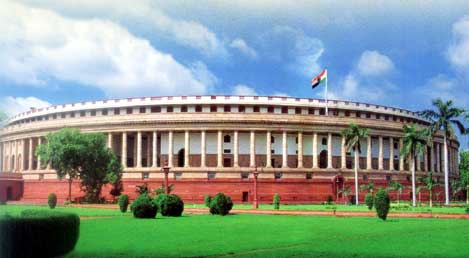
The Epicentre of Democracy – Indian Parliament
Due to the large amount of money doled out in elections, politicians and bureaucrats (hand-chosen by politicians) engage in corruption once in power to recover the money, giving rise to scams. Indirectly, it also leads to loss of confidence from industry and tax payers. It harms the public eventually, but people are too ignorant or too cynical to realize that. This led to a flawed democratic system which is existing in India today and continuing as such. Any change in the system has to be done by politicians themselves and as corruption has seeped into the highest levels, it is understandable why they don’t change the laws and rules.
Again applying the metaphor of a missile to a government, when a government fails to do its function, it becomes a very dangerous weapon in the hands of those in power. What is supposed to be for the people, by the people and of the people turns into something harmful to people itself. This defeats the very purpose of having a democratic government.
If you are thinking what am I trying to imply, think what would you do if you know a missile has lost control and can fall anywhere with disastrous consequences. You will look for ways to protect yourself, try to shot down the missile, or simply go mad and crazy. So why not the same in the case of failed governance? Why don’t we try to protect ourselves? Why don’t we get angry? Why don’t we go crazy?
I can write more, but I am leaving it here as an open question. Leave your replies, and I will make sure to respond to them as best as I can.
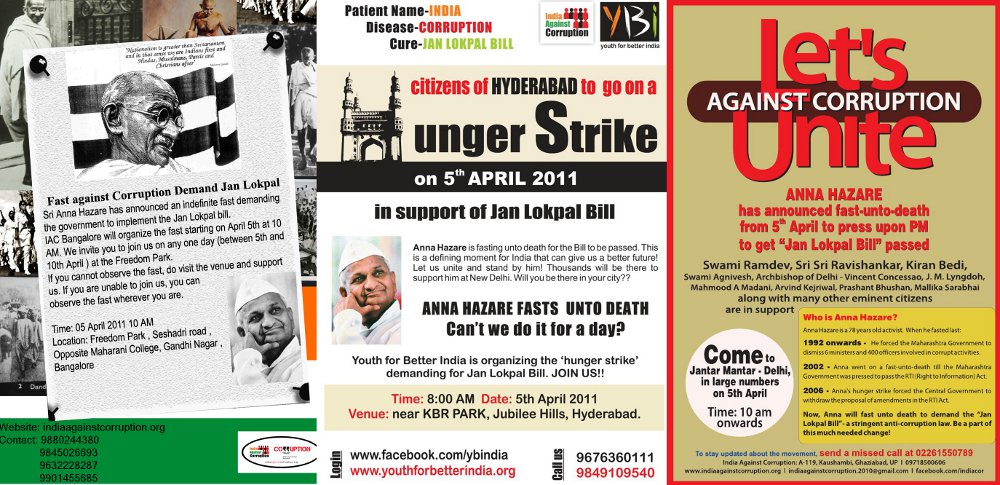
Anna Hazare began his fast unto death yesterday in support of a stronger Jan Lokpal Bill to fight corruption. He is fasting in front of Jantar Mantar, Delhi and asking the government to create a joint committee with top members from the government and civil society to draft the bill. In support, thousands of people from over 400 cities in India and abroad are sitting on similar fasts. A few members are sitting on a fast unto death while many are doing relay fasting. People from all backgrounds, students, professionals, activists, are participating in the fast for one cause, a stronger anti-corruption bill. Many people are fasting from their work or home in support of Anna ji.
The media coverage of his fast has been very good and heartening to see. It will surely help in spreading awareness about the issue to the general public. Here are five reasons I think thousands have joined in support of “India Against Corruption” and why you should also join and contribute to this movement.
1. Fast for your country
We all fast, at different times, for our religion, some festival or for someone. Fasting holds a very important place in our culture, and we take pride in our traditions. This time, thousands are fasting for the country. People from different religions, castes, states have come together to fast for a disease which affects all of us, corruption. In these days, we rarely get to see the face of united India. We recently saw when the whole country celebrated the World Cup triumph and there were celebrations on the streets. Let us get behind Anna Hazare and fast for our country in the same spirit, and I have no doubt corruption (or any other issue) will be gone in no time if India unites and all Indians stand up for a just society.
2. Anna is doing this for us at 73 years “At 73 years, Anna is not fasting for himself, he is fasting for the future of my kid. I will myself fast on 5th April for a day and ask my 5 year daughter also to skip a meal.” Rakesh, a software engineer said. And very rightly so, if Anna Hazare can fast until death for a corruption free future for us and our children, can’t we join him for one day in support. Seeing more and more people behind him will give Anna and India Against Corruption movement a lot of courage and confidence. It is also a chance for all of us to show we care about our future, the future of our kids and a corruption free India.
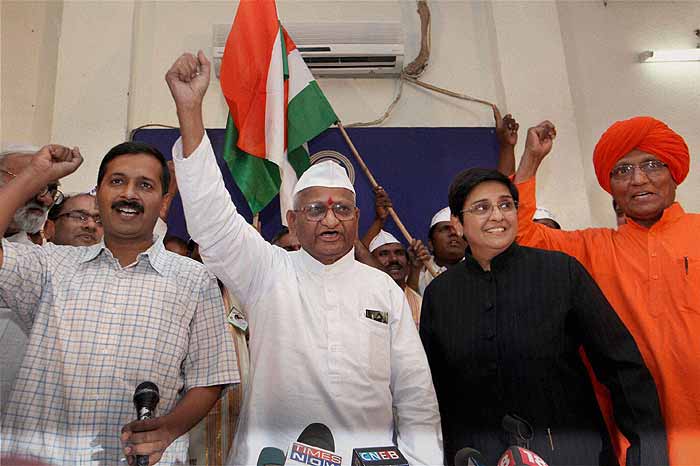
Anna Hazare, with Arvind Kejriwal and Kiran Bedi
3. Spreading awareness
By fasting for one day, two days, alternate days, or whatever time and duration you are comfortable with, you can spread awareness among people around you about India Against Corruption movement. You can be a part of this movement by saying “I fast with Anna Hazare against corruption.” You can share and post about it on your mail, status messages on facebook, twitter, etc. We need more and more people behind this to put pressure on the government to bring a strong anti-corruption law, and each one of us can do our bit for it.
4. We only need a decent environment to live in
Most of us don’t want to be involved in politics or public affairs. And that is why we choose a government. We only need a fair society to live in. We need good roads to travel, good schools for our children, buses and trains for us to travel. We ask for nothing more. We are decent people only asking for a decent environment to live in. And we deserve it. The current environment has been polluted by corruption and the government has not taken steps to curb it. It is high time we realize our duties as citizens and peacefully demand what we deserve.
5. Corruption can, and must, end
Most of us see corruption as a problem which is deep rooted in our society and which can’t be eradicated. But history is proof that if committed citizens come together for change, anything is possible. The case of Hong Kong is one major example. Hong Kong was so corrupt during the 1960s that it was an open secret and a way of life. And the government seemed powerless to do anything about it. But in the early 1970s, one event after another triggered off a storm of public protests and a powerful and independent agency was setup to deal with corruption. The Independent Commission Against Corruption, or ICAC, was created in 1974 and now Hong Kong is one of the most cleanest and corruption free cities to work in. Similarly, it might look there is no end to the problem today, but seeing in perspective, this is our time to act and be the cause in the matter of a corruption free society.
So participate in the fast, for whatever duration you like and be a part of the movement. Spread the word to your friends, family, colleagues, neighbors, everyone. I will end with this quote by Edward Abbey – “A patriot must always be ready to defend his country against his government“.
I thought it right to write a post describing what Jan Lokpal Bill is and why is it needed. To give a brief history, Lokpal Bill was first introduced in parliament in 1968. It has been brought in parliament on eight times on later occasions, but has never been passed by the parliament. It is a bill that is supposed to give powers to citizens to sue the people responsible for corruption. A similar kind of independent agency disappeared corruption from Hong Kong a few decades ago.
The government is again thinking of introducing a Lokpal Bill in parliament this year, and the National Advisory Council (NAC) chaired by Sonia Gandhi is considering it. But as it stands today, the bill is riddled with loopholes, defeating its very purpose. Social activists have remarked it to be a toothless bill and not at all acceptable. An alternative bill, the Jan Lokpal Bill has been drafted by Justice Santosh Hegde (Lokayukta of Karnataka), Prashant Bhushan and Arvind Kejriwal after series of consultations with public and social activists. This bill is supported by Kiran Bedi, Shanti Bhushan, Anna Hazare, etc.
The Dandi March 2 event and the subsequent ‘fast unto death’ by Anna Hazare from April 5 and Aug 16 were in support of this ‘Jan Lokpal Bill’. The activists have already sent the bill to the PM and all CMs but there has been no response. After the ‘fast unto death’ was announced by Anna Hazare, he was invited for talks by the PM, but the response was bad as the PM said the government has no time for corruption till May 13. This after the numerous corruption scams like the Commonwealth Games, Adarsh Society, 2G scam being uncovered in the past months.
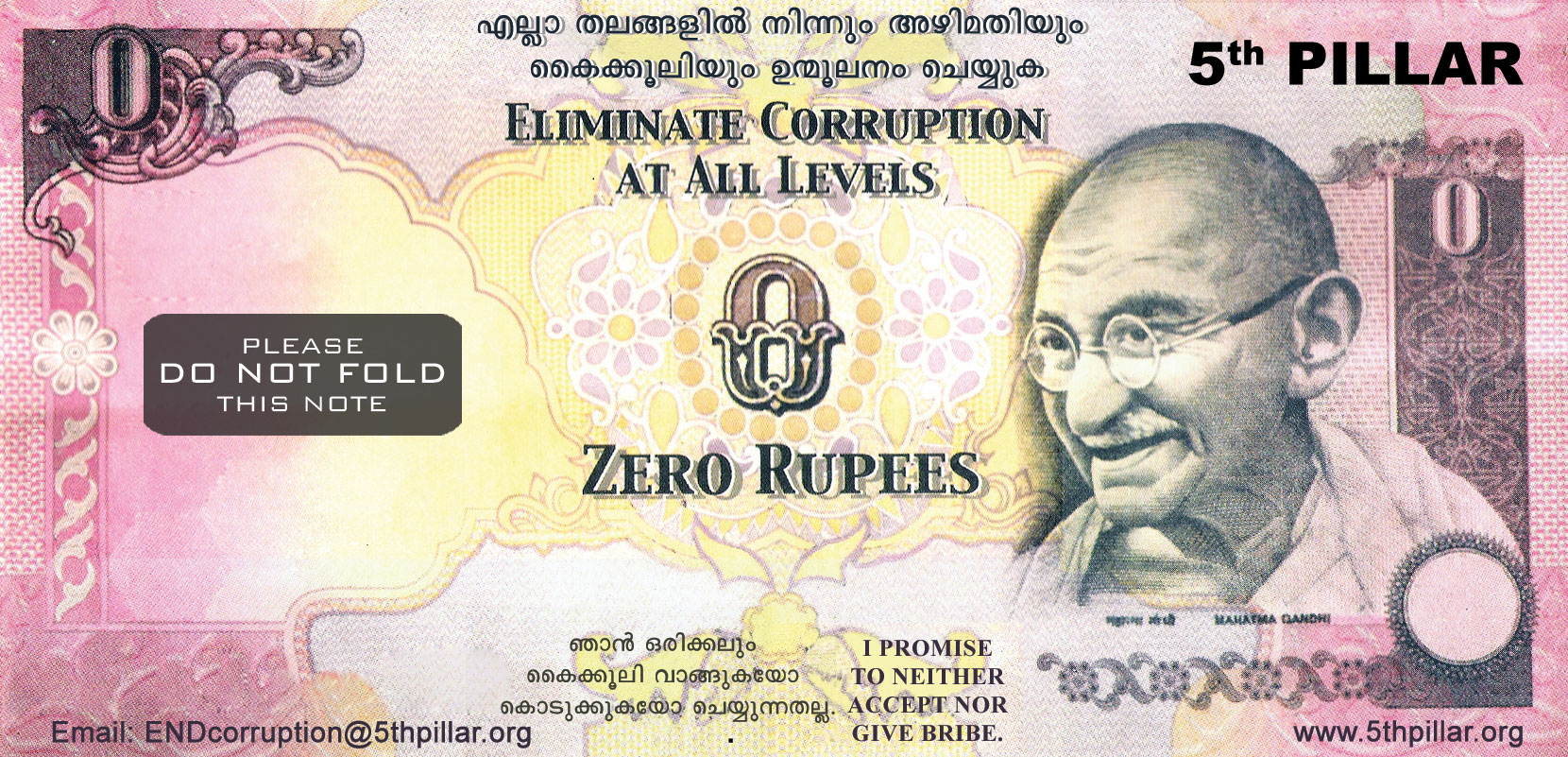
The Zero Rupee Note – Stop Corruption
The present system to fight corruption in India can be described in some points as below –
The Anti Corruption Branch and CBI comes under the government. Despite having evidence, it is very difficult to convict people as they have to take permission from the same bosses, against whom the case has to be investigated.
No corrupt officer is dismissed from the job because Central Vigilance Commission, which is supposed to dismiss corrupt officers, is only an advisory body. Whenever it advises government to dismiss any senior corrupt officer, its advice is never implemented.
No action is taken against corrupt judges because permission is required from the Chief Justice of India to even register an FIR against corrupt judges
The functioning of CBI and vigilance departments is secret and hence it promotes corruption.
Weak and corrupt people are appointed as heads of these institutions by the government.
Citizens face harassment in government offices. Sometimes they are forced to pay bribes. One can only complaint to senior officers. No action is taken on complaints because senior officers also get their cut.
Nothing in law to recover ill gotten wealth. A corrupt person can come out of jail and enjoy that money.
Small punishment for corruption- Punishment for corruption is minimum 6 months and maximum 7 years.
As you can see, in the present system, there is no deterrent for any public official to engage in an act of corruption. Some of the salient features of the Jan Lokpal Bill are –
An institution called LOKPAL in the centre and LOKAYUKTA in each state will be set up. These institutions will completely independent of the governments, just like the Supreme Court and the Election Commission. No minister can influence their investigations.
Investigation in any case will have to be completed in one year. Trial should be completed in next one year so that the corrupt officer, or politician goes to jail in two years max.
The loss that a corrupt person caused to the government will be recovered at the time of conviction.
If any work of any citizen is not done in prescribed time in any government office, Lokpal will impose financial penalty on guilty officers, which will be given as compensation to the complainant. So, you could approach Lokpal if your ration card or passport or voter card is not being made or if police is not registering your case or any other work is not being done in prescribed time. Lokpal will have to get it done in a month’s time.
Election of Lokpal officials – What if government appoint corrupt and weak people as Lokpal members? That won’t be possible because its members will be selected by judges, citizens and constitutional authorities and not by politicians, through a completely transparent and participatory process.
What if some officer in Lokpal becomes corrupt? The entire functioning of Lokpal/ Lokayukta will be completely transparent. Any complaint against any officer of Lokpal shall be investigated and the officer dismissed within two months.
What will happen to existing anti-corruption agencies? CVC, departmental vigilance and anti-corruption branch of CBI will be merged into Lokpal. Lokpal will have complete powers and machinery to independently investigate and prosecute any officer, judge or politician.
The punishment would be minimum 5 years and maximum of life imprisonment.
Please read my two poems “Fast with Anna” and “Messenger of Hope” and join in this fight against corruption. We must remember Anna and others on fast are fighting for US and OUR India
The recent crisis and revolution in Egypt forced their President of 30 years, Hosni Mubarak to resign and pave the way for a civilian government. Egypt has remained under emergency rule ever since Hosni Mubarak came to power three decades ago and he has ruled Egypt with an iron fist since then. But all it took was 18 days of protests by the Egyptian public at the symbolic Tahrir square that forced Mubarak to relent to the demands. Though hundreds of lives were lost in the protests, it marks the sacrifice people have given for demanding their right to a democratic government. With the world media focussed on Egypt, and social media like Facebook and Twitter making it impossible to stop what was happening in Egypt from coming out, it was impossible to crush the rebellion as had been done in China and other countries earlier.
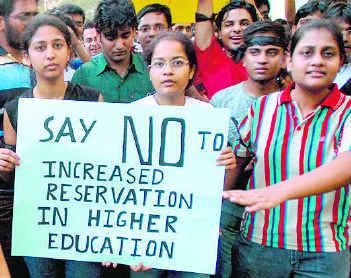
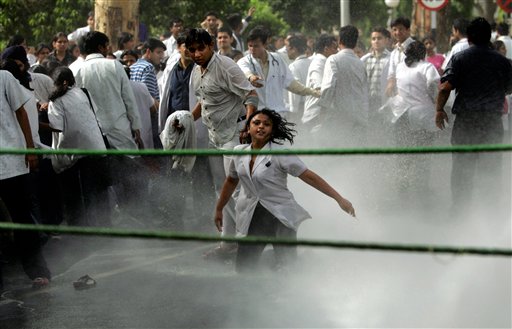
In our country too, we have seen protests in the past. In fact, such peaceful protests all over the world have been inspired by none other than our own Bapu. He lead the country in peaceful protests against the British rule, inspiring leaders like Martin Luther King Jr and Nelson Mandela in the process. Our forefathers had come together and raised their voice in unity for their right of self governance from the British. We can say that we have inherited the ability to protest peacefully to demand our rights from the government. After independence too, we have seen protests during the emergency period in the 1970s and the recent anti-reservation protests in 2006 where students marched against the governments decision to implement 27% caste based reservation in educational institutions.
Today we live in a democratic country. As a country, we are governed by the constitution which was framed in 1949. Unlike Egypt, we have a government which is answerable to its citizens, and which in fact is chosen by its citizens. Our democracy, as with most democracies, came into being after an era of protests. Protesting for our rights and for what is rightfully ours is not only within our rights as per the constitution, it is also our duty as responsible citizens. Considering the current state of our society which I have mentioned in previous posts like “The India of Today” and “The Irony of living in India”, we more than anyone else need a public uprising and peaceful protests under the principles of Gandhi and Nehru. We have an obligation to our forefathers, and to our children and grand children, to give them an India which our forefathers dreamed of. And there is no reason we can not make the current government and its officials accountable for their responsibilities towards the nation.
Although the principles of such a revolution will be the same as followed during the Independence struggle, the objective would be very different. India protested against a foreign rule before Independence, for the right of self-governance. However, right now we have self governance, but any protest will be to stop the rampant corruption in the system and ensuring our constitution doesn’t only remain a text. The protest should be to make the government officials accountable to the people and to the constitution. The protest could include appealing to the courts, making use of the law as it exists today to make sure we are not denied of our fundamental rights. If these modes of protest won’t work, we can turn to public protest. This can be in the form of strikes, civil disobedience or plain old gatherings to make the government take notice.
Anti Reservation Protests in 2006
We have seen some protest in the last decade, like after the Jessica Lall murder case, after the reservation decision by the HRD ministry, after the Mumbai terror attacks and most recently, in Jammu and Kashmir. All these protests have been triggered by some event or tragedy which has shook the nation emotionally. However, the rampant corruption and neglect of civilians by the politicians and babus has continued ever since independence. They are supposed to be public servants and at the service of the common people. But they have gotten into the skins the Britishers left behind and never treated their jobs as a service to the nation.
Having said that, we have no right to blame the government being in a democracy. We have elected this government by our own votes, and we have the power to overthrow it the next time. We give excuses to ourselves by saying that all parties are the same and nothing can be done. By thinking so, and suffering silently at the hands of the government, we are not acting as responsible citizens either. Only responsible citizens have the right to have a responsible government, and I think we have ourselves to blame for our condition. If we don’t give bribes no matter what the cost, our officials can’t be corrupt. If we don’t sit silently over the injustice happening around us, it would never give confidence to the wrong doers to continue their act. What I am trying to say that we are equally responsible for our condition, and its not only because of the government or the babus or the system.
A symbolic image of the 2006 protests
A protest against this has to start with ourselves. We need to act like model citizens as the first step of our demand of an accountable government. We need to stop giving bribes to corrupt officials, we need to stop being resigned about our government and take legal actions in case of any injustice. We need to take the means which are written in the constitution and follow our fundamental duties to be rightful claimants of our rights. Now, as with every protest, we have to bear some hardships and give some sacrifices in order to gain what we want. There might be times, when the government/police try to forcefully threaten us under the guise of law and order. But we have to stood our ground, and suffer patiently without being aggressive as a sacrifice for our future generations.
We have to follow the same powerful principles which the Father of the Nation, Mahatama Gandhi advocated. We have to hate the sin, and not the sinner. We have to smile at them, treat them with respect, even when they shout at us, beat us or threaten us. We have to follow what Gandhi said, “There might be reasons for which I am willing to give my life for, but there is no reason I am willing to kill”. We have to abjure from violence at all costs, and violence means all kinds of aggression. Not just the aggression from our actions, but aggression from our heart. When our fellow Indians could make this work against the Britishers, why can’t we act with compassion with our officials, who are after all our own brothers and sisters. We have to follow his words “The weak can never forgive. Forgiveness is the attribute of the strong” as we go about being responsible citizens.
I use cookies on this website to give you the most relevant experience and for analytics purposes. Any personal data collected will never be shared with any third party, or used to spam you. That is my promise. - Sumit By clicking “Accept”, you consent to the use of ALL the cookies.
This website uses cookies to improve your experience while you navigate through the website. Out of these, the cookies that are categorized as necessary are stored on your browser as they are essential for the working of basic functionalities of the website. We also use third-party cookies that help us analyze and understand how you use this website. These cookies will be stored in your browser only with your consent. You also have the option to opt-out of these cookies. But opting out of some of these cookies may affect your browsing experience.
Necessary cookies are absolutely essential for the website to function properly. This category only includes cookies that ensures basic functionalities and security features of the website. These cookies do not store any personal information.
Any cookies that may not be particularly necessary for the website to function and is used specifically to collect user personal data via analytics, ads, other embedded contents are termed as non-necessary cookies. It is mandatory to procure user consent prior to running these cookies on your website.