Leaders frequently pride themselves on data-driven decisions and logical planning. Yet, there’s an often-overlooked leadership muscle that remains dramatically undertrained—the ability to purely and powerfully want something, free from justification, reasoning, or incremental thinking.
This is not about frivolous desire but about tapping into a source of powerful leadership: unfiltered, unreasonable, unapologetic wanting. Let me unpack this for you.
Want vs. Need: Understanding the Crucial Difference
Consider this snippet from a conversation with Alex, a CEO:
Me: “What’s your target revenue for three years from now?”
Alex: “20 million.”
Me: “Why 20 million?”
Alex: “It’s just a logical projection from our current growth.”
Me: “Forget logic. What do you truly want?”
Alex:(pauses, uncomfortable) “Honestly? 30 million with an 18% margin.”
Me: “How does saying that feel?”
Alex: “Powerful, scary, but exciting.”
Key distinction:
Need: Rational, justified, incremental.
Want: Visionary, bold, free from immediate practicality.
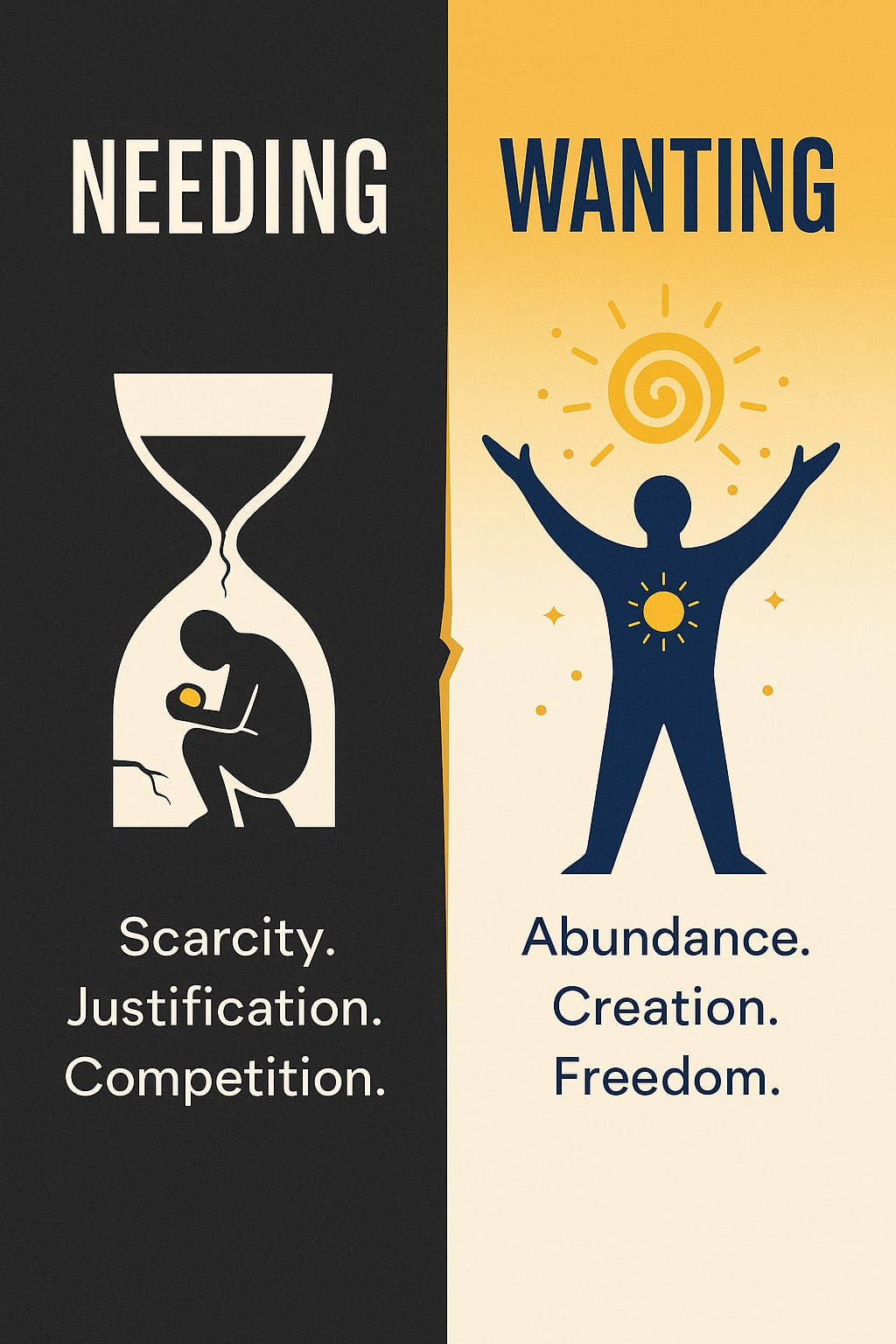
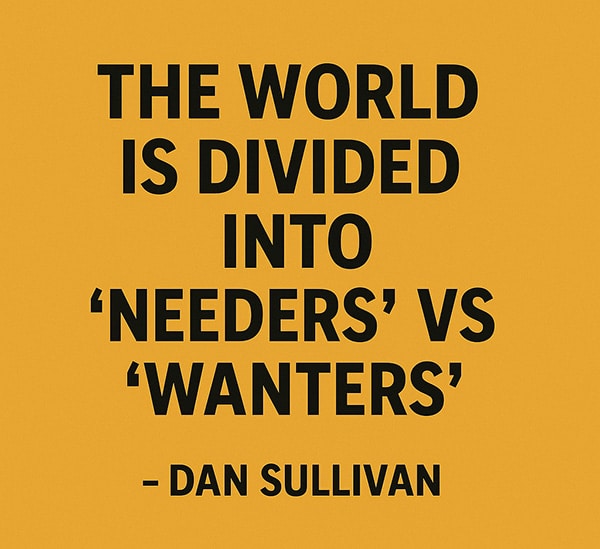
Most leaders confuse wanting with needing. ‘Need’ is rational, safe, and justified. It relies on data, past achievements, and incremental improvements. But ‘want’ is different—it’s free, unbound, and daringly ambitious. It’s not derived from past performance or future projections. It’s rooted purely in what you care about without external justification.
Escaping the Trap of ‘Should’
Consider this dialogue with Sara, a technology executive, which illustrates this well:
Sara: “I should take some time alone tonight; it’s been a stressful day.”
Me: “Notice your justification? Try it again without any reasoning.”
Sara: “I want one hour alone tonight.”
Me: “How does that sound?”
Sara: “Clear. Liberating. Surprisingly simple.”
Why “should” is problematic:
Implies obligation, external expectation, or guilt.
Creates heaviness, stress, and emotional constraint.
Leaders frequently operate within this restrictive frame: “I should achieve this,” “We should improve by this percentage,” “The profit margin should be at least X.” The word ‘should’ introduces heaviness, stress, and constraint—emotionally draining rather than empowering.
The Cost of Ignoring Pure Wanting
Consider Paul, a corporate executive who played it safe:
Paul: “We consistently meet our growth targets.”
Me: “Is that exciting for you or your team?”
Paul:(hesitates) “Honestly, it’s safe but dull.”
Me: “What bold vision do you truly want, without needing logic?”
Paul: “I want us to dominate our industry—not because data says it’s possible, but because I genuinely desire it.”
Me: “How does declaring that feel?”
Paul: “Invigorating. Like fresh energy.”
Ignoring the muscle of pure wanting leads to:
Predictable mediocrity.
Limited innovation.
Reduced team motivation and engagement.
Linda’s experience as a division leader in a multinational corporation illustrates this vividly. Her division consistently achieved its targets yet suffered from chronic disengagement and low innovation. When Linda surveyed her team anonymously, the feedback was clear: employees felt their work lacked real purpose or excitement. Linda realized that her own cautious, data-driven approach was partly to blame.
Only after she publicly shifted from safe, predictable objectives to openly declaring ambitious, passionate goals did the division experience a noticeable revival in creativity, morale, and productivity.
The ability to purely want something without needing rational justification is a muscle that requires intentional cultivation. Leaders conditioned by logic, practicality, and data often find it challenging initially. However, this muscle—once developed—creates visionary breakthroughs, fosters courage, and generates a powerful leadership presence.
When you declare a want, especially something seemingly impossible or unrealistic, you create a space for innovation. There’s no guarantee you’ll immediately know how to achieve it, and that’s precisely the point. Leadership isn’t management. Management handles execution based on what’s already known; leadership thrives in the unknown, carving pathways where none previously existed.
Imagine John F. Kennedy declaring he wanted to land a man on the moon. It wasn’t a need; America didn’t necessarily have to do it. It wasn’t a ‘should’ dictated by societal obligation. It was a pure, bold want. He didn’t have all the data or a proven roadmap, but by boldly declaring the impossible as his desire, he galvanized an entire nation, sparked unprecedented innovation, and ultimately achieved a milestone that seemed unthinkable at the time.
The Life of a Needer
A needer doesn’t chase dreams—they chase survival. They ask themselves, What do I need to do to get by? What do I need to keep things stable? What can I reasonably ask for without rocking the boat?
They settle. They settle for the client that underpays, the partner that drains them, the life that suffocates—but at least feels “secure.” They compromise their time, energy, and joy, not because it’s what they want, but because it’s what they believe they should accept.
In the world of needing, every request, every desire, has to be run through a filter of justification:
“I need this because I’ve worked hard.”
“I deserve this because I’ve sacrificed.”
“I should have this because others have it too.”
It’s exhausting. And worse—it’s a trap. Because needing is always tied to lack. Needing assumes there isn’t enough. If you get more, someone else gets less. So you justify to yourself and to others why you’re allowed to want what you want.
The Shift: From Scarcity to Creation, from Needing to Wanting
But there’s another way. A shift so subtle, it’s easy to miss. But once you cross that line, you never go back.
The shift is this: You stop living from need. And you start living from want.
Wanting, true wanting, doesn’t come with excuses. You don’t need a spreadsheet, a résumé, or a reference to prove your worth. You want because you want.
You want a thriving business? Say it.
You want a loving, spacious relationship? Say it.
You want to take a month off to write, rest, or just breathe? Say it.
And when someone asks you, “Why do you want that?”, your answer isn’t an essay—it’s a sentence:
“Because I want it.”
That’s it.
Strengthening Your “Want” Muscle
Developing your want muscle starts simply. Begin by distinguishing clearly between your ‘wants’ and your ‘needs’ or ‘shoulds.’ Whenever setting a goal, ask yourself, “Do I want this purely because I desire it, or is it driven by reasoning from past data, trends, or external expectations?”
To build this crucial leadership skill, use these practical steps:
Clarify Your Wants Regularly
Regularly ask yourself: “What do I genuinely want, irrespective of feasibility?”
Have your team frequently articulate bold, unreasonable desires.
Conduct “Want” Dialogues
Hold dedicated meetings exploring ambitious wants without immediate practicality.
Celebrate audacious ideas openly, building trust and confidence.
Storytelling and Reflection
Share success stories where bold wants led to major breakthroughs.
Reflect on historical visionary examples (e.g., JFK’s moon landing).
Journal Without Limits
Regularly journal your pure wants without filtering for practicality or logic.
Use these reflections as a springboard for visionary actions.
Transformative Leadership Through Wanting
Leaders who embrace pure, unfiltered wanting often create extraordinary breakthroughs:
Google’s famous “20% Time” policy led employees to freely pursue what they genuinely wanted, producing Gmail and AdSense.
Steve Jobs consistently pursued desires others deemed impractical, revolutionizing entire industries.
Living in the World of Wanting
Living from want isn’t easy. It takes courage. Most people won’t understand you. They’ve been conditioned to chase what’s practical, what’s logical, what’s deserved. They’ve built a life inside a box of justification.
When you step outside that box, you disrupt their system. And they’ll try to pull you back in.
They’ll call you selfish. Unrealistic. Naive.
They’ll say, “You can’t just have whatever you want.”
But you’re not taking anything from anyone. You’re creating something new. That’s the power of wanting.
Because in the world of wanters:
There is no scarcity.
There is no zero-sum game.
There is no competition.
A true wanter doesn’t compete—they create. They invent, initiate, innovate. They carve paths where there were none. They write songs that never existed. Build products no one asked for but everyone needs. Create companies, cultures, communities out of thin air.
Why? Because they wanted to.
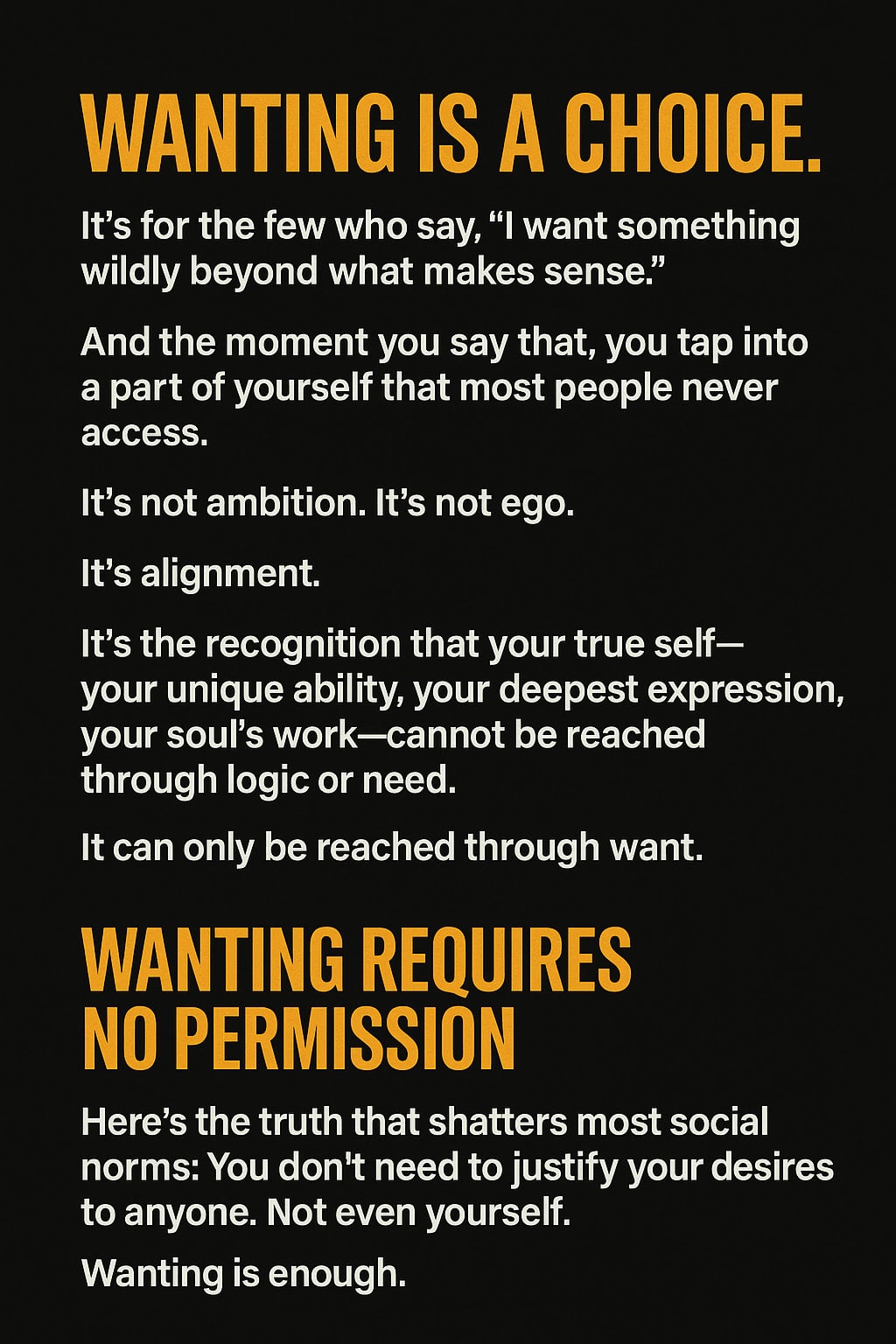
Wanting is a Choice.
It’s for the few who say, “I want something wildly beyond what makes sense.”
And the moment you say that, you tap into a part of yourself that most people never access.
It’s not ambition. It’s not ego.
It’s alignment.
It’s the recognition that your true self—your unique ability, your deepest expression, your soul’s work—cannot be reached through logic or need.
It can only be reached through want.
Wanting Requires No Permission
Here’s the truth that shatters most social norms:
You don’t need to justify your desires to anyone. Not even yourself.
Wanting is enough.
This is terrifying for the needers. Because if you don’t justify your wants… they can’t argue with you. They can’t out-reason you.
Provocative Questions for Bold Leaders
To provoke deeper reflection, consider these questions:
What audacious goal would you declare if feasibility wasn’t a factor?
How many of your current goals are set out of obligation rather than genuine desire?
If your entire team started openly expressing ambitious wants, how would your organizational culture change?
For political leaders: If your leadership were guided by bold desire rather than public expectations, how differently would you act?
Ultimately, leadership is about envisioning beyond the visible, feasible, and practical. Ask yourself—and dare to answer honestly—what do you truly want?
There’s something I need every founder, every entrepreneur, every CEO out there to hear—clearly, directly, and without any fluff:
I will never give up on you.
Even when you want to give up on yourself.
Even when you’re too tired to care.
Even when you feel like a failure and all you want to do is disappear.
Because I’ve been there. Not in your exact shoes, maybe, but in that same space—where the world feels heavy, the pressure won’t let up, and you start wondering if any of it is worth it. I’ve walked through those lonely corridors, and I know exactly how quiet it gets when things start to fall apart.
And that’s the moment where most people will walk away.
But that’s exactly where I step in.
The Founder Who Was Ready to Shut It All Down
A few weeks ago, I had a call with a founder I’ve been coaching for a while. This is not a small-time entrepreneur. He runs a company with 120 people—an ambitious, growing business that’s already scaled more than 50% since we started working together.
But now, things were tight.
He said to me, “We’ve got maybe a month of runway left. We’re thinking about cutting everything. Even coaching.”
I listened. He didn’t say it out of anger or blame. He said it from exhaustion. From overwhelm. From embarrassment. From fear. The kind of fear that hits you when you’ve been holding everything up for too long, and you’re finally too tired to fake it anymore.
And I told him what I want to tell every founder who hits that moment:
“You don’t need to feel ashamed. You don’t need to feel guilty. And you’re not getting rid of me that easy. I’m not here for your money. I’m here for your future.”
I meant every word of that. If I have to write off a payment, I’ll do it. But if you think I’m only doing this because of the payment—then you’ve missed who I am.
I Know What It Feels Like to Stand Alone
Here’s why this matters to me so much.
Growing up, I didn’t have people standing behind me. I didn’t have mentors. I didn’t have powerful role models telling me I could do something great. I didn’t have anyone offering to walk with me through fire.
Except for my parents.
They didn’t have a lot, but they believed in me with everything they had. They stood behind me even when I doubted myself. They stood behind me when I failed, when I struggled, when I couldn’t see anything in myself worth standing for.
And I remember thinking—if I didn’t have them, I would’ve collapsed. Completely. I wouldn’t have made it through the tough times. I wouldn’t have found my voice. I wouldn’t be doing this work today.
So now, when I see a founder on the edge—when I see someone doing everything they can to hold up their company, their team, their vision—and I see them standing there alone…
That’s not okay with me.
You Don’t Need Advice—You Need Someone Who Would Always Have Your Back
The world is full of advisors. Consultants. Gurus.
People who will gladly “support” you as long as you’re doing well, as long as the revenue’s climbing, as long as it looks good on a LinkedIn post.
But when the pressure hits? When the numbers dip? When you feel like you’re drowning?
Most of them vanish.
What I offer is different.
You don’t hire me for advice.
You hire me because when everything feels like it’s falling apart, I’m still here. Still with you. Still fighting for your future.
And when everything is going well, I will challenge you to dream even bigger. I am the one who will ask – “If you can do this, then what else can you do?”
Here’s What Happened
That same founder who was ready to cancel everything—I asked him a question that changed the tone of the entire conversation.
I said, “What would be a dream outcome in the next 30 days?”
Not a practical one. Not a “just survive” scenario. A dream. A miracle.
And he paused. He hadn’t let himself think like that in weeks.
Then I asked him, “Who on your team needs to rise up right now?”
He gave me three names.
And I said, “Great. Let’s build a plan. Use me. Use my time. Use my resources. Let’s create something that not only gets you through the next 30 days—but changes the trajectory of this company forever.”
That was the turning point.
Not because I had a magic answer.
But because I refused to see him as broken or weak or “just surviving.”
I saw him as an entrepreneur. A leader. A creator. And I spoke to that part of him.
That’s what I do.
I have got your back
This Is Bigger Than You
Founders often forget how much is riding on them—not just revenue and metrics, but people. Culture. Families. Purpose.
When you rise, your team rises.
When you remember who you are, others follow.
And when you give up—know that it doesn’t just affect you.
But this is not pressure. This is purpose. With great powers come great responsibility.
This is your invitation to lead from a deeper place.
Not fear.
Not scarcity.
But vision. Belief. Commitment.
Why I’ll Never Give Up On You
Here’s the truth: You can ghost me.
You can miss payments.
You can tell me you’ve lost faith.
You can fall flat on your face.
I’ll still be here. Not chasing you. Not dragging you. But standing right where I’ve always stood—until you’re ready to rise again.
Because I will never give up on you.
Even when you’ve given up on yourself.
And that’s not a branding line.
That’s my life. That’s my stand. That’s who I am.
I’m here because I know what it feels like to be left alone.
And I refuse to let that happen to you.
If you’re a founder right now and you’re struggling—emotionally, financially, mentally—I need you to hear this:
You’re not weak. You’re not broken. And you’re not alone.
You don’t need to hide.
You don’t need to delay.
You don’t need to shut down.
You need to reach out.
You need to rise.
You need to remember who the hell you are.
And if you forget—I’ll remind you.
That’s why I’m here.
This is not my business. This is not a service. This is not a transaction.
This is my life’s work.
I will never give up on you.
Even when you want to give up on yourself.
Because I’m not here for your money. I am here for your impact. I am here for your potential.
Have you ever noticed how some leaders seem to create results out of thin air while others struggle to move the needle despite working twice as hard?
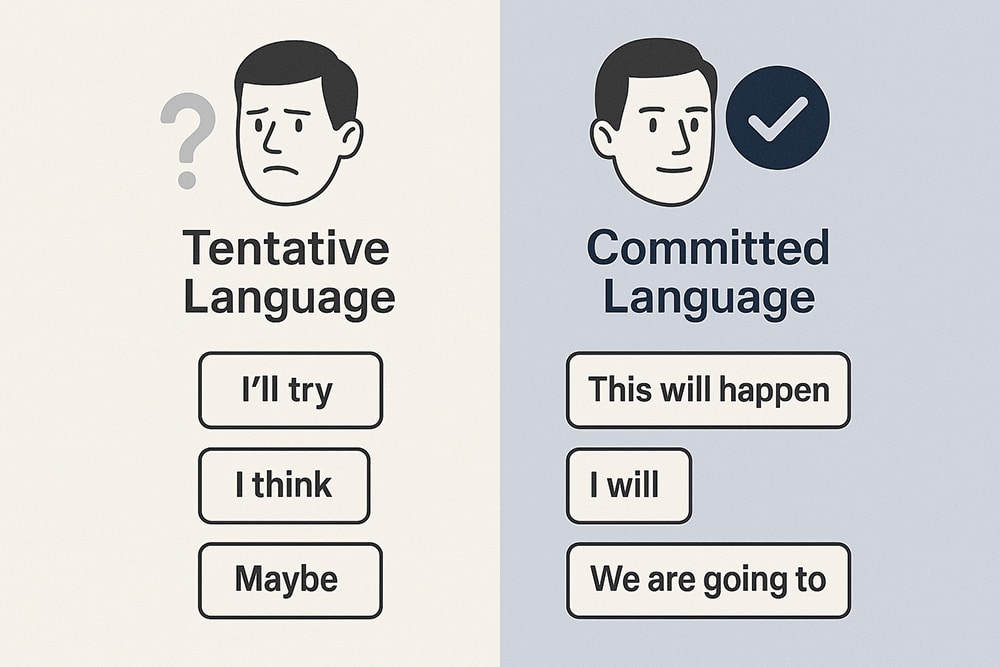
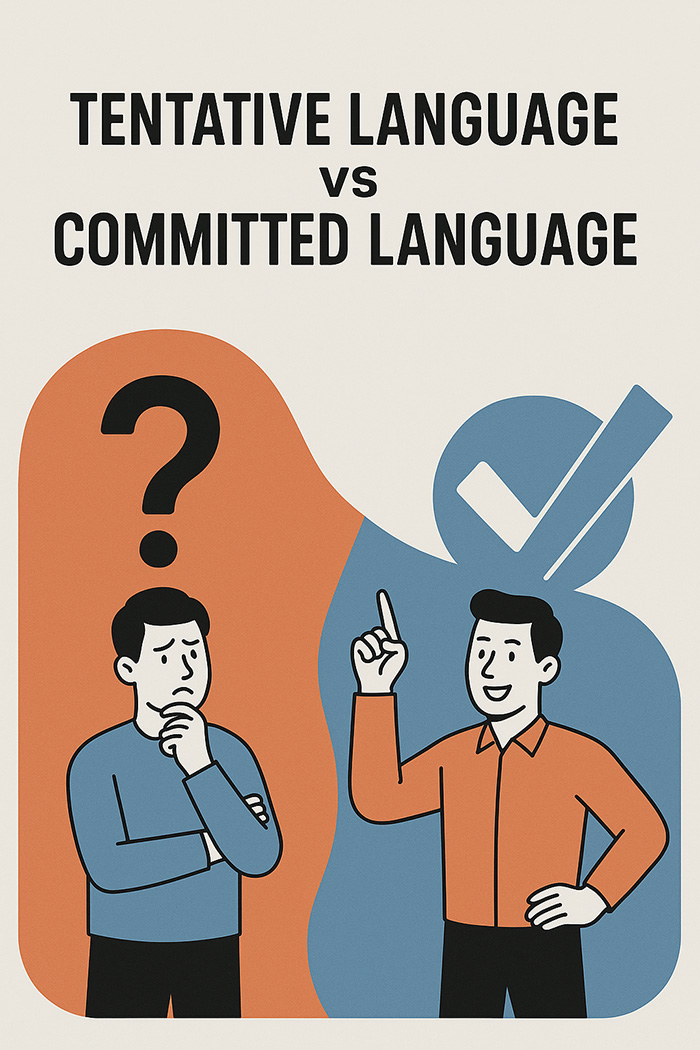
The difference often isn’t found in their strategies, intelligence, or even work ethic. It’s hidden in their language – specifically, whether they speak and then act with commitment or tentativeness when addressing the future.
Let me share what I witnessed in a fascinating leadership session that revealed this crucial distinction. A group of managers was exploring why they habitually used phrases like “I’ll try,” “I hope,” or “Let me see what I can do” – even when they fully intended to complete the task.
Their answers revealed something profound about how most of us operate:
“I’m buying time to make sure I can deliver.” “I don’t want to disappoint people if I can’t follow through.” “I’m avoiding taking full responsibility.” “I’m protecting myself from looking wrong.”
Sound familiar? These are the unconscious calculations we make dozens of times daily.
But here’s the twist: these seemingly harmless verbal cushions aren’t just communication quirks – they fundamentally shape how we think, act, and ultimately, what we achieve.
The Hidden Cost of “I’ll Try”
When you say “I’ll try” instead of “I will,” you’re not just being cautious. You’re unconsciously programming your mind and actions for uncertainty. This tentative language carries hidden costs:
Mental burden and constant background stress
Scattered attention and divided focus
Lower productivity and action velocity
More time spent in indecision and doubt
Uncertainty for everyone involved
As one participant confessed: “When I say I’ll try, I end up working overtime to accommodate everything, constantly juggling priorities, and feeling perpetual stress because I’m not clear about what I’m fully committing to.”
Another revealed: “I find myself overthinking and second-guessing instead of just executing. It’s exhausting.”
These aren’t just personal inconveniences. They represent a massive tax on your leadership energy – energy that could be directed toward creating breakthrough results.
It is not just Semantics
Language shapes thought. Thought drives action. Action creates results. This causal chain, supported by decades of neurolinguistic research, explains why the words leaders choose don’t merely describe their intentions—they fundamentally shape what becomes possible for themselves and their organizations.
As Dr. Guillaume Thierry notes in his groundbreaking research on neurolinguistic relativity, “Language influences—and may be influenced by—nonverbal information processing.” This isn’t about linguistic tricks or superficial changes to your vocabulary. It’s about understanding and harnessing the profound connection between language, thought, and action—a connection that lies at the heart of truly transformational leadership.
When a leader says “We will launch this product by Q3,” they’re not just making a prediction—they’re performing what linguists call a “commissive speech act” that creates a social commitment. This commitment changes the relationship between the speaker and listeners, establishing new expectations and permissions that shape subsequent behavior.
In contrast, when a leader says “We hope to launch this product by Q3,” they’re performing what linguists call an “expressive speech act” that merely describes their current mental state without creating new social commitments. This distinction explains why teams respond so differently to committed versus tentative leadership language—the former creates new social realities that drive action, while the latter merely comments on existing realities.
The Liberation of Clear Commitment
Now consider the alternative. What happens when you simply say “This will happen” or “I will deliver this” – even before you have all the evidence that you can?
The same participants described:
Mental clarity and inner peace
Heightened productivity
Optimal use of time
A healthier communication environment
Faster, more decisive action
One leader noted: “When I commit clearly, I don’t waste time debating with myself. I just find a way to make it happen.”
This is the power of committed language – it creates a different foundation from which you operate and take action. Instead of waiting for certainty before committing, you commit first and then create the certainty through your actions.
When leaders use committed language, they’re not just expressing confidence—they’re creating psychological conditions that automatically trigger action when relevant situations arise, without requiring additional decision-making or motivation.
The psychological power of committed language extends beyond individual cognition to social dynamics. Dr. Robert Cialdini, whose research on influence has transformed our understanding of persuasion, identifies commitment and consistency as one of the fundamental principles of human behavior. Once people make a clear commitment, they experience both internal and external pressure to behave consistently with that commitment.
This commitment-consistency principle explains why leaders who make clear, public commitments using committed language are significantly more likely to follow through than those who use tentative language. The psychological and social forces activated by committed declarations create momentum toward the declared outcome that tentative statements simply cannot generate.
At this point, you might be thinking: “But what if I commit and fail? Isn’t it more honest to say I’ll try?”
This is where courage enters the picture. The truth is, there’s no evidence in the future – only in the past. When you commit to something unprecedented, something you’ve never done before, you’re stepping into territory where failure is possible.
Most people avoid this risk at all costs. They want guarantees before they commit. But that’s precisely why most people don’t create extraordinary results.
Leaders who produce unprecedented outcomes understand a fundamental truth: commitment precedes evidence. They don’t wait for proof they can deliver before they commit – they commit first, then find a way to deliver.
Fear of Disappointment: Many leaders use tentative language to manage expectations—both their own and others’. By saying “I’ll try” rather than “I will,” they create a psychological buffer against the pain of disappointing themselves or others if they fail to deliver.
James, a senior executive at a technology company, recognized this pattern in himself: “I realized I was saying ‘I’ll try’ even when I fully intended to complete the task. It was a way of giving myself an out, of protecting myself from the potential disappointment of failure.”
Fear of Judgment: Leaders often worry that clear commitments will expose them to harsher judgment if they fall short. Tentative language creates plausible deniability—”I only said I would try”—that shields them from full accountability.
Research in social psychology confirms this dynamic. A study published in the Journal of Personality and Social Psychology found that individuals who used tentative language were judged less harshly for identical failures than those who had made clear commitments. This creates a perverse incentive for leaders to hedge their language, even when doing so undermines their effectiveness.
Fear of the Unknown: Perhaps most fundamentally, leaders fear committing to outcomes when they cannot see the full path to achievement. This fear of the unknown drives them toward tentative language that preserves optionality and avoids the discomfort of certainty in uncertain conditions.
Dr. Carol Dweck’s research on mindset provides insight into this fear. Leaders with a fixed mindset—who believe capabilities are static rather than developable—are particularly prone to fear of the unknown. They worry that they may not have the skills or resources to fulfill clear commitments, so they hedge with tentative language.
The Paradox of Leadership Fear
The paradox of leadership fear is that the very language patterns that protect leaders from these fears also prevent them from achieving their full potential. By using tentative language to avoid the risk of being wrong, leaders create conditions that make success less likely and limit what’s possible for themselves and their organizations.
This creates a self-reinforcing cycle: fear leads to tentative language, which leads to diminished results, which reinforces the fear that clear commitments are too risky. Breaking this cycle requires understanding that the apparent safety of tentative language is illusory—it protects you from the risk of being wrong at the cost of ensuring you’ll never be transformatively right.
The Two Operating Systems
Think of these approaches as two distinct operating systems for leadership:
Operating System 1: Evidence-Based Commitment
Wait for evidence before committing
Use tentative language to protect yourself
Avoid disappointing others
Reduce risk of being wrong
Create predictable, incremental results
Operating System 2: Commitment-Based Evidence
Commit first, then create the evidence
Use clear, direct language
Accept that some may be disappointed
Accept the risk of being wrong
Create unprecedented, breakthrough results
Most leaders operate exclusively in System 1. They believe it’s the only responsible way to lead. But what they don’t realize is that System 1 has built-in limitations – it can only produce results that are extensions of what’s already been done.
System 2 is where unprecedented results come from. It’s where you find the leaders who transform industries, redefine what’s possible, and create outcomes that seemed impossible before they arrived.
The Language Patterns of Each System
The distinction between these operating systems is most clearly revealed in language patterns. Leaders operating in Evidence-Based Commitment tend to use:
Conditional statements: “If X happens, then we’ll do Y”
Probability-based phrasing: “There’s a good chance,” “It’s likely that”
Hedging qualifiers: “Assuming all goes well,” “Barring unforeseen circumstances”
In contrast, leaders operating in Commitment-Based Evidence consistently employ:
Declarative statements: “We will,” “This is going to happen”
Time-bound commitments: “By this date,” “Within this timeframe”
Certainty-based phrasing: “This will work,” “We are going to succeed”
Unequivocal language: “No matter what,” “Whatever it takes”
These language patterns aren’t merely stylistic differences—they reflect and reinforce fundamentally different approaches to leadership and possibility. By becoming aware of your own language patterns, you can begin to shift from System 1 to System 2 in the areas where breakthrough results matter most.
The Personal Challenge
One participant shared his personal struggle with this concept:
“I have a long history of blaming myself when things go wrong. I worry that if I commit strongly and then fail, I’ll spiral into self-blame.”
This is a legitimate concern. But notice what’s happening here – the fear of future self-blame is preventing bold commitment in the present.
The solution isn’t to avoid commitment. It’s to develop a healthier relationship with mistakes and failures. As this leader discovered, daily practice in reframing mistakes as learning opportunities gradually reduced his tendency toward self-blame.
He shared: “I started practicing positive daily declarations and focusing on what I can learn from mistakes rather than internalizing them. This has drastically reduced my stress and improved my productivity.”
This inner work is essential. You cannot speak with powerful commitment externally if you’re plagued by self-doubt and harsh self-judgment internally.
Distinguishing Accountability from Self-Blame
A critical distinction for leaders developing the courage for committed language is between healthy accountability and unhealthy self-blame. Both involve taking responsibility for outcomes, but they create fundamentally different psychological conditions for committed language.
The Neuroscience of Self-Blame
Neuroscience research reveals that self-blame activates brain regions associated with shame and avoidance, creating a neurological state that naturally drives tentative rather than committed language. When leaders engage in self-blame after failures, they neurologically prime themselves to hedge future commitments.
In contrast, healthy accountability activates brain regions associated with problem-solving and approach motivation, creating a neurological state conducive to clear, decisive action.
When to Say No
Another crucial aspect of committed language is learning to say a clean, clear “no” when appropriate.
One leader confessed: “I say ‘I’ll try’ when I actually want to say no, because I don’t want to hurt or disappoint people.”
This is where empathy without authenticity becomes weakness. When you say “I’ll try” instead of “no,” you’re not being kind – you’re being unclear. You’re creating false hope and ultimately more disappointment than a clear no would have caused.
“Empathy without authenticity is weakness. Leadership is doing what is required, not what is easy.”
A clean no is far more respectful than a vague, uncommitted maybe. It allows the other person to make clear decisions based on accurate information rather than false hope.
The False Kindness of “Maybe”
When faced with requests they don’t intend to fulfill, many leaders default to tentative responses: “Maybe later,” “I’ll see what I can do,” or “Let me think about it.” They believe these responses are kinder than a direct “no,” sparing the requester immediate disappointment.
This belief, while well-intentioned, reflects what psychologists call the “empathy-accuracy trade-off”—the mistaken assumption that being kind requires being vague or even misleading. Research in communication psychology reveals that this approach actually creates more harm than good.
Dr. Brené Brown, whose research focuses on vulnerability and leadership, explains: “Clear is kind. Unclear is unkind. When we use vague, tentative language instead of a direct ‘no,’ we’re not being kind—we’re avoiding our own discomfort at the expense of the other person.”
This avoidance creates several significant problems:
False hope: The requester often interprets tentative language optimistically, creating expectations that will eventually be disappointed.
Wasted energy: Without clear boundaries, requesters may continue investing time and emotional energy pursuing something that won’t happen.
Delayed disappointment: The disappointment isn’t eliminated—it’s merely postponed, often to a point where the stakes and expectations are higher.
Eroded trust: When patterns of tentative “maybes” consistently become eventual “nos,” trust in your communication deteriorates.
The Practice of Commitment
Transforming your language from tentative to committed isn’t an overnight change. It’s a practice – one that feels uncomfortable at first, especially if you’ve spent years or decades operating from System 1.
Here’s how to begin:
Notice your language patterns. Pay attention to how often you say “I’ll try,” “I hope,” or “Let me see.” Just observing these patterns creates awareness.
Start with low-stakes commitments. Practice committed language in areas where the consequences of failure are minimal. This builds your comfort with commitment.
Examine your fears. When you catch yourself using tentative language, ask: “What am I afraid might happen if I commit clearly here?”
Separate identity from outcomes. Remember that failing at something doesn’t make you a failure. It makes you someone who took a risk.
Create morning intentions. As one participant shared: “I write down my intentions for the day – how I want to show up, what I’m committed to accomplishing. This primes my mind for clear commitment.”
The Leadership Choice
Every day, in countless conversations, you choose how you’ll speak about the future. Most of these choices happen unconsciously, driven by habits and fears you may not even recognize.
But now you have a choice. You can continue operating exclusively from System 1 – waiting for evidence before committing, protecting yourself from being wrong, and creating predictable results.
Or you can begin incorporating System 2 – committing before you have all the evidence, accepting the risk of being wrong, and creating the possibility of unprecedented outcomes.
This isn’t about abandoning careful thinking or responsible planning. It’s about recognizing that for the results that matter most – the breakthrough innovations, the transformative changes, the unprecedented achievements – commitment must precede certainty.
The Spectrum of Commitment
It’s worth noting that this isn’t an all-or-nothing proposition. You don’t have to commit with absolute certainty to everything. Think of it as a spectrum:
For routine, low-impact decisions: Your habitual approach may work fine
For moderate-impact decisions: Consider more committed language
For high-impact, transformative goals: Full commitment is essential
I’m not asking you to jump totally to committed language for everything. But for the things that matter, for the results that matter, you commit. And yes, you can be wrong. And that’s the cost of taking on any big game.
Your Unprecedented Future
Look at the goals you’re currently pursuing. The ones that really matter. The ones that would transform your leadership, your organization, or your life.
Now ask yourself honestly: Am I speaking about these goals with committed language or tentative language?
Am I saying “I’ll try to hit our targets” or “We will hit our targets”?
Am I saying “I hope to transform our culture” or “I will transform our culture”?
Am I saying “Let’s see if we can innovate” or “We will innovate”?
The difference may seem subtle, but it’s everything. In that small linguistic gap lies the difference between leaders who manage the status quo and leaders who create new realities.
The Time for Commitment
Most of us have been conditioned to believe that certainty should precede commitment – that we should only promise what we’re already certain we can deliver.
But that approach has built-in limitations. It confines you to the realm of the proven, the established, the already-done. It makes unprecedented results impossible by definition.
The greatest leaders throughout history have operated differently. They committed to outcomes that seemed impossible at the time:
Landing on the moon before the technology existed
Creating computers that fit in our pockets before the components were invented
Building electric vehicles viable for mass markets before the infrastructure was in place
None of these commitments were “reasonable” when they were made. All required their leaders to stand in a place of commitment before evidence existed.
You have this same power available to you right now. The power to commit to a future that doesn’t yet exist – and through that commitment, begin creating it.
Yes, you might be wrong sometimes. Yes, you might disappoint people occasionally. Yes, you might look foolish in the eyes of those who operate solely from System 1.
But you also might create something unprecedented – something that changes everything.
Isn’t that possibility worth the risk?
The Choice Before You
So here’s the invitation: Choose one important goal – something that matters deeply to you, something that would represent a breakthrough in your leadership or organization.
Now, how do you speak about this goal? With tentative, cautious language? Or with clear, committed language?
If you’re like most leaders, you’ve been operating from System 1 – waiting for certainty before committing. That’s not wrong, but it is limiting.
What would happen if you shifted to System 2 for this one crucial goal? If you spoke with commitment before you had all the evidence? If you said “This will happen” instead of “We’ll try to make this happen”?
You might fail. You might be wrong. You might disappoint yourself or others.
Or you might create something unprecedented – something that changes everything.
The choice is yours.
The journey of committed language begins with a single, powerful choice: the decision to speak with clarity and certainty about the future you will create. This choice—to replace “I’ll try” with “I will”—seems simple on the surface but represents a profound shift in how you relate to possibility, responsibility, and your own capacity for impact.
In making this choice, you join a lineage of transformational leaders throughout history who have used the language of commitment to create unprecedented futures. From Churchill’s defiant “We shall never surrender” to Kennedy’s bold “We will go to the moon” to your own declarations about what will happen in your organization, committed language (or the lack of it) shapes your future.
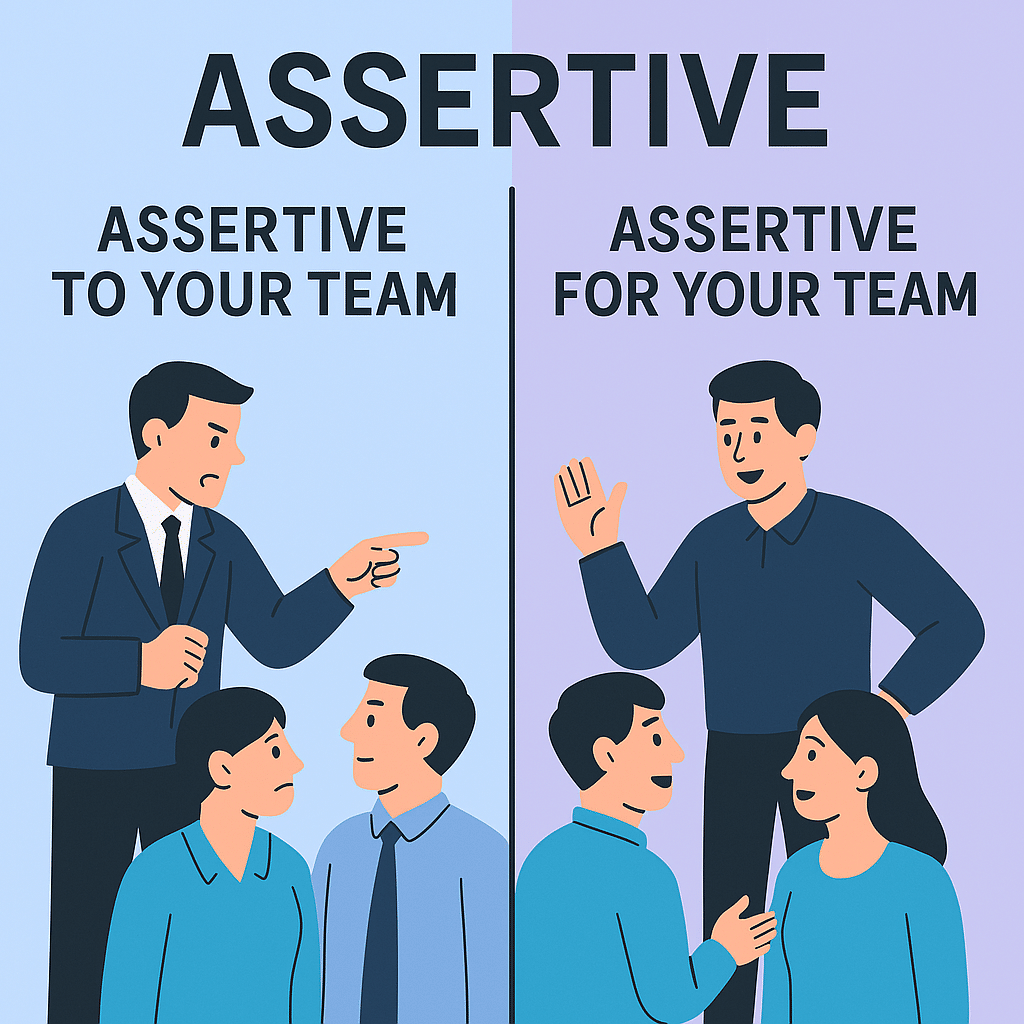
Being Assertive to Your Team vs. Being Assertive for Your Team
In the high-stakes world of executive leadership, how CEOs interact with their leadership teams can make or break an organization’s success. Many CEOs struggle with finding the right balance of assertiveness—push too hard, and you risk creating a culture of fear and compliance; be too passive, and decisions stall while accountability fades.
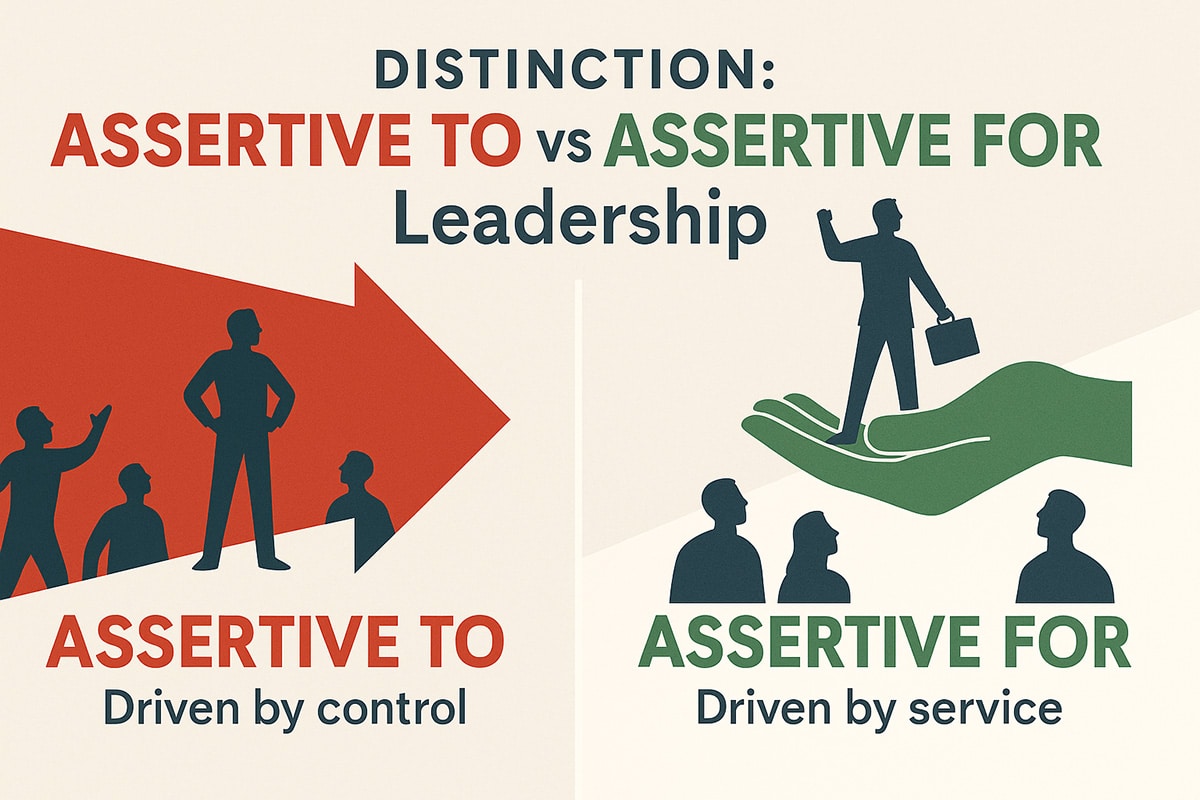
The key distinction that separates truly transformative leaders from merely effective managers lies in understanding the difference between being assertive to your team versus being assertive for them. See below:
Assertive To Your Team
Assertive For Your Team’s Growth
Mindset
“I need to be in control.” Driven by fear of failure or losing authority Measures success by compliance Worried about what others might think about you
“I want them to step into leadership.” Driven by trust in people’s growth potential Measures success by ownership and initiative Sees assertiveness as a gift to their people’s growth
Communication Style
Directive: “Do this now.” Corrects mistakes immediately Talks at the team
Ask questions supportively: “What’s your approach?” Creates space for reflection and learning Talks with the team, listens deeply
Conflict & Accountability
Blames or points fingers Uses pressure to drive results Reacts emotionally to errors
Holds space for difficult conversations with care Uses clarity and agreements to foster accountability Responds by coaching through the issue
Long-Term Impact
Creates dependency on you Limits innovation & experimentation Exhausts you & bottlenecks scale
Builds leaders who operate without you Encourages ownership and initiative Frees you to lead the company forward
Assertive TO your team
This approach positions the CEO and their leadership team in a subtle but problematic dynamic:
The CEO pushes for results and compliance
Team members focus on meeting expectations rather than solving core problems
Executives filter information to align with what they think the CEO wants to hear
The CEO receives incomplete or sanitized information
Strategic decisions suffer from limited perspective and insufficient challenge
The cycle continues, reinforcing superficial alignment rather than genuine commitment
This dynamic creates fundamental organizational tension. Senior leaders sense they’re being directed rather than developed, managed rather than led. Even when they verbally commit to initiatives, their internal commitment may be lacking, leading to what looks like agreement in meetings but manifests as delayed implementation afterward.
When CEOs are assertive TO their teams in this manner, they:
Generate compliance without commitment
Create environments where people manage up rather than speak truth
Discourage the healthy conflict necessary for optimal decisions
Receive superficial agreement followed by passive resistance
Foster a culture where meetings result in vague action items rather than clear decisions
Being Assertive For Your Team
The alternative approach—being assertive for your leadership team—fundamentally reframes the relationship and purpose of executive interactions. This mindset sees the CEO’s primary responsibility not as directing outcomes but as creating conditions for clear decisions, genuine commitment, and leadership development.
When a CEO is assertive for their team, they:
Challenge indecision and avoidance patterns: By refusing to accept vague commitments or endless analysis, they help executives break through organizational inertia and personal risk aversion.
Demand clarity rather than specific outcomes: The goal isn’t to force agreement with the CEO’s preferred solution but to eliminate the middle ground of “maybe” that keeps organizations stuck.
Hold leaders accountable to their own stated values and goals: If an executive has committed to certain priorities or principles, the CEO reminds them of these commitments when conflicting behaviors emerge.
Force organizational truth-telling: By asking penetrating questions, they help the leadership team confront uncomfortable realities rather than hiding behind comfortable narratives.
Provide structure for consequential decision-making: Many leadership teams struggle with decisions not because they lack information but because they lack frameworks for evaluation and the courage to commit to difficult choices.
A Common Objection to Assertiveness – Empathy
There is a common objection that stops people from being assertive. It is the fear that “I am not being empathetic if I am completely honest and assertive” or “I will not be authentic if challenge that person more. And I understand their point of view.”
Let me tell you something in a no-nonsense way.
Empathy is a powerful leadership skill.
BUT
Empathy without authenticity is just weakness.
It is cheating yourself of your own dreams and values.
It is cheating the other person of your honest opinion and what you have to offer to them (by being authentic or assertive).
Leaders Lead.
And Leaders lead in a way that not only helps them but also inspires and teaches those around them.
If you can be authentic and assertive (while still being empathetic) that is your leadership – for yourself and for others too.
When you are fully authentic, even when it gets uncomfortable, you are setting an example and a high-bar – for yourself and others.
This is why you are here. This is why you are reading this article.
The Distinction in Practice
1. Detailed questioning about implementation plans rather than making judgements
Rather than accepting “We’ll look into it” or “We’ll report back next quarter,” the CEO who is assertive for their team asks:
“What specifically will you be doing between now and our next meeting?”
“What metrics will tell us whether this approach is working?”
“What obstacles do you anticipate, and how will you address them?”
“When exactly will key milestones be reached?”
“How will you communicate progress to the rest of the organization?”
These questions aren’t designed to micromanage but to create clarity and structure around execution.
2. Challenging unnecessary delays in decision-making with curiosity instead of blame
When an executive suggests an extended timeframe for making a strategic decision, the CEO might ask:
“You mentioned needing another month for analysis. What specific information will that additional time provide?”
“We’ve been discussing this issue for the past three quarters. What is preventing us from deciding today?”
“If we truly believe this is the right strategic direction, why would we delay implementation by six weeks?”
These challenges aren’t about rushing decisions but about exposing organizational patterns of avoidance that keep companies from necessary action.
3. Explicit acknowledgment of team and organizational patterns
A CEO being assertive for their leadership team might say:
“I notice we’ve had this same conversation in our last three quarterly reviews. What’s really preventing us from moving forward?”
“Do you recognize that the hesitation we’re seeing reflects the same pattern that delayed our last major initiative?”
“Would you agree that our collective tendency to seek perfect information has cost us market opportunities in the past?”
This approach helps leadership teams see their own behavioral and decision-making patterns more clearly.
4. Forcing explicit choice helps grow others as leaders
Perhaps most powerfully, being assertive for a leadership team means requiring them to make explicit choices between clear alternatives:
“We have two options: commit fully to this market entry strategy with all its risks, or explicitly decide to focus elsewhere. Which are we choosing today?”
“I need a clear decision: either we’re restructuring this division now, or we’re consciously deciding to maintain the current structure despite its challenges.”
“There’s no middle ground here. Either we’re going to invest at the level required for success, or we’re going to exit this business. Which is it?”
This isn’t dictatorial—it’s clarifying. It forces leadership teams to confront the reality that not deciding is itself a decision with consequences.
5. Distinguishing between dialogue and decision
CEOs who are assertive for their teams clearly delineate when conversations are exploratory versus when they require resolution:
“We’re in exploration mode for the next 30 minutes. All ideas are welcome without judgment.”
“We’re now shifting to decision mode. We need to leave this room with a clear choice.”
“This topic requires a decision today. If we can’t reach consensus in the next hour, I’ll make the call, but I’d prefer we arrive there together.”
This clarity about conversation mode prevents the common pattern of endless discussion without resolution.
The Results of This Shift
When CEOs master the art of being assertive for their teams rather than to them, several transformative organizational shifts occur:
Decision velocity increases dramatically: Issues that previously cycled through multiple meetings reach resolution in a single discussion.
Implementation improves: When leaders make clear, specific commitments in front of peers, follow-through improves dramatically.
Strategic clarity emerges: By forcing explicit choices between competing priorities, the organization develops sharper focus.
Leadership capacity expands: Team members develop greater decision-making confidence and skill through the CEO’s modeling.
Organizational politics decrease: When ambiguity is eliminated, the space for political maneuvering shrinks.
The Cultural Dimension
Being assertive for your team rather than to them transforms organizational culture in profound ways:
Truth-telling becomes normalized: When the CEO consistently demands clarity, honesty gradually displaces political calculation.
Respect for leadership deepens: Leaders who challenge their teams to be their best selves, even when uncomfortable, earn deeper respect than those who manage through authority alone.
Psychological safety paradoxically increases: Though the conversations may be more challenging, executives feel safer knowing where they stand and what’s expected.
Decision ownership becomes distributed: When leaders make clear commitments of their own volition (even if prompted), they take ownership of outcomes rather than merely executing the CEO’s will.
Organizational maturity accelerates: The entire leadership system develops greater capacity for handling complexity and ambiguity when clarity of process is demanded.
Implementing the Shift
For CEOs looking to make this crucial shift from being assertive to their teams to being assertive for them:
Examine your relationship with control: Can you genuinely focus on decision quality and clarity rather than directing specific outcomes?
Develop comfort with tension: Practice maintaining productive discomfort in meetings rather than relieving tension prematurely.
Master the art of powerful questions: Learn to ask questions that reveal underlying assumptions and force clarity rather than questions that lead to predetermined answers.
Recognize that your attention is your most powerful tool: What you consistently ask about and focus on will shape your organization more than what you direct.
Lead through curiosity rather than certainty: Position yourself as the chief question-asker rather than the chief answer-provider.
The Broader Impact
This leadership approach extends far beyond the executive suite. When CEOs model being assertive for rather than to their teams:
The pattern cascades: Senior leaders begin using similar approaches with their own teams.
Organizational decision-making improves at all levels: The clarity and commitment modeled at the top becomes the standard throughout.
Talent retention strengthens: High performers are drawn to environments where clarity and decisive action are valued.
Strategic execution accelerates: The gap between decision and implementation narrows dramatically.
Innovation thrives: When leaders know that clear decisions will be made and supported, they’re more willing to propose bold ideas.
The distinction between being assertive to versus for your leadership team may appear subtle, but its organizational impact is profound.
By shifting from a posture of directing outcomes to one of demanding clarity and commitment, CEOs transform from perceived taskmasters to developmental catalysts. They help their leadership teams break through their own avoidance patterns while establishing the conditions for truly distributed leadership.
In an era of unprecedented complexity and rapid change, this approach cuts through organizational noise and politics. It respects leaders’ agency while refusing to enable the indecision that keeps organizations stuck. And it creates the foundation for authentic executive teams based on truth-telling rather than impression management—a foundation that serves both immediate business outcomes and long-term organizational health.
I was born and raised in India, an introverted child who thought deeply about the world. Like many others, I followed the “safe” path. I became an engineer. I built a successful 16-year career in tech. I relied on structure, planning, and logic.
But something was missing.
I felt a pull toward making a greater impact as far as I can remember. The safe path wasn’t enough.
First, I started two startups and then a social impact NGO in India. Later, I moved to the Netherlands. Finally, after 16 years of stability, I finally walked away from my high-paying job. I took a leap into the unknown to do what I do today.
There was no roadmap. No guarantees. Just a deep commitment to bringing people together and to bring meaning, joy and fulfilment back to workplaces.
The Discomfort of Saying “No”
The most challenging part of making a bold commitment is the willingness to eliminate everything that can’t grow exponentially with you—even if that means letting go of what brought you success so far. This creates significant discomfort that most people avoid.
When you say “no” to opportunities that once seemed valuable, you’ll feel the pain of potential loss. When you step away from projects that interested you but don’t serve your core focus, you’ll question your decision. When you distance yourself from relationships that drain rather than energize you, you’ll feel guilty. These uncomfortable feelings are natural and inevitable.
The discomfort comes from several sources:
Fear of missing out: Each “no” feels like closing a door that might have led somewhere good.
Identity confusion: Saying “no” to things you’ve always done challenges your sense of self.
Social pressure: Others won’t understand your choices and may try to pull you back to your old ways.
Uncertainty: The path of bold commitment doesn’t offer guarantees, while the familiar path feels safer.
Yet this discomfort is precisely what drives your growth.
Leaving my career wasn’t easy. It meant saying “no” to security. It meant disappointing current and past colleagues who didn’t understand. It meant facing my own fears of failure.
Every “no” felt uncomfortable. When I turned down consulting opportunities to focus on my coaching practice, my bank account suffered. When I declined social invitations to develop my methods, friendships were tested. When I set boundaries with clients who wanted the old way of leadership, I risked rejection.
Each “no” was painful. But each “no” was necessary.
I discovered something powerful in this discomfort. Each difficult “no” strengthened my commitment. Each uncomfortable choice clarified my vision. Each time I disappointed others to honor my deeper purpose, I became more authentic.
The discomfort didn’t just lead to better results. It transformed me.
Focusing on What Truly Matters
I became obsessed with understanding momentum. I studied what makes leaders grow fast versus stay stuck. I did deep inner work through silence, meditation, and coaching. I faced my fears head-on.
This obsessive focus required eliminating distractions. I couldn’t be everything to everyone anymore. I had to concentrate on what truly mattered: transforming leadership.
Within four years, I built a coaching practice that stood out. I began working with top entrepreneurs and CEOs, helping them scale beyond €100M. I ran transformational retreats and experiences for leadership teams – 1 in 2022, 2 in 2023 and 9 in 2024 alone. I had never done anything like that ever before.
None of this would have happened if I had kept saying “yes” to everything.
How Discomfort Transforms You
The discomfort of saying “no” doesn’t just lead to better results—it transforms you as a person. This transformation happens in several ways:
Increased self-awareness: When saying “no” is difficult, you’re forced to examine why. This examination reveals your fears, attachments, and hidden motivations.
Greater emotional resilience: Each time you face the discomfort of saying “no,” you build emotional muscles. The discomfort never disappears completely, but your capacity to bear it grows substantially.
Clearer values: Saying “no” requires knowing what you’re saying “yes” to. This process forces you to clarify what truly matters to you.
Authentic relationships: When you say “no” to activities and relationships that don’t align with your core focus, you create space for deeper connections with those who truly support your vision.
Increased confidence: Each time you make a difficult choice that honors your commitment, your confidence grows. You begin to trust yourself more deeply.
The person who left that engineering job is not the same person writing these words today. The transformation goes far beyond my professional achievements.
I developed greater self-awareness. Each difficult “no” forced me to examine my motives. Why was saying “no” so hard? What attachments were holding me back?
I built emotional resilience. The discomfort of disappointing others never disappeared completely. But my capacity to bear this discomfort grew substantially.
My values became clearer. Saying “no” required knowing what I was saying “yes” to. This process forced me to clarify what truly mattered to me.
My confidence grew. Each difficult choice that honored my commitment built trust in myself. I began making decisions more quickly and with greater conviction.
Pushing Beyond Comfort Zones
Today, I push leaders beyond their comfort zones. I challenge them to take bold, high-stakes action NOW.
I see myself in them. The hesitation. The attraction to the safe path. The fear of saying “no.” I recognize it because I’ve lived it.
When a CEO struggles to let go of a product line that’s holding their company back, when a founder hesitates to raise their prices, or when a leadership team clings to outdated processes, it all sounds so familiar today. Because I have been there. I know how that feels.
These stories resonate because they’re real. The discomfort is real. The transformation is real.
Why Bold Commitments Are Easier Than Small Improvements
Surprisingly, bold commitments are often easier to achieve than small improvements for several reasons:
Less Competition: When you aim for extraordinary results, you enter a space with fewer competitors. Everyone is fighting for small improvements, but few have the vision or courage to pursue bold exponential results.
Deeper Focus: Bold commitments require you to focus on very few things rather than many. Research shows that constantly switching tasks makes deep work and high performance nearly impossible. By eliminating distractions and focusing deeply, you can achieve breakthroughs that would be impossible with divided attention.
Creative Thinking: Bold commitments force you to think differently. You can’t achieve extraordinary results with ordinary thinking. This necessity drives innovation and creativity, leading to novel solutions that can leapfrog the competition.
Team Building: Bold commitments push you beyond what you can accomplish alone. They require building teams and systems that multiply your impact. This shift from doing everything yourself to leading others creates growth that small improvements rarely demand.
The Power of Being Different
This meant standing out. While other coaches offered incremental improvements, I focused on transformation. While others promised stress management, I delivered momentum and exponential business growth.
Being different wasn’t always comfortable. It meant challenging traditional leadership models that CEOs were familiar with. It meant pointing out that most executives were stuck in stress rather than scaling with clarity.
But being different created a unique space. I didn’t need to be dramatically better than every other coach. I just needed to be slightly better and notably different. This combination produced outsized results.
How Quality Creates Outsized Rewards
When you commit to exceptional quality in a focused area, the returns don’t simply double—they can multiply many times over. This happens because making a bold commitment isn’t about working harder; it’s about taking a completely different approach that leads to mastery and freedom.
Most productivity advice focuses on efficiency—doing more in less time. But bold thinking flips this idea. It’s not about doing more; it’s about doing less, but at a much higher level of quality. This shift creates a snowball effect that can lead to dramatically greater outcomes.
Simple Steps for Your Bold Commitment
If you’re considering a bold new commitment, start here:
Ask yourself: What small portion of my work creates most of my results?
Consider: What would happen if I focused exclusively on this area?
Reflect: What activities or commitments are holding me back? My stable engineering career was both a blessing and a limitation.
Face the truth: What uncomfortable “no” decisions am I avoiding? Saying “no” to security was my biggest challenge.
These questions will reveal uncomfortable truths. Activities you’ve invested years in might be holding you back. Relationships you value might be incompatible with your vision. Habits you’ve developed might belong to your past, not your future.
Embracing Discomfort for Growth
The path to extraordinary growth isn’t complicated. It requires clarity, commitment, and courage to eliminate everything that doesn’t align with your highest potential.
My mission is to change how organisations are led. No more hesitation. No more stress. Just momentum, impact, and exponential growth.
This mission demanded bold commitment. It required saying “no” to the safe path. It meant embracing discomfort again and again.
The question isn’t whether you can make a bold commitment. The question is whether you have the courage to embrace the discomfort of saying “no” to everything holding you back.
Conclusion: The Courage to Make a Bold Commitment
The path to extraordinary growth isn’t easy, but it’s simpler than most people realize. It doesn’t require superhuman abilities or endless hours of work. It requires clarity, commitment, and the courage to eliminate everything that doesn’t align with your highest potential.
By committing fully to the few areas where you can truly excel and saying “no” to everything else—despite the discomfort—you create the space for exponential growth. You free yourself from the trap of incremental thinking and open the door to breakthrough results.
Remember: How you approach one thing reflects how you approach everything. When you commit to high standards in one area of your life, that commitment will naturally spread to other areas. The result is not just better outcomes, but a better you—defined by mastery, purpose, and the joy that comes from living at your highest potential.
The question isn’t whether you can make this bold commitment. The question is whether you have the courage to embrace the discomfort of saying “no” to everything that’s holding you back. If you do, you’ll discover that bold commitments are not only more rewarding but also more achievable than you ever imagined.
I’ve spent most of my life trying to get it right.
Get what right? Everything. My relationships. My career. My parenting. My software. My presentation. My trip. My very existence.
For the longest time, I thought that was the point—to master the game called life by figuring out the rules and following them better than anyone else.
It took me almost 4 decades to realize a simple truth: There is no “right way” to live. There’s only your way.
The Painter Who Failed His Way to Success
One of my failures as a coach was with a client who was successful as an engineer but dreamed of becoming a painter. During our first meeting, he told me, “I’ve tried and failed with multiple coaches before.”
Talk about pressure.
What followed were months of argumentative sessions, during which nothing I offered seemed to help. He rejected and dismissed my questions and was unwilling to self-reflect and take action. Eventually, after three months of coaching, we decided to part ways.
I did the only thing I could do—I bowed out gracefully, feeling like an absolute failure.
Less than a year later, I stumbled across an interview with this same client about his paintings being displayed in a gallery. The interviewer asked how he managed to move from engineering to becoming an artist.
His answer stunned me.
“I finally realized that nothing was wrong or missing,” he said. “And that no one could help me unless I helped myself first. I needed to find my own way and stop relying on others or a ‘perfect answer, strategy, coaching or skillset’ to sort my life out for me.”
That’s when it hit me. My failure was his catalyst for success. Our coaching failure was just a milestone on his journey to explore outside options before realising the answer was within himself.
The Backwards Approach to Responsibility
This pattern isn’t unique to my former client. I’ve seen it repeatedly in myself and in hundreds of people I’ve worked with:
We try everything possible to get others to help us succeed
We exhaust all external resources and guidance
We feel abandoned or let down by the world
We finally say “f*ck it—I’ll do it my way”. After all, what’s there to lose as nothing is working in my life anyway.
We discover our own power and start paving the path forward. The path doesn’t become any easier. We just stop being the biggest obstacle in the way. We deal with the path as it is rather than from the frustration of “this should not be happening to me”.
Taking ownership isn’t our go-to strategy—it’s our last resort. It’s not Plan A. It’s barely Plan B. It’s more like Plans C through Z when nothing else works.
What would happen if we flipped this sequence and start with complete ownership – like nothing is wrong with us or with others or with life?
My Personal Ownership Cycle
Let me get vulnerable for a moment. My own cycle of ownership looks something like this:
I work tirelessly to make everyone around me happy
I put in the hours and do all the “right things”
At least I get the satisfaction and consolation prize of struggling and working hard.
Life still doesn’t work out as I think it should
I become resentful and feel victimized. I blame myself (I am not courageous, I am not an extrovert). I blame others (they do not understand me, they are making a mistake), or life (this is not fair, why is it so hard on me?)
Eventually, I get so fed up that I declare “f*ck all rules, processes, strategies and how to’s—I’m just going to do what I want”
Almost immediately, I begin to feel better
I start listening to myself and doing things my way – with complete choice and no obligation.
Life begins to feel light, friendly and enjoyable again. Results start to happen. and even when they don’t happen, it doesn’t bother me a bit.
I start feeling guilty about my “selfish” approach – “I can’t live this way. My luck is going to run out. This is selfish”
Without noticing, I slip back into seeking external validation and trying to “figure it out” and “get it right”
The cycle repeats
The pattern is clear. I feel worst when I’m abdicating responsibility for my happiness to others, and I feel best when I take ownership of my choices, regardless of circumstances or things working my way or not.
The Hidden Cost of Blame (including blaming oneself)
When we blame others for our circumstances—even subtly—we hand over our power. Each time I point a finger at something or someone else for my unhappiness, I’m saying, “You hold the key to my wellbeing.”
This isn’t just disempowering—it’s exhausting.
Consider what happens when we blame:
We position ourselves as victims rather than creators
We focus on what’s wrong instead of what’s possible
We wait for others to change before we can be happy
We put our life on hold, waiting for perfect conditions
We miss opportunities that are directly in front of us
We get the consolation prize of feeling sorry about ourself
A client of mine, a successful executive, spent three years blaming her boss for blocking her career advancement. During one session, I asked her what would happen if she stopped waiting for her boss’s approval and created her own path forward.
“But it’s his fault,” she insisted. “He’s the obstacle.”
“Maybe,” I said. “But who’s suffering because of that?”
The question hung in the air between us. Two months later, she had launched a department initiative that eventually led to her promotion—without her boss’s initial support.
She later told me, “I realized I was using him as an excuse to play small. The moment I took ownership, everything shifted.”
I have seen the same pattern play out differently for other clients:
A frustrated artist stopped waiting for gallery validation and created her own exhibition opportunities, building direct relationships with collectors and establishing her own successful path.
A struggling startup founder who shifted from blaming a better-funded competitor to identifying an underserved niche, repositioning his company to serve it exceptionally well, resulting in tripled user retention and valuable partnerships – all without falling into the narrative of “struggle and stress is inevitable”.
A struggling parent who shifted from blaming his ex-wife and trying to control his teenagers to focusing on how he showed up as a father, resulting in rebuilt trust and improved relationships.
An unfit, busy mom who moved beyond blaming her genetics and schedule to taking ownership of her wellbeing through small, consistent changes, finding both physical improvements and emotional freedom.
A three-time divorcee who recognized his pattern of choosing partners who confirmed his negative beliefs about love, and did the internal work that eventually led to a healthy relationship.
A third-generation family business owner who moved beyond blaming market forces, senior family members and honoring tradition at all costs to make tough decisions—streamlining product lines, modernizing operations, and closing legacy facilities—ultimately returning the business to profitability.
The Frustrated Team Leader who discovered her micromanagement was causing the very lack of initiative she complained about, and transformed her approach to emphasize outcomes over methods, leading to increased team creativity and leadership.
The CEO who stopped blaming industry changes and economic factors for stagnation and instead reimagined his service offerings and pricing structure, implementing value-based pricing and performance compensation that reignited growth.
The Moment of Power
There’s a specific moment in our leadership journeys that I’ve come to recognize as the turning point. It’s that instant when we say “f*ck it” and decide to do things our way. We are saying, “I am no longer ok that _____”. When we say that, we are drawing a line in the sand and turning a page in our life – forever.
In that moment, several things happen simultaneously:
We stop seeking external validation or approval or understanding or appreciation
We reconnect with our inner wisdom
We feel a surge of energy and clarity
We begin taking action from authentic motivation
We experience an immediate boost in wellbeing
For me, there was a time after I lost my mother to cancer when life became so dull that there was a day when I said, “This Sumit is dead. This is a fresh start for me. Right now. Right here. This is day 1 of my life.”
After that, everything about life was different (without anything being different)
The paradox is striking: the moment we stop trying to feel better is often when we start feeling better.
But here’s the question that changed everything for me:
What if I made doing life my way into my Plan A, instead of waiting until I’m fed up to implement it?
The Ownership Experiment
Since 2021, I’ve been conducting an experiment. Instead of waiting until I’m at my breaking point to take ownership, I’m making it my first response.
When faced with challenges, I ask myself:
What makes sense to ME in this situation?
What would I do if I wasn’t worried about getting it “right”?
What aspects of this situation am I treating as personal problems rather than part of the human condition?
What do I actually want to do, beyond my ideas about what I’m “supposed” to do?
The results have been nothing short of transformative. Not because I always follow through perfectly—I don’t—but because the very act of asking these questions shifts my perspective from victim to leader andfrom a spectator to being a player.
Let me be clear: taking ownership doesn’t mean blaming yourself when things go wrong. In fact, it’s the opposite. It means releasing the entire concept of blame—whether directed at yourself or others—and stepping into the simple power of choice.
The Telltale Sign
How do you know when you’re living YOUR life YOUR way? It feels good to YOU.
Not “good” in the sense of constant pleasure or absence of challenge. Rather, it feels right. Aligned. True. Even when it’s difficult.
When my painter client finally took ownership of his path, he didn’t suddenly find painting or earning money from it easy. What he found was purpose. Meaning. Direction that came from within rather than without.
Your Invitation
I invite you to join me in this experiment. Over the next few days, check in with yourself regularly:
What would you do right now if you weren’t trying to get it right?
What aspects of your current challenges are you treating as personal failings rather than part of being human?
What would taking radical ownership of your life—without blame—look like in this moment?
Don’t worry about perfection. In my experience, simply asking these questions creates momentum. The answers will come, and with them, a sense of clarity that no external guidance could provide.
Remember: this is your one life. No one else can live it for you. And paradoxically, the moment you truly accept that fact is often the moment life begins to flow with unexpected ease.
Taking ownership isn’t about carrying the weight of the world. It’s about releasing the weight of expectations and stepping into the freedom of authentic choice.
That’s not Plan B. That’s the only plan that ever really works.
Do you feel stuck? Like no matter what you do, you’re just spinning your wheels? That lack of momentum is costing you more than you think. It’s not just about missing goals or seeing slow growth—it’s killing your potential, draining your energy, and keeping you stuck in a loop of frustration.
When it comes to leadership, momentum is the key to progress. Yet, many leaders find themselves stuck, struggling to move forward. The reasons aren’t always obvious—and I have identified 3 common patterns from my work with ambitious entrepreneurs.
If you’re wondering why you’re not making progress, here are 3 reasons that are holding you back. But more importantly, let’s talk about the cost of staying stuck. The pain of being stagnant. The opportunities you’re missing every single day. And why things need to change—now.
1. You’re Not Dreaming Big and Specific Enough
Most people don’t set goals based on what they truly desire. Instead, they set goals based on what feels achievable or reasonable. What makes it even worse is that they aren’t specific enough. Vague goals kill momentum because they fail to provide clarity or urgency.
Here’s the hard truth: vague goals are the silent killers of your momentum. When you’re not specific and your dreams aren’t big enough, you’re setting yourself up for mediocrity. Every day that you keep your goals unclear, you’re paying the price in frustration and miscommunication with your team.
The Cost of Being Vague
Vague goals don’t just keep you stuck—they create confusion, wasted time, and frustration for your team. Without a clear direction, everyone’s pulling in different directions. Misaligned efforts. Missed deadlines. Endless debates on what “success” even looks like. Your team feels lost, and so do you.
Frustration: When your goals are unclear, your team can’t deliver what you need. They’ll try, but it won’t be right, leading to constant frustration.
Rework: Vague goals mean people will have to redo their work because it wasn’t what you wanted—because you didn’t know what you wanted.
Lost Time: Every day without a specific target is a day lost. How much longer are you willing to waste?
Example:
One client kept saying, “Let’s increase revenue.” Sounds good, right? But the team had no idea what that meant. What kind of revenue growth? By when? Through which strategy? The team was stuck, and nothing moved. Once we broke it down to a specific, measurable goal—“Increase revenue by 10% this quarter by focusing on upselling current clients”—the team knew exactly what to do. Results followed immediately.
The Pain of Small Thinking
Small dreams create small results. If you’re only setting goals you know you can achieve, you’ll never push your boundaries. You’ll never inspire yourself or your team. You’ll wake up every day wondering why things aren’t moving, while deep down, you know you’re capable of so much more.
Start Being Specific Today:
Stop saying “someday” or “as soon as possible.”
Start defining exactly what you want, when you want it, and how you’ll measure success.
Remember that dreaming big doesn’t mean dreaming vaguely. Be bold, but be clear.
2. You’ve Become a Spectator in Your Own Life
Think of this scenario: Why does a pen fall? You could say, “Because of gravity.” That’s the easy answer, but it leaves you powerless to change anything. Instead, try saying, “Because I let it go.” Suddenly, you’re no longer a spectator—you’re a player. You see your role in what happened and understand that you have the power to create a different outcome.
“The market is down, so growth is slow.” “The team isn’t motivated, so projects are delayed.” While these reasons might seem valid, they place you in a passive, spectator role—someone who watches things happen without control.
Let’s be real: when you let external circumstances dictate your outcomes, you’re playing the role of a spectator, not a leader. You’ve given up control. Every time you blame the market, your team, or any outside force, you’re slowly handing over your power.
The Cost of Watching From the Sidelines
Spectators have no momentum because they aren’t driving anything. They’re reacting to life instead of creating it. You tell yourself, “There’s nothing I can do because the market’s tough,” or “It’s just how my team is.” You let yourself off the hook, but deep down, you know it’s costing you.
Stagnation: You’re stuck because you’re not taking action. Watching from the sidelines means you’re not in the game.
Lost Opportunities: While you’re busy blaming external factors, you’re missing out on chances to create real change and momentum.
Powerlessness: The longer you play the spectator, the more powerless you feel. It’s a slow, draining process that saps your confidence and kills your ability to act.
Example:
One client said his team was always late with projects. His excuse? “That’s just how the industry is.” But when we looked deeper, we found the real problem: he hadn’t set clear expectations. He was the reason for the missed deadlines, not the industry. He was watching from the sidelines, not taking responsibility.
Be the Player, Not the Spectator:
Stop blaming circumstances.
Start identifying what you can control and act on it.
Remember: Momentum happens when you take ownership, not when you watch things happen.
3. You’re Being Too Reasonable
Being reasonable might sound like a good thing, but when it comes to momentum, reasonable thinking can be the enemy of bold action.
Here’s something no one tells you: being reasonable is killing your dreams. If you’re only setting “realistic” goals that feel comfortable, you’re not just holding yourself back—you’re dooming yourself to mediocrity.
Momentum doesn’t come from reasonable thinking. Leaders who create massive results start by declaring a future that doesn’t yet exist, then they work backwards to make it happen.
The Cost of Being Reasonable
When you stick to what’s reasonable, you limit yourself to safe, incremental growth. You might achieve modest success, but you’ll never experience the massive breakthroughs that come from bold moves. You’ll stay far from where you really want to be.
Missed Breakthroughs: Playing it safe means you’re missing out on the breakthroughs that only come from taking risks.
Comfort Zone: You’ll stay in your comfort zone—safe but unfulfilled. You’ll wonder why things aren’t changing, but deep down, you know it’s because you’re not pushing yourself.
Lack of Inspiration: When you set goals that feel safe, you rob yourself—and your team—of the chance to get fired up, excited, and passionate about the future.
Example:
Another leader I worked with wanted media coverage for a nonprofit but couldn’t afford ad space. Instead of playing by the rules, they flipped the game and invited media outlets to become partners. The result? Free coverage, brand recognition, and a huge impact. Sometimes, all it takes is flipping the script and daring to be bold.
Stop Playing Safe
Reasonable action doesn’t inspire anyone. They don’t create excitement, and they don’t lead to breakthroughs. Every day you choose to stay reasonable, you’re choosing to stay stuck. You’re choosing small wins over life-changing leaps. You’ll feel the weight of missed potential, knowing you could’ve done more, but didn’t.
Stop Being Reasonable Today:
If you want real momentum, you need to stop playing it safe and take bold, unreasonable actions. Here’s how:
Make Unreasonable Requests: Ask for opportunities, partnerships, or support that feel out of reach. You’ll be surprised at who says yes.
Take a Leap: Instead of inching forward, take one big, bold move that scares you—whether it’s launching that idea, pursuing a massive client, or restructuring your team.
Flip the Game: When the usual path feels limiting, change the rules. Instead of following the typical route, try an unexpected approach that opens up new opportunities.
The Cost Is Real—And It’s Growing Every Day
The cost of staying stuck isn’t just slow progress—it’s the loss of your potential, the missed chances to build something bigger than yourself, and the deep, nagging feeling that you’re not living up to what you’re truly capable of.
What to Do
You already know the pain of not having momentum. The question is, what are you going to do about it?
It’s time to get specific with your goals, start playing as a leader, and stop being reasonable. You don’t have to stay stuck. You can create momentum, but it starts with making bold moves today.
I’m running theImmediate Momentum Challenge, a small, invite-only experience for a few select leaders. You join, declare a bold goal, and by the time it’s over, you’ve taken actions you’ve been avoiding for months. Entry is based on commitment & certain terms.
Have you ever thought you knew something only to realize later how much more there was to learn?
It’s a common trap—especially for leaders. We get so used to needing the answers, being the expert, that we can easily fall into the illusion of knowing. Let’s explore why this is such a dangerous trap and how you can avoid it.
The Comfort of Familiar Labels
For a long time, I knew who I was. I was an engineer. I was an introvert. I was not a coach. These labels felt familiar, safe even. As an engineer, I was comfortable solving complex problems with logic. As an introvert, I avoided the spotlight, staying quiet and unseen. And as someone who knew he “wasn’t a coach,” I knew I wasn’t the kind of person who could help others grow.
But then, reality started chipping away at these “certainties.” I found myself in situations that pushed me outside my comfort zone. People began seeking my advice, wanting my insights, and it forced me to question my labels. What if I could be more than just an engineer? What if being an introvert didn’t stop me from being an impactful leader? It took years of challenging these notions before I embraced a new identity—a coach who stands for other people’s transformation.
Client Example: I once worked with a CEO who was convinced that “I know my team is too complacent.” He was frustrated because he thought he had all the answers, and nothing was changing. When we dug deeper, it became clear that he had never actually listened to his team’s perspectives. They weren’t complacent—they were unclear about the vision. When he dropped the “I know” mindset, he finally heard their concerns, and things started to shift.
Knowledge is the Enemy of Learning
The Illusion of Knowing
We often believe we have it all figured out, but just like trying to explain how a car engine works in detail, we may quickly find that our knowledge is superficial. It’s an illusion—the illusion of knowing more than we do.
I once had a client, a successful entrepreneur, who believed he “knew” his market inside out. He had been in the industry for over a decade and felt there wasn’t much more to learn. However, when we explored his assumptions, he realized he hadn’t considered how customer needs were evolving.
His once-thriving business had started to plateau, and his unwillingness to question what he “knew” was a big part of the problem. He learned to let go of that certainty, stay curious, and adapt—and his business began to grow again.
Three Ways to Escape the Trap of ‘I Know’
How can we, as leaders, avoid falling into the trap of thinking we know it all? Here are three practical approaches that have worked for me and my clients:
1. Resist the Need to Say, “I Know”
The quickest way to shut down new learning is to utter those words: “I know.” It’s natural to want to be seen as competent and knowledgeable, but this often comes at the cost of genuine understanding.
Example from My Life: In my early days as a coach, I thought I knew what my clients needed without truly listening to them. I remember once giving a client advice before they had even finished explaining their situation. The look of frustration on their face told me everything—I had shut down the opportunity to learn something deeper about their challenges. From that moment on, I committed to listening fully before assuming I had the answer.
2. Stay Curious and Embrace the Unknown
Curiosity is the antidote to the illusion of knowledge. When we think we know something, we stop exploring. But the best leaders are the ones who remain endlessly curious, always looking to dig deeper.
Practical Tip: Pick a topic that feels familiar—maybe it’s something in your industry, a recent trend, or even a challenge in your personal life. Challenge yourself to learn something new about it. Read conflicting views, ask more questions, and engage with it as if you’re a beginner. You might be surprised at what you uncover.
3. Practice Explaining to Others
A great test of your knowledge is whether you can explain it simply. The process of articulating your understanding forces you to confront gaps in your thinking.
Client Story: I had a client who prided himself on his financial expertise. I challenged him to explain his company’s financial strategy to a new hire in plain language. He struggled, realizing that he was hiding behind jargon and buzzwords. This exercise not only helped him understand his own gaps but also made him a much more effective communicator.
Vulnerability as a Path to Growth
One of the most transformative shifts I made was learning to admit when I didn’t know something. As an engineer, admitting I didn’t know was terrifying—it felt like failure. But as a coach, I realized that my willingness to be vulnerable—to say “I don’t know, but let’s find out”—opened up entirely new possibilities for my clients and myself. The same is true for you as a leader. Saying “I don’t know” is not your weakness but your strength.
Your Challenge: The next time you find yourself about to say, “I know,” pause. Ask yourself if you truly do. Could there be more to learn? Could there be another perspective you haven’t yet considered? Lean into that discomfort—it’s where growth happens.
Conclusion
The trap of “I know” is one of the most insidious challenges for leaders. It keeps us comfortable but ultimately stuck. To grow as a leader, you must be willing to let go of certainty, stay curious, and be open to learning, even when it’s uncomfortable. The leaders who thrive are not the ones who claim to have all the answers but those who remain lifelong learners, willing to question themselves and adapt.
Are you ready to let go of what you think you know and discover what’s truly possible for you and your leadership?
yes – the person sitting in your chair right now, I see you. I get you.
I see the sleepless nights, the endless pressure, the constant balancing act you perform every day. You’ve created something out of nothing—a company, a vision, a team. That alone makes you stand apart. Most people won’t ever know what it takes to do what you’ve done.
But I also see the frustration. The exhaustion. The feeling that no matter how hard you push, you’re not making the progress you want.
And I see something else—a trap that you may not even realize you’ve fallen into.
The Trap of External Reasons and Excuses
Right now, you’re searching for answers outside of yourself. Maybe you think a new strategy will fix it, or a consultant will give you that secret weapon you’ve been missing. Or maybe you believe that the conditions around you—market trends, team issues, limited resources—are the real reason you’re stuck.
Here are some of the most common external reasons leaders lean on:
Market Conditions: “The economy is tough right now,” or “Our industry is changing too fast.”
Lack of Resources: “If only we had more budget,” or “We need more talent on the team.”
Client Demands: “Our clients’ needs are constantly shifting,” or “They’re squeezing our margins.”
Team Dynamics: “My team isn’t delivering,” or “There’s too much turnover.”
Time Constraints: “I don’t have the time to focus on growth with everything going on.”
Board or Investor Pressure: “The board wants me to follow a certain path,” or “Our investors are pushing for faster results.”
These reasons feel legitimate. They sound real because they reflect the complex, chaotic world of running a business. And maybe you’ve even convinced yourself that if only one or two of these things would change, everything else would fall into place.
But here’s the truth: These external reasons are just distractions. They’re taking your focus away from the one thing that actually matters—you.
Leadership is never about having the perfect resources. It is about being “resourceful”.
The Real Problem: Looking in the Wrong Direction
The problem isn’t that the market is unpredictable, or that your team is underperforming, or that your board has other ideas. The problem is where you’re looking for the solution. When you constantly look outside of yourself, you’re missing the point.
Here’s what happens when you chase external solutions:
Temporary Fixes: You might find a quick solution—a new strategy or hire—that gives you a temporary win. But sooner or later, the same problems will come back, just in a different form. You’ll be right back where you started because you haven’t addressed the core issue.
Giving Away Your Power: When you place blame on external factors, you’re giving away control over the situation. You’re telling yourself, “I can’t succeed unless these outside conditions change.” But the truth is, you are the one in control. The leader sets the tone, the pace, and the direction.
Avoiding Responsibility: It’s easier to point to external factors than to look in the mirror. It’s easier to say, “The market is bad,” than to ask, “What am I avoiding? What am I not doing that could change this?”
Looking outside for answers is like rearranging deck chairs on the Titanic. You can move things around, but unless you address the leak, you’re still going to sink.
Why It’s Always About You
Here’s a radical idea: Every situation you’re in, you contributed to creating it.
That’s not to say you’re responsible for every external event, but you are responsible for how you’ve reacted, for the choices you’ve made, and for the environment you’ve built around you. The business, the team, the results—all of it reflects the leadership you’ve brought to the table.
You are not to blame. You did not consciously create the problems that you have. I am not saying that.
I am saying that you can still own the choices you made that led you here. That is responsibility and ownership, not blame.
And if that feels like a hard truth, good. It should. Because until you recognize that you are the common denominator in every problem you’re facing, you won’t be able to fix it.
Why External Success is the Booby Prize
The business results you’re chasing—more revenue, more clients, better margins—they’re important, but they’re not the real prize. They’re the booby prize. They’re the shiny object that keeps you focused on external markers of success while ignoring the deeper work you need to do as a leader.
Here’s the thing: You didn’t start this company just to hit revenue targets. You didn’t pour your heart and soul into this business just to stay afloat. You started it because you had a vision. A gift. A contribution to make to the world. Somewhere along the way, you got caught up in what everybody was telling you, and that vision – your vision – got lost in the shuffle.
But if you’re only chasing results, you’re going to be on an emotional rollercoaster for the rest of your career. Revenue will go up and down. Clients will come and go. Markets will shift. If you’re anchored to those external outcomes, you’ll always be at the mercy of forces you can’t control.
What you can control is who you are as a leader. The steady hand that remains calm no matter what storms come your way. That’s the real work. That’s where you should be focused.
The Work Begins with You
So, how do you get there? How do you stop chasing external solutions and start becoming the kind of leader who can weather any storm?
It starts with asking yourself some tough questions:
How did I create this situation?
What am I avoiding?
What hard truths am I not facing about myself?
What would happen if I took full responsibility for this, instead of blaming external factors?
These questions aren’t easy to answer, but they’re necessary. Because until you take ownership of your role in creating your current reality, nothing will change. You’ll keep spinning your wheels, trying to fix things externally, when the real solution is within you.
The Leader You Were Meant to Be
Look, I get it. You’ve been grinding day in and day out. You’ve been doing everything you can to make this business a success. You’ve been putting out fires, managing crises, and trying to stay afloat. And I see you for all of that.
I am an entrepreneur myself. I have started companies in the past and failed. I get it. and I have great respect of what you do – day in and day out.
But I also see the leader you’re capable of becoming. The one who isn’t thrown by external challenges. The one who leads from a place of strength and conviction. The one who doesn’t chase the next shiny object, but instead builds something lasting, meaningful, and true.
That leader is already inside you. But you have to stop looking outside for answers and start looking at yourself.
Your team deserves better. Your company deserves better. And most importantly, you deserve better. You deserve to lead from a place of purpose and clarity, not from fear or pressure. You deserve to build something that matters, not just something that survives.
The world needs the gift you have to offer. But it can only come from you stepping into the leader you were meant to be.
Building and scaling a company is an adventure. You are on an adventure. And adventures are exciting and fun. It doesn’t have to stress, alienate, and kill you.
My Challenge To YOU
What if—just for a moment—you stopped trying to fit in?
What if you stopped trying to please everyone around you?
What if you stopped second-guessing yourself and shrinking to meet other people’s expectations?
What if, instead, you started speaking from your purpose? From the deep, passionate reason you started this company in the first place?
What if you started asking for what you truly want without apologizing or justifying yourself?
Let me ask you: What do you stand for? Not what your business stands for, not what your brand is about—what do YOU stand for? As a leader, as a CEO, as a parent, as a friend, as a human being? What are the beliefs and values that, deep down, you refuse to compromise on, even when it’s uncomfortable or unpopular?
What are your key PROMISES to your employees, partners, children, colleagues, fellow leaders, spouse – and most importantly – to yourself?
It’s easy to lose sight of those things. It’s easy to get caught up in the day-to-day noise, the expectations, the opinions of others, and the need to be liked or approved of. But what if you stopped listening to that racing mind that tells you to play it safe? What if, instead, you spoke from your heart?
What If You Spoke from What You CARE about?
Remember what drove you to start this company? What do you CARE about most deeply?
Remember the fire that fueled those early days? What if you started speaking from that place again?
Leaders don’t convince people. They don’t beg for approval or give endless justifications for their choices. Leaders inspire. They move people by standing firmly in what they believe, by speaking with conviction, by showing up powerfully and unapologetically.
What if, instead of trying to convince others of your worth, you spoke in such a way that people were left wondering, “Who is this person?” What if you stopped trying to be liked and started being someone worth following?
What if you spoke in such a way that people want to join you because they know deep down that you will create something powerful in the future?
What if people wanted to work with you—not because you’re the CEO, not because they have to—but because you showed them a bigger possibility for themselves? What if they saw in you the kind of leader who makes them believe they can do more, be more, create more?
I am writing this letter because I see that potential in YOU.
What If You Played to Win?
I’m going to ask you something that might make you uncomfortable: Are you playing it safe?
I know you’re doing your best. I know you’re navigating a thousand pressures and responsibilities. But are you playing to win? Or are you just trying to survive, to get through the next quarter, the next deal, the next fire to put out?
What if you gave yourself permission to fall and fail, to take risks that scare you, and to push the limits of what you believe is possible? What if you wore your scratches and bruises with pride instead of fear? Wouldn’t you rather be bruised from playing big than stay perfectly safe and small?
What If You Knew Everything Would Work Out?
Now let’s go even further. Imagine—just for a moment—that everything would work out. Imagine that no matter what risks you took, no matter how far you stretched, everything would be fine. Nothing could go wrong.
What would you do next if you knew it would all turn out well? How would you lead? What decisions would you make? What risks would you take if you weren’t afraid of failure?
The truth is, you don’t need that kind of guarantee. You already have everything you need to lead powerfully. You just have to give yourself permission. Permission to step into your own leadership, to trust your gut, to follow your passion, and to make bold choices even when it’s scary.
What If You Stopped Worrying About What Others Think?
So many leaders hold back because they’re afraid of what others will think. They’re worried about judgment, criticism, or disappointing someone. But what if you stopped caring about that? What if you stopped worrying about what others will say about you and started saying what you actually mean?
Yes, it will be uncomfortable. Yes, it will feel scary. But it will also be worth it.
You’ll start to feel the weight lift off your shoulders. You’ll feel the freedom that comes from being true to yourself. You’ll inspire your team, your clients, your colleagues—not because you’re trying to win their approval, but because you’re living and leading authentically.
You Don’t Need a New Knife—You Need a Steady Hand
So, stop looking for the next tool, strategy, or fix.
Enough of that!!!
Or, keep going and you can come back to this letter next year. Be my guest.
Instead of looking for a new knife or tool, strengthen your hand. Strengthen YOU.
Do the hard work of looking inside, taking responsibility, and growing into the leader who can turn any situation into an opportunity.
Because the real prize isn’t the business results—it’s the leader you become in the process.
You Are Stronger Than You Think
The truth is, you are stronger than you think. You’ve already shown immense strength in building your company and leading through countless challenges. But you have even more in you than you realize. More than just adjusting to the world around you. More than just managing the day-to-day. You don’t need to look for someone else to save you.
You don’t need a savior. You are the leader you’ve been waiting for.
It’s time to own your choices. Own your power. Own your leadership.
Every moment, you’re making a choice. Even when you choose not to act, you’re making a choice to stay where you are. So, why not choose something different? Why not choose to step into the fullness of who you are? Why not choose to lead from your heart, from your purpose, from your deepest values?
Choose Wisely. Choose Leadership. Choose YOU.
This is your moment. Your team, your business, the people around you—they all deserve a leader who is fully alive, fully engaged, fully in their power.
More importantly, you deserve it. You deserve to lead from a place of freedom, purpose, and passion. You deserve to be the leader you know you’re capable of being. You deserve to have fun and enjoy each day on this journey.
Yes, it will be uncomfortable. Yes, it will require courage. But it will also be exhilarating. It will also be transformative. And it will also be worth it.
Your dreams deserve that. Your purpose deserves that. You deserve that.
You have a choice in every moment. Choose yourself. Choose leadership. Choose your power.
Because the world needs what only you can give. And that gift can only come from you stepping fully into your leadership—without apology, without hesitation, without fear.
At the heart of producing results in life and leadership is integrity—the simple yet profound practice of saying what you mean and doing what you say. Integrity is not just about morality or ethics; it’s about effectiveness and workability.
When your actions consistently align with your promises, you become a powerful creator in your world. Every promise you make is a declaration of intent, and when you consistently honor that promise, you begin to see the real power of your word.
If Your Hand Went Rogue?
Imagine if your hand had a mind of its own. It moves when it wants, does what it feels like, and ignores your commands. You try to drink a glass of water, but the hand grabs a pen instead. You reach to shake someone’s hand, but it fumbles into your pocket.
This hand isn’t bad, but it’s no longer useful. It’s unpredictable. You can’t trust it. In fact, it causes more harm than good. Soon, you’d have no choice but to tie it down or, in extreme cases, consider removing it to stop the chaos it causes. The hand is no longer in integrity with the purpose it was designed for.
Now think of promises in your organization like that hand. When people make promises but don’t follow through, it’s like having a rogue hand. It’s not about being bad, but it makes the team or organization unworkable. A promise is a tool—when it’s out of integrity, the whole system starts to fail.
Just like you wouldn’t trust that hand, you can’t trust promises that aren’t kept. Deadlines get missed, projects fall apart, and trust erodes. The organization becomes less effective, like a body trying to function with a hand it can’t rely on.
When promises are out of integrity, the entire organization becomes less usable to the extent its promises are out of integrity. Productivity drops, frustration rises, and trust erodes. Just like the rogue hand, things fall apart.
To fix this, you don’t need to punish the person or cut them off from the team. You need to restore integrity. Have an honest conversation about what went wrong. Clear up the mess, and get back on track.
The Foundation of Leadership: Integrity in Action
As leadership expert Warren Bennis pointed out, “Leadership is the capacity to translate vision into reality.” The bridge between vision and reality is integrity. Without it, your vision remains just a dream. When leaders act with integrity—when they honor their word and follow through on their commitments—they create trust, alignment, and real impact. This is where integrity becomes not just a value but a practical tool for producing results.
Integrity as a Generative Force
Werner Erhard, a pioneering thinker in the field of personal development, introduced a powerful insight about integrity: It is not just a moral stance but a generator of power and performance. Erhard argues that when you consistently honor your word, it creates an unshakable foundation for trust, reliability, and, ultimately, results. He teaches that our integrity is whole and complete when we do what we say, when we say it will be done, and in the way we said we would do it—no excuses.
Promises: The Source of Personal Power
Integrity begins with your promises, and every promise you make is first a promise to yourself. According to Sameer Dua, the power of integrity lies in our ability to take responsibility for our promises and follow through on them, regardless of changing emotions or circumstances. He asserts that when you fail to honor your promises, you diminish your personal power and lose credibility—not only with others but with yourself.
Living in integrity means recognizing that your word is the source of your reality. When you say something will happen, and you commit to making it happen, you are shaping your world in alignment with your declaration. This is where true leadership emerges—when you create results not by chance or luck, but by the force of your integrity.
Three Kinds of Promises
Criminal Promise:
A criminal promise is when you or someone says “yes” to a task or agreement, but internally they already know they won’t deliver on time or at all. For example, someone promises to deliver a task by Monday but already knows they will deliver it on Wednesday and does not communicate this discrepancy. It’s a form of dishonesty since the person knowingly gives their word without the intention to follow through.
Conditional Promise:
A conditional promise is when you or someone commits to something, but their commitment is dependent on external conditions. For example, saying, “I will be on time if there’s no traffic” or “I will do this if everything goes according to plan.” This kind of promise leaves room for excuses when circumstances change, allowing the person to back out of the commitment without taking responsibility.
Committed Promise:
A committed promise is the highest form of promise. In this type, the person is fully dedicated to making it happen no matter what . If they face challenges or realize they cannot fulfill their commitment, they will inform the other party immediately, rather than waiting to be called out on it. This kind of promise builds trust, as the individual takes full responsibility for their word and actions.
Creating Trust and Reliability: Bob Dunham’s View
Bob Dunham, founder of the Institute for Generative Leadership, builds on this by explaining that integrity creates the conditions for trust and reliability in relationships and organizations. When leaders honor their commitments, they set a standard of reliability that others can depend on. Trust becomes the currency that fuels high-performing teams, collaborative environments, and lasting partnerships.
Dunham suggests that the breakdown of trust in teams and organizations often stems from a failure to maintain integrity. This could be something as simple as consistently missing deadlines or failing to deliver on promises. Each breach of integrity, no matter how small, erodes the foundation of trust that is essential for long-term success.
These questions will gently provoke you to see blind spots that are currently producing results in your life that you want to avoid:
Have I said “yes” to any requests because I didn’t want to seem incapable, even though I knew I couldn’t follow through?
Have I ever agreed to a timeline just to avoid confrontation, knowing that I had no intention of meeting it?
Have I ever said “I’ll try” instead of giving a clear commitment, leaving myself an escape route if things get tough?
Am I allowing myself to back out of commitments when a “better” opportunity comes along?
In what situations do I agree to things knowing I’ll probably back out or delay without communicating it clearly?
Am I spending more time fixing problems caused by broken promises than I would if I communicated openly from the start?
What opportunities have I lost because I failed to fully commit, opting instead to make conditional promises that I later dropped?
How much stress, anxiety, or guilt do I experience because of promises I’ve made but can’t or won’t keep?
Integrity is the Path to Mastery: Michael Jensen’s Insights
According to Michael Jensen, one of the leading voices in business ethics, integrity is fundamental to achieving mastery in any field. In his paper “Integrity: A Positive Model,” Jensen argues that integrity is the essence of performance. When individuals and organizations operate with integrity, they are whole and complete, enabling them to perform at their highest levels.
Jensen explains that most people fail to recognize the economic and practical value of integrity. He sees it as not only a personal virtue but also a competitive advantage in business. When you live with integrity, you make fewer mistakes, recover from errors more quickly, and build stronger relationships—all of which lead to better outcomes and sustained success.
A critical aspect of integrity is keeping your word, especially when it’s uncomfortable. Life and leadership are full of situations where it would be easier to back out, make excuses, or shift blame. But true integrity means following through on your commitments, even when it’s tough.
As Sameer Dua emphasizes, “Integrity is not about convenience.” It’s about holding yourself to a standard that transcends your preferences, feelings, and circumstances.
By honoring your word—even when it’s uncomfortable—you build a track record of reliability that people, including yourself, can trust. This reliability becomes the bedrock upon which you build your leadership.
The Power of Promises to Yourself
The first promise you ever make is to yourself. As Werner Erhard and others teach, the promises we make to others are just an extension of the promises we’ve already made to ourselves. When you break a promise to someone else, you’re also breaking a promise to yourself. And when that happens, it undermines your belief in your own ability to create results.
Keeping promises to yourself is an essential part of living in integrity. It starts with the small things: if you say you’re going to wake up early to exercise or make time for your family, do it. These small promises matter because they build a foundation of self-trust. When you trust yourself, you have the confidence to make bigger promises—ones that shape your future and transform your leadership.
What’s Possible is What You Say is Possible
Here’s the most important part: When what you do aligns with what you say, you gain the power to create anything you declare. Imagine this—whatever comes out of your mouth, happens. That’s the power of living in integrity.
Michael Jensen describes this alignment as the key to creating possibility. When your words match your actions, you become a force of creation. Suddenly, the realm of possibility expands because you’ve proven that what you say can be trusted. People around you begin to believe in your word, and more importantly, you begin to believe in your word. In this way, what’s possible is directly tied to what you say is possible.
When you live in this way, you no longer need to wonder if your goals are achievable. You know they are—because you say they are, and you have the integrity to make them happen.
Integrity is more than a value—it’s a tool for creating your world. When you say what you mean and do what you say, you unlock a new level of leadership, trust, and personal power. You become the kind of leader who produces real, tangible results, not by luck or force, but by the sheer power of your word.
*“How to”* questions focus on tactical, surface-level solutions rather than deep transformation. These questions imply that there’s a specific formula or step-by-step guide to solving complex leadership challenges. leadership isn’t about following a manual—it’s about shifting perspectives, developing emotional intelligence, and leading with authenticity in situations that are unpredictable and nuanced.
*Here’s why “how” questions miss the mark:*
*They Assume There’s One Right Way* : When you ask “how,” you’re looking for a fixed answer or a quick-fix solution. leadership is deeply personal. What works for one leader might not work for another because each leader’s context, personality, and challenges are unique. Asking “how” oversimplifies this complexity.
*They Avoid Self-Reflection:* True leadership growth comes from looking inward, identifying your values, strengths, blind spots, and mindset shifts. “How” questions bypass this inner exploration by seeking an external solution. For example, instead of asking, “How do I motivate my team?” a more powerful question is, “What is it about my leadership that may not be inspiring my team right now?”
*They Can Create Dependency:* “How” questions often reinforce the idea that someone else has all the answers, which can make a leader dependent on someone else’s guidance rather than trusting their own judgment and instincts. There is no handbook of leadership, even though everyone will give you theirs when you ask “how” questions.
*They Close Off Possibility:* Leadership is about navigating ambiguity and complexity. Asking “how” limits thinking to one route or solution – to what is already known or achieved in the past. It keeps us in the realm of incremental improvements rather than opening the door to disruptive, exponential growth.
In contrast, open-ended questions like “What’s possible?” or “What’s standing in my way?” expand thinking and open up a world of possibilities. aThese types of questions lead you into the realm of “what you do not know that you do not even know.” In leadership, this is the fertile ground where breakthroughs happen.
*They Focus on the Symptoms, Not the Root Cause:* “How” questions often address the immediate problem rather than exploring the deeper issue that’s causing it. If a CEO asks, “How do I improve team communication?” they can instead explore, “What beliefs or behaviors are currently hindering communication in the team?” This leads to more lasting change.
Many of the world’s greatest innovators, like Steve Jobs or Elon Musk, didn’t ask “how.” They asked questions like, “What if?” or “Why not?” These questions break the mold and allow creativity and visionary thinking to thrive.
Examples
Here’s a table that contrasts weak “how” questions with more powerful, expansive questions that unlock greater possibilities:
Weak “How” Questions
Powerful, Expansive Questions
How can I grow my business by 10% this year?
What’s possible if I remove all current limits on my business growth?
How do I get my team to meet their goals?
What would it take for my team to consistently exceed their goals?
How can I solve this problem?
What am I not seeing that could transform this situation entirely?
How do I become a better leader?
Who do I need to become to lead in ways that create exponential impact?
How do I scale my company?
What new markets or opportunities could 10x my company’s growth?
How can I motivate my team?
What kind of leader do I need to be to inspire my team to self-motivate?
How do I manage this challenge?
What’s standing in my way, and how can I leverage it as an advantage?
How can I improve my product?
What could I create that revolutionizes my industry?
How do I get more customers?
What untapped audience could I serve that I haven’t even considered?
How do I increase my efficiency?
What systemic changes would allow us to operate on a whole new level?
How do I handle this conflict?
What deeper issue or opportunity is this conflict revealing?
How can I make time for everything?
What truly matters, and how can I focus on that to maximize impact?
How do I manage my workload?
What am I doing that no longer serves me or the bigger vision?
How do I deal with competition?
What new paradigm can I create that makes competition irrelevant?
How do I prepare for next quarter’s results?
What bold moves can I make now that would disrupt next quarter’s expectations?
This contrast shows that while weak “how” questions tend to focus on specific, immediate tasks or problems, powerful questions invite broader thinking, challenge existing assumptions, and open up pathways to exponential growth.
Who Not How
The phrase “Who Not How” is a powerful mindset shift popularized by Dan Sullivan. This concept emphasizes the importance of focusing on who can help you achieve your goals rather than getting bogged down in the how of accomplishing them.
” How ” questions can indeed become a trap in certain situations, particularly when they focus too much on the process rather than the people involved.
“How” questions often lead to:
The Trap of “How” Questions
Overthinking : They can cause people to get bogged down in details and processes.
Limiting creativity : By focusing on the “how,” we may miss innovative solutions.
Overwhelm : Complex “how” questions can paralyze action due to perceived difficulty.
Individual burden : They can imply that the person being asked must solve the problem alone.
The Limitations of “How” Questions “How” questions can hinder leadership and growth in several ways:
Promotes Micromanagement : “How” questions often focus on specific processes or methods, which can lead leaders to become overly involved in day-to-day operations.
Limits Creativity : By focusing on the “how,” leaders may inadvertently restrict innovative thinking and problem-solving approaches.
Creates Dependency : When leaders constantly provide answers to “how” questions, it can create a culture of dependency where team members always look to the leader for solutions.
Narrows Perspective : “How” questions tend to focus on immediate solutions rather than encouraging broader, strategic thinking
The Power of “Who” Questions In contrast, “who” questions can unlock unlimited growth for leaders:
Encourages Delegation : By asking “who” questions, leaders shift their focus from processes to people, promoting effective delegation and empowerment.
Fosters Collaboration : “Who” questions naturally involve others in problem-solving, leading to more diverse perspectives and innovative solutions.
Develops Team Members : By identifying the right people for tasks, leaders can provide growth opportunities and develop their team’s skills.
Expands Networks : “Who” questions encourage leaders to look beyond their immediate circle, potentially uncovering valuable connections and resources.
Promotes Strategic Thinking : Instead of getting bogged down in details, “who” questions allow leaders to focus on high-level strategy and vision
Examples
Weak “How” Questions
Powerful “Who” Questions
How can I grow my business by 10% this year?
Who can help me achieve 10x growth this year?
How do I build a marketing strategy?
Who is the best marketing strategist I can partner with?
How can I scale my team without burnout?
Who can help me design a scalable and sustainable team structure?
How do I create more time in my schedule?
Who can I delegate tasks to that free up my time for higher value activities?
How can I improve my leadership skills?
Who can mentor me to become a more effective leader?
How do I solve this technical problem?
Who has the expertise to solve this technical problem quickly?
How can I motivate my team?
Who can provide insights on how to inspire and lead my team effectively?
How do I manage all these projects?
Who can take over managing these projects so I can focus on the big picture?
How do I get more sales leads?
Who is the best at generating high-quality leads that I can work with?
How can I raise capital for my business?
Who can connect me with investors or help me with fundraising?
How do I handle conflict in my team?
Who can help mediate and resolve conflicts effectively within my team?
How can I improve my product design?
Who is a product design expert that I can collaborate with?
How do I expand into new markets?
Who has experience in these markets that can guide our expansion?
How do I improve team communication?
Who is the right person to help implement better communication systems?
How can I innovate in my industry?
Who are the top innovators that I can learn from or partner with?
How do I manage my time better?
Who can help streamline my schedule and manage non-essential tasks for me?
This table illustrates how focusing on “who” instead of “how” allows leaders to leverage the strengths of others, enabling faster growth, more efficiency, and bigger breakthroughs.
In a recent conversation with the leadership team of a company, the core of our discussion centered on the essence of commitment and how it shapes our actions, defines our results, and ultimately, steers our lives. The conversation shed light on different aspects of commitment, the difference between promises and commitments, and the profound impact of living an intentional life.
Understanding Commitments vs Promises
Commitments and promises are often used interchangeably, but they hold distinct meanings. A promise is an assurance that one will do something or that a particular thing will happen. It’s specific with clear conditions of satisfaction. However, a promise can be conditional or even made without full sincerity. On the other hand, commitment is the energy and determination behind a promise – it’s the unwavering intention to fulfill the promise no matter what.
Types of Promises
We explored three types of promises:
Criminal Promise: A promise made with no intention of fulfillment.
Conditional Promise: A promise with hidden conditions that might prevent its fulfillment.
Committed Promise: A promise made with full dedication, where the person ensures its fulfillment, overcoming any obstacle.
Commitment in Action
Our session vividly illustrated how commitment is the driving force behind achieving tangible results. Here are key takeaways and real-life applications that were highlighted:
Result-Oriented Mindset: Your results reflect your true commitments. If you consistently show up late, it indicates you are committed to other priorities more than being on time. Altering your mindset to focus on desired outcomes can dramatically change your productivity and effectiveness.
No Conditions: Commitments is always with the mindset of “no matter what.” Whether it’s committing to a project deadline, a personal goal, or a promise to a client, approaching it with an unwavering resolve is commitment.
Clear Communication and Renegotiation: Life is unpredictable, and unforeseen circumstances arise. A key component of commitment is clear communication and the willingness to renegotiate terms to preserve trust and integrity. For example, if you cannot adhere to a promised timeline due to an unavoidable delay, informing the concerned party and proposing a new timeline is crucial.
Transformative Practice of Creating Yourself
The session emphasized the power of “I Am” declarations in creating one’s own BEING. Statements like “I am fearless,” “I am resourceful,” and “I am committed” aren’t just declarations; they shape our BEING and influence our actions and results. And we use such language to our detriment all day – examples are “I am weak”, “I am not ready”, “I am not enough”, etc.
Real-Life Applications of Commitment
Here are some anecdotal reflections from the session:
Professional Accountability: One participant shared their practice of daily goal-setting and reflection. This habit ensured they stayed on track with their professional commitments and communicated transparently with clients about any delays, thereby building trust.
Personal Integrity: Another participant reflected on how their commitments influenced their personal life, particularly with family. A commitment to spend a quality hour daily with their daughter became non-negotiable, highlighting the power of prioritizing commitments over excuses.
Why Are You Here? Discovering Your Mission
A thought-provoking part of the discussion was exploring our overarching mission in life. Questions like “Why are you here?” and “What is your mission?” are profound and pivotal. They invite us to align our daily actions with a larger purpose, enabling us to live a more meaningful and fulfilled life.
Steps to Embrace Commitment
Identify Key Commitments: Determine what you are genuinely committed to both professionally and personally. Write them down.
Make Unconditional Promises: Start differentiating between conditional promises and committed promises. Where possible, eliminate conditions and fully commit.
Communicate Clearly: Ensure all parties involved in your commitments are aware of your intentions. This maintains trust and clarity.
Reflect and Adjust: Regularly reflect on your commitments and adjust as necessary to stay aligned with your goals and values.
Practice “I Am” Statements: Daily speaking of your commitment and BEING will create who you are in each moment.
Conclusion
Commitment is a powerful catalyst for transforming intentions into reality. By recognizing the true essence of commitment, practicing clear communication, and aligning our actions with our values and goals, we can achieve remarkable results. Transform your promises into committed actions today and witness the extraordinary impact on your personal and professional life.
Leaders in every growing company face a common challenge: creating momentum and increasing revenue while maintaining integrity. The key isn’t in adding more strategies or increasing complexity—it’s about aligning actions with promises and ensuring that integrity is the foundation of every step. Without integrity, nothing works. Here’s how leaders can use it to create immediate momentum, increase profits, and cut costs.
Step 1: Challenge Vague Commitments
One of the biggest reasons teams fail is because their commitments are too soft. Leaders need to challenge vague agreements and hold people accountable for their “yes.” When a team member says “yes,” it must be a firm commitment, not a way to end a conversation or avoid conflict.
One of the most overlooked issues in companies is when team members say “yes” out of politeness or a desire to please their bosses or clients, without fully committing. Leaders must challenge these “polite yeses” to ensure that what’s being promised can actually be delivered.
Politeness and humility often come in the way here. We don’t want to seem rude or incapable, so we nod and agree. But these half-hearted commitments are the cracks in your team’s integrity. When politeness gets in the way, your team ends up overpromising and underdelivering.
Example:
Imagine a project where the marketing department promises to deliver a campaign by the end of the month. Everyone assumes it’s a done deal, but the marketing lead hasn’t nailed down all the resources. By the time the deadline approaches, the campaign isn’t ready, and the sales team scrambles to fill the gap. That “yes” was never solid. If leadership had challenged it, asking for clarity on available resources and potential bottlenecks, this could have been avoided.
Action: Make sure every “yes” is backed by clear, actionable steps. Ask follow-up questions like:
“Do you have the resources?”
“Are there any risks we need to know?”
“How confident are you in delivering this on time?”
“What do you need to make this happen?”
“What risks might prevent you from completing this?”
This way, you challenge ambiguity and turn it into concrete, dependable action. It’s uncomfortable, but integrity requires it.
Step 2: Stop Relying on Hope
Hope is not a strategy. Yet many leaders allow their teams to rely on hope when there’s uncertainty. Hope may give a temporary sense of comfort, but it doesn’t create results. You cannot build a business on “I hope this works.” Replace hope with action and certainty.
Example:
A tech company hopes its new product launch will meet customer expectations, but the feedback channels are weak. Instead of hoping the product works, they could have set up a structured feedback loop early on. By not relying on hope, they would have caught user concerns faster, saving them from bad reviews and a costly relaunch.
Action: In every meeting, challenge your team to stop using “hope” and focus on real actions. Ask:
“What are the concrete steps we’re taking to ensure this happens?”
“How are we monitoring progress?”
“What’s the backup plan if this doesn’t go as expected?”
This approach reduces risk and prevents costly surprises down the road. It forces your team to be accountable and proactive.
Step 3: Track Every Promise—Even the Small Ones
Promises get forgotten in the chaos of growing a business. One missed commitment can derail a project, frustrate a client, or cause unnecessary rework, which costs time and money. Leaders must implement a simple system to track promises made across teams and departments.
Example:
A software development company promises a client they’ll deliver a new feature by a certain date. But there’s no system in place to track this promise internally. When the deadline arrives, the feature is nowhere near ready. The client is angry, the team scrambles, and costly overtime hours are put in. If that promise had been properly tracked and followed up, this entire mess could have been avoided.
Action: Use a simple tool—whether it’s a spreadsheet, project management software, or even email—to track every commitment. Make sure there’s clear visibility on who is responsible, what the deadline is, and what needs to be done to follow through.
This keeps the team accountable and ensures that nothing slips through the cracks. The result? Less rework, happier clients, and reduced costs.
Step 4: Encourage Open Conversations About Overcommitment
Teams often overcommit, thinking it shows dedication or ambition. But overcommitting only leads to missed deadlines, burnt-out employees, and projects that don’t deliver results. Leaders need to create an environment where it’s okay to say, “I can’t take this on right now.”
Example:
A startup was on the verge of launching its new service, and the CEO asked everyone to pitch in. The head of operations took on additional tasks despite already being overloaded. As a result, mistakes were made, the launch was delayed, and the team had to fix costly errors. If there had been an open conversation about capacity, these mistakes could have been avoided.
Action: Create a culture where team members feel safe to speak up when they are overcommitted. Encourage honesty, and ask them questions like:
“Do you have the capacity to take this on?”
“What can we remove from your plate so you can focus on this?”
When you allow your team to have these conversations, you prevent burnout and ensure that projects are completed efficiently, saving both time and money.
Step 5: Model Integrity by Following Through on Your Commitments
As a leader, the quickest way to build momentum and drive performance is to model integrity yourself. This means keeping every commitment you make, or addressing it immediately if you can’t. When leaders are consistent in following through, it sets the tone for the entire organization. This is the cornerstone of trust.
Example:
Consider a CEO who makes big promises in all-hands meetings but rarely follows up on them. Over time, employees start to doubt his word, and morale plummets. But imagine if that same CEO was known for always keeping his word or directly addressing when he couldn’t. Trust would be built, teams would work harder, and the company would save time and energy spent on unnecessary follow-ups.
Action: As a leader, always keep your promises. If something changes and you can’t follow through, be transparent and clean up the situation. Say:
“I promised this, but things have changed. Here’s what I’m going to do to make it right.”
This builds trust and makes people more willing to give their best effort, which increases efficiency and productivity.
Questions to gently provoke you to see blind spots that are currently producing results in your life that you want to avoid:
Have I said “yes” to any requests because I didn’t want to seem incapable, even though I knew I couldn’t follow through?
Have I ever agreed to a timeline just to avoid confrontation, knowing that I had no intention of meeting it?
Have I ever said “I’ll try” instead of giving a clear commitment, leaving myself an escape route if things get tough?
Am I allowing myself to back out of commitments when a “better” opportunity comes along?
In what situations do I agree to things knowing I’ll probably back out or delay without communicating it clearly?
Am I spending more time fixing problems caused by broken promises than I would if I communicated openly from the start?
What opportunities have I lost because I failed to fully commit, opting instead to make conditional promises that I later dropped?
How much stress, anxiety, or guilt do I experience because of promises I’ve made but can’t or won’t keep?
In Conclusion: Integrity = Performance
Integrity isn’t just a nice-to-have value—it’s the foundation for success in any business. Without integrity, teams waste time, money, and energy. By challenging vague commitments, replacing hope with action, tracking promises, encouraging honest conversations about workload, and modeling integrity as a leader, you can generate immediate momentum, increase profits, and cut costs.
Integrity is not about being perfect. It’s about making clear, actionable promises and following through on them. When your team sees that integrity is non-negotiable, they will rise to the challenge. Performance will skyrocket, and your business will thrive.
Take Action Now:
Challenge the next “yes” you hear.
Eliminate hope from your team’s vocabulary.
Start tracking every promise, even the small ones.
Create a space for open conversations about overcommitment.
Model integrity in your own actions.
When integrity drives your decisions, everything else falls into place. Without it, nothing works.
If Your Hand Went Rogue? (an example I share often)
Imagine if your hand had a mind of its own. It moves when it wants, does what it feels like, and ignores your commands. You try to drink a glass of water, but the hand grabs a pen instead. You reach to shake someone’s hand, but it fumbles into your pocket.
This hand isn’t bad, but it’s no longer useful. It’s unpredictable. You can’t trust it. In fact, it causes more harm than good. Soon, you’d have no choice but to tie it down or, in extreme cases, consider removing it to stop the chaos it causes. The hand is no longer in integrity with the purpose it was designed for.
Now think of promises in your organization like that hand. When people make promises but don’t follow through, it’s like having a rogue hand. It’s not about being bad, but it makes the team or organization unworkable. A promise is a tool—when it’s out of integrity, the whole system starts to fail.
Just like you wouldn’t trust that hand, you can’t trust promises that aren’t kept. Deadlines get missed, projects fall apart, and trust erodes. The organization becomes less effective, like a body trying to function with a hand it can’t rely on.
When promises are out of integrity, the entire organization becomes less usable to the extent its promises are out of integrity. Productivity drops, frustration rises, and trust erodes. Just like the rogue hand, things fall apart.
To fix this, you don’t need to punish the person or cut them off from the team. You need to restore integrity. Have an honest conversation about what went wrong. Clear up the mess, and get back on track.
Let’s face it—there are things we all need to hear that nobody wants to say. As leaders, entrepreneurs, and high achievers, we like to think we’ve got it all figured out, but the truth is, we often get in our own way. This isn’t about blame, judgment, or criticism. It’s about waking you up to your own potential.
I’m not here to sugarcoat reality or tell you what you want to hear. I’m deliberately using language that’s provocative and direct (I guess I am becoming more and more Dutch by the day) because sometimes, that’s the only way to cut through the noise. This is not about me or arrogance—it’s about getting you to see what’s possible for you when you step up and own your role as a leader. So buckle up, and take these truths to heart.
And if one or all of the below truths doesn’t apply to you, ignore it and let it go. I am not here to convince, justify or prove anything. Consider the below as gentle provocations to help you see something of value that you might be missing. And if not, that’s already amazing.
1. Your Employees Aren’t Unmotivated—You’re Uninspiring.
When was the last time you made your team feel something beyond the grind? Motivation doesn’t come from forcing people to work harder; it comes from making them believe in a vision worth working for. If your team is dragging, ask yourself: are you leading with energy, passion, and a purpose they can rally around?
Personal Story: Early in my career, I used to think I had to be the toughest guy in the room. I’d push, push, push, and then wonder why my team wasn’t matching my intensity. It hit me one day when a team member said, “We don’t even know why we’re working this hard.” That was a wake-up call. I realized I was driving them but not leading them toward something meaningful. When I began sharing the bigger purpose and inviting them into the vision, everything changed. Suddenly, they weren’t just working hard—they were inspired to build something with me.
2. Your Team Isn’t Overworked—You’re Underleading.
The number of hours your team works doesn’t define their success. But if they’re burning out, constantly overwhelmed, and unclear on priorities, it’s not because they have too much work—it’s because you haven’t given them enough guidance. Leadership isn’t just delegating tasks; it’s about providing the clarity, direction, and support needed to make the load feel manageable.
Client Example: I was coaching a CEO who believed her team was on the verge of collapse from overwork. But when we dove deeper, it wasn’t the workload itself that was the issue. The team didn’t know where to focus their energy. They felt scattered, not overworked. Once she shifted her leadership to provide clear priorities and restructured the workload, the team started to thrive. It wasn’t about reducing tasks—it was about providing direction.
3. Your Customers Aren’t Demanding—You’re Underdelivering.
If your customers are constantly unsatisfied, they’re not the problem (unless you have the wrong customers you know you should say NO to). You are. Customers demand what they need. It’s your job to exceed those needs. Are you consistently showing up for them, or are you falling short? Don’t blame the market when you can control how you show up in it.
I once worked with a company that was getting frustrated with their clients for what they felt were “unreasonable” demands. But the truth was, the company had stopped innovating. Their product was behind the times, and the customers were just pushing for what should have been the standard. It took some hard reflection, but once the company stepped up its game, the complaints turned into praise.
4. Your Meetings Aren’t Pointless—You’re Making Them That Way.
We’ve all been in those mind-numbing meetings that suck the life out of us. But here’s the kicker: if your meetings are a waste of time, it’s because you haven’t made them purposeful. Every meeting should have a clear goal and leave people feeling more empowered, not drained. Otherwise, what’s the point?
Client Example: One of my clients, a founder, had meetings that always ran long, felt scattered, and frustrated everyone involved. When I asked him why he thought the meetings were necessary, he couldn’t give a concrete answer. We restructured his meetings around clear objectives with action items at the end of each one. The result? Meetings were cut in half, and productivity soared.
5. Your Business Isn’t Stagnating Because of the Market—It’s Because of Your Inaction.
Stop blaming the economy, competitors, or timing. If your business is stuck, it’s because you’re stuck. Growth doesn’t happen by waiting for the right conditions; it happens when you take bold, decisive action regardless of the external factors. The market will always have its ups and downs, but how you navigate it is entirely up to you.
Personal Story: I remember when I first left my tech career to start my coaching business, I was terrified. I found myself waiting for “the right time” to launch, blaming the market and my own doubts for the delay. But eventually, I realized I was the one holding myself back. Once I stopped waiting and took action, even imperfect action, my business started to take off. And guess what? The market didn’t change—I did.
6. Your Employees Don’t Resist Change—They Resist Poor Leadership.
People aren’t afraid of change—they’re afraid of chaos. If your team is pushing back on new initiatives, it’s not because they’re set in their ways. It’s because you haven’t communicated the why behind the change or made them feel safe during the transition. Change without leadership is just disruption.
Client Example: A tech company I worked with was rolling out a major software update, and their development team was resisting the change. The leadership thought it was just the team’s resistance to doing more work, but the real issue was a lack of understanding. Once the CEO sat down with the team to explain the vision and addressed their concerns, the team embraced the change wholeheartedly. The resistance wasn’t about the work—it was about the unknown.
7. Your Team’s Innovation Isn’t Lacking—Your Support Is.
Innovation doesn’t happen in a vacuum. If your team isn’t coming up with new ideas, it’s not because they’re not capable—it’s because they don’t feel supported. Are you fostering a culture where risk-taking is rewarded, or are people too afraid to fail because they don’t feel backed up by leadership?
Personal Story: I’ve seen this firsthand with my own teams in the past. Early on, I would give them a lot of autonomy but rarely provide the support or encouragement they needed. It wasn’t until one of my team members said, “We’re not sure what you expect from us,” that I realized I had failed to support their innovation. Once I started engaging more directly, their creativity and initiative flourished.
8. Your Projects Aren’t Failing Due to Complexity—They’re Failing Due to Your Lack of Clarity.
Complexity is part of the game, especially as your business grows. But if your projects are failing, it’s because you haven’t been clear about expectations, timelines, or outcomes. Don’t let complexity become an excuse for disorganization. Leaders thrive on complexity by bringing clarity into the chaos.Make things simple. Then multiply. You can not multiply a complex system.
9. Your Company Culture Isn’t Toxic Because of Them—It’s Toxic Because of You.
Toxic cultures don’t just happen. They’re the result of a lack of leadership. If your team is full of backstabbing, finger-pointing, and negativity, look in the mirror. You set the tone for the culture, whether you realize it or not. The good news? You also have the power to change it.
10. Your Goals Aren’t Unreachable—You’re Just Not Reaching.
Dreams don’t die because they’re too big; they die because you stop chasing them. If your goals feel unattainable, it’s because you’ve stopped pushing yourself. You’re more capable than you think. The only thing holding you back from achieving greatness is your willingness to go after it relentlessly.
This is not about blame—this is about waking you up to your potential. Every challenge you face has a solution, and that solution starts with you. You are the leader, the visionary, the one who sets the tone.
Once again, if one or all of the above truths don’t apply to you, ignore it and let it go. I am not here to convince, justify or prove anything to you. Consider the above as gentle provocations to help you see something of value that you might be missing. And if not, that’s already amazing.
“The new CEO is no good. Look at what he did in his previous company.”
While the above sentences don’t directly mention “responsibility”, all of them are blaming people for not taking responsibility for what they are accountable for. These kinds of statements are all too common in the world we live in today.
Most people talk about “responsibility” lightly, and it is thrown around in random conversations. It can cause a lot of blame, grudges, and grievances because someone else has not been “responsible”. Yet, when it comes to ourselves and our own responsibilities, we rarely stop to think about what “responsibility” means, what it demands from us, and what is the price of accepting responsibility or not.
In this article, I want to share my thoughts about what accepting responsibility means, and how accountability and responsibility are different – especially for leaders.
Years ago, I was approached by a colleague who wanted my help in setting up an alumni program for the company we were working for. Here is how the conversation went:-
I – “Why do you want to set up this program?”
He – “Because there is no such program for our alumni currently.”
I – “Has management given you this task to create such a program?”
He – “No, they haven’t. I hope to convince them soon though.”
I – “If the management is not interested, then why are you making this up?”
He – “I just told you – for our alumni to have a way to connect, support and help each other in the future.”
I – “If you are not responsible for this project, then why do you want to pick up this additional burden?”
He – “I have benefited from alumni networks of my previous companies. And it sucks when I see that we don’t have one. I am not accountable for creating this network, but I choose responsibility for it because this matters to me. It is not a burden, it is a choice and a privilege.”
What Is Accountability?
The above conversation led me to distinguish responsibility from accountability – which I have seen is confusing for most people. Accountability is simply being answerable for certain results which you have committed/promised to produce. Responsibility, on the other hand, is a choice. You can take (or choose) responsibility even without any agreement or promise.
Let me elaborate. When you take on a role or make an agreement, you are accountable for certain results and outcomes. For example – If you become a team leader at work, then you are accountable for all results the team produces, as well as other intangibles like culture, relationships, etc which impact and influence those results.
You can be accountable for something without accepting responsibility for it. I often meet people who are accountable for their team and its results, and yet they refuse to take full responsibility for it. They continue to blame others and act like a victim despite having made an explicit commitment towards producing those results.
Responsibility Is A Choice – To Respond Or To React
What is Responsibility?
Responsibility is our ability to respond to any given situation. And we always have this ability, though whether to use it or not remains our choice. To be responsible means to acknowledge that you are responsible “not” for the situation you find yourselves in, but for acting in the face of the situation.
Responsibility doesn’t mean you are “responsible” for all the situations, circumstances, and challenges in your life. However, it does mean that you choose to fix the situation and move in the direction of your desired results.
Embracing responsibility will demand a shift in behaviour compared to the normal way of doing things. When you understand what accepting responsibility means, you can’t make excuses or play the victim. Instead, it demands that you stand up and do whatever is needed to produce the results you have taken responsibility for.
Responsibility Is A Privilege And A Choice
Responsibility means looking at your contribution to the problem. Why do you have to do that? Well, you don’t. If you don’t want to. That is why I want to repeat that responsibility is a choice, and it is perfectly ok to not choose responsibility in a given situation. There is nothing wrong with not choosing responsibility. It is just not effective for leadership and producing results.
However, acknowledging that responsibility is a choice gives you the freedom and power to move forward despite the circumstances of your life. If I pick up my phone and drop it, it will fall on the ground. Why did the phone fell? Did it fell because of “gravity”? Or did it fell because I dropped it?
Both the above reasons are true. Taking responsibility is to choose the second answer. The phone fell because I dropped it. Yes, there is gravity, and it would not be wrong to say that the phone fell because of gravity. But at the same time, it would not be very powerful when it comes to taking action and doing something about it.
Acknowledging that the phone fell because you dropped it gives you the power to do something about it. That is what I mean by looking at your contribution to the problem. How did you contribute to the situation you find yourselves in? What could you have done earlier to prevent the situation? What could you do now to move towards creating the result you want to create?
While this may seem like a burden, responsibility is a privilege. It is not taking or accepting the “blame” for the situation. You are not responsible for the circumstances or situation you find yourself in. However, you can choose responsibility in the face of your circumstances.
“Do what you can, with what you have, where you are.” ― Theodore Roosevelt
Responsibility is Results Oriented
You take responsibility to produce the results that matter to you. Not to look good or to prove you are a good leader. Not because it is the right or fair thing to do. Responsibility is always oriented towards a particular result you want to produce in the future. You choose responsibility because it will help you and your teams move toward that result. As simple as that.
In any given situation, we can choose what actions to take so that it moves us forward towards our desired results. Or we can choose those actions which come easily to us or are more comfortable to us and our peers. Responsibility is about accepting that you always have the choice to choose your actions. Responsibility allows you to do something to solve the problem.
Choosing responsibility doesn’t mean that you have to have all the answers. You do not have to know the entire way to the results you desire. Responsibility includes acknowledging uncertainty and finding the way to where you want to do. Responsibility means starting on a journey even when you don’t know the complete route to your destination.
Choosing responsibility also doesn’t mean that you become “heroic” and can now trump any challenge. Responsibility includes acknowledging your humanness and limitations. It includes asking for help when required, seeking an apology when you make a mistake, and renegotiating a previous commitment that you know will not be kept.
Are You Choosing Responsibility?
Responsibility is Always Unconditional (You Can’t Play Victim)
“Did you see what he just did? He just messed up the whole assembly line.”
“Let us help him identify his error and prevent production and supply chain problems down the line.”
“Wait. Why do you want to do that? We are not responsible for that. He messed it up. Let him pay the price.”
“It’s not about who is responsible. It is about who suffers in the future. If the production is delayed, then our customers suffer. Our company will suffer, and as a result, all of us (employees) will suffer. We must take action to avoid future problems.”
“But we didn’t cause the problem. It is not our fault.”
“You are right. And doing something about it doesn’t mean accepting responsibility for causing the problem. It just means that we do what is necessary now to create the results that we say we want in the future – which in this case is on-time delivery to our customers to keep our commitments.”
It is so easy to go into blame when things don’t go as expected or planned. Blame is part of the culture in many workplaces. When things go wrong, fingers are pointed as people look to escape responsibility (often subconsciously). Unfortunately, this could destroy opportunities for individual and team learning, growth, and success. However, if you accept responsibility, you can’t play the victim anymore.
It is important to clarify that accepting responsibility doesn’t mean you go on to blame yourself instead. No blame means you do not get to blame somebody else (your manager, wife, friend, colleague), something else (your company, traffic, circumstances), or yourself.
This means that when mistakes and setbacks happen, you have to take ownership of the results produced and not produced instead of passing the buck. Taking responsibility will put you on a path of problem-solving rather than an endless game of blame and guilt that offers no solutions. It will require you to identify what you can do now.
Pointing fingers rarely solves anything. The energy you waste by blaming others is better spent on finding solutions. When a leader plays the victim card, they risk being marginalized and ignored. Blame also leads to mistrust in the team. People don’t feel safe and have to constantly watch over their shoulders.
When you distance yourself by claiming that the situation was out of your control or it is not your job, you miss out on the opportunity to exercise your choice. You relinquish your power as a leader. There is no time for excuses when you choose responsibility as you would instead be looking for what to do next. Each time you take responsibility, you become better at exercising choice (to focus on the future and not the past) and inspire the rest of your team to do the same.
The Opposite of Responsibility – Blame and Judgement
Every time you blame others, you refuse to acknowledge your contribution to the problem. Blaming and judging others incentivizes people to deny ownership and inhibits learning and growth. The opposite of responsibility is not irresponsibility or indifference. The opposite of responsibility is accusing and blaming something else, someone else, or yourself.
Like a drug, blame only gives you temporary relief and then leaves you in a state of righteousness and inaction. It fails to address the problem from a long-term perspective and can even exacerbate the situation. In the worst-case scenario, it prevents the team from performing by creating distrust. Blame focuses on only the symptoms while it ignores the deep underlying problems.
Blame looks to simplify the situation by finding someone or something to blame when the reality of human interaction is much more complex and everyone plays a part in whatever failure or success a team achieves or not. Taking responsibility discourages the culture of blame and judgment and promotes introspection, growth, and learning.
Blame pulls people apart while taking responsibility brings them together. You not only boost your immediate performance but also contribute to improving your organization’s long-term health.
You Are A Bystander or A Victim When You Do Not Take Responsibility
If you do not choose responsibility then you are either a bystander or a victim. For example – If I am worried about climate change but decide not to take responsibility to make things better, then I am a bystander. Nobody is going to hold me accountable for climate change (as I have no official accountability for it).
However, if I have official accountability for managing climate change due to my position, for example, as a head of a state, then I become a victim if I do not choose responsibility for climate change. In an official role, people will hold me accountable for the results I have committed to or they expect me to deliver. The only choice I have is whether to choose responsibility or not. If I do not choose responsibility, I automatically become a victim.
Responsibility Requires You To Focus on the Future At All Times
After surveying thousands of people on the subject of leadership qualities, Barry Posner and Jim Kouzes found that forward-thinking is the most admired trait in leaders after honesty. Being responsible means focusing on the future and what you can do in the present moment to move your team/company towards the future you aspire.
Mistakes and setbacks are part of work-life and will happen along the way, but dwelling on the past distracts from the only thing you can impact – the present moment. Instead of wasting time and energy assigning blame, concentrate on learning from the mistakes and do what you can do to offer solutions to ensure the mistake doesn’t happen again.
Being responsible demands you to focus on the future and not endlessly stay stuck in thinking about what happened in the past – whether it was 5 minutes ago or 5 years ago. The past has a way of holding you back when you dwell on it for too long.
As Soren Kierkegaard once said, “Life can only be understood backwards, but it must be lived forwards.”
Thinking about the future we want to create, and exploring ways to get there together with the team saves time that would have otherwise been lost blaming yourself or others. It also helps prevent similar problems in the future.
Where are we going? How will we get there? What do we need to do to move from point A to point B, given the state we are in currently? These are some of the questions you should ask yourself if you want to choose responsibility.
Choosing Responsibility
You Can Choose To Be Responsible For More Than What You Are Accountable For
You can always take responsibility for your team, department, or company even if you are just an individual contributor. Every team is bound to experience challenges along the journey. For example, when individuals with varying viewpoints, skills and knowledge come together, conflict is inevitable.
As a team member, you are not accountable for the entire team’s performance. That is the team leader’s accountability. But you can always choose that responsibility and act in the interest of the entire team. If you do that (and take care to not step on others’ feet while doing so), you will soon find yourself in the job you voluntarily choose to be responsible for.
Ask yourself – Where are you resigned or disempowered in your life? Where do you feel emotions like frustration, apathy, or a lack of engagement in your life? Whenever I ask myself this question, I find out that I am not taking responsibility where I feel a lack of energy or empowerment.
Ask yourself the above questions and see what emerges? Are you not taking responsibility in areas where you feel disempowered? What could be some alternate choices in those areas that could allow you to move towards the future, no matter how unlikely or difficult that might be? Responsibility is not having all the answers to fix what you face. It is about taking the next action that you can take in that direction.
“Everything can be taken from a man but one thing: the last of the human freedoms—to choose one’s attitude in any given set of circumstances, to choose one’s own way.” ― Viktor E. Frankl
Final Thoughts
There will always be friction, no matter what you are trying to achieve. But it can either grind you down or give you energy. When you choose to be responsible, friction will never demotivate you. Instead, it will encourage you to learn, grow and set a high bar for yourself as well as for others around you.
Accepting responsibility for our actions is a choice. It often leads to joy, satisfaction, pride, and peace regardless of the outcome. When things are going as planned, you will be more satisfied knowing that your hard work had a role to play in it. Also, when things don’t work as expected, you will accept what is so, learn from the mistakes, and continue on the journey.
I use cookies on this website to give you the most relevant experience and for analytics purposes. Any personal data collected will never be shared with any third party, or used to spam you. That is my promise. - Sumit By clicking “Accept”, you consent to the use of ALL the cookies.
This website uses cookies to improve your experience while you navigate through the website. Out of these, the cookies that are categorized as necessary are stored on your browser as they are essential for the working of basic functionalities of the website. We also use third-party cookies that help us analyze and understand how you use this website. These cookies will be stored in your browser only with your consent. You also have the option to opt-out of these cookies. But opting out of some of these cookies may affect your browsing experience.
Necessary cookies are absolutely essential for the website to function properly. This category only includes cookies that ensures basic functionalities and security features of the website. These cookies do not store any personal information.
Any cookies that may not be particularly necessary for the website to function and is used specifically to collect user personal data via analytics, ads, other embedded contents are termed as non-necessary cookies. It is mandatory to procure user consent prior to running these cookies on your website.