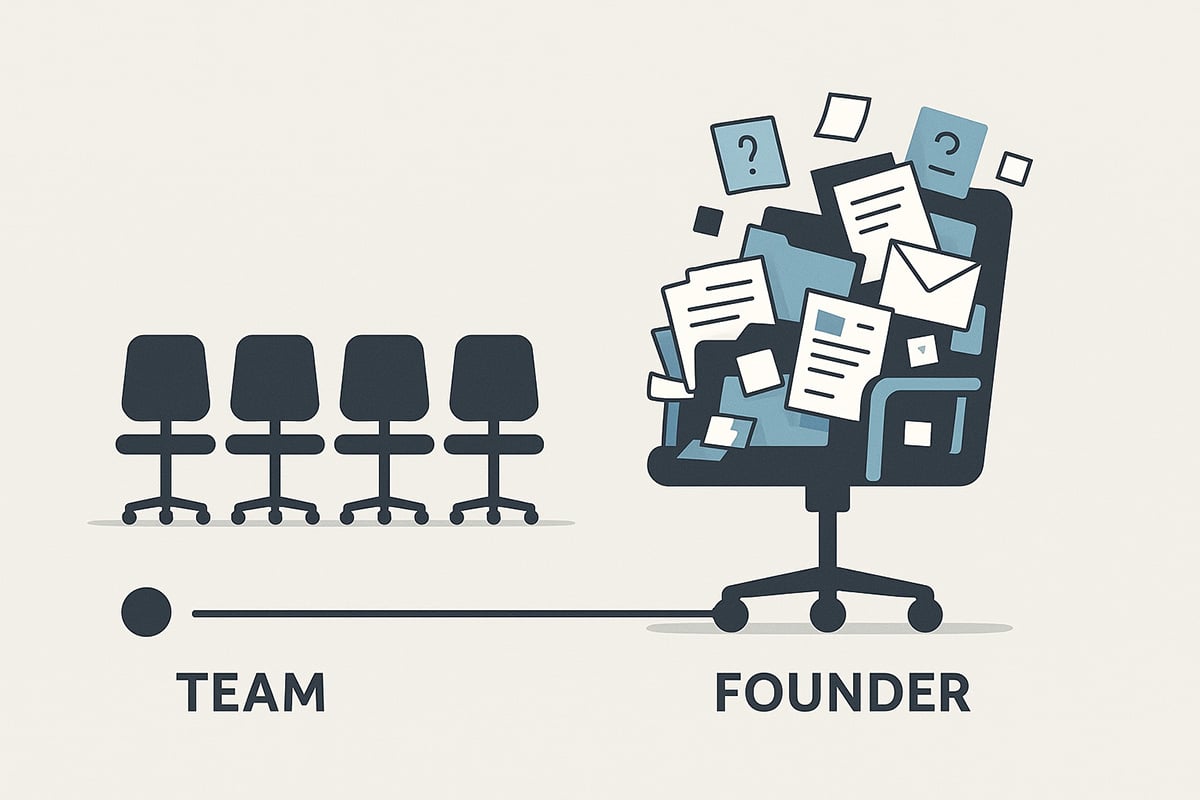
If you’re the default problem-solver in your company, you’ve become the bottleneck.
The 1–3–1 delegation framework is a simple way to break that pattern and train your team to think and decide for themselves.
It works like this:
ONE Problem When someone comes to you, they must define one clear problem.
Ask: “What is the one problem we’re trying to solve?”
Don’t allow a laundry list. Force clarity.
THREE Options They must propose three possible solutions.
Ask: “Give me three options for how we can solve this.”
Do not accept “I don’t know, you tell me.”
This pushes them to think instead of dumping the problem on you.
ONE Recommendation They must choose one path and back it.
Ask: “Which option do you recommend, and why?”
Then you either:
Approve it
Approve with tweaks
Or suggest a better alternative (now on a much better thinking base)
You’re no longer the person with all the answers. You’re the person who insists others use their brain before they use your calendar.
Example: Inventory Problem
Your operations lead walks in and says:
“Stock is all messed up in the warehouse. Orders are getting delayed. What should we do?”
Using 1–3–1:
1. One problem You: “What is the one problem we’re solving?” Them: “We don’t have a reliable way to ensure new stock is checked, entered into the system, and placed in the correct rack on time.”
Now you’re solving a real problem, not vague chaos.
2. Three options You: “Okay, give me three options.” Them:
Create a simple SOP for how new stock moves from gate → QC → system → rack.
Assign a single owner per shift responsible for final verification and sign‑off.
Introduce a daily 10‑minute standup at the warehouse to review previous day’s misses and fix root causes.
3. One recommendation You: “Which one do you recommend, and why?” Them: “Start with option 1 this week (SOP), combine with option 2 (clear owner). If needed, add option 3 later. This will immediately reduce errors and confusion.”
Now you’re deciding on a thoughtful recommendation, not rescuing someone who hasn’t done the thinking.
Why 1–3–1 Works
You stop being the bottleneck. People learn to come with solutions, not just problems.
You build leaders, not followers. Thinking becomes a requirement, not a bonus.
You get better decisions. Options + reasoning expose blind spots and improve judgment.
You buy back your time. Every 1–3–1 conversation is an investment: less dependency next time.
Adopt a simple rule in your company:
“If you bring me a problem without 1–3–1, we’re not discussing it yet.”
Do this consistently, and in a few weeks you’ll notice: the quality of thinking around you goes up, and your calendar finally starts to breathe.
Kobe Bryant made 800 shots before breakfast. You wing your most important conversations. One of you is doing it wrong.
During Team USA training camp, Kobe called a trainer at 4:30 in the morning. He ran conditioning drills until 6. Lifted weights until 7. Then shot baskets until he made 800 of them – not attempted, made – before the team’s official practice even started.
By the time his teammates arrived for the first drill, Kobe had already done more work than most players did in a full day. He won games because he prepared at a level that made the game itself feel easy.
But here’s what nobody talks about: this isn’t just a sports thing.
The best leaders in business do the same thing. They practice. Not occasionally. Not when they feel like it. Deliberately, granularly, obsessively.
Greatness requires repetition. And most leaders don’t practice at all.
The Problem: We’ve Confused Repetition with Practice
You’ve had a hundred difficult conversations. You’ve coached struggling employees. You’ve negotiated deals and handled conflict and tried to inspire your team.
But doing something repeatedly isn’t the same as practicing it.
Practice is deliberate. It’s isolated. It’s focused on getting better at a specific skill under controlled conditions. It happens when nothing is at stake so you’re prepared when everything is.
Athletes understand this intuitively. Kobe didn’t practice his fadeaway jumper during the fourth quarter of the Finals. He drilled it ten thousand times in an empty gym so that when the pressure was on, his body already knew what to do.
Leaders? We “learn on the job.”
That’s a polite way of saying we treat every high-stakes moment like a first draft. We walk into boardrooms, investor pitches, difficult terminations, and crisis situations having never practiced the specific skills those moments require.
Then we wonder why leadership feels so hard. Or why you end up creating a mess and cleaning it up later.
Leadership Is a Set of Practiceable Skills
Let’s be specific about what you’re not practicing:
Speaking boldly. Not in the meeting. Before it. Record yourself delivering the hard truth you need to say. Listen to it. Notice where you hedge, where you apologize, where you dilute your point. Do it again. Most leaders practice being diplomatic. Champions practice being direct.
Breathing and centering. You can’t regulate your nervous system in real-time if you’ve never practiced doing it when you’re calm. Athletes train their breathing for years. On the other hand, I have seen many leaders hyperventilate through Zoom calls and calling it “intensity.”
Empathy. You think empathy is about being nice. It’s not. It’s about accurately reading what someone else is experiencing and responding to the real problem, not the surface one. That’s a skill. You can practice it by role-playing situations and forcing yourself to name the emotion you’re observing before you respond.
Resisting the urge to interrupt. This one’s simple. In practice conversations, put a physical object in your hand and don’t speak until the other person has finished and you’ve counted to three. Your ego will hate this drill. That’s how you know it’s working.
Listening. Real listening – the kind where you’re actually trying to understand, not just waiting for your turn to talk – is unnatural for most leaders. Not because it is difficult. Not because of instagram notifications. Or Tiktok. Because you have not practiced it enoughl. Practice it by having someone tell you a problem and then forcing yourself to ask three clarifying questions before offering any solution.
Deal making. You don’t negotiate your biggest deal cold. You role-play it. You practice the concessions you’re willing to make, the points you won’t budge on, the moments where you’ll walk away. You rehearse staying silent after you make an offer.
Dealing with bullies. You will encounter people who try to dominate you through aggression, condescension, or manipulation. If you haven’t practiced staying grounded and non-reactive when someone’s in your face, you’ll either collapse or escalate. Neither is leadership.
Inspiring people. You think inspiration is spontaneous. It’s not. It’s clarity about what matters, delivered with conviction at the right moment. You can practice this. Write down what you actually believe about your work, then practice saying it out loud until it doesn’t sound rehearsed.
Coaching people. Most leaders give advice when they should be asking questions. Practice coaching by forcing yourself to only ask questions for the first five minutes of a conversation. No statements. No suggestions. Just questions that help the other person think more clearly.
These aren’t abstract concepts. They’re practiceable skills.
The Mountain with No Top
Here’s what makes leadership different from almost any other skill: there’s no finish line.
You don’t “complete” empathy training and move on. You don’t “master” inspiring people. Leadership is a mountain with no top. No matter how good you are at something, you can always practice more and get better at it.
And here’s the paradox: the people who practice the most aren’t the rookies. They’re the champions.
Kobe practiced more than the guys fighting for a roster spot. Buffett has read more investor letters than junior analysts will read in their entire careers. The best leaders don’t coast on their experience. They obsessively sharpen the skills that got them there.
Most business leaders do the opposite – especially when it comes to leadership and people skills. They treat “experience” as if repetition alone makes them better. But repetition without reflection is just rehearsing your mistakes.
You’re not getting better at difficult conversations by having more of them badly. You’re just reinforcing bad habits.
How to Actually Practice Leadership
Here’s the framework:
1. Isolate the skill. Don’t try to “get better at leadership.” Pick one granular skill. This week, it’s resisting the urge to interrupt. That’s it.
2. Create low-stakes repetitions. Role-play with a peer. Record yourself. Practice in conversations that don’t matter. The point is to build the muscle memory before the high-pressure moment arrives.
3. Get feedback. You can’t see your own blind spots. Ask someone to watch you practice and tell you what you’re missing. Athletes have coaches for this reason.
4. Increase the difficulty. Once you can stay centered in a calm practice conversation, practice staying centered when someone’s deliberately trying to trigger you. Make the drill harder until it’s harder than the real thing.
5. Repeat until it’s automatic. You’re not done practicing when you can do it right once. You’re done when you can’t do it wrong. When your nervous system responds correctly before your brain even catches up.
That’s the standard. and today, AI can help you practice all of that.
The Unfair Advantage
The gap between good leaders and great ones isn’t intelligence. It’s not charisma. It’s not even strategy.
It’s that great leaders turn more of their life into a practice that nobody else sees.
They practice breathing before the meeting starts. They role-play difficult conversations with a trusted peer. They drill staying non-reactive when someone’s being an asshole. They rehearse inspiring people until their conviction sounds natural, not performative.
They do the work when nothing’s at stake so that when everything’s at stake, their body already knows what to do.
You’re not going to get better at leadership by reading more books or attending more conferences or gaining more “experience.”
You’re going to get better by practicing the specific skills you’re currently winging.
Pick one. Breathing and centering. Speaking boldly. Listening without interrupting. Coaching instead of advising.
Then practice it like Kobe practiced his basketball skills.
The game feels hard because you never rehearsed for it. Not because the game (or your job) is hard.
Why Your “Competing Commitments” Are Stalling Your Team
There is a pattern I observe in founders led companies that is quietly stifling their organizations. It is not a lack of skill, and it is not a lack of vision. It is a conflict of identity.
The pattern looks like this: A founder walks into a meeting and casually says, “We should get some case studies from clients.”
To the founder, this is just an idea – a helpful contribution. Whoever hears that idea – no matter how many levels below the founder they sit – treats it as a directive, not an idea.
That directive collides with existing priorities. It creates confusion. It overloads people with tasks that aren’t anchored in a clear problem or purpose. The only real “why” behind it is (when it comes to execution): the founder said so. (even if the founder didn’t mean it like that)
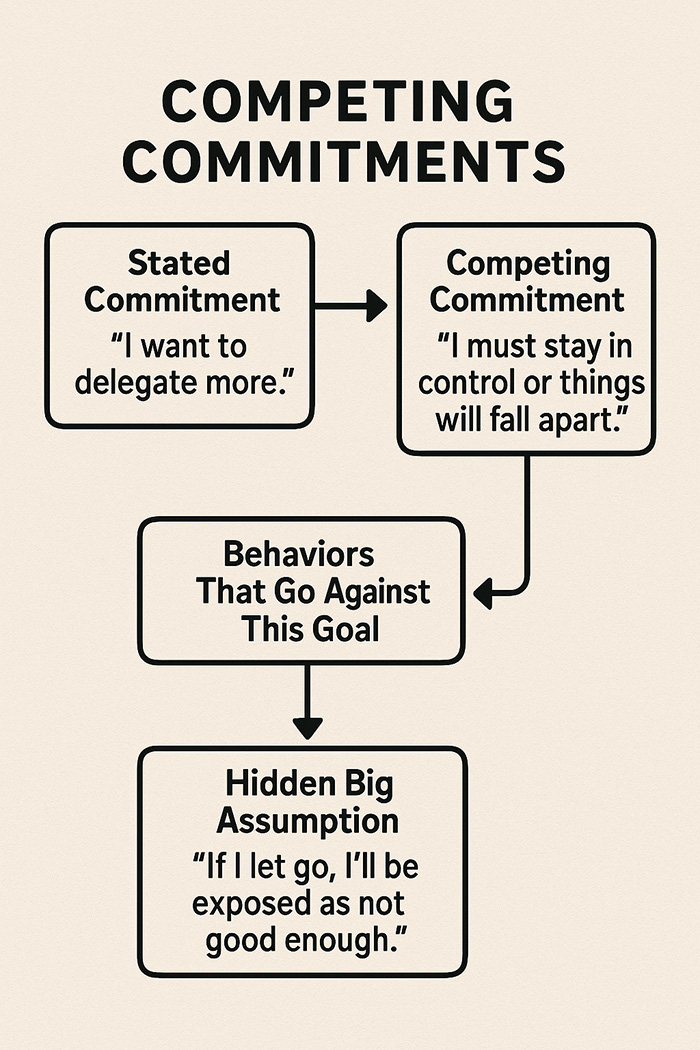
On the surface, this looks like a communication issue. But if we look deeper, we find what organizational psychologists call “Competing Commitments.” You say you are committed to building an autonomous, empowered team. But subconsciously, you are committed to being the person who saves the day.
The outcome – chaos, missed deadlines, lack of clarity, misunderstandings, last-minute firefighting, and the whole company being dependent on the founder to save the day.
So What’s Really Happening?
A founder comes across a single piece of information. Perhaps someone tells them something at a conference. It might be something vague like, “People are talking about your company.”
Instead of slowing down and asking, “Which people? How often? What exactly did they say?”—they treat the information as truth.
From there, everything accelerates. They jump to a conclusion: “This is a problem.” They decide the problem requires action: “This is something we need to deal with.” They decide on a solution: “We need some case studies.”
They decide who should do it – and task them directly. All of this happens before anyone else is involved. Before more data is gathered. Before the actual owner of the problem has any say in defining it. One data point becomes a full-blown directive with organizational weight behind it.
The “Artisan” Identity vs. The EnterpriseBuilder
Chris, owner of Crown Capital, who specializes in transitioning founder-led businesses, describes this perfectly when I recently spoke with him. He notes that many founders get stuck at a specific revenue ceiling because they are running an “Artisan Shop.”
In an Artisan Shop, the founder is the product. They are the best salesperson, the best product designer, and the best problem solver. The business relies entirely on their personal craftsmanship. As Chris points out, “It feels really good to be needed.”
This is the seduction of the Artisan identity. In the early days, your identity was tied to being the engine that made things move. You were the “fixer.” But as the company scales, that same identity becomes a “cul-de-sac”—a dead end where you are running in circles, unable to scale because you cannot scale yourself.
To break through, you have to fundamentally alter your relationship with the company. You must stop viewing the company as an extension of your personal output and start viewing it as a system that you design.
This Isn’t Malicious – The Founders Are Not Doing Anything Wrong
In fact, it’s rooted in something pretty brilliant. To understand why this happens and what can be done about it, you have to begin by looking at how founders see themselves, their role, and their identity. If we treat their actions as a “bad habit to correct,” we miss the point entirely.
Behavior doesn’t change because someone is told to “slow down” or “stop giving solutions.” It changes when they see what’s driving the behavior in the first place. Founders often have commitments running in the background that they don’t fully see:
A commitment to being useful.
A commitment to being helpful.
A commitment to ensuring their people succeed.
A commitment to adding value.
A commitment to being essential.
These commitments got them where they are. However, these are the same commitments that are keeping them stuck now.
Even if a founder says they want empowerment, autonomy, and a team that owns problems end-to-end – their deeper commitment, the one they don’t consciously see, can still run the show. Our competing commitments make all of us run on autopilot.
Why This Is So Hard
Keith Rabois, who helped build PayPal, LinkedIn, and Square, has a useful framework here. He learned it from Peter Thiel. The idea is simple: before you get involved in a decision, consider two things. First, how strong is your conviction about the right answer? Second, how significant are the consequences if you’re wrong?
If the consequences are low and your conviction is low, let your team run with it. If the consequences are high and your conviction is high, get involved. But most founders don’t think this way. They treat every decision like it’s high stakes. They jump in everywhere. And over time, their team learns to wait for permission instead of taking ownership.
The Shift in Being: From Hero to Architect
Changing behavior (e.g., “I will speak less in meetings”) is rarely enough because behaviors are only symptoms that happen downstream of identity (who you are). If you still identify as the “Hero or the Problem Solver” you will inevitably intervene when things get tough.
You have to shift your state of Being.
Chris shares his own painful transition from being a high-net-worth attorney/consultant to a fund manager. As a consultant, he was the product. To move to the next level, he had to enter “The Dip”—a period of discomfort where he had to stop doing the work that made him feel valuable (billable hours, direct client advice) to invent a new identity as an asset allocator.
He had to stop asking, “How do I solve this?” and start asking, “How do I build a system that solves this?”
This is a crisis of ego. It requires accepting that your value is no longer defined by your direct output.
The Cost Nobody Talks About
Here’s what happens when this pattern runs unchecked.
The team stops thinking. They learn that their job isn’t to solve problems—it’s to wait for the founder to tell them what to do.
The best people leave. Not because they don’t believe in the mission, but because they’re tired of being treated like executors instead of leaders.
The founder becomes the bottleneck. Everything runs through them because that’s what the organization has learned to expect.
The founder burns out. They can’t understand why nobody else steps up—when in reality, they’ve trained the whole company not to.
And none of this is visible to the founder. Because from their perspective, they’re just being engaged. Responsive. Helpful.
What This Looks Like in Practice
Next time you hear a piece of information or feel the urge to act, pause. Ask yourself: Am I about to make this my problem to solve?
If the answer is yes, stop. Then ask:
Whose problem is this, really? Not who should solve it — who actually owns this domain?
Separate what happened from what you’re making it mean from what you’ve already decided to do.
What would it look like if I held space instead of solving this?
That might mean bringing the issue to the right person and asking, “What do you make of this?” It means staying engaged without taking over.
This will feel uncomfortable. It’ll feel like you’re not adding value. Like you’re being passive.
You’re not.
You’re teaching your team that they’re capable. You’re building their ownership. You’re creating space for them to rise.
This shift requires new practices that force you to step out of the “Artisan” role.
1. The Bezos Decision Framework
Most founders treat every decision as a crisis that requires their “Hero” identity. Jeff Bezos counters this by distinguishing between Type 1 (irreversible) and Type 2 (reversible) decisions.
The “Artisan” founder treats everything as Type 1. The “Architect” founder realizes that 90% of decisions are Type 2. By recognizing that most doors are two-way, you can suppress the urge to intervene, allowing the team to own the risk and the learning.
2. The Munger Inversion
Chris utilizes a technique from Charlie Munger called “Inversion.” Instead of asking, “How do I help my team succeed?” ask, “What would I do if I wanted to ensure my team remains helpless?”
Answer: I would solve every hard problem for them. I would correct their work before they finish it. I would make every decision myself.
Realization: By doing these things, you are actively sabotaging the autonomy you claim to want.
3. Creating “Thinking Space”
You cannot shift your identity if you are constantly reacting. Chris implemented a rigorous practice of blocking out Thursday afternoons entirely. No meetings, no calls—just “block production time” to think. (My interview with Chris will come out early next year – 2026)
If you are always on the treadmill of execution, you are acting as an employee of your own company, not its leader. You need space to detach from the “doing” so you can work on the “being.”
A New Relationship With Your Business
There’s something else worth naming here. As a company grows, the founder’s relationship with it has to change. What worked at twenty people breaks at two hundred. The intimacy that once held everything together can become the very thing that holds it back.
This isn’t failure. It’s evolution.
The founder who built the startup has to become the leader who builds the institution. And that requires letting go of being needed in the old ways while finding new ways to matter. This is one of the loneliest transitions in leadership. And it’s rarely talked about.
The Audit: To make this shift real, you need a feedback loop.
Find a Truth-Teller: Give a trusted partner permission to interrupt you. “If you see me playing the Hero, call it out.”
The Weekly Reflection: Ask yourself, “What did I take ownership of this week that wasn’t mine?”
You have to let go the loss of your old identity – the one that saved the day, the one that knew all the answers. That version of you was essential to get the company from $0 to $2 million. But that version of you is now the primary obstacle getting from $2 million to $20 million.
Your team doesn’t need a savior. They need a leader who believes they can save themselves.
There’s a pattern I see in certain companies that’s puzzling at first glance.
The CEO is a very nice and kind person. Genuinely kind. The kind of person people respect deeply and stay loyal to for decades. They’ve built a team of exceptional people around them. Each one of them can be called superstars by any measure.
And yet.
Those superstars play against each other. They form factions. They undermine one another in meetings. They gossip. They politic. They spread negativity behind closed doors. I have now seen it in too many companies to call it a “pattern”.
As a result, the culture suffers. Performance of the company suffers. And if the company suffers, each individual superstar is also suffering. But – alas – they can not see that. They continue pointing fingers at others and getting defensive when a finger is pointed at them. They are all losing – because the company is losing – and yet they think that they are each performing well.
From the outside, it doesn’t make sense. Great leader. Great people. Terrible dynamics.
But when you look closer, it makes perfect sense.
The Question Nobody Wants to Ask
When a team is dysfunctional, the natural instinct is to look at the team.
“These people are too competitive.”
“They have ego problems.”
“They’re not team players.”
But that’s rarely the whole story.
The harder question is: What is the founder or the CEO doing – or not doing – that makes this behavior possible?
Because here’s the thing. Smart people don’t engage in politics for fun. They do it because something in the system rewards it. Or at least doesn’t punish it.
So if you’ve got a team of brilliant people acting like rivals instead of partners, something in the environment is allowing it. And that environment starts at the top.
What’s Really Going On
To understand this, you have to look at how the CEO sees themselves, their role, and their relationship with conflict.
If we treat the team’s behavior as the problem to fix, we miss the point entirely.
The CEO likely has commitments running in the background – commitments they don’t fully see. These commitments feel like virtues. They probably are virtues. But left unexamined, they create the exact conditions for dysfunction. These commitments create a “pattern” of behavior for the founder/CEO that then leads to the pattern we see with the team.
These commitments are what the Harvard psychologist Robert Kegan calls the Competing Commitments (from his & Lisa Lahey’s work on the book “Immunity to Change”) . They are the hidden commitments you made to yourself long ago that now quietly competing with your biggest goals.
Here are some of the competing commitments I find in these companies and their leaders:
(one or many of the below might be applicable for you)
A Commitment to Being Liked
Kind leaders want people to feel good around them. They want to be seen as fair, caring, approachable.
The other side of it? They avoid hard conversations.
When two superstars are at war, the kind CEO might hope it resolves itself. They might talk to each person privately but never bring them into the same room. They smooth things over instead of naming the real issue. They avoid taking sides because someone might get hurt.
The result? Nothing gets resolved. The conflict goes underground. It becomes hallway conversations and political maneuvering instead of direct confrontation.
The CEO thinks they’re keeping the peace. They’re actually teaching the team: We don’t deal with conflict here. You’re on your own.
A Commitment to Being Fair
Kind leaders bend over backwards to be equitable. They don’t want anyone to feel favored or overlooked.
The other side? They refuse to make clear calls.
They won’t publicly say, “This is the direction we’re going.” They won’t back one leader’s approach over another, even when the situation demands it. They keep things open-ended in the name of fairness.
So what do the superstars learn? The CEO won’t decide. Which means I have to win through other means.
That’s when politics becomes rational. If the boss won’t pick a direction, the team will fight it out amongst themselves – through influence, alliances, and undermining each other.
A Commitment to Harmony
Some leaders believe that good teams shouldn’t have conflict. That if people are fighting, something is wrong.
The other side of it? They suppress tension instead of working through it.
They shut down debates too early. They change the subject when things get heated. They privately ask people to “be more collaborative” instead of letting the team wrestle with real disagreements.
The result? The real conversations happen outside the room. People learn that the only way to be heard is through back channels.
That’s not politics because people are bad. It’s politics because the front door is closed.
A Commitment to Loyalty
When a CEO has people who’ve stayed for decades, there’s deep mutual respect there. But it can also become a trap.
The other side of it? They tolerate behavior they shouldn’t because of history.
A superstar who’s been there for fifteen years gets a pass for things that would get someone else fired. The CEO tells themselves, “That’s just how they are.” Or, “They’ve earned the right.”
The rest of the team sees this. And they learn that rules don’t apply equally. That tenure is protection. That power is about relationships, not performance. That’s fertile ground for factions and resentment.
The Painful Truth
Here’s what makes this so difficult.
Every one of these commitments feels like a virtue. Being kind. Being fair. Wanting harmony. Valuing loyalty. Staying above pettiness.
These are good things. They’re probably why people respect this CEO. They’re probably why people have stayed so long.
But taken too far—or left unexamined—they create the conditions for exactly what the CEO hates.
The CEO’s kindness, without clarity and courage, becomes a fertile ground for dysfunction.
Nobody’s being malicious. But the system is producing politics because the leader – without realizing it – has made politics the only viable path.
What Might Be Missing
If I had to name what’s absent, it would be these:
Naming reality.
Sitting the team down and saying, “Here’s what I see happening. The politics. The groupisms. The gossip. It’s not acceptable. And I’m willing to look at how I’ve contributed to it.” Most leaders skip this. They address symptoms. They talk to individuals. They hope things or people will change. It won’t. Someone has to name the thing out loud.
Making hard calls.
Superstars need clarity. They need to know who owns what. Whose strategy wins. Where the boundaries are.
When everything is open for negotiation, people negotiate through power instead of merit. The CEO has to be willing to decide—even when it disappoints someone.
Holding people accountable visibly.
Not in a shaming way. But in a way that signals to the whole team: this behavior has consequences. We don’t do politics here. We don’t tolerate undermining. The founder/CEO has to be willing to say: “This is no longer ok.” or “This can never happen again.”
If accountability only happens in private, the team never sees it. And what the team doesn’t see, the team doesn’t believe.
Having the conversations nobody wants to have.
Bringing two warring leaders into a room and saying, “We’re not leaving until this is resolved.” Letting the discomfort happen instead of smoothing it over. Most kind people avoid this. It feels aggressive. It feels risky. But it’s the only way through.
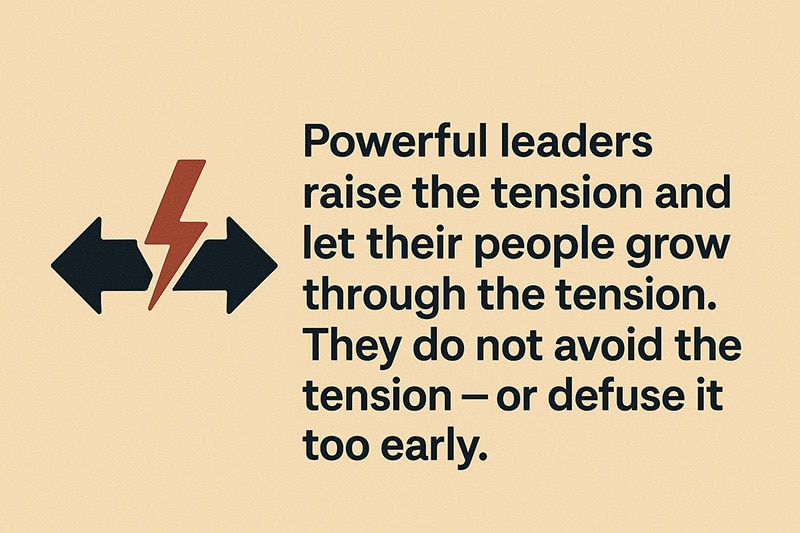
Powerful leaders raise the tension and let their people grow through the tension. They do not avoid the tension – or defuse it too early.
Letting go of someone they care about.
Sometimes, one person is the source. And the CEO knows it. But they can’t bring themselves to act because of history, loyalty, or genuine affection.
So the whole system stays sick to protect one relationship.
This might be the hardest one of all. And often, it’s the one that would change everything.
The Shift
This isn’t about becoming less kind. The world needs kind leaders.
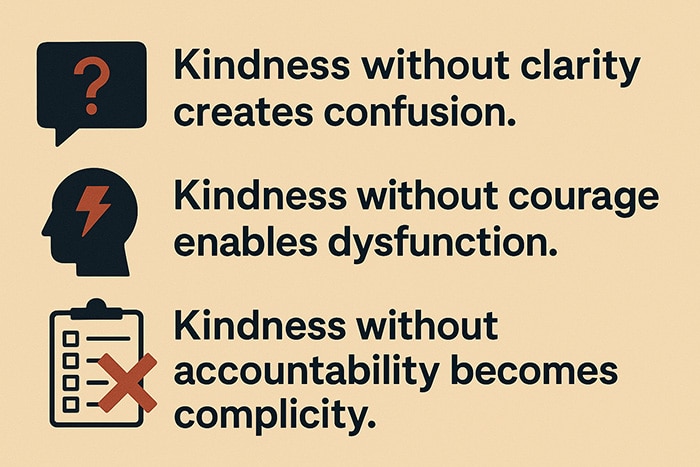
But kindness without clarity creates confusion. Kindness without courage enables dysfunction. Kindness without accountability becomes complicity.
The shift is learning to be both.
Kind and clear. Kind and direct. Kind and willing to make the hard call.
That’s not a contradiction. That’s integration.
And that’s the leader this team of superstars is waiting for.
They don’t need someone who keeps the peace. They need someone who builds the peace – by being willing to disrupt the false comfort of gossip, politics, and rumors.
That’s when everything changes. What are your competing commitments?
Let’s get real for a second (especially if you have a large team)
Every year, organizations spend more than $60 billion on strategic planning and leadership development. Yet McKinsey, Bain, and Harvard Business Review converge on a sobering truth: roughly 70–90% of strategies fail to achieve their intended outcomes. Not because the ideas are wrong, but because execution breaks down.
The evidence is overwhelming. A McKinsey Global Survey on strategy implementation found that only 27% of executives believe their organizations are good at translating strategy into action. A Bain & Company study showed that nearly two-thirds of companies struggle to coordinate across business units once execution begins. And evenHBR reported that coordination failures—not funding or technology—are now the number-one reason transformation initiatives stall.
What’s fascinating is that most leaders still misdiagnose the issue. They call it a “change-management issue,” or a “lack of accountability.” But these are merely symptoms of a deeper dysfunction: a breakdown in the coordination of action—the invisible chain that turns intention into results.
Coordination is the choreography of execution. It’s how commitments are made, tracked, and recovered when they slip. It’s how leaders ensure that promises travel through the organisation without distortion. When this choreography collapses, even brilliant strategies implode under their own complexity.
It’s not your strategy or vision that’s failing. It’s your coordination of human behaviour and action (often also called execution)
You can have the smartest people, the boldest goals, and the most inspiring off-sites — and still, your execution limps. Deadlines slip. Priorities clash. You and your team are all busy and working hard, and yet progress seems slow or stalled.
Every leader knows this feeling. You start the quarter with momentum and clarity. But within weeks, the plan splinters into miscommunication, duplication, and “I thought you meant…” chaos.
That’s not incompetence. That’s a coordination breakdown.
What’s Missing in Most Companies Today
You’ve probably invested heavily in strategy sessions, leadership retreats, or workshops on emotional intelligence. Yet something vital is missing — the shared language and system for making and keeping commitments.
Most organisations run on what I call hope-based execution:
“I’ll try.”
“We should.”
“It’s in progress.”
“Almost done.”
Those phrases sound harmless — but they hide millions of euros in waste, delay, repeated work, and frustration.
The truth is that all results are produced through conversations. Yet most leaders have never learned how to have the right ones. That’s not a failure of our leaders. That’s a failure of our education system (but that’s a topic for another day).
The problem isn’t that people don’t care. It’s that they don’t know how to have the right conversations in a rhythm that drives action.
Work doesn’t just get done because people want to do it. It gets done when requests, promises, completions and incompletions are tracked, owned and closed.
The truth is: All work is coordination(of human behaviour). And all coordination happens through four simple conversations.
The Conversation for Coordination of Action
Every time something gets done, it follows this invisible loop — whether you realize it or not.
Let’s make it visible. It is the Conversation for Coordination of Action.
This framework—the Conversation for Coordination of Action—comes from decades of research in speech act theory, organizational linguistics, and commitment-based management. It was pioneered by Terry Winograd and Fernando Flores in their groundbreaking 1986 work on how language creates action, not just describes it.
The big insight? Coordination happens through explicit commitments, not assumptions.
There are four conversations in the conversation of coordination of action:
Conversation 1: Making a Clear Request or Offer(creating clarity from chaos)
What’s really happening: You’re creating a possibility out of thin air.
Every coordination of action starts with a request or an offer:
Request: “Can you do X?” (you become the customer of the execution)
Offer: “Can I do X?” (you become the performer of the execution)
Today you’re the customer. Tomorrow you’re the performer. The roles flip constantly – with each request or offer.
This step breaks down because Vague requests = vague results.
❌ “Can you handle this?” ❌ “Can we get this done soon?” ❌ “Let’s try to improve the deck”
These aren’t requests. They’re hopes wrapped in politeness.
Research on commitment-based management shows that unclear requests lead to what organizational psychologists call “fake agreement”—people say yes when they mean maybe, creating a trust debt that compounds over time.
Real-World Example
Broken: “Hey, can you send me the Q4 data when you get a chance?”
Fixed: “Can you send me the Q4 revenue data by Thursday at 3 PM? I need the breakdown by region, formatted as a CSV, so I can include it in Friday’s board presentation.”
Notice the difference:
What (Q4 revenue data)
When (Thursday, 3 PM)
How (CSV, by region)
Why (board presentation context)
The Power Move: The “Conditions of Satisfaction” Checklist
Before making any request, answer:
What specifically do I need?
By when do I need it?
In what format or quality?
Why does this matter? (Context helps people make smart trade-offs)
Specificity isn’t being demanding—it’s being clear. When you’re clear, you give people what they need to succeed.
A vague request is like ordering “something nice” at a restaurant. You’ll get something — but not what you want.
Conversation 2: Negotiation and Promise(creating commitments from wishes)
What’s really happening: You’re testing reality and building trust by creating trustworthy promises.
This is where most leaders chicken out. They make the request, and they want the other person just to say “yes” instead of making sure they get an unequivocal, trustworthy YES that they know they can count upon.
Each request has onlyfour valid responses:
Yes (I commit)
No (I can’t/won’t)
Counteroffer (I can do this instead)
Commit to commit later (I need more info first)
All four are legitimate. All four are respectful. Anything else is a future disappointment waiting for you.
Why This Step Breaks Down
People say “yes” when they mean “maybe” or “no” because:
They don’t want to disappoint you
They’re afraid of looking incompetent
Your culture punishes “no”
They genuinely want to help, but haven’t thought through the reality
Research from organisational behaviour shows that most companies have chronic over-commitment, which leads to burnout, missed deadlines, and erosion of trust.
You can only get a trustworthy promise if people can actually negotiate on what they will do by when.
Real-World Example
Broken: Manager: “Can you get this to me by Friday?” Employee: “Sure!” (internally screaming)
Fixed: Manager: “Can you get this to me by Friday at noon?” Employee: “I’m already committed to the Martinez presentation Friday morning. I can get it to you by Monday at 10 AM, or I can get you a draft Friday afternoon—which works better?”
See what just happened? The employee:
Acknowledged the request
Explained the constraint
Offered two alternatives
Put the decision back in the manager’s court
That’s a real promise. Not a fake one.
The Power Move: The “Four Valid Responses” Script
When someone makes a request, train yourself (and your team) to respond with one of these:
“Yes, I commit to [specific outcome] by [specific time].”
“No, I can’t do that because [reason]. But here’s what I can do: [alternative].”
“I need to check [X] before I can commit. Can I get back to you by [time]?”
“I can do [modified version]. Does that work?”
The unlock: A “no” is a gift. It means someone respects you enough to tell the truth. If your culture punishes “no,” you’ve just bought yourself a factory of resentment and missed deadlines.
A “NO” is as much a promise as a “YES”. And your role as a leader is not to get YESes but to create trustworthy promises people can count upon – whether they are a YES or NO.A “no” is healthy. A “maybe” is poison.
The other person must have the space to say yes, no, or let’s renegotiate. When there’s a clear promise, trust is built. When there’s fake agreement, resentment brews.
If people can’t say NO to you, their YESes have no value.
Conversation 3: Execution and Declaration of Completion(creating satisfaction)
This is the most invisible breakdown. And it’s everywhere. Someone finishes the work but never declares it’s done. The result?
You’re sitting there waiting. Checking your inbox. Wondering if they forgot. Getting annoyed.
They think they’re a hero. You think they’re slacking. Both of you are wrong – you just didn’t close the loop.
Completion is a speech act. It doesn’t happen until someone says “It’s done.”
But here’s the thing: most people assume that doing the work is enough. It’s not.
Think about it like landing a plane. You don’t just descend and hope for the best. You announce it: “Touchdown. Wheels down.”
That declaration closes the loop. Without it, the loop stays open—and open loops drain trust faster than anything else in an organization.
Real-World Example
Broken: Designer finishes the deck, saves it to Dropbox, goes to lunch. Manager is still waiting three hours later, thinking it’s not done yet.
Fixed: Designer Slacks: “The Q4 deck is done and saved to Dropbox/Projects/Q4-Deck-Final.pptx. All feedback from yesterday’s meeting has been incorporated. Ready for your review.”
Three sentences. Five seconds. Loop closed.
The Power Move: The “Completion Declaration” Template
When you finish something, always include:
“[Task] is complete.”
“It’s located at [place/link].”
“I addressed [key requirements from the original request].”
Optional: “Next steps are [X], or let me know if you need anything else.”
The unlock: Declaring completion isn’t ego, it’s respect. You’re giving the other person certaintynow so they can move forward.
Conversation 4: Assessment and Feedback(learning & closing the loop)
The last conversation is – the customer of the execution declares satisfaction or dissatisfaction, and everyone learns.
Without this last step, loops stay open. Misunderstandings multiply. In research on coordination frameworks, lack of this phase is a major barrier to cross-functional execution.
Without this step:
You repeat the same mistakes
Trust erodes silently
People invent stories about what “good” looks like
Resentment builds
A feedback loop is essential for learning. This is what organizational learning researchers call “double-loop learning”. You’re not just fixing the task, you’re improving the system.
But most leaders skip this step because it feels awkward, unnecessary, or confrontational. (read that again)
Wrong. It’s the most respectful thing you can do.
When you don’t give feedback, people:
Assume you’re unhappy (and invent reasons why)
Think they nailed it (and repeat the same mistakes)
Guess what “good” looks like (and drift further from your expectations)
Research shows that feedback, regardless of content, positively influences performance, motivation, and task engagement. But here’s the catch: it has to actually happen. Teams just… never close the loop. And then wonder why coordination falls apart.
Real-World Example
Broken: Manager reviews the deck, thinks “This is decent, but not quite what I wanted.” Says nothing. Designer thinks they crushed it. Next project, same issues. Slowly, resentment builds and leads to future coflict, “this has happened for the last 3 times” (though I never told you so).
Fixed: Manager responds: “Thanks for getting this done on time. The data visualizations are clear and the flow works. For next time: I need more emphasis on the ‘why it matters’ section—that’s what the board cares about. The current version is 80% there. Can you add one slide that directly addresses ROI implications? That would make it complete.”
Notice:
Acknowledged what worked
Named what needs to change
Made it specific
Gave context (why it matters)
Created a path forward
The Power Move: Acknowledge, Declare Satisfaction, and Make a Fresh Request (if reqd)
Here’s how to do it right:
Acknowledge completion: “You delivered this on time—thank you.”
Declare satisfaction level: “This meets 80% of what I needed” OR “This fully satisfies the request.”
Name specifics: “The [X] part is great. The [Y] part needs [specific change].”
Explain why: “We need [Y] because [context].”
Confirm next steps: “Can you revise [Y] by [time]?” OR “We’re good to move forward.”
The unlock: Feedback isn’t criticism—it’s completion. Both “This nailed it” and “This missed the mark” are acts of respect. Silence is the real disrespect.
Now multiply this loop by hundreds of projects, meetings, and emails inside your company every week.
If your people don’t close these loops, you lose speed, trust, and energy. That’s why execution feels heavy – because thousands of promises are floating around unkept, unacknowledged, or untracked. Or worse, there are no promises – there are only plans, wishes, hopes, and expectations.
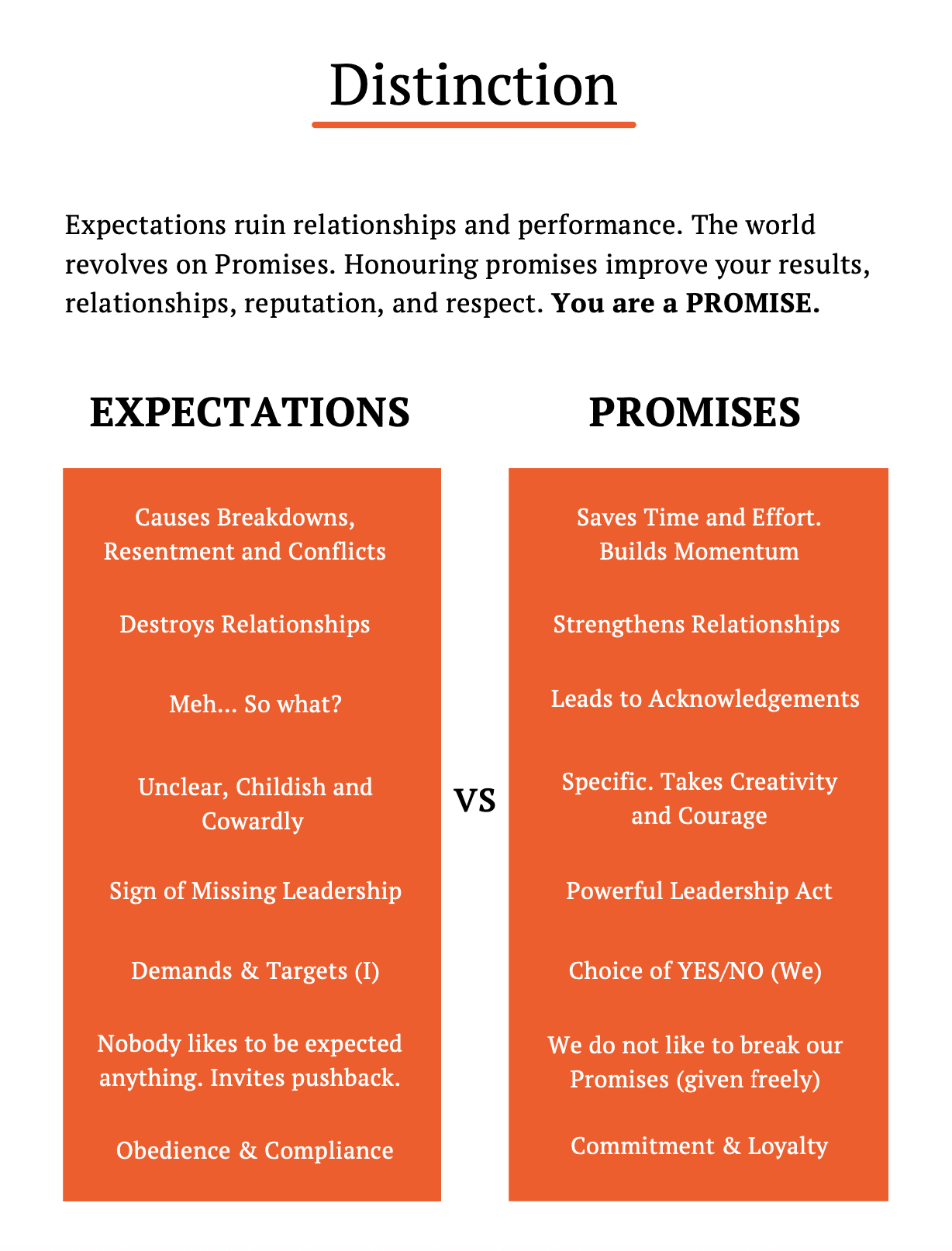
As I often share, Expectations are the cancer of collaboration.
The Hidden Cost of Poor Coordination
Poor coordination isn’t just an organisational headache. It hits hard — financially, culturally, emotionally.
Wasted time & energy: If you’re chasing commitments, running after teams, and slotting in rescue meetings, you’re indirectly paying for all those unclosed loops.
Burnout & bottlenecks: When leaders become the hub of every decision because no one else is coordinating, you become the chokepoint. That’s a leadership trap.
Trust erosion: When people behave like “I’ll try” becomes the norm, you build a culture of maybe, delay, blame. According to research, when alignment is low ~68%, teams believe they’re not moving in the same direction. AchieveIt
Strategy drift: You may have a great vision, but if execution spirals out of coordination control, you don’t just miss targets — you lose competitive position. “More than 70 % of strategic growth plans fail … because execution breaks down.” Strategy Ladders
If you run a €100 M business, even a 2-5 % drag from coordination breakdowns could mean millions in missed margin, customer churn, delayed launches, or wasted talent.
You can’t scale bold visions on vague agreements and open loops. Period.
When you master this conversation, you:
✅ Stop wondering why things aren’t happening (Because you made the invisible visible) ✅ Build a culture where people can say “no” without fear (Which paradoxically increases commitment) ✅ Create accountability that doesn’t feel like surveillance (Because it’s based on mutual promises, not control) ✅ Close loops so fast that momentum becomes your default state (Because nothing stays in limbo)
Why This Matters More in 2025
The world has shifted as remote teams, global functions, rapid tech change are the norm. In this environment:
You need coordination across functions not just alignment within them. Research shows that cross-functional coordination (or lack thereof) is now the core challenge. infeedo.ai
Visibility, accountability and speed matter more than ever. According to McKinsey, the healthiest organisations embed coordination and control and capability and motivation. McKinsey & Company
What Great Leaders Do Differently
Great leaders don’t try to do everything themselves. They install a culture of clean promises.
They train their teams to have these four conversations consciously and explicitly. They build what I call coordination muscle— the ability to move fast without confusion.
They stop saying: “Who’s on this?” and start saying: “Who’s making a promise here, and when will it be complete?”
They don’t confuse motion with progress. They don’t reward “effort” – they reward closed loops (results).
A Simple Example
Let’s say your CMO asks the sales head: “Can you send me your input on the Q2 campaign soon?” That’s a weak request.
A strong one sounds like:
“Can you send your input on the Q2 campaign by Wednesday 5pm so we can finalize the copy on Thursday morning?”
Now the performer can negotiate:
“Wednesday’s tough, but I can send it Thursday morning at 8am.”
That’s a clear promise. When it’s done, they declare completion. The CMO reviews and says, “Yes, this works,” or “Let’s tweak section two.”
That’s a clean coordination loop.
Now imagine 10,000 of those running in your company every week — clean, explicit, complete. That’s not just communication. That’s velocity. That’s the momentum you have been waiting for.
NASA & Apollo Missions Example
During the Apollo missions, NASA engineers lived by one simple rhythm: Request. Confirm. Execute. Verify. No vague “ASAPs,” no half-yeses. Every instruction was a clear commitment, every step was verified out loud. That discipline, not technology, is what put humans on the moon with computers weaker than your phone. The secret wasn’t genius; it was coordination done right.
From Strategy to Execution: The Missing Bridge
Most strategies fail not because they’re wrong. They fail because they die in the space between intention and execution.
Leaders often think their job is to design the “what” and “why.” But the real test of leadership is creating and coordinating the chain of commitment conversations that make results that add value inevitable – and not just effort and time spent.
Your job isn’t to have more meetings. It’s to coordinate human action. And you do that through the conversation for the coordination of action.
This is how high-performing organisations work — not through charisma or chaos, but through clarity and closure.
The Opportunity in Front of You
If you can master this and teach your team to make, keep, and close promises cleanly — everything changes.
Execution accelerates.
Burnout drops.
Trust compounds.
Strategy turns into results.
You are free to zoom out and think bigger while your team executes on the weekly, monthly, and quarterly.
Your company becomes a place where people do what they say and say what they’ll do.
That’s not control. That’s coordination with integrity.
And that, more than any new strategy, is what will separate your company from the rest.
MIT’s Sloan Management Review calls coordination “the missing muscle in modern leadership.” It’s rarely taught, often assumed, and almost always under-practiced. Yet it determines whether strategies live or die in the real world.
The uncomfortable truth? Most leaders don’t have a coordination blind spot. And until that’s addressed, every new strategy is just another expensive rehearsal for failure.
In Simple Words
You don’t need another meeting or more time. You need better conversations. Half the talk, double the promises.
Not more talk — but conversations that coordinate action. Conversations that build trust. Conversations that close loops.
Let’s talk about that thing that’s been bugging you. That goal that feels perpetually out of reach. We’ve all been there, feeling stuck and spinning our wheels.
It’s like having a tiny, sharp stone in your shoe. At first, it’s just a little annoying. You can limp along, telling yourself, “It’s not that bad. I’ll deal with it later.”
But with every step, that stone grinds away. Eventually, what was a minor nuisance wears a raw, painful hole in your foot. You’re now injured, all because you didn’t take a moment to dump the stone out.
You know that moment when you’re trying to solve a problem, and you keep circling back to the same reasons? “I don’t know how.” “I can’t figure it out.” “I need more information first before starting.”
You want something. You know that you are meant for more.
You know that you are more capable than what your current level of success shows.
And yet you hold back, you wait, you hesitate – instead of moving forward boldly and unapologetically.
That is like living with a stone in your foot.
This is what happens when we avoid the things we know we need to do. We think we’re saving time and energy by ignoring the discomfort, but we’re actually creating a much bigger, more painful problem down the road.
So, why do we do it? Why do we live with the stone in our shoe?
When I talk to people who feel stuck, they almost always give me the same reasons, in this exact order:
“I don’t know how to fix it.” (The plan)
“I don’t really believe I can fix it.” (The confidence)
“I guess I’m just not that committed to fixing it.” (The commitment)
This sounds logical, right? It makes sense.
“Of course I’m not committed! I don’t know what I’m doing, and I’m not even sure it’ll work! So how can I commit?”
Here’s what nobody tells you: you’re looking at it backwards.
The real order, the one that actually runs the show, is this:
“I’m not committed to fixing it.” (The commitment)
“So, I don’t believe I can fix it.” (The confidence)
“And that’s why I never figure out how to fix it.” (The plan)
I see this constantly with leaders who come to me stuck, frustrated, and running on empty. They’re brilliant people. They’ve built careers, led teams, created value. But they’re grinding against the same obstacles over and over, like there’s an invisible wall they can’t get past.
In every case, the person lays out their evidence: “No plan, no surety, no confidence.” And then they draw what feels like an inevitable conclusion: “Therefore, I cannot commit.“
The Moment of Power
Understanding this backwards flip is everything. The “how” is findable. The “belief” is buildable through action. But you will never access them if you haven’t made the foundational choice – to commit.
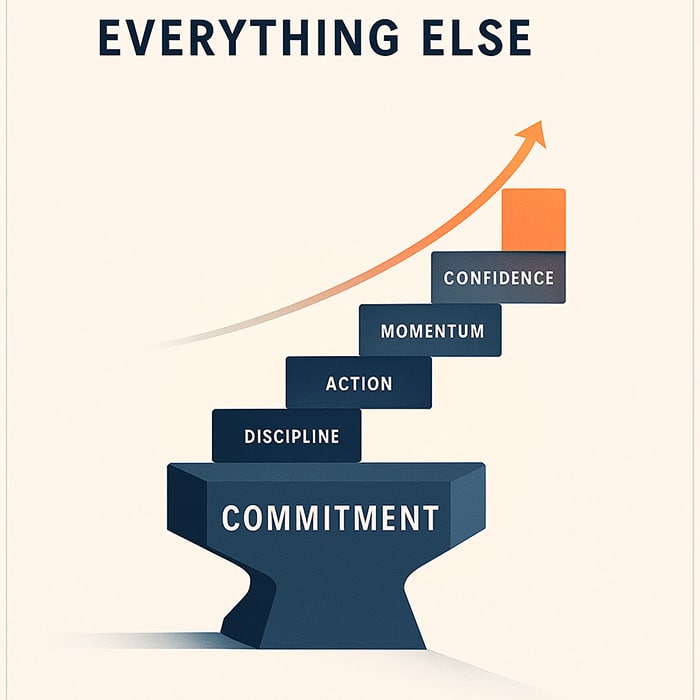
Commitment is the engine. Everything else is just cargo. You can have all the maps and fuel in the world (“the how” and “the belief”), but if the engine is off, you’re going nowhere.
The moment you make a real, internal commitment—a “I AM doing this, period”—your brain stops being a problem-finder and becomes a solution-finder.
The commitment creates the first step. The first step creates a result. The result builds belief. And belief fuels the next step. The “how” reveals itself one piece at a time.
So, ask yourself: what’s the “stone in your shoe”? And are you using “I don’t know how” and “I don’t believe I can” as a comfortable excuse to avoid the one thing that has always been in your power?
The power to choose. The power to commit.
The Trap of “How” and “Belief”
We’ve been taught to wait. We think, “First, I need a detailed map. Then, I need to feel super confident. Then, and only then, will I start the journey.”
It’s like wanting to learn to cook a fantastic meal. If you use the backwards logic, you’d say: “I can’t start cooking because a) I don’t know the recipe, and b) I don’t believe I’m a good cook.” So you never turn on the stove. You never chop a vegetable. You just stare at the kitchen, feeling helpless, and order takeout again.
But what’s the real problem? It’s not the lack of a recipe—you can find a million recipes online! It’s not the lack of belief—belief comes from practice! The real problem is that you never made a firm commitment to cook the meal.
The “how“ is out there for the finding. You can learn just about anything. And “belief”? Belief isn’t a magic feather that you’re given. It’s a seed. You can’t wait for it to grow before you plant it. You have to plant it first—by taking action—and then it grows.
But commitment? That’s different. That’s the one thing no one can give you. That’s the one thing you can’t google. It’s a choice that happens entirely inside you. Nobody else can make that choice for you.
Commitment isn’t the final prize you get after everything is easy and figured out. It’s the first step you take when everything is hazy.
The real order—the one that actually creates all results—is:
Get clear and commit to what it is that you want (nothing else required)
Commitment creates the courage and belief that you need to start
Learn how to adapt and stay committed on the way – building confidence and momentum
Commitment comes first. Not eventually. Not “once I figure things out.” First.
because Commitment creates everything else.
The Power Move: Commitment Creates Everything Else
Here’s the thing about commitment that most people miss: commitment doesn’t follow results. Results follow commitment.
You don’t wait until you have clarity to commit. You commit, and clarity emerges.
You don’t wait until you believe it’s possible to commit. You commit, and belief builds.
You don’t wait until you know how to commit. You commit, and the how reveals itself.
You don’t wait until you have all the resources to commit. You commit, and then get resourceful to make it happen.
This isn’t some positive thinking nonsense. This is how reality works.
When you genuinely commit—not “try” or “hope” or “see what happens”—everything changes. Resources appear (because of your actions – not because of some magical “secret”).
Why? Because commitment changes you. It changes what you notice, what you prioritize, what you’re willing to do. It changes what you say yes to and what you say no to. Commitment reorganizes your entire operating system as a human BEING.
I’ve watched this happen hundreds of times. A client comes in stuck on something they’ve been “working on” for months or years. We get clear on what they actually want. They make a real commitment—not a wish, not a goal, a commitment—and within weeks, sometimes days, what seemed impossible starts moving.
Not because they suddenly got smarter or learned some secret technique. Because commitment unlocked everything else.
From Standstill to Creation
Let’s make this practical. Pull out that mental list of “Things I Need to Change.” Now, ask yourself a more pointed question: which one of these, if accomplished, would have the greatest impact on my life, business, career, or family?
Prioritize your top one or two. Are they important? You know they are. They are the stones in your shoe that you’ve been ignoring.
Now, instead of asking, “Do I know how to do this?” or “Do I truly believe I can?” ask only this: “Am I willing to make a commitment to this, right now?”
This commitment is not a vague wish. It is a definitive, internal contract. It is the decision that, no matter what, you are in the game. This commitment immediately changes your orientation. The “how” that once seemed invisible suddenly becomes visible. You notice relevant information, you are drawn to the right people, and you begin to see pathways where before there were only walls.
Your belief begins to grow, not from thin air, but from the evidence of your own actions. Each step you take, fueled by your commitment, becomes a brick in the foundation of your self-confidence. The clarity you longed for emerges from the process of engagement, not from passive contemplation.
Commitment creates the action. Action creates results and builds belief. Belief fuels more commitment and bigger actions. This is the virtuous cycle that commitment initiates. It is the force that creates everything else—the clarity, the capability, the confidence, and ultimately, the tangible results you desire.
The power to move past standstill was never outside of you. It was never hidden in a secret formula or contingent on the right circumstances. It resides in the most fundamental choice you can make: the choice to commit.
Stop waiting for the path to appear. Choose where you want to go, and the very act of commitment will start carving the path for you.
Creating Commitment Is Always In Your Power
The beautiful, sometimes terrifying truth is this: creating commitment is always available to you.
You might not have the skills yet. You might not have the resources. You might not have the evidence that it’s possible.
You always have the power to commit.
You can commit to learning. You can commit to believing. You can commit to finding the way.
You can create a commitment to something you don’t have, and then create it.
This is where real power lives. Not in having all the answers. Not in being certain. In being willing to commit anyway. And then move from that commitment.
Commitment is how you stop, take off the shoe, and remove the stone. Not someday. Not when you figure out the perfect way to do it. Now.
Everything you want is on the other side of a real commitment.
Not a try. Not a hope. Not an “I’ll see.”
A commitment.
And creating that commitment? That’s always, always in your power.
You know what’s funny? When I quit my 16 years tech career to start on a totally new journey – to guide and work with the biggest changemakers & leaders on this planet, I thought the hard part was getting there.
Landing the big CEO clients. Hitting the numbers and building a reputation. Being known for bringing people together and helping them go beyond even their own wildest dreams – both personally and professionally.
Turns out, I had no idea.
The real challenges of success? They’re the ones nobody talks about at conferences. They’re not in the Harvard Business Review case studies. They’re the 3 am thoughts, the conversations you can’t have with anyone, the slowly growing sense that you’re living someone else’s life while everyone congratulates you on yours.
I’ve sat across from people who look like they have it all figured out—the title, the impact, the respect—and watched them break down because they finally found someone who wouldn’t judge them for admitting: “I don’t know if I can keep doing this.”
Let me walk you through what success actually looks like from the inside. Not the Instagram version. The real one.
When You Become a Role, Not a Person
I’ll never forget this CEO I worked with—let’s call him Raj. Built an incredible company from scratch. 300 employees. Lives changed. Real impact. And he came to me completely burned out.
“I can’t remember the last time someone asked me how I actually am,” he said. “Not how the company’s doing. Not how the quarter looks. Just… me.”
Here’s what happens: You achieve something significant, and suddenly you’re not allowed to be human anymore. You’re “The CEO.” You’re “The Founder.” You become a symbol, an inspiration, a beacon—and all of that is beautiful except you’re still just a person who gets scared and tired and confused.
Raj told me about going to a friend’s birthday party—people he’d known for years—and spending the whole evening answering questions about his company. Nobody asked about him as a father or about his painting hobby. Nobody noticed he’d lost weight from stress. The entire conversation was about his role, never about him.
This is the identity prison. You get trapped in the character you’ve created, and the bars are made of other people’s expectations and your own success.
I see this constantly. A leader can’t admit they’re struggling with a decision because “leaders are decisive.” They can’t show uncertainty because “leaders inspire confidence.” They can’t have a rough day because everyone’s watching.
The exhausting part? You start believing it too. You internalize that you should always have answers. You should never waver. And slowly, you lose touch with the actual human underneath—the one who’s allowed to not know, to be tired, to need support.
The Loneliness Nobody Warns You About
Let me tell you about Priya. Brilliant executive. Everyone wanted to work with her. Her calendar was packed 7am to 8pm. And she was profoundly, achingly lonely.
“I’m surrounded by people all day,” she told me. “But I can’t actually talk to any of them.”
This is the cruel irony of success: The higher you go, the fewer people you can be real with.
Your team needs you to be strong, so you can’t share your doubts. Your board wants confidence, so you can’t express fear. Your old friends feel distant because your life looks so different now. Your new “friends” might want access more than connection.
I remember Priya describing a moment when she was in a meeting with her executive team, discussing a major strategic pivot. She was terrified it was the wrong call. Her stomach was in knots. But everyone was looking at her for certainty, so she projected it. The decision went through. It worked out. And she felt more isolated than ever because nobody knew how scared she’d been.
Who do you talk to when you can’t talk to anyone?
This is why our work together mattered so much. Not because I had magic answers, but because I was someone she could actually be honest with. Someone who didn’t need her to be anything other than human. Someone who could handle her uncertainty without panicking or judging.
I remember one conversation where she spoke for 55 minutes of the 60-minute session. Internally, I was almost blaming myself because I didn’t get a chance to coach her or solve her problems. I was wondering if I added value because the only thing I did was I listened to her. At the end of the session, she said, “This was the best conversation I have had in a long time. Nobody has listened so deeply to me.” This feedback helped me understand the other side of success.
The loneliness of success isn’t about being alone. It’s about being surrounded by people and still feeling like nobody sees you.
When Success Stops Feeling Like Success
Here’s something wild: I’ve worked with people who hit goals they’d been chasing for years—goals that would change their lives—and they felt… nothing. Or worse, they felt empty.
There was this founder I coached who finally closed his Series B. Eight million dollars. Validation from top-tier investors. Everything he’d been working toward for three years.
He called me the next day. “Is this it?” he asked. “I thought I’d feel different.”
This is the moving goalpost syndrome, and it’s brutal. You think hitting the target will bring peace, satisfaction, that sense of “I made it.” Instead, it brings relief for about 48 seconds, and then your brain is already moving to the next thing.
The Series B becomes “we need a Series C.” The VP title becomes “I need to be in the C-suite.” The successful exit becomes “but what’s my next thing?”
You become addicted to the chase, to the achievement, to the validation—but you never actually feel satisfied. Success becomes this treadmill you can’t get off because stopping means facing the emptiness you’ve been running from.
I see this with executives who work 80-hour weeks not because they have to, but because they don’t know who they are without the work. The hustle became their identity. The achievement became their drug. And now they’re trapped in a cycle that’s slowly killing them but they can’t imagine life without it.
The Weight of Other People’s Lives
At 2am one night, I got a text from a client—a CEO of a mid-sized company. Just two words: “Can’t sleep.”
I called him first thing the next morning. He’d been lying awake thinking about a restructuring decision. Twenty people would lose their jobs. Twenty families. Kids. Mortgages. Dreams.
“I know it’s the right business decision,” he said. “The numbers are clear. But these are real people. How do you sleep when you’re making choices that impact lives?”
This is something most people never consider about success and leadership: Every decision carries weight that goes far beyond you.
You’re not just responsible for results. You’re responsible for people’s livelihoods, their sense of security, sometimes their entire identity if they’ve wrapped it up in their job. One wrong strategic call and you’re not just missing a target—you’re affecting dozens or hundreds of lives.
I’ve seen this weight crush people. The executive who can’t stop thinking about the single mom on their team who’s about to be laid off. The founder who feels guilty about every 5-star hotel stay because their employees can’t afford one. The leader who lies awake calculating how many people they’re affecting with each decision.
The privilege of impact comes with the crushing burden of consequence. And you carry that alone because who else can understand it?
When You Don’t Know Which Version of You Is Real
I worked with a leader once—a woman who’d built an incredible reputation in her industry. Confident. Inspiring. The person everyone wanted to be.
In our third session together, she said something that broke my heart: “I’ve been performing for so long, I don’t remember what I actually think or feel about anything. I don’t know who I am.”
She’d spent years crafting the right image. Saying the right things. Showing up the right way. And somewhere along the line, the performance became the reality. Or rather, she lost track of which was which.
This is the authenticity gap. The distance between who you are and who you show up as. And it grows every time you:
Project confidence you don’t feel in a meeting
Give an inspiring speech when you’re terrified inside
Act like you have it together when you’re falling apart
Smile and say “everything’s great” when it’s not
The gap gets wider and wider until you feel like a fraud in your own life.
I see this especially with introverts who’ve learned to perform extroversion. With people from cultures where showing vulnerability is seen as weakness. With anyone who’s had to “fake it till you make it” for so long that they forgot there’s a real person underneath the performance.
The work we do together often starts with simply creating space to let the real person emerge. No performance. No image management. Just “what’s actually true for you right now?”
When Everyone Wants Something From You
“I don’t know who actually likes me anymore,” a client told me once. He’d just sold his company for a stupid amount of money, and suddenly he had more “friends” than ever.
This is the trust deficit. When you’re successful, every relationship gets complicated. Is this person genuine or do they want funding? Want a job? Want to be associated with your success? Want to network through you?
You start filtering every interaction through suspicion. It’s not paranoia—you’ve been burned. The person who seemed so supportive suddenly had an agenda. The friendship that felt real turned out to be transactional.
I’ve watched this make people incredibly isolated. They want connection but they can’t trust it. They want friendship but they can’t tell if it’s real. And the sad part? Sometimes they’re right to be suspicious. Success attracts people who are more interested in what you can do for them than who you actually are.
This is why finding people who knew you before, who don’t need anything from you, becomes so valuable. Or working with someone like me, where the relationship is clear and boundaried and there’s no hidden agenda.
When You Have Everything Except Time
The most painful irony of success: You finally have resources but no time to use them.
You can afford the vacation but can’t take it. You can hire help but you’re too busy to let them help. You want to be present with your family but you’re always mentally somewhere else.
I remember this executive—father of three—who realized he’d missed every single one of his daughter’s soccer games that season. He could afford front-row tickets to anything. But he couldn’t afford the three hours on a Saturday afternoon.
Success promised freedom. Instead, it delivered a different cage—one made of opportunities you can’t say no to, obligations you can’t drop, expectations you can’t ignore.
“I thought making it would mean I could finally relax,” he told me. “But I’m more trapped than ever.”
The Imposter in the Room
Here’s the wildest part: The more successful people become, often the more like an imposter they feel.
You’d think it would be the opposite. You’d think results would build confidence. But what actually happens is this: The stakes get higher, the spotlight gets brighter, and that voice in your head gets louder: “When are they going to figure out I’m making this up?”
I worked with a woman who’d been promoted to SVP. Huge company. Incredible opportunity. And she was terrified.
“Everyone else seems to know what they’re doing,” she said. “I’m just figuring it out as I go.”
The truth I shared with her? Everyone is figuring it out as they go. But at higher levels, you’re expected to hide it better.
The imposter complex doesn’t go away with success. It just gets more sophisticated. More subtle. More isolating because you think you’re the only one who feels this way.
What Actually Helps
After years of sitting with people going through all of this, here’s what I’ve learned: The antidote to these challenges isn’t working harder or achieving more. It’s finding people and spaces where you can be fully human.
Where you can admit you’re scared and it doesn’t shake anyone’s confidence in you.
Where you can say “I don’t know” and it’s not a crisis.
Where you can drop the performance and just be yourself, whatever that looks like today.
This is why people come to me. Not because I have all the answers (I definitely don’t), but because I can hold space for the full reality of their experience. The fear and the confidence. The doubt and the vision. The exhaustion and the commitment. My promise to them is that I will never judge them (even when feedback is very honest and direct) and they can always count on me – for the rest of their lives.
They come with their lights dim—frustrated, stuck, low on energy. And through our work together, something shifts. Not because I fix them (they’re not broken), but because they finally have space to be honest. To reconnect with themselves. To remember who they are underneath all the roles and expectations.
They leave empowered, confident, ready—not because the challenges went away, but because they’re no longer carrying them alone.
(All names have been changed and details in this article have been anonymised)
The Real Conversation
If you’re reading this and recognizing yourself, know this: What you’re experiencing is real. It’s valid. And you’re not alone in it, even though it feels like you are.
The challenges don’t get easier with success—they just get more invisible and more isolating. And that’s exactly why finding someone who can see the real you, who won’t need you to be anything other than human, becomes absolutely critical.
There are moments in every leader’s life when they need someone they know they can count on. Someone who gets it.
Maybe that’s why you’re still reading this.
If any of this resonated, send me a note. Better yet, record a voice note or a video msg. Let yourself be seen.
Because here’s what I know for sure: You don’t have to carry all of this alone. And on the other side of being real about what’s actually happening? That’s where you let the burden of leadership go and acknowledge the privilege and grace of leadership. You deserve it.
There’s a meeting happening right now, in every country, where a leader is saying something they don’t mean, making a promise they won’t keep, or avoiding a conversation that actually matters.
And everyone in the room knows it.
Including the leader.
But the show (or drama) goes on. The performance continues. The loop keeps looping.
Here’s what nobody wants to admit: Most of what we call leadership is theater. Not the inspiring kind—the kind where everyone’s pretending not to notice that the emperor has no clothes, the strategy has no substance, and the “transformation” is just rearranging deck chairs on the titanic.
We’re not leading. We’re performing safety. We are repeating the same “drama” on repeat. And calling it business or leadership.
What These Loops Actually Are
These patterns aren’t conscious choices. They’re what happens when your nervous system learns to prioritize safety over truth. A self-blame loop like “there’s something wrong with me” isn’t a conclusion you’ve reached through careful analysis. It’s a pattern that organizes chaos around a painful but familiar center. It hurts, yes. But it’s more durable than ambiguity.
The victim loop—“nothing ever works out for me”—isn’t giving up. It’s making chaos make sense by creating a story where you’re at least the protagonist of your own suffering.
“All I want to do is be helpful” sounds virtuous. Strip away the performance and you’ll often find self-preservation disguised as service. Being helpful means you’re needed. Being needed means you’re safe.
Carl Jung saw this clearly: “Until you make the unconscious conscious, it will direct your life and you will call it fate.”
Let’s look at the loops we’re all running but pretending we’re not.
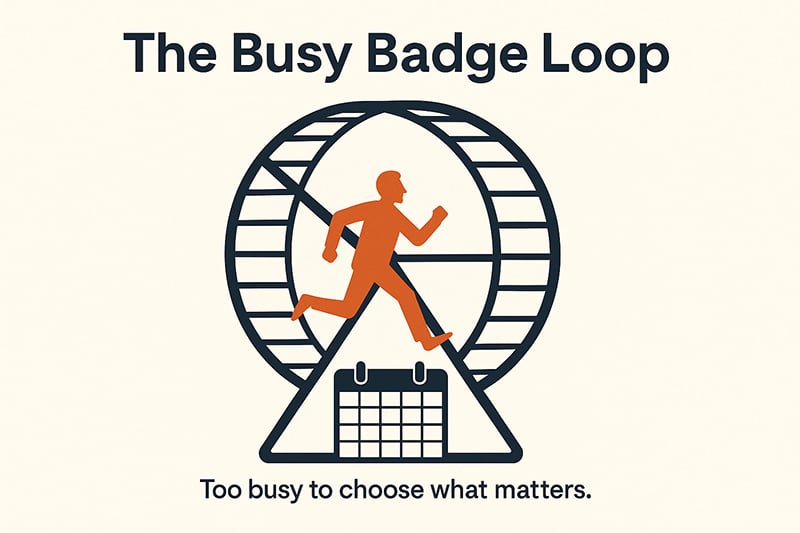
The Busy Badge Loop
“I’m so busy.”
It’s the most acceptable humble-brag in business. Said with exhaustion, sometimes pride, always as explanation for why something else isn’t happening.
But busyness isn’t productivity. It’s a shield against prioritization. Because choosing what matters means risking being wrong about what matters.If everything is urgent, nothing has to be important. The calendar stays full. The inbox stays overwhelming. And underneath runs quiet relief that you never have to face the question: “What would I do if I actually had space to think?”
Ask yourself: What dream or bold move have I been too “busy” to pursue for the last year, and what will my life look like in five years if I’m still too busy?
The Perfectionism Postponement
“We’ll launch when it’s ready.”
How many world-changing ideas have died in that sentence?
Perfectionism isn’t about high standards. It’s about never having to face judgment. If you never ship, you never fail. The preparation becomes the point. You get to be the person who could do something amazing rather than the person who did something imperfect.
Steve Jobs understood this trap: “Real artists ship.” Not perfect artists. Real ones.
Ask yourself: What would I have already created, launched, or become if “good enough” had been acceptable, and who might have already been helped by it?
The Certainty Collector
“I need more data before I decide.”
That is paralysis in a business suit.
Every decision involves loss. Choose one path and you lose the others. More information doesn’t change that—it just gives you more sophisticated ways to avoid choosing. Analysis becomes the thing you do instead of deciding.
Jeff Bezos famously distinguished between one-way and two-way doors. Most decisions are two-way doors (reversible). But we treat them like one-way doors because that justifies the delay.
Ask yourself: What decision have I been “gathering information” about for months, and what momentum, opportunity, or possibility dies with each day I wait?
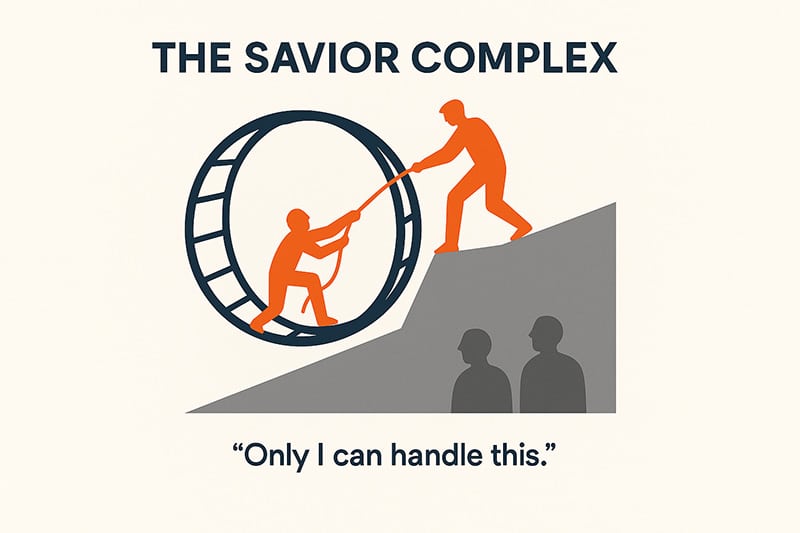
The Savior Complex
“I’m the only one who can handle this.”
Listen closely and you’ll hear relief underneath. Because being indispensable means never being challenged to grow beyond your current identity. The martyr and the tyrant are the same pattern in different clothes. Both say: “The world needs me to be exactly who I am right now.” Both are terrified of what happens when that stops being true.
Lao Tzu wrote, “A leader is best when people barely know he exists.” That’s not about invisibility. It’s about leaders who’ve stopped needing to be the hero of every story.
Ask yourself: Who on my team isn’t growing because I keep swooping in to save the day, and what leader could they become if I stepped back?
The Cynicism Shield
“Nothing will really change anyway.”
Corporate cynicism sounds like sophistication. It’s actually exhausted hope wearing a suit.
Cynicism is what happens when you’ve been disappointed enough times that pre-emptive disappointment feels safer than staying open. You can’t be hurt if you expect nothing. The leader who says “that’s just how it is” isn’t being realistic—they’re protecting themselves from caring enough to be wrong.
Marianne Williamson nailed it: “We ask ourselves, ‘Who am I to be brilliant, gorgeous, talented, fabulous?’ Actually, who are you not to be?” The same applies to hope. Who are you to be cynical when the world needs leaders who still believe change is possible?
Ask yourself: What possibility am I no longer even allowing myself to imagine because I’ve decided it’s naive, and what kind of world am I creating by giving up before I start?
The Comparison Trap
“At least our numbers are better than our competitors’.”
Using others as your reference point means never having to look directly at whether you’re actually building what matters. Comparison stabilizes the ego by making identity relational rather than examined.
The most dangerous version? “At least I’m not like that CEO.” Every critique of someone else’s leadership style is an opportunity to avoid examining your own.
Theodore Roosevelt said, “Comparison is the thief of joy.” In leadership, it’s also the thief of vision.
Ask yourself: If no one else existed to compare myself to, what would I actually want to create, and how far am I from that right now?
The Authenticity Performance
“I’m just being honest.”
Honesty without kindness isn’t authenticity—it’s cruelty seeking permission. The leader who prides themselves on “telling it like it is” often confuses brutality with truth. Real authenticity admits “I don’t know.” It says “I was wrong.” It doesn’t perform transparency—it is transparent, even when uncomfortable.
Brené Brown reminds us: “Vulnerability is not winning or losing; it’s having the courage to show up and be seen when we have no control over the outcome.”
Ask yourself: Who have I hurt or pushed away with my “honesty,” and what deeper truth am I avoiding by staying on the surface of brutal?
The Potential Prisoner
“We could scale to $100M if we wanted to.”
Living in the hypothetical is seductive. Unrealized potential can never fail. It’s the gap between what you are and what you could be that lets you avoid ever having to be anything specific.
The entrepreneur who’s always “between ventures.” The executive who’s “considering opportunities.” The leader who talks about vision but never takes the first step.
Goethe understood: “Whatever you can do or dream you can do, begin it. Boldness has genius, power and magic in it.”
Ask yourself: What am I sacrificing by staying in the realm of “could” instead of “did,” and what will I regret not attempting when I look back at this moment in ten years?
The Gratitude Bypass
“I should just be grateful for what we’ve achieved.”
Gratitude is beautiful. Using it to silence legitimate ambition? That’s self-betrayal with a spiritual bow on it.
This loop weaponizes thankfulness against desire. You can’t want more if you should be happy with what you have. It sounds humble. It’s actually a way to avoid the vulnerability of admitting you want something you might not get.
Ask yourself: What do I genuinely want that I’m pretending not to want by hiding behind gratitude, and what becomes impossible when I silence my own desires?
The Learning Loop
“I’m still learning. It’s a journey.”
Permanent student status is a brilliant defense mechanism. Growth language used to avoid ever being accountable as someone who knows. The journey never ends because arrival means responsibility.
There’s a difference between genuine humility and hiding behind “I’m still figuring it out” when people are actually waiting for you to lead.
Ask yourself: What am I qualified to teach or lead right now that I’m avoiding by staying in “student” mode, and who’s waiting for me to step up?
The Boundary Softness
“I don’t want to upset anyone.”
You’re not keeping the peace. You’re trading your needs for the mirage of harmony. But there’s no peace—just resentment accumulating while you pretend avoiding conflict is the same as connection.
Every unexpressed boundary is a future explosion waiting to happen. Every “yes” that should have been “no” is integrity leaking out.
Ask yourself: What boundary have I failed to set that’s now costing me my energy, time, or self-respect, and what relationship is actually suffering because I won’t be honest?
The Delegation Theater
“I’ve empowered my team.”
But have you? Or have you just created a system where they need your approval for everything while you maintain the illusion that you’re not a bottleneck?
Real delegation is scary because it means genuinely letting go of control. Fake delegation lets you keep control while looking collaborative. One builds leaders. The other builds dependency you can complain about.
Ask yourself: What’s not getting done or scaled because everything has to go through me, and what leader am I preventing from emerging by holding all the strings?
The Vision Vagueness
“We’re building something transformational.”
Vague vision isn’t inspiring—it’s a smoke screen. If your strategy can mean anything, it means nothing. But specificity is scary because it can be wrong. Vagueness can never fail because it never really commits.
The leader who speaks in inspiring abstractions but can’t answer “What does success look like next quarter?” isn’t visionary. They’re avoiding accountability.
Ask yourself: What am I avoiding committing to by keeping my vision vague, and how is my team’s confusion or misalignment the direct result of my lack of clarity?
The Consensus Cage
“Let’s make sure everyone’s aligned before we move forward.”
Sometimes that’s wisdom. Often it’s decision-making abdication disguised as inclusion. You’re not building buy-in—you’re distributing blame in advance.
Real leadership sometimes means making the call that not everyone agrees with and being willing to be wrong. The consensus loop means no one’s really leading.
Ask yourself: What bold decision have I been avoiding by waiting for everyone to agree, and what opportunity is dying while I run another alignment meeting?
The Optimism Bypass
“Everything happens for a reason.”
This isn’t faith. It’s a structure that turns randomness into reassurance. It’s a way to avoid grief, anger, and the messy reality that sometimes terrible things happen and there’s no lesson, no silver lining, no cosmic plan.
Toxic positivity in leadership looks like: “This layoff is actually an opportunity for those affected to find their true calling.” No. It’s a layoff. Let it be hard.
Ask yourself: What painful reality am I spiritually bypassing instead of facing, and who am I failing to truly support by forcing positivity onto their struggle?
The Meeting About Meetings
“We need better processes.”
Process improvement is legitimate. But sometimes “we need better systems” is a way to avoid addressing the actual problem: people aren’t having honest conversations.
No amount of process will fix a culture where people are afraid to tell the truth. The meeting about the meeting about the meeting is theater. The real issue is usually relational, not procedural.
Ask yourself: What difficult conversation am I avoiding by focusing on process improvements, and what would change if I just addressed the human issue directly?
The Awareness Paradox
“I’m aware of my patterns now.”
Here’s the most sophisticated loop of all: awareness that doesn’t lead to change. You’ve read the books. Done the workshops. Know your triggers. And yet… the same patterns persist.
Because awareness outside the loop is often just the loop preserving itself by imagining a vantage point not bound by its own constraints. Real awareness lives in the moment of choice, not in the reflection after.
Ask yourself: What pattern have I been “aware” of for years without changing, and what am I getting from knowing about it without doing anything about it?
Why The Drama Continues
These patterns persist because they work—not at creating results, but at creating coherence and safety of familiarity. They emerged because at some point, they kept you safe. They made chaos manageable. They gave you a role when you didn’t know who to be.
The trap isn’t that they exist. It’s that they persist long after the threat has passed, running on autopilot because familiarity feels like truth.
They’re not you—they’re weather patterns you learned to live in. And like weather, they can change.
But first you have to stop calling them “just how things are” or “just how I am.”
The Real Work
Leadership isn’t about eliminating these patterns. It’s about recognizing them in real-time and choosing differently. Not perfectly. Not always. But consciously.
Read that again. It is that I call “Constant Conscious Creation”. Choosing consciously in real-time.
The next time you hear yourself say “I’m too busy,” pause. Ask: “What am I avoiding by staying busy?”
When you catch yourself collecting more data, ask: “What decision am I afraid to make?”
When you feel indispensable, ask: “What would become possible if I weren’t?”
When you’re performing authenticity, ask: “What truth am I avoiding by being so ‘honest’?”
This is the work. Not creating a perfect self, but creating a conscious one. A leader who can see their own loops and choose—even occasionally—to step outside them.
That’s when leadership stops being theater and boring drama and starts being transformation and fulfilling.
That’s when the drama ends and the real work begins.
The Leadership Trinity: The 3 Essential States of Being for any Leader
Picture this: You’re sitting in your office at 10 pm, staring at a mountain of unfinished tasks while your phone buzzes with urgent messages from three different time zones. Your head of sales is demanding clearer targets, your engineering team needs inspiration for the next breakthrough, and your newest hire just submitted their resignation because they felt “unsupported.”
Sound familiar?
Here’s what nobody will tell you: You’re not failing because you lack skills or knowledge. You’re struggling because you’re trying to be everything to everyone while being unclear about which version of yourself to show up as in each moment.
After working with hundreds of leaders who’ve gone from feeling like they’re drowning in their own success to becoming unstoppable forces of positive change, I’ve discovered that every business owner must master not just one but three essential states of being: Leader, Manager, and Coach.
The Problem
Let me share Sonia’s story. She built a startup from her garage to a $50M valuation in four years. Impressive, right? But when I met her, she was burned out, her team was confused, and her company culture was toxic despite all their external success.
The problem? Sonia was switching between being a leader, manager, and coach without understanding the distinction. In Monday morning meetings, she’d inspire her team with grand visions (Leader), then immediately micromanage their daily tasks (Manager), before asking them to figure out their own solutions (Coach) – all within the same conversation.
Her team was getting whiplash. They didn’t know which Sonia would show up, so they learned to wait for instructions instead of taking initiative. Innovation stopped. Engagement went down.
Sonia’s mistake is the same one I see everywhere: treating leadership as a single skill instead of recognizing it as three distinct states of being, each with its own purpose, energy, and impact.
The Three States of Being: Your Leadership Trinity
Think of these three states like instruments in an orchestra. Each has its unique sound, purpose, and moment to shine. A symphony fails when the violins try to be drums, just like your organization fails when you bring the wrong energy to each situation.
State 1: The Leader – The Visionary Who Ignites Possibility
When you embody the Leader state, you’re not managing what is – you’re creating what could be. You’re the person who walks into a room and shifts the energy simply by declaring a possibility that didn’t exist before.
I think of Hitesh, a CEO who inherited a struggling manufacturing company from his father. The business was bleeding money, morale was at rock bottom, and everyone expected him to announce layoffs. Instead, Hitesh stood before his 200 employees and declared: “In 18 months, we’re going to be the most innovative, employee-loved manufacturing company in our region, and every person in this room is going to be proud to tell their family where they work.”
Crazy? Maybe. But he wasn’t predicting the future – he was creating it through his declaration. That’s what Leaders do. They don’t manage reality; they create the future.
Key Actions of a Leader:
Declare a Future: Paint a vivid picture that makes people’s hearts race. Not goals, not targets – futures that feel inevitable once spoken. When Elon Musk declared we’d colonize Mars, he wasn’t setting a goal. He was creating a future that thousands of brilliant minds could step into.
Ask Insightful Questions: The right question can change everything. Instead of “How do we cut costs?” ask “What would we do if money wasn’t the constraint?” Instead of “Why is this taking so long?” ask “What would make this project irresistible to work on?”
Engage Perspectives: Leaders listen to different viewpoints without agreeing to disagreeing with any. They know that breakthrough thinking emerges from the collision of different perspectives. They ask “What am I not seeing?” and actually listen to the answers.
Example: “What would our ideal customer experience look like in five years if we had unlimited resources and complete customer trust?” Notice how this question immediately expands thinking beyond current limitations.
Being a Leader requires you to be a Player, not a Spectator.
Spectators observe, explain and comment.
Players step onto the field and influence outcomes through their presence and actions (requests and promises).
State 2: The Manager – Coordinating Human Behaviour And Creating Order
If the Leader creates the vision, the Manager makes it real. This is where inspiration meets execution, where dreams get translated into deliverable actions.
I worked with Alex, a brilliant visionary who could inspire a team to climb mountains but couldn’t get them to complete a simple project on time. His company was full of motivated people going in seventeen different directions. Alex had mastered the Leader state but was afraid to be a Manager, thinking it would make him “controlling” or “micromanaging.”
Here’s what I told him: “Alex, your team doesn’t need another inspiring speech. They need clarity. They need to know exactly what success looks like and when it’s done. That’s not controlling – that’s caring.”
The Manager state isn’t about being a dictator. It’s about creating the structure that allows brilliance to flourish. Think of it like being a conductor – you don’t play every instrument, but you ensure everyone plays in harmony and on time. It is about coordinating human behaviour and actions so that who will do what by when is clear to everyone involved.
Key Actions of a Manager:
Create Clear Promises: This is where most leaders fail. They create expectations instead of promises. An expectation is something you hope will happen. A promise is something you can count on. “I expect you to improve customer satisfaction” is weak. “Can you reduce customer complaint resolution time to under 24 hours by month-end?” is a promise when responded to by a clear YES or NO.
Provide Directives: Be specific. Be clear. Be unambiguous. “Complete the quarterly report by Friday following the outlined template, including the three scenario analyses we discussed, and send it to me and the board by 5 PM EST. Can you do that?” No guessing. No interpretation needed.
Monitor Compliance: This isn’t about micromanaging – it’s about caring enough to ensure promises are kept. Set up systems that make success visible and failure impossible to ignore.
Accountability Conversations: While being a manager includes holding others accountable, if you create PROMISES properly, people will hold themselves accountable on their own – as progress would be self-evident, measured and visible – leaving nothing to guessing.
The Manager state requires understanding the distinction between Promises and Expectations. Promises are commitments with specific deliverables and timelines. Expectations are wishes disguised as requirements. Which one do you think gets results?
State 3: The Coach – The Developer Who Unleashes Potential
The Coach state is perhaps the most misunderstood of the three. It’s not about being nice or supportive (though those can be byproducts). It’s about creating an environment where people discover their own answers and commit to the way forward.
Lisa, a VP of Engineering, came to me frustrated because her team kept coming to her with problems instead of solutions. “I’ve tried everything,” she said. “I’ve given them frameworks, sent them to training, even hired consultants. Nothing works.”
“Have you tried asking them what they think?” I asked.
“Of course I—” she stopped mid-sentence. “Actually, no. I tell them what I think they should think.”
That’s the difference between a Knower and a Learner. Knowers have all the answers (or pretend to). Learners have all the questions.
A leader creates, a manager knows, and a coach is always open to learning about themselves and the person in front of them.
The next week, Lisa tried something different. Instead of solving her team’s problems, she asked: “What do you think is the best approach here? What would need to be true for this to work? What support do you need from me?”
Magic happened. Not only did her team come up with better solutions than she would have provided, but they also became committed to implementing them because the ideas were theirs.
(if coaching is not familiar to you, it is never as easy as the above example – though it can be)
Key Actions of a Coach:
Facilitate Self-Discovery: Your job isn’t to have all the answers – it’s to ask the questions that help others find their answers. “What would you do if you knew you couldn’t fail?” “What’s the smallest step you could take today?” “What would success look like to you?”
Encourage Growth: Create psychological safety where people can experiment, fail, and learn without judgment. Celebrate attempts as much as achievements. Growth happens at the edge of comfort zones. Stay in your center and make sure the person in front of you stays in theirs.
Support Autonomy: Give people ownership of their development. Ask permission before giving advice: “Would you like my perspective on this?” “Are you looking for solutions or just someone to listen?” Respect their autonomy to choose.
Coaching is not manipulation. Coaching is treating the other person as an equal with complete autonomy – even if the topic of discussion is incompetence, confusion, or failure.
Example in action: “What do you think is the best way to tackle this challenge, and how can I support you?” Notice how this question puts ownership squarely on their shoulders while offering support.
The Coach state requires being a Learner, not a Knower. Learners are curious, open, and comfortable with not having all the answers. Knowers are rigid, closed, and need to be right.
The Art of State Switching: When to Be What
Here’s where most leaders crash and burn: they don’t know when to switch states. They bring Leader energy to operational meetings, Manager energy to coaching conversations, and Coach energy to crisis situations.
Let me paint you some scenarios:
Crisis Management: Your biggest client just threatened to leave unless you fix a critical bug by tomorrow. This is Manager time – clear directives, specific timelines, no ambiguity. “Sachin, drop everything and focus on the authentication module. Leslie, you’re handling client communication every two hours with updates. Everyone else, clear their calendar until this is resolved.”
Strategic Planning: You’re designing the company’s five-year vision. This is Leader territory – declarations, questions, possibility. “What if we could make our industry irrelevant? What would we build if we started from scratch today? What future are we most excited to create?”
Performance Development: An employee is struggling with confidence after a failed project. Coach mode activated – questions, permission, insight. “What did you learn from this experience? What would you do differently next time? What support would help you feel more prepared for similar challenges?”
The key is reading the room and the moment. What does this situation call for? What does this person need right now? What state of being will serve the highest good?
Your Leadership Audit
Now comes the uncomfortable truth-telling moment. Most leaders have a dominant state – one they default to because it feels safe or familiar. But your default might be exactly what’s limiting your impact.
Take a moment and honestly assess yourself:
Which state do you most easily embody?
Are you naturally the visionary who paints compelling futures but struggles with follow-through? The organized executor who gets things done but rarely inspires? The supportive developer who coaches everyone but never makes tough decisions?
I was naturally a Coach – I loved asking questions and helping people discover their own answers. But I was afraid of being directive (Manager) because I thought it made me controlling. And I avoided making bold declarations (Leader) because I was scared of being wrong and responsible.
My breakthrough came when I realized that serving others sometimes means being the Manager who sets clear boundaries or the Leader who declares an uncomfortable truth. My natural Coach state was actually a limitation when it prevented me from giving people the clarity or inspiration they needed.
Being a coach allowed me to become one of the best at coaching.
Being a manager allowed me to create a thriving coaching business.
Being a leader allowed me to inspire the best of the best – both the CEOs and other coaches I work with today.
The last two – I had to learn. It was the tough pill and learning I needed to do what I do today.
Which state do you need to cultivate to win at your biggest game?
This question will reveal your growth edge. Maybe you’re brilliant at execution but your team is uninspired because you never paint the bigger picture. Maybe you’re amazing at inspiring people but projects fail because you avoid creating clear accountability.
The fintech CEO I mentioned earlier, realized she was avoiding the Coach state because she equated it with being “soft.” She thought successful CEOs had to be always-on, always-directive. But her team needed space to think, to contribute, to feel heard. When she learned to ask instead of tell, magic happened.
The visionaries and coaches often have to embrace their inner Manager. They have to learn that structure isn’t the enemy of creativity – it’s creativity’s best friend. Clear agreements frees teams to innovate within defined boundaries.
The Ripple Effect: How Being Centered Transforms Everything
When you are Centered, you can choose Who to BE – Leader, Manager or Coach.
When you can choose these three states of being, something profound happens. Your organization stops being dependent on your mood, your energy level, or your latest management book. Instead, it becomes a living system that can handle complexity because everyone knows what to expect and when.
Your team stops walking on eggshells, wondering which version of you will show up. They learn to recognize the states and respond appropriately. When you’re in Leader mode, they bring their biggest thinking. When you’re in Manager mode, they focus on execution. When you’re in Coach mode, they open up and share their real challenges.
But here’s the deeper transformation: you stop being exhausted by leadership. Instead of trying to be everything to everyone, you become exactly what each moment requires.
Read the above again. One more time. You stop fighting your natural state and start leveraging all three.
The manufacturing CEO told me six months after we worked together: “I used to dread Monday mornings because I never knew what crisis I’d have to solve. Now I look forward to them because I know I have three different ways to approach any situation. I’m not just reacting anymore – I’m responding from center and choice.”
Your Next Move
So here’s my challenge to you: For the next week, before every important interaction, center yourself & ask: “What does this situation call for? What state of being will serve the highest good right now?”
Don’t try to be perfect. Don’t try to master all three states at once. Just become conscious of which one you’re in and whether it’s serving you and others.
Start with your natural state and get even better at it. Then gradually expand into the other two. Remember, this isn’t about becoming someone you’re not – it’s about becoming all of who you are.
The world needs leaders who can hold all three states with equal mastery. Leaders who can inspire the impossible, create order from chaos, and develop others to exceed their own potential.
The question isn’t whether you have the capacity for this – you do. The question is whether you’re willing to stop being comfortable and embrace the full spectrum of your leadership power.
Which state of being will you choose to step into in your next conversation?
The Leadership Trap: Why Serving Beats Pleasing Every Time
How breaking free from this childhood programming of pleasing others can transform your leadership and life
Picture this: You’re in a meeting, and something isn’t right. The project is headed toward disaster, but everyone’s nodding along. You know you should speak up, but… what if they don’t like what you have to say? What if it makes waves? So you stay quiet, smile, and hope someone else will be the bad guy.
Sound familiar? Welcome to the pleasing trap – the invisible prison that’s keeping most leaders from their true potential.
The Programming We Can’t See
Here’s the uncomfortable truth: We’re all walking around with childhood software that’s completely obsolete for adult leadership. As kids, our survival literally depended on pleasing the giants (our parents, teachers, etc) who fed us, sheltered us, and kept us safe.
How We Got Programmed to Please:
Survival Strategy: Small children learned that pleasing powerful adults meant getting food, shelter, and safety
Parental Reinforcement: “Good job, sweetheart!” “You were so well-behaved today!” “Mommy’s so proud when you’re nice to everyone!”
Personality Formation: We built our entire identity around what worked to win approval
Biological Programming: Our psychological “brain” got hardwired to seek approval first, serve second
This is not wrong or bad. This is just what it is. This is how kids grow up. This is how we treat kids to help them grow up.
The Invisible Impact (Fish in Water Effect):
This programming runs so deep it’s like being a fish in water – we can’t see it because we’re swimming in it. Every day, leaders unconsciously deploy these same tactics:
Communication: Carefully crafted emails that say nothing substantial
Meetings: Everyone agrees but nothing actually gets decided or done
Feedback: Dancing around real issues to avoid discomfort
Decision-Making: Choosing what’s popular over what’s right
But here’s the kicker – what kept us alive as children is killing our leadership as adults.
The Hidden Cost of Pleasing
When leaders operate from a pleasing mindset, they’re not just being ineffective – they’re creating a slow-motion disaster.
The Organizational Impact:
Mediocrity Becomes Normal: Every avoided difficult conversation teaches your team that “good enough” is acceptable
Problems Fester: Issues that could be solved early become organizational cancer
Trust Erodes: People sense the inauthenticity and distance themselves
Chronic Exhaustion: Constantly performing drains your energy
Emotional Isolation: Never sure if people like you or just your pleasing persona
Frustration: Knowing you’re not operating at your full potential
Disconnection: Relationships feel surface-level and transactional
Imposter Syndrome: Living as a performing self instead of authentic self
It’s a lonely, miserable way to live – and it shows up in everything from their energy levels to their ability to inspire genuine loyalty.
I speak from personal experience. I have spent most of my life pleasing people and avoiding any uncomfortable situation.
The Service Revolution
Now let’s talk about the alternative that changes everything: service (of the person in front of you). Real service isn’t about being nice or making people happy – it’s about making their lives genuinely better, even when it’s uncomfortable to you or them.
Giving alcohol to an alcoholic would be pleasing them.
Sending them to rehab would be serving them, even though that would not please them and they might even hate you for it.
That’s what real leadership looks like – sometimes you have to disturb the peace to create something better.
What Service Requires (That Pleasing Never Does):
Courage: Telling someone what they need to hear instead of what they want to hear
Strength: Holding your ground when your service isn’t immediately appreciated
Wisdom: Knowing that sometimes the most loving thing you can do is be the villain in someone else’s story
Confidence: Believing in your ability to add value, even when it’s not immediately recognized
Authenticity: Operating from your true self, not your performing self
Service in Action: Growing Up as a Leader
1. Team Alignment: The Truth-Telling Leader
The Situation: Gunjan, a VP at a tech startup, noticed her team was consistently missing deadlines.
The Pleasing Approach Would Have Been:
Work around the problem (hire more people, extend timelines)
Avoid confrontation
Hope things improve naturally
Make excuses for the team
The Service Approach:
Called a direct meeting: “We need to talk about what’s really happening here”
Created space for honest conversation
Uncovered the real issues: team conflict, personal overwhelm, secret drowning in stress
Focused on solutions, not blame
The Result: Team hit their next three deadlines ahead of schedule.
2. Sales: The Demonstration of Value
Instead of the typical pleasing approach:
Song-and-dance of features and benefits
Trying to “win over” prospects
Focusing on what they want to hear
Building fake rapport
Service-oriented leaders focus on:
Immediate value demonstration
Asking: “What’s the biggest challenge you’re facing right now?”
Spending time actually helping them (for free) and not chit-chatting
Refusing to spend time on frivolous issues or waiting
Making their life better before asking for anything
Example: Shiv, a consultant, stops trying to “win over” prospects and instead spends 15 minutes helping them think through their biggest challenge. He raises an objection and is willing to walk away if he is made to wait for the potential client and not treated as an equal.
This isn’t a sales tactic; it’s genuine service. People don’t need to be convinced to work with someone who’s already making their life better.
3. Trust Building: The Accountability Partner
Service-Based Trust Building:
Do what you say you’ll do (reliability)
Hold others accountable to their commitments. Don’t let them slip.
Refuse to let people settle for less than their potential
Create psychological safety through consistency
Example: Jennifer, a CEO, serves her leadership team with monthly “reality check” sessions. She asks each leader:
Where are you struggling?
What support do you need?
What’s one thing you’re avoiding?
How can we help you succeed?
It’s not comfortable, but it’s transformed how they work together because everyone knows they can count on honest feedback and real support.
4. Holding Others Accountable: The Courageous Conversation
This might be the ultimate test of service versus pleasing.
The Pleasing Approach:
Let underperforming team members slide
Avoid difficult conversations
Hope things improve on their own
Enable mediocrity to keep peace
The Service Approach:
“I care about your success too much to let this continue”
“Let’s figure out what needs to change”
Be willing to be the bad guy today to help someone become better tomorrow
Focus on their growth, not their comfort
Key Mindset Shift: You’re not being mean; you’re being loving enough to have the hard conversation.
5. Living a Happy and Joyful Life: The Authentic Path
The Pleasing Paradox: The more you try to make everyone happy, the more miserable you become.
Benefits of Serving irrespective of how it is received:
Live from your authentic self instead of your performing self
Stop exhausting yourself trying to be everything to everyone
Start energizing yourself by making a real difference
Feel more connected, purposeful, and genuinely happy
What Service-Oriented Leaders Report:
Better sleep (knowing they’re making a genuine difference)
More energy (excited about problems to solve and people to help)
Deeper relationships (based on authenticity, not performance)
Greater life satisfaction (purpose-driven instead of approval-driven)
The Uncomfortable Truth About Service
Let’s be honest: service isn’t always popular. When you serve people, sometimes they don’t like it. Sometimes they resist. Sometimes they push back. And that’s okay – it’s part of the job.
Why Service Can Be Uncomfortable:
Immediate Resistance: People might not want what they need
Short-term Friction: Disturbing the status quo creates temporary discomfort
Rejection Risk: Some people will say no to being served
Misunderstanding: Your motives might be questioned initially
Responsibility: You’re accountable for the outcomes you create
That’s what service looks like in leadership – you’re willing to risk the rejection because you believe in the value you’re providing.
The Deathbed Question
Steve Chandler asks a powerful question: When you’re on your deathbed, what will you ask yourself?
“How many people did I please?”
“Did I avoid enough conflicts?”
“Was I liked by everyone?”
A career of avoided conflicts, missed opportunities, and relationships that never quite felt real
OR
“How many people did I serve?”
“What difference did I make?”
“Is life different because I was here?”
A life of genuine impact, authentic relationships, and problems solved
Making the Switch: From Pleasing to Service
Start Small – Daily Practice Questions:
In your next meeting, ask yourself:
“What would serve this group right now?”
“What question needs to be asked that no one wants to ask?”
“What’s the elephant in the room?”
“What assumption is holding everyone back?”
In your next one-on-one:
Instead of: “How can I help you?” (often leads to pleasing)
Ask: “What do you need to hear right now that you’re not hearing?”
In your next difficult conversation:
Instead of softening the message to make it palatable
Deliver it with love but without dilution
The Three-Step Service Framework:
Identify the Need: What does this person/situation actually need (not want)?
Assess Your Ability: Can you genuinely serve this need?
Deliver with Love: Provide the service, even if it’s uncomfortable
The Service Mindset: Key Mental Shifts
From Pleasing Questions to Service Questions:
Pleasing
Serving
“How can I make this person happy?”
“How can I make this person better?”
“What do they want to hear?”
“What do they need to hear?”
“How can I avoid conflict?”
“How can I create value?”
“Will they like me?”
“Will this help them?”
“What’s the safe thing to do?”
“What’s the right thing to do?”
Service = Ownership: Taking full responsibility for demonstrating value and making someone’s life better
Pleasing = Victim: Believing all power is outside of you, requiring approval from others to feel safe
The Ripple Effect: What Changes When You Serve
For Your Team:
Real Conversations: Replace polite agreements with honest dialogue
Problem-Solving: Address actual issues instead of managing around them
Psychological Safety: People feel safe to be authentic and vulnerable
Higher Performance: Standards rise when mediocrity is no longer acceptable
For Your Organization:
Culture Shift: From artificial harmony to genuine collaboration
Innovation: People feel safe to challenge assumptions and propose bold ideas
Accountability: Everyone holds themselves and others to higher standards
Results: Better outcomes because truth drives decision-making
For You:
Authenticity: Finally get to be yourself instead of performing
Energy: Feel energized by making a difference instead of drained by performance
Relationships: Build connections based on genuine value, not transactions
Legacy: Look back on a life well-lived and say, “I made a difference”
The choice is yours: Will you spend your career trying to please everyone, or will you commit to serving them?
Make It Count
This Week: Identify one difficult conversation you’ve been avoiding and schedule it
This Month: Ask your team what they need to hear that they’re not hearing
This Quarter: Implement one uncomfortable change that will genuinely serve your organization
This Year: Build a reputation as someone who makes people’s lives better, not just happier
The difference isn’t just in the results you’ll produce – it’s in the person you’ll become.
Remember: Service isn’t about being perfect. It’s about being willing to risk temporary discomfort for lasting value. That’s not just better leadership – that’s a better life.
I had two client conversations today that I will not forget for a while.
Two clients. Both wildly successful. One’s a former pro athlete who’s dominated their sport for years and is now contributing to their sport in an even bigger way after retirement. The other’s a CEO who’s built a company where 4000+ people feel proud to work.
And guess what? Both were drowning in the same damn doubt.
“Maybe I’m too much,” they said. “Maybe I should dial it back.”
Sound familiar?
Here’s what I told them – and what I’m telling you right now: Going all-in and giving all of yourself isn’t your problem. It’s your f*cking superpower.
The World Wants You Small
Let me paint you a picture. You’re out there crushing it, building something that matters, chasing a vision that keeps you up at night (in the best way possible). And what does the world tell you?
“Slow down.” “Be realistic.” “Get some balance.” “Take it easy.”
Nonsense.
You know what balance gets you? Average. And average doesn’t cut it.
I’ve spent 16 years in tech, climbed every ladder they put in front of me, played by every rule in the book. And you know what? It was comfortable. It was safe. It was slowly killing my soul.
The day I stopped playing small and started giving all of myself to what mattered – that’s when everything changed.
That’s when I started actually making a dent in the universe. And not feeling tired and exhausted even if I was spending longer hours.
Working more doesn’t make you tired or exhausted.
Holding yourself back and playing small does.
Take “Balance” Out of Your Vocabulary
Here’s a radical thought: What if I told you to delete the word “balance” from your vocabulary entirely?
Look around. Show me where balance exists in nature.
The mountain doesn’t apologize for being grand. It doesn’t try to balance itself with the valley. It stands tall, unapologetic, magnificent in its commitment to being exactly what it is.
The ocean doesn’t balance its waves. Some are gentle laps on the shore, others are tsunamis that reshape coastlines. The ocean gives what the moment demands.
The lion doesn’t balance its hunt. When it’s time to strike, it gives everything. When it’s time to rest, it rests completely.
Nature doesn’t do balance. Nature does seasons. Cycles. Rhythms of intensity and rest, of growth and dormancy, of all-in effort and complete recovery.
You’re not a spreadsheet that needs equal columns. You’re a force of nature with your own seasons of intensity.
When it’s time to build, build with everything you’ve got.
When it’s time to rest, rest completely.
When it’s time to lead, lead without apology.
The word “balance” is just another way society tries to keep you small, predictable, manageable.
Your greatness isn’t balanced. It’s seasonal, rhythmic, and unapologetically powerful.
Good vs. Going All-In: The Real Talk
Here’s the brutal truth nobody wants to say out loud:
GOOD will get you applause. GOING ALL-IN will get you misunderstood.
Good follows the rules that someone else wrote for a game you didn’t even choose to play. Going all-in? Going all-in throws out the rulebook and writes their own damn game.
Good asks for permission like a kid asking to use the bathroom. Going all-in gives itself the green light and floors it 🙂
Good fits in, plays nice, doesn’t rock the boat. Going all-in builds boats that others can’t even imagine yet.
And here’s the kicker – going all-in gets called crazy. Too much. Too intense. Too focused. Too different.
That’s not criticism. That’s confirmation you’re on the right track.
The Gift Nobody Talks About
True commitment gets a bad rap because mediocre people don’t understand it. They see your fire and think it’s going to burn them. They see your intensity and feel inadequate about their lukewarm approach to life.
But giving all of yourself? It’s a gift.
It’s what drives you to stay up until 3 AM perfecting something that already works because you know it can work better. It’s what makes you see solutions where others see problems. It’s what turns your crazy ideas into world-changing realities.
I’ve seen it with every leader I work with. The ones who change everything – they’re all committed at a level others can’t fathom. Committed to their standard. Committed to their craft. Committed to their calling.
Not sometimes. Not when it’s convenient. Every. Damn. Day.
Plan B Is the Killer of Plan A
Here’s where most people miss. They hedge their bets. They keep Plan B warm and ready, just in case Plan A doesn’t work out.
Let me tell you something I learned the hard way: When you’re built for Plan A, Plan B becomes a safety net that turns into a noose.
Plan B whispers in your ear when things get tough. “Maybe this isn’t working,” it says. “Maybe you should take the safer route.”
Plan B is seductive. It promises comfort, security, the approval of people who never dared to dream as big as you do.
But Plan B kills Plan A every single time.
You know what successful obsessed leaders do? They burn the boats. They stand in the fire. They make Plan A the only option because that’s how you get obsessed enough to make the impossible happen.
The Misunderstood Truth About Balance
Everyone’s preaching balance like it’s the holy grail. Work-life balance. Balanced approach. Balanced perspective.
But here’s what nobody tells you: Balance doesn’t change the world. True commitment does.
Steve Jobs wasn’t balanced. Oprah isn’t balanced. Elon Musk sure as hell isn’t balanced. Every person who’s ever shifted culture, created something revolutionary, or built an empire that matters – they went all-in.
Now, I’m not saying neglect your health or your relationships. I’m saying stop apologizing for caring more, working harder, and dreaming bigger than everyone else around you.
Your commitment isn’t taking away from your life. It IS your life. It’s the thing that makes you come alive, that gives meaning to every breath you take.
What They Don’t Want You to Know
The people telling you to slow down, be realistic, find balance? Most of them are projecting their own fears onto your dreams. and they are not to blame for that.
They see your commitment and it makes them uncomfortable because it highlights their own settling. Your intensity reminds them of dreams they gave up, risks they were too scared to take, visions they let die in the name of being “practical.”
Don’t let their fear dim your fire.
When they call you too much, too intense, too focused, too different – that’s not feedback. That’s confirmation that you’re operating on a frequency they can’t understand.
And that’s exactly where you need to be.
The All-In Manifesto
So here’s what I want you to do. Stop apologizing for your commitment. Stop dimming your light to make others comfortable. Stop second-guessing the fire that burns inside you.
Your willingness to give all of yourself is your compass. It’s pointing you toward the impact you’re meant to make, the legacy you’re meant to leave, the change you’re meant to create.
Let them call you too much. Own it. Let them say you’re too intense. Embrace it. Let them wonder why you can’t just be normal. Thank them for the compliment.
Because normal doesn’t innovate. Normal doesn’t inspire. Normal doesn’t transform industries, lives, or the world.
Your commitment isn’t your weakness. It’s your strength. It’s your edge. It’s your secret weapon in a world full of people who’ve convinced themselves that average is acceptable.
Don’t stop until the vision you carry becomes the reality you live.
The world doesn’t need another balanced leader. It needs more leaders who are willing to go all-in.
Authenticity is aligning who you are with what you think, what you say and what you do
Let me tell you about Shweta, a VP at a tech company who was known for her “transparency.” She’d stand in front of her team every Monday morning, preaching about open communication and honest feedback. But when her boss questioned her team’s missed deadline, Shweta gave a good sounding reason – the economy and the customer’s mindset in Europe – where they operated – without batting an eye. Later, she’d tell her team member, “I had to say something to protect the bigger picture.”
Sound familiar?
We’ve all been Shweta. We’ve all had our moments where who we think we are, what we say we stand for, and what we actually do are completely out of alignment. And here’s the kicker – everyone around us sees it, even when we don’t.
The Uncomfortable Truth About Being “Authentic”
Here’s what nobody talks about at those authenticity trainings: trying to be authentic is the most inauthentic thing you can do. It’s like putting makeup on a bruise and expecting it to heal. The harder you try to appear genuine, the more fake you become.
I’ve sat in countless team meetings where leaders talk about “bringing their authentic selves to work” while simultaneously hiding their real thoughts, fears, and mistakes. They’re performing authenticity, not living it.
The real path to authenticity isn’t pretty. It starts with getting brutally honest about all the ways you’re NOT authentic. It means admitting where you pretend, where you hide, where you manipulate situations to look good.
Why We All Fake It (And Why It’s Killing Our Leadership)
Let’s get real about what drives our inauthenticity. We’re all desperately hungry for admiration or maintaining a nice image. In the corporate world, admiration is currency – it gets you promoted, respected, included in the important conversations.
Think about the last time you were in a meeting where you didn’t understand something. Did you ask for clarification, or did you nod along and hope nobody noticed? Most of us choose the nod. We’d rather look smart than actually learn something.
Or consider Marcus, a CEO I worked with who built his entire leadership brand around being “the decisive leader.” When his company faced a crisis he’d never dealt with before, instead of admitting uncertainty and asking for help, he made a quick decision that cost the company millions. His need to maintain his image of decisiveness literally cost more than his annual salary.
We sacrifice truth for approval. We sacrifice authenticity for admiration. And in doing so, we create organizations built on pretense rather than performance.
The Loyalty and Empathy Trap That’s Destroying Teams
Here’s another place where leaders lose their authenticity: the loyalty or empathy game. We tell ourselves we’re being “loyal” or “empathetic” when we don’t speak up about a bad decision our boss made. We call it “loyalty” and “empathy” when we don’t give honest feedback to a struggling team member because we don’t want to hurt their feelings.
I watched a senior leadership team spend six months implementing a strategy they all knew was doomed to fail. Not one person spoke up because they didn’t want to seem “disloyal” to the CEO who championed it. Six months, millions of dollars, and countless hours later, the strategy collapsed. That’s not loyalty – that’s cowardice dressed up as virtue.
Real loyalty means caring enough about someone and the organization to tell uncomfortable truths. It means risking short-term discomfort for long-term success.
The Looking Good Disease
Then there’s our obsession with looking good and maintaining appearances and avoid looking bad. This might be the most expensive habit in corporate business. How many projects have failed because someone was too embarrassed to admit they didn’t understand the requirements? How many strategies have crashed because a leader was too proud to acknowledge they needed help?
I remember Fiona, a brilliant engineer who got promoted to head of product. In her first quarterly review meeting, she presented beautifully crafted slides about market opportunities and competitive advantages. Everything looked perfect. Except the product was three months behind schedule because she’d been spending all her time on presentations instead of actually managing the development process.
When her CEO asked direct questions about timeline and delivery, Fiona deflected with more beautiful slides about “long-term vision” and “strategic positioning.” She looked great in that meeting. And six months later, she was looking for a new job.
Looking good is not the same as being good. And the gap between the two will eventually catch up with you.
What Real Authenticity Looks Like in Action
So what does authentic leadership actually look like? It’s messier than the Instagram version, but it’s also more powerful.
Authentic leaders say things like: “I don’t know, but I’ll find out.” They admit when they’ve made mistakes before someone else points them out. They share their struggles, not just their successes.
Take David, a founder I coached who was struggling with investor meetings. Instead of pretending everything was fine, he started his next board meeting with: “I need to be honest with you. I’m in over my head on the financial projections, and I’m scared I’m going to make a decision that kills this company.”
The room went quiet. Then his lead investor said, “Finally, someone who tells the truth in these meetings. Let’s figure this out together.”
That honesty didn’t make David look weak – it made him trustworthy. And trust is the foundation of all great leadership.
The Hidden Price Tag of Fake Leadership
Before we talk about what authenticity creates, let’s get brutally honest about what inauthenticity costs. Because every time you choose appearances over truth, you’re not just compromising your integrity – you’re literally hemorrhaging money, opportunities, and years of your life.
The Business Costs Are Staggering
Remember that CEO who couldn’t admit he didn’t understand the financial projections? His company burned through $2.3 million in six months on a product line that any honest conversation with customers would have killed in week one. But he was too busy looking smart to ask dumb questions.
Here’s what happens when leaders prioritize looking good over being real:
Decision-making becomes dangerously slow. When people are afraid to bring bad news or admit they don’t understand something, critical information gets filtered, delayed, or buried. By the time reality breaks through the pretense, you’re months behind competitors who were dealing with facts instead of managing egos.
Innovation dies. Teams stop proposing breakthrough ideas because breakthrough ideas are risky, and risky ideas might make you look foolish if they fail. So everyone gravitates toward safe, incremental improvements while your competition eats your lunch with bold moves.
Customer relationships become transactional. When your sales team is more focused on looking competent than solving actual problems, they oversell capabilities and under-deliver results. Customer lifetime value plummets, and your reputation becomes your biggest liability instead of your greatest asset.
Top talent walks away. The best people don’t stick around to work for leaders who can’t handle the truth. They go where they can do their best work, not where they have to manage someone else’s ego.
I’ve seen companies lose entire market categories because leadership couldn’t admit their strategy wasn’t working. I’ve watched brilliant teams implode because nobody could say “this isn’t working” without triggering a defensive meltdown from the person in charge.
The Personal Costs Cut Even Deeper
But the business costs are nothing compared to what inauthenticity does to you personally. Every time you choose pretense over truth, you’re trading pieces of yourself for temporary comfort. You are teaching yourself that you can not count on yourself.
Your stress levels skyrocket. Maintaining a false image is exhausting. You’re constantly monitoring what you say, how you say it, and how others might interpret it. You become a full-time actor in your own life, and the performance anxiety never stops.
Relationships become hollow. When people only know the version of you that you think they want to see, you end up surrounded by people but feeling completely alone. You can’t celebrate real victories because nobody knows your real struggles. You can’t get real help because nobody knows your real challenges.
Imposter syndrome becomes your constant companion. Deep down, you know the gap between your public persona and your private reality. That gap breeds a persistent fear that you’ll be “found out.” So instead of growing into your role, you’re constantly defending a position you’re not sure you deserve.
Decision fatigue becomes overwhelming. When every interaction requires you to calculate how to look good instead of simply being honest, the mental load becomes crushing. You’re not just solving business problems – you’re solving perception problems, relationship problems, and ego problems simultaneously.
Your learning stops. You can’t grow when you can’t admit what you don’t know. You get stuck in patterns that used to work instead of evolving with new challenges. Your career plateaus not because you lack capability, but because you lack the courage to be a beginner again.
The Compound Effect of Small Deceptions
Here’s the thing that really gets me: it’s not usually one big lie that derails leaders. It’s a thousand small compromises with truth that compound over time.
You don’t correct someone’s assumption that you understand blockchain technology. Six months later, you’re approving a $500K investment in a crypto project you still don’t understand.
You don’t admit that your “successful” product launch actually missed every meaningful metric. A year later, you’re doubling down on a strategy built on fictional success.
You don’t tell your team that you’re overwhelmed and need help prioritizing. Two years later, you’re burned out, your family relationships are strained, and your company culture is built around heroic overwork instead of sustainable excellence.
Each small inauthenticity creates a debt that compounds with interest. Eventually, reality demands payment – and the bill is always higher than you expect.
The Opportunity Cost Is Massive
But perhaps the biggest cost of all is what you don’t build when you’re busy maintaining appearances.
While you’re managing perceptions, your authentic competitors are building trust with customers, creating psychologically safe environments that unleash team creativity, and developing genuine expertise instead of surface-level credibility.
While you’re worried about looking smart, they’re getting smarter. While you’re protecting your image, they’re building something real. While you’re performing leadership, they’re actually leading.
The gap between authentic and inauthentic leaders isn’t just about style – it’s about substance. And in a world that rewards results over appearances, substance always wins in the long run.
The Business Case for Radical Honesty
Here’s what happens when leaders embrace authentic leadership:
Teams start telling the truth about project status, market feedback, and operational challenges. Instead of managing up with rose-colored reports, people share real data that allows for real solutions.
Innovation accelerates because people aren’t afraid to propose ideas that might fail. They know failure will be met with curiosity, not punishment.
Customer relationships deepen because sales teams stop overpromising and start having honest conversations about capabilities and timelines.
Retention improves because people want to work for leaders who see them as humans, not just resources to be optimized.
The Practice of Authentic Leadership
Being authentic about your inauthenticities isn’t a one-time confession. It’s a daily practice. It means:
Catching yourself in the moment when you’re about to hide, deflect, or pretend. Pausing and choosing truth instead.
Having regular conversations with your team where you share what you’re learning, what you’re struggling with, and where you need their help.
Creating space for others to be equally honest without judgment or punishment.
Measuring success not just by results, but by the quality of relationships and level of trust in your organization.
Why This Matters More Than Ever
In a world where AI can handle data analysis and automation can manage routine processes, the uniquely human capabilities become more valuable. Authenticity, vulnerability, and genuine connection aren’t just nice-to-haves – they’re competitive advantages.
The leaders who thrive in the next decade won’t be the ones who have all the answers. They’ll be the ones brave enough to admit they don’t, curious enough to keep learning, and authentic enough to build organizations where truth travels fast and trust runs deep.
Your Next Move
So here’s my challenge to you: identify one area where you’re not being fully authentic. Maybe it’s admitting you don’t understand a key part of your business. Maybe it’s acknowledging that you’re overwhelmed and need help. Maybe it’s having an honest conversation with someone you’ve been avoiding.
Start there. Start small. But start.
Because authenticity isn’t about being perfect. It’s about being real. And in a world full of polished presentations and carefully crafted personas, real is revolutionary.
The question isn’t whether you have inauthenticities – we all do. The question is whether you’re brave enough to be honest about them. That honesty, that willingness to be human in a world that demands perfection, is what separates great leaders from the rest.
Your people are waiting for you to be real. Your business needs you to be real. And frankly, you need you to be real.
The foundation of all great leadership isn’t having all the answers. It’s having the courage to be authentically human while pursuing extraordinary results.
How childhood rewards for reliability can create an invisible cage around your boldest ambitions?
Let me paint a picture that might feel uncomfortably familiar. You’re sitting in your office, staring at a proposal that could transform your industry. Your team is waiting for your decision. The opportunity is real, the timing feels right, but there’s that familiar knot in your stomach – the one that whispers, “What if you can’t deliver on this? What if you let everyone down?”
This isn’t about incompetence or lack of vision. This runs much deeper. This is about a pattern that was wired into you decades ago, when being reliable wasn’t just appreciated – it was how you earned love, approval, and recognition.
The Golden Child Syndrome in Leadership
Think back to your childhood for a moment. Were you the kid who always followed through? The one adults could count on? The one who got praised, hugged, and celebrated specifically because you were so dependable? Maybe teachers loved you because you always turned in assignments on time. Maybe your parents bragged about how responsible you were. Maybe your family’s reputation in the community was partly built on having raised such a reliable child.
Here’s what happened in those formative moments: your developing brain learned a crucial equation. Reliability equals approval equals love. Keeping promises equals acceptance. Being dependable equals being worthy.
This learning was profound and positive in many ways. It shaped you into someone with integrity, someone others can count on, someone who understands the weight of commitment. These qualities likely propelled you into leadership positions and helped you build trust with teams, investors, and partners.
But here’s where the pattern gets trips you up. That same reward system that served you so well is now working against you in ways you might not even recognize.
Deep & Powerful Reflective Questions
What would you attempt if you knew that being loved had absolutely nothing to do with your ability to keep every promise perfectly?
What promise are you avoiding making right now because you’re more committed to protecting your image than serving your purpose?
Whose approval are you still trying to earn, even though they may not even be alive anymore or present in your current reality?
What would change about your leadership if you truly believed that your worthiness was never up for negotiation – not dependent on your performance, promises, or perfection?
What are you more afraid of: disappointing others or disappointing the person you were meant to become?
What stories about leadership did you inherit that were never actually yours to carry?
When Reliability Becomes Leverage Against Yourself
The child in you who learned that reliability equals worthiness is still operating your adult leadership decisions. Every time you consider making a bold promise – launching that innovative product, committing to that aggressive timeline, declaring that audacious vision – that child’s voice pipes up with a terrifying question: “What if you fail? What if people stop loving and respecting you?”
This creates what I call a “double bind.” You know that bold leadership requires taking calculated risks and making ambitious commitments. But your nervous system, trained from childhood, interprets any possibility of not delivering as a threat to your fundamental worthiness and belonging.
The result? You find yourself caught between two competing needs: the need to lead boldly and the need to maintain the love and acceptance that reliability has always brought you.
The Procrastination Defence Mechanism
When faced with this internal conflict, your brain does something that feels protective but is actually self-sabotaging: it procrastinates. You delay making those big commitments. You gather more data. You wait for “perfect” conditions. You make smaller, safer promises.
This delay feels like responsible leadership – after all, you’re being thoughtful and strategic, right? But what’s really happening is that your childhood programming is running a sophisticated avoidance pattern. By not making the big promise, you can’t break the big promise. By not declaring the bold vision, you can’t fail at the bold vision.
The cruel irony is that this “protective” procrastination actually makes you less reliable, not more. While you’re delaying decisions to avoid the risk of disappointing people, you’re creating a different kind of disappointment – the disappointment of a leader who won’t lead, a visionary who won’t declare the vision, a company that moves slowly while opportunities pass by.
Understanding the Emotional Math of Childhood
To break free from this pattern, you need to understand the emotional mathematics that your childhood brain calculated. It went something like this:
Reliable behavior + Positive reinforcement = Love and belonging
Unreliable behavior + Disappointment from others = Rejection and unworthiness
Your adult brain knows this equation is oversimplified and not always true. But your emotional system, particularly under stress, still operates as if this childhood math is absolutely accurate. When you consider making a promise you might not be able to keep perfectly, your emotional system rings alarm bells as if your fundamental belonging and worth is at stake.
This is why the fear of breaking promises feels so intense for leaders like you. It’s not just about professional reputation or team trust – though those matter. At an unconscious level, it feels like risking the very foundation of how you’ve always earned love, acceptance and importance.
The Hidden Cost of Playing It Safe
When you consistently choose safe promises over bold ones, you pay a price that extends far beyond missed business opportunities. You begin to experience what I call “leadership grief” – a deep sadness about the leader you know you could be but aren’t allowing yourself to become.
This grief shows up as that heavy feeling when you leave meetings where you know you should have spoken up more boldly. It’s the frustration when you see competitors taking risks you’ve been considering for months. It’s the quiet disappointment when your team starts looking elsewhere for the kind of visionary leadership they’re craving.
Perhaps most painfully, you start to lose touch with the very qualities that made you an effective leader in the first place. The confidence, the willingness to take calculated risks, the ability to inspire others with compelling visions – these begin to atrophy when they’re not exercised regularly.
Deep & Powerful Reflective Questions
What would you do if you truly believed that the right people will love you more for your authentic boldness than your inauthentic perfection?
If you only had 18 months left to lead, what would you do with this time that you’re not doing now?
What kind of leader would you become if you were willing to disappoint people in service of a cause bigger than their comfort?
If you were meant to be remembered for one courageous stand you took, not for how nice you were, what stand would that be?
If the person you were meant to become met the person you are today, what would they say?
What would you tell your own child if they came to you afraid to dream big because they might disappoint people?
Rewriting the Emotional Equation
The path forward requires what I call “creating yourself from the ground up” You need to consciously install new beliefs about the relationship between reliability, love, and leadership worthiness. This isn’t about positive thinking or affirmations – it’s about creating new experiences that teach your nervous system a different truth.
Consider this updated equation: Courageous leadership + Transparent communication + Learning from outcomes = Deeper trust and respect.
And refusing to any longer abdicate your worth, dignity, belonging and success to the outcome of your promises.
You are worthy. You belong. You matter. You are a visionary. and you are successful. Period (no more striving for it).
The leaders who earn the most authentic love and respect aren’t those who never fail – they’re those who are willing to fail forward, who communicate honestly about challenges, who learn publicly from their mistakes, and who stay committed to purposes bigger than their own comfort.
When you look at the leaders you most admire, I’d bet they’re not the ones with perfect track records. They’re the ones who were willing to make bold promises, adjust course when needed, and maintain their commitment to growth and learning throughout the process.
The Permission Practice
Here’s a practice that can help rewire this childhood programming. I want you to give yourself explicit permission to declare: I am worthy. I belong. I matter. I am a visionary. and I am successful. My results are not a proof of my success. They are the evidence of it.
This means permission to make promises that stretch you and your team. Permission to communicate early and often when those promises need to evolve. Permission to be loved and respected not because you’re perfect, but because you’re real, committed, and willing to grow.
Start small if you need to. Make one promise this week that feels slightly uncomfortable – not reckless, but ambitious enough that you can’t guarantee the outcome. Then practice managing that promise with the same level of care and communication you’d bring to a promise you were certain you could keep.
Notice what happens in your body when you make this kind of promise. Notice the fear, but also notice something else – the aliveness, the energy, the sense of possibility that comes with stepping into bigger leadership.
Your Team Is Waiting for Your Bold Leadership
Here’s something crucial to understand: your team doesn’t just respect you because you’re reliable in the traditional sense. They respect you because you care enough to carry responsibility, because you’re committed to outcomes that matter, and because you’re willing to navigate uncertainty in service of something important.
What they’re waiting for – what they’re hoping for – is not your perfect execution of safe promises. They’re hoping for your bold leadership on promises that matter. They want to be part of something bigger than what currently exists, and that requires leaders who are willing to declare ambitious visions even when the path isn’t completely clear.
Your childhood training in reliability is an asset, not a liability – when it’s channeled toward bold purposes rather than safe outcomes. The same care and commitment that made you a reliable child can make you a courageous leader, if you’re willing to apply it toward bigger promises.
The question isn’t whether you’ll face moments when your promises need to evolve. The question is whether you’ll let the fear of those moments prevent you from making the promises that could change everything for your team, your organization, and the people you’re ultimately serving.
Your reliability was never about perfection. It was about caring enough to show up fully, even when things get complicated. That’s exactly the kind of leadership your organization needs right now.
I still remember the moment that changed everything.
It was my first year of college when I discovered what my parents had been hiding from me. My mother had cancer—a battle she’d been quietly fighting while they took loans to send me to engineering school.
As the truth unfolded, I learned something that would forever alter my understanding of love and leadership: my parents had been redirecting money that could have funded my mother’s treatment to pay for my tuition instead.
I witnessed what’s possible when love outruns logic. My parents’ sacrifice wasn’t just about education or even family duty—it was a profound demonstration of what it means to approach life from a “bringing to” rather than a “getting from” mindset.
This distinction—between bringing to and getting from—has become the cornerstone of my life’s work. Everything I do now, and until I die, is to show people what is possible: not just tangible business success, but deeper human possibilities—loving boldly, caring deeply, speaking authentically, and standing unapologetically for their beliefs.
In this article, I’ll share how this fundamental shift in BEING can transform not only how you lead but how you live. Drawing from research, real-world examples, and personal experience, I’ll offer a roadmap for leaders who want to make a genuine difference in their organizations and beyond.
My message is simple but profound: Your dreams and ambitions are within reach; you do not have to wait to live them. And it begins with understanding the power of this DISTINCTION: bringing to versus getting from.
The Fundamental Distinction: Understanding Bringing To vs. Getting From
The Hidden Paradigm That Shapes Everything
Most of us have been conditioned to approach life—both personal and professional—with an unconscious focus on what we can get. We seek validation, recognition, satisfaction, and fulfillment from outside ourselves. When we don’t receive what we’re looking for, we often conclude there’s something wrong with the relationship itself.
This “getting from” state of BEING is so deeply ingrained that we rarely question it. It’s the water we swim in, the air we breathe. But what if there’s another way?
The “bringing to” state of BEING flips this paradigm entirely. Instead of asking “What can I get from this person, team, or situation?” you ask “What can I bring or contribute?” This isn’t about self-sacrifice or martyrdom.
It’s about recognizing that the most fulfilling and effective way to lead—and live—is to approach each interaction with a focus on contribution rather than taking.
The Research: Why This Matters
Wharton professor Adam Grant’s groundbreaking research confirms the power of this shift. In his extensive studies on workplace dynamics, Grant identified three reciprocity styles: givers, takers, and matchers. What he discovered was surprising—givers, those who contribute to others without expecting immediate returns, are found at both the bottom AND the top of success metrics across industries.
The difference? The most successful givers are strategic about how, when, and to whom they give. They don’t give indiscriminately or at the expense of their own well-being. Instead, they bring their best to each interaction while maintaining healthy boundaries.
This research aligns perfectly with my own experience. When my parents chose to redirect funds from cancer treatment to my education, they weren’t being martyrs. They were making a profound statement about what they valued most—the future they wanted to help create through me. Their giving wasn’t about self-denial; it was about self-expression of their deepest values.
The Personal Cost of Getting From
I’ve seen firsthand the toll that a “getting from” state of BEING takes on leaders. Early in my career, I worked with a CEO who approached every interaction with the question “What can I get here?” His leadership created a culture of fear, withholding, and ultimately, stagnation. Employees protected their ideas, hoarded resources, and focused on survival rather than innovation.
The irony was painful to watch: the more he tried to extract, the less value there was to extract. His company eventually lost market share to more innovative competitors, and he was replaced by the board. The personal cost was even higher—strained relationships, health issues from chronic stress, and a legacy defined by what he took rather than what he gave.
Contrast this with leaders like Satya Nadella, who took over as CEO of Microsoft when the company was struggling with internal competition and market challenges. Nadella instituted a fundamental shift from a “know-it-all” culture to a “learn-it-all” culture—essentially moving from a “getting from” to a “bringing to” paradigm.
This transformation wasn’t smooth; there were numerous setbacks and resistance. But Nadella’s persistence in modeling curiosity, empathy, and a growth mindset eventually transformed the company. Since this cultural shift, Microsoft’s market value has increased by over 600%.
The Journey: My Moment of Truth
My own journey from “getting from” to “bringing to” wasn’t a smooth one. After college, driven partly by my parents’ sacrifice, I pursued success with singular focus. I climbed the corporate ladder quickly, but something felt hollow about my achievements.
I remember the exact moment this paradigm shift became clear to me. I was leading a high-stakes project with an impossible deadline. The pressure was immense, and I found myself increasingly frustrated with my team. In my mind, I wasn’t getting the performance, the commitment, or the creativity I needed from them.
During one particularly tense meeting, I caught myself thinking, “Why aren’t they giving me what I need to succeed?” And then it hit me—I had been approaching leadership as a transaction where my role was to extract value from my team. I was coming to work each day focused on what I could get from others rather than what I could bring to them.
That night, I made a decision to flip the script. Instead of asking “What am I getting from my team?” I started asking “What am I bringing to my team?” The next morning, I walked in with a fundamentally different energy. I wasn’t there to extract performance—I was there to bring support, clarity, and genuine appreciation for each person’s unique contributions.
The transformation wasn’t immediate, but it was unmistakable. Within weeks, the same team that I had labeled as underperforming was exceeding expectations. The project that seemed doomed became our division’s greatest success story that year. But the most profound change wasn’t in my team—it was in me. I discovered that leadership satisfaction doesn’t come from what you get; it comes from what you give.
The Pain That Drives Purpose
It pains me deeply to meet people with a dream in their eyes who believe it’s impossible. I see in them the same potential my parents saw in me—possibilities that might never be realized if they remain trapped in a “getting from” mindset.
This pain has shaped everything I do today. My life is a stand for possibility—love, peace, ambition, meaning, full aliveness right now. Not someday. Not when conditions are perfect. Right now.
When I share my parents’ story, people often ask if I feel guilty about the sacrifice they made. The truth is more complex. I feel a profound responsibility to honor their gift by living fully and helping others do the same. Their sacrifice showed me what’s possible when love outruns logic, and that lesson has shaped every aspect of my leadership approach.
The B.R.I.N.G. Framework: A Practical Guide for Leaders
To help leaders practice this DISTINCTION and shift their BEING, I’ve developed the B.R.I.N.G. Framework—five practical dimensions of the “bringing to” leadership paradigm that you can implement starting today:
B – Being Before Doing
The “bringing to” BEING begins with who you are, not what you do. Before you can bring your best to others, you must cultivate your own internal BEING. This means developing self-awareness and knowing what you stand for.
Many leaders believe that “practice makes perfect,” but that’s an oversimplification. Mindless practice only reinforces existing patterns. The truth is that “conscious practice makes progress.” Daily reflection on how you’re showing up—not just what you’re getting done—is essential.
ACTIONABLE STEP: Begin each day with a 5-minute reflection on your leadership intention. Ask yourself: “Who do I want to be for my team today?” rather than just “What do I need to accomplish?”
PERSONAL EXAMPLE: After my mother passed away, I found myself going through the motions of leadership—present physically but absent emotionally.
After 8 years of her passing away and going through mild-depression, I created a morning ritual where I would look at her photo and ask myself, “How would she want me to show up today?” This simple practice transformed my presence as a leader, helping me quit my 16-year tech career and start the Deploy Yourself School of Leadership
R – Responsibility for Energy
Energy is contagious, and as a leader, yours sets the tone. The “bringing to” leader takes full responsibility for the energy they bring into every interaction. This doesn’t mean being artificially positive; it means being intentional.
Before every meeting, every conversation, ask yourself: “What energy am I bringing to this interaction? Is it aligned with my highest intentions for this relationship?”
ACTIONABLE STEP: Create an “energy check” ritual before important meetings. Take 30 seconds to assess your current emotional state and consciously choose the energy you want to bring. Studies from the Center for Creative Leadership show that teams whose leaders practice emotional regulation are 67% more likely to maintain high performance during stressful periods.
PERSONAL EXAMPLE: During a particularly challenging company restructuring while at Booking.com, I noticed my anxiety was affecting my team’s confidence. I started taking five deep breaths before entering any meeting, consciously releasing tension and connecting with my commitments. Team members later shared that my calm presence during that period was what enabled them to navigate the uncertainty productively.
I – Investment Without Attachment
Bring your full investment to relationships and outcomes, but practice non-attachment to specific responses or results. This paradoxical approach—caring deeply while holding lightly—creates space for others to step into their own power.
When you’re attached to getting a particular response, people sense it and often resist. When you bring your best without attachment, you create psychological safety that allows others to bring their best as well.
ACTIONABLE STEP: When delegating an important task, clearly communicate your investment in both the person and the outcome, then explicitly give them autonomy: “I trust your judgment on how to approach this.” McKinsey’s research shows that this combination of support and autonomy increases innovation by 41% and employee satisfaction by 53%.
PERSONAL EXAMPLE: I learned this lesson painfully when launching a new software revamp. I was so attached to the project that I micromanaged the team, creating resentment and stifling creativity. When I finally stepped back and said, “I trust you to make this great in your own way,” the team exceeded my original vision with innovations I never would have conceived.
N – Needs Awareness
Understand that all behavior—yours and others’—is an attempt to meet fundamental human needs. The “bringing to” leader develops literacy in identifying these needs and addresses them directly rather than reacting to surface behaviors.
When a team member is underperforming, instead of asking “How do I get better performance?” ask “What needs might be unmet that are affecting their ability to contribute fully?”
ACTIONABLE STEP: In your next one-on-one meeting with a team member, use the “needs conversation” approach. Ask: “On a scale of 1-10, how well do you feel your needs for autonomy, mastery, and purpose are being met in your current role?” Then explore specific ways you can help address any gaps. Google’s Project Aristotle research identified psychological safety as the #1 predictor of team effectiveness, and needs-based conversations are a primary builder of that safety.
PERSONAL EXAMPLE: One of my most valuable team members was becoming increasingly withdrawn in meetings. Rather than focusing on the behavior, I invited her to coffee and asked about her needs.
She revealed that she felt her expertise wasn’t being utilized in our current project. By restructuring her role to leverage her strengths, not only did her engagement return, but she delivered breakthrough insights that significantly improved our product.
G – Generative Questioning
The questions we ask shape the reality we create.
“Getting from” leaders ask: “What’s wrong?” “Who’s to blame?” “How do we fix this?”
“Bringing to” leaders ask generative questions that open possibilities: “What’s trying to emerge here?” “What would make this relationship thrive?” “How can I support your highest potential?”
The quality of your life is determined by the quality of the questions you habitually ask yourself and others.
ACTIONABLE STEP: Create a “question transformation” practice for your team. Identify the three most common problem-focused questions in your organization and reframe them as opportunity-focused questions. For example, change “Why are we behind schedule?” to “What would enable us to accelerate our progress?” Research from the Appreciative Inquiry field shows that this simple shift can increase solution generation by 300%.
Real-World Example: The Bringing To Mindset in Action
The Founder Who Built Giving Into Business
When Blake Mycoskie founded TOMS Shoes with his “One for One” model—giving a pair of shoes to a child in need for every pair purchased—he wasn’t just creating a charitable business. He was modeling a “bringing to” mindset that transformed consumer expectations across the retail industry.
This ripple effect has inspired hundreds of companies to adopt similar models, collectively bringing billions of dollars in resources to communities in need.
Mycoskie’s approach reminds me that the “bringing to” mindset isn’t just about individual interactions—it can be built into the very DNA of organizations and business models.
Just as my parents’ sacrifice wasn’t a one-time decision but a consistent expression of their values, truly transformative leadership embeds the “bringing to” philosophy into systems and structures.
The Science Behind the Shift
The Psychological Safety Connection
Research from McKinsey confirms the power of the “bringing to” approach. Their global survey found that only a small percentage of business leaders consistently demonstrate the positive behaviors that create psychological safety in their workforce—a critical foundation for innovation and adaptation.
Yet the same research shows that when leaders shift from authoritative styles to more consultative and supportive approaches, team performance dramatically improves.
This research resonates deeply with my experience. When I shifted from focusing on what I could get from my team to what I could bring, I wasn’t just changing my behavior—I was transforming the entire emotional climate of our work environment.
The Neurological Evidence
Recent neuroscience research provides fascinating insights into why the “bringing to” mindset is so powerful. A 2022 study using fMRI technology examined brain activity in leaders practicing different approaches to influence.
When leaders focused on what they could get from others (coercive influence), the brain’s threat response system was activated, triggering the release of cortisol and other stress hormones—not just in the leader, but also in those they were attempting to influence.
In contrast, when leaders focused on what they could bring to others (supportive influence), the brain’s reward system was activated, triggering the release of oxytocin and dopamine—again, in both the leader and those they were influencing.
This neurological evidence suggests that the “bringing to” mindset creates a virtuous cycle of positive brain chemistry that enhances creativity, collaboration, and well-being for everyone involved.
Transforming Teams
While individual leadership transformation is powerful, the true magic happens when entire teams embrace the “bringing to” mindset collectively. When everyone on a team shifts from asking “What can I get?” to “What can I bring?”, the result is exponentially greater than the sum of individual contributions.
The Pixar Example
Consider the remarkable transformation at Pixar Animation Studios. In the early days of developing Toy Story, the team faced numerous technical and creative challenges that could have derailed the project. Instead of focusing on individual credit or blame, they developed a culture of “plussing“—a practice where team members build on each other’s ideas by adding something positive rather than criticizing.
This collective “bringing to” approach not only saved Toy Story but established a creative process that has produced some of the most successful animated films in history.
What strikes me about Pixar’s approach is how it creates a culture where everyone feels both safe and challenged—safe to offer ideas without fear of ridicule, and challenged to continuously improve those ideas. This balance of psychological safety and high standards is the sweet spot where innovation thrives.
This research confirms what I’ve observed in my own teams: When people shift from protecting their individual interests to actively contributing to collective success, performance improves dramatically. But more importantly, work becomes more meaningful and fulfilling for everyone involved.
Actionable Steps for Team Transformation
1. Implement a “Bringing Ritual” at the beginning of team meetings. Have each person briefly share what they’re bringing to the team today—whether it’s a resource, an insight, or simply a supportive presence. Research from MIT’s Human Dynamics Laboratory shows that teams that practice such check-ins experience 30% higher productivity and 50% higher satisfaction.
2. Create a “Team Bringing Agreement” with your group. Together, identify 3-5 specific ways team members commit to bringing value to each other and to stakeholders. Review and renew this agreement quarterly.
3. Establish “Bringing Metrics” alongside traditional performance metrics. Measure and celebrate not just what team members achieve, but how they contribute to others’ success. This might include tracking instances of knowledge sharing, cross-functional support, or mentoring.
The Ripple Effect: Beyond Your Organization
The impact of the “bringing to” state of BEING extends far beyond your immediate team or organization. As you embody this approach, you create ripple effects that influence your industry, community, and even society at large.
My Personal Ripple Effect
When I think about the ripple effects of my parents’ sacrifice, I’m humbled and inspired. Their decision to prioritize my education over my mother’s treatment wasn’t just about me—it was about everything has happened in my life since then. They couldn’t have known exactly how their sacrifice would ripple outward, but they trusted that it would.
In the same way, when we lead from a “bringing to” mindset, we create ripples that extend far beyond what we can see or measure. Every person who experiences your leadership carries that experience into other relationships and contexts. Every team that thrives under your guidance becomes a model for other teams. Every organization that embodies this philosophy influences its industry and community.
Actionable Steps for Creating Positive Ripples
1. Identify one “bringing opportunity” beyond your organization’s boundaries. This could be mentoring emerging leaders in your industry, sharing best practices with peer organizations, or addressing a community need related to your expertise.
2. Create a “Bringing Beyond” initiative that encourages and supports employees in applying their skills to community or industry challenges. This could include paid volunteer time, skills-based volunteering programs, or collaborative projects with nonprofit organizations.
3. Share your “bringing to” journey openly with other leaders. By vulnerably discussing both the challenges and benefits of this shift in BEING, you inspire others to consider their own approach. Leadership transparency has been shown to accelerate positive cultural change across organizational boundaries, according to research from the MIT Sloan School of Management.
Overcoming Challenges: When Bringing To Gets Tough
The journey from “getting from” to “bringing to” isn’t always smooth. There are real challenges and potential pitfalls along the way. Acknowledging these challenges is essential for sustainable transformation.
The Challenge of Boundaries
One of the most common concerns about the “bringing to” mindset is the fear of being exploited or burning out. This is a legitimate concern—giving indiscriminately without boundaries can indeed lead to depletion and resentment.
The key is to distinguish between healthy giving and unhealthy self-sacrifice. Healthy giving comes from a place of fullness and choice; unhealthy self-sacrifice comes from a place of emptiness and obligation.
PERSONAL EXAMPLE: After my mother’s passing, I initially honored her memory by saying yes to everyone who needed help, regardless of the cost to my own well-being. I was trying to replicate her sacrifice, but I was doing it from a place of grief and obligation rather than love and choice. The result was predictable: burnout, resentment, and diminished effectiveness as a leader.
The turning point came when I realized that true “bringing to” leadership requires self-care as a foundation. I couldn’t bring my best to others if I was depleted and resentful. Setting healthy boundaries wasn’t a betrayal of my mother’s legacy—it was the only way to truly honor it by sustaining my capacity to give over the long term.
When I put myself first, I can serve others best.
The Challenge of Organizational Culture
Another significant challenge arises when you’re attempting to embody the “bringing to” mindset within an organization that operates primarily from a “getting from” paradigm. This misalignment can create tension and even career risks.
PERSONAL EXAMPLE: Early in my career, I worked in an organization with a highly competitive, zero-sum culture. When I began shifting to a more generous, collaborative approach, I faced skepticism and even ridicule from peers who saw my behavior as naive or strategically unwise.
Rather than abandoning my approach or leaving immediately, I focused on creating a micro-culture within my team while strategically demonstrating the business value of the “bringing to” mindset. Over time, our team’s superior results spoke for themselves, and other leaders began to take notice and ask questions. What began as a small pocket of cultural change eventually influenced the broader organization.
ACTIONABLE STEP: Identify a “bringing to” ally within your organization—someone who shares your values or is open to this approach.
The Challenge of Consistency
Perhaps the most persistent challenge is maintaining consistency in the “bringing to” state of BEING, especially under pressure. When stakes are high, deadlines are looming, or resources are scarce, it’s easy to slip back into a “getting from” approach.
PERSONAL EXAMPLE: During a particularly stressful period, I found myself reverting to command-and-control leadership, focusing more on what I needed from my team than what I could bring to them. The impact was immediate and negative—trust eroded, creativity diminished, and progress slowed.
Recognizing this pattern, I created a simple practice: whenever I felt myself slipping into “getting from” mode, I would pause and ask, “What could I BRING TO this situation?” This question immediately reconnected me with my deeper values and shifted my focus back to contribution rather than extraction.
ACTIONABLE STEP: Create a personal “stress trigger plan” that identifies: 1) Early warning signs that you’re slipping into a “getting from” mindset, 2) A specific pause practice to interrupt this pattern, and 3) A reconnection question that brings you back to your core values.
The Ultimate Transformation: From Success to Significance
As powerful as the “bringing to” mindset is for achieving traditional success metrics, its greatest impact may be in transforming how we define success itself. When we shift from getting to bringing, we often experience a parallel shift from pursuing success to creating significance.
Redefining Success
For much of my early career, I defined success in conventional terms—advancement, recognition, financial rewards. These aren’t inherently negative goals, but they created a perpetual sense of striving without arriving. There was always another level to reach, another achievement to pursue.
My parents’ sacrifice taught me a different definition of success—one based on contribution rather than acquisition. They didn’t measure their lives by what they accumulated but by what they gave. Their success wasn’t visible on a balance sheet or resume, but it was profound and lasting.
As I’ve embraced the “bringing to” DISTINCTION more fully, my own definition of success has evolved. I still value achievement and results, but they’re no longer the primary metrics by which I measure my life and leadership. Instead, I ask questions like:
How have I helped others grow and thrive?
What positive impact have I created beyond myself?
Am I living in alignment with my deepest values?
Am I fully present and alive in this moment?
This shift doesn’t diminish ambition—it transforms it. My ambition now is not just for personal achievement but for collective flourishing. I want to succeed not just by conventional metrics but by creating meaningful value for others.
From Transaction to Transformation
The ultimate power of the “bringing to” mindset is its ability to transform relationships from transactional to transformational. When we approach interactions with a focus on what we can bring rather than what we can get, we create space for genuine connection and mutual growth.
PERSONAL EXAMPLE: In the aftermath of my mother’s passing, I initially approached my grief as something to “get through”—a challenge to overcome so I could get back to normal functioning. This “getting from” approach to grief left me feeling stuck and isolated.
The breakthrough came when I shifted to asking what I could bring to my grief—presence, compassion, patience, and eventually, meaning-making. This shift didn’t make the pain disappear, but it transformed my relationship with it. My grief became not just a burden to bear but a teacher that deepened my capacity for empathy and connection with others.
This same transformation is possible in all our relationships—with colleagues, team members, customers, and communities. When we shift from asking “What can I get from this relationship?” to “What can I bring?”, we create the conditions for genuine transformation.
The Legacy Question
Perhaps the most profound shift that occurs when we embrace the “bringing to” mindset is in how we think about legacy. Legacy isn’t something that begins at the end of our career or life—it’s being created in every interaction, every decision, every day.
My parents didn’t set out to create a legacy through their sacrifice. They were simply expressing their deepest values in a moment of difficult choice. Yet their decision has rippled outward in ways they couldn’t have fully imagined, touching countless lives through my work and the work of those I’ve influenced.
In the same way, your legacy as a leader is being written not primarily through your achievements but through your contributions—the value you bring to others and the positive impact you create. This legacy isn’t measured in quarters or even years but in generations.
ACTIONABLE STEP: Create a “legacy journal” where you regularly reflect on three questions:
What am I bringing to my relationships and work today?
How might these contributions ripple outward beyond what I can see?
What values do I want my actions to express and perpetuate?
A Call to Possibility: Your Dreams Are Within Reach
We stand at a critical inflection point in the evolution of leadership. The old paradigm of “getting from”—extracting value, maximizing personal gain, and measuring success by what we accumulate—has reached its limits. It’s creating burnout, disengagement, and a profound sense that something essential is missing from our work lives.
The “bringing to” paradigm offers not just a more fulfilling approach to leadership, but a more effective one. The research is clear: leaders and organizations that focus on contribution rather than taking outperform their peers on virtually every meaningful metric—from innovation and adaptability to talent retention and long-term financial performance.
But beyond the business case, there’s a deeper truth: we are at our best, most alive, and most fulfilled when we’re bringing our gifts rather than focused on what we’re getting. This isn’t just good leadership; it’s good living.
It pains me to meet people with a dream in their eyes who believe it’s impossible. I see in them the same potential my parents saw in me—possibilities that might never be realized if they remain trapped in a “getting from” mindset.
My life is a stand for possibility—love, peace, ambition, meaning, full aliveness right now. Not someday. Not when conditions are perfect. Right now.
Your dreams and ambitions are within reach; you do not have to wait to live them. The shift from “getting from” to “bringing to” is the key that unlocks not just greater success but deeper fulfillment and more meaningful impact.
As you leave this article, I invite you to take three specific actions and then reach out and share with me what happened:
Start with one relationship: Identify one important professional relationship and consciously shift from “What am I getting?” to “What am I bringing?” Notice what changes.
Transform your team: Introduce the B.R.I.N.G. Framework to your team and implement at least one of the actionable steps we’ve discussed. Measure the impact over 90 days.
Expand your influence: Share this paradigm shift with at least one peer leader. The more we spread this approach, the more we transform not just our organizations but our communities and society.
Remember, this journey isn’t about perfection—it’s about practice. You’ll have days when you slip back into old patterns. That’s not failure; it’s part of the process. What matters is your commitment to return, again and again, to the fundamental question: “What am I bringing today?”
The world is waiting for leaders who understand that true power comes not from what we take, but from what we give. Will you be one of them?
About Me (Sumit)
Everything I do—now and until I die—is to show people what is possible: not only tangible business success but deeper human possibilities: loving boldly, caring deeply, speaking authentically, standing unapologetically for their beliefs.
Today, I work with leaders and organizations to help them shift from a “getting from” to a “bringing to” mindset, unlocking greater success, fulfillment, and positive impact. My approach combines rigorous research, practical frameworks, and authentic personal narrative to create transformative learning experiences.
I believe that leadership is not primarily about position or power but about contribution and impact. The leaders who make the greatest difference are those who focus not on what they can get, but on what they can bring.
If you’d like to continue this conversation or explore how the “bringing to” mindset might transform your leadership and organization, please reach out. Together, we can create ripples of positive impact that extend far beyond what either of us might accomplish alone.
There exists a profound distinction in both business and personal life that shapes nearly every interaction, negotiation, and relationship we engage in. It’s not merely a strategy or technique but a fundamental state of being—either Being the Buyer or Being the Seller. Understanding and embodying this distinction can radically transform your effectiveness as a leader, your personal happiness, and your overall success in life.
Two States of Being: The Essence of Buyer and Seller
At its core, the distinction between Being a Buyer and Being a Seller represents two fundamentally different ways of existing in the world. This isn’t about what you do—it’s about who you are at the deepest level, which then naturally shapes everything you do.
When you embody the state of Being a Buyer:
You exist in a state of clarity about what you truly want
You embody the freedom to walk away if what you want isn’t available
Your very presence communicates power and choice
You radiate a clear standard that defines who you are
When you exist in the state of Being a Seller:
You live in uncertainty about what you truly desire
You embody attachment to outcomes and fear of walking away
Your presence communicates need or desperation
You exist without internal boundaries, constantly willing to lower your “price”
The difference in outcomes between these two states of being is profound. The person who embodies Being a Buyer maintains their power, integrity, and self-respect while naturally attracting what they want. The person who embodies Being a Seller often gets worked over, manipulated, and feels diminished—sometimes without even getting the deal they were desperate to close.
The Executive’s Transformation: Why Leaders Must Be Buyers
For CEOs and senior leaders, shifting into the state of Being a Buyer isn’t just beneficial—it’s essential to authentic leadership. This is about who you are, not just what techniques you employ.
1. The Essence of Negotiation Power
When you exist as a Buyer in business negotiations, you naturally alter the energy dynamic of every interaction. Rather than existing in a state of trying to convince others to choose your product or service, you naturally screen them to determine if they’re a fit for what you offer. This fundamental shift in your state of being changes everything downstream.
As one of my clients once remarked: “If you’re the buyer, they’re lucky if you choose them. If you’re the seller, you’re lucky if they choose you.” This isn’t about tactics—it’s about identity.
2. The Embodiment of Standards Within Organizations
CEOs who exist in the Buyer state establish high standards that naturally permeate their entire organizations. By being clear about their minimum standards at the level of identity and comfortably walking away from opportunities that don’t meet them, they create a culture of excellence and intentionality.
One client shared how they turned down a speaking opportunity when the client tried to negotiate the fee down by $10,000. Instead of accepting the lower rate, they maintained their standard: “It’s this or nothing. I’m out.” The result? The client found a way to meet the original price. But importantly, even if they hadn’t, the leader was perfectly content to walk away—not as a strategy, but as a natural expression of who they are: a Buyer.
3. The Nature of Strategic Focus
Leaders who embody Being a Buyer aren’t scattered across a thousand initiatives. Their very nature understands that exponential results come from quality, not quantity. This state of being naturally translates into schedules that prioritize deep work and focused effort on the vital few projects that truly matter.
The Personal Transformation: Becoming a Buyer in Your Life
The Buyer vs Seller states of being extend far beyond the workplace. They fundamentally shape our personal relationships, our self-image, and our daily experiences from the inside out.
1. The Energy of Relationships
Many people unknowingly exist as sellers in their relationships—romantic, familial, and social. They emanate, sometimes subconsciously, that they’ll stay “at the table” regardless of how they’re treated (no boundaries or consequences of breaking them). This energetic dynamic invariably leads to imbalanced relationships where one party feels free to take advantage of the other or take the other for granted.
If you’re in an actual intimate relationship with someone that you know as a seller—like they’re just never gonna leave, you can do whatever you want to them—they will intuitively treat you as the seller.
The healthiest relationships occur when both parties exist as Buyers. Each person embodies clarity about why they’re there, radiates clear standards for the relationship, and naturally walks away if those standards aren’t met. This mutual state of being creates deeper connection and satisfaction.
2. Self-Worth and Mental Health
Constantly existing in the Seller state takes a severe toll on your mental health and self-image.
Conversely, when you exist as a Buyer—clear on your standards and willing to walk away—you naturally build self-respect. You embody self-value in how you treat your time, your work, and your contribution. This state of being is essential for mental wellbeing and sustainable performance.
3. Life Enjoyment Through Authentic Being
Being a Buyer means existing in a state of natural selectivity about where you invest your time, energy, and attention. This isn’t a strategy—it’s who you are, and it leads to higher quality experiences and relationships.
Most people go through life existing as perpetual Sellers, emanating desperation for any opportunity or connection. But those who embody Being a Buyer naturally engage only with what truly serves their goals and values. The result is a life of purpose, impact, and genuine satisfaction rather than scattered busyness.
The Inside-Out Transformation: Becoming the Buyer
Transitioning from Being a Seller to Being a Buyer requires an inside-out transformation—a shift in who you are, not just what you do. Here’s how this transformation unfolds:
For Leaders:
Define your standard as part of your identity: Know exactly what represents you and what doesn’t. Make this standard an expression of who you are, not just a tactical position.
Embody the capacity to walk away: Cultivate the inner freedom that allows you to turn down opportunities that don’t align with your identity, even when they seem attractive on the surface.
Exist in a state that values depth: Create multiple days per week with no meetings, allowing for the deep work that naturally produces breakthrough results when you value quality over quantity.
Embody different energies on different days: Like elite athletes, recognize that different days call for different states of being. Some days you embody performance, some days you embody deep focus, and some days you embody recovery.
For Individuals:
Recognize where you exist as the Seller: In which relationships or situations do you feel powerless or desperate? These are states where you’re Being the Seller.
Establish standards as expressions of your identity: For your relationships, your work, and how you spend your time, determine what aligns with who you truly are.
Replace “have to” with “get to”: As one leader shared, he naturally frames experiences optimistically: “Can you believe we get to do this? Isn’t this going to be awesome?” This isn’t just what he says—it’s who he is.
Align with those who embody your desired state of being: Surround yourself with people who naturally exist in the Buyer state you aspire to embody. Our state of being aligns with those we spend time with.
The Deeper Impact: From Transactional to Transformational Being
The Buyer vs Seller states of being ultimately represent a shift from transactional existence to transformational presence.
When you exist as the Seller, you emanate focus on the immediate transaction—getting the deal, maintaining the relationship, staying at the table. This short-term state of being leads to incremental results at best.
When you exist as the Buyer, you naturally focus on transformation—pursuing only what aligns with your highest standards and greatest goals. This long-term state of being leads to exponential results.
By existing as a Buyer, you naturally position yourself for these quantum leap improvements rather than the incremental gains that come from the desperate Seller state.
Conclusion: The Essential Choice of Being
In every interaction, negotiation, and relationship, you have a fundamental choice about who you will be: Will you embody the Buyer or the Seller?
The Seller exists in a state of desperation, constantly lowering their standards and price to stay at the table.
The Buyer exists in a state of clarity, embodying clear standards and the freedom to walk away.
One state leads to burnout, disappointment, and mediocre results. The other state leads to respect, fulfillment, and extraordinary impact.
The choice is not just about what you do—it’s about who you are at the deepest level. And it’s a choice you make in every moment of every day.
Choose wisely.
So ask yourself: In your current biggest challenge or opportunity, who are you being—the Buyer or the Seller? Your answer will determine not just the outcome, but how you feel about yourself along the way.
The most successful and fulfilled individuals—whether CEOs or everyday people—have embraced this truth: Life’s too short to exist as a Seller. Be the Buyer.
I use cookies on this website to give you the most relevant experience and for analytics purposes. Any personal data collected will never be shared with any third party, or used to spam you. That is my promise. - Sumit By clicking “Accept”, you consent to the use of ALL the cookies.
This website uses cookies to improve your experience while you navigate through the website. Out of these, the cookies that are categorized as necessary are stored on your browser as they are essential for the working of basic functionalities of the website. We also use third-party cookies that help us analyze and understand how you use this website. These cookies will be stored in your browser only with your consent. You also have the option to opt-out of these cookies. But opting out of some of these cookies may affect your browsing experience.
Necessary cookies are absolutely essential for the website to function properly. This category only includes cookies that ensures basic functionalities and security features of the website. These cookies do not store any personal information.
Any cookies that may not be particularly necessary for the website to function and is used specifically to collect user personal data via analytics, ads, other embedded contents are termed as non-necessary cookies. It is mandatory to procure user consent prior to running these cookies on your website.