Deploy Yourself

  • Daniel Goleman Reveals in Social Intelligence The Deep Impact Of Relationships On Everything

    We are all social beings. The quality of our interactions in society affects our quality of life. The stronger social connections one forms, the happier they seem to be. Social Intelligence can lead to a socially stronger and less stressful society. 

    Intelligence is of many types. However, unlike IQ (that measures mainly cognitive abilities), our interactions in society can be measured using Social Intelligence. Social Intelligence refers to a person’s ability to be able to accurately read behaviors, understand emotions, and function appropriately in a social setting.

    Social Intelligence (2006), penned by Daniel Goleman discusses the concept of Social Intelligence – an intelligence that is not measurable yet is crucial for everyone. It is the ability to understand others to create supportive, deep, and emotional bonds. It helps us lead more fulfilling lives and foster healthy social bonds.

    One needs to understand the factors that affect social intelligence to develop and nurture it and to relate to others’ behaviour.

    1. The Importance of Empathy

    Empathy refers to one’s ability to read how people feel and why they feel that way. It also refers to one’s capacity to understand oneself in a social context. Empathy helps us understand how to appropriately respond by gauging what the other person is thinking during an interaction. It is essential not only while interacting with strangers, but also while interacting with people close to us. Studies have shown that people who show empathy towards their partners have successful relationships.

    William Ickes, a psychologist at the University of Texas conducted an experiment with two participants who were asked to attend a meeting. They were them asked to review the recording of the meeting and try to infer what the opposite person was thinking during key moments.

    One of the participants correctly guessed that the second participant looked and was feeling embarrassed during the conversation when she could not remember her teacher’s name. Another instance during the same conversation, the lady had zoned out. The other participant thought that she was thinking if she would be asked out on a date. However, she was thinking about a play she had seen. This demonstrated that everyone has a different level of empathetic ability.

    2. Paying Attention Is A Challenge 

    In any social interaction, paying attention to the other person is vital. People often find it difficult to pay attention to others. Additionally, differences among people with respect to customs and beliefs also differ from culture to culture.

    Japanese psychologist Takeo Doi noticed these differences in attention to detail and differences in culture when he visited the United States. On the day he arrived at the house he was staying, the family asked him if he was hungry. Though he was, he politely declined and went hungry.

    He explained the differences in culture starting that in Japan, a guest’s needs would have been felt rather than asked, and due to the differences in culture, the Japanese would have been more attentive to a guest’s needs and food would have been offered without asking.

    3. The Neuroscience Behind It

    Our social abilities are also influenced by (yet not determined by) the ways our brain is wired. The neural circuitry and the amygdala play an important role in triggering the sensory cortex that is responsible for the response to stimuli.

    An experiment conducted by Jerome Kagan, a Harvard psychologist studied reactions of babies to unexpected and unknown stimuli in the form of toys and linked them to later development in a social context.

    He found that the children that showed negative reactions (and additionally protected by parents) were prone to shyness and timidity in later life. His research also concluded that shy and timid behavior in social context can be reduced by practicing more social interactions.

    4. The Fear Factor

    Some amount of fear is actually beneficial for emotional development. People who have been exposed to healthy doses of fear in their early life tend to be more adventurous. 

    Psychologist Karen Parker showed this by experimenting with squirrel monkeys. She regularly exposed 17-week-old monkeys to unknown monkeys in a cage. After they had been weaned, she moved them to a new cage with hidden places, nooks, and crannies filled with treats. She observed that the monkeys who had been exposed to unfamiliar monkeys earlier were the ones with an adventurous streak and willingness to explore the cage further, than the other monkeys who clung to their mothers.

    It is essential, however, that the exposure to fear must be within limits of tolerance. Too many scary experiences at a young age will drive people to be timid later on.

    5. The Effect of Testosterone On Empathy

    A lack of social intelligence is triggered by a lack of empathy. Furthermore, a lack of empathy is related to narcissism and the effects of the hormone testosterone on social intelligence, especially in males. Fuelled by the hormone some males even tend to resort to sexual violence.

    For example, a study conducted by psychologist Brad Bushman in 2003, showed that narcissistic men were more inclined to believe that rape victims “called for trouble” and that when a woman says ‘no’, she actually means ‘yes’.

    Though it is not a conclusive outcome, it showed that testosterone to some degree affected social intelligence and the empathy.

    6. The Impact of Stress

    Practicing social interaction can prove to be stressful. Moreover, any form of stress can result in not only lower levels of social interactions but also in lower levels of immunity.

    This is evident in a study by psychologist Janise Kiecolt-Glaser and immunologist Ronald Glaser in 1998. They saw a correlation between the declining health of caregivers and the daily stress of managing people suffering from chronic diseases.

    However, whether the caregiver is a family member or a professional caregiver, one sure way to reduce the impact on health is to ensure a sound social support system. Such social support can help reduce the burden of caregiving, and eventually, reduce levels of stress.

    7. Tackling Stigmas

    It is a known fact that positive social interaction can speed up recovery from illness. When it comes to boosting recovery and health, healthy social interactions can make a positive impact on the caregiver as well as the patient.

    However, the stigmas associated with illness can push a patient deeper into withdrawal making recovery more difficult. It is a vicious cycle that can be broken by ensuring that an ill person is surrounded by family and friends and has access to a healthy social network during their illness.

    A study conducted by Brooks Gump and James Kulik in 1997, confirmed the theory and added that emotions are contagious and are reinforced, affecting behaviors.

    8. Disability Or A Lack of Empathy

    Children with learning disabilities are often neglected as poor performers when in turn, they only need a little show of social empathy and attention. 

    An example can be seen in the social and academic transformation of a schoolgirl – Maeva – who was labeled as a difficult child to one of the author’s friends who was a New York schoolteacher. The teacher provided the child with extra emotional support and paid attention to the emotional needs of the child.

    Social intelligence is an essential trait for those in learning and development environments and does wonders for socially challenged children.

    Key Message

    Daniel Goleman explains that Social intelligence is crucial for everyone and is needed in all walks of life. It helps in leading healthy fulfilled lives and promotes forging stronger bonds and relationships with the people who surround us. It helps in building stronger personalities and can lead to a happier and more successful life.

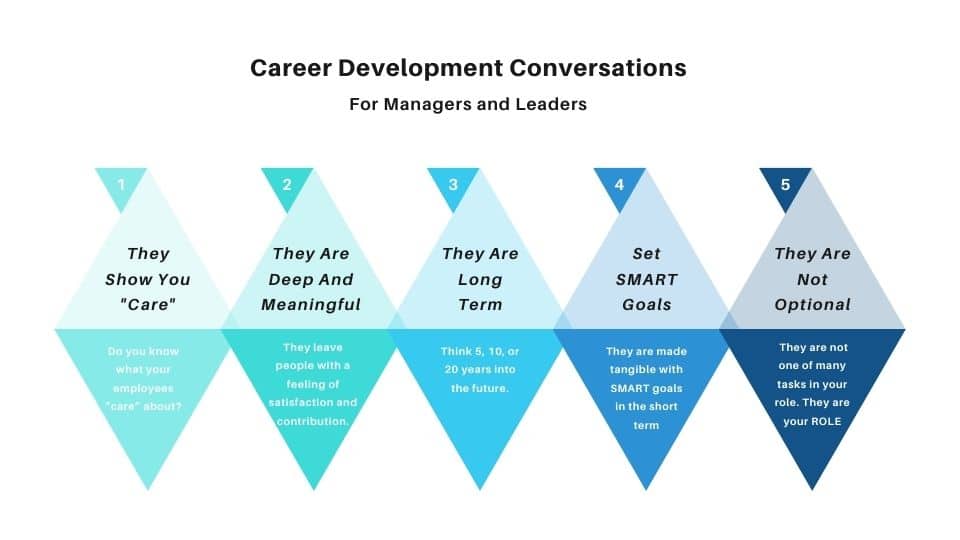
  • How to Have Career Development Conversations With Your Employees? or How to Care for Your People?

    One of the most fundamental human needs we all share is to make meaningful progress in what we are doing. At the workplace this means knowing how does the road ahead looks, and how can we learn and grow to the next milestone on that road.

    If you lead people, you can coach and guide your people on the path of future success by having what I term as Career Development Conversations. Knowing that their career progression is being taken care of freeing up mental space for people, which in turn gives them the space to do well in their current roles.

    What They Are?

    Career Development Conversations are a set of coaching conversations a leader can have to help people understand, prioritize, and act on their long term career ambitions.

    People are mostly unaware of how they can grow in their careers, and as a coach, you can help them figure this out. These conversations help provide clarity on how best to make meaningful progress, within or outside the current organization.

    Every 2 weeks I share my most valuable learnings from living life fully in my Deploy Yourself Newsletter. Sign up now to download a workbook with 164 Powerful Questions which I use daily in my work and coaching. Allow these questions to transform your life and leadership.

    1. Career Development Conversations show you “Care” for your people

    I believe one of the most important roles for a coach (and every manager is a coach by default) is to “care” for their people. And you do that by taking care of the “cares” of your people.

    Do you know what your employees “care” about, what they value or not value in life, and why? Do you know what motivates or drives them? Do you know what frustrates them?

    As a coach you can help people figure out what they “care” about. If we explore this simple yet powerful concept of “care” with our teams, it can open up a new world for them as individuals, and for us as a leader.

    2. They are Deep, Meaningful, and Long Term; but made Tangible with Short Term Goals and Milestones

    Working with various teams across continents over the last decade and a half, I have seen that people are often not aware what they “care” about, and what matters the most to them.

    Career Development Conversations are deep and meaningful to figure this out. They not only help people to be proactive in their career choices as they achieve important career milestones like promotions but also leave them with a feeling of satisfaction and contribution.

    3. They are the second-best opportunity to serve your people

    Leading by example is without doubt the primary way your people see and perceive your leadership. Any conversation or management practice will fall through if you don’t do what you talk about.

    The second best way is to continuously have these career development conversations with your people, which will create the context and form the background of everything else people do in their day to day jobs.

    These conversations can inspire people to cooperate in the face of business challenges. They help people align their own purposes with the larger collective purpose of the organization, leading to accountability and co-operation instead of conflict and self-destruction.

    “Treat a man as he appears to be, and you make him worse. But treat a man as if he were what he potentially could be, and you make him what he should be.” — Johann Wolfgang von Goethe

    What they are not?

    There are a lot of misconceptions around career development conversations since there are different definitions of them depending on the organisation you find yourself in. Let’s clear up what I mean when I say career development conversations.

    1. They are not Optional

    Most managers / leaders I have seen in different companies don’t have these conversations at all. Companies don’t realise its importance and it often takes a backseat with the focus mostly on driving business results.

    Even when they are, they are not regularly reinforced and leaders are not held accountable for them. Nobody told me about these conversations either. I have learned them the hard way – making numerous mistakes as a leader and only later stumbling upon these conversations from numerous trainings and books.

    2. They are not Performance Reviews.

    Many people and companies equate career development conversations with performance reviews, which happen on a quarterly or half yearly basis. However, what I mean by career development conversations is the total opposite of performance reviews.

    Performance reviews focus on the past. Career development conversations focus on the future.  Performance reviews focus on putting you in a box (of job expectations) and measuring you against the expectations of that box. Career development conversations encourage you to get out of any defined boxes (or job roles) and define for yourself the meaning of success and contribution.

    3. They are not Short Term.

    Career Development Conversations are long term. Think 5 to 10 years or even longer if you can. They help people envision what their career is (or can be) all about. They go beyond material milestones and successes; and empower each person to find their own meaning at work, and define the legacy they want to leave behind.

    Having said the above, and keeping that as the background context, Career Development Conversations then drop back to shorter time frames of one year and less. By working on tasks aligned with the long term context, people can find new meaning and joy in their work which wasn’t available before. Needless to say, all of this results in better business results too.

    4. They are not about the Next Promotion or Job Titles.

    Career Development Conversations can also be confused with promotion and the usual benefits that come along. I believe that while that might happen as an outcome of these conversations, they are not the end goal in themselves.

    The focus is on the continuous development of employees and their progression as professionals. The emphasis is on doing work which not only challenges people professionally but also leaves them with a deep sense of pride and purpose in your work.

    5. They are not just one of many “tasks” to be done

    Career Development Conversations should not be taken lightly by managers / leaders. They are not just one of many tasks in your role. Infact, they are your ROLE. If you are not having these conversation, you are leaving huge potential in people and your team untapped. When done well, they can cause careers to take off.

    Career development conversations should not be taken lightly. I believe every task your team member does should revolve around these conversations. These conversations will set the context of everything the team member does or does not achieve. They are to careers what oxygen is to life.

    Key Conversations

    Having gone over what career development conversations are and what they are not, let’s go over some of the key conversations :-

     1. Understand Them

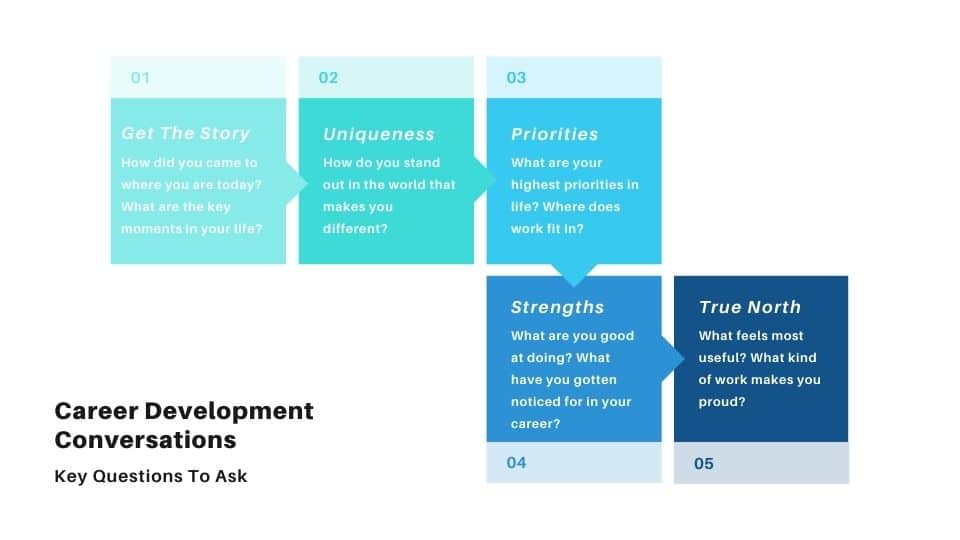
    The intent of this conversation is to understand your people beyond their job descriptions. You can do so by asking and answering the below questions.

    • What is your story?
    • How did you come to where you are today?
    • What are the key moments in your life –  ups and downs, successes and failures, and how each of these events has shaped you?
    • Tell me something I don’t know about you. This question always amazes me as I find out something new about the person.

    If you think this can be hard, then you are absolutely right. Getting people to open up about their life can be a slow and gradual process as you build trust and go beyond personal barriers.

     2. Help them figure out their True North / Lighthouse

    • How do you stand out in the world that makes you different?
    • What are you good at doing? What do you believe you are the best at? What have you gotten noticed throughout your career?
    • What feels most useful? What kind of work makes you proud? Which of your tasks are most critical?
    • What bugs you? What makes you angry or frustrated?
    • What are your highest priorities in life? Where does work fit in?

    By asking some powerful questions like the above, you will help people identify their strengths and weaknesses, values, and motivations, and what makes them unique and special. For me, knowing someone as a human being is such a wonderful experience as I get exposed to the personality of the person which is normally hidden in workplace conversations.

    Helping people figure out their True North can help clear the fog of uncertainty and clearly distinguish the path or at least the direction, they can pursue in the future. This True North can be a lighthouse (of values) that can serve as a compass in difficult times.

    3. Empower Them by Preparing a Plan

    The next type of conversation is to build upon the above two and make it concrete in the form of a plan for where they want to go. Present them opportunities for future growth in the organisation based on their values and motivations, and not just on their talent and skills.

    Once you have identified opportunities that they can pursue with purpose and commitment,  support them to find training to acquire any skills they need, or in reaching the right people. Work with them to create SMART (Specific Measurable Attainable Relevant Timely) objectives, which are impactful for both the organization and the individual personally.

    Having clear objectives to achieve in the future, and also clarity about how will it help them individually as well as the organisation will empower them as they build up confidence and momentum once they start. Once they grow their wings and build up speed, get out of the way and give them space to fly. (which can be very difficult, especially in big organisations)

    In conclusion, I would also like to add that all the 3 kinds of conversations above never happens chronologically. You can jump between them as you feel fit, and it is a gradual process as you discover more and more about your people, and guide / support them on their way.

    As you discuss these questions, you also open up and answer these same questions for yourself too. These conversations are not a monologue but a dialogue. I have always found having these conversations very useful to me too, and you also end up building deeper relationships and friendships at work. And working with friends is always a breeze while working with strangers can be painful.  

  • How to be Emotionally Intelligent with Written Communication at the Workplace

    Emotions play a big part in our communication in the workplace, either face-to-face or written. The way we express our emotions requires us to be sensitive to others’ emotions. In the same way, we also need to be sensitive to our own emotions and values and respond accordingly. The mastery of our own emotions is a skill that can help us become more productive at work. Working on how we express ourselves can greatly affect how we connect and collaborate with others.

    Expressing ourselves through written communication is a challenging task as we have limited means to express our ideas. Email, chats, and all other sorts of documents in a workplace often focus totally on the subject or topic; which makes it difficult to understand the emotions behind them. However, I feel we need to make space for our emotions, ideas, and thoughts to be freely expressed in any form of communication to build lasting trust and cooperation with our colleagues.

    “People will forget what you said. People will forget what you did. But people will never forget how you made them feel.” – Maya Angelou

    Pros and Cons of Written Communication In The Workplace?

    The digital age has made communication faster and more accessible. We’re able to send messages to people we can’t meet personally in a more efficient manner. Emails and text messages can distribute information to people anywhere in the world while we’re at the comfort of our desk.

    We use written communication in many different situations at the workplace. Some of these situations can be found below :-

    • Sharing important information through emails to different division members
    • Providing feedback on documents sent to us for review
    • Responding to messages asynchronously
    • Requesting permission for vacations leave and other administrative tasks

    These situations can get challenging since you need to fit your message into a certain format and you’re left to express your message often only through text. There are no verbal and nonverbal cues to help you express your thoughts.

    So, where does emotional intelligence fit? Emotional intelligence can help us in phrasing our emotions into words and sentences. The knowledge of our emotions serves as a guide to how we can communicate better with other professionals.

    Communication, in whatever form, is never detached from our personality (thoughts, emotions, beliefs). Even a simple email or letter is already an expression of ourselves. Emotional Intelligence is not just about communicating verbally and listening to others. It is about expressing ourselves clearly regardless of what medium we use for communication.

    Written communication, while it is effective, also has drawbacks. Since messages are limited to written text, they can get lost in translation. The way we choose to express the message can be interpreted differently by the other person. Some parts or the whole intent of the message can be misunderstood.

    When dealing with people, remember you are not dealing with creatures of logic, but with creatures of emotion. – Dale Carnegie

    What Can We Do To Avoid Confusion And Misinterpretation?

    By being careful about a few ideas as listed below, we can make written communication easier for others to process and understand :-

    1. Write messages in simple and short sentences. Written communication is about effectively transferring information. By adopting a simple style of writing, we become more effective since there is less room for misinterpretation.
    2. Ask others if they understand the message you’re expressing. The most effective way to ensure that no miscommunication happens is by confirming the message with others. There’s nothing wrong with asking colleagues if they understood the details you provided.
    3. Be careful about being funny or sarcastic. It’s alright to add some humor to messages, but be sensitive to others who might get offended or misinterpret them.
    4. Avoid emotionally-charged messages. Written communication is not meant for emotional release. Ask yourself if you would have the courage to say the same thing face to face. If not, don’t express it as an email either.
    5. Ask for acknowledgment if you expect something back. Or follow up if you don’t hear back or hear an unsatisfactory response to make things clear.

    When Should We Not Use Written Communication?

    While written communication may be helpful, there are times when its use is not the best choice. Having the presence of mind not to use written communication if the situation calls for it is also being emotionally intelligent. Some situations like those listed below might require a personal conversation instead of written.

    • Discussing sensitive or emotion-loaded discussions – Written communication cannot express the full spectrum of emotions and messages we wish to send to others. Verbal and nonverbal cues are important when talking about sensitive topics to be able to fully express emotions and communicate the message without room for misinterpretation.
    • Personal discussions – Personal discussions often require attention and immediate feedback. The nature of written communication, unfortunately, cannot fit the needs of these important discussions.

    In conclusion, becoming emotionally intelligent requires us to know when and how written communication can be used in a professional setting. Doing it well allows us to capitalize on human relationships and unlock the huge potential when people work together for a common purpose and mission. On the other hand, if not done well, it can also go downhill pretty quickly.

  • Do You Know your Emotional Triggers? And What To Do When You Are Emotionally Triggered?

    “Mastering others is strength. Mastering yourself is true power” – Lao Tzu

    I am sure we’ve all experienced a sudden emotional reaction. It happens when our thinking starts to become clouded, and feelings (of fear, anger, or sadness) overwhelm us. While it’s not always possible to avoid emotional outbursts, there are always better ways of expressing our emotions without suppression or explosion.

    Our emotions play a crucial role in the workplace too. Anybody who tells us otherwise doesn’t understand that human beings are emotional beings, and just because we are at work we can’t expect to not have any emotions at all.

    Teamwork and cooperation rely heavily on each team members’ communication. Here’s where identifying our emotional triggers becomes important. Understanding our own emotions also helps us understand how we can interact better with others. Rather than suppressing or controlling our emotions, we should be able to express our emotions in a way that we can be proud of in the long term, and which just doesn’t give the kind of short term relief an emotional outburst provides. When we are able to do that, we build trust and cooperation with colleagues which in turn translates into better quality work.

    When Do We Become Emotionally Triggered?

    Every one of us is unique. We have our own likes and dislikes, personalities, and habits. We sometimes refer to this as our “identity” as individuals. We all have our own unique and different emotional triggers as part of our identity, and some of us are more sensitive to these emotional triggers than others.

    Our beliefs, values, culture, and past experiences shape how our identity is formed. In a similar fashion, our means of expressing emotions are shaped over time. They are learned and slowly become habits unless we intervene and decide to change them.

    But what causes our emotions to trigger in the first place? There are different factors that can trigger our emotions. Figuratively, emotional triggers are stimuli that can press our hot buttons. Like an Achilles’ heel, we usually try to guard ourselves against these triggers.

    Understand Science Based Facts About Emotions and Ease Your Shoulders of Their Burden
    Do You Know Your Emotional Triggers?

    What Factors Cause Our Emotions to Trigger?

    These triggers can vary from the simplest things in our daily life to more personal ones, but they can be classified into common factors such as the following:

    • Undesirable memories of people, places, and events – Anything that reminds us of a past traumatic experience can be an emotional trigger. These memories evoke strong emotions that might cause us to behave differently.
    • Stress and lack of comfort – Some situations cause our emotions to stir without us knowing why. The loss of comfort and the built-up stress in these situations weaken us and cause our emotions to trigger.
    • Conflicting beliefs, values, and culture – Our emotions often trigger when we feel that our identity is being attacked. While some of us can be aware when this happens, most of us instinctively have our emotions triggered whenever conflicting beliefs arise without us realizing so.
    • Pet peeves and dislikes – The things we dislike, whether or not we’re aware, also trigger our emotions depending on how much we dislike that thing. While pet peeves don’t always trigger strong emotions, these dislikes may weaken our emotional barriers and make us more emotionally vulnerable.

    Once these emotional triggers press our hot buttons, we often become overwhelmed with emotions. As a result, our actions can often end up sending the wrong message. These can strain our relationships with people around us, or give an impression to others which we might not want to convey.

    Knowing what our emotional triggers are is the first step to expressing them wisely. Becoming less vulnerable to emotional triggers requires knowing where our weak spots hide. As we get to know more about ourselves, we learn our emotional triggers and become more skilled in expressing emotions in a way that we can be proud of. When we think of it this way, we can turn our emotions into a strength rather than a weakness.

    How Do You Identify Your Emotional Triggers?

    “But feelings can’t be ignored, no matter how unjust or ungrateful they seem.” – Anne Frank, The Diary of a Young Girl

    We can’t always avoid stressful situations. At work, we face these situations when heated arguments happen and conflicting views arise.  There will always be times when our emotional triggers suddenly act up. Whether we like it or not, we still need to collaborate with different people and their different identities. It all boils down to how we react to what we face.

    range-of-emotions

    To be able to identify our emotional triggers, we must begin with introspection or the process of examining our emotions. Like a river, our emotions flow continuously. Learning what causes the tides of our emotions to change will help us identify our emotional triggers. Our bodies can also help us identify these changes.

    • Start by identifying the physical symptoms of uneasiness and stress. Our body sends warning signals to our brain without us consciously knowing. These signals manifest into physical symptoms that we can identify. Involuntary shaking, sweating, increased heartbeat, and headaches are common symptoms that our mental state is vulnerable. You’ll notice that these physical symptoms arise when we start becoming highly emotional. By mastering this knowledge, we can identify the emotional triggers that cause us discomfort.
    • Notice changes in our behavior. Our actions and mannerisms usually change when our emotional triggers affect us. Changes in the way we interact with certain people or in our routine are also symptoms of a weakened emotional state. In the same way as physical symptoms, we can also learn more about our emotional triggers by noticing patterns in our behavior.
    • Identify common patterns. Learning more about our emotions and emotional triggers requires us to identify some common patterns. We need to know our dominant emotion before, during, and after periods of being highly emotional. Through this method, we can slowly map out how our emotions play out when we are triggered.
    • Reflect on your actions when you became emotionally triggered. There will be situations when you will not know what exactly triggered your emotions even if you’re already aware of some of your emotional triggers. The best way to adapt to these situations is by reflecting on our actions and identifying what we can do to prevent the same situation from happening again.

    What To Do When You Are Emotionally Triggered?

    “He that knows patience knows peace” – Chinese Proverb

    When worst comes to worst, we need to think and act fast and not panic. Below are some ways to avoid acting impulsively and doing something which we would regret later. 

    • Take a break – Take a pause, right where you are. Stop speaking if you are talking and take some deep breaths.  Get present to your body inhaling and exhaling. Let your body calm down and slowly relax. This will help you diffuse the situation as fast as possible. 
    • Get out of the situation (if possible). If it’s an uncomfortable situation that you can get out of, then do so immediately. You’ll know when you need to leave if you’re starting to feel physical symptoms. Removing yourself from the situation gives you a chance to recover. If you can’t get out of the situation, patiently wait for an opening to excuse yourself.
    • Write it all down in a journal. Feelings of blame, justification, guilt, or regret may often linger after having emotional outbursts. What you can do is to write your experience down in a journal. Keep writing until you have nothing left to say or express. Releasing all of the lingering emotions into a journal not only helps you release those emotions but also helps document your progress. P.S. – Don’t send it to anyone. Read it a few times and delete/destroy it.
    • Reflect and continue learning from the experience. Learning about ourselves is a continuing experience. Reflect on what you did and what you can do differently the next time. By reflecting on our past actions, we can always find ways to express our emotions better. 
    • Seek professional help if you need to. There’s nothing to be ashamed of in seeking professional help. This could range from asking a trusted mentor for advice or seeking intervention from a trained doctor. Some of us have grown up with several emotional triggers that greatly affect our daily life, and seeking professional help is sometimes necessary to live a more meaningful life.

    Avoid Intoxication

    Though there is always a temptation of doing so, we must avoid taking drugs and alcohol to feel better or suppress our emotions in the short term. Drugs and alcohol do not only remove so-called “inhibitors” but also weaken our mental state to the point where we become increasingly sensitive to our emotional triggers. What’s worse is that we tend to act more impulsively under the influence of alcohol that can cause harm to our relationships and people close to us.

    In conclusion, the process of controlling our emotions goes hand-in-hand with learning about our true identity. Like how the seasons change, so too does our identity. Different experiences will eventually lead us to learn more about ourselves. Hopefully, this article will guide you in identifying and adapting to new emotional triggers that you’ll discover.

  • The Top Three Tragic Myths Of The Times We Live In

    “It was dark and quiet, and it took me a few seconds to stand steady on my feet. Well, that’s what happens when you have to get up at 2am to go to the bathroom. But things were going to get worse.

    Just as I began to walk, I suddenly jumped and screamed. Something was crawling on my feet. It felt like a spider and I reached for the light switch. When the light turned on it turned out to be a piece of thread that had been lying on the floor. Apart from the disappointment of jumping for no reason, I was wide awake now!”

    Just as it happened to me, we often get scared of an insect or a rat, but when we turn on the light they are just objects lying around. But our senses gave them an illusion of being an insect or a rat. Building upon this analogy, everything else in life – our riches, our troubles, and our possessions are illusions and a mirage created by our mind.

    “Reality is merely an illusion, albeit a very persistent one.” – Albert Einstein.

    Taking this notion forward, this article of mine is going to dwell upon why life itself is a myth, and how each one of us is driven by some ‘absolute‘ truths that are nothing more than widely accepted myths. These myths drain the life out of our days and take us onto paths of mediocrity and obscurity.

    Below are the three such myths I think we all encounter in everyday life. (Give them some time to sink in, as they very well might be absolute truths for you.)

    1. You Have to Work to Survive

    The biggest myth of our times is ‘having to work‘ to earn a living for surviving. Right from our birth, everything is setup to create this illusion. Our education system, the economic system, all the news and shows on TV and the movies we watch. As we grow up, this myth becomes very ‘real‘ for us. The only thing from our childhood which we term as illusions are the cartoons we watch. Did you ever wonder why everyone loves cartoons?

    There is a common misconception that work is necessary. Over decades and centuries, every rock is chipped away into sand and dust. Work can do the same to our lives and souls. Day by day, hour by hour, our work can chip us away into disintegration.

    If someone tells you they are “making a living”, they can’t be more wrong. They are making a dying, and most probably fast spending whatever little time they have doing things out of compulsion rather than the pure desire of doing it.

    Instead, what we can all do is PLAY. Go out and do what you want. Find something you love doing, something you are passionate about.

    DisclaimerWork and Play don’t have to be mutually exclusive. If you can find a way to play while at work, nothing could be better.

    Many people say they don’t know their passion or hobbies, or they have not discovered them yet. Here is a formula – Look into your life, and the things you do for which you pay others are your hobbies and passions, and for which you get paid and compelled to do is work.

    DO NOT spend the vast majority of your life working so that you can play in the end. That end might never come, or which might be tomorrow itself, for all you know.

    2. Planning and Living for the Future

    We live in a world where insurance and pension policies, investments, education, business, almost everything is done with an objective to achieve something in the future. While planning for the future has its benefits, I believe we often take it too far and miss the only time we really have, which is “now”, or this very moment.

    Who gave you the guarantee that you will not die tomorrow, next week or next month? What made you believe that you are going to die at 70 or 80, and not at 20 or 30 or 40. If you don’t believe it, read and watch the news. People are dying every day at all ages. The average age might be 70 or 80, but ask yourself – Do you really want to live your life based on a statistic?

    Instead, LIVE NOW. Enjoy whichever phase of life you are in. Be in each day fully, rather than counting the days. Live your life in a way that you are satisfied even if you die tomorrow or the next second. Make every breath count. Don’t wait for tomorrow if you want to fall in love, travel to your dream destination, or eat that favorite ice-cream of yours. Do it NOW (or at least pick a date in the calendar and book tickets now).

    Fall in LOVE with life, not just with a few selected people, things and ideas. Whether you make 1 grand or 1 million, whether you live in an apartment or a mansion, embrace life fully NOW and don’t let your goals and milestones in life decide the level of your happiness or joy.

    3. Control and Consistency

    The next big myth we base our lives on is aiming for control and consistency. We plan and build systems, and we make rules and processes to make our lives more comfortable and smooth. But the very fact that we can control life is the biggest lie that we tell ourselves.

    Life, by its very nature, is messy and unpredictable. It is not fair and nobody is entitled to get anything out of it. In school, if you study more, you get better grades and vice versa.

    The same doesn’t hold true in life, as there are so many other factors at play other than your efforts. The sooner we realise this the better. Good and bad things will happen to you. Your education, job, the country you live in, or any other reason which gives you the illusion of safety, is a very bad armor against life.

    Instead, be FREE from these controls. Embrace the uncertainty of life and experience real FREEDOM. Go out and play. Learn a new language. Take a new job, or live in different cities/countries and soak in different cultures. Write, paint, or do anything else that makes you experience life rather than draining the life out of you.

    Don’t try to be nice or do what is expected. Don’t live for the gallery. Be authentic. For a change, LIVE for YOURSELF. Let yourself be misunderstood, hated, judged, or whatever, but live by your convictions. It is better to be assassinated by another human being than being assassinated by death.

    Conclusion

    Our thoughts (and perception of reality) shape our decision and in turn our circumstances. It is like watching the same movie again and again. If we want to play a different movie in our life, we have to change the tape.

    And rejecting the above myths might be the first step. Thoughts arise in the mind, and we become aware of them. But over time, we stop seeing them as thoughts and see them as reality. Therefore, we should never stop to question our thoughts and the reality they form.

    Life is a mirage. An earring and a bangle are both made out of gold. But our thoughts make one an earring and another a bangle, but in essence, both are only gold. Yet we only term what we see while asleep as dreams and not what we see while awake. In essence, both are illusions created by our senses. We must never lose sight of that.

  • How to Ask and Get the Feedback You Need Without Any Stress and Awkwardness?

    “I want to give you some feedback.”

    If you are like most people, once you hear the above statement, your heart will start to beat a little faster, your palms might begin to sweat, and in certain situations, you might even begin to shake. Feedback can make anyone anxious and stressed – not because there is something inherently negative or bad about it, but because most people have never been trained in giving and receiving feedback. If you give and get feedback only once a quarter at work (even worse if it is once a year), and without any preparation, obviously it will be a strange conversation.

    What I have learned over my career is that feedback can be an immensely valuable and insightful tool in our growth and progression, but only if we are ready and prepared to digest and use it for our benefit. Today I want to share via this article my thoughts on the value of feedback, what is the best way to receive it, and then what to do with it. I hope that after reading this article, instead of just waiting for feedback you actually start asking for it. If you are thinking why would anyone do that, let’s dive right in.

    Why Do You Need Feedback?

    Feedback is one of the easiest and most insightful tools to uncover your blind spots. A blind spot is anything that others know about you but you yourself don’t. For example – if you think you are confident but others find you arrogant and cocky, how the hell do you figure that out if nobody ever tells you that?

    Feedback is like a beam of light which shows you how others perceive you. It can be the simplest way to uncover your strengths and weaknesses, but it is often not easy to digest and process it. Feedback lets you know how others perceive you and your talent, skills, behaviour, and performance. And knowing them is a good thing. When used correctly, feedback can be a very useful tool to move in the right direction, change course if necessary, and grow in your career (and in life).

    “Criticism may not be agreeable, but it is necessary. It fulfils the same function as pain in the human body. It calls attention to an unhealthy state of things.”
    – Winston Churchill

    How Do You Ask For Feedback?

    Just like hearing feedback can be stressful for you, providing feedback can also be a stressful experience for the person on the other side. But there are a few ways you can make the feedback conversation a pleasant experience:-

    1. The best way to make the process easier for both sides is to actively and explicitly ask for it. When you invite feedback regularly, it removes the formality surrounding the process and makes the conversation more “normal”.
    2. Explain that you see feedback as a tool to learn and grow and that you welcome any negative or uncomfortable feedback. You can also go one step ahead and assure the person that the feedback will not have any negative impact on the relationship. Knowing this always puts the other person at ease and allows the conversation to continue more maturely.
    3. Know what you are looking for in feedback. Feedback is not always critical. You should also ask for acknowledgment or appreciation for a task well done. Positive feedback will help you understand your strengths, and gives you the confidence and assurance required to look objectively at your weaknesses.
    4. Be specific and ask for examples. Don’t let anyone get away with vague feedback. Always dig deeper and ask for specific events and evidence in support of the feedback you receive. Here are a few questions you can ask:-
      a) Can you explain what you mean?
      b) Can you give an example to support your point?
      c) Paraphrase the feedback and ask – Is that what you mean?
    5. Seek feedback from people all around you and not just your boss. Ask people above, below, and sideways in your organization. Multiple sources of feedback can eliminate any outliers and helps to surface any obvious blind spots immediately.


    Powerful Questions

    Whenever you are looking for some powerful and insightful answers, there are always corresponding powerful questions to go with them. Below are a few such questions you can ask to solicit deep and meaningful feedback about yourself:-

    1. If I were to wow you with my performance, what would that look like?
    2. What’s one thing I could improve?
    3. What would you have done differently had you been in my position?
    4. What’s your opinion about how I handled that conversation, presentation, task, etc?
    5. What specifically can I do to handle that task, conversation, project better?
    6. What is one thing you can always count on me for?
    7. What is one thing you will never count on me for?

    What To Do After Receiving The Feedback

    The worst thing that you can do with feedback is to do nothing with it. The feedback conversation is just the beginning on the road to learning and growth. So once you are done with the feedback, you can take the following steps to make the most of it.

    1. Thank the person for providing you feedback. Not only is feedback essential for your growth, it is also often a courageous step to provide it in the first place. Acknowledge the person for the conscious act of providing you feedback.
    2. Do not defend yourself during a feedback conversation. Do not get into a game of blame and justifications. Respond to the feedback, not react to it.
    3. If the feedback is critical, take responsibility (not blame) for what you hear. Let the other person know that you will evaluate the feedback and get back.
    4. Take time to introspect and evaluate the feedback. Does it resonate with feedback from others? Can you gather more data or feedback to validate it? If no, explain to others how you see it. If yes, let them know what you will change. Make certain promises and then do what you say.
    5. Take all the positive feedback and put it into a complements” document. Often we tend to focus too much on the negatives and ignore what we are doing well. Visiting this document regularly will give you motivation and positive reinforcement. Sometimes reading one little positive feedback can make your day.

    Following the above guidelines doesn’t mean that your feedback conversations will be painless, but they will certainly go more smoothly. Once you see feedback for the powerful tool it is in your learning and growth, you will fall in love with it. The more you seek and get feedback, the faster you can move to learn, adapt, and change course if necessary. To conclude I would like to leave you with the below quote by Ken Blanchard.

    “Feedback is the breakfast of champions.”
    – Ken Blanchard

  • How to Give Feedback Effectively? What to do Before, During and After a Feedback Conversation?

    Giving good quality feedback is an important skill to have in any organization. Doing so regularly with our peers gives everyone an accurate understanding of how they are doing at work, and what needs to change/improve. However, I have always felt that the importance of feedback and how to effectively deliver it is something that is rarely stressed and communicated within companies. In this article, I want to share some of the best practices I have learned from different people and mentors over the years about giving feedback.

    Why?

    The first step to giving good feedback is to realize the importance and reason behind doing so. I believe that the only reason to provide feedback is to improve performance while working together. The purpose of giving feedback is never to measure performance, blame, to prove yourself right, to make others wrong, or to put someone in his/her place.

    I believe this is the most important aspect of feedback which we often miss. I see feedback as a ‘gift’ given from one person to another, with the only purpose of improving how they work together. When we see feedback as a ‘gift’, the feedback conversations tend to be more natural and less awkward.

    Before (Preparation)

    “Give me six hours to chop down a tree and I will spend the first four sharpening the axe.”
    ― Abraham Lincoln

    Like most things in life, doing some groundwork before giving feedback is critical. Over time I have come up with a list of steps which helps me prepare for a feedback conversation.

    1. The first step is to collect data and evidence to back up your feedback and to make sure you have seen the situation from different angles and points of view. This might include gathering some tangible data like sales reports, code reviews, etc, or validating your feedback with a different set of people.
    2. Apart from remembering the why behind sharing the feedback, it is also very important to have an open mind going into the conversation. We must be willing to investigate/apologize if things turn out otherwise. If the person you are sharing the feedback with brings up new facts or information you weren’t aware of, make sure to acknowledge them and take a time out to investigate rather than thrusting your feedback upon the person.
    3. Create a comfortable space for providing feedback. Allow enough time so that none of you feel rushed. Depending on the type of feedback, choose an appropriate setting for the feedback. For example – do not choose a place that is overly conspicuous, and never give negative feedback in public.
      If the feedback is on a trivial issue, you can do it while walking back from a meeting, or in a vehicle driving to another destination to make it less formal. But if your conversation is more difficult, you might want to do it in a meeting room. The important thing to realise is that there is no one right place to deliver feedback, and you should choose based on the type of feedback.
    4. Sleep on it! If you feeling angry, upset, or feel an urge to provide feedback; it is often better to sleep on it. Giving feedback at the wrong time can often do more harm than good. Once your emotions are more settled and you have gathered your thoughts, you can then share the feedback as soon as possible.

    During (Process)

    While you can do all the preparation you want, receiving feedback can still be a stressful experience for people (especially if it is critical). To ensure that the conversation goes smoothly you can follow a few guidelines :-

    1. Criticize in Private, Praise in Public. Use this as a golden rule for any feedback conversation.
    2. Never attach adjectives to people. Start by stating why you are providing feedback, which is always to improve performance (of the person, team, organization). You demonstrate that by stressing the impact of the person’s actions (on the team and their performance) and not on the person themselves. For example – Instead of saying “you are a weak communicator”, say “your communication style can be refined to make a better impact in team meetings”.
    3. Be specific in your feedback. Give examples. Do not be vague in your statements.
    4. Be aware of the other person’s body language. Notice if they are getting defensive, angry, upset, and change course if necessary.
    5. Be prepared for an emotional reaction. But do not react yourself. Do not get into a game of arguments and justifications. Stay silent and let people vent out their emotions (if any).
    6. Listen and paraphrase what you hear to ensure there is no confusion and misunderstanding. Understand the situation from the other person’s point of view.
    7. Use non-conflicting language. Use “I” instead of “you”. For example – Say “I felt disappointed when you did that.” rather than “You disappointed me by doing that.”
    8. Don’t Push – When you push people, they will push back. Present your thoughts without trying to push them through. Give people a choice to accept or reject your feedback, as you cannot force them to your point of view anyway.
    9. Give more positive feedback than negative, and always be sincere when giving positive feedback. Remember that there are always positives about people to acknowledge.
    10. Thank them for listening to your feedback. End the conversation on a positive note, with the other person thinking about the next steps. He/she should see the feedback as a stepping stone, not as a stumbling block.

    “Criticism may not be agreeable, but it is necessary. It fulfils the same function as pain in the human body. It calls attention to an unhealthy state of things.”
    – Winston Churchill

    After (Follow Up)

    To make sure that the feedback is serving its intended purpose, i.e., to improve performance, it is important to take a few follow up steps after the feedback conversation :-

    1. Send a brief summation of your meeting if it was important and critical enough. Also, summarise any action points both of you agreed in a follow-up email.
    2. The other person might need some time to process what you discussed. Give them that space. Follow up after a few days for any additional thoughts. Ask for feedback about how you provided the feedback. Anything they would like you to do differently the next time? Let your people know it is ok for them to give you useful feedback.
    3. Make sure to act on your action points, or share your progress on them. If you don’t walk your talk, you lose trust. If that happens, you have bigger problems to worry about.
    4. Follow up and ask for progress on the other person’s action points. Offer your support and help in any way you can.
    5. Thank the person and commend him/her for any change in future behavior. Remember you can never give enough positive feedback.

    To conclude, feedback sharing sessions, when done well, are an incredible tool to build healthy relationships and make teams stronger. By listening and working on feedback, people can learn about themselves (self-awareness) and be more conscious of their choices and decisions (career development). When you encourage people to give and share feedback, it helps create a culture of feedback, which eventually increases the strength and effectiveness of teams in your organization.

  • What is Feedback? And The Benefits of Feedback for Your Team / Company You Never Knew?

    It is the end of the quarter. And it is feedback season again!

    Feedback is a word many people dread and it makes them uncomfortable, while for others it is a tool to reflect on and improve performance. Having been on both ends of the feedback spectrum over my career, I want to share today what I think feedback is, and how it can benefit people as well as organizations.

    What is feedback?

    Do you think feedback is an operational necessity that your organisation requires you to do? Do you think feedback is something “extra” you have to do in addition to your work? In the early days of my career, I saw feedback as a distraction that keeps me away from “real” work. I wanted to get done with the feedback cycles as soon as possible as it would make me anxious and nervous. After all, nobody ever told me the purpose of feedback, how to do it well, and how to make it a tool in my development.

    It was only through my own mistakes receiving and giving feedback (and a few trainings) that I realized that feedback is work itself and not something external to it. Feedback is as much a part of my (and everyone else’s) work duties as any other task I consider essential. Over time I came to see feedback as a tool to improve not just my own performance, but also of the people around me, and of my team/organization as a whole.

    Feedback can happen in a ‘day to day’ manner like any other task. It can be a simple comment on some work which was just completed, like :-

    • You handled that really well. Thank you for thinking about that specific case.
    • I loved how you presented your ideas in the meeting we just had.

    OR, Feedback can be a structured conversation with your manager or employee. For example :-

    • I see you doing really well in … , …
    • I would like to see you develop skills like … , etc

    “Feedback is the breakfast of champions.”
    – Ken Blanchard

    The Benefits of Feedback You Never Knew

    The most important and obvious benefit of feedback is that it shines a light on and reveal our blind spots. We all need feedback to reflect, learn, and grow. It helps us become aware of our strengths and weaknesses, and identify any actions required to address them and improve performance. Timely feedback is essential to creating a loop where we are constantly reflecting upon what we did in the past and how can we do better in the future.

    But apart from assisting in our own personal development, I believe feedback can be an important tool that can help our team/company in other ways. Some of these are :-

    1. Better Relationships

    A regular cycle of feedback, not just with our managers but also with our peers, helps us build better relationships at work. It helps us get comfortable with each other and develop friendships with our colleagues. Having strong relationships at work not just impacts business results, but also results in more smiles and satisfaction from what we do. Giving and receiving feedback builds trust and helps create a safe environment where people can be themselves without any pretensions.

    2. Clear Expectations

    Having regular feedback conversations with people help clear expectations about what we expect from each other. It brings out our implicit expectations in the open and irons out any disagreements. Doing this right avoids any future misunderstanding and conflicts, and even if they arise, are much easier to handle and resolve.

    3. Positive Reinforcement

    Giving appreciation of a task well done serves as a wonderful positive reinforcement for the kind of behaviors you want to nurture in your team and your organization. Giving people a pat on their back or an informal “whoop” or “cheers” can do wonders for their confidence and sets an example for everyone else.

    4. Culture of Feedback

    If people are comfortable giving and receiving feedback in a company, and if it becomes a part of people/teams working together, then you have what is called a “culture of feedback”. This can be a tremendous asset for any organization. This culture lets your employees know that you care about them as people and not just the business results they produce. The culture of feedback creates an environment that enables every team to take ownership and pride in going after and achieving their business goals, while also taking care of their personal well-being and growth.

    To sum it up, the benefits of continuous feedback far outweigh the cost of having a culture of feedback and the little awkwardness everyone feels while giving and sharing feedback, which can be easily mitigated with proper training and guidance. Having a culture of open communication and regular feedback empowers people to come to work and make a difference – to their own growth as well as to the company’s purpose.

  • The Distinction Between Meaningless Activity and Meaningful Actions, And Why It Can Make All The Difference

    In today’s age of always-connected devices and nonstop notifications, we all have more to do each day than the hours can fit. Crossing items off the to-do list always feels good and gives one a feeling of accomplishment, but have we ever stopped and asked ourselves – accomplishment towards what?

    The ‘Busy’ Trap

    Whenever I have stopped to ask myself that question, I have realized that I have fallen into the trap of being busy rather than being productive. Being busy often relieves us from the fear of sitting still and the pain of conscious thinking, while the really important tasks often get neglected.

    We are often sucked into doing meaningless activities, either through algorithms running on our “smart” devices or through habits we have formed by emulating our peers rather than consciously choosing them. In other words, we waste most of our time doing meaningless activities that we have no time left for what really matters.

    We keep looking for happiness in materialistic gains which never leads to fulfillment. While everyone is constantly fighting to achieve their materialistic goals, very few understand that these are mere empty pursuits, only adding to the vicious cycle of wanting more.

    Every 2 weeks I share my most valuable learnings from living life fully in my Deploy Yourself Newsletter. Sign up now to download a workbook with 164 Powerful Questions which I use daily in my work and coaching. Allow these questions to transform your life and leadership.

    Meaningless vs Meaningful

    Everything that we do can be divided into either meaningless activity or meaningful actions. What I mean by meaningless activity is anything we do to only keep ourselves busy. Example – checking email and social media, hanging out with friends, or anything we do without a specific intention in mind.

    In contrast with the above, any activity which adds meaning to your life, or takes you in the direction of a conscious intention (or a goal), is what I would term meaningful. It could be a business trip for one or spending time with their family for another.

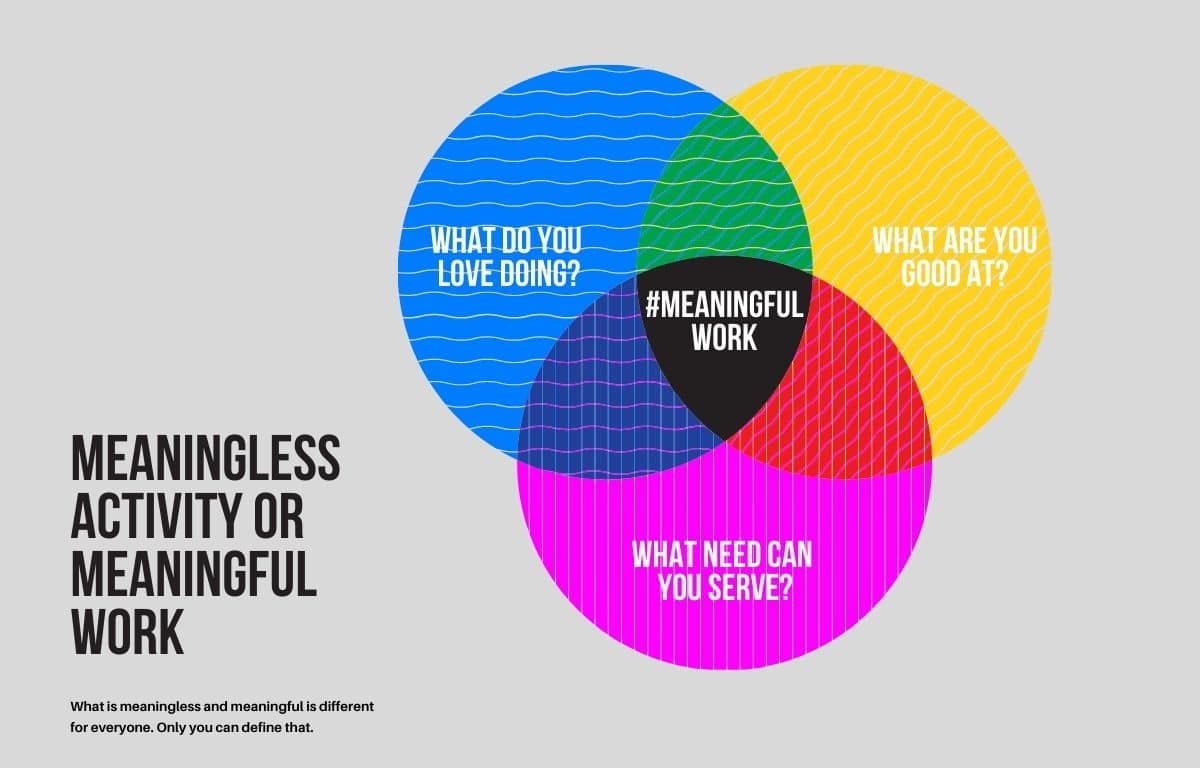
    What is meaningless and meaningful is different for everyone. Only you can define that. No-one else can make that distinction for you.

    We are often focused on what is urgent or what seems important today that we end up ignoring what is really important for us in the long run. Only by being aware of our decisions, we can be deliberate about them to move our life in the direction we want to go.

    “A man who procrastinates in his choosing will inevitably have his choice made for him by circumstance.” – Hunter S Thompson

    Focus and Prioritise

    Research has shown that not having the courage to live a life true to ourselves, not expressing our feelings when we should have, and working too hard are the top three regrets people have at the end of their lives.

    Doing things that we find meaningful is essential to our well being. But how many of us spend time wondering about what gives our life meaning, and what is really important to us?

    When we accept the standards and values others’ have set for us, we surrender our own will and judgment. By figuring out our own values, we allow our unique light to shine upon the world.

    If we only follow what everyone else is doing and not take the time and effort required to find our own values, which are unique for everyone, we will soon find ourselves lost and confused. But once you have put in the effort and identified your unique set of values, motivations, desires, and talents; you can nurture them and let them guide you.

    Three Questions

    • What are you good at?
    • What do you love doing?
    • What need can you serve?

    I believe the intersection of answers to the above three questions will be the most meaningful work for you. Once you have these answers, it will give you the clarity to prioritize tasks and the courage to say “No” to anything that doesn’t align with what you discover.

    Answering these questions will require some sincere and dedicated effort on your side, but once you do that, you will have more clarity on how you define your meaningful work. I would also like to add that it is a continuous rather than a one-time process. You should revisit the above questions every now and then as a “health-check”.

    Having the clarity about the “why” before the “what” and “how” of any action will ensure you create focused output that moves you forward, rather than the effort that just takes you around in circles. So the next time you think you have no time to follow your dreams, you know you have fallen into the trap of being busy with meaningless activities.

  • Have You Discovered Your Leadership Lighthouse? Why Should You?

    A Global World

    Today, we live in a globalized world which is more connected than ever before, and the movement of people and goods has never been easier. It is driven by economics and money, and it is possible to sit on your couch and order what you want from the opposite corner of the world and have it delivered to you in a few days.

    Open markets, lower trade tariffs, and an ever-increasing movement of people, goods, and information to any part of the world have resulted in great prosperity for everyone involved. Major world problems like poverty, hunger, and disease have decreased considerably over the last 50 years. The health and well-being of people all over the world have never been better.

    However, living in a consumerist society driven by economics has also resulted in greed, corruption, and the pursuit of economic success at any cost. It is no surprise then that we saw scandals like Enron in 2001, the financial crisis in 2008, and the Volkswagen emissions scandal in 2015-16. These scandals resulted from cutting corners in the pursuit of success by leaders in these companies.

    The Leadership Lighthouse

    Just like ships need a compass and a lighthouse to navigate in the vast oceans, our companies and their leaders too need a leadership lighthouse to find direction in the vast ocean of global competition. The speed (of a ship or a business) is not the only thing matters. Our leaders need to realize that the direction they choose to go and take their companies along is more important than the speed.

    The Leadership Lighthouse is a set of values (to guide us), standards (to measure us), and boundaries (to keep us in check); which will act as a moral compass as leaders take decisions and navigate their companies in the race for success in the global economy. These standards and values guide us in finding the right direction in challenging and exciting times.

    Find Your Own Way

    The whole essence of leadership is to bring our own unique values, talents, and skills into the world, and to express ourselves in alignment with those. When we accept the standards and values others’ have set for us, we surrender our own will and judgment. By figuring out our own leadership lighthouse, we allow our unique light to shine upon the world.

    If we only follow what everyone else is doing and not take the time and effort required to find our own leadership lighthouse, which is unique for everyone, we will soon find ourselves lost and confused. But once you have put in the effort and identified your unique set of values, motivations, desires, and talents; you can nurture them and let them guide you.

    If we stop and look back at the history of the world, be it in the business world or outside of it, you will find that every human achievement is an achievement of the individual who went against the norm and followed their own leadership lighthouse.

    How Can You Find Your Leadership Lighthouse

    As mentioned above, our leadership lighthouse is the set of standards and values that define and inspire you. It will guide you during challenging moments by serving as a moral compass and give you a solid ground to stand upon when you face turbulent times.

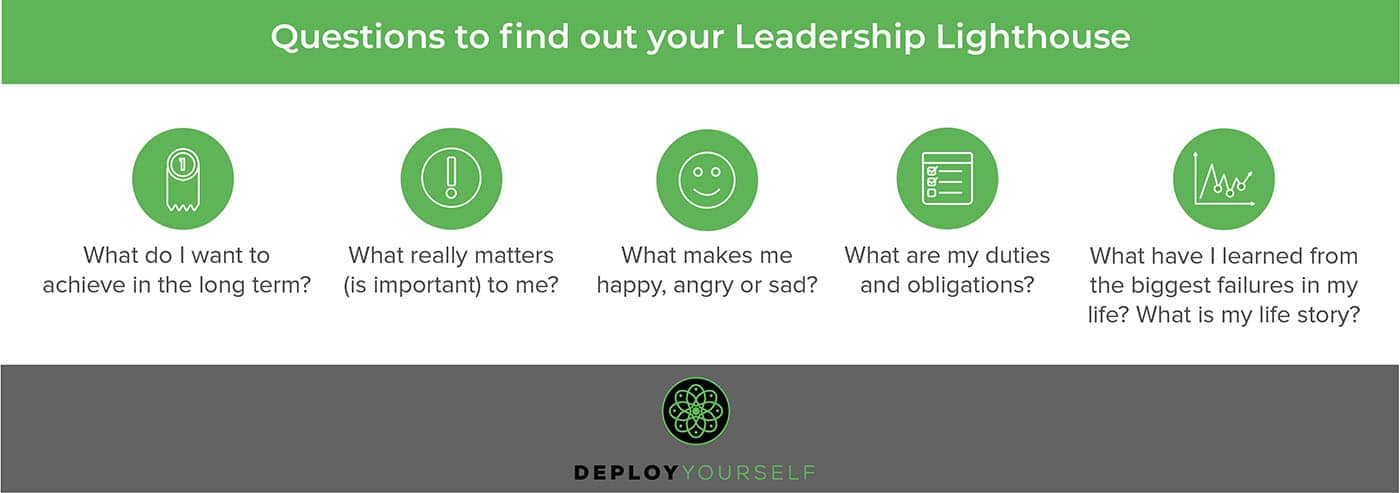
    To find leadership lighthouse, try answering the below questions:-

    1. What do you want to achieve in the long term?
    2. What really matters (is important) to you?
    3. What makes you happy, angry, or sad?
    4. What are your duties and obligations with regard to different aspects of your life?
    5. What have you learned from the biggest failures of your life?

    Answering these questions will require some sincere and dedicated effort on your side, but once you do that, you will have more clarity on how you define your own leadership lighthouse. I would also like to add that it is a continuous rather than a one-time process. You should revisit the above questions every now and then as a “health-check”.

    Knowing your leadership lighthouse will give you the confidence and assurance to follow your own path instead of the path others have decided for you. Once you nurture and develop your strengths and act consistent with your standards and values, you will allow your own unique light to shine upon the people and the world around you.

  • The Role and Importance of Emotions in Our Professional and Personal Lives

    When I started working at the age of 21, my manager was only a few years older than me. Both of us being very young and passionate about work, we developed a good friendship. As I completed my first year at work, I sat down with this friend (manager) to discuss my performance. I wasn’t ready for what came next.

    In the meeting, he was very formal and distant in his approach which I found unfair. Due to our friendship, I expected an informal conversation. Instead, what I got was “feedback” and “improvement points”. When he was done with the performance cycle, it left me in a very bad mood and it affected our friendship. While he was only performing his job as a manager, I was too naive and felt betrayed as a friend. It took us more than a year to mend our friendship, and I am good friends with him to this day.

    This incident was very tough for me, and it was not until many years later that I recognized why it was so. At first, I blamed my manager friend for being more of a “manager” than a “friend“. Later (after we mend ways) I blamed myself for being too emotional and developing friendships at work. I came to the (wrong) conclusion that emotions and rationality are mutually exclusive, and I shut myself down emotionally.

    It was much later that I realized that emotions were not the culprit. Instead, it was my inability to handle my emotions which led me to react impulsively. With experience, I have come to believe that emotions are absolutely necessary for doing any meaningful work. They only seem tough when we don’t know how to handle them.

    I have already written about how to handle our emotions in the workplace. In this article, I want to stress the importance of emotions as the driving force behind decisions.

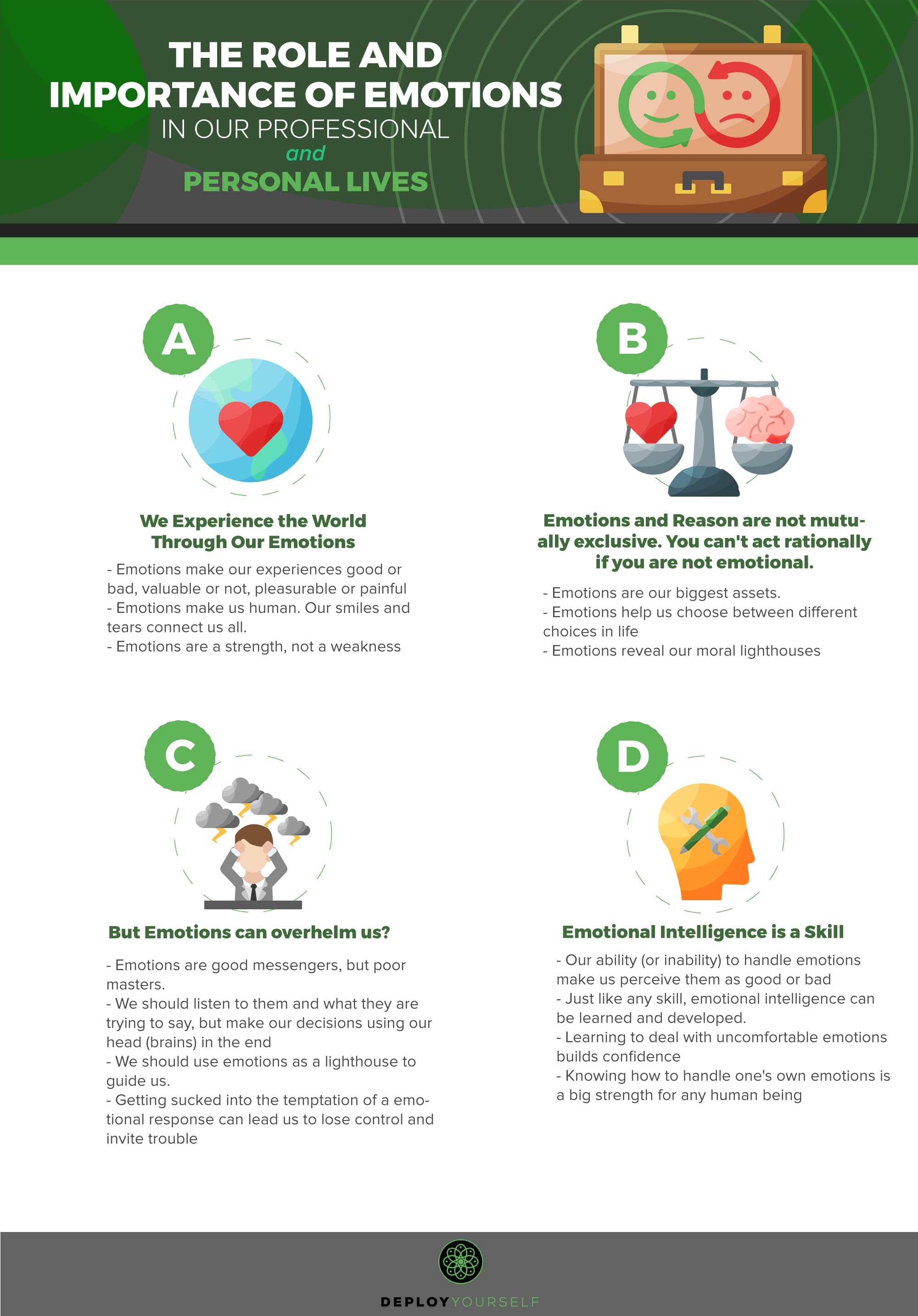
    We Experience The World Through Our Emotions

    We walk around the world and make sense of it through our emotions. When we experience an event, different emotions get triggered based on our values and beliefs. Emotions make our experiences good or bad, valuable or not, and pleasurable or painful. If we introspect we will found that every decision we end up taking is derived from an emotion that touched and moved us.

    These emotions can overwhelm us occasionally, but without them, we would have no connection with people or events around us. While emotions can sometimes bring pain and tears, it is only through them that we feel joy, happiness, and peace in life. It is very important to realize that emotions are our strength and not our weakness.

    It is our emotions that make us human. The little moments of joy when we play with our kids, the smile on our faces when we help someone, the tears in our eyes when we see something cruel and terrible (even if it is on TV) – it is these emotions that connect us all as human beings.

    Seeing a tweet by a billionaire CEO and to be able to feel empathy for him/her makes us bridge the economic, physical, and social divides and come closer. On the other hand, if we are privileged in any way, being able to empathize with the less privileged and act for them brings us closer. Emotions help keep our egos in check and prevent us from being indifferent towards the less or more privileged in our society.

    Emotions and Reason are Not Mutually Exclusive

    Most of us believe that emotions and reason are opposites of each other, and it is often presented as a fact that you can’t act rationally if you are emotional. In many workplaces, emotions are frowned upon and an excessive display of emotions (joy, tears, anger) is seen as a liability.

    On the contrary, what I have learned over the years is that emotions can be our biggest asset. They can give us important information that can shape our lives if we listen to what they are trying to tell us. The key is to learn how to express our emotions without repression or explosion.

    Emotions can help us clear the fog of rational choices and reveal our moral lighthouses. They help us choose wisely when presented with two equally good or equally bad choices. Emotions clarify our thinking and help us see rational choices in a new light while pure rationality often makes us run wild with ideas, even at the expense of others. Rationality without emotions can look enticing in the short term, but it can be a menace in the long term.

    It Is Impossible to Be Rational Without Emotions

    While it is true that emotions can overwhelm rationality at times, it is impossible to be rational without being emotional. Today there is scientific evidence to prove that we, as human beings, are incapable of making decisions if we can’t feel our emotions. You can read about the works of neurobiologist Antonio Damasio to see that without emotions, there is no decision making possible. [1][2]

    He worked on a patient with a severed connection between the frontal lobe (where rationality originates) and cerebral amygdala (where emotions originate) in the brain. After the surgery, the patient could think, but he could not feel anything. He noticed that while he was able to engage in rational thought all the time, he was not able to make a choice over the other.

    When Emotions Overwhelm Us?

    We all have been in situations where we don’t want to do what we know is the right thing to do. When emotions overwhelm us, we can get sucked into the temptation of the respective emotion and (re)act in a way that provides us emotional relief. For example – When you couldn’t control your frustration and vented it out on your manager because it felt good to spurt it out.

    Emotions are very good messengers, but poor masters. We should always listen to them and let them play a big role in our rationality, but subjugating reason for emotional whims can cause us short and long-term harm. In the end, we should always use reason to choose the best option available for us, and use emotions as a lighthouse to guide us on the right path. This will help us in making the right choices (which might not be the easy ones) in life with conviction.

    Emotions Intelligence is a Skill. Train Yourself

    Now that we have seen that there is no action possible without emotions, we can conclude that emotions are not bad or good in themselves. It is our ability to handle them that makes us interpret them as so. It is a skill that, just like other skills, can be developed.

    Learning to deal with uncomfortable emotions builds confidence and opens up new pathways that were earlier closed to you. Emotional people are often regarded as weak in certain societies, but I believe that the ability to handle one’s own emotions is one of the most useful skills a human being can acquire.

    Increased emotional awareness can be a great asset we all can make use of not only to make the right decisions for ourselves but also to create a better world around us. A world which is not mine or yours – but ours.

  • Focus on Interests, Not on Positions – The One Tip Which Can Make Every Conversation More Productive

    There was once only one orange left in a kitchen and two chefs were fighting over it.
    “I need that orange!”
    “Yes, but I need that orange as well !”
    Time was running out and they both needed an orange to finish their particular recipes for the dinner. They decided on a compromise: they grabbed one of the large kitchen knives that was lying around, split the orange in half, and each went to his corner to finish preparing his meal.
    One chef squeezed the juice from the orange and poured it into the special sauce he was making. It wasn’t quite enough, but it would have to do. The other grated the peel and stirred the scrapings into the batter for his famous cake. He too didn’t have as much as he would have liked, but given the situation, what else could he have done?

    We all love to form, hold, and defend our positions. Whether it is at home with our spouse, or at work with our colleagues, once we form a position on a certain topic, it is going to take some convincing to loosen our hold on our “coveted” position. Isn’t that true?


    As human beings, we function and operate in this world by forming positions on different subjects we face in our day to day interactions. However, when we encounter opposition or resistance to our point of view, or when we oppose others’ points of view, it is very common for us to defend our positions and it takes some convincing for us to yield from our position.


    What I have discovered with my experience of dealing with people over the last many years is that if we focus on people’s interests instead of their positions, it can become much easier to negotiate and converse with them. To clarify my point, and to understand the difference between positions and interests, consider the three points (and corollaries) below.

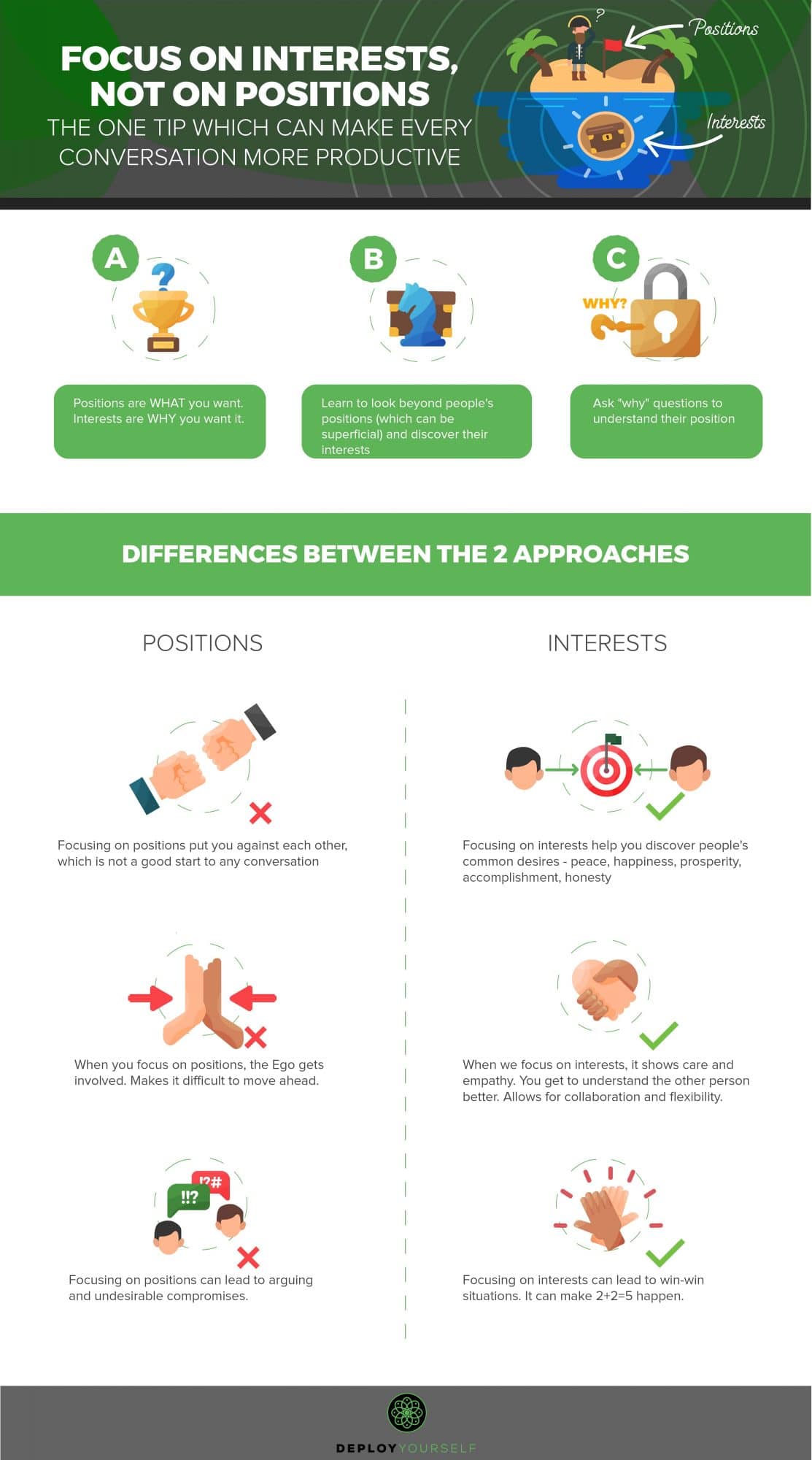
    1. Positions are WHAT You Want. Interests are WHY You Want It.

    In the story above both chefs wanted the orange, and that was their position. What you WANT, the specifics and details of it is your POSITION. One chef wanted the orange for its juice to prepare a sauce while the other for its peel to prepare a cake. This was their INTEREST behind wanting the orange.

    Corollary 1

    Focusing on positions puts us against one another, which is not a good start to any conversation. On the other hand, distinguishing between the positions and interests helps us discover people’s common desires – like fairness, accomplishment, happiness, and prosperity. These desires might not be the same for both parties, but they often are compatible, which makes for easier negotiation.

    2. Look Behind Superficial Positions To Discover People’s Hidden Interests.

    The positions we form can be, and often are, superficial in nature. Considering the above story again, it is obvious now that it would have been better for the chefs to peel the orange and take the part they needed for their respective recipes. However, they choose to focus on each other’s positions (the what) and hence ignored their interests (the why).

    Corollary 2

    When we focus on positions, our EGO gets involved which makes it difficult to move ahead. Looking to discover each other’s interests helps us to understand each other better. It presents an opportunity to collaborate and work together to produce not just better results, but also better relationships.

    3. To Uncover Interests, ask “WHY?”

    In the above story, what the two chefs got was an undesirable compromise, and I am sure their relationship didn’t get any better because of this.
    It is very easy to form positions as human beings, but it is always helpful to ask ourselves why we want what we want. Asking this question can help us discover our hidden interests, which can then lead to many flexible alternatives instead of just one fixed position.

    Corollary 3

    Focusing on positions alone can lead to unpleasant arguments and/or undesirable compromises. Understanding each other’s motivations behind the positions can lead to win-win situations. It can make 2+2=5 happen.

    Conclusion

    It is very common to confuse positions and interests. When we act in a “my way or the highway” manner without considering the views of the other side as legitimate, it becomes very difficult to make progress in conversations. Negotiating in this way can do more harm than good, as people tend to dig-in with their opinions and justifications, and their positions tend to move further apart.


    However, looking to work together by asking the “Why?” question, and taking efforts to understand each other’s concerns can create a pathway where there was none before. It can result in a partial solution in a not-so-ideal case, and it can allow for magic (any solution better than what both sides wanted initially) to happen in the best case.

  • What To Do If You Can’t Achieve Consensus in a Conflict?

    In the previous four articles, I have written about what conflicts are, what not to do when they happen, how to prepare to solve them through a conversation, and some practical tips to follow during the conversation itself. However, doing all this doesn’t guarantee the result you desire.
    Conflicts can be complex, and there are times when people (including you and me) are more interested in winning (or getting our way) rather than working together to get what we really want.  Human beings are complex emotional beings, and often we end up attaching the outcome of a conflict to our personal identification.
    That leaves us with the question of what to do if we can’t achieve consensus in a conflict resolution conversation?

    1.  Follow Pre-Decided Escalation Rules

    If you have done your preparation well, you already know how to escalate the stalemate to your superiors in the organization so that they can help. If you have not decided on any escalation rules earlier, now is not a bad time to do it either.
    The only thing we must keep in mind with deciding escalation rules or escalating an issue itself is to not do it unilaterally. It is always beneficial to work with the other party to decide whatever escalation rules you can come up with, and then if the situation demands, to escalate the issue together.
    Escalating an issue alone without first communicating with the other party hurts the trust and the relationship which might make it even more difficult to resolve the conflict in the future.

    1. Take A Break, And Try Again

    If you have reached a stalemate, one common option is to take a break and reconvene later. Taking a pause at this time gives both sides space to reflect on the discussions so far and evaluate options. You might decide to harden or soften your position during this time and get a different perspective of the big picture.
    When you meet again after a break, it is important to redefine the common purpose which both parties are seeking. Then you can work together to understand each other’s points of view and negotiate again.

    If the above two steps don’t help you in moving forward, you can try these:-

    What To Do If You Can’t Achieve Consensus in a Conflict?
    What To Do If You Can’t Achieve Consensus in a Conflict?

    1. Walk Away With Your BATNA

    If the disagreement has reached a point where you can’t reach a solution acceptable to both parties, it might be prudent for both parties to walk away with their respective BATNAs (Best Alternative To A Negotiated Agreement). Not reaching a consensus in a conflict is not a bad outcome. Sometimes the best outcome is to not agree with the other party while still respecting them and keeping the relationship healthy.
    Once the discussions are over and everyone walks with their BATNAs, you can look back and reflect upon the whole process. There might be lessons for you that might help you in future conflicts, and evaluating the choices you made is a good exercise after the discussion.
    You should also acknowledge yourself for putting in the effort required to resolve the conflict. Give yourself credit for working together and strengthening the relationship, irrespective of whether you got the result you wanted or not.

    1. Seek Mediation By A Third Party

    Another step forward (if both parties agree to it) could be to seek mediation from a third party. This is different from escalation as escalation means involving your managers or seniors in the conversation. The rules of mediation seek the involvement of an independent third party.
    And of course, the rules of mediation should be decided by both parties together. Below are a few ideas to keep in mind before you go down the path of mediation.

    1. The third-party must be agreeable and respected by both of you. Do not accept a third party mediator you don’t trust, and never force a third party on another.
    2. The third-party should play a neutral role and not take sides. It must listen to both sides then make a decision based on the merits of the arguments and facts presented. Decide the rules of argumentation and reasoning together before starting the process.
    3. Discuss possible solutions and compromises. See if you can agree on any tentative agreements. Take it step by step. Even if you can’t reach your desired outcome, see if you can reach halfway.
    4. Close the mediation and finalize any agreements. Do a final check to see if both parties are satisfied? Do both the parties consider the mediation and final resolution fair and pragmatic? Without a YES to the above questions, any solution or agreement is unlikely to last the distance so don’t ignore this step.
    5. Create a provision for future conflicts. What will you do if one party goes back to the mediated settlement? Can any party seek a revision to the mediated agreement?
    “The harder the conflict, the more glorious the triumph. What we obtain too cheap, we esteem too lightly; it is dearness only that gives everything its value. I love the man that can smile in trouble, that can gather strength from distress and grow.”
    ― Thomas Paine

    To sum up, the above four steps will help you to amicably close a conflict resolution process – with or without an agreement. I believe learning to effectively manage conflicts in a constructive and respectful manner is an important skill to learn, and one which gives people more confidence to work together.
    Conflicts can lead to misunderstanding and destroyed relationships, or it can be an opportunity to collaborate constructively and strengthen relationships. In the high-pressure business environment we all live in today, if we can develop this ability to resolve conflicts amicably, it can become a competitive advantage for us and the companies we work in.  

  • Eight Practical Tips for Making A Conflict Resolution Conversation More Effective

    So you have prepared well (read my previous article), and are walking into a conflict resolution conversation with trust and respect for the other person. You have established ground rules for the conversation, and you know your BATNA.

    Even with all this preparation, it is easy to get sucked into our emotions and give into reacting impulsively. Below you will find some practical tips I find really helpful to navigate a conflict resolution conversation efficiently.

    An enemy is a person whose story we have not heard. - Gene Knudsen Hoffman
    An enemy is a person whose story we have not heard. – Gene Knudsen Hoffman

    I have gathered and collected these tips from various books I have read and trainings I have undertaken, apart from my own mistakes and learnings in the past.

    1. Speak in a Non-Attacking Manner – Use “I” language rather than “You” language. For example – Say “I felt angry when you said that.” rather than “You made me angry by saying that.” Take responsibility for your own emotions, and remember the aim is to work together.
    2. Listen and Understand. Summarise and paraphrase what the other person says to make sure you understand his/her concerns and they know it is very important for you to do so.
    3. Walk the Talk – If you feel angry or frustrated by hearing certain words or voice tone, make sure to not use the same words and tone to the other person. I have often seen that observing my own thoughts and emotions helps me to understand others better.
    4. Separate the Facts from the Opinions –  Work together to challenge each other’s assumptions, and distinguish opinions backed by emotions from opinions backed by facts and data.
    5. Stay Silent – Use the power of silence to give the other person and yourself space to process what is being said in the conversation. It creates positive energy instead of building tension and enables us to handle tough situations in a more mature way.
    6. Speak Up Only If It Makes Things Better – Speak Up only when what you have to say will help the conversation in one way or the other. If what you have to say will not make the situation any better, don’t say it. In other words, do not vent or speak only because you had a thought in mind. Speak only when it helps you move towards the desired result.
    7. Give Time for Emotional Release – If someone is venting out, don’t interrupt. If it gets too heated, take a break. Wait for the (emotional) storm to pass before making repairs. Jumping in too early to fix things might backfire and cause more damage despite your good intentions.
    8. Don’t Push –  When you push people, they will push back. Present your thoughts without trying to push them through, and be open and flexible to listen to others’ concerns and thoughts. Give people a choice to accept or reject your ideas, as you cannot force them to your point of view anyway. Work together, not against each other.
  • How to Prepare for a Conflict Resolution Conversation?

    A conflict resolution conversation is one of the most critical conversations in any organization. The success or failure of this conversation will determine how the inherent energy in a conflict will be used, and how the relationship between the involved parties will be in the future.

    As I have written previously, conflicts have a lot of energy, like an overflowing river. It is up to us to build a dam and channel all this extra water (energy) into electricity? Because if left unchecked, all this extra water can cause flooding and devastation in its path. The most effective tool to prevent the flooding and use the energy in each conflict productively is the Conflict Resolution Conversation.

    Below are the 5 steps I think all of us must take before/in any conflict resolution conversation:-

    1. Create A Foundation of Trust and Respect among all involved parties, which is essential for any productive conversation to happen. This is more like a step 0, as trust is like oxygen in a conversation.

    Take steps to apologize or forgive for any past behavior, and prepare a clean slate by setting any prejudices aside. This will help create an environment of trust and mutual respect. Work together as partners, and not adversaries, as you set about resolving the conflict.

    2. Decide Ground Rules for the conversation before you start. These rules will allow you to proceed amicably in the face of differences and disagreements. They can include what is the common goal both parties are seeking, how would you treat each other, and what do you do if you can’t agree on a common solution?

    Having such ground rules will assist both parties to keep their egos in check and keep the focus on a mutually beneficial solution. Even in the case of an unproductive conversation, these rules will leave you with respect and understanding for the other person’s position, rather than with resentment and cynicism.

    3. Listen. The freedom to speak your mind includes a duty to listen and understand the other person’s perspective. Walk a mile in the other person’s shoes to see the situation from his point of view. Acknowledge the validity of the different perspectives without making any one perspective right or wrong.

    Walk into the conversation with an empathetic attitude and care for the other party’s concerns. Understand that the conversation is not productive unless the concerns of both parties are met. If you work to address what the other person cares about, you create the possibility of a win-win result which might be even better than what you initially wanted.

    “Courtesy towards opponents and eagerness to understand their viewpoint is the ABC of non-violence.” – Mahatma Gandhi

    4. Differentiate Your Positions from your Interests – Ask yourself what do you really desire? And why? Let go of your attachment to your position and seek to discover yours and others’ common desires. Asking the question “why” a couple of times can help you do that.

    This will help you understand the other person better and create space for collaboration and flexibility. Understanding the concerns of each other will turn you into partners rather than adversaries, and it opens up the possibility of making 2 + 2 = 5 happen.

    5. Prepare your BATNA (Best Alternative to a Negotiable Agreement) – The BATNA is your lower boundary, the minimum you are willing to get out of the conversation. Knowing your BATNA increases your negotiating power.

    When you enter a conversation knowing your BATNA, that gives you assurance and confidence. If nothing else works, you walk out with your BATNA.

    To sum it up, doing this preparation before any conflict resolution conversation prevents us from reacting impulsively when the going gets tough. Conflicts are a natural order of life, and being prepared will allow us to turn them into an opportunity to build a strong foundation (relationship) not just for immediate but also long term results.

    It is also important to note that the above steps do not guarantee a successful conversation or the results we desire. But they will equip us to deal with conflicts with steady and not shaky hands, which is always a good skill to have.