
The Conversation I Got Wrong
I met a founder whom nobody was telling the truth (normal for CEOs). Everyone around him was politely telling him what he wanted to hear. So I said it – to his face – without any sugarcoating.
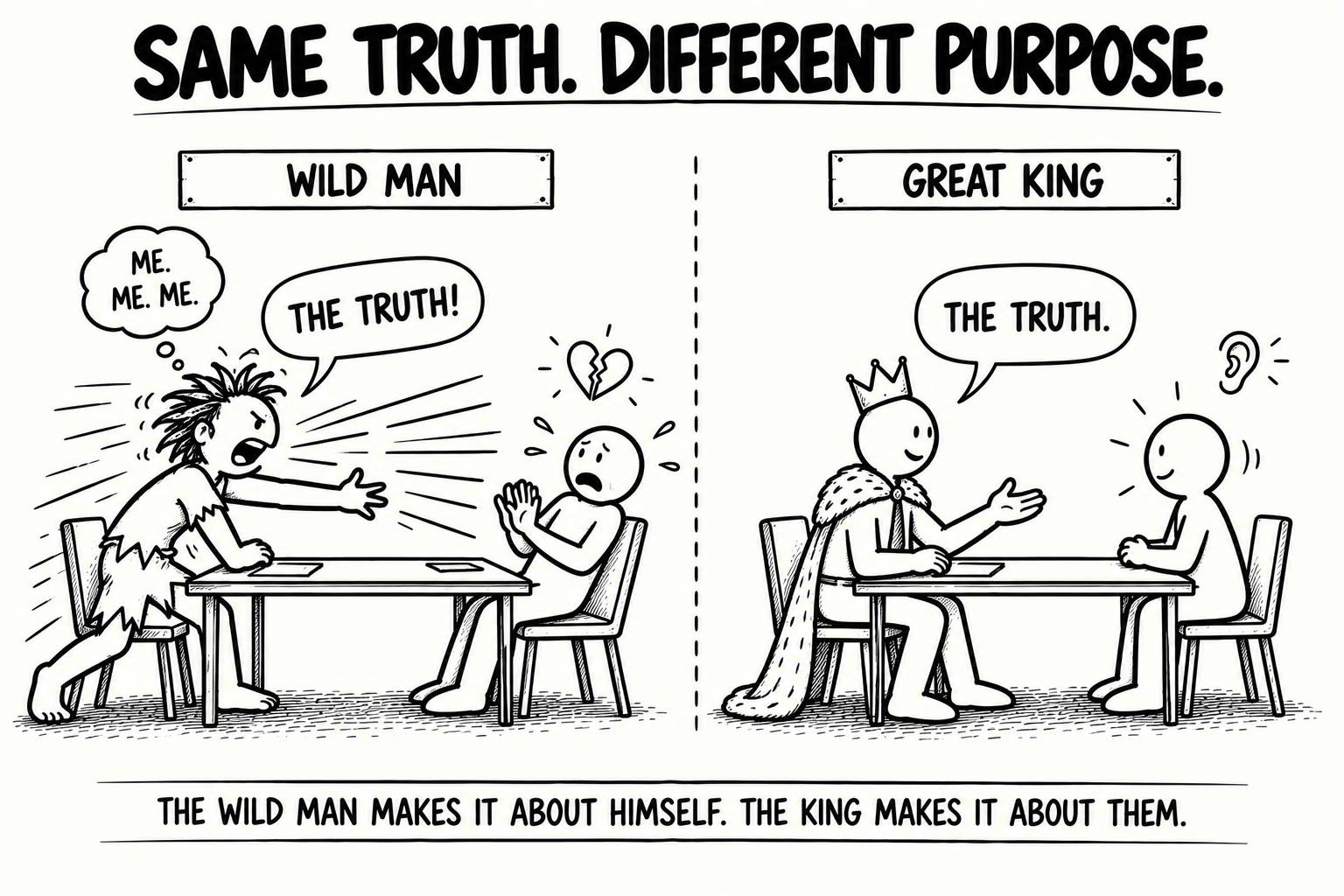
I was bold. I was direct. And honestly, I came on way too strong – and way too fast. I went at a speed he just couldn’t keep up with. My boldness drowned out my empathy, and somewhere along the way I stopped listening. Without even noticing, I made it about me – about me being authentic and brave (which I have not been most of my life). Not about him and making sure he receives the message.
The conversation spiralled out of control. It became about the two of us (and our egos) instead of the important feedback for the company. Trust dropped. And our relationship broke down.
The good boy in me would never have started that conversation. He’d have smiled, nodded and kept the peace – and then later – blamed himself for withholding. The wild man in me did start it – and then took it way too far. The conversation was exactly what was needed. The speed at which I went, my inability to listen, and making it about “me” were not. That’s what this article is about.
Most CEOs I Meet Are Good Boys
I sit with founder-CEOs every week. They’re smart, responsible, and they work harder than almost anyone in their company. They are also tired, busy, stressed, and have no free time – for themselves or their families. They are such good people that they do it all with choice – and would do it all over again if given a chance.
Here’s what I see in those rooms: so many good boys and girls, a few wild men and women, and still the rarest of all – a great king or queen.
Good boys start companies – they’re reliable, they show up, they get the thing off the ground. Wild men make them successful – they take risks and break the rules that need breaking. Great kings scale them – they build leaders and leave an impact bigger than themselves.
So why do so many companies get stuck at ~€5M and then at ~€10M and just stay there? There’s an old story that explains it better than any leadership book I’ve read.
Iron John
In 1990 the poet Robert Bly wrote a book called Iron John, based on an old Grimm fairy tale. What I took from it changed how I see myself and others. There are three energies we can all live from:
- The Good Boy (or Good Girl) – polite, careful, methodical, waiting for permission, wanting to be liked – this is most of us most of the time.
- The Wild Man (or Wild Woman) – raw instinct, fire and courage. Breaks through barriers and walls. Says what needs to be said and moves on to the next thing.
- The Great King (or Great Queen) – holds power for other people. Takes a stand for something bigger. Protects, decides, and builds other leaders. Makes a contribution bigger than themselves.
This isn’t about gender. You’ll see more “he” than “she” in this article. That’s because I’m a man, and most of the leaders I meet are men. But everything here is just as true for women – if anything, more so. Girls are often taught to be “good” even earlier and even harder than boys.
So What Is a Good Boy?
We were all born wild and free. Watch any small child. They shout when they’re happy and cry when they’re sad. They say exactly what they want. They climb things they shouldn’t and ask “why? & why not?” a hundred times a day. Nobody has to teach a child to be wild or free.
Then, slowly, the wildness gets taught out of us. Parents say “sit still” and “don’t be rude”. School says “raise your hand” and “stay inside the lines”. Society says “don’t stand out” and “who do you think you are?” Most of it is said with love, to keep us safe. Bit by bit, we learn that being wild gets you in trouble, and being good gets you praise. So we cast the wild one away. And we become good.
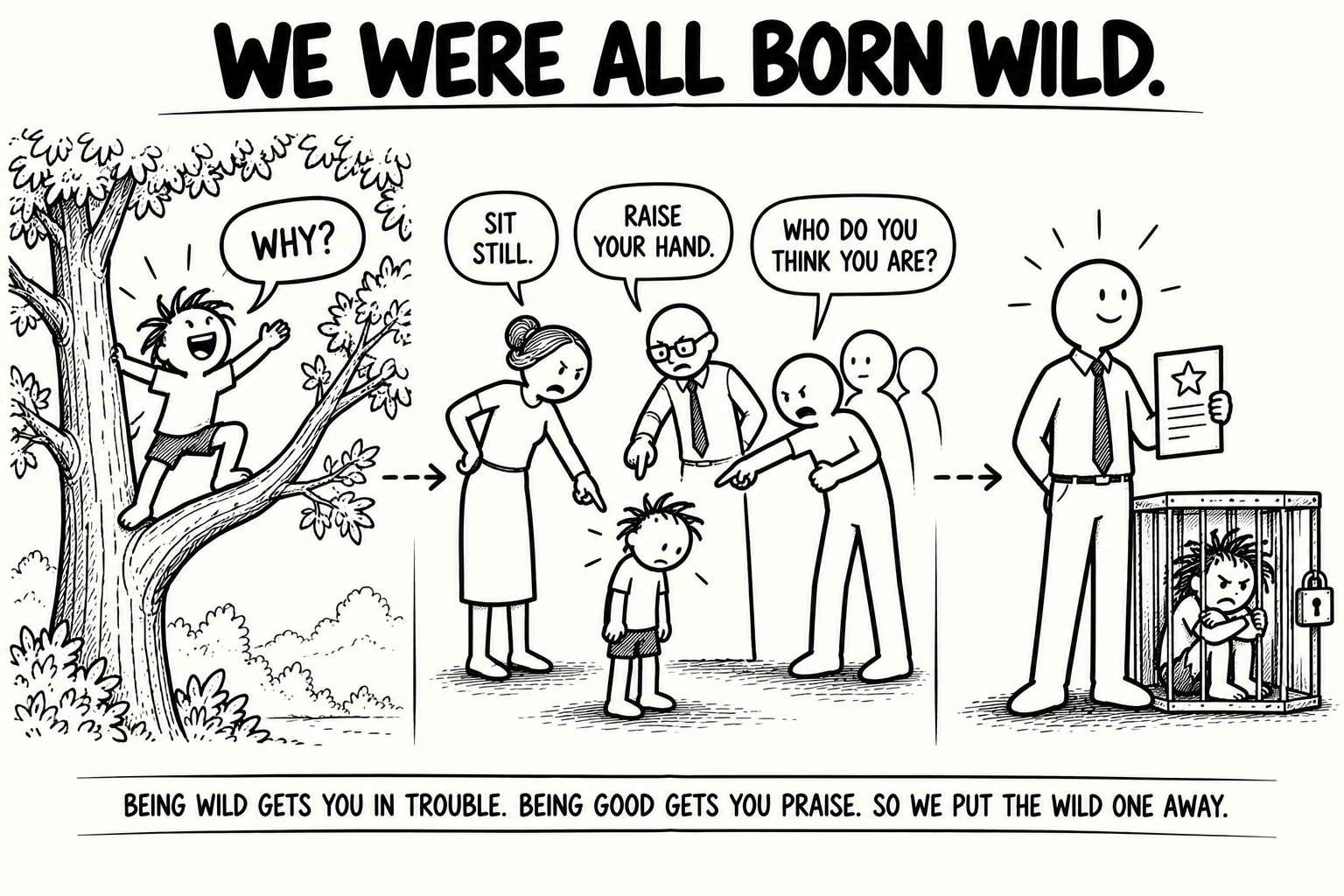
FIG 1 – We were all born wild. Then we learnt that being good gets you praise.
The good boy got rewarded his whole life for being right, being polite and not causing trouble. School loved him. His parents were proud. Then he becomes a leader – and the same habits that made him popular make him successful to an extent, and then hold his company back. How do you know the good boy in you is running things? See if any of these sound familiar:
- You over-prepare. One more analysis, one more meeting, one more month.
- You take on everybody and everything’s responsibility on your shoulders.
- You try to keep your team/board happy instead of leading them.
- You keep the “good enough” leader who stopped growing years ago, because letting them go feels unkind.
- You say “we’re fine” while you’re running on fumes.
- You call it humility when, if you’re honest, it’s fear.
There is nothing wrong with all of the above. They have brought you so far. And yet, being easy to get along with often has a huge invisible blind spot. This costs more than you’d think. Researchers followed about 10,000 workers over roughly 20 years and found that less agreeable men were more successful than very agreeable ones.
Now multiply that across a whole company. It grows, but slowly, and then it gets stuck. The ceiling isn’t the market. It’s the good boys or girls at the top. And I know this from personal experience, because I was the best good boy you ever met.
Being easy to get along with often has a huge invisible blind spot. Now multiply that across a whole company. It grows, but slowly, and then it gets stuck. The ceiling isn’t the market. It’s the good boys or girls at the top. And I know this from personal experience, because I was the best good boy you ever met.
I have lived most of my life trying to fit in
I grew up in India, and most of my early life went into one thing: getting my family out of poverty. In my second year of college, I found out my mother had cancer. My parents had hidden it from me – and used the money that could have treated her to pay for my education.
What do you do with love like that? You become very, very good.
So I did. I was a quiet, introverted kid who became an engineer and built a well-paid 16-year career in tech. I did everything right. I built my whole life around serving other people, and never once asked what I wanted. I would not even buy myself an ice cream just because I felt like having one.
From the outside, it looked like success. On the inside, I was holding back every dream I had until it became suffocating – and then depressing. Being good kept my family safe. It also kept me small.
Though, in little moments in 1999 (when I hacked my school exams), 2002 (hacked my college computers), 2007 (started my first company), 2010 (did the Landmark Forum), 2011 (started an NGO), 2019 (my son was born) and 2021 (started coaching CEOs), something else (my wild side) woke up in me.
The Wild Man In Each of Us
In 2011, I decided to organise an anti-corruption protest march. I, the introverted techie, full of self-doubt, had no idea what it would take. When I told my mother, she said, “Yes, it is crazy. But you can do that. You will find a way. Just put one foot after the next.”
400 people walked 11 kilometres with us just 40 days later.
That was one of those times I felt the wild part of me. And I learnt that being wild isn’t about being loud or mean or reckless. It’s about doing the thing your fear says no to. Years later, the same wild man walked me out of a safe, well-paid career to build a life on my own terms.
You see it in business too. Phil Knight (founder of Nike) was a qualified accountant. He worked at Price Waterhouse and kept an accounting job for years to pay the bills – while selling running shoes out of his car at track meets. In Shoe Dog, he calls it his “Crazy Idea”, and says the best advice he can give is: “Let everyone else call your idea crazy… just keep going.” That idea became Nike.
And Sara Blakely spent seven years selling fax machines door to door. Then one day she cut the feet off a pair of pantyhose, put $5,000 of her savings on the line, and started Spanx.
What wild is not
I need to be really clear here, because good boys use this as their excuse. When you hear “wild”, you might picture being mean or a jerk or a bully. Someone rude who shouts at their team, or cuts corners to win. That’s not what a wild man is.
The wild man is just the free animal in us, allowed to breathe. We’re animals. We have natural aggression, hunger, instinct and impulses. The good boy learnt to lock all of that away to stay safe and liked. Being wild means letting those impulses out – without harming anyone.
For a CEO, that might look like saying no out loud to a big customer or ripping apart a best practices process within the company. It could mean asking for the big number without apologising. Walking out of a bad deal. Or calling a potential client 23 times over a week to sign a deal (real story). Telling the board the truth before they ask. Trusting your gut when the facts or data say otherwise.
The good boy is scared that if he lets the wild one out, he’ll turn into a monster. He won’t. Or that things might get unpleasant and he will lose people. It won’t. Instead, he’ll come alive.
Your Wild Side Can Become a Trap Too
I also meet a few wild founders for whom their wildness has become an addiction. They’re brilliant, bold, and magnetic. And very often the whole company revolves around them. Everyone is scared of them or of disappointing them. And sooner or later the founder burns out – or burns everyone else out.
The most famous example is Steve Jobs. Young Jobs was a pure wild man – brilliant, bold, and so hard on people that Apple’s board pushed him out of his own company in 1985. He spent the next twelve years “in the wilderness”, as his biographers put it. At NeXT, his wild impulses nearly sank the company again. At Pixar, he learnt to step back and let talented people do their work.
When he came back to Apple in 1997, he was more patient and actually listened when people pushed back. The wild man was still there. But now he was serving something bigger than himself – and that’s when Apple took off.
Wild with nothing bigger to serve than themselves turns into a bully – or burns everything down. Wildness this way can become an addiction. The rush of the bold move, the next big risk, the thrill of being the one who says the crazy thing. Slowly, it stops being a choice and starts running you.
I know this one well. Think back to that conversation at the start. I didn’t choose the wild man in that moment – he chose me. And it cost me trust and a relationship. Then guess what happens? The good boy rushes back in. He apologises, plays it safe, and promises never to be that bold again. Good, wild, guilty, good again. That’s the loop so many leaders live in.
So if being good keeps you small, and being wild can run you, what breaks the loop?
What Makes One a Great King?
The great king doesn’t throw away the good boy, and he doesn’t cage the wild man either. He keeps the good boy’s care and the wild man’s fire, and points both at something bigger than himself.
In practice, a great king or queen:
- Decides – fast, and owns the result. They are tough when they have to be.
- Protects the kingdom – even from their own moods and impulses.
- Acknowledges people – sees them and says out loud what they see – blunt & honest.
- Makes more kings – helps others grow into leaders, not just followers.
- Raises the bar – makes last year’s best the new normal for everyone.
Jim Collins found something similar when he studied companies that went from good to great. The leaders behind them had a rare mix: they were truly humble, and they had a fierce drive to win. The good boy’s humility and the wild man’s will, in one person.
Satya Nadella is a great modern example. He was a quiet, loyal engineer who spent 22 years inside Microsoft before becoming CEO in 2014 – a classic good boy. Then he did the bold things nobody expected. He worked with old rivals, made big bets, and openly changed the culture from “know-it-all” to “learn-it-all”. And he kept talking about empathy – saying “empathy has everything to do with work”. Courage and care, in one person. Microsoft went from being seen as yesterday’s company to one of the most valuable companies in the world.
So what would the king have done in my conversation? He’d have said the same hard truth. But he’d have said it at a pace the other person could take. He’d have listened. And he’d have made it about them, not about himself. Same truth, different purpose.
Why are kings so rare? Because the good boy tries to skip straight to king and becomes a nice king – which really means a weak one. And the wild man skips ahead too far and becomes a bully. You can’t become a king without first letting your wild & pure energy out.
And yes, even kings slip. The difference is they notice faster, and find their way back.
You have to be Somebody before you become Nobody
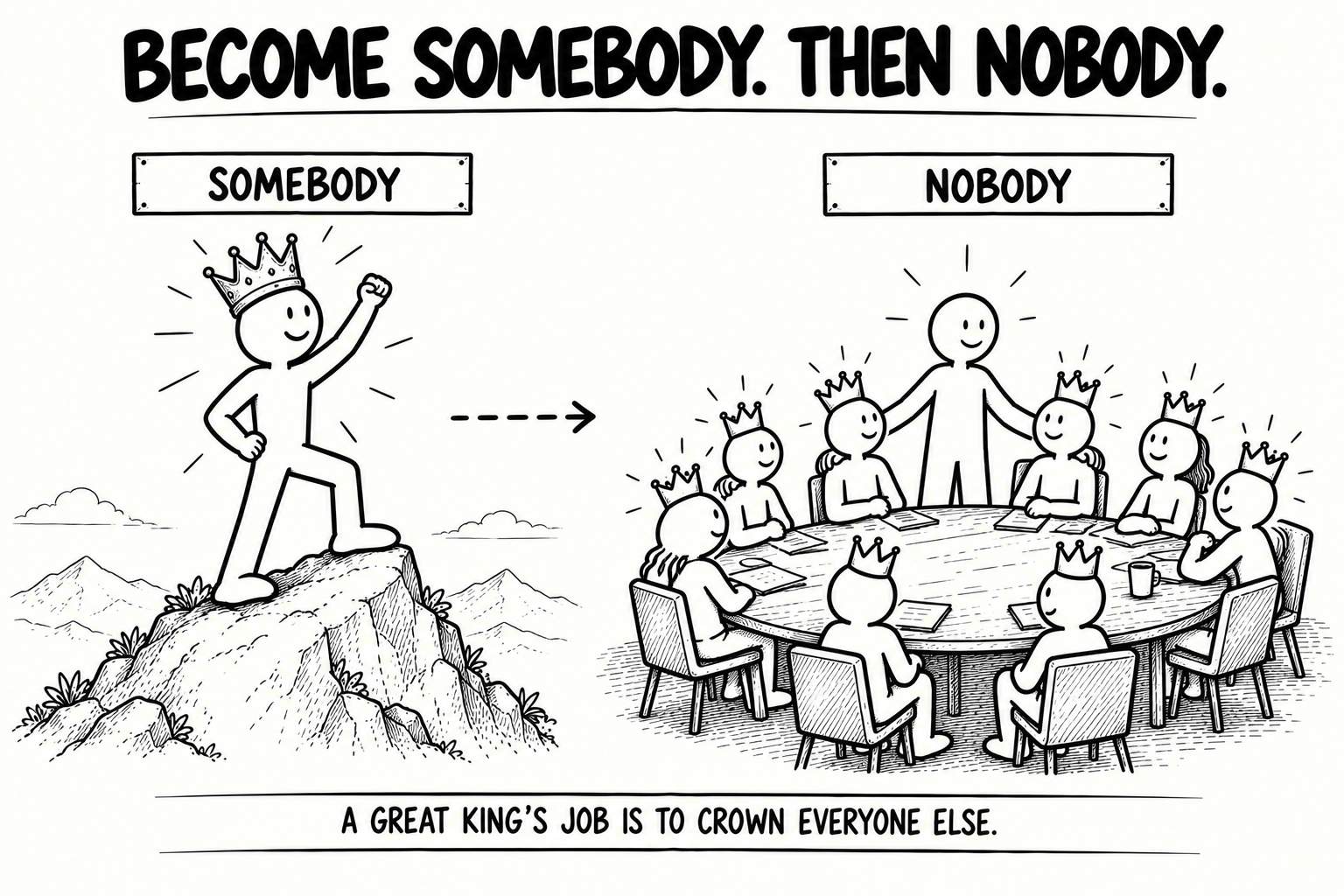
Ram Dass loved to say: “You have to be somebody before you can be nobody.” (The line first came from a teacher called Jack Engler, but Ram Dass made it famous.) The good boy tries to be humble before he has anything to be humble about. That isn’t humility. That’s hiding (like I was most of my life).
The wild man is how you become somebody – with your own unique free expression in the world. You find your voice. You stop asking for permission. You stand out. You own your power. The king is how you become nobody – or go beyond yourself. You stop needing it to be about you. Your power stops being yours, and starts being used for a purpose/mission larger than your life or business. It becomes about helping your team, your company and everyone your work touches.
The clearest example I know of becoming nobody is Yvon Chouinard, who founded Patagonia. He started as a wild climber and blacksmith who once said, “I never wanted to be a businessman.” He built a company worth about $3 billion. Then, in 2022, he gave it away – handing the ownership to a trust and a non-profit to fight climate change. His letter said it simply: “Earth is now our only shareholder.” First he became somebody. Then he chose to become nobody.
Becoming a Rock for Others
I lost my mother in 2012, the year after the march. Only then did I see how much of a rock she’d been for me. Every “impossible” thing I’d done, I’d done because she was standing behind me.
Something changed in me after that. I stopped trying to prove myself. I wanted to stand behind other people, the way she stood behind me. That’s what I mean by going from somebody to nobody. Today, my promise to everyone I work with is the same – I will never give up on you. I will never judge you and also never hide the truth from you.
I help them grow their companies past €100M. But honestly, the money isn’t the point. The point is to build companies and leaders who shape the next ten generations – and to have a lot of fun doing it. To look back at life and say, “holy fuck! what a life!!”.
Have I got it all figured out? No. You already know I still slip both ways. Today I find my way back faster. A king’s power is measured by how many people grow around him – not just by how “wild” he or she can be.
Where to start the journey from good to wild?
Most leaders who come to me are good boys and good girls. You can also be good with a certain set of people and wild with others. Or you can be good at a certain ambition and wild with another. One founder ran team meetings that dragged on for two and a half hours. Everyone was comfortable, and nothing got decided. When he stopped keeping everyone comfortable and started saying what was true, those meetings dropped to 45 minutes.
Another leader finally told their team, out loud, what they saw in each person. People cried. It had been sitting inside that leader for years, just waiting. And one founder told me after our first year together: “I would have given three years for what happened in one.” None of them turned into jerks. They came alive. And their companies felt it.
If you are asking, where do I start? I suggest three things.
- Name the one conversation you’ve been too “good” to have.
- Make one decision this week when you only know 70% of what you’d like to know.
- And ask for something so big it embarrasses or terrifies you.
You don’t need to run off to a forest to find your wild. You just need a few minutes each day doing the above three things.
So Here’s My Call to You
If you’re a good man or a good woman, you’ve been good for a long time. Your family is safe. Your company is steady. You’ve earned the right to stop playing small. Let the wild one out. Nobody will get hurt – except your fear.
If you’ve already met your wild side, it’s your biggest gift. Don’t hide it. Also, don’t waste it proving yourself, and don’t let it run you. Stop using it only for yourself. Use it for your team, your company, and all the people whose lives your work touches.
Ask the king’s question. Ask: “What does my mission need here – not what keeps me comfortable or proves me right?” Then do that.
That’s how a good boy who starts a company becomes the wild man who makes it successful and then the great king who helps it grow into an institution. Become somebody first. Then become nobody (go beyond yourself) – and watch how many people rise with you.
It is important to note that the good boy, the wild man, and the great king aren’t stages you go through. Your company might go through stages, but you don’t graduate from good boy to wild man to king and then stay there. Most of us swing between all three – sometimes in the same meeting.
I still slip back into being a good boy far more often than I’d like. And sometimes the wild man’s impulses grab me like an addiction. You saw how that went. So the real question isn’t “Which one am I?” It’s “Which one is running me right now?”
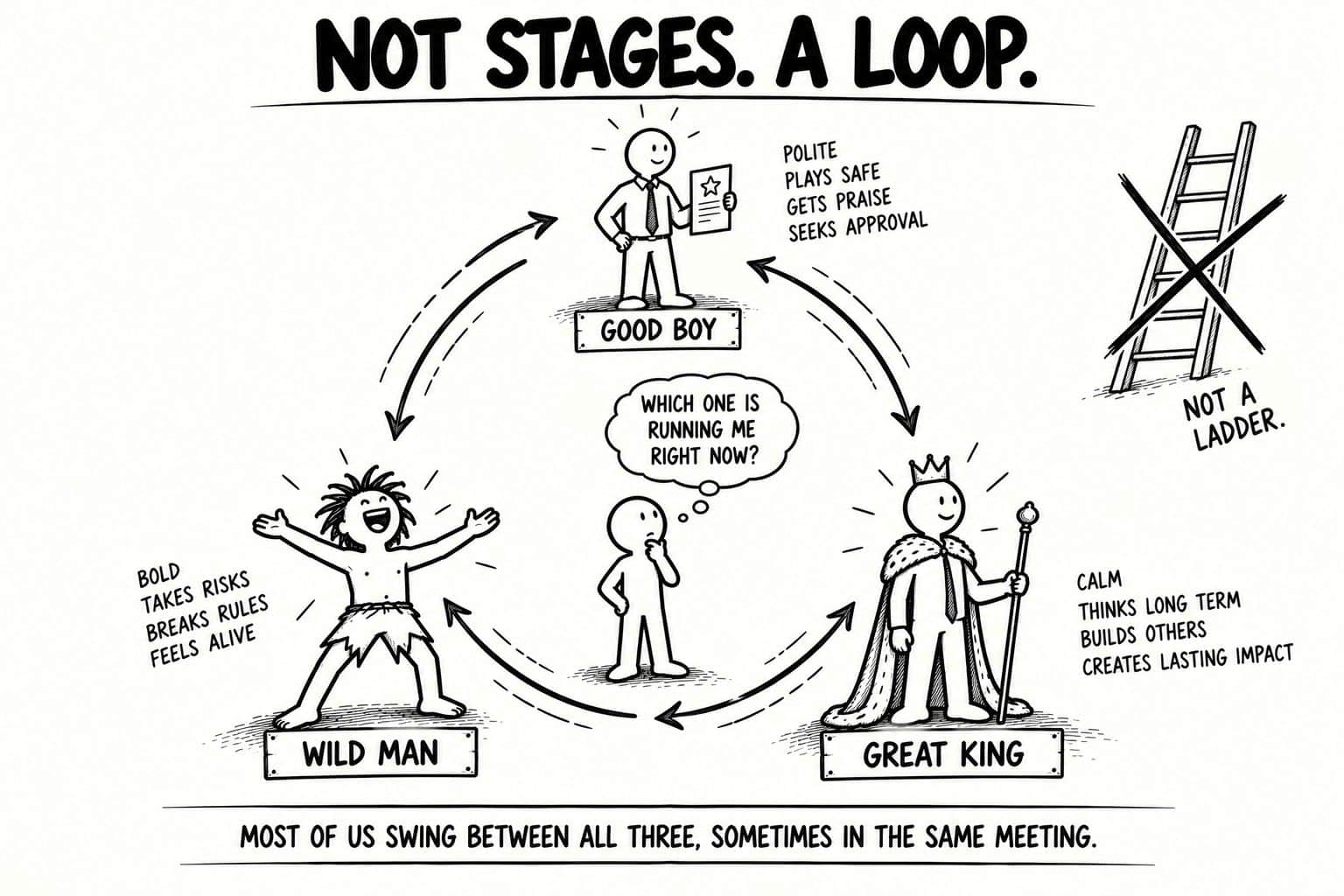
FIG 4 – Not stages, a loop. Most of us swing between all three, sometimes in the same meeting.
Sources
- Robert Bly, Iron John: A Book About Men (1990). A poet’s reading of an old Grimm fairy tale about the wild man, the king and growing into one’s full power.
- Timothy Judge, Beth Livingston and Charlice Hurst, “Do Nice Guys – and Gals – Really Finish Last?”, Journal of Personality and Social Psychology (2012). About 10,000 workers over roughly 20 years; less agreeable men earned about 18% more. Notre Dame summary · Journal record
- Jim Collins, Good to Great (2001), and “Level 5 Leadership”, Harvard Business Review. The leaders behind great companies mixed personal humility with professional will. Article PDF
- Ram Dass, “The Transition from Somebody to Nobody”. Ram Dass on moving from ego to service. The line “You have to be somebody before you can be nobody” is usually traced to Jack Engler. Be Here Now Network, Ep. 162
- Phil Knight, Shoe Dog (2016). CNBC · Background
- Sara Blakely and Spanx. Entrepreneur · TODAY, on her father’s dinner question
- Brent Schlender and Rick Tetzeli, Becoming Steve Jobs (2015). Publishers Weekly review
- Satya Nadella on culture and empathy. Stanford GSB
- Yvon Chouinard gives Patagonia away (2022). Al Jazeera
Leave a Reply