A stand for what’s possible for us as human beings
I want to start with something true about me. I’m fully committed to the leaders & companies in my portfolio, except when I’m committed to being right or looking good.
I didn’t enjoy writing that sentence. But when I look honestly, it’s there. Some moments I’m fully there for these leaders and entrepreneurs. Other moments, without deciding to, I am withholding my best. I am saving my full expression for when they mature, when I have spoken to someone else in their team, when a particular result happens, and so on and so on.
My reasons always change – but there is often a reason to withhold and save my highest service to them for some later moment in time. And it is because I am trying to look good or avoid looking bad if I give my best right now.
What I’ve noticed
Most of us, most of the time, aren’t fully in – in whatever we are doing. We are holding back, even if just a little, because of a prudent reason or explanation. We give a lot at work, but hold something back. We love our families deeply, but keep a small part of ourselves in reserve. We show up for friends, our health and our dreams, up to a point.
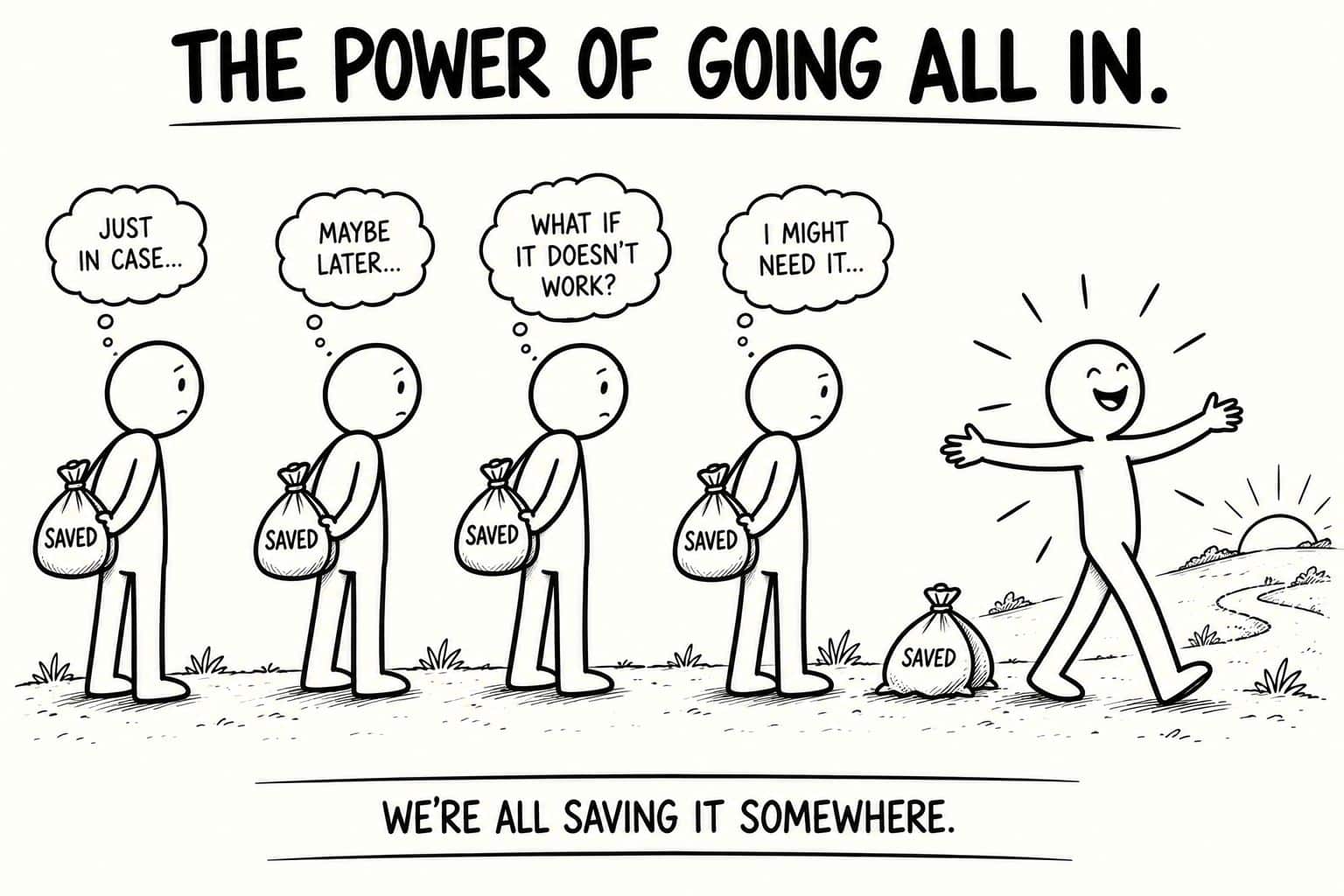
Werner Erhard pointed out this: we’re all saving it somewhere. We’re always committed to something. Sometimes it’s the person or the dream in front of us. Sometimes, quietly, it’s staying safe, looking good, being right or not getting hurt. The tricky part is that holding back rarely looks like holding back. It looks like being reasonable, busy, humble, careful, even kind. That’s why we so rarely notice it.
Why we do it
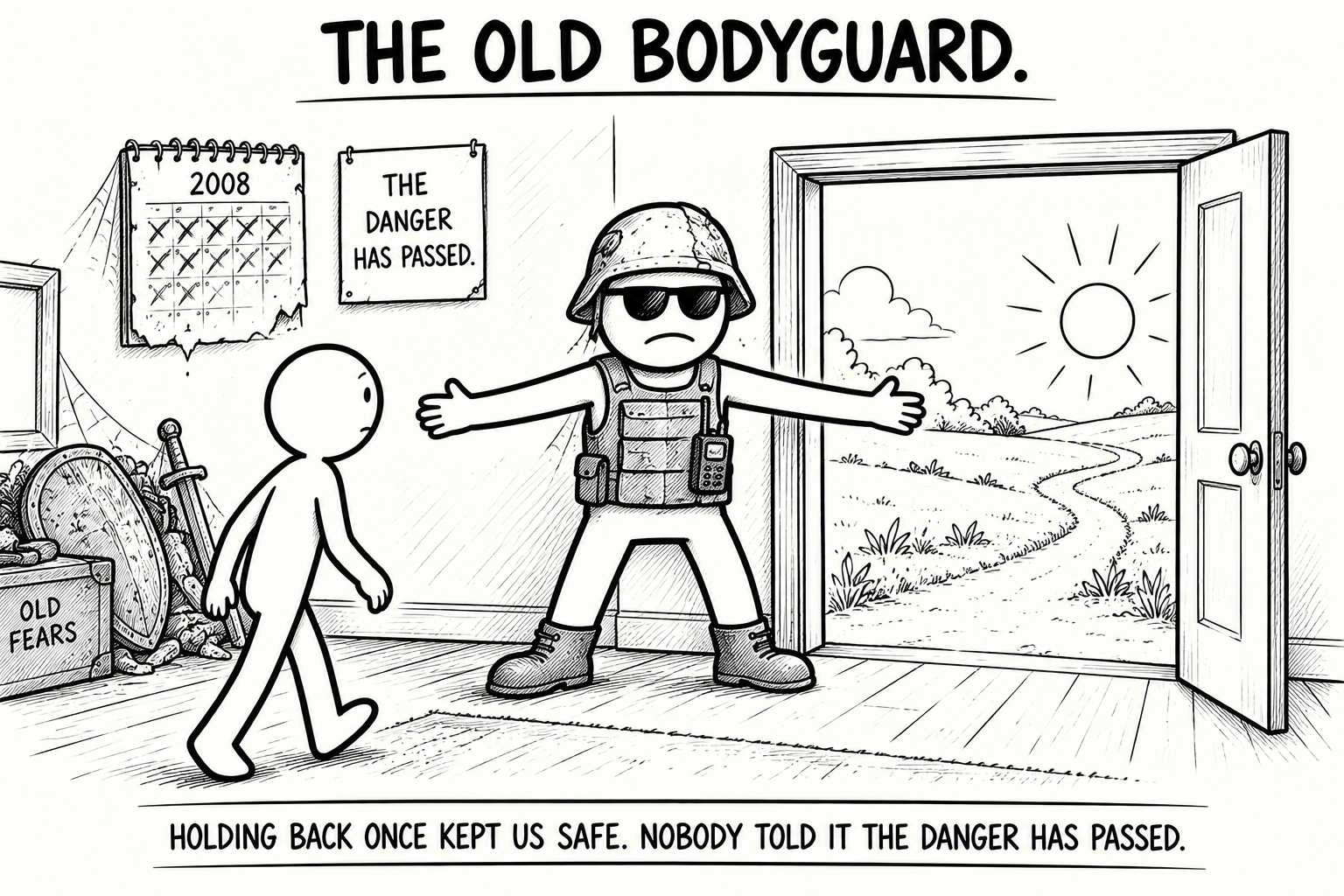
None of this makes us weak or wrong. It makes us human. Every one of us learned to hold back for a reason. Somewhere along the way, going all in cost us something. We got hurt, we were let down, or we had to survive. Keeping something in reserve protected us, and it probably worked.
Our reasons are good: “Let’s be careful.” “Not yet.” “I’ve been here before.” They sound like wisdom, and sometimes they are. But a lot of the time, holding back is a habit that outlived its purpose.
How we save our best without realising
I recognise myself in most of these. You may recognise yourself in some.
At work. We share 70% of the vision and keep the really big version to ourselves, so nobody thinks we’re crazy and so we can’t fail at it publicly. We say “let me think about it” when we already know the answer.
We over-prepare with one more analysis and one more week. It feels like rigour. We do things ourselves and call it high standards, when sometimes it’s a quiet reluctance to trust others. We soften feedback until it’s safe and useless.
We hire the good candidate who won’t challenge us over the great one who might. We say “let’s see how Q3 goes,” when we can already see the writing on the wall.
At home. We win the argument and leave the other person alone in the room. We go quiet and call it “not wanting a fight.” We answer “I’m fine,” the most common way of holding yourself back in any relationship.
We sit at dinner with one ear on the phone and half our mind on Monday. We love by providing, fixing and gifting – instead of being there with and for the person. It can become a comfortable way to avoid saying the tender, vulnerable thing. We keep score. And we don’t ask for what we want, because if we never ask, we can never be refused.
With friends. We share the highlight reel and keep the struggle to ourselves. We take the role of helper, always giving and never needing, which is lovely and also very safe. We say “we should catch up soon,” mean it warmly, and it doesn’t happen. We keep friendships comfortable instead of real.
With ourselves. “Someday” is the busiest day on our calendar. It is when we will take action on the book, the trip and the dream. We keep them alive by never starting them. We start strong and then settle at a level that’s safe from both failure and complete success.
We train at 80% and stop just before it would really stretch us. We make the joke about ourselves first so nobody else can. We stay busy, because a full calendar is a respectable way to avoid the things that really matter. And sometimes describing the dream in detail quietly replaces pursuing it.
The disguises we use
Withholding our best rarely shows up as withholding. It shows up as:
| What we call it | What it can sometimes be |
|---|---|
| Being prudent | Not wanting to be seen to fail |
| Being realistic | Settling before we’ve tried |
| Being humble | Hiding our real ambition |
| Being patient | Waiting for permission |
| Being independent | Not letting anyone in |
| Being professional | Keeping our heart out of it |
| Being nice | Avoiding the honest conversation |
| Being busy | Avoiding what matters most |
| Being right | Choosing safety over connection |
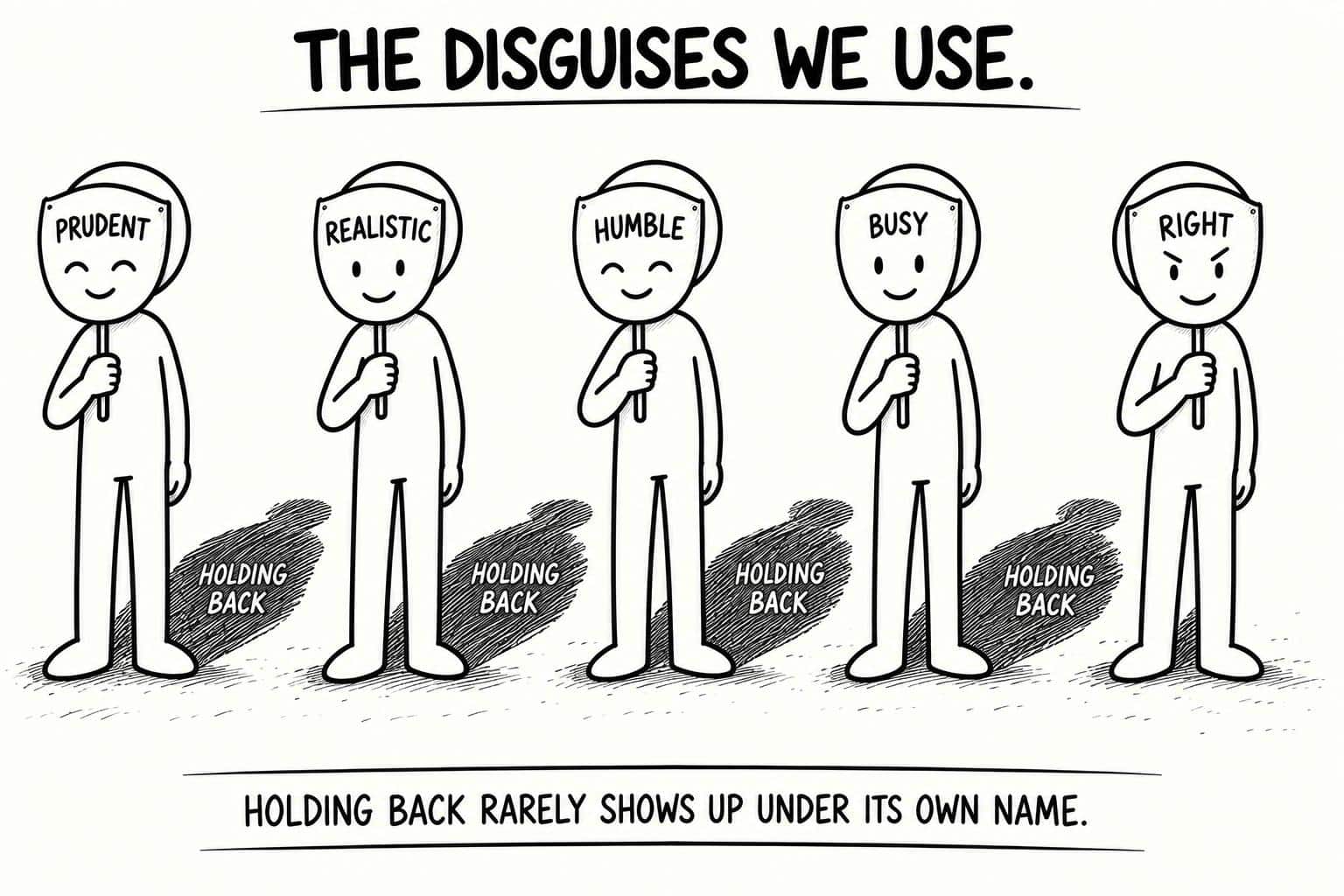
Each of these is sometimes genuine. Being realistic is real, and so is patience. The question isn’t whether it is real or not. It’s whether we’re choosing it or it’s running us. A simple test: can I say out loud exactly what I’m holding back and why? If I can, it’s probably a conscious choice. If I get vague or defensive, or start building a case, I’ve probably found where I’m withholding my best.
What it costs
Here’s what I’ve come to see. When we hold back a little everywhere, we don’t get a little less life. We get a different kind of life.
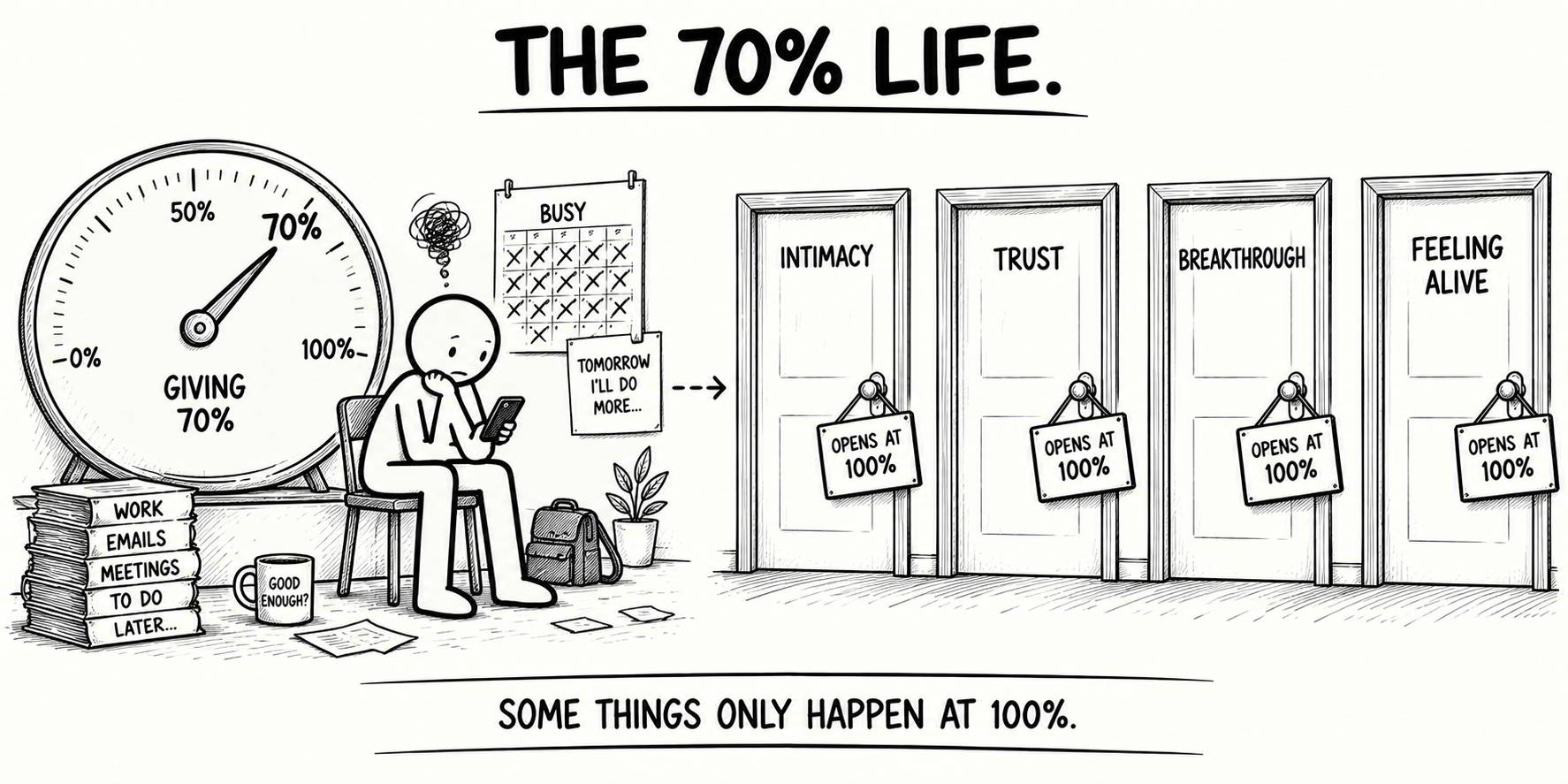
Some things only happen at 100%: real intimacy, deep trust, big breakthroughs, bold ambitions, and feeling fully alive. You can’t be 70% in love or make a 70% bold move. Those things either happen or they don’t. So we end up successful and “good enough” (which is the enemy of greatness). Busy but not fulfilled. Surrounded by people and still a bit alone. Leading teams that are good but never quite extraordinary, because they’re holding back too, just like us.
Often the price isn’t dramatic. It’s quiet. It’s the conversation we never had, the idea we never said out loud, and the evening we won the argument and lost the connection. It’s years that went by at 70%, and a vague sense that there was supposed to be more.
How to notice
Some gentle signals that we might be saving our best:
- Our energy drops. Real commitment tends to energise us, even when it’s hard. Withholding is quietly tiring.
- We feel a flicker of relief when something gets cancelled or postponed.
- We have a very good explanation ready before anyone asks for one.
- We feel slightly separate, like an observer of our own life rather than a player in it.
- “Yes, but…” shows up a lot.
- “Not yet” has been the answer to the same thing for years.
Noticing isn’t about judging or blaming ourselves. It’s the moment choice becomes possible again.
What’s possible
I stand for human excellence – be it in business, relationships, or simply the joy and aliveness we experience in life. That doesn’t mean perfection or working harder. It means giving all of ourselves in what matters to us. I’ve seen what people can do when they stop holding back. I’ve also lived it.
In 2011, I was an introverted engineer who decided to organise an anti-corruption march. I had no idea what it would involve. I was full of self-doubt and anxiety. When I told my mother, she said: “Yes, it is crazy. But you can do that. You will find a way.” 400 people walked 11 km with us. The hardest part wasn’t the march. It was the weeks I spent in my head before I took the first step.
Walking away. For 16 years I had a lucrative tech career. I was good at it, and for 8 long years I was holding back my dreams of coaching entrepreneurs. It became suffocating. Leaving looked like the biggest risk of my life. It led to the most cherished, enjoyable, and meaningful phase of my life.
Two days against a year. After two days with his leadership team, one CEO told me: “What we did in those two days I’ve been trying to do for the last year.” A year of trying the reasonable way. Two days all in. Within 2 years, that company had tripled its revenue.
2.5 hours to 45 minutes. Another CEO saw his meetings shrink from 2.5 hours to 45 minutes. A lot of meetings are long because of what nobody is saying. He told me the work “made me a better human being, a better son and a better leader.”
Three years in one. A founder once said to me: “I would have given three years for what happened in one.” I’ve seen founders stuck for years break through once they stopped holding back one conversation.
I helped a client mend a 20-year rift with her estranged family. She was turned away the first time. She didn’t hold back & went again after a few days. They had the conversation they had avoided for 20+ years.
The paradox & power of going all-in
This is what has surprised me the most. Going all-in for an impossible life might be uncomfortable. But it is not harder than living a reasonable one. Often it is easier.
- A reasonable goal asks for more of the same. So you get more of the same effort, the same meetings, the same tiredness. An impossible goal forces you to stop and find a completely different way.
- A reasonable goal doesn’t inspire anyone. You end up pushing alone. An impossible goal gives people something worth their best effort, and they remember it for the rest of their life – irrespective of the result.
- A reasonable goal leaves room for everything. An impossible goal makes it obvious what to drop and say NO to.
- Fear charges you up front. Most of the pain of going all in lives in the waiting and the imagining. Once you’re moving, it’s one foot after the next. People tell me that an impossible goal was worth it even if they didn’t succeed.
Research backs this up. Psychologists Edwin Locke and Gary Latham spent decades studying goals. Across hundreds of studies, they found that specific, hard goals lead to far better performance than easy goals or “just do your best” (goal-setting theory). A big goal pulls out effort that a reasonable one never asks for.
So the reasonable path isn’t the safe one. It just hides its cost. We pay it slowly, in energy, in years, and in the quiet sense that there was supposed to be more. We are all capable of far more than the lives we’re living. Not because something is missing in us, but because so much of us is still held in reserve. That isn’t a problem. That is good news.
An invitation
I’m not asking you to be all-in all the time. I’m inviting us to notice. Where am I holding back right now? What am I committed to instead? What would it be like to give it fully, just once, on purpose? To not hold back? It might be one sentence to someone we love. One honest conversation with our team. One “yes” to the dream we’ve been postponing to “someday.”
My mother once told me, when I shared one of my crazy dreams, “Going all in isn’t one giant leap. It’s one foot after the next, one moment at a time, choosing to give ourselves fully to what matters.” Imagine what becomes possible when we stop withholding our best and go all in.
Leave a Reply