I sit with people, often, who are already successful by most standards. Their team calls them bold. Their board calls them a risk-taker. The media applaud them for “playing big.” And yet, when I actually listen to them & their dreams, I see & share with them the opposite. I think you are playing too safe.
It shocks them at first, every single time. How can that be true, when everyone around them says the opposite? But when I hold the question a little longer, something else comes out. A bigger, faster, bolder version of what they actually desire. And they see their current reality as a safe version because of how it would look. To their peers. To their team. And hardest of all, to the people standing closest to them.
The version of you that people applaud is usually already sized down to something the world can approve of.
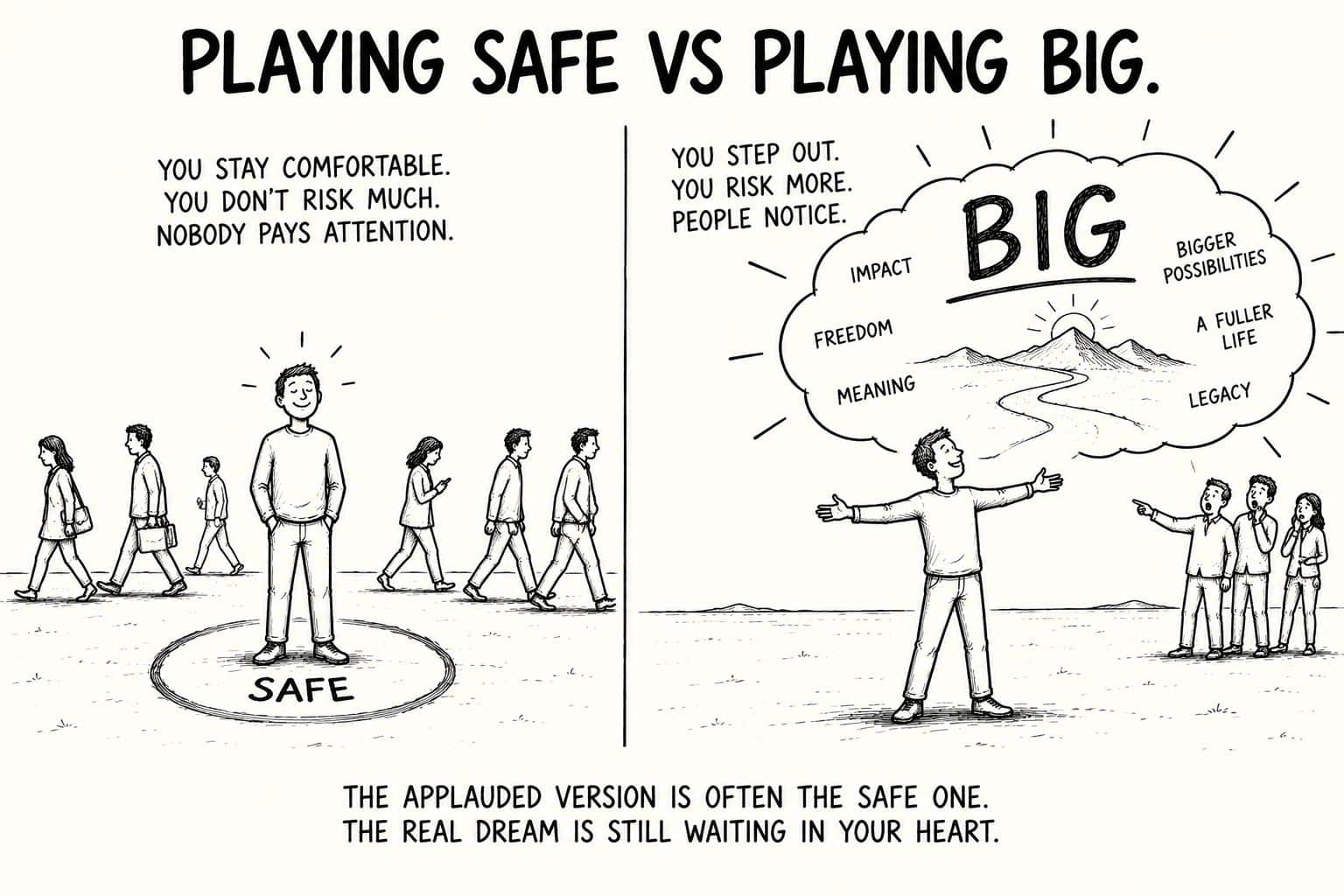
The applauded version is often the safe one. The real dream is still waiting in your heart.
Small Games Don’t Get Judged
The kind of people I work with, their playing safe is bolder than most people playing big. Keeping that in mind, playing it safe rarely gets you judged, because it never asks enough of anyone to react to. Safe games are quiet by design. Big games stand out, make people notice you, and almost always invite judgement.
A founder once told me, almost as a confession. I am playing safe. I am playing in the waters where I am already the expert, where nothing puts me on the back foot.
I have played safe myself, for sixteen years, in a career that looked like everything a good son from a modest background was supposed to want. I was applauded by every one but never judged or questioned. A safe life protects you from judgment. As my coach once remarked,
“You will either be judged or ignored. Choose.”
Judgment Is Not A Verdict
Once you go for what you really desire, the reactions start. And here is what I know: getting judged does not mean you were wrong. It often means you did the thing nobody else was willing to do.
I have told leadership teams directly: you do not need to keep everybody happy. Sometimes the hard call, the one that upsets people, is exactly what can make everyone’s career or change the entire industry. If you wait until everyone approves of your decision, you will never make it, because that day does not come.
There is a reason this feels dangerous even when it isn’t. Researchers Naomi Eisenberger and colleagues found that social rejection activates the same regions of the brain as physical pain. Being disapproved of does not just feel bad metaphorically. Your nervous system treats it, in that moment, as an actual threat. Which is exactly why so many capable people quietly negotiate their ambition down to a size others can swallow without flinching.
Playing safe is how your real dreams, over months and years, turns into the smaller dream people end up applauding. Nobody sets out to do this on purpose. It happens one compromise at a time, each one small enough to seem reasonable, until the original dream is barely visible anymore.
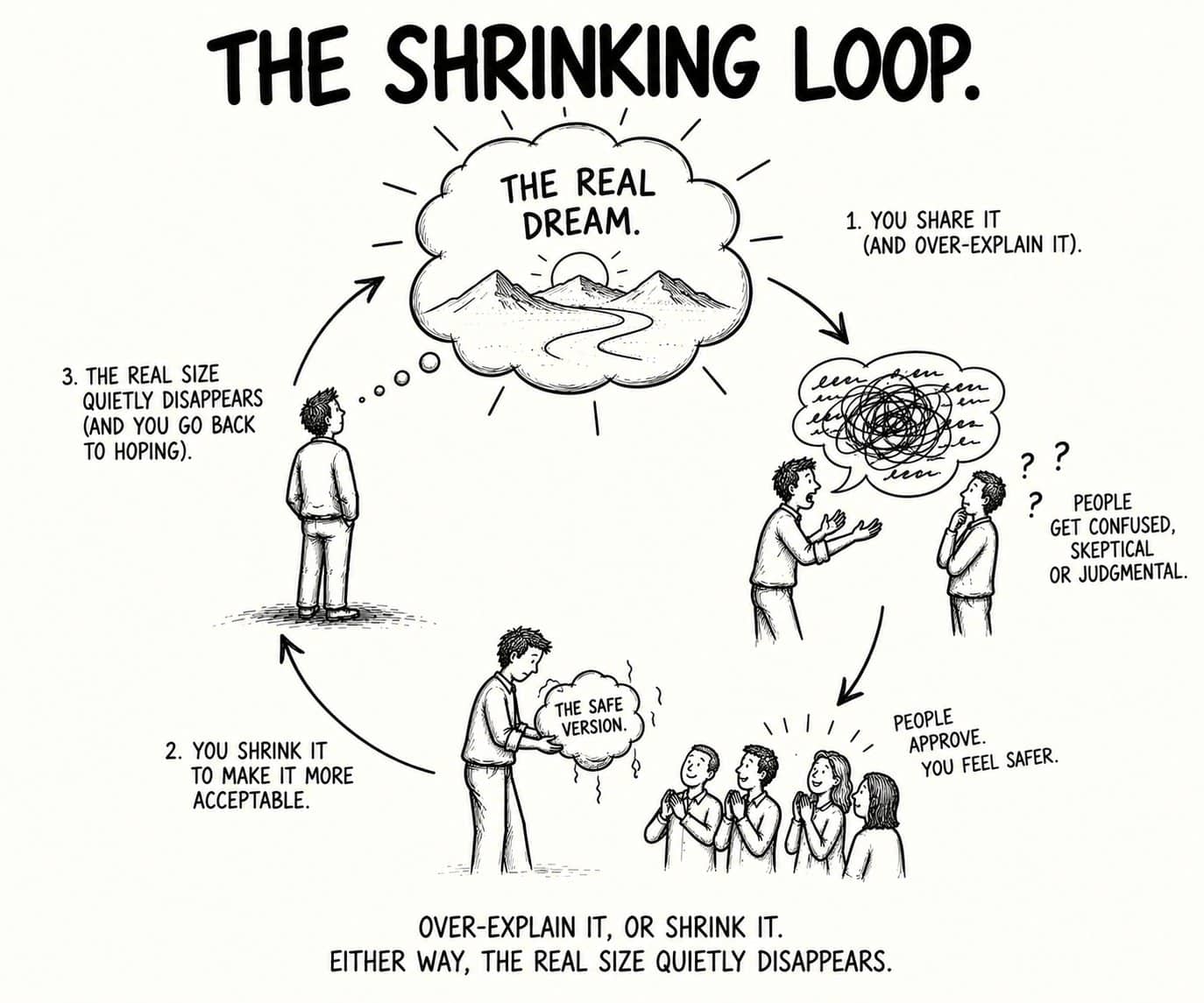
Over-explain it, or shrink it. Either way, the real size quietly disappears.
Slow Poison Or One Shot
Even when someone finally dreams big, the next trap is timing. They just will not move now but postpone the decision to later (or someday or soon). There is always a good reason to not take action now. The “right” time to act, if you deliberate on it, is always in the future. The reasoning comes in the form of “when this happens”, “after I have this”, “after so and so occurs”, then it will be the right time to act.
It is like choosing between slow poison and one-shot poison. Keeping someone in a role that is not working, hoping it resolves itself, is slow poison. It costs you a little every single day, quietly, for months. Letting the person and upholding the standards your real desires require is the one-shot version. It hurts once, and then you move forward. The same happens when you put your foot down and declare that you will grow 10x and not 10% this year – without waiting for the market to change, the required resources to present themselves, or anybody to feel ready. It is the one-shot poison of seeing a shocked room instead of being dissatisfied the whole year.
Waiting does not remove the judgment from others either. You will likely face it eventually anyway, once the decision can no longer be avoided, except now you have also paid for every day of the delay in between. I have watched leaders protect an underperforming favourite for a year, telling themselves they were being kind, while deals with 7-8 zeroes behind them sat untouched because their energy was spent managing one issue instead of making the next big move. Try to make everybody happy, and you do not end up with anything. Not the money, not the peace, and eventually, not even that person’s respect either.
Most people wait for the decisive moment, while people of power are decisive in the moment, as Werner Erhard said.
Speed Decides Who Wins
In most industries right now, the gap between companies that stall and companies that pull ahead is decision speed, more than decision quality. A good decision made today beats a slightly better decision made in 6 months, almost every time, because the world has already moved on in 6 months.
Kodak’s own engineers invented the digital camera in 1975. Kodak sat on it for decades, protecting its film business, worried about what moving fast on it would do internally and how it would look externally. Fujifilm, working with the same underlying shift in technology, moved into digital imaging aggressively and diversified early. Kodak filed for bankruptcy in 2012. Fujifilm did not. Same technology, available to both. The difference was who acted on it, and when.
Blockbuster had the chance to buy Netflix outright in 2000, and passed. It then spent years deliberating over its own streaming response while Netflix simply shipped a version, learned from it, and shipped again. By the time Blockbuster finally moved, the gap between them was no longer competitive. It was too big.
The military strategist John Boyd studied exactly this pattern and called it the OODA loop: observe, orient, decide, act. His finding was blunt. In almost any competitive situation, the side that cycles through that loop faster wins, largely independent of who has more resources. A company that completes its decision loop faster is effectively already acting on its next move while its slower competitor is still finishing the argument over the last one.
Jeff Bezos said something almost identical in a shareholder letter years ago, describing what he called high-velocity decision-making. Most business decisions are reversible, he argued, two-way doors you can walk back through if you are wrong. Those should be made fast, with somewhere around seventy percent of the information you wish you had. Waiting for ninety percent, on a decision you could reverse anyway, is not diligence. It is mediocrity. Only the rare, truly irreversible call deserves the long, careful process.
Speed is no longer one input among many. For anyone actually playing a big game, it has become the primary differentiator. The cost of being right slowly is now higher than the cost of being slightly wrong fast, as long as you notice the mistake and correct it before it compounds.
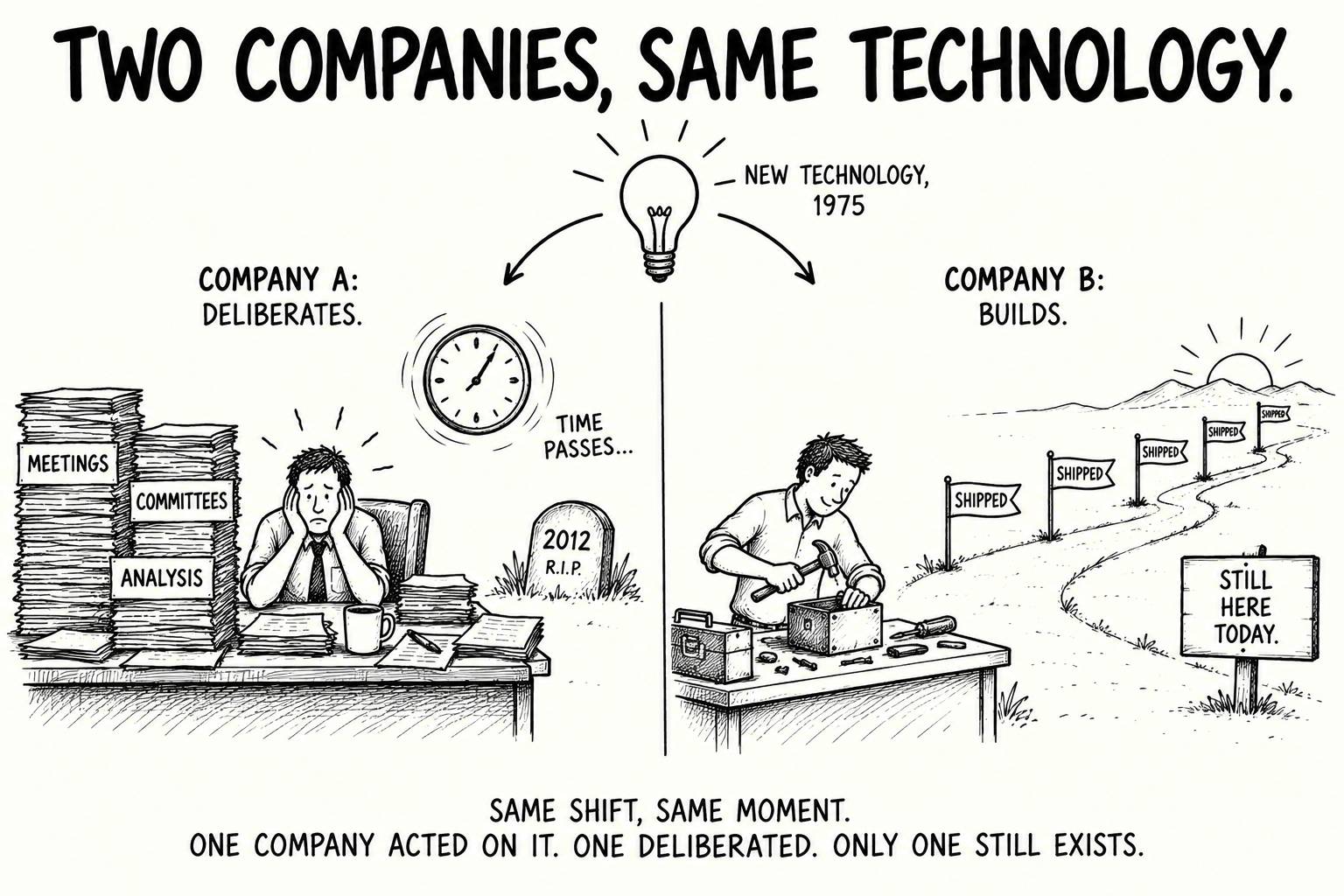
Same shift, same moment. One company acted on it. One deliberated. Only one still exists.
What Moving Fast Requires
“Move fast” gets said so often that it has stopped meaning anything specific. Average speed looks like this: a leadership team spends six weeks drafting the plan, then another six weeks socialising it internally, before a single customer has heard about it. Real speed looks almost reckless next to that. Real speed is the CEO simply asking a client for a 10x bigger project almost spontaneously without even their team knowing it.
When Instagram’s founders noticed that almost nobody was using the eight features they had built, and everybody was only using the photo filter, they did not schedule a quarter of research. They stripped the entire product down to that one feature and rebuilt it within weeks. When Airbnb’s founders could not get their early listings to book because the photos looked amateurish, they did not commission a study. They flew to New York themselves, camera in hand, and photographed their hosts’ apartments personally, one by one, because waiting for a scalable process would have meant waiting until the company was already dead.
A few months ago, a client mentioned a new business idea he heard while having lunch – almost in passing. I knew nothing about the industry or the idea. In the next week, I must have mentioned the idea to at least a dozen CEOs and leaders I met – again – almost casually. One of them happen offered to connect me to a CEO who runs a company that could actually benefit from the idea. I immediately said, and the next day, I was in a conversation with this person. I offered to help his leadership team implement this idea, which would be a $500M project over the next decade. It is only after he showed interest that I actually googled the idea and read about the technicalities of it.
That is what real speed asks of you, and none of it is comfortable (because it shows you all your competing commitments). It requires:
- Acting on incomplete information, because often the complete picture will arrive after the window of opportunity has already closed.
- Picking up the phone right now, not “following up next week.” The ask made today is worth more than the perfect one made in a month.
- Making the actual ask, directly, instead of hinting at it and hoping the other person reads between the lines.
- Changing your strategy, and your team’s, mid-work, without treating the change as proof the original plan failed.
- Moving with full conviction while not knowing how it turns out. Conviction was never about certainty. It is commitment made before the evidence arrives, not after.
- Being willing to be proven wrong, in public, without making it mean anything about you. The people who move fastest are also the ones who reverse course the fastest, without ceremony and without shame.
- Holding the whole thing with a sense of lightness. The moment it turns into a referendum on who you are, you will slow down to protect yourself. None of it matters anyways, so have fun.
None of this is reckless in the way it looks from the outside. Average speed protects the plan. Real speed protects the outcome. Average speed allows you to stay committed to your often hidden competing commitments. Real speed requires you to commit to what you want – irrespective of your preferences, likes, dislikes, comfort level or any other reason you might have.
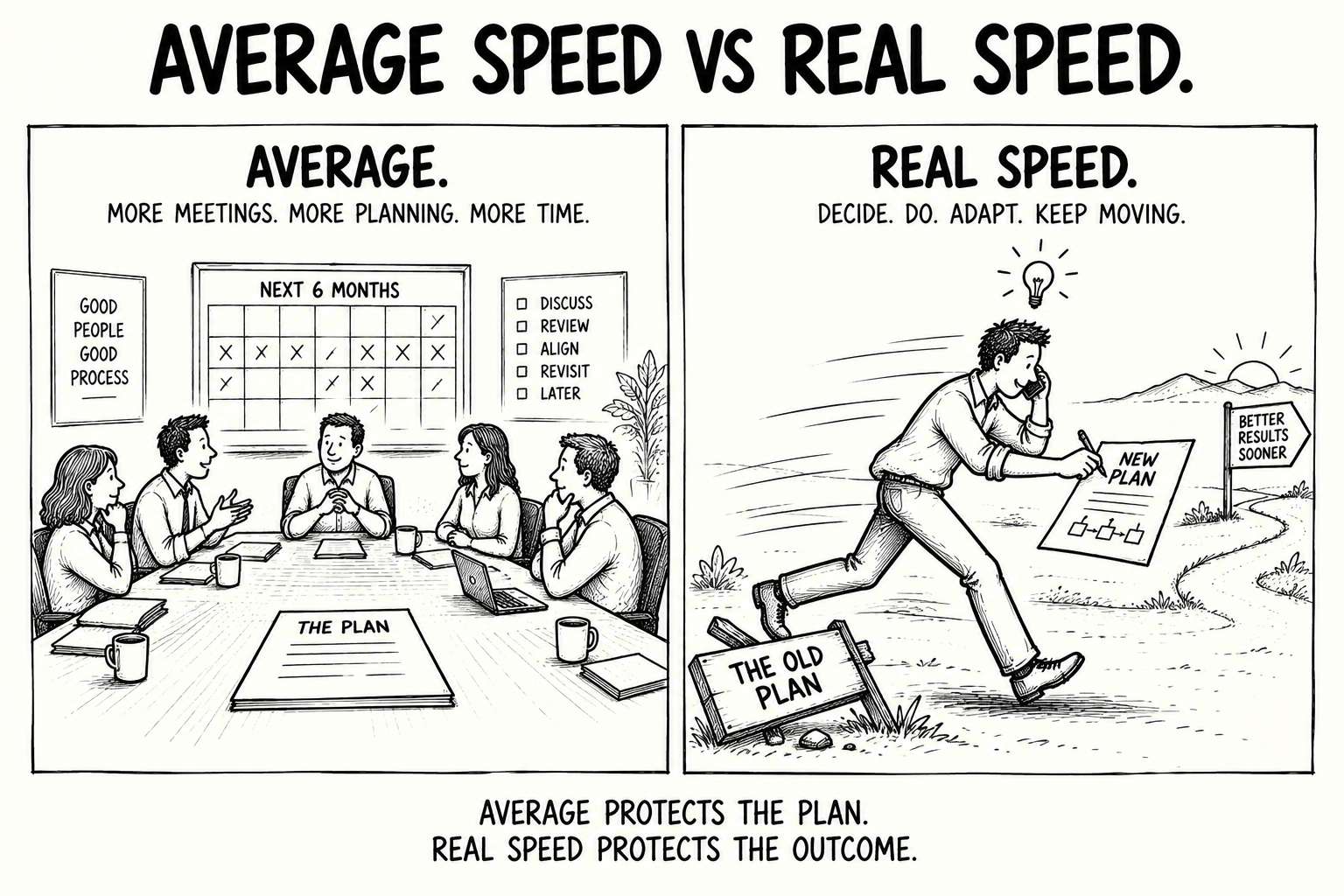
Average protects the plan. Real speed protects the outcome.
The Practice
Name the real dream. What would you go after if you could not fail and if nobody else’s opinion mattered?
Name the version you are actually living. Write the smaller one next to it. Be honest about the gap between the two.
Find the one decision you are delaying. Somewhere inside the bigger dream is a call you already know you need to make and have been avoiding because of appearances.
Cost the delay precisely. What is it costing you? (A number, a deal, a person, a month you are losing by waiting)
Choose one-shot over slow poison. Set an actual deadline, not “soon,” and act before it passes. Let whatever judgment follows be the proof that you are finally playing big and fast.
Sources
- Boyd, J. The OODA Loop: why decision speed determines competitive outcomes independent of resource advantage. https://en.wikipedia.org/wiki/OODA_loop
- Bezos, J. (2016). Amazon Shareholder Letter, on high-velocity, reversible decision-making. https://www.aboutamazon.com/news/company-news/2016-letter-to-shareholders
- Eisenberger, N. I., Lieberman, M. D., & Williams, K. D. (2003). “Does Rejection Hurt? An fMRI Study of Social Exclusion.” Science. Social rejection activates the same neural regions as physical pain. https://en.wikipedia.org/wiki/Social_pain
Leave a Reply