A founder once told me, very reasonably, that he had been thinking a lot about how to exit the company. He wanted his co-founder to commit and had spent two months waiting for the right moment. And the one real question never crossed his lips.
Will you commit to this?
He had turned it into a bunch of statements in his mind without making the one request from his co-founder that would move him forward?
There is a distinction my own coach, Townsend Wardlaw, taught me, and it is one I come back to in almost every session, because it is behind so much that quietly dies in companies and in people. The distinction between a statement and a request.
The simple rule is this. To move foward, make the request. Stop dropping hints. Stop making statements. Just ask.
A statement is safe because nothing is at risk in it. A question is risky because it exposes you to an answer you might not want to hear. Every human being feels that difference in their body, below the surface, which is exactly why we all turn one into the other. And why we make statements instead of clear requests when most is at stake.
The Request Nobody Makes
Here is how it sounds with the CEOs I sit in every week.
A founder wants their co-founder to commit. Instead of “will you commit to this?” they say, “I’ve been thinking a lot about how we should structure the company.”
A founder wants an investor in. Instead of “would you invest €500K?” they say, “we’re currently raising, and we’ve had some interesting conversations.”
Personally, someone wants to know if the person they love still wants to be in the relationship. Instead of “do you still want this?” they say, “we’ve been spending a lot of time apart lately.”
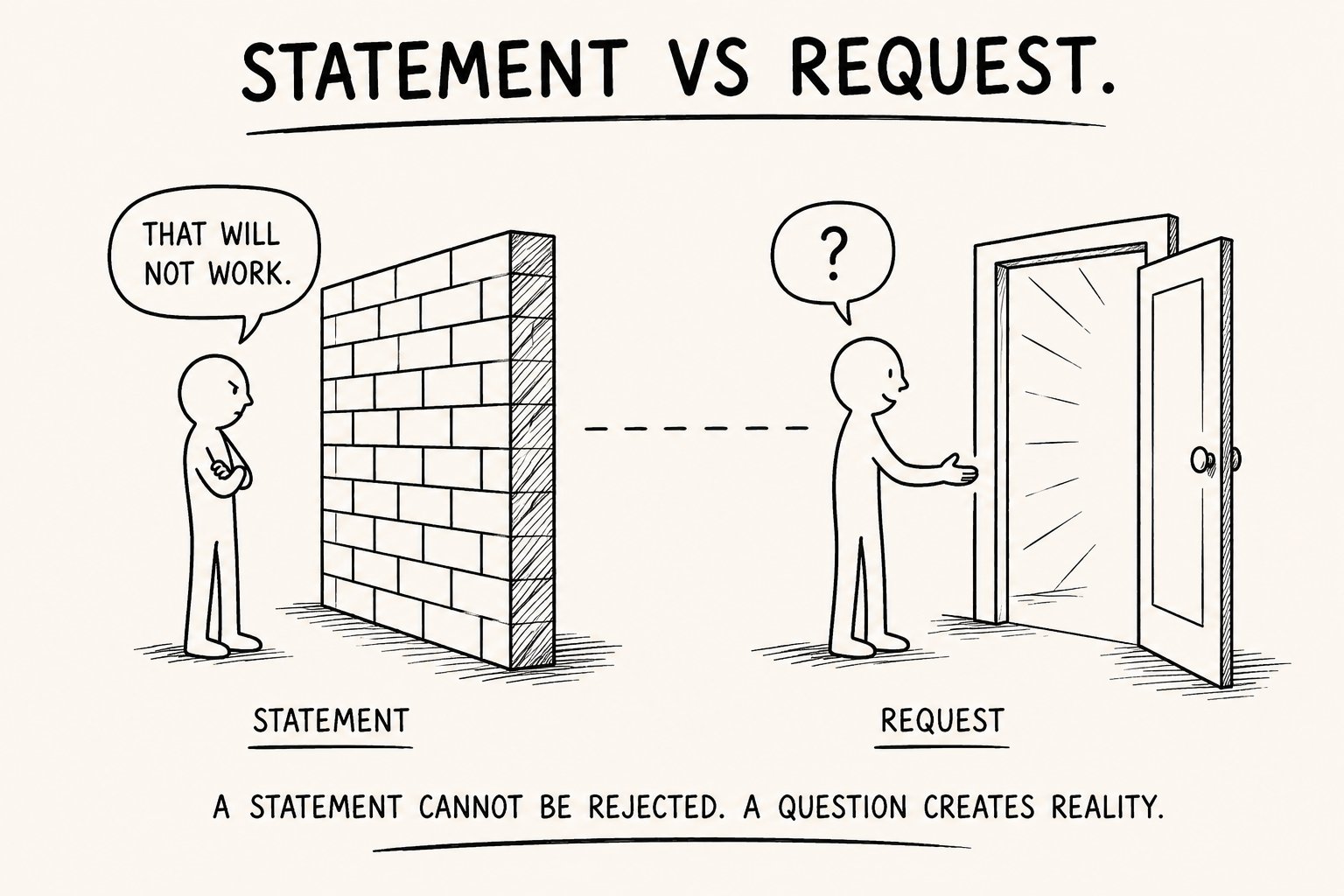
These are statements that secretly contain requests you have in mind. And the terrible thing about a statement is that nobody can really say no to it.
That is precisely why we use them. It keeps us safe and protects us.
Why We Avoid The Request
The reason you do this is rarely plain cowardice. It is usually a quiet decision you made long ago, that their answer will tell you something about you.
If the investor says no: maybe my company is not good enough.
If the co-founder says no: maybe he does not believe in me.
If your partner says no: maybe I am not lovable.
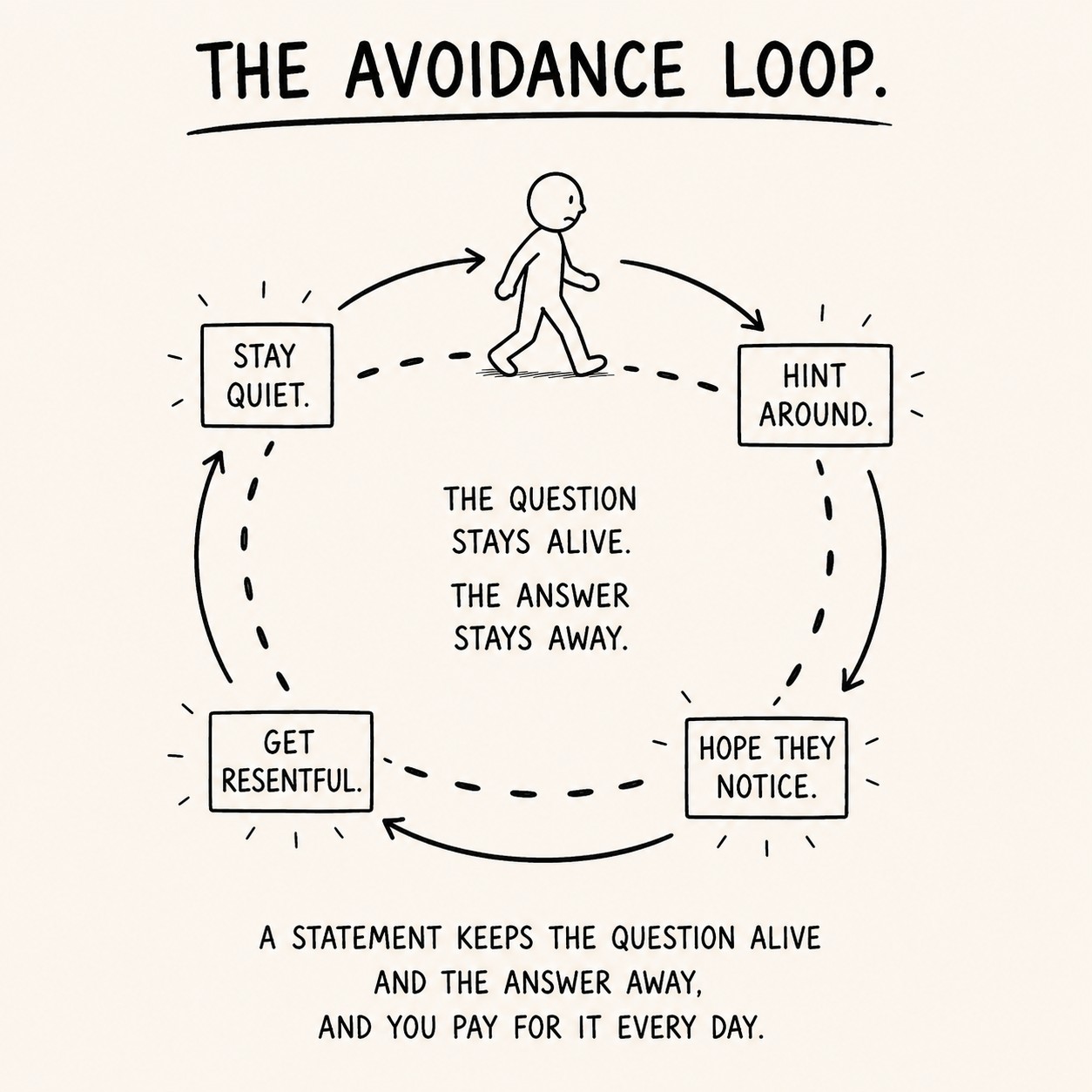
So instead of asking the question and discovering what is real, you circle. You hint. You wait. And the whole time, you are trading forward progress for an intact self-image. You preserve your self-image at the cost of real information.
There is evidence for this in how the brain is wired. In the nineteen seventies, the psychologists Daniel Kahneman and Amos Tversky showed that people feel a loss far more sharply than an equal gain. They called it loss aversion. A possible no reads, to that part of you, as a loss of yourself. So you choose the cheaper, safer option. You keep the maybe – which is what you have when you make a statement instead of a clear request.
A Statement Is Armour. A Question Is Exposure.
A statement is safe for one reason: nothing is at risk. Nobody has to answer. Nobody has to show up. You carry the thought, the other person hears it, and the world stays exactly as it was. You have risked nothing, because you have asked for nothing.
A clear request is the opposite. The moment it actually matters, a real question does three terrifying things. It admits you want something. It lets the other person have a say in what you want. And it hands them the power to say no. That is exposure. Every nerve in you is saying to them: you have power over how I feel right now. And there is nothing a human brain will work harder to avoid that.
A statement lets you keep what you want under the surface, where it cannot be rejected. It lets you pretend you are not attached, not frightened, not needing. It is armour wrapped around the thing you care about most.
And here is the cruel second part. When you hide the request, you also make the yes impossible. Without the question, no answer can ever arrive, including the one you want. You trade the small risk of hearing no for the certainty of never hearing yes. You protect yourself from the pain, and you quietly give up the very thing you were too frightened to ask for.
That is why we all do this. And why we do it most when it matters most. The bigger the thing, the bigger the possible loss, the harder the recoil. The most important questions in your life and your company are the quietest ones, because they cost the most to ask. It is completely backwards, and completely human.
The Question I Ask When You Hedge
When I sit across from you, that’s when I stop being polite. I do not accept the statement. I ask for the question underneath it.
A CEO tells me they want to see how someone on their team performs over the next six months. Maybe that is true. Or maybe, underneath it, they already know they need to make a change, and the conversation is painful. So I ask: when will you talk to this person about all eventual possibilities?
I asked a leadership team this once, about a person who kept disappearing on the uncomfortable days. Is this helpful to the company, yes or no? Not is it right or wrong. Just helpful or not. The answer was no. It was comfortable for him, not useful for the company. And I told them: do not avoid the discomfort. Bring the person here and have the conversation. That is what a real question does. It pulls the thing out of the shadows.
The statement sounds like being careful. The question exposes what you are avoiding. It makes you face what you do not want to face.
Do Not Do Their Work For Them
Here is the most subtle part once you make the request. When someone is clearly avoiding your question, you will want to help them. You will reach for something that sounds wonderfully empathetic.
You will say: “I understand you’re probably afraid that…..”
Stop.
Do not do that. Because you have just written their half of the conversation for them. You have done the emotional work that was never yours to do.
The move is embarrassingly simple, which is why nobody does it. Make the request. Then shut up.
That silence is uncomfortable. It does not feel productive. You will want to fill it. That is exactly the point. Silence makes the other person confront themselves. And until they do, you will not get a real answer, only a polite statement back.
The Answer Is Not A Verdict
Most of us quietly believe that says YES means I am good, and NO means I am bad.
It is a lie. And it is the lie that keeps you from asking. A yes or a no is information. It is not a verdict on your worth. When a prospective client says no, you have learned something about what they want. When a potential partner says no, you have learned something about their situation. When a co-founder says no, you have learned where they actually stand. None of that is about whether you are fundamentally fine or good or worthy or lovable. That part was never in question.
The answer tells you what the other person wants, not you. A NO reveals something about the person saying it, not about the person hearing it. And that gives you freedom.
You Pay For Uncertainty Every Day
Imagine twelve months wondering whether a senior executive is really committed. The statements. The hints. The feedback. The responsibilities rearranged. The waiting for the right moment. The hoping they will change.
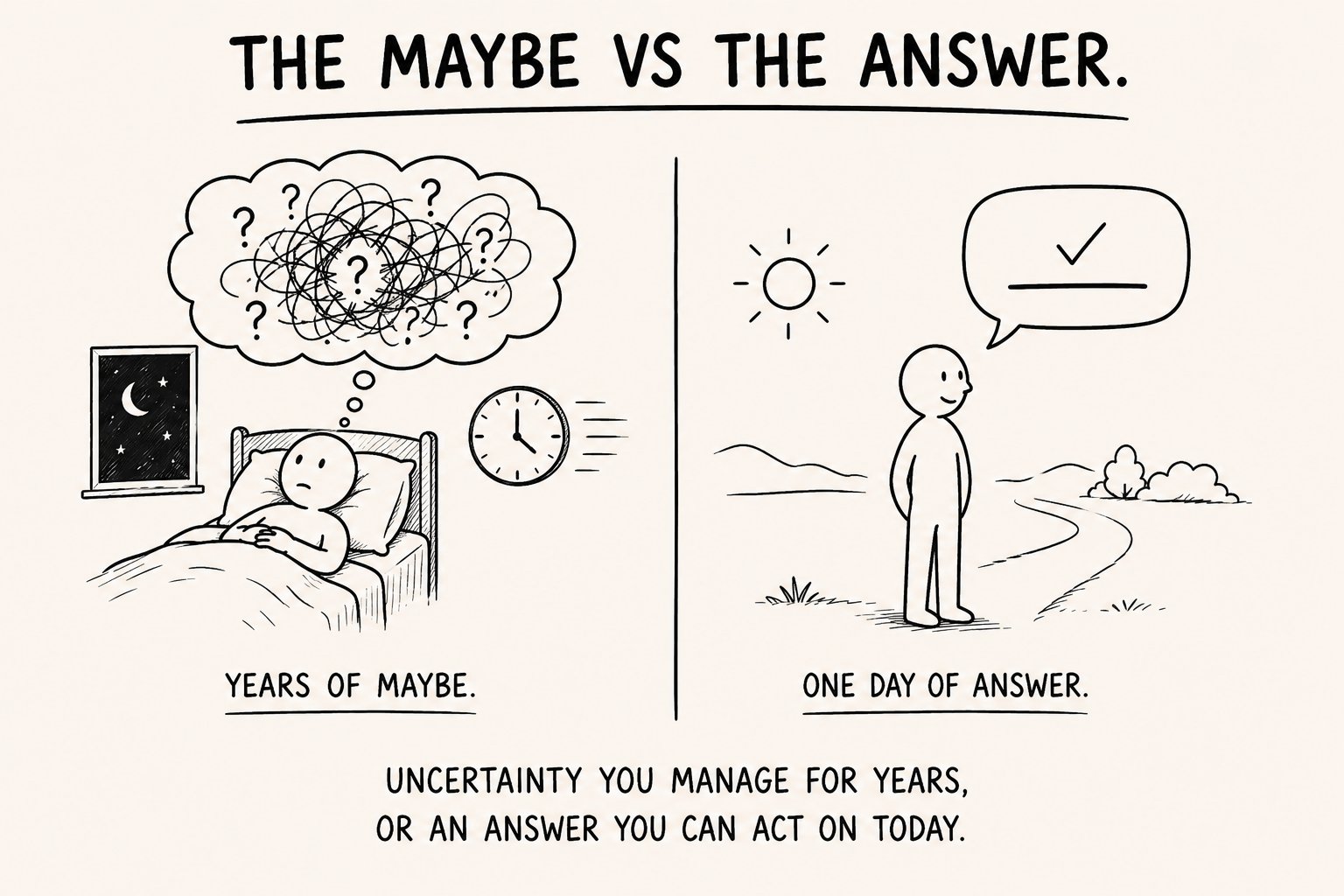
You think you are avoiding conflict. You are not. You are paying for uncertainty every single day.
I said this to a leadership team once, when they told me they would circle back to me later. I stopped them. You cannot circle around it. You have to go through it. It will be uncomfortable. It is supposed to be uncomfortable. But you have to go through it as a team, together, because the circling is what is actually costing you.
You can spend years managing an unresolved question, telling yourself it is ok. Then one day you realise the cost, and it is enormous. Or you can simply ask the question. The answer may hurt. But knowing lets you act and move.
And here is where research backs it. In 1927, the psychiatrist Bluma Zeigarnik noticed that waiters in a busy cafe remembered the orders they had not yet been paid for more sharply than the ones they had finished. Unfinished things keep running in the background of the mind. The unresolved question, the commitment you never asked for, the executive you never confronted, does not rest. It keeps humming and consuming your attention. That is the maybe tax. You have been paying it without noticing.
A leader says: “I need to see how this person performs over the next six months.”
Maybe that is true. Or maybe: “I already know they are not the person to take us to the next level, and the conversation would be painful.”
A sales leader says: “We’re nurturing this prospect.”
Maybe. Or maybe: “I’m afraid to ask for the big order because I don’t want to hear no.”
A founder says: “We’re exploring our options.”
Maybe. Or maybe: “I know I need to make this decision, and I don’t want to confront what it means.”
Can you hear how clean the difference is? The statement sounds rational. The question exposes reality.
Notice when you are planning around the worst case, the what if it all goes wrong. A founder told me once he was not acting because of what might go wrong. I said plainly: acting on the worst case is not acting. It is postponing. The question is not whether it is scary. It always is. The question is whether you have turned a decision you already know into a statement you can keep repeating.
The Practice
Here is the whole practice, and it is uncomfortable, and it is what leaders do – week after week.
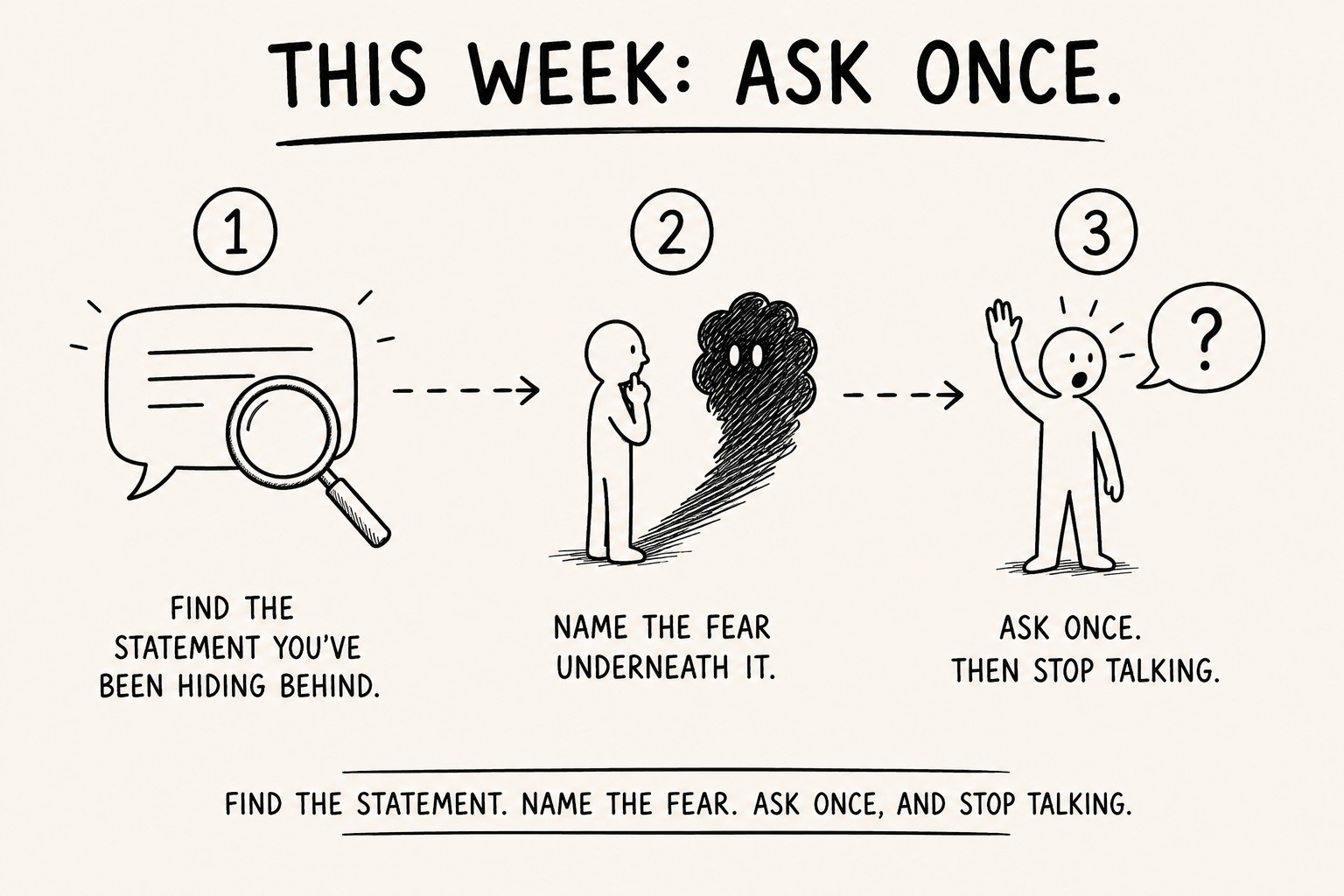
Find the statement. Take one thing you keep mentioning, floating, or circling. Start with the business one. Then find the personal one you thought of a moment ago and did not want to look at. Write the real question underneath it. The one you are actually asking.
Name the fear. Ask yourself: what am I afraid their answer would prove about me? Write it down and say it out loud. See it for what it is. A fear, not a fact.
Ask it once. Not a hint. Not a setup. Not at the perfect moment. The actual question, directly. Will you commit? Would you invest? Do you still want this?
Then shut up. Do not fill the silence. Do not pre-answer for them. Do not reassure them if you sense their discomfort. Let them sit with their own answer. Silence is where a real answer comes from.
Act on what you learn. Treat the answer as information, not a verdict. Whatever it is, you now know, and knowing lets you move.
Ask. Accept. Act.
You are often more afraid of knowing than you are of losing.
Because once you know, you have responsibility. Before you know, you can keep telling yourself maybe. Maybe they will change. Maybe they will invest. Maybe they will step up. Maybe the relationship will improve.
Maybe is a warm place. It also lets you postpone action forever. Maybe will kill you if you do not kill your maybe’s.
But a clear answer is clean. A clear yes or no are both useful. The real enemy is not rejection. The real enemy is the ambiguity you manufacture to protect yourself.
So here is your choice, stated as plainly as it can be. You can hint, hedge, and hide, and pay the maybe tax every single day until avoiding the requests quietly becomes your team culture. Or you can ask, accept, and act, and take one real piece of real action this week.
The request nobody makes is usually the one that matters most. Ask the question. Make the request. Once. And then stop talking, and listen, and act on what you hear.
Because the question you most do not want answered is often the one with the highest return. Not because the answer will be yes. Because certainty lets you finally move and create momentum – which is what you want.
Sources
- Wardlaw, T. “You Turned It Into a Statement.” Coach of Being. The origin of this distinction: https://coachofbeing.substack.com/p/you-turned-it-into-a-statement
- Kahneman, D., & Tversky, A. (1979). Prospect theory and loss aversion: why we dread losing more than we value gaining. https://en.wikipedia.org/wiki/Loss_aversion
- Zeigarnik, B. (1927). The Zeigarnik effect: why unfinished things keep running in the mind. https://en.wikipedia.org/wiki/Zeigarnik_effect
Leave a Reply