
A leader I work with called me last week with three problems at once.
An old legal case, still eating money after four years. A price change that blew up in the market. And under both of those, the real problem: the leadership team hadn’t sat in one room together in two months. Not even a single joint call or meeting.
We talked for forty minutes. Case updates. Numbers. Who said what to whom. Somewhere in there, without meaning to, they told me the real thing. Their leadership meetings had turned into a place where people wait for a chance to catch someone out. Their own words, not mine.
Here’s the pattern I’ve learned to watch for, and I saw it again on this call. Whatever problem a leader opens with – a conflict, supply chain issues, a client about to walk – is almost never the real problem. It’s a symptom. Scratch at it a little and you find the same thing underneath, every time: the people at the top of the company aren’t actually a team. They don’t meet. They don’t talk to each other directly. They talk about each other – to me, to HR, to anyone except the person they actually need to say it to.
Nobody planned it that way. It just happened, one meeting at a time.
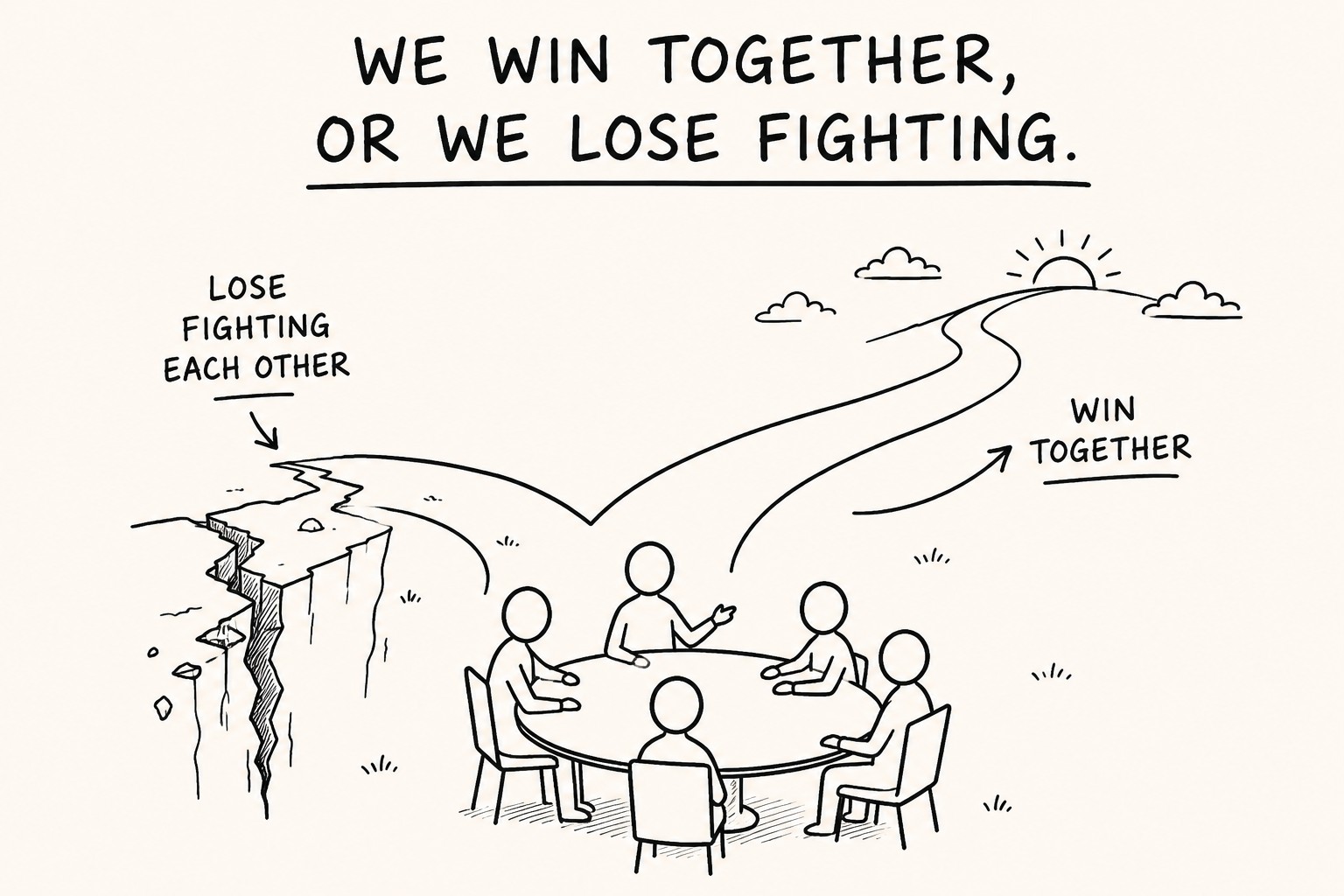
That’s the moment I knew we weren’t actually there to solve any particular business problem. We were there to solve the thing sitting upstream of them. fix the team, and most of these “problems” stop being problems.
Here’s What I Suggested They Do First
A meeting behaves exactly like its name. Call it a “Management Review” and you’ve built a courtroom, whether anyone meant to or not. People walk in with their excuses ready, or watching for who to blame. Nobody has to say “let’s go after each other” out loud – the meeting name already says it for them.
So the first thing I suggested was simple: change the name of the meeting. Not to make it sound nicer. Change it because the name decides (even dictates) what happens in the room.
“Management Review” became “We Win Together” meeting. Because the meeting is for winning – not for proving each other wrong. For being together, not against each other. (which is more important than winning)
A New Name Wasn’t Enough On Its Own
I’ve watched teams rename a meeting and still tear each other apart inside it, because the real trap was never the title. It’s the words people reach for once they’re sitting in the room. So the second thing I suggested was: watch your language, because a few words in particular will quietly undo everything the new name was supposed to fix.
Right And Wrong Is A Trap
Here’s a sentence that stops most teams cold: “This was the wrong decision.”
The second those words come out, the meeting stops being about the business. It becomes about the person. Whoever made the call gets defensive. Whoever predicted it would fail gets to say “I told you so” – which feels like winning, but it’s actually the fastest way to lose your team.
I said it to him plainly: right and wrong is a trap. It’s about the ego, not the business. The moment I decide I’m right and you’re wrong, I’ve stopped solving the problem. I’m just defending myself now.
And here’s the part that makes it worse – both people are usually right, in their own ways, at the same time. A price goes up because costs went up. That’s true. A salesperson loses a client because the price changed halfway through a deal. That’s also true. Nobody is wrong. Both people are just standing on their own side, pointed at each other.
There is no winning inside that. You have to leave the whole idea of right and wrong behind.
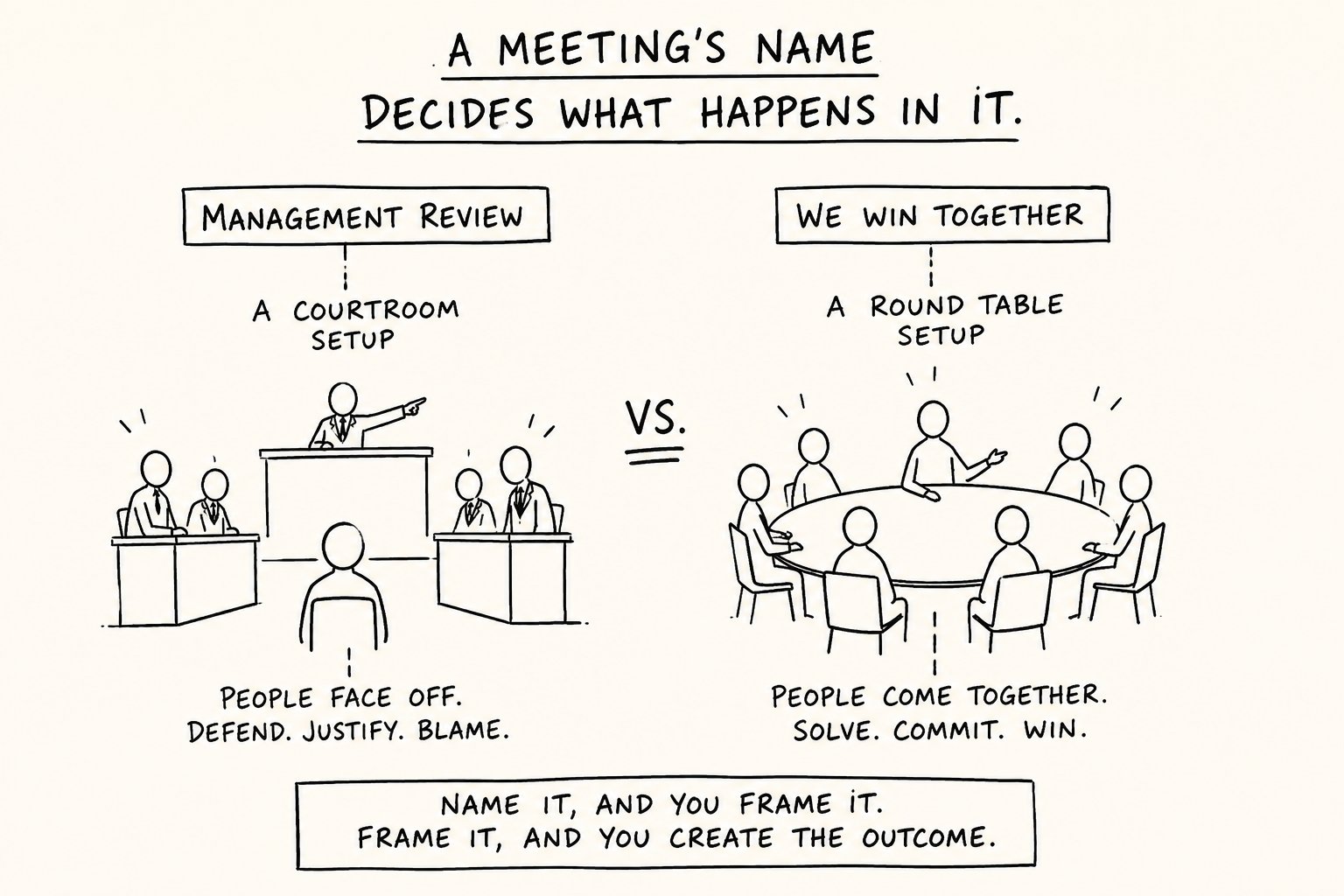
Call it a review, people show up ready to defend. Call it something else, and they show up ready to build.
“Should” Is The Same Trap, Wearing A Disguise
Another such word is “should.”
“Inventory should be higher.” Sounds harmless. Sounds like a fact. It isn’t. The moment you say “should”, the person who owns inventory hears an accusation, and they start defending themselves – even if you never raised your voice, even if you never said their name.
That’s what “should” does. It sounds like an observation. It lands like blame. And the second someone feels judged, they stop listening and start explaining why it’s not their fault. Now you’re not solving a problem together. You’re two people defending their own corner, same as with right and wrong. (remember, being a team together is more important than winning or losing any one business problem)
Say what’s true instead (the facts): “Inventory is at one week. ca we make it three to solve this issue?” That’s a fact and a proposal. Nobody has to defend anything. You can disagree about the number without either of you being wrong.
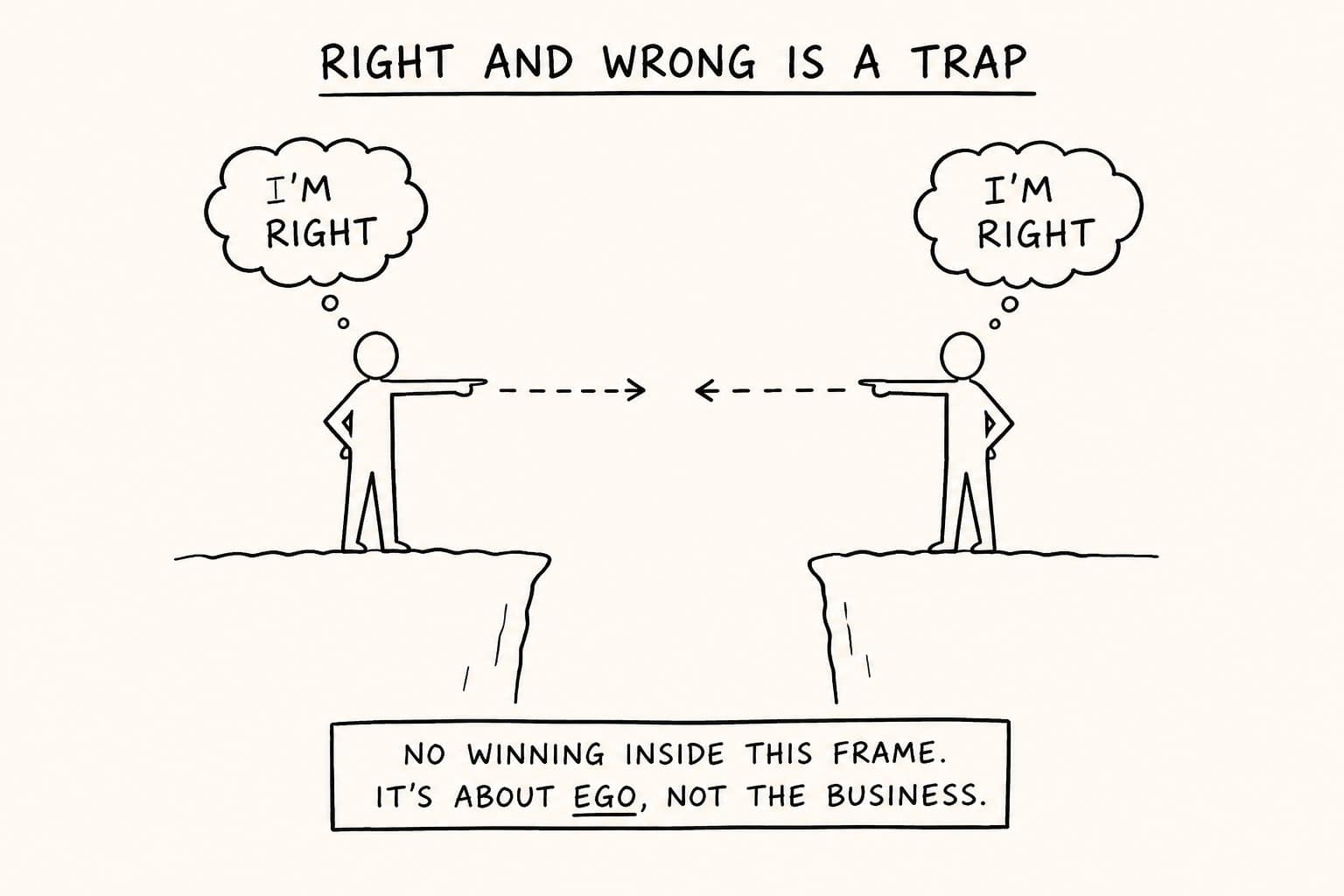
Blame spends your team’s energy defending the past. “We” spends it building the next move.
Talking Without Fighting Still Isn’t Fixing
A team that renames its meeting and drops right, wrong, and should will finally be able to talk to each other without it turning into a fight. That’s real progress. But talking isn’t the same as fixing. I learned that the hard way a few days later, on a completely different call, with someone else on that same leadership team.
Before You Fix Anything, Measure It
Days later, I met another leader on that same team – the one who runs sales.
His team was losing about 15% of every month’s orders to late deliveries. He wanted to jump straight to fixing it. I stopped him.
“What’s the exact size of this? Where’s the data?”
He didn’t have it. Nobody had broken it down. So we did it together, right there on the call. Out of that 15%, how much was late because of one thing, and how much because of another? It turned out one single cause – supplies that had to be imported and took months to arrive – was behind 80% of the delay. The rest, 20%, was something else entirely, sitting in their own factory.
That split changes everything. If you don’t know the split, you fix the wrong 80% of the problem, or worse, you fix a little bit of everything and nothing actually moves. You cannot solve a problem you haven’t measured. Not “it feels like most of it is X.” The actual number – verifiable.
This isn’t complicated. It’s just a discipline most teams skip, because measuring feels slower than acting. It isn’t. Acting on a guess is what’s actually slow – you find out three months later that you fixed the smaller half of the problem.
Someone Still Has To Own It
Once he had the real numbers, I asked him a simple question.
“Is there an owner of this problem?”
There wasn’t. Three people touched it – sales, factory planning, the warehouse – and every one of them had a piece of the picture and none of them had the whole thing. That’s not just a blame situation. That’s a nobody-is-leading “this problem” situation, which is worse.
If more than one person owns something, nobody owns it. One problem = One responsibile individual. Not a group. Not a team. Not a committee.
So I asked him directly: are you willing to own this? Not do all of it yourself – own it. He said yes.
One person owns the whole result. Other people owning their own piece of it, with the leader’s support. And the same people can exchange these roles for different projects.
Why All Of This Actually Works
Underneath the renamed meeting, the dangerous words, the measuring, and the ownership, there’s one principle about how business works:
You do something. You get feedback. You do something again. That’s how you move forward.
The faster you can make the feedback loops and iterate, the faster you win. and it becomes faster if everyone acts together, not against each other.
This isn’t just a nice way to think about it. it’s backed by real research. A Harvard professor named Amy Edmondson studied hospital teams and found something surprising: the best teams reported more mistakes, not fewer. Not because they messed up more. Because they were the only ones honest enough to say so out loud, instead of hiding it. She called this feeling of safety to speak up “psychological safety” – simply put, a team where nobody gets punished for saying “that didn’t work.”
Google went looking for the same answer years later. They studied 180 of their own teams to find out what actually made a team perform well – and this exact thing, the freedom to admit a mistake without fear, came out on top. Ahead of talent. Ahead of experience. Ahead of resources.
Engineers figured this out too, in their own way. When something breaks, good tech teams sit down afterwards and ask two questions only: what happened, and what do we change. No names attached to blame. Not because nobody’s responsible – but because the fastest way to stop it happening again is to make it safe to say exactly what went wrong.
A price change is not a verdict on anyone’s judgment. It’s information. The faster a team can take that in without flinching, the faster it moves.
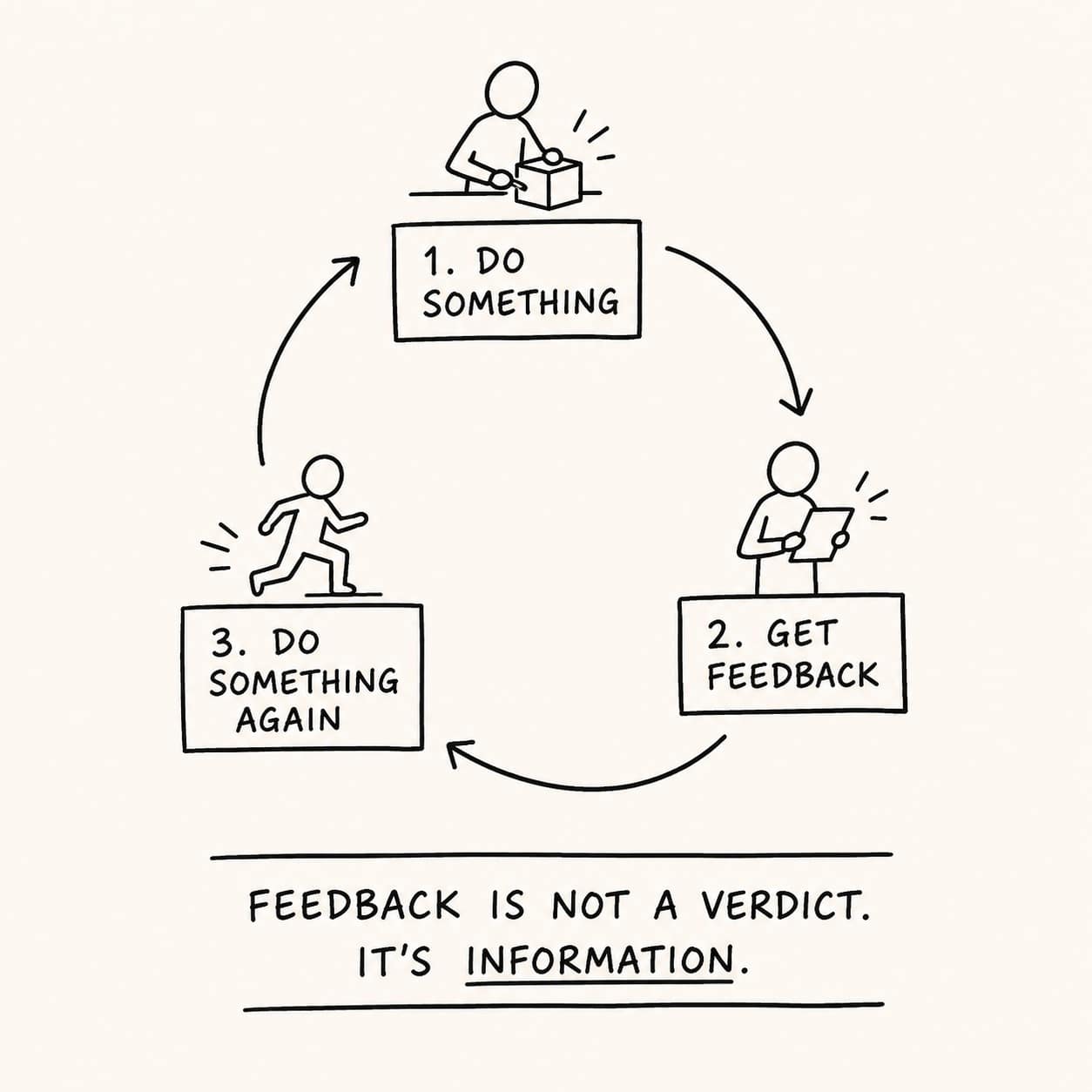
The best teams aren’t the ones who make fewer mistakes. They’re the ones who talk about them fastest.
One Habit Kept Getting In The Way
Even with all of this in place, one old habit kept pulling the first leader I spoke with back toward the trap. It showed up as a single word: “why.”
At one point in the call, this leader kept circling back to “why.” Why is he acting like this? Why did we not realise it earlier? Why won’t he take a stand?
I stopped them.
That question has no useful answer. Why is a guessing question. Any answer I give you is a speculation, and a guess about someone else’s reasons won’t help you. It just keeps you stuck.
The real question was sitting right there, unasked: what do you actually want? Not what happened. Not why. Not whose fault. What do you actually want to happen next?
Every time you swap “why did this happen” for “what do I want now,” the whole conversation moves. From the past, which you can’t change, to the next step, which you can.
Why Any Team Needs to meet at least once weekly
This is exactly why the weekly meeting matters more than any single fix on this list. Once a team actually starts meeting – even for thirty minutes – problems stop hiding in people’s head and start showing up on a shared list. And the list fills up fast. One meeting, one team, and you’ll walk out with three to five real problems holding the business back.
You cannot fix ten problems at once. Nobody can. So:
- Put every problem on one list the whole team can see. Not five separate mental lists.
- Rank them. Which two or three actually matter this quarter. Share the specific size of each in clear numerical metrics (revenue, profits, efficiency improved, etc)
- Put one name next to each – the owner, not who to blame.
- Every week, each owner answers two questions in front of the team: is this on track, and can anyone help?
That last part is what keeps a problem from quietly doubling before anyone notices. A problem on a shared list, checked every week, either moves or it gets help. It doesn’t get to just sit there growing.
Put It All Together: The Practice
This isn’t advice to “communicate better.” That never works on its own. You have to change how the meeting is built. Here’s the whole system, laid out simply – exactly what this company implemented on their own. Try it with your own team this week.
Rename the meeting. Whatever you call your leadership review, retire that name today. Call it something that points toward together, not toward review or audit. “We Win Together” worked here. Find your own version.
Meet every week. Not once a month. Not “when there’s an issue.” Forty-five minutes is enough, especially at first.
Keep one shared list of every real problem. Not five people’s separate mental lists. One list, everyone can see it.
Quantify before you assign a fix. For each problem on the list, get the real number and the real breakdown before anyone proposes a solution. A guess is not a starting point.
Put one owner next to each problem. No blame, ever.
Ban three words: “right,” “wrong,” and “should.” And any finger-pointing. Say what’s true and what you’re proposing instead.
Give everyone one line they can use anytime: “This is not the purpose of this meeting. Stop.” Anyone in the room can say it. No rank needed.
- Have fun: remember that nothing really matters, and allow yourself to relax and smile, even with all the problems around. Full commitment without stress and pressure.
Every week, each owner answers two questions: is this on track, and can anyone help? That’s what stops a problem from doubling in the dark.
Don’t ask for permission, “Can I do this?” Say: “We’re not meeting enough as a team. It’s creating misunderstandings between us, and we can’t win if we’re not together. I’m setting up a 45-minute weekly meeting starting this week. Tell me if you want me to stop, or if you want to change something.” That’s not asking for approval. That’s leading.
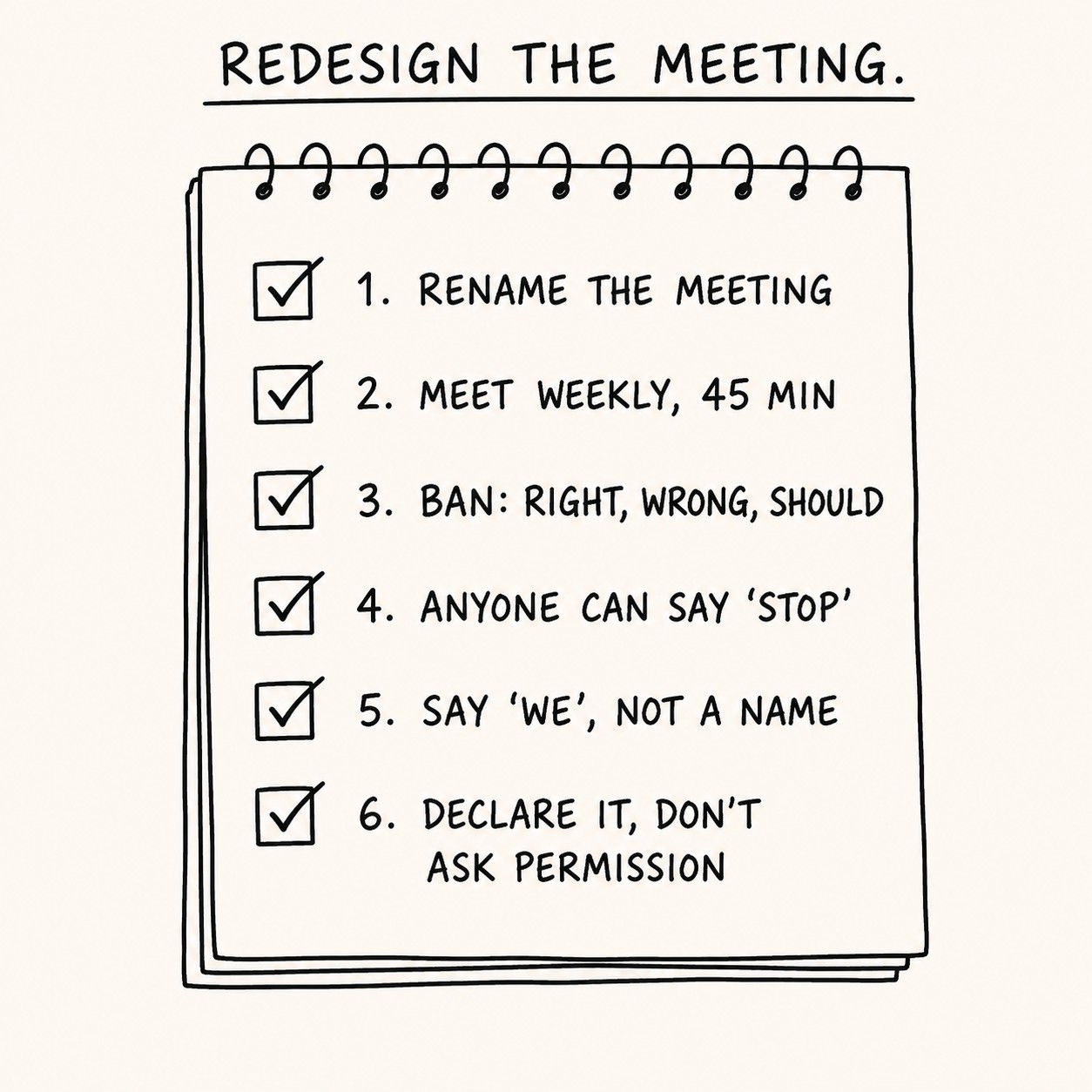
Same team. Same problems. A different room changes everything that happens inside it.
Together Beats Being Right
It’s better to lose by being together than to win by tearing each other apart. Together matters more than winning or losing. A team that stays together through a bad quarter will always beat a team that “wins” one argument and breaks apart doing it.
It means giving up the small satisfaction of being right. It means catching yourself mid-sentence and saying “we” instead of someone’s name. It means banning your own favorite word – “should” – from your own language first.
There is no point in spending all energy defending the past. A team that wins together spends that same energy on what happens next after a feedback loop.
Sources
- Amy Edmondson’s research on psychological safety, first published in 1999, studying hospital teams: https://en.wikipedia.org/wiki/Psychological_safety
- Google’s internal study on what makes teams work, known as Project Aristotle: https://rework.withgoogle.com/en/subjects/team-effectiveness
- The “blameless postmortem” practice from Google’s Site Reliability Engineering team: https://sre.google/sre-book/postmortem-culture/
Leave a Reply