
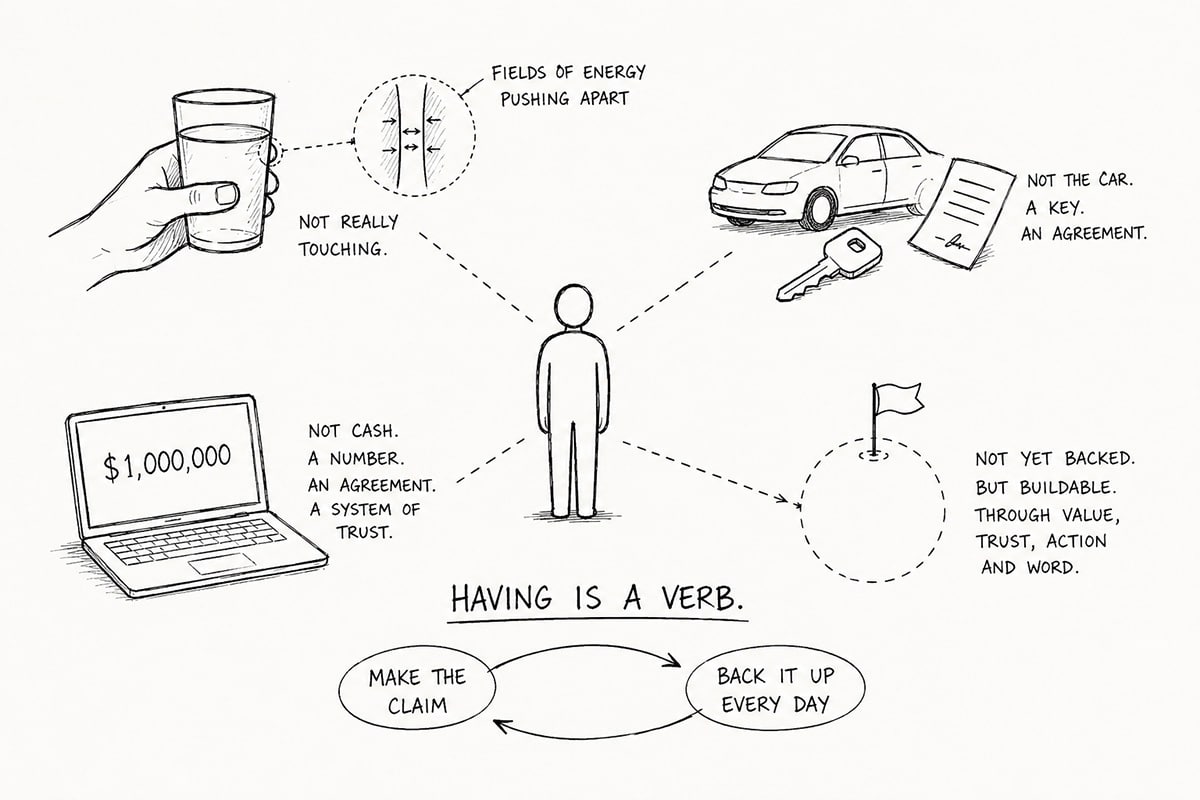
Pick up a glass of water. You’d say you’re holding it, touching it.
But zoom in far enough, down to the atoms, and your hand never actually touches the glass. What feels like contact is really just two fields of energy pushing against each other, holding you a tiny distance away from ever truly touching anything. It is mostly empty space between your hand and the glass.
Same with a car. You say “I have a car.” But right now, it’s not with you. It’s parked somewhere you can’t see, and there’s no guarantee it will be there when you need it. You never really “have” a car – you only hold a belief that it will be there when you need it.
If “having” was never solid (like in physics), even for a glass in your hand, it’s worth asking what else you think you have, or don’t have, that’s built on the same illusion.
You Have a Million Dollars. Do You, Though?
Say you have a million dollars in your bank account. Simple enough, right?
Except, where is it? There’s no vault with your name on it. No pile of cash sitting somewhere waiting for you. What you actually have is a number in a computer, and an agreement between you and your bank. If you walked in tomorrow and asked to hold your million dollars, all of it, at once, in your hands – you couldn’t. (banks don’t work that way) It was never a thing you could hold. It was always a promise somebody else agreed to keep.
Here’s the question worth sitting with: if that’s true, what’s actually stopping you from saying you have ten million?
Not the laws of physics for sure. The only real difference between “I have $1M” and “I have $10M” is that one is backed – by people willing to honor it – and the other isn’t “yet”. The backing or promise is what’s missing. And backing, it turns out, is something you can build (just like it was built for the $1M).
So I Never “Have” Anything? No, Here’s the Trap to Avoid
This is the part where people often go wrong, so let’s go slow.
The wrong conclusion is: “If I really never have anything, I can say I have anything I want, and it’s all equally true.” That sounds clever. It’s actually just a nice way to lie to yourself.
Two sociologists, Peter Berger and Thomas Luckmann, wrote a famous book about exactly this back in 1966. Their point: things like money, marriage, companies, and ownership aren’t physical objects – but they are completely real, because enough people agree to treat them as real and keep acting that way. Not solid the way a rock is solid. Real the way a promise is real.
Having works the same way. It was never a hard physical fact. It was always a promise, backed by trust. The million dollars is real not because it’s more “physically there” than the ten million (neither one is) but because a whole system of trust and follow-through stands behind it.
The ten million isn’t fake. It’s just not backed by a promise yet. And building that promise isn’t magic. It’s simple, even if it isn’t easy: create value, build trust, and make a request leading to an agreement/promise. (as i said, simple, not easy)
Having Is a Verb, Not a Noun
Once you see it this way, having stops being a box you’re either inside or outside of. A title you hold or don’t.
“Having” becomes something you do, continuously – a declaration you make, and then back up, again and again, through your actions and promises. Whatever you can do that for, you can “have” it, even though you might not have it in the traditional sense.
For example, if you can say you have $1M (which only means you have a promise from your bank), you can also say you have $10M as long as you can create a promise from someone else (even though the money might be in their bank account and not yours).
The Energy Changes Before the Result Does
Here’s something you can feel:
When you say and act as if you have something you don’t yet have in the traditional sense – the client, the money, or the standing in the room – something shifts in you. You stop grasping. You stop checking. You make the ask, the offer, the walk into the room without neediness (because you already “have” it). That is magnetic in a way that neediness never is.
Watch what happens to your decisions, too. Someone operating from “I don’t have this yet” makes small, careful, hedged moves because every move might cost them the thing they don’t have. Someone operating from “I already have this” makes bigger, cleaner, more generous moves because there’s nothing left to protect. The strange result: the second person almost always ends up with more, not less. Not because the universe rewards confidence for its own sake, but because clean, ungrasping action is simply better action – sharper decisions, faster follow-through, no energy wasted overthinking or procrastinating from fear and holding onto that tightly in the first place.
People feel this difference in you, even when they can’t name it. Neediness is easy to smell and is repulsive – in a negotiation, a pitch, or a first meeting. Its opposite, the quiet certainty of someone who’s already decided the outcome is theirs, pulls people in. Investors lean toward the founder who isn’t chasing the check. Partners commit faster to the person who was already going to be fine without them. This isn’t a trick you perform. It’s a natural consequence of acting from a place of “already having” what you want.
You have everything, and you have nothing
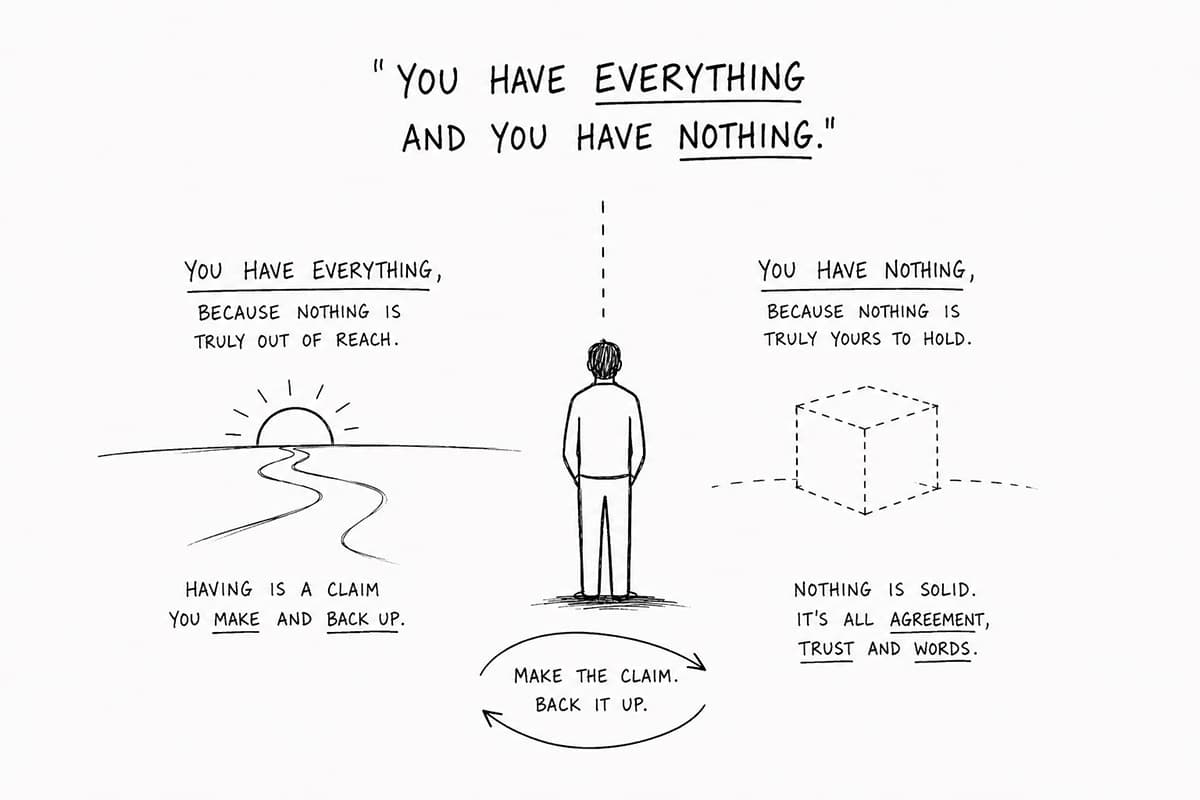
Both of these are true at the same time. You have nothing, because nothing was ever really “held” – not the million dollars, not the car, not even the glass in your hand. Everything you call “having” is a claim, resting on trustworthy promises.
And you have everything, because that exact same fact means nothing is locked away from you either. If having was never about physically possessing something, then anything is yours to have if you’re willing to make the claim and then back it up with trustworthy promises.
Most people only know the first part of this – “I have nothing, I’m not there yet, I don’t officially own this” – and it makes them small, cautious, waiting. That’s the posture the world calls hustle: chasing, proving, over-effort, gripping the outcome so tightly your hands cramp.
The same truth, seen the other way, is enormously freeing, and it feels completely different from the inside. If having was never physical to begin with, there’s no invisible wall keeping you out of the next room, the next level, the next version of your life. There’s only the question of whether you’re willing to claim it, stand calmly inside it, and go build the promise – without the stress, the striving, or the constant checking that comes from believing you do not have it yet.
The sociologist Robert Merton named a version of this in 1948: he called it the self-fulfilling prophecy – a belief, acted on with enough conviction, that changes behaviour in ways that make the belief come true. It sounds almost too simple to be real. It works anyway, and not by magic. It works because the person believing it stops behaving like someone who’s missing something, and starts behaving like someone who already has it – and the second kind of behaviour gets very different results than the first.
The Promise Isn’t Found. It’s Created.
Here’s the move most people miss.
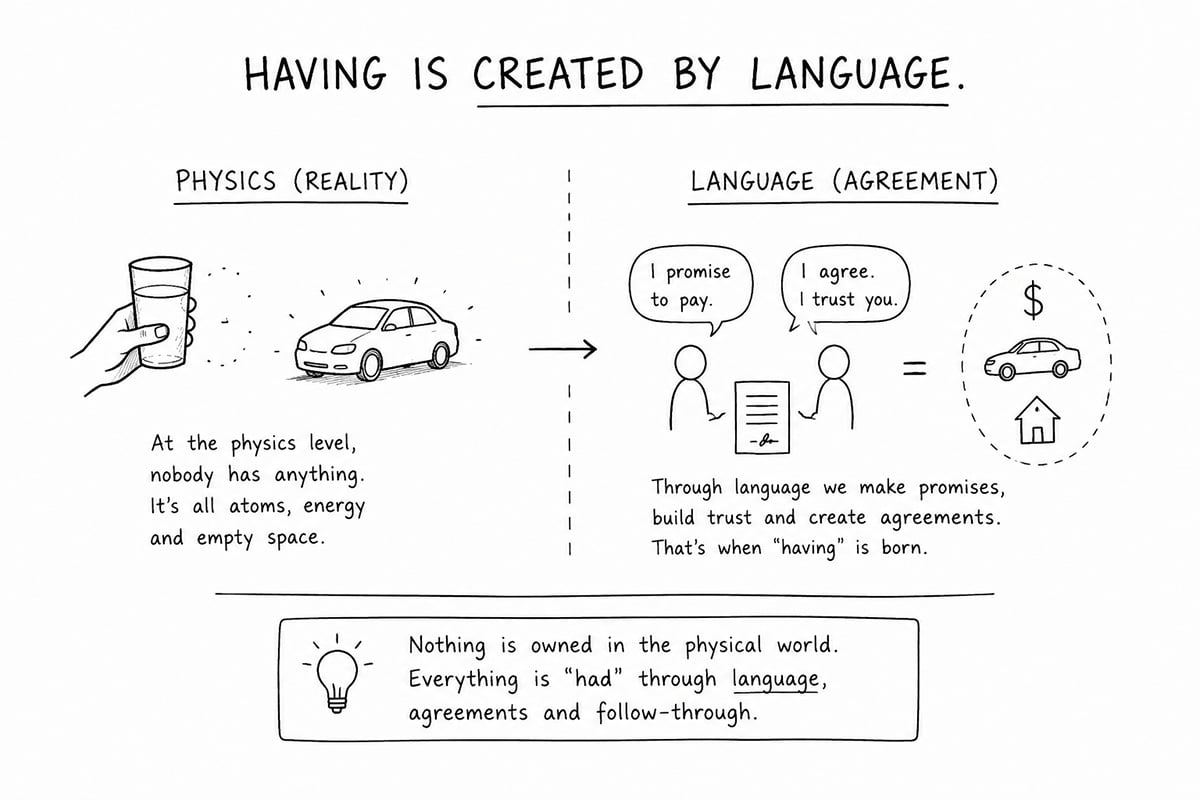
If having is really just a claim backed by a promise, then that promise is not sitting out there somewhere waiting for you. It is only created by you, through an act of leadership. Of imagination. Of simple willingness.
Think about your own life. Every result you’ve ever had sits on the other side of some agreement or promise. A marriage is a promise. A company is a bundle of promises, stacked on top of each other. Even that million dollars in your account is really just the outcome of a thousand kept promises – yours and other people’s.
Since a promise can only be made in language, all you have to do is make requests of others to get their promise. If you can get a person or institution to promise you $10M, then you “have” it, irrespective of where the $10M actually is.
The philosopher John Searle spent a large part of his career studying exactly this – how words create real things in the world. He noticed that some sentences don’t just describe reality, they make reality. If I say “I promise,” I haven’t described a promise – I’ve created one, on the spot, out of nothing but language. Money, marriages, companies, ownership: Searle showed that all of them work this way. They exist because someone declared it, and other people agreed to treat those words as binding.
There Is No Other to Ask (this will get a bit metaphysical)
In the Sanskrit tradition, there’s a concept – namarupa – name and form. The old texts put it simply: everything you encounter is ONE thing, wearing a different name and a different shape each time. The person across the table. The company. The room you feel too small to walk into. All of it, underneath the names, is the same one thing.
If that’s true, something interesting happens to the whole idea of asking permission. There was never really a separate “other” whose blessing you needed. I am you, wearing a different name. You are me, wearing a different shape. Walking into a room you think you don’t belong in was never trespassing on someone else’s territory because underneath it all, there is no someone else. There’s one thing, meeting itself, dressed in different names and forms.
I’ll give you the most honest proof I have of this in how I live it. When I commit with someone on their big mission, I’m willing to give my life for them. No formal or legal contract can ever capture that. No court would recognise it as a term. And yet it doesn’t need paper to be real – if anything, it’s the most honest agreement I make, because nobody asked for it, it wasn’t negotiated, and it’s backed by nothing except my own word to myself.
As a Leader, This Changes What You’re Allowed to Aim For
Most people wait to feel like the owner, the founder, the person in charge, before they act like it. They wait for the title to catch up to how they already show up. But you’ve just seen that the title was never the real source of the authority in the first place – the courage to claim it was.
A leader operating from “I don’t have this yet” walks into every room aiming to prove themselves and get the approval of the room, and anyone can tell. A leader operating from “I already have this” walks in with calm certainty, and certainty is what makes investors lean in, makes talent want to follow, makes the room trust you before you’ve said very much at all. You stop chasing the deal, the hire, the room. You start pulling them toward you, simply by no longer needing them.
This is also, by the way, exactly why safety is such a myth. A job with a signed contract feels safer than building something of your own. But that contract can end tomorrow, with two weeks’ notice or none. The stable job never guaranteed anything. It just felt like it did.
Which means the real question was never “do I have the paperwork to justify walking in like I belong here.” The real question is: are you willing to write the agreement, back it with your actions, and act from it before anyone else agrees it’s true?
The Practice
Try this, this week.
- Name one place in your life where you’ve been waiting – for a title, a contract, someone else’s permission – before you’d let yourself act like you already “have” that.
- Say it out loud. Use having as a verb. First to yourself, then to one person who matters. “I have ______. I am the owner of ___. I am committed to ___.”
- Then take one real action this week that only makes sense if the claim is already true.
- Notice the energy while you do it. Not the outcome – the energy. Is it calm, or is it needy? If it’s still needy (it stinks), you haven’t fully owned it yet. Keep going until the calm shows up. That’s how you’ll know it’s real.
You have nothing. You have everything. Both are true, right now, at the same time. The only thing that was ever missing was you deciding to “have” it and then create the promise – and then living like it’s already signed, calmly, without the hustle, and letting what you declared find its way back to you.
Sources
- Berger, P. & Luckmann, T. (1966). The Social Construction of Reality: A Treatise in the Sociology of Knowledge. Doubleday. https://en.wikipedia.org/wiki/The_Social_Construction_of_Reality
- Merton, R. K. (1948). “The Self-Fulfilling Prophecy.” The Antioch Review, 8(2), 193–210. https://en.wikipedia.org/wiki/Self-fulfilling_prophecy
Leave a Reply