
How to coach a leader with a huge potential for impact and yet they are playing safe relative to that potential (which would be ambitious for most people)
Some leaders are already operating at a level that would look highly ambitious to almost anyone around them. They are building real companies, carrying serious responsibility, thinking in systems, and stretching themselves far beyond the norm. And yet, when you speak to them, you can sometimes feel it clearly: they are still playing safe relative to their actual potential.
This is one of the most nuanced situations in coaching.
Because the issue is not underperformance in the ordinary sense. The leader is often already impressive. Their goals may already be bold. Their operating capacity may already be rare – from normal standards and for most people.
In fact, if you challenge them too crudely, they may feel misunderstood. If you push too hard, you risk dishonouring the wisdom that helped them get this far. But if you do not challenge them at all, you may collude with a version of their ambition that is still edited down, overly reasonable, or constrained by hidden fear.
Great coaches do not simply say or challenge them to “Think bigger.” They help them discover whether their current ambition is truly self-authored, or whether it is a compromised target that protects comfort, control, identity, or emotional safety.
The first mistake: mistaking visible ambition for full ambition
A leader can be highly ambitious and still be playing safe.
This is especially true of strong founders, athletes and builders – who you would put in the 1% of the top 1% . They may already be outperforming their peers by a wide margin. They may be scaling businesses, leading teams, making serious bets, and carrying uncommon levels of complexity. But their stated ambition can still lag behind their inner capacity.
This is highly subjective – and only reflective of the potential that you see in them as a coach or peer leader.
Often the clue is not the size of the goal itself, but the mismatch between:
- the way they think and the scale they are targeting
- the uniqueness of their strengths and the narrowness of their plan
- the quality of their long-range vision and the conservatism of their short-range commitments
This is what coaches must learn to detect. Not whether the goal is objectively big, but whether it is big for them.
A target that would be extraordinary for most people may still be a safe target for this person.
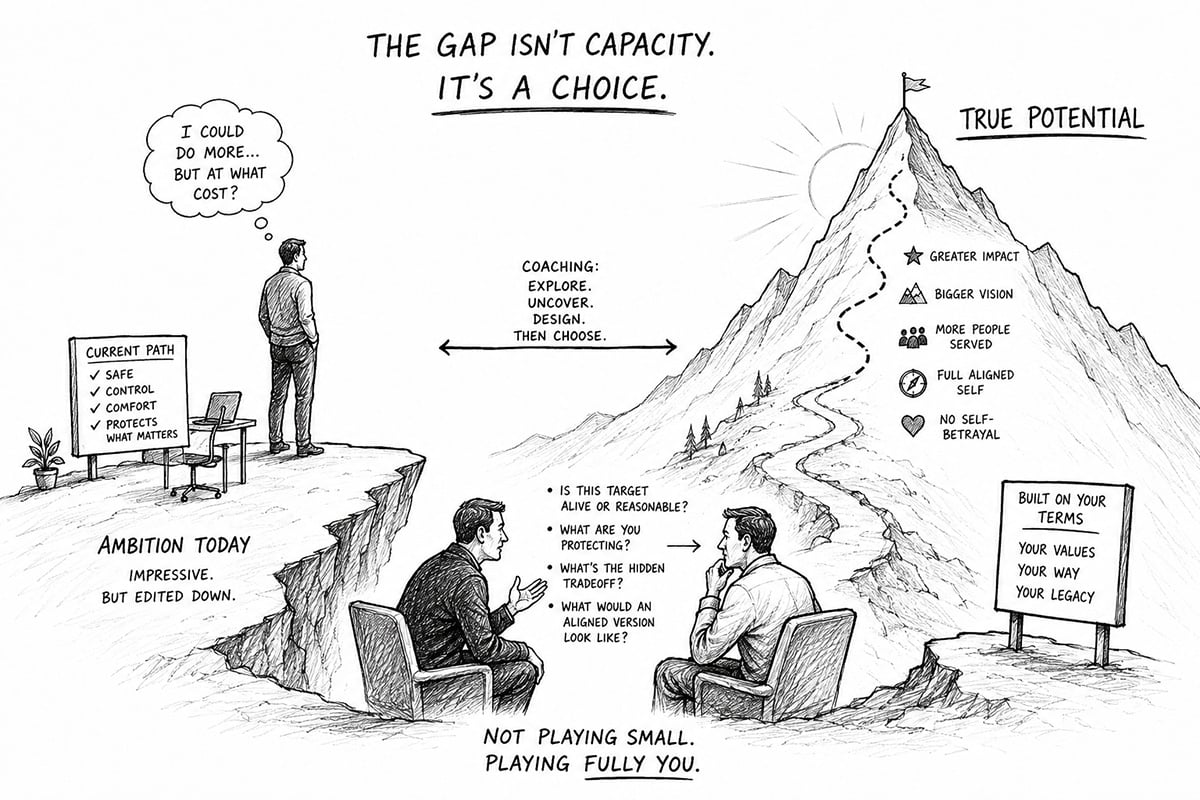
Why leaders play safe relative to their potential
Usually, the leader is not lacking courage in a simplistic sense. More often, they are protecting something valuable.
They may be protecting:
- freedom
- quality
- ownership
- pace
- identity
- peace of mind
- family stability
- the integrity of the thing they are building
This is why a simplistic “dream bigger” intervention often falls flat. The leader does not just fear scale. They fear what the usual path to scale might cost them.
Sometimes they do not distrust ambition. They distrust dilution – of equity, rewards, or control. They do not resist growth. They resist self-betrayal – of their values and principles. They do not reject impact. They reject becoming trapped by visibility, investor pressure, or a model of success that feels externally driven.
So the coach must avoid making the leader’s caution synonymous with weakness. Often that caution contains real wisdom. The work is to separate the wisdom from the fear.
Start with exploration, not declaration
When you sense that a leader is playing safe relative to their potential, it is tempting to say:
- You are underestimating yourself.
- You are thinking too small.
- You are capable of far more than this.
Sometimes that kind of provocation is useful – especially if you are talking to someone who stands out from most people you have met in your life. But if it comes too early, it can become coach-authored rather than client-authored. The leader may feel inspired in the moment, but the insight may not fully stick because they have not yet said it for themselves.
A stronger approach is exploratory.
Ask:
- When you say this target out loud, does it feel alive or merely reasonable?
- What part of you senses there may be a bigger game here?
- What are you protecting by keeping it at this level?
- What kind of growth would still feel aligned?
- What part of your caution is wisdom, and what part is fear?
These questions do something subtle but powerful. They do not impose scale. They help the leader locate the truth of their current relationship to scale.
The goal is not to talk them into a bigger ambition. The goal is to help them hear whether the current ambition is fully true.
Listen for the hidden tradeoff
Leaders who are playing safe relative to their potential are often making an unspoken bargain.

It may sound like:
- If I grow bigger, I will lose control.
- If I accelerate, quality will collapse.
- If I become more visible, I will lose freedom.
- If I pursue the largest version of my mission, I will have to become someone I do not respect.
- If I let this become truly big, it will cost me too much personally.
The coach’s job is to make that hidden tradeoff visible.
Ask:
- What are you assuming has to come with bigger scale?
- What exactly feels costly to you about this path?
- Are you saying no to the goal, or no to the usual way people pursue that goal?
- If there were an aligned version, what would it look like?
If you can deeply listen as a person reflects and answers these questions, this is often the breakthrough. The leader realizes that they do not need to choose between playing small and becoming distorted. There may be a third path: an ambitious path built on their own terms.
Stay grounded in their language
When coaching gifted leaders, it is easy to get carried away by what you can see in them (I do that often – as a shadow side of being a no-bullshit stand for human excellence and not for what is just “good enough”). You may genuinely sense that they have the capacity for enormous impact. You may see futures they have not yet named. That perception can be valuable. But it must be handled carefully.
One of the biggest coaching errors in these moments is getting ahead of the leader’s own language and projecting a more elevated future onto them than they have fully claimed for themselves.
Yes, bold vision can be catalytic. They have to see and speak it though – not just hear it from you.
If the coach says:
- This could be your life’s mission.
- You are meant for something massive.
- Your future is on another level.
The conversation may feel electric. But unless the leader has reached that articulation themselves, the coaching can become more declarative than exploratory.
A better move is to keep returning the insight to them:
- How would you say this in your own words?
- What feels true here, and what feels like my projection?
- What version of this future is actually yours?
- What changes if you really own that?
The aim is not to suppress your intuition as a coach. It is to let the leader metabolise it into their own language, their own choices, and their own commitments.
Challenge after clarity
Once the truth is more visible, then challenge becomes far more effective.
At that point, you can say something sharper:
- It sounds like the issue is not ambition. It is your mistrust of the common path to ambition.
- It sounds like your current target protects real values, but may also be keeping you smaller than necessary.
- It sounds like you already know there is a larger field of play here.
then follow the above with a question like
“What do you think?” or “Does it make sense?”
This kind of challenge works because it emerges from the leader’s own revealed reality.
Now the conversation can become:
- What scale would actually fit your nature?
- What do you need to stop protecting?
- What forms of capital, partnership, or structure would allow you to expand without self-betrayal?
- What is the next move that is both true and stretching?
Convert insight into commitment
A powerful founder session cannot end with expanded possibility alone.
If the leader leaves only with a bigger feeling, the insight may dissipate. The coach must help convert vision into commitment.
Ask:
- What has become clearer?
- What are you now committed to?
- What would be a real move before our next conversation?
- What must now be designed, delegated, or decided?
- What are you willing to test?
For a leader with unusual potential, the next step does not have to be dramatic. But it must be real. A sharper target. A new conversation. A redefined role. A capital thesis. A team design choice. A decision to stop performing reasonableness and name the bigger ambition plainly.
The deeper role of the coach
Coaching a high-potential leader who is still playing safe is delicate work. You are not there to inflate them. You are not there to flatter their genius. You are not there to impose grandiosity.
You are there to help them tell the truth.
The truth may be that their current path is right. The truth may be that their caution is wisdom. The truth may be that they are already carrying enough.
But the truth may also be that they have quietly edited down their own future to keep it manageable, defensible, or emotionally safer than what they really want.
Your role is to create the conditions in which that truth becomes unavoidable.
And if it does, then your job is to help them step toward it in a way that is not just more ambitious, but more aligned, more owned, and more structurally sound.
That is how you coach the best of the best out there – whose “safe” is already extraordinary: not by pushing them into a larger dream, but by helping them discover whether the larger dream is already theirs.
Leave a Reply