
Here’s the uncomfortable truth: your company will never grow beyond how much its leaders believe in it.
Your product may be excellent. Your team may be talented. But if you secretly wonder, “Are we really worth the price?”, you have already lost. Doubt shows. You can’t hide it, even if you try. It comes out in your tone, your pauses, your body, and the small hesitation before you answer a hard question.
No amount of convincing can make up for a lack of conviction. In sales, it leads you to charge too little, sell to the wrong customers (you will have a very good reason for this), and compete on price instead of value.
And here’s the part almost nobody talks about. The moment you start defending, justifying or convincing, you tell everyone in the room, including yourself, that you don’t fully believe what you’re saying.
Defending vs. Conviction
Defending feels like strength. It isn’t. It’s what we do when we’re not sure. Here is what defending costs you, and what conviction gives you instead:
| When you defend… | When you lead from conviction… |
|---|---|
| You need others to agree with you before you feel okay | You’re okay whether they agree or not |
| You talk more, explain more, and say less | You say it once, clearly, and stop |
| A question feels like an attack | A question feels like interest |
| You drop your price to win the argument | You hold your price because you know your value |
| Your team learns that challenging you is risky, so they go quiet | Your team tells you the truth, early |
| You hold on to bad decisions to avoid looking wrong | You change your mind fast when you’re wrong, and it costs you nothing |
| You end the day drained from protecting yourself | You end the day with energy left to build |
| The room loses energy, and people switch off | The room leans in, because certainty is contagious |
The dangerous part is that defending rarely looks like defending. It looks like “being thorough”, “adding context”, “just clarifying” or “making a strong case”. So most leaders never notice they’re doing it. They just notice that deals slip, meetings drag, and they feel tired all the time.
The Conviction Crisis
Ask yourself: do your thoughts or words in leadership meetings already show doubt? When conviction is missing, questions like these come up in your head and in your meeting rooms:
- “Are we still worth that price?”
- “Can we still charge this much when competitors offer something similar for less?”
- “Do we still have the right to call ourselves leaders in our industry?”
These doubts creep into leadership meetings. They shape your strategy. And slowly they change how you talk to the market. Your sales team feels it. Your customers feel it. And the race to the bottom begins. Not because your offering lost value, but because you stopped believing in it.

A Story
A few months ago, I watched a brilliant founder pitch his premium software to a room full of potential clients. His product was truly better. But halfway through, someone questioned his price. Instead of standing firm (which adds energy to the room), he got tense and started defending himself and trying to convince people (which drains energy from the room).
Three people who had been nodding along started checking their phones. They switched off and made up their minds. The sale was lost. Not because the product was bad, but because the founder didn’t believe in it enough. And if you don’t believe in what you offer, why would anyone else?
Your customers aren’t buying your features. They’re buying your certainty. And you never defend, justify or argue about something you are certain of.
Here’s a simple example. Someone says, “I don’t believe you are 6 feet tall.” If you are 6 feet tall, you just say, “You can measure me. Beyond that, believe whatever you like.” You’re calm because you know. Without that certainty, you start defending: “How can you say that?” “Let me prove it.” “Here are 3 reasons I’m 6 feet tall…” And on and on.
There Is No Place for Defending in Leadership
Look at the 6-feet example again. When you are certain, there is no need to defend. No tight jaw. No need for the other person to agree. Nothing is at risk, so there is nothing to fight for. Now notice when you DO feel the heat (in your body). Someone questions your price. Your strategy. Your decision to hire that person. Your leadership. Something in you tightens, and you start building your case. As my coach once told me, “Defence is the first act of war.”
Pay attention to that feeling. Here is what I have seen again and again, with leaders and in my own life: we only defend what we are not sure of. Nobody guards something they know is solid. So whatever you find yourself defending shows you exactly where your belief is weak.
Defending, justifying and convincing are not communication problems. They are belief problems. They are leadership problems.
What defending does to you without you noticing
Most of the damage is invisible. That’s why it costs so much. Every time you defend, this is what happens underneath:
- You teach yourself that you are fragile. Each time you rush to protect your idea, your price or your reputation, you tell your own mind: “This is under attack. This can break.” Do it often enough and you start to believe it. The defending creates the very doubt it was trying to hide.
- You lose energy without knowing it. Defending runs in the background all day. Replaying the conversation in the car. Rewriting the email three times. Practising the perfect reply in the shower. CEOs come to me exhausted and think it’s the workload. Very often, it’s the cost of protecting themselves all day. That energy should go into building and leading.
- You stop hearing the truth. When you are busy defending, you can’t listen. And when your people learn that every challenge gets pushed back, they stop challenging you. Bad news stops reaching you. You become the last person in your own company to know what’s really going on.
- You end up wrong more often. The founders I know who have built something big are not right more often than others. They just find out faster where they are wrong, because they don’t waste energy protecting their ego. They listen, get curious, and change course. By the time they act, it looks like they were right all along. Defensive leaders hold on to their mistakes and spend months justifying them.
- Your team copies you. Your team does what you do. If you defend, your leadership team defends. Meetings become arguments. Everyone tries to win, nobody solves the problem, and a 45-minute decision turns into a 2.5-hour debate that ends with “let’s discuss later.”
- You lose the room’s energy and trust. Remember the founder in the story. The moment he started defending, the energy left the room. People don’t trust someone who needs their agreement. They trust someone who doesn’t.
If you were trained as an engineer like me, be careful here. We learned that the best argument wins. So when doubt shows up, we build a bigger argument: more data, more slides, more proof. It looks like being thorough. Very often, it’s just doubt in disguise.
Not defending doesn’t mean being a pushover
To be clear: dropping defensiveness doesn’t mean you have no opinion, or that you give in the moment someone pushes back. It’s the opposite.
Conviction is what lets you stay open. When you know who you are and what you’ve built, you can say, “Interesting. Tell me more. Where do you think I’m wrong?” and really mean it. People can question your price, your plan, your decisions, even you, and you stay standing. You listen. You think about it. If they’re right, you change your mind. If they’re not, you hold your ground. Either way, no drama.
Defensive leaders are closed and easy to break. Leaders with conviction are open and hard to shake. The more certain you are, the more curious you can be.
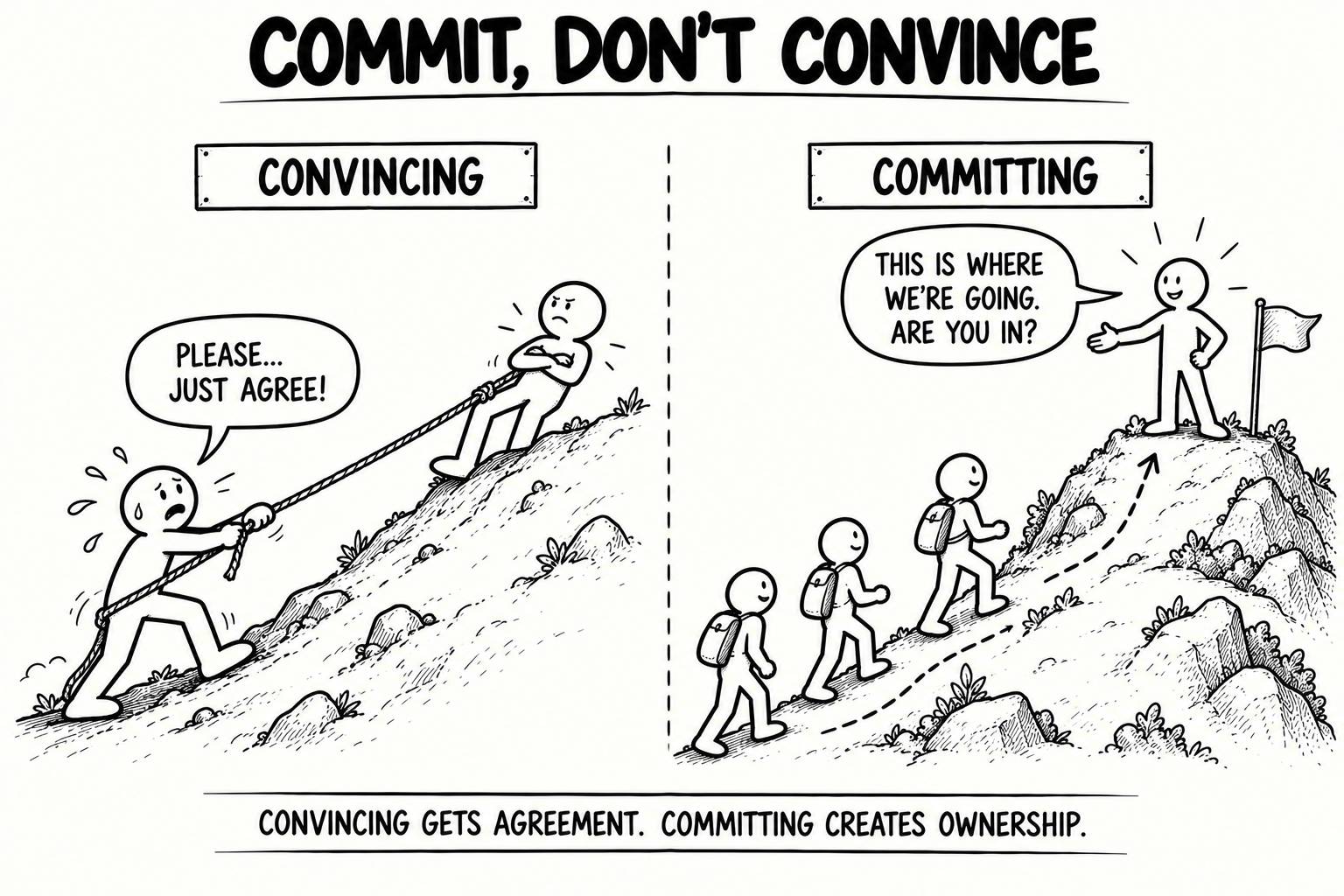
Commit People. Don’t Convince Them.
This is the shift that separates powerful leaders from busy ones. Insecure leaders try to convince people. Powerful leaders commit people.
Convincing comes from insecurity, doubt, lack of belief, or the need to prove something. Underneath it is a quiet need: “I need your yes so I can feel okay.” So you push, persuade, over-explain and chase. Even when you win, you get agreement, not commitment. When things get hard, the people you convinced change their minds just as fast.
Committing comes from conviction. You’re not asking anyone to approve of you. You have already chosen where you’re going, and you invite people to come with you: “This is where we’re going. This is why it matters to me. Are you in?” No pressure. No begging. People are free to say no, and that’s fine, because your stand doesn’t depend on their answer.
Here’s how to tell the difference:
| Convincing | Committing |
|---|---|
| Talks more | Asks more |
| Pushes back on objections | Welcomes them |
| Needs the yes | Is fine with a no |
| Gets agreement | Creates ownership |
| Is about proving you’re right | Is about what’s possible for all of us |
This works the same with a customer deciding to pay your price, a board deciding to back your 5x plan, and a team deciding to follow you into the impossible. Nobody wants to be talked into a bold future. They want to be invited into it by someone who already lives there.
Rediscovering Your Conviction
You can’t fake conviction. You rediscover it. It means reconnecting with who you are, what you’ve built, and why.
- Know who you are and what you stand for. Who are you at your core? What do you really care about? What do you want your life to be about? What are you committed to, at work, in business, with your team and with your customers? (If you don’t have answers to these, stop here and find them first.)
- Do a value audit. Write down every win, every innovation and every customer success from the past. This isn’t marketing material. It’s a reminder for you of the real value you’ve created. Don’t just know it. Feel it. Be proud of it.
- Collect honest customer stories. Not satisfaction scores. Real conversations about how you changed their business. Write them down word for word. Read them when doubt shows up.
- Experience your difference yourself. Use your product the way customers do, side by side with the alternatives. You need to feel the difference, not just describe it.
- Catch yourself defending. For the next two weeks, notice every time you feel the heat: the tight chest, the urge to explain, the “to be fair…”, the “let me just clarify…”, the long email with three reasons. Don’t fight it and don’t act on it. Just write down what you were protecting. That list shows you where your belief is weak, and where your real work is.
- Practise being open on purpose. Hear things about yourself you don’t like. Let people question your decisions. Listen to views you disagree with. Admit when you’re simply wrong. Hear it fully, and say, “Thank you. Let me think about that.” You will not break. Every time you don’t defend, you prove to yourself that what you were protecting was never fragile.
Communicating with Conviction
When real conviction is there, and only then, you can speak with conviction:
- You speak clearly about your value because you know it, rather than hope it
- You talk about price as an investment, not a cost, because you’ve seen the returns
- You lead with value and results, not features or discounts
- You stand firmly for who you are, what makes you different, and where you’re going
- You can answer “Why is working with us the best decision you’ll make?”
- You welcome questions and pushback instead of bracing for them
- You make your ask once, clearly, and let people choose
- You don’t ignore criticism or sarcasm about your value. You deal with it directly, from what you stand for, not from hurt
- You speak powerfully, not against others, but from knowing your own worth
When you truly know you’re worth every cent, prospects feel it. They’re not buying features. They’re buying your certainty.
A medical device company I worked with stopped talking about the technical features of their surgical tool. Instead, they had surgeons share how the tool gave them confidence in the most high-stakes moments of their careers. Their sales doubled. The product didn’t change. The message did. It connected to what surgeons truly cared about: being at their best when patients needed them most.
The Courage to Stand Apart
People around you will keep telling you to fit in and not stand out too much. Standing apart takes courage. The courage to price on value instead of copying competitors. To speak without defending yourself. To stay out of feature-comparison battles. And to let people disagree with you without needing to win them over.
That courage only comes from conviction. Not arrogance. Not wishful thinking. The quiet certainty of knowing who you are and what you stand for.
Remember: if you don’t truly believe in your worth, as a person and as a team, no sales technique, marketing campaign or strategy will fix it. Your most urgent work may not be outside, in strategy. It may be inside, in belief. When you truly believe, the market feels it. And that belief is worth more than any marketing budget in the world.
So next time you feel the urge to defend, justify or convince, pause. Ask yourself what you’re protecting. Then go back to what you know is true, and speak from there.
Stop convincing. Start committing.
Leave a Reply