This is the Leadership Journey series on the Choosing Leadership Podcast.
I believe we all have a lot to learn from each other’s stories – of where we started, where we are now, and our successes and struggles on the way. With this series of interviews, my attempt is to give leaders an opportunity to share their stories and for all of us to learn from their generous sharing. If you know a leader whom you would like to see celebrated on the show, please send me a message on LinkedIn with their name.
Vinod shares in the interview how he and his wife started a coffee house in 2015 to provide a sip of happiness to every customer, and to enhance the experience around coffee. He shares how they navigated covid and are now looking to expand, and how they have leveraged technology during covid. He also talks about caring for people and building a team on a solid foundation of values.
We knew immediately that was the first opportunity that we gotta pursue it. So we put our eggs in that basket and we went forward with it.
It took me five years to find the connection and when I found it, It clicked immediately because we were then able to leverage my background.
Most business schools don’t necessarily focus on running a small business. This is what we realized.
only when you make an attempt to actually get closer to the customer, understand the customer, you understand the challenges in it and the actual value of why it is so important.
We never thought we will be delivering a cup of cappuccino. Pizza is one thing. But delivering a cappuccino is a totally different problem that we never thought we’d be delivering a cappuccino, but now we do.
In hindsight, everything is easy and clear, but when you’re going through the process it’s a mess.
The second thing that motivates us is we feel like we need to take care of the people That work for us. And it’s important to take care of them because quite literally, their livelihood is dependent on the business.
an entrepreneur needs to be very comfortable with ambiguity. I think that’s the thing. You have to be comfortable with ambiguity and you have to be comfortable with things going wrong and things not going according to plan.
And you have to know what the non-negotiables are, You have to pick the right fight, cuz when things go wrong and you have to fight the circumstances, it’s easy to lose energy.
People find themselves stuck in a rut, unable to realise ideas into a finished product, or even dreams into a reality, more often than they like. When the flow of creativity or ideas, feels jammed, it is very difficult to get out of it. Many feel like they are unable to accomplish or realize their goals and tend to either give up or settle for less.
What stops people from achieving their goals? And how does one get out of inaction and realise goals and ambitions?
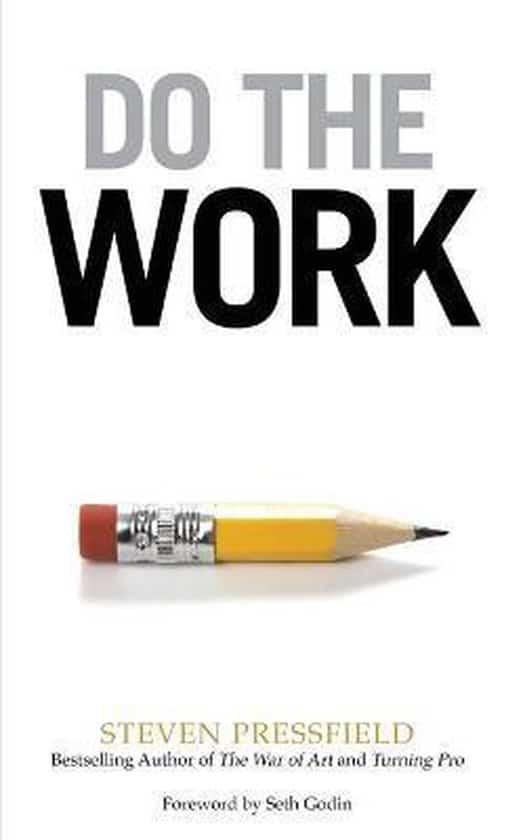
It is an inner negative force called resistance that causes people to get stuck in a rut. Steven Pressfield’s Do The Work (2011), explains how resistance is a thwarting force that stops one from the action. It helps identify causes, helps one conquer fears, stops procrastinating, and learns how resistance is one’s worst enemy. It delves into techniques that can help one to get back on track and finally move forward toward success.
Identifying Allies And Enemies
In life, there are things that can help one achieve a set goal and things that get in the way of achieving them. These are one’s allies and enemies. While self-awareness and ambition are one’s key allies, resistance is an enemy that constantly poses a threat to achieving goals.
Do The Work by Steven Pressfield – Book Summary & Review
Resistance, an internal negative force, manifests itself in different ways. For example, the self-doubt a person feels while trying to work on something meaningful, any activity that requires a lot of energy or takes time, can draw resistance too. In fact, the more important an activity is, the more one has to fight the resistance to achieve it.
When it comes to one’s allies, passion, dedication, and confidence are all positive allies that can strengthen one’s resolve to achieve a goal. However, there are certain negative traits like stubbornness, arrogance, ignorance, etc. that can end up being allies too. Stubbornness, though a negative trait can help keep one dedicated to work.
For instance, Charles Lindberg, the American aviator was ignorant about the difficulties of flying for 33 straight hours. However, his arrogance and stubbornness led him to believe that he could. He succeeded and accomplished great feats. Lindberg is in fact, the first man in history to be in New York one day and in Paris the next!
Apple’s Steve Jobs was known for his stubbornness. It led him to guide the company to become the world’s most successful technology company.
Creating Structures and Productive schedules
At times, rather than inaction, it is excessive preparation and overthinking that is counterproductive to getting things done. One has to be able to resist them.
Work is like meditating. One has to concentrate and focus and get into a mental state of being able to objectively assess one’s own feelings and thoughts. When self-doubt creeps in, one has to ignore it. Such thinking is a form of resistance and one should act on it first rather than waste time thinking and reflecting on it, or feelings of doubt.
For example, for a writer, action equals putting words down on paper, whereas reflection, is the evaluation of what was written the next day. Trying to write and reflect at the same time, will end in contradiction, and a waste of time.
One has to create structures and production schedules for oneself. The three-act structure is one of the useful structures that one can apply. In this, an idea is divided into three parts – the beginning, the middle, and the end.
For instance, if this structure were to be applied to the creation of Facebook, its beginning would be where Facebook as a digital meeting space wherein anyone could create their own page. The middle would refer to the creation of an interconnected web of contacts, where each could choose who is allowed access. The third part, the end, is a worldwide community of friends, where people can share and communicate whatever they want.
Confronting The Enemies Within
Creative blocks can lead to a loss of confidence. However, it is important to remember that these blocks can be overcome by recognizing the fact that there is an enemy working against the realization of dreams and goals.
This enemy lies inside one’s own head. It has to be defeated by oneself, and blaming external factors is futile. Additionally, one also has to recognize that this enemy, though inside oneself, isn’t the person itself. It is just internal resistance that is blocking the creativity inside, and there is no one to blame. Once a person understands this, fighting the enemy becomes possible.
When one encounters resistance, one has to answer two questions. These questions have only one answer, which will help one proceed in pursuing one’s goal. The questions are –
How badly do I want this?
The only answer to this question is, ‘Badly enough to be totally committed.” If one gets any other answer, such as I want this badly for the money, for fame, for power, etc., one will not succeed. Why? Because one needs to be totally committed to be able to push oneself to achieve a goal – no matter what!
Why do I want this?
The answer to this question should be, ‘Because I have no choice.’ It doesn’t matter whether one wants to achieve a goal for the fun of it, or because of its beauty of it. But because only having no choice will bring profound dedication and determination to achieve a goal.
Overcoming The Big Crash
A Big Crash is a major obstacle in the path of achieving a goal that one encounters. Everyone faces it at some point in their careers. Crashes are demanding and difficult to overcome. However, one has to keep in mind that these ‘Big Crashes’ too, are just another problem that one can overcome.
Big Crashes can also be beneficial. They can force one to work hard to figure out what in their plan or project isn’t working. The author, after he had finished writing his book, The Profession, which had taken him two years, experienced a Big Crash. His friends who read the book hated it. It took him another year of hard work, and long conversations with colleagues, to improve it.
People often experience crashes after reaching higher levels of work, often when they are close to crossing thresholds. However, it is imperative to keep in mind that every attempt to move ahead will bring courage to go on and persevere. In fact, even fearing advances and success can be a resistance. Fear is at the very core of resistance.
Resistance is, at its strongest when one is close to the finish line. However, when one does overcome resistance, and as one tastes the success of overcoming more resistance in life, overcoming resistance gets easier. After all, what doesn’t kill, makes one stronger!
Conclusion
People often face resistance in the final lap of achieving a goal. They tend to overthink their success or lack of it and fall prey to inner resistance.
One can overcome these inner resistances by identifying allies and enemies, creating structures and schedules, confronting inner enemies, and learning that big crashes can be overcome.
This is the Leadership Journey series on the Choosing Leadership Podcast.
I believe we all have a lot to learn from each other’s stories – of where we started, where we are now, and our successes and struggles on the way. With this series of interviews, my attempt is to give leaders an opportunity to share their stories and for all of us to learn from their generous sharing. If you know a leader whom you would like to see celebrated on the show, please send me a message on LinkedIn with their name.
In the interview, Raymond shares about his journey of being 100k dollars in debt before becoming a teacher, coach, and successful businessman. He also shares that he only does what he loves to do, and spoke a bit about some of his crazy adventures – including a 350-mile foot race to the North Pole. We spoke about leadership, growth, commitment, and how to have more than 24 hours in a day.
People typically underguess my age by five to 15 years, and my secret is that I do only what I love.
I tried all these businesses and they all failed, and I did extremely well as a salaried employee in math and computer. But I didn’t enjoy it, and so at age 39, I was a 39-year-old life loser. I was a hundred thousand dollars in debt, completely broke.
My boss had just fired me. I told my wife I got fired, and she did the only thing a reasonable woman could do. She dumped me out of our marriage and I was depressed. I didn’t know what to do.
It just exploded because I was meant to be a teacher. And so if you want to know how it all really got started, it’s the day I found out that I was supposed to be a teacher.
Once you commit the resources come to you. Once you commit, the physical universe gets pushed to the side and the spiritual universe delivers to you whatever you want.
You can’t know what’s gonna happen. You have to be able to allow chance encounters.
Not only should you burn plan B and C, which I really love, I’ve never heard that before, but I say you should burn Plan A, and just go for it. Ready, Fire, aim.
It’s wonderful to have intentions because that’s the fuel of the soul.
Welcome to the Deploy Yourself Newsletter, where I share what impactful leadership looks like to show your own power. I also share the most insightful lessons and stories I encountered in the last two weeks. You can also read this issue online.
Hey,
5 Reminders for You – for when you forget
For a couple of years now, I have had these 5 reminders in front of me always – both digitally and physically.
They are hanging on my monitor as post-it notes so that I never forget their message.
And they are on one of the open Stickies on my mac to make sure I see them every now and then.
And each time I am stuck or feeling low and disempowered, a glance at these reminders and a deep breath makes me feel better.
Sometimes I can do this (deep breathing & reminding myself) 10-20 times in an hour if there is a particularly stressful meeting or situation.
And the impact is immediate and transformative. I am able to stay grounded, centred, and have conversations from choice instead of from past repeated and unconscious patterns.
As a result, this year is one of my most transformative ever – for both inner growth and results in the outer world. The 5 reminders are –
You are enough. Never better or lesser than anyone else. You have what it takes. You have all the answers within you.
There are no ordinary moments. There is only “now”. Learn to meditate in every action.
You always have the choice to respond. Take responsibility.
Do not take yourself too seriously. However, be impeccable with your word.
Stand for something bigger than yourself. Take action in service and for its own sake.
I share these with everybody I work with. As we all forget them from time to time. If you prefer video and want more detail, see below.
It is time to start thinking about 2023. I am looking for my next superstar to coach.
Ready to make 2023 your best year ever? Then, I want to be YOUR coach.
Reply back to find out my requirements and about the program. I read and respond to every reply.
Fascinating Articles & Stories
One
Taking personal time is never more essential than now
As the civil-rights activist, Audre Lorde once said: “Caring for myself is not self-indulgence, it is self-preservation.”
Be direct and ask for what you need. It’s okay to be direct. In fact, it’s a gift that saves the other person time and effort.
Know that the same rules can’t apply to everyone.
It’s okay to outsource aspects of life.
Add an extra layer to your communications around time off.
Happy people live modestly. Our society glorifies bling—big houses, fancy cars, private jets, a baller lifestyle. The evidence is clear: Those “hallmarks of success” aren’t hallmarks of happiness—it’s the opposite.
Happy people have committed long term relationships. They tend to stay married and have intimate, life-long friendships.
Happy people are fit. Your body is your vessel for experiencing life. It’s hard to be happy if your vessel isn’t in tip-top shape.
Happy people have multiple passionate pursuits. Happy people are curious, life-long learners who pursue growth in multiple ways.
Happy people help others. And they expect nothing in return.
Happy people say no (a lot). They have clear priorities, set boundaries and have the discipline to stick to them. They stay in their lane, eyes on the prize.
New Inspiring Episodes on the Choosing Leadership Podcast
Below are the latest episodes where I have interviewed these amazing leaders. Listen to their story to know the choices they have made to be where they are now.
Silvia catches my bias as a man and illuminates me. Must watch for all women, and men.
That’s it for now. If you have any questions or feedback, or if you are new and want to introduce yourself, hit reply. I read and respond to every reply. All the best,
Sumit
P.S. – I am looking to interview more inspirational leaders on my podcast. If you know anyone I should interview, reply back with their name.
This is the Leadership Journey series on the Choosing Leadership Podcast.
I believe we all have a lot to learn from each other’s stories – of where we started, where we are now, and our successes and struggles on the way. With this series of interviews, my attempt is to give leaders an opportunity to share their stories and for all of us to learn from their generous sharing. If you know a leader whom you would like to see celebrated on the show, please send me a message on LinkedIn with their name.
In the interview, Silvia shares how she is empowering women and couples by translating medical research into valuable information for family planning. She shares how the mission of her startup is also her personal mission, how similar leadership is to parenting, and the challenges of convincing investors as well as other stakeholders about what they are doing and why.
When you’re struggling to conceive, it’s not just women who are part of the equation, but also men.
Part of my life that led me here was wanting to be a mom for a long time.
And you wanna have kids and then it didn’t work. And I was overwhelmed by that sense of urgency, that belonging, or that desire to have a child. Was so strong all of a sudden, and then realizing that you want something badly, then not able to get it. That like really sparked something in me and gave me the energy to do something about that.
There are so many hundreds and thousands of clinical studies where issues regarding fertility diagnostics and fertility therapy are discussed. Are found great results, but they’re not made available to the people who really need them.
Patients typically think that doctors should have all the answers. They should know everything, but that is an unrealistic expectation from my point of view.
We have to empower women to make good decisions for family planning and for diagnosing fertility and addressing fertility issues.
I wouldn’t say that it’s so niche because every sixth to seventh, a couple struggles to conceive it really depends on who, and how open your friends and family are.
People just don’t open up that they’re doing IVF because they’re embarrassed. Very few couples share fertility struggles openly, or even with their family and friends.
It’s impossible to know everything.
When it comes to coaches the important thing is to not get a coach when everything is falling apart, but to get a coach way before and when you’re doing well.
many people tell you no, you can’t do this. No, this can’t be done. No, you’re too early for this. No, you’re not the right person. And I think having a coach helps you navigate all the different responses from your environment and the different expectations from customers and the expectations from your team and how you grow with that and how you struggle with that.
I see a coach like a mirror on the wall, really reflecting things and pushing back things to me and giving me things to think about. And to question not as somebody who’s giving me the solutions.
Motherhood for me is challenging just like, for everybody, I would say it is very fulfilling. It is a lot of fun. I just love the directness and the honesty that you get from your kids.
I struggle to be a mother and have a startup at the same time, I feel like I’m never doing enough on the one end and I’m never doing enough on the other. I always would like to have more time for my children more quality time. And I always have things for my startup at the end of the day.
Any work that needs to be done requires the use of certain tools. For example, to write, one needs a pen, to fix a broken cup, one can use superglue, etc. Similarly, for decision-making, one needs to be equipped with the right tools. These tools are mental devices that one can use to make good decisions. While certain knowledge, ideas, and techniques can be used, one has to be able to understand which mental models can assure one of success.
These mental models help in upgrading one’s ability to think and handle the challenges that are thrown along the path of life. Humans have a whole toolbox of such mental models. The Great Mental Models (2019) by Shane Parrish and Rhiannon Beaubien, draws on a number of disciplines and gives the nine mental models that can boost one’s decision-making and thinking capacity.
The Map
Mental models can be considered like maps that help one navigate reality. While maps are navigational aids, they generally help one understand the benefits, basic features and limitations of mental models.
Maps represent the reality of the world around us in a more simplified manner. For example, the map of a city lines out its overall layout. Simple lines and squares representing roads, buildings, parks etc., are enough without having to include every detail. This simple representation is enough to get a person from point A to point B in the city.
In other words, maps are a simplified representation of the complex reality that surrounds us.
While a simple representation is enough, at times, one needs to include certain vital details in a map. For example, when a GPS device leads one to a closed road, one realises the importance of having an updated map. These details are equally vital to metaphorical maps that one uses. Instruction manuals, financial statements, and policy papers, all are simplified representations of reality.
These simplifications are meant to guide people through the complex world. Mental models need to be designed in the same way. They have to include the right details, leave out the clutter and need to be updated as well, as the world, and ones thinking changes.
The Circle of Competence
To navigate the complex world, one needs to use metaphorical maps. Let’s consider that that all the knowledge humans have about the world around them is a vast landscape, and one would need a map to navigate through it. Thus for cooking, one would need a cookbook, to manage and invest in a stick, one would need an investment manual, etc.
Great Mental Models by Shane Parrish and Rhiannon Beaubien – Book Summary and Review
While one would need a map for navigating some places in the metaphorical landscape, some places would be so familiar, that a map would be unnecessary. These places (or actions) would be the skills that have been mastered throughout one’s life. These familiar, mastered places fall within one’s circle of competence.
One can move with confidence within this circle of competence. One knows what to expect and can easily navigate through any challenges one faces. However, outside this circle of competence, one feels baffled. For example, a plumber can easily understand whether the problem lies with the faucet, the pipe, or the drainage system. Whereas, the plumber will find it difficult to work out whether the problem is in the engine of the car, or the automation system, as the work of a mechanic lies outside his circle of competence.
Everyone has an area of ignorance, and not everything is known to one person. Hence, it is vital that one has an idea as to where one’s circle of competence begins and ends. One simply has to be honest about one’s limitations in order to be able to focus on one’s strengths, and know when to seek help with areas in one is weak.
For example, if one wants to better finances, and is weak at numbers, hiring a personal financial consultant, or even reading up a bit on the subject could help one navigate around the basics. In this manner, even if one is outside one’s circle of competence, one won’t feel completely disoriented.
That said, it is essential that one understands when one is outside one’s circle of competence. It is unfortunate that human egos tend to make humans believe that one’s circle of competence is wider than it actually is. Due to this misguided perception, many tend to venture out of their comfort zones with confidence, totally clueless that they are out of depth. A stark reminder of this is the 200 or so frozen bodies that are dotting the landscape of Mount Everest! Each of those who perished probably felt confident about their abilities to conquer the mountain.
Creativity, And Reasoning From First Principles
There is more to success than just focusing on one’s circle of competence. In order to succeed, one also needs to be creative. Thinking out of the box is but an important cliché. Without it, one cannot break away from the common and will end up doing the same thing that everyone does. And this includes the mistakes!
One has to begin with digging deep and creatively reason from the first principles.
The first principles are the foundational facts that are the base of the knowledge of any field. For example, understanding the laws of thermodynamics is the first principle for an engineer who wants to build a refrigerator.
The first principles of any field can also be found in less obvious domains, which often lead to creative solutions. For example, a scientist trying to solve the environmental impact of livestock farming and overconsumption of meat will try to first go back to thinking about how can the consequences can be mitigated.
On the other hand, the scientist could also approach the matter differently, by asking, “What are the first principles of meat consumption?”
The scientists of the 1970s started with this very question. They learned that for consumers, it is the smell and the taste that matter more than whether the meat comes from an animal or not. They learned that these aspects of the meat depend on reactions and chemical properties that take place between the amino acids and sugars when meat is cooked. Thus they started experimenting with ways of creating artificial meat grown in labs, that not only replicate the smell and taste but also do away with the need to kill animals.
This realization has led to over 30 labs across the world that are developing artificial meat presently.
Approaching any problem by understanding the first principles – essentially, starting with the underlying cause, rather than trying to solve its effects – helps in preventing it from becoming a problem in the first place, creatively.
Practising Inversion
In the 1920s, Edward Bernays, an Austrian-American PR and propaganda pioneer, was faced with a question. How to sell more Lucky Strike cigarettes to women in an age where most smokers were men. Bernays used an effective mental model called inversion that involved approaching a problem by turning it upside-down.
In an inversion, the first trick is to assume that something is true, and then work backwards to prove what else could have to be true to arrive at the same truth. Bernays started by thinking, ‘Assuming women smoke as much as men, what else would have to be true?’
He arrived at the conclusion that women would need to feel that smoking was socially desirable and acceptable, and hence would be needed to link with other things that were socially desirable and acceptable. Bernays then advertised Lucky Strike cigarettes as an ‘after-dinner treat’ that would replace desserts – an elegant manner of keeping a slim figure. He further portrayed smoking as a way for women to show independence (as the women’s rights movement was on the march) and marketed cigarettes as ‘torches of freedom’.
The second trick in inversion is to assume the opposite of what one wants to achieve, and then see what needs to be proved true for the case to happen. For example, if one wants to get rich, one has to assume one is poor and then think backwards as to what actions lead to poverty. Thus, if one thinks that spending more than what one earns or taking high-interest loans will lead to poverty, these, and all other behaviours that one list could be avoided to get rich.
Thought Experiments
With all the creative ideas that one can conjure by using the aforementioned techniques, one has to have a clear idea of how these should be carried out in reality. In order to do this, one should first simulate them in one’s mind.
Simulating these experiments in one’s thoughts has a clear advantage over trying them out first. For starters, one can imagine taking risks without actually bearing the consequences. Moreover, these experiments can be conducted in one’s mind over and over again – without wasting time or resources. This enables one to think of the impossible or even the impractical!
For example, Einstein actually came up with the general theory of relativity using thought experiments. He thought if a person was put in an elevator with their feet glued to the floor, and the elevator was transported into space and pulled upwards at an accelerating rate, would the person be able to notice it, or would the person feel like being pulled by the gravitational force of the Earth? This thought, as absurd it may sound, helped him work out his ideas about gravity.
Similarly, thought experiments enable one to think of impossible ideas, and at the same time clarify ones thinking. Moreover, they help one understand the value of things.
Second Order-Thinking
Consider a person who has won a lottery. Let’s say this person thinks of using that money to buy a house. He next thinks of the consequences of buying the house. He might either need to spend more time cleaning., or hire house help.
Whatever, the person thinks, the person has gone from thinking about the consequence of winning the lottery, to thinking about the consequences (more cleaning time or hiring house help) of the consequence (winning the lottery). This is known as second order-thinking.
In second order-thinking, one looks at a problem by considering its absence. Now in livestock farming, , when dairy farmers first started using antibiotics, they focussed on the first-order consequences – which were better milk production and stronger cattle. However, as they eyed bigger profits, the second-order consequences started to show effect. Some bacteria resisted the antibiotics, and these drug-resistant bacteria entered the human food chain.
Though unintentional, had the farmers considered the potential second-order consequences, things would be different. Hence in decision-making, thinking about second-order consequences is vital, as they could have negative outcomes, and reassessment will be essential.
However, second-order consequences can also be positive, enabling one to use them to bolster arguments in favour of any decision. To make good decisions, one often needs to rope in other people, for example, to get a partner convinced to try a new parenting technique.
Mary Wollstonecraft, philosopher and the author of A Vindication of the Rights of Woman, argued in her book that giving women equal rights as men is not only morally correct but will also be beneficial for society later. She essentially used the positive second-order consequences to plead her case in the book.
Probabilistic Thinking
While weighing the pros and cons of the second-order consequences, one has to be careful to overthink or overreact by drawing extreme conclusions, or excessively guarding oneself against them. One can get paralysed with indecision.
For example, an overreaction to thinking about the second-order consequences of having a drink would be to think of alcoholism and advocate for prohibition. If one has to be rational while decision-making, one can use probability or probabilistic thinking.
To get better at probabilistic thinking, one can use the Bayesian updating approach. In this approach, one thinks that they have all the information about the world. Though it is limited, it could also be useful, and one should make the most of that information one has. Hence when one gets access to any new information, one has to comparatively assess it with the prior information before reaching a conclusion.
For example, a person sees a report in the newspaper, “Violent crimes are skyrocketing.” Rather than panic and vow to never go outside, if the person is a Bayesian thinker, the person will start tabulating the previous crime rate and compare it with the doubled rate of crime. So if the crime rate – which was declining in the past decade – was at 0.1%, at a doubled rate, it would be 0.2%. that would indicate that 2 out of every 10000 people would be probable victims of violent crime. The person would have a very slim chance of being a victim.
That said, one cannot dismiss the new information altogether. Change is a constant and one needs to keep updating oneself from time to time.
Thus, the word ‘skyrocketing’ should only diminish the person’s belief that the crime rate is low by little. It actually tells the person that the crime rate is only slightly higher than what the person earlier believed and that one has to only slightly adjust one’s belief.
Now in case, the person continues to see news reports that tell of increasing crime rates, the person will have to replace his belief about the crime rate being low altogether. The person should then, based on the new information, exercise caution while venturing outside.
Occam’s Razor
Consider a person waking up feeling sick. The person does a quick google search of the symptoms experienced and gets 2 results – flu or Ebola. Which result should the person believe? The answer is important, as it could be the difference between popping paracetamol and heading back to bed, or going into quarantine!
Such scenarios are different from probabilistic thinking where one has to weigh only one piece of information. Here, one has to decide between 2 explanations for the evidence in hand. In such scenarios, one can use Occam’s razor.
Occam’s razor tool, when given two explanations that equally account for the facts in hand, considers the simpler explanation to be true. The tool’s basic idea is that the explanation that is more complicated, has more variables attached for it to be true. With each additional variable, the explanation seems more unlikely to be true.
For example, if a friend hasn’t shown up at the time that was decided, one has two explanations – either the friend is running late, or has gotten into an accident. With the second explanation, many variables such as – did the friend leave his house, was driving, did the friend caused the accident or another driver, etc. – have to be accounted for it to be true. The first explanation that the friend is running late, is simpler and hence more likely to be true.
However, one cannot completely dismiss the second explanation as impossible. It is just the case that simpler explanations are true more often than complicated ones.
Hanlon’s Razor
While Occam’s razor is a great tool for decisions that have competing explanations, human behaviour is varied, needing another tool.
Hanlon’s razor, similar to Occam’s razor, believes that keeping all things equal, the simpler explanation is true, and thus the safer bet. However, it adds a small twist. It states that acts of wrongdoings or decisions are more an outcome of stupidity and mistakes than malicious intent.
For example, let’s consider a person driving a car gets speedily cut off by another person. Before the person actually speeds up to follow the other car and take revenge, the person should consider what could be the reason for the behaviour of the other driver.
There could be 2 explanations. Either the person acted in malice and had some evil intention, or it was just a stupid mistake.
With the first explanation, the other driver’s act would have to fulfil a host of conditions for it to be true. The person would have had to follow the car, had a desire to cut off, conjured up a plan to act on that desire, and then manoeuvres his own car dangerously to fulfil it. The second explanation is simpler to believe.
Mistakes are a lot easier to make and more common than detailed planning for intentional acts of wrongdoing. While people can be evil on purpose, thinking of it as a mistake, is simply a healthy way of remembering that wrongdoers are exceptions in a world of people who make mistakes. One shouldn’t jump to conclusions and assume the worst of others.
Conclusion
Mental models can be used to navigate the complicated reality that surrounds us. Every model, with its specific uses, limitations and strengths, can be applied to decision-making to sharpen ones thinking, develop knowledge, and have a better understanding of the world around, and in turn, enable people to make better decisions to succeed in life.
This is the Leadership Journey series on the Choosing Leadership Podcast.
I believe we all have a lot to learn from each other’s stories – of where we started, where we are now, and our successes and struggles on the way. With this series of interviews, my attempt is to give leaders an opportunity to share their stories and for all of us to learn from their generous sharing. If you know a leader whom you would like to see celebrated on the show, please send me a message on LinkedIn with their name.
In a very candid conversation, I don’t even want to call it an interview, Chris shares so much of his life that we normally keep hidden – not just from others but also from ourselves. He opens up and shares about his childhood, his tryst with entrepreneurship, failure, success, mental heath challenges, and what gives his life meaning. Listen to this conversation to understand who Chris is and his story. We talk about material success as well as meditation, doing more as well as doing nothing, and fear as well as courage.
I ended up spending a lot of time after my parents split and got divorced when I was very depressed, just sitting at my computer and it helped me be very comfortable with computers.
And I ended up finding computers to be very safe. There was nothing that could like physically or emotionally hurt me with a computer.
I got diagnosed with bipolar two when I was 20 or 21.
Whenever I had to do something interpersonal, I did not deal with it very well. I tended to be very abrupt or brash when talking to people like they were a computer I wasn’t empathetic and I tended to type strong messages
It was very painful. Going through therapy sucks. I don’t enjoy one bit of it, but the benefits of it really helped me in my life.
If anyone has a mental illness where there’s like heavy anxiety, it helps to do a lot of exercises to manage that it helps to level it out.
From the base of the mountain, you can see the mountain, but from the top of the mountain, you can no longer see the mountain. And the concept is about the journey. It’s not about achieving the thing in the end. And there’s something rewarding about the journey that I look forward to.
Boys are taught to not talk about their emotions and girls are taught to shut up. And it’s interesting the struggles that men and women have after getting a bit older
The last company I co-founded, when I sold it when I sold my interest, it really hurt because this thing that I had devoted, like almost every waking hour or two for a year and a half, it was suddenly gone.
And it made me realize one, one day, I want to be able to change that dynamic if I can because you hear all these things. If you had a day to live, what would you do? And if your company’s gonna go away from you, what would you do? It was a big lesson I learned.
No matter what field of work, or which role in which company, everyone needs to work in teams at some point or another. Every company, club or even theatre group vies for a dream team. After all, there’s much to be appreciated in having a strong team of individuals. Everyone benefits from success.
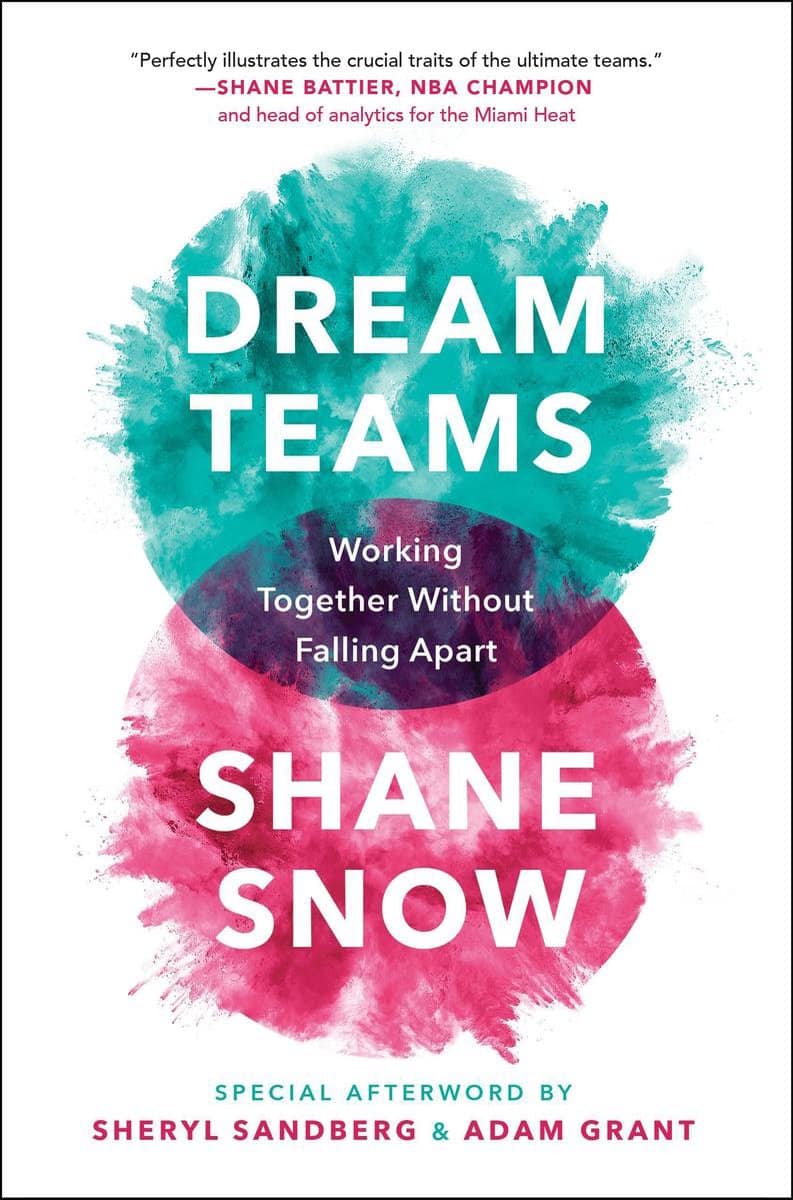
Shane Snow’s Dream Teams (2018), shows the science behind dream teams by highlighting examples from different industries and different times. He scrutinizes the strategies employed by many great teams in succeeding time and again. He charts the elements that make a dream team and how simple strategies and rules can be applied in creating one’s own dream team.
Diversity
In any team, diversity is a crucial element. It not only helps a team think in creative ways but also increases the chances of finding the right solutions.
Let’s look at a case in 1974, when the FBI was trying its best to subpoena a Newark, New Jersey based Mafia boss. The law then was clear. It was necessary for a person to obey a subpoena and appear in court only if it was delivered personally and directly to the person.
The Mafia boss, knowing this had surrounded himself with bodyguards to avoid the same, and not one FBI agent was able to come close to him to personally deliver the subpoena. Chris Jung, a young female agent came up with a plan. She went undercover to the mafia Boss’s daughter’s wedding and delivered the subpoena to the boss directly as he was welcoming guests.
Jung was successful because, in a male-dominated profession, she was a woman. No one suspected her. She proved to the agency that brawn and strength weren’t needed all the time and that successes could be won with clever manoeuvring, intrigue and disguise as well.
Diversity, racial, gender-based, or otherwise adds different perspectives to a team. The different lived experiences of different people add to the way they see, think and solve problems. Diversity helps in challenging people in a team to re-evaluate entrenched prejudices and perspectives.
Furthermore, diversity leads to decisions that are strength-tested for success. In 2013, four different universities in the US invited about 200, self-identified as Republicans or Democrats, people to participate in a murder mystery scenario.
Though the scene itself didn’t wasn’t politically oriented, the participants were told that they would be explaining the solution of the mystery to people of opposing party allegiances. The participants were then better prepared with stronger arguments, proving the benefits of diversity.
A Little Bit Of Tension
Conflict is a sign of preparedness to find solutions, whereas silence leaves issues unresolved. This is evident when one observes that couples who argue all the time, tend to stay together for longer. In fact, the researchers at the Gottman Institute show that when it comes to relationships, couples that stop talking to each other indicate long-term relationship issues, more than frequent arguments.
Dream Teams by Shane Snow – Book Summary and Review
The same is true of teams in organizations. Organizational silence is a clear indicator of problems down the line.
Detroit-based Chrysler and the German car manufacturer Daimler decided to merge in 1988, however, the venture was a massive failure only 3 years into the merger. DaimlerChrysler was worth only half of what the company was at the time of the merger.
What caused the problem?
DaimlerChrysler, unfortunately, didn’t become a fusion of the best practices of both culturally different companies. Surprisingly, the conflict was seen in the ways of working of the utility-oriented Chrysler workers and the quality-oriented Daimler employees. There was no discussion encouraged between the two parties, and they rarely interacted. This cognitive friction led to organizational silence.
Conflict isn’t always bad, though. If we look at one of the greatest hip-hop groups of all time, The Wu-Tang Clan which was formed in 1990, one can see that they used their differences – of musicians of different ages, characters and musical influences – to create ground-breaking beats and lyrics, and ended up moving the whole genre of hip-hop forward.
However, conflict always reaches a point where the tension doesn’t help stimulate ideas and discussion. It could even lead to toxic animosity. The Wright brothers knew and understood the risks of this well. They used an interesting strategy to avoid hostilities. They would swap sides and argue each other’s points. They were actually able to detach the argument points from the person and reassess their own stubbornness.
The Power Of Playing Together
While the strategy used by the Wright brothers was helpful, it doesn’t always work as well when applied to groups with more deep-seated animosities.
Around the turn of the century, many communities in Buenos Aires were at loggerheads. Perspectives were different, and swapping sides at a community scale was impossible. However, as the Argentinian nationality was evolving, dominated by pibes, or kids that played on the streets with a football, regardless of social class, race, religion, etc. soccer actually brought them together.
The explosion of the soccer scene in the country helped diminish the animosity between the different communities, as different people played together.
According to research, when individuals play together, they see each other as participants of an ‘in-group’, irrespective of which side they play on. They feel more empathetic towards opponents rather than feeling threatened.
Biologically, the brain divides people into ‘in-groups’, people who are similar and who can be trusted, or ‘out-groups’, people who one is more likely to have a suspicious feeling about. The amygdala in the brain is responsible for this feature, as it triggers levels of adrenalin to increase when suspicious people are identified. As adrenalin increases, blood pressure and heart rate increase as well. In fact, it takes a very small sign – even something as small as hearing a foreign language – to set this response off.
Playing together, helps one increasingly view others as ‘in-group’ participants, as the Argentinians did. Trust increases and people get along better.
Getting ‘Unstuck’
The saying, ‘don’t change a winning team’, is commonly believed among business circles. While the saying might hold some weight, the fact of the matter is that successful teams tend to get stuck with old ways, that have led to their successes. Innovation, in such teams, tends to get stagnant.
Consider a company ‘G-Corp’. It struck gold in the 1980s with its ‘blister cushion’ – a bandage that would release medication onto a blister over time. While it enjoyed initial success, its fresh ideas weren’t as good, the sales of the company began to decline, and it couldn’t attract new customers.
G-Corp was forced to reinvent its successful team. They hired Sense Worldwide, consultants who helped G-Corp to expand their markets. The company needed the shock to be able to move ahead.
To understand the customer base better, the consultants started by setting up focus groups of individuals who were particularly susceptible to blisters. They made the G-Corp executives draw a circle around the participants’ blisters and then discuss their needs.
This exercise resulted in a new line of plaster-type products varying in shape and thickness depending on the severity of the blisters. What Sense Worldwide did, was introduce someone, or something that challenged the view of the executives – one way to change the team.
Another experiment conducted in 2009, had American students teamed up in three’s to solve a murder mystery. After about 20 minutes, a fourth member – a devil’s advocate – was added to the team. The study revealed that after the addition of the fourth member, the chances of the teams succeeding doubled.
What worked for them was that group of three was forced to cross-examination by the fourth member and had to test their arguments and choices.
Bad Ideas Can Lead To Useful Solutions
The author once headed to the Tretyakov Gallery to see Kazimir Malevich’s ground-breaking Black Square painting. Painted at the beginning of the 20th century, the painting was actually just a small canvas painted black. However, it was the story behind the painting that was intriguing.
Before the Black Square, artists, Picasso included, would portray beauty and reality in their paintings. Black Square changed that tendency and the need for the portrayal of reality and reality alone. It freed art and showed that art could be a vehicle for cognitive expansion and enriched visual communication.
Inspired, El Lissitsky – one of Malevich’s students – put these ideas into action by designing propaganda posters for the Russian Communists. However, when the power of art to influence the masses proved to be too much, Lissitsky fled to Germany. It was these artists who founded the Bauhaus art movement that redefined the role of art in global advertising and industry.
This example proves that initial ideas, even when not liked, can still have a lasting impression and influence. It is unwise to completely dismiss an idea before it is fully formed.
Another example of city planners of Winooski, Vermont, wanted to reduce the freezing town’s heating expenses by building a large dome that covered the whole town with federal funding. As their crazy idea gained national coverage and intervention from President Jimmy Carter in 1979 to stop the building of the dome, it actually helped the town to secure funding for a hydroelectric plant nearby. The funding was, astonishingly, the second largest per-capita funding amount in the history of the US.
Winooski got its heating issues resolved. And it was because a bad idea got people taking!
Mutual Respect And Superordinate Goals
If we consider the allies of WWII, the authoritarian Communist Soviet Union and the western capitalist democracies were unusual allies. However, when Hitler’s Blitz proved to be an existential threat, both these ‘poles-apart’ ideologies put aside their differences and got together.
The lesson?
Superordinate goals get different people from varied backgrounds together.
In another example, when the British, during the war of 1812, tried to recapture a newly independent America and had planned to send military vessels up the Mississippi River, the New Orleans port stood in their way. Andrew Jackson, an American General found himself poorly matched against the British forces. He was forced to add pirates, African American militia, volunteers with hatchets, and even prostitutes to his own cavalry. Jackson hated his new troops and the feelings on the other side were mutual. However, with differences set aside, the unusual cavalry beat the British in 1815 and saves their country from an invasion.
However, post the battle, the animosities returned. The State of Louisiana attempted to reclaim pirate property. Despite the success of the war with the British, they couldn’t overcome their differences completely.
However, in a team, if mutual respect and a culture of teamwork are nurtured, one can avoid dissolution. For example, an experiment conducted at a boy’s camp in 1954 had the boys divided into two teams – the rattlers and the Eagles. Both the teams came to hate each other.
They were soon given certain challenges that forced them to compromise and work together. After the first challenge, they got back to loathing one another. However, as more and more challenges of working together were given to the two groups, they began trusting each other, began to empathize, and by the last day of the camp, all animosities were gone.
Intellectual Humility
Malcolm X, the famed civil rights activist had a lot that contributed to his beliefs that white and black communities should be kept separate. Not only was he a radical member of the Nation of Islam, but he also had unpleasant experiences with white people during his younger years. For him integration was impossible.
Research has shown that human opinions are the result of how the brain interpolates beliefs based on past experiences. However, as Malcolm X later found out, there is a way out.
When one is put in a strange environment, one tends to assess one’s own intellectual standpoint with humility. One starts becoming more receptive to new ideas if one immerses oneself completely in the different culture that surrounds one. Moving away from a comfort zone enables one to see things with a new perspective – one that is disassociated with one’s individual identity.
Malcolm X acquired a multicultural perspective when he travelled to Mecca in 1964 and in Africa after that. He saw different cultures and ethnicities all living in harmony. He started to believe that it was possible in the US too.
However, such reassessment isn’t easy. One has to be able to recognize one’s own prejudices and be prepared to approach intellectual arguments with humility. One then can value arguments and discussion on the basis of their rational merits alone.
Malcolm X was able to reassess and reconsider his entrenched opinions, and thus exemplifies intellectual humility. This lesson holds true for teams as well. How?
While the diversity of opinions in a group can increase its chances of finding a solution, it is not necessary that the right solutions will be settled upon. Here, if the members of the group are willing to reconsider their opinions, then a difference of opinions will result in a rational debate. Essentially people have to display intellectual humility, and if the debate is rational, there are more chances of the right solution will be chosen.
Increased Empathy By Sharing Stories
When people share their life stories with one another, they elicit empathy. Thus in a team, members are better equipped to understand each other.
Paul Zak of Claremont University conducted a series of experiments that studied the production of the hormone oxytocin in participants under certain conditions. Oxytocin is produced in the body when one experiences kindness or trust.
His experiments showed that the production of oxytocin in the body when participants were shown charity advertisements of cancer patients sharing their life stories, or of pets that suffered at animal shelters was more than when they were shown statistical adverts of the same. The story-based adverts also increased the participants’ chances of donating to the cause.
Stories help people relate to each other. It helps people put themselves in other shoes empathetically. Stories have also been central to some of the most important social justice milestones. For example, attitudes of people toward Asian Americans and the gay community have drastically changed in the past century, whereas earlier they were some of the most negatively stereotyped.
In fact during WWII, after the Japanese attacked Pearl Harbour, over 120,000 Asian Americans were put in prison camps. It positively portrayed characters on TV and in films that helped change people’s perceptions. For example, Hikaru Sulu in Star Trek challenged racial stereotypes and was eloquent.
Similarly, around the 1950s homosexuality was considered a crime. It was only when gay people started coming out and sharing their stories bravely, did perceptions change.
It can be difficult to assemble and to manage a dream team. However, provocation, diversity, compassion, empathy and intellectual humility can go a long way.
Conclusion
Great teams can often result in work that is greater than the efforts of an individual. However, building a great team can be frustrating too. Creating dream teams and maintaining them takes time and effort.
One has to be able to respect diversity, appreciate a little tension, play together, be willing to change, have patience with ideas and opinions, have mutual respect, have compassion and empathy, and above all be willing to face challenges together.
Welcome to the Deploy Yourself Newsletter, where I share what impactful leadership looks like to show your own power. I also share the most insightful lessons and stories I encountered in the last two weeks. You can also read this issue online.
Hey,
Doing nothing is not FAILURE. It could be the best thing for you.
Do you feel the urge to fill your time with work?
Do you feel the urge to make each hour and minute of your day productive?
Does doing nothing feel like a failure or a waste of time?
I am sharing this today because I have spent most of my life trying to be busy or productive.
I am sharing this because I equated being busy or productive with success or the path to success.
But what if being busy is just an escape hatch to avoid what we don’t want to face – stillness and silence?
What if there is a huge treasure in being with oneself without any distractions or anything to do?
A powerful question to ask yourself is –
What am I consciously avoiding so much that I have to keep so busy?
If I can not be in silence in my own company, what does that tell me about myself?
Sitting in silence can be hard.
It means facing the anxiety and fear we want to avoid, and answering the questions we don’t want to answer.
If you have the courage, sit alone in solitude and do nothing.
See what questions come up and what are they pointing towards
How long can you sit with yourself without any distractions? 5 mins, 10 mins, 30 mins…
Try doing that for a few days or longer, and you will be amazed by what you discover.
Reply back with any insights or surprises in your life as you reflect on what I share. I read and respond to every reply.
PS – I have taken a stand to eradicate workplace stress. In the 21st century, stress has no place at work. If you want to transform your teams and build a culture where people wait for Mondays and not Fridays, send me a message.
Fascinating Articles & Stories
One
How to Navigate Conflict with a Coworker
No matter what type of difficult colleague you’re dealing with or what you decide to do next, these seven strategies can improve your odds of responding productively, establishing appropriate boundaries, and building stronger, more fulfilling collaborations at work.
1. Remember That Your Perspective Is Just One Among Many
2. Be Aware of Your Biases
3. Don’t Make It “Me Against Them”
For the complete list of 7 strategies, see the article on HBR
Two
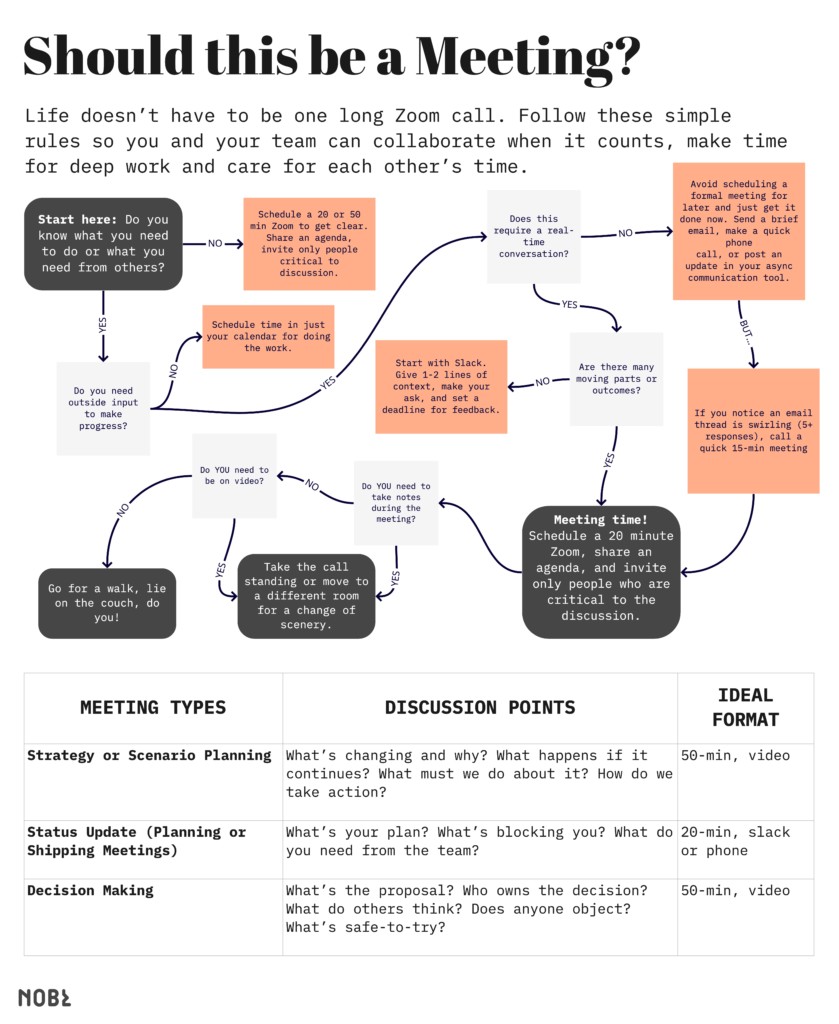
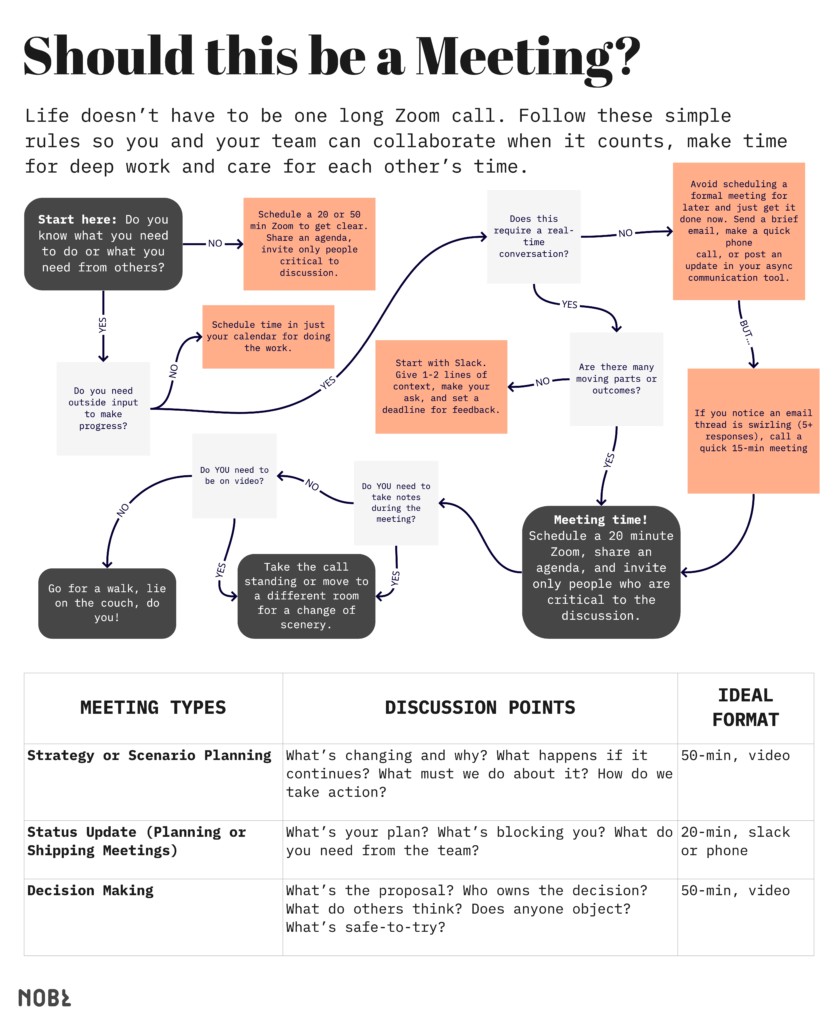
Should this be a meeting? in one image
Without saying much, please find the image below or here.
New Inspiring Episodes on the Choosing Leadership Podcast
Below are the latest episodes where I have interviewed these amazing leaders. Listen to their story to know the choices they have made to be where they are now.
That’s it for now. If you have any questions or feedback, or if you are new and want to introduce yourself, hit reply. I read and respond to every reply. All the best,
Sumit
P.S. – If you are in Amsterdam, I am co-leading a 5-week leadership BootCamp later this year. There are only a few seats remaining. If you want to join or send a few people from your leadership team, simply reply back. More details here
This is the Leadership Journey series on the Choosing Leadership Podcast.
I believe we all have a lot to learn from each other’s stories – of where we started, where we are now, and our successes and struggles on the way. With this series of interviews, my attempt is to give leaders an opportunity to share their stories and for all of us to learn from their generous sharing.
In the interview, we talk about how that led him to create a software solution to fix communication breakdowns. Brian shared how any corporate group behaves like a larger organism. We spoke about the transition from working in a company to starting your own thing, and how that requires stopping being anonymous and becoming comfortable with being in the limelight.
What happens is there’s this slow disengagement of the employee over a long period of time.
The decentralized process has more to do with the efficiency of creating better relationships than it does, even information because information only travels when the relationships are in a growth cycle.
You have to put yourself out there and say, Hey, this is what I’ve got. This is who I am. And it’s a totally different process. You become a promoter of yourself and then you’re creating, new relationships constantly on the outside.
We’re all part of basically the same growing organism, and that organism works better when our relationships work better.
COVID pulled us apart. And we saw the, I think we’re seeing the after-effects of that.
Unfortunately, sometimes it takes an accident before people realized how important they are to one another.
A bigger group has an emotional body and a mental body just like you.
Organizations are built like a tree.
I don’t think anybody wants to be in a state of conflict. So any system that we can put in place where. We get out of that state of conflict. All you have to do is start the growing cycle.
Conflict is a negative growing cycle where you’re, you’re growing up apart. You just have to overcome that negative growing cycle.
Nobody grows without failures. And well, what we conceive as failures actually tell us more about ourselves in order for us to keep moving forward. So I think I’m grateful for all those experiences
The world today is obsessed with looks. Media, in every form, exacerbates the importance of the “perfect look”. Definitions of size, shape, colour, hair, etc. have been blown out of proportion. Moreover, the compulsion to fit within others’ ideas of perfection has made body-shaming and self-hatred more common, leading to people having unhealthy relationships with their own bodies.
The Body Is Not An Apology (2018) by Sonya Renee Taylor calls out this unhealthy habit. It proposes the concept of radical self-love, a way to overthrow unhealthy relationships, understand the mental processes that encourage people to hate their bodies, accept and appreciate the uniqueness of one’s own body, and work towards reconstructing a society that accepts physical differences rather than shaming them.
Radical Self-Love
In order to understand radical self-love, one has to understand how different it is from self-esteem and self-acceptance.
Consider an analogy. Radical self-love can be perceived as a tropical island where self-esteem thrives. However, the two are not the same. For example, if self-esteem were to be a ship, it is pushed across the oceans by wins of ego and willpower. Such ideals can cause a ship of self-esteem to crash. While selfish and arrogant people have confidence and high levels of self-esteem, they don’t epitomize love.
Radical self-esteem differs from self-acceptance too. If one thinks back to any time in one’s life when one merely accepted something, one will find that the feelings weren’t inspiring or enjoyable. Self-acceptance is merely accepting oneself and is far placed from radical self-love. Anyone can do better than merely accepting oneself, especially when it comes to respecting and loving oneself.
In order to get closer to radical self-love, one has to learn how to better one’s attitudes toward oneself and towards others.
Acceptance And Celebration Of Oneself And Others
In radical self-love, loving oneself is primary. One’s body, (spiritual energies and soul aside) is physically present in the here and now. It is therefore sensible to direct one’s self-love towards it first.
The Body Is Not An Apology by Sonya Renee Taylor – Book Summary and Review
Judgements are external ideas. One needs to accept that any harmful thoughts one harbours about oneself aren’t one’s own. They are comments and ideas that others have made. These judgements are constructs that have entered one’s mind and aren’t based on truth.
Loving one’s own body is highly beneficial. It not only benefits an individual but also those around. For example, loving one’s own body and celebrating it teaches children, family and friends to respect and appreciate their own bodies too. Radical self-love is more than just acceptance f one’s own body. It is about acceptance and celebration of the uniqueness of others’ bodies too.
In 2015, Dr Deb Burgard, a specialist in eating disorders made a movie called The Danger Of Poodle Science. The satirical film highlights the crazy concept that a dog’s health is determined based on how closely it resembles a poodle. Considering this idea, a St. Bernard would be a very unhealthy dog. The film focuses on how the world views health, happiness and beauty as a one-size-fits-all concept.
A Body-shamer who claims to worry for the health of a friend is more likely to use the word ‘health’ as a means to justify his own critique of the friend’s body. This is a problem more concerning than it is made out to be. People who have disabilities, or those who live with illnesses do not need to change themselves for the benefit of others.
The Body-shaming Initiation
Body-shaming, for many, originates in childhood, or during early puberty. The adolescent years, when bodies undergo change and are typically vulnerable, is when most learn to feel ashamed of their bodies.
According to a yahoo health study conducted in 2016 on about 2000 adults and teens, Body-shaming starts around the ages of 13-14, and for younger generations, around the ages of 9-10! While girls are told that they are fat, ugly or are humiliated for their breasts, boys get called out for being skinny or small. Gender non-conforming children are admonished that their self-expressions are entirely wrong!
The author recalls that as a child, while she was playing with the kids in the neighbourhood, the parents called out a girl called Nia – who was just entering puberty – and asked her if she was “stung by a bee”. While the author was confused at first, she learned that adults were making fun of her friend. The result? Nia learnt that breasts were something to be ashamed of, and consequently stayed inside most of the summer.
Such Body-shaming that one encounter in childhood gets reinforced in adulthood.
The Reinforcement Of Body-shaming
The ideals of gender and beauty are flexible. Moreover, notions about the body are formed by political, economic and social landscapes. This makes the ideals of a perfect body a reflection of a society’s power structures.
That said anyone can be the face of beauty. It is not unrealistic. For example, in the 16th century, a fat body was a symbol of wealth and abundance, and hence, considered beautiful. Similarly, the perception of gender in society has also changed over generations. Queen Hatshepsut, in 1503, dressed like a man in a beard when she ascended the throne to show her subjects that she intended to rule like her male predecessors.
Today, it is unfortunate that the flexibility of gender and beauty do not conform to capitalism or media, and hence body-shaming is reinforced and emphasised. The sheer enormity of monetary incentives that are found in making people feel ashamed about their bodies is enticing. Products are advertised and sold, giving businesses and the advertising industry a boost.
The statistics say it all, while in 2015, EMarketer reported $513 billion were spent on advertising in the US alone, Business Wire reported that in 2014 global sales of beauty products hit a whopping $460 billion, that sky-rocketed to $675 billion in 2020.
Developing Radical-Self Love
Today, combating body-shaming and developing radical self-love can prove to be a daunting task – especially with the amount of media propagating body-shaming that is aimed at people.
Thus, it is vital to reduce one’s media intake. In fact, the average American adult, according to the technology company TiVo, spends about 12 hours consuming one or the other form of media. Reducing media intake becomes essential, as media tries to dictate how one should feel about one’s body.
Putting on radical self-love glasses, one will be able to see that everything, right from Netflix to YouTube to that favourite TV show, all portrays stereotypes about race, gender, disabilities, and body size in some way or another.
Often, the body is perceived merely as an accessory, whereas the mind is the identity. In order to develop radical self-love, one has to recognize that one is one’s body first.
In Eve Ensler’s TED Talk she too described how she felt not only disconnected and estranged from her body, but also felt unattached to it. She wrote The Vagina Monologues in an effort to reconnect with her body. She became sexually active too. Despite these efforts, she continued to feel detached from it and viewed it as a means to an end to sexual activity. It was only after she was diagnosed with cancer that she really began to view her body as her own, as something more and began to pay attention to it.
If one has to practice radical self-love, one has to reconcile with one’s own body.
Active Involvement With One’s Body
The voice of radical self-love will grow louder as one starts reducing media intake and starts reconciling with one’s own body. One has to be able to familiarize with one’s own body, and this requires practice.
One way is to learn about and get to know one’s own body intimately.
The body, for many years, has been perceived and associated with nasty features such as defecation and sweat. It is a conditioning that one needs to let go of. One should view the body as a miracle, and examine each and every part of the body, its structures, and how it performs simple as well as complicated functions. One has to get acquainted with it and then get active with it.
With radical self-love, one can rediscover the most beautiful thing about one’s body – movement. Sports, performing arts and even sex will then seem less like chores. One has to keep in mind that the movement of the body isn’t about losing weight or about changing it. It is about loving and enjoying what the body is capable of. That is what radical self-love aims to achieve.
Not Participating In Body-shaming
Everyone is involved in Body-shaming at some point in time. It is, in fact, easier to view Body-shamers as others who bully. Body-shaming, like mentioned above, is a deeply conditioned behaviour that sets in during childhood years – mainly through observation.
Social behaviours are learnt by watching grown-ups, and children learn that these are appropriate ways to act when they see the adults around them display these behaviours. Moreover, these behaviours are also reinforced at school. The Author recalls chants of ‘ Keisha, Keisha, bald spots’ directed toward a girl suffering from hair loss.
When there is no one to defend the person who is body-shamed, then these acts are encouraged in society. By not participating in defending, one indirectly participates in Body-shaming. The notion that differences in the body are to be felt ashamed of gets reinforced and internalized.
Hence it is vital that one recognized internal biases. One of the reasons this is difficult to do is because mostly, these behaviours are unconscious. This phenomenon is called implicit bias. Addressing implicit bias is vital to be able to accept one’s own as well as others’ bodies just as they are.
Practising Meditation
Mutual Body-shaming friendship is a common problem. For example, when one person tells a friend that the friend is actually beautiful, but they themselves are ugly is a mutual Body-shaming friendship.
It has to be stopped. People should start changing the way they talk about themselves. One has to understand the difference between vanity and self-appreciation. Society teaches one to be modest and never boast, but one should be able to recognize one’s place in society, and not hesitate to celebrate oneself.
Practising meditation is a great way to increase radical self-love. When one talks negatively about oneself, it reflects one’s own personal feelings. These feelings can be changed via mediation. A Carnegie Mellon University study in 2016 showed that meditation can increase one’s sense of well-being and reduce stress. Meditation can stimulate parts of the brain that process stress and the production of calm feelings.
Clearing one’s mind through meditation helps one to view one’s body in a positive light, and see it for what it’s worth. This can steer one on the path to radical self-love.
Conclusion
Radical self-love is unconditionally and unashamedly loving one’s own body. Moreover, it involves respecting others’ bodies for what they are. It has to be developed and practised.
Body shaming is an underrated social evil that is reinforced during one’s childhood. It is further fuelled by media and society’s perceptions of what beauty is. If one becomes aware of one’s own implicit biases, accepts and celebrates one’s own body, and gets actively involved in understanding one’s own body, one can work towards radical self-love.
This is the Leadership Journey series on the Choosing Leadership Podcast.
I believe we all have a lot to learn from each other’s stories – of where we started, where we are now, and our successes and struggles on the way. With this series of interviews, my attempt is to celebrate leaders for the choices they have made, which are not always easy or comfortable, and for all of us to learn from their generous sharing.
In the interview, Yasmina spoke about the power of being yourself and then demonstrated it wonderfully by being her wonderful self. We talked about thinking outside the box, connecting with people as human beings first, and her journey from her roots in Africa to working in many male-dominated industries. She shares with us the valuable lesson she learned from her dad about working for passion and not for making money.
We are doing it because we love doing it. And we impress people because we are driven by our passion. So passion is, again, all about your leadership.
I do not consider my teams like team members. I always keep them as a family because we grow together. We nurture together. I’m not your leader or your manager. I’m the person who’s just having the job title.
When we talk about leadership. It’s tribal, it’s really, tribal’s ways of doing.
Don’t be nice. Be yourself because you have your ups and downs.
As a leader, you can not fear being wrong or being not knowing.
The Western ways of living have made many realise the necessity of finding an inner steadying anchor. Due to the fast-paced lives, people lead today, many have turned to yoga to find happiness and inner peace, which are often lost in the race for success.
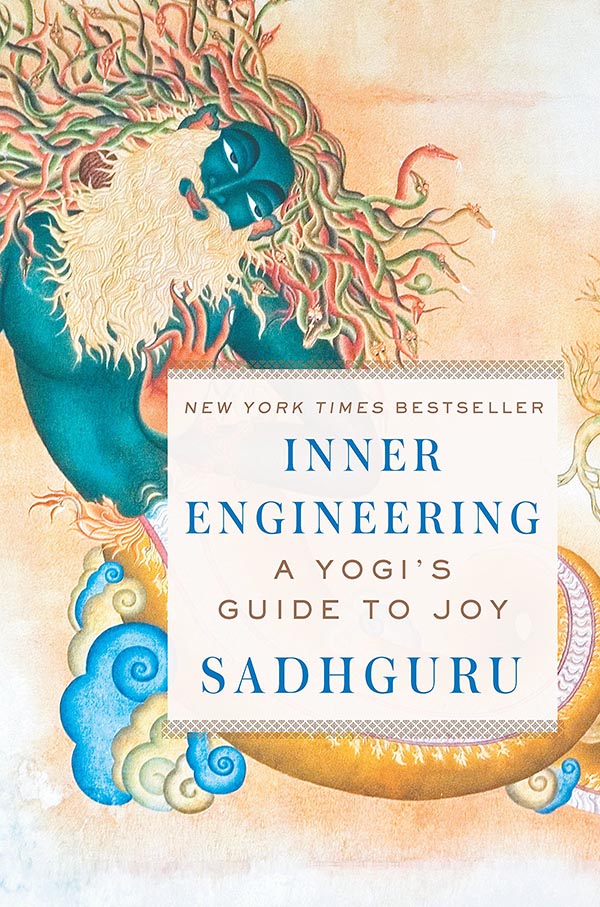
Inner Engineering (2016) by Sadhguru Jaggi Vasudev explains how yoga can be the means to find inner happiness, and how spiritual wisdom leads to lasting fulfilment. It shows how yoga is a philosophy that is more than just a form of physical exercise, and how it can help one rediscover spirituality, rather than just a ‘keep-fit’ class to get the body ready for the ongoing race for success.
Fulfilment Lies Within Oneself
Success is that shining star at the horizon that often makes people stray away from their true selves in its pursuit. While most blindly follow the path to success this way, it is only effective for a limited time. In the longer run, even the most successful people can’t find true happiness in life.
Inner Engineering (2016) by Sadhguru Jaggi Vasudev – Book Summary and Review
An Indian story explains this rather crudely. A pheasant once complained to the bull that its weak wings aren’t enough to take it to the top of the tree to enjoy the view. The bull advised the pheasant to eat a small bit of dung every day to strengthen its wings to reach the top.
The bull’s advice did indeed make the pheasant stronger, and one day it was able to reach the top of the tree. That day, a farmer saw the strong, juicy pheasant, and shot it out of the tree for his dinner. So much for the ‘bullshit’ advice!
The same goes for people too. Bullshit only ever gets one this far.
Fixating oneself to the outer world, convinced that that’s where all one emotions and experiences – positive and negative – lie, is simply an illusion. The key to finding fulfilment is to see the world from inside oneself.
For example, when one reads a book, where actually is the book that is being read? While rationally, it is the hands of the person, the script gets reflected by the light from the pages onto the retina of the person and is seen within.
Understanding this concept is vital. Just like everything else in the outside world is reflected within, fixating on the external prevents one from finding the fulfilment which lies within.
Emotions And Perceptions Are Self-Generated
Human experiences are often paradoxical. For instance, while one longs for a hug at one time, one gets irritated by the show of intimacy at another time. This proves that feelings, perceptions and emotions are completely self-generated. Just like the book, and other objects in the world can be perceived from within, feelings too work the same way.
Feelings such as anger and fear are reactions that are unconsciously produced by the body. Yet the human body-mind has the ability to make them conscious and control them. For example, when a person is yelled at, the person can choose a conscious response. This is the way humans create their own life experiences.
According to the Israeli chemist Raphael Mechoulam, people have the ability to create their own ‘bliss molecule’, rather than depend on alcohol and drugs that create temporary happiness within. The chemical, called anandamide can stimulate the nerves just like marijuana can.
When it is released into the body, it produces a sense of absolute pleasure, without side effects. One only needs to experience or exercise states of flow and ease while working to trigger the chemical.
Yogis, however, have the ability to produce anandamide simply through willpower and concentration, by learning to control their bodies to an incredible extent. The good news is, that everyone has a similar ability to control their own life experiences.
Respond Consciously Rather Than Compulsively
Painful experiences in life make people compulsively obsess over them. For example, a person going through a bitter breakup will compulsively tend to replay the experience of the partner cheating over and over again in the mind, until the mind fully identifies with the feeling of pain of the situation, and eventually makes the person incapable of trusting another lover.
However, there are more conscious and different ways to respond to experiences and events in life. The way involves learning from them by reflecting on them. Such an approach enables one to grow personally from adversity – big or small.
For example, the author knows a woman who, during her childhood was separated from her parents during World War II. Along with her brother, she was taken to the train station, where she realised her brother had lost his shoes while playing with the other boys in the group. She scolded her brother and called him an idiot. Unfortunately, she and her brother were immediately separated after that, and she never saw her brother again. She later learned that he died at a concentration camp. Her last words to her brother were unkind.
Despite the pain and anger she felt, she resolved to learn from the experience. She consciously made a choice to never say anything to anyone that she would regret later on. She made herself consciously aware that every conversation could be the last with any given person. This conscious decision changed her outlook, making her life more fulfilling.
This shows that holding grudges, and reliving memories of painful and shameful events never serves anyone. All one needs to do is break the cycle of compulsive reactions, and take the path of conscious responses.
Responsibility Increases Freedom
Just as consciously reacting to life events is an important concept in leading a fulfilling life, responsibility is another important concept. Responsibility is one’s ability to take a step back and consider the options one has while deciding the best way to respond to any situation.
For example, a round-the-journey, when considered responsibly opens up many options to choose from, as opposed to making decisions on a whim. One could choose to not go, take the family along, go alone, etc. Simply thinking or acknowledging, and considering one’s choices amounts to being responsible, increasing responsibility rather than diminishing it. Thus being responsible doesn’t even need one to take action. Responsibility gives freedom to act, and that choice depends on the person.
Consider how a responsible citizen gets affected by news on global warming. While it is impossible for the person to take action against all the problems of global warming, the person still feels incumbent to do something about it. Hence the person chooses to be responsible for all his actions that could affect global warming.
On the other hand, when an earthquake hits a country on the other side of the globe, the responsible reaction a person can have is to think how, sitting on the other side of the globe, help can be given to those affected. Does the person have the resources, money, skill, or even the drive to leave all responsibilities at hand and go to help? If not, then the decision of not helping is also being responsible.
Such conscious response, rather than turning a blind eye, amounts to being responsible too.
Alignment Of The Body, Mind, Emotion And Energy For Enlightenment
Just as teamwork lies at the crux of a successful organization, teamwork is vital within an organism. The different parts of the body have to work in sync for the organism to live and function well.
Similarly, to reach enlightenment, the body, mind, emotions and energy have to be in tight-knit cooperation with each other. The following Indian story explains this beautifully.
Four yogis, the first a believer of the power of physical yoga, the second a believer of the yoga of the mind, the third a believer of the yoga of prayer and the fourth a believer of the yoga of chakras (or energy centres), were walking through the forest. Each of them believed that their method of yoga was supreme.
As it started raining, they sought refuge in an ancient temple without walls. The deity was in the centre with a roof above that was supported by pillars. As the rain poured down harder, the yogis gathered around the deity, finally embracing it to shelter themselves from the rain.
Just at that moment, God appeared. The yogis questioned why God chose to appear now rather than earlier when they spent their lives working for and praying to him. God laughed at their question and replied that they had finally joined forces.
Similarly, achieving enlightenment requires the coming together or unity of the body, mind, emotions and energy. For instance, if the body is in balance, but the mind craves food, the body will fall out of balance. Similarly, an emotional state of mind disbalances the energy of the chakras. Yogic philosophy states that without this tandem working, the individual cannot achieve true balance. Thus one needs to pray, meditate, and practice yoga exercises, that keep the chakras in balance too.
Such alignment can be found when one rediscovers one’s place in the universe.
The Universe, The Earth, The Body
The body is made from the things that made the earth. We are all intimately connected with the earth, and anything affecting it affects the human body too.
If we widen the perspective, the earth is a part of the universe. Hence by extension, the body is too. It is why all cosmic events such as the alignment of the stars, and the positions of the moon and the sun, all affect the human body too.
Hence, the body is a part of the earth and the universe and can tune into them.
Once, the author hired a deaf man named Chikkegowda to tend his farm, who no one wanted to hire due to his disability. One day out of the blue, Chikkegowda took the plough to the fields. When asked why, he said it was going to rain, and the land should be ploughed. Sure enough, it rained that day.
Like Chikkegowda was, many country dwellers are attuned to the meteorological changes that take place around them. They can be felt within the body, and one can teach the body to become aware of these transitions.
The Limitations Of Science And Intellect
The present age is a scientific age. We have placed our beliefs in science, without realising that science too, has human limitations. This belief can prevent one from experiencing life to the fullest.
Once, Aristotle was walking along the sea shore, too lost in thought to even notice the beautiful sunset. Suddenly, he saw a man digging a hole with a spoon. When Aristotle asked him what he was doing, he said he was digging a hole to fit the ocean in it.
Aristotle laughed and asked how could the ocean fit into the hole. The man replied, “you make fun of me for wanting to fit the ocean into this small hole, but you’re big-headed enough to believe you can fit all the secrets of the universe into your brain, which is also basically a small hole. So, which of us is crazier?” The man was the philosopher Heraclitus.
In order to experience life, it is necessary to recognize how insignificant humans and their thoughts are as compared to the universe. Intellect always makes people believe that they can grasp the essence of life. However, in reality, it can never fathom how the complex universe, and the delicate balance of the cosmos functions.
Reality is much larger, and one should have the intellect to acknowledge it.
Spiritual Energetic Locations
Spirituality is a vast ocean, and one seeking it often gets lost. Where can one begin? Surprisingly, travel is a great way to begin one’s spiritual journey of exploration.
There are many places in the world that are stores of spiritual energy. These places are often high mountain summits, where yogis have practised yoga and attained spiritual knowledge, which is where that energy is stored. For example, Mount Kailash in Tibet, which is considered the home of the Gods by Hindus and Buddhists, or the Kedarnath temple in the Indian Himalayas, which is dedicated to Lord Shiva.
Such places have stores of energy, where one can find enlightenment and heal.
The author, in 2007, was suffering from a combination of malaria, typhoid and cancer. Doctors were baffled, and could not clearly diagnose the illness. However, upon reaching Mount Kailash he was able to reconnect his energy with the energy of the mountain. He immediately started feeling better and was recovering faster.
Such locations are the best place for spiritual seekers to start their journey. One has to simply find a guru who will guide their path.
Conclusion
The key to finding fulfilment lies within oneself. Everyone has the ability to control their own perception and experiences, and respond consciously rather than compulsively to them. By aligning one body, mind, emotions and energy, one can find enlightenment. Such a spiritual journey to finding happiness, joy and peace, can be guided by a guru.
I use cookies on this website to give you the most relevant experience and for analytics purposes. Any personal data collected will never be shared with any third party, or used to spam you. That is my promise. - Sumit By clicking “Accept”, you consent to the use of ALL the cookies.
This website uses cookies to improve your experience while you navigate through the website. Out of these, the cookies that are categorized as necessary are stored on your browser as they are essential for the working of basic functionalities of the website. We also use third-party cookies that help us analyze and understand how you use this website. These cookies will be stored in your browser only with your consent. You also have the option to opt-out of these cookies. But opting out of some of these cookies may affect your browsing experience.
Necessary cookies are absolutely essential for the website to function properly. This category only includes cookies that ensures basic functionalities and security features of the website. These cookies do not store any personal information.
Any cookies that may not be particularly necessary for the website to function and is used specifically to collect user personal data via analytics, ads, other embedded contents are termed as non-necessary cookies. It is mandatory to procure user consent prior to running these cookies on your website.