Welcome to the Deploy Yourself Newsletter. Every two weeks I share what impactful leadership looks like to show your own power. I also share the most insightful lessons and stories I encountered in the last two weeks. You can also read this issue online.
Hey,
Discover Your Most Powerful Tool – Language
Language, and especially using it to create the future we want, is the best tool we have. We have the power to choose, in any given moment and circumstance, the life we are going to live. And that happens in language. We all have it within us to give up being a victim and take a stand for everything that matters in our lives. And that happens in language.
We live in language just like fish live in water. Language is not only for describing and communicating. Its most powerful use is in creating a future. That happens when you make a declaration. Recall every time you said “yes” to a request or made a “commitment”. In these moments you were not just describing and communicating, you were creating a future. All human progress was created first in someone’s words – before it manifested as tools, technology, and objects.
The only person who can envision and create your future is you. And that happens in language. The only person who can pin you down or defeat you is you. And that happens in language too. You produce every result by having conversations. Similarly, there is a missing conversation behind every result you desire but do not currently have.
Reply to this email right now if it sparked something for you, or if you want to know more…
Articles and Stories Which Have Fascinated Me
One
Be The Water in a River, Not Like in a Glass
If you add salt to a glass of water, it becomes salty. And if you add salt to a river, the water stays as it is. In life, be more like the river and less like the glass when dealing with other’s emotions. The river and the glass are wonderful metaphors for having a big heart.
Leadership is not a role; it is a mindset. It is about taking a stand and operating from a place of responsibility in all situations – and that includes the possibility of making mistakes and stumbling on the way.
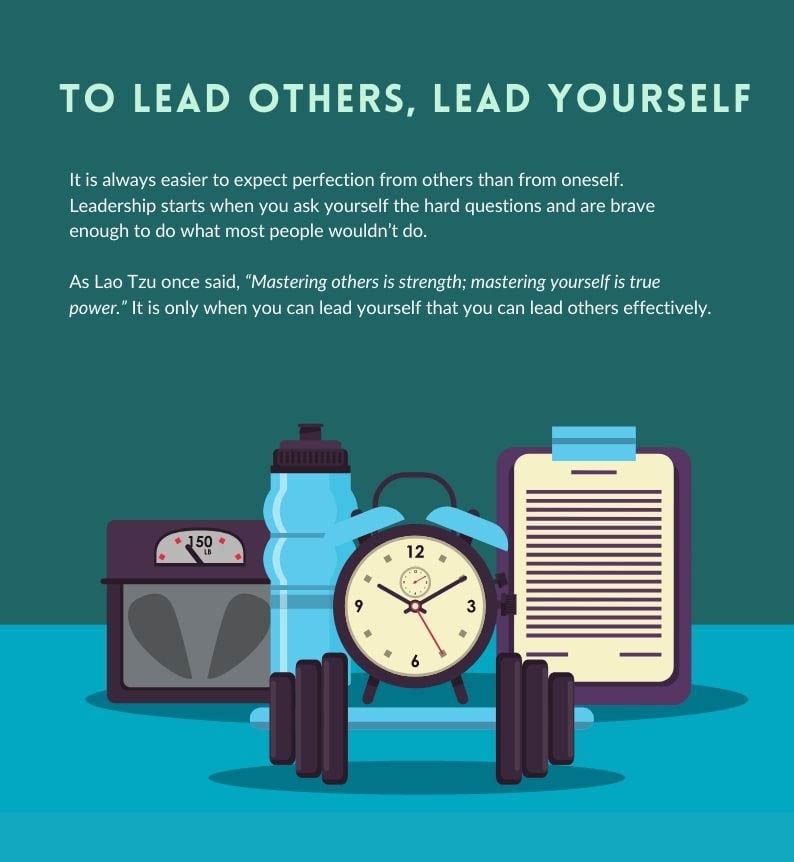
Leadership starts from reflection and focussing inwards. Leadership starts when you ask yourself the hard questions and are brave enough to do what most people wouldn’t do. As Lao Tzu once said, “Mastering others is strength; mastering yourself is true power.” It is only when you can lead yourself that you can lead others effectively.
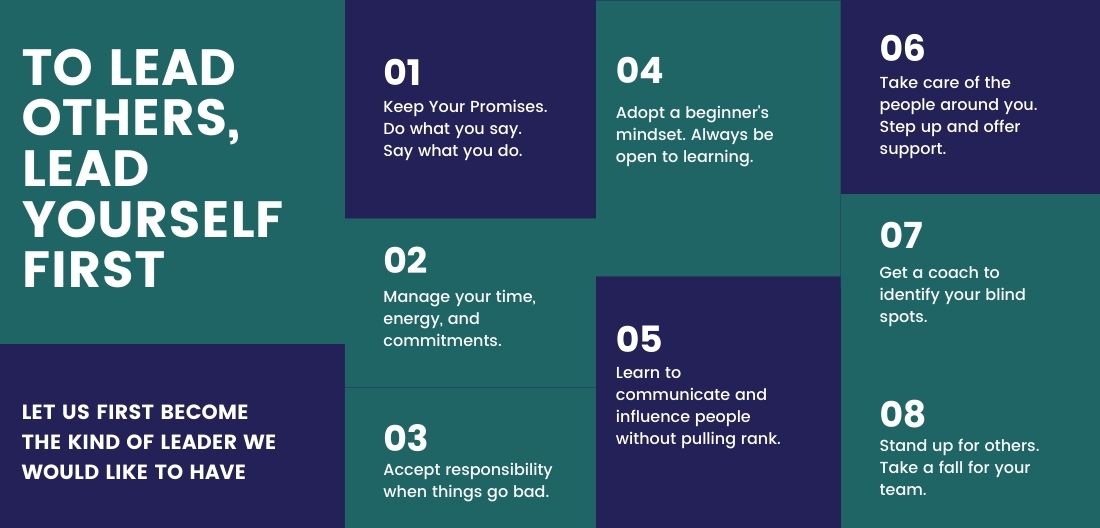
Here are 8 leadership skills and qualities to do so :-
The key to turning your experience into words is prioritization. Writing is a muscle, a marathon, and a legacy. My writing went from general advice to specific life musings. Instead of branching to more topics, I began to share my fears, dreams, and hesitations. People came for the content and stayed for the character. Aim to share your intimate and unfiltered thoughts, and you will intrigue your readers.
Not everyone is good at saving money. While there are people who have mastered the art of managing their accounts, a majority of us fall prey to the inherent human nature to be bad at saving money, despite a number of efforts. Additionally, we can be pretty irrational about expenditure.
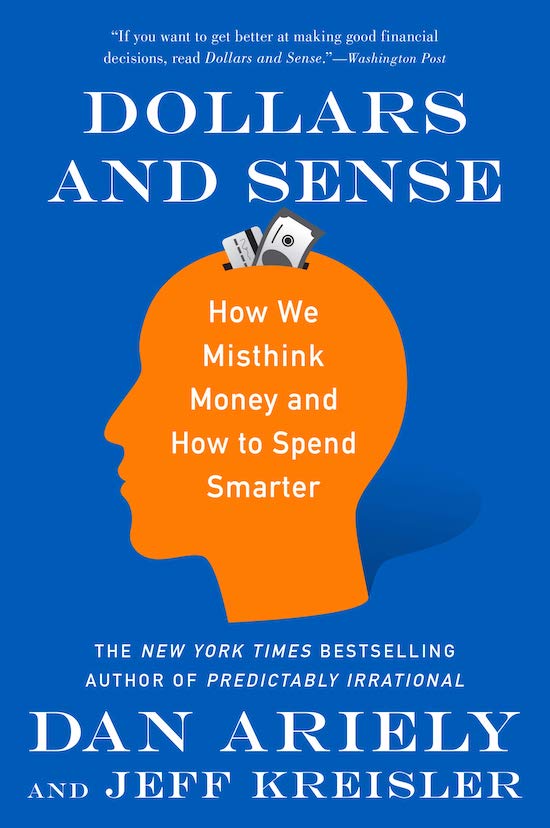
Dollars and Sense (2017) by Dan Ariely and Jeff Kreisler point out the reasons why rationalism with our own money eludes us. They touch upon fundamental human characteristics, emotions versus common sense, and other flaws that are at the crux of bad spending habits.
No One Considers An Alternative to Expenditure
A few years ago, Dan Ariely, asked a few Toyota customers at a dealership, what purchases were they giving up in order to buy a new car? Most of the customers did not understand what his questions meant. Upon explaining further, many said that they were giving up on the opportunity to buy a different car. However, out of those few who did make the connection, answered that were giving up on a vacation, or eating out, etc.
What most people do not realize is that while money might be an abstract concept, its value enables our choices. However, humans do not naturally think of alternatives to what their money can get them. These alternatives, in economics, are known as Opportunity Costs. Most do not even consider these opportunity costs, making massive expenditure errors.
Dollars and Sense (2017) by Dan Ariely and Jeff Kreisler
Enticing, Misleading Value Cues
As customers, we tend to place importance, and rely more on ‘value cues’. ‘Value Cues’ are external signs and hints that are suggestive of an item’s real value.
In a utopian situation, rationality would make people consider ‘opportunity costs’ while making purchase decisions, rather than focus on value cues such as, “limited offer” or “end-of-season-sale”. Salesmen often use such value cues to entice customers to make their purchases now, or miss the opportunity forever!
Yet, value cues can be helpful too. They can provide a true sense of the value of any commodity, and help in making practical purchases. However, they are used by companies to mislead customers into making buying decisions. Additionally, misleading value cues are used to skew a customers’ sense of value.
Value Cues, Comparison Shopping, and Decision Making
If we are susceptible to be misled by enticing value cues, how do we really make buying decisions? Do we understand the value of the things we buy? If we do understand, then why do we not consider opportunity costs?
Actually, it is difficult to ascertain the value of any product by simply looking at it. For example, if we want to buy a phone, we do not look at other factors such as the cost of labor, materials, shipping, manufacturing, etc. affecting its overall value. Instead, we use comparison with similar products, a mental shortcut, to determine the value of the phone we want to buy.
Such comparison-shopping can be misleading too. Nevertheless, humans, as customers, need value cues to guide their buying decisions. In 2012, Ron Johnson took over as the CEO of JCPenney, the department store. The routine practice there was to increase the prices of products and then introduce sales, discounts, and coupons, to bring the prices back to retail value. Johnson did not like the practice of misleading customers and decided to discontinue the practice, with good intentions. He discontinued all discounts and retained original retail prices. This made customers unhappy, and within a year, JCPenney lost $985 million.
Consumers needed the enticing, misleading value cues for the feel good factor of getting a bargain.
What If’s, Mental And Emotional Accounting
Everyone uses mental accounting to make financial decisions. Mental accounting is weighing out one’s options while making financial decisions. Therefore, mental accounting is a very subjective concept and differs based on one’s circumstances, understanding of the situation, and of course, financial understanding, and its implications. Mental accounting can be irrational by nature.
For example, lets look at two ‘what if’ scenarios –
What if the $100 bill concert ticket you bought, flies out of the bus window on the way to the concert? Would you buy another one for the same price? And,
What if you lost a $100 bill on the way to buying the $100 concert ticket? Would you still buy it?
Different people do mental accounting differently. For example, for someone, the money has already been spent on the ticket that got lost. The feeling will be different from when the $100 bill is lost, as the value for the $100 is not assigned a category (in one’s mind) yet.
Many who were asked these ‘what if’s’, chose to take out a new $100 bill and buy the ticket, however, not buy a new ticket if the one already purchased gets lost. Such is the irrationality of mental accounting.
However, there is a purpose to mental accounting too. Rationally, in both the scenarios, the value of the lost ticket and the lost $100 bill is the same, and therefore, the loss of value is the same. However, we all get countless opportunity cost options every time we think of any expenditure. How we choose is another thing altogether.
That is where emotional accounting comes into place. Emotional attachment to money and value greatly influences buying and spending decisions. Emotional accounting can be bad and one has to be wary of it. For example, when someone deals with money that comes to us from a source that we do not like, they try to add justifications to the expenditure of that money only to make themselves feel better. They might donate a small part of it to charity, feel better, and then frivolously spend the rest of it.
Perception Of Value
Our perception of the world around us and our experiences with our surroundings are hugely influenced by language. Let us try to understand the differences between the following two sentences –
Living with 20% lesser salary
Living off of only 80% salary
There is no difference between the two! Nevertheless, in 1988, a Journal Of Consumer Research study showed that people were more interested in spending their retirement with 80% of their income rather than 20% less of it. it was just a play of words.
Similarly, language is used as a key for advertising and influencing customer choices. For example, in restaurants, a wine with ‘earthy notes of oak and tobacco’ will easily sell for $80, whereas it wont even sell for $30 at a grocery store.
This phenomenon is known as ‘consumption vocabulary’. It links a word to the superiority of a product in consumers’ minds. For example, the word ‘artisan’ gives one the feeling of superiority, handmade, and thus more expensive.
Another way by which our perception of value increases is by adding a ritual around a product. This ritual can improve the experience. For example, the ritual of swirling wine in a goblet, taking in the heady fragrances, and finally tasting it, creates an experience that increases the value of a wine tasting.
Self-Control And Resisting Expenditure
Often people look for new ways to budgeting their money and reducing expenditure simply because we are irrational. Yet, despite efforts, they fail to save their money. This happens because they are unable to exercise their self-control while spending, making bad decisions.
It is essential that people start to consciously exercise their self-control by connecting emotionally to their own futures. This can be done by thinking of your future self. For example, one can see their future selves as fat couch potatoes binging on ice creams. While they know that their current habits are leading them towards that future, they choose to give in to the temptations because that future-self is remote, far, and un-relatable. Additionally, the fact that our future-self is a probability, we dismiss it.
One way to work around such temptations to spend, according to UCLA’s Hal Hershfield, is to write a letter to your future-self and forging an emotional connection. Additionally, one can also create visions or imagine your future-self appreciating past efforts of saving and enjoying the benefits.
Setting a tangible fixed date to retirement is another way to encourage yourself to save for it. for example, saving for use after ‘10 November 2050’ makes it more real than saving for ’30 years later’, which sounds like a generalization.
Concluding With The Ulysses Contract
According to the famed Greek legend, Ulysses had to be tied to the mast of his ship by his crew to avoid the Sirens’ alluring and deadly songs. Similarly, a Ulysses contract is setting up a structure or a process where a bad decision is not an option at all.
For example, if a person is habitually bad at managing credit cards that person should best avoid keeping credit cards and stick to debit cards. Or if a person cannot seem to save money, they should set up a standing instruction to directly put an amount in savings from their monthly paycheck.
Automated savings have shown to help people save about 81% more yearly.
In conclusion, even though we are wired to be bad at spending money, and make irrational expense decisions, we should stop making excuses and take efforts to save more and make better spending decisions. While changing spending habits doesn’t come naturally, nor happens instantly, one can definitely try and use methods such as Ulysses Contracts to help them save.
Many people view leadership with a narrow lens – as simply directing others to meet certain goals. However, leadership is not a role; it is a mindset. It is about taking a stand and operating from a place of responsibility in all situations – and that includes the possibility of making mistakes and stumbling on the way.
A good illustration of why having a leadership mindset is crucial is the King’s Cross Subway Station fire in Central London on November 18, 1987. On that fateful day, commuters noticed a pile of burning papers on the tracks and alerted the ticket-collecting staff. However, due to policies, the staffers were not permitted to leave their workstations, so someone alerted their supervisor, who also alerted their manager.
As that message was making its way up the chain of command, so was the fire. As fate would have it, the paint used on the tunnels was flammable. When the fire reached one of those tunnels, it left 31 people dead and injured about 100.
Looking back at it, it was a failure in leadership that caused that tragedy. If the ticket collectors had taken action immediately, the fire would have been quelled sooner. The same would have happened if each supervisor had not decided that “it was not their job.” And, of course, anyone could have stepped up as a “leader” to strip off the old flammable paint.
In short, if only one person had taken charge and shown leadership qualities, 31 souls would not have been lost.
But why is it so difficult for people to act as leaders? Why are leadership skills so rare? One reason is that organizations tend to value processes more than doing what is right. People justify not doing what they knew was the right thing because they were supposed to do something else or it was someone else’s job according to the process book.
A lack of leadership traits and qualities is also a reflection of the lack of deeper inner work among aspiring leaders. It is always easier to expect perfection from others than from oneself. Leadership takes commitment, integrity, and standing for something larger than oneself. And often people have good reasons for not doing what they know is the right thing to do.
Leadership starts from reflection and focussing inwards. Leadership starts when you ask yourself the hard questions and are brave enough to do what most people wouldn’t do. As Lao Tzu once said, “Mastering others is strength; mastering yourself is true power.” It is only when you can lead yourself that you can lead others effectively.
Are you leading yourself effectively? Here are 8 leadership traits and qualities to do so :-
1. Keep Your Promises. Do What You Say. Say What You Do.
This boils down to a simple question – Are you trustworthy? Can people rely on you?
“Gain a modest reputation for being unreliable and you will never be asked to do a thing.” – Paul Theroux.
In the past, a promise and a handshake are all people had to do to seal a deal. These days, however, you have to sign all kinds of papers to be held accountable for your promises. Why is this the case? Unreliability is almost the norm today.
The ability to keep promises and its positive effects can be far-reaching. Keeping your promises is the definition of integrity. In his bestseller, The 7 Habits of Highly Effective People, Stephen R. Covey defines integrity as “Making reality conform to your words.” This means going above and beyond to see to it that your promises are not mere words.
Being a person of integrity has a huge impact on your leadership ability:
It allows others to trust you
It allows you to influence others without pulling rank
The impact of your leadership increases with your influence
Considering how honouring promises is a critical skill for leadership success, why do some leaders struggle with keeping their word?
One of the main reasons for broken promises today is the need to please people. Afraid to disappoint, many people find it difficult to say no and say YES even when they are not willing to fully stand behind their promise.
Other reasons include:
Not realizing that you either made or implied a promise
Losing enthusiasm upon realizing how difficult keeping that promise is
Lacking the strength to follow through
The consequences of not being able to keep your promises to yourself and others can be severe. For starters, you will have low self-esteem because you cannot trust yourself to keep your word. Secondly, people will not be enthusiastic about working with or collaborating with you.
How to Keep Your Promises
We all break promises occasionally. To keep that at a minimum, consider the following:
Think First Before Committing
Most broken promises stem from impulsive decisions or an inability to say no. It is wiser to think first before agreeing to anything. Check whether you have the ability, resources, and time needed to deliver something. If you are in doubt, either decline the request politely or negotiate an alternative promise. The skill to say NO is a very important but often ignored leadership quality.
Be Principled
This means having integrity as one of the values you hold dear. This means that you will never allow yourself to go back on your word.
Your credibility as a leader rests on your integrity. Remember, there is no trust without integrity. If your team cannot trust your decisions, you will have an incredibly difficult time leading them to success.
Lead Yourself First – The Most Important Leadership Quality
2. Manage Your Time, Energy, and Commitments. Be Ambitious. But Don’t Take On More Than You Can Handle
You cannot lead others effectively if you are having a difficult time leading yourself. This means having the skill to prioritize goals and holding yourself accountable for their accomplishment.
As a leader, the ability to manage your time, emotions, and attention while maintaining an objective view of your strengths and weaknesses is arguably the most important factor of success. Effective leaders are exceptional at balancing their lives.
The following tips should help you manage yourself more effectively:
Be Organized
Start with keeping your work area neat. According to research, working in a clean office improves productivity dramatically. This is because the brain focuses better when there is less clutter around. Moreover, the simple act of cleaning gives you a sense of accomplishment, thus setting up the rest of your day for success. The proper organization allows you to plan, prioritize, and act on your goals more effectively.
Set Goals
Setting goals is the process of determining your objectives in a clear and well-defined way, as well as creating an action plan for achieving them. This allows you to be strategic in your actions instead of winging them. You will be less likely to mismanage yourself when you are following a set plan.
Manage Stress
Stressors often waylay us, as emotions can be overwhelming at times. For example, without effective stress management, a fight with your significant other in the morning could see you have a bad day at work.
One of the hallmarks of a strong leader is their ability to maintain calm during a storm. They are able to focus on their objectives regardless of their emotions. Unfortunately, no one is born a stoic. Emotional Intelligence is achieved by learning how to control one’s emotions.
Be Accountable
Take ownership of your thoughts, time, and actions. In the workplace, this means accepting responsibility for your team’s performance. One of the best ways of exercising accountability is by assigning deadlines to yourself and doing whatever it takes to honour them.
“A person who refuses to manage himself and discipline his flesh will be disciplined and taught by life itself.” – Sunday Adelaja.
3. Accept Responsibility When Things Go Bad. Don’t Blame Others
Unfortunately, we live in a society where people like to take credit for success while passing blame for failure. You see it with politicians all the time. Perhaps, they feel like admitting that they made a mistake will mean losing credibility.
However, that mindset is detrimental to growth. How can you address a problem effectively if no one is willing to take responsibility? As a leader, if things go wrong under your watch, you should have no hesitation to look within and address what needs to be improved. After all, you are the one in charge.
While the words responsibility and accountability are often used interchangeably, when it comes to their influence on your mindset, they are quite different.
Accountability means being willing to accept the outcome of a project. As such, all you need to do is simply deliver the bare minimum. Accountability is often given by others and an external authority.
Responsibility, on the other hand, is a choice. It is a leadership trait as well as a mindset. It means taking it upon yourself to not only see the project through but also that it is a success. A responsible leader, therefore, will never be comfortable with delivering the bare minimum. They are proud when the organization succeeds and are willing to take the blame when their team under-delivers.
If there is a problem, take it upon yourself to solve it. Do not assume that someone else will. The same goes for decisions. You do not have to wait for authority from someone else. Responsibility is a choice.
Be Result-Driven
Your effectiveness as a leader ultimately depends on your team’s results. Therefore, instead of focusing on pleasing your team, focus on supporting them on their tasks. In case the desired results fail to materialize, go back to the drawing board and identify the pitfalls, and then come up with a new strategy.
Accept Criticism
You are not perfect; nobody is. This means that you will make mistakes occasionally. Accept any criticism that comes your way without becoming attached. Review the feedback and then make amends.
Protect Your Subordinates
This means acting as a buffer between senior management and your team. If senior management is making unreasonable demands, do not pass down those directives without expressing your authentic voice. Irrespective of the outcome, it will build trust if you stand by your values and fight for them.
Ensure Your Team Always Has Resources
Do not hesitate to ask for the resources your team needs. This will allow your department to run like a well-oiled machine. Go seek help and find those resources if your team is lacking.
Hold Others Accountable
Ensure that every member is working towards the team’s goal. Do not incentivize individual performance over team goals. Do this by holding them accountable for their team spirit. Let your people know that they are not only responsible for their own goals but also for the entire team.
4. Adopt a beginner’s mindset and always be open to learning
“I know that I know nothing” – Socrates.
To Socrates, the beginning of wisdom was accepting that you are an empty vessel. As a result, you will always be a beginner and hungry for learning.
Great leaders understand that they do not have all the solutions. As such, they have an insatiable curiosity for learning, as that is what helps them grow.
This means taking advice even from your subordinates, which is something many people simply cannot do.
We are living in an incredibly fast-paced world. This means that what worked last year might not work this year. Therefore, continuously learning is the only way to prevent yourself from becoming obsolete.
5. Learn to communicate clearly and influence people by the weight of your arguments and not your rank
If there is something that most great leaders have in common, it is their ability to communicate and influence others. To get things done, you must know how to put your message across in a clear and convincing manner.
The most underrated communication skill is simply silence. Just listen. Great leaders do more listening than talking. By actively listening, they get to understand the other person’s perspective. Listening allows you to take care of others’ priorities and interests as well as taking care of the organization’s needs.
The benefits of active listening are tremendous. For starters, it is a demonstration of respect, as it shows that you value the other party’s ideas or opinions. This not only helps you construct good arguments but also builds trust.
6. Take care of the people around you. Step up to support colleagues if they need help.
Good leaders know that the health and wellness of their people play a critical role in the success of the organization. Productivity and wellbeing are not mutually exclusive, and strong leaders create an environment where people can express themselves freely.
As a result, they take it upon themselves to be supportive of their colleagues. This means offering mentorship or guidance whenever necessary. Good leaders also create a healthy environment where everyone flourishes.
“Leadership without support is like trying to make bricks without enough straw. True leaders reinforce their ideas and plans with strategic partnerships, alliances, and supportive audiences.” ~Reed Markham
7. Ask for regular feedback to identify your blind spots. Ask for help when you need to. Work with a Coach
Many leaders become so enamoured with the titles that they feel they are beyond asking for feedback. To them, not asking for feedback allows them to avoid criticism.
However, you will never be effective as a leader if you are more concerned about yourself than with the well-being of your team. This is because effective leadership comes from problem-solving as a team, not you solving everybody else’s problems.
Strong leaders are humble enough to acknowledge their limitations. As such, it is not beneath them to ask for feedback from their colleagues. What’s more, being humble makes you more relatable with your team members. Asking for feedback and hearing the honest truth is a very critical leadership skill and quality that can make all the difference.
Strong leaders work with a coach to identify their own blind spots. A coach can help you remove your own mental blocks and see possibilities that were hidden to you before.
8. Be selfless. Stand up for others. Take a fall for your team or your colleague. Speak your mind when it is what you believe, even at the risk of loss of reputation
Are you willing to stick your neck out for your team? Good leaders will have their team’s back no matter what. If the ship is sinking, they will be the last ones to leave.
Why is it important for a leader to be selfless? It is for the simple reason that your team looks up to you. According to the CEO of Michael Hyatt & Company, “Leaders replicate themselves, whether they like it or not. Your followers will adopt your habits and behaviours.” Therefore, if you want your team to act selflessly, you must be selfless in your actions.
One leadership trait present in courageous leaders is to speak their minds out. They express themselves fully and speak up for their values and standards, and are willing to take a fall for the team if speaking up means doing so. Strong leaders do not just follow orders from above. They follow their inner voice and listen to their conscience when making choices and decisions.
Conclusion
Mahatma Gandhi challenged us to be the change we want to see in the world. When it comes to becoming a better leader, you must be the change you want to see in your team, as well as in your communities and organizations. Before leading others, you must lead yourself.
Welcome to the Deploy Yourself Newsletter. Every two weeks I share what impactful leadership looks like to show your own power. I also share the most insightful lessons and stories I encountered in the last two weeks. You can also read this issue online.
Hey,
Are You Speaking Your Truth?
I struggled with fear for a long time – fear to start this newsletter, fear to pursue coaching full-time, etc. What I have figured out in the last few years is that fear tells you what you really care about. Fear reveals what will make your life meaningful and make you come alive. Underneath fear is desire – the desire of what you really really long for.
Fear is very useful as it is designed to keep us safe. It helps us escape danger, and plan for challenging situations. Fear is also a sign that you have a dream within you, and you long for something beyond your current comfort zone. You can either let fear stop you, or you can listen to fear and use it as a compass to guide you towards what you really really desire.
I feel a little fear every time I write this newsletter. I am scared to speak my truth to my coachees – the truth that they don’t want to hear. But the truth is what my coachees want and pay me for. I speak to them as nobody would. As a coach, it is my job to serve them, not please them.
Are you speaking your truth? Or, are you playing safe and only saying what is acceptable around you – at your work, in your family, and in your communities. It is not easy and comfortable. But it very meaningful and empowering. It scares me every time I speak my truth to a coachee, but it becomes worth it when they later thank me for saying it.
I AM IN. ARE YOU?
Reply to this email right now if it sparked something for you, or if you want to know more…
Articles and Stories Which Have Fascinated Me
One
Lessons From Geniuses, and How To Be One?
IQ, it turns out, is overrated and so, too, are other standardised tests, grades, Ivy League schools, and mentors. Stephen Hawking didn’t read until he was eight; Picasso and Beethoven couldn’t do basic mathematics. Jack Ma, John Lennon, Thomas Edison, Winston Churchill, Walt Disney, Charles Darwin, William Faulkner, and Steve Jobs likewise were all academic underachievers.
If IQ is overrated, curiosity and persistence are not. Nor is having a childlike imagination through adult life, the capacity to relax so as to allow disparate ideas to coalesce into new, original ones, and the ability to construct a habit for work so as to get the product out the door. Genius is not an absolute but a human construct that’s dependent on time, place, and culture.
Celebrate and Reward Yourself To Make New Habits Stick
If we really want to make lasting changes in our lives, psychologist BJ Fogg believes we need to break them down into specific, easy behaviors (what he calls Tiny Habits), and find ways to trigger and reward them. Taking 30 seconds or less, a Tiny Habit is fast, simple and will grow. For example, instead of having “get in shape” as a vague and intimidating goal, do two push-ups every time you make your morning coffee — that’s your Tiny Habit.
When you celebrate, you create a positive feeling inside yourself on demand. This good feeling wires the new habit into your brain. Emotions create habits. Not repetition. Not frequency. Not fairy dust. Emotions. Celebration is the best way to use emotions and create a positive feeling that wires in new habits. It’s free, fast, and available to people of every color, shape, size, income, and personality. In addition, celebration teaches us how to be nice to ourselves.
A definition of love beyond the limited domain of “romantic love”. Love (and care) is the foundation of trust. And trust is the foundation of all the work we do together as colleagues and comrades.
Love for a person is acceptance of him or her the way he is and the way he is not. – Werner Erhard
That’s it for now. If you have any questions, just hit reply. All the best,
Creativity is a buzzword these days. Every artist, businessman, executive, manager, professional, etc. wants to be creative. In other words, creativity is a virtue today that is at the crux of every job profile. Creativity, unfortunately, can fall prey to lack of inspiration, disillusionment, doubt, be susceptible to dry spells, and even creative blocks.
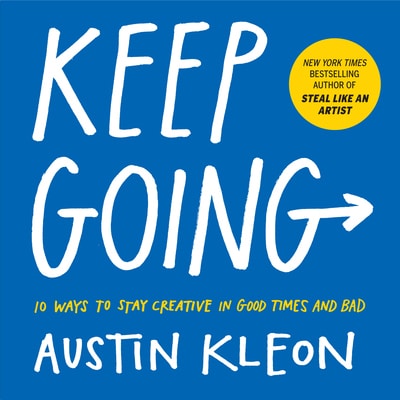
Keep Going (2019) by Austin Cleon is a push to all those needing to fall back on creativity, whether personally or professionally. It is a guide to fuel, rekindle, and persevere when there is a shortage of those creative juices. It helps all those who need to keep their creativity fires kindled and burning, and even to understand when they need to be put out!
The Daily Routine
Many people take the concept of the ‘daily routine’ lightly. They don’t fully understand the importance of it.
For many creative minds, their creativity is like the ebb and flow of the waves – sometimes gushing out or at times, out like a flashbulb for days! While these ups and downs of creativity cannot be controlled, one can surely control making the most of it!
Establishing a daily routine, a schedule, or even a habit that triggers – irrespective of whether the creativity is gushing or trickling – is the best way of harnessing whatever creativity one has. For example, Sylvia Plath always wrote in the mornings, early, before the family was up.
On the other hand, Franz Kafka found his creativity after the family was in bed, at night. An example of establishing a habit, John Steinbeck would sharpen a dozen or so pencils before writing and Goethe needed to smell rotten apples. There is really no ‘one’ solution that fits. Where creativity is concerned, routines vary from person to person, suited to their own personalities, needs, and circumstances.
Often, establishing a regime seems off-putting, arduous, and frustrating to some. However, one needs to remember that routine isn’t intended to sap-off freedom, but to give one the freedom and the specified time to pursue creative interests, without having anything else disturbing that time.
Keep Going (2019) by Austin Cleon
Time, Space And No Intrusion
To be creative, time, space, and no intrusions are very important. However, with a million distractions bombarding our senses every second, it is very difficult to get the much-needed peace and quiet.
Literary scholar and writer Joseph Campbell used the concept of a ‘bliss station’, a quiet and isolated place where one can sit and work without any disturbance or distractions. This ‘bliss station’ can be a place like a study or a garage, or if one has space constraints, it could be a scheduled time of the day or week, when one is alone.
Once the ‘bliss station’ is identified, one has to ensure that there are no disturbances of any type. This essentially means that one has to get into the ‘Airplane Mode’.
Just like our smartphones enable us to turn on the ‘Airplane Mode’, one needs to create an environment where distractions such as emails and messages are turned off. Additionally, one can use earplugs or earphones to keep sounds and other distractions at bay. Another addition to the ‘Airplane Mode’ is to disconnect oneself from the daily news that can make the mind wander away from the tasks at hand.
Sleep, Tidy-up, And Make Lists
There are a million ways to get organized. Making lists, or to-do lists is one of the ways that one can use to help enhance creative thinking. While it is a known fact that many creative people are disorderly, many others tend to get not only distracted by chaos but also lost without order.
Visual artist David Shrigley maintains lists of things that he wants to draw. Therefore whenever he gets to work, he never wastes time thinking and always had ideas at hand. Steven Johnson, the writer writes and reviews his writing lists every few months for inspiration, and the rock band ‘The Wire’ have a list of the things they wouldn’t do – like ending their songs with a chorus, do solos, or rocking out.
Mary Kondo the tidiness expert has revolutionized the war on clutter and mess. Yet, at times, some amount of mess can be conducive for some creative people, especially when it comes to creating interesting juxtapositions inspired by the unrelated mess. However, there is a limit to ‘messy’, and it should never come to a point where one’s tools get lost in the mess.
Tidying-up can be a great inspiration to creativity, especially when one experiences a creative block. Many use tidying-up to contemplate and reflect, and even to look for inspiration in some old lost things and ideas.
In addition to tidying-up one’s workspace, creativity flows when one de-clutters the mind. The most effective way to de-clutter one’s mind is to get a good amount of sleep. Many creative people find that they get refreshing new ideas when they have slept over them. The famous Salvador Dali used to sleep as an effective way of refreshing the mind and getting great ideas.
The Perils Of Monetizing And Popularity
In today’s world, ‘doing what you love’ is the new mantra. It has also opened up the world to pursue careers in creative interests. Many even consider it as a dream job come true. However, at times, pursuing careers in creative interests can backfire, and one can end up hating their passions, simply because of the pressures of monetizing them.
The joy of a creative interest can get crushed due to the fact that it simply becomes a job to sustain the roof over the head, rather than what one loves to do. Therefore it is essential to keep a job and a passion separate. However, if one still intends to pursue a passion for a living, they should avoid monetizing their entire creative output and do some creative work simply for the love of it.
In addition to money, obsessions with popularity are perilous to creativity as well. The need for social gratification in today’s times, such as getting more likes, shares, and followers can make creative people lose focus. It is therefore essential to ignore social media metrics from time to time.
To keep one’s creative-self grounded, one can use the method of gifting. This essentially entails using one’s creative skills to create something and gift it to family, friends, or even an online follower. For example, A.A. Milne’s Winnie The Pooh and J.R.R. Tolkien’s The Hobbit were actually written for their children. These ‘gifts’ are world-famous today!
Do Creative Vs. Be Creative
‘Making it big’, ‘Arriving officially’ or, ‘finally being best’, are measures of success that many creative people fall prey to. Whether it is a writer, artist, photographer, or singer, people in the creative lines focus too much on their creative titles as nouns rather than as verbs.
To put it simply, people tend to focus on becoming the nouns (dancer, painter, singer, writer, etc.) rather than focusing on mastering the verb (the actual activities – dancing, painting, singing, writing), making it counterproductive. Additionally, when one focuses too much on being the noun, they simply restrict themselves from trying on other things. For example, if a painter is too invested in being a creative painter, he might not explore other avenues he could be better at, such as a good interior designer.
Many creative people tend to forget that being creative isn’t a journey from point A to point B (or from being a painter to becoming the best A-grade, certified painter on earth) rather it is a never-ending, forever-learning journey. At the end of every painting, the painter should be able to ask himself, “What’s next?”
Therefore, it is essential to understand that focusing on ‘doing’ is more important than ‘being’.
Enjoy Your Creativity
Since ‘doing’ is more important than ‘being’, it becomes essential to understand how to focus on ‘doing creative’ than ‘being creative’. Let us take an example of children indulging in art. They never focus on becoming artists. In fact, honing their art skills is the last thing on their minds. They truly enjoy the action of drawing, and hardly care for the final outcome.
Why and how are children so indifferent towards their creative skills? The answer lies in play. They consider art a form of enjoyment, play, or fun. External considerations such as money, popularity, or fame are of no consequence to them. This is exactly what the author realized when he saw his son Jules drawing. It simply didn’t matter to Jules if his father tore up his painting or hung it in his study!
When one attributes external considerations to their creative work, they get lost in the worry of whether their creative work is good enough for others or not. It is therefore essential to incorporate playfulness in creative work. It helps in letting the creativity flow with abandonment, helping the creator to detach from the outcome and actually enjoy their work.
One can even indulge in playing with kids or playing like kids. Lawrence Wechsler, the writer would play with a set of kid’s building blocks to help unleash his creativity.
How To Be Extraordinarily Creative
What really makes people extraordinarily creative? Is it having an extraordinary life, or an extraordinary job, workplace, or friends? If one had to upgrade one life to extraordinary, would it help in making their creative work more creative?
Many people tend to think that if their lives were extraordinary they would be better. They think that the ordinariness of their work holds them back from being extraordinarily creative. However, it isn’t so.
There are many extraordinarily creative people living ordinary lives, finding magic even in the most mundane things. Everyone can, in fact, mine his or her ordinary lives for that magical, creative element that can transform ordinary work into extraordinary.
Harvey Pecker noted comic book writer is a perfect example. He worked in Cleveland as a file clerk in a hospital. He used excerpts from his experiences at his mundane job to create his comic content. Thus, one has to find creativity in life by paying attention to the details in one’s surroundings.
Our fast-paced lives today, however, do not allow us the time for paying attention to detail. Therefore, we have to slow down a little to observe what is around us.
When To Step Away From Creativity
What does one do when their actions make them or those around them unhappy? Change it, right? The same goes for creativity. If your creativity is causing you or someone around you pain and misery, it is time to re-evaluate it, or even step away!
Many creative artists believe in the myth of the ‘tortured artist’. The myth states that some form of unhappiness or misery is warranted, can be used as an excuse, or even be compensated for great creativity. This myth, however, is simply a myth.
Any form of creative work serves but one purpose – to make lives better. However, if it’s causing anyone unhappiness, it is always better to re-evaluate or even step away from the creativity that is causing harm. Take a break, try another job, do something mundane and totally disconnected.
It is essential to understand and know when to, and when not to ‘keep going’.
Summary
All creativity is subject to ups and downs. Creative people can use certain tools to enhance, promote, and revive their creativity, by establishing routines, habits, maintaining tidiness, avoiding distractions, and using the help of lists.
Additionally, one can use creative inspiration from the details in the most mundane surroundings and incorporating play in their work. Finally, all creative people should bear in mind that creativity should make their lives better. If not, then it’s simply best to step away!
Whether it is from those who work under us or our coworkers, we are all faced with questions in our daily lives. Of course, not all questions may warrant a response. But when a reasonable person genuinely enquires about something, it is important to listen and respond in a manner that serves them best.
The truth is that answering questions in a way that benefits the questioner requires some skill. Very often we answer people just to get out whatever is in our heads, without thinking about formatting our answers to suit the person’s needs.
Learning how to answer questions can be very useful. And it is also a very rewarding experience if your answers actually help them. Although there is no holy grail formula for answering questions, here are a few strategies that you can apply.
1. Go Deeper to Understand the Real Issue
Not everyone is clear about what they are looking for when asking questions. Understanding what the real concern behind the question is could be very helpful. It will let you know where the questioner is coming from. And it will help you tailor your answer to address the specific concern. Every situation requires a unique solution depending on the circumstances.
You can help a person clarify their question by prompting them to provide the information they might have left out initially. For instance, if someone asks you how to deal with a client, you can ask them further questions to understand the context. That will help you know what prompted their question, thus enabling you to respond appropriately.
In some instances, the questioner could be on the wrong path. And answering their (wrong) question will not help their situation at all. For instance, they could ask, “How do I print my proposal in pdf format?” when they should be sending it via email instead.
It is upon you to set them on the right path without appearing condescending. Perhaps they want to print it for reasons you don’t know about. One way to approach the situation is to answer the original question first. Then answer the question you think they should really be asking later.
Answering Questions Is A Skill. Master It.
2. Paraphrase to Make Sure you Got it Right
Sometimes people do not mean what they say or do not know how to say what they mean. You must find out what they mean if you intend to help. If you want to nail the response, ensure you answer the real question by rephrasing it back to them.
In our previous example, you could ask, “Are you asking how to deal with an unfavorable client?” The questioner can either agree or disagree. Depending on their response, you will address the actual concern or get clarification if needed.
Paraphrasing the question back to the questioner can help them find better ways to phrase the question. The clearer the question is, the easier it will be to respond. Getting it right at the start is beneficial to both parties. You waste less time answering the wrong questions. And the answers you give will be more useful since you will answer the real question on their minds.
“Google can bring you back 100,000 answers. A librarian can bring you back the right one.”
― Neil Gaiman
3. Request to Offer Different Perspectives
Every problem can be seen and understood through multiple lenses. These could be psychological, neurological, or ontological. Since there are different ways of seeing the same problem, answering the question from different angles could help the questioner understand the matter more clearly. Before answering their query, ask for permission to present different perspectives on the issue.
It would also be useful to find out the information they already know before answering the question. Not only will it help you understand their perspective, but it will also save time you would have spent relaying what they already know.
“It is better to debate a question without settling it than to settling a question without debating it.” – Joseph Joubert
4. Share Your Own or Other People’s Stories and Experiences
Often the best way to answer a question is by sharing a story. Stories are more engaging, easy to remember, and more relatable than just laying down the facts. It is easy to forget information, but a story will stick with you. Rather than picking and choosing what information to share, stories present everything in an easy to digest manner.
The next time a colleague presents a question, try sharing your experience or another person’s story. People learn better by knowing how others dealt with the same problem. However, take care not to leave out important pieces of information. Remember, the questioner is seeking to learn, so do not spare them the essential details.
If you want someone to know how you accomplished a task or dealt with a situation, break your personal experience down into actionable steps they can mimic. That might take longer, but it is the most useful way to answer the question. It makes the questioner better equipped for handling a similar situation in the future.
5. Refer Them to a Reliable Source
It is good to answer the question directly. But it is better when you back it up with a reliable source. Therefore, it might be important to refer to an article, book, or video that answers the query in-depth, especially if the source could also answer other additional related questions they may have.
When directing someone to a source, make sure it answers their specific question. Do not hesitate to seek clarification on what the questioner needs to avoid wasting their time. You can also save time by telling them the specific place on the document to get the information, especially if it is very long.
If you suggest they read a book, for instance, you can point them to the specific chapter. Then they don’t have to read hundreds of pages when looking for a specific thing.
If you don’t have a source on hand, help them find the information faster. For instance, you can tell them what specific keywords to use when searching. It might be obvious to you, but someone else could benefit from that knowledge. After suggesting sources, always go back to ensure they got the answer they needed.
If many people keep asking the same question, it would be convenient to write a well-detailed response. It may take longer to write one, but the benefits will be worth your time. Apart from giving a more detailed and comprehensive response, multiple people will benefit from the same resource. It will save you the trouble of answering the same question many times. However, documentation may not be necessary if the answer to the question keeps changing.
“Every answer begins with a question.”
― T.A. Uner
6. Check if You Answered Satisfactorily
Sometimes your answer could fail to satisfy the questioner even when you think it did. Checking in to ensure the questioner is satisfied is always advisable. Find out whether you were able to answer their question or whether your response was helpful. Perhaps more questions have popped up based on your answer. Use this opportunity to find that out.
Your answer could also inadvertently leave out essential details that the questioner may consider relevant. But you can only know for sure after asking for feedback. You could ask, “Is there anything else you would want to know?” Make sure to pause because not everyone will have the answer on the spot. Give them adequate time to process the information you have just shared.
Although a phone call or text is convenient, face to face communication works best when answering questions. Thanks to video conferencing, it is now possible to interact visually across distances. Although there is nothing wrong with texting or calling, some things are said better face to face. Here you have the advantage of reading facial expressions and body language.
In conclusion
Granted, not every strategy will be appropriate for every situation. But learning how to answer questions is an invaluable skill. The article is in no way exhaustive, but some of these tips could be very useful when applied rightly. Regardless of the situation, it is imperative to be respectful when answering questions. For instance, don’t make the questioner feel bad because they don’t know something.
Before answering any question, ensure you are responding to the right one. Understanding the reason behind it could also help you address the real concern. If possible, you should point the questioner to additional documentation and sources that answer their questions in depth. Additionally, stories, including personal experiences, are always a good option. Finally, you should always request feedback to find out whether you did the question justice with your answer.
Welcome to the Deploy Yourself Newsletter. Every two weeks I share what impactful leadership looks like to show you how powerful you are. I also share the most insightful lessons and stories I encountered in the last two weeks. You can also read this issue online.
Hey,
We are much more powerful than we think we are. I talked about the power of your mind and your emotions in the last two newsletters, and language is the subject of today’s e-mail.
The Power Of Your Language
Words, and thus language, is the technology that has made humans the most powerful species on the planet. Alone, a human being is a puny creature that cannot stand its ground against most animals. However, as a team, it is a completely different ball game. Our ability to communicate effectively is what has led to all the progress we have made.
Language does more than just help in describing and communicating. Language creates our world. The way we use language shapes how we view the world. It impacts every action we take, and hence every result we produce.
Every result that you have in your life started as a conversation – either with yourself or with someone else. And every result that you do not have in your life is also because of a missing conversation. Read that again, because that’s how powerful it is.
The path to any result that you desire in the future is paved with a series of conversations. Ask yourself – If there is a result that you want but do not currently have, what might be the missing conversations?
Reply to this email right now if it sparked something for you, or if you want to know more…
Articles and Stories Which Have Fascinated Me
One
Abraham Lincoln’s – Success or Failure?
Abraham Lincoln is still regarded as one of the greatest American leaders, and his legacy lives on today. Today, in the 21st century, it is easy to remember him as the “most successful” President and to reflect on all his achievements. Yet many people are unaware of what it took for him to reach there.
Here is how Abraham Lincoln’s road to be elected the President of the US looked like. Can you count the failures?
1816: His family was forced out of their home. He had to work to support them.
1818: His mother died.
1831: Failed in business.
1832: Ran for state legislature – lost.
1832: Also lost his job – wanted to go to law school but couldn’t get in.
1833: Borrowed some money from a friend to begin a business and by the end of the year he was bankrupt. He spent the next 17 years of his life paying off this debt.
1834: Ran for state legislature again – won.
1835: Was engaged to be married, sweetheart died and his heart was broken.
1836: Had a total nervous breakdown and was in bed for six months.
1838: Sought to become speaker of the state legislature – defeated.
1840: Sought to become elector – defeated.
1843: Ran for Congress – lost.
1846: Ran for Congress again – this time he won – went to Washington and did a good job.
1848: Ran for re-election to Congress – lost.
1849 Sought the job of land officer in his home state – rejected.
1854: Ran for Senate of the United States – lost.
1856: Sought the Vice-Presidential nomination at his party’s national convention – got less than 100 votes.
1858: Ran for U.S. Senate again – again he lost.
1860: Elected president of the United States.
Two
Never Sacrifice Happiness For Achievement
Happiness and achievement are two different things. No doubt we need goals to challenge us, to inspire us, and take action, but we need not be happy only on the successful completion of the goal. Happiness is more of a choice rather than an outcome. When we are doing small daily tasks towards a bigger goal or a milestone, we can be happy and enjoy our best in each of these tasks, no matter how small they may be.
Remember gold needs to go through a furnace before it starts to glow and shine. A diamond is nothing but carbon. It has to withstand enormous pressure for many many years before it becomes a diamond. Similarly, for any commendable achievement, everybody has to make some sacrifices, do some tasks which we don’t like, or sometimes we have to just hope and wait for the results of our efforts. All this is ‘part of the game‘.
So start living NOW. Enjoy what you are doing. This is the only moment you will ever have. This is the moment to celebrate. Courage is not the absence of fear, it is knowing that it is there and still dreaming to be bigger than your fear. I will end with a simple but very powerful quote – “Have the courage to live. Anyone can die.”
I use cookies on this website to give you the most relevant experience and for analytics purposes. Any personal data collected will never be shared with any third party, or used to spam you. That is my promise. - Sumit By clicking “Accept”, you consent to the use of ALL the cookies.
This website uses cookies to improve your experience while you navigate through the website. Out of these, the cookies that are categorized as necessary are stored on your browser as they are essential for the working of basic functionalities of the website. We also use third-party cookies that help us analyze and understand how you use this website. These cookies will be stored in your browser only with your consent. You also have the option to opt-out of these cookies. But opting out of some of these cookies may affect your browsing experience.
Necessary cookies are absolutely essential for the website to function properly. This category only includes cookies that ensures basic functionalities and security features of the website. These cookies do not store any personal information.
Any cookies that may not be particularly necessary for the website to function and is used specifically to collect user personal data via analytics, ads, other embedded contents are termed as non-necessary cookies. It is mandatory to procure user consent prior to running these cookies on your website.