writing

  • The 7 Most Powerful Investments You Can Make. They Are Not What You Think

    What comes to your mind when you are asked about the most powerful investments you should make? Is it stocks? Is it bonds? Or a new house? Real estate is the safest investment, you might have heard.

    If you ask me, I would say, neither!

    Over the course of my life, with its few successes and numerous failures, I have come to see another type of investment that will give you the maximum returns – investing in yourself.

    All of us want to lead a life of high quality and success, isn’t it? We all want to be satisfied and productive.

    Most of the time when we talk or think about investing, we limit our thoughts to financial investing and to maximize our monetary returns. We believe doing so will maximize the quality of our lives in the long term.

    All that is good thinking, but I have discovered that there are some simple investments we can make in ourselves which we tend to miss or neglect. And for most of these are not even financial. You don’t need to have money to do this kind of investing.

    “Investing in yourself is the best thing you can do. If you’ve got talents, no one can take them from you.” — Warren Buffett

    Investing in yourself is a continuous process. The effort and time you put in to invest in yourself consistently will determine the quality of life you would be leading in the future.

    Below are the 7 most powerful investments you can make:-

    1. Reading Books

    I have discovered books to be like ‘power banks‘ that revitalize the human mind. They pack knowledge, wisdom, and valuable lessons from people who have lived life before us.

    My favorite books are often memoirs of successful people from different fields like business, sports, politics, activism, art, etc. Reading them gives you a whole new perspective of how they looked at life, and their struggles and achievements.

    Books can lead you to locations you have never been to. For example – reading Theodore Roosevelt’s biography by Edmund Morris took me to New York in the late 1800s and early 1900s. They can give you many interesting ideas you never would have thought of otherwise, as you relate and compare your own life to the protagonist of the book.

    Take some time out each day to read books. Audiobooks are also available these days and you can tune into your favorite book even when you are on the move. Reading for just 10 minutes daily would help you finish around 15-20 books every year. Does that sound too difficult?

    2. Foundational Knowledge of How The World Works

    The most successful people are used to thinking and reasoning from First Principles. Some notable example thinkers are inventor Johannes Gutenberg, the Greek philosopher Aristotle, and entrepreneur Elon Musk – the founder of SpaceX and Tesla.

    First Principles Thinking starts with learning about the essentials which are always true – in the world we live in, and how the people in it operate. Subjects like physics, math, economics, and psychology are the foundation of how our world works.

    The laws of physics define how the material world behaves, psychology tells you how human beings behave and how irrational we can be, economics defines how the financial world behaves – the world of money and markets which affect us all, and math is often the foundation of every kind of reasoning and logic.

    Investing time in knowing and understanding these basic foundational subjects, irrespective of your job or industry, will help you make better decisions for you and the people around you.

    You wouldn’t go to a new city without looking at its map. So why would you want to interact with people, handle your money, and live in this physical world without the basic knowledge of psychology, economics, math, and physics?

    “An investment in knowledge pays the best interest.” – Benjamin Franklin

    3. Nurturing ‘Positive’ Habits

    By ‘positive’ habits, I mean the habits that serve you and help you achieve what you want to achieve. As most people do, I have been setting goals for myself – both at work and personal – for most of my life. And as most people discover at some point, I now realize that goals (like new year resolutions) never work – at least not as well as we expect them to.

    Neuroscience and psychology research proves that habits are better than goals when we look for iterative and long term results. Goals require willpower and discipline, and still, the desired result might not be in our control. On the other hand, habits are totally in our control and take little motivation as they become part of our routine.

    The best thing about habits is that once formed, they run in the background without taking our mental cycles, just like many software programs run in the background on your computer. This leaves us free to focus on other important things.

    Habits powerfully influence our behavior. And because of the fact that they work as part of our subconscious, bad habits can be just as damaging as good habits can be beneficial.

    “Habits are powerful but delicate. They can emerge outside our consciousness or can be deliberately designed. They often occur without our permission but can be reshaped by fiddling with their parts. They shape our lives far more than we realize—they are so strong, in fact, that they cause our brains to cling to them at the exclusion of all else, including common sense.” – Charles Duhigg

    Some of the ‘positive’ habits that have been very beneficial to me are:-

    • The habit of reading books in every 5 or 10-minute gap I found in my day, instead of making a goal to read 20 books in a year. Now, I automatically default to reading whenever I have a little time and finish over 40-50 books every year.
    • The habit of writing for 30 minutes as soon as I get up in the morning, vs making a goal of writing 2 articles every week. Writing is still the most painful task I do (from a willpower point of view), and having this simple daily habit means now I don’t worry about the number of articles and just focus on writing right after getting up. Usually, the 30 minutes stretch to 60 minutes, and I have been pretty happy with the outcome.
    • The habit of exercising for at least half an hour every day, instead of making goals like running a marathon or so. Be it walking, cycling, or simple exercises in my living room, I am happy now as long as I do 30 minutes of it. In addition to the attached health benefits, this has broken the monotony of everyday life.

    Invest in Yourself
    Invest in Yourself

    4. Communication and Interpersonal Skills

    No matter what we do for a living, we all work with other human beings. Learning to communicate better is one investment we can all make, and it will produce compounded results over time.

    Understanding how human beings behave, and what it takes to convince, persuade, and influence people is as fundamental a skill as any.

    Make a habit of listening to people and giving them the value they deserve. Understand where they are coming from. Make them feel important. Learn how to put the message across, how to talk to different types of people, and how to express yourself with clarity and purpose.

    Let go of the habit of blaming others or yourself when you mess up. Own up and apologize if you need it. Build the foundations that strengthen every relationship. Focus on relationships instead of negotiating when you talk.

    5. Writing Skills

    Writing could be private (a journal) or public (a blog, book, etc). It is not only a skill to communicate and express yourself, but also to think. As you put your thoughts to paper, it helps you to clarify your thinking and form a comprehensive picture of the topic at hand.

    Research shows that writing makes you healthier and happier. It helps you deal with various difficulties life throws in a way you can be proud of. Writing about what makes you grateful helps your mental health and makes you look at life more cheerfully.

    Powerful Investments in Life

    6. Trusting People by Default

    Trust people when you first meet them. Rather than fear the worst-case scenario, have faith that the best case will turn out to be true.

    Give your energy, time, gratitude, and appreciation to people around you. See it as an investment – in people. Investment in people always tends to come back in life, and in proportions we can’t imagine.

    “Everyone thinks of changing the world, but no one thinks of changing himself.” ― Leo Tolstoy

    7. Knowing What You Stand For

    Just like ships need a compass and a lighthouse to navigate in vast oceans, we all need to understand what we stand for, to guide us in difficult times. Our deepest held values, standards, and boundaries can be that guide and keep us in check.

    When we accept the standards and values others’ have set for us, we surrender our own will and judgment. By figuring out what we stand for, we allow our unique light to shine upon the world.

    Conclusion

    As you must have realized, the above-mentioned ‘investments’ do not cost you much (money). You do not need to spend money to make any of these investments. But, you need to be consistent and invest “brick-by-brick” with your time.


    References

    1. The Health Benefits of Writing about Life Goals – Laura A. King, 2001
    2. Top 11 Scientific Benefits of Writing [INFOGRAPHIC]
    3. Have You Discovered Your Leadership Lighthouse? Why Should You?
  • Explaining the Lull in Writing

    I had been writing pretty regularly from 2010 onwards till 2013. I have hardly written anything this year, and whatever little I have written, I have not posted it on this blog – sumit4all.com . Many of my friends have asked me to start writing again, and have questioned me time and again why I have stopped writing. To be honest, I have been asking the same question too. I decided to write this article to better formulate my thoughts on this topic, but now I have decided to post this online for all to read and know.

    So the question first – Why haven’t I been writing anything lately?

    Well, there are two big reasons for that, and I will try to elaborate on them below, as clearly as possible.

    1. I didn’t have much to say

    I have always tried to be very honest in my writings, and always written what I wanted to say. I have written because there was something I needed to communicate, and not because I ‘should’ write an article on my blog regularly. But there are a few events in life which alter the way you view life so drastically that even you can’t believe it. On the outside, everyone thinks you are the same person, and expect you to behave like you have always done. But inside, you are in such a conflict that you are just hoping to figure it all out. You don’t see the world the same way, don’t think the same way, don’t believe what you used to before. I was in such a state after my mother passed away. I could not resonate with whatever I had written previously, as my thinking, beliefs and actions had changed suddenly.

    I did not write anything because I had nothing to say. I read my own articles and poems and they felt so alien now. I was not interested in the ideas and projects I was so excited about before. I shut off CricketRadius.com – the start up I was working on, moved back to Delhi and got back to a job. I wrote a few articles here and there, but the frequency was nothing like before.

    2. Coding and Photography

    Once I moved back to Delhi in Nov 2012, I stopped my involvement in every social project or tech startup I was involved with. I had a new job in a new city, so I just dived back in all the tech stuff and computer programming/coding, which I still enjoyed. A few months later, at an office off-site, I brought along my DSLR, which I had bought in Bangalore 3-4 years earlier, but never used it a lot due to work or some other project I was so occupied with while in Bangalore. It would not be wrong to say that I haven’t put the camera down after that. I have always loved photography right from my childhood, but over the last two years, I have connected with my camera like never before. It became a medium for me to hide behind and communicate to the world in a totally different way.

    A sunset in the Thar Desert of Rajasthan
    A sunset in the Thar Desert of Rajasthan

    Over the last two years, I have traveled and taken my camera to places all over the country. For Leh in the north to Rajasthan and Pune in the west, to Sikkim in the east and to numerous other places near Delhi. Apart from these travels, I have taken my camera out on the streets of Delhi and captured some candid street shots. After a lot of gear hopping which resulted in two new cameras and another set of expensive lenses to go along, I am getting the feeling that I am just getting started in a new way of communicating – via my photographs.

    Looking ahead, I am not sure whether this is just a phase or this is something that will last for long. Well, time will tell. As of now, I am looking to start a photography specific blog where I will write less and try to say more through my photographs. I will also keep on writing on this blog whenever I have something to say, whatever the frequency of that be, in the future.

    “When words become unclear, I shall focus with photographs. When images become inadequate, I shall be content with silence.”
    — Ansel Adams

    A candid street scene in Paharganj, New Delhi
    A candid street scene in Paharganj, Delhi
  • 10 Simple Steps to make writing easier and more effective

    My previous article on writing regularly and getting better at it in 10 easy steps has been received very well, and I could not have been more glad. There is no better way to start your day than by waking up to a mail by someone who read my article saying that it has helped him in his writings and he follows my tips (blushing 🙂 )

    Obviously my learnings while writing has not been limited to only ten points. So when I thought of writing a sequel to the above article, it didn’t took me enough time to come up with 10 more points. These are some tips which helps me in writing easily and effectively without much distractions. I am sure it would help you too if you are facing problems on finding ideas or concentrating while writing an article.

    1. Disconnect from the internet

    Take that network cable out or turn off your wifi before you start writing an article. This way, you can concentrate fully on your writing and not be distracted by new emails, facebook notifications or pings by friends on messengers.

    2. If you get stuck, take a break

    If you get stuck while writing and could not figure out what to write next, get up from your seat and take a break. A break could be just taking a 10 minute walk outside your office in fresh air or chatting with friends or colleagues over a cup of coffee. While on this break, try not to think about what you were writing and just have some fun. Crack some jokes, spread some gossip, or just spread smiles. This way, when you come back, more often than not, you will find words flowing out naturally. It has worked for me on numerous times, and I have no doubt it will work for you.

    3. Write at a time when you are at your best

    Everybody has some time of the day when they are at their best. For example, I am at my best in the morning and get my most productive work done before noon. Some people work better at evenings and late nights. To be able to write more effectively, I recommend writing during your most productive time, or in other words, when you are in the mood.

    4. Hang around with people related to topics of your writing

    I think this is very important. If you are writing about politics, meet people who talk about politics and indulge in a dialogue with them. If you love sports, find a group to talk about sports, or even better, play the sport. If you don’t know people who will talk about your interest, find them. I tend to observe people and then write about human behavior, and for this, I get out on long walks sometimes and just observe people on the roads, in some shops and try to find ideas for my articles.

    Have fun, but make your life worthwhile
    Have fun, but make your life worthwhile

    5. Write multiple articles at the same time

    There is no restriction on writing only one article at a time. Instead you can always work on writing two (or more) articles at one time. Write for one article for 15 minutes, and then switch to the another. I think it helps me as I write on one article, the mind still churns out ideas about the second, which I then write down when I switch. It keeps my mind from getting saturated and bored with the pressure of writing on just one idea.

    6. Write an outline first

    Before starting to writing an article, try to write some bullet points on what you want the article to focus on and how you want to structure your different points in the form of an article. Once you are done with it, you can start expanding each point into one or two paragraphs. For example – Before writing this article, I wrote down the 10 points first and then proceeded to write a paragraph of text for each point.

    7. Don’t wait, start before being ready

    Don’t wait for a good mood, or the right time to start. Start without waiting to be ready, for when you start writing, you are ready. I have always believed beginning is the most important part of doing any task. Many times we give ourselves excuses like the mood is not right, or ‘I don’t feel like writing today’, or ‘I don’t write well’. Instead, leave all these reasons and start writing. Period.

    8. Concentrate and focus in a quiet place

    If you are getting distracted by people around you and the noises they make, go sit in a quiet place. It could mean closing the doors of your room for 30 minutes while you write or find some peaceful place in your office. Personally, I sometimes book a conference room in office and go and sit peacefully and write 🙂 If you are at home, make sure you have your TV and music turned off, unless you like some music playing while you write.

    9. Go out and write. In a cafe. Watch people. observe

    Contradicting the above point, you might want to go out to a crowded place and write. The aim is to change your regular environment and write in a new place. I sometimes go out to a cafe, sip some cold coffee and eat some cookies while I write. After an hour of two, as I get my task done, I get up and leave. Sometimes just by watching and observing people as they come, chat and leave in a cafe you get many ideas flowing which you can write down.

    10. Make it fun

    If you take a look at the above points, and even in my previous article, you will find that I tend to make writing fun. I don’t take it too seriously (infact I don’t take anything seriously) and focus on having fun along the way. So don’t write because you want a good article to come out. Write to express yourself, write to have fun, and write to write. When you focus more on bringing your ideas to life and not on the actual words, you will find that the output is undeniably good which people can connect to.

  • How to write regularly, and get better at it in 10 easy steps

    I have been writing on this blog for almost two years now, and as I have mentioned in a previous article, writing is not easy. From writing just a couple of articles a month in the beginning of 2010 to writing around 15 articles every month now, it has taken a lot of patience and hard work. There have been frustrations at not being able to finish a simple article over many days, and the pain of not liking what you have just finished writing. It still happens, and not all the articles or poems I come up are ready to post that instant. Sometimes I edit an article multiple times, and over several weeks before posting it.

    Today I am going to share some of my learnings from these last 20 months of writing, and what steps you can take if you aspire to write regularly, and become better at that. Even if you are not not writing now, these tips will help you get started and going. Since there are a lot of lessons I have learnt and I keep getting new insights everyday as I write more and more, I am going to write it down in multiple articles, but starting with 10 points which I feel the most important in this article. So here we go…

    1. Just Do It

    You will become a better writer by writing more, not by planning to write more. So, irrespective of the fact that whether you are tired or busy, whether it is sunny or cloudy outside, just put your butt down, and write. Let me say it again for more impact. Don’t Dream about writing, just WRITE.

    2. Feel It. Express it

    Write about something you feel and care about. Choose a topic or subject that gets your heart beating, whether it is music, sports, yoga, business or fiction. Writing is not about the language, it is about the subjects that bring out different emotions in you. And once you start writing on something close to your heart, you will be amazed to see how words flow out.

    3. Keep a Notebook

    Ideas don’t work on an on-call basis. You can’t call out for new ideas, topics or phrases when you want them. They can sprout up in your mind anytime, sometimes even in the middle of the night. So always keep notes, either offline or online, and note your thoughts and ideas, about a new topic or some interesting sentence or quote you might have just thought. When you actually sit down to write, refer to these notes to structure your article. An idea lost is an idea lost, and you can’t recall it again at will, so better note it down the first time.

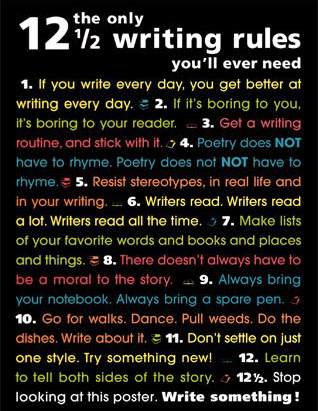
    The Rules of Writing by E L Doctorow
    The Rules of Writing by E L Doctorow

    4. Keep Patience

    You will not like everything you like. Sometimes even after sitting for an hour, you won’t be able to write much. But don’t loose patience. This is expected, and a part of the game. If you want to write good stuff, you have to empty your mind of all the rubbish. And when you write something which you don’t like, it is only this rubbish coming out. Now you must not loose hope and persevere because only after all the rubbish is gone, the good stuff will start coming out.

    5. Take Feedback

    Most often we are blinded to flaws in our writings, whether grammatical or structural, and it is always helpful to take feedback from a few people before publishing. What is more important is to take critical feedback and not just reject it, but work on it to make your article better. I would also like to take this opportunity to thank all those to whom I go for review whenever I finish writing something new.

    6. No Fear

    Let go of any fear you might have. Fear only results in you ‘not‘ writing. So be without fear, which I know, is impossible. But recognize your fears, and get over them rather than letting them overwhelm you. Let these fears drive your writing. Write badly if you must, but do write. Because if you write, you won and the fear lost.

    7. Keep Editing for Later

    When you start writing, very often you will feel that what you just wrote can be improved. But don’t be tempted and work on finishing the first draft of your article first, and keep all editing for later. Nobody is asking you to be perfect, so have the courage to write badly, but don’t stop writing unless you finish the first draft.

    8. Review and Edit Multiple Times

    One practice which has worked very well for me is to review my own writings multiple times, often separated by time intervals of atleast a day. After I finish writing the first draft of any article, I don’t review it immediately, but instead review it once for the next few days, and then post it. This helps me view the same article with a fresh mind every day and hence the changes (if any) I do make it better, instead of if I were to edit it just after I finished writing it.

    9. Maintain Discipline

    One of the most important practice you can bring to the table is being disciplined at writing. I write around 4 days a week now, and want to increase it to 6 days soon. But it is very important to keep writing regularly, even if you are writing only rubbish. Even if you are not in the mood. Even if you are tired, or exhausted, or whatever. Don’t let your reasons for not writing become greater than your discipline.

    10. Read a lot

    One sure shot way to improve your writing, and get new ideas to write about, is to read a lot. Read books, newspapers, and articles online. Most often I get the idea of a new blog topic after reading an article online or while reading a book. At this point, I just make a note of the topic and any bullet points which I might have, and come back to it later to write the full article. Due to reading, and keeping notes (see point 3 above) I always have a list of articles to write with some notes already in place.

  • 5 Ways My Writing Has Helped Me, and Why You Should Try It?

    Ever since I have started writing on this blog (from Jan 2010), it has helped me in more ways than I could have imagined at that time. After struggling to write regularly in the whole of 2010, I have now actually started to enjoy my writing. It helps me to draw out my thoughts and clear up my mind. That itself makes me feel better many times. I think writing is a wonderful way of keeping your mind uncluttered, attaining clarity of thought and managing your emotions. Below are some ways writing has helped me and why should anybody try it —

    You have to be specific, do more research

    When you are talking, there are a lot of ideas and stats which come to your mind and you just say it. You don’t have to make sure that the information is correct or credible, and nobody is going to hold you accountable if you are wrong. But while writing, you make sure twice that what you are about to write is correct. You ask a few people, do some research about the topic, read some articles or books but make sure that you get your facts right before writing. This helps to clear the clutter in your mind of the unnecessary stuff and confusion regarding a lot of areas. It also clears up our mind to focus on newer and important areas which we would not have focussed on otherwise.

    Try your hand at writing too
    Try your hand at writing too

    A good reference for the future

    Writing my thoughts and experiences down has helped me provide a good reference point for the future. Sumit4all.com is one of the sites I myself read very regularly whenever I am free or bored or confused. And it has helped me get my act together in more ways than one. Recalling some old memories from my posts is one of the best way to remember how wonderful life is. Many a times, the poems and articles I have written has helped me clear my confusion and get me focussed on the task at hand.

    Finding your voice

    Writing for me is a way to find my self-expression. There are many thoughts in my mind which are left unexpressed because of the lack of opportunity or the lack of proper audience for it. But writing my thoughts down for the whole world to see and discuss has helped me express how I feel. Many times we keep our feelings inside us, specifically feelings of sadness, hurt and anger. And over time, these feelings can build up as stress and have negative effects on our daily lives. Writing is a powerful vehicle for expressing our feelings which we sometimes loose sight of and to get our focus back on what is really important.

    P.S. – You can keep your writing private too, there is no gneed to put up everything for public view 🙂

    Speak more effectively

    Writing has improved my speaking skills too, as my sphere of knowledge has expanded due to the research and time spent in writing. I have gone to the depth of many issues which I would not have gone had I not written about that particular subject. I also tend to speak more slowly and give facts to support the point I am making. I also know that many times I might be wrong, and prefer to go back and check for facts rather than push my words down another person’s throat. I think it is a result of the fact that I know many times I am wrong. This has happened because the research before writing has proved many of my initial thoughts wrong. How I organize my speech has also seen a marked difference, taking its cue from how I have been structuring my articles.

    Thinking and imagination

    As I said earlier, writing helps to clear one’s mind. It also forces you to confront what you think and feel about different situations in life. Writing also distills your ideas and generates a lot of new and better ones too. Writing makes us see different point of views about an argument, hence presenting a broader picture about the situation. In my experience, writing improves your imagination, and when you think better, you will write better the next time. Doing either improves the other in a way.

    Obviously, not everything I write is great or even worth reading. There are days when nothing seems to come out right, days when I don’t even feel like writing anything, but many times, words just keep coming if I try to write regularly. It feels real good at the point when you have some momentum in writing and the words just start to flow. I think the hardest part with writing, as with everything else, is just getting started. So persevere with yourself for the first 10-15 minutes of your writing an article, and more often than not, words will start flowing after that.. Keep Trying.. Keep Writing… If not already, Start Now..

    Update – Read my article on 10 easy steps to start writing

anger anna hazare bangalore business challenge coaching conflict conversation corruption Cricket culture dandi march emotions energy friends fun gandhi giving gold growth hope india jan lokpal bill language leadership lessons Life listening love moment mother movie new year people perspective poem sachin tendulkar saleraja trust values walk waste women words world cup