“It is not enough to be busy. So are the ants. The question is: What are we busy about?”
— Henry David Thoreau
Have you ever found yourself lying awake at night trying to get some sleep, only to discover that you are caught in a seemingly endless loop of random thoughts?
“I’ve got that big presentation so I should probably leave early tomorrow…what’s traffic going to be like, I wonder?… Is my blue shirt clean?…that reminds me, I need to buy laundry detergent…I hope my presentation goes well…that Larry at the office is a funny guy…Whatever happened to ‘The Simpsons?’ It just isn’t that funny anymore, not like Larry…”
And so on and so forth, rinse and repeat.
If you’re not careful, you can choke on this never-ending stream of random thoughts. So much so that it can block the rest of your thinking.
That can prevent you from focusing on what you need to be focused on, and applying clear, deliberate thinking to the problems you face and the goals you’re trying to achieve.
That’s what today’s article is about, the danger of choking on your random thoughts. And the difference between random, fleeting ideas that go through everyone’s mind, and deliberate thinking.

Why So Serious?
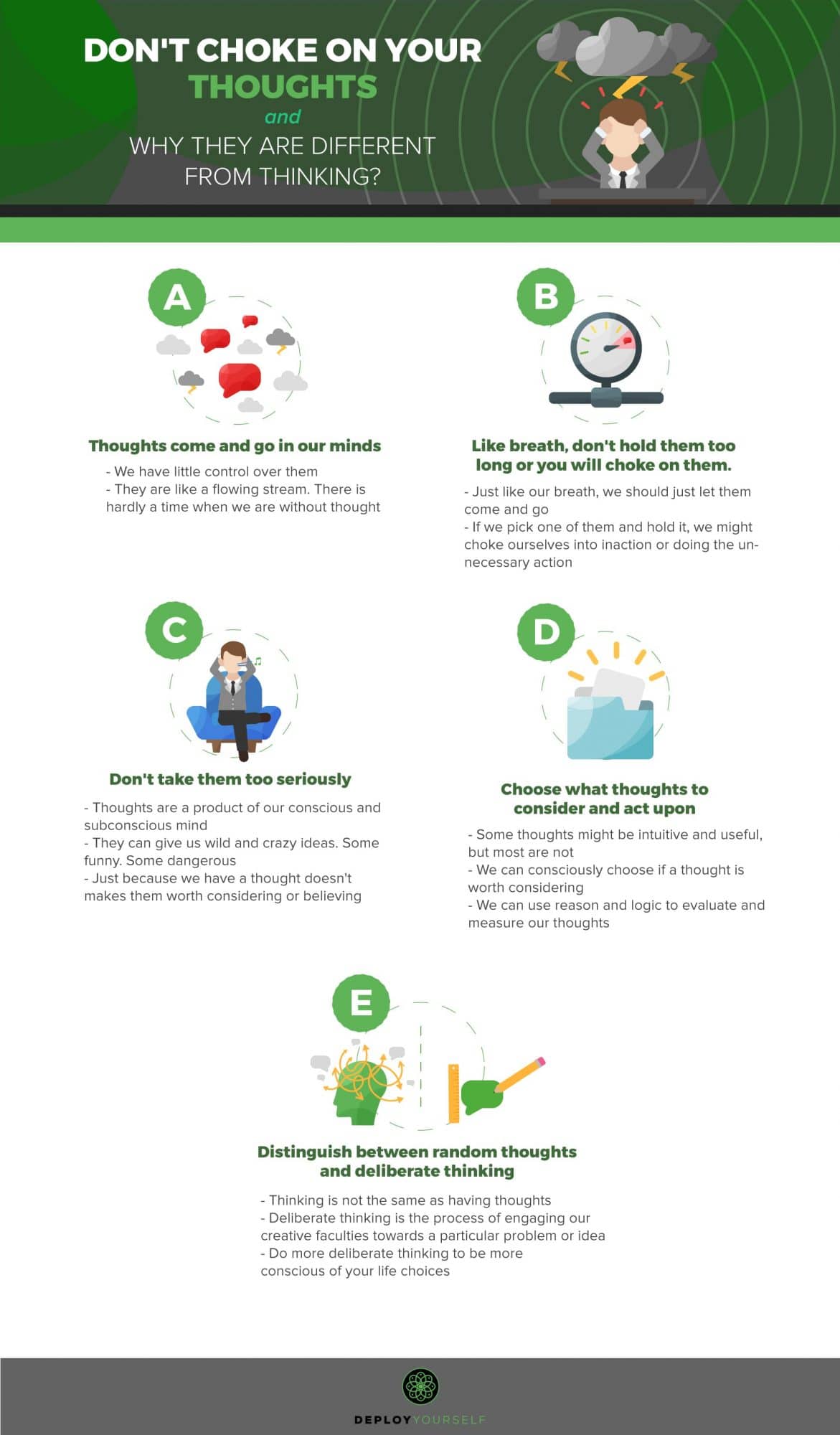
We must note take our random, passing thoughts too seriously. As a product of both the conscious and subconscious parts of our minds, these fleeting thoughts are disconnected and random much more than they are profound or interesting.
They can give us wild and crazy ideas. Some of those ideas are funny, like the aforementioned random thoughts about co-workers, friends, places we’ve been, etc.
Some random thoughts can be dangerous too. For instance, it’s easy to get lost in entertaining fantasies about your ideal life rather than doing the concrete work necessary to achieve it. If you get stuck with such fantasies you might let yourself procrastinate and never do the action required to reach that future state. This is one reason we must learn to let them pass like a flowing stream rather than hanging on to them.
“It is the mark of an educated mind to be able to entertain a thought without accepting it.”
– Aristotle
Always remember that just because we have a thought doesn’t make it worth considering or believing. This is where it becomes important to think deliberately.
Thoughts Come and Go
We all have thoughts going through our minds all the time. There is very little we can do about them. Some psychologists suggest that this constant noise of random thoughts running through our minds is the very reason TV is so popular: we watch TV so we don’t have to listen to ourselves think for a little while.
These thoughts are like a flowing stream. If you live near a river you become accustomed to the sound of the water flowing. Similarly, there is hardly a time when we are without thought. But much like with the water in a flowing stream — or with our every breath — we have to learn to let these thoughts flow on. We have to learn to let them go.

That’s because these random thoughts are often useless, and seldom worth paying attention to. Like a breath, you can’t hold onto them for too long or you will choke on them and not get time to think about anything important deliberately. Just like our breath, we should let these thoughts come and go.
Continuing to ponder over these thoughts can deprive us of the time and space needed to consciously examine our life, goals, and plans. By obsessing over our thoughts, we lose the opportunity to think deliberately.
Studies show that experts rely much more on deliberate thinking — and that it helps them to make superior decisions.

You Have The Choice
While your flowing stream of thoughts is bound to continue for the rest of our lives, you can choose which thoughts to consider and act upon. It’s up to you to decide which thoughts to look at more closely, and which ones to ignore and let drift on downstream.
Some thoughts might be useful, but most are not. Consciously choosing if a thought is worth considering is a vital step in learning to think deliberately. Just because you got a thought, it doesn’t mean you have to ponder over it. You can use reason and logic to evaluate and measure your thoughts, and then decide which ones are worth thinking about further.
“To a mind that is still the whole universe surrenders.”
― Lao Tzu

What Is Deliberate Thinking?
A deliberate thinker goes beyond the surface. To think deliberately means you must dig deeper than your preconceived notions and fully analyze a problem. Deliberate thinking is a process as opposed to shallow thinking, which is often just an assumption or an untested opinion.
You must look at the future and higher-order consequences. This means a deliberate thinker assesses not only the immediate outcome but also considers what possible consequences today’s decisions might have on tomorrow’s events.
A deliberate thinker seeks out potential chains of events that might not be too obvious. By thinking deliberately and taking the time to examine a problem, you can figure out hidden connections that might not be obvious at first, and assess them.
Identify the real problem. Shallow thinking happens when people grasp at the easiest answer — an answer that is often wrong or incomplete. Deliberate thinking takes the time to really look at a problem fully. It gets to the root of it rather than settle for a convenient answer that is more often than not unhelpful.
Develop a step by step approach. Deliberate thinking means you can assess and analyze not only the problem you face, but also break down the solutions in a logical, step by step manner, and apply them.

Random Thoughts vs Deliberate Thinking
As we have seen, thinking is not the same as having thoughts. Everyone has thoughts all the time, but not everyone thinks. Deliberate thinking is the process of engaging our creative faculties towards a particular problem or idea.
There are ways you can train your mind to think more deliberately. Here are a few steps toward becoming a more deliberate thinker:
- Write down your major goals – You must know what you really want. For each of your objectives, write out clear, honest sub-goals that will get you closer to the final objective.
- Take lots of notes – Every great idea in the world came from a kernel of an idea, from a seed. So while lots of thoughts are useless, not all of them are. Keep a journal and take notes as your thoughts come before you forget them. When you come across any that show promise, apply deliberate thought, and develop them further.
- Order your physical space – It often helps with deliberate thinking to set aside a “thinking place.” Carve yourself out a physical place for you where you can think with clarity and without distractions
- Exercise – Psychologists and doctors say that exercise helps us to think more clearly. A recent study from the University of British Columbia shows that regular exercise increases the heart rate and improves our thinking skills. Next time you’re stuck on a problem, take a break and go on a short run or a quick walk instead.
- Reserve time for deliberate thinking every day: Be sure to set aside some time where you can concentrate on your problems and challenges each day.
To conclude, we can either choke on the random, flowing thoughts and not have time and space to think about anything else.
Or we can do more deliberate thinking to be more conscious of our life choices and results. As with most things, the choice is ours.