Last year I wrote an article about three small steps in treating our employees that can make a big difference as an entrepreneur. Great teams are made up of employees who help each other, know their roles, set aside personal goals, and value team success over everything else. I want to expand those steps and add three more very simple things we can do –
Your first few employees will make or break your company
4. Be the First to Take the Blame
Whenever something goes wrong, as it will many times, it is the boss’s duty and responsibility to be visible and face the music from inside and outside. Otherwise, anger, upsets and blame can set in and make things worse for the future. While taking blame, you also have to be honest about what is happening and efficient in dealing with the repercussions.
5. And the Last to Take Credit
Always give credit to the team first, because any success you have is actually theirs. That doesn’t mean discounting your role which you should always acknowledge. But your success is not only yours, and that’s why you should pass on every credit you get to the people behind, who normally wont get much visibility. Make sure they know their part in the success and importance in the company.
6. Make Sure Your Employees know how much They Mean to You
If someone is working a weekend for you, make sure you are there too. Otherwise, do something to let them know how much that means to you. Nobody wants to work on a weekend, and it is your duty to acknowledge their effort and responsibility to make them feel thanked for their contribution.
If I were to compare a startup to hunting, then the idea of hunting that bear is akin to the new business idea you are pursuing. But the hunting doesn’t start unless we get our lazy asses out in the jungle. Similarly, entrepreneurship only happens when we enter the jungle (execution), with all its uncertainty and dangers which we all miss in the city (idea). Below are some rules of the jungle, if you have forgotten –
1. No Reasons and Excuses
Once you have stepped in the jungle, you can’t blame the wild bushes and animals and the lack of roads. You can’t demand a hospital and a restaurant in a jungle. So if you think you need funding to execute an idea, or a quiet time to write that book, or that degree to be successful, then shut the **** up and stop giving excuses. Outside in the civilized world you can give these reasons, but in the jungle these become just excuses. Nobody wants your MBA degree in the jungle, and neither can it make any difference.
Life is a zoo in a jungle. – Peter De Vries
2. No Blame, Only Responsibility
In the jungle, you can either blame the thorns and the leeches for you not being able to hunt, or you can take responsibility for stepping into the jungle and dealing with whatever it has to offer. Taking responsibility will ignite the inner fire in you, to take charge of your life and improve/change and do whatever is required to reach your goal, inspite of all the challenges that the jungle presents to you. And yes, it takes strength.
3. Calmness amid Change
In a jungle, you can’t blame that the ecosystem changes every inch. If fact, it is utter stupidity if you expect anything other than change in a jungle. Similarly, in the startup world, you must learn to accept that life is filled with change. The only thing that matters is how accepting or rejecting you can get of that change, discomfort and hardship? The more you accept that as normal and stop resisting it, the more easily you can find the hidden treasures of entrepreneurship. As one wise man once said – “It is much easier to ride the horse in the direction that it is running.”
4. One Difference
If there is one difference between a startup and hunting, it is that in hunting you know which tools to carry and what animal you are going to hunt. But in a startup, most often you don’t even know your target (customers) so there is no question of having the right tools like a gun or a knife with you. So, you will not have the programmer, the sales guy, the money when you need it the most. Face it. Using whatever tools, you have to do get the job done. Using rocks as knifes and stones as guns can look funny to others, but that is the best you can do in your situation. And so you do it.
Taking it a notch ahead, I would say LIFE itself is a jungle. Think about it? For me, that is what makes it so exciting. For you, only you can answer this question?
I was never among the physically stronger kids during my childhood. And since fist-fights among kids are not uncommon, I had to devise other ways to tackle my opponents rather than relying on only my physical strengths. At times you get beaten up, but since you know you can’t overpower someone you start hitting the areas where they might be most vulnerable. Sometime you just wait and pass time while your opponent gets tired before you take your shot.
Starting and running a start-up is also the same, in many ways. Being matched up against competitors many times your size and weight, and that too in a market which is not always ‘fair‘, to put it gently. But as in my childhood, being placed against a bigger opponent can have its benefits too. You learn persistence and resourcefulness irrespective of your current situation. These challenges are what makes a startup interesting, and those who drive the thrill out of overcoming these challenges are the right people for a startup.
Why would anyone do that?
You can ask that why would anyone want to fight against a tougher and stronger opponent? Why would anyone want to do something where the chances of success are only minimal? Yes, it doesn’t make sense. This ‘WHY‘ is very difficult to explain in words, but those who do it know the answer somewhere inside. Maybe it is the same reason people cheer the underdog team when they win against a stronger opposition in sports? Maybe it is the same reason that we draw hope from those who fight against the norms for something they truly believe in? Despite of all the fears and challenges. Despite of the very minimal chance of success.
Coming back to entrepreneurship, maybe it is just in some people’s blood (as they say entrepreneurs are born and not made). But whatever it is, the likes of Steve Jobs, Lance Armstrong, Bill Gates and Anna Hazare felt it and at many different times, each one of us have also felt it. When we believe in something for which we are ready to put a lot at stake, we all become entrepreneurs in a way. Whether it is fighting for a cause, running a business, or expanding the boundaries of human performance!!
How would anyone do that? – Perseverance and Resilience
When you win against a stronger opponent, you become more confident and fearless. But when you lose, you start working on your weaknesses and try to make use of the resources you have. You very well know you can’t afford and have all the resources your competitors have, so you try to make the best out of what you have. And by doing so, you develop such a wonderful skill which even your big competitors doesn’t have – the ability to survive tough times with resilience.
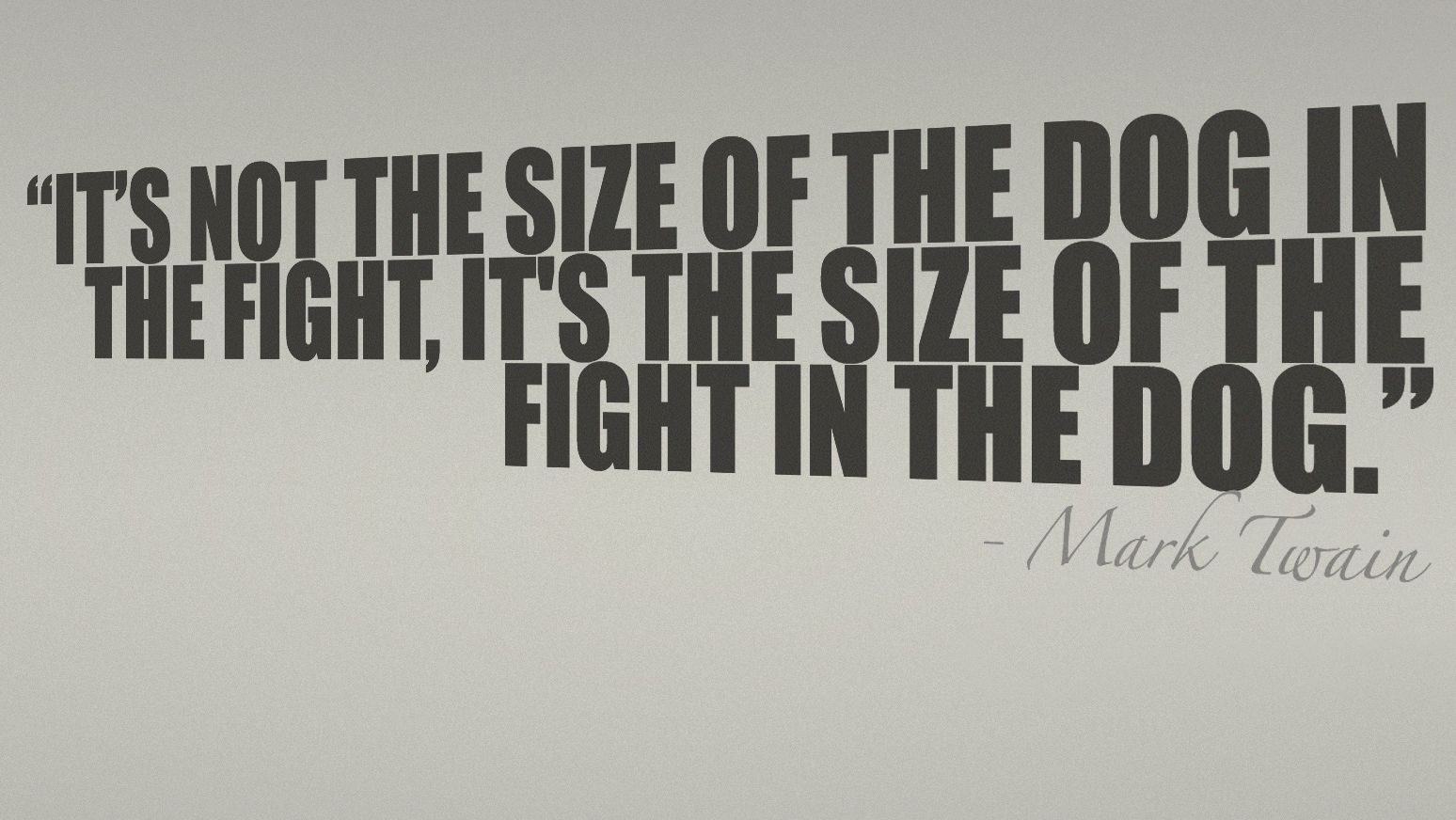
Mark Twain said it very rightly so
– Iterate
In the startup world, as George Patton said “A good plan today is better than the perfect plan tomorrow”, it is very important to act on incomplete information and in a world where uncertainty looms large. If you are doing something worthwhile, then you have to constantly go into uncharted territory, try new ideas, fail, then start again, and then fail again. And so on. As you have to expand yourself so much and step out of your comfort zone in doing so, you also have a steep learning curve.
– Use your ego, but with feet on the ground Ego is not always bad. Doing a startup is basically believing in yourself when no-one else does, and when even you have your doubts. It is about the confidence that “I can do it, I will do it, even if I don’t have the resources or skills to do it“. It takes a man with ego to go up and stand against the world. But at the same time, you need to stay realistic and know your limitations. A healthy ego is not only required but also necessary to constantly expand yourself and to keep fighting every day, even after facing many defeats. A healthy ego doesn’t stop you from getting back up knowing you might get beaten again.
– Getting things done, despite of a hundred things which need your attention
Startups aren’t for everyone. In a startup you always have thousands of things to do, and you don’t have anybody to delegate to. You will have to do all kinds of things which are normally reserved for ‘other‘ people in a normal job. In short, there are no boundaries of work. You might be planning, designing, coding, doing marketing and sales calls, all in a day. What becomes most important in a startup is to get a task done, irrespective of whether it is above or below your pay scale, irrespective of whether you have done it before or not, irrespective of whether you know how to do it or not. If a client is visiting and your office is a mess, the first person who picks a broom to clean up is the best fit for that startup.
In the end, I think it is the fighting that matters and not the winning. It is the daily grind you go through which is the most important part, even more than actually beating a stronger opponent. As it has been told by many great leaders – “The journey is more important than the destination”. I will end with a quote by Marian Wright Edelman – “You’re not obligated to win. You’re obligated to keep trying to do the best you can every day.”
When I joined my first job, work was on full swing to launch 99acres.com . I was part of the team which did all the technical work and the site was launched one month after I joined. Thereafter, I launched Sukip.com in Jan 2007 and Saleraja.com in Aug 2007. After moving to Bangalore, I worked with Jivox.com for 18 months. Recently I startedPickaFight.in, this time as a non-profit initiative. In all these endeavors over the last six years, I got a good exposure to starting up and scaling up websites, both from a technical, product and business point of view.
There have been many lessons along the way, most of them learned the hard way. Here are seven important points I would like to share with one and all who might be interested in starting a web based business. Update – Here are eight more lessons which I wrote as a follow up article 🙂
1. Passion in what you are doing
Always do what you are passionate about. If you are starting a new website based business, it will keep you awake at nights and make you work on weekends. So it is very important that it is something you are really excited about.
2. Prioritize
In my first job, my boss gave me a valuable lesson, “In a startup, you will always have thousand things to do but not the resources to do all of them. The key is to prioritize among them and then keep your focus on doing the selected tasks to the best”. I have never forgotten this. You will always have more than your plate can hold. So prioritize, prioritize and prioritize.
Working in a startup can be totally fun and 'not like' work
3. Release regularly
We launched sukip.com after 6 months of development, and then SaleRaja.com was launched after just 11 days of coding. Release early, release often is the idea. Rather than planning and building a Taj Mahal after months or years of work, start with a basic model and then make changes based on market feedback. Because the customer is the best judge of your product. Period.
4. Understand technology driving your product
As a founder, you might not do all the coding for your product, but it is very important to understand the technology behind it. By doing so, you will be better prepared to perform your job when you step in the shoes of your sales guy or the product manager. In short, it will allow you to make better business decisions.
5. Work like a family
Starting a company is like raising a baby, and hence it is very important the atmosphere is very cordial and like a family. People need to trust each other, care for each other and treat the work as their baby. This family like work culture could be the difference between success and failure later on.
6. Hire people smarter than you or who fill your gaps
You might be smart, talented and hard working, but nobody can know or do everything. Hence it becomes very important to hire people smarter or more talented than you are, or who are talented in the areas where you have a skill gap. Many times people don’t do this for personal and ego reasons, but this is a valuable lesson which I have learned the hard way.
7. Work with people who share your value system
Although your work might not require you to deal with your moral and ethical values very often, it is better to work with people who share your value system. In times of crises, or in times of extreme excitement and growth, these value systems can sometimes prevent us from making big mistakes. At the same time, a difference in the value system can cause rift between the team as both parties might consider their beliefs as right and blame the other party for not understanding.
I use cookies on this website to give you the most relevant experience and for analytics purposes. Any personal data collected will never be shared with any third party, or used to spam you. That is my promise. - Sumit By clicking “Accept”, you consent to the use of ALL the cookies.
This website uses cookies to improve your experience while you navigate through the website. Out of these, the cookies that are categorized as necessary are stored on your browser as they are essential for the working of basic functionalities of the website. We also use third-party cookies that help us analyze and understand how you use this website. These cookies will be stored in your browser only with your consent. You also have the option to opt-out of these cookies. But opting out of some of these cookies may affect your browsing experience.
Necessary cookies are absolutely essential for the website to function properly. This category only includes cookies that ensures basic functionalities and security features of the website. These cookies do not store any personal information.
Any cookies that may not be particularly necessary for the website to function and is used specifically to collect user personal data via analytics, ads, other embedded contents are termed as non-necessary cookies. It is mandatory to procure user consent prior to running these cookies on your website.