In recent times, there has been a drastic shift in how organizations around the world view 1-on-1 meetings. For a long time, communication between managers and their employees typically revolved around either occasional over-the-desk check-ins or group meetings.
Without a regularly scheduled 1-on-1 meeting, employees don’t have an option for expressing their concerns openly. Without one-on-one meetings, the manager also does not get to know their employee well enough.
However, changes in work culture in the 21st century have called for a shift in this trend. For example, more and more employees are seeking fulfilment from their jobs rather than just a salary. One-on-one meetings have been found to be one of the most effective ways of listening to people’s concerns, understanding them as individuals, and giving them opportunities for growth and fulfilment.
According to a Harvard Business Review report, employees who have limited one-to-one time with their managers tend to have higher disengagement rates compared to those who do. In fact, employees who get more one-on-ones with their bosses are 67% less likely to experience disengagement.
GE and Adobe are great examples of how you can improve engagement using 1-on-1s. Once Adobe started using this strategy, they noted a 30% reduction in turnover rates, while GE reported a fivefold increase in employee productivity within just 12 months.
One-on-one conversations with your employees, therefore, are critical to boosting engagement and productivity in the workplace. When I first became a manager, having a 1-on-1 meeting was not even a strict requirement for my role. And now, I see managers being reprimanded for not having 1-on-1 meetings in companies regularly.
In this article, we will cover
- Best practices and guidelines to follow when it comes to one-on-one meetings.
- What is the purpose of one-to-one meetings
- Questions to ask in one to one meetings
- How Often Should You Have 1-on-1s?
- Where should you have your one-on-one meetings?
- Advantages of 1-on-1 meetings
- How to Prepare for One to One Meetings
- Common Misconceptions about One-on-One Meetings
General Guidelines
Before you head into any one-on-one meeting with an employee or subordinate, keep the following things in mind:
- Do your homework well. Go well-prepared for the meeting. Review any notes from the past meetings, go over any action points to follow up, and go over the agenda if you have pre-decided that.
- Go into the meeting devoid of any judgment, bias, or emotional overwhelm from how your day has gone so far. In fact, go into the meeting thinking of your employee as a superstar. Take a minute or two of silence and deep breathing before the meeting to ground yourself in your values, and enter into the meeting in a mood of relaxation and possibilities.
- Do it at regular time intervals (weekly/bi-weekly). Do not wait for the quarter or the year to end to meet your employees. Do it regularly. Your people are your most important asset. Time spent with them is your best investment.
- Be humble and polite. You work together, not against each other. Collaborate and communicate openly. If you have disagreements, welcome them and use the energy in them to create win-win results rather than conflict and friction.
- Listen attentively so that you do not miss anything. Avoid potential distractions and give your full attention to your employee. Make eye contact and talk with the employee like he/she is the most important person in your life. Put your mobile, laptop, and other devices aside.
What Are 1on1s for? (Purpose)
One-on-ones are the regular conversations that a manager has with their employee. Essentially, they are meetings with a mix of formal and informal talk. They can happen anywhere and at any time. Experts recommend making them as frequent as possible.
Many leaders view these meetings as performance conversations and use them to get status updates. While one-on-ones are an excellent way of discussing goals and performance in real-time, they offer you a platform for achieving so much more, including:
1. To Know Your Employee Better by Asking Powerful Questions
As a leader, you expect your people to do their job. However, it is your job to provide them with the support they need to not only execute their tasks perfectly but also to reach their full potential.
Unfortunately, that can be difficult to achieve if you do not know your employees on an individual basis. This is why one-on-ones are necessary, as they allow you to have a good read of a person’s strengths, weaknesses, values, and principles.
For example, even among people with similar skill sets, you will find that they have different ways of working – because of their past experiences. Therefore, by finding out what excites each person, you will be able to delegate tasks more strategically, thus improving the team’s overall productivity.
In addition to allowing you to know your employees better, powerful questions show that you care for your employees, which, as mentioned, improves their engagement tremendously. Care comes first, engagement second. That is why I strongly believe that you have to be a good human being to be a good leader.
Consider asking the following powerful questions during your one-on-ones, in addition to whatever else you might have prepared:
- What makes you stand out?
- What do you do after work? What are your hobbies?
- What are your highest priorities in life?
- Where does work fit in?
- What are your future aspirations?
- What makes you special?
- What are you most excited about?
- What does success look like to you?
- Do you feel that your work is recognised and valued?
- What motivates you to work each day?
- How often do you use your strengths at work?
- What’re your preferred means of communication? How can we align best?
- How can we work your challenges out together?
- Is there anything blocking you?
- Is any part of your job unclear or without transparency?
- What could I do to help us work better?
- What feedback do you have for me? Both positive and negative?
- What could I be doing better as your leader?
- What skills/areas would you like to improve upon?
- What have you learned recently?
- What can I do to make you more successful and happy?
- How do you find your team?
- Do you think we are headed in the right direction?
- What’s the biggest problem we are facing?
- What is the one opportunity for our company that we should not miss?
- How do I know when you are annoyed?
- What were your priorities since we last met?
- How is your work/life balance?
- What are your hobbies? Do you take time out for them?
- Tell me about your weekend
- Was this meeting helpful? How can we improve in the future?
Based on the answers, you will be in a better position to set them up on the best path to realizing their full potential. The only purpose of work doesn’t have to be to fulfil the team’s goals and increase productivity. Work can also be fulfilling, nourishing, and enriching for your people. The only question is – do you provide that opportunity or not?
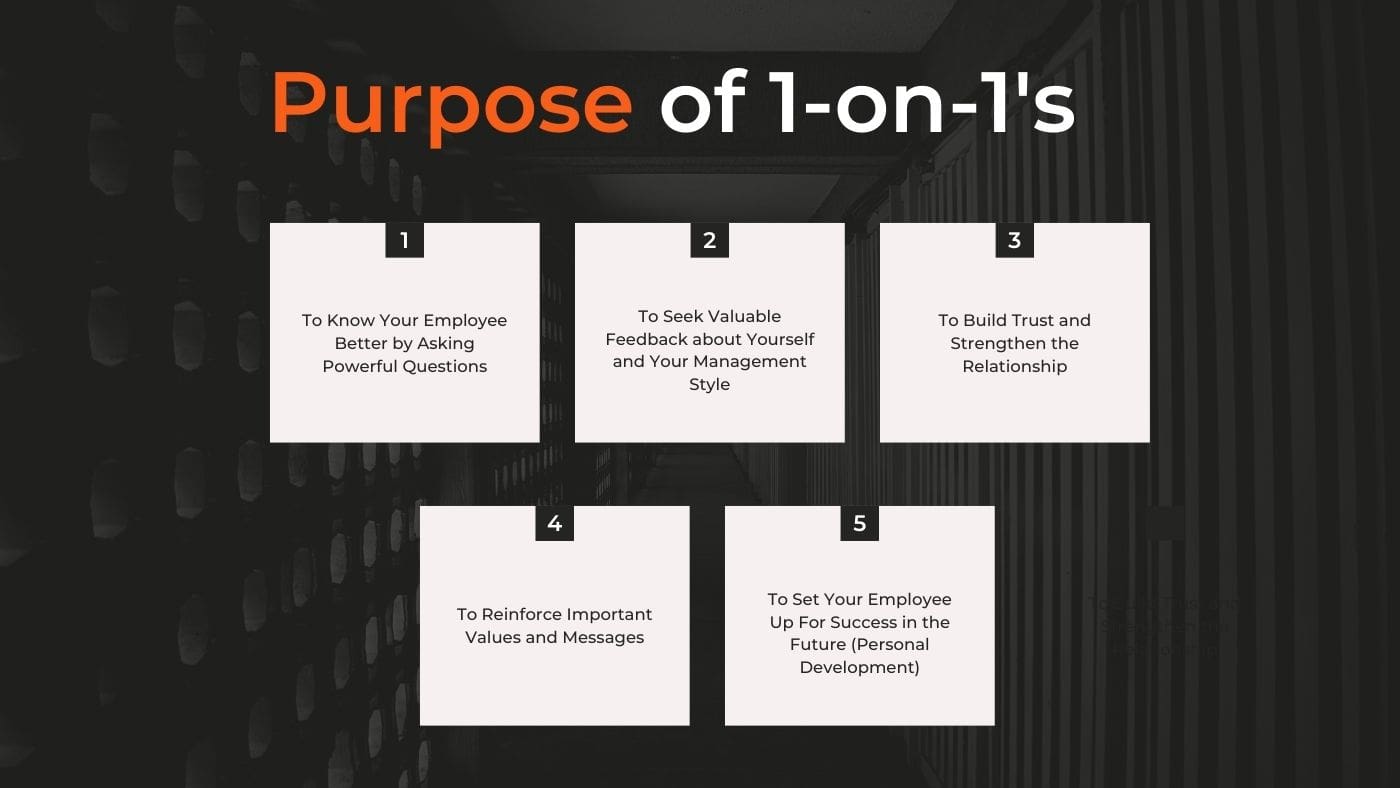
2. To Seek Valuable Feedback about Yourself and Your Management Style
Employee feedback is one of the most under-utilized tools by managers or team leaders. It is unfortunate that most leaders and managers fall prey to the idea that listening and accepting critical feedback is a weakness. Instead, it is the only way for you to grow.
Leaders who think of themselves as bosses, superior, or better usually also find it difficult to listen to critical feedback. They think their job is to tell their employees how to do their job.
However, such a mindset can be incredibly costly. How expensive, you ask? In a survey titled “The Cost of Poor Communications,” which involved over 400 companies and more than 100,000 employees, each company lost an average of $62.4 million per year to poor communication with employees.
The importance of seeking feedback from your team members can therefore not be overemphasized. Let go of the fear of being critiqued, as that fear will only wall you off from valuable input that could help you grow and change your perspective.
Therefore, during your one-on-ones, encourage the employee to share some input regarding what they think about your leadership style, as well as what they think you could do better. Of course, this does not mean that their feedback is a true reflection of your performance as a leader. But if you notice a recurring theme in the feedback from different employees, you will need to reflect on it and address any underlying issues.
Most importantly, asking for feedback tells your employees that their opinion is valued by the organization, and that goes a long way in boosting engagement.
3. To Build Trust and Strengthen the Relationship
According to a study by Gallup, people who have close friends at their workplace can be up to 7 times as engaged at work compared to those who do not. While this does not necessarily mean that you should become everyone’s BFF at work, the value of developing closer relationships with your employees is undeniable.
For starters, humans are social creatures, meaning that we thrive when we are close to those around us. Considering that the average human spends one-third of their lives at work, enhancing the quality of your relationships with your colleagues is not only important for better cooperation but also for enhancing the overall quality of your life.
When your employees are more comfortable around you, they will be more willing to listen to your ideas, in addition to voicing their own opinions and suggestions. This will create an environment where teamwork takes precedence over everything else, thus improving everyone’s productivity tremendously.
4. To Reinforce Important Values and Messages
Every company has core values that it holds dear. An organization’s core values are its lifeline, as they not only create an identity for the company but also attract individuals who share similar values.
It is important for leaders and managers to keep repeating and reinforcing these values so they people remember what they are working towards. According to Seetec, having a concrete set of core values is one of the best ways of keeping your employees motivated and engaged, hence resulting in better performance and productivity.
This is because when people believe in and respect the company’s values, they gain greater clarity regarding their role in the company. One-on-ones offer you the perfect platform for reinforcing these values. Remind them of any expectations, boundaries, or ethics that they are supposed to uphold in order to be in compliance with the organization’s values. At the same, acknowledge and celebrate people when they act according to the company’s values.
5. To Set Your Employee Up For Success in the Future (Personal Development)
I believe one of our main roles as leaders is to help people achieve their full potential. Therefore, use the one-on-ones to discuss the employee’s progress and career aspirations. To make these goals tangible, work together to create both short-term and long-term goals for the employee.
Short-term goals encompass the objectives the employees look to accomplish within a month or a quarter, while long-term goals are the strategic milestones they look to achieve within 6 months or a year. You can also create a vision for 5 years or even 20 years into the future. It can be tremendously powerful when done well.
The short-term goal is climbing the ladder of personal growth, while the long-term goals and vision help to ensure the ladder is leaning against the right wall. Long-term planning is more to set the direction rather than being specific. That is why it is ok if long-term goals are vague, but short-term goals work best when they are time-bound and specific.
How Often Should You Have 1-on-1s?
To some managers, having these meetings on a monthly basis sounds reasonable. However, when you consider all the activities that can happen at work in a month, you will find that four weeks are too long a time to wait.
For example, an employee might be experiencing a challenge, and it can quickly become a big issue if you address it a month later. On the other hand, the employee can accomplish several important milestones within a month if you can support and guide them along the way.
What’s more, if we assume that you are meeting them only once every month for an hour, you will only have spent a total of 12 hours together after one year. That is not nearly enough time to forge a good relationship with anyone.
So how much time should you dedicate to one-on-one meetings? There isn’t a definite answer to this question. Consider the following factors when deciding the appropriate frequency for your one-on-ones:
1. Team Size
If you are managing a team of five or less, consider meeting each member weekly or twice a month for 45-60 minutes. If you have more than five direct reports, you can shorten the length of those meetings to 30 minutes.
Don’t focus too much on the length of these meetings when you are starting out. The goal is to have a better understanding of your employees without burdening them with formalities. Therefore don’t make them longer than necessary.
2. Task-Relevant Maturity
If the employee is still new to their role, they will require more help and guidance than someone who has been on the job longer. With new team members, consider meeting them on a weekly basis. Experienced employees, on the other hand, can do with twice a month meetings.
3. How Frequently You Work with Them
Teams operate differently, with some working more closely than others do. If you rarely interact and work independently with people as part of your daily job, twice a month one-to-ones are more appropriate. On the other hand, if you work closely with your team members, a weekly one-to-one is a better fit.
Mix it Up When it comes to Meeting Location
Now that you have chosen the frequency at which you will be meeting your employees for one-on-ones, you might probably be wondering about the ideal location to hold those meetings.
Whether it is having lunch together or going for a walk, it does not matter as long as you meet your objective – of creating a safe space where you can talk about anything openly and honestly. However, you do not want those meetings to feel like a chore to both of you. Therefore, consider trying out different settings.
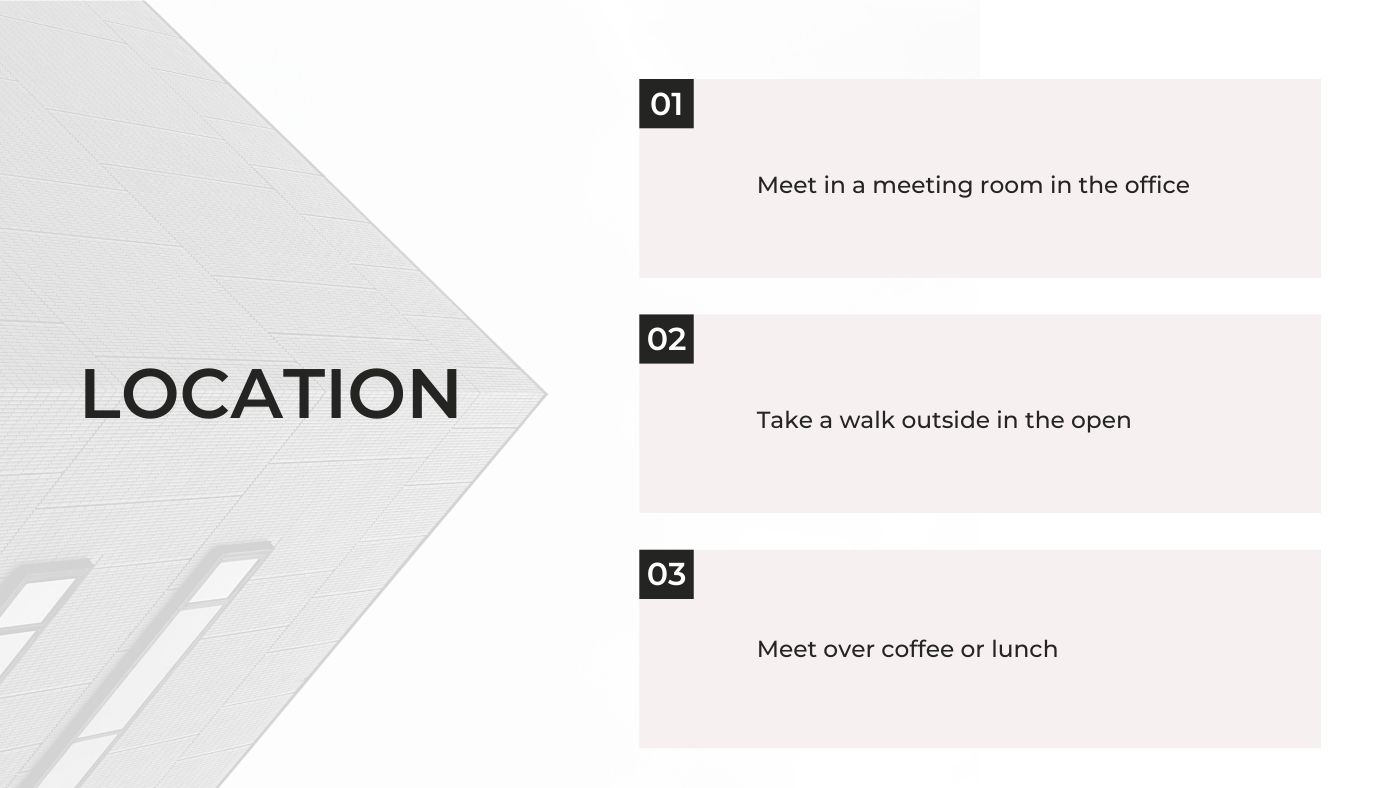
The most common settings for one-on-ones with direct reports include:
1. Meeting at the Office
The benefit of holding one-on-one meetings at the office is the safe and quiet environment it provides you. It allows the person to be more comfortable, thus allowing them to express themselves more freely and privately.
Office meetings, however, do have their drawbacks. For example, it might feel too official, causing the employee to be more reserved than you would like. Office environments and cultures can become too toxic or negative, and that can shadow your whole conversation if you are not mindful about that.
2. Taking a Walk Outside
Holding a one-on-one outside while walking can be incredibly impactful. According to some studies, a person’s creativity can increase by up to 60% during walks. As such, you are more likely to have better conversations when you meet outside as compared to closed doors.
What’s more, walking eliminates the tension that typically comes with facing each other across the table. When the body is moving, it is easier to be flexible with ideas and opinions rather than getting stuck in arguments.
Another benefit of outdoor one-on-ones is they allow you to be comfortable with silence. Therefore, those moments where you both pause to think will not feel as awkward.
Meeting outside in the open also makes it easy to start casual conversations. Sometimes, it is those ‘filler’ conversations that end up being the most insightful and can reveal deep desires and motivations.
However, walking one-on-ones might not always be ideal. For example, you might keep running into people you know. If you feel like a walking meeting is a good option, consider doing it in a place with few distractions, such as a park. Avoid busy places with noise.
3. Meeting at a Restaurant or Coffee Shop
The main benefit of holding a one-on-one while eating or drinking coffee is that it makes you relate on a more personal level. Consider doing this if you are looking to know an employee better and willing to have a casual conversation.
The main issue with this meeting style, however, is that it can be too distracting. A cafeteria is not the ideal place to discuss sensitive issues or make strategic plans, so make sure you choose the meeting venue based on the agenda of the meeting.
Advantages of 1-on-1s
Unfortunately, some managers still do not have one-on-one meetings frequently enough. They hold them only when it is unavoidable. Some even avoid them entirely.
Nevertheless, one-on-one meetings are extremely important. Below are a few reasons why you should have them regularly.
1. They Boost Productivity
One of the biggest reasons for having these kinds of meetings is their positive impact on work quality and productivity. It sounds like a paradox to me when a manager tells me he has no time for 1-on-1 meetings. My next question to them usually is “So you have no time to increase the productivity of your team?”
In his book, “High Output Management,” Andy Grove argues that meeting your employees regularly gives you the opportunity to not only coach them but also to help you develop a common information base, thus allowing the team to be in sync at all times leading to better results.
You have to remember that employees are not equal when it comes to prioritizing tasks, with some not having the necessary experience to know which tasks bring the highest ROI. By scheduling regular one-on-ones, therefore, you will be able to set clear priorities with all your people.
One-on-one meetings also boost your own productivity. This is because they allow you to address all the pertinent issues effectively, thus reducing the incidences of your direct reports popping in for a “quick question or an emergency.”
On his Managers Tools podcast, Mark Horstman says, “One of the first things you will notice once you start holding regular one-on-ones is the significant reduction in the number of questions that you receive per week. However, it is not because things are not running as they should, but people have learned that they can wait for the one-on-one to bring any queries to your attention.”
Buffer, Inc., the company behind the Buffer software application that provides social media accounts management tools, decided to get rid of their managers, suffering a tremendous blow in engagement and productivity in the process. They soon discovered that managers were not only necessary but also one-on-one meetings were incredibly effective in fixing things and improving productivity.
2. To Improve Employee Engagement and Forge Better Work Relationships
Building healthy relationships takes a while. For example, you cannot expect to have a good relationship with your significant other (or friend) if you rarely communicate. The same goes for work relationships; you need to see and talk to your employees regularly to build strong relationships.
Frequent one-on-one meetings are one of the best tools managers can use to build better relationships. In fact, one-on-ones have been found to be so effective that companies such as Adobe, Deloitte, IBM, and Microsoft have ditched their annual reviews, replacing them with frequent check-ins.
One-on-ones are also incredibly effective at boosting engagement and retention. According to a Gallup report, employees who meet with their managers regularly are up to three times more likely to be engaged in their work as compared to those who do not.
It comes as no surprise, therefore, that Ben Horowitz, CEO of Andreessen Horowitz (a Silicon Valley venture capital firm), was willing to fire two of his managers when he found out that they had not been conducting one-on-one meetings.
3. They Can Help You Identify and Address Problems Proactively
A one-on-one is one of the best tools you can use to identify potential problems, allowing you to solve them in time before they become an emergency.
Conflict between employees is bound to happen when people work together. However, if it is not solved in time, it can turn messy, impeding your team’s culture and productivity. One-on-one conversations allow you to pick up on any potential seeds of conflict, frustration, and disengagement.
If you are a leader or a manager, do not fit your 1-on-1 meetings in the rest of your work. Fit the rest of your work with your schedule for 1-on-1 meetings. They come first, not second to anything else you might consider “real work”.
How to Prepare for One to One Meetings
Keep the following things in mind when preparing for a one-on-one with your employee:
- Make it About Them
One of the main goals of a one-to-one meeting is to make your employees feel appreciated, in addition to getting to know them better. Therefore, the meeting’s talking points should be centered on them, discussing things such as:
- How they feel about work
- Challenges they are facing
- Their suggestions on how to make the workplace better
- Personal problems they might want to share
- Their career development plans
Some employees are reserved or introverted, hesitating to open up. This is why you should ask employee-centric questions, as these will allow them to be more expressive.
Most importantly, however, be a good listener. A good listener is one that listens to understand, not to reply. Good listening skills are a sign of maturity and humility and allow you to pinpoint potential issues early. What’s more, showing genuine interest in your employees reveals to them that you care about their welfare, thus strengthening your bond.
- Take Notes
Regardless of how good your listening skills are, there is always a chance that you might forget an important point or two. This is why it is good practice to take notes during or after the meeting.
Note down action points, what you talked about, and any issues to bring up the next time. Doing that will allow you to review the important discussion points before your next meeting, thus allowing you to address any issues in future meetings.
- Be Open-Minded
If the conversation in a 1-on-1 meeting becomes somewhat casual, do not feel like it is inappropriate. Casual conversation lightens up the mood, allowing your employee to feel more relaxed.
Employees are more expressive when they are feeling comfortable. Besides, the goal is to establish healthier relationships and not just focus on results, projects, and deadlines. They go together, as you might have already realized if you have been leading people for a while.
- Ask Them to Prepare an Agenda
It takes two to tango; therefore, ask people to prepare talking points for the meeting. Let them know that the one-on-one is their meeting with you, not yours with them.
- Have Your Agenda As Well
The employee owns the 1-on-1 meeting, but make sure you add your points to the agenda as well. If important issues like career development, employee motivation, engagement, trust, progress on goals need discussion, make sure to bring them up.
- De-Stress Before the Meeting
A one-on-one will be of no use if you are not in the right mood. You want your employee to know that you are genuinely glad that you are spending some time with them. That is what will get them to open up.
Therefore, consider taking a 2-minute silent break before the meeting to relax. Consider meditating or performing breathing exercises during that period if you are stressed out. When you walk into a 1-on-1 meeting, be ready to put your full attention on the person in front of you.
- Enter the meeting thinking about your employee like a superhero.
Your meeting will be more fruitful if you go into the meeting with a positive mindset. In fact, be enthusiastic about the meeting, which is why it is critical that you first de-stress before heading into a one-on-one.
A positive, upbeat mood goes a long way in relieving any potential tension an employee might have when meeting their boss. It also would help tremendously if you gave them the same type of respect and attention that you give your colleagues or superiors.
Respecting people is not only good for engagement and productivity, it is also a human thing to do. It should not require any convincing from anyone for you to respect your employees. Treat them with respect and give them the attention they deserve.
- Avoid distraction. Make Eye-Contact
Think about it, how would you feel if your manager barely looked at you during a one-on-one meeting? Chances are you would feel disrespected or insignificant even if nothing demeaning was said to you.
This is because eye contact is one of the most fundamental forms of body language. Maintaining eye contact when talking to someone indicates that you are not only paying attention but also that you care about what they have to say.
One of the biggest barriers to effective communication today is our phones, laptops, and other devices. While it might seem harmless, looking at your devices while talking to someone is incredibly disrespectful. Avoid such subtle and often unintended signs of disrespect.
- Leave on a Positive Note
As mentioned, one of the primary reasons for doing one-on-ones is to improve employee engagement. A one-on-one achieves that by bridging the gap between managers and their employees. Therefore, it is crucial that the meeting ends on a positive note.
Even if you have to deliver bad news or bring up a difficult issue, frame that as a learning opportunity for both yourself and your employee in the meeting. Mistakes and failures can be stepping stones or stumbling blocks. It is your responsibility to help people see seemingly bad outcomes as a stepping stone for them.
Common Misconceptions about One-on-One Meetings
The following are 3 common misconceptions about one-on-ones.
1. One-on-Ones are Easy
If you have never held a one-on-one before, you might assume that they are easy since all you have to do is talk. However, dealing with different people and their problems and emotions can be challenging and might even be frustrating at times.
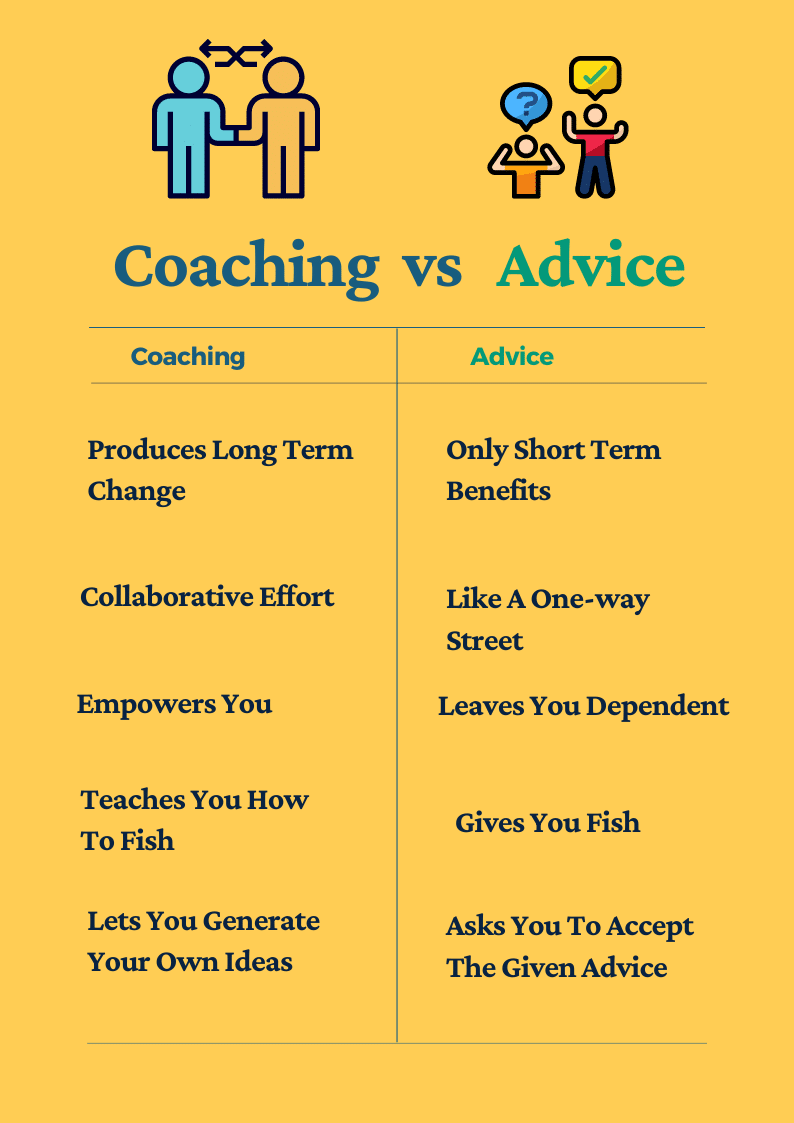
As with any other skill, listening and effective communication takes time to master. Therefore, even though the first few one-on-ones might feel awkward, keep going. Invest in your learning and learn to coach by asking better questions. You will soon get the hang of it.
2. They Might Breed Unrealistic Expectations
Considering how employee-centric these meetings are, some managers fear that they might breed unrealistic expectations. They start asking questions such as, “What if the employees start asking for things we cannot deliver?”
Nonetheless, that should not stop you from holding one-on-ones. The goal of the meeting is to clarify expectations. Both parties get to communicate what they want or expect from one another. Therefore, let your employees know that they can always make their needs known. However, not all of them can be met. Be open, honest, and straight.
It is not your job as a manager to say nice things to your employees. It is your job to care for them and to ensure their growth, productivity, and development. Don’t beat around the bush. If you have something to say, say it the way it is.
3. The Manager Should Have it All Figured Out
Managers often stress themselves up thinking that they should have all the answers. Nonetheless, that should not be the case, as you are human after all. Answer what you can while promising to look into what you do not know.
Even if you make mistakes, don’t be too hard on yourself. You are not superhuman, and expecting too much will only put you under pressure. Forgive yourself when you mess things up. Take responsibility and apologize to the responsible parties. Make fresh promises if you need to.
Conclusion
One-on-one meetings are one of the most powerful tools you have as a leader and manager. This is because they give you the opportunity to know people better, build better relationships, and go on an inspiring journey together. A journey that can be challenging, fun, and at the same time, fulfilling.