perspective

  • Give Yourself Permission To Focus on the Journey Instead of the Destination. Here’s How It Can Fill Your Days With Joy and Satisfaction?

    During a 3200 meter race in 2012, Arden McMath collapsed due to exhaustion. Instead of continuing past her and finishing one spot ahead, fellow runner Meghan Vogel stopped to give Arden a hand. Meghan draped Arden’s arm over her shoulders, and supported her the last 50 meters to the finish line. When they crossed, Meghan ensured Arden finished before her, and in the process, ensuring she finished last overall.

    Despite being at the bottom of the standings, Meghan was a winner that day, she finished a champion. With the crowd watching the events unfold, Meghan’s sportsmanship won over many hearts. It’s a testament to how the first place is not the only way to triumph.

    Arden McMath and Meghan Vogel Finishing Their Race Together
    Arden McMath and Meghan Vogel Finishing Their Race Together

    Winning Is Not The Only Thing That Matters

    We all know that winning is important, be it in sports or life. It is, after all, the reward at the end of the race that initially attracts most competitors.

    Today I want to highlight something beyond winning, something which is even more important—the journey. As you can see in the above story, winning is not the only thing that matters. Meghan was a winner that day despite finishing last.

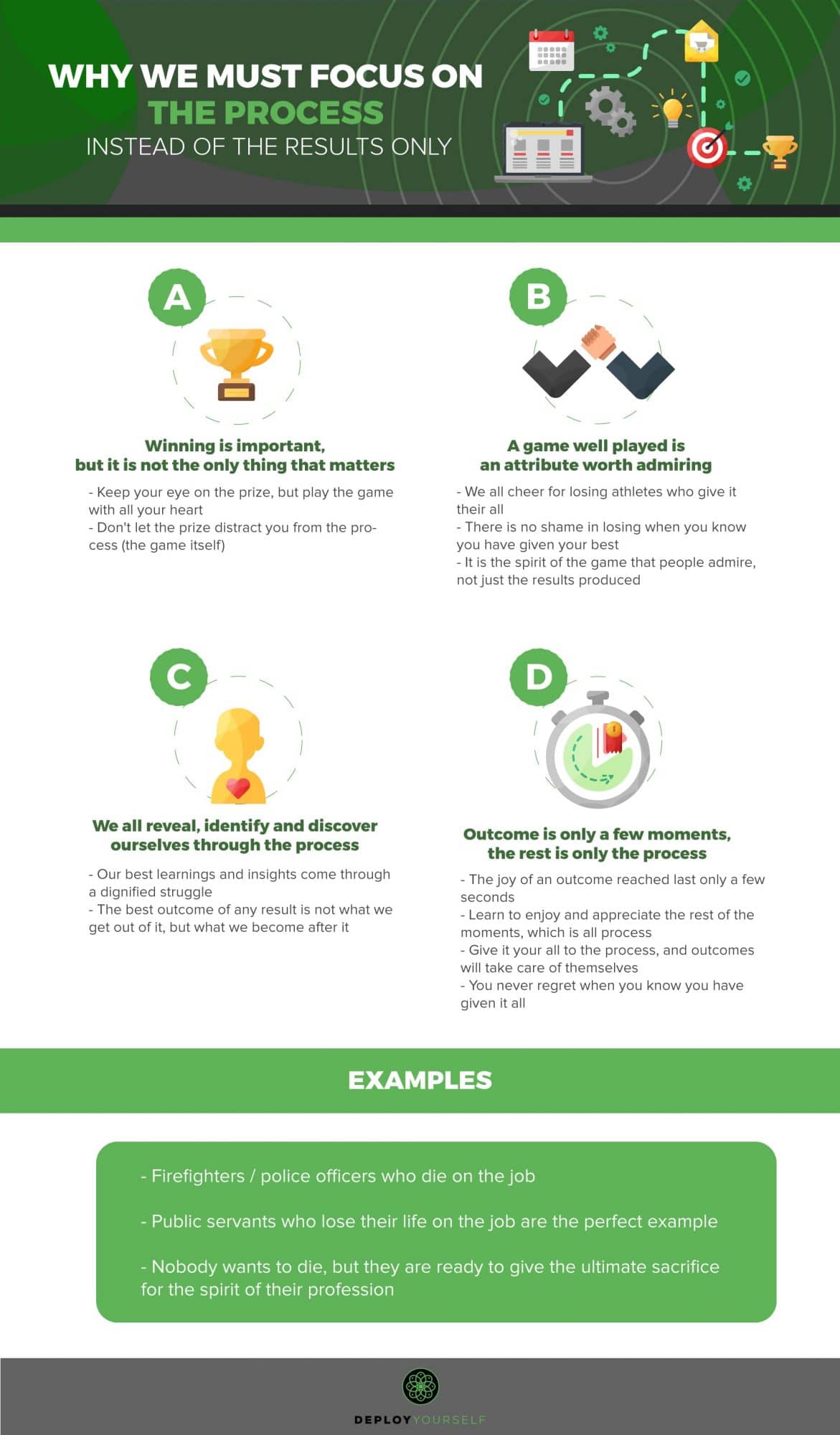
    You can see this in all sports. You don’t only support the best players or teams. You don’t only cheer for the winners. You cheer for the people that play with integrity and give it their all. (See an infographic with the main points of this article at the end.)

    Even those that come in last are cheered when they play the game with the right attitude. You’ll find that most sports have awards not only for winning but for many other aspects of the game. There are trophies and awards handed out for sportsmanship in almost every sport.

    Sports stars are not only athletes. They are role-models. Apart from their performance, it is their attitude and behavior that makes them so.

    It’s Not the Dog in the Fight, It’s the Fight In The Dog

    Over 50 years before Meghan helped Arden to the finish line, a similar thing occurred in the 1956 Australian National Championships.

    Runner Ron Clarke got in a tangle when another runner inadvertently clipped his heels. Clarke had been leading the race but at this point fell to the ground, and was leaped over by those runners just behind him.

    One of those to initially jump over him was John Landy. Unfortunately in his attempt to avoid Ron, John’s shoe clipped and cut Ron’s arm. Rather than continue on, John—who was a favorite for the race and expected to appear in the nearing Olympic Games—stopped to check on Clarke. After helping him up, the two continued the race. John, even after stopping to help, made up the deficit and won the race.

    But it was not the win that John was remembered for. His gesture of sportsmanship was so well-received that a sculpture of the moment was made, and remains to this day in Olympic Park, Melbourne. Clarke, in his autobiography, wrote:

    “Within seconds the whole field was jumping over me or running wide. Then John did a foolish, but a typically thoughtful thing – he came back to say he was sorry and see if I was alright. The mile title, his bid for the world record, even the approaching Olympics… all were forgotten as the champion made his spontaneous gesture to the raw stripling floundering in the cinders.”

    We must always keep our eye on the prize, but play the game with all our hearts. The reward or goal at the end shouldn’t distract us from the process of playing the game itself. If John Landy or Meghan Vogel had been too focused on the white stripe at the end of the track, it’s unlikely they would be as well-remembered or respected as they are today.

    A game well played is an attribute worth admiring in itself. And playing the game doesn’t happen in the moment of winning or losing, it happens in every moment before that. This is the reason we all cheer for an athlete who lost but gave it everything.

    There Is No Shame In Losing When You Have Given Your Best

    There is no shame in losing when you know you have given your best. In life as well as in sports, it is the spirit of the game that people admire, not just the results produced.

    If we only focus on the result, it is easy to miss the process which leads to those results in the first place. We all reveal, identify, and discover ourselves through the process, as that is where we spent most of our time.

    The finish line is a fraction of the total time we invest. When you switch from only enjoying the rewards at the end to relishing the entire process, more of your life becomes meaningful and enjoyable.

    Growth is a continuous process, not something that happens only in brief moments of time. Most of our life is spent in between the wins and the losses, the ups and the downs, and the start and the finish. Happiness is fleeting, and if you only expect yourself to be happy when you reach certain goals, it will leave you disappointed and frustrated most of the time.

    There are two reasons why our happiness from these moments quickly fades:

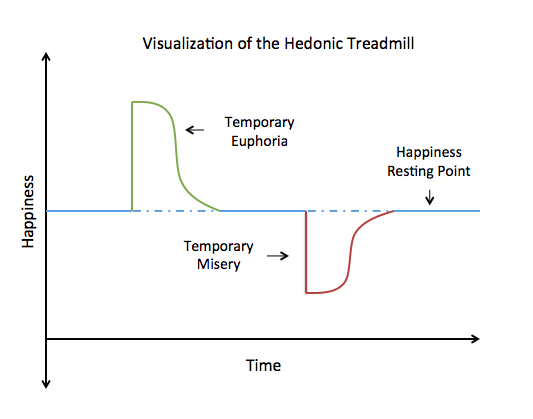
    • The first is that positive emotions fade after the moment of success or victory. While we might be joyous and celebrate for a time, the shine wears off and we return to a baseline state.
    • The second is that our aspirations continually grow. We don’t reach a goal and decide to completely stop. We soon turn our attention to something else. A new goal takes hold, and the struggle begins again.

    The result is that after we achieve a goal, we enjoy it for a moment before moving onto the next thing. It is part of what psychologists call hedonic adaptation, and occurs for both positive and negative events—the emotions never last, you always return to the baseline. 
    Goals Don’t Create Or Sustain Happiness

    They have value because they give us a direction, and they’re trackable and measurable. But only focusing on them places a lot of pressure on us. When we do achieve them, the positive effect is over all-too-soon. Then it’s on to the next thing, with the pressure back on.

    This is not a healthy way to live or grow. However, there is an alternative, which is to give more of our attention to the journey instead of the destination.

    For The Love Of The Challenge

    If you are only focused on what you want, the process will be an obstacle. If you think of the process as a problem, you’ll do anything to find a short cut, and get straight to the prize, reward, or good feeling, without the challenge.

    There are times when removing a challenge will help you. You use calculators and washing machines to achieve goals that you don’t want to waste your time and effort on. Because you want to save your effort for more important tasks.

    But when it comes to our most important goals, there are no shortcuts. If there were, it would defeat the purpose. Growth happens and life derives its meaning in the process. It’s what happens when you respond to the challenge, not when you reach the end result.

    Philosopher and mathematician Bertrand Russel wrote that removing challenges from life is a sure way to remove happiness, not increase it. You need the struggle, the obstacles, and the challenges to overcome. That’s how you improve and derive meaning and joy.

    Our most significant lessons and outcomes in life do not come from winning, but from giving our best in a dignified struggle. The joy of a race won or a business victory lasts only a few seconds, while the satisfaction of discovering something deep and true about ourselves lasts a lifetime.

    When you pour effort into an activity, you do so because of love for what you’re doing. When behavioral economist Dan Ariely and others had participants build IKEA products or origami, their creations were often of poor quality. But their creators loved them and expected to be paid much more for their products than anybody was willing to pay.  From an outsider’s perspective, each person’s creation could be viewed as a failed attempt, especially when compared to expert creations. But to each individual, the time and effort that went into what they built ensured they held it in high regard.

    When you’re not busy trying to compete with other people or claim a reward, and simply focus your energy on the task itself, the outcome will be positive and meaningful no matter your level of success.

    How To Change Your Perspective 

    You don’t know who you will be in the future. You don’t know whether you will even reach the destination when you’re still on the journey. But you do know who you are now, the direction in which you want to go, and the kind of effort you want to put in. Setting your sights on the future can distract you from what happens in the here and the now. Every distant goal begins with taking action now, so it is important to focus on your present actions. Winning a race depends on taking action now. 

    World-class sports stars do not just walk out on the track and win, they practice day and night for years. There is a long and arduous process that happens behind the scenes. You need similar processes and habits driving you. And you need to cherish them, even when they get repetitive or painful.

    This means changing your focus from your big goals to your system of daily habits and processes. Goals are something you go after, habits and processes define who you are. Goals are future bound, but processes are in the here and now.

    By creating habits, you can make lasting changes in the way you show up for life. Instead of reverting back to your past self when you reach your goal, you will continue the behavior. Your goal becomes another point on a journey of continuous improvement. 

    Research suggests that a simple change of perspective can help us do this. In six studies by Szu-Chi Huang and Jennifer Aaker, of over 1600 people from different cultures and backgrounds, they found that construing goals as a journey led to continuing the behavior that attained the goal. They write that:

    “The journey metaphor may have helped people think more about the actions they took during the journey, where they started out, and all the ups and downs along the way, leading to the feeling of growth. These thoughts could also contribute to an increased perception that the actions they took were instrumental and should be continued.”

    If you want to lose weight, and you succeed, there’s little stopping you from falling back into old habits and putting the weight back on. Treating the process as the most important element ensures we don’t regress after a goal is achieved but continue on the journey. 

    There is another benefit to thinking in terms of a journey—the scale of the goal is less likely to deter you. 

    Before you start on your journey, a goal that seems insurmountable might stop you from acting at all. A goal that seems easy could have you put it off. By changing your perspective and focusing on what you can do now, and what processes will help, you win even when the goal is missed

    Hence you should learn to enjoy and appreciate each moment in the journey towards the destination. Relish the challenge. When we know we have given our best, we never regret it in the end. That is success beyond success. There is no better joy or satisfaction in life than knowing you did the best you could.

    It Is The Journey, Not The Destination

    Goals are just dots on a map and often miss the story of how you got there. And everybody cares deeply about their story. You don’t skip to the end of movies or books to read about the happy ending, because it’s the process that is most appealing. It’s the difficult stuff that reels you in, the trials and tribulations, the conflicts and resolutions.

    In any story, there are unexpected twists and turns. If you’re too focused on the future, you’ll miss opportunities to do something good and meaningful now. When someone falls (like in the story I started this article with), you’ll be too concerned with your goal to stop and help them up.

    Real winners are not identified by the medals hanging around their necks, or the plaques on their walls, or their names in the record books—real winners are embodiments of qualities like determination, sacrifice, grit, integrity, effort, and heart.

    It’s how they respond to the challenge, not the final result. It’s their journey, not the destination. And right now, you’re on your journey. There will be good times and there will be tough times, and it’s what you do in each of those that count. 

    Watch the video of the story (Meghan and Arden) I started this article with below. Every time I watch it, it gives me goosebumps and leaves me a little teary-eyed. And as you can see, Meghan’s act of sportsmanship that day continues to inspire people even today.

    If that is not what success is, then I don’t know what is.
  • Can We Walk in Another Person’s Shoes? Why Empathy Might Be The Most Important Human Ability?

    On a recent archaeological dig in Man Bac in what is now northern Vietnam, a team of researchers made a remarkable discovery. While unearthing the remains of some Stone Age people who were buried 4,000 years ago, they discovered one young man who had been placed in his grave differently from the others: he was curled in the fetal position.

    It turned out he was laid to rest as he lived. Further examination showed that this man suffered from a rare congenital disease that fused the vertebrae of his spine. It would have left him paralyzed from the waist down from the time he was a small child.

    Yet the scientists concluded that this young man lived a good ten years past his adolescence. That means that for years, perhaps decades, others had to care for him, feed him, keep him clean, and keep him safe from danger.

    Why is this significant? Because this young man’s life and death show us the essence of what it means to ‘walk in someone else’s shoes.’ This profoundly disabled young man lived into his 20s only because others in his little tribe had empathy for him: they imagined what it might be like to be him, they chose to feel his pain, and they chose to experience the difficulty of his life.

    And then they chose to care for him since he couldn’t care for himself.

    That is walking in someone else’s shoes. That is the beating heart of empathy.

    Every 2 weeks I share my most valuable learnings from living life fully in my Deploy Yourself Newsletter. Sign up now to download a workbook with 164 Powerful Questions which I use daily in my work and coaching. Allow these questions to transform your life and leadership.

    What Do We Mean By Walking in Another Person’s Shoes?

    To walk in someone else’s shoes is to make an effort to grasp their point of view emotionally.

    Empathy‘ is the ability to recognize and understand the feelings and thoughts of another person.

    Perhaps most importantly, walking in another person’s shoes is the ability to not only see the world from their perspective but to feel it as if you were them.

    The Ability To Walk In Someone Else’s Shoes

    Sadly, empathy isn’t taught very well in our schools and workplaces. This is strange given that developing empathy has always been recognized as an important part of human development.

    Throughout our lives, we learn many skills that are drilled into us through regular tests, projects, and repetition. But in my experience, I’ve found that it isn’t always the formal skills – the ones like math, history, and physics – that are the most important.

    Formal Skills vs. Informal Skills

    After going through 21 years of education and now 15 years of work experience, I have learned that while the skills taught in formal education are important, the most crucial skills I have used to succeed in my career and life were never taught to me in an educational setting.

    Like most people, I was not even aware that there were other skills that I needed in order to succeed. As many of us do, I was running blind without even knowing that this blind spot was hampering my growth and success. I’ve since learned that there are a few vital informal skills that we can develop, skills that put a powerful compass in our hands to help us navigate the difficult seas of the modern workplace – and life in general.

    Vital Informal Skills

    Why Are These Skills So Important?

    Of course, having the kinds of skills we learn in school and later in the workplace are important. However, knowing how to actually achieve your goals while working together with multiple people within your company is a different matter altogether.

    A lack of empathy not only hampers our ability to be productive in the workplace, but it is also foundational to rational decision-making, building lasting relationships, and distinguishing between right and wrong.

    Without empathy, that one particular, critical skill in your tool kit – one that often doesn’t appear on a CV – you are likely to face an uphill battle in anything you’re trying to accomplish.

    “When you show deep empathy toward others, their defensive energy goes down, and positive energy replaces it. That’s when you can get more creative in solving problems.”

    – Stephen Covey

    I Hear You, I See You, I Feel You.

    To walk in another person’s shoes is to shift perspective, and to see and feel the world as another sees and feels it. The word feel in the previous statement is very important, important enough that we must take a closer look at it.

    What I mean by feeling as another person is that you must learn to not only see things intellectually from someone else’s point of view but also to feel the same emotions that the other person feels. This might mean feeling scared, tearful, or elated depending on the situation, and understanding on a profound level what has made the other person feel this way.

    Researchers have found that when we feel another person suffering, it activates not only the visual cortex in the brain but also our emotions and physical sensory receptors. Imagine witnessing someone get a paper cut: you not only sympathize with their pain, but you might also wince, or draw your own hand back involuntarily. You can almost feel the slice happening to you.

    Developing and nurturing these empathetic abilities rather than shying away from them is like a secret weapon when it comes to working with other people. It’s a foundational component of what made us human in the first place – just ask our Stone Age friend from Man Bac in Vietnam.

    So what is it that prevents us from fully understanding what another person is feeling? Why can’t we listen deeply?

    That’s because we’ve already filtered it out.

    Listening Filters, Empathy and Your Truth

    Empathy has deep roots in our evolution as a species. Developmental psychologists say that empathetic behaviors like altruistic helping and comforting others who appear to be in distress emerge in children as young as 12 months! Thus, empathy is built into who and what we are.

    However, as we get older, it becomes more and more difficult for us to be empathetic with others.

    All of us see the world differently based on our listening filters. We select what to pay attention to and what to ignore, often subconsciously, based on our particular set of experiences and knowledge. Our parents, friends, culture, values, beliefs, expectations, moods, and prejudices all combine to form such filters. These filters help each one of us create our own perceived reality and affect every decision we make.

    The important thing to realize here is that the “truth” we form by the above process is only “our” truth and not the absolute truth. Throughout any interaction, understanding that others’ perceptions of the world are equally valid as ours is key to gaining any level of understanding with them.

    Everyone has a right to form their own perception based on how they experience the world around them. Indeed, if you stop and think about our listening filters, we quickly realize that it would be literally impossible for two people to share the same “truth” in the deepest sense.

    Once we understand that our apparent “truth” is only a perspective, it allows us to view the same situation differently and accommodate someone else’s point of view. This is the foundation of empathy and is of immeasurable help in resolving conflicts.

    “Physics isn’t the most important thing. Love is.”

    ― Richard P. Feynman

    Perspective and Conflict

    Conflicts don’t occur because of different perceptions, not exactly. Rather, conflicts occur because of our inability to step outside of our own perspective and acknowledge the other person’s point of view. If you can’t take a moment to walk in another person’s shoes, how on earth are you going to reach any kind of accord or understanding with them?

    And this is why I believe that seeing and understanding different points of view is a superpower for those who possess it. Friction should be between points of view, not between people, and certainly not between organizations and nations. Empathy allows us to escape unnecessary stress from friction in relationships.

    President John F. Kennedy famously brought in advisers from profoundly different backgrounds and political persuasions in order to guarantee he would get the widest possible variety of perspectives. After a pair of advisers went on a fact-finding mission to Vietnam in the early years of the conflict there and came back with wildly differing tales of what the conditions were like on the ground, Kennedy famously quipped, “You both went to the same country?”

    When it comes to our own lives, it’s vital to remember that we can all be in the same country, even standing in the same room, but nonetheless perceive our surroundings in profoundly different ways.

    Celebrating Difference, Loving Friction

    Every great human accomplishment has come out of differing opinions and the energy generated by healthy friction. Seeing things from different perspectives can allow us to create something better than anyone could on their own.

    Taking the time to step into the other person’s shoes is the very necessary first step we must take to engage in productive conversations, iron out our differences without making things personal, and reach a win-win solution/agreement. To not do so out of defensiveness or fear is to invite unnecessary conflict and misunderstanding.

    How to Build Empathy

    Like any skill, empathy can be learned and it gets better over time with practice. Here is how you can do so:-

    • Pay Attention – Be fully present without distractions when in the company of others.
    • Active Listening – Stop thinking about what you’re going to say next and just take in what the other person is saying.
    • Don’t Interrupt – Even with the best intentions, saying things like, ‘It’ll get better,’ or ‘It’s not that bad’ diminish the other person’s problems and may cause them to shut down. Avoid doing that.
    • Make It About them, Not You – Resist the urge to speak. Use filler words like “umm”, “and”, and “tell me more” to hear them out fully before speaking.
    • Be Open and Vulnerable – Empathy is a two-way street. We make these connections by sharing our own vulnerabilities and struggles. Don’t be afraid to open up.

    You Can Be Right and Still Be Wrong.

    In the end, we must ask ourselves this question – Do we want to be right, or effective?

    And this is the question that can be answered by seeing things from another’s point of view.

    Do we want to be right and prove others wrong and secure a personal victory?

    Or is it more important to be effective in dealing with the topic at hand, even with the different points of view we might have?

    Once we learn to choose the latter, we can take meaningful steps towards reaching solutions and agreements that are more positive and inclusive than any individual point of view. Developing the ability to empathize and to approach life from this perspective will result in consistently better results for not only you but for everyone around you.

    Now that’s what I call a real superpower.

  • Understanding Conflicts Better – The First Step to Conflict Resolution

    CONFLICT!

    Is that a word that scares you? Is that something that makes you run in the opposite direction? Do you wish you had the skills to handle conflicts better?

    If you are like most people, you are no fan of conflicts and have often been caught up in the maze of a conflict. I certainly have, and I can honestly attest that conflict (or the fear of it) has given me many sleepless nights.

    In my 12 years of professional life, I have spent many a moment amidst conflicts, and many more reflecting upon them. Why do they happen? How can I best handle them? Can I still achieve my goals and enrich my relationships with conflict all around me? Can I beat the stress and anxiety which comes with conflict and still be happy and peaceful? Can I deal with conflict in a way that I can be proud of?

    There has been wise advice shared with me which I have ignored out of arrogance or ignorance, only to stumble upon and be humbled by the same realization later. Over time I have written down some notes which I have referenced later in times of conflict. This article is the first in a series of articles I am writing from these notes which revolve around the subject of handling conflict in our professional and personal lives.

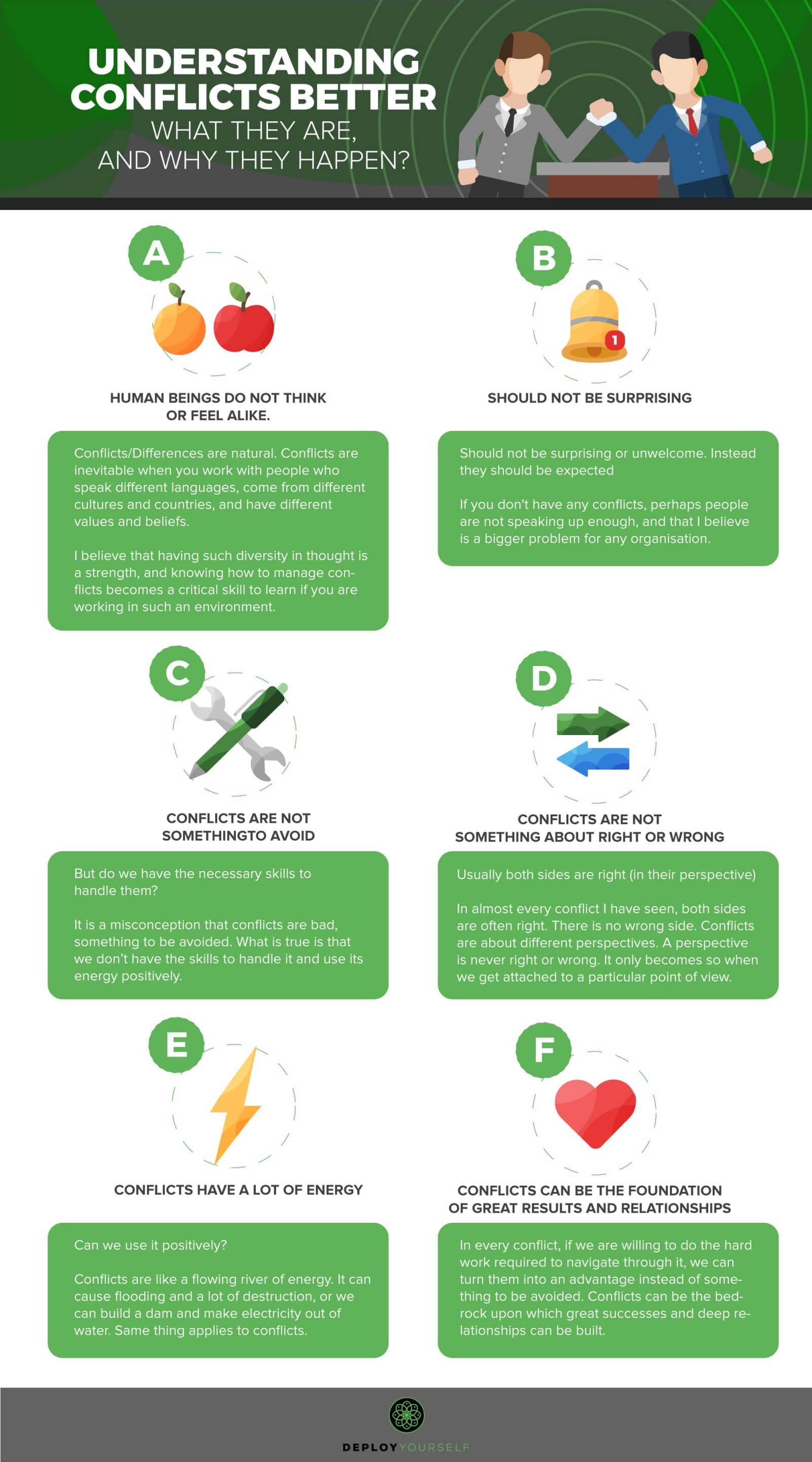
    Human Beings Do Not Think or Feel Alike. Conflicts are Natural.

    Wherever there is life, there is conflict. Every species on this planet experiences conflict in its fight for survival. Plants and animals strive for limited food, space, and mates in the wild, often giving rise to conflict. Humans are much more complex. In addition to food, space, and sex; we want power, fame, and money; giving rise to even more conflicts.

    Conflicts are a natural order of life, and if we step back and see the bigger picture, there is nothing unexpected around them. They are inevitable when we work with people who speak different languages, come from different cultures and countries, and have different values and beliefs.

    They Should Not Be Surprising. Instead They Should Be Expected.

    Today we live in a world driven by democratic and secular values (in most countries). If you don’t see any conflicts, perhaps people are not speaking up enough, and that I believe is a bigger problem for any society or organisation.

    In democratic societies, differences of opinion are not only expected but it is also a duty of each citizen to express himself without fear or hesitation. I believe that having diversity in thought is a strength, and knowing how to manage conflicts becomes a critical skill to learn if we are to live and work in such an environment.

    Understanding Conflicts Better Infographic
    Understanding Conflicts Better Infographic

    Are Conflicts Bad? Or Do We Lack The Skills To Handle Them?

    After facing and trying to avoid many conflicts over the years, I have come to believe that conflicts are not bad or something to be avoided. However, it is a common misconception and I have seen people do anything to avoid them.

    We have no choice or power over when a conflict is going to present itself. Our only choice is in responding to them. We find them undesirable or unproductive not because they are unpleasant but because we have no idea about how to handle them.

    Conflicts Are Not About Right or Wrong. Usually Both Sides Are Right.

    In almost every conflict I have seen, both sides are right. There is no wrong side. Conflicts are about different perspectives, and each perspective is valid for the one holding it. A perspective becomes right or wrong only when we get attached to a particular point of view.

    Can we see that we are all seeking to express the truth as we see it? Can we acknowledge that everyone sees the world differently and form their own perception of events? Conflicts happen not because of different perceptions, but because of our inability to acknowledge another’s point of view.

    Conflicts Have A Lot of Energy. Can We Use It Productively?

    Conflicts are like a flowing river. If left unchecked, they can cause flooding and destruction. But if we can build a dam and channel the water in the right direction, we can turn it into electricity.

    The same thing applies to conflicts. The only question is – Can we use the energy in conflict productively? Can we channel this energy into productive conversations that can lead to creative solutions and better results?

    However, if we can’t control the energy in a conflict, it can result in damage (stress, frustration, bad results) and lost opportunity.

    Conflicts Can Be The Foundation for Great Results and Relationships.

    Healthy disagreement creates friction and energy. If we look back at history we will find that every great accomplishment has come out of differing opinions of people who have found a way to work together.

    In every conflict, if we are willing to do the hard work required to navigate through it, we can turn them into an advantage instead of something to be avoided. Conflicts can be the bedrock upon which great successes and deep relationships can be built.

    “An enemy is a person whose story we have not heard.” – Gene Knudsen Hoffman

    In the next article, I will share a few things which most of us have done in the past amidst a conflict, but which I have learned that we MUST NOT DO when we encounter a conflict.

  • There Are Only Perspectives, No Truth. And Five Different Perspectives You Can Apply In Each Situation

    Tom : “I am sorry I am a bit late to this meeting. My previous meeting ran over.”
    Sara : “I am more worried about the missed deadline on the product your team is developing. Your team is slow.”
    Tom : “It’s not my fault. Two members on my team reported sick last week and I can’t help it.”
    Sara : “I don’t really care what happened. But I know I can’t count on your team. This makes me look bad.”
    Tom : “You are not being fair, Sara. “
    Sara (to herself) : “Tom’s lack of experience shows. He doesn’t hold his team accountable, and always has excuses for delays.”

    How many times have we spoken or seen others speak such sentences? As we solve complex business problems, very often we “know” the truth (you are slow, this is not how things work here, etc) and base our actions on it. In this article, I want to stress that there are no truths in the workplace (and life). There are only perspectives, and there can be many different perspectives depending on how you look at the situation. Once we realize that our apparent “truth” is only a perspective, it allows us to view the same situation differently to help us make better decisions.

    How We Form Our Truth?


    The first thing we must do is to take a pause and ponder about how we form our truth in the first place. We (human beings) gather inputs from our five senses – smell, touch, sight, sound, and taste. Anything which is external reaches us via one of the senses. We touch something which is hot, and we “know” it is dangerous and not safe. We hear something from multiple people or from a reliable source, and are inclined to believe it as truth”.

    The quality, source, and frequency of sensory information we gather have a big role in how we interpret it. For example – If you read an article with a lot of grammatical and spelling mistakes (quality), you are less likely to trust the content. Similarly, if you hear about the same thing from multiple people (frequency), you will be more inclined to trust it.

    Once we collect the sensory information from the outside world, our brain makes sense of it. It decides which signals to pay more attention to and which to ignore. Our brains also apply the collective influence of our memories, beliefs, thoughts, and values to every new information, and derive meaning from it. I already wrote about Listening Filters and how they create the “truth“. For example – Growing up in a very hierarchical corporate culture (and society) in India, it still takes effort on my part to see and interact with people above me on the corporate ladder as peers in Amsterdam.

    The Five Different Perspectives


    The important thing to realize here is that the “truth” we form by the above process is only “our” truth and not the absolute truth. Realizing that different people can see and create their own truth in the same situation is the key to working together more productively. Seeing our own truth as a ‘perspective‘ instead of the truth leads to humility and a willingness to consider other perspectives.

    Unless we step down from the high pedestal of truth we often end up placing ourselves on, we can’t see all the other perspectives out there. I believe there are (at least) five different perspectives that can offer tremendous insights to us. However, it is not always easy, nor are we often willing, to view a situation from these perspectives. They might lead to some uncomfortable moments, but the process can often result in new insights and learnings. These not only can lead to better results but also help us become more human in the process.

    As I write down the different perspectives below, I will also specify a few questions we can ask to uncover each perspective :-

    First Person (My) Perspective


    The first person perspective is how I see and perceive things. The biggest clue about the first-person perspective is the usage of pronouns like We, Us, Our, I, Me, Mine in our thoughts, and language. This is the most natural perspective for all living creatures, and we listen and think in a first-person perspective by default. The first person perspective leaves you with ownership, authenticity, and often attachment to your point of view.

    Questions to Uncover First Person Perspective


    1. What conclusion am I arriving at?
    2. Is it the truth or just my opinion?
    3. What reasons/proof do I have in my opinion?
    For Example – Sara’s (in the above conversation) first-person perspective could be – “Tom is a difficult person to deal with because of his immaturity. I can’t trust him or his team as he is not accountable.”

    Second Person (Your) Perspective


    The second person perspective is seeing things from another person’s point of view. Listening to someone and making efforts to understand her perspective shows respect. The second person perspective calls for seeing and feeling the world as another person does. It doesn’t matter if you agree or disagree with it. The second person perspective has a lot to do with listening and it can have a massive impact. The second-person perspective leaves you with empathy and humility.

    Questions to Uncover Second Person Perspective


    1. How would this situation look and feel to him/her?
    2. How would he/she interpret the situation? Can I step in his/her shoes?
    3. Can I feel how he/she might be feeling (anger/joy/frustration) right now?
    For Example – Sara’s second-person perspective could be – “Tom is new to this job and he must be finding it difficult to make demands from his people. He must be really stressed out and might need some help to manage his priorities better. I might only be making matters worse for him. Instead, can I help him somehow?”

    Third Person (His/Her) Perspective


    Another perspective could of a related third party. If you are talking to your colleague, a third party perspective could be of your manager or another colleague. For example – In a workplace, a third-person perspective could be of a colleague whose work will/might be impacted by what you are talking about. Seeing through the third-person perspective leaves you with a big picture view, more options, and opens up blind spots.

    Questions to Uncover Third Person Perspective


    1. How would my boss think about this situation?
    2. How would the sales head think about this conversation?
    3. If I were him/her, how would I have described the situation?
    For Example – Sara’s third-person perspective, from the point of view of another colleague, would be – “Tom is trying hard to keep everyone happy, and failing at it. And Sara is not making it any easier for him by making demands without understanding his situation. How will they make this project succeed? If they fail, it will hurt our team and we will miss our targets.”

    Stranger (Witness) Perspective


    The fourth perspective calls for viewing the situation from the point of view of a witness. A witness is someone who neither has any stake in what you are discussing nor does he knows either of you. The witness perspective is purely objective, and the witness observes the proceedings just like a camera would. Taking this perspective leaves you with detachment and objectivity. You see things as they are, without any judgment and attachment to either side or to a specific outcome.

    Questions to Uncover Stranger Perspective


    1. How would a stranger see and report my situation?
    2. If this were a movie, how would I describe it?
    For Example – Sara’s stranger perspective could be – “Tom is acting like a typical newbie, and is going to make the same mistakes everyone makes. People around him are too busy in their own lives to help or assist him grow through this phase in his career. Sara or Tom’s manager can step in to help, but do they even realize the need for it.”

    God / Compassion Perspective


    The fifth perspective calls for looking at the situation from a place of love, kindness, and compassion. With this perspective, we look at how we can make things better for every party involved, and worse for no-one. We attempt to listen to our inner voice (consciousness) from this perspective. How does it feel? Is there something which I know but am unwilling to acknowledge?

    Questions to Uncover God Perspective


    1. Would I want this conversation to be aired on TV, or reported in tomorrows’ newspapers?
    2. Do I hear an inner voice saying “this doesn’t feel right” or anything else?
    3. How would Jesus / Allah / Buddha / Krishna do in my situation?
    Disclaimer – This perspective has nothing to do with religion or our religious views, but is rather an invitation to stand in a place where we want to see everyone happy. It is about feeling instead of thinking and using our heart for mutual well-being instead of our brain for personal gains and business results.
    For Example – Sara’s fifth perspective could be “Tom must be going through a hard time, and might even be carrying his stress into his personal life. And I am not making it any easier for him. Can I help him manage his priorities better? Can he seek some training or help? The same holds true for me too. Going after business goals is fine, but it doesn’t have to be at the cost of stress and unhappiness.”

    To conclude, asking the above questions and viewing our situation from multiple perspectives can be tremendously liberating. It can provide us with options that weren’t visible to us before. Getting lost in what we believe to be the truth (first-person perspective) can bring us stressful days, broken relationships, and health problems.

    All of this can often be avoided by taking a look at the above five perspectives. It can often ease up any emotional build up (stress, anger, over-excitement) and prevent us from doing something in haste and from our limited viewpoint. It might not solve every business problem we get stuck in, but we can surely finish with better results and make more informed choices after considering these five different perspectives.