leadership

  • The Invisible Weight of Success: What Nobody Tells You About Making It

    You know what’s funny? When I quit my 16 years tech career to start on a totally new journey – to guide and work with the biggest changemakers & leaders on this planet, I thought the hard part was getting there.

    Landing the big CEO clients. Hitting the numbers and building a reputation. Being known for bringing people together and helping them go beyond even their own wildest dreams – both personally and professionally.

    Turns out, I had no idea.

    The real challenges of success? They’re the ones nobody talks about at conferences. They’re not in the Harvard Business Review case studies. They’re the 3 am thoughts, the conversations you can’t have with anyone, the slowly growing sense that you’re living someone else’s life while everyone congratulates you on yours.

    I’ve sat across from people who look like they have it all figured out—the title, the impact, the respect—and watched them break down because they finally found someone who wouldn’t judge them for admitting: “I don’t know if I can keep doing this.”

    Let me walk you through what success actually looks like from the inside. Not the Instagram version. The real one.

    When You Become a Role, Not a Person

    I’ll never forget this CEO I worked with—let’s call him Raj. Built an incredible company from scratch. 300 employees. Lives changed. Real impact. And he came to me completely burned out.

    “I can’t remember the last time someone asked me how I actually am,” he said. “Not how the company’s doing. Not how the quarter looks. Just… me.”

    Here’s what happens: You achieve something significant, and suddenly you’re not allowed to be human anymore. You’re “The CEO.” You’re “The Founder.” You become a symbol, an inspiration, a beacon—and all of that is beautiful except you’re still just a person who gets scared and tired and confused.

    Raj told me about going to a friend’s birthday party—people he’d known for years—and spending the whole evening answering questions about his company. Nobody asked about him as a father or about his painting hobby. Nobody noticed he’d lost weight from stress. The entire conversation was about his role, never about him.

    This is the identity prison. You get trapped in the character you’ve created, and the bars are made of other people’s expectations and your own success.

    I see this constantly. A leader can’t admit they’re struggling with a decision because “leaders are decisive.” They can’t show uncertainty because “leaders inspire confidence.” They can’t have a rough day because everyone’s watching.

    The exhausting part? You start believing it too. You internalize that you should always have answers. You should never waver. And slowly, you lose touch with the actual human underneath—the one who’s allowed to not know, to be tired, to need support.

    The Loneliness Nobody Warns You About

    Let me tell you about Priya. Brilliant executive. Everyone wanted to work with her. Her calendar was packed 7am to 8pm. And she was profoundly, achingly lonely.

    “I’m surrounded by people all day,” she told me. “But I can’t actually talk to any of them.”

    This is the cruel irony of success: The higher you go, the fewer people you can be real with.

    Your team needs you to be strong, so you can’t share your doubts. Your board wants confidence, so you can’t express fear. Your old friends feel distant because your life looks so different now. Your new “friends” might want access more than connection.

    I remember Priya describing a moment when she was in a meeting with her executive team, discussing a major strategic pivot. She was terrified it was the wrong call. Her stomach was in knots. But everyone was looking at her for certainty, so she projected it. The decision went through. It worked out. And she felt more isolated than ever because nobody knew how scared she’d been.

    Who do you talk to when you can’t talk to anyone?

    This is why our work together mattered so much. Not because I had magic answers, but because I was someone she could actually be honest with. Someone who didn’t need her to be anything other than human. Someone who could handle her uncertainty without panicking or judging.

    I remember one conversation where she spoke for 55 minutes of the 60-minute session. Internally, I was almost blaming myself because I didn’t get a chance to coach her or solve her problems. I was wondering if I added value because the only thing I did was I listened to her. At the end of the session, she said, “This was the best conversation I have had in a long time. Nobody has listened so deeply to me.” This feedback helped me understand the other side of success.

    The loneliness of success isn’t about being alone. It’s about being surrounded by people and still feeling like nobody sees you.

    When Success Stops Feeling Like Success

    Here’s something wild: I’ve worked with people who hit goals they’d been chasing for years—goals that would change their lives—and they felt… nothing. Or worse, they felt empty.

    There was this founder I coached who finally closed his Series B. Eight million dollars. Validation from top-tier investors. Everything he’d been working toward for three years.

    He called me the next day. “Is this it?” he asked. “I thought I’d feel different.”

    This is the moving goalpost syndrome, and it’s brutal. You think hitting the target will bring peace, satisfaction, that sense of “I made it.” Instead, it brings relief for about 48 seconds, and then your brain is already moving to the next thing.

    The Series B becomes “we need a Series C.” The VP title becomes “I need to be in the C-suite.” The successful exit becomes “but what’s my next thing?”

    You become addicted to the chase, to the achievement, to the validation—but you never actually feel satisfied. Success becomes this treadmill you can’t get off because stopping means facing the emptiness you’ve been running from.

    I see this with executives who work 80-hour weeks not because they have to, but because they don’t know who they are without the work. The hustle became their identity. The achievement became their drug. And now they’re trapped in a cycle that’s slowly killing them but they can’t imagine life without it.

    The Weight of Other People’s Lives

    At 2am one night, I got a text from a client—a CEO of a mid-sized company. Just two words: “Can’t sleep.”

    I called him first thing the next morning. He’d been lying awake thinking about a restructuring decision. Twenty people would lose their jobs. Twenty families. Kids. Mortgages. Dreams.

    “I know it’s the right business decision,” he said. “The numbers are clear. But these are real people. How do you sleep when you’re making choices that impact lives?”

    This is something most people never consider about success and leadership: Every decision carries weight that goes far beyond you.

    You’re not just responsible for results. You’re responsible for people’s livelihoods, their sense of security, sometimes their entire identity if they’ve wrapped it up in their job. One wrong strategic call and you’re not just missing a target—you’re affecting dozens or hundreds of lives.

    I’ve seen this weight crush people. The executive who can’t stop thinking about the single mom on their team who’s about to be laid off. The founder who feels guilty about every 5-star hotel stay because their employees can’t afford one. The leader who lies awake calculating how many people they’re affecting with each decision.

    The privilege of impact comes with the crushing burden of consequence. And you carry that alone because who else can understand it?

    When You Don’t Know Which Version of You Is Real

    I worked with a leader once—a woman who’d built an incredible reputation in her industry. Confident. Inspiring. The person everyone wanted to be.

    In our third session together, she said something that broke my heart: “I’ve been performing for so long, I don’t remember what I actually think or feel about anything. I don’t know who I am.”

    She’d spent years crafting the right image. Saying the right things. Showing up the right way. And somewhere along the line, the performance became the reality. Or rather, she lost track of which was which.

    This is the authenticity gap. The distance between who you are and who you show up as. And it grows every time you:

    • Project confidence you don’t feel in a meeting
    • Give an inspiring speech when you’re terrified inside
    • Act like you have it together when you’re falling apart
    • Smile and say “everything’s great” when it’s not

    The gap gets wider and wider until you feel like a fraud in your own life.

    I see this especially with introverts who’ve learned to perform extroversion. With people from cultures where showing vulnerability is seen as weakness. With anyone who’s had to “fake it till you make it” for so long that they forgot there’s a real person underneath the performance.

    The work we do together often starts with simply creating space to let the real person emerge. No performance. No image management. Just “what’s actually true for you right now?”

    When Everyone Wants Something From You

    “I don’t know who actually likes me anymore,” a client told me once. He’d just sold his company for a stupid amount of money, and suddenly he had more “friends” than ever.

    This is the trust deficit. When you’re successful, every relationship gets complicated. Is this person genuine or do they want funding? Want a job? Want to be associated with your success? Want to network through you?

    You start filtering every interaction through suspicion. It’s not paranoia—you’ve been burned. The person who seemed so supportive suddenly had an agenda. The friendship that felt real turned out to be transactional.

    I’ve watched this make people incredibly isolated. They want connection but they can’t trust it. They want friendship but they can’t tell if it’s real. And the sad part? Sometimes they’re right to be suspicious. Success attracts people who are more interested in what you can do for them than who you actually are.

    This is why finding people who knew you before, who don’t need anything from you, becomes so valuable. Or working with someone like me, where the relationship is clear and boundaried and there’s no hidden agenda.

    When You Have Everything Except Time

    The most painful irony of success: You finally have resources but no time to use them.

    You can afford the vacation but can’t take it. You can hire help but you’re too busy to let them help. You want to be present with your family but you’re always mentally somewhere else.

    I remember this executive—father of three—who realized he’d missed every single one of his daughter’s soccer games that season. He could afford front-row tickets to anything. But he couldn’t afford the three hours on a Saturday afternoon.

    Success promised freedom. Instead, it delivered a different cage—one made of opportunities you can’t say no to, obligations you can’t drop, expectations you can’t ignore.

    “I thought making it would mean I could finally relax,” he told me. “But I’m more trapped than ever.”

    The Imposter in the Room

    Here’s the wildest part: The more successful people become, often the more like an imposter they feel.

    You’d think it would be the opposite. You’d think results would build confidence. But what actually happens is this: The stakes get higher, the spotlight gets brighter, and that voice in your head gets louder: “When are they going to figure out I’m making this up?”

    I worked with a woman who’d been promoted to SVP. Huge company. Incredible opportunity. And she was terrified.

    “Everyone else seems to know what they’re doing,” she said. “I’m just figuring it out as I go.”

    The truth I shared with her? Everyone is figuring it out as they go. But at higher levels, you’re expected to hide it better.

    The imposter complex doesn’t go away with success. It just gets more sophisticated. More subtle. More isolating because you think you’re the only one who feels this way.

    What Actually Helps

    After years of sitting with people going through all of this, here’s what I’ve learned: The antidote to these challenges isn’t working harder or achieving more. It’s finding people and spaces where you can be fully human.

    Where you can admit you’re scared and it doesn’t shake anyone’s confidence in you.

    Where you can say “I don’t know” and it’s not a crisis.

    Where you can drop the performance and just be yourself, whatever that looks like today.

    This is why people come to me. Not because I have all the answers (I definitely don’t), but because I can hold space for the full reality of their experience. The fear and the confidence. The doubt and the vision. The exhaustion and the commitment. My promise to them is that I will never judge them (even when feedback is very honest and direct) and they can always count on me – for the rest of their lives.

    They come with their lights dim—frustrated, stuck, low on energy. And through our work together, something shifts. Not because I fix them (they’re not broken), but because they finally have space to be honest. To reconnect with themselves. To remember who they are underneath all the roles and expectations.

    They leave empowered, confident, ready—not because the challenges went away, but because they’re no longer carrying them alone.

    (All names have been changed and details in this article have been anonymised)

    The Real Conversation

    If you’re reading this and recognizing yourself, know this: What you’re experiencing is real. It’s valid. And you’re not alone in it, even though it feels like you are.

    The challenges don’t get easier with success—they just get more invisible and more isolating. And that’s exactly why finding someone who can see the real you, who won’t need you to be anything other than human, becomes absolutely critical.

    There are moments in every leader’s life when they need someone they know they can count on. Someone who gets it.

    Maybe that’s why you’re still reading this.

    If any of this resonated, send me a note. Better yet, record a voice note or a video msg. Let yourself be seen.

    Because here’s what I know for sure: You don’t have to carry all of this alone. And on the other side of being real about what’s actually happening? That’s where you let the burden of leadership go and acknowledge the privilege and grace of leadership. You deserve it.


  • An Open Letter to Entrepreneurs and CEOs

    hey you,

    yes – the person sitting in your chair right now, I see you. I get you.

    I see the sleepless nights, the endless pressure, the constant balancing act you perform every day. You’ve created something out of nothing—a company, a vision, a team. That alone makes you stand apart. Most people won’t ever know what it takes to do what you’ve done.

    But I also see the frustration. The exhaustion. The feeling that no matter how hard you push, you’re not making the progress you want.

    And I see something else—a trap that you may not even realize you’ve fallen into.

    The Trap of External Reasons and Excuses

    Right now, you’re searching for answers outside of yourself. Maybe you think a new strategy will fix it, or a consultant will give you that secret weapon you’ve been missing. Or maybe you believe that the conditions around you—market trends, team issues, limited resources—are the real reason you’re stuck.

    Here are some of the most common external reasons leaders lean on:

    • Market Conditions: “The economy is tough right now,” or “Our industry is changing too fast.”
    • Lack of Resources: “If only we had more budget,” or “We need more talent on the team.”
    • Client Demands: “Our clients’ needs are constantly shifting,” or “They’re squeezing our margins.”
    • Team Dynamics: “My team isn’t delivering,” or “There’s too much turnover.”
    • Time Constraints: “I don’t have the time to focus on growth with everything going on.”
    • Board or Investor Pressure: “The board wants me to follow a certain path,” or “Our investors are pushing for faster results.”

    These reasons feel legitimate. They sound real because they reflect the complex, chaotic world of running a business. And maybe you’ve even convinced yourself that if only one or two of these things would change, everything else would fall into place.

    But here’s the truth: These external reasons are just distractions. They’re taking your focus away from the one thing that actually matters—you.

    Leadership is never about having the perfect resources. It is about being “resourceful”.

    The Real Problem: Looking in the Wrong Direction

    The problem isn’t that the market is unpredictable, or that your team is underperforming, or that your board has other ideas. The problem is where you’re looking for the solution. When you constantly look outside of yourself, you’re missing the point.

    Here’s what happens when you chase external solutions:

    1. Temporary Fixes: You might find a quick solution—a new strategy or hire—that gives you a temporary win. But sooner or later, the same problems will come back, just in a different form. You’ll be right back where you started because you haven’t addressed the core issue.
    2. Giving Away Your Power: When you place blame on external factors, you’re giving away control over the situation. You’re telling yourself, “I can’t succeed unless these outside conditions change.” But the truth is, you are the one in control. The leader sets the tone, the pace, and the direction.
    3. Avoiding Responsibility: It’s easier to point to external factors than to look in the mirror. It’s easier to say, “The market is bad,” than to ask, “What am I avoiding? What am I not doing that could change this?”

    Looking outside for answers is like rearranging deck chairs on the Titanic. You can move things around, but unless you address the leak, you’re still going to sink.

    Why It’s Always About You

    Here’s a radical idea: Every situation you’re in, you contributed to creating it.

    That’s not to say you’re responsible for every external event, but you are responsible for how you’ve reacted, for the choices you’ve made, and for the environment you’ve built around you. The business, the team, the results—all of it reflects the leadership you’ve brought to the table.

    You are not to blame. You did not consciously create the problems that you have. I am not saying that.

    I am saying that you can still own the choices you made that led you here. That is responsibility and ownership, not blame.

    And if that feels like a hard truth, good. It should. Because until you recognize that you are the common denominator in every problem you’re facing, you won’t be able to fix it.

    Why External Success is the Booby Prize

    The business results you’re chasing—more revenue, more clients, better margins—they’re important, but they’re not the real prize. They’re the booby prize. They’re the shiny object that keeps you focused on external markers of success while ignoring the deeper work you need to do as a leader.

    Here’s the thing: You didn’t start this company just to hit revenue targets. You didn’t pour your heart and soul into this business just to stay afloat. You started it because you had a vision. A gift. A contribution to make to the world. Somewhere along the way, you got caught up in what everybody was telling you, and that vision – your vision – got lost in the shuffle.

    But if you’re only chasing results, you’re going to be on an emotional rollercoaster for the rest of your career. Revenue will go up and down. Clients will come and go. Markets will shift. If you’re anchored to those external outcomes, you’ll always be at the mercy of forces you can’t control.

    What you can control is who you are as a leader. The steady hand that remains calm no matter what storms come your way. That’s the real work. That’s where you should be focused.

    The Work Begins with You

    So, how do you get there? How do you stop chasing external solutions and start becoming the kind of leader who can weather any storm?

    It starts with asking yourself some tough questions:

    • How did I create this situation?
    • What am I avoiding?
    • What hard truths am I not facing about myself?
    • What would happen if I took full responsibility for this, instead of blaming external factors?

    These questions aren’t easy to answer, but they’re necessary. Because until you take ownership of your role in creating your current reality, nothing will change. You’ll keep spinning your wheels, trying to fix things externally, when the real solution is within you.

    The Leader You Were Meant to Be

    Look, I get it. You’ve been grinding day in and day out. You’ve been doing everything you can to make this business a success. You’ve been putting out fires, managing crises, and trying to stay afloat. And I see you for all of that.

    I am an entrepreneur myself. I have started companies in the past and failed. I get it. and I have great respect of what you do – day in and day out.

    But I also see the leader you’re capable of becoming. The one who isn’t thrown by external challenges. The one who leads from a place of strength and conviction. The one who doesn’t chase the next shiny object, but instead builds something lasting, meaningful, and true.

    That leader is already inside you. But you have to stop looking outside for answers and start looking at yourself.

    Your team deserves better. Your company deserves better. And most importantly, you deserve better. You deserve to lead from a place of purpose and clarity, not from fear or pressure. You deserve to build something that matters, not just something that survives.

    The world needs the gift you have to offer. But it can only come from you stepping into the leader you were meant to be.

    Building and scaling a company is an adventure. You are on an adventure. And adventures are exciting and fun. It doesn’t have to stress, alienate, and kill you.

    My Challenge To YOU

    What if—just for a moment—you stopped trying to fit in?

    What if you stopped trying to please everyone around you?

    What if you stopped second-guessing yourself and shrinking to meet other people’s expectations?

    What if, instead, you started speaking from your purpose? From the deep, passionate reason you started this company in the first place?

    What if you started asking for what you truly want without apologizing or justifying yourself?

    Let me ask you: What do you stand for? Not what your business stands for, not what your brand is about—what do YOU stand for? As a leader, as a CEO, as a parent, as a friend, as a human being? What are the beliefs and values that, deep down, you refuse to compromise on, even when it’s uncomfortable or unpopular?

    What are your key PROMISES to your employees, partners, children, colleagues, fellow leaders, spouse – and most importantly – to yourself?

    It’s easy to lose sight of those things. It’s easy to get caught up in the day-to-day noise, the expectations, the opinions of others, and the need to be liked or approved of. But what if you stopped listening to that racing mind that tells you to play it safe? What if, instead, you spoke from your heart?

    What If You Spoke from What You CARE about?

    Remember what drove you to start this company? What do you CARE about most deeply?

    Remember the fire that fueled those early days? What if you started speaking from that place again?

    Leaders don’t convince people. They don’t beg for approval or give endless justifications for their choices. Leaders inspire. They move people by standing firmly in what they believe, by speaking with conviction, by showing up powerfully and unapologetically.

    What if, instead of trying to convince others of your worth, you spoke in such a way that people were left wondering, Who is this person?” What if you stopped trying to be liked and started being someone worth following?

    What if you spoke in such a way that people want to join you because they know deep down that you will create something powerful in the future?

    What if people wanted to work with you—not because you’re the CEO, not because they have to—but because you showed them a bigger possibility for themselves? What if they saw in you the kind of leader who makes them believe they can do more, be more, create more?

    I am writing this letter because I see that potential in YOU.

    What If You Played to Win?

    I’m going to ask you something that might make you uncomfortable: Are you playing it safe?

    I know you’re doing your best. I know you’re navigating a thousand pressures and responsibilities. But are you playing to win? Or are you just trying to survive, to get through the next quarter, the next deal, the next fire to put out?

    What if you gave yourself permission to fall and fail, to take risks that scare you, and to push the limits of what you believe is possible? What if you wore your scratches and bruises with pride instead of fear? Wouldn’t you rather be bruised from playing big than stay perfectly safe and small?

    What If You Knew Everything Would Work Out?

    Now let’s go even further. Imagine—just for a moment—that everything would work out. Imagine that no matter what risks you took, no matter how far you stretched, everything would be fine. Nothing could go wrong.

    What would you do next if you knew it would all turn out well? How would you lead? What decisions would you make? What risks would you take if you weren’t afraid of failure?

    The truth is, you don’t need that kind of guarantee. You already have everything you need to lead powerfully. You just have to give yourself permission. Permission to step into your own leadership, to trust your gut, to follow your passion, and to make bold choices even when it’s scary.

    What If You Stopped Worrying About What Others Think?

    So many leaders hold back because they’re afraid of what others will think. They’re worried about judgment, criticism, or disappointing someone. But what if you stopped caring about that? What if you stopped worrying about what others will say about you and started saying what you actually mean?

    Yes, it will be uncomfortable. Yes, it will feel scary. But it will also be worth it.

    You’ll start to feel the weight lift off your shoulders. You’ll feel the freedom that comes from being true to yourself. You’ll inspire your team, your clients, your colleagues—not because you’re trying to win their approval, but because you’re living and leading authentically.

    You Don’t Need a New Knife—You Need a Steady Hand

    So, stop looking for the next tool, strategy, or fix.

    Enough of that!!!

    Or, keep going and you can come back to this letter next year. Be my guest.

    Instead of looking for a new knife or tool, strengthen your hand. Strengthen YOU.

    Do the hard work of looking inside, taking responsibility, and growing into the leader who can turn any situation into an opportunity.

    Because the real prize isn’t the business results—it’s the leader you become in the process.

    You Are Stronger Than You Think

    The truth is, you are stronger than you think. You’ve already shown immense strength in building your company and leading through countless challenges. But you have even more in you than you realize. More than just adjusting to the world around you. More than just managing the day-to-day. You don’t need to look for someone else to save you.

    You don’t need a savior. You are the leader you’ve been waiting for.

    It’s time to own your choices. Own your power. Own your leadership.

    Every moment, you’re making a choice. Even when you choose not to act, you’re making a choice to stay where you are. So, why not choose something different? Why not choose to step into the fullness of who you are? Why not choose to lead from your heart, from your purpose, from your deepest values?

    Choose Wisely. Choose Leadership. Choose YOU.

    This is your moment. Your team, your business, the people around you—they all deserve a leader who is fully alive, fully engaged, fully in their power.

    More importantly, you deserve it. You deserve to lead from a place of freedom, purpose, and passion. You deserve to be the leader you know you’re capable of being. You deserve to have fun and enjoy each day on this journey.

    Yes, it will be uncomfortable. Yes, it will require courage. But it will also be exhilarating. It will also be transformative. And it will also be worth it.

    Your dreams deserve that. Your purpose deserves that. You deserve that.

    You have a choice in every moment. Choose yourself. Choose leadership. Choose your power.

    Because the world needs what only you can give. And that gift can only come from you stepping fully into your leadership—without apology, without hesitation, without fear.

    With respect and belief in your greatness,
    Sumit

  • 10 Harsh Truths You Need to Hear Again & Again

    Let’s face it—there are things we all need to hear that nobody wants to say. As leaders, entrepreneurs, and high achievers, we like to think we’ve got it all figured out, but the truth is, we often get in our own way. This isn’t about blame, judgment, or criticism. It’s about waking you up to your own potential.

    I’m not here to sugarcoat reality or tell you what you want to hear. I’m deliberately using language that’s provocative and direct (I guess I am becoming more and more Dutch by the day) because sometimes, that’s the only way to cut through the noise. This is not about me or arrogance—it’s about getting you to see what’s possible for you when you step up and own your role as a leader. So buckle up, and take these truths to heart.

    And if one or all of the below truths doesn’t apply to you, ignore it and let it go. I am not here to convince, justify or prove anything. Consider the below as gentle provocations to help you see something of value that you might be missing. And if not, that’s already amazing.

    1. Your Employees Aren’t Unmotivated—You’re Uninspiring.

    When was the last time you made your team feel something beyond the grind? Motivation doesn’t come from forcing people to work harder; it comes from making them believe in a vision worth working for. If your team is dragging, ask yourself: are you leading with energy, passion, and a purpose they can rally around?

    Personal Story: Early in my career, I used to think I had to be the toughest guy in the room. I’d push, push, push, and then wonder why my team wasn’t matching my intensity. It hit me one day when a team member said, “We don’t even know why we’re working this hard.” That was a wake-up call. I realized I was driving them but not leading them toward something meaningful. When I began sharing the bigger purpose and inviting them into the vision, everything changed. Suddenly, they weren’t just working hard—they were inspired to build something with me.

    2. Your Team Isn’t Overworked—You’re Underleading.

    The number of hours your team works doesn’t define their success. But if they’re burning out, constantly overwhelmed, and unclear on priorities, it’s not because they have too much work—it’s because you haven’t given them enough guidance. Leadership isn’t just delegating tasks; it’s about providing the clarity, direction, and support needed to make the load feel manageable.

    Client Example: I was coaching a CEO who believed her team was on the verge of collapse from overwork. But when we dove deeper, it wasn’t the workload itself that was the issue. The team didn’t know where to focus their energy. They felt scattered, not overworked. Once she shifted her leadership to provide clear priorities and restructured the workload, the team started to thrive. It wasn’t about reducing tasks—it was about providing direction.

    3. Your Customers Aren’t Demanding—You’re Underdelivering.

    If your customers are constantly unsatisfied, they’re not the problem (unless you have the wrong customers you know you should say NO to). You are. Customers demand what they need. It’s your job to exceed those needs. Are you consistently showing up for them, or are you falling short? Don’t blame the market when you can control how you show up in it.

    I once worked with a company that was getting frustrated with their clients for what they felt were “unreasonable” demands. But the truth was, the company had stopped innovating. Their product was behind the times, and the customers were just pushing for what should have been the standard. It took some hard reflection, but once the company stepped up its game, the complaints turned into praise.

    4. Your Meetings Aren’t Pointless—You’re Making Them That Way.

    We’ve all been in those mind-numbing meetings that suck the life out of us. But here’s the kicker: if your meetings are a waste of time, it’s because you haven’t made them purposeful. Every meeting should have a clear goal and leave people feeling more empowered, not drained. Otherwise, what’s the point?

    Client Example: One of my clients, a founder, had meetings that always ran long, felt scattered, and frustrated everyone involved. When I asked him why he thought the meetings were necessary, he couldn’t give a concrete answer. We restructured his meetings around clear objectives with action items at the end of each one. The result? Meetings were cut in half, and productivity soared.

    5. Your Business Isn’t Stagnating Because of the Market—It’s Because of Your Inaction.

    Stop blaming the economy, competitors, or timing. If your business is stuck, it’s because you’re stuck. Growth doesn’t happen by waiting for the right conditions; it happens when you take bold, decisive action regardless of the external factors. The market will always have its ups and downs, but how you navigate it is entirely up to you.

    Personal Story: I remember when I first left my tech career to start my coaching business, I was terrified. I found myself waiting for “the right time” to launch, blaming the market and my own doubts for the delay. But eventually, I realized I was the one holding myself back. Once I stopped waiting and took action, even imperfect action, my business started to take off. And guess what? The market didn’t change—I did.

    6. Your Employees Don’t Resist Change—They Resist Poor Leadership.

    People aren’t afraid of change—they’re afraid of chaos. If your team is pushing back on new initiatives, it’s not because they’re set in their ways. It’s because you haven’t communicated the why behind the change or made them feel safe during the transition. Change without leadership is just disruption.

    Client Example: A tech company I worked with was rolling out a major software update, and their development team was resisting the change. The leadership thought it was just the team’s resistance to doing more work, but the real issue was a lack of understanding. Once the CEO sat down with the team to explain the vision and addressed their concerns, the team embraced the change wholeheartedly. The resistance wasn’t about the work—it was about the unknown.

    7. Your Team’s Innovation Isn’t Lacking—Your Support Is.

    Innovation doesn’t happen in a vacuum. If your team isn’t coming up with new ideas, it’s not because they’re not capable—it’s because they don’t feel supported. Are you fostering a culture where risk-taking is rewarded, or are people too afraid to fail because they don’t feel backed up by leadership?

    Personal Story: I’ve seen this firsthand with my own teams in the past. Early on, I would give them a lot of autonomy but rarely provide the support or encouragement they needed. It wasn’t until one of my team members said, “We’re not sure what you expect from us,” that I realized I had failed to support their innovation. Once I started engaging more directly, their creativity and initiative flourished.

    8. Your Projects Aren’t Failing Due to Complexity—They’re Failing Due to Your Lack of Clarity.

    Complexity is part of the game, especially as your business grows. But if your projects are failing, it’s because you haven’t been clear about expectations, timelines, or outcomes. Don’t let complexity become an excuse for disorganization. Leaders thrive on complexity by bringing clarity into the chaos. Make things simple. Then multiply. You can not multiply a complex system.

    9. Your Company Culture Isn’t Toxic Because of Them—It’s Toxic Because of You.

    Toxic cultures don’t just happen. They’re the result of a lack of leadership. If your team is full of backstabbing, finger-pointing, and negativity, look in the mirror. You set the tone for the culture, whether you realize it or not. The good news? You also have the power to change it.

    10. Your Goals Aren’t Unreachable—You’re Just Not Reaching.

    Dreams don’t die because they’re too big; they die because you stop chasing them. If your goals feel unattainable, it’s because you’ve stopped pushing yourself. You’re more capable than you think. The only thing holding you back from achieving greatness is your willingness to go after it relentlessly.


    This is not about blame—this is about waking you up to your potential. Every challenge you face has a solution, and that solution starts with you. You are the leader, the visionary, the one who sets the tone.

    Once again, if one or all of the above truths don’t apply to you, ignore it and let it go. I am not here to convince, justify or prove anything to you. Consider the above as gentle provocations to help you see something of value that you might be missing. And if not, that’s already amazing.

  • 36 Communication Quotes for Better Relationships & Leadership

    Please find below my favourite collection of quotes and one-liners about effective and deep communication, building strong relationships – both at work and in life, and effective team management and leadership.

    “Paradoxically, the ability to be alone is the condition for the ability to love.”

    —Erich Fromm

    “If you judge people, you have no time to love them.”

    ― Mother Teresa

    “The most important thing in communication is to hear what isn’t being said.”

    Peter Drucker

    “There are two things people want more than sex and money… recognition and praise.”
    – Mary Kay Ash

    “When you are 80 years old, and in a quiet moment of reflection narrating for only yourself the most personal version of your life story, the telling that will be most compact and meaningful will be the series of choices you have made. In the end, we are our choices. Build yourself a great story.” — Jeff Bezos

    “You cannot truly listen to anyone and do anything else at the same time.”

    ― M. Scott Peck

    “You can’t let praise or criticism get to you. It’s a weakness to get caught up in either one.” – John Wooden

    “Wise men speak because they have something to say; Fools because they have to say something.”

    Plato

    “Dream more than others think practical. Expect more than others think possible. Care more than others think wise.” Howard Schultz

    “I speak to everyone in the same way, whether he is the garbage man or the president of the university.”

    ― Albert Einstein

    “Effective communication is 20% what you know and 80% how you feel about what you know.”

    Jim Rohn

    “I have always strenuously supported the right of every man to his own opinion, however different that opinion might be to mine. He who denies to another this right, makes a slave of himself to his present opinion, because he precludes himself the right of changing it.”

    ― Thomas Paine

    “There is nothing stronger than gentleness.”

    — John Wooden

    “I am a storyteller, for better and for worse.

    I suspect that a feeling for stories, for narrative, is a universal human disposition, going with our powers of language, consciousness of self, and autobiographical memory.

    The act of writing, when it goes well, gives me a pleasure, a joy, unlike any other. It takes me to another place — irrespective of my subject — where I am totally absorbed and oblivious to distracting thoughts, worries, preoccupations, or indeed the passage of time. In those rare, heavenly states of mind, I may write nonstop until I can no longer see the paper. Only then do I realize that evening has come and that I have been writing all day.

    Over a lifetime, I have written millions of words, but the act of writing seems as fresh, and as much fun, as when I started it nearly seventy years ago”.

    – Oliver Sacks

    “Music is the greatest communication in the world. Even if people don’t understand the language that you’re singing in, they still know good music when they hear it.”

    Lou Rawls

    “The one thing you can’t take away from me is the way I choose to respond to what you do to me. The last of one’s freedoms is to choose one’s attitude in any given circumstance.”

    – Viktor Frankl

    The limits of my language are the limits of my mind. All I know is what I have words for.

    Ludwig Wittgenstein

    “If you have nothing to say, say nothing.”

    Mark Twain

    “When you give yourself permission to communicate what matters to you in every situation you will have peace despite rejection or disapproval. Putting a voice to your soul helps you to let go of the negative energy of fear and regret.”
    ― Shannon L. Alder

    It is a sin to be silent when it is your duty to protest.

    Abraham Lincoln

    “Not the fastest horse can catch a word spoken in anger.”

    Chinese proverb

    “I’ve learned that people will forget what you said, people will forget what you did, but people will never forget how you made them feel.”

    ― Maya Angelou

    “One of the most important things you can do on this earth is to let people know they are not alone.”
    ― Shannon L. Alder

    “I don’t like that man. I must get to know him better.”

    — Abraham Lincoln

    “There is no greater agony than bearing an untold story inside you.”

    ― Maya Angelou

    “When a person can’t find a deep sense of meaning, they distract themselves with pleasure.”

    ― Viktor E. Frankl

    “We can know only that we know nothing. And that is the highest degree of human wisdom.”

    ― Leo Tolstoy

    “When you accept yourself, the whole world accepts you.”

    ― Lao Tzu

    “I would rather have questions that can’t be answered than answers that can’t be questioned.”

    ― Richard Feynman

    “The most important single ingredient in the formula of success is knowing how to get along with people.”―

    Theodore Roosevelt

    “The highest forms of understanding we can achieve are laughter and human compassion.”

    ― Richard P. Feynman

    Opportunities don’t knock, they whisper. So shut up and listen.

    — Thomas Leonard

    “You can talk with someone for years, everyday, and still, it won’t mean as much as what you can have when you sit in front of someone, not saying a word, yet you feel that person with your heart, you feel like you have known the person for forever…. connections are made with the heart, not the tongue.”
    ― C. JoyBell C.

    “Much unhappiness has come into the world because of bewilderment and things left unsaid.”
    ― Fyodor Dostoevsky

    “Assumptions are the termites of relationships.”
    ― Henry Winkler

  • 8 Leadership Traits, Skills & Qualities for Effective Leaders

    Many people view leadership with a narrow lens – as simply directing others to meet certain goals. However, leadership is not a role; it is a mindset. It is about taking a stand and operating from a place of responsibility in all situations – and that includes the possibility of making mistakes and stumbling on the way.

    A good illustration of why having a leadership mindset is crucial is the King’s Cross Subway Station fire in Central London on November 18, 1987. On that fateful day, commuters noticed a pile of burning papers on the tracks and alerted the ticket-collecting staff. However, due to policies, the staffers were not permitted to leave their workstations, so someone alerted their supervisor, who also alerted their manager.

    As that message was making its way up the chain of command, so was the fire. As fate would have it, the paint used on the tunnels was flammable. When the fire reached one of those tunnels, it left 31 people dead and injured about 100.

    Looking back at it, it was a failure in leadership that caused that tragedy. If the ticket collectors had taken action immediately, the fire would have been quelled sooner. The same would have happened if each supervisor had not decided that “it was not their job.” And, of course, anyone could have stepped up as a “leader” to strip off the old flammable paint.

    In short, if only one person had taken charge and shown leadership qualities, 31 souls would not have been lost.

    But why is it so difficult for people to act as leaders? Why are leadership skills so rare? One reason is that organizations tend to value processes more than doing what is right. People justify not doing what they knew was the right thing because they were supposed to do something else or it was someone else’s job according to the process book.

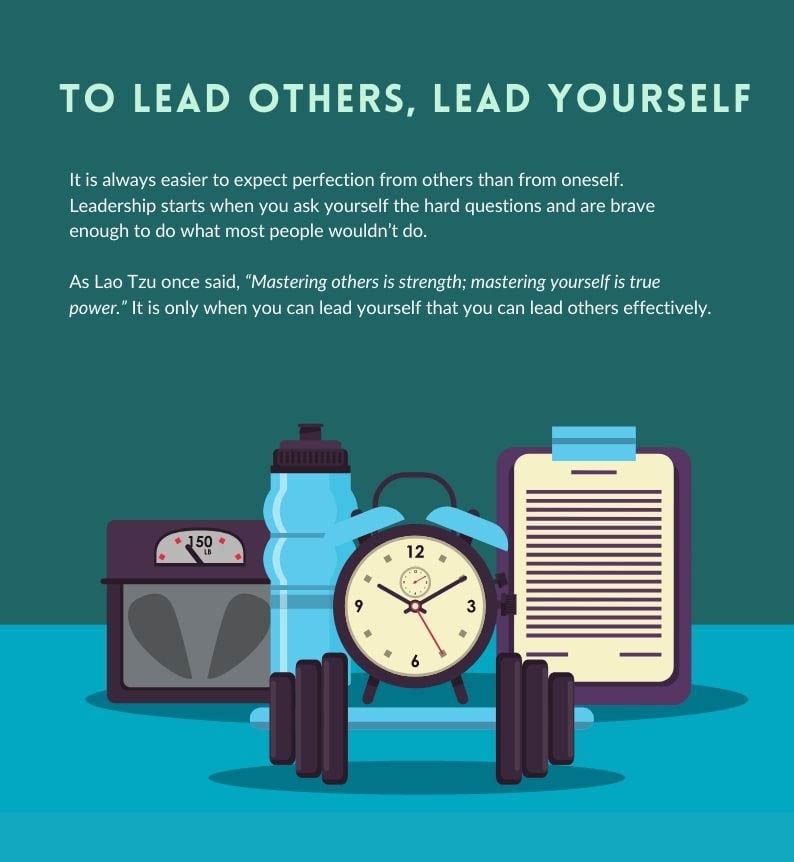
    A lack of leadership traits and qualities is also a reflection of the lack of deeper inner work among aspiring leaders. It is always easier to expect perfection from others than from oneself. Leadership takes commitment, integrity, and standing for something larger than oneself. And often people have good reasons for not doing what they know is the right thing to do.

    Leadership starts from reflection and focussing inwards. Leadership starts when you ask yourself the hard questions and are brave enough to do what most people wouldn’t do. As Lao Tzu once said, “Mastering others is strength; mastering yourself is true power.” It is only when you can lead yourself that you can lead others effectively.

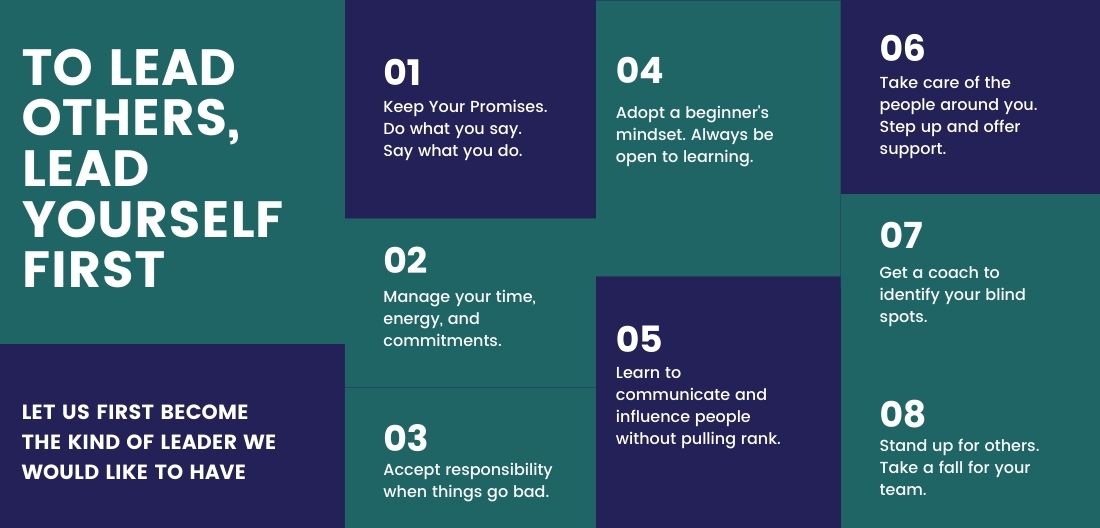
    Are you leading yourself effectively? Here are 8 leadership traits and qualities to do so :-

    1. Keep Your Promises. Do What You Say. Say What You Do.

    This boils down to a simple question – Are you trustworthy? Can people rely on you?

    “Gain a modest reputation for being unreliable and you will never be asked to do a thing.” – Paul Theroux.

    In the past, a promise and a handshake are all people had to do to seal a deal. These days, however, you have to sign all kinds of papers to be held accountable for your promises. Why is this the case? Unreliability is almost the norm today.

    The ability to keep promises and its positive effects can be far-reaching. Keeping your promises is the definition of integrity. In his bestseller, The 7 Habits of Highly Effective People, Stephen R. Covey defines integrity as “Making reality conform to your words.” This means going above and beyond to see to it that your promises are not mere words.

    Being a person of integrity has a huge impact on your leadership ability:

    • It allows others to trust you
    • It allows you to influence others without pulling rank
    • The impact of your leadership increases with your influence

    Considering how honouring promises is a critical skill for leadership success, why do some leaders struggle with keeping their word?

    One of the main reasons for broken promises today is the need to please people. Afraid to disappoint, many people find it difficult to say no and say YES even when they are not willing to fully stand behind their promise. 

    Other reasons include:

    • Not realizing that you either made or implied a promise
    • Losing enthusiasm upon realizing how difficult keeping that promise is
    • Lacking the strength to follow through

    The consequences of not being able to keep your promises to yourself and others can be severe. For starters, you will have low self-esteem because you cannot trust yourself to keep your word. Secondly, people will not be enthusiastic about working with or collaborating with you.

    How to Keep Your Promises

    We all break promises occasionally. To keep that at a minimum, consider the following:

    Think First Before Committing

    Most broken promises stem from impulsive decisions or an inability to say no. It is wiser to think first before agreeing to anything. Check whether you have the ability, resources, and time needed to deliver something. If you are in doubt, either decline the request politely or negotiate an alternative promise. The skill to say NO is a very important but often ignored leadership quality.

    Be Principled 

    This means having integrity as one of the values you hold dear.  This means that you will never allow yourself to go back on your word. 

    Your credibility as a leader rests on your integrity. Remember, there is no trust without integrity. If your team cannot trust your decisions, you will have an incredibly difficult time leading them to success. 

    2. Manage Your Time, Energy, and Commitments. Be Ambitious. But Don’t Take On More Than You Can Handle

    You cannot lead others effectively if you are having a difficult time leading yourself. This means having the skill to prioritize goals and holding yourself accountable for their accomplishment. 

    As a leader, the ability to manage your time, emotions, and attention while maintaining an objective view of your strengths and weaknesses is arguably the most important factor of success. Effective leaders are exceptional at balancing their lives.

    The following tips should help you manage yourself more effectively:

    Be Organized

    Start with keeping your work area neat. According to research, working in a clean office improves productivity dramatically. This is because the brain focuses better when there is less clutter around. Moreover, the simple act of cleaning gives you a sense of accomplishment, thus setting up the rest of your day for success. The proper organization allows you to plan, prioritize, and act on your goals more effectively.

    Set Goals

    Setting goals is the process of determining your objectives in a clear and well-defined way, as well as creating an action plan for achieving them. This allows you to be strategic in your actions instead of winging them. You will be less likely to mismanage yourself when you are following a set plan.

    Manage Stress

    Stressors often waylay us, as emotions can be overwhelming at times. For example, without effective stress management, a fight with your significant other in the morning could see you have a bad day at work.

    One of the hallmarks of a strong leader is their ability to maintain calm during a storm. They are able to focus on their objectives regardless of their emotions. Unfortunately, no one is born a stoic. Emotional Intelligence is achieved by learning how to control one’s emotions

    Be Accountable

    Take ownership of your thoughts, time, and actions. In the workplace, this means accepting responsibility for your team’s performance. One of the best ways of exercising accountability is by assigning deadlines to yourself and doing whatever it takes to honour them.

    “A person who refuses to manage himself and discipline his flesh will be disciplined and taught by life itself.” –  Sunday Adelaja.

    3. Accept Responsibility When Things Go Bad. Don’t Blame Others

    Unfortunately, we live in a society where people like to take credit for success while passing blame for failure. You see it with politicians all the time. Perhaps, they feel like admitting that they made a mistake will mean losing credibility.

    However, that mindset is detrimental to growth. How can you address a problem effectively if no one is willing to take responsibility? As a leader, if things go wrong under your watch, you should have no hesitation to look within and address what needs to be improved. After all, you are the one in charge. 

    While the words responsibility and accountability are often used interchangeably, when it comes to their influence on your mindset, they are quite different.

    Accountability means being willing to accept the outcome of a project. As such, all you need to do is simply deliver the bare minimum. Accountability is often given by others and an external authority.

    Responsibility, on the other hand, is a choice. It is a leadership trait as well as a mindset. It means taking it upon yourself to not only see the project through but also that it is a success. A responsible leader, therefore, will never be comfortable with delivering the bare minimum. They are proud when the organization succeeds and are willing to take the blame when their team under-delivers. 

    The best thing about taking responsibility is that it empowers you. Instead of feeling like a victim, you take ownership of the outcome. Anyone can choose to be responsible without being told by an external authority. Here’s how you can do that:-

    Be Willing to Take Charge

    If there is a problem, take it upon yourself to solve it. Do not assume that someone else will. The same goes for decisions. You do not have to wait for authority from someone else. Responsibility is a choice.

    Be Result-Driven

    Your effectiveness as a leader ultimately depends on your team’s results. Therefore, instead of focusing on pleasing your team, focus on supporting them on their tasks. In case the desired results fail to materialize, go back to the drawing board and identify the pitfalls, and then come up with a new strategy.

    Accept Criticism

    You are not perfect; nobody is. This means that you will make mistakes occasionally. Accept any criticism that comes your way without becoming attached. Review the feedback and then make amends.

    Protect Your Subordinates

    This means acting as a buffer between senior management and your team. If senior management is making unreasonable demands, do not pass down those directives without expressing your authentic voice. Irrespective of the outcome, it will build trust if you stand by your values and fight for them.

    Ensure Your Team Always Has Resources

    Do not hesitate to ask for the resources your team needs. This will allow your department to run like a well-oiled machine. Go seek help and find those resources if your team is lacking.

    Hold Others Accountable

    Ensure that every member is working towards the team’s goal. Do not incentivize individual performance over team goals. Do this by holding them accountable for their team spirit. Let your people know that they are not only responsible for their own goals but also for the entire team. 

    4. Adopt a beginner’s mindset and always be open to learning

    “I know that I know nothing” – Socrates. 

    To Socrates, the beginning of wisdom was accepting that you are an empty vessel. As a result, you will always be a beginner and hungry for learning.

    Great leaders understand that they do not have all the solutions. As such, they have an insatiable curiosity for learning, as that is what helps them grow.

    This means taking advice even from your subordinates, which is something many people simply cannot do. 

    We are living in an incredibly fast-paced world. This means that what worked last year might not work this year. Therefore, continuously learning is the only way to prevent yourself from becoming obsolete.

    5. Learn to communicate clearly and influence people by the weight of your arguments and not your rank

    If there is something that most great leaders have in common, it is their ability to communicate and influence others. To get things done, you must know how to put your message across in a clear and convincing manner.

    However, this does not mean barking orders left and right. Good leaders take people with them and know how to choose the right words and expressions for every situation. 

    The most underrated communication skill is simply silence. Just listen. Great leaders do more listening than talking. By actively listening, they get to understand the other person’s perspective. Listening allows you to take care of others’ priorities and interests as well as taking care of the organization’s needs.

    The benefits of active listening are tremendous. For starters, it is a demonstration of respect, as it shows that you value the other party’s ideas or opinions. This not only helps you construct good arguments but also builds trust. 

    6. Take care of the people around you. Step up to support colleagues if they need help.

    Good leaders know that the health and wellness of their people play a critical role in the success of the organization. Productivity and wellbeing are not mutually exclusive, and strong leaders create an environment where people can express themselves freely.

    As a result, they take it upon themselves to be supportive of their colleagues. This means offering mentorship or guidance whenever necessary. Good leaders also create a healthy environment where everyone flourishes.

    “Leadership without support is like trying to make bricks without enough straw. True leaders reinforce their ideas and plans with strategic partnerships, alliances, and supportive audiences.” ~Reed Markham

    7. Ask for regular feedback to identify your blind spots. Ask for help when you need to. Work with a Coach

    Many leaders become so enamoured with the titles that they feel they are beyond asking for feedback. To them, not asking for feedback allows them to avoid criticism.

    However, you will never be effective as a leader if you are more concerned about yourself than with the well-being of your team. This is because effective leadership comes from problem-solving as a team, not you solving everybody else’s problems.

    Strong leaders are humble enough to acknowledge their limitations. As such, it is not beneath them to ask for feedback from their colleagues. What’s more, being humble makes you more relatable with your team members. Asking for feedback and hearing the honest truth is a very critical leadership skill and quality that can make all the difference.

    Strong leaders work with a coach to identify their own blind spots. A coach can help you remove your own mental blocks and see possibilities that were hidden to you before.

    8. Be selfless. Stand up for others. Take a fall for your team or your colleague. Speak your mind when it is what you believe, even at the risk of loss of reputation

    Are you willing to stick your neck out for your team? Good leaders will have their team’s back no matter what. If the ship is sinking, they will be the last ones to leave.

    Why is it important for a leader to be selfless? It is for the simple reason that your team looks up to you. According to the CEO of Michael Hyatt & Company, “Leaders replicate themselves, whether they like it or not. Your followers will adopt your habits and behaviours.” Therefore, if you want your team to act selflessly, you must be selfless in your actions.

    One leadership trait present in courageous leaders is to speak their minds out. They express themselves fully and speak up for their values and standards, and are willing to take a fall for the team if speaking up means doing so. Strong leaders do not just follow orders from above. They follow their inner voice and listen to their conscience when making choices and decisions.

    Conclusion

    Mahatma Gandhi challenged us to be the change we want to see in the world. When it comes to becoming a better leader, you must be the change you want to see in your team, as well as in your communities and organizations. Before leading others, you must lead yourself.

  • The Top Three Tragic Myths Of The Times We Live In

    “It was dark and quiet, and it took me a few seconds to stand steady on my feet. Well, that’s what happens when you have to get up at 2am to go to the bathroom. But things were going to get worse.

    Just as I began to walk, I suddenly jumped and screamed. Something was crawling on my feet. It felt like a spider and I reached for the light switch. When the light turned on it turned out to be a piece of thread that had been lying on the floor. Apart from the disappointment of jumping for no reason, I was wide awake now!”

    Just as it happened to me, we often get scared of an insect or a rat, but when we turn on the light they are just objects lying around. But our senses gave them an illusion of being an insect or a rat. Building upon this analogy, everything else in life – our riches, our troubles, and our possessions are illusions and a mirage created by our mind.

    “Reality is merely an illusion, albeit a very persistent one.” – Albert Einstein.

    Taking this notion forward, this article of mine is going to dwell upon why life itself is a myth, and how each one of us is driven by some ‘absolute‘ truths that are nothing more than widely accepted myths. These myths drain the life out of our days and take us onto paths of mediocrity and obscurity.

    Below are the three such myths I think we all encounter in everyday life. (Give them some time to sink in, as they very well might be absolute truths for you.)

    1. You Have to Work to Survive

    The biggest myth of our times is ‘having to work‘ to earn a living for surviving. Right from our birth, everything is setup to create this illusion. Our education system, the economic system, all the news and shows on TV and the movies we watch. As we grow up, this myth becomes very ‘real‘ for us. The only thing from our childhood which we term as illusions are the cartoons we watch. Did you ever wonder why everyone loves cartoons?

    There is a common misconception that work is necessary. Over decades and centuries, every rock is chipped away into sand and dust. Work can do the same to our lives and souls. Day by day, hour by hour, our work can chip us away into disintegration.

    If someone tells you they are “making a living”, they can’t be more wrong. They are making a dying, and most probably fast spending whatever little time they have doing things out of compulsion rather than the pure desire of doing it.

    Instead, what we can all do is PLAY. Go out and do what you want. Find something you love doing, something you are passionate about.

    DisclaimerWork and Play don’t have to be mutually exclusive. If you can find a way to play while at work, nothing could be better.

    Many people say they don’t know their passion or hobbies, or they have not discovered them yet. Here is a formula – Look into your life, and the things you do for which you pay others are your hobbies and passions, and for which you get paid and compelled to do is work.

    DO NOT spend the vast majority of your life working so that you can play in the end. That end might never come, or which might be tomorrow itself, for all you know.

    2. Planning and Living for the Future

    We live in a world where insurance and pension policies, investments, education, business, almost everything is done with an objective to achieve something in the future. While planning for the future has its benefits, I believe we often take it too far and miss the only time we really have, which is “now”, or this very moment.

    Who gave you the guarantee that you will not die tomorrow, next week or next month? What made you believe that you are going to die at 70 or 80, and not at 20 or 30 or 40. If you don’t believe it, read and watch the news. People are dying every day at all ages. The average age might be 70 or 80, but ask yourself – Do you really want to live your life based on a statistic?

    Instead, LIVE NOW. Enjoy whichever phase of life you are in. Be in each day fully, rather than counting the days. Live your life in a way that you are satisfied even if you die tomorrow or the next second. Make every breath count. Don’t wait for tomorrow if you want to fall in love, travel to your dream destination, or eat that favorite ice-cream of yours. Do it NOW (or at least pick a date in the calendar and book tickets now).

    Fall in LOVE with life, not just with a few selected people, things and ideas. Whether you make 1 grand or 1 million, whether you live in an apartment or a mansion, embrace life fully NOW and don’t let your goals and milestones in life decide the level of your happiness or joy.

    3. Control and Consistency

    The next big myth we base our lives on is aiming for control and consistency. We plan and build systems, and we make rules and processes to make our lives more comfortable and smooth. But the very fact that we can control life is the biggest lie that we tell ourselves.

    Life, by its very nature, is messy and unpredictable. It is not fair and nobody is entitled to get anything out of it. In school, if you study more, you get better grades and vice versa.

    The same doesn’t hold true in life, as there are so many other factors at play other than your efforts. The sooner we realise this the better. Good and bad things will happen to you. Your education, job, the country you live in, or any other reason which gives you the illusion of safety, is a very bad armor against life.

    Instead, be FREE from these controls. Embrace the uncertainty of life and experience real FREEDOM. Go out and play. Learn a new language. Take a new job, or live in different cities/countries and soak in different cultures. Write, paint, or do anything else that makes you experience life rather than draining the life out of you.

    Don’t try to be nice or do what is expected. Don’t live for the gallery. Be authentic. For a change, LIVE for YOURSELF. Let yourself be misunderstood, hated, judged, or whatever, but live by your convictions. It is better to be assassinated by another human being than being assassinated by death.

    Conclusion

    Our thoughts (and perception of reality) shape our decision and in turn our circumstances. It is like watching the same movie again and again. If we want to play a different movie in our life, we have to change the tape.

    And rejecting the above myths might be the first step. Thoughts arise in the mind, and we become aware of them. But over time, we stop seeing them as thoughts and see them as reality. Therefore, we should never stop to question our thoughts and the reality they form.

    Life is a mirage. An earring and a bangle are both made out of gold. But our thoughts make one an earring and another a bangle, but in essence, both are only gold. Yet we only term what we see while asleep as dreams and not what we see while awake. In essence, both are illusions created by our senses. We must never lose sight of that.

  • How to Ask and Get the Feedback You Need Without Any Stress and Awkwardness?

    “I want to give you some feedback.”

    If you are like most people, once you hear the above statement, your heart will start to beat a little faster, your palms might begin to sweat, and in certain situations, you might even begin to shake. Feedback can make anyone anxious and stressed – not because there is something inherently negative or bad about it, but because most people have never been trained in giving and receiving feedback. If you give and get feedback only once a quarter at work (even worse if it is once a year), and without any preparation, obviously it will be a strange conversation.

    What I have learned over my career is that feedback can be an immensely valuable and insightful tool in our growth and progression, but only if we are ready and prepared to digest and use it for our benefit. Today I want to share via this article my thoughts on the value of feedback, what is the best way to receive it, and then what to do with it. I hope that after reading this article, instead of just waiting for feedback you actually start asking for it. If you are thinking why would anyone do that, let’s dive right in.

    Why Do You Need Feedback?

    Feedback is one of the easiest and most insightful tools to uncover your blind spots. A blind spot is anything that others know about you but you yourself don’t. For example – if you think you are confident but others find you arrogant and cocky, how the hell do you figure that out if nobody ever tells you that?

    Feedback is like a beam of light which shows you how others perceive you. It can be the simplest way to uncover your strengths and weaknesses, but it is often not easy to digest and process it. Feedback lets you know how others perceive you and your talent, skills, behaviour, and performance. And knowing them is a good thing. When used correctly, feedback can be a very useful tool to move in the right direction, change course if necessary, and grow in your career (and in life).

    “Criticism may not be agreeable, but it is necessary. It fulfils the same function as pain in the human body. It calls attention to an unhealthy state of things.”
    – Winston Churchill

    How Do You Ask For Feedback?

    Just like hearing feedback can be stressful for you, providing feedback can also be a stressful experience for the person on the other side. But there are a few ways you can make the feedback conversation a pleasant experience:-

    1. The best way to make the process easier for both sides is to actively and explicitly ask for it. When you invite feedback regularly, it removes the formality surrounding the process and makes the conversation more “normal”.
    2. Explain that you see feedback as a tool to learn and grow and that you welcome any negative or uncomfortable feedback. You can also go one step ahead and assure the person that the feedback will not have any negative impact on the relationship. Knowing this always puts the other person at ease and allows the conversation to continue more maturely.
    3. Know what you are looking for in feedback. Feedback is not always critical. You should also ask for acknowledgment or appreciation for a task well done. Positive feedback will help you understand your strengths, and gives you the confidence and assurance required to look objectively at your weaknesses.
    4. Be specific and ask for examples. Don’t let anyone get away with vague feedback. Always dig deeper and ask for specific events and evidence in support of the feedback you receive. Here are a few questions you can ask:-
      a) Can you explain what you mean?
      b) Can you give an example to support your point?
      c) Paraphrase the feedback and ask – Is that what you mean?
    5. Seek feedback from people all around you and not just your boss. Ask people above, below, and sideways in your organization. Multiple sources of feedback can eliminate any outliers and helps to surface any obvious blind spots immediately.


    Powerful Questions

    Whenever you are looking for some powerful and insightful answers, there are always corresponding powerful questions to go with them. Below are a few such questions you can ask to solicit deep and meaningful feedback about yourself:-

    1. If I were to wow you with my performance, what would that look like?
    2. What’s one thing I could improve?
    3. What would you have done differently had you been in my position?
    4. What’s your opinion about how I handled that conversation, presentation, task, etc?
    5. What specifically can I do to handle that task, conversation, project better?
    6. What is one thing you can always count on me for?
    7. What is one thing you will never count on me for?

    What To Do After Receiving The Feedback

    The worst thing that you can do with feedback is to do nothing with it. The feedback conversation is just the beginning on the road to learning and growth. So once you are done with the feedback, you can take the following steps to make the most of it.

    1. Thank the person for providing you feedback. Not only is feedback essential for your growth, it is also often a courageous step to provide it in the first place. Acknowledge the person for the conscious act of providing you feedback.
    2. Do not defend yourself during a feedback conversation. Do not get into a game of blame and justifications. Respond to the feedback, not react to it.
    3. If the feedback is critical, take responsibility (not blame) for what you hear. Let the other person know that you will evaluate the feedback and get back.
    4. Take time to introspect and evaluate the feedback. Does it resonate with feedback from others? Can you gather more data or feedback to validate it? If no, explain to others how you see it. If yes, let them know what you will change. Make certain promises and then do what you say.
    5. Take all the positive feedback and put it into a complements” document. Often we tend to focus too much on the negatives and ignore what we are doing well. Visiting this document regularly will give you motivation and positive reinforcement. Sometimes reading one little positive feedback can make your day.

    Following the above guidelines doesn’t mean that your feedback conversations will be painless, but they will certainly go more smoothly. Once you see feedback for the powerful tool it is in your learning and growth, you will fall in love with it. The more you seek and get feedback, the faster you can move to learn, adapt, and change course if necessary. To conclude I would like to leave you with the below quote by Ken Blanchard.

    “Feedback is the breakfast of champions.”
    – Ken Blanchard

  • How to Give Feedback Effectively? What to do Before, During and After a Feedback Conversation?

    Giving good quality feedback is an important skill to have in any organization. Doing so regularly with our peers gives everyone an accurate understanding of how they are doing at work, and what needs to change/improve. However, I have always felt that the importance of feedback and how to effectively deliver it is something that is rarely stressed and communicated within companies. In this article, I want to share some of the best practices I have learned from different people and mentors over the years about giving feedback.

    Why?

    The first step to giving good feedback is to realize the importance and reason behind doing so. I believe that the only reason to provide feedback is to improve performance while working together. The purpose of giving feedback is never to measure performance, blame, to prove yourself right, to make others wrong, or to put someone in his/her place.

    I believe this is the most important aspect of feedback which we often miss. I see feedback as a ‘gift’ given from one person to another, with the only purpose of improving how they work together. When we see feedback as a ‘gift’, the feedback conversations tend to be more natural and less awkward.

    Before (Preparation)

    “Give me six hours to chop down a tree and I will spend the first four sharpening the axe.”
    ― Abraham Lincoln

    Like most things in life, doing some groundwork before giving feedback is critical. Over time I have come up with a list of steps which helps me prepare for a feedback conversation.

    1. The first step is to collect data and evidence to back up your feedback and to make sure you have seen the situation from different angles and points of view. This might include gathering some tangible data like sales reports, code reviews, etc, or validating your feedback with a different set of people.
    2. Apart from remembering the why behind sharing the feedback, it is also very important to have an open mind going into the conversation. We must be willing to investigate/apologize if things turn out otherwise. If the person you are sharing the feedback with brings up new facts or information you weren’t aware of, make sure to acknowledge them and take a time out to investigate rather than thrusting your feedback upon the person.
    3. Create a comfortable space for providing feedback. Allow enough time so that none of you feel rushed. Depending on the type of feedback, choose an appropriate setting for the feedback. For example – do not choose a place that is overly conspicuous, and never give negative feedback in public.
      If the feedback is on a trivial issue, you can do it while walking back from a meeting, or in a vehicle driving to another destination to make it less formal. But if your conversation is more difficult, you might want to do it in a meeting room. The important thing to realise is that there is no one right place to deliver feedback, and you should choose based on the type of feedback.
    4. Sleep on it! If you feeling angry, upset, or feel an urge to provide feedback; it is often better to sleep on it. Giving feedback at the wrong time can often do more harm than good. Once your emotions are more settled and you have gathered your thoughts, you can then share the feedback as soon as possible.

    During (Process)

    While you can do all the preparation you want, receiving feedback can still be a stressful experience for people (especially if it is critical). To ensure that the conversation goes smoothly you can follow a few guidelines :-

    1. Criticize in Private, Praise in Public. Use this as a golden rule for any feedback conversation.
    2. Never attach adjectives to people. Start by stating why you are providing feedback, which is always to improve performance (of the person, team, organization). You demonstrate that by stressing the impact of the person’s actions (on the team and their performance) and not on the person themselves. For example – Instead of saying “you are a weak communicator”, say “your communication style can be refined to make a better impact in team meetings”.
    3. Be specific in your feedback. Give examples. Do not be vague in your statements.
    4. Be aware of the other person’s body language. Notice if they are getting defensive, angry, upset, and change course if necessary.
    5. Be prepared for an emotional reaction. But do not react yourself. Do not get into a game of arguments and justifications. Stay silent and let people vent out their emotions (if any).
    6. Listen and paraphrase what you hear to ensure there is no confusion and misunderstanding. Understand the situation from the other person’s point of view.
    7. Use non-conflicting language. Use “I” instead of “you”. For example – Say “I felt disappointed when you did that.” rather than “You disappointed me by doing that.”
    8. Don’t Push – When you push people, they will push back. Present your thoughts without trying to push them through. Give people a choice to accept or reject your feedback, as you cannot force them to your point of view anyway.
    9. Give more positive feedback than negative, and always be sincere when giving positive feedback. Remember that there are always positives about people to acknowledge.
    10. Thank them for listening to your feedback. End the conversation on a positive note, with the other person thinking about the next steps. He/she should see the feedback as a stepping stone, not as a stumbling block.

    “Criticism may not be agreeable, but it is necessary. It fulfils the same function as pain in the human body. It calls attention to an unhealthy state of things.”
    – Winston Churchill

    After (Follow Up)

    To make sure that the feedback is serving its intended purpose, i.e., to improve performance, it is important to take a few follow up steps after the feedback conversation :-

    1. Send a brief summation of your meeting if it was important and critical enough. Also, summarise any action points both of you agreed in a follow-up email.
    2. The other person might need some time to process what you discussed. Give them that space. Follow up after a few days for any additional thoughts. Ask for feedback about how you provided the feedback. Anything they would like you to do differently the next time? Let your people know it is ok for them to give you useful feedback.
    3. Make sure to act on your action points, or share your progress on them. If you don’t walk your talk, you lose trust. If that happens, you have bigger problems to worry about.
    4. Follow up and ask for progress on the other person’s action points. Offer your support and help in any way you can.
    5. Thank the person and commend him/her for any change in future behavior. Remember you can never give enough positive feedback.

    To conclude, feedback sharing sessions, when done well, are an incredible tool to build healthy relationships and make teams stronger. By listening and working on feedback, people can learn about themselves (self-awareness) and be more conscious of their choices and decisions (career development). When you encourage people to give and share feedback, it helps create a culture of feedback, which eventually increases the strength and effectiveness of teams in your organization.

  • The Distinction Between Meaningless Activity and Meaningful Actions, And Why It Can Make All The Difference

    In today’s age of always-connected devices and nonstop notifications, we all have more to do each day than the hours can fit. Crossing items off the to-do list always feels good and gives one a feeling of accomplishment, but have we ever stopped and asked ourselves – accomplishment towards what?

    The ‘Busy’ Trap

    Whenever I have stopped to ask myself that question, I have realized that I have fallen into the trap of being busy rather than being productive. Being busy often relieves us from the fear of sitting still and the pain of conscious thinking, while the really important tasks often get neglected.

    We are often sucked into doing meaningless activities, either through algorithms running on our “smart” devices or through habits we have formed by emulating our peers rather than consciously choosing them. In other words, we waste most of our time doing meaningless activities that we have no time left for what really matters.

    We keep looking for happiness in materialistic gains which never leads to fulfillment. While everyone is constantly fighting to achieve their materialistic goals, very few understand that these are mere empty pursuits, only adding to the vicious cycle of wanting more.

    Every 2 weeks I share my most valuable learnings from living life fully in my Deploy Yourself Newsletter. Sign up now to download a workbook with 164 Powerful Questions which I use daily in my work and coaching. Allow these questions to transform your life and leadership.

    Meaningless vs Meaningful

    Everything that we do can be divided into either meaningless activity or meaningful actions. What I mean by meaningless activity is anything we do to only keep ourselves busy. Example – checking email and social media, hanging out with friends, or anything we do without a specific intention in mind.

    In contrast with the above, any activity which adds meaning to your life, or takes you in the direction of a conscious intention (or a goal), is what I would term meaningful. It could be a business trip for one or spending time with their family for another.

    What is meaningless and meaningful is different for everyone. Only you can define that. No-one else can make that distinction for you.

    We are often focused on what is urgent or what seems important today that we end up ignoring what is really important for us in the long run. Only by being aware of our decisions, we can be deliberate about them to move our life in the direction we want to go.

    “A man who procrastinates in his choosing will inevitably have his choice made for him by circumstance.” – Hunter S Thompson

    Focus and Prioritise

    Research has shown that not having the courage to live a life true to ourselves, not expressing our feelings when we should have, and working too hard are the top three regrets people have at the end of their lives.

    Doing things that we find meaningful is essential to our well being. But how many of us spend time wondering about what gives our life meaning, and what is really important to us?

    When we accept the standards and values others’ have set for us, we surrender our own will and judgment. By figuring out our own values, we allow our unique light to shine upon the world.

    If we only follow what everyone else is doing and not take the time and effort required to find our own values, which are unique for everyone, we will soon find ourselves lost and confused. But once you have put in the effort and identified your unique set of values, motivations, desires, and talents; you can nurture them and let them guide you.

    Three Questions

    • What are you good at?
    • What do you love doing?
    • What need can you serve?

    I believe the intersection of answers to the above three questions will be the most meaningful work for you. Once you have these answers, it will give you the clarity to prioritize tasks and the courage to say “No” to anything that doesn’t align with what you discover.

    Answering these questions will require some sincere and dedicated effort on your side, but once you do that, you will have more clarity on how you define your meaningful work. I would also like to add that it is a continuous rather than a one-time process. You should revisit the above questions every now and then as a “health-check”.

    Having the clarity about the “why” before the “what” and “how” of any action will ensure you create focused output that moves you forward, rather than the effort that just takes you around in circles. So the next time you think you have no time to follow your dreams, you know you have fallen into the trap of being busy with meaningless activities.

  • Have You Discovered Your Leadership Lighthouse? Why Should You?

    A Global World

    Today, we live in a globalized world which is more connected than ever before, and the movement of people and goods has never been easier. It is driven by economics and money, and it is possible to sit on your couch and order what you want from the opposite corner of the world and have it delivered to you in a few days.

    Open markets, lower trade tariffs, and an ever-increasing movement of people, goods, and information to any part of the world have resulted in great prosperity for everyone involved. Major world problems like poverty, hunger, and disease have decreased considerably over the last 50 years. The health and well-being of people all over the world have never been better.

    However, living in a consumerist society driven by economics has also resulted in greed, corruption, and the pursuit of economic success at any cost. It is no surprise then that we saw scandals like Enron in 2001, the financial crisis in 2008, and the Volkswagen emissions scandal in 2015-16. These scandals resulted from cutting corners in the pursuit of success by leaders in these companies.

    The Leadership Lighthouse

    Just like ships need a compass and a lighthouse to navigate in the vast oceans, our companies and their leaders too need a leadership lighthouse to find direction in the vast ocean of global competition. The speed (of a ship or a business) is not the only thing matters. Our leaders need to realize that the direction they choose to go and take their companies along is more important than the speed.

    The Leadership Lighthouse is a set of values (to guide us), standards (to measure us), and boundaries (to keep us in check); which will act as a moral compass as leaders take decisions and navigate their companies in the race for success in the global economy. These standards and values guide us in finding the right direction in challenging and exciting times.

    Find Your Own Way

    The whole essence of leadership is to bring our own unique values, talents, and skills into the world, and to express ourselves in alignment with those. When we accept the standards and values others’ have set for us, we surrender our own will and judgment. By figuring out our own leadership lighthouse, we allow our unique light to shine upon the world.

    If we only follow what everyone else is doing and not take the time and effort required to find our own leadership lighthouse, which is unique for everyone, we will soon find ourselves lost and confused. But once you have put in the effort and identified your unique set of values, motivations, desires, and talents; you can nurture them and let them guide you.

    If we stop and look back at the history of the world, be it in the business world or outside of it, you will find that every human achievement is an achievement of the individual who went against the norm and followed their own leadership lighthouse.

    How Can You Find Your Leadership Lighthouse

    As mentioned above, our leadership lighthouse is the set of standards and values that define and inspire you. It will guide you during challenging moments by serving as a moral compass and give you a solid ground to stand upon when you face turbulent times.

    To find leadership lighthouse, try answering the below questions:-

    1. What do you want to achieve in the long term?
    2. What really matters (is important) to you?
    3. What makes you happy, angry, or sad?
    4. What are your duties and obligations with regard to different aspects of your life?
    5. What have you learned from the biggest failures of your life?

    Answering these questions will require some sincere and dedicated effort on your side, but once you do that, you will have more clarity on how you define your own leadership lighthouse. I would also like to add that it is a continuous rather than a one-time process. You should revisit the above questions every now and then as a “health-check”.

    Knowing your leadership lighthouse will give you the confidence and assurance to follow your own path instead of the path others have decided for you. Once you nurture and develop your strengths and act consistent with your standards and values, you will allow your own unique light to shine upon the people and the world around you.

  • The Role and Importance of Emotions in Our Professional and Personal Lives

    When I started working at the age of 21, my manager was only a few years older than me. Both of us being very young and passionate about work, we developed a good friendship. As I completed my first year at work, I sat down with this friend (manager) to discuss my performance. I wasn’t ready for what came next.

    In the meeting, he was very formal and distant in his approach which I found unfair. Due to our friendship, I expected an informal conversation. Instead, what I got was “feedback” and “improvement points”. When he was done with the performance cycle, it left me in a very bad mood and it affected our friendship. While he was only performing his job as a manager, I was too naive and felt betrayed as a friend. It took us more than a year to mend our friendship, and I am good friends with him to this day.

    This incident was very tough for me, and it was not until many years later that I recognized why it was so. At first, I blamed my manager friend for being more of a “manager” than a “friend“. Later (after we mend ways) I blamed myself for being too emotional and developing friendships at work. I came to the (wrong) conclusion that emotions and rationality are mutually exclusive, and I shut myself down emotionally.

    It was much later that I realized that emotions were not the culprit. Instead, it was my inability to handle my emotions which led me to react impulsively. With experience, I have come to believe that emotions are absolutely necessary for doing any meaningful work. They only seem tough when we don’t know how to handle them.

    I have already written about how to handle our emotions in the workplace. In this article, I want to stress the importance of emotions as the driving force behind decisions.

    We Experience The World Through Our Emotions

    We walk around the world and make sense of it through our emotions. When we experience an event, different emotions get triggered based on our values and beliefs. Emotions make our experiences good or bad, valuable or not, and pleasurable or painful. If we introspect we will found that every decision we end up taking is derived from an emotion that touched and moved us.

    These emotions can overwhelm us occasionally, but without them, we would have no connection with people or events around us. While emotions can sometimes bring pain and tears, it is only through them that we feel joy, happiness, and peace in life. It is very important to realize that emotions are our strength and not our weakness.

    It is our emotions that make us human. The little moments of joy when we play with our kids, the smile on our faces when we help someone, the tears in our eyes when we see something cruel and terrible (even if it is on TV) – it is these emotions that connect us all as human beings.

    Seeing a tweet by a billionaire CEO and to be able to feel empathy for him/her makes us bridge the economic, physical, and social divides and come closer. On the other hand, if we are privileged in any way, being able to empathize with the less privileged and act for them brings us closer. Emotions help keep our egos in check and prevent us from being indifferent towards the less or more privileged in our society.

    Emotions and Reason are Not Mutually Exclusive

    Most of us believe that emotions and reason are opposites of each other, and it is often presented as a fact that you can’t act rationally if you are emotional. In many workplaces, emotions are frowned upon and an excessive display of emotions (joy, tears, anger) is seen as a liability.

    On the contrary, what I have learned over the years is that emotions can be our biggest asset. They can give us important information that can shape our lives if we listen to what they are trying to tell us. The key is to learn how to express our emotions without repression or explosion.

    Emotions can help us clear the fog of rational choices and reveal our moral lighthouses. They help us choose wisely when presented with two equally good or equally bad choices. Emotions clarify our thinking and help us see rational choices in a new light while pure rationality often makes us run wild with ideas, even at the expense of others. Rationality without emotions can look enticing in the short term, but it can be a menace in the long term.

    It Is Impossible to Be Rational Without Emotions

    While it is true that emotions can overwhelm rationality at times, it is impossible to be rational without being emotional. Today there is scientific evidence to prove that we, as human beings, are incapable of making decisions if we can’t feel our emotions. You can read about the works of neurobiologist Antonio Damasio to see that without emotions, there is no decision making possible. [1][2]

    He worked on a patient with a severed connection between the frontal lobe (where rationality originates) and cerebral amygdala (where emotions originate) in the brain. After the surgery, the patient could think, but he could not feel anything. He noticed that while he was able to engage in rational thought all the time, he was not able to make a choice over the other.

    When Emotions Overwhelm Us?

    We all have been in situations where we don’t want to do what we know is the right thing to do. When emotions overwhelm us, we can get sucked into the temptation of the respective emotion and (re)act in a way that provides us emotional relief. For example – When you couldn’t control your frustration and vented it out on your manager because it felt good to spurt it out.

    Emotions are very good messengers, but poor masters. We should always listen to them and let them play a big role in our rationality, but subjugating reason for emotional whims can cause us short and long-term harm. In the end, we should always use reason to choose the best option available for us, and use emotions as a lighthouse to guide us on the right path. This will help us in making the right choices (which might not be the easy ones) in life with conviction.

    Emotions Intelligence is a Skill. Train Yourself

    Now that we have seen that there is no action possible without emotions, we can conclude that emotions are not bad or good in themselves. It is our ability to handle them that makes us interpret them as so. It is a skill that, just like other skills, can be developed.

    Learning to deal with uncomfortable emotions builds confidence and opens up new pathways that were earlier closed to you. Emotional people are often regarded as weak in certain societies, but I believe that the ability to handle one’s own emotions is one of the most useful skills a human being can acquire.

    Increased emotional awareness can be a great asset we all can make use of not only to make the right decisions for ourselves but also to create a better world around us. A world which is not mine or yours – but ours.

  • There Are Only Perspectives, No Truth. And Five Different Perspectives You Can Apply In Each Situation

    Tom : “I am sorry I am a bit late to this meeting. My previous meeting ran over.”
    Sara : “I am more worried about the missed deadline on the product your team is developing. Your team is slow.”
    Tom : “It’s not my fault. Two members on my team reported sick last week and I can’t help it.”
    Sara : “I don’t really care what happened. But I know I can’t count on your team. This makes me look bad.”
    Tom : “You are not being fair, Sara. “
    Sara (to herself) : “Tom’s lack of experience shows. He doesn’t hold his team accountable, and always has excuses for delays.”

    How many times have we spoken or seen others speak such sentences? As we solve complex business problems, very often we “know” the truth (you are slow, this is not how things work here, etc) and base our actions on it. In this article, I want to stress that there are no truths in the workplace (and life). There are only perspectives, and there can be many different perspectives depending on how you look at the situation. Once we realize that our apparent “truth” is only a perspective, it allows us to view the same situation differently to help us make better decisions.

    How We Form Our Truth?


    The first thing we must do is to take a pause and ponder about how we form our truth in the first place. We (human beings) gather inputs from our five senses – smell, touch, sight, sound, and taste. Anything which is external reaches us via one of the senses. We touch something which is hot, and we “know” it is dangerous and not safe. We hear something from multiple people or from a reliable source, and are inclined to believe it as truth”.

    The quality, source, and frequency of sensory information we gather have a big role in how we interpret it. For example – If you read an article with a lot of grammatical and spelling mistakes (quality), you are less likely to trust the content. Similarly, if you hear about the same thing from multiple people (frequency), you will be more inclined to trust it.

    Once we collect the sensory information from the outside world, our brain makes sense of it. It decides which signals to pay more attention to and which to ignore. Our brains also apply the collective influence of our memories, beliefs, thoughts, and values to every new information, and derive meaning from it. I already wrote about Listening Filters and how they create the “truth“. For example – Growing up in a very hierarchical corporate culture (and society) in India, it still takes effort on my part to see and interact with people above me on the corporate ladder as peers in Amsterdam.

    The Five Different Perspectives


    The important thing to realize here is that the “truth” we form by the above process is only “our” truth and not the absolute truth. Realizing that different people can see and create their own truth in the same situation is the key to working together more productively. Seeing our own truth as a ‘perspective‘ instead of the truth leads to humility and a willingness to consider other perspectives.

    Unless we step down from the high pedestal of truth we often end up placing ourselves on, we can’t see all the other perspectives out there. I believe there are (at least) five different perspectives that can offer tremendous insights to us. However, it is not always easy, nor are we often willing, to view a situation from these perspectives. They might lead to some uncomfortable moments, but the process can often result in new insights and learnings. These not only can lead to better results but also help us become more human in the process.

    As I write down the different perspectives below, I will also specify a few questions we can ask to uncover each perspective :-

    First Person (My) Perspective


    The first person perspective is how I see and perceive things. The biggest clue about the first-person perspective is the usage of pronouns like We, Us, Our, I, Me, Mine in our thoughts, and language. This is the most natural perspective for all living creatures, and we listen and think in a first-person perspective by default. The first person perspective leaves you with ownership, authenticity, and often attachment to your point of view.

    Questions to Uncover First Person Perspective


    1. What conclusion am I arriving at?
    2. Is it the truth or just my opinion?
    3. What reasons/proof do I have in my opinion?
    For Example – Sara’s (in the above conversation) first-person perspective could be – “Tom is a difficult person to deal with because of his immaturity. I can’t trust him or his team as he is not accountable.”

    Second Person (Your) Perspective


    The second person perspective is seeing things from another person’s point of view. Listening to someone and making efforts to understand her perspective shows respect. The second person perspective calls for seeing and feeling the world as another person does. It doesn’t matter if you agree or disagree with it. The second person perspective has a lot to do with listening and it can have a massive impact. The second-person perspective leaves you with empathy and humility.

    Questions to Uncover Second Person Perspective


    1. How would this situation look and feel to him/her?
    2. How would he/she interpret the situation? Can I step in his/her shoes?
    3. Can I feel how he/she might be feeling (anger/joy/frustration) right now?
    For Example – Sara’s second-person perspective could be – “Tom is new to this job and he must be finding it difficult to make demands from his people. He must be really stressed out and might need some help to manage his priorities better. I might only be making matters worse for him. Instead, can I help him somehow?”

    Third Person (His/Her) Perspective


    Another perspective could of a related third party. If you are talking to your colleague, a third party perspective could be of your manager or another colleague. For example – In a workplace, a third-person perspective could be of a colleague whose work will/might be impacted by what you are talking about. Seeing through the third-person perspective leaves you with a big picture view, more options, and opens up blind spots.

    Questions to Uncover Third Person Perspective


    1. How would my boss think about this situation?
    2. How would the sales head think about this conversation?
    3. If I were him/her, how would I have described the situation?
    For Example – Sara’s third-person perspective, from the point of view of another colleague, would be – “Tom is trying hard to keep everyone happy, and failing at it. And Sara is not making it any easier for him by making demands without understanding his situation. How will they make this project succeed? If they fail, it will hurt our team and we will miss our targets.”

    Stranger (Witness) Perspective


    The fourth perspective calls for viewing the situation from the point of view of a witness. A witness is someone who neither has any stake in what you are discussing nor does he knows either of you. The witness perspective is purely objective, and the witness observes the proceedings just like a camera would. Taking this perspective leaves you with detachment and objectivity. You see things as they are, without any judgment and attachment to either side or to a specific outcome.

    Questions to Uncover Stranger Perspective


    1. How would a stranger see and report my situation?
    2. If this were a movie, how would I describe it?
    For Example – Sara’s stranger perspective could be – “Tom is acting like a typical newbie, and is going to make the same mistakes everyone makes. People around him are too busy in their own lives to help or assist him grow through this phase in his career. Sara or Tom’s manager can step in to help, but do they even realize the need for it.”

    God / Compassion Perspective


    The fifth perspective calls for looking at the situation from a place of love, kindness, and compassion. With this perspective, we look at how we can make things better for every party involved, and worse for no-one. We attempt to listen to our inner voice (consciousness) from this perspective. How does it feel? Is there something which I know but am unwilling to acknowledge?

    Questions to Uncover God Perspective


    1. Would I want this conversation to be aired on TV, or reported in tomorrows’ newspapers?
    2. Do I hear an inner voice saying “this doesn’t feel right” or anything else?
    3. How would Jesus / Allah / Buddha / Krishna do in my situation?
    Disclaimer – This perspective has nothing to do with religion or our religious views, but is rather an invitation to stand in a place where we want to see everyone happy. It is about feeling instead of thinking and using our heart for mutual well-being instead of our brain for personal gains and business results.
    For Example – Sara’s fifth perspective could be “Tom must be going through a hard time, and might even be carrying his stress into his personal life. And I am not making it any easier for him. Can I help him manage his priorities better? Can he seek some training or help? The same holds true for me too. Going after business goals is fine, but it doesn’t have to be at the cost of stress and unhappiness.”

    To conclude, asking the above questions and viewing our situation from multiple perspectives can be tremendously liberating. It can provide us with options that weren’t visible to us before. Getting lost in what we believe to be the truth (first-person perspective) can bring us stressful days, broken relationships, and health problems.

    All of this can often be avoided by taking a look at the above five perspectives. It can often ease up any emotional build up (stress, anger, over-excitement) and prevent us from doing something in haste and from our limited viewpoint. It might not solve every business problem we get stuck in, but we can surely finish with better results and make more informed choices after considering these five different perspectives.

  • Five Things A Leader Must Do By Default

    In today’s corporate environment, after a few years of doing your job well enough, chances are that you will be asked to step up and lead a team. You trained and studied to be good at your job, and now getting to manage people seems like a reward for a job well done.

    By promoting the good performers to be managers and leaders, people have assumed for centuries that the skills that made you successful as an individual contributor would also make you successful as a manager. If you have led people for any considerable amount of time, you would know how false this assumption is. Yet in the business world, this continues to be the norm.

    Today I want to list down five things which you must do, or are expected to do by default, to be effective as a manager/leader. And it is likely that nobody told you this when you were promoted. I have only figured them out after leading teams for over a decade, and I believe I am on a continuous journey to learn and know more about leadership.

    1. Lead Yourself

    The first thing you must do to be effective as a leader is to lead yourself. Your relationship with your team will be determined more by your trustworthiness than by any other skill or talent you might possess. Trust is the foundation of leadership, and you build trust by leading yourself first – by holding yourself accountable for what you demand from your team. Like any worthwhile endeavor, it takes time, effort, and daily investments to build trust with your team.

    If you want your team members to honour their promises, honour your promises to them. If you ask them to be on time for meetings, you must be on time first. Or you will lose their trust. If you ask them to be respectful to each other, you must respect them first. Or you will lose their trust. If you want them to be humble, you need to exemplify that in your behaviour. If you need them to be honest and sincere, you need to acknowledge your mistakes publicly and make amends for them. You can not lead a team if you can’t lead yourself.

    2. Know Where You are Headed

    When you are leading a team, people will look up to you for providing direction. Having a well-defined purpose clarifies why the team exists in the first place. Coming up with the team’s purpose together with your team will empower them to take decisions that are in the best interest of the team.

    Listening to your team and engaging in a dialogue will allow the team to define and own its purpose. You need to spend time with the team regularly to discuss, revisit, or reshape the team’s purpose. Ensuring each member understands the team’s purpose and their role in the team will empower them to prioritize their tasks effectively.

    3. Be a Coach


    If you have people reporting to you, then you are their coach by default. You don’t have a choice in being their coach as people will approach you anyway. When they are demotivated, when they have a conflict, or when they need help for any other reason; it is your responsibility to listen, understand their concerns, and then coach them to align their personal motivations with the team’s shared purpose and goals. If you can’t do that effectively, it will impact the results the team intends to produce in the future.

    While I assert that you are a coach by default, the skills and conversations required to be a coach don’t come by default. You must invest time and effort in learning and practicing your coaching skills. How well you coach people will be directly proportional to the results the team produces. Investing in learning these skills and making coaching a priority will be your best investment ever.

    4. Demand Commitment and Accountability

    Just as every sport has a certain set of rules, each business team can come up with rules (or standards) which apply to their business and industry. These rules will govern how you work and define success and failure. Examples could be how you treat your colleagues, how complaints are handled, and what boundaries you set in matters important to the team. Once these standards are set, it frees up everyone to exercise their own creativity in making decisions. This gives shape to the ‘culture’ in the team.

    After you set up these standards together with your team, you have to demand them. Of course, for this to work, you have to exemplify them yourself. Holding your team accountable to these standards (or rules) will bring the team members together and set the team up for high performance. The intention behind it is not to punish or penalise people when they slip up, but to ensure an open, fair and supportive culture in the team.

    5. Serve Your People

    I believe that leadership is a privilege, and that each leader is a custodian of the company’s values, beliefs, and ambitions for the future. Leadership will require you to think beyond your own self-interest, and from your team or company’s point of view. In order to lead, you must be willing to serve – to put your team’s interest in front of any individual interests, which might lead you to make some difficult decisions from time to time.

    Leadership is not about power or authority, nor is it about popularity. Leadership is about character – which you will need to express yourself authentically, compassion – which you will need to grow and develop your people, and integrity – which you will need to serve your people with the respect and transparency they deserve.

    I believe that leadership is standing for something bigger than yourselves. You show your team the way, give it what it needs to do the job, and then get out of the way. Your biggest job is to create an environment of respect and accountability, where people have fun and express themselves freely by continuously moving forward towards the team’s goals.

    To sum it up, these five points above are not strategies or tactics which you can incorporate in your leadership style to get better results. These are the bedrock which will give rise to a myriad of strategies and tactics, which in turn will lead to those results. If you try to fake them, your people will call your bluff sooner or later, and you will lose all credibility and trust. An attitude of humble service will enable you to become a better leader, while taking care of your team and company’s needs.

  • The Only Real Opponent You Have, In Work or in Life, Is Yourself

    Mahatama Gandhi once said – “As human beings, our greatness lies not so much in being able to remake the world – that is the myth of the atomic age – as in being able to remake ourselves.” And indeed, it is one of the greatest myths of this world that we have to fight our battles in the outside world.

    Everyone who has reached the pinnacle of sport, business, or his/her chosen profession knows that there comes a time when you realize that the real opponent which you have to fight is you yourselves. To take our performance above a certain level, we need to break our safety walls and take new actions which previously we might not have even thought of. By changing ourselves we actually change the world around us.

    Commitment

    If we want to improve our performance manifold, instead of just learning new courses or reading new books, we need to work on our commitment to the goal we are after. We should make that commitment so unwavering that our own lazy and procrastinating self (and yes, we all have that) can’t stop us from doing what is necessary.

    So don’t miss the morning walk, even if you are sick or it is raining outside. Don’t stop doing something just because it is getting tough for you. You have given a commitment, and it is your fight with yourself that you need to win to complete that commitment.

    Excellence

    If we can demand nothing less than excellence from ourselves and others in every little task we do, whether it is watering the plants or giving that presentation, the kind of results we produce will change dramatically.

    We should strive to give our best to every second, and not just in the important events. We have to make things happen, by doing what we have never done before, or by doing them in a way that we have never tried before.

    “Character, like a photograph, develops in darkness.”
    — Yousuf Karsh

    Discover The Strength Inside

    All of us have amazing strengths which we never realize or acknowledge unless we are forced by some sudden situation which requires us to act beyond what we think we are capable of. This is epitomized by the famous saying – “When the going gets tough, the tough get going.”

    So the so-called ‘tough‘ people seem to get their strength out of nowhere in tough times. Our defeats tell us more about ourselves than our victories. We all have tremendous reservoirs of strengths hidden beneath us, but we have to dig deep and defeat our own ‘stay in comfort zone‘ self to uncover it.

    I will end with this powerful quote by Arnold Schwarzenegger

    “Strength does not come from winning. Your struggles develop your strengths. When you go through hardships and decide not to surrender, that is strength.”