Technology

  • Giving for Charity and Philanthropy, and the role Technology can play in it

    Giving, or philanthropy, is nothing new. It has been going on for ages. People, institutions and governments have been donating money and resources to their families and their communities since thousands of years. But today, as we move into the 21st century, we are more connected with each other than ever before in the history of mankind. Through technology solutions like the internet, mobile phones and other connected devices, the whole world is more united than it ever was.

    The topic of this article is to discuss and debate the role technology will play in giving and philanthropy in the coming decades. There have already been some examples of how technology can help connect people from different parts of the world and promote giving in unique ways that wasn’t possible even 20 years ago. Kiva, DonorsChoose and Kickstarter are just a few of the examples who have come up in developed countries like the US and the UK and connected donors from these countries to small entrepreneurs in countries like Mexico, India, China and from Africa.

    One difference which we can credit technology for is moving giving from a local to a global landscape. Traditionally, giving and philanthropy has been limited to your local communities. But now it is possible for you to be earning a handsome income living in New York while supporting three projects in Brazil, India and Kenya, all at the same time. See this amazing visualization of what happens when 620,000 lenders fund 615,000 entrepreneurs, students and other microfinance borrowers around the world.

    See the below video to see how Kiva works

    Apart from dedicated giving networks and organizations like Kiva, the advent of social networking and smart phones have helped in spreading information and news about various giving opportunities around the world. They have been effective in spreading these news like wildfire where traditional media would not have been effective, and have also managed to raise large amounts of money by getting small contributions from individuals like you and me.

    In the developing world, where smart phones and internet are still not readily available, it has not stopped people from devising new and innovative ways to develop technological solutions using just sms and phone calls. SMS has been used to gather people together and spreading news about an event to a large number of people. SMS based solutions, like a farmer turning ON and OFF his tubewell, just by sending an SMS rather than walking 5km in his field, are also making a big value addition in the lives of people.
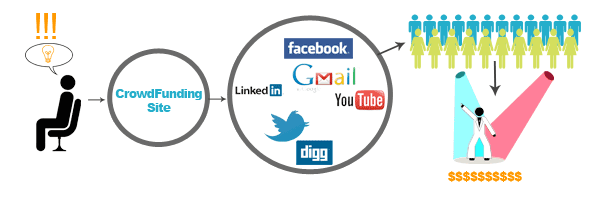
    How crowd-funding works?
    How crowd-funding works?

    Even with all that, I would say that we have just seen the tip of the iceberg in using technology to facilitate giving. There are a lot of imaginative ideas being developed as I write this article. For example, PlayMob, a tech company launched its GiverBoard platform designed for charities and game developers, linking them to design giving opportunities within the game itself. And it is not asking gamers to give donations, but has linked charity with buying products within the game itself that supports a good cause.

    Going into the 21st century, it would be interesting to see new innovative and disruptive attempts to create networks and platforms for doing good, and not just by providing a technology solution to fundraising. If we are able to inculcate giving and doing good into our daily activities rather than creating separate fundraising platforms, it would connect a lot more people, generate a lot more money and resources, and make businesses and people feel good about the business and transactions they are doing.

    I am waiting to hear news about such disruptive solutions popping up in different parts of the world in the coming decades. I am waiting for not just the Giving world to change for the better, but also for the time when our daily activities leave us feeling good and grateful for our contribution.

  • Is the Innovation ladder leaning against the right wall?

    Innovation is defined as the creation of better or more effective products, technologies or ideas that makes life easier for its customers and solves a problem in the process. Innovation is the buzz word these days in business circles and the use of technology in designing innovative solutions across different sectors has never been more pronounced before.

    If you see innovation discussions happening these days, most people will list the iPhone and the iPad, Facebook, the Sony Walkman and other technology related stuff on the top of their list. While such innovations have captured the media attention and earned a lot of money and market share for the respective companies behind them, there is another kind of innovation happening in the world. This new kind of innovation is happening in developing countries, even in villages, but it is not being covered by media, not being distributed across markets and countries, and not being talked about as much as iPad and other similar products.

    While the first kind of innovation is mostly happening for business reasons and are focussing on making life more comfortable for its users (and not necessarily solving any critical problems), the second kind of innovation is happening mostly sporadically but for solving serious problems like hunger and poverty. In the first scenario, life would have continued for people as usual even if the innovation hasn’t happened (albeit in a less efficient way) while in the second scenario, there would have been serious issues of disease, health and death (and they have been) in the absence of the said innovation.

    An example of the second kind of innovation is a simple Tippy Tap, which is a low cost, low tech, low water usage device to promote hand washing with soap. While most of the world talk about solving problems like accessing emails on the go, do we realize that 3.5 million children under the age of 5 die each year of diarrheal and respiratory infections, with 1000 deaths in India daily. Do not think I have put an extra zero, there are indeed thousand deaths daily. Now that is a real problem, purely avoidable just by washing hands with soap, and Tippy Tap intends to solve this problem. Now you decide what is a bigger, or better, or more needed innovation. (See how to build a Tippy Tap)

    Are we solving the right problems?
    Are we solving the right problems?

    While we can always term the iPad, Facebook and other such technological innovations as innovations, they don’t solve any big or critical problems. You can call them innovations as a new approach to markets but not for problem solving. They focus on the opportunity and the market size, but NOT on any real problem. If we look more, most of the time real problem solvers are not from the business sector but they could be local people, academicians, social workers or just plain anybody. While the only innovation highlighted by the media has been done by businessmen. Now I don’t think anybody believes only businessmen can innovate!

    I am in no way trying to discredit technological innovations, as the Sony Walkman revolutionized the music industry by allowing people to carry music on the go. But nobody complaint about the need of a portable music player, and it did not solve any problem. Similarly, Amazon did not solve any problem. People had been shopping offline for ages, and nobody complained. Yet Amazon changed the way shopping is done forever, and there are 100s of Amazon clones coming up everyday. Users never asked for a social network before Facebook, neither did they ask for online video sharing or a service to tweet what they were doing every second. But all these are hugely successful products now.

    Mahatama Gandhi said that “I will give you a talisman. Whenever you are in doubt, or when the self becomes too much with you, apply the following test. Recall the face of the poorest and the weakest man [woman] whom you may have seen, and ask yourself, if the step you contemplate is going to be of any use to him [her]. Will he [she] gain anything by it? Will it restore him [her] to a control over his [her] own life and destiny? In other words, will it lead to swaraj [freedom] for the hungry and spiritually starving millions? Then you will find your doubts and your self melt away.” If we follow his simple words in our day to day actions, we will see real innovation.

    The question I am asking here is that either all the commercial innovation happening is not innovation at all, and if they are, is the innovation ladder is leading against the wrong wall as of now? As most of the problem solvers or real innovators are not from the business world, we  need to provide them with skills straining, investment and venture capital help, advice about R&D and intellectual property rights, and the right guidance to be able to scale their innovative solutions so that they make a dent to a ‘real‘ problem.

  • What our life has become these days?

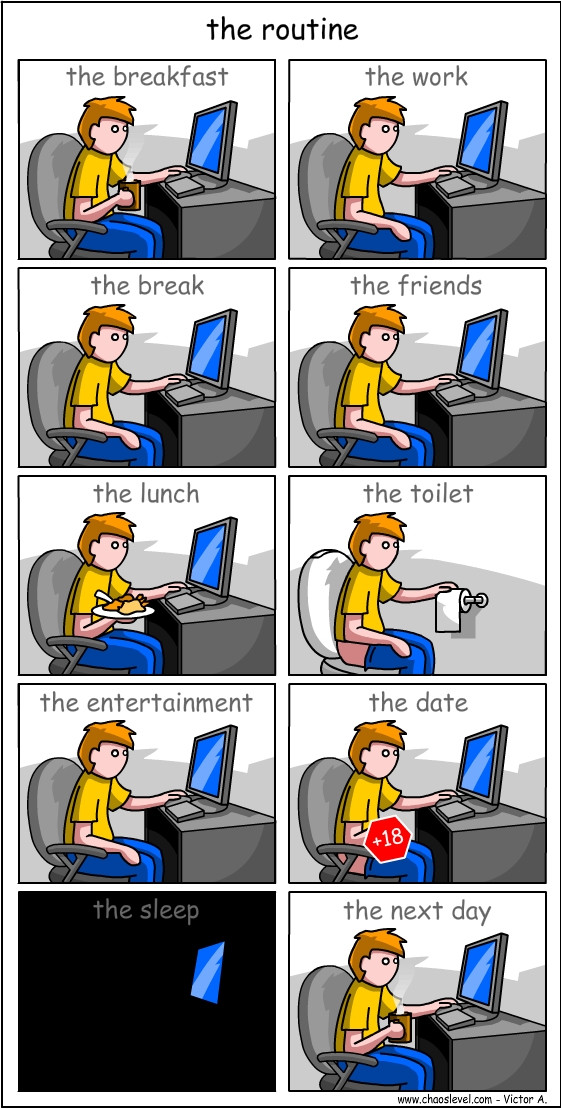
    I came across this pic and could not stop wondering how true it is. It totally describes what our life has become these days. With the advent of internet and social networking, everything has moved to the screen of our laptop. We work on our laptop, we talk with friends on the laptop, we take a break by listening to music or watching movies, again on our laptop and many of us (atleast me) sleep with our laptop ON downloading some movie or software.

    The Daily Routine
    The Daily Routine

    Isn’t it amazing how technology has influenced us? How facebook has become the first thing to do in the morning rather than brushing our teeth? And all this technology is only 10 years old. Ever wondered how we used to live our lives before that 🙂

anger anna hazare bangalore business challenge coaching conflict conversation corruption Cricket culture dandi march emotions energy friends fun gandhi giving gold growth hope india jan lokpal bill language leadership lessons Life listening love moment mother movie new year people perspective poem sachin tendulkar saleraja trust values walk waste women words world cup