Coaching

  • The Distinction Between Meaningless Activity and Meaningful Actions, And Why It Can Make All The Difference

    In today’s age of always-connected devices and nonstop notifications, we all have more to do each day than the hours can fit. Crossing items off the to-do list always feels good and gives one a feeling of accomplishment, but have we ever stopped and asked ourselves – accomplishment towards what?

    The ‘Busy’ Trap

    Whenever I have stopped to ask myself that question, I have realized that I have fallen into the trap of being busy rather than being productive. Being busy often relieves us from the fear of sitting still and the pain of conscious thinking, while the really important tasks often get neglected.

    We are often sucked into doing meaningless activities, either through algorithms running on our “smart” devices or through habits we have formed by emulating our peers rather than consciously choosing them. In other words, we waste most of our time doing meaningless activities that we have no time left for what really matters.

    We keep looking for happiness in materialistic gains which never leads to fulfillment. While everyone is constantly fighting to achieve their materialistic goals, very few understand that these are mere empty pursuits, only adding to the vicious cycle of wanting more.

    Every 2 weeks I share my most valuable learnings from living life fully in my Deploy Yourself Newsletter. Sign up now to download a workbook with 164 Powerful Questions which I use daily in my work and coaching. Allow these questions to transform your life and leadership.

    Meaningless vs Meaningful

    Everything that we do can be divided into either meaningless activity or meaningful actions. What I mean by meaningless activity is anything we do to only keep ourselves busy. Example – checking email and social media, hanging out with friends, or anything we do without a specific intention in mind.

    In contrast with the above, any activity which adds meaning to your life, or takes you in the direction of a conscious intention (or a goal), is what I would term meaningful. It could be a business trip for one or spending time with their family for another.

    What is meaningless and meaningful is different for everyone. Only you can define that. No-one else can make that distinction for you.

    We are often focused on what is urgent or what seems important today that we end up ignoring what is really important for us in the long run. Only by being aware of our decisions, we can be deliberate about them to move our life in the direction we want to go.
    “A man who procrastinates in his choosing will inevitably have his choice made for him by circumstance.” – Hunter S Thompson

    Focus and Prioritise

    Research has shown that not having the courage to live a life true to ourselves, not expressing our feelings when we should have, and working too hard are the top three regrets people have at the end of their lives.

    Doing things that we find meaningful is essential to our well being. But how many of us spend time wondering about what gives our life meaning, and what is really important to us?

    When we accept the standards and values others’ have set for us, we surrender our own will and judgment. By figuring out our own values, we allow our unique light to shine upon the world.

    If we only follow what everyone else is doing and not take the time and effort required to find our own values, which are unique for everyone, we will soon find ourselves lost and confused. But once you have put in the effort and identified your unique set of values, motivations, desires, and talents; you can nurture them and let them guide you.

    Three Questions

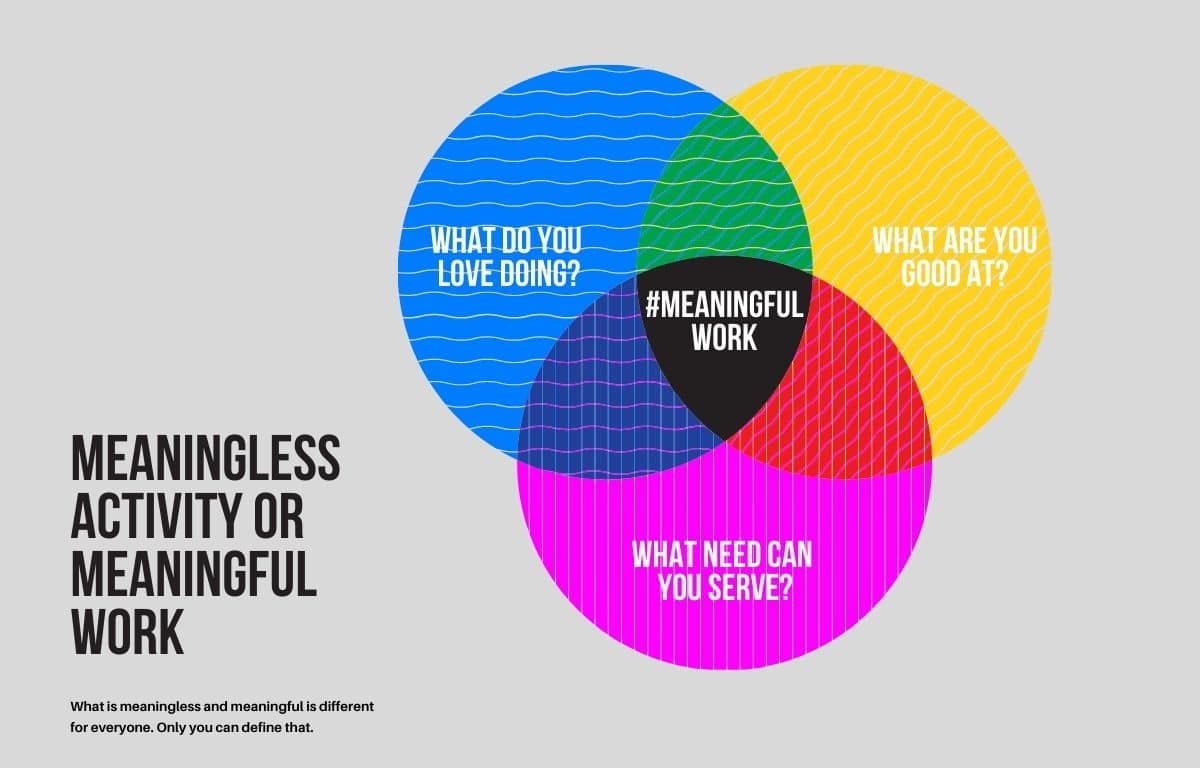
    • What are you good at?
    • What do you love doing?
    • What need can you serve?

    I believe the intersection of answers to the above three questions will be the most meaningful work for you. Once you have these answers, it will give you the clarity to prioritize tasks and the courage to say “No” to anything that doesn’t align with what you discover.

    Answering these questions will require some sincere and dedicated effort on your side, but once you do that, you will have more clarity on how you define your meaningful work. I would also like to add that it is a continuous rather than a one-time process. You should revisit the above questions every now and then as a “health-check”.

    Having the clarity about the “why” before the “what” and “how” of any action will ensure you create focused output that moves you forward, rather than the effort that just takes you around in circles. So the next time you think you have no time to follow your dreams, you know you have fallen into the trap of being busy with meaningless activities.
  • Don’t Allow Yourself to Use the Word TIRED

    Recently I was talking to a friend of mine, who has been a state-level Taekwondo Champion for the state of California. She was telling me about her strenuous training program which she used to follow when she was training. Among other things, the one thing which she told me was that she was not allowed to use the word “tired” even if the trainer asked her to do 300 push-ups. She said “tired” was the word which they could use only after they turned 80.

    The Role of Language in Shaping Our World

    Language plays a very important role in how we feel and go about our daily lives. The way we use language can determine the results we produce in the near and distant future. Researchers at Stanford University have proved that the way we use language shape how we see the world.

    It is often said that what you say is what you get. Saying that you are tired will actually make you feel tired and you will have all the symptoms to prove that. But we don’t realize that it was our word which caused it in the first place.

    So when someone asks you “How are you doing?” and you reply with, “I am tired” or “You know how Mondays’ are.“, we are actually contributing towards the impending tiredness or exhaustion by saying these words. The same goes for all the negative thoughts that come into our mind and out of our mouth, like “I don’t have enough money“, “I am not lucky” and so on.

    Language Creates and Generates Too

    Most people understand language to be descriptive and see it as a tool for communication. They are blind to the generative power of language. It is in language that people create their future and their present. Our mental models and unique assessments of the world determine the narrative we create for ourselves, which in turn determine the world we observe, and every action we take thereafter.

    For example – Every time you said yes or no to a request, you were not just communicating, but also creating a future. Your life would be different if you had said No instead of Yes to the various opportunities you said Yes to previously in your life.

    Chalmers Brothers and Vinay Kumar share this story in their book Language and the Pursuit of Leadership Excellence: How Extraordinary Leaders Build Relationships, Shape Culture and Drive Breakthrough Results.

    Two baseball umpires were sitting around talking, and one says, “Old Joe, he’s a great umpire. There’s balls and there’s strikes, and he calls ‘em like they are.” The second umpire then says, “Yeah, Joe’s a great umpire… there’s balls and there’s strikes, but he calls ‘em like he sees ‘em.” Just then Joe walks up and says, “You’re both wrong… there’s balls and there’s strikes, but they ain’t nothin’ till I call ‘em!”

    They add,

    Language conveys commitment, not just information. By understanding your organization as a network of conversations, relationships, and commitments (human beings making and managing commitments), you can open dramatically new possibilities for intervening and improving performance in a wide variety of areas.

    “I am always in conversation. And sometimes other people are involved” – Mark Twain

    Words can Take Power away, or they can Give Power

    Whenever we say something, we increase our belief in it. We give power to outside situations, individuals, and circumstances which is always disempowering. Athletes, like my friend in the example above, are not allowed to use such language because the trainers are aware of this fact.

    On the other hand, when somebody asks you, “How are you doing?” and you reply, “I am doing great!!“, you will actually feel a smile on your face and some adrenaline rushing through your body. It is impossible to say I am doing great without actually feeling good.

    If you are stretching your limits while doing a task, instead of saying “I am tired“, next time try saying, “Let me check my physical limits.“, and you will gain the strength to go that extra mile and achieve the impossible.

    Do you see a connection between what you have been saying and how your life is turning out?

    One of the quickest ways to improve your way of being is to change the words you use, to others and to yourself. When I say words, it includes the spoken words and the unspoken thoughts too.

    Just by changing the words we use, we can release a lot of tension and create joy. So the next time you speak, be aware of the words that come out of your mouth. Be aware of how others’ negative words make you speak out negative words too, and vice versa. Try to catch yourself when in negative emotion and speak powerful words instead.

    Speak words that profit others, depict hope, courage, and inspiration and which create positive images. Then notice the difference in how your surroundings and people react.

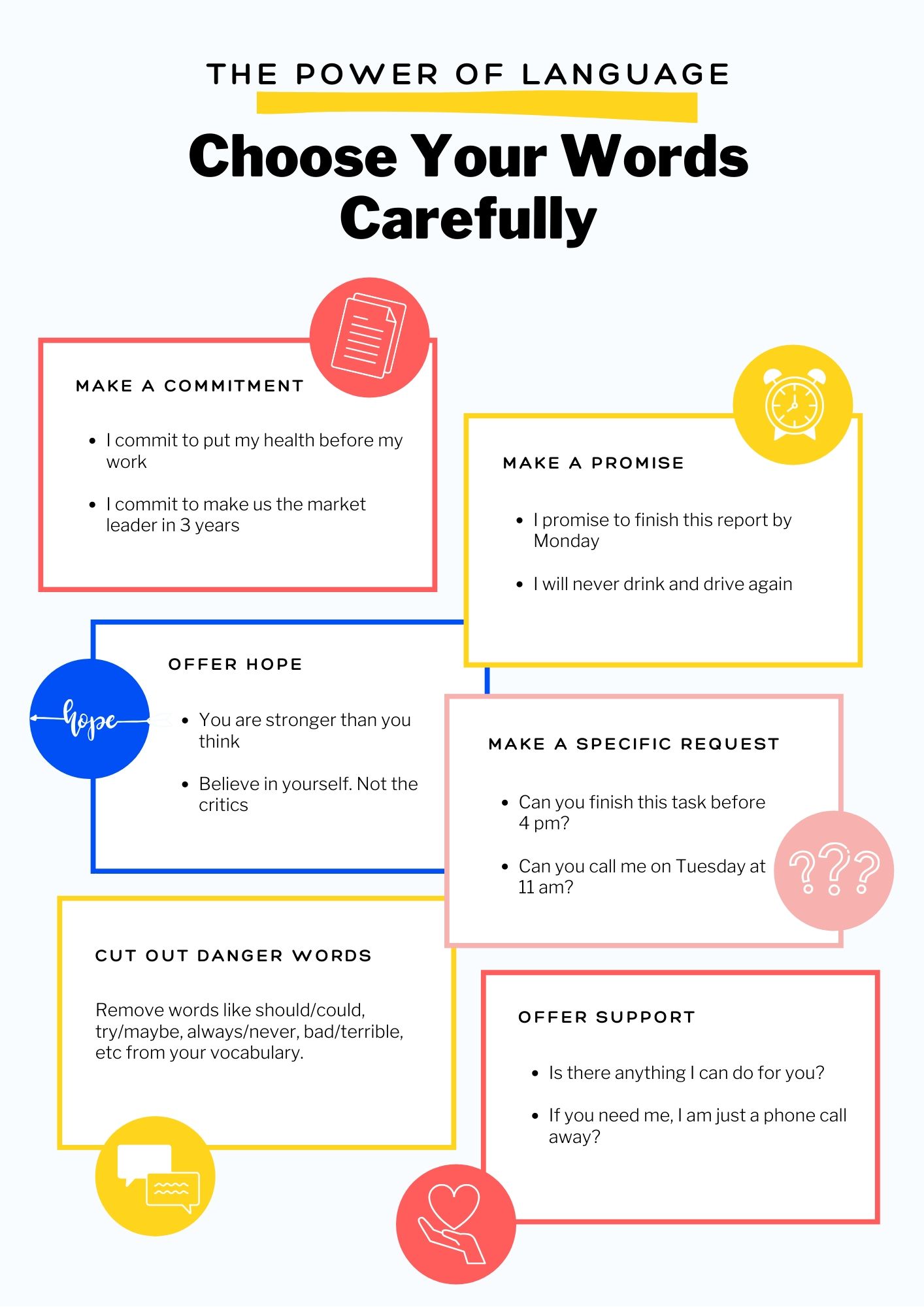
    Some of the danger words which we should cut from our vocabulary are –

    1. Should / Could – These words, spoken for ourselves or for others, implies judgment and makes people defensive and tense.
    2. Try / Maybe – These words leave ambiguity and leave an option for you or another to escape commitment in case things get difficult.
    3. Always / Never / Nobody  / Everybody – These words generalize opinions which are rarely the case and can cause people to react unexpectedly.
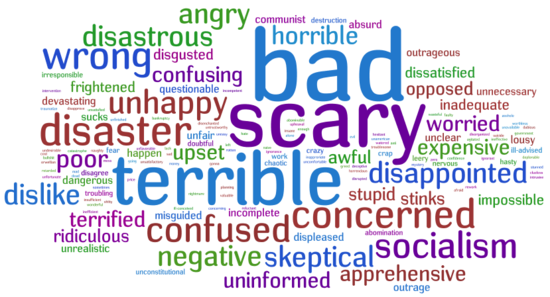
    4. Bad / Disastrous / Terrible – These words spread panic and can lead to more mistakes, stress, and confusion.
    5. Nothing is gonna change / That’s how it is done here – Using such phrases creates a culture of resentment and cynicism which ends up killing all enthusiasm and creativity in people.

    Instead, you can use powerful words and make them work for you :-

    1. Declare a Commitment. 
      1. I commit to exercising 30 minutes daily.
      2. Let us commit together to make this company the best place to work for.
    2. Make a Promise
      1. I promise to finish this report in two days.
      2. I promise to never drink and drive again.
    3. Make a Specific Request
      1. Can you finish this report before Friday or not?
      2. If you like it, can you share this article on Facebook today?
    4. Offer Support
      1. Is there anything I can do to help you with this task?
      2. I am just a phone call away if you need me.
    5. Offer Hope
      1. You will make it through it. You are stronger than you think.
      2. Believe in yourself, not the critics. I know you will prove them wrong.

    Watch your thoughts, for they become words. Watch your words, for they become actions. Watch your actions, for they become habits. Watch your habits, for they become character. Watch your character, for it becomes your destiny. – Lao Tzu

    So the next time, instead of saying –

    • “I can’t exercise more, I am tired.”, say, “I am not tired, let me do one more round.”
    • “I can’t work outside because I have asthma”, say, “I will work to prove I am bigger than my asthma”
    • “I can’t do this because I don’t have enough money”, say, “How can I earn enough money to start doing this?”
    • “I am not feeling good, it is going to be a bad day”, say, “Today is going to be a great day and I am raring to go”
    • “My life sucks”, say, “Today is a new day. Let’s make the most of it!!”

    Do this and you will see that your days will get brighter and dreams will turn into reality. Break the pattern of using words that suck power out of you, and instead form a new habit of using words that give power to you and the people around you.

anger anna hazare bangalore business challenge coaching conflict conversation corruption Cricket culture dandi march emotions energy friends fun gandhi giving gold growth hope india jan lokpal bill language leadership lessons Life listening love moment mother movie new year people perspective poem sachin tendulkar saleraja trust values walk waste women words world cup