Coaching

  • You Are Going to Talk Yourself Out of It

    We all do this – Talk Ourselves Out of Our Commitments

    And that’s exactly what we need to talk about.

    If you’ve just had a powerful conversation with me about your future—the one that made your heart race and your mind light up with possibility—I need you to know something important: you’re probably going to talk yourself out of it.

    Not because you don’t want it (the new possibility). Not because it’s not right for you. But because your brain is about to do what brains do when faced with something bigger than they’re used to: protect you from what it perceives as danger.

    I’m writing this because I’ve seen it happen hundreds of times. Someone leaves our call feeling electric, inspired, clear about what they want to create. Then, 24 to 48 hours later, the doubts creep in. The “what ifs” start multiplying. The practical concerns suddenly seem insurmountable.

    And if I don’t hear from them, I know exactly what’s happening. They’re sitting at their kitchen table or in their car, having a mental wrestling match with themselves. They’re building a case for why now isn’t the right time, why they should wait, why they need to be more prepared.

    We all talk ourselves out of our dreams and commitment. And we always have good reasons for that.

    Here’s what I want you to know is:

    • This is not a character flaw
    • This is not weakness. There is nothing wrong with you.
    • This is not a sign that you’re not ready or that the dream isn’t real
    • This is your nervous system doing exactly what it was designed to do—keep you safe and comfortable
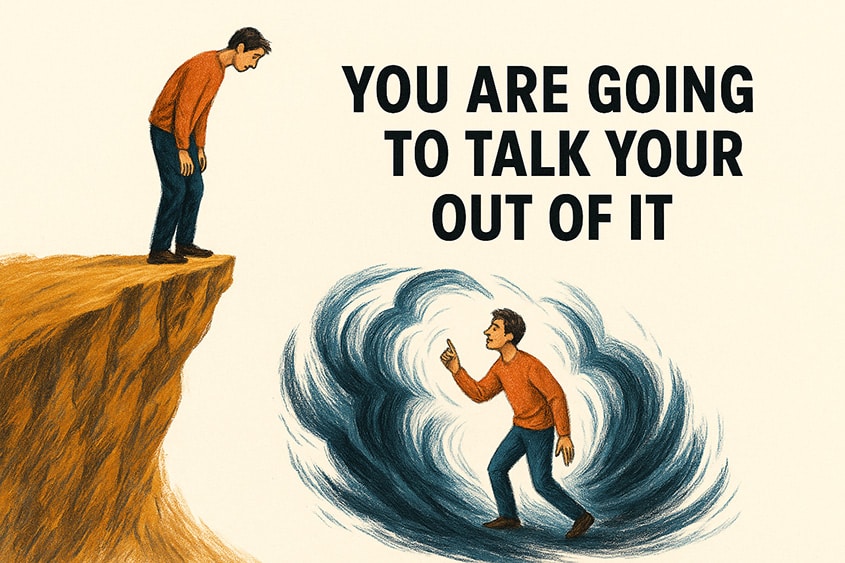
    Your Brain Doesn’t Know the Difference Between a Tiger and a Dream

    Let me tell you about Shruti, a tech company CEO who came to me feeling stuck. She’d been in the same role for three years, comfortable but unfulfilled. She had a vision of starting her own consulting firm, helping companies build more human-centered cultures. When we talked, her eyes lit up. She could see it all—the clients she’d work with, the impact she’d make, the freedom she’d have.

    Two weeks later, she hadn’t returned my call.

    When we finally connected, she was embarrassed. “I got scared,” she admitted. “I started thinking about everything that could go wrong. What if I can’t get clients? What if I fail? What if I’m not as good as I think I am?”

    Her brain couldn’t tell the difference between a sabre-toothed tiger and starting a consulting firm. Both triggered the same ancient alarm system: DANGER. THREAT. RETREAT.

    Your brain evolved in a world where taking big risks often meant death. The person who decided to explore that dark cave might have found food—or they might have become food. The brain that kept humans alive was the one that said, “Better safe than sorry.”

    That same brain is now trying to keep you “safe” from your dreams. It’s flooding you with cortisol and adrenaline, making you feel anxious and overwhelmed. It’s not trying to sabotage you—it’s trying to save you.

    The Committee Meeting in Your Head

    After a coaching conversation (sometimes even a regular conversation) with me – especially if you find it insightful or powerful, something predictable is going to happen. Your brain is going to call a committee meeting. And this committee is not your friend.

    The committee members include:

    The Accountant: “Do you know how much this costs? You could use that money for so many other things. What about the roof? What about retirement? This is irresponsible.”

    The Comfort-Seeker: “You’re already so busy. Do you really want to add more stress to your life? Things are fine the way they are. Why rock the boat?”

    The Inner Critic: “Remember when you tried that other thing and it didn’t work out? You’re not disciplined enough for this. You’re going to disappoint everyone, including yourself.”

    The Social Worrier: “What will your spouse think? Your friends? Your colleagues? They’ll think you’re going through a midlife crisis. They’ll think you’re being frivolous.”

    This committee’s job is to maintain the status quo. They’re not interested in your growth or your dreams. They’re interested in keeping everything exactly as it is, because that feels safe.

    And here’s the kicker: they’re going to make very logical, rational-sounding arguments.

    They’re not going to say, “Don’t do this because you’re scared.”

    They’re going to say, “Don’t do this because it’s financially irresponsible” or “Don’t do this because the timing isn’t right.”

    PS – The committee is just a dramatic name for your brain and nervous system.

    The Vulnerability Hangover

    Let me tell you about Marcus, a successful lawyer who came to me feeling empty despite his achievements. In our session, he shared something he’d never said out loud: he wanted to write a book about his experience growing up in foster care and how it shaped his drive to help others.

    He left our call feeling alive, purposeful, clear. Three days later, he was mortified. “I can’t believe I told you that,” he said. “I sound like such a cliché. A lawyer who wants to write a book? How original.”

    This is what I call the vulnerability hangover. When you share your deepest dreams with someone, you’re being incredibly vulnerable. In the moment, it feels amazing—like you’re finally being seen for who you really are. But later, when the emotional high fades, that vulnerability can feel terrifying – like a hangover.

    Your brain starts saying:

    • “Why did you tell them that? Now they know.”
    • “What if you can’t do it? What if you fail?”
    • “You’ll look like a fool.”

    The easiest way to deal with this discomfort is to distance yourself from the person who witnessed your vulnerability.

    If you avoid me, you can avoid the reminder of what you shared. You can avoid the accountability. You can avoid the possibility of disappointment.

    But you can not avoid that dream that you have hiding and holding down for years – sometimes even for – decades.

    The Gap Between Who You Are and Who You Could Be

    Here’s what’s really happening: in our conversation, I helped you see a version of yourself that’s bigger than your current reality. I held up a mirror that showed not who you are today, but who you could become.

    This creates what I call the “aspiration gap“—the space between your current self and your potential self. This gap is both incredibly exciting and absolutely terrifying.

    On one hand, it’s thrilling to see what’s possible. On the other hand, it’s overwhelming to think about all the changes you’d need to make to get there.

    Let me tell you about Jennifer, a marketing director who came to me feeling burned out. She had a vision of creating a more balanced life, maybe even starting her own agency. When we talked, she could see it all clearly. But a week later, she was paralyzed.

    “I was so excited on our call,” she told me. “But now I’m looking at my life and I don’t know how to get from here to there. It feels impossible.”

    Jennifer wasn’t backing away from her dream. She was backing away from the seemingly impossible journey between where she was and where she wanted to be.

    What I Want You to Know About Me

    If you’re reading this and feeling called out, if you’re recognizing yourself in these stories, I need you to know something important: I am the last person you need to worry about disappointing.

    Here’s what I’m NOT here to do:

    • to judge you
    • to be disappointed in you
    • to make you feel guilty or ashamed
    • to keep score of your progress
    • to wait for you to prove yourself

    Here’s what I AM:

    • Someone who’s been where you are
    • Your thinking partner and reality check
    • Your reminder of what’s possible
    • Here to help you take the next step
    • Someone who will never judge you
    • Someone who will never give up on you
    • Someone whom you can always count on

    I’ve been where you are. I’ve had the dreams that seemed too big, the visions that felt too scary to pursue. I’ve felt the vulnerability hangover after sharing something deeply personal. I’ve had my own committee meetings where every logical voice said, “Don’t do it.”

    When I decided to leave my lucrative tech career to become a coach (which took me 8 years), my own brain went into overdrive. “You’re giving up a sure thing for what? To help people? That’s not a real job. You’re being irresponsible. You’re going to fail.”

    I almost talked myself out of it a dozen times. The only difference is that I had someone in my corner who understood what was happening—someone who helped me see that the fear was not a stop sign but a sign that I was onto something important.

    I’m that person for you now.

    The Fear Is Not the Enemy

    Here’s what I’ve learned: the fear you’re feeling isn’t a bug in the system—it’s a feature. It’s your brain’s way of saying, “This matters. This is important. This could change everything.”

    The bigger the dream, the bigger the fear. If you weren’t scared, it would mean the goal wasn’t significant enough to trigger your growth edge.

    Let me tell you about Ahmed, a CEO who came to me wanting to transform his company culture. He had a vision of creating a workplace where people actually wanted to be, where they felt valued and heard. In our session, he was passionate, clear, committed.

    A week later, he was second-guessing everything. “Maybe I’m being too idealistic,” he said. “Maybe this is just how business works. Maybe I should focus on the numbers and leave the touchy-feely stuff alone.”

    “Ahmed,” I said, “if this were easy, if it didn’t scare you, would it be worth doing?”

    He was quiet for a long moment. Then: “No. If it were easy, someone would have done it already.”

    The fear wasn’t telling him to stop. It was telling him he was onto something that mattered.

    What to Do When the Committee Convenes

    So what do you do when the committee in your head starts its meeting? When the doubts creep in and the excuses start forming?

    Your Four-Step Process:

    1. Expect it. Don’t be surprised when it happens. Say to yourself, “Oh, there’s my brain trying to keep me safe. Right on schedule.”
    2. Don’t fight it. Don’t try to push the fear away or pretend it doesn’t exist. Acknowledge it. “I hear you, brain. You’re scared. Thank you for trying to protect me.”
    3. Remember who’s in charge. The committee doesn’t get to make the final decision. They get to voice their concerns, but they don’t get to vote on your future. Only you get to do that.
    4. Call me. Seriously. Don’t sit with this alone. Don’t let the committee be the only voices in your head. Let me be your thinking partner, your reality check, your reminder of what’s possible.

    The Smallest Possible Step

    One of the reasons people retreat is because the dream feels too big, too overwhelming. Going from where you are to where you want to be feels like trying to leap across the Grand Canyon.

    But here’s the thing: you don’t need to leap across the Grand Canyon. You just need to take one step in the right direction.

    Real examples of first steps:

    Shruti (VP who wanted to start consulting): Her first step wasn’t quitting her job or finding clients. It was spending 15 minutes writing down what she’d learned about culture change in her current role.

    Marcus (lawyer who wanted to write a book): His first step wasn’t writing a book proposal or finding a publisher. It was spending 10 minutes journaling about one memory from his childhood.

    Jennifer (marketing director who wanted more balance): Her first step wasn’t starting an agency or negotiating a new work arrangement. It was blocking out 30 minutes on her calendar for a walk.

    The goal isn’t to solve everything at once. The goal is to take one small step that proves to yourself that change is possible.
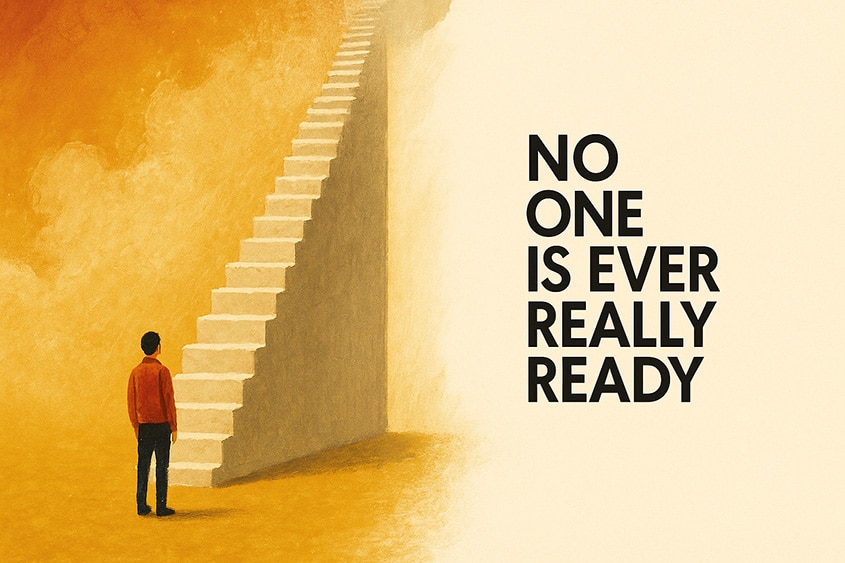
    You Don’t Have to Be Ready

    Let me tell you a secret: no one is ever really ready for the thing that will change their life. You don’t become ready by waiting, by preparing more, by getting all your ducks in a row. You become ready by starting.

    You are waiting for readiness to start. Without realising that you become ready by starting.

    Every successful person I know—every leader who’s created something meaningful, every entrepreneur who’s built something lasting, every person who’s made a significant change—they all started before they were ready.

    They started:

    • Scared
    • Uncertain
    • With incomplete information
    • With imperfect plans

    But they started.

    An Invitation, Not a Demand

    I’m writing this to help you understand what’s happening in your brain so you can make a conscious choice instead of an unconscious one.

    If you decide that now isn’t the right time, that’s okay. If you decide that the dream isn’t worth the discomfort, that’s your choice to make.

    But I want you to make that choice consciously, not because your brain hijacked the decision-making process.

    And if you do decide to move forward, I want you to know that you don’t have to do it alone. You don’t have to figure it all out by yourself. You don’t have to be perfect or have all the answers.

    You just have to be willing to take the next step.

    The Dream Is Still There

    Here’s what I know about you: the dream that showed up in our conversation is still there. The vision you had, the excitement you felt, the clarity you experienced—that wasn’t fake. That wasn’t a moment of delusion. That was you catching a glimpse of who you really are and what you’re really capable of.

    Remember:

    • The fear might have dimmed that light, but it hasn’t extinguished it. It’s still there, waiting for you to fan it back into a flame.
    • The committee in your head is loud, but it’s not the only voice. There’s another voice—quieter, gentler, but infinitely wiser
    • It’s the voice that brought you to our conversation in the first place. It’s the voice that knows what you’re capable of

    Listen to that voice. Trust that voice. Follow that voice.

    And when you’re ready—not when you’re fearless, but when you’re ready to move forward despite the fear—I’ll be here. Not to judge you or pressure you or make you feel guilty, but to remind you of what’s possible and to help you take the next step.

    Your dream is still valid. Your vision is still real. Your future is still waiting.

    And I’m still here, ready to help you create it.

    The only question is: are you ready to stop talking yourself out of it?

  • Why I’ll Never Give Up on You (Even When You Want to)

    There’s something I need every founder, every entrepreneur, every CEO out there to hear—clearly, directly, and without any fluff:

    I will never give up on you.

    Even when you want to give up on yourself.

    Even when you’re too tired to care.

    Even when you feel like a failure and all you want to do is disappear.

    Because I’ve been there. Not in your exact shoes, maybe, but in that same space—where the world feels heavy, the pressure won’t let up, and you start wondering if any of it is worth it. I’ve walked through those lonely corridors, and I know exactly how quiet it gets when things start to fall apart.

    And that’s the moment where most people will walk away.

    But that’s exactly where I step in.


    The Founder Who Was Ready to Shut It All Down

    A few weeks ago, I had a call with a founder I’ve been coaching for a while. This is not a small-time entrepreneur. He runs a company with 120 people—an ambitious, growing business that’s already scaled more than 50% since we started working together.

    But now, things were tight.

    He said to me, “We’ve got maybe a month of runway left. We’re thinking about cutting everything. Even coaching.”

    I listened. He didn’t say it out of anger or blame. He said it from exhaustion. From overwhelm. From embarrassment. From fear. The kind of fear that hits you when you’ve been holding everything up for too long, and you’re finally too tired to fake it anymore.

    And I told him what I want to tell every founder who hits that moment:

    “You don’t need to feel ashamed. You don’t need to feel guilty. And you’re not getting rid of me that easy. I’m not here for your money. I’m here for your future.”

    I meant every word of that. If I have to write off a payment, I’ll do it. But if you think I’m only doing this because of the payment—then you’ve missed who I am.


    I Know What It Feels Like to Stand Alone

    Here’s why this matters to me so much.

    Growing up, I didn’t have people standing behind me. I didn’t have mentors. I didn’t have powerful role models telling me I could do something great. I didn’t have anyone offering to walk with me through fire.

    Except for my parents.

    They didn’t have a lot, but they believed in me with everything they had. They stood behind me even when I doubted myself. They stood behind me when I failed, when I struggled, when I couldn’t see anything in myself worth standing for.

    And I remember thinking—if I didn’t have them, I would’ve collapsed. Completely. I wouldn’t have made it through the tough times. I wouldn’t have found my voice. I wouldn’t be doing this work today.

    So now, when I see a founder on the edge—when I see someone doing everything they can to hold up their company, their team, their vision—and I see them standing there alone

    That’s not okay with me.


    You Don’t Need Advice—You Need Someone Who Would Always Have Your Back

    The world is full of advisors. Consultants. Gurus.

    People who will gladly “support” you as long as you’re doing well, as long as the revenue’s climbing, as long as it looks good on a LinkedIn post.

    But when the pressure hits? When the numbers dip? When you feel like you’re drowning?

    Most of them vanish.

    What I offer is different.

    You don’t hire me for advice.

    You hire me because when everything feels like it’s falling apart, I’m still here. Still with you. Still fighting for your future.

    And when everything is going well, I will challenge you to dream even bigger. I am the one who will ask – “If you can do this, then what else can you do?”


    Here’s What Happened

    That same founder who was ready to cancel everything—I asked him a question that changed the tone of the entire conversation.

    I said, “What would be a dream outcome in the next 30 days?”

    Not a practical one. Not a “just survive” scenario. A dream. A miracle.

    And he paused. He hadn’t let himself think like that in weeks.

    Then I asked him, “Who on your team needs to rise up right now?”

    He gave me three names.

    And I said, “Great. Let’s build a plan. Use me. Use my time. Use my resources. Let’s create something that not only gets you through the next 30 days—but changes the trajectory of this company forever.”

    That was the turning point.

    Not because I had a magic answer.

    But because I refused to see him as broken or weak or “just surviving.”

    I saw him as an entrepreneur. A leader. A creator. And I spoke to that part of him.

    That’s what I do.


    This Is Bigger Than You

    Founders often forget how much is riding on them—not just revenue and metrics, but people. Culture. Families. Purpose.

    When you rise, your team rises.

    When you remember who you are, others follow.

    And when you give up—know that it doesn’t just affect you.

    But this is not pressure. This is purpose. With great powers come great responsibility.

    This is your invitation to lead from a deeper place.

    Not fear.

    Not scarcity.

    But vision. Belief. Commitment.


    Why I’ll Never Give Up On You

    Here’s the truth: You can ghost me.

    You can miss payments.

    You can tell me you’ve lost faith.

    You can fall flat on your face.

    I’ll still be here. Not chasing you. Not dragging you. But standing right where I’ve always stood—until you’re ready to rise again.

    Because I will never give up on you.

    Even when you’ve given up on yourself.

    And that’s not a branding line.

    That’s my life. That’s my stand. That’s who I am.

    I’m here because I know what it feels like to be left alone.

    And I refuse to let that happen to you.


    If you’re a founder right now and you’re struggling—emotionally, financially, mentally—I need you to hear this:

    You’re not weak. You’re not broken. And you’re not alone.

    You don’t need to hide.

    You don’t need to delay.

    You don’t need to shut down.

    You need to reach out.

    You need to rise.

    You need to remember who the hell you are.

    And if you forget—I’ll remind you.

    That’s why I’m here.

    This is not my business. This is not a service. This is not a transaction.

    This is my life’s work.

    I will never give up on you.

    Even when you want to give up on yourself.

    Because I’m not here for your money. I am here for your impact. I am here for your potential.

    I’m here for your future.


  • 5 Reasons CEOs and Entrepreneurs Choose to Work with Me

    As a CEO or an entrepreneur, you carry immense responsibility. You face daily challenges that require you to lead, innovate, and make decisions that impact not only your business but also the lives of those around you.

    The higher you rise, the lonelier it can get—and the more you realize you need someone who truly gets you. Someone who can challenge you, support you, and speak the truths that no one else dares to say. Here are five reasons my clients, many of whom are high-performing leaders like you, choose to work with me.

    1. Radical Honesty: No Sugar-Coating, Just Truth

    The most successful leaders don’t need more yes-men—they need someone who is willing to tell them the truth, even if it’s uncomfortable. That’s where I come in. I provide radical honesty, a kind that cuts through the noise and gets to the core of what’s holding you back.

    • Example: I once told a client that their current leadership style was not working and that their true potential required them to shut down and start again from scratch. It was a hard conversation, but it led them to build something far more aligned with their vision. Radical honesty isn’t about arrogance; it’s about love, support, and a genuine commitment to your success.

    Your Pain Point: You feel like no one tells you the whole truth anymore. Your team is hesitant to share their real thoughts because of your status, and you need someone who isn’t afraid to tell it like it is.

    My Promise: I care more about your dreams and goals than I do about staying comfortable or being liked. When you work with me, you will hear what you need to hear, not what you want to hear.

    2. Bold Challenges: Break Through Your Limits

    Ambition is not the problem—you’ve got plenty of that. The problem is that sometimes, even with your ambition, you stop seeing the bigger possibilities. My job is to challenge you to dream even bigger, to go beyond the limits you might have unknowingly set for yourself.

    • Example: One client once said, “My goal is to scale from $10M to $20M in revenue.” I looked him in the eye and said, “Why not $100M?” That question changed everything. We worked together to develop leadership presence and strong communication skills that ultimately surpassed his initial goals.

    Your Pain Point: You want to dream big, but you also want a guide to push you beyond the horizon that you see for yourself. Sometimes you wonder if you’re playing too small, but no one around you questions it.

    My Promise: I will challenge you more than you’ve ever been challenged. Whether that means asking you to fly to Amsterdam for a conversation that redefines your path, or pushing you to make the decisions you’ve been avoiding—I’m here for all of it. I care less about why something might not be possible and more about why it might be.

    3. True Depth: Discover Who You Really Are

    Exceptional leadership requires deep self-awareness. But this level of awareness isn’t something you can achieve alone. You need a partner who will act as your mirror—someone who will help you see yourself in ways you haven’t yet imagined.

    • Example: One of my clients used to struggle with understanding how they showed up to their team. Through our work together, they began to realize the impact their words and actions had—both the positive and the negative. They became more present, more effective, and their relationships with their team transformed.

    Your Pain Point: You often wonder if you truly know yourself as a leader. You feel that something is missing, but you can’t quite put your finger on it.

    My Promise: I’ve been where you are—afraid of being seen, hiding parts of myself to keep the peace. Today, I stand as an example of what’s possible when you embrace your full self. I help you go deep, so you can unlock every aspect of your potential and create a ripple effect that transforms not only your leadership but also your life.

    4. Authentic Presence: It’s Not About Impressing, It’s About Being Real

    For years, I played small, hiding my true self to keep others happy. I thought I had to be perfect to coach others. But the truth is, authenticity is the bridge that leads to trust. When I stopped trying to impress my clients and started showing up as my full, flawed self, everything changed.

    • Example: Once, I was distracted during a coaching session because of an argument I had earlier. I chose to share that with my client instead of pretending. He thanked me for my honesty, telling me it made him trust me even more. By being real, I showed him that he could be real too.

    Your Pain Point: You’re tired of the façade. You’re tired of feeling like you need to be perfect, like you need to impress people just to be heard.

    My Promise: I will show up as my authentic self, and in doing so, invite you to do the same. Our work together will be a place where you can be vulnerable and real—because that’s where true growth happens.

    5. Legacy and Deeper Relationships: It’s About More Than Success

    Most high achievers eventually ask themselves deeper questions: “Why am I really here? What am I leaving behind?” Success is great, but it’s not everything. True fulfillment comes from the impact you have on the people around you—the legacy you leave.

    • Example: I’ve helped clients reconnect with their families after years of neglect due to their relentless pursuit of business success. One client told me, “I realized that no amount of money is worth losing the people I love.” Today, he is not only leading a successful business but also being the father and partner he always wanted to be.

    Your Pain Point: You’ve achieved great success, but it feels hollow. You know there’s more to life than business metrics and financial wins, but you don’t know how to tap into that deeper purpose.

    My Promise: I will help you explore what legacy really means for you. We will work on not just scaling your business but also making a multigenerational impact—one that touches the lives of your team, your family, and everyone who looks up to you.

    Vulnerability and Trust: The Foundation of Transformation

    The most transformative coaching relationships are built on vulnerability and trust. I bring both to the table—being vulnerable with you, while also being a steadfast leader. I will push you harder than you’ve ever been pushed, and support you more than you’ve ever felt supported.

    Your Pain Point: You need someone who can handle the weight of your aspirations, your fears, and your truth—someone you can trust completely.

    My Promise: I will be that person. I will always tell you the truth. I will challenge you because I believe in you. And whether we work together for one session or for years, you will always leave feeling more inspired, more capable, and with a greater sense of what’s possible.


    These are the reasons CEOs, entrepreneurs, and other high-achieving individuals choose to work with me. You need someone who will tell you the truth, push you beyond your current vision, help you see yourself clearly, be authentic with you, and guide you toward a legacy that truly matters. If this resonates with you, let’s connect and explore how we can turn your boldest visions into reality.

  • The Power of Integrity: Saying What You Mean, Doing What You Say

    At the heart of producing results in life and leadership is integrity—the simple yet profound practice of saying what you mean and doing what you say. Integrity is not just about morality or ethics; it’s about effectiveness and workability.

    When your actions consistently align with your promises, you become a powerful creator in your world. Every promise you make is a declaration of intent, and when you consistently honor that promise, you begin to see the real power of your word.

    If Your Hand Went Rogue?

    Imagine if your hand had a mind of its own. It moves when it wants, does what it feels like, and ignores your commands. You try to drink a glass of water, but the hand grabs a pen instead. You reach to shake someone’s hand, but it fumbles into your pocket.

    This hand isn’t bad, but it’s no longer useful. It’s unpredictable. You can’t trust it. In fact, it causes more harm than good. Soon, you’d have no choice but to tie it down or, in extreme cases, consider removing it to stop the chaos it causes. The hand is no longer in integrity with the purpose it was designed for.

    Now think of promises in your organization like that hand. When people make promises but don’t follow through, it’s like having a rogue hand. It’s not about being bad, but it makes the team or organization unworkable. A promise is a tool—when it’s out of integrity, the whole system starts to fail.

    Just like you wouldn’t trust that hand, you can’t trust promises that aren’t kept. Deadlines get missed, projects fall apart, and trust erodes. The organization becomes less effective, like a body trying to function with a hand it can’t rely on.

    When promises are out of integrity, the entire organization becomes less usable to the extent its promises are out of integrity. Productivity drops, frustration rises, and trust erodes. Just like the rogue hand, things fall apart.

    To fix this, you don’t need to punish the person or cut them off from the team. You need to restore integrity. Have an honest conversation about what went wrong. Clear up the mess, and get back on track.

    The Foundation of Leadership: Integrity in Action

    As leadership expert Warren Bennis pointed out, “Leadership is the capacity to translate vision into reality.” The bridge between vision and reality is integrity. Without it, your vision remains just a dream. When leaders act with integrity—when they honor their word and follow through on their commitments—they create trust, alignment, and real impact. This is where integrity becomes not just a value but a practical tool for producing results.

    Integrity as a Generative Force

    Werner Erhard, a pioneering thinker in the field of personal development, introduced a powerful insight about integrity: It is not just a moral stance but a generator of power and performance. Erhard argues that when you consistently honor your word, it creates an unshakable foundation for trust, reliability, and, ultimately, results. He teaches that our integrity is whole and complete when we do what we say, when we say it will be done, and in the way we said we would do it—no excuses.

    Promises: The Source of Personal Power

    Integrity begins with your promises, and every promise you make is first a promise to yourself. According to Sameer Dua, the power of integrity lies in our ability to take responsibility for our promises and follow through on them, regardless of changing emotions or circumstances. He asserts that when you fail to honor your promises, you diminish your personal power and lose credibility—not only with others but with yourself.

    Living in integrity means recognizing that your word is the source of your reality. When you say something will happen, and you commit to making it happen, you are shaping your world in alignment with your declaration. This is where true leadership emerges—when you create results not by chance or luck, but by the force of your integrity.

    Three Kinds of Promises

    Criminal Promise:

    A criminal promise is when you or someone says “yes” to a task or agreement, but internally they already know they won’t deliver on time or at all. For example, someone promises to deliver a task by Monday but already knows they will deliver it on Wednesday and does not communicate this discrepancy. It’s a form of dishonesty since the person knowingly gives their word without the intention to follow through.

    Conditional Promise:

    A conditional promise is when you or someone commits to something, but their commitment is dependent on external conditions. For example, saying, “I will be on time if there’s no traffic” or “I will do this if everything goes according to plan.” This kind of promise leaves room for excuses when circumstances change, allowing the person to back out of the commitment without taking responsibility.

    Committed Promise:

    A committed promise is the highest form of promise. In this type, the person is fully dedicated to making it happen no matter what . If they face challenges or realize they cannot fulfill their commitment, they will inform the other party immediately, rather than waiting to be called out on it. This kind of promise builds trust, as the individual takes full responsibility for their word and actions.

    Creating Trust and Reliability: Bob Dunham’s View

    Bob Dunham, founder of the Institute for Generative Leadership, builds on this by explaining that integrity creates the conditions for trust and reliability in relationships and organizations. When leaders honor their commitments, they set a standard of reliability that others can depend on. Trust becomes the currency that fuels high-performing teams, collaborative environments, and lasting partnerships.

    Dunham suggests that the breakdown of trust in teams and organizations often stems from a failure to maintain integrity. This could be something as simple as consistently missing deadlines or failing to deliver on promises. Each breach of integrity, no matter how small, erodes the foundation of trust that is essential for long-term success.

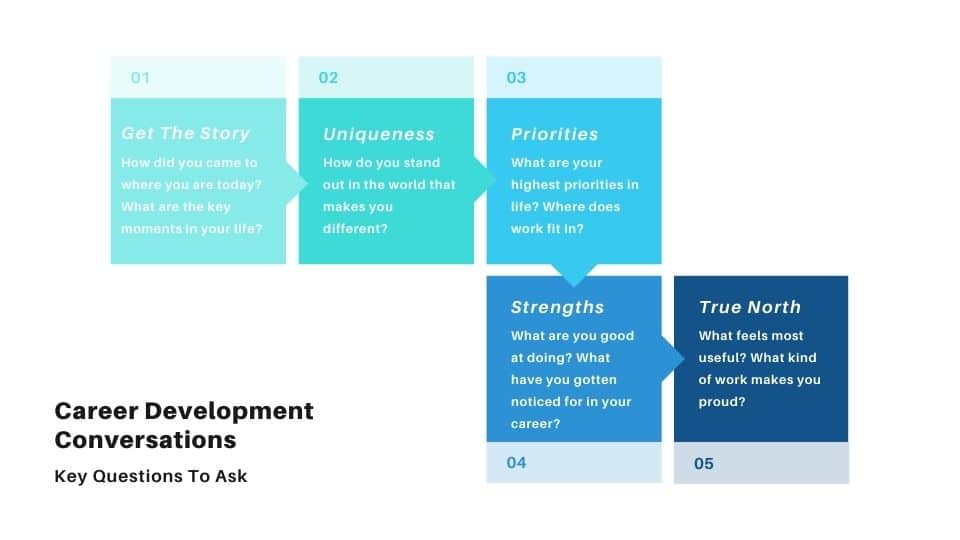
    These questions will gently provoke you to see blind spots that are currently producing results in your life that you want to avoid:

    1. Have I said “yes” to any requests because I didn’t want to seem incapable, even though I knew I couldn’t follow through?
    2. Have I ever agreed to a timeline just to avoid confrontation, knowing that I had no intention of meeting it?
    3. Have I ever said “I’ll try” instead of giving a clear commitment, leaving myself an escape route if things get tough?
    4. Am I allowing myself to back out of commitments when a “better” opportunity comes along?
    5. In what situations do I agree to things knowing I’ll probably back out or delay without communicating it clearly?
    6. Am I spending more time fixing problems caused by broken promises than I would if I communicated openly from the start?
    7. What opportunities have I lost because I failed to fully commit, opting instead to make conditional promises that I later dropped?
    8. How much stress, anxiety, or guilt do I experience because of promises I’ve made but can’t or won’t keep?

    Integrity is the Path to Mastery: Michael Jensen’s Insights

    According to Michael Jensen, one of the leading voices in business ethics, integrity is fundamental to achieving mastery in any field. In his paper “Integrity: A Positive Model,” Jensen argues that integrity is the essence of performance. When individuals and organizations operate with integrity, they are whole and complete, enabling them to perform at their highest levels.

    Jensen explains that most people fail to recognize the economic and practical value of integrity. He sees it as not only a personal virtue but also a competitive advantage in business. When you live with integrity, you make fewer mistakes, recover from errors more quickly, and build stronger relationships—all of which lead to better outcomes and sustained success.

    Watch this short video – https://vimeo.com/104661437

    Honor Your Word, Even When It’s Uncomfortable

    A critical aspect of integrity is keeping your word, especially when it’s uncomfortable. Life and leadership are full of situations where it would be easier to back out, make excuses, or shift blame. But true integrity means following through on your commitments, even when it’s tough.

    As Sameer Dua emphasizes, “Integrity is not about convenience.” It’s about holding yourself to a standard that transcends your preferences, feelings, and circumstances.

    By honoring your word—even when it’s uncomfortable—you build a track record of reliability that people, including yourself, can trust. This reliability becomes the bedrock upon which you build your leadership.

    The Power of Promises to Yourself

    The first promise you ever make is to yourself. As Werner Erhard and others teach, the promises we make to others are just an extension of the promises we’ve already made to ourselves. When you break a promise to someone else, you’re also breaking a promise to yourself. And when that happens, it undermines your belief in your own ability to create results.

    Keeping promises to yourself is an essential part of living in integrity. It starts with the small things: if you say you’re going to wake up early to exercise or make time for your family, do it. These small promises matter because they build a foundation of self-trust. When you trust yourself, you have the confidence to make bigger promises—ones that shape your future and transform your leadership.


    What’s Possible is What You Say is Possible

    Here’s the most important part: When what you do aligns with what you say, you gain the power to create anything you declare. Imagine this—whatever comes out of your mouth, happens. That’s the power of living in integrity.

    Michael Jensen describes this alignment as the key to creating possibility. When your words match your actions, you become a force of creation. Suddenly, the realm of possibility expands because you’ve proven that what you say can be trusted. People around you begin to believe in your word, and more importantly, you begin to believe in your word. In this way, what’s possible is directly tied to what you say is possible.

    When you live in this way, you no longer need to wonder if your goals are achievable. You know they are—because you say they are, and you have the integrity to make them happen.


    Integrity is more than a value—it’s a tool for creating your world. When you say what you mean and do what you say, you unlock a new level of leadership, trust, and personal power. You become the kind of leader who produces real, tangible results, not by luck or force, but by the sheer power of your word.

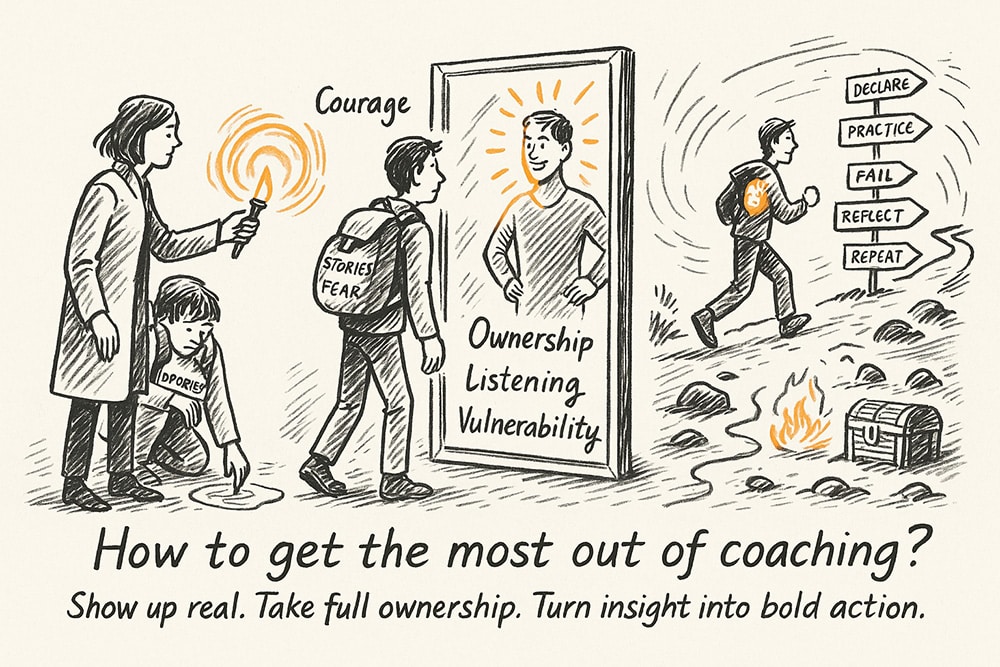
  • How to Get the Most Out of Coaching?

    Most people treat coaching like a spa day—a pleasant escape that temporarily feels good before returning to business as usual. But real transformation requires a fundamentally different approach.

    The Truth Nobody Wants to Hear

    Early in my coaching journey, my coach told me something that changed everything: “Nobody is coming to save you.”

    It felt brutal at first. But it was the best news I could receive—because it meant the power to change was entirely within me. The coach isn’t there to fix you; they’re there to challenge you and hold up a mirror to what you’re creating.

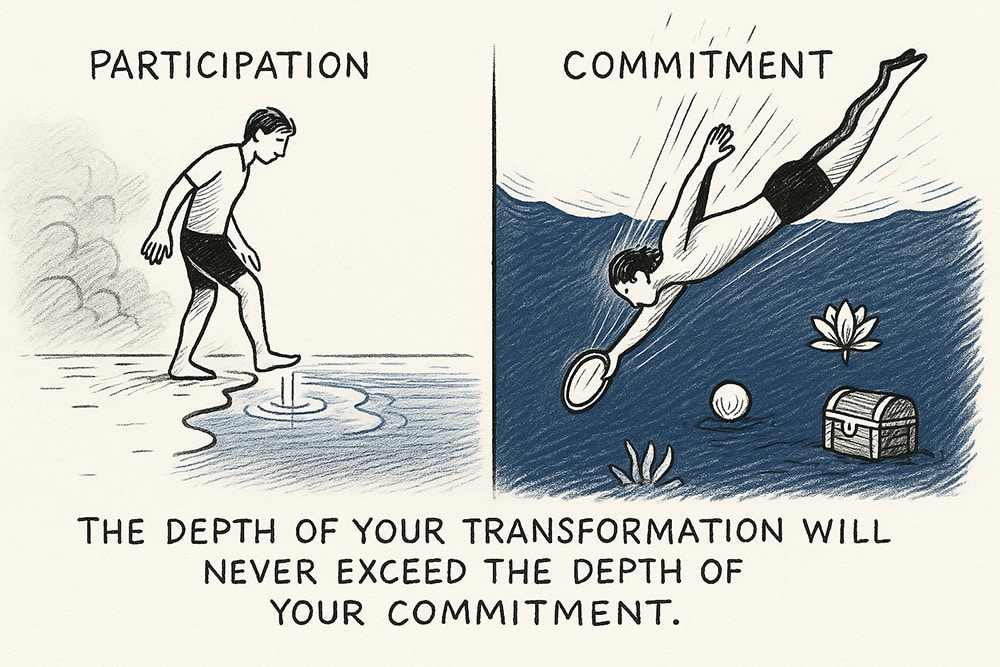
    The Difference Between Dabbling and Commitment

    Why Comfort Is the Enemy of Growth

    We’re naturally drawn to comfort—to situations, people, and environments that affirm our existing self-concept and behaviors. But this comfort, while pleasant, is fundamentally incompatible with transformation.

    Significant development happens not in your comfort zone but at its edge—where you feel stretched but not broken, challenged but not threatened.

    The most successful coaching clients understand this paradox: the discomfort they feel in coaching isn’t a sign that something’s wrong but that something’s working. They learn to distinguish between productive discomfort (which signals growth) and unproductive distress (which signals harm).

    The real value of coaching is in how you choose to listen, perceive, and act. It’s not in the coach’s wisdom, but in your commitment to growing as a leader.

    Research from Harvard Business Review confirms what I’ve seen in practice: when motivation comes from external sources—a coach’s directives, incentives, or threats—commitment to change is short-lived.

    True transformation only happens when you recognize that:

    1. You are already creating the results in your life and business, whether consciously or not
    2. The coach isn’t there to fix things but to illuminate what you’re creating
    3. The power to change your circumstances exists entirely within you

    The Courage to Be Uncomfortable

    Ultimately, getting the most from coaching requires the courage to be uncomfortable—to voluntarily step into the discomfort of growth rather than remaining in the familiarity of limitation.

    This courage isn’t about fearlessness. It’s about feeling the fear and moving forward anyway, trusting that the discomfort of growth serves your larger purpose and potential.

    Remember: The moments in coaching that feel most uncomfortable often hold the greatest potential for transformation. Your willingness to lean into productive discomfort—supported by appropriate safety—may be the single most important factor in what you gain from the coaching relationship.

    The Ultimate Mindset Shift

    The most powerful approach to coaching isn’t asking “What can my coach give me?” but rather “Who must I become to create the results I want?”

    This shift from getting to becoming is what separates those who use coaching as a temporary boost from those who experience genuine transformation.


    The Coachee’s Role: Owning the Process

    1. Own Your Results

    You’re already producing every result in your life and business—whether you realize it or not. The overwhelm, the revenue, the team dynamics—you’re creating all of it. Coaching simply brings this into conscious awareness so you can create something different.

    A founder I coached blamed demanding clients and market volatility for her stress. When asked, “How are you contributing to your own overwhelm?” she realized she was creating it by refusing to set boundaries. Taking ownership changed everything.

    2. Show Up Prepared

    Preparation determines 80% of your coaching outcomes. Before each session:

    • Identify what you’re avoiding: The conversation that makes you most uncomfortable often holds the greatest growth potential
    • Find the pattern: What keeps repeating despite different circumstances?
    • Raise the stakes: What’s the cost if nothing changes?
    • Bring hunger: Connect emotionally to why your growth matters

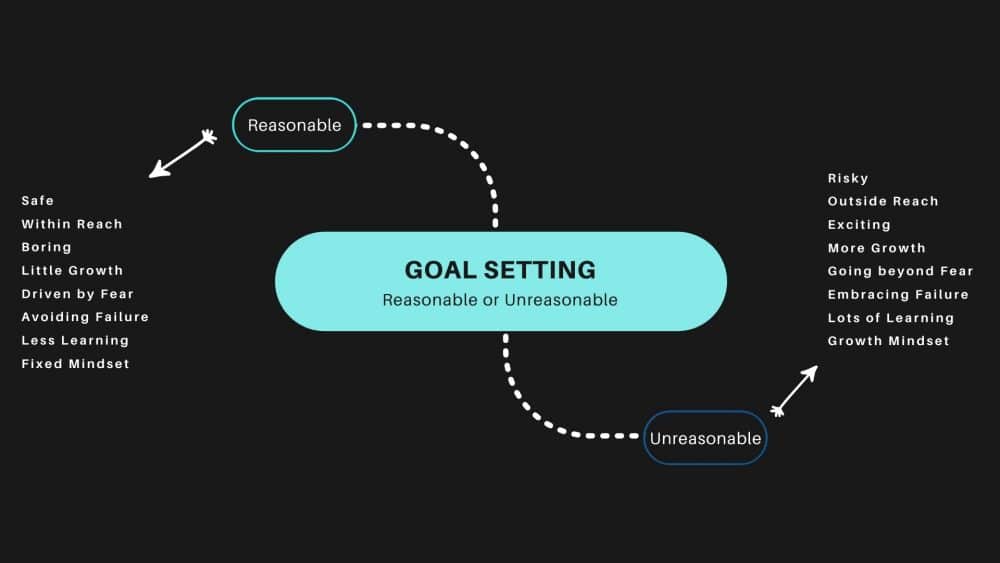
    3. Set Goals That Scare You

    Forget SMART goals. Transformational coaching requires TID goals:

    • Thrilling: Energizes you at a visceral level
    • Important: Serves something greater than yourself
    • Daunting: Requires you to grow beyond who you are today

    One client didn’t aim to “increase sales by 15%.” She committed to “becoming the kind of leader who builds a million-dollar business while working fewer hours.” That’s the difference.

    From Participation to Commitment

    Most people participate in coaching. Few commit to transformation. Here’s the difference:

    You’re just participating if you:

    • Reschedule sessions when work gets busy
    • Only implement comfortable suggestions
    • Want results without discomfort
    • Keep coaching insights separate from daily decisions

    You’re committed when you:

    • Treat coaching as non-negotiable
    • Embrace productive discomfort
    • Extend learning between sessions
    • Take action even when scared

    Let me give you an example: I was coaching a founder who wanted to grow his business from $5M to $10M in annual revenue. At first, he thought it was just a matter of getting better at sales and operations. But through our conversations, he realized that the real challenge was his own fear of stepping up as a leader. He was holding back on making bold decisions because he was afraid of failure and what others might think of him.

    Once he took ownership of that fear and realized that he was the one producing the results in his business, things changed. He started leading his team more decisively, took unimaginable risks, and his business started growing—not because of any specific tactic we discussed, but because he shifted how he saw himself as a leader.

    Why Preparation Determines 80% of Coaching Outcomes

    The quality of your coaching experience depends largely on what you bring to the table. Many people default to surface-level operational issues rather than addressing the deeper patterns that “run” you on autopilot.

    To identify your most valuable focus areas, ask yourself these questions during your preparation:

    1. What conversation am I avoiding? Often, the topic that makes you most uncomfortable holds the greatest potential for growth.
    2. Where am I feeling friction? Resistance, frustration, or recurring problems usually point to important development areas.
    3. What’s the problem beneath the problem? If you’re struggling with team performance, the real issue might be your difficulty with direct feedback. If you’re overwhelmed with work, the underlying challenge might be boundary-setting.
    4. What pattern keeps repeating? Look for situations where you keep getting similar results despite different circumstances.
    5. What would make the biggest difference? If you could change just one aspect of your leadership or business approach, what would create the most significant impact?

    A client who was struggling with work-life balance initially wanted to discuss time management techniques. During her preparation, she realized the real issue wasn’t scheduling but her inability to say no to new opportunities—stemming from a deeper fear of missing out. This insight completely shifted our focus and led to transformative work on her relationship with sufficiency and self-worth.

    Material Outcomes: Just Practice for Real Transformation

    Most people come to coaching with a desire for specific material outcomes: more revenue, a stronger team, a successful product launch. And while those goals are important, they’re not the real transformation.

    The real transformation is your growth as a leader. The material outcomes are just the practice field where you get to see how much you’ve grown. The true value of coaching is the awareness that you can create any outcome, once you fully step into your role as a leader.

    Take this story from one of my clients: He came into coaching wanting to double his company’s revenue. But by the end of our work together, he realized the real transformation was in his leadership. He saw that every decision, every result, was a reflection of how he showed up as a leader. Once he stepped into that, the revenue followed naturally. It wasn’t about hitting a number; it was about realizing that he had the power to create any result he wanted.

    The Power of Identity-Based Goals

    When you set goals that challenge your identity—not just your calendar or your tactics—you create the conditions for genuine transformation. You stop trying to become a slightly better version of your current self and start evolving into someone new.

    As one client who published her book and expanded internationally put it: “I realized I wasn’t just trying to write a book. I was becoming someone who expresses her truth boldly, who claims her expertise without apology, who serves through vulnerability rather than perfection. Once I understood that, the writing became the easy part.”

    Remember: The most powerful goals aren’t just about what you’ll achieve. They’re about who you’ll become in the process. And that’s where the true magic of coaching lies.


    Ultimately, commitment isn’t something that happens to you—it’s a choice you make repeatedly. Each time you face resistance, each time the path becomes difficult, you have a choice: to participate or to commit.

    The clients who experience the most profound transformations make this choice consciously. They decide that their development isn’t optional or conditional—it’s essential to who they are becoming.

    As one client who took a stand for herself for the first time and drew boundaries with her husband put it: “I realized I had been treating my growth like a hobby—something I did when it was convenient and comfortable. The breakthrough came when I decided it was non-negotiable, as essential as breathing. That’s when everything changed.”

    Remember: The depth of your transformation will never exceed the depth of your commitment. When you shift from participation to full commitment, you create the conditions for extraordinary change.

    The Power of Integrity: Saying What You Mean, Doing What You Say

    At the heart of transformation is integrity: saying what you mean and doing what you say. This isn’t about morality—it’s about power.

    When you consistently honor your word:

    • You develop unshakeable self-trust
    • You build momentum through kept promises
    • You clarify what truly matters
    • Your commitments become reality

    Track every promise you make—to yourself and others. Review them daily. When circumstances change, communicate proactively.

    read more on integrity

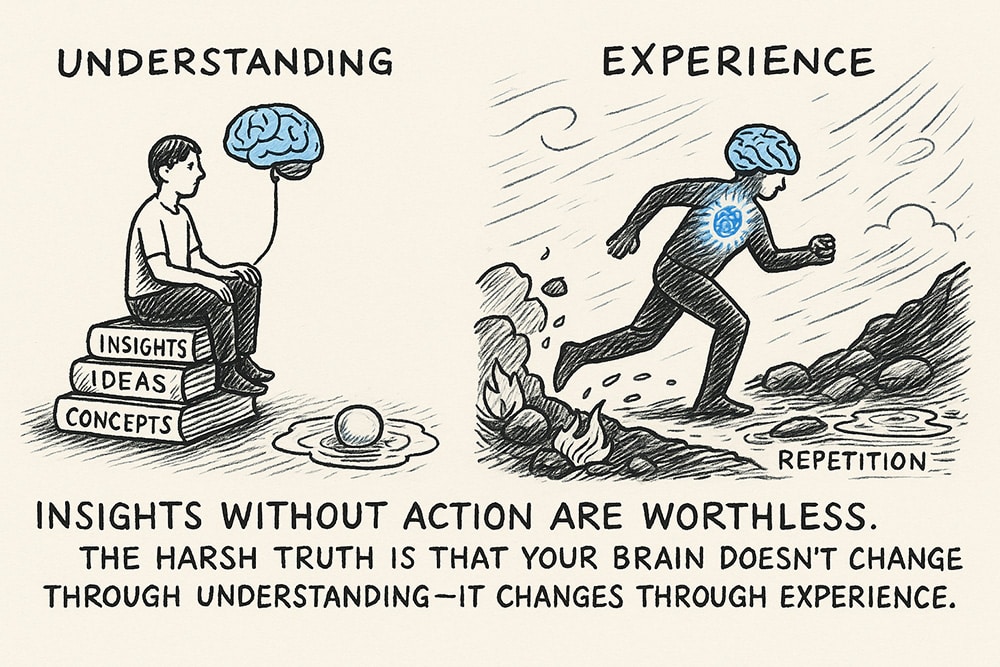
    Action Over Insight

    Insights without action are worthless. Your brain doesn’t change through understanding—it changes through experience.

    After each session:

    • Experiment boldly: Try new behaviors, even imperfectly
    • Reflect deeply: What did you do differently? What impact did you observe?
    • Document learning: Capture insights to solidify neural pathways
    • Share with your coach: Don’t wait until the next session

    One client reduced meeting time from 12 to 6 hours daily while doubling team productivity. The transformation wasn’t the metrics—it was who he became as a leader. The metrics just reflected that deeper change.

    Remember: The true measure of coaching effectiveness isn’t what happens during sessions but what happens between them. Your commitment to the action-reflection cycle is what transforms coaching from an interesting conversation into a catalyst for profound change.

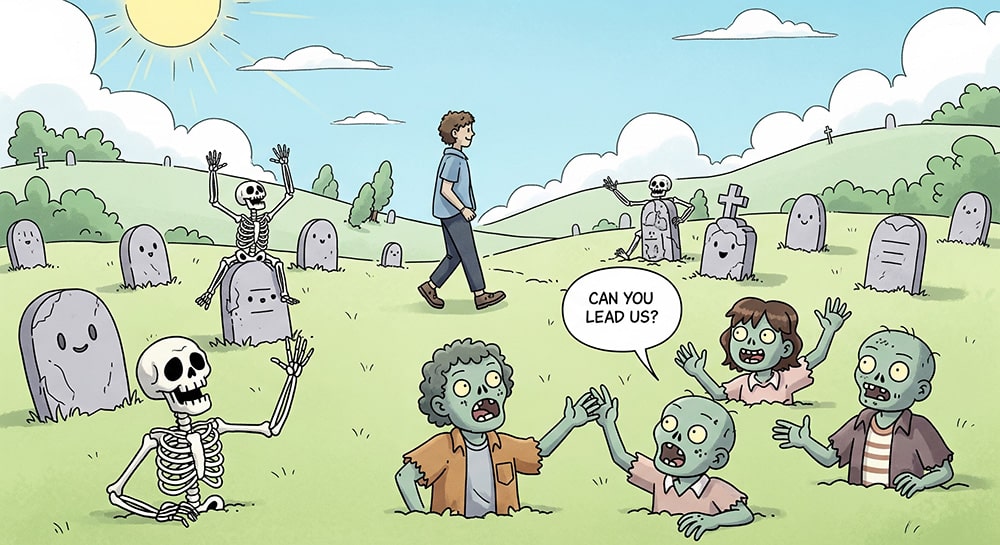
    An absurd and dramatic example

    Imagine this: You’re walking through a graveyard. Everything seems lifeless. But as you walk, dead bodies begin to rise out of the ground—one by one, they come to life and start asking to work with you, wanting your leadership and insight.

    It sounds absurd, right? Completely impossible.

    Yet, this is the exact metaphor I use to explain the power we have as leaders. We all have the ability to “create” something out of nothing by changing how we see ourselves and the world around us. Just as those “dead bodies” in the graveyard seem immobile, the challenges or situations in your business may appear stagnant or impossible to change. But when you realize that you are the source of change, you suddenly have the ability to transform the seemingly impossible into new opportunities.

    I know this is an overly dramatic example – but I want to make a point – results like the above are available for you from coaching.

    The Final Word: You’re the Creator

    Stop asking “What can my coach give me?”

    Start asking “Who must I become to create the results I want?

    This shift—from getting to becoming—separates temporary boosts from genuine transformation.

    The invitation: Will you show up to coaching not seeking improvement but committed to transformation? Will you bring your full self—challenges, aspirations, fears, power—to the process?

    If you do, there’s no limit to what you can create. Not because any coach will give you answers, but because you’ll discover your capacity to generate them yourself.

    Remember: The power to transform your business, leadership, and life is already within you. The coach simply helps you discover it.

  • How To See The World Differently – To Create New Possibilities, New Actions, and New Results

    Imagine this.

    You are moving teams within your company today. Today is the first day you meet your new colleagues, and they greet you warmly. You meet your new boss, and he asks about your well-being and informs you about the team and the wonderful work they do. He gives you space to settle in, provide all the help and support you need to do your job.

    When you do settle in, you find that you onboard quickly and are productive very soon. In fact, you feel much more comfortable in your body, much more open in your emotions, and much more productive in your work compared to your previous team. The nature of work has not changed, and your skill has not changed, so what allowed you to do much better work?

    If your answer is the culture of the new team, you are right but that is only one half of the story. The new environment allowed you to observe the world around you differently, which opened up a new set of actions that weren’t available to you earlier.

    “We see the world not as it is, but as we are”  Albert Einstein

    What Albert Einstein means by “as we are” here is our way of being in the world. Our body and associated physiology, our thoughts and language, and the emotions we are in currently define our “being” in any given moment. And it is from this way of being, which is unique for everyone, we observe one way or the other. This is the reason the same world (events) is seen differently by different people, allowing them a different set of actions.

    But have you ever stopped yourself to ask the below questions :-

    1. Why do I observe the world that I observe?
    2. Is the way I am interpreting this event grounded in facts and proper reasoning, or am I choosing this interpretation only because it is convenient to my ego and my identity?
    3. Is there another way of observing the same event? Is there a different perspective that would serve my needs and goals, instead of just serving my ego and primitive identity which is constantly seeking safety and comfort?

    Wearing Colored Glasses And Not Realising We Are Wearing Them

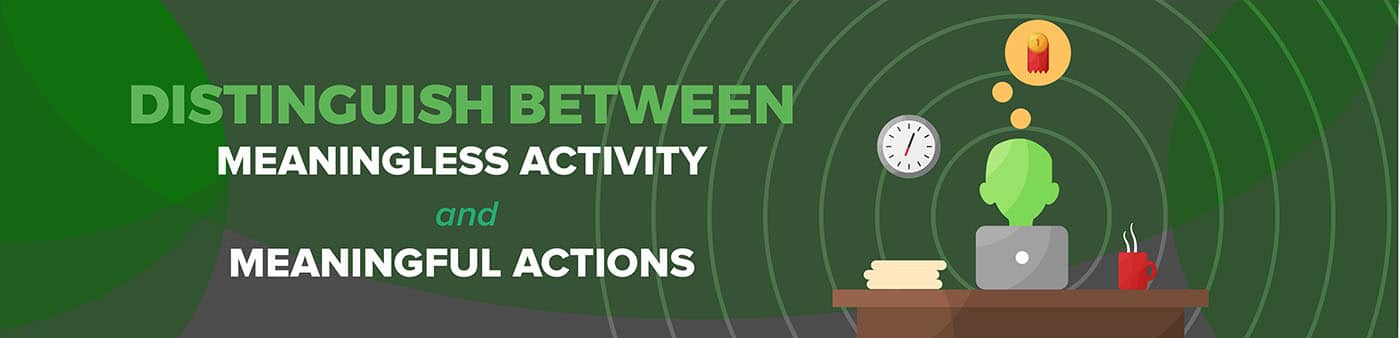
    What will happen if you are wearing dark glasses but forget that you are wearing them? The whole world would appear darker, wouldn’t it?
    What if you are wearing pink glasses instead? The whole world would appear pink, right?
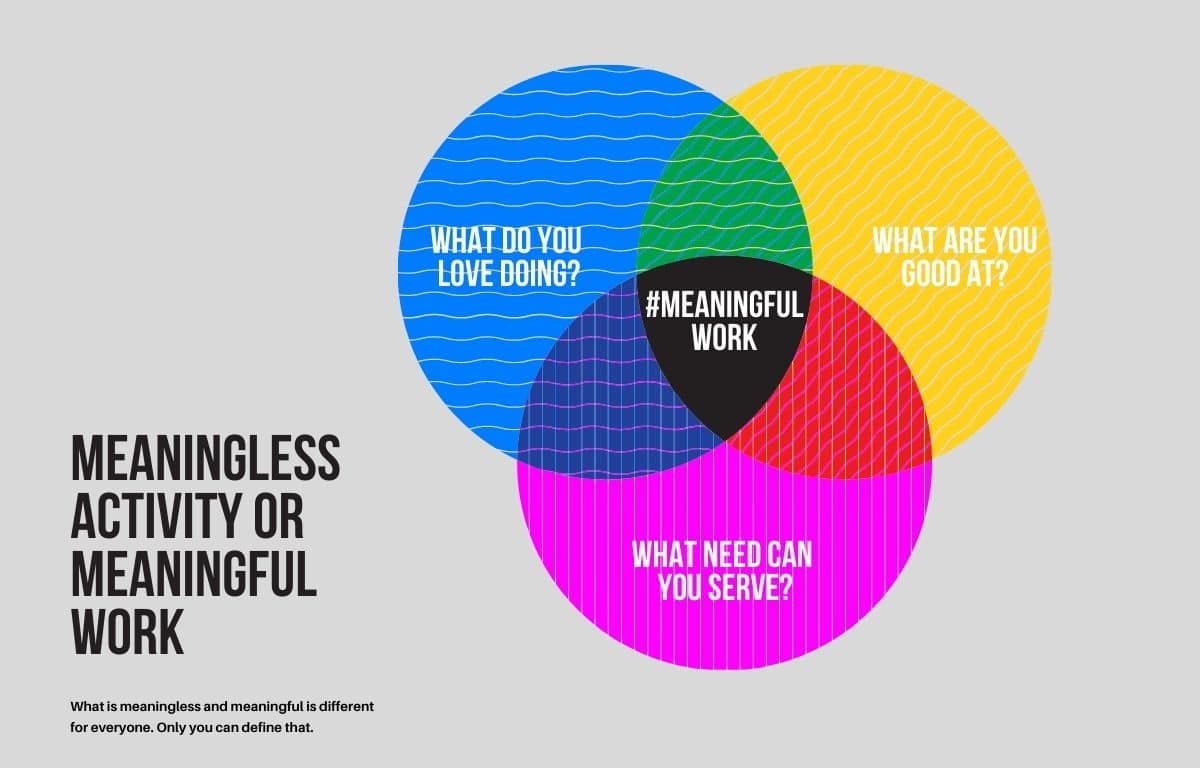
    And what will happen if the person wearing dark glasses and the one wearing pink ones start arguing about the color of things they see? They will argue endlessly about things being “their way” because they are both being different observers. They both would be right, and they both would be wrong at another level. If you can imagine this situation, it might look funny from the outside, but let me tell you that there is nothing funny about being trapped in such a situation.

    Who are the people wearing the pink and the dark glasses?

    They are not the people in your family, or your colleagues, or your friends. They are you, and they are me. I and you (all of us) are wearing our own versions of colored glasses, and we have no idea that we are wearing them. No wonder we are endlessly arguing about things. Now does it sound funny?

    “You never change things by fighting the existing reality.
    To change something, build a new model that makes the existing model obsolete.”
    ― Buckminster Fuller

    The O-A-R Model From Ontology

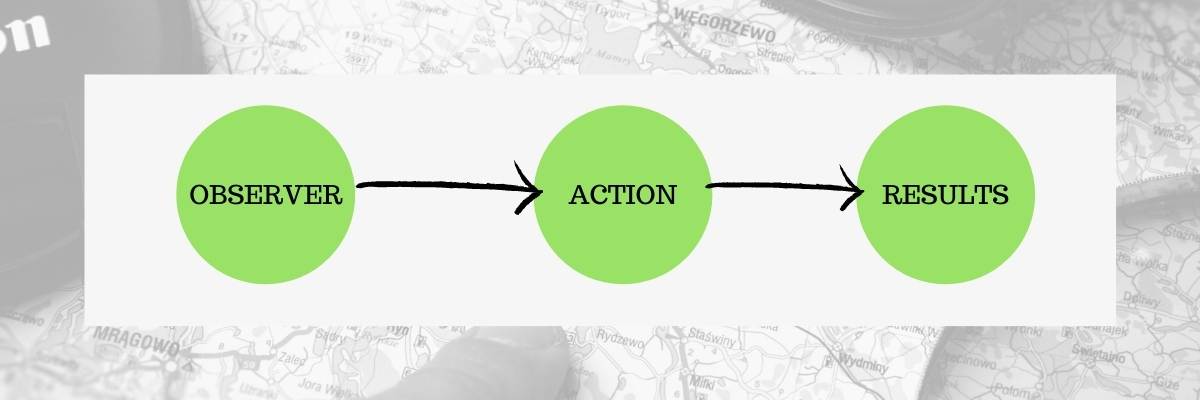
    What I have described above is called the Observer – Action – Results model, which I have learned in my Ontological studies. It is a very simple but powerful way to understand how we act in this world, in the pursuit of whatever results we want. As Chalmer Brothers write in his book “Language and the Pursuit of Happiness” –

    First Order Learning has to do with changing our actions (which of course include changing our speaking) for the purpose of producing new results. In some ways, First Order Learning represents our traditional approach to problem-solving. It implies that there is an objective problem “out there,” and in order to solve it we must take actions which are effective in producing some desired result. It has everything to do with cause and effect.

    Let’s explore the Observer portion of the model now. Many of us have been in situations similar to this: You find yourself struggling with a problem, trying to figure out what to do, and it appears you’ve run out of options. You’ve tried several alternatives, none of which seemed to work, and you just don’t see any more good possibilities left. At some point another person comes into the room, and in 5 minutes of conversation with you they offer a fresh new alternative, and you say “Oh, I didn’t see it that way!”

    Many of us have had this experience. We say that this occurs precisely because a new observer has appeared – someone with a different view, a different perspective, a different way of looking at something. Notice how all the metaphors here are visual metaphors – they have a great deal to do with the observer. They all point to a central claim of this model: Our results have a great deal to do with our actions or lack of actions. This is well-known. What’s less clear is that our actions themselves have a great deal to do with the observer that we are, with how we “see things”.

    Human perception is strange and unpredictable. We like to believe that the way we see the world is the way it is. But in fact, there is no reality, only perspectives. We are deeply affected by forces we don’t see or feel. Our parents, our language, our culture, and our beliefs all influence and create the world around us.

    For example – We (people who speak English) often refer to the future as forward and our past as backward. We use phrases such as “what’s coming ahead?” “next year”. We right things from left to right when we have to indicate a sequence of things.

    However, in Chinese Mandarin, time is denoted along a vertical time axis. The word xià (down) is used to talk about future events, so when referring to “next week” a Mandarin Chinese speaker would literally say “down week”. The word shàng (up) is used to talk about the past – so “last week” becomes “up one week”. Watch the video at the end of this article for more on how language shapes our reality.

    Others have seen what is and asked why. I have seen what could be and asked why not. – Pablo Picasso

    You Can’t Change What You Can’t See

    In first-order learning, we take our observations for granted and do not question the world we see. However, as we have seen, language, culture, emotions, our moods, and our bodily sensations are important factors that determine the world we see. We have rarely questioned these factors which determine the way we see the world, which in turn determines every action we take or do not take.

    Second-order learning does not focus directly on the actions we take, but on the observer that we are when we take those actions. In this way, second-order goes one level deeper and operates at a more abstract level than first-order learning. This opens new possibilities of action which weren’t available to us before as we a new world, or a different reality than before.

    The ontological interpretation of the observer that we are, or in other words, our being, is constituted by three inter-related areas of our existence – language, emotions, and body. Observing what is happening in our language, emotions, and body gives us a window into how we are “being“? And making changes in our language, emotions, and body are the tools we need to enable a new way of “being”.

    Our language, emotions, and body are the colored glasses we all wear and through which we view the world. We already read about the impact of language on our world above. Let’s consider emotions now. We are always in some emotional state or mood. And every time we interact with the world, new emotions are triggered based on our unique listening filters.

    And if we reflect a bit, we will realize that we all see very different worlds depending on whether we are in a good mood or a bad one. If we can learn to observe our emotions as they arise instead of getting sucked into their temptation, we can use second-order learning and become a more powerful observer of our being.

    If you are only seeing problems and not possibilities, maybe you are unaware that you are wearing “problem” glasses, and you need to replace them with “possibility” glasses. When we can change our glasses, or shift the observer that we are being, we can see a totally different world and a new set of actions to go along with it.

    I believe changing the way we look at things is a superpower that can produce transformational results. This ability to shift the way we see things is all the more important in the ever-changing and chaotic world we live in today. I will end this article with what Don Miguel Ruiz says in his book The Four Agreements.

    “We make the assumption that everyone sees life the way that we do. We assume that others think the way we think, feel the way we feel, judge the way we judge. This is the biggest assumption that humans make.”

    References

    https://theconversation.com/language-alters-our-experience-of-time-76761

    http://www.newfieldinstitute.com.au/html/articles_OCCT_008.html

  • 7 Key Reasons Why Asking Powerful Questions & Coaching Works Better Than Giving Advice

    We’ve all got an irresistible urge to offer advice. It’s a basic human instinct. We often switch to our expert, advice-giver, answer-it, solve-it, fix-it mode. A recent medical research study revealed doctors interrupt their patients with advice within 11 seconds. (Phillips, K.A., Ospina, N.S. & Montori, 2019)

    But why do we feel compelled to advise to be helpful? Is it because we can predict the other person’s future mistake? Or we assume our knowledge will fast track their success? Or maybe it’s our ego — a need to use their situation to flaunt our knowledge and self-importance.

    Coaching is a style of management characterized by asking questions, instead of the usual command and control style. You will find this article valuable if you manage people or have people coming to you for help often. I will share the 7 key differences between coaching (by asking questions) and giving advice, and why the former works better than the latter.

    “Answers are closed rooms, and questions are open doors that invite us in.” — Nancy Willard.

    7 Key Difference Between Coaching And Giving Advice

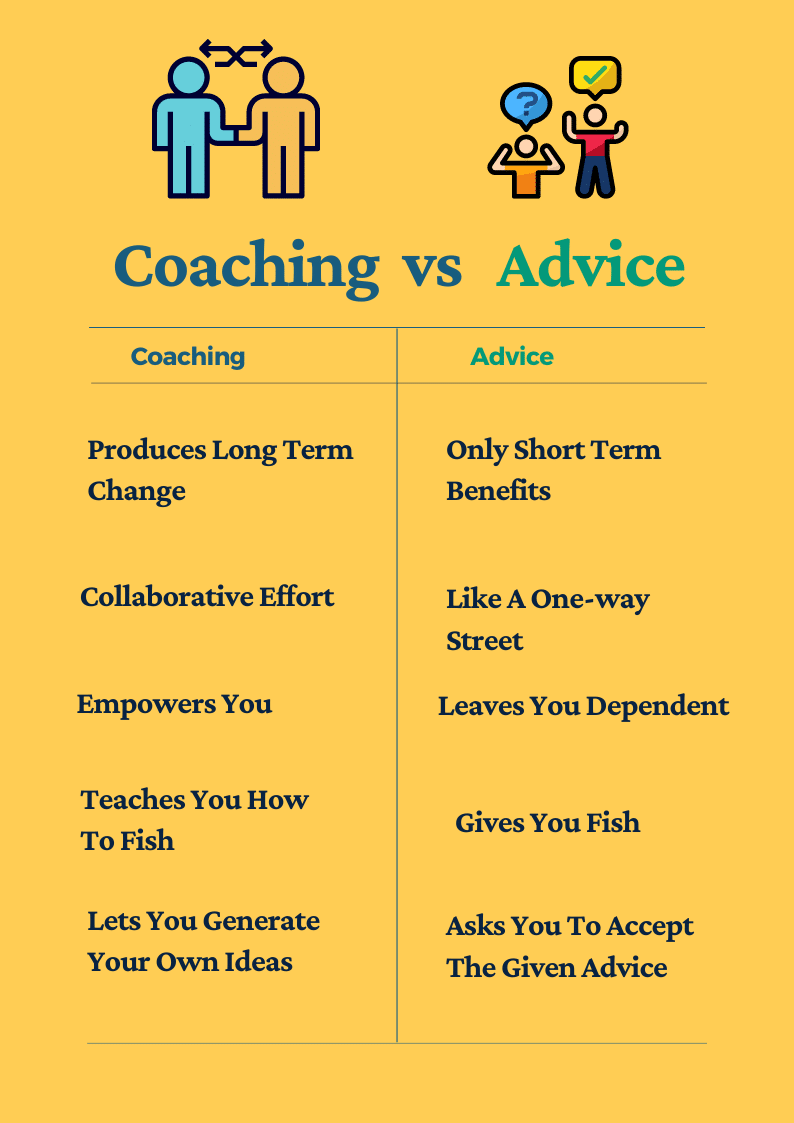
    1. Coaching Enables Long Term Behaviour Change. Advice Is Short Term

    Think of it this way. If a member of your team comes up to you for advice, would you prefer working with them so that they learn, improve, and grow or would you prefer to get it sorted out as soon as possible?

    Coaching not only solves the problem but also helps people grow. When you help people think things through, that leads to long-term behavior change. As a coach, you empower and help people build their own critical thinking and problem-solving skills.

    On the other hand, offering suggestions or sharing your advice will solve their current problem faster, but you limit their potential to think for themselves. Any gains that come from giving advice is only short-term, without any long term learning. The next time people face a problem, they will again need your advice.

    1. Advice Is a One-Way Street, While Coaching Is Cooperative

    Coaching is a mutual learning experience. It allows the person seeking help to dig deep into their own experience and begin to fit pieces of the puzzle for themselves. It is empowering for both the individual and the coach.

    In contrast, advice is a one-way street with you holding yourself as the “expert“. You may feel good about advising the employee and solving their issue, but nothing has changed in reality.

    As a coach myself, I often struggle to bite my tongue when I have the urge to dispense advice. I have realized that asking powerful questions is often a better way, and people often surprise you by coming up with better solutions than my “advice”.

    Coaching people has allowed me to learn so much from my coachees, while giving advice is always a one-way street.

    1. Advice Can Be Crippling, While Coaching Empowers

    It’s incredible what happens when you stop trying to be the “wellspring of knowledge” with all the answers. With advice, you are stifling people’s ability to arrive at their own solutions. 

    The truth is people already have the answers to their challenges within themselves. Your only task is to help them learn how to find theirs.

    Yes, advice has its place, but when we coach people by asking open-ended questions, we pull them forward towards their potential by letting them think for themselves.

    As a manager, you can see coaching as a tool to empower your people – helping you to take a hands-off approach.

    1. Coaching Is Teaching People How To Fish, Advice Is Giving Them Fish

    Many leaders give people “great” advice only to see them not take it and not make any changes. After all, no one likes to be told what to do. And there is hardly any ownership when you are following someone else’s advice.

    That is what differentiates coaching from advising. You ask simple, open-ended questions that draw out thoughtful responses. People are more motivated as it is their own idea, and they’re accountable to themselves.

    1. Coaching Lets People Think Big and Generate New Ideas. Advice Is Asking People to Accept Your Idea

    The role of the coach is to help the coachee think without any shackles and decide for themselves what to do. Far too many people have an obsession with dishing out advice on anyone who will listen.

    Advice stifles creativity and doesn’t create an opportunity for that person to think. Good coaches motivate their employees and encourage critical thinking and problem-solving. You will be surprised when people show resourcefulness and come up with big ideas on their own.

    1. Coaching starts with being curious and asking powerful questions. Advice leaves little room for brainstorming and dialogue.

    At this very moment, people are solving unnecessary problems in their organizations. It is because leaders haven’t stayed curious enough to pull back the curtain on the real issues.  That is why asking questions is more powerful than giving advice.

    Coaching creates space to reach the heart of the issue. People often have the answers to their problems. Most times, what they’re looking for is a sounding board and a keen listener.

    But when you advise people, you don’t expand their awareness. The advice trap makes it impossible for them to discover innovative solutions.

    1. Coaching shows humility, empathy, and respect. Advice gives a feeling of arrogance, indifference, and separation.

    As humans, we have a strong reflex against being told what to do. It takes away our independence. We have a strong impulse for self-control and freedom.

    So when we tell a person what they need to do, we wear the coat of authority, “I know what is best for you.” It is a poor move for a leader. When you push people, they will push back.

    Sometimes, advice does the exact opposite of what you intend for it to do: damage relationships and push the person further away from a solution. Your advice will have zero worth if it doesn’t show respect and empathy for people to independently figure out things.

    Coaching creates a space for people to express their feelings and validate their ideas. It says to them: I see you, I hear you, and I value you.  

    How To Ask Powerful Questions

    The one critical skill in coaching is asking powerful questions. It is at the heart of any good coaching session. It creates authenticity in the relationship and also inspires confidence.

    Below are 5 principles to follow when asking powerful questions:

    1. Ask open-ended questions. Don’t ask questions that have one-word answers.

    The way you pose questions is very important. Don’t ask questions people can answer with a yes, no, or other one-word response.

    Ask questions that make people pause and think, and probe deeper. Some of my favorite questions start with “How so?”, “Tell me more about …”, and “Why is that important to you?”

    These types of questions are uncomfortable because they break down defenses and challenge people to think differently and see things from fresh perspectives. For example – How do you hope to personally and professionally benefit from working on this project?

    1. Be curious. Ask one question at a time. Then shut up and listen. Get comfortable with silence.

    Silence is uncomfortable and awkward. Nobody likes those pauses in conversations. We often feel a need to fill up the void, but that moment of silence encourages people to think for themselves.

    You need to learn to shut up and be genuinely curious when your coachee is thinking something through. Imagine this scenario: You’re coaching an employee. She starts to think about taking on a new initiative, and there’s a short back and forth. 

    Then there is silence while she reflects. It is at this stage you need to hold off since she’s weighing options. Whatever she says next is going to be important and useful to her. 

    1. Don’t ask leading questions 

    Leading questions invite a yes or no. Lawyers use these types of questions during cross-examination to manipulate the conversation towards a certain way. For instance, “Do you feel Bill bullies you?” is a leading question while “How would you describe Bill’s behavior towards you?” is not.

    Don’t assume for other people, or put words in their mouths by asking leading questions. Your questions should get your coachees to do most of the talking and thinking. People need space, time, and acceptance to feel heard and then think their way through their fears, difficulties, and challenges.

    1. Ask deep and meaningful questions that make people think 

    The art of questioning is a powerful tool in coaching and leading others. Powerful questions change the way you connect with people. These questions give your employees time to think about what is really important to them.

    We have well-rehearsed and scripted answers for the usual questions. Powerful Questions makes one think and come up with original answers. If a question makes you think about your life, priorities, values, etc, it is a powerful question.

    They don’t linger on the surface where there is emotional safety. Instead, powerful questions force you to be vulnerable. It requires some courage to face the discomfort of answering a Powerful Question.

    They take longer to answer, but they often end up revealing something important about yourself which you were not aware of before. For example – What is “on hold” in your life? What is that you want to do someday / one day? What are you waiting for?

    1. Don’t assume. Instead, challenge yours and others’ assumptions by asking, “What are we assuming in this situation”?

    Our assumptions often sabotage many well-meaning intentions. Here is what I mean. When assumptions appear in your mind, you may tend to rush to conclusions and make a poor judgment. You need to recognize this immediately and stop. 

    Instead, be curious. Ask yourself and the person you’re coaching about what you don’t know. Let people know when you make an assumption. Doing this will trigger both self-awareness and clarity for everyone involved. 

    Conclusion

    Remember that coaching is not about you – but about the employee. When an employee asks for your help, they often need the time and space to think it through. Coaching aims for development first, performance second. Though, over the long-term coaching leads to more sustained performance too.

    A good coach empowers their coachees to be more confident and solve their own problems in an empathetic way. 

    References

    1. Phillips, K.A., Ospina, N.S. & Montori, V.M. Physicians Interrupting Patients. J GEN INTERN MED 34, 1965 (2019). https://doi.org/10.1007/s11606-019-05247-5
    2. https://hbr.org/2014/12/the-questions-good-coaches-ask
    3. https://www.forbes.com/sites/forbescoachescouncil/2018/11/21/coaching-isnt-just-questions/#67eaff8447a1
    4. https://www.deployyourself.com/deploy-yourself/asking-powerful-questions-51-different-situations/
  • 5 Simple (But Not Easy) Steps Every Manager Can Take To Improve Work Culture

    If you are lucky enough to be someone’s employer, then you have a moral obligation to make sure people do look forward to coming to work in the morning. – John Mackey

    I have been leading teams for 12 years in companies such as Yahoo, Booking.com, etc in India and Europe. When I look over the last 12 years, I get a smile on my face on recalling how foolish I was to think that I had it all figured out. I used to believe management and leadership is only common sense, and that I do not need any special training or knowledge for it.

    Today, while I still believe that leadership is a lot of common sense, but I couldn’t be more wrong about how easy or hard would be. As it is said, the one thing about common sense is that it is not so common. One of my biggest learnings about leadership is that while the concepts behind it are simple and age-old, they are not easy to actually implement in real life. What I found is that even with all the leadership knowledge, these skills can desert you when you need it the most.

    What I learned is that human psychology and our evolution driven behavior patterns are hard to undo. Our ego, various cognitive biases, and our desire to look good in front of others can fool us easily. These very human traits can make us behave in ways that are diagonally opposite to our deepest held beliefs and values.

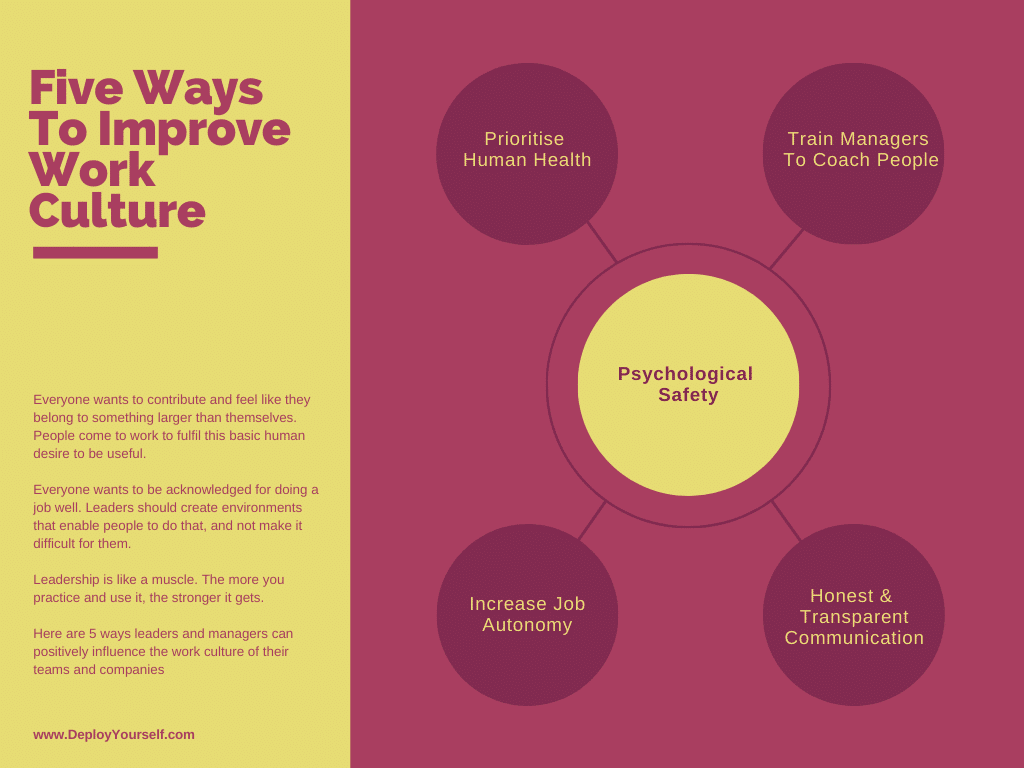
    Leadership is like a muscle. The more you practice and use it, the stronger it gets. Without practice, all the leadership knowledge is only as useful as the knowledge of nutrition while we keep on eating fast food. Below are 5 ways leaders and managers can positively influence the work culture of their teams and companies:-

    1. Make Human Health A Priority

    Good management starts with taking “care” of your people. As managers, we should all ask ourselves – how well do we know our people? Do we know what they “care” about? And then we should make it a priority to take care of what they care about. If we know that, we can match work projects and assignments to employees better. This leads to motivation, growth, and success for both the company and the employee.

    Managers should actively discourage bad practices like working late and on weekends, and encourage people to focus on their health by providing and promoting adequate health insurance, healthy food, and sports facilities – whether inside or outside the physical space of organizations.

    “Customers will never love a company until the employees love it first.” – Simon Sinek

    2. Create Psychological Safety

    No productive work is possible if people don’t feel safe at work. If you have to put a mask at work and are not free to say what you feel, it creates a lot of friction and stress. Thus creating an environment of psychological safety is very important for any manager. Your biggest job is to create an environment of respect and accountability, where people have fun and express themselves freely by continuously moving forward towards the team’s goals.

    3. Train Managers to Coach People

    If you are a manager, you are a coach by default. You don’t have a choice in being their coach as people will approach you anyways. When they are demotivated, when they have a conflict, or when they need help for any other reason; it is your responsibility to listen, understand their concerns, and then coach them to align their personal motivations with the team’s shared purpose and goals.

    How well you coach people will be directly proportional to the results the team produces. Investing in learning these skills and making coaching a priority can be your best investment ever.

    4. Increase Job Autonomy

    Nobody likes to be told what to do. Nobody likes to be micromanaged. We hire people after extensive interviews which test them on their skills. I think we disrespect the same skills when we don’t listen to them.

    As managers, it is important to give people a say in how they want to work. Once people have everything they need to do their job, managers should get out of their way and not stand over their shoulders.

    5. Honest and Transparent Communication

    Finally, we should treat our employees like adults. We should be honest and share what is going on in the company – even if it means sharing bad news. This builds trust and makes it more likely that people will stand by you in times of adversity.

    Leaders should stop using complicated language or hiding behind jargon. Share documents openly. Let people ask anything about everything. Transparent communication involves people in problem-solving and they see the team’s or the company’s problems as their own. And, you never know where a good solution to your biggest challenges might come from.

    Employees who believe that management is concerned about them as a whole person — not just an employee — are more productive, more satisfied, more fulfilled. Satisfied employees mean satisfied customers, which leads to profitability. — Anne M. Mulcahy

    Everyone wants to contribute and feel like they belong to a company. People come to work to fulfill this basic human desire to be useful. Everyone wants to be acknowledged for doing a job well. Leaders should create environments that enable people to do that, and not make it difficult for them.

    References

    1. https://rework.withgoogle.com/guides/understanding-team-effectiveness/steps/foster-psychological-safety/
    2. https://www.researchgate.net/publication/335690856_Work_Engagement_Trust_and_Respect_to_Engage_your_People
    3. https://hbr.org/2018/11/if-your-employees-arent-speaking-up-blame-company-culture
    4. https://www.researchgate.net/publication/255625175_Putting_People_First_for_Organizational_Success
    5. https://www.worldcat.org/title/which-comes-first-organizational-culture-or-performance-a-longitudinal-study-of-causal-priority-with-automobile-dealerships/oclc/5811616905&referer=brief_results
  • Why True Joy and Real Happiness Doesn’t Come from Winning But From A Dignified Struggle?

    Winning and Losing Is Everywhere

    Most of us grow up in this world in a culture where the idea of winning and losing is omnipresent. Movies often celebrate the victory of the good over the evil. We cheer for our teams in sports when they win. We strive to get better grades in school and outsmart each other. We aim to get admitted to the best universities and find jobs in the best companies to one-up our peers.

    Add to this the constant stream of news and media which only seems to focus on big wins or failure. No wonder most of us grow up believing that winning is what we should aim for, and that is what will give us true joy and happiness.

    We are so obsessed with winning that we try to see everything in our lives as a game that we have to win. So our career becomes a game, which restaurant we go to dinner becomes a game, which schools our kids go to becomes a game, how big a house to buy becomes a game, and so on.

    We take great pleasure and stoke our egos whenever we outsmart our peers in such “games” of everyday life. Winning in friends and family circles could mean having the latest gadgets, drinking the most beers, or some other weird definition of a “game“. But no matter how you see it, winning and losing is everywhere.

    True Joy Doesn’t Come from Winning But From A Dignified Struggle
    True Joy Doesn’t Come from Winning But From A Dignified Struggle

    How Much Can You Win Anyways? And Is It All Worth It?

    Winning is rare though because if everyone is playing games in different areas of life, there can be only so many winners. And even for those who “win” the big games of life, happiness often remains elusive. I have seen people win big in sports, career, or friends and yet end up feeling empty, meaningless, and drained.

    Have you ever felt something similar? Like you feel nothing after you get what you have been working towards all this while. If I reflect on my life I can certainly see some such empty victories. Acing an exam in my high school, nailing a job interview, getting promoted ahead of others, buying a house, finishing many an important work project are some which come to mind. Even though I might have celebrated after each of these “victories“, it never led to long term happiness or joy.

    What Causes Real Joy and Satisfaction?

    Yet there are moments in my life when I have felt true joy and a deep sense of satisfaction, irrespective of whether I have found victory in the end or not. There have been moments when I have felt completely exhausted and confused, and yet, felt surprisingly alive and content. For example – the 2.5 years I spent working on my startup SaleRaja was immensely satisfying despite it not being a commercial success. Similarly, I still remember the hard work I did during the first few years of my working career in 99acres as immensely joyful despite there being a mix of failures and successes.

    In the last 5 years, I have spent countless hours roaming the streets of Amsterdam photographing the city without any intention of achieving an objective or a goal. These long hours of walking have given me tremendous joy and satisfaction as I learned a lot, despite it being physically painful on many occasions. I will never forget the 2 hours I walked in Amsterdam in -8 degree Celcius weather in Feb 2018. Despite the tremendous discomfort of the bone-chilling cold, I still look at the photos I took that day with pride and joy.

    “The harder the conflict, the more glorious the triumph. What we obtain too cheap, we esteem too lightly; it is dearness only that gives everything its value. I love the man that can smile in trouble, that can gather strength from distress and grow.”

    ― Thomas Paine

    If Winning Doesn’t Make You Happy, Then What Does?

    Over the years, I have realized that it is never just winning that makes us happy. It is always overcoming obstacles while going through a period of struggle or discomfort which leaves us feeling joyful and satisfied. Research has also shown that we are at our most blissful state when we are up against a difficult challenge.

    When we push our boundaries and focus completely on learning from setbacks encountered, we get into a state of “flow“. Being in this state enhances our ability to focus, and is characterized by the release of dopamine and norepinephrine. In other words, we enjoy the most when we are swept away and lose track of time while working on a hard challenge.

    If you reflect back on your life and think of moments where you grew dramatically, either in one specific skill or as a person, you will recognize that the growth came out of a situation where you overcame something challenging. It would be a period where you got a bit roughed up and took a few blows, but yet persisted and eventually made it through.

    And when you came out on the other side, you were a different / better person. You grew not just in your abilities or skills, but also in your confidence and wisdom. If you have had such an experience you know what living to its fullest really means.

    Success comes from knowing that you did your best to become the best that you are capable of becoming - John Wooden

    It’s Not What You Get. It’s What You Become

    I must add that the joy or the bliss of the state of flow comes not from the challenge of winning, but from the challenge of doing what is hard but at the same time worthwhile. So stop tackling challenges that are too easy. Pick up a project or a game which you are excited about, and one which will be challenging for you. Then work hard and push yourself to the limits of your abilities.

    You might feel frustrated, tired, and confused at times, and yet you will notice being completely alive. The end result is immaterial to this joy I am talking about. It is more about playing and loving the process that brings us joy.

    The best outcome of success when you go through a dignified struggle is never what you get out of it. The best outcome of going through such a challenge is what you become out of it. The medal, the bonus, and the adrenaline rush at the podium often go away in a fleeting moment. But your enhanced skills, abilities, and confidence will stay with you for the rest of your lives. And not just that, it will get compounded as you play more big games in the future.

    “This is the true joy in life, the being used for a purpose recognized by yourself as a mighty one; the being thoroughly worn out before you are thrown on the scrap heap; the being a force of Nature instead of a feverish selfish little clod of ailments and grievances complaining that the world will not devote itself to making you happy.”

    ― George Bernard Shaw

    This is Why We Admire The Underdogs

    Going after a hard but meaningful goal, even with struggles on the way, is the reason we admire people who have gone through difficult challenges and overcome them in their personal or professional lives. It is the reason we rejoice when we see our favorite player or team come from behind and win a game. It is the reason we root for those who get knocks on their flesh and bones in sports and still carry on.

    It is the reason we remember those players who have had short careers but were full of challenges and who came out bruised on the other side. It is the reason we cheer and cry for firefighters and police officers who die on the job rescuing or saving someone else.

    So What Can You Do?

    If you are playing too safe or lacking meaning and joy in your life, you know what to do. Your big game is out there waiting for you. You just need to embrace the challenge and go after a problem that would be worth dedicating your time and effort. It might not be easy, it might even be scary and challenging, but the process of overcoming those challenges is exactly what will make it worthwhile and leave you with true joy and fascination. It is never too late to start playing.

    I will end with a question.

    What in your life is “on hold”? What have you been waiting for?


  • 5 Unconscious Ways We Limit Our Own Freedom

    I still remember that morning of excitement. It was supposed to an relaxing long drive in my new car, but I had no idea how the day would turn up. As I started the engine and pushed down on the accelerator, I got busy admiring the posh interiors and the sophisticated dashboard of my car. As soon as I got on the highway, I turned on the cruise control mode so that the car can drive itself while I was free to admire the views of the snow-capped mountains ahead.

    Over 20 odd kilometers away, I felt something was off. So I decided to take back control from the cruise control and accelerate. But to my surprise, I felt a lack of power. I pushed on the accelerator and didn’t get the speed I expected from my brand new car. I continued to struggle in disbelief to get some power for the next 50 kilometers when I smelled a burning odor.

    “Damn”, I said as I started to look for the … yes .. the hand brake. There it was, and as I grabbed and released the brake, I felt that power which had eluded me so far. But by then the smelling odor (from the brake pads) was strong enough that I decided to turn back and head to the mechanic. In the end, my car’s brakes needed replacement and ended up costing me a good amount. My thoughts then moved from my new car’s brilliance to my lack of it.

    Are you living your life with your hand-brakes on without realizing it? Are you struggling to get the power in your life which you know you can? Do you wonder why your life looks so constrained and limited in this age of freedom and abundance?

    “Let go of certainty. The opposite isn’t uncertainty. It’s openness, curiosity, and a willingness to embrace paradox, rather than choose upsides. The ultimate challenge is to accept ourselves exactly as we are, but never stop trying to learn and grow.”  ― Tony Schwartz

    In this article, I will share how freedom is a state of mind, and the many ways we unconsciously restrict it. Freedom is not something to be given by others. People are as free as they want to be. However, it is very easy to be un-free, and most of the time we do not even realize that we are limiting our own freedom.

    As Daniel Kahneman points out in the book “Thinking, Fast and Slow” our fast and unconscious thinking brain helps us survive by making quick decisions. It is then a paradox that the same part of our brain limits our freedom in so many ways before we can consciously intervene and make our own choices. Conscious thinking and reasoning is very tiring for our brains, and hence most of our decisions are made unconsciously or in our brain’s autopilot mode.

    You Are As Free As You Want To Be
    You Are As Free As You Want To Be

    Our unconscious mind control far more of our decision making than we can imagine. Let’s find out 5 unconscious ways in which we limit our own freedom :

    1.  We are not clear about what we want, and just continue to go by what we see in the world or what society expects from us. We have never taken the time to define what “freedom” really means and the kind of life we would like to have for ourselves. We never sit down to think consciously of what our “ideal” life would look like. We never set our own boundaries and rules, and unconsciously accept what is the “norm” around us. We let the attachment to a certain way of life, and a desire for money and possessions come in the way of defining our own ideal definition of life and success.

    “We live in an age when unnecessary things are our only necessities.”  ― Oscar Wilde

    2. We are unaware of our own limiting beliefs. The language that we use and the thoughts that we think has a huge impact on how we show up in life. What do you believe and communicate about your abilities and the kind of life you want? Are those abilities good to create the kind of life you really want?

    3. We don’t execute our plans. We get lost in the details or get used to mediocrity. We allow procrastination to come in the way and accept the reasons of our circumstances and obligations. We don’t hold ourselves accountable for what we said we will do. We will always have reasons why we can’t do anything. Our unconscious mind presents us with these reasons to keep us safe and to ensure our survival. But it is up to us to believe these reasons as truth and stop moving ahead, or consciously find ways around these reasons to reach our destination.

    4. We don’t aim big enough. We settle for too low. And then we blame ourselves for achieving less than what we know deep inside we are capable of. We play small as everyone around us is doing the same. Playing small is easy as we don’t get unwanted attention and questions. Unless we consciously aim for what really makes us feel alive, we will never know what we are capable of. We deprive the world of our full self-expression and what we can achieve if we were to play the game of life with complete freedom. The psychologist Abraham Maslow called this the Jonah complex – “… the “fear of one’s own greatness” or the “evasion of one’s destiny” or the “running away from one’s own best talents.”

    “Our deepest fear is not that we’re inadequate, Our deepest fear is that we’re powerful beyond measure. It is our light, not our darkness, that most frighten us. But our playing small doesn’t serve the world. There’s nothing enlightened about shrinking so that other people won’t feel insecure around you.” – Marianne Williamson

    5. We don’t ask for help when we need to. We keep our true desires, challenges, and ambitions inside us because we have no idea how to realize them. We are too scared to show the world our brilliance because it might invite unconscious reactions of hate, envy, and humor. So we take our own unconscious decision to fit when what we really ought to do is to stand out. We think that we are all alone and never look for the right mentor or coach who can guide us and help us along the way.

    We Limit Our Own Freedom Unconsciously
    We Limit Our Own Freedom Unconsciously

    Conclusion

    Your unconscious and limiting beliefs stop yourself “to be” in the world. It is not “you” if you are not free. You might be breathing but you are not living. If you allow your unconscious mind to limit your choices in life, you will endlessly worry without finding out if you are on the right path or not. Being scared or feeling anxious about our deep desires is normal (from both the psychological and neuroscience point of view), but the real opportunity and power lie beyond them. And the amount of unconscious resistance you face from within can give you a measure of the real potential you have kept locked inside and which is waiting to be unleashed.

    Go ahead and give yourself full permission to acknowledge your own unique gifts. Give yourself the freedom to play, laugh, and fully express yourself without any fear or apprehensions. Act in a way that allows your own unique light to shine upon the world, instead of following the path others have decided for you.

    Resources

    1. https://www.psychologytoday.com/us/blog/passion/201903/why-we-play-small
    2. https://www.brainpickings.org/2018/04/17/erich-fromm-escape-from-freedom/
  • 5 Research Backed Reasons Taking Regular Breaks Can Help You Get More Done

    If you have a lot to do, take regular breaks. Find out about the counterintuitive advice of taking breaks to get more done.

    Are you surging ahead in life? Is your life becoming too fast for comfort? Why not take a break?

    What did I just say?

    Do you think you have a lot more to achieve and you just can’t afford to take breaks? Does this sound like your life?

    If this looks like your life, you are not alone. Many people find it difficult to switch off from their daily activities. They feel so busy achieving their goals and targets that they do not have time to have a break.

    I am afraid they are grossly mistaken. Research has shown that a break can do wonders to increase your efficiency and productivity. Breaks have a direct and positive relationship with productivity as well as well-being.

    In this article, I will share the 5 benefits of taking regular breaks and 5 ways to take them.

    Understand Science Based Facts About Emotions and Ease Your Shoulders of Their Burden
    Too Much To Do, Take a Break?

    .

    Benefits of Taking Regular Breaks

    .

    1. Helps Our Brain To Focus Better

    Research shows that regular breaks help us to focus; thereby, allowing us to process information in a better way.

    Our brains get tired after continuous work, and taking regular breaks helps our brains to relax. Our brain demands time to rest, regroup, and gather its thoughts. We are then able to focus better when we resume work.

    For example – you do yourself more harm than good if you skip your lunch when you are in the middle of work that demands intense focus. It’s just like how an athlete allows his body to rest after an intense training session.

    2. Helps To Generate New And Creative Ideas

    Research has shown that when we take a break, our brain doesn’t just stop functioning. Instead, it is busy digesting different ideas and making connections between them.

    Have you ever solved a problem, or got a new idea while taking a shower or another non-cognitive activity? That is because our brains make sense of our experiences when it gets a break.

    A brain at rest doesn’t mean an idle brain, and that is why we often get new and creative ideas during a break.

    3. Healthy For Our Mind Snd Body

    Today’s fast-paced work culture takes a heavy toll on our mind and body. Work is the most prominent source of stress and we often run the risk of burnout, without even realizing it.

    Constantly working and not moving much puts us at a higher risk of several diseases like heart ailment, diabetes, and depression. Taking regular breaks to move around can lead to increased energy levels and improved health.

    It also decreases exhaustion by returning our psychical and mental systems to their base levels. Besides, a relaxing break helps a great deal to reset our mood. Thus it reduces stress and promotes our wellbeing.

    “All that is important comes in quietness and waiting.” ― Patrick Lindsay

    4. Helps Us Make Better Decisions

    A well-deserved break allows you to have a good look at the bigger picture and make better decisions. When you are too engrossed in a complex task and your brain gets tired, you are easily distracted from what is important, and you tend to procrastinate. In a state of busyness and overwhelm, you also tend to make poorer decisions.

    When you take a break, you give yourself a chance to reflect on your priorities and goals. Your motivation goes up and you can assess whether you are giving due importance to the right tasks/projects. This will help you make better decisions.

    5. Help Us Do More And Be More Productive in the Long Run

    All of us want to be more productive at work, right? Research proves that taking breaks refreshes our brains, re-energizes us, and improves engagement levels.

    All of the above directly lead to higher productivity over the long term. You might think you can do more in a long day, but you can’t sustain that pace without risking burnout or other health issues. Taking regular breaks and reducing your work hours will make you more likely to sustain that pace for the long term.

    Taking A Break Beside a Canal in Amsterdam
    The Canals in Amsterdam Are My Favorite Location To Take A Small Break

    .

    How To Take Breaks?

    .

    As we have seen, taking small breaks regularly can be of immense value to your health and productivity. Now let’s take a look at 5 different ways we can do that despite our busyness:-

    1. Take a Walk in Nature

    Take a stroll amidst nature. One recent study has shown that it is a wonderful remedy to calm your mind. They call it a “nature pill”.

    By nature, any green area would do – a small park in your neighborhood, or if you have a water body (river, lake) nearby. Personally, I love walking in Amsterdam because the presence of water eases off any stress I might have.

    2. Pomodoro Technique

    This is a method of time management developed in the ‘80s. It breaks down work into time intervals (usually 25 minutes), separated by a short break of 5 minutes. These intervals are called Pomodoros. One can extend the break duration to 15 or 20 minutes after about 4-5 Pomodoros.

    You can give it a try. You may download any Pomodoro timer app on your smartphone and split your workday into short bursts of Pomodoros. Do ensure though that you step up from your desk and do something completely different for the break duration.

    3. Notice What Is Going On Around You

    Being mindful of little things going around you is another way to give your cognitive brain a break. Take a few deep breaths and relax your mind and body.

    Notice the faces of people around you – the smiles and the frowns. Notice the different sounds you can hear – birds chirping, people walking, of a printer or a coffee machine, etc.

    Doing such mini-meditations for even a minute or two has been shown to be helpful.

    4. Take A Small Nap

    A small nap of 10 to 20 minutes during the day is one of the proven ways to rest your brain and increase not just your health and well-being, but also your productivity.

    A Small Nap Can Help Improve Productivity
    A Small Nap Can Help Improve Productivity

    5. Engage Your Right Side of The Brain

    Most of our cognitive tasks which involve thinking and logic happen on the left side of the brain. Another way to give our brains a break is to do something that engages the right side of the brain – which is more creative.

    Drawing, painting, listening to music, or just imagining and visualizing are some of the ways to engage our right-side brain and give our thinking (right side) brain a break.

    .

    Resources

    1. 12 Quick Mini-Meditations to Calm Your Mind and Body
    2. Why Your Brain Needs More Downtime
    3. The Overwhelming Benefits of Power Napping
    4. How to be Happier and More Productive by Avoiding ‘Decision Fatigue’
    5. Is It True That “Movement Is Medicine”?
    6. To Become a Better Writer, Be a Frequent Walker
    7. Research Reveals How to Take a Better Break
  • The 7 Most Powerful Investments You Can Make. They Are Not What You Think

    What comes to your mind when you are asked about the most powerful investments you should make? Is it stocks? Is it bonds? Or a new house? Real estate is the safest investment, you might have heard.

    If you ask me, I would say, neither!

    Over the course of my life, with its few successes and numerous failures, I have come to see another type of investment that will give you the maximum returns – investing in yourself.

    All of us want to lead a life of high quality and success, isn’t it? We all want to be satisfied and productive.

    Most of the time when we talk or think about investing, we limit our thoughts to financial investing and to maximize our monetary returns. We believe doing so will maximize the quality of our lives in the long term.

    All that is good thinking, but I have discovered that there are some simple investments we can make in ourselves which we tend to miss or neglect. And for most of these are not even financial. You don’t need to have money to do this kind of investing.

    “Investing in yourself is the best thing you can do. If you’ve got talents, no one can take them from you.” — Warren Buffett

    Investing in yourself is a continuous process. The effort and time you put in to invest in yourself consistently will determine the quality of life you would be leading in the future.

    Below are the 7 most powerful investments you can make:-

    1. Reading Books

    I have discovered books to be like ‘power banks‘ that revitalize the human mind. They pack knowledge, wisdom, and valuable lessons from people who have lived life before us.

    My favorite books are often memoirs of successful people from different fields like business, sports, politics, activism, art, etc. Reading them gives you a whole new perspective of how they looked at life, and their struggles and achievements.

    Books can lead you to locations you have never been to. For example – reading Theodore Roosevelt’s biography by Edmund Morris took me to New York in the late 1800s and early 1900s. They can give you many interesting ideas you never would have thought of otherwise, as you relate and compare your own life to the protagonist of the book.

    Take some time out each day to read books. Audiobooks are also available these days and you can tune into your favorite book even when you are on the move. Reading for just 10 minutes daily would help you finish around 15-20 books every year. Does that sound too difficult?

    2. Foundational Knowledge of How The World Works

    The most successful people are used to thinking and reasoning from First Principles. Some notable example thinkers are inventor Johannes Gutenberg, the Greek philosopher Aristotle, and entrepreneur Elon Musk – the founder of SpaceX and Tesla.

    First Principles Thinking starts with learning about the essentials which are always true – in the world we live in, and how the people in it operate. Subjects like physics, math, economics, and psychology are the foundation of how our world works.

    The laws of physics define how the material world behaves, psychology tells you how human beings behave and how irrational we can be, economics defines how the financial world behaves – the world of money and markets which affect us all, and math is often the foundation of every kind of reasoning and logic.

    Investing time in knowing and understanding these basic foundational subjects, irrespective of your job or industry, will help you make better decisions for you and the people around you.

    You wouldn’t go to a new city without looking at its map. So why would you want to interact with people, handle your money, and live in this physical world without the basic knowledge of psychology, economics, math, and physics?

    “An investment in knowledge pays the best interest.” – Benjamin Franklin

    3. Nurturing ‘Positive’ Habits

    By ‘positive’ habits, I mean the habits that serve you and help you achieve what you want to achieve. As most people do, I have been setting goals for myself – both at work and personal – for most of my life. And as most people discover at some point, I now realize that goals (like new year resolutions) never work – at least not as well as we expect them to.

    Neuroscience and psychology research proves that habits are better than goals when we look for iterative and long term results. Goals require willpower and discipline, and still, the desired result might not be in our control. On the other hand, habits are totally in our control and take little motivation as they become part of our routine.

    The best thing about habits is that once formed, they run in the background without taking our mental cycles, just like many software programs run in the background on your computer. This leaves us free to focus on other important things.

    Habits powerfully influence our behavior. And because of the fact that they work as part of our subconscious, bad habits can be just as damaging as good habits can be beneficial.

    “Habits are powerful but delicate. They can emerge outside our consciousness or can be deliberately designed. They often occur without our permission but can be reshaped by fiddling with their parts. They shape our lives far more than we realize—they are so strong, in fact, that they cause our brains to cling to them at the exclusion of all else, including common sense.” – Charles Duhigg

    Some of the ‘positive’ habits that have been very beneficial to me are:-

    • The habit of reading books in every 5 or 10-minute gap I found in my day, instead of making a goal to read 20 books in a year. Now, I automatically default to reading whenever I have a little time and finish over 40-50 books every year.
    • The habit of writing for 30 minutes as soon as I get up in the morning, vs making a goal of writing 2 articles every week. Writing is still the most painful task I do (from a willpower point of view), and having this simple daily habit means now I don’t worry about the number of articles and just focus on writing right after getting up. Usually, the 30 minutes stretch to 60 minutes, and I have been pretty happy with the outcome.
    • The habit of exercising for at least half an hour every day, instead of making goals like running a marathon or so. Be it walking, cycling, or simple exercises in my living room, I am happy now as long as I do 30 minutes of it. In addition to the attached health benefits, this has broken the monotony of everyday life.

    Invest in Yourself
    Invest in Yourself

    4. Communication and Interpersonal Skills

    No matter what we do for a living, we all work with other human beings. Learning to communicate better is one investment we can all make, and it will produce compounded results over time.

    Understanding how human beings behave, and what it takes to convince, persuade, and influence people is as fundamental a skill as any.

    Make a habit of listening to people and giving them the value they deserve. Understand where they are coming from. Make them feel important. Learn how to put the message across, how to talk to different types of people, and how to express yourself with clarity and purpose.

    Let go of the habit of blaming others or yourself when you mess up. Own up and apologize if you need it. Build the foundations that strengthen every relationship. Focus on relationships instead of negotiating when you talk.

    5. Writing Skills

    Writing could be private (a journal) or public (a blog, book, etc). It is not only a skill to communicate and express yourself, but also to think. As you put your thoughts to paper, it helps you to clarify your thinking and form a comprehensive picture of the topic at hand.

    Research shows that writing makes you healthier and happier. It helps you deal with various difficulties life throws in a way you can be proud of. Writing about what makes you grateful helps your mental health and makes you look at life more cheerfully.

    Powerful Investments in Life

    6. Trusting People by Default

    Trust people when you first meet them. Rather than fear the worst-case scenario, have faith that the best case will turn out to be true.

    Give your energy, time, gratitude, and appreciation to people around you. See it as an investment – in people. Investment in people always tends to come back in life, and in proportions we can’t imagine.

    “Everyone thinks of changing the world, but no one thinks of changing himself.” ― Leo Tolstoy

    7. Knowing What You Stand For

    Just like ships need a compass and a lighthouse to navigate in vast oceans, we all need to understand what we stand for, to guide us in difficult times. Our deepest held values, standards, and boundaries can be that guide and keep us in check.

    When we accept the standards and values others’ have set for us, we surrender our own will and judgment. By figuring out what we stand for, we allow our unique light to shine upon the world.

    Conclusion

    As you must have realized, the above-mentioned ‘investments’ do not cost you much (money). You do not need to spend money to make any of these investments. But, you need to be consistent and invest “brick-by-brick” with your time.

    References

    1. The Health Benefits of Writing about Life Goals – Laura A. King, 2001
    2. Top 11 Scientific Benefits of Writing [INFOGRAPHIC]
    3. Have You Discovered Your Leadership Lighthouse? Why Should You?
  • Why Unreasonable Goals Are Better For Your Growth And Success?

    Have you ever achieved something you aimed for still felt like “meh”? Do you feel “empty” on the inside despite being successful by usual standards? Here is how to achieve meaningful success by overcoming our deep psychological need to play it safe.

    If you have ever done any writing on a computer, you would have relied on copy and paste. It’s hard to imagine a life without it, as manually erasing and retyping would substantially add to the time and effort of writing.

    We have Larry Tesler to thank for the copy and paste functionality. He passed away in February this year, after a very successful career that involved, among other things, the development of the copy-paste functionality in the 1970s.

    Larry was intent on making computers user friendly. He started his career at Xerox before making a move to Apple to work with Steve Jobs for 17 years and later spent time with Amazon and Yahoo.

    His success can be attributed in large part to his mindset. Larry set unreasonable goals for himself. While it’s safe to say he achieved his vision of making computers user friendly, he failed at other goals—such as solving Fermat’s Theorem.

    In an interview in 2013, Larry said, “as is my personality, if I ever hear somebody say something’s impossible or extremely difficult, almost impossible, it’s a challenge and I always try to do it.“

    While setting reasonable goals makes it more likely that we will succeed, it also means we are less likely to reach the height of your ability. If we can learn one lesson from Larry Tesler, it should be to go after what we find unreasonable.

    If you do this, there will be failures, but with the right attitude, those failures can be avenues for learning and future growth. 

    “I would just try to do anything that couldn’t be done and learned a lot along the way,” Larry said, “and when I was younger I hardly ever accomplished anything that was in that category but trying taught me a lot.” – Larry Tesler

    Larry Tesler
    Larry Tesler

    We Aim For What We Think We Can Achieve

    We all have our definitions of what is reasonable and what is not. 

    At first sight, it seems silly to aim for goals you doubt you can achieve. You know what’s reasonable and what is not, and you set reasonable goals for yourself.

    This sounds like a fine approach, but is it?

    Setting unreasonable goals could, in fact, be the better choice. That means aiming for what you think is unreasonable, looking at your reasonable goals and raising the bar a few notches.

    When setting goals you’re easily capable of achieving, you avoid chances of failure but also avoid reaching your full potential. It was Robert Browning who said that “a man’s reach should exceed his grasp.” 

    If you aren’t pushing yourself further than you think your abilities can take you, those abilities won’t grow and develop. You are capable of more than you think. 

    It only is by pushing yourself outside of your comfort zone that you grow. To escape the safety of your comfort zone, you have to risk failure.

    “The greater danger for most of us lies not in setting our aim too high and falling short, but in setting our aim too low, and achieving our mark.” – Michelangelo 

    Why Do We Underestimate Ourselves?

    What if we are capable of achieving much more than we think? Wouldn’t it be a pity if we never found out, and keep aiming too low.

    1. Risk Aversion

    Several factors hold us back from pursuing unreasonable goals. One such factor is risk aversion—opting for a sure thing rather than taking a chance for larger payoffs. 

    Psychologist Daniel Kahneman pioneered research into how people make decisions under uncertainty and risk. He won the Nobel Prize in economics for his work developing what’s known as Prospect Theory.

    Kahneman found that losing hurts more than gaining the equivalent amount feels good. He wrote in his book Thinking Fast and Slow, “People who lose suffer more than people who merely fail to gain.”

    For instance, imagine someone offered you a gamble on a coin-flip. If it’s heads, you win $100, if it’s tails, you lose $100. Would you take the bet? Most people decline.

    What if heads win you $120, while tails still only cost you $100? In this case, the numbers are in your favor, and yet many people still say no. Kahneman has said that often people won’t accept the bet until the potential winnings are twice as high as what we might lose.

    Loss Or Risk Aversion
    Risk Aversion

    Strangely, it feels better to not lose $100 than to gain $120.

    The problem here is it creates a bias towards the status quo. People don’t take chances that they’re not completely confident in, because they are afraid of losing.

    While this example uses money, the effects can occur throughout other domains of life, including the goals you set for yourself. Because of this, we tend to underestimate our abilities and what we can achieve over a long period of sustained effort and hard work.

    2. Impostor Syndrome

    Imposter syndrome is a feeling that we will soon be discovered as incompetent and fraudulent, even when we are fully capable. Today, impostor syndrome is recognized as experienced by most people. 

    It is accompanied by feelings of self-doubt, sabotaging our own success, underestimating our skills, and attributing our success to luck when we do well. This causes constant anxiety and can lead to depression.

    Impostor Syndrome along with our past failures results in fear and insecurity which causes us to aim too low. 

    Going Beyond Our Reasons & Justifications

    All of us can go beyond our reasons and justifications and surprise ourselves with better results than what we hoped for. But to do this we have to overcome the fear holding us back.

    You have to ask yourself what is more important – your commitment to your task (or your business/project) or your reasons and justifications. If your commitment is more important, then why not shoot for the stars?

    “Dream more than others think practical. Expect more than others think possible. Care more than others think wise.” – Howard Schultz

    If you aim too high and then miss, even then you might reach beyond what you originally thought was within reason. If you shoot for the stars and miss, you still land up near the moon. 

    In other words, if you aim for 10 and reach a 7, it is still better than the 5 you were aiming for before. When you aim big and achieve what you never thought was possible, you also build up confidence and learn to live with and overcome your fears.

    Seeing Failure As A Necessity for Success

    Failing to reach a goal can create feelings of doubt and inadequacy. It is our choice whether we see failure as a stumbling block or a stepping stone. 

    When you can’t see the positives of failure, you risk going down a spiral of negativity and setting reasonable goals again. However, by changing your mindset, you can make failures work to your advantage.

    It’s essential to realize that failure is necessary for success. As counterintuitive as that sounds, failures often provide a lot of useful lessons if we seek the right feedback.

    “I have not failed. I’ve just found 10,000 ways that won’t work.”  ― Thomas A. Edison

    “Every winner begins as a loser,” says Dashun Wang, who ran a study that found failure was an important ingredient to success. But it wasn’t just failure, the key was to learn from them.

    Failure Is an Important Ingredient to Success
    Failure Is an Important Ingredient to Success

    “You have to figure out what worked and what didn’t, and then focus on what needs to be improved instead of thrashing around and changing everything,” said Wang.

    Failures are often greater learning experiences than successes. You can learn from them to take a step forward rather than backward. 

    Most people focus on the successes and the successful. They look at what successful people like Steve Jobs or Bill Gates do right. When we look at others, we only look at success—this is the survivorship bias—but almost every successful person failed first.

    Every business person, scientist, and artist experienced failures and made mistakes before achieving what they did. 

    “Success is not final, failure is not fatal: it is the courage to continue that counts.” ― Winston S. Churchill

    People who achieve their unreasonable goals persevere through fear and uncertainty. They don’t ignore their failures, instead, they learn from them. If you can learn from your failures, you can use failure to your advantage. 

    It’s Not What We Get, It’s What We Become

    The real outcome of any sincere attempt at an ambitious goal is not what we get out of it, but what we become out of it. After aiming for unreasonable goals (irrespective of the result) we are left with more knowledge and lessons. That itself is a good reward.

    If you can look at things this way, going after unreasonable goals will leave you wiser and more experienced, even if you fall short. That’s the most important outcome of any unreasonable endeavor – the fact that we come out much better off than before.

    In short, the most important benefit of going for unreasonable goals is that it will help you expand as a person.

    Many people “achieve” a lot and still feel empty. If you, however, go after meaningful and unreasonable goals, then irrespective of the outcome, you achieve meaning and growth, which compounds over time and leads to greater results too. 

    Material successes and results fade over time. You can even lose your money and possessions. But you can never lose what you have become – the lessons you have learned, the laughs you have had, and the satisfaction from knowing you gave it your all.

    In conclusion, you should set goals big enough that they scare you. If your goals are not scary, you need to be a bit more unreasonable with them. 

    With this mindset, going after unreasonable goals might be very rewarding, and playing it safe can be dangerous as you miss out on the most important thing – expanding yourselves.

    Unreasonable Goals

  • How to Have Career Development Conversations With Your Employees? or How to Care for Your People?

    One of the most fundamental human needs we all share is to make meaningful progress in what we are doing. At the workplace this means knowing how does the road ahead looks, and how can we learn and grow to the next milestone on that road.

    If you lead people, you can coach and guide your people on the path of future success by having what I term as Career Development Conversations. Knowing that their career progression is being taken care of freeing up mental space for people, which in turn gives them the space to do well in their current roles.

    What They Are?

    Career Development Conversations are a set of coaching conversations a leader can have to help people understand, prioritize, and act on their long term career ambitions.

    People are mostly unaware of how they can grow in their careers, and as a coach, you can help them figure this out. These conversations help provide clarity on how best to make meaningful progress, within or outside the current organization.

    Every 2 weeks I share my most valuable learnings from living life fully in my Deploy Yourself Newsletter. Sign up now to download a workbook with 164 Powerful Questions which I use daily in my work and coaching. Allow these questions to transform your life and leadership.

    1. Career Development Conversations show you “Care” for your people

    I believe one of the most important roles for a coach (and every manager is a coach by default) is to “care” for their people. And you do that by taking care of the “cares” of your people.

    Do you know what your employees “care” about, what they value or not value in life, and why? Do you know what motivates or drives them? Do you know what frustrates them?

    As a coach you can help people figure out what they “care” about. If we explore this simple yet powerful concept of “care” with our teams, it can open up a new world for them as individuals, and for us as a leader.

    2. They are Deep, Meaningful, and Long Term; but made Tangible with Short Term Goals and Milestones

    Working with various teams across continents over the last decade and a half, I have seen that people are often not aware what they “care” about, and what matters the most to them.

    Career Development Conversations are deep and meaningful to figure this out. They not only help people to be proactive in their career choices as they achieve important career milestones like promotions but also leave them with a feeling of satisfaction and contribution.

    3. They are the second-best opportunity to serve your people

    Leading by example is without doubt the primary way your people see and perceive your leadership. Any conversation or management practice will fall through if you don’t do what you talk about.

    The second best way is to continuously have these career development conversations with your people, which will create the context and form the background of everything else people do in their day to day jobs.

    These conversations can inspire people to cooperate in the face of business challenges. They help people align their own purposes with the larger collective purpose of the organization, leading to accountability and co-operation instead of conflict and self-destruction.

    “Treat a man as he appears to be, and you make him worse. But treat a man as if he were what he potentially could be, and you make him what he should be.” — Johann Wolfgang von Goethe

    What they are not?

    There are a lot of misconceptions around career development conversations since there are different definitions of them depending on the organisation you find yourself in. Let’s clear up what I mean when I say career development conversations.

    1. They are not Optional

    Most managers / leaders I have seen in different companies don’t have these conversations at all. Companies don’t realise its importance and it often takes a backseat with the focus mostly on driving business results.

    Even when they are, they are not regularly reinforced and leaders are not held accountable for them. Nobody told me about these conversations either. I have learned them the hard way – making numerous mistakes as a leader and only later stumbling upon these conversations from numerous trainings and books.

    2. They are not Performance Reviews.

    Many people and companies equate career development conversations with performance reviews, which happen on a quarterly or half yearly basis. However, what I mean by career development conversations is the total opposite of performance reviews.

    Performance reviews focus on the past. Career development conversations focus on the future.  Performance reviews focus on putting you in a box (of job expectations) and measuring you against the expectations of that box. Career development conversations encourage you to get out of any defined boxes (or job roles) and define for yourself the meaning of success and contribution.

    3. They are not Short Term.

    Career Development Conversations are long term. Think 5 to 10 years or even longer if you can. They help people envision what their career is (or can be) all about. They go beyond material milestones and successes; and empower each person to find their own meaning at work, and define the legacy they want to leave behind.

    Having said the above, and keeping that as the background context, Career Development Conversations then drop back to shorter time frames of one year and less. By working on tasks aligned with the long term context, people can find new meaning and joy in their work which wasn’t available before. Needless to say, all of this results in better business results too.

    4. They are not about the Next Promotion or Job Titles.

    Career Development Conversations can also be confused with promotion and the usual benefits that come along. I believe that while that might happen as an outcome of these conversations, they are not the end goal in themselves.

    The focus is on the continuous development of employees and their progression as professionals. The emphasis is on doing work which not only challenges people professionally but also leaves them with a deep sense of pride and purpose in your work.

    5. They are not just one of many “tasks” to be done

    Career Development Conversations should not be taken lightly by managers / leaders. They are not just one of many tasks in your role. Infact, they are your ROLE. If you are not having these conversation, you are leaving huge potential in people and your team untapped. When done well, they can cause careers to take off.

    Career development conversations should not be taken lightly. I believe every task your team member does should revolve around these conversations. These conversations will set the context of everything the team member does or does not achieve. They are to careers what oxygen is to life.

    Key Conversations

    Having gone over what career development conversations are and what they are not, let’s go over some of the key conversations :-

     1. Understand Them

    The intent of this conversation is to understand your people beyond their job descriptions. You can do so by asking and answering the below questions.

    • What is your story?
    • How did you come to where you are today?
    • What are the key moments in your life –  ups and downs, successes and failures, and how each of these events has shaped you?
    • Tell me something I don’t know about you. This question always amazes me as I find out something new about the person.

    If you think this can be hard, then you are absolutely right. Getting people to open up about their life can be a slow and gradual process as you build trust and go beyond personal barriers.

     2. Help them figure out their True North / Lighthouse

    • How do you stand out in the world that makes you different?
    • What are you good at doing? What do you believe you are the best at? What have you gotten noticed throughout your career?
    • What feels most useful? What kind of work makes you proud? Which of your tasks are most critical?
    • What bugs you? What makes you angry or frustrated?
    • What are your highest priorities in life? Where does work fit in?

    By asking some powerful questions like the above, you will help people identify their strengths and weaknesses, values, and motivations, and what makes them unique and special. For me, knowing someone as a human being is such a wonderful experience as I get exposed to the personality of the person which is normally hidden in workplace conversations.

    Helping people figure out their True North can help clear the fog of uncertainty and clearly distinguish the path or at least the direction, they can pursue in the future. This True North can be a lighthouse (of values) that can serve as a compass in difficult times.

    3. Empower Them by Preparing a Plan

    The next type of conversation is to build upon the above two and make it concrete in the form of a plan for where they want to go. Present them opportunities for future growth in the organisation based on their values and motivations, and not just on their talent and skills.

    Once you have identified opportunities that they can pursue with purpose and commitment,  support them to find training to acquire any skills they need, or in reaching the right people. Work with them to create SMART (Specific Measurable Attainable Relevant Timely) objectives, which are impactful for both the organization and the individual personally.

    Having clear objectives to achieve in the future, and also clarity about how will it help them individually as well as the organisation will empower them as they build up confidence and momentum once they start. Once they grow their wings and build up speed, get out of the way and give them space to fly. (which can be very difficult, especially in big organisations)

    In conclusion, I would also like to add that all the 3 kinds of conversations above never happens chronologically. You can jump between them as you feel fit, and it is a gradual process as you discover more and more about your people, and guide / support them on their way.

    As you discuss these questions, you also open up and answer these same questions for yourself too. These conversations are not a monologue but a dialogue. I have always found having these conversations very useful to me too, and you also end up building deeper relationships and friendships at work. And working with friends is always a breeze while working with strangers can be painful.  

  • The Distinction Between Meaningless Activity and Meaningful Actions, And Why It Can Make All The Difference

    In today’s age of always-connected devices and nonstop notifications, we all have more to do each day than the hours can fit. Crossing items off the to-do list always feels good and gives one a feeling of accomplishment, but have we ever stopped and asked ourselves – accomplishment towards what?

    The ‘Busy’ Trap

    Whenever I have stopped to ask myself that question, I have realized that I have fallen into the trap of being busy rather than being productive. Being busy often relieves us from the fear of sitting still and the pain of conscious thinking, while the really important tasks often get neglected.

    We are often sucked into doing meaningless activities, either through algorithms running on our “smart” devices or through habits we have formed by emulating our peers rather than consciously choosing them. In other words, we waste most of our time doing meaningless activities that we have no time left for what really matters.

    We keep looking for happiness in materialistic gains which never leads to fulfillment. While everyone is constantly fighting to achieve their materialistic goals, very few understand that these are mere empty pursuits, only adding to the vicious cycle of wanting more.

    Every 2 weeks I share my most valuable learnings from living life fully in my Deploy Yourself Newsletter. Sign up now to download a workbook with 164 Powerful Questions which I use daily in my work and coaching. Allow these questions to transform your life and leadership.

    Meaningless vs Meaningful

    Everything that we do can be divided into either meaningless activity or meaningful actions. What I mean by meaningless activity is anything we do to only keep ourselves busy. Example – checking email and social media, hanging out with friends, or anything we do without a specific intention in mind.

    In contrast with the above, any activity which adds meaning to your life, or takes you in the direction of a conscious intention (or a goal), is what I would term meaningful. It could be a business trip for one or spending time with their family for another.

    What is meaningless and meaningful is different for everyone. Only you can define that. No-one else can make that distinction for you.

    We are often focused on what is urgent or what seems important today that we end up ignoring what is really important for us in the long run. Only by being aware of our decisions, we can be deliberate about them to move our life in the direction we want to go.

    “A man who procrastinates in his choosing will inevitably have his choice made for him by circumstance.” – Hunter S Thompson

    Focus and Prioritise

    Research has shown that not having the courage to live a life true to ourselves, not expressing our feelings when we should have, and working too hard are the top three regrets people have at the end of their lives.

    Doing things that we find meaningful is essential to our well being. But how many of us spend time wondering about what gives our life meaning, and what is really important to us?

    When we accept the standards and values others’ have set for us, we surrender our own will and judgment. By figuring out our own values, we allow our unique light to shine upon the world.

    If we only follow what everyone else is doing and not take the time and effort required to find our own values, which are unique for everyone, we will soon find ourselves lost and confused. But once you have put in the effort and identified your unique set of values, motivations, desires, and talents; you can nurture them and let them guide you.

    Three Questions

    • What are you good at?
    • What do you love doing?
    • What need can you serve?

    I believe the intersection of answers to the above three questions will be the most meaningful work for you. Once you have these answers, it will give you the clarity to prioritize tasks and the courage to say “No” to anything that doesn’t align with what you discover.

    Answering these questions will require some sincere and dedicated effort on your side, but once you do that, you will have more clarity on how you define your meaningful work. I would also like to add that it is a continuous rather than a one-time process. You should revisit the above questions every now and then as a “health-check”.

    Having the clarity about the “why” before the “what” and “how” of any action will ensure you create focused output that moves you forward, rather than the effort that just takes you around in circles. So the next time you think you have no time to follow your dreams, you know you have fallen into the trap of being busy with meaningless activities.