
I caught myself doing it again this week.
Someone asked me about what 10GenPartners does. About the leaders I work with. The companies that have doubled, the teams that have grown five to ten times. And I heard something come out of my own mouth that I have spent years training out of myself. I made it smaller. “Oh, it’s nothing really. It’s just coaching people.”
Just coaching. As if any of this were small.
I know exactly where that voice comes from. For sixteen years I lived inside it. I was the introverted engineer who made himself smaller so the room would accept him. Before that, I rarely raised my hand in school and college as I could not stand the whole room looking at me.
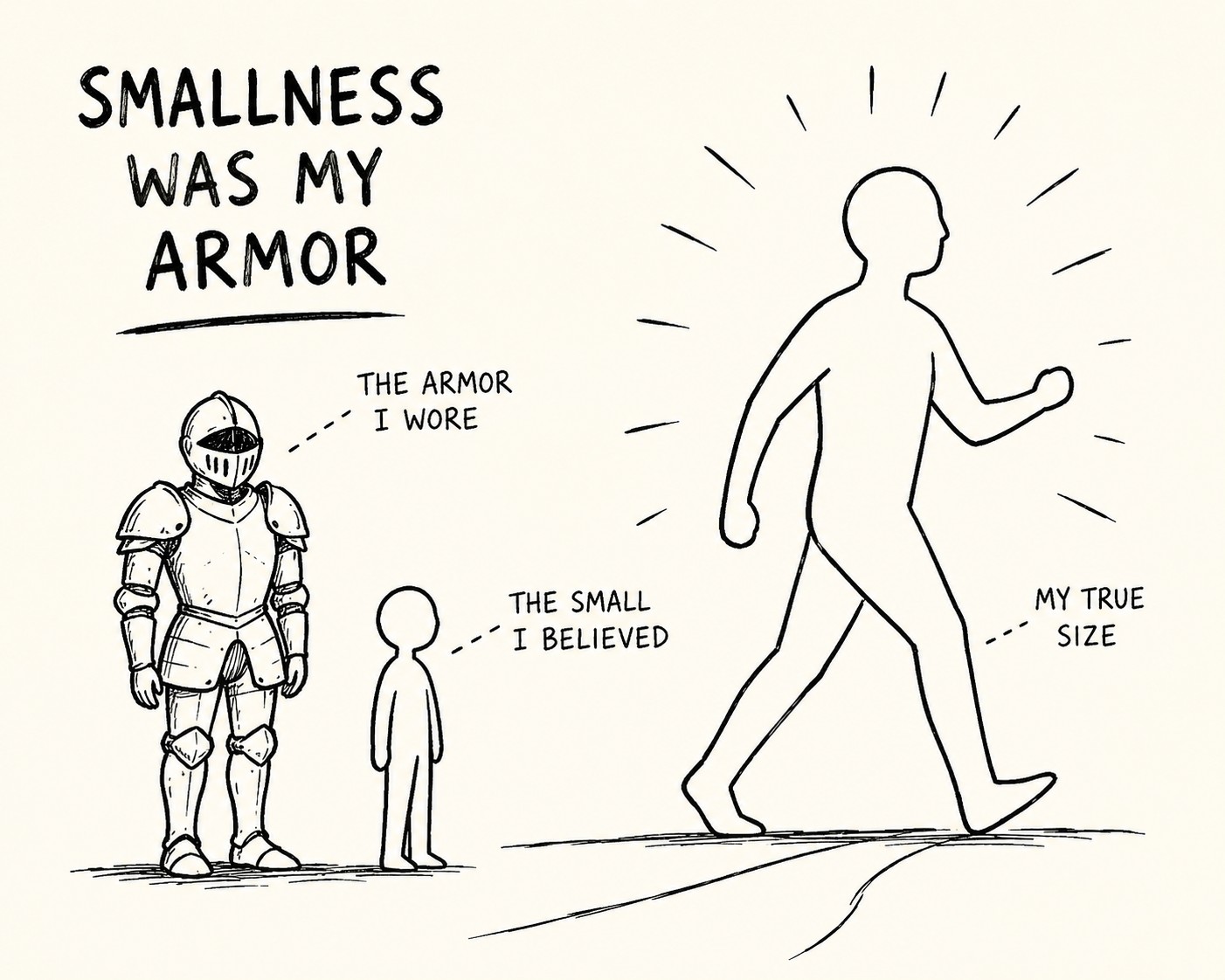
I learned to downplay what I wanted, what I was capable of, what I was building. Smallness was my armour. It kept me safe, and it kept me stuck.
Here is the thing I want to tell you plainly. Making yourself smaller does not make you safer. It leaves you frustrated. And worse, it slowly convinces your own mind that your dreams are a fantasy. There are two ways almost all of us do this. With our words. And with our actions. Let me show you both, and then let me show you the way out. Because I found it, and I know it works.
The Language That Keep You Small
The first way you shrink is with your words. And you do it without noticing.
Say you lead a team of any kind. Someone needs to redo something. And you soften it. You apologise for your own standards. “I’m sorry, folks, but I’m going to have to ask you to redo this.” That one sentence plays your standards down in front of the exact people who look to you to set them.
I’ve done this. I know the pull. You think you’re being polite. You’re not. You’re training your team to expect less from you.
There is a cleaner way to say the same thing. “We really want to uphold our high standards. Let’s adjust this part.” One version shrinks you. The other doesn’t. Neither one is rude. The language of minimisation does not serve anyone – the speaker or the listener.
And at home, socially, it gets worse. Around your achievements most of all. You do something real, someone notices it, and you rush to diminish it. “It’s no big deal.” “It’s all my team’s work” “It’s not really that special.” “I got lucky.”
Stop. Either be honest about what you did, or be quiet. But never play down your dreams, what you do, what you want, or what you see as possible. Not out loud, and not to yourself.
The Words You Say To Yourself
Here is the second place it happens. The one nobody else hears.
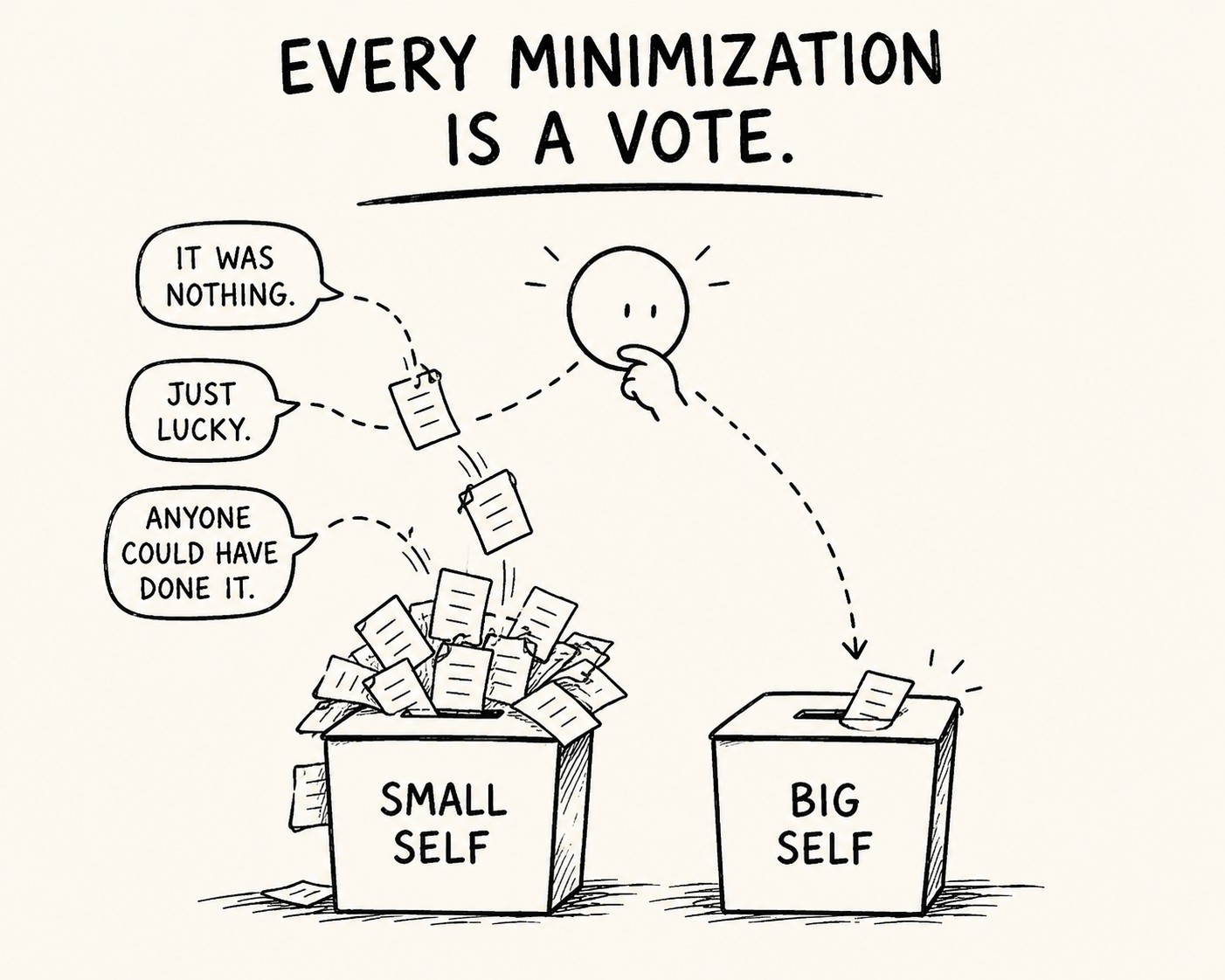
The voice that says “it’s no big deal” to yourself. “Anyone could have done that.” “A lot of it was luck.” “Who am I to want that?”
That last one will kill your dreams before you even start. Who am I to want that?
I built a whole career on that question. I earned the approvals. I hit the deadlines. I did what was expected. And underneath all of it, a quiet voice kept telling me I was lucky to be there, that people would figure me out, that I should be grateful for what I had (a good career) and not reach for more.
Here is what I’ve learned about that voice. It is not telling you the truth. It is protecting you. Minimisation is protection. It protects you from being vulnerable, from people making fun of you. It protects you from disappointment, in case you try and miss. It protects you from rejection, from the pushback that always comes when you stand for something big.
All of that protection comes at one price. It convinces your own mind that you are small.
Even The Successful Do This
Now, you might be sitting there thinking this isn’t you. I have a good job. I’ve built a real business. I am not playing small.
Let me tell you what I have seen more times than I can count. I work with highly successful CEOs or athletes every week. And I have yet to meet one, not one, who doesn’t know deep in their gut that they are more powerful than the level they are playing.
I’ve heard the same quiet sentence underneath the success of every extreme performer – be it from sport or business. I could be doing more. I’m not.
Making Yourself Small Is Protection
So why does the voice survive every piece of evidence that you are bigger than it says? Because it is not trying to be accurate. It is trying to keep you safe – the main job of the human brain.
It does not matter how old you are or how much you have built. That protective habit was made early, and it does not go away on its own. Mine was shaped in a kid who always felt out of place, who watched his parents sacrifice everything so he could have a chance, and who learned that being too visible was dangerous.
The problem is that protection stops being useful the moment you’re an adult with one life to live. Get this – you will get hit whether you play small or not. Disappointment, rejection, criticism. They come for everyone. So if you are going to take hits anyway, why on earth would you make yourself small to dodge hits that are coming for you regardless? Take the hits going for what you actually want.
Why Smallness Reinforces Itself
It’s not just a habit. Your mind is built to find evidence for the story you keep telling yourself.
There is a name for this. In 1957, a psychologist named Leon Festinger studied what happens when you hold two beliefs that don’t match, like I am capable of extraordinary things and I keep telling everyone it’s no big deal. He called it cognitive dissonance. And he found that you don’t just sit with that tension forever. Your mind will resolve it. And it resolves it by pulling you down to match your actions. Say you are small long enough, and your mind decides you must be small. You settle. Then you build excuses for the settling.
There is a quieter layer under it too. A researcher named William Swann spent decades showing that we all pull the world, and our own identity, toward the version of ourselves we believe in, even when that version is smaller than reality. Believe you’re the kind of person who plays small, and you will act and feel small, and the belief gets stronger. Every time you minimise, you cast a vote for the small version of you. And that version wins.
So I Started Believing Myself
I know the way out because I took it. And it started with the scariest sentence I have ever believed: that my mind and my gut were telling me the truth about what I could do.
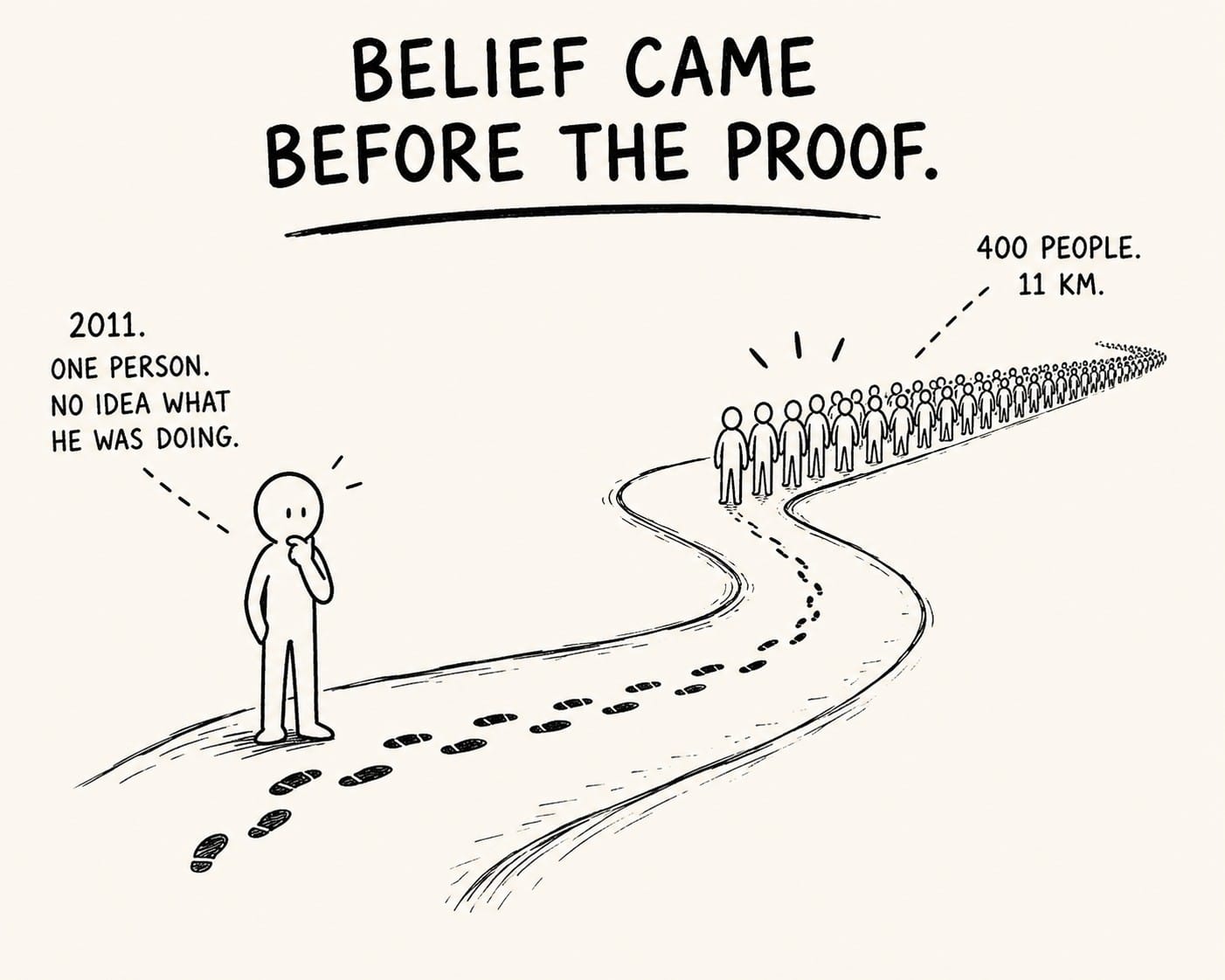
In 2011, this introverted engineer who had never organised anything in his life decided to organise an anti-corruption march. There was no sensible reason. I had never done anything like it. I told my mother, half hoping she would hand me a way out. She said, “Yes, it is crazy. But I know you. You will find a way. Put one foot after the other.”
She believed me when I did not believe myself. And I found out that believing was everything. Not the readiness. Believing came first, and the path showed up after. Four hundred people walked eleven kilometres with me.
A few years later, I walked away from a sixteen-year career that looked like winning, because I had finally understood something that changed everything. If your mind is telling you that you can be more, that you are bigger than this, stop kicking that off to the side. Believe it. That is step one. Just believe yourself. The whole world will line up to tell you what you can’t do. Ignore it.
What Bigness Actually Requires
Believing yourself is step one. If you are going actually to live your size, you have to:
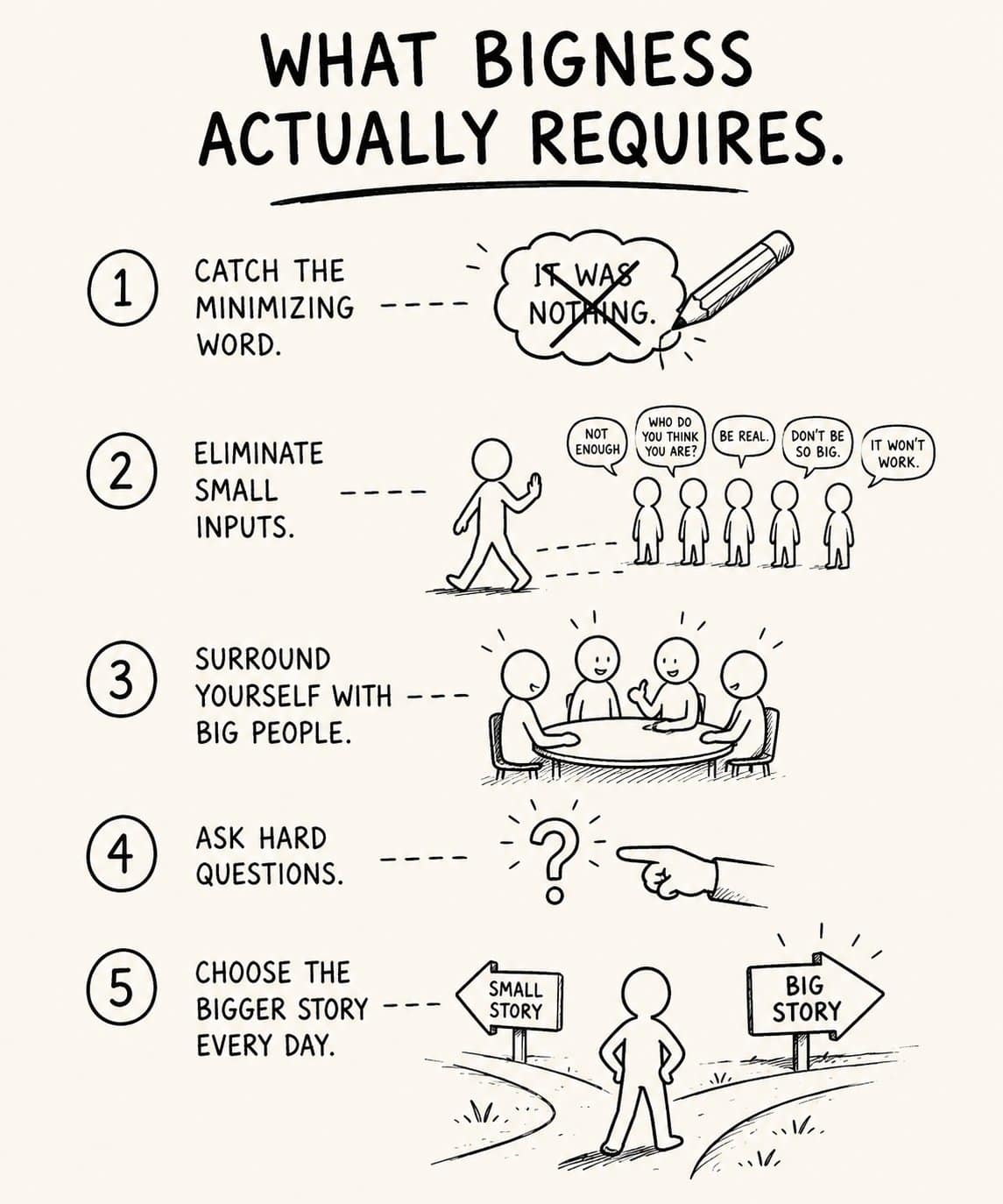
Kill the small inputs. Look at what you let into your mind. The social media feeds that tell you to be happy with what you have, that wanting more is greedy. Mute them. All of them. They are not neutral. They are votes for the small version of you. Replace them with optimistic people, people doing great things, people like you who are chasing and building. You cannot fill a room with small thinking and expect to be big inside it.
Get your team together. Start with your spouse. Then the people you call your friends, neighbours, or social circle. You don’t want someone at home pulling you down. Talk to them. Get them on your team.
Take Action consistent with your belief. If you truly believed what your gut tells you you’re capable of, what would be your next move? What would you do if you could not fail? if money didn’t matter? if you didn’t give a damn about what others think of you? Then go do it.
The Practice
Stop letting smallness in. Here is exactly what to do.
Catch your minimisations. For the next seven days, notice every time you shrink yourself with your words, out loud or in your head. “It’s no big deal.” “Anyone could have done it.” Write it down when you catch it. Noticing is where it starts.
Kill one small input. Find one feed, one page, one person you follow who keeps reinforcing smallness, and mute them today.
Say the hard truth once. Pick one real achievement. The next time someone brings it up, don’t bury it. Don’t brag either. Just be honest. “Yes, I did that, and I’m proud of it.” One honest sentence.
Have the buy-in conversation. If you have a partner, sit down this week and talk about what you’re capable of and what it might take. Get their honest thoughts. Get them on the team.
Name your next move. Write down the answer to “if I truly believed my gut, what would I do next?” One move. Real. Specific. Not someday. This week.
Choose The Right Story
The powerful you cannot live in the same body as the small you – in how you speak and behave. They cannot coexist. One of them will win. In fact, one of them must die.
The only question is which one. Make sure it is the right thing you are killing.
I spent sixteen years killing my bigness to keep the smallness comfortable. It almost cost me everything that matters. Then one day I killed the smallness instead, and I found out the bigness was never a fantasy. It was the truest thing about me. It is the truest thing about you too.
Don’t fall prey to this anymore.
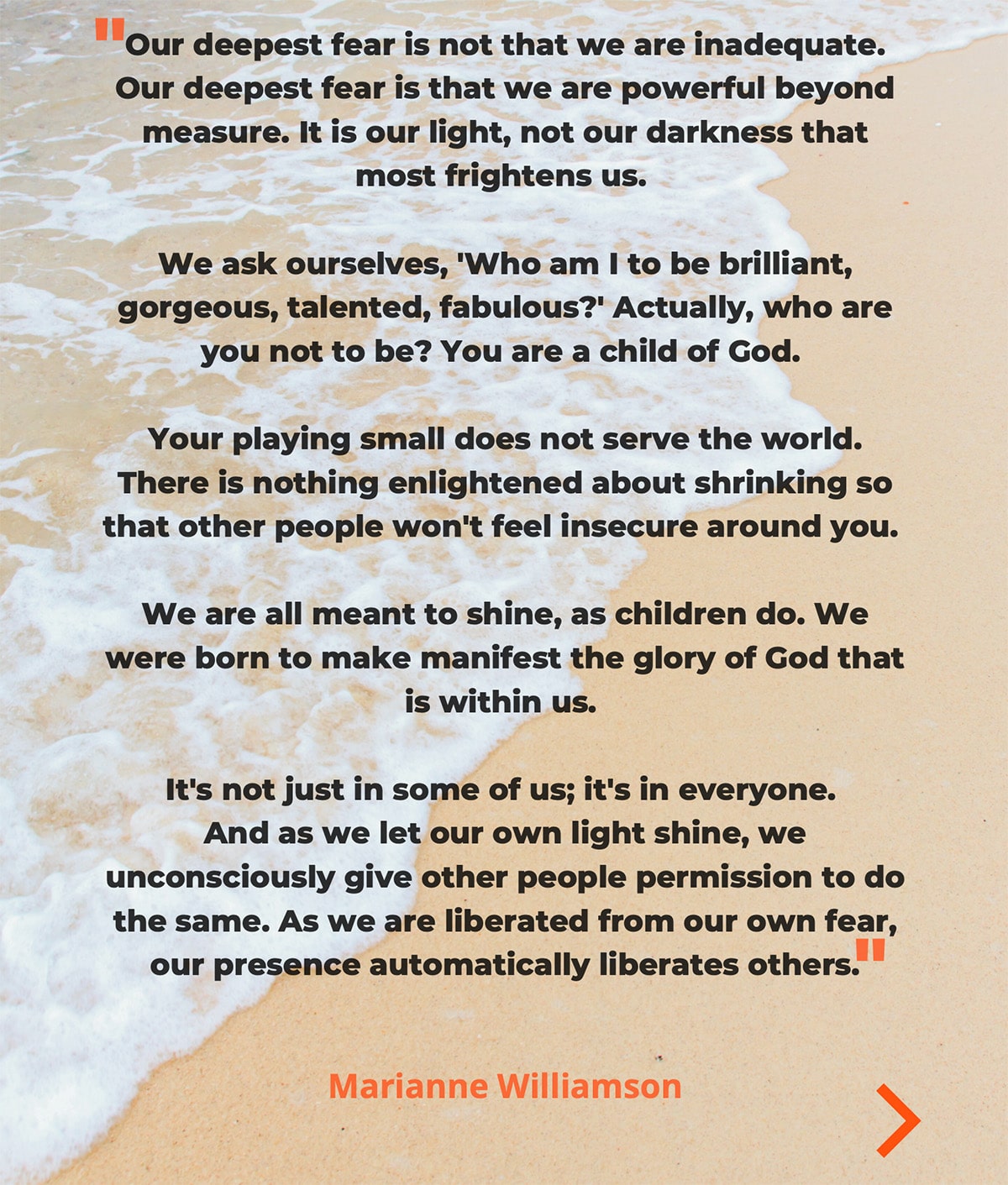
You are a lot more powerful than you think you are. No more small thinking. You know what you can do. Permit yourself to be bigger.
Sources
- Festinger, L. (1957). A Theory of Cognitive Dissonance. Stanford University Press. The foundational study on how the mind resolves mismatched beliefs by pulling itself into alignment. https://en.wikipedia.org/wiki/Cognitive_dissonance
- Swann, W. B. (1983). Self-verification theory: how people seek and keep the identity they believe in, even a smaller one. https://en.wikipedia.org/wiki/Self-verification_theory
- Clance, P. R., & Imes, S. A. (1978). “The Impostor Phenomenon in High Achieving Women.” The pattern of successful people quietly believing they don’t deserve their success. https://en.wikipedia.org/wiki/Impostor_syndrome
Leave a Reply